 Скачать презентацию CNS STIMULANTS TOBACCO NICOTINE CAFFEINE AND OTHER
962fead3aba843e44e3a8651819f1fd1.ppt
- Количество слайдов: 36



CNS STIMULANTS TOBACCO & NICOTINE CAFFEINE AND OTHER METHYLXANTHINES
Introduction to CNS Stimulants Characterized based on CNS Effects: Over-the-Counter Stimulants Increased energy, mental alertness Positive hedonic effects, euphoria Reduced fatigue, decreased sleepiness Casually referred to as “uppers” Toxicities associated with excessive CNS stimulation: e. g. , seizures, cardiac and respiratory failure Nicotine, Caffeine, Theophylline, Theobromine, Ephedrine Legally Restricted Stimulants Cocaine, Amphetamine, Methamphetamine
History of Tobacco Use Early Medicinal Uses Europe New World The spread of tobacco use Tobacco production Nicotiana tobacum Spanish monopoly on sales to Europe Tobacco colony in Virginia Popularity of snuff in England
Forms of Tobacco/Nicotine. Use Snuff Chewing tobacco Cigars Cigarettes Nicotine Replacement Treatments Chewing gum, lozenge, inhaler, patch
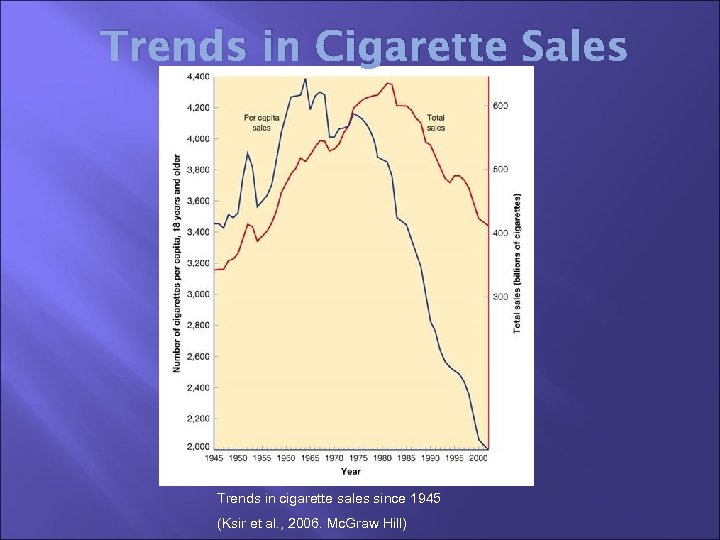
Trends in Cigarette Sales Trends in cigarette sales since 1945 (Ksir et al. , 2006. Mc. Graw Hill)
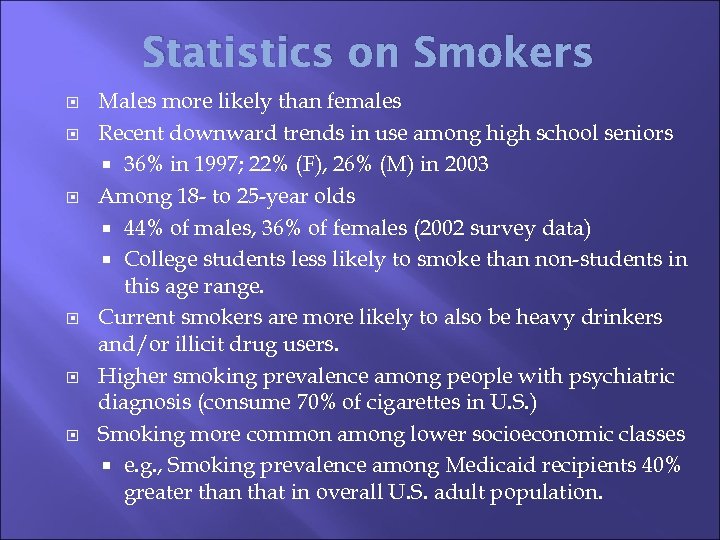
Statistics on Smokers Males more likely than females Recent downward trends in use among high school seniors 36% in 1997; 22% (F), 26% (M) in 2003 Among 18 - to 25 -year olds 44% of males, 36% of females (2002 survey data) College students less likely to smoke than non-students in this age range. Current smokers are more likely to also be heavy drinkers and/or illicit drug users. Higher smoking prevalence among people with psychiatric diagnosis (consume 70% of cigarettes in U. S. ) Smoking more common among lower socioeconomic classes e. g. , Smoking prevalence among Medicaid recipients 40% greater than that in overall U. S. adult population.
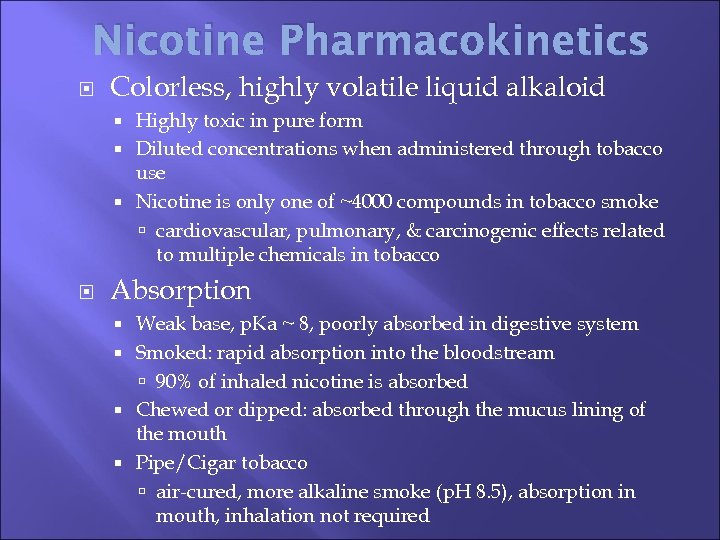
Nicotine Pharmacokinetics Colorless, highly volatile liquid alkaloid Highly toxic in pure form Diluted concentrations when administered through tobacco use Nicotine is only one of ~4000 compounds in tobacco smoke cardiovascular, pulmonary, & carcinogenic effects related to multiple chemicals in tobacco Absorption Weak base, p. Ka ~ 8, poorly absorbed in digestive system Smoked: rapid absorption into the bloodstream 90% of inhaled nicotine is absorbed Chewed or dipped: absorbed through the mucus lining of the mouth Pipe/Cigar tobacco air-cured, more alkaline smoke (p. H 8. 5), absorption in mouth, inhalation not required
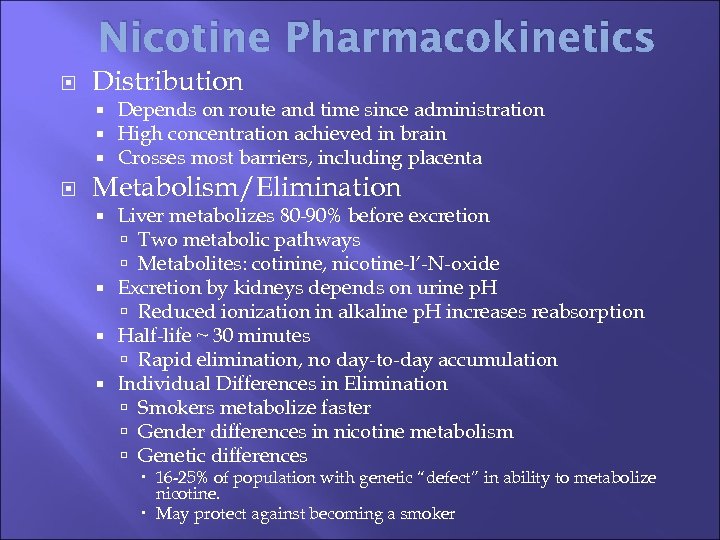
Nicotine Pharmacokinetics Distribution Depends on route and time since administration High concentration achieved in brain Crosses most barriers, including placenta Metabolism/Elimination Liver metabolizes 80 -90% before excretion Two metabolic pathways Metabolites: cotinine, nicotine-l’-N-oxide Excretion by kidneys depends on urine p. H Reduced ionization in alkaline p. H increases reabsorption Half-life ~ 30 minutes Rapid elimination, no day-to-day accumulation Individual Differences in Elimination Smokers metabolize faster Gender differences in nicotine metabolism Genetic differences 16 -25% of population with genetic “defect” in ability to metabolize nicotine. May protect against becoming a smoker
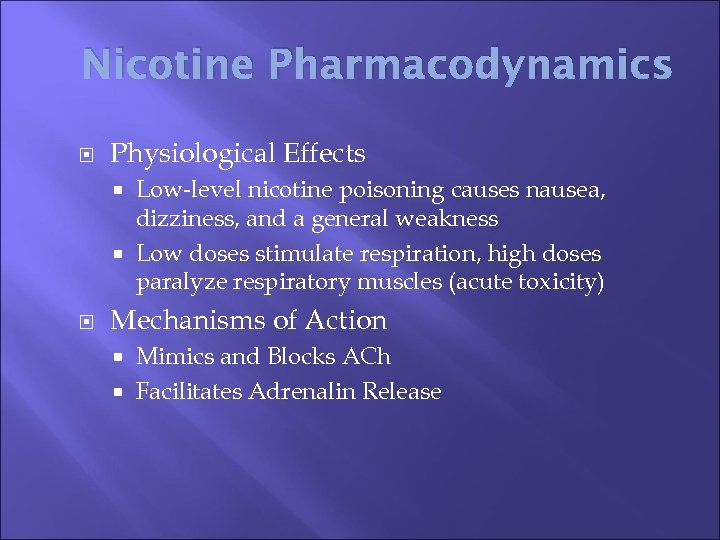
Nicotine Pharmacodynamics Physiological Effects Low-level nicotine poisoning causes nausea, dizziness, and a general weakness Low doses stimulate respiration, high doses paralyze respiratory muscles (acute toxicity) Mechanisms of Action Mimics and Blocks ACh Facilitates Adrenalin Release
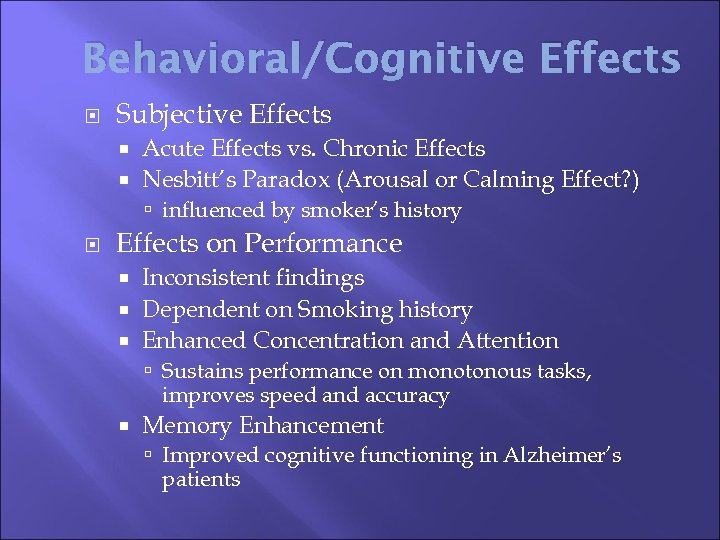
Behavioral/Cognitive Effects Subjective Effects Acute Effects vs. Chronic Effects Nesbitt’s Paradox (Arousal or Calming Effect? ) influenced by smoker’s history Effects on Performance Inconsistent findings Dependent on Smoking history Enhanced Concentration and Attention Sustains performance on monotonous tasks, improves speed and accuracy Memory Enhancement Improved cognitive functioning in Alzheimer’s patients
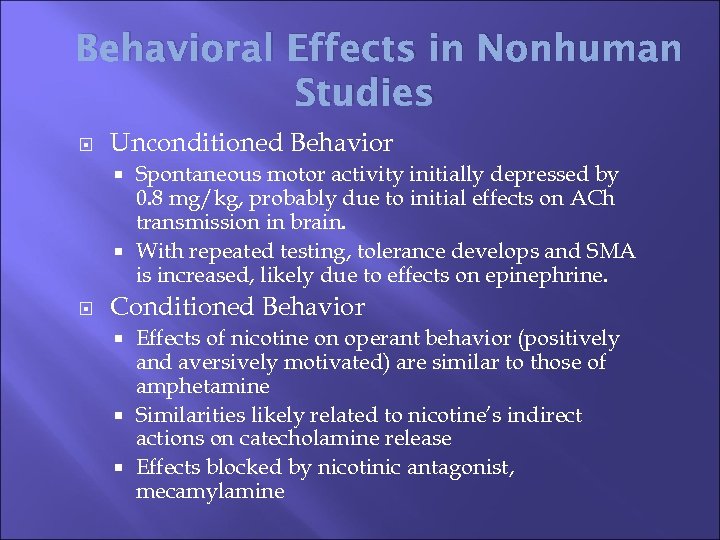
Behavioral Effects in Nonhuman Studies Unconditioned Behavior Spontaneous motor activity initially depressed by 0. 8 mg/kg, probably due to initial effects on ACh transmission in brain. With repeated testing, tolerance develops and SMA is increased, likely due to effects on epinephrine. Conditioned Behavior Effects of nicotine on operant behavior (positively and aversively motivated) are similar to those of amphetamine Similarities likely related to nicotine’s indirect actions on catecholamine release Effects blocked by nicotinic antagonist, mecamylamine
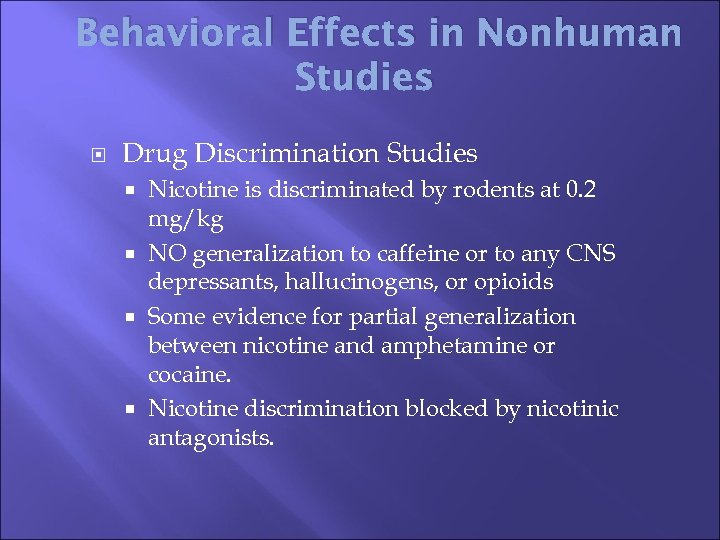
Behavioral Effects in Nonhuman Studies Drug Discrimination Studies Nicotine is discriminated by rodents at 0. 2 mg/kg NO generalization to caffeine or to any CNS depressants, hallucinogens, or opioids Some evidence for partial generalization between nicotine and amphetamine or cocaine. Nicotine discrimination blocked by nicotinic antagonists.
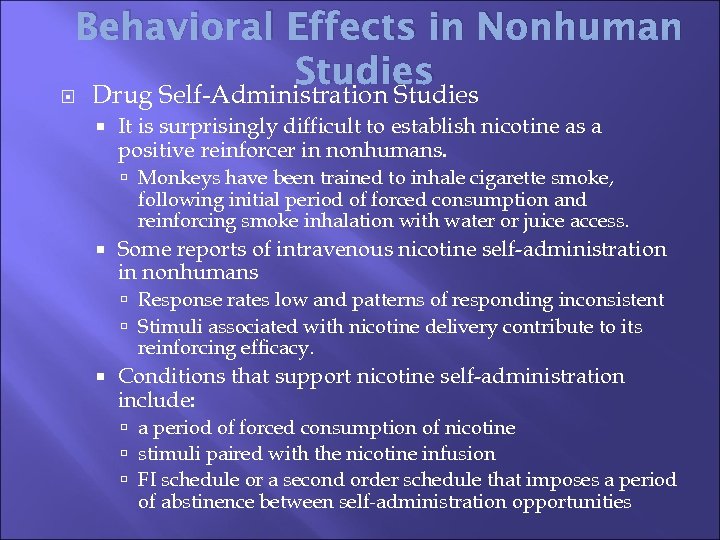
Behavioral Effects in Nonhuman Studies Drug Self-Administration Studies It is surprisingly difficult to establish nicotine as a positive reinforcer in nonhumans. Monkeys have been trained to inhale cigarette smoke, following initial period of forced consumption and reinforcing smoke inhalation with water or juice access. Some reports of intravenous nicotine self-administration in nonhumans Response rates low and patterns of responding inconsistent Stimuli associated with nicotine delivery contribute to its reinforcing efficacy. Conditions that support nicotine self-administration include: a period of forced consumption of nicotine stimuli paired with the nicotine infusion FI schedule or a second order schedule that imposes a period of abstinence between self-administration opportunities
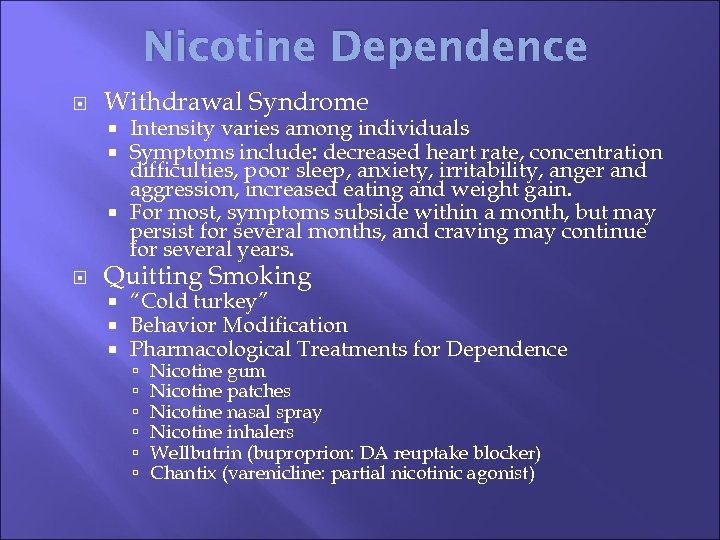
Nicotine Dependence Withdrawal Syndrome Intensity varies among individuals Symptoms include: decreased heart rate, concentration difficulties, poor sleep, anxiety, irritability, anger and aggression, increased eating and weight gain. For most, symptoms subside within a month, but may persist for several months, and craving may continue for several years. Quitting Smoking “Cold turkey” Behavior Modification Pharmacological Treatments for Dependence Nicotine gum Nicotine patches Nicotine nasal spray Nicotine inhalers Wellbutrin (buproprion: DA reuptake blocker) Chantix (varenicline: partial nicotinic agonist)
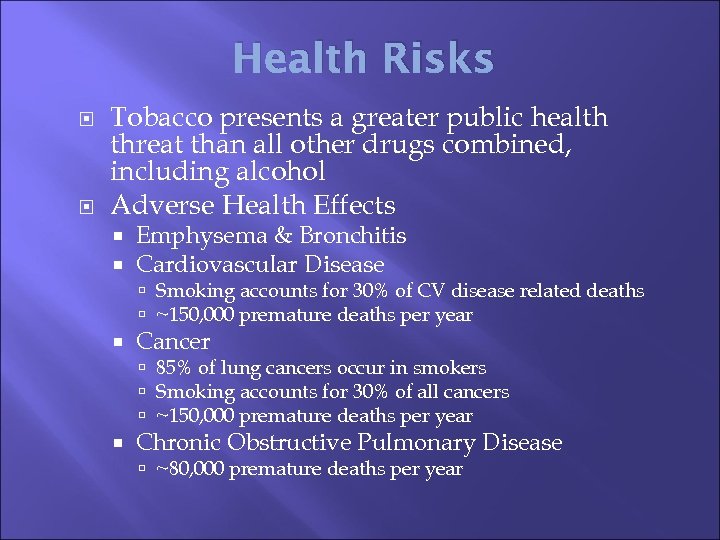
Health Risks Tobacco presents a greater public health threat than all other drugs combined, including alcohol Adverse Health Effects Emphysema & Bronchitis Cardiovascular Disease Smoking accounts for 30% of CV disease related deaths ~150, 000 premature deaths per year Cancer 85% of lung cancers occur in smokers Smoking accounts for 30% of all cancers ~150, 000 premature deaths per year Chronic Obstructive Pulmonary Disease ~80, 000 premature deaths per year
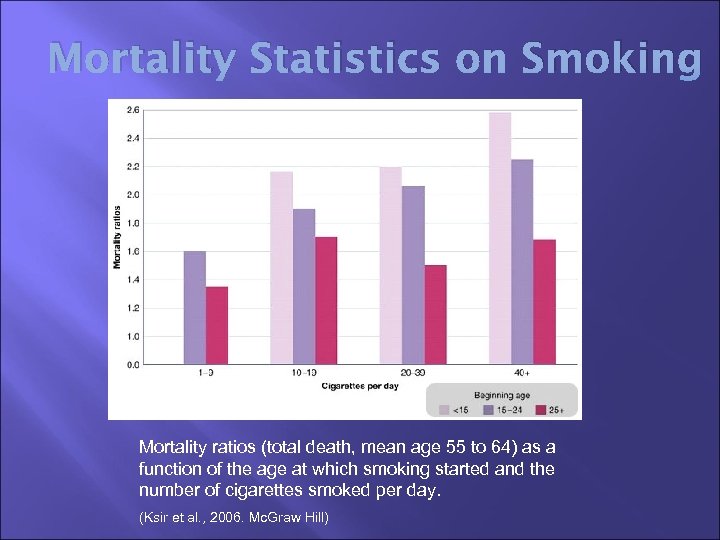
Mortality Statistics on Smoking Mortality ratios (total death, mean age 55 to 64) as a function of the age at which smoking started and the number of cigarettes smoked per day. (Ksir et al. , 2006. Mc. Graw Hill)
Health Risks Smoking and Pregnancy higher miscarriage rates lower birth weight Some evidence for long-lasting intellectual and physical effects in children of mother’s who smoked during pregnancy e. g. , lower IQ, increased prevalence of ADHD Sudden Infant Death Syndrome (SIDS)
Health Risks Passive Smoke Health Risks Exhaled Mainstream Smoke - smoke exhaled by the smoker Side stream smoke - smoke released from burning end of a cigarette Environmental tobacco smoke – mixture of side stream smoke and exhaled mainstream smoke U. S. Dept of Health and Human Services Data In 2005, exposure to second hand smoke responsible for the following deaths: 3000 adults due to lung cancer 46, 000 adults due to coronary artery disease 430 newborns due to SIDS
Health Risks More than 50 cancer-causing chemicals are found in secondhand smoke including: Polynuclear aromatic hydrocarbons (PAHs) (such as Benzo[a]pyrene) N-Nitrosamines (such as tobacco-specific nitrosamines) Aromatic amines (such as 4 -aminobiphenyl) Aldehydes (such as formaldehyde) Miscellaneous organic chemicals (such as benzene and vinyl chloride) and Inorganic compounds (such as those containing metals like arsenic, beryllium, cadmium, lead, nickel and radioactive polonium-210). Source: Office of the Surgeon General http: //www. surgeongeneral. gov/library/secondhandsmoke/factsheets/factsheet 9. html
Social & Economic Dilemma of Smoking Economic Impact of Tobacco Sales Total annual sales almost $50 billion Advertising funding for newspapers and magazines The federal government collects $6 billion and states collect $7. 5 billion annually in taxes Health Care and Productivity Losses Related to Tobacco $75 billion medical costs $82 billion lost productivity
METHYLXANTHINES Caffeine, Theophylline, Theobromine
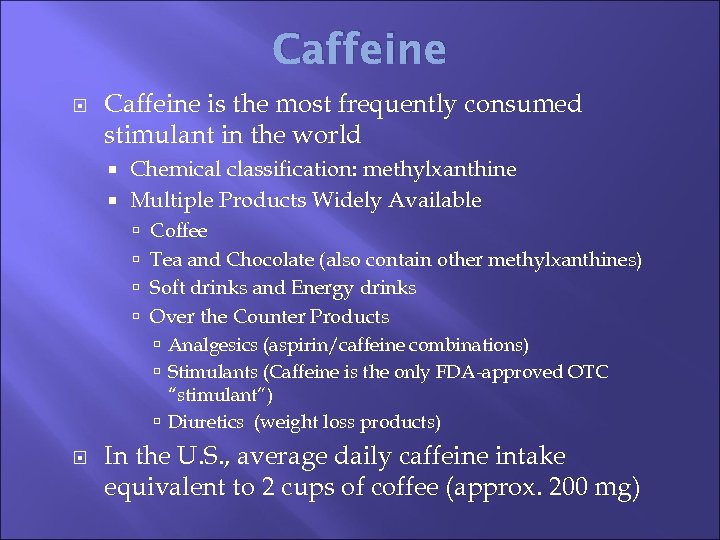
Caffeine is the most frequently consumed stimulant in the world Chemical classification: methylxanthine Multiple Products Widely Available Coffee Tea and Chocolate (also contain other methylxanthines) Soft drinks and Energy drinks Over the Counter Products Analgesics (aspirin/caffeine combinations) Stimulants (Caffeine is the only FDA-approved OTC “stimulant”) Diuretics (weight loss products) In the U. S. , average daily caffeine intake equivalent to 2 cups of coffee (approx. 200 mg)
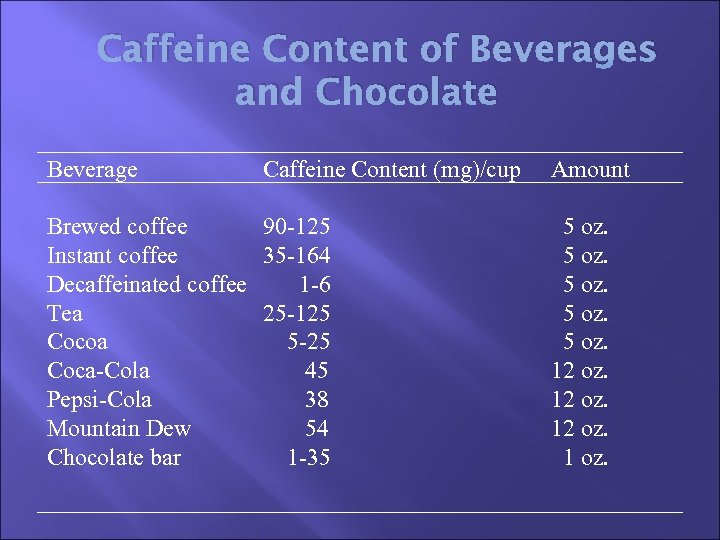
Caffeine Content of Beverages and Chocolate Beverage Caffeine Content (mg)/cup Brewed coffee 90 -125 Instant coffee 35 -164 Decaffeinated coffee 1 -6 Tea 25 -125 Cocoa 5 -25 Coca-Cola 45 Pepsi-Cola 38 Mountain Dew 54 Chocolate bar 1 -35 Amount 5 oz. 12 oz. 1 oz.
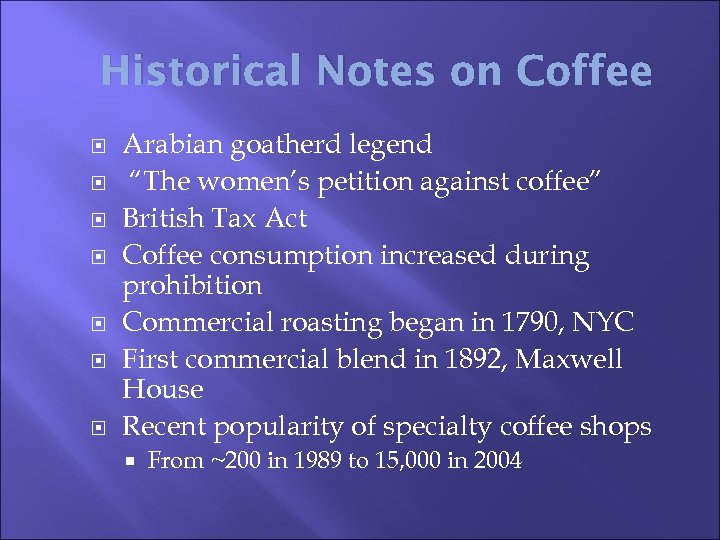
Historical Notes on Coffee Arabian goatherd legend “The women’s petition against coffee” British Tax Act Coffee consumption increased during prohibition Commercial roasting began in 1790, NYC First commercial blend in 1892, Maxwell House Recent popularity of specialty coffee shops From ~200 in 1989 to 15, 000 in 2004

Tea First reliable report was in a Chinese document, dated 350 AD First European record of Tea, 1559 English East India Company Popular in new colonies Boston Tea Party
Methylxanthines in Tea Caffeine main methylxanthine in tea Amount varies, ~ 40 -60 mg per 5 oz cup Theophylline in small amounts Theophylline is a potent respiratory stimulant, widely used to treat asthma
Chocolate Cocoa: Aztec and Mayan origins 17 th century spread to wealthy in Europe Drinks and Coffee Houses First chocolate bar, 1847 Milk chocolate invented by Swiss, 1876 (sold under Nestle label) Theobromine main methylxanthine in chocolate (200 mg; 4 mg caffeine)
Caffeine Pharmacokinetics Methylxanthines are alkaloids Slightly soluble in water Absorption of Caffeine Rapid, peak blood levels within 30 min. Maximum CNS effects ~ 2 hours Metabolism and Elimination Half-life ~3 hours < 10% excreted unchanged
Caffeine Pharmacodynamics Mechanism of Action Adenosine Antagonism Adenosine is a neuromodulator which inhibits release of a variety of neurotransmitters. CNS effects of adenosine include behavioral sedation. Caffeine exerts its actions by inhibiting these effects of adenosine.
CNS Effects of. Methylxanthines Mild CNS effects with low to moderate doses Enhance alertness, cause arousal, diminish fatigue Potential adverse CNS effects with high doses Insomnia, increase in tension, anxiety, and initiation of muscle twitches Over 500 milligrams - panic sensations, chills, nausea, clumsiness Extreme high doses (5 to 10 grams) - seizures, respiratory failure, and death
Physiological Effects Cardiovascular system Low doses - heart activity increases, decreases, or do nothing High doses - rate of contraction of the heart increases, minor vasodilation in most of the body, cerebral blood vessels are vasoconstricted Respiratory system Opens airways and facilitates breathing
Behavioral Effects in Nonhuman Studies Unconditioned Behavior Caffeine increases spontaneous motor activity in mice at 20 -40 mg/kg. 80 mg/kg decreases activity. LD 50 in rodents ~250 mg/kg (i. p. ) Automutilation has observed following chronic high dose administration. Conditioned Behavior Pavlov (1927) first to show caffeine can disrupt conditioned discriminations (i. e. , increased responding to CS-). Effects on operant behavior similar, but not identical to those of psychomotor stimulants, like the amphetamines. Caffeine increases avoidance responding (indicative of anxiogenic effects).
Behavioral Effects in Nonhuman Studies Drug Discrimination Studies Rats can be trained to discriminate 32 mg/kg caffeine. Generalization to other methylxanthines NO generalization to nicotine Some evidence for partial generalization between low dose caffeine and amphetamine or cocaine DA antagonists block discrimination of low doses caffeine, but not high doses.
Behavioral Effects in Nonhuman Studies Drug Self-Administration Studies By itself, caffeine is a relatively weak positive reinforcer. Caffeine maintains low and inconsistent patterns of responding, but generally higher responding compared to vehicle. Initial forced consumption is usually required to establish caffeine as a reinforcer in nonhumans. Caffeine has been shown to potentiate reinforcing effects of low cocaine doses. Caffeine has been shown to prime reinstatement of previously extinguished cocaine self-administration.
Health Risks Potential Health Risks of Caffeine Use Increased risk of pancreatic cancer ? Original research criticized for methodological flaws Currently no support for this putative link Other research shows a relationship with: cancers of the bladder, ovaries, colon, and kidneys women - fibrous cysts in breasts Reproductive Effects High daily doses (> 300 mg/day) may inhibit pregnancy, promote miscarriage, and slow fetal growth Heart Disease Some retrospective studies report the incidence of nonfatal heart attacks in men under 55 directly related to amount of coffee consumed A prospective study showed that men who consume 5 or more cups of coffee daily are 2. 5 x more likely to suffer from coronary artery disease.
Health Risks Caffeine Intoxication Caffeinism: restlessness, nervousness, excitement, insomnia, flushed face, diuresis, muscle twitching, rambling thoughts and speech, stomach complaints Caffeine Dependence Primary withdrawal symptom: headache ~18 hours after last use Other symptoms include increased fatigue, reduced energy evident within first two days, with decreased symptoms over 5 -6 days.
Скачать презентацию CNS STIMULANTS TOBACCO NICOTINE CAFFEINE AND OTHER
962fead3aba843e44e3a8651819f1fd1.ppt