


 Скачать презентацию CNC-RP A Rapid Prototyping Method Using Computer Numerical
5e7e361f76f12b2b72ffa49e581f2af4.ppt
- Количество слайдов: 71
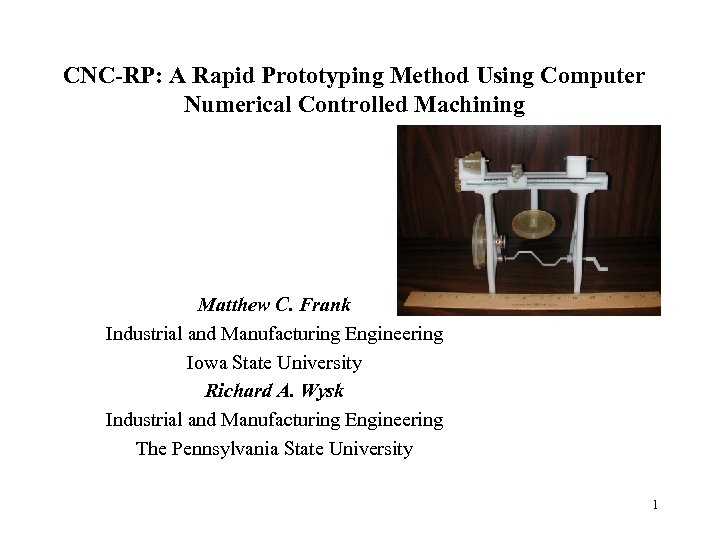 CNC-RP: A Rapid Prototyping Method Using Computer Numerical Controlled Machining Matthew C. Frank Industrial and Manufacturing Engineering Iowa State University Richard A. Wysk Industrial and Manufacturing Engineering The Pennsylvania State University 1
 Agenda • • • What is RP? Limitations of RP Economics of RP New directions in RP Observations and conclusions 2
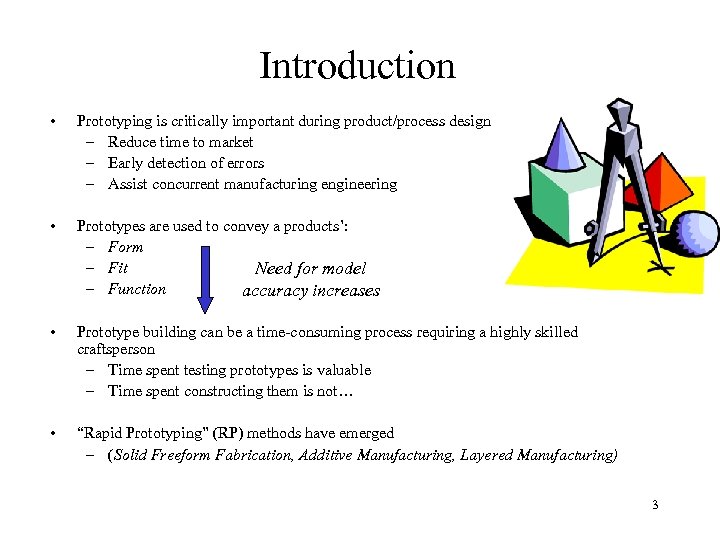 Introduction • Prototyping is critically important during product/process design – Reduce time to market – Early detection of errors – Assist concurrent manufacturing engineering • Prototypes are used to convey a products’: – Form – Fit Need for model – Function accuracy increases • Prototype building can be a time-consuming process requiring a highly skilled craftsperson – Time spent testing prototypes is valuable – Time spent constructing them is not… • “Rapid Prototyping” (RP) methods have emerged – (Solid Freeform Fabrication, Additive Manufacturing, Layered Manufacturing) 3
 Stereolithography (SLA) Stereolithography is a common rapid manufacturing and rapid prototyping technology for producing parts with high accuracy and good surface finish. A device that performs stereolithography is called an SLA or Stereolithography Apparatus. Stereolithography is an additive fabrication process utilizing a vat of liquid UV-curable photopolymer "resin" and a UV laser to build parts a layer at a time. On each layer, the laser beam traces a part cross-section pattern on the surface of the liquid resin. 4
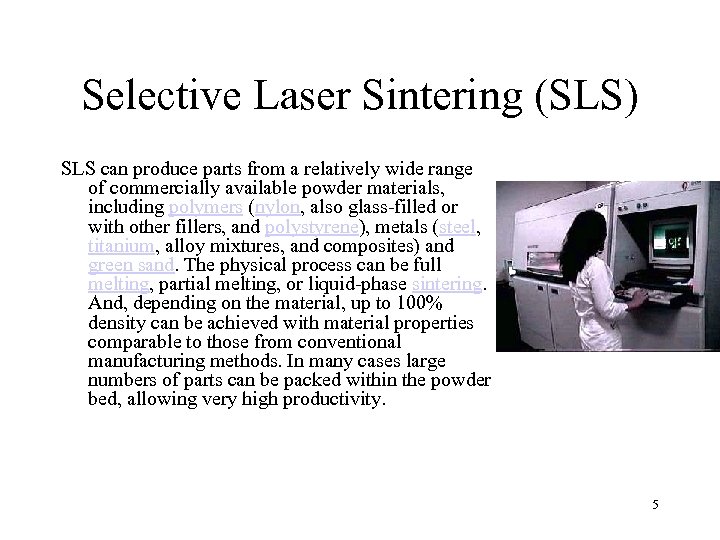 Selective Laser Sintering (SLS) SLS can produce parts from a relatively wide range of commercially available powder materials, including polymers (nylon, also glass-filled or with other fillers, and polystyrene), metals (steel, titanium, alloy mixtures, and composites) and green sand. The physical process can be full melting, partial melting, or liquid-phase sintering. And, depending on the material, up to 100% density can be achieved with material properties comparable to those from conventional manufacturing methods. In many cases large numbers of parts can be packed within the powder bed, allowing very high productivity. 5
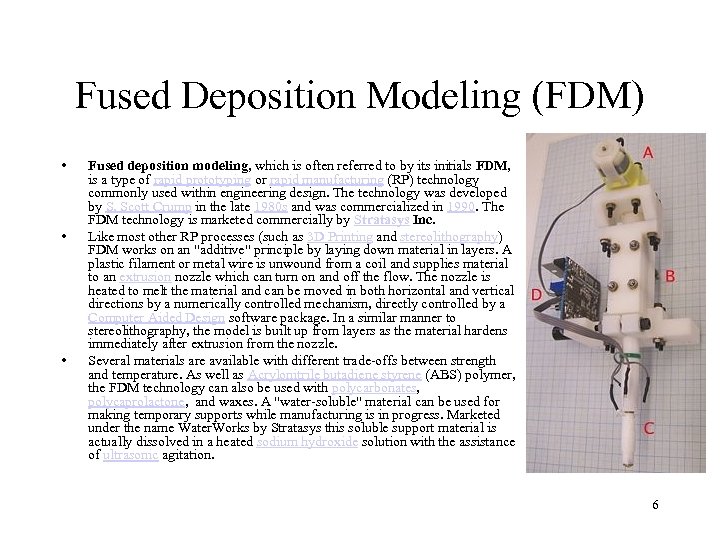 Fused Deposition Modeling (FDM) • • • Fused deposition modeling, which is often referred to by its initials FDM, is a type of rapid prototyping or rapid manufacturing (RP) technology commonly used within engineering design. The technology was developed by S. Scott Crump in the late 1980 s and was commercialized in 1990. The FDM technology is marketed commercially by Stratasys Inc. Like most other RP processes (such as 3 D Printing and stereolithography) FDM works on an "additive" principle by laying down material in layers. A plastic filament or metal wire is unwound from a coil and supplies material to an extrusion nozzle which can turn on and off the flow. The nozzle is heated to melt the material and can be moved in both horizontal and vertical directions by a numerically controlled mechanism, directly controlled by a Computer Aided Design software package. In a similar manner to stereolithography, the model is built up from layers as the material hardens immediately after extrusion from the nozzle. Several materials are available with different trade-offs between strength and temperature. As well as Acrylonitrile butadiene styrene (ABS) polymer, the FDM technology can also be used with polycarbonates, polycaprolactone, and waxes. A "water-soluble" material can be used for making temporary supports while manufacturing is in progress. Marketed under the name Water. Works by Stratasys this soluble support material is actually dissolved in a heated sodium hydroxide solution with the assistance of ultrasonic agitation. 6
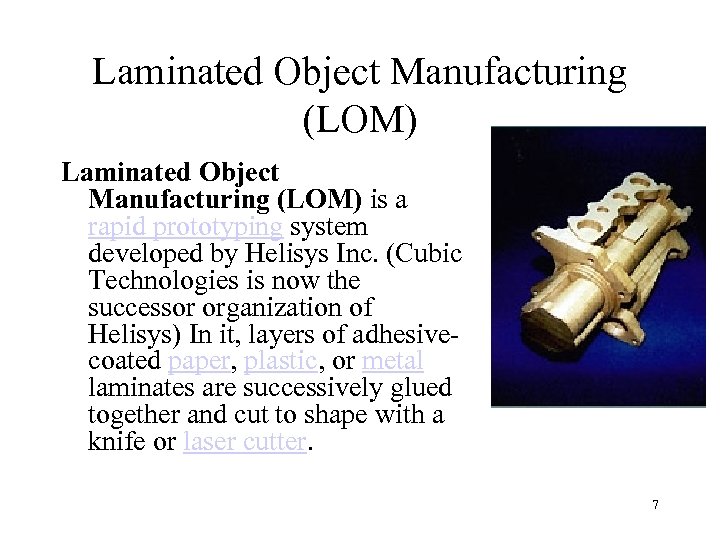 Laminated Object Manufacturing (LOM) is a rapid prototyping system developed by Helisys Inc. (Cubic Technologies is now the successor organization of Helisys) In it, layers of adhesivecoated paper, plastic, or metal laminates are successively glued together and cut to shape with a knife or laser cutter. 7
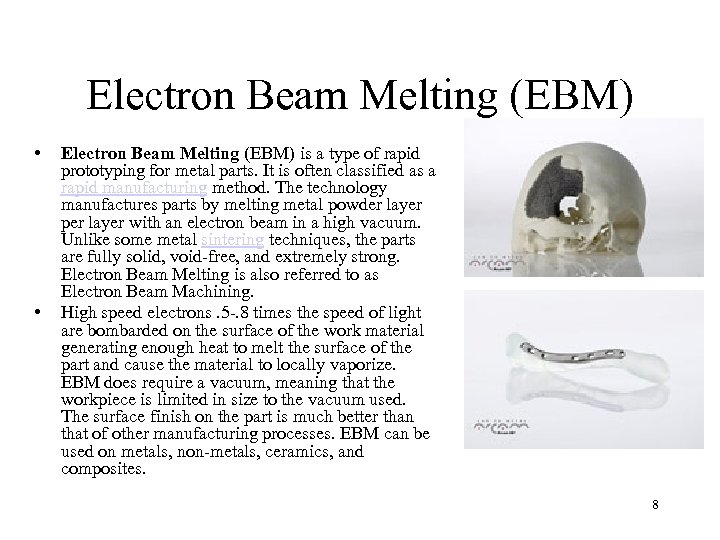 Electron Beam Melting (EBM) • • Electron Beam Melting (EBM) is a type of rapid prototyping for metal parts. It is often classified as a rapid manufacturing method. The technology manufactures parts by melting metal powder layer per layer with an electron beam in a high vacuum. Unlike some metal sintering techniques, the parts are fully solid, void-free, and extremely strong. Electron Beam Melting is also referred to as Electron Beam Machining. High speed electrons. 5 -. 8 times the speed of light are bombarded on the surface of the work material generating enough heat to melt the surface of the part and cause the material to locally vaporize. EBM does require a vacuum, meaning that the workpiece is limited in size to the vacuum used. The surface finish on the part is much better than that of other manufacturing processes. EBM can be used on metals, non-metals, ceramics, and composites. 8
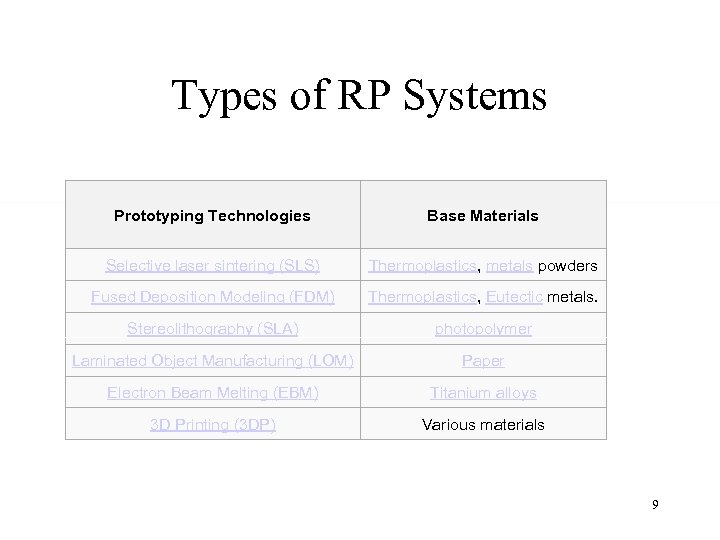 Types of RP Systems Prototyping Technologies Base Materials Selective laser sintering (SLS) Thermoplastics, metals powders Fused Deposition Modeling (FDM) Thermoplastics, Eutectic metals. Stereolithography (SLA) photopolymer Laminated Object Manufacturing (LOM) Paper Electron Beam Melting (EBM) Titanium alloys 3 D Printing (3 DP) Various materials 9
 Time and Cost to machine 10
 Material cost • In most cases this is independent of the number of parts 11
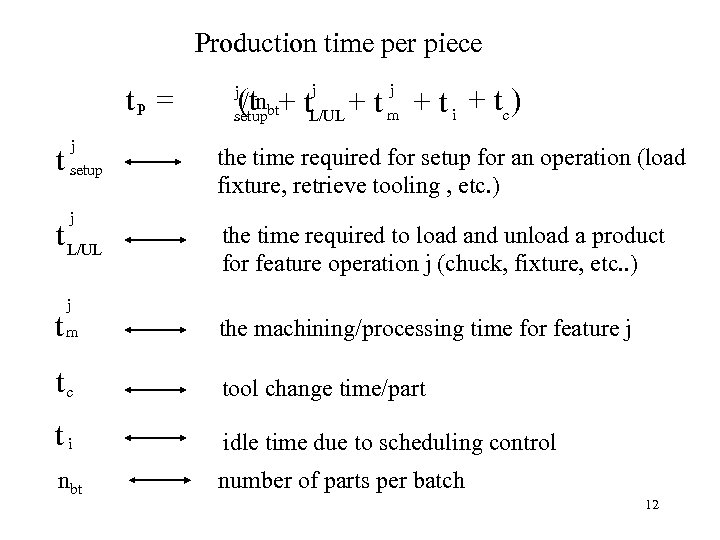 Production time per piece t. P = t j setup j t L/UL j j (t + t. L/UL + t m + t i + tc ) j /n setupbt the time required for setup for an operation (load fixture, retrieve tooling , etc. ) the time required to load and unload a product for feature operation j (chuck, fixture, etc. . ) j tm the machining/processing time for feature j tc tool change time/part ti idle time due to scheduling control nbt number of parts per batch 12
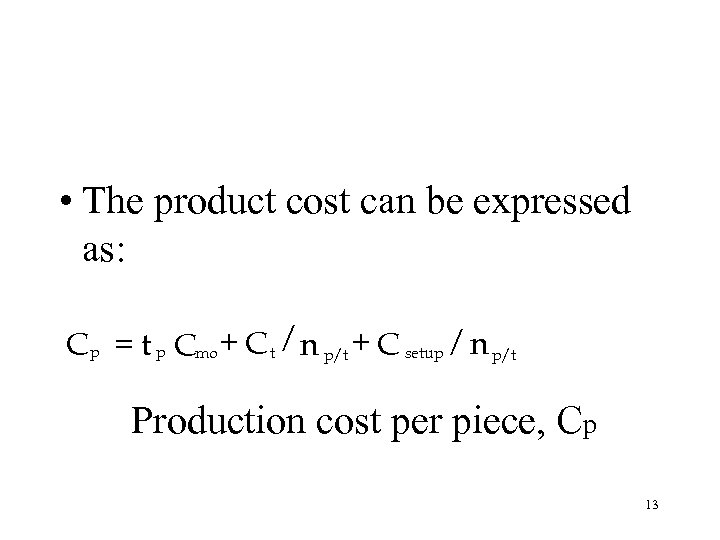 • The product cost can be expressed as: C p = t p Cmo + C t / n p/t + C setup / n p/t Production cost per piece, Cp 13
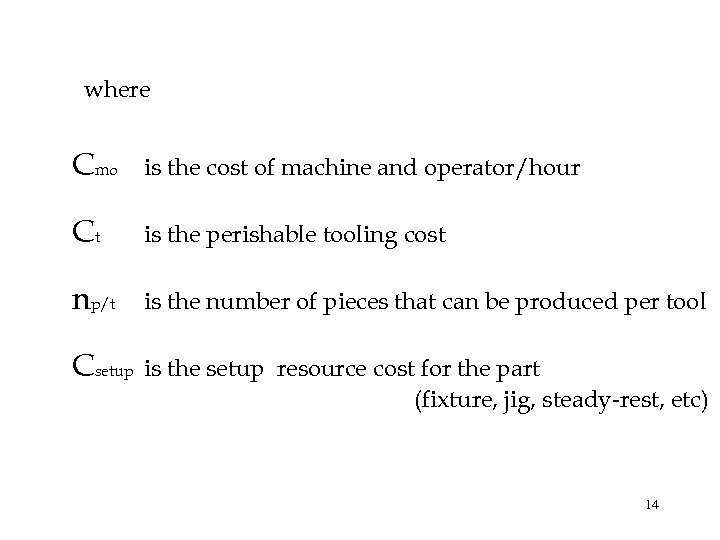 where Cmo is the cost of machine and operator/hour Ct is the perishable tooling cost np/t is the number of pieces that can be produced per tool Csetup is the setup resource cost for the part (fixture, jig, steady-rest, etc) 14
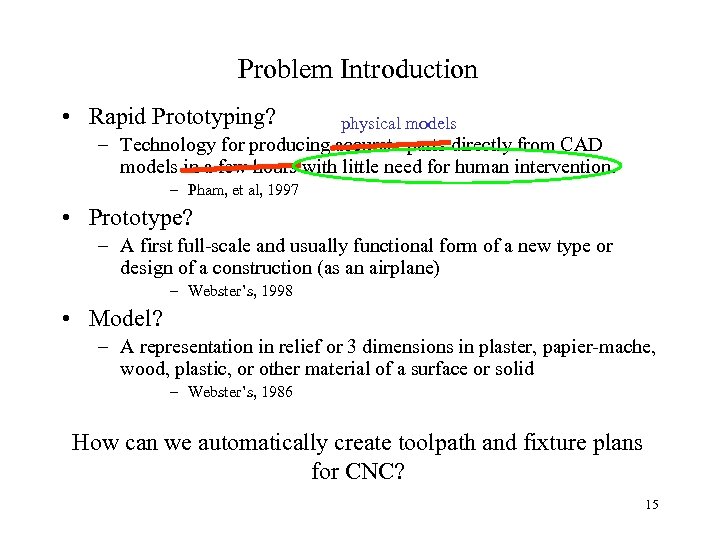 Problem Introduction • Rapid Prototyping? physical models – Technology for producing accurate parts directly from CAD models in a few hours with little need for human intervention. – Pham, et al, 1997 • Prototype? – A first full-scale and usually functional form of a new type or design of a construction (as an airplane) – Webster’s, 1998 • Model? – A representation in relief or 3 dimensions in plaster, papier-mache, wood, plastic, or other material of a surface or solid – Webster’s, 1986 How can we automatically create toolpath and fixture plans for CNC? 15
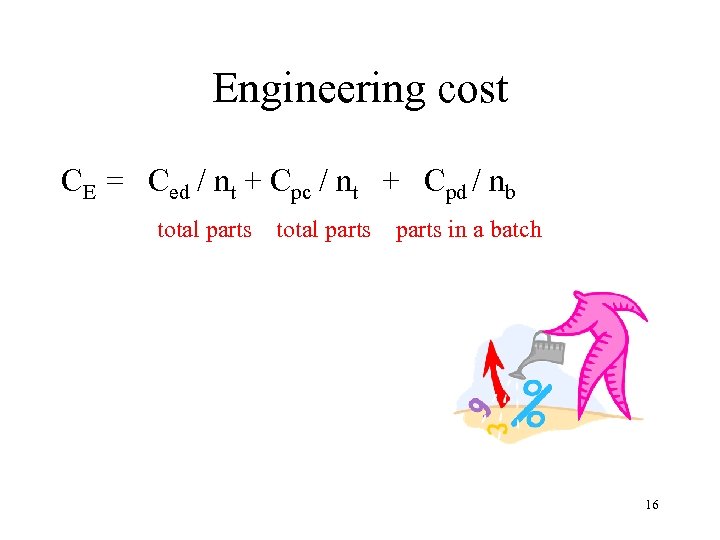 Engineering cost CE = Ced / nt + Cpc / nt + Cpd / nb total parts in a batch 16
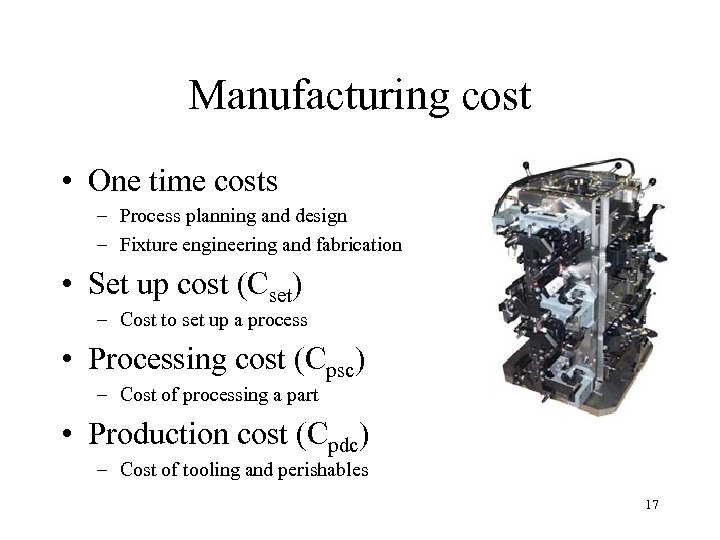 Manufacturing cost • One time costs – Process planning and design – Fixture engineering and fabrication • Set up cost (Cset) – Cost to set up a process • Processing cost (Cpsc) – Cost of processing a part • Production cost (Cpdc) – Cost of tooling and perishables 17
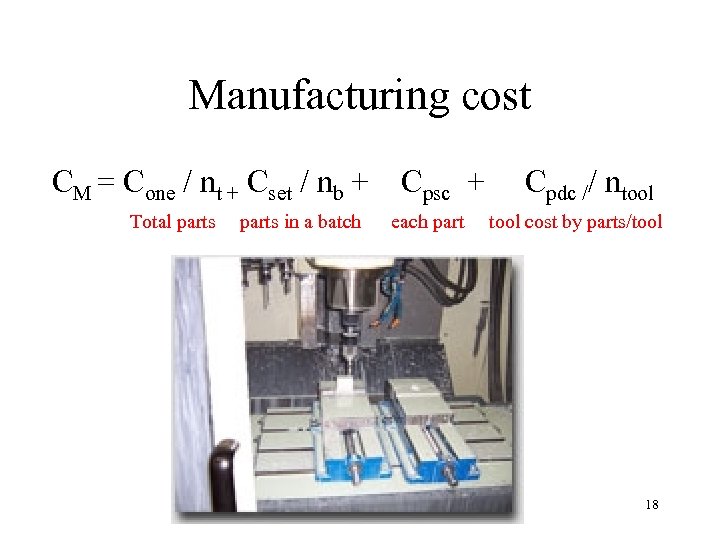 Manufacturing cost CM = Cone / nt + Cset / nb + Total parts in a batch Cpsc + each part Cpdc // ntool cost by parts/tool 18
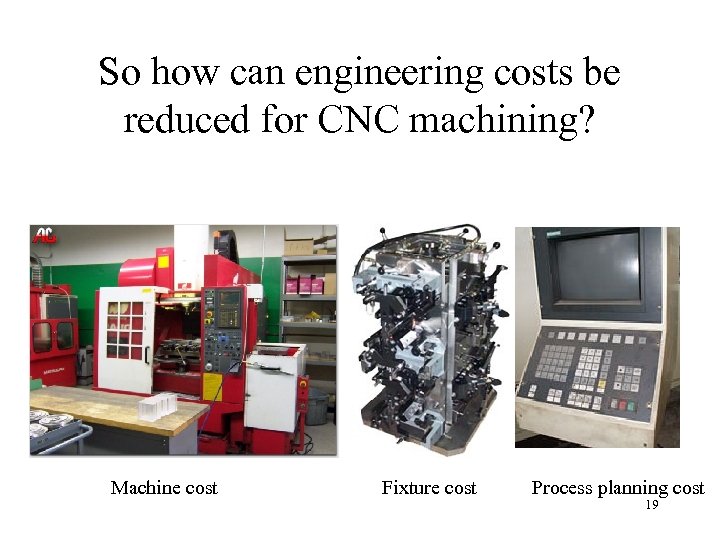 So how can engineering costs be reduced for CNC machining? Machine cost Fixture cost Process planning cost 19
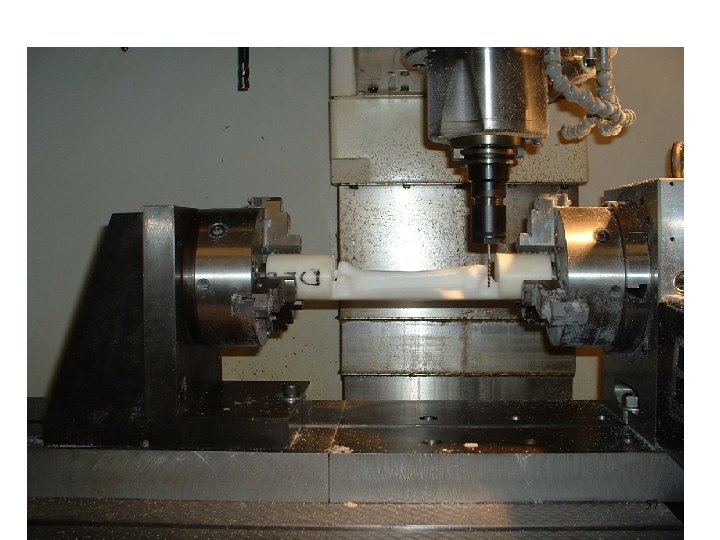
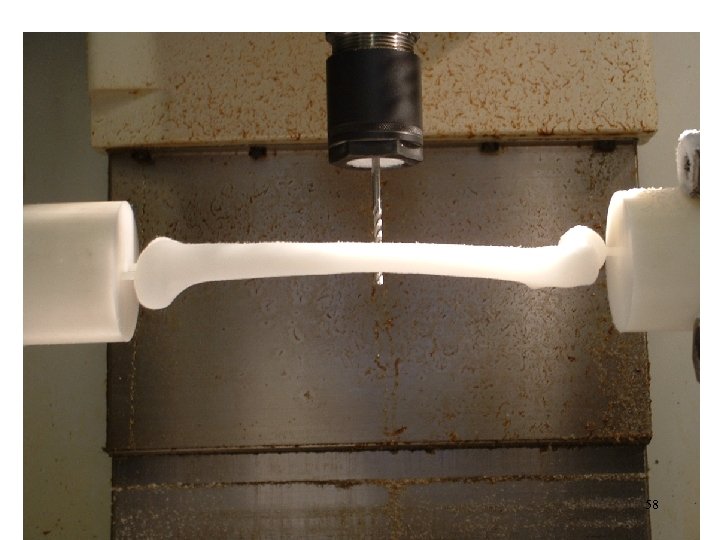
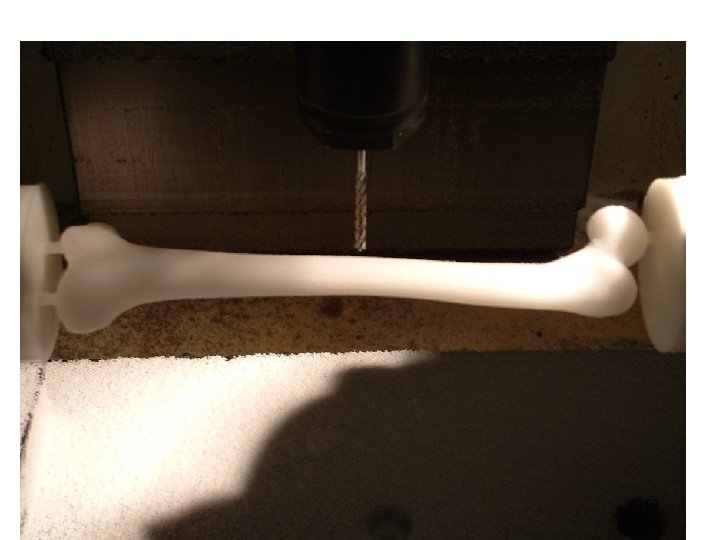
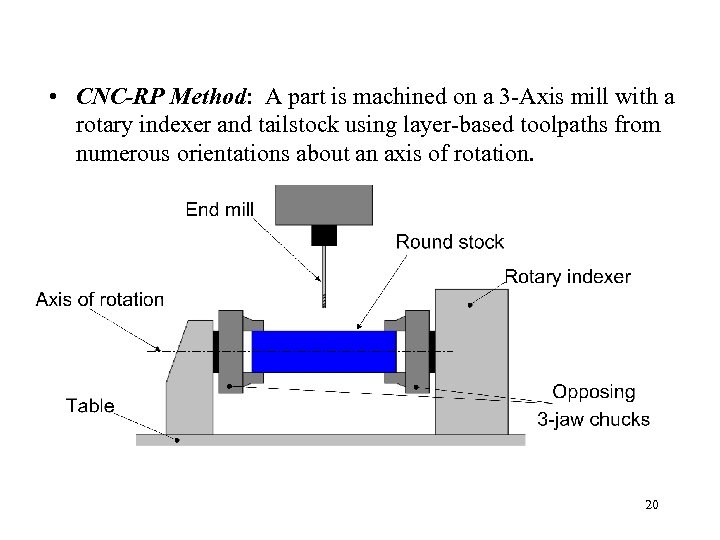 • CNC-RP Method: A part is machined on a 3 -Axis mill with a rotary indexer and tailstock using layer-based toolpaths from numerous orientations about an axis of rotation. 20
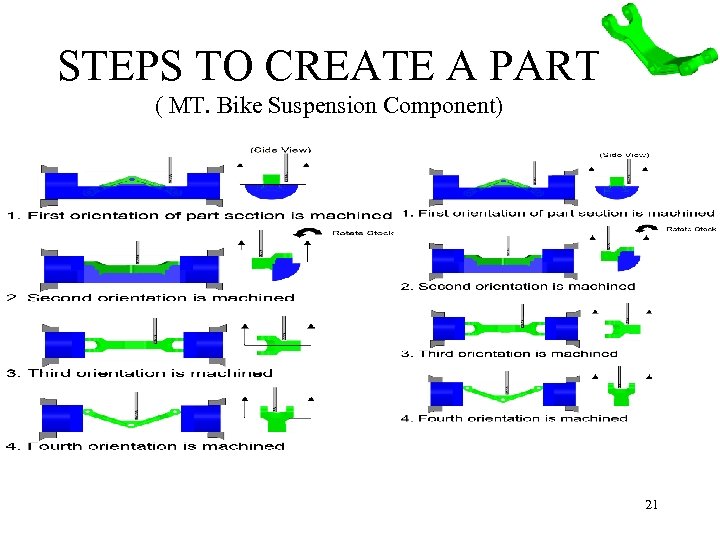 STEPS TO CREATE A PART ( MT. Bike Suspension Component) 21
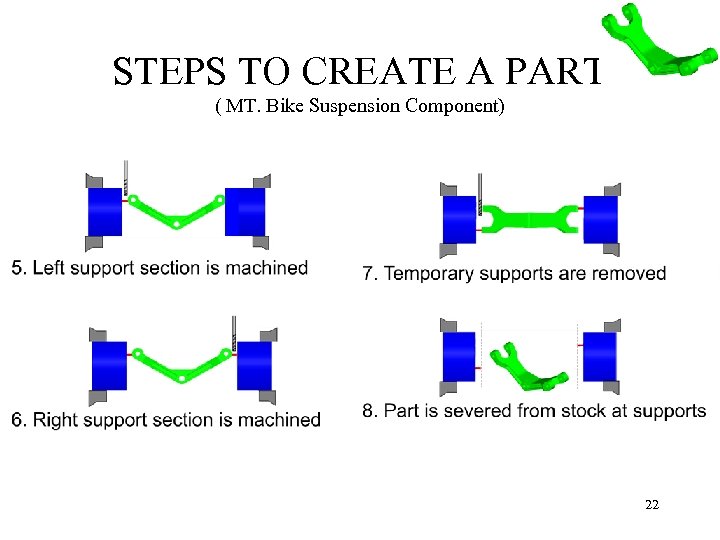 STEPS TO CREATE A PART ( MT. Bike Suspension Component) 22
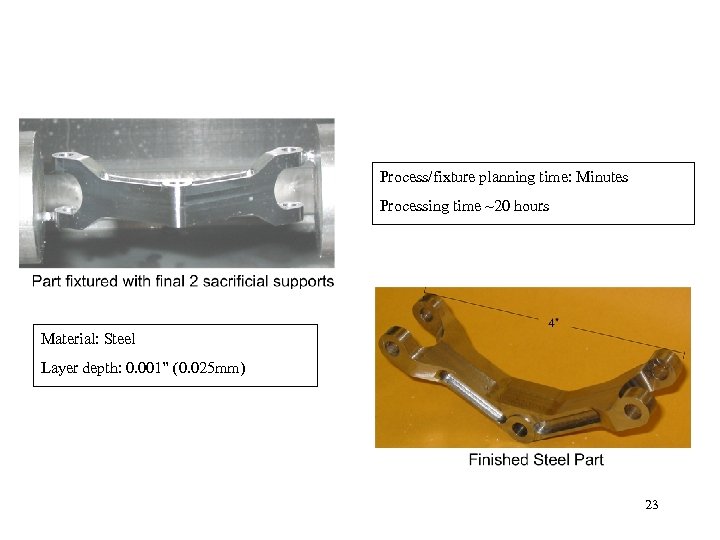 Process/fixture planning time: Minutes Processing time ~20 hours Material: Steel Layer depth: 0. 001” (0. 025 mm) 23
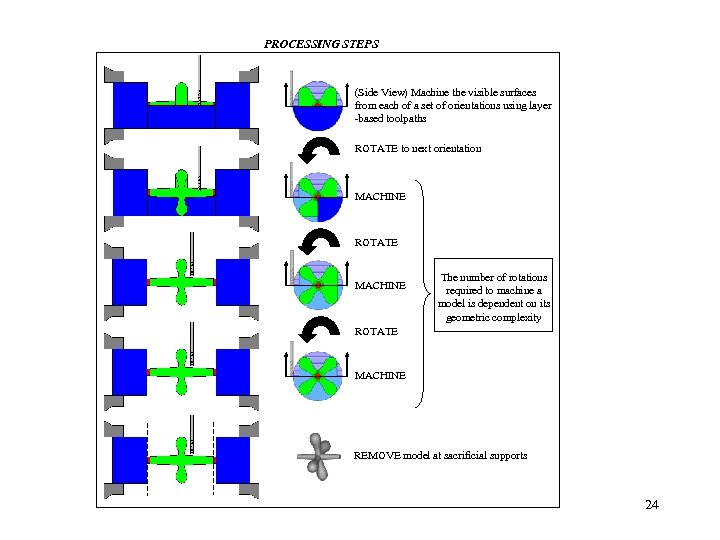 PROCESSING STEPS (Side View) Machine the visible surfaces from each of a set of orientations using layer -based toolpaths ROTATE to next orientation MACHINE ROTATE MACHINE The number of rotations required to machine a model is dependent on its geometric complexity ROTATE MACHINE REMOVE model at sacrificial supports 24
 Methodology • Creation of complex parts using a series of thin layers (slices) of 3 -axis toolpaths generated at numerous orientations rotated about an axis of the part • Toolpath planning based on “layering” methods used by other RP systems • “Slice” represents visible cross-sectional area to be machined about (subtractive) rather than actual cross section to be deposited (additive) • Slice thickness is the depth of cut for the 2½-D toolpaths • Tool used is a flat end mill cutter with equal flute and shank diameter (or shank diameter < flute diameter) • Stock material will be cylindrical, therefore toolpath z-zero location will be same for all orientations 25
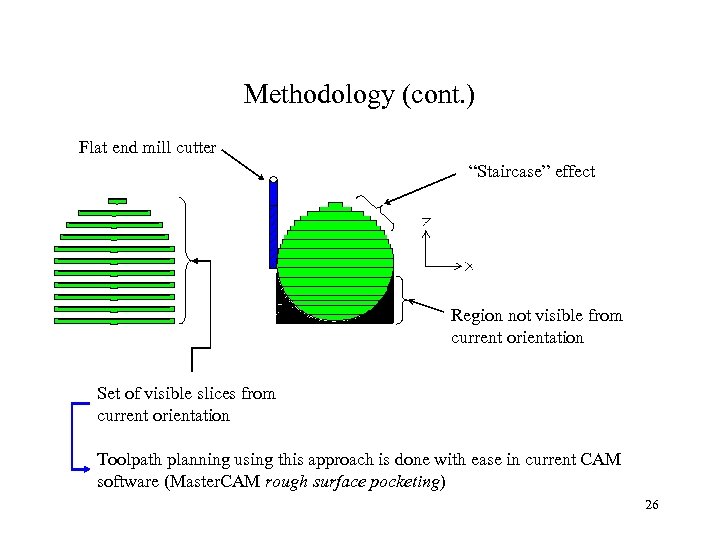 Methodology (cont. ) Flat end mill cutter “Staircase” effect Region not visible from current orientation Set of visible slices from current orientation Toolpath planning using this approach is done with ease in current CAM software (Master. CAM rough surface pocketing) 26
 Methodology (cont. ) • Fixturing accomplished through temporary feature(s) (cylinders) appended to the solid model prior to toolpath planning • Cylinders attached to solid model along the axis of rotation • Incrementally created during machining operation as the model is rotated • Model remains secured to stock material then removed (similar to support structures in current RP methods) 27
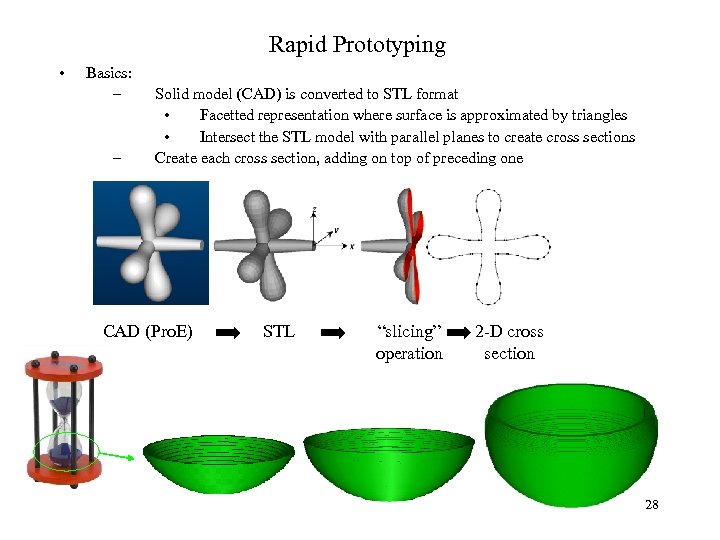 Rapid Prototyping • Basics: – – Solid model (CAD) is converted to STL format • Facetted representation where surface is approximated by triangles • Intersect the STL model with parallel planes to create cross sections Create each cross section, adding on top of preceding one CAD (Pro. E) STL “slicing” operation 2 -D cross section 28
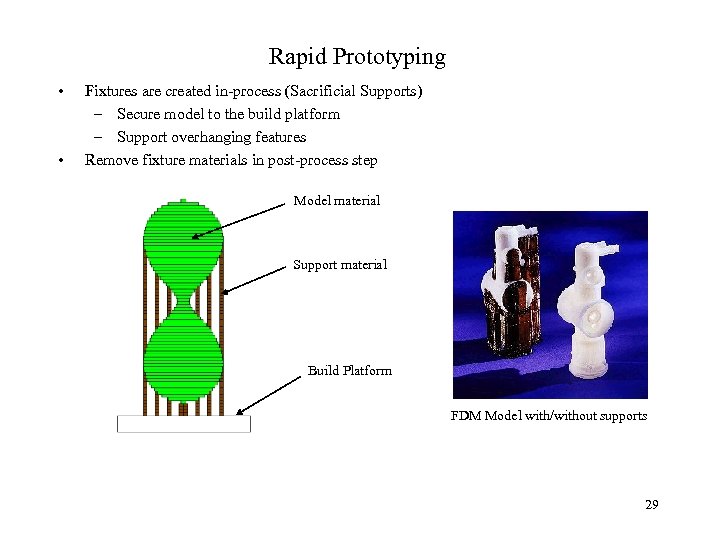 Rapid Prototyping • • Fixtures are created in-process (Sacrificial Supports) – Secure model to the build platform – Support overhanging features Remove fixture materials in post-process step Model material Support material Build Platform FDM Model with/without supports 29
 RP versus CNC Machining • • RP processes are very flexible and very capable However: – RP processes rely on specialized materials – Limited accuracy in some cases Functional prototypes? • CNC Machining is: – Subtractive process – Accurate – Capable of using many common manufacturing materials • CNC Machining is NOT: – Automated – Easily usable except by highly skilled technicians • CNC machining cannot create all parts • No hollow parts • No severely undercut features The time consuming tasks of process and fixture planning are major factors which prohibit CNC machining from being used as a Rapid Prototyping Process – Wang et al, 1999 • 30
 Previous Work • Chen and Song, 1991 – Layer based machining for prototyping – Machined layers using robotic arm/machine tool – Layers laminated in a stack • Merz, et al, 1994 – Shape Deposition Manufacturing – Additive/Subtractive Process • Walczyk and Hardt, 1998; Vouezelaud et al, 1992 – Rapid tooling – Laminated machining for dies • Lennings, 2000 – Deskproto software – CNC machining planner – Processes similar to a mill/turn operation 31
 Motivation • RP processes are almost completely automated “turnkey” operations – User does not have to be skilled technician – Process planning is simplified by layer-based approach – Fixtures are created in process • The approach to CNC-RP will have to relax many of the traditional constraints – Efficient machining is not a major driver (Traditional feeds/speeds not used) – Not feature-based (Not necessary to machine entire feature in one setup orientation) – Surface finish not as critical (Allow staircase effect) • Goal of this research is to develop a method for CNC rapid prototyping such that: – Toolpath planning, sequencing, tool sizing is automated – Fixture design is created in-process, flexible, and allows access to almost all surfaces – Setups/orientation automatically calculated, executed – No collision problems 32
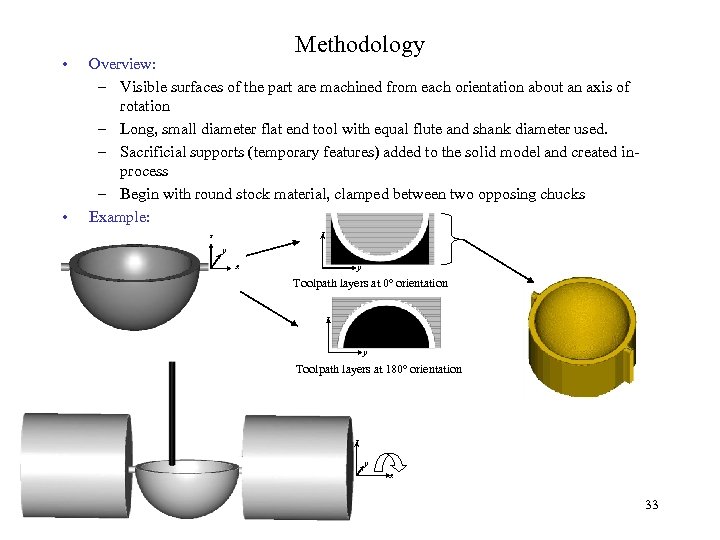 • • Methodology Overview: – Visible surfaces of the part are machined from each orientation about an axis of rotation – Long, small diameter flat end tool with equal flute and shank diameter used. – Sacrificial supports (temporary features) added to the solid model and created inprocess – Begin with round stock material, clamped between two opposing chucks Example: z z y x y Toolpath layers at 0º orientation z y Toolpath layers at 180º orientation z y x 33
 Research Problems • Setup/Orientation – How many rotations (setup orientations) about the axis of rotation are required? – Where are they? • Toolpath planning – For each orientation, how can we automatically generate toolpaths? – What diameter and length tools should be used? – In what order should the toolpaths be executed? • Fixture planning – How can we automatically generate sacrificial supports? – What diameter and length should they be? 34
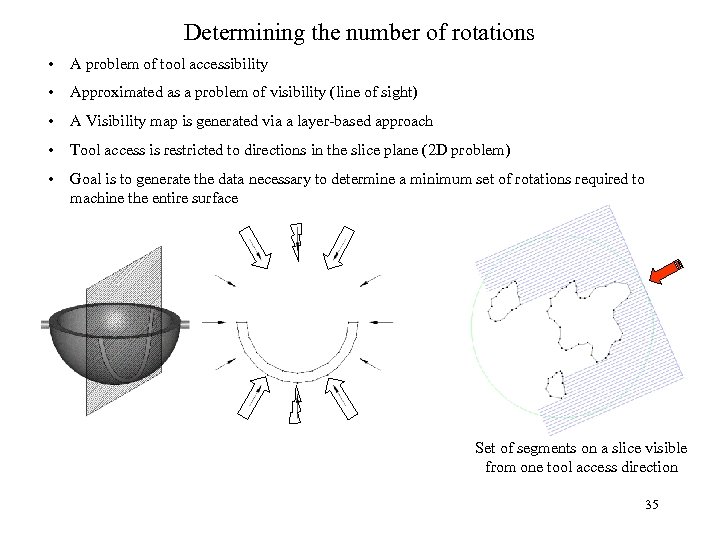 Determining the number of rotations • A problem of tool accessibility • Approximated as a problem of visibility (line of sight) • A Visibility map is generated via a layer-based approach • Tool access is restricted to directions in the slice plane (2 D problem) • Goal is to generate the data necessary to determine a minimum set of rotations required to machine the entire surface Set of segments on a slice visible from one tool access direction 35
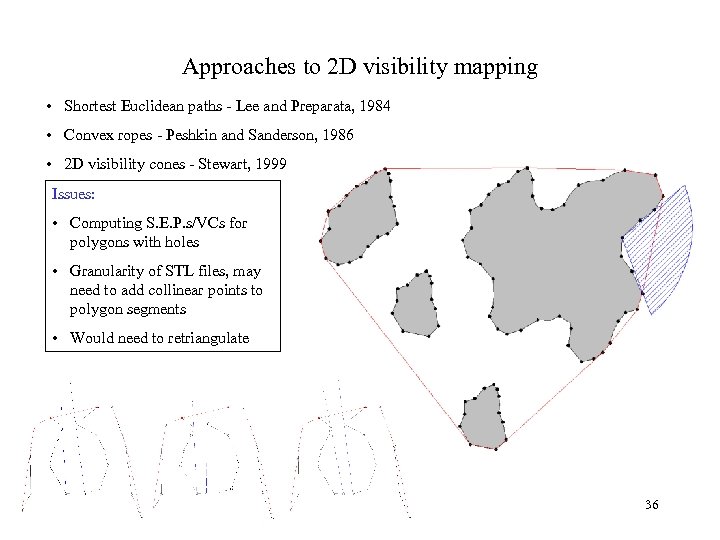 Approaches to 2 D visibility mapping • Shortest Euclidean paths - Lee and Preparata, 1984 • Convex ropes - Peshkin and Sanderson, 1986 • 2 D visibility cones - Stewart, 1999 Issues: • Computing S. E. P. s/VCs for polygons with holes • Granularity of STL files, may need to add collinear points to polygon segments • Would need to retriangulate 36
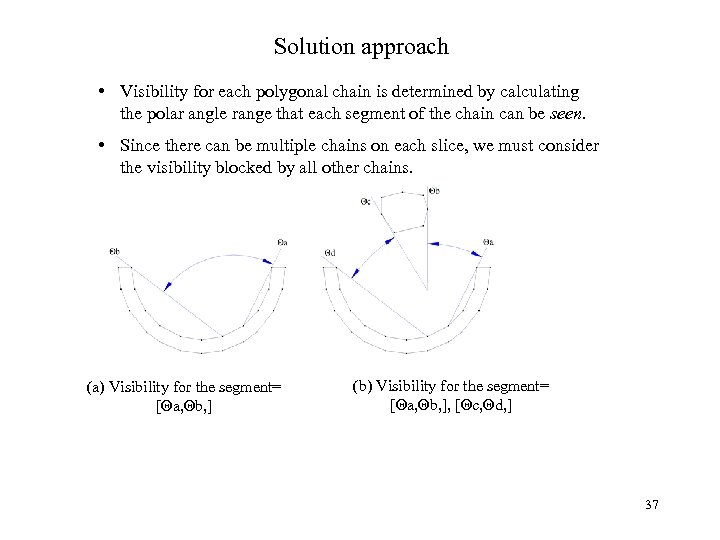 Solution approach • Visibility for each polygonal chain is determined by calculating the polar angle range that each segment of the chain can be seen. • Since there can be multiple chains on each slice, we must consider the visibility blocked by all other chains. (a) Visibility for the segment= [Θa, Θb, ] (b) Visibility for the segment= [Θa, Θb, ], [Θc, Θd, ] 37
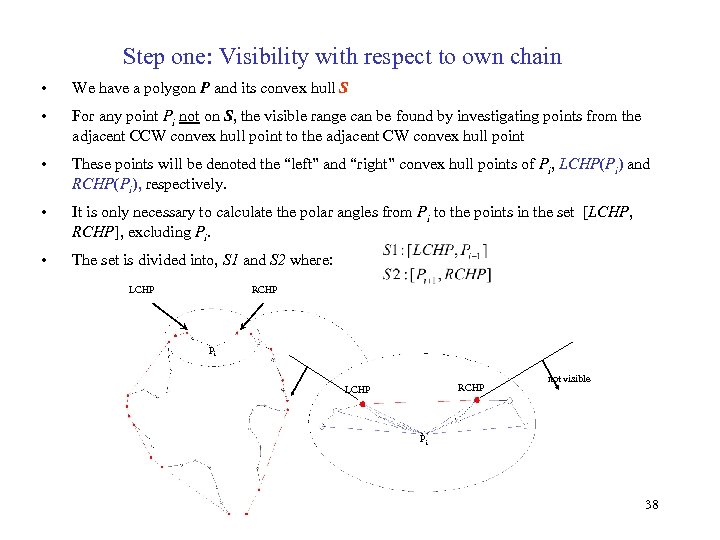 Step one: Visibility with respect to own chain • We have a polygon P and its convex hull S • For any point Pi not on S, the visible range can be found by investigating points from the adjacent CCW convex hull point to the adjacent CW convex hull point • These points will be denoted the “left” and “right” convex hull points of Pi, LCHP(Pi) and RCHP(Pi), respectively. • It is only necessary to calculate the polar angles from Pi to the points in the set [LCHP, RCHP], excluding Pi. • The set is divided into, S 1 and S 2 where: LCHP RCHP Pi+1 Pi P: S: , not visible RCHP LCHP Pi-1 Pi+1 Pi 38
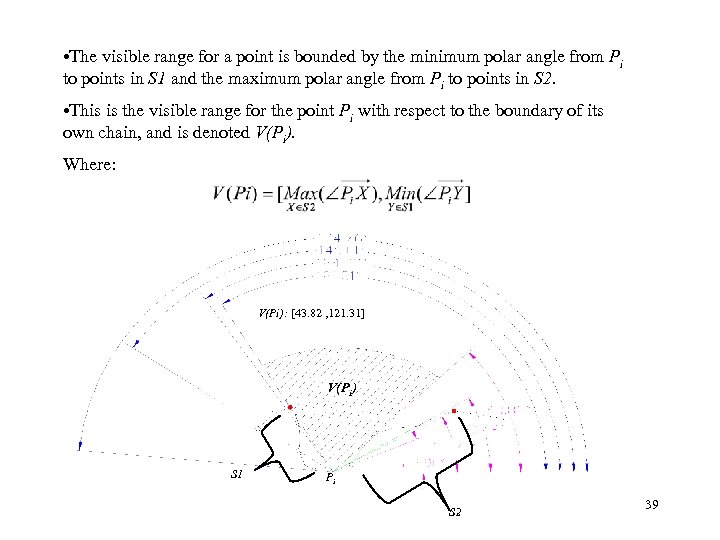 • The visible range for a point is bounded by the minimum polar angle from Pi to points in S 1 and the maximum polar angle from Pi to points in S 2. • This is the visible range for the point Pi with respect to the boundary of its own chain, and is denoted V(Pi). Where: V(Pi): [43. 82 , 121. 31] V(Pi) S 1 Pi S 2 39
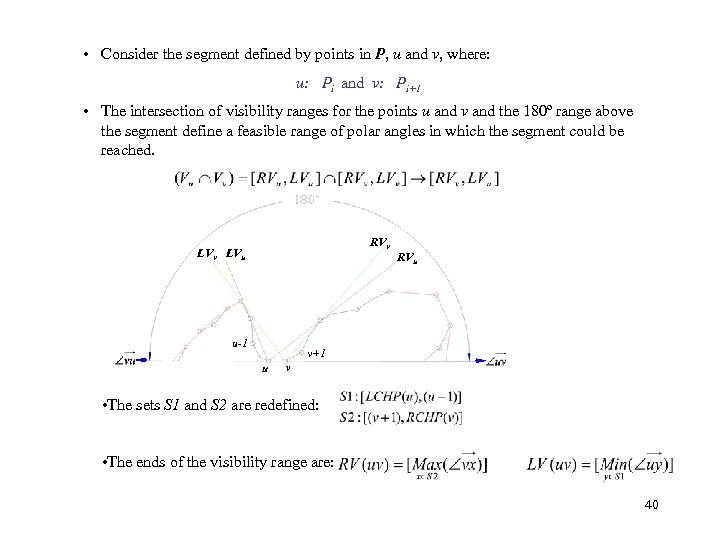 • Consider the segment defined by points in P, u and v, where: u: Pi and v: Pi+1 • The intersection of visibility ranges for the points u and v and the 180º range above the segment define a feasible range of polar angles in which the segment could be reached. RVv LVu u-1 RVu v+1 u v • The sets S 1 and S 2 are redefined: • The ends of the visibility range are: 40
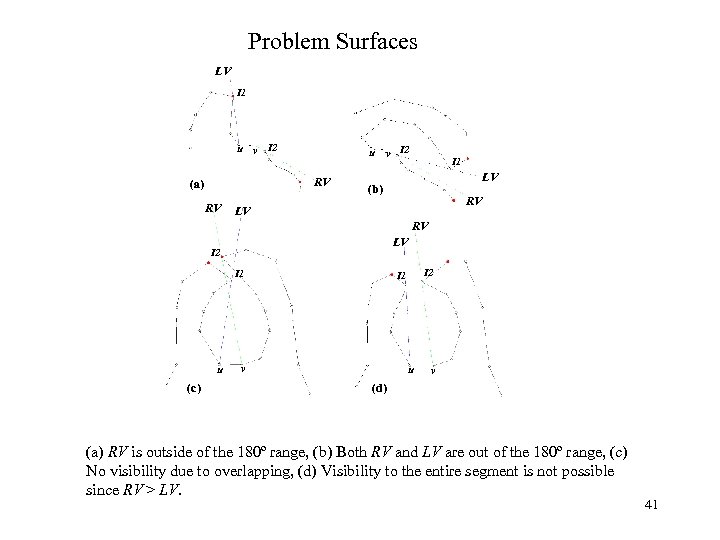 Problem Surfaces LV I 1 u v I 2 RV (a) RV I 1 LV (b) RV LV I 2 I 1 u (c) I 2 I 1 v u v (d) (a) RV is outside of the 180º range, (b) Both RV and LV are out of the 180º range, (c) No visibility due to overlapping, (d) Visibility to the entire segment is not possible since RV > LV. 41
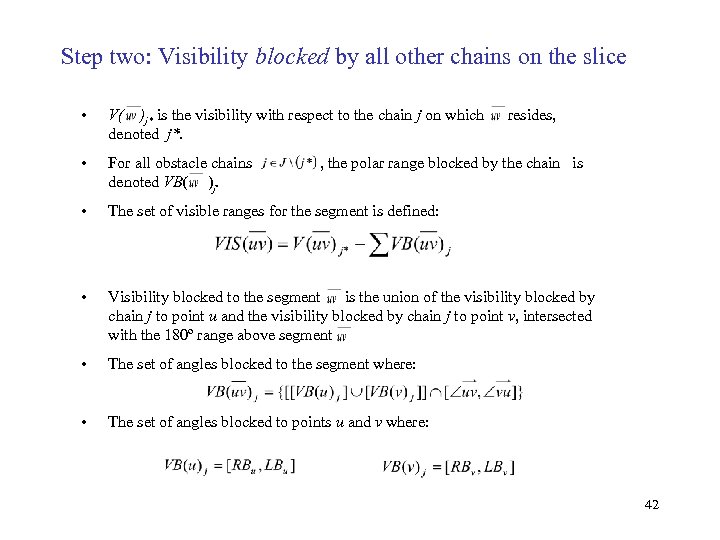 Step two: Visibility blocked by all other chains on the slice • V( )j* is the visibility with respect to the chain j on which denoted j*. • For all obstacle chains denoted VB( )j. • The set of visible ranges for the segment is defined: • Visibility blocked to the segment is the union of the visibility blocked by chain j to point u and the visibility blocked by chain j to point v, intersected with the 180º range above segment • The set of angles blocked to the segment where: • The set of angles blocked to points u and v where: resides, , the polar range blocked by the chain is 42
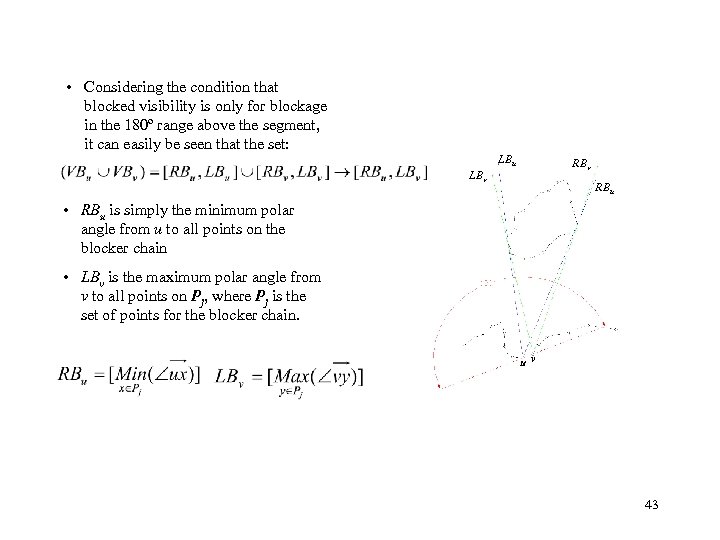 • Considering the condition that blocked visibility is only for blockage in the 180º range above the segment, it can easily be seen that the set: LBu RBv LBv RBu • RBu is simply the minimum polar angle from u to all points on the blocker chain • LBv is the maximum polar angle from v to all points on Pj, where Pj is the set of points for the blocker chain. uv 43
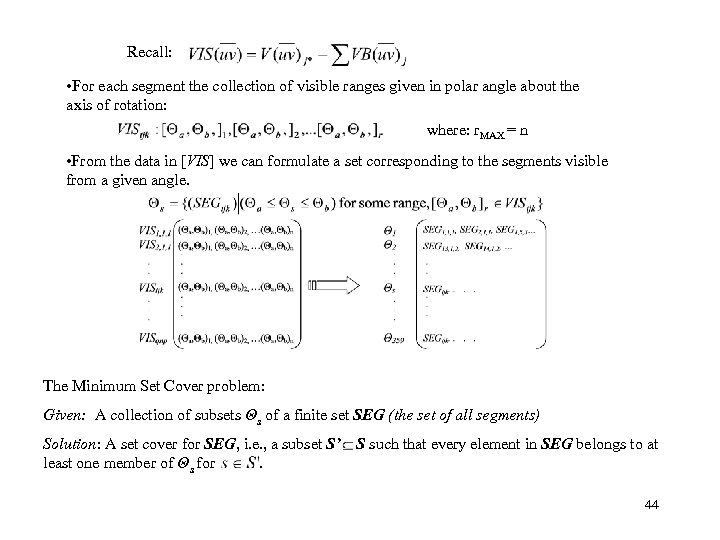 Recall: • For each segment the collection of visible ranges given in polar angle about the axis of rotation: where: r. MAX = n • From the data in [VIS] we can formulate a set corresponding to the segments visible from a given angle. The Minimum Set Cover problem: Given: A collection of subsets Θs of a finite set SEG (the set of all segments) Solution: A set cover for SEG, i. e. , a subset S’ least one member of Θs for. S such that every element in SEG belongs to at 44
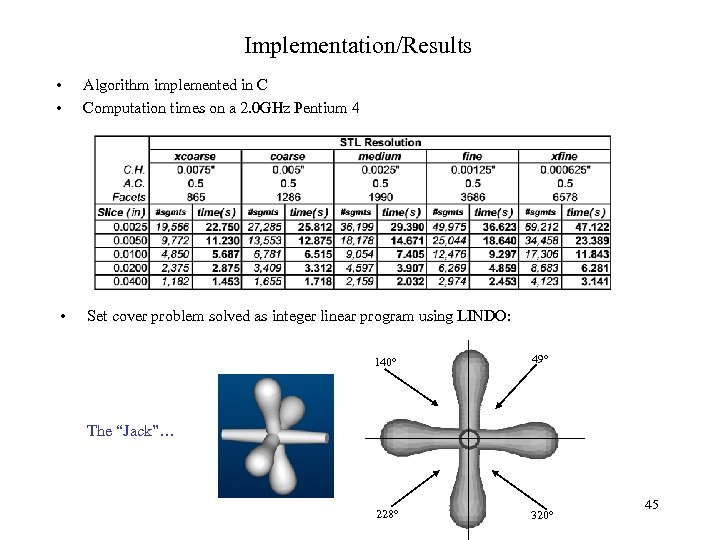 Implementation/Results • • Algorithm implemented in C Computation times on a 2. 0 GHz Pentium 4 • Set cover problem solved as integer linear program using LINDO: 140º 49º 228º 320º The “Jack”… 45
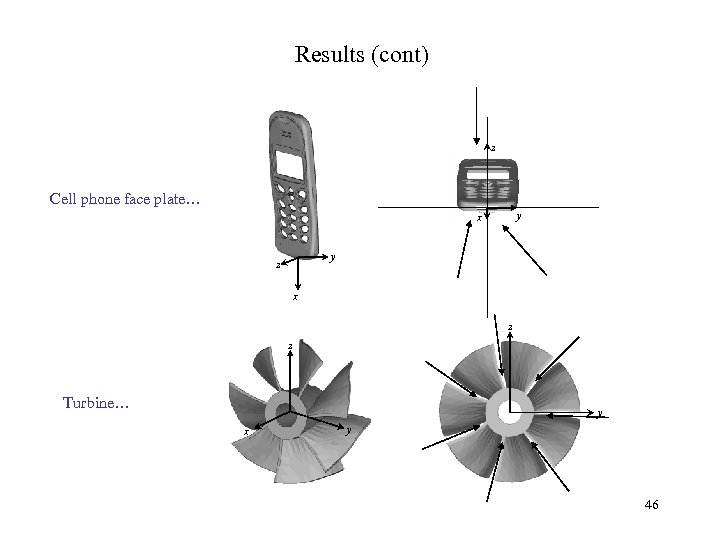 Results (cont) z Cell phone face plate… y x x z y x z z Turbine… y x y 46
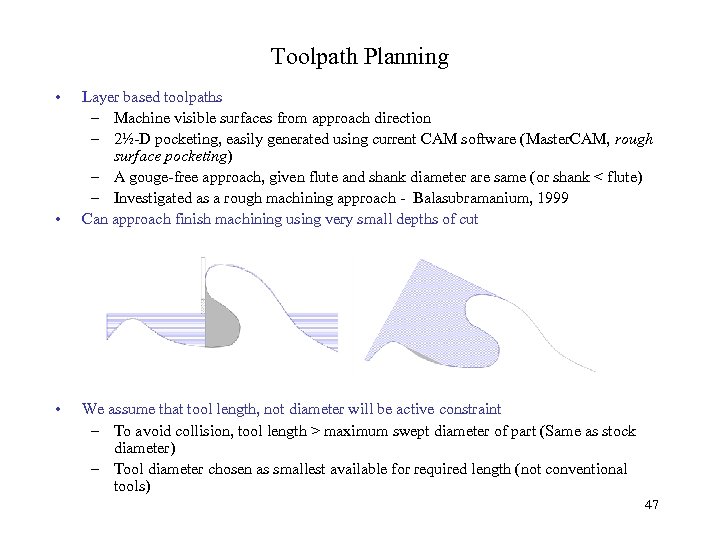 Toolpath Planning • • • Layer based toolpaths – Machine visible surfaces from approach direction – 2½-D pocketing, easily generated using current CAM software (Master. CAM, rough surface pocketing) – A gouge-free approach, given flute and shank diameter are same (or shank < flute) – Investigated as a rough machining approach - Balasubramanium, 1999 Can approach finish machining using very small depths of cut We assume that tool length, not diameter will be active constraint – To avoid collision, tool length > maximum swept diameter of part (Same as stock diameter) – Tool diameter chosen as smallest available for required length (not conventional tools) 47
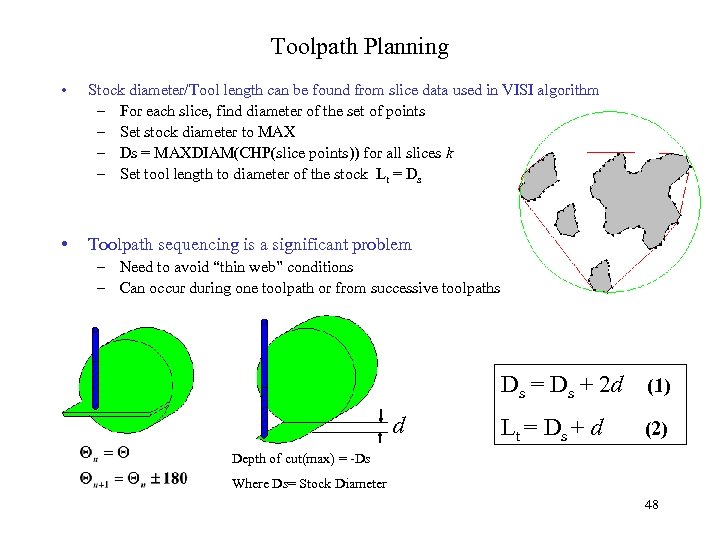 Toolpath Planning • Stock diameter/Tool length can be found from slice data used in VISI algorithm – For each slice, find diameter of the set of points – Set stock diameter to MAX – Ds = MAXDIAM(CHP(slice points)) for all slices k – Set tool length to diameter of the stock Lt = Ds • Toolpath sequencing is a significant problem – Need to avoid “thin web” conditions – Can occur during one toolpath or from successive toolpaths Ds = Ds + 2 d d (1) Lt = D s + d (2) Depth of cut(max) = -Ds Where Ds= Stock Diameter 48
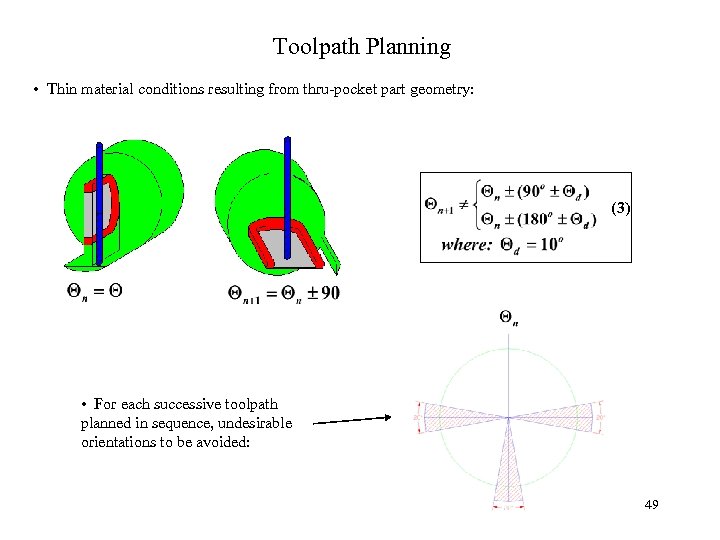 Toolpath Planning • Thin material conditions resulting from thru-pocket part geometry: (3) • For each successive toolpath planned in sequence, undesirable orientations to be avoided: 49
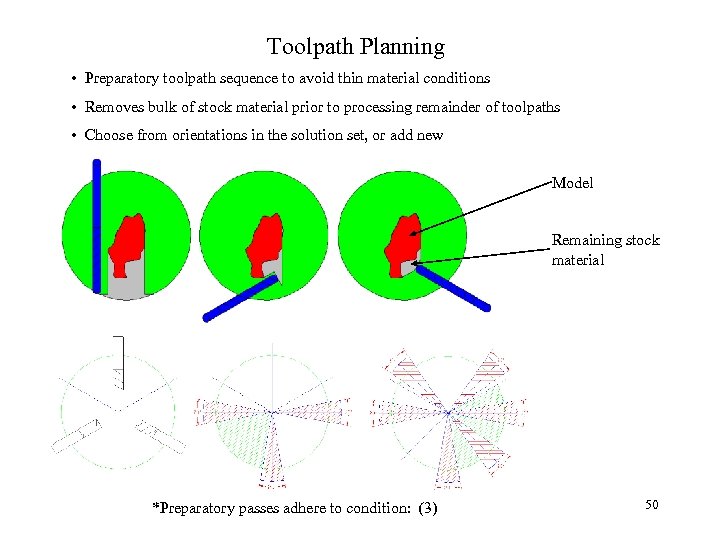 Toolpath Planning • Preparatory toolpath sequence to avoid thin material conditions • Removes bulk of stock material prior to processing remainder of toolpaths • Choose from orientations in the solution set, or add new Model Remaining stock material *Preparatory passes adhere to condition: (3) 50
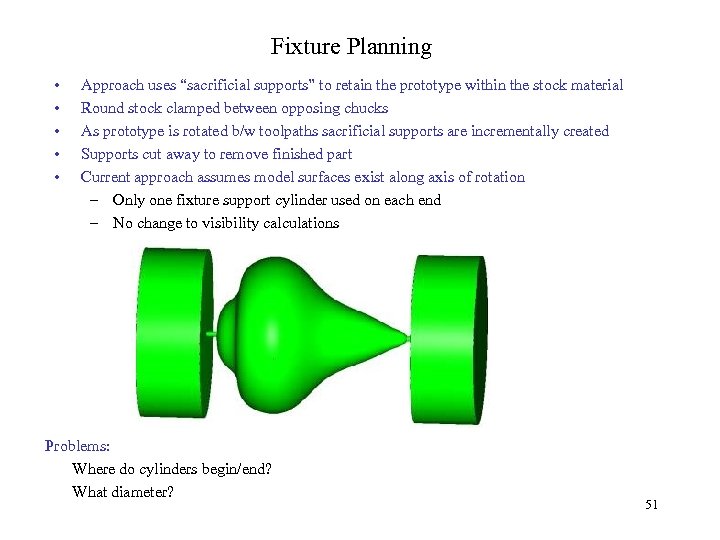 Fixture Planning • • • Approach uses “sacrificial supports” to retain the prototype within the stock material Round stock clamped between opposing chucks As prototype is rotated b/w toolpaths sacrificial supports are incrementally created Supports cut away to remove finished part Current approach assumes model surfaces exist along axis of rotation – Only one fixture support cylinder used on each end – No change to visibility calculations Problems: Where do cylinders begin/end? What diameter? 51
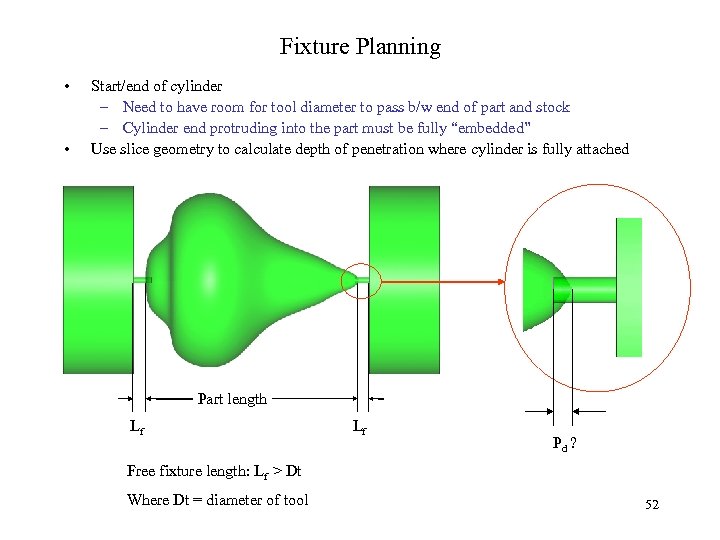 Fixture Planning • • Start/end of cylinder – Need to have room for tool diameter to pass b/w end of part and stock – Cylinder end protruding into the part must be fully “embedded” Use slice geometry to calculate depth of penetration where cylinder is fully attached Part length Lf Lf Pd ? Free fixture length: Lf > Dt Where Dt = diameter of tool 52
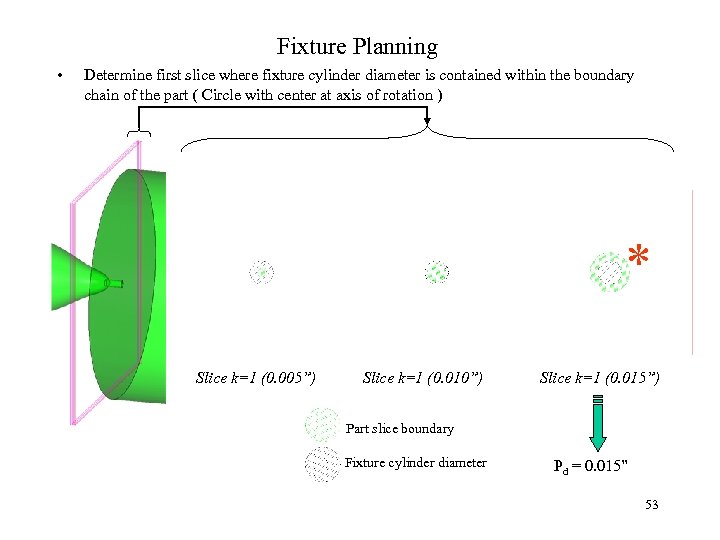 Fixture Planning • Determine first slice where fixture cylinder diameter is contained within the boundary chain of the part ( Circle with center at axis of rotation ) * Slice k=1 (0. 005”) Slice k=1 (0. 010”) Slice k=1 (0. 015”) Part slice boundary Fixture cylinder diameter Pd = 0. 015” 53
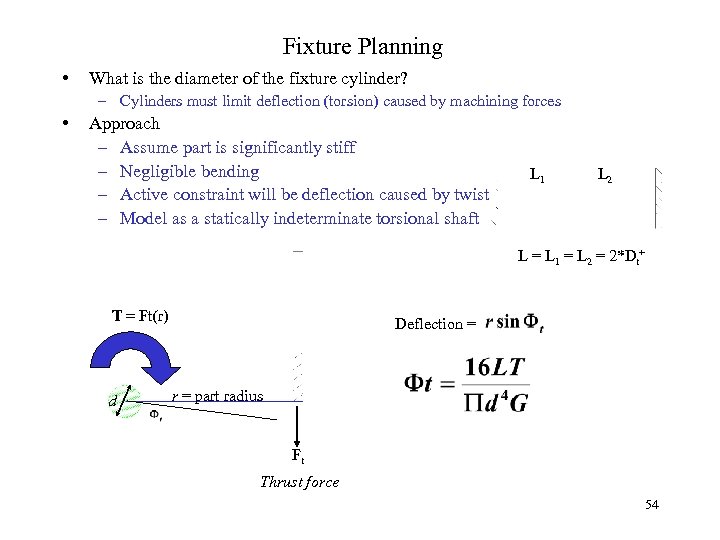 Fixture Planning • What is the diameter of the fixture cylinder? – Cylinders must limit deflection (torsion) caused by machining forces • Approach – Assume part is significantly stiff – Negligible bending L 1 – Active constraint will be deflection caused by twisting – Model as a statically indeterminate torsional shaft L 2 L = L 1 = L 2 = 2*Dt+ T = Ft(r) d Deflection = r = part radius Ft Thrust force 54
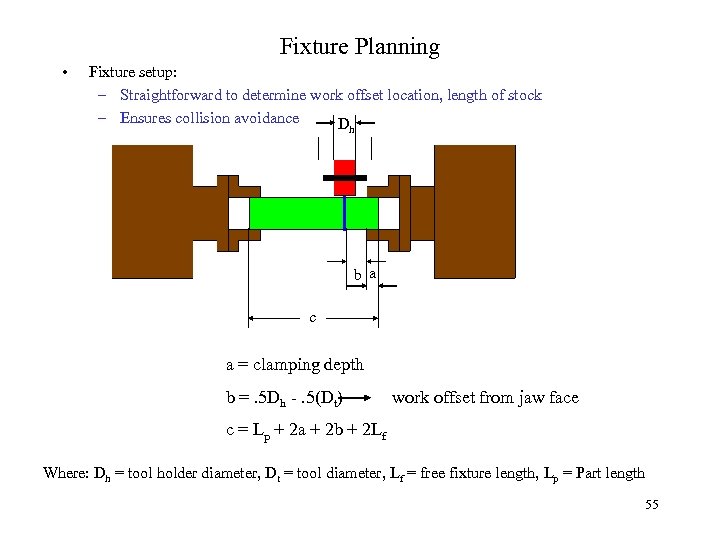 Fixture Planning • Fixture setup: – Straightforward to determine work offset location, length of stock – Ensures collision avoidance D h b a c a = clamping depth b =. 5 Dh -. 5(Dt) work offset from jaw face c = Lp + 2 a + 2 b + 2 Lf Where: Dh = tool holder diameter, Dt = tool diameter, Lf = free fixture length, Lp = Part length 55
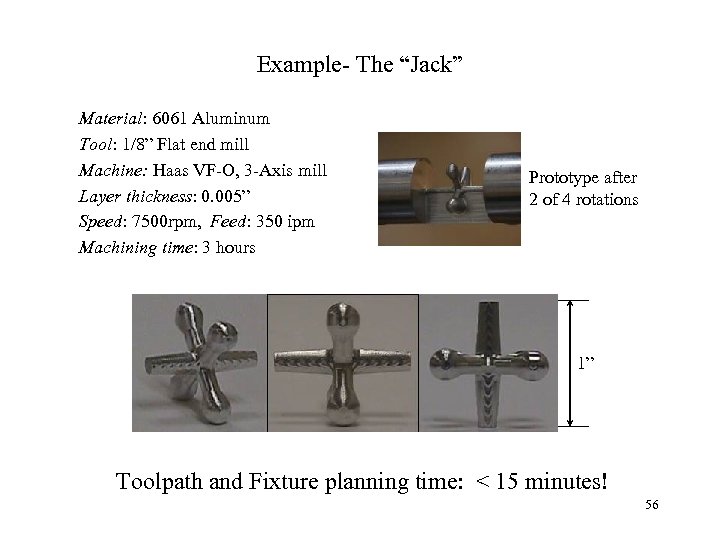 Example- The “Jack” Material: 6061 Aluminum Tool: 1/8” Flat end mill Machine: Haas VF-O, 3 -Axis mill Layer thickness: 0. 005” Speed: 7500 rpm, Feed: 350 ipm Machining time: 3 hours Prototype after 2 of 4 rotations 1” Toolpath and Fixture planning time: < 15 minutes! 56
 57
57
 58
58
 59
59
 60
60
 61
61
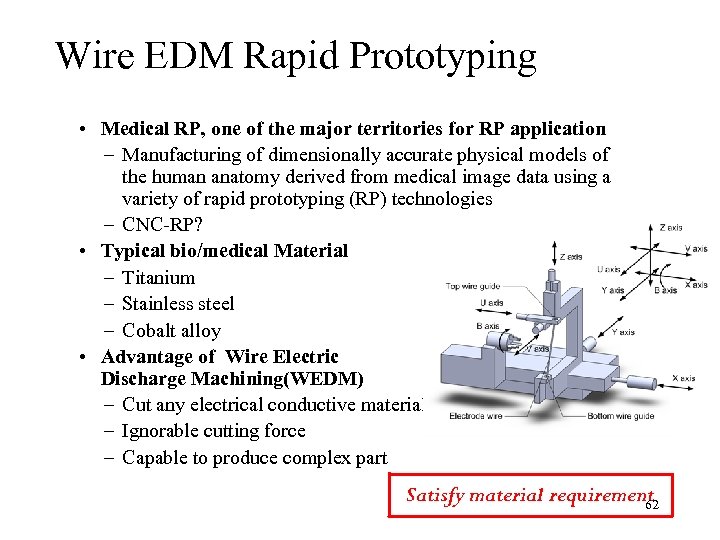 Wire EDM Rapid Prototyping • Medical RP, one of the major territories for RP application – Manufacturing of dimensionally accurate physical models of the human anatomy derived from medical image data using a variety of rapid prototyping (RP) technologies – CNC-RP? • Typical bio/medical Material – Titanium – Stainless steel – Cobalt alloy • Advantage of Wire Electric Discharge Machining(WEDM) – Cut any electrical conductive material regardless hardness – Ignorable cutting force – Capable to produce complex part Satisfy material requirement 62
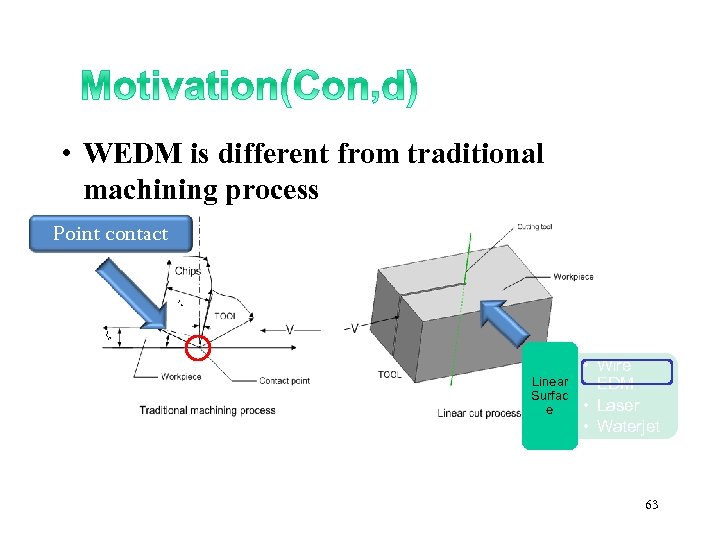 • WEDM is different from traditional machining process Point contact Linear Surfac e • Wire EDM • Laser • Waterjet 63
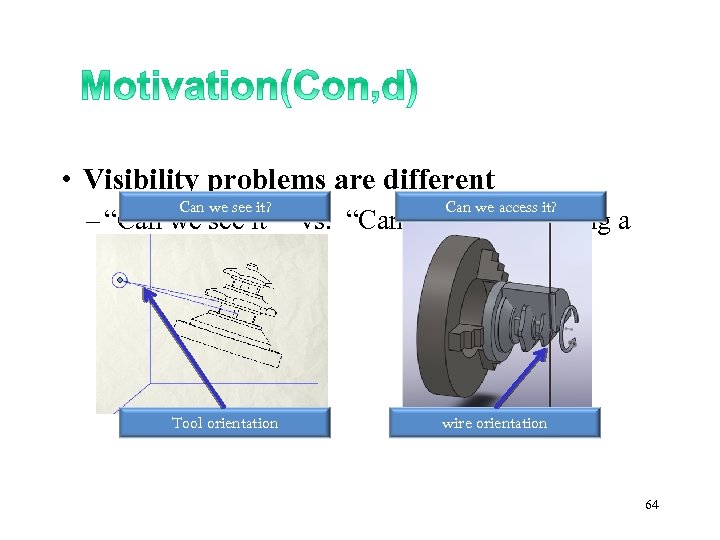 • Visibility problems are different Can we see it? Can we access it? – “Can we see it” vs. “Can we access it using a straight line” Tool orientation wire orientation 64
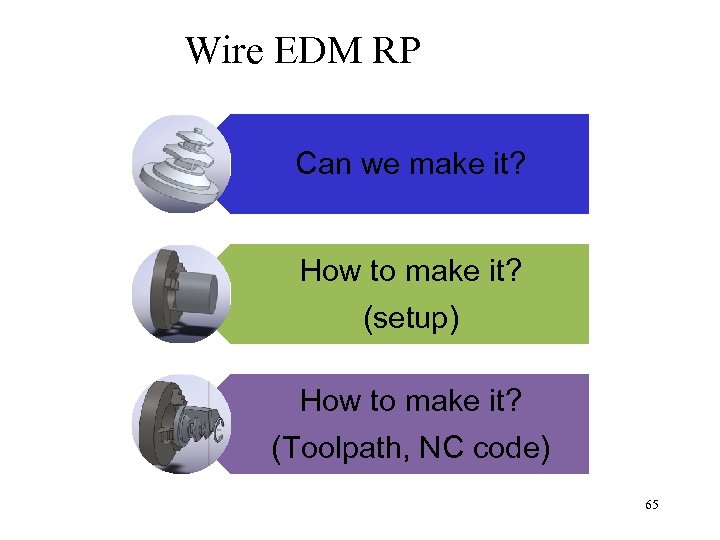 Wire EDM RP Can we make it? How to make it? (setup) How to make it? (Toolpath, NC code) 65
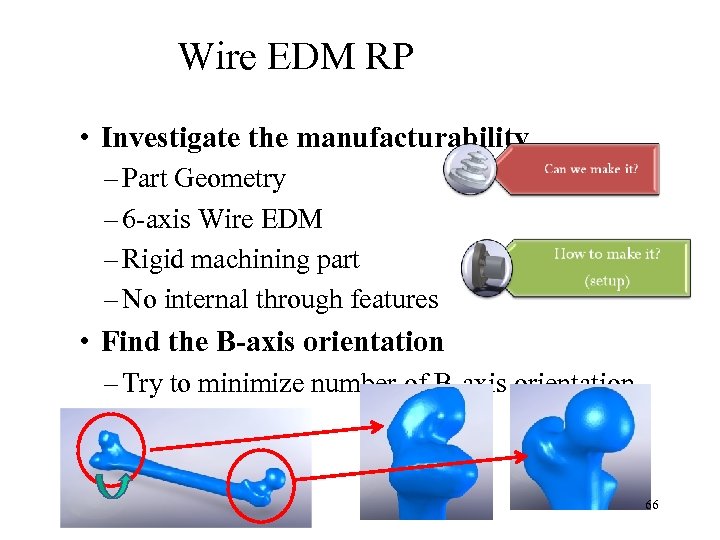 Wire EDM RP • Investigate the manufacturability – Part Geometry – 6 -axis Wire EDM – Rigid machining part – No internal through features • Find the B-axis orientation – Try to minimize number of B-axis orientation 66
 Wire EDM RP • Toolpath generation – Discrete Toolpath for B-axis and other 5 -axis – STEP-NC • Fixture Design – Ignorable cutting force : Clamp part 67
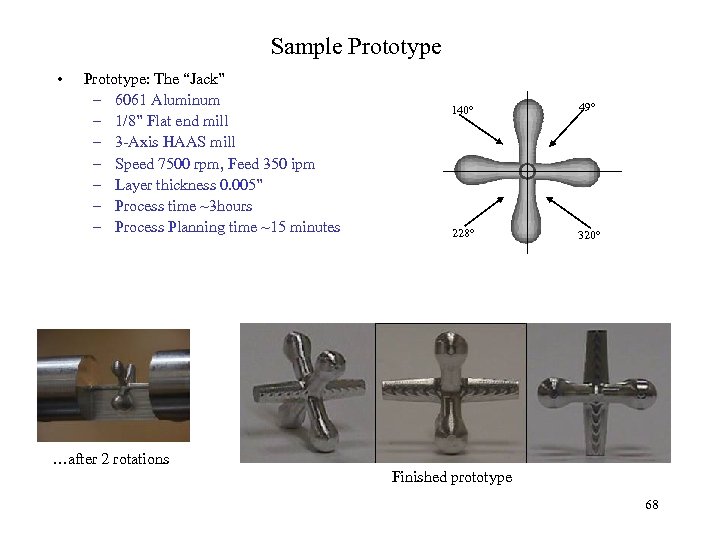 Sample Prototype • Prototype: The “Jack” – 6061 Aluminum – 1/8” Flat end mill – 3 -Axis HAAS mill – Speed 7500 rpm, Feed 350 ipm – Layer thickness 0. 005” – Process time ~3 hours – Process Planning time ~15 minutes 140º 49º 228º 320º …after 2 rotations Finished prototype 68
 Conclusions • For prototyping, the process is dominated by engineering cost – Product engineering, Process engineering, production engineering • RP has come a long way – Usable products – Process and production engineering coasts are minimal • Conventional methods are on their way back – CNC RP – Wire EDM RP 69
 Conclusions -- continued • The methods developed (CNC-RP and Wire EDM –RP) represent a deliberate approach at making CNC machining usable by engineers and designers, not just machinists • Capable of producing fully functional prototypes in the appropriate material • Wide spread availability of CNC machines provides fast, low-cost integration to current product design processes • Quick changeover from RP to Production setup will enable higher utilization of machines • The concept of sacrificial supports for CNC machining represents a significant area of basic research that may yield even greater contributions outside of RP 70
 References: • • • Wang, F. C. , L. Marchetti, P. K. Wright, “Rapid Prototyping Using Machining”, SME Technical Paper, PE 99 -118, 1999 Chen, Y. H. , Song, Y. , “The development of a layer based machining system”, Computer Aided Design, Vol. 33, pp. 331 -342, 2001 Merz, R. , Prinz, F. B. , Ramaswami, K. , Terk, M. , Weiss, L. E. , “Shape Deposition Manufacturing”, Proceedings of the Solid Freeform Fabrication Symposium, University of Texas at Austin, pp. 1 -8, 1994 Walczyk, D. F. , Hardt, D. E. , “Rapid tooling for sheet metal forming using profiled edge laminationsdesign principles and demonstration”, Journal of Manufacturing Science and Engineering, Transactions of the ASME, Vol. 120, No. 2, pp. 746 -754, November 1998 Vouzelaud, F. A. , Bagchi, A. & Sferro, P. F. , (1992), Adaptive Laminated Machining for Prototyping of Dies and Molds, Proceedings of the 3 rd Solid Freeform Fabrication Symposium, pp. 291 -300, August 1992 Lennings, L. , “Selecting Either Layered manufacturing or CNC machining to build your prototype”, SME Technical Paper, Rapid Prototyping Association, PE 00 -171, 2000 Peshkin, M. A. , Sanderson, A. C. , “Reachable Grasps on a Polygon: The Convex Rope Algorithm”, IEEE Journal of Robotics and Automation, Vol. RA-2, No. 1, March 1986 Lee, D. T. , Preparata, F. P. , "Euclidean Shortest Paths in the Presence of rectilinear Barriers", Networks, Vol. 14, No. 3, pp. 393 -410, 1984. Stewart, J. A. , “Computing visibility from folded surfaces”, Computers and Graphics, Vol. 23, No. 5, pp. 693 -702, 1999 Balasubramaniam, M. , “Tool Selection and Path Planning for 3 -Axis Rough Cutting”, Thesis, Department of Mechanical Engineering, The Massachusetts Institute of Technology, June 1999 Tang, K. , Woo, T. C. , Gan, J. , “Maximum Intersection of Spherical Polygons and Workpiece Orientation for 4 - and 5 -Axis Machining”, Journal of Mechanical Design, Vol. 114, pp. 477 -485, 71 September 1992