 Скачать презентацию CNB experience with weakening of koruna and adoption
5a9df2722d8b92327be7b69ce438cdc4.ppt
- Количество слайдов: 21



CNB experience with weakening of koruna and adoption of euro Miroslav Singer Governor, Czech National Bank Austrian-Czech Business Forum Prague, 12 April 2016
Overview • Unconventional monetary policy tools adopted by CNB since 2012 • CNB forecast (February 2016) • Euro adoption and assessment of economic alignment of Czech economy with euro area (December 2015) M. Singer – CNB experience with weakening of koruna and adoption of euro 2
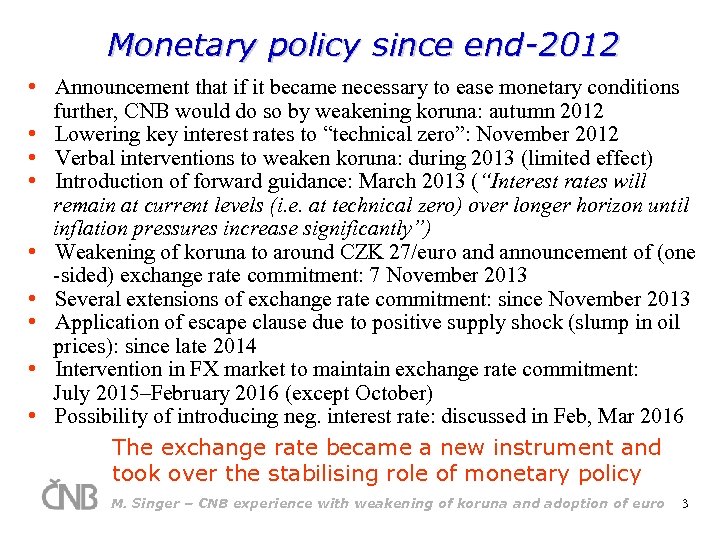
Monetary policy since end-2012 • Announcement that if it became necessary to ease monetary conditions further, CNB would do so by weakening koruna: autumn 2012 • Lowering key interest rates to “technical zero”: November 2012 • Verbal interventions to weaken koruna: during 2013 (limited effect) • Introduction of forward guidance: March 2013 (“Interest rates will remain at current levels (i. e. at technical zero) over longer horizon until inflation pressures increase significantly”) • Weakening of koruna to around CZK 27/euro and announcement of (one -sided) exchange rate commitment: 7 November 2013 • Several extensions of exchange rate commitment: since November 2013 • Application of escape clause due to positive supply shock (slump in oil prices): since late 2014 • Intervention in FX market to maintain exchange rate commitment: July 2015–February 2016 (except October) • Possibility of introducing neg. interest rate: discussed in Feb, Mar 2016 The exchange rate became a new instrument and took over the stabilising role of monetary policy M. Singer – CNB experience with weakening of koruna and adoption of euro 3
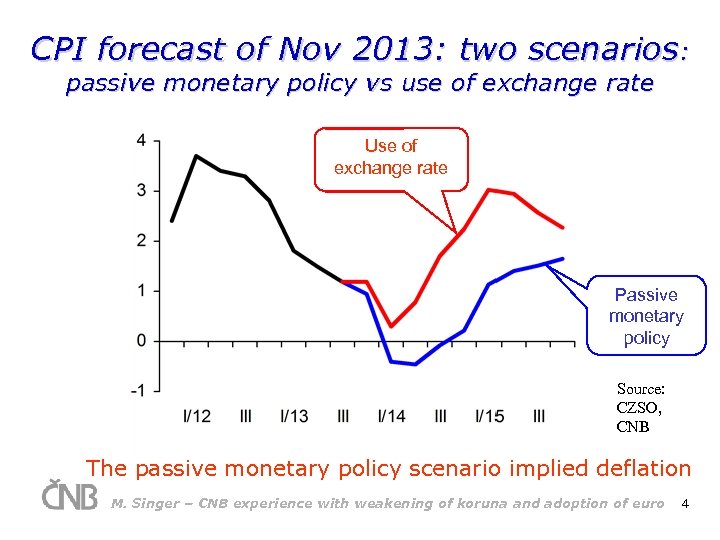
CPI forecast of Nov 2013: two scenarios: passive monetary policy vs use of exchange rate Use of exchange rate Passive monetary policy Source: CZSO, CNB The passive monetary policy scenario implied deflation M. Singer – CNB experience with weakening of koruna and adoption of euro 4
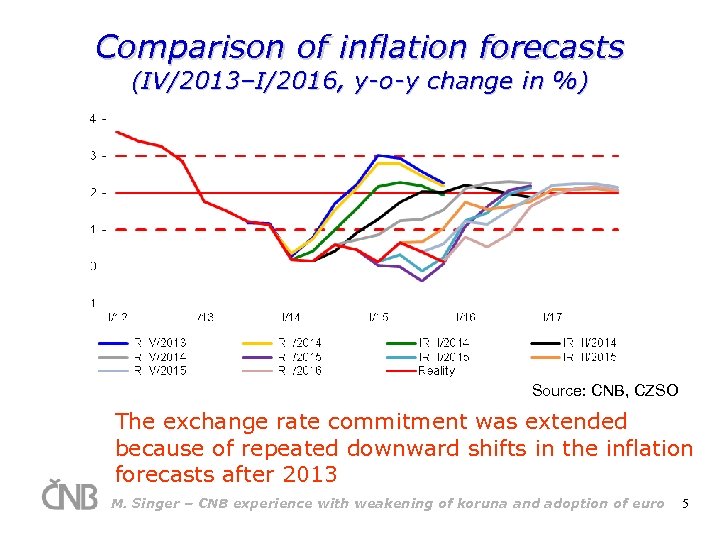
Comparison of inflation forecasts (IV/2013–I/2016, y-o-y change in %) Source: CNB, CZSO The exchange rate commitment was extended because of repeated downward shifts in the inflation forecasts after 2013 M. Singer – CNB experience with weakening of koruna and adoption of euro 5
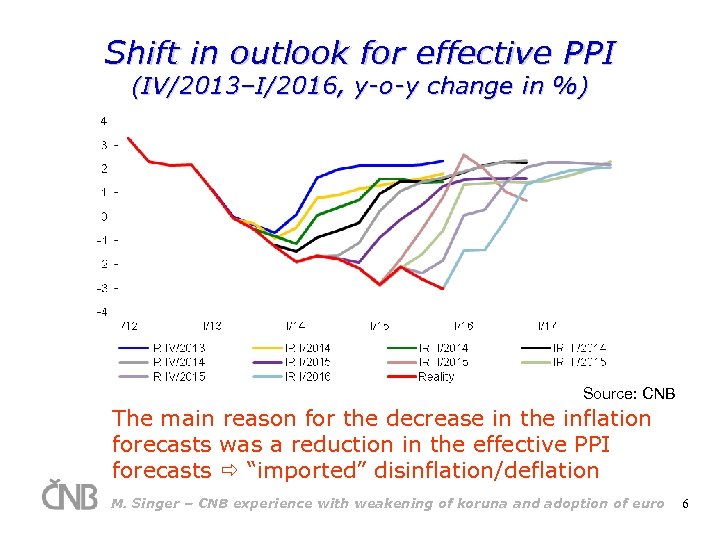
Shift in outlook for effective PPI (IV/2013–I/2016, y-o-y change in %) Source: CNB The main reason for the decrease in the inflation forecasts was a reduction in the effective PPI forecasts “imported” disinflation/deflation M. Singer – CNB experience with weakening of koruna and adoption of euro 6
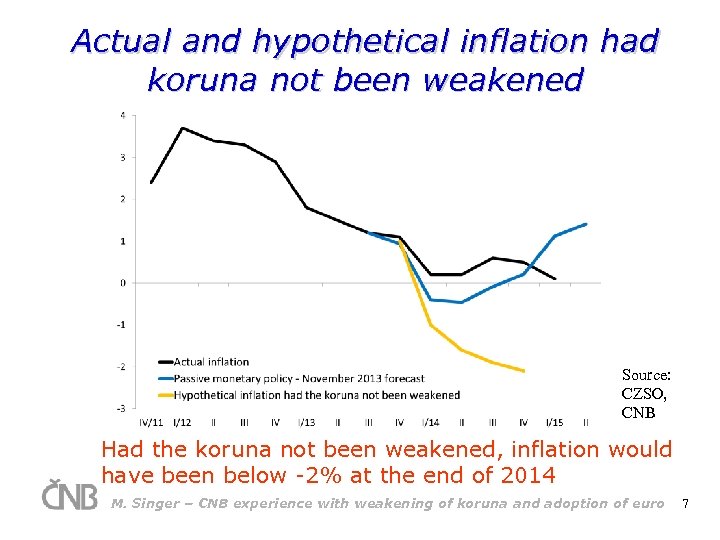
Actual and hypothetical inflation had koruna not been weakened Source: CZSO, CNB Had the koruna not been weakened, inflation would have been below -2% at the end of 2014 M. Singer – CNB experience with weakening of koruna and adoption of euro 7
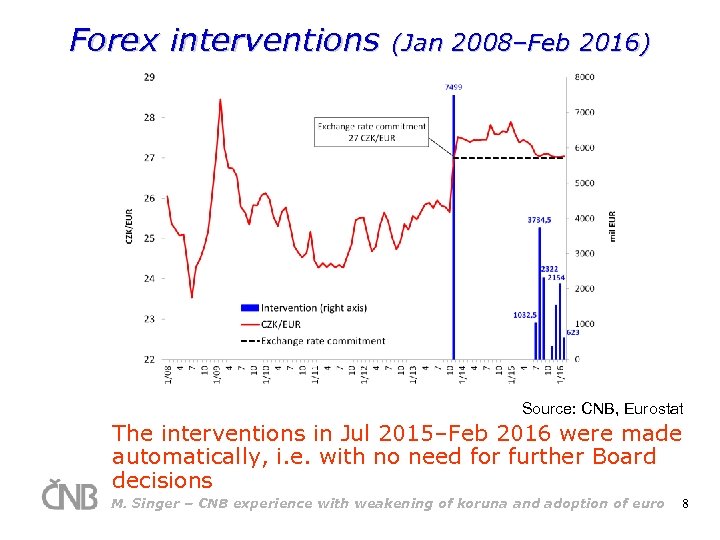
Forex interventions (Jan 2008–Feb 2016) Source: CNB, Eurostat The interventions in Jul 2015–Feb 2016 were made automatically, i. e. with no need for further Board decisions M. Singer – CNB experience with weakening of koruna and adoption of euro 8
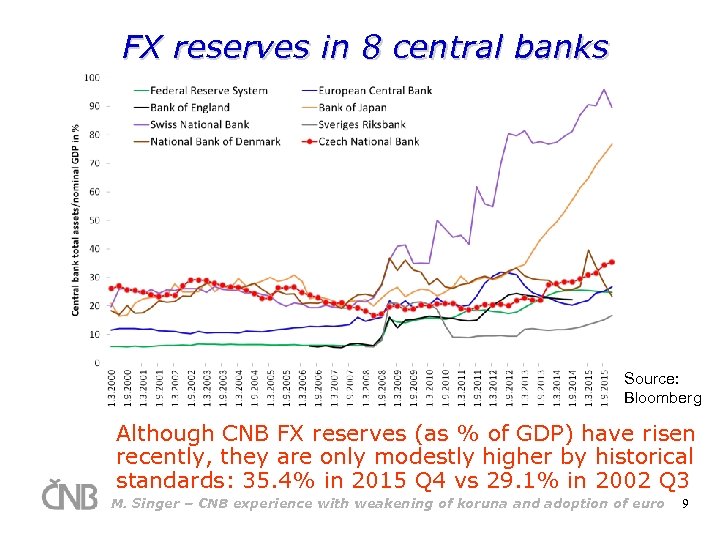
FX reserves in 8 central banks Source: Bloomberg Although CNB FX reserves (as % of GDP) have risen recently, they are only modestly higher by historical standards: 35. 4% in 2015 Q 4 vs 29. 1% in 2002 Q 3 M. Singer – CNB experience with weakening of koruna and adoption of euro 9
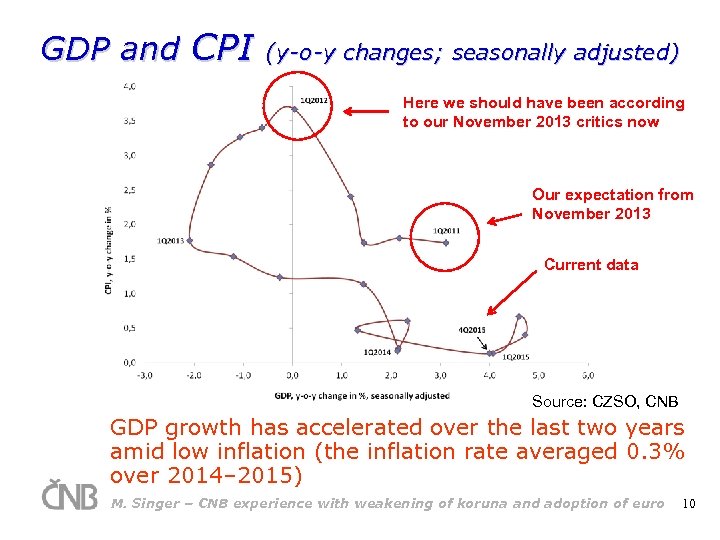
GDP and CPI (y-o-y changes; seasonally adjusted) Here we should have been according to our November 2013 critics now Our expectation from November 2013 Current data Source: CZSO, CNB GDP growth has accelerated over the last two years amid low inflation (the inflation rate averaged 0. 3% over 2014– 2015) M. Singer – CNB experience with weakening of koruna and adoption of euro 10
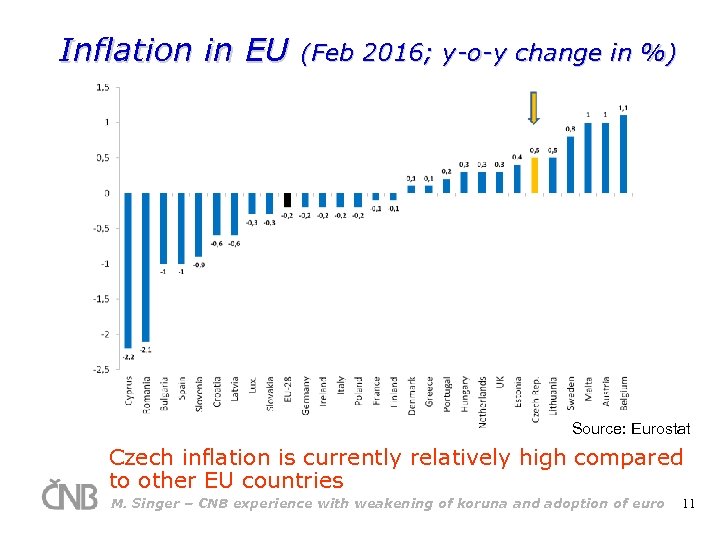
Inflation in EU (Feb 2016; y-o-y change in %) Source: Eurostat Czech inflation is currently relatively high compared to other EU countries M. Singer – CNB experience with weakening of koruna and adoption of euro 11
CNB forecast (February 2016) M. Singer – CNB experience with weakening of koruna and adoption of euro 12
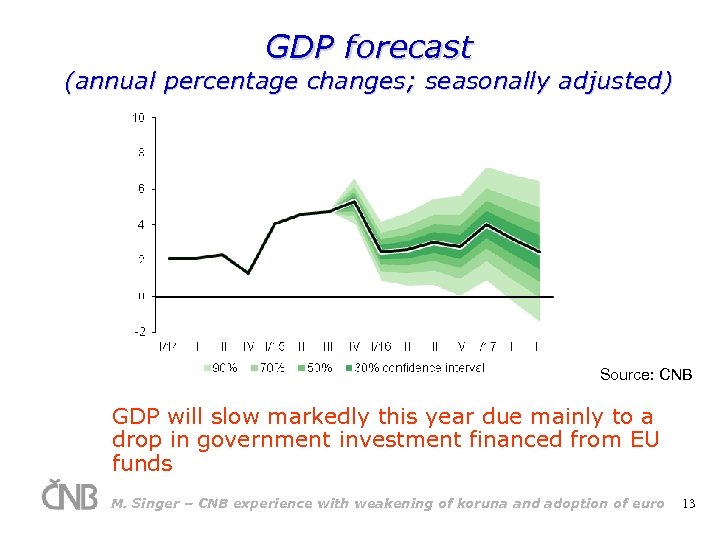
GDP forecast (annual percentage changes; seasonally adjusted) Source: CNB GDP will slow markedly this year due mainly to a drop in government investment financed from EU funds M. Singer – CNB experience with weakening of koruna and adoption of euro 13
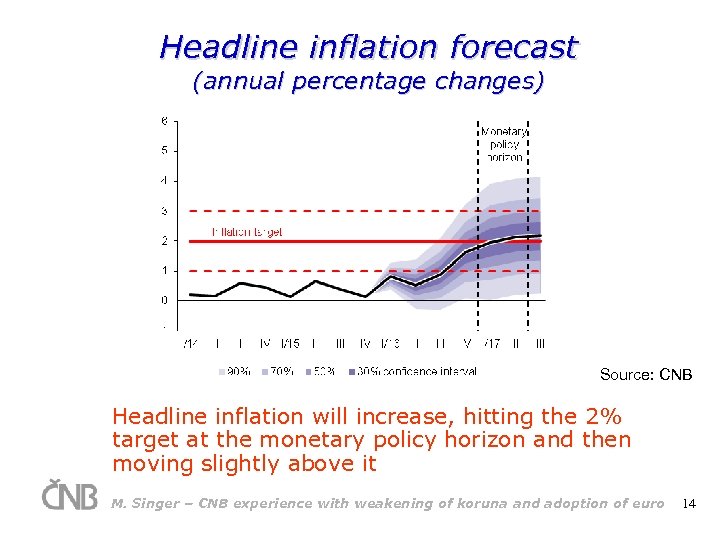
Headline inflation forecast (annual percentage changes) Source: CNB Headline inflation will increase, hitting the 2% target at the monetary policy horizon and then moving slightly above it M. Singer – CNB experience with weakening of koruna and adoption of euro 14
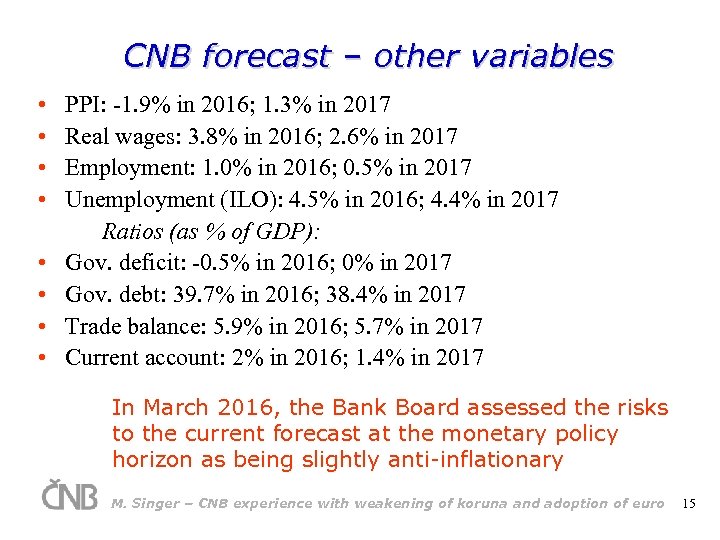
CNB forecast – other variables • • PPI: -1. 9% in 2016; 1. 3% in 2017 Real wages: 3. 8% in 2016; 2. 6% in 2017 Employment: 1. 0% in 2016; 0. 5% in 2017 Unemployment (ILO): 4. 5% in 2016; 4. 4% in 2017 Ratios (as % of GDP): Gov. deficit: -0. 5% in 2016; 0% in 2017 Gov. debt: 39. 7% in 2016; 38. 4% in 2017 Trade balance: 5. 9% in 2016; 5. 7% in 2017 Current account: 2% in 2016; 1. 4% in 2017 In March 2016, the Bank Board assessed the risks to the current forecast at the monetary policy horizon as being slightly anti-inflationary M. Singer – CNB experience with weakening of koruna and adoption of euro 15
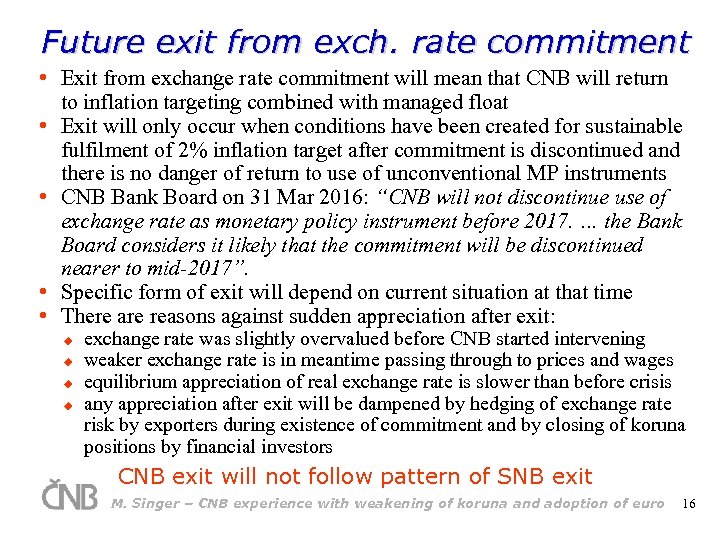
Future exit from exch. rate commitment • Exit from exchange rate commitment will mean that CNB will return to inflation targeting combined with managed float • Exit will only occur when conditions have been created for sustainable fulfilment of 2% inflation target after commitment is discontinued and there is no danger of return to use of unconventional MP instruments • CNB Bank Board on 31 Mar 2016: “CNB will not discontinue use of exchange rate as monetary policy instrument before 2017. … the Bank Board considers it likely that the commitment will be discontinued nearer to mid-2017”. • Specific form of exit will depend on current situation at that time • There are reasons against sudden appreciation after exit: u u exchange rate was slightly overvalued before CNB started intervening weaker exchange rate is in meantime passing through to prices and wages equilibrium appreciation of real exchange rate is slower than before crisis any appreciation after exit will be dampened by hedging of exchange rate risk by exporters during existence of commitment and by closing of koruna positions by financial investors CNB exit will not follow pattern of SNB exit M. Singer – CNB experience with weakening of koruna and adoption of euro 16
Euro adoption and assessment of economic alignment of Czech economy with euro area (Dec 2015) M. Singer – CNB experience with weakening of koruna and adoption of euro 17
Assessment of alignment indicators 1/2 1. Indicators that speak in long run in favour of adopting euro • High degree of openness of Czech economy • Close trade and ownership links with euro area (FDI inflows) • Alignment of business cycle with euro area cycle • Long-term alignment of inflation, nominal interest rates and exchange rate with euro area • Stable and resilient banking sector – similar transmission as in EMU 2. Areas where convergence was disrupted by crisis, but where improvement has been recorded again in recent years • Real economic convergence to euro area (renewed 2014– 2015) • Marked reduction in structural deficit in 2010– 2013 3. Areas where positive trends were disrupted by global crisis and return to convergence has yet to occur • Long-term convergence of price level (higher inflation after euro adoption could lead to low real interest rate: risk of overheating) M. Singer – CNB experience with weakening of koruna and adoption of euro 18
Assessment of alignment indicators 2/2 4. Areas which are showing long-term problems or misalignment and no significant improvement • Population ageing (risk to public finance sustainability) • Some labour market parameters: u u Relatively high implicit labour taxation (low incentive to work) Relatively low labour mobility • High share of industry in GDP (structural misalignment) • Differences in financial sector and asset structure • Estimated financial costs of joining EMU: u u Capital deposit in European Stability Mechanism (ESM): CZK 51 billion within four years (with additional contingent liability of up to CZK 390 billion) Transfer of contributions of banks registered in CZ to Single Resolution Fund (SRF): CZK 25 billion over eight years Preparedness of CZ to adopt euro has improved on previous years, but still cannot be assessed as sufficient not attempt to enter ERM II in 2016 M. Singer – CNB experience with weakening of koruna and adoption of euro 19
Summary • CNB started to use unconventional tools after Nov 2012 due to sustained disinflation from abroad • Weakening of koruna prevented deflation and was one of factors of recovery two and half years on we assess it as success • CNB intervened in Jul 2015–Feb 2016 to maintain its ER commitment • Czech economy was growing fast in 2015; drivers: easy monetary conditions, sharp rise in gov. investment, external demand, low oil prices • Sustainable fulfilment of target will occur 2017 H 1 (Feb 2016 forecast) • CNB will not discontinue use of exchange rate as monetary policy instrument before 2017; likely that commitment will be discontinued nearer to mid-2017 • Alignment analyses: CZ not yet ready to adopt euro • Costs of EMU membership for CZ are unclear due to unfinished changes in institutional architecture of euro area The Czech economy experienced non-inflationary growth in 2015; growth will decelerate to a still decent pace and inflation will accelerate during 2016 M. Singer – CNB experience with weakening of koruna and adoption of euro 20
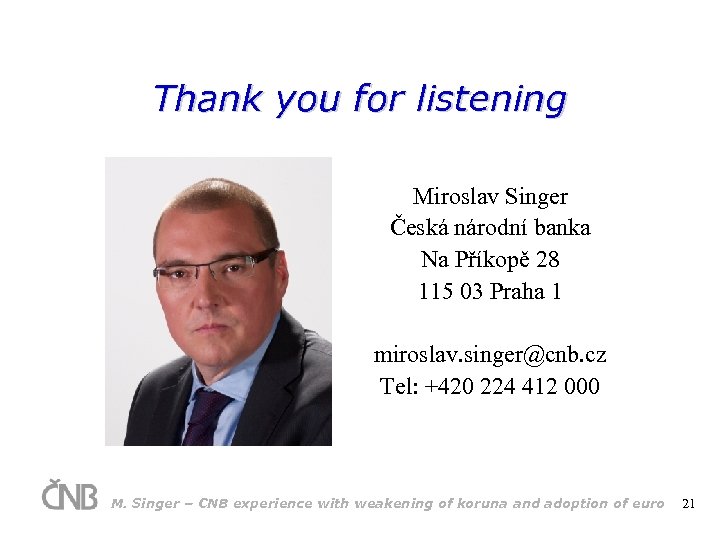
Thank you for listening Miroslav Singer Česká národní banka Na Příkopě 28 115 03 Praha 1 miroslav. singer@cnb. cz Tel: +420 224 412 000 M. Singer – CNB experience with weakening of koruna and adoption of euro 21
Скачать презентацию CNB experience with weakening of koruna and adoption
5a9df2722d8b92327be7b69ce438cdc4.ppt