 Скачать презентацию CMU SCS 15 -826 Multimedia Databases and Data
abd94a7d9129e6df7bdb0dd77a381936.ppt
- Количество слайдов: 31



CMU SCS 15 -826: Multimedia Databases and Data Mining Lecture #30: Data Mining - assoc. rules C. Faloutsos
CMU SCS Must-read Material • Rakesh Agrawal, Tomasz Imielinski and Arun Swami Mining Association Rules Between Sets of Items in Large Databases Proc. ACM SIGMOD, Washington, DC, May 1993, pp. 207 -216 15 -826 Copyright: C. Faloutsos (2014) 2
CMU SCS Outline Goal: ‘Find similar / interesting things’ • Intro to DB • Indexing - similarity search • Data Mining –… – Association Rules 15 -826 Copyright: C. Faloutsos (2014) 3
![CMU SCS Association rules - outline • • Main idea [Agrawal+SIGMOD 93] performance improvements](https://present5.com/presentation/abd94a7d9129e6df7bdb0dd77a381936/image-4.jpg "CMU SCS Association rules - outline • • Main idea [Agrawal+SIGMOD 93] performance improvements")
CMU SCS Association rules - outline • • Main idea [Agrawal+SIGMOD 93] performance improvements Variations / Applications Follow-up concepts 15 -826 Copyright: C. Faloutsos (2014) 4
![CMU SCS Association rules - idea [Agrawal+SIGMOD 93] • Consider ‘market basket’ case: (milk,](https://present5.com/presentation/abd94a7d9129e6df7bdb0dd77a381936/image-5.jpg "CMU SCS Association rules - idea [Agrawal+SIGMOD 93] • Consider ‘market basket’ case: (milk,")
CMU SCS Association rules - idea [Agrawal+SIGMOD 93] • Consider ‘market basket’ case: (milk, bread) (milk, chocolate) (milk, bread) • Find ‘interesting things’, eg. , rules of the form: milk, bread -> chocolate | 90% 15 -826 Copyright: C. Faloutsos (2014) 5
CMU SCS Association rules - idea In general, for a given rule Ij, Ik, . . . Im -> Ix | c ‘c’ = ‘confidence’ (how often people by Ix, given that they have bought Ij, . . . Im ‘s’ = support: how often people buy Ij, . . . Im, Ix 15 -826 Copyright: C. Faloutsos (2014) 6
CMU SCS Association rules - idea Problem definition: • given – a set of ‘market baskets’ (=binary matrix, of N rows/baskets and M columns/products) – min-support ‘s’ and – min-confidence ‘c’ • find – all the rules with higher support and confidence 15 -826 Copyright: C. Faloutsos (2014) 7
CMU SCS Association rules - idea Closely related concept: “large itemset” Ij, Ik, . . . Im, Ix is a ‘large itemset’, if it appears more than ‘minsupport’ times Observation: once we have a ‘large itemset’, we can find out the qualifying rules easily (how? ) Thus, let’s focus on how to find ‘large itemsets’ 15 -826 Copyright: C. Faloutsos (2014) 8
CMU SCS Association rules - idea Naive solution: scan database once; keep 2**|I| counters Drawback? Improvement? 15 -826 Copyright: C. Faloutsos (2014) 9
CMU SCS Association rules - idea Naive solution: scan database once; keep 2**|I| counters Drawback? 2**1000 is prohibitive. . . Improvement? scan the db |I| times, looking for 1 -, 2 -, etc itemsets Eg. , for |I|=3 items only (A, B, C), we have 15 -826 Copyright: C. Faloutsos (2014) 10
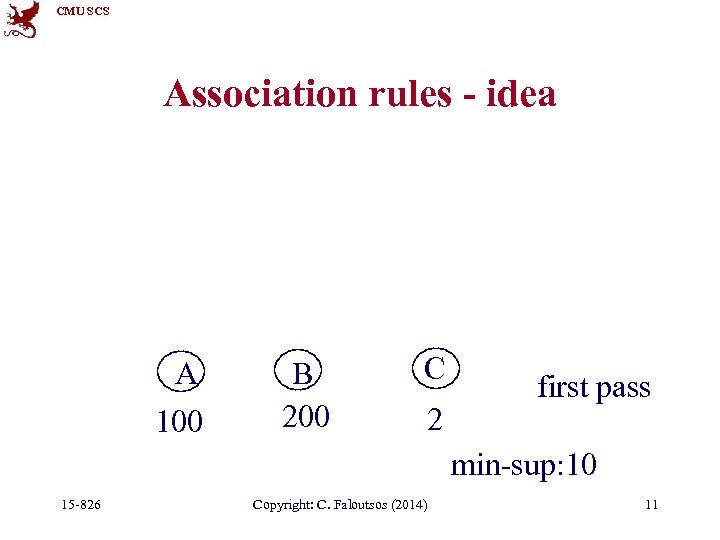
CMU SCS Association rules - idea A 100 B 200 C 2 first pass min-sup: 10 15 -826 Copyright: C. Faloutsos (2014) 11
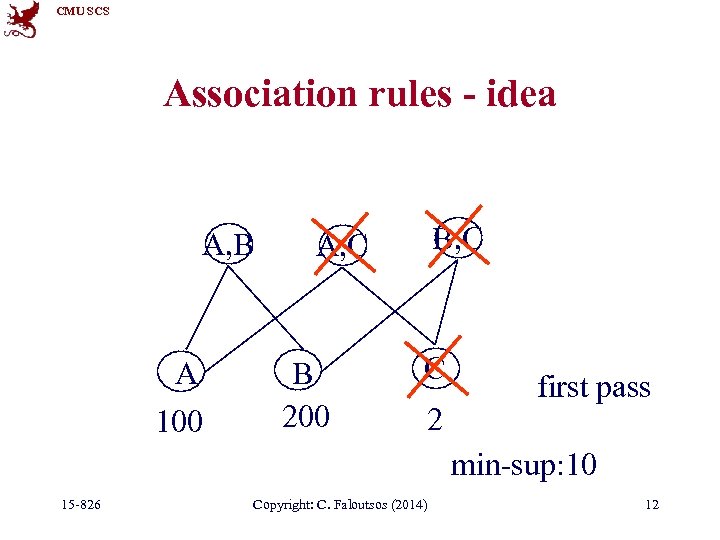
CMU SCS Association rules - idea A, B A 100 B, C A, C B 200 C 2 first pass min-sup: 10 15 -826 Copyright: C. Faloutsos (2014) 12
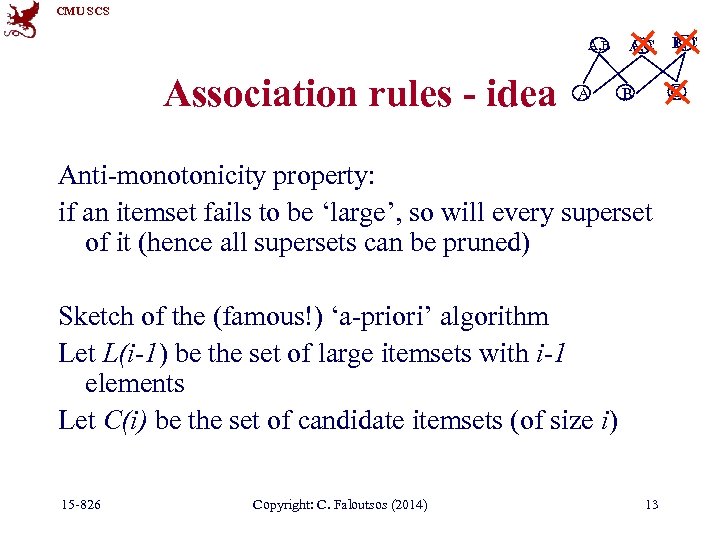
CMU SCS A, B Association rules - idea A A, C C B Anti-monotonicity property: if an itemset fails to be ‘large’, so will every superset of it (hence all supersets can be pruned) Sketch of the (famous!) ‘a-priori’ algorithm Let L(i-1) be the set of large itemsets with i-1 elements Let C(i) be the set of candidate itemsets (of size i) 15 -826 Copyright: C. Faloutsos (2014) B, C 13
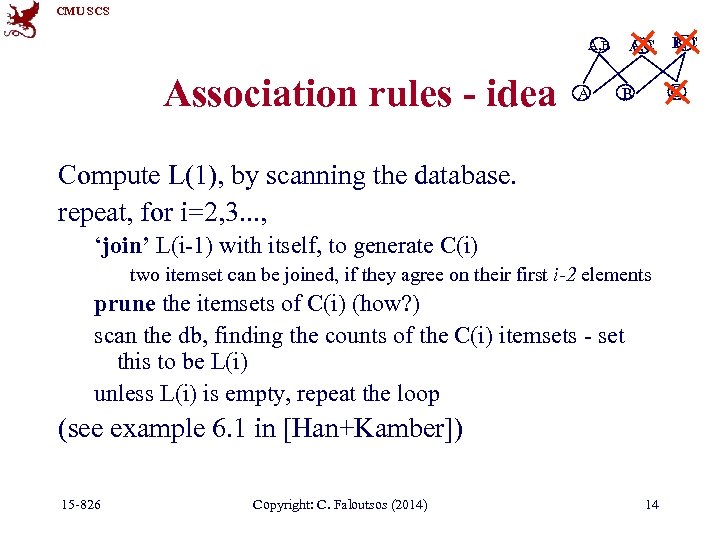
CMU SCS A, C A, B Association rules - idea A C B Compute L(1), by scanning the database. repeat, for i=2, 3. . . , ‘join’ L(i-1) with itself, to generate C(i) two itemset can be joined, if they agree on their first i-2 elements prune the itemsets of C(i) (how? ) scan the db, finding the counts of the C(i) itemsets - set this to be L(i) unless L(i) is empty, repeat the loop (see example 6. 1 in [Han+Kamber]) 15 -826 Copyright: C. Faloutsos (2014) B, C 14
![CMU SCS Association rules - outline • • Main idea [Agrawal+SIGMOD 93] performance improvements](https://present5.com/presentation/abd94a7d9129e6df7bdb0dd77a381936/image-15.jpg "CMU SCS Association rules - outline • • Main idea [Agrawal+SIGMOD 93] performance improvements")
CMU SCS Association rules - outline • • Main idea [Agrawal+SIGMOD 93] performance improvements Variations / Applications Follow-up concepts 15 -826 Copyright: C. Faloutsos (2014) 15
CMU SCS Association rules improvements • Use the independence assumption, to second-guess large itemsets a few steps ahead • eliminate ‘market baskets’, that don’t contain any more large itemsets • Partitioning (eg. , for parallelism): find ‘local large itemsets’, and merge. • Sampling • report only ‘maximal large itemsets’ (dfn? ) • FP-tree (seems to be the fastest) 15 -826 Copyright: C. Faloutsos (2014) 16
CMU SCS Association rules improvements details • FP-tree: no candidate itemset generation - only two passes over dataset • Main idea: build a TRIE in main memory Specifically: • first pass, to find counts of each item - sort items in decreasing count order • second pass: build the TRIE, and update its counts (eg. , let A, B, C, D be the items in frequency order: ) 15 -826 Copyright: C. Faloutsos (2014) 17
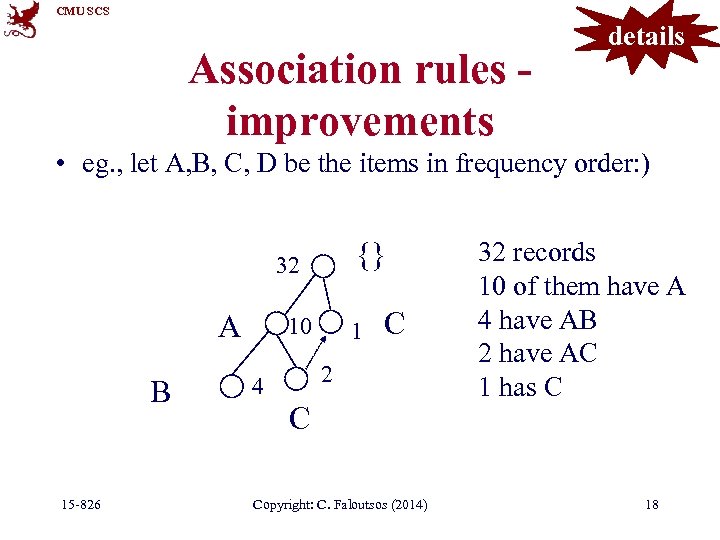
CMU SCS Association rules improvements details • eg. , let A, B, C, D be the items in frequency order: ) {} 32 A B 15 -826 10 1 C 2 4 C Copyright: C. Faloutsos (2014) 32 records 10 of them have A 4 have AB 2 have AC 1 has C 18
CMU SCS Association rules improvements details • Traversing the TRIE, we can find the large itemsets (details: in [Han+Kamber, § 6. 2. 4]) • Result: much faster than ‘a-priori’ (order of magnitude) 15 -826 Copyright: C. Faloutsos (2014) 19
![CMU SCS Association rules - outline • • Main idea [Agrawal+SIGMOD 93] performance improvements](https://present5.com/presentation/abd94a7d9129e6df7bdb0dd77a381936/image-20.jpg "CMU SCS Association rules - outline • • Main idea [Agrawal+SIGMOD 93] performance improvements")
CMU SCS Association rules - outline • • Main idea [Agrawal+SIGMOD 93] performance improvements Variations / Applications Follow-up concepts 15 -826 Copyright: C. Faloutsos (2014) 20
CMU SCS Association rules - variations 1) Multi-level rules: given concept hierarchy • ‘bread’, ‘milk’, ‘butter’-> foods; • ‘aspirin’, ‘tylenol’ -> pharmacy look for rules across any level of the hierarchy, eg ‘aspirin’ -> foods (similarly, rules across dimensions, like ‘product’, ‘time’, ‘branch’: ‘bread’, ‘ 12 noon’, ‘PGH-branch’ -> ‘milk’ 15 -826 Copyright: C. Faloutsos (2014) 21
CMU SCS Association rules - variations 2) Sequential patterns: ‘car’, ‘now’ -> ‘tires’, ‘ 2 months later’ Also: given a stream of (time-stamped) events: A A B A C. . . find rules like B, A -> C [Mannila+KDD 97] 15 -826 Copyright: C. Faloutsos (2014) 22
CMU SCS Association rules - variations 3) Spatial rules, eg: ‘house close to lake’ -> ‘expensive’ 15 -826 Copyright: C. Faloutsos (2014) 23
CMU SCS Association rules - variations 4) Quantitative rules, eg: ‘age between 20 and 30’, ‘chol. level <150’ -> ‘weight > 150 lb’ Ie. , given numerical attributes, how to find rules? 15 -826 Copyright: C. Faloutsos (2014) 24
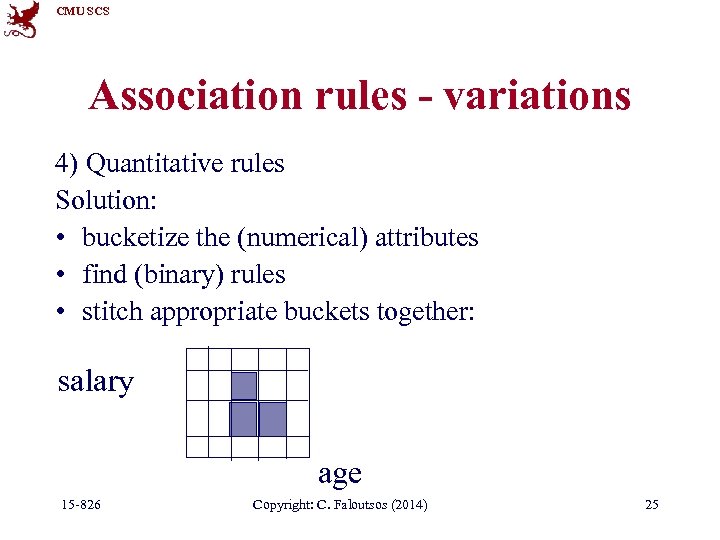
CMU SCS Association rules - variations 4) Quantitative rules Solution: • bucketize the (numerical) attributes • find (binary) rules • stitch appropriate buckets together: salary age 15 -826 Copyright: C. Faloutsos (2014) 25
![CMU SCS Association rules - outline • • Main idea [Agrawal+SIGMOD 93] performance improvements](https://present5.com/presentation/abd94a7d9129e6df7bdb0dd77a381936/image-26.jpg "CMU SCS Association rules - outline • • Main idea [Agrawal+SIGMOD 93] performance improvements")
CMU SCS Association rules - outline • • Main idea [Agrawal+SIGMOD 93] performance improvements Variations / Applications Follow-up concepts 15 -826 Copyright: C. Faloutsos (2014) 26
CMU SCS Association rules - follow-up concepts Associations rules vs. correlation. Motivation: if milk, bread is a ‘large itemset’, does this means that there is a positive correlation between ‘milk’ and ‘bread’ sales? 15 -826 Copyright: C. Faloutsos (2014) 27
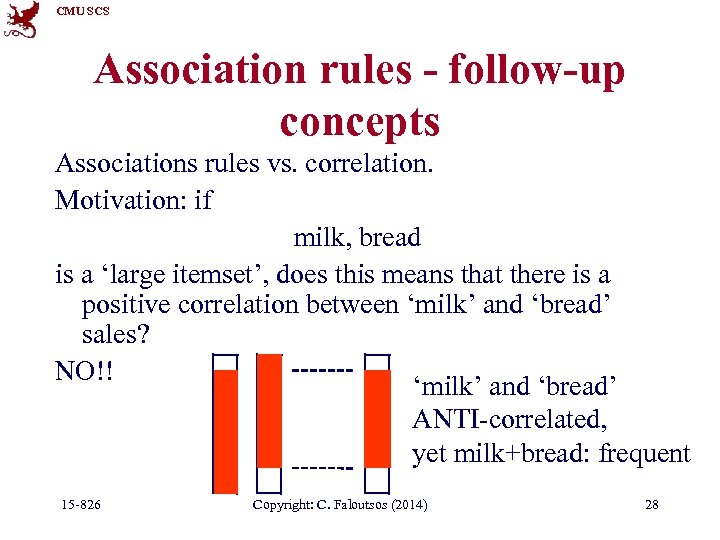
CMU SCS Association rules - follow-up concepts Associations rules vs. correlation. Motivation: if milk, bread is a ‘large itemset’, does this means that there is a positive correlation between ‘milk’ and ‘bread’ sales? NO!! ‘milk’ and ‘bread’ ANTI-correlated, yet milk+bread: frequent 15 -826 Copyright: C. Faloutsos (2014) 28
CMU SCS Association rules - follow-up concepts What to do, then? 15 -826 Copyright: C. Faloutsos (2014) 29
CMU SCS Association rules - follow-up concepts What to do, then? A: report only pairs of items that are indeed correlated - ie, they pass the Chi-square test The idea can be extended to 3 -, 4 - etc itemsets (but becomes more expensive to check) See [Han+Kamber, § 6. 5], or [Brin+, SIGMOD 97] 15 -826 Copyright: C. Faloutsos (2014) 30
CMU SCS Association rules - Conclusions Association rules: a new tool to find patterns • easy to understand its output • fine-tuned algorithms exist 15 -826 Copyright: C. Faloutsos (2014) 31
Скачать презентацию CMU SCS 15 -826 Multimedia Databases and Data
abd94a7d9129e6df7bdb0dd77a381936.ppt