


 Скачать презентацию CMS Infection Control Standards Hospitals Need to Know
3a4b3beff30fd40f02ff5dfdd5fcc65f.ppt
- Количество слайдов: 148
 CMS Infection Control Standards Hospitals Need to Know About the Infection Control Interpretive Guidelines What Hospitals Need to Know.
 Speaker Sue Dill Calloway RN, Esq AD, BA, BSN, MSN, JD CPHRM, CCMSCP President of Patient Safety and Health Care Consulting Board Member Emergency Medicine Foundation www. empsf. org 614 791 -1468 sdill 1@columbus. rr. com 2
 You Don’t Want One of These 3 / 40
 The Conditions of Participation (Co. Ps) § Regulations first published in 1986 § Manual updated June 7, 2013 and 437 pages § Revised discharge planning standards published May 27, 2013 are not in manual § First regulations are published in the Federal Register then CMS publishes the Interpretive Guidelines and some have survey procedures 2 § Hospitals should check this website once a month for changes 1 www. gpoaccess. gov/fr/index. html 4 2 www. cms. hhs. gov/Survey. Certification. Gen. Info/PMSR/list. asp
 The Conditions of Participation (Co. Ps) § Regulations first published in 1986 § Manual updated August 30, 2013 and 457 pages § Many changes since regulations first published § First regulations are published in the Federal Register then CMS publishes the Interpretive Guidelines and some have survey procedures 2 § Hospitals should check this website once a month for changes 1 www. gpoaccess. gov/fr/index. html 5 2 www. cms. hhs. gov/Survey. Certification. Gen. Info/PMSR/list. asp
 The Conditions of Participation (Co. Ps) § The manual is known as the conditions of participation or the Co. Ps for short § The Co. P sections are called tag numbers § They go from Tag 0001 to 1164 § All the sections contain a tag number so it is easy to go back and look up that section if you want to read more about it § There are currently 457 pages in the current manual § There were changes in the Federal Register went into effect July 16, 2012 and IG issued March 15, 2013 and effective June 7, 2013 6
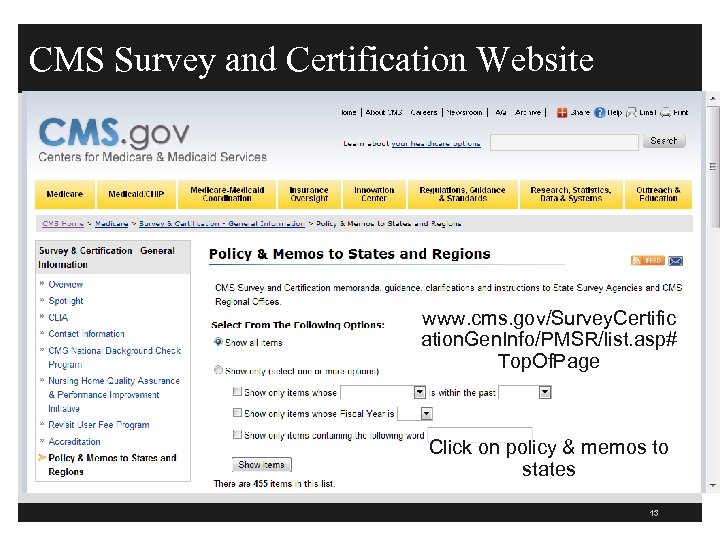
 How to Keep Up with Changes § First, periodically check to see you have the most current Co. P manual 1 § Once a month go out and check the survey and certification website as discussed previously 2 § Once a month check the CMS transmittal page 3 § CMS reserves right to tinker with the language in survey memo and when final will publish it as a transmittal § Have one person in your facility who has this responsibility § 1 § 2 http: //www. cms. gov/Survey. Certification. Gen. Info/PMSR/list. asp#Top. Of. Page § 3 http: //www. cms. gov/Transmittals http: //www. cms. hhs. gov/manuals/downloads/som 107_Appendicestoc. pdf 7
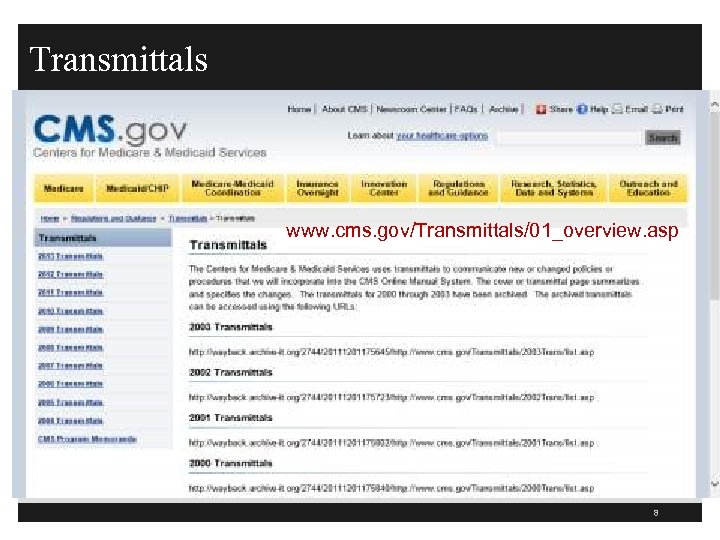 Transmittals www. cms. gov/Transmittals/01_overview. asp 8
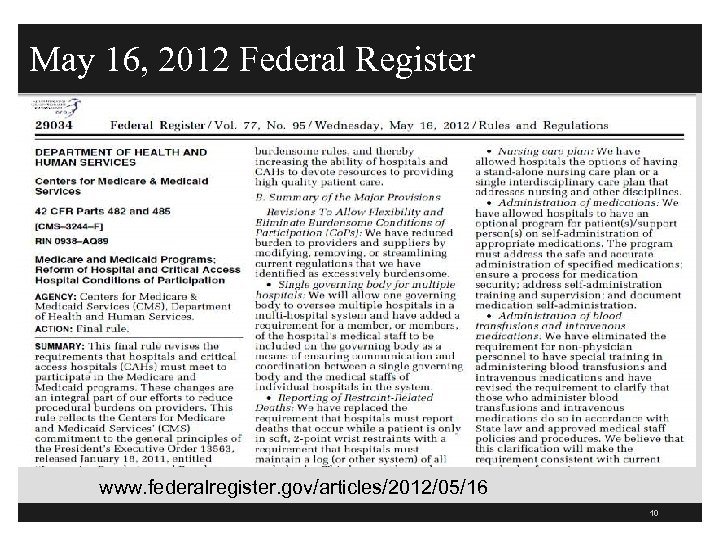
 CMS Issues Final Regulation § CMS publishes 165 page final regulations changing the CMS Co. P § Published in the May 16, 2012 Federal Register § CMS publishes to reduce the regulatory burden on hospitals-more than two dozen changes § States will save healthcare providers over 5 billion over five years § FR effective 60 days of publication so went into effect on July 16, 2012, IG issued 3 -15 -2013 and effective June 7, 2013 § Eliminated the infection control log under Tag 750 § Available at www. ofr. gov/inspection. aspx 9
 May 16, 2012 Federal Register www. federalregister. gov/articles/2012/05/16 10
 Location of CMS Hospital Co. P Manuals new address www. cms. hhs. gov/manuals/downloads/som 107_Appendixtoc. pdf 11
 CMS Hospital Co. P Manual www. cms. hhs. gov/manuals/d ownloads/som 107_Appendix toc. pdf 12
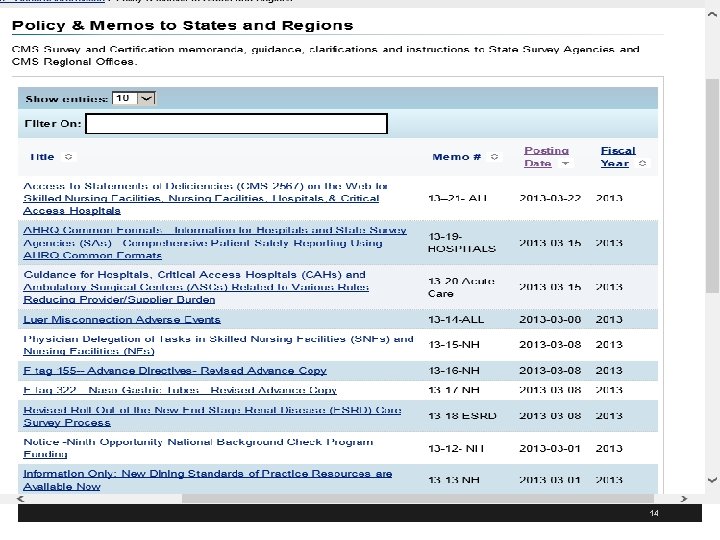
 CMS Survey and Certification Website www. cms. gov/Survey. Certific ation. Gen. Info/PMSR/list. asp# Top. Of. Page Click on policy & memos to states 13
 14
14
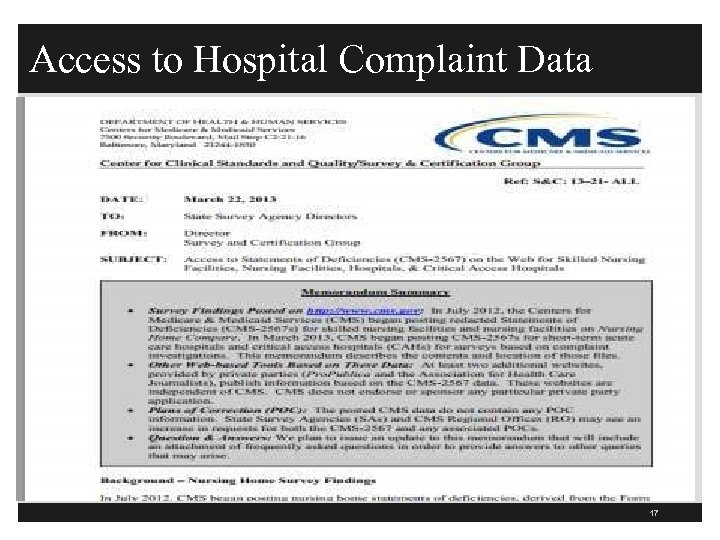
 Access to Hospital Complaint Data § CMS issued Survey and Certification memo on March 22, 2013 regarding access to hospital complaint data § Includes acute care and CAH hospitals § Does not include the plan of correction but can request § Questions to bettercare@cms. hhs. com § This is the CMS 2567 deficiency data and lists the tag numbers § Will update quarterly and updated November 2013 § Available under downloads on the hospital website at www. cms. gov 15
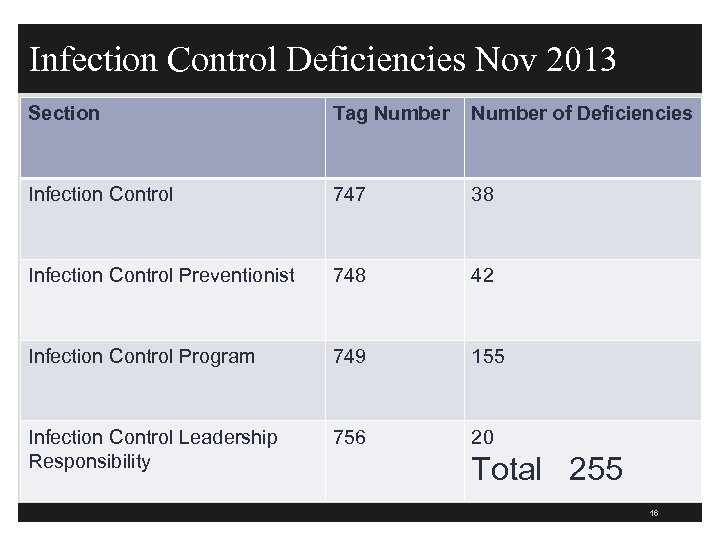 Infection Control Deficiencies Nov 2013 Section Tag Number of Deficiencies Infection Control 747 38 Infection Control Preventionist 748 42 Infection Control Program 749 155 Infection Control Leadership Responsibility 756 20 Total 255 16
 Access to Hospital Complaint Data 17
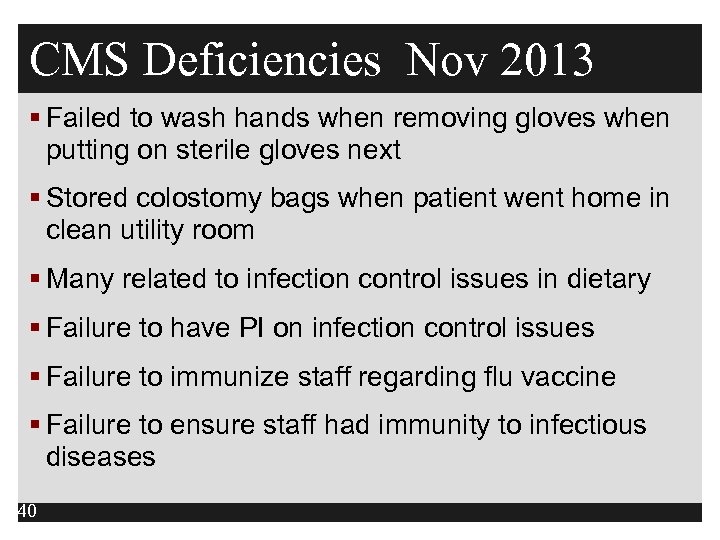 CMS Deficiencies Nov 2013 § Failed to wash hands when removing gloves when putting on sterile gloves next § Stored colostomy bags when patient went home in clean utility room § Many related to infection control issues in dietary § Failure to have PI on infection control issues § Failure to immunize staff regarding flu vaccine § Failure to ensure staff had immunity to infectious diseases / 40
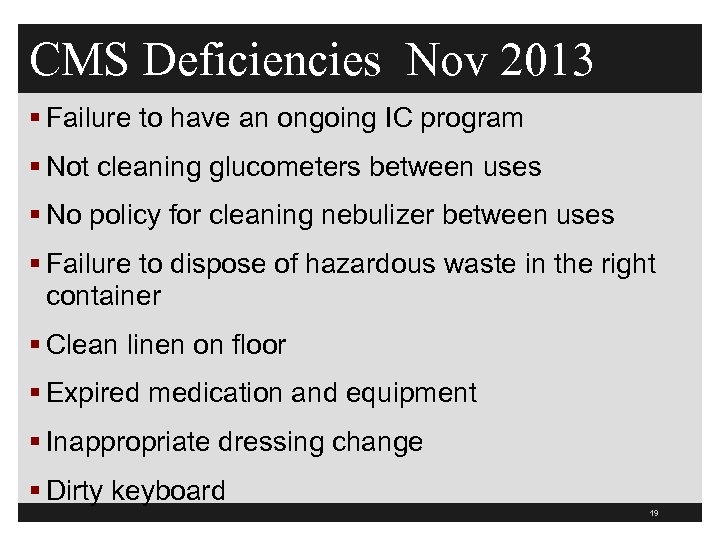 CMS Deficiencies Nov 2013 § Failure to have an ongoing IC program § Not cleaning glucometers between uses § No policy for cleaning nebulizer between uses § Failure to dispose of hazardous waste in the right container § Clean linen on floor § Expired medication and equipment § Inappropriate dressing change § Dirty keyboard 19
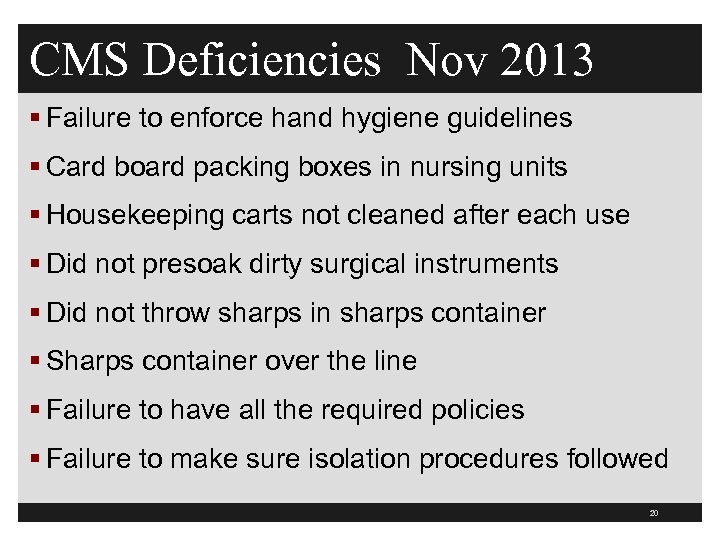 CMS Deficiencies Nov 2013 § Failure to enforce hand hygiene guidelines § Card board packing boxes in nursing units § Housekeeping carts not cleaned after each use § Did not presoak dirty surgical instruments § Did not throw sharps in sharps container § Sharps container over the line § Failure to have all the required policies § Failure to make sure isolation procedures followed 20
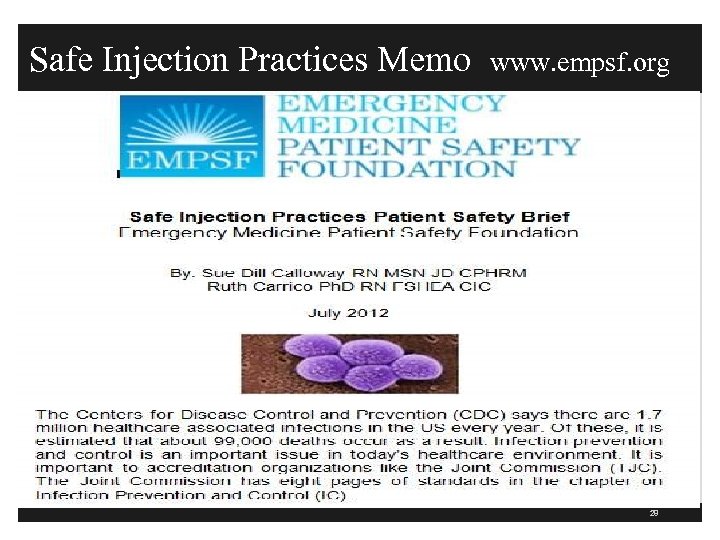
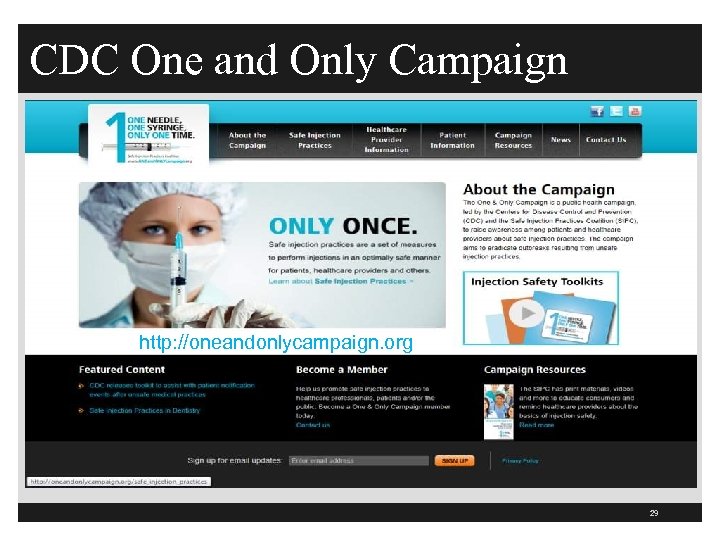
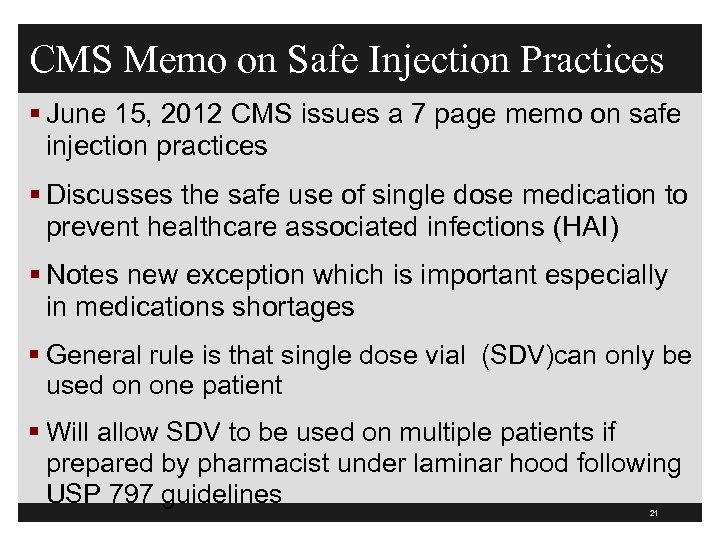 CMS Memo on Safe Injection Practices § June 15, 2012 CMS issues a 7 page memo on safe injection practices § Discusses the safe use of single dose medication to prevent healthcare associated infections (HAI) § Notes new exception which is important especially in medications shortages § General rule is that single dose vial (SDV)can only be used on one patient § Will allow SDV to be used on multiple patients if prepared by pharmacist under laminar hood following USP 797 guidelines 21
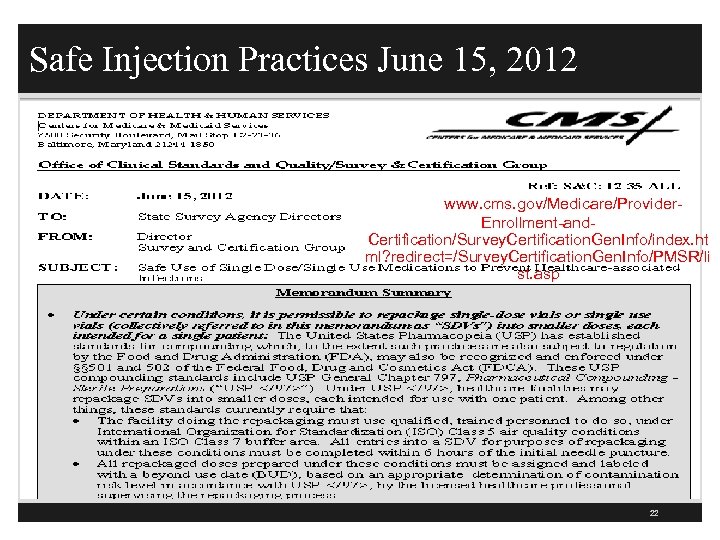 Safe Injection Practices June 15, 2012 http: //www. cms. gov/Medicare/Provider- Enrollment-and. Certification/Survey. Certification. Gen. Info/index. ht ml? redirect=/Survey. Certification. Gen. Info/PMSR/li st. asp 22
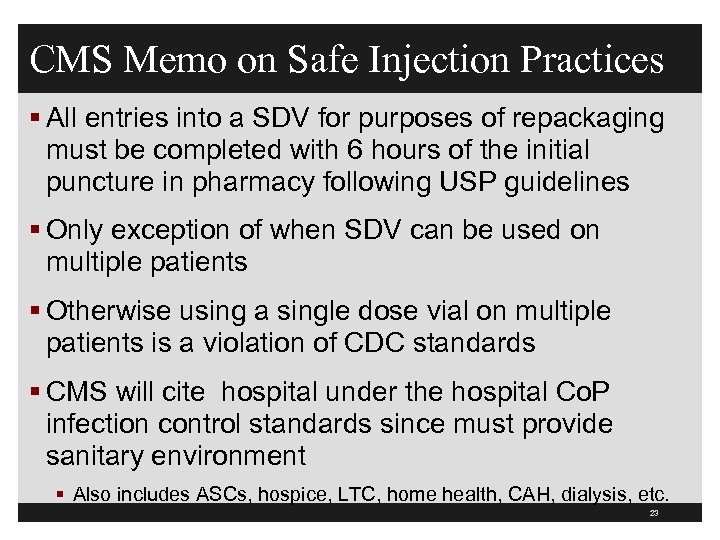 CMS Memo on Safe Injection Practices § All entries into a SDV for purposes of repackaging must be completed with 6 hours of the initial puncture in pharmacy following USP guidelines § Only exception of when SDV can be used on multiple patients § Otherwise using a single dose vial on multiple patients is a violation of CDC standards § CMS will cite hospital under the hospital Co. P infection control standards since must provide sanitary environment § Also includes ASCs, hospice, LTC, home health, CAH, dialysis, etc. 23
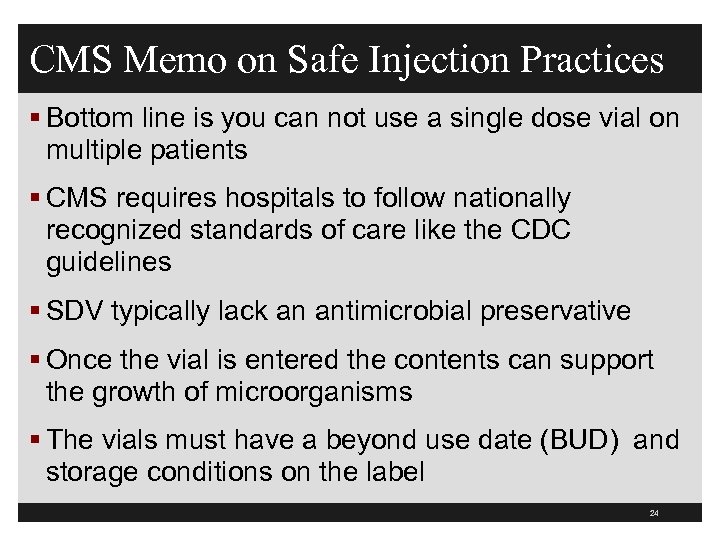 CMS Memo on Safe Injection Practices § Bottom line is you can not use a single dose vial on multiple patients § CMS requires hospitals to follow nationally recognized standards of care like the CDC guidelines § SDV typically lack an antimicrobial preservative § Once the vial is entered the contents can support the growth of microorganisms § The vials must have a beyond use date (BUD) and storage conditions on the label 24
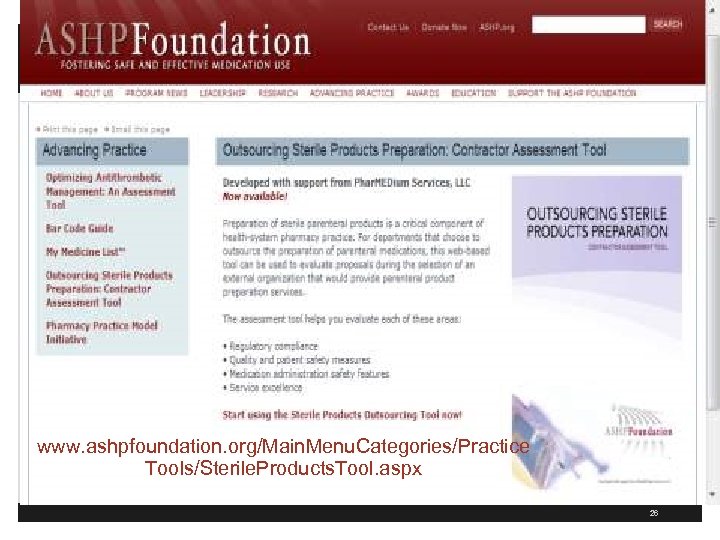
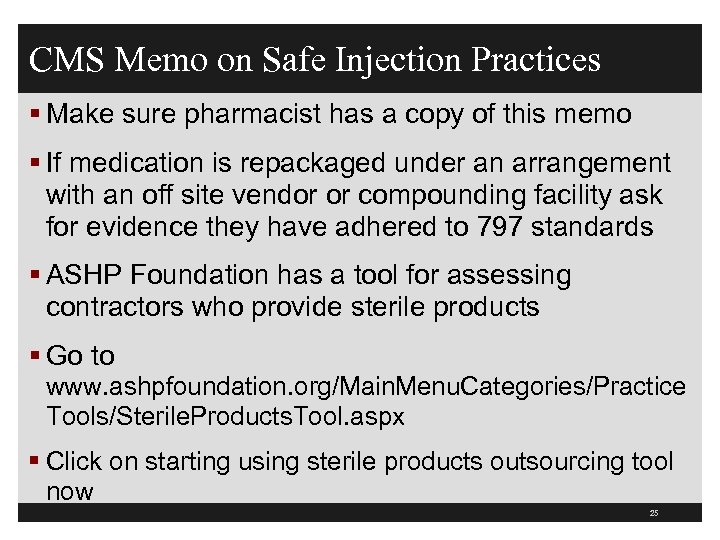 CMS Memo on Safe Injection Practices § Make sure pharmacist has a copy of this memo § If medication is repackaged under an arrangement with an off site vendor or compounding facility ask for evidence they have adhered to 797 standards § ASHP Foundation has a tool for assessing contractors who provide sterile products § Go to www. ashpfoundation. org/Main. Menu. Categories/Practice Tools/Sterile. Products. Tool. aspx § Click on starting using sterile products outsourcing tool now 25
 www. ashpfoundation. org/Main. Menu. Categories/Practice Tools/Sterile. Products. Tool. aspx 26
 Not All Vials Are Created Equal 27
 Safe Injection Practices Memo www. empsf. org 28
 CDC One and Only Campaign http: //oneandonlycampaign. org/ 29
 Watch Award Winning Video Safe Injection Practices - How to Do It Right www. youtube. com/watch? v=6 D 0 st. Moz 80 k&feature=youtu. b 30
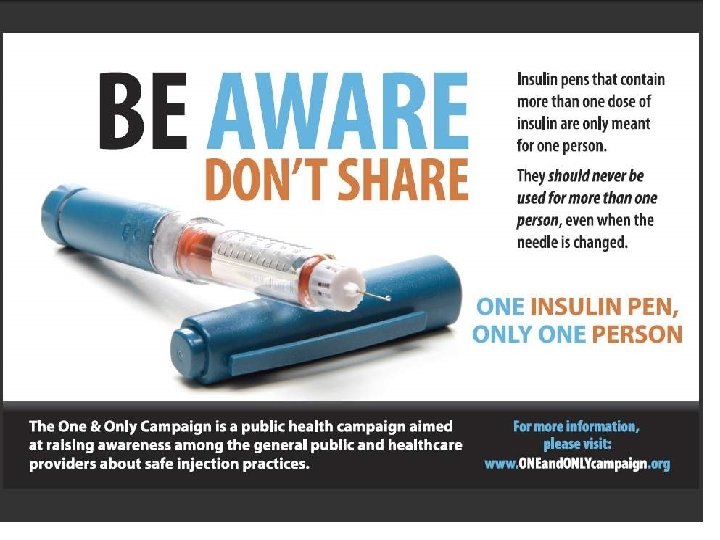
 CMS Memo on Insulin Pens § CMS issues memo on insulin pens on May 18, 2012 § Insulin pens are intended to be used on one patient only § CMS notes that some healthcare providers are not aware of this § Insulin pens were used on more than one patient which is like sharing needles § Every patient must have their own insulin pen § Insulin pens must be marked with the patient’s name 31
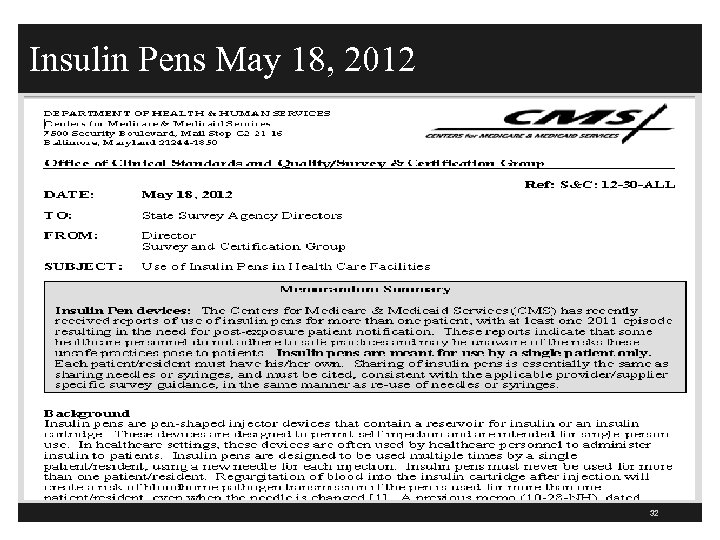 Insulin Pens May 18, 2012 32
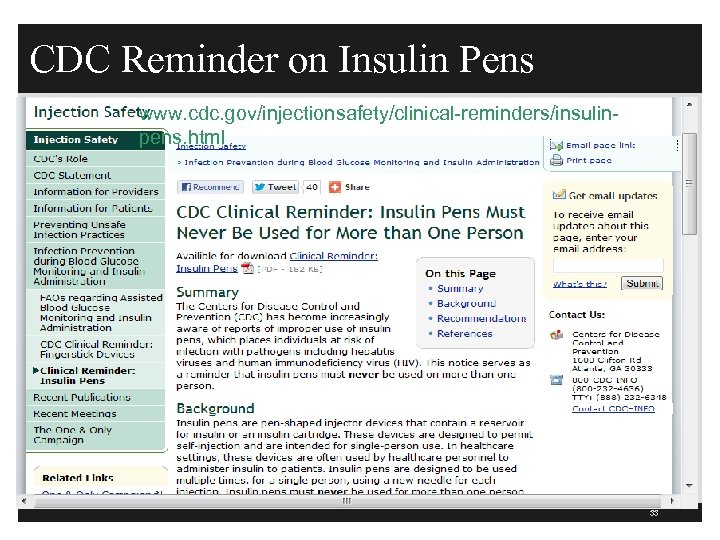 CDC Reminder on Insulin Pens www. cdc. gov/injectionsafety/clinical-reminders/insulinpens. html 33
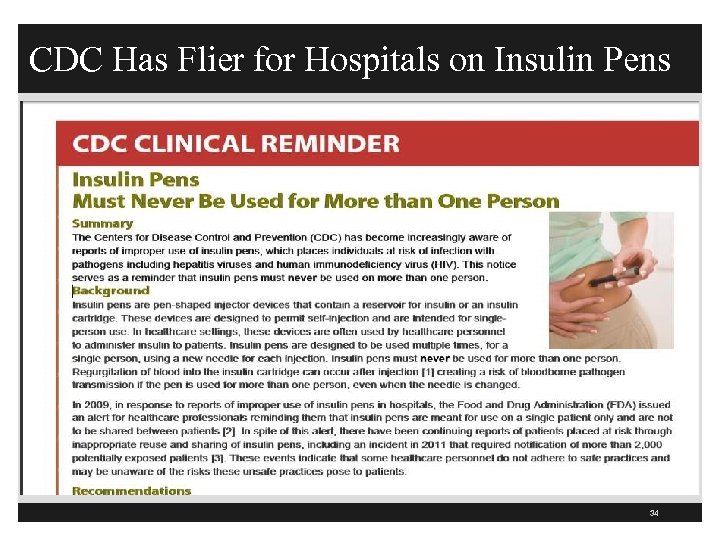 CDC Has Flier for Hospitals on Insulin Pens 34
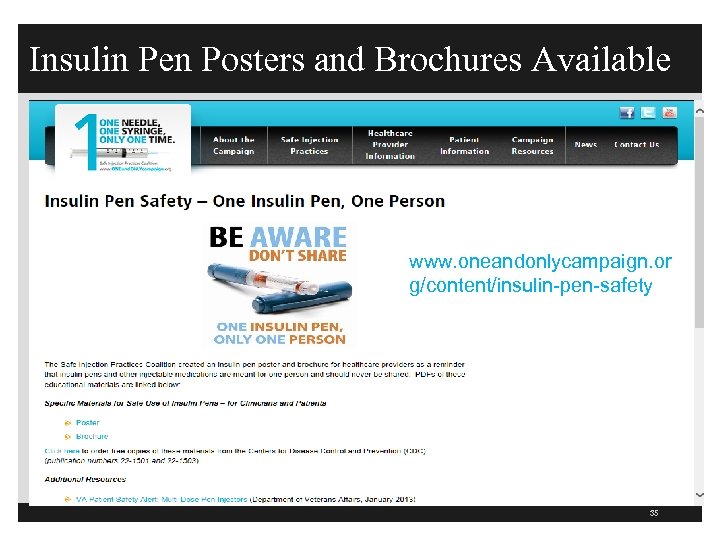 Insulin Pen Posters and Brochures Available www. oneandonlycampaign. or g/content/insulin-pen-safety 35
 36
36
 CMS Worksheets Infection Control Short Summary
 CMS Hospital Worksheets Third Revision § October 14, 2011 CMS issues a 137 page memo in the survey and certification section § Memo discusses surveyor worksheets for hospitals by CMS during a hospital survey § Addresses discharge planning, infection control, and QAPI § It was pilot tested in hospitals in 11 states and on May 18, 2012 CMS published a second revised edition § Piloted test each of the 3 in every state over summer 2012 § November 9, 2012 CMS issued the third revised worksheet which is now 88 pages 38
 CMS Hospital Worksheets § Will select hospitals in each state and will complete all 3 worksheets at each hospital § This is the third and most likely final pilot and in 2014 will use whenever a survey is done such as a validation survey is done at a hospital by CMS § Third pilot is non-punitive and will not require action plans unless immediate jeopardy is found § Hospitals should be familiar with the three worksheets 39
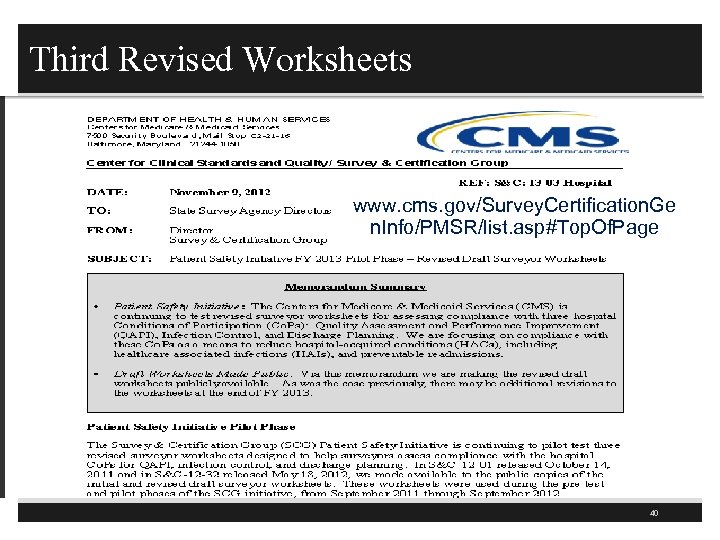 Third Revised Worksheets www. cms. gov/Survey. Certification. Ge n. Info/PMSR/list. asp#Top. Of. Page 40
 CMS Hospital Worksheets § The regulations are the basis for any deficiencies that may be cited and not the worksheet per se § The worksheets are designed to assist the surveyors and the hospital staff to identify when they are in compliance § Will not affect critical access hospitals (CAHs) but CAH would want to look over the on PI and especially infection control § Questions or concerns should be addressed to Mary Ellen Palowitch PFP. SCG@cms. hhs. gov 41
 42
42
 43
43
 44
44
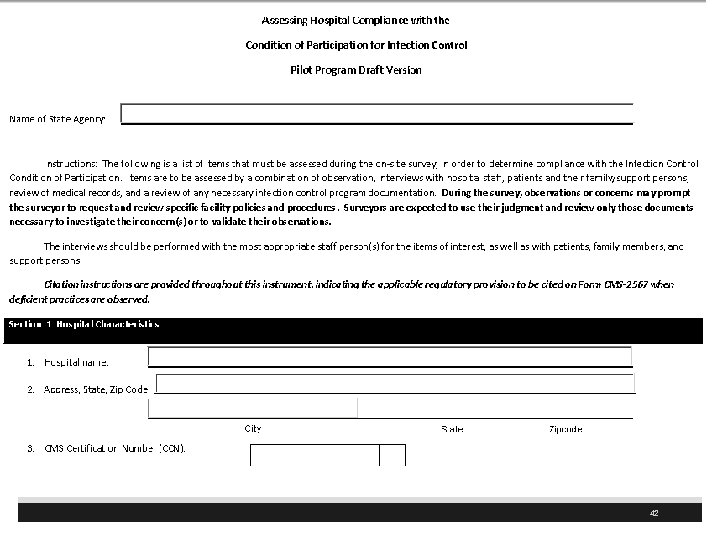
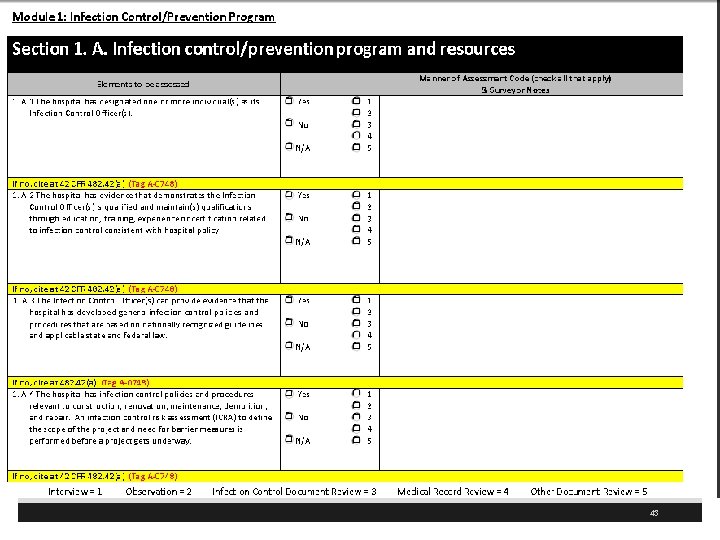
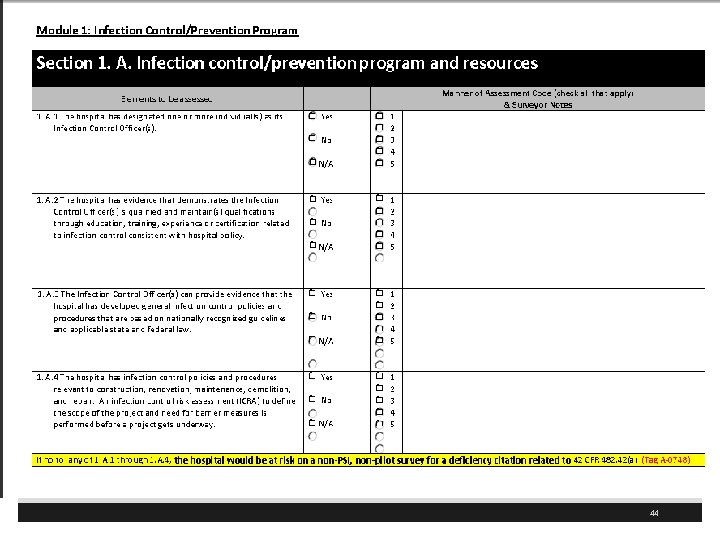
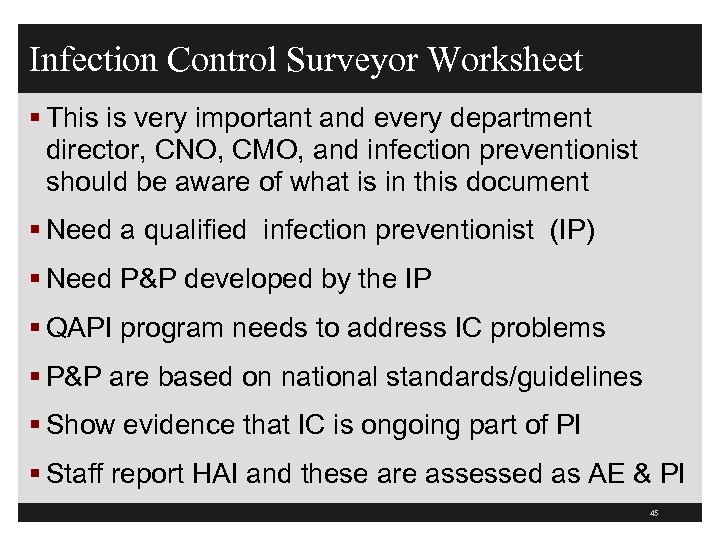 Infection Control Surveyor Worksheet § This is very important and every department director, CNO, CMO, and infection preventionist should be aware of what is in this document § Need a qualified infection preventionist (IP) § Need P&P developed by the IP § QAPI program needs to address IC problems § P&P are based on national standards/guidelines § Show evidence that IC is ongoing part of PI § Staff report HAI and these are assessed as AE & PI 45
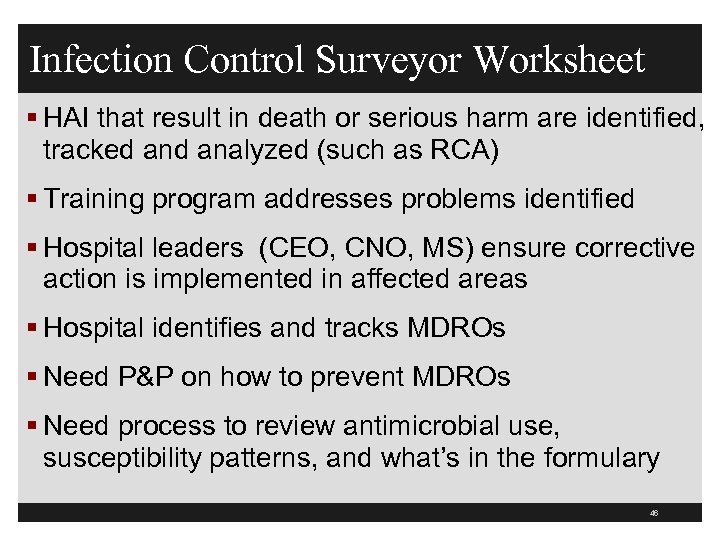 Infection Control Surveyor Worksheet § HAI that result in death or serious harm are identified, tracked analyzed (such as RCA) § Training program addresses problems identified § Hospital leaders (CEO, CNO, MS) ensure corrective action is implemented in affected areas § Hospital identifies and tracks MDROs § Need P&P on how to prevent MDROs § Need process to review antimicrobial use, susceptibility patterns, and what’s in the formulary 46
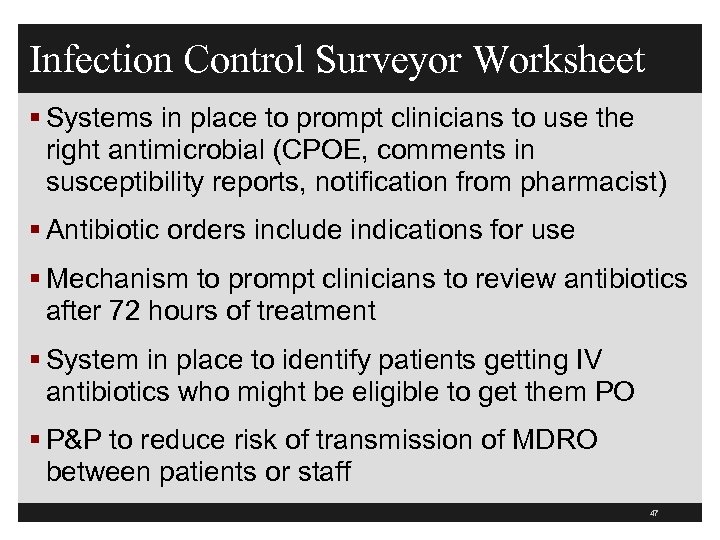 Infection Control Surveyor Worksheet § Systems in place to prompt clinicians to use the right antimicrobial (CPOE, comments in susceptibility reports, notification from pharmacist) § Antibiotic orders include indications for use § Mechanism to prompt clinicians to review antibiotics after 72 hours of treatment § System in place to identify patients getting IV antibiotics who might be eligible to get them PO § P&P to reduce risk of transmission of MDRO between patients or staff 47
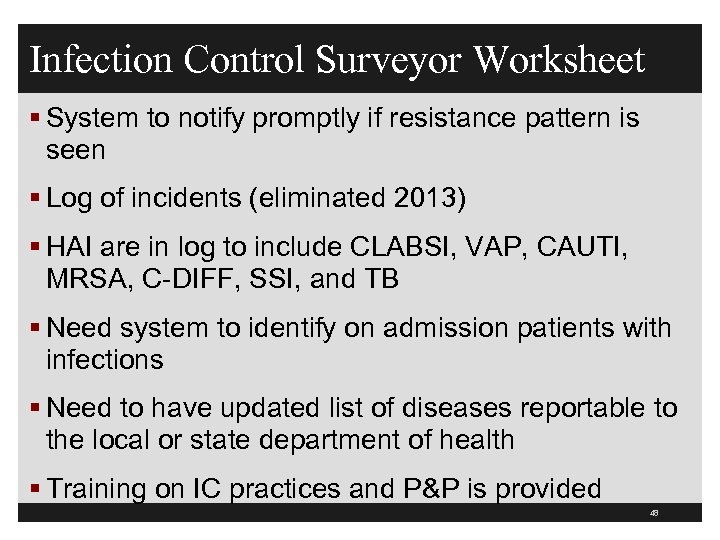 Infection Control Surveyor Worksheet § System to notify promptly if resistance pattern is seen § Log of incidents (eliminated 2013) § HAI are in log to include CLABSI, VAP, CAUTI, MRSA, C-DIFF, SSI, and TB § Need system to identify on admission patients with infections § Need to have updated list of diseases reportable to the local or state department of health § Training on IC practices and P&P is provided 48
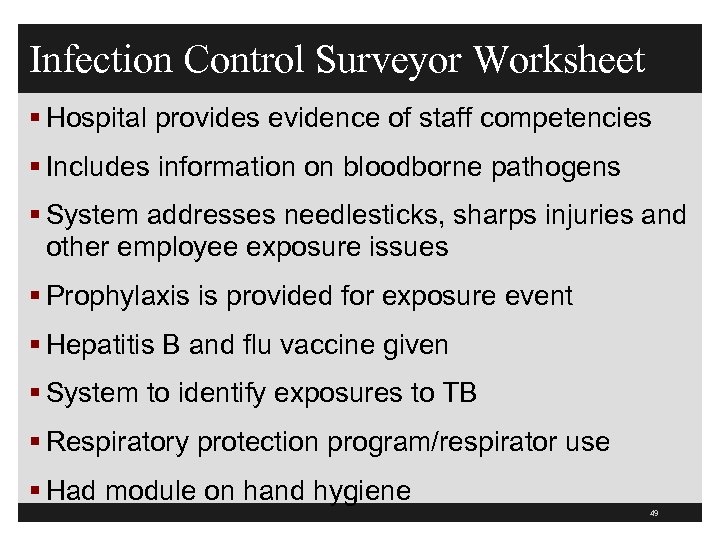 Infection Control Surveyor Worksheet § Hospital provides evidence of staff competencies § Includes information on bloodborne pathogens § System addresses needlesticks, sharps injuries and other employee exposure issues § Prophylaxis is provided for exposure event § Hepatitis B and flu vaccine given § System to identify exposures to TB § Respiratory protection program/respirator use § Had module on hand hygiene 49
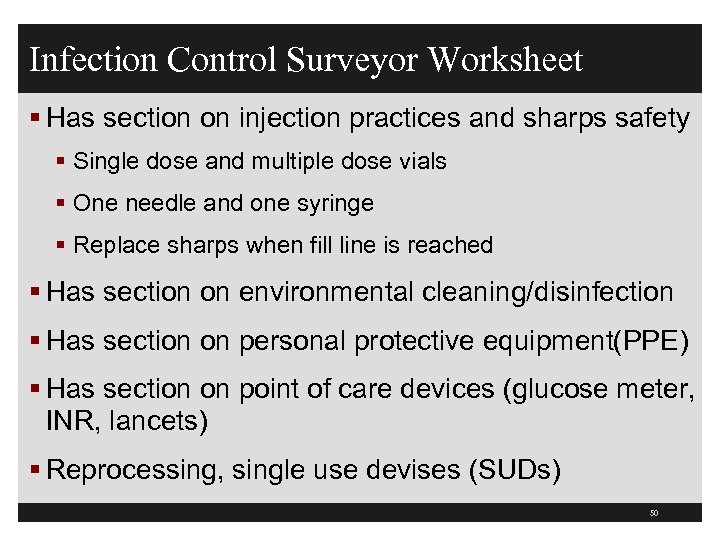 Infection Control Surveyor Worksheet § Has section on injection practices and sharps safety § Single dose and multiple dose vials § One needle and one syringe § Replace sharps when fill line is reached § Has section on environmental cleaning/disinfection § Has section on personal protective equipment(PPE) § Has section on point of care devices (glucose meter, INR, lancets) § Reprocessing, single use devises (SUDs) 50
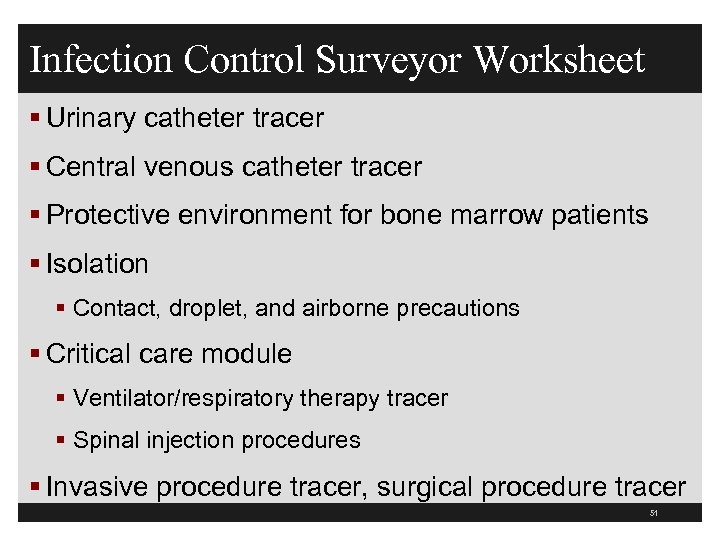 Infection Control Surveyor Worksheet § Urinary catheter tracer § Central venous catheter tracer § Protective environment for bone marrow patients § Isolation § Contact, droplet, and airborne precautions § Critical care module § Ventilator/respiratory therapy tracer § Spinal injection procedures § Invasive procedure tracer, surgical procedure tracer 51
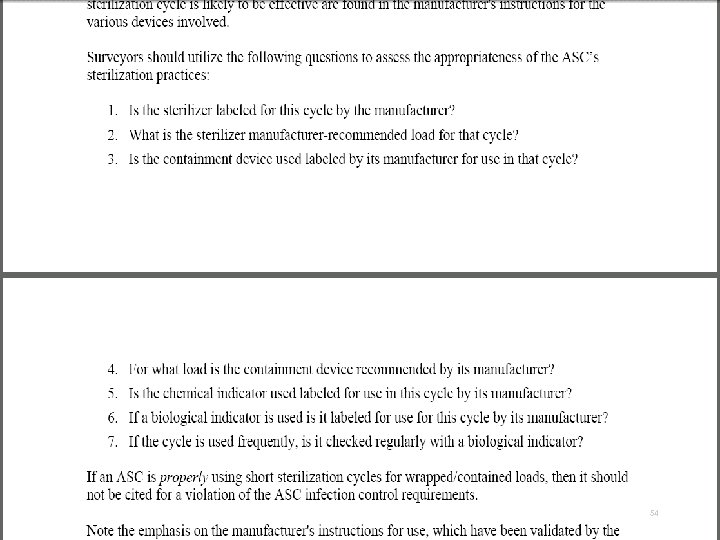
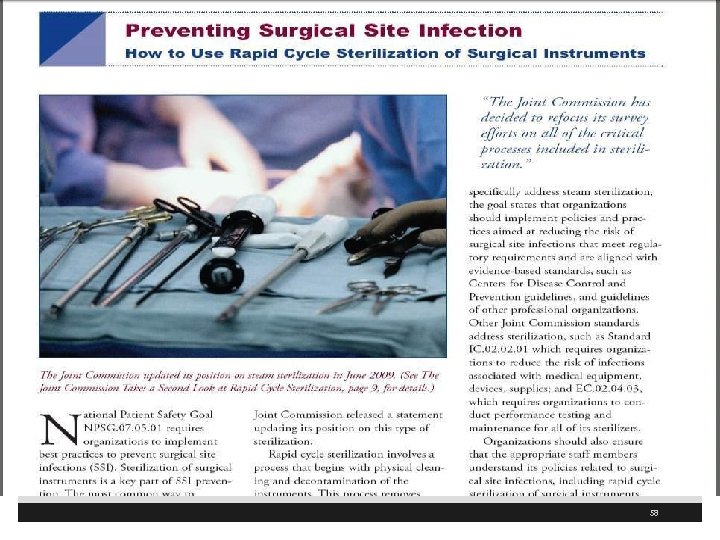
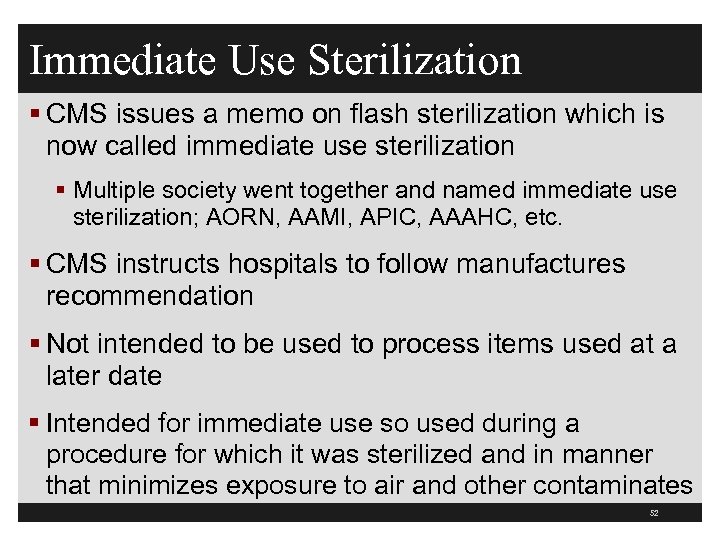 Immediate Use Sterilization § CMS issues a memo on flash sterilization which is now called immediate use sterilization § Multiple society went together and named immediate use sterilization; AORN, AAMI, APIC, AAAHC, etc. § CMS instructs hospitals to follow manufactures recommendation § Not intended to be used to process items used at a later date § Intended for immediate use so used during a procedure for which it was sterilized and in manner that minimizes exposure to air and other contaminates 52
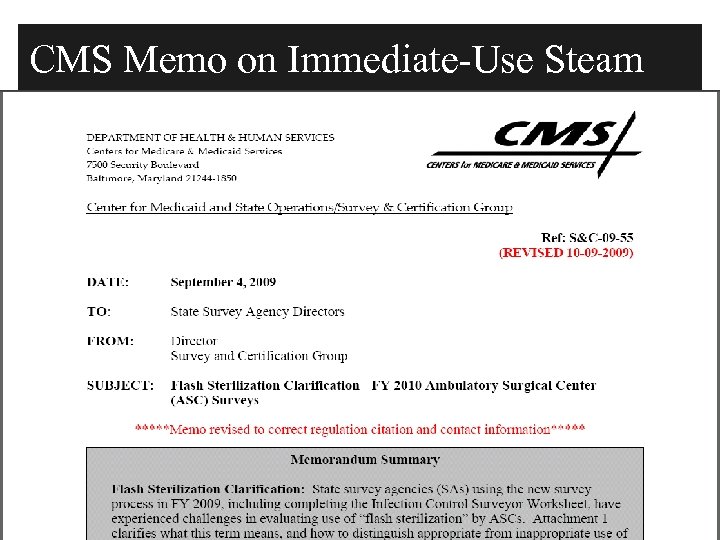 CMS Memo on Immediate-Use Steam 53 / 40
 54 / 40
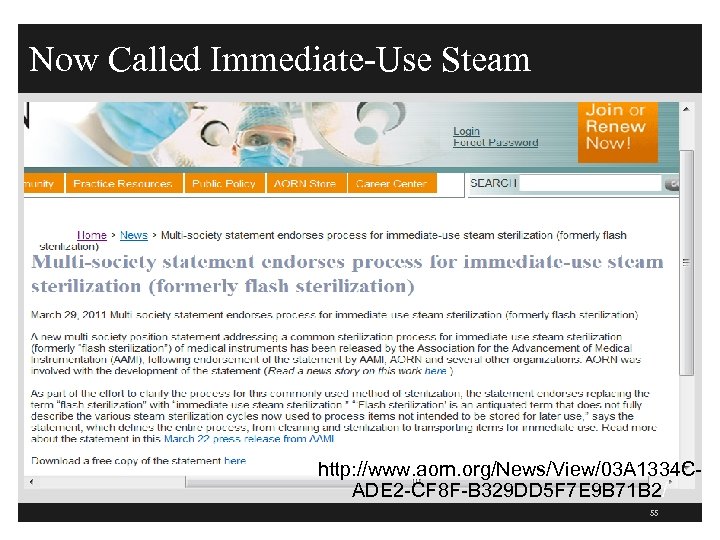 Now Called Immediate-Use Steam http: //www. aorn. org/News/View/03 A 1334 CADE 2 -CF 8 F-B 329 DD 5 F 7 E 9 B 71 B 2/ 55
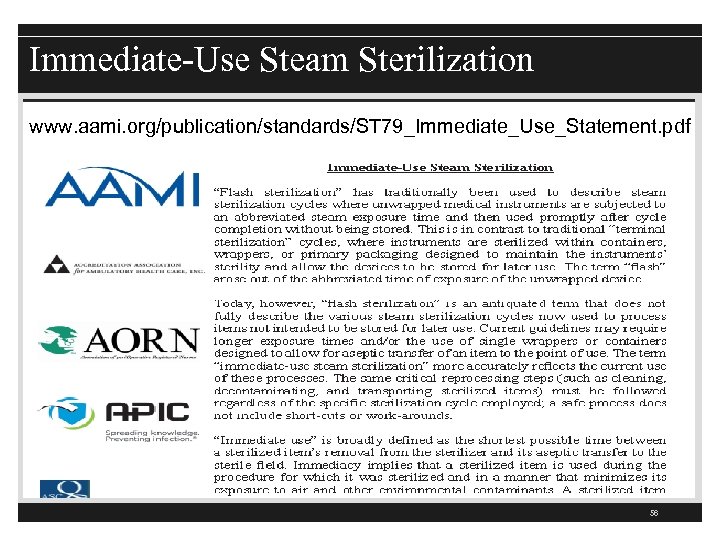 Immediate-Use Steam Sterilization www. aami. org/publication/standards/ST 79_Immediate_Use_Statement. pdf 56
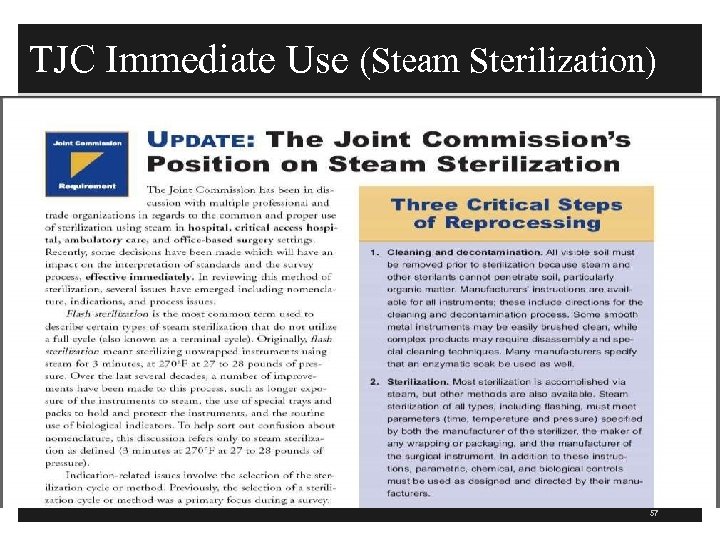 TJC Immediate Use (Steam Sterilization) 57
 58
58
 CMS Infection Control Standards Hospitals Need to Know About the Infection Control Interpretive Guidelines What Hospitals Need to Know.
 Mandatory Compliance § Hospitals that participate in Medicare or Medicaid must meet the Conditions of Participation (COPs) § For all patients in the facilities § Not just those who are Medicare or Medicaid § Hospitals accredited by TJC, DNV Healthcare, CIHQ, and AOA HCFA have what is called deemed status § This means hospitals can be reimbursed for M/M patients without going through a state department of health survey § CMS must now report deficiencies to the accreditation organizations (AO) § CMS announces unannounced surveys related to IC control 60 / 40
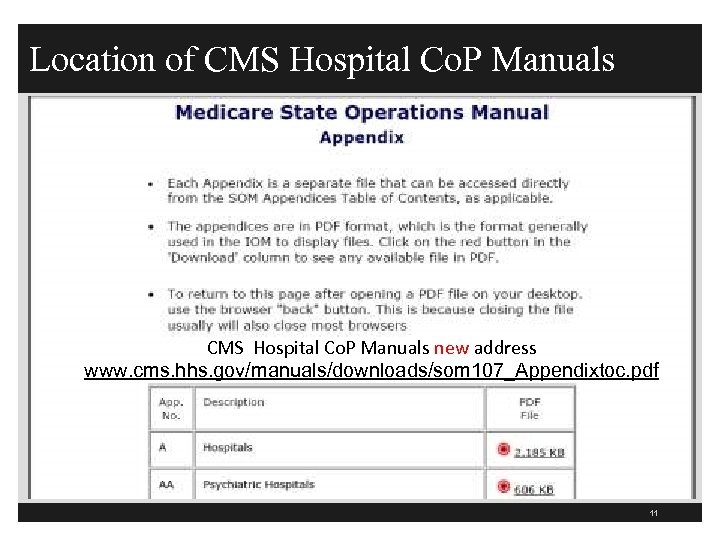
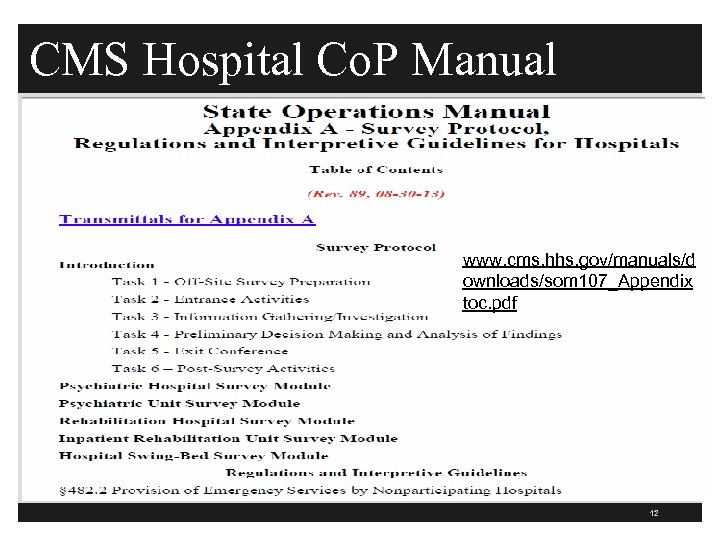
 CMS Hospital Co. Ps § Interpretative guidelines on CMS website under state operations manual 1 § Appendix A, Tag A-0001 to A 1164 § Interpretative guidelines updated August 30, 2013 § 457 pages long § Consider placing copy on intranet § Can go back and look up tag number to read more and infection control starts at tag 747 § Manuals found at website 1 http: //www. cms. hhs. gov/manuals/downloads/som 107_Appendixtoc. pdf / 40 (new)
 Infection Control § There were 12 pages of changes in the interpretive guidelines § CAH follow Appendix W but Infection Control standards are very closely cross walked § Reflected tag numbers, A-0747 thru 756 § Updated to reflect changing infectious and communicable disease threats § Includes current knowledge and best practices § Must follow national standards of care and practice 62 / 40
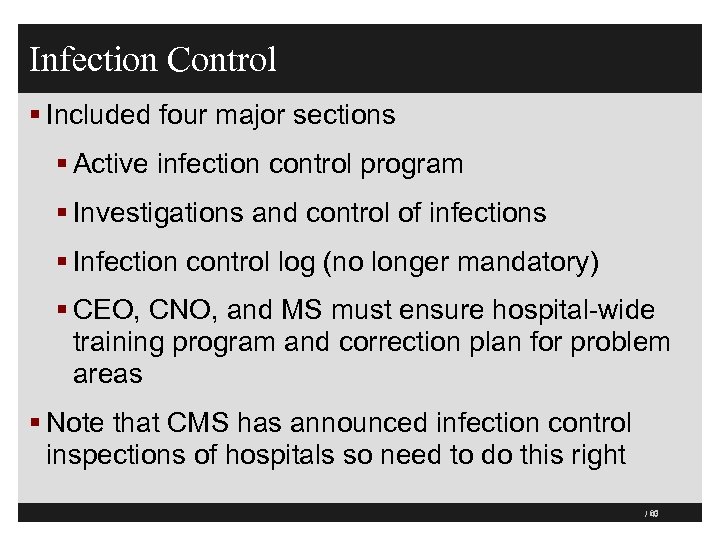 Infection Control § Included four major sections § Active infection control program § Investigations and control of infections § Infection control log (no longer mandatory) § CEO, CNO, and MS must ensure hospital-wide training program and correction plan for problem areas § Note that CMS has announced infection control inspections of hospitals so need to do this right 63 / 40
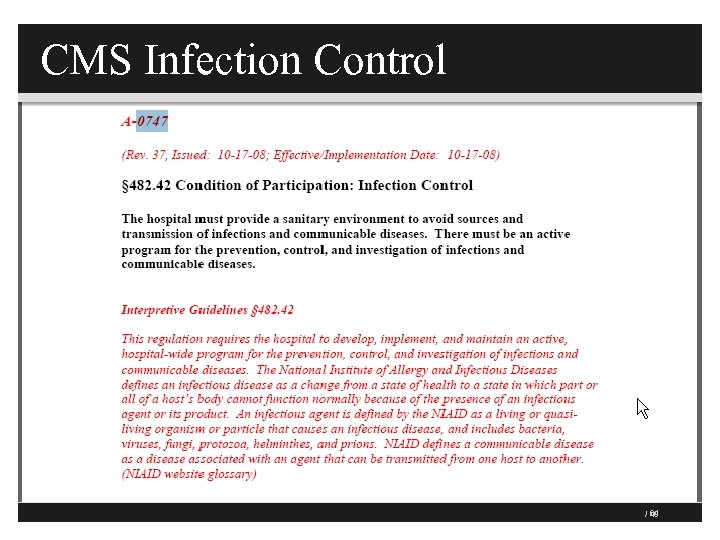 CMS Infection Control 64 / 40
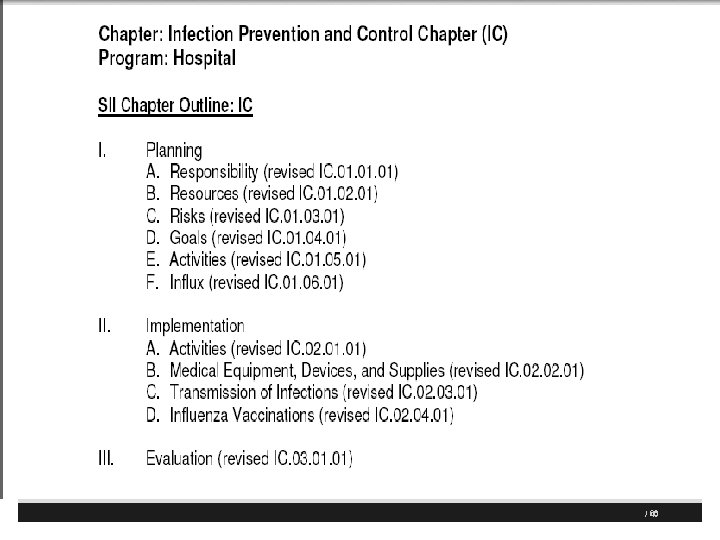
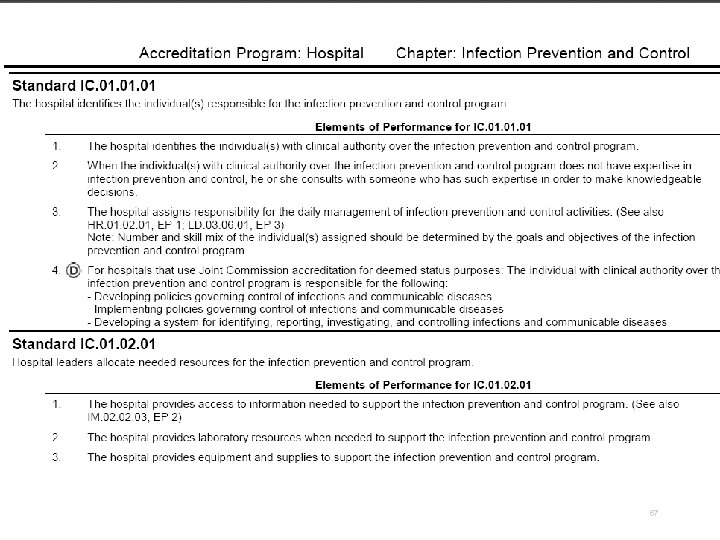
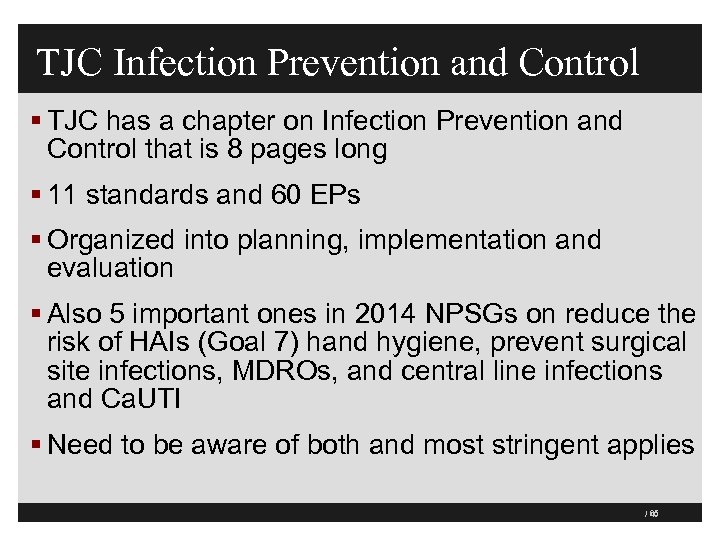 TJC Infection Prevention and Control § TJC has a chapter on Infection Prevention and Control that is 8 pages long § 11 standards and 60 EPs § Organized into planning, implementation and evaluation § Also 5 important ones in 2014 NPSGs on reduce the risk of HAIs (Goal 7) hand hygiene, prevent surgical site infections, MDROs, and central line infections and Ca. UTI § Need to be aware of both and most stringent applies 65 / 40
 66 / 40
 67 / 40
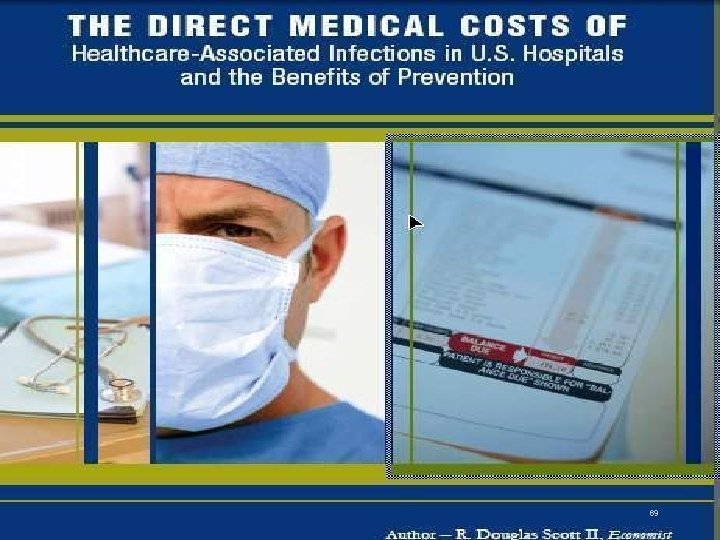
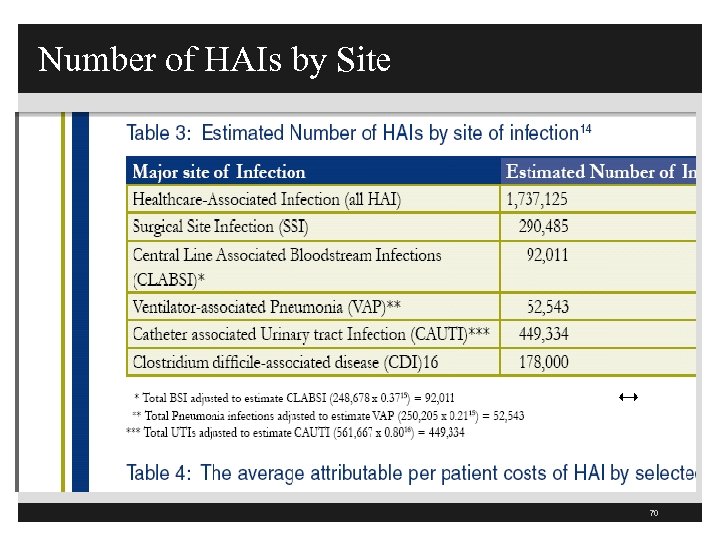
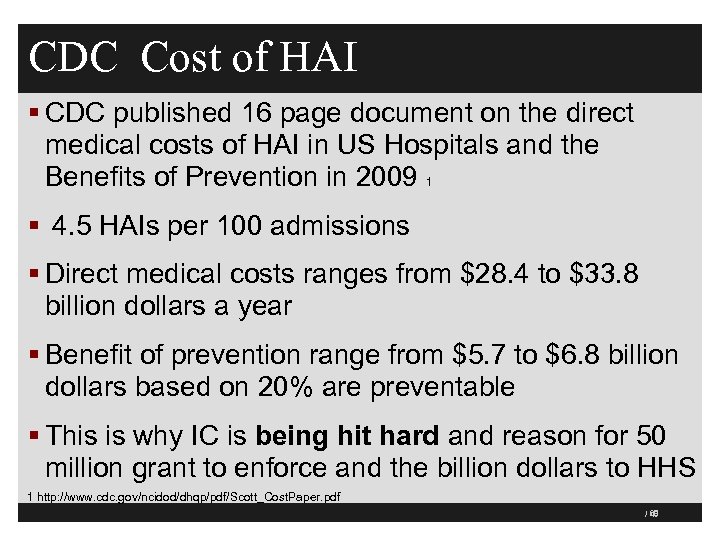 CDC Cost of HAI § CDC published 16 page document on the direct medical costs of HAI in US Hospitals and the Benefits of Prevention in 2009 1 § 4. 5 HAIs per 100 admissions § Direct medical costs ranges from $28. 4 to $33. 8 billion dollars a year § Benefit of prevention range from $5. 7 to $6. 8 billion dollars based on 20% are preventable § This is why IC is being hit hard and reason for 50 million grant to enforce and the billion dollars to HHS 1 http: //www. cdc. gov/ncidod/dhqp/pdf/Scott_Cost. Paper. pdf 68 / 40
 69 / 40
 Number of HAIs by Site 70
 HHS Action Plan § Estimated that HAIs incur nearly $20 billion in excess healthcare cost each year § Many are preventable § Top priority of HHS now § Develop HHS Action Plan to Prevent HAIs § Every infection preventionist (IP) should have a copy of this document § HHS get a billion dollars to enforce IC and has a video every healthcare practitioner should see § Partnering to heal video at http: //www. hhs. gov/partneringtoheal 1 http: //hhs. gov/ophs/initiatives/hai/index. html 71 / 40
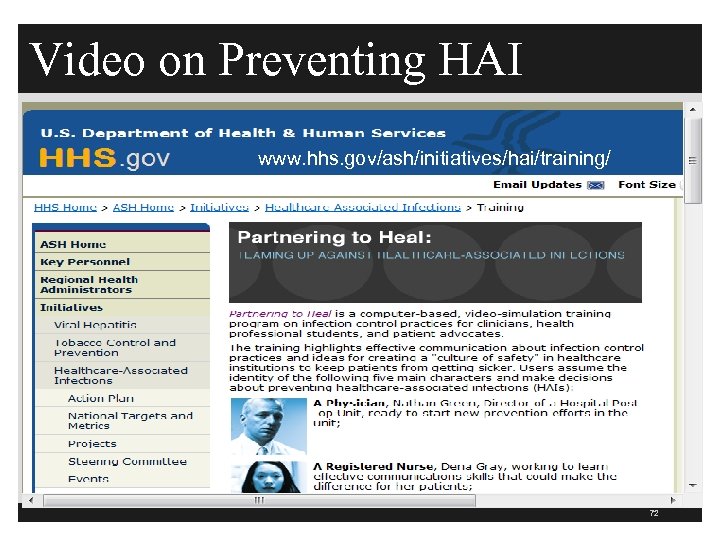 Video on Preventing HAI www. hhs. gov/ash/initiatives/hai/training/ 72
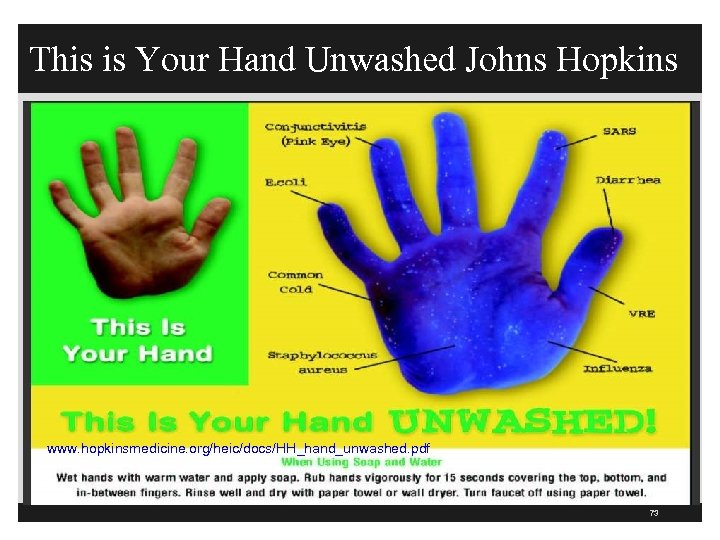 This is Your Hand Unwashed Johns Hopkins www. hopkinsmedicine. org/heic/docs/HH_hand_unwashed. pdf 73
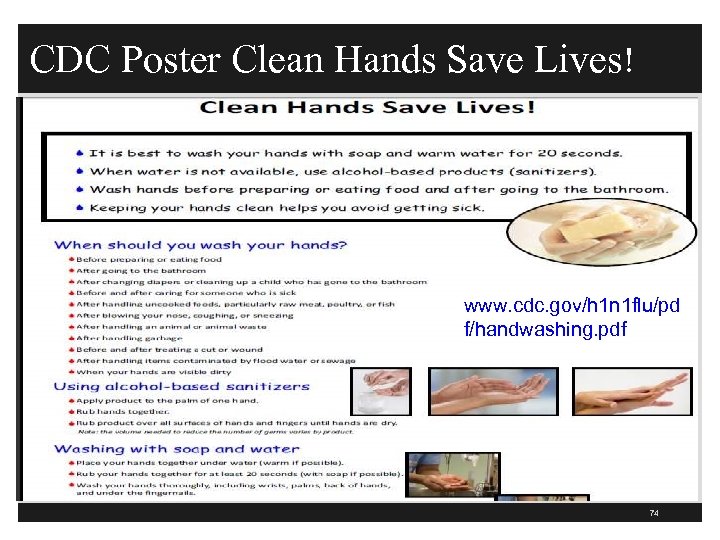 CDC Poster Clean Hands Save Lives! www. cdc. gov/h 1 n 1 flu/pd f/handwashing. pdf 74
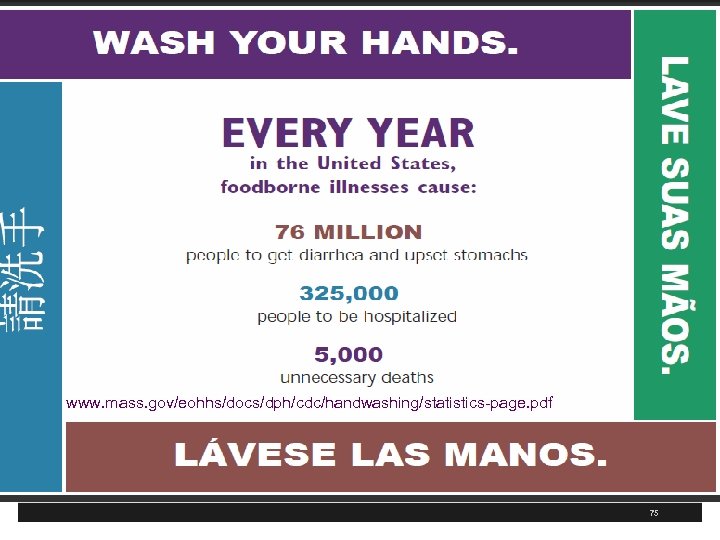 www. mass. gov/eohhs/docs/dph/cdc/handwashing/statistics-page. pdf 75
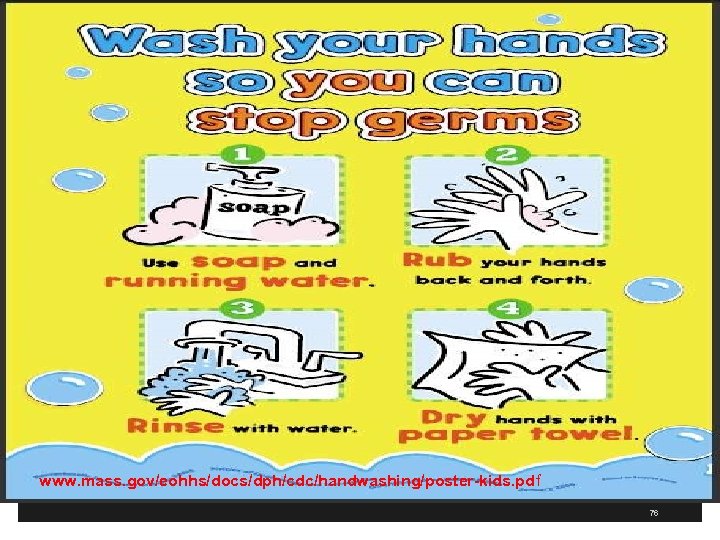 www. mass. gov/eohhs/docs/dph/cdc/handwashing/poster-kids. pdf 76
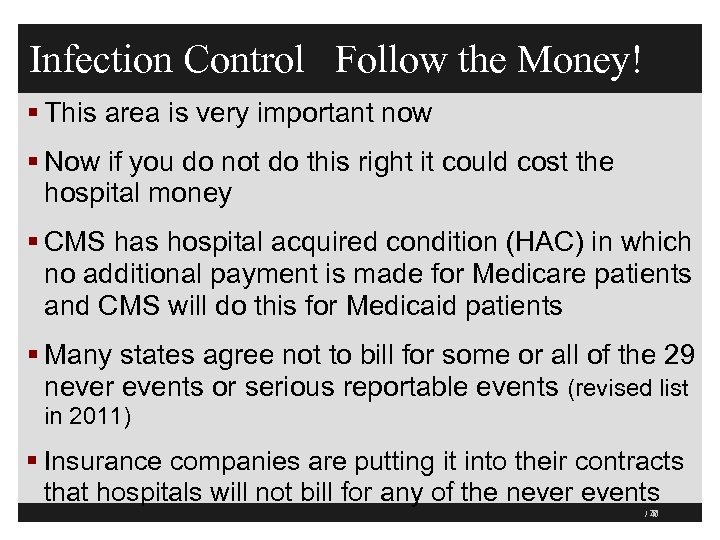 Infection Control Follow the Money! § This area is very important now § Now if you do not do this right it could cost the hospital money § CMS has hospital acquired condition (HAC) in which no additional payment is made for Medicare patients and CMS will do this for Medicaid patients § Many states agree not to bill for some or all of the 29 never events or serious reportable events (revised list in 2011) § Insurance companies are putting it into their contracts that hospitals will not bill for any of the never events 77 / 40
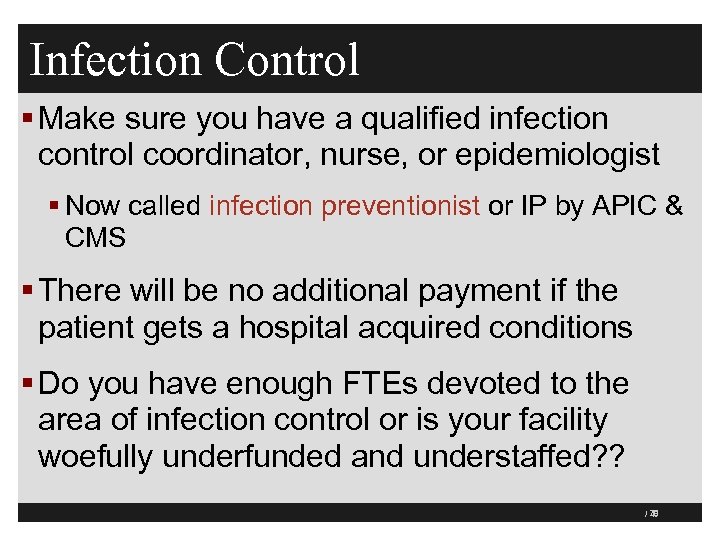 Infection Control § Make sure you have a qualified infection control coordinator, nurse, or epidemiologist § Now called infection preventionist or IP by APIC & CMS § There will be no additional payment if the patient gets a hospital acquired conditions § Do you have enough FTEs devoted to the area of infection control or is your facility woefully underfunded and understaffed? ? 78 / 40
 CMS Hospital Acquired Conditions § CMS has no additional payment for these HACs or never events § Studies show hugh cost to hospitals § Vascular catheter-associated infection § Surgical site infection such as mediastinitis after coronary artery bypass graft surgery § Catheter-associated urinary tract infections § Surgical-site infections following certain orthopedic procedures (repair, replacement or fusion of joints) 79 / 40
 CMS Hospital Co. P Definition of Infection § The guidelines include a definition of infectious disease, infectious agent, and communicable diseases § Hospitals may want to include these definitions in their revised policies and procedures § Definitions developed by the National Institute of Allergy and Infectious Diseases (NIAID) § Communicable disease is defined as a disease associated with an agent that can be transmitted from one host to another 80 / 40
 Definition of Infection § Infectious disease is defined as a change from a state of health to a state in which part or all of a host’s body cannot function normally because of the presence of an infectious agent or its product. § An infectious agent is defined as a living or quasiliving organism or particle that causes an infectious disease, and includes bacteria, viruses, fungi, protozoa, helminths (parasitic worms), and prions. § Note that APIC now calls them infection preventionist or IPs 81 / 40
 Infection Control (IC) § Hospital must have sanitary environment to avoid sources and transmission of infection and communicable diseases § Maintain an active IC program for prevention, control, and investigation of infections and communicable diseases § Standards apply to all departments of hospitals both on and off campus § All areas must be clean and sanitary § No dried blood on the floor, side of stretchers or on the ceiling tile / 82
 Infection Control § Infection prevention must include monitoring of housekeeping and maintenance including construction activities § Areas to monitor include food storage preparation, serving and dish rooms, refrigerators, ice machines, air handlers, autoclave rooms, venting systems, inpatient rooms, treatment areas, labs, waste handling, surgical areas, supply storage and equipment cleaning 83 / 40
 Infection Control (IC) A-0747 § Include all standards of care and practice § State and federal laws § Look at national organization recommendations § APIC (Association for Professionals in Infection Control and Epidemiology), CDC (Center for Disease Control), SHEA (Society for Healthcare Epidemiology of America), OSHA (Occupational Health and Safety Administration), AORN, IDSA, etc. § Investigate infections and communicable diseases for inpatients and personnel working in hospitals including volunteers / 40
 APIC’s Targeting Zero Campaign § Targeting zero is the philosophy that every hospital should be working toward a goal of zero HAIs § While not all HAIs are preventable, APIC believes we should strive for the goal of elimination and strive for zero infections § Association for Professionals in Infection Control and Epidemiology (APIC) put together many resources to help hospitals to start to meet this goal § Prompt investigation of HAIs of greatest concern to the hospital (like MRSA, C-Diff surgical site infections, catheter associated UTIs) § Needed because of our declining arsenal of antibiotics to treat infections 85
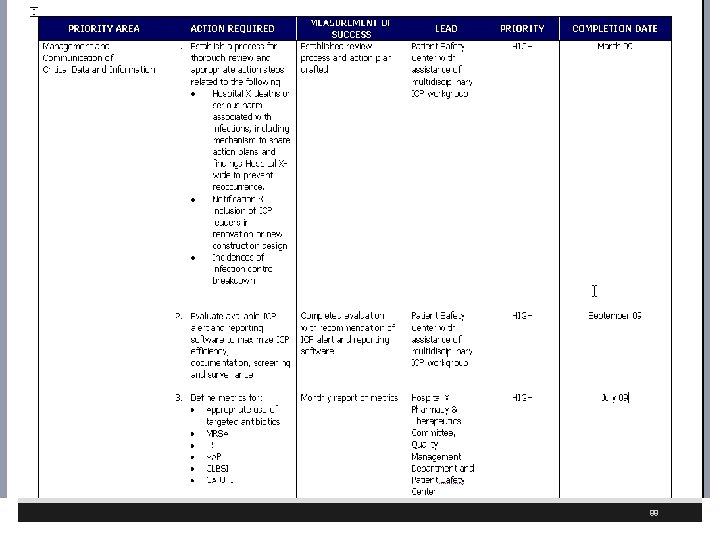
 Infection Control § Maintain active surveillance program § So what’s in your IC plan and IC program? § Specific measures for infection detection, data collection, analysis monitoring, and evaluations of preventive interventions § Document surveillance activities § Must have reliable sampling or other mechanism in place to identify and monitor infections and communicable diseases 86 / 40
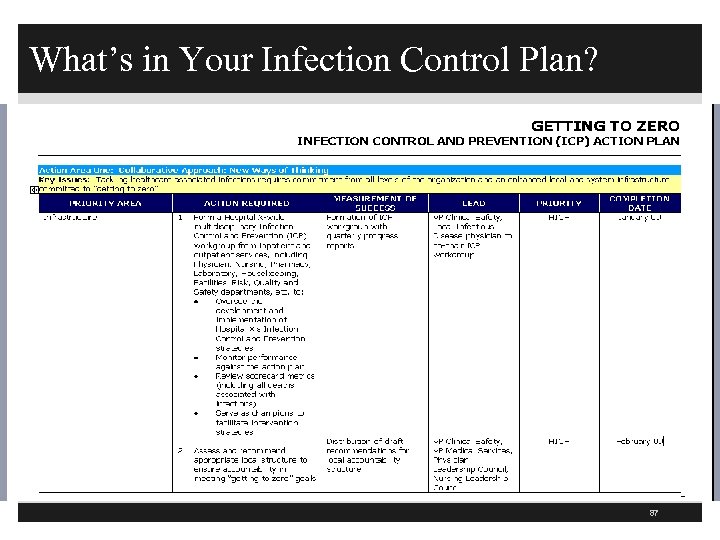 What’s in Your Infection Control Plan? 87
 88
88
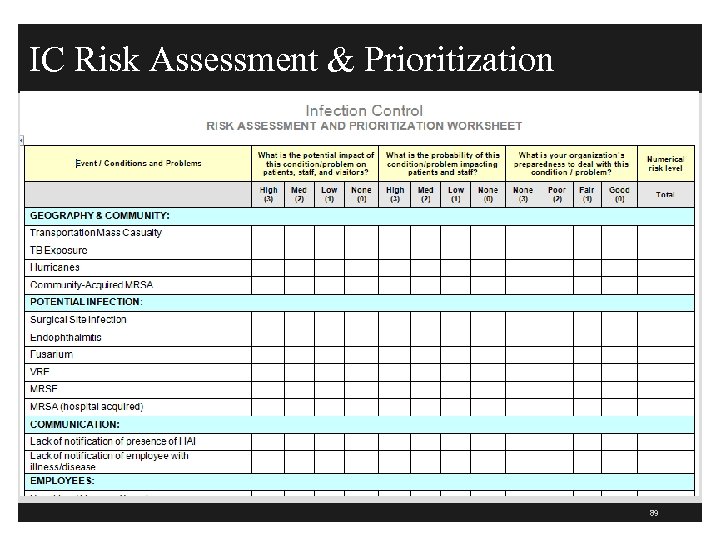 IC Risk Assessment & Prioritization 89
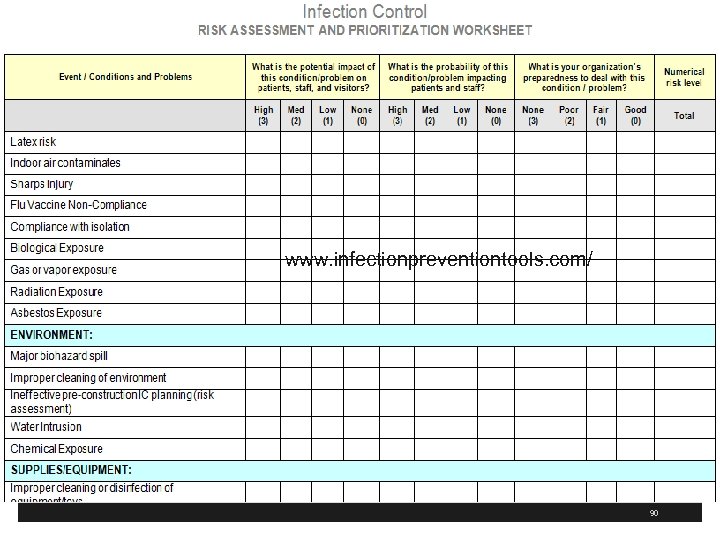 www. infectionpreventiontools. com/ 90
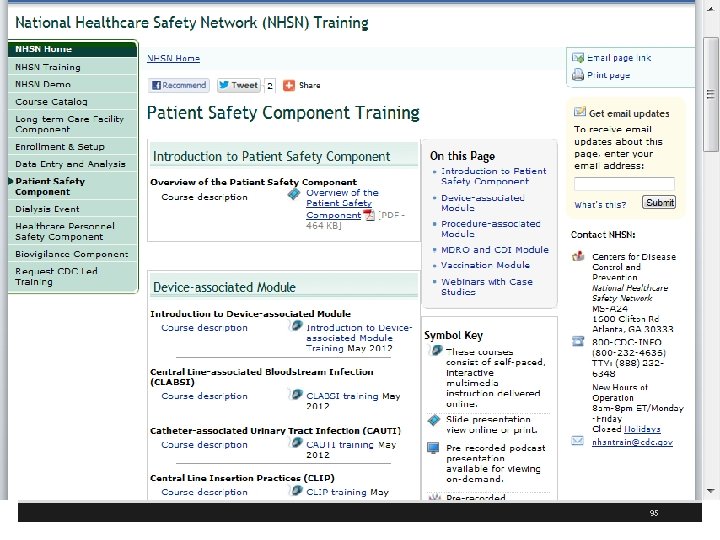
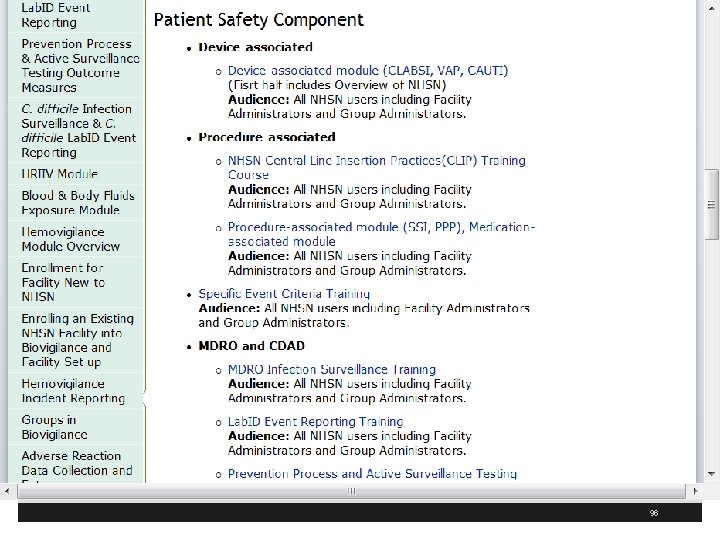
 Infection Control § Infection control must be integrated in PI § Surveillance activities should be conducted in accordance with recognized surveillance practices § CDC NHSN (National Healthcare Safety Net) § NHSN is internet-based surveillance system managed by the CDC § Hospitals now using to report ICU and NICU central line infections and selected reporting of CAUTIs § Available for hospitals at no charge and great resource § Provides multiple options for data analysis and more flexibility for sharing information within and outside the facility 91 / 40
 Infection Control § NHSN replaces the CDCs National Nosocomial Infection Surveillance system (NNIS) § Was considered the gold standard for tracking HAI for more than 30 years § Designed to help hospitals better manage episodes of HAI such as MRSA and VRE § Used by the VA hospitals § Hospitals report central line infections in ICUs and NICUs § Enroll on-line for HAI surveillance and many other resources 1 1 http: //www. cdc. gov/ncidod/dhqp/nhsn. html 92 / 40
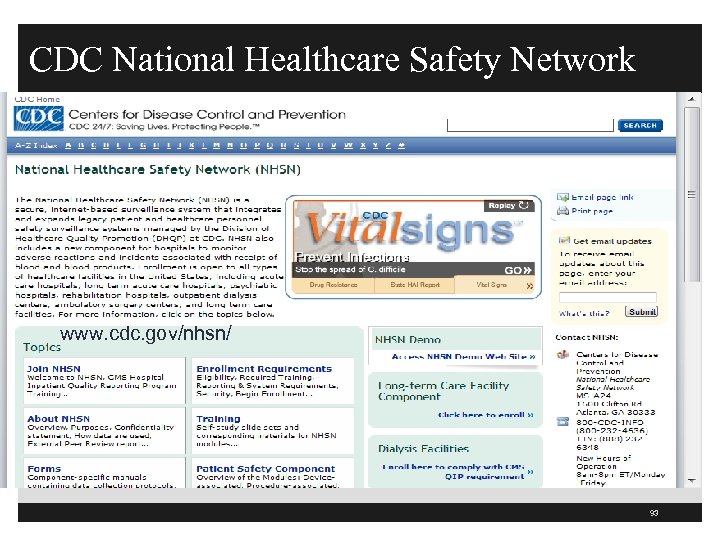 CDC National Healthcare Safety Network www. cdc. gov/nhsn/ 93
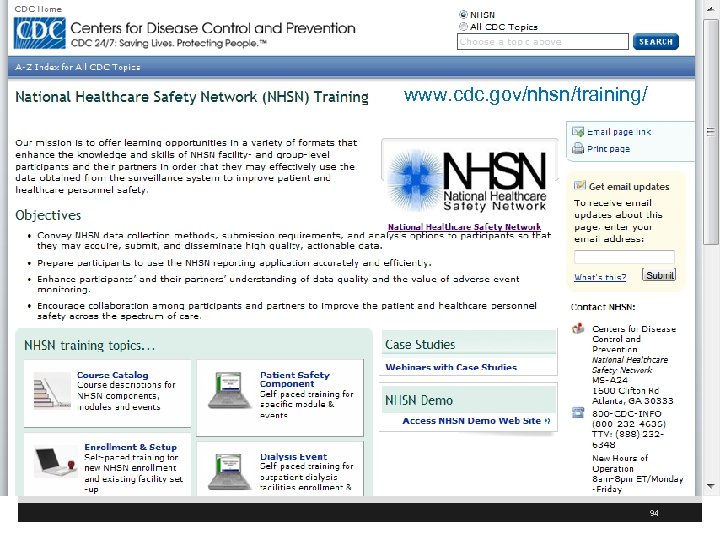 www. cdc. gov/nhsn/training/ 94
 95
95
 96
96
 www. cdc. gov/hicpac/pdf/guidel ines/bsi-guidelines-2011. pdf 97
 98
98
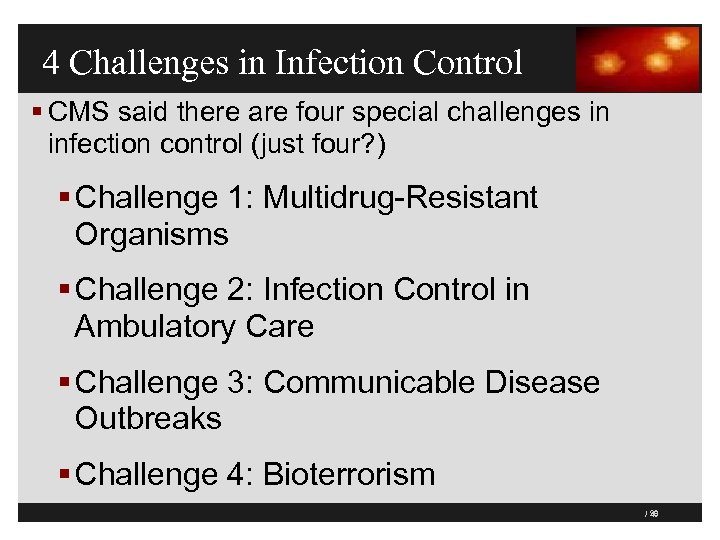 4 Challenges in Infection Control § CMS said there are four special challenges in infection control (just four? ) § Challenge 1: Multidrug-Resistant Organisms § Challenge 2: Infection Control in Ambulatory Care § Challenge 3: Communicable Disease Outbreaks § Challenge 4: Bioterrorism 99 / 40
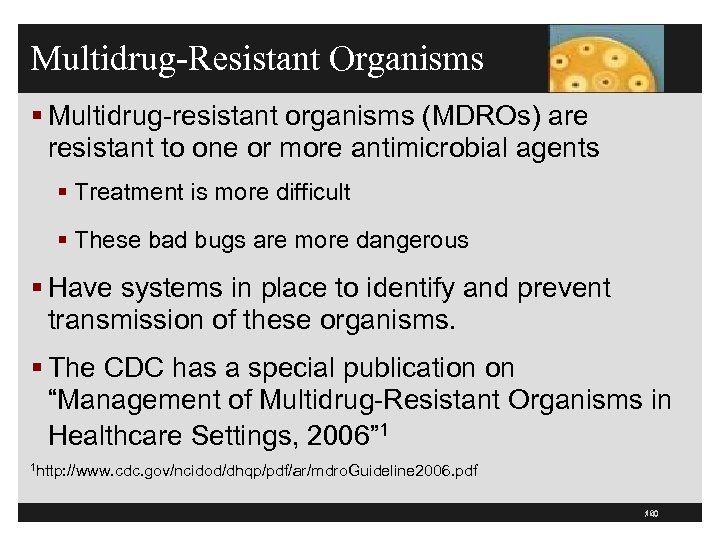 Multidrug-Resistant Organisms § Multidrug-resistant organisms (MDROs) are resistant to one or more antimicrobial agents § Treatment is more difficult § These bad bugs are more dangerous § Have systems in place to identify and prevent transmission of these organisms. § The CDC has a special publication on “Management of Multidrug-Resistant Organisms in Healthcare Settings, 2006” 1 1 http: //www. cdc. gov/ncidod/dhqp/pdf/ar/mdro. Guideline 2006. pdf 100 / 40
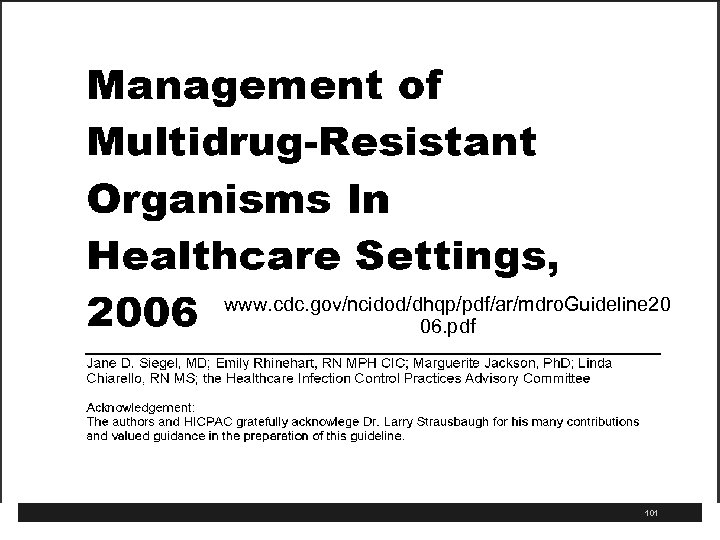 www. cdc. gov/ncidod/dhqp/pdf/ar/mdro. Guideline 20 06. pdf 101
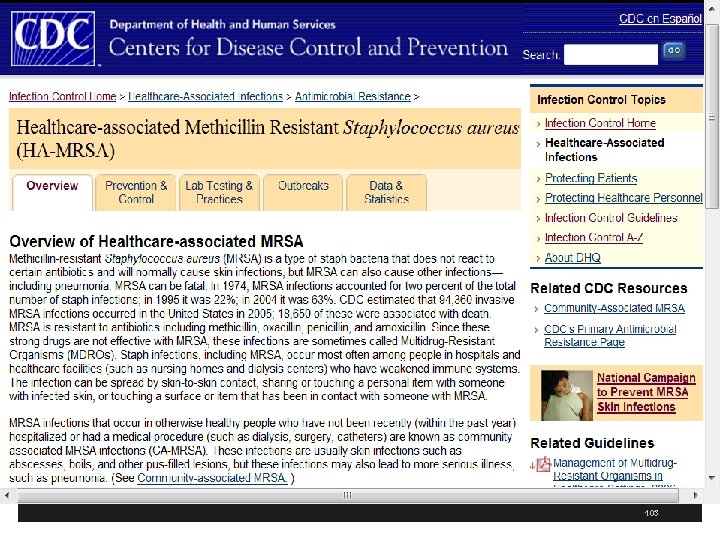
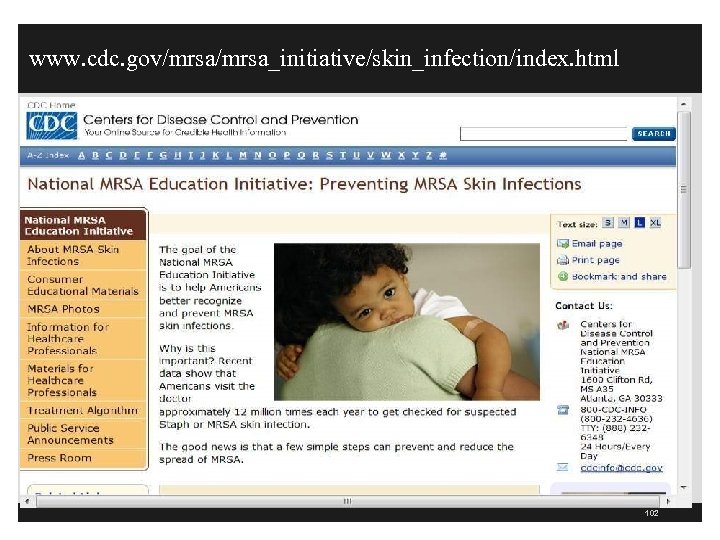 www. cdc. gov/mrsa_initiative/skin_infection/index. html 102
 103
103
 APIC 2013 C-Diff Guide www. apic. org/Professional. Practice/Implementation-guides 104
 SHEA C-Diff Guidelines www. sheaonline. org/Guidelines. Resources/Guidelines/Guid eline/Article. Id/11/Clinical-Practice-Guidelines-for. Clostridium-difficile-Infection-in-Adults-2010. aspx 105
 Infection Control in Ambulatory Care § Infection control in ambulatory care presents special problems § Patients remain in common areas such as the lobby and ED waiting areas § Patients are turned around quickly with minimal cleaning § Infectious patients may not be recognized immediately § Immuno-compromised patients can receive treatment in rooms with other patients who pose a risk of infection 106 / 40
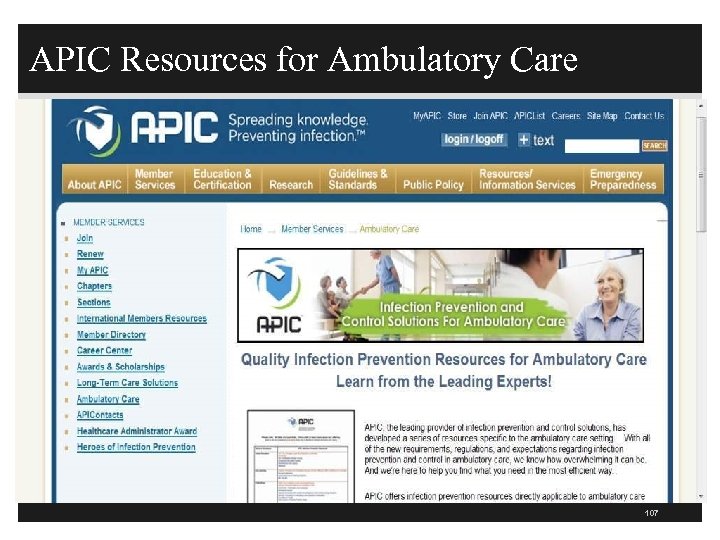 APIC Resources for Ambulatory Care 107
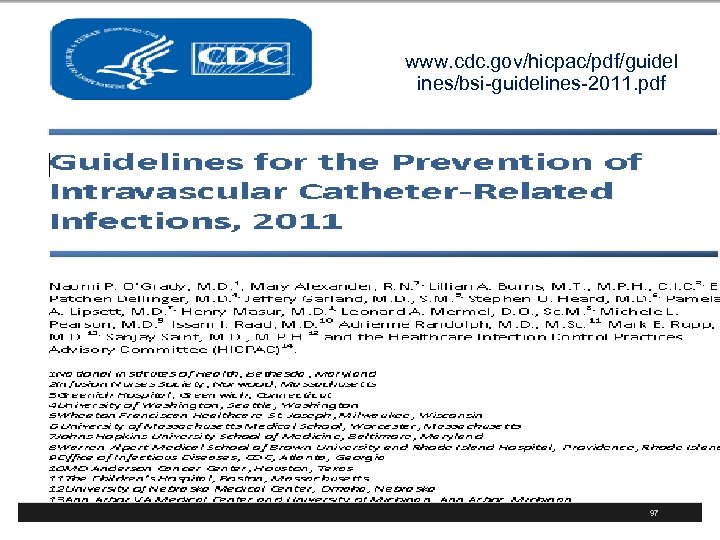
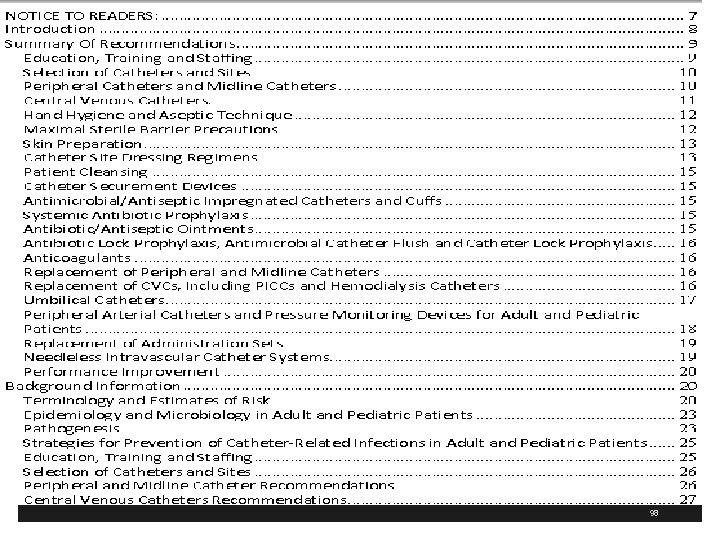
 Infection Control in Ambulatory Care § Guidelines have been developed by the CDC’s Healthcare Infection Control Practices Advisory Committee (HICPAC) hwww. cdc. gov/hicpac/pubs. html § Infection control plan for ambulatory care § Norovirus gastroenteritis outbreaks 2011 § Guidelines for Disinfection and Sterilization in Healthcare Facilities 2008 § Guidelines for Isolation Precautions 2007 § CDC Intravascular guidelines 2011 § Management of Multidrug-Resistant Organisms 2006 § Influenza Vaccination of Healthcare Personnel 2006 108 / 40
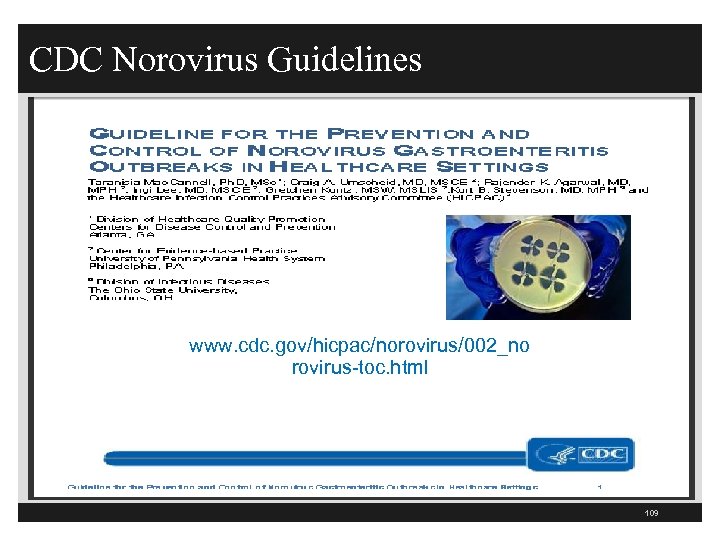 CDC Norovirus Guidelines www. cdc. gov/hicpac/norovirus/002_no rovirus-toc. html 109
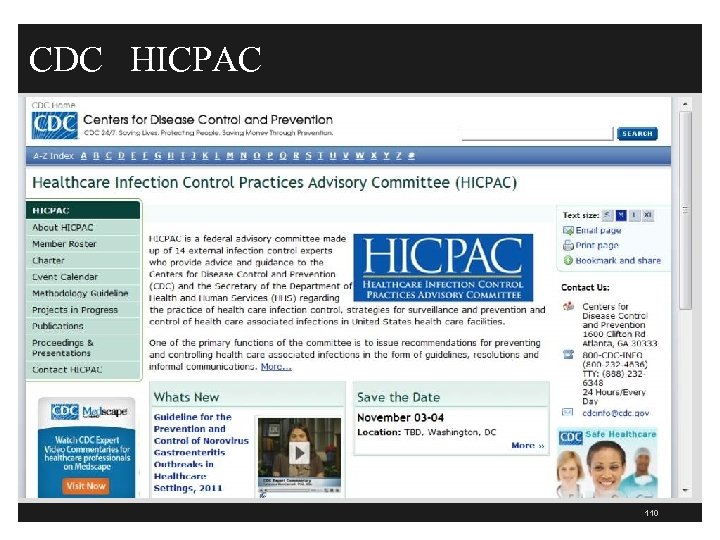 CDC HICPAC 110
 Infection Control in Ambulatory Care § CDC’s Healthcare Infection Control Practices Advisory Committee (HICPAC) Guidelines (continued) § Guidance on Public Reporting of HAI 2005 § Guidelines for Preventing Healthcare Associated Pneumonia 2004 § Guidelines for Environmental Infection Control in Healthcare Facilities 2003, 2002 Hand hygiene guidelines, Prevention of Surgical Site Infections and more § HICPAC is a federal advisory committee made up of 14 external IC experts who provide guidance and advice to the CDC and HHS – Members from APIC, SHEA, AORN, CMS, FDA etc. 111 / 40
 Preventing Infections in the Outpatient Unit § 2011 CDC has a guide and checklist for preventing infections in the outpatient setting § The Guide to Infection Prevention for Outpatient Settings: Minimum Expectations for Safe Care and § The Infection Prevention Checklist for Outpatient Settings; Minimum Expectations for Safe Care § Free off the website at www. cdc. gov/hai/settings/outpatientsettings. html? source=govdelivery 112
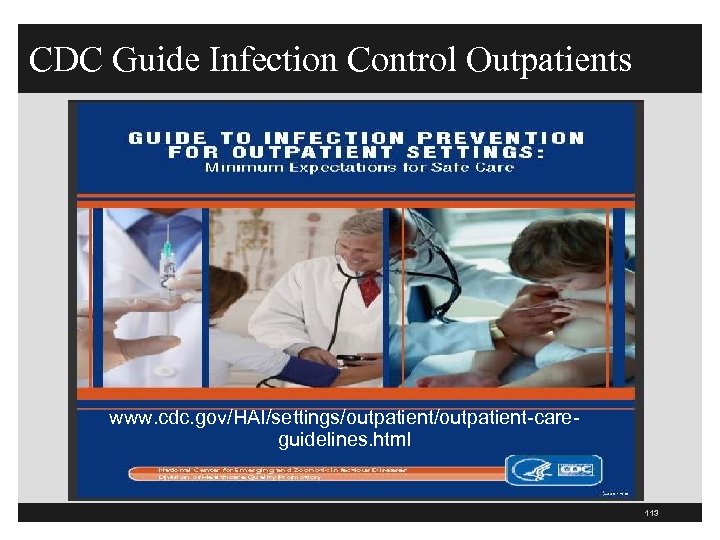 CDC Guide Infection Control Outpatients www. cdc. gov/HAI/settings/outpatient-careguidelines. html 113
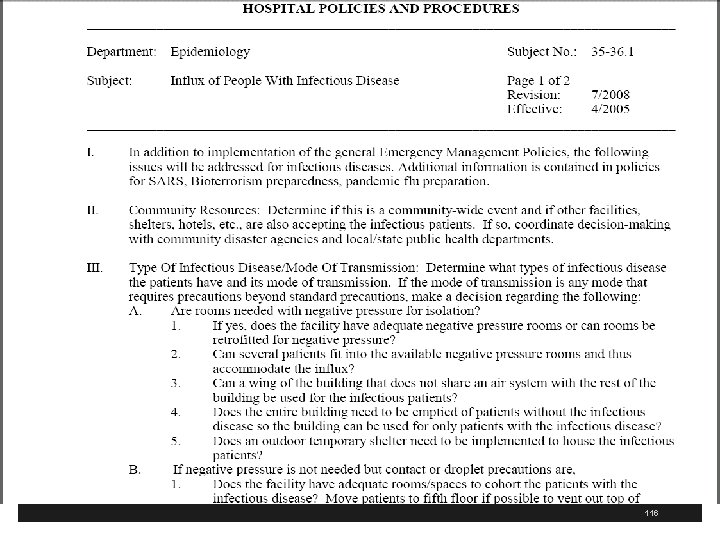
 Communicable Disease Outbreaks § Community-wide outbreaks of communicable diseases present many of the same types of issues as hospital infection disease threats § Understand the epidemiology § Know how it is transmitted and the clinical course of the disease in order to manage the outbreak § Pandemics, or widespread outbreaks of an infection require back up resources § Hospitals need to work with state, federal, and local health agencies 114 / 40
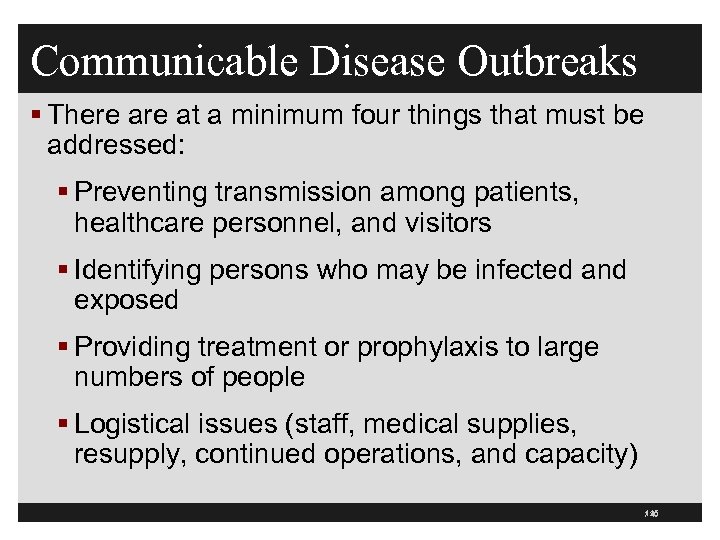 Communicable Disease Outbreaks § There at a minimum four things that must be addressed: § Preventing transmission among patients, healthcare personnel, and visitors § Identifying persons who may be infected and exposed § Providing treatment or prophylaxis to large numbers of people § Logistical issues (staff, medical supplies, resupply, continued operations, and capacity) 115 / 40
 116
116
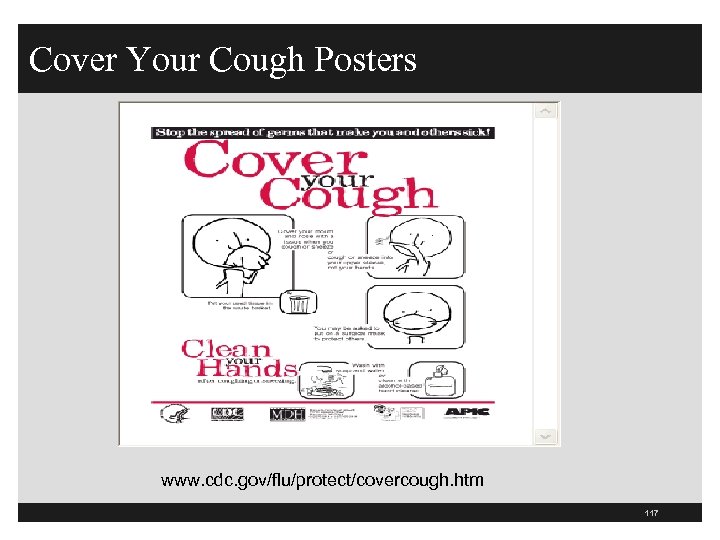 Cover Your Cough Posters www. cdc. gov/flu/protect/covercough. htm 117
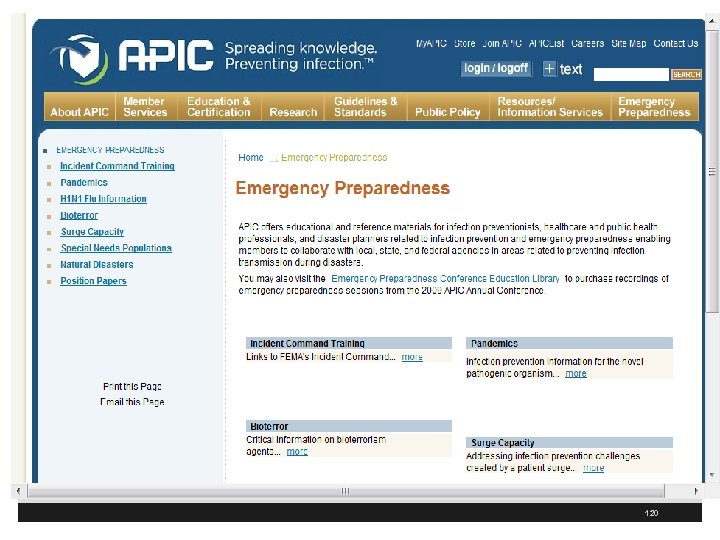
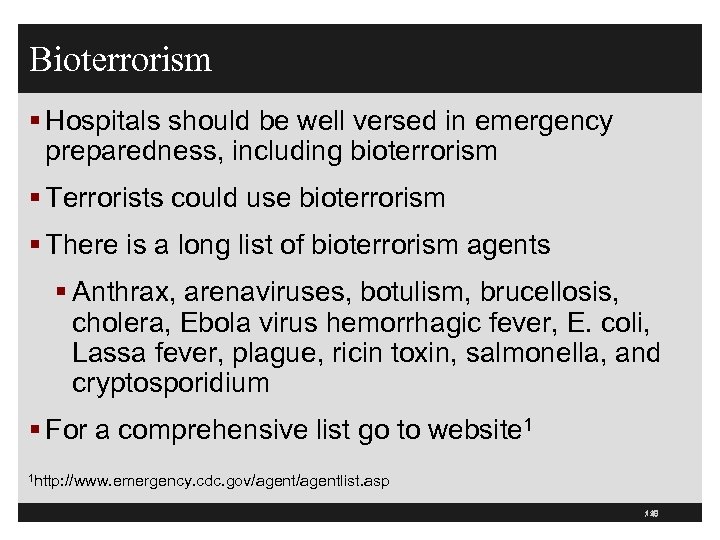 Bioterrorism § Hospitals should be well versed in emergency preparedness, including bioterrorism § Terrorists could use bioterrorism § There is a long list of bioterrorism agents § Anthrax, arenaviruses, botulism, brucellosis, cholera, Ebola virus hemorrhagic fever, E. coli, Lassa fever, plague, ricin toxin, salmonella, and cryptosporidium § For a comprehensive list go to website 1 1 http: //www. emergency. cdc. gov/agentlist. asp 118 / 40
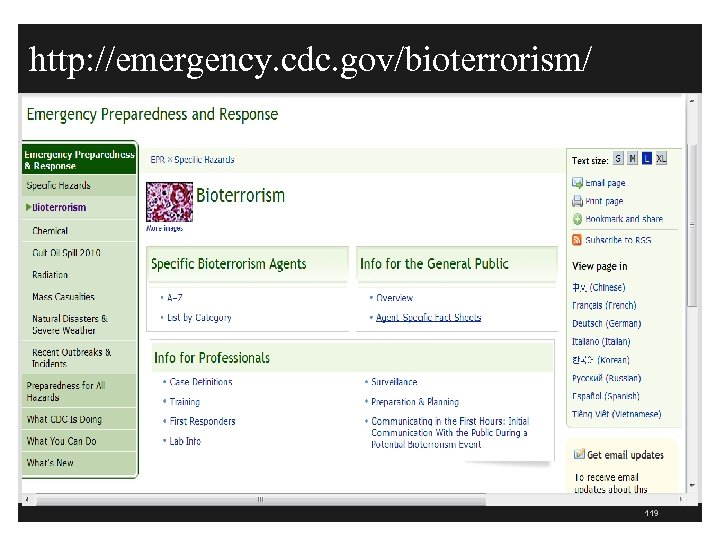 http: //emergency. cdc. gov/bioterrorism/ 119
 120
120
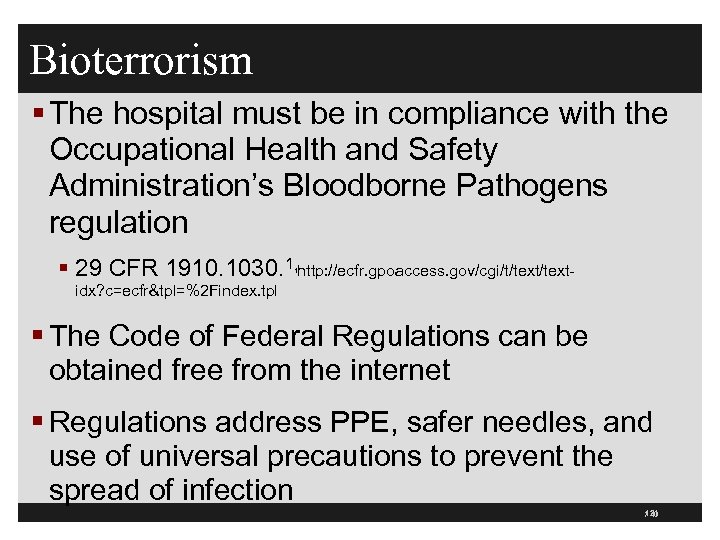 Bioterrorism § The hospital must be in compliance with the Occupational Health and Safety Administration’s Bloodborne Pathogens regulation § 29 CFR 1910. 1030. 1 http: //ecfr. gpoaccess. gov/cgi/t/text 1 idx? c=ecfr&tpl=%2 Findex. tpl § The Code of Federal Regulations can be obtained free from the internet § Regulations address PPE, safer needles, and use of universal precautions to prevent the spread of infection 121 / 40
 IP Officer’s Responsibilities § Many have added these to their job descriptions § Maintain sanitary hospital environment § Ventilation and water controls, constructionmake sure safe environment, safe air handling in areas of special ventilations such as the OR and isolation rooms, techniques for food sanitation, cleaning and disinfecting surfaces, carpeting and furniture, how is pest control done, and disposal of trash along with nonregulated waste 122 / 40
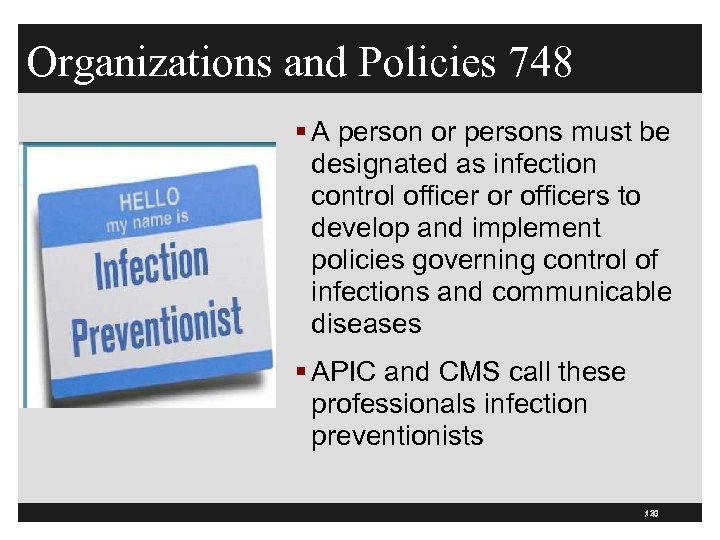 Organizations and Policies 748 § A person or persons must be designated as infection control officer or officers to develop and implement policies governing control of infections and communicable diseases § APIC and CMS call these professionals infection preventionists 123 / 40
 Infection Control Officer 748 2013 § Hospital infection control officers are often referred to as hospital epidemiologists (HEs), infection control professionals (ICPs) or IP § APIC calls them Infection Preventionist or IP and June 7, 2013 CMS added IP to tag 748 § CDC has defined “infection control professional” as “a person whose primary training is in either nursing, medical technology, microbiology, or epidemiology and who has acquired specialized training in infection control” § The hospital must designate in writing an individual as its infection control officer 124 / 40
 Infection Control Preventionist § The person assigned to the job should be educated and competent in that area § Qualified through education, training, experience, or certification § Certification offered by: § Certification Board of Infection Control and Epidemiology Inc. (CBIC) § Specialty boards in adult or pediatric infectious diseases – American Board of Internal Medicine (for internists) – American Board of Pediatrics (for pediatricians). 125 / 40
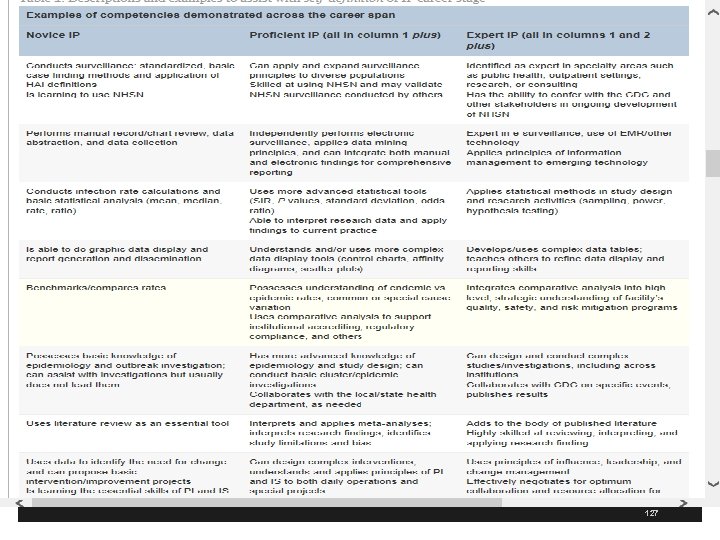
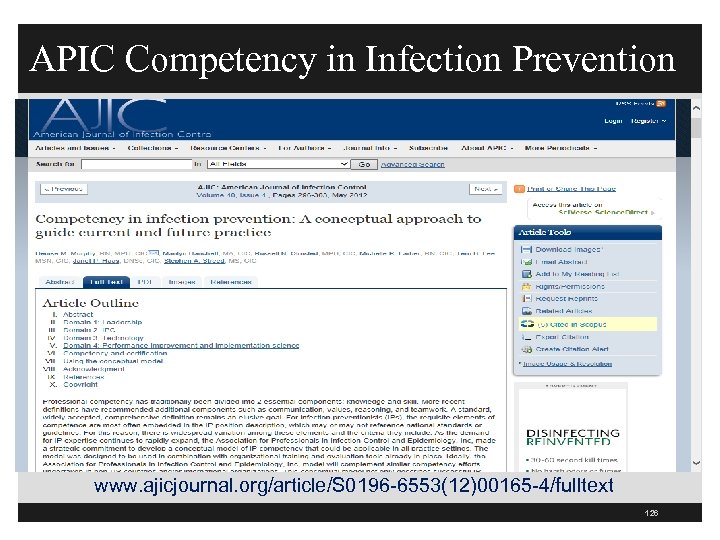 APIC Competency in Infection Prevention www. ajicjournal. org/article/S 0196 -6553(12)00165 -4/fulltext 126
 127
127
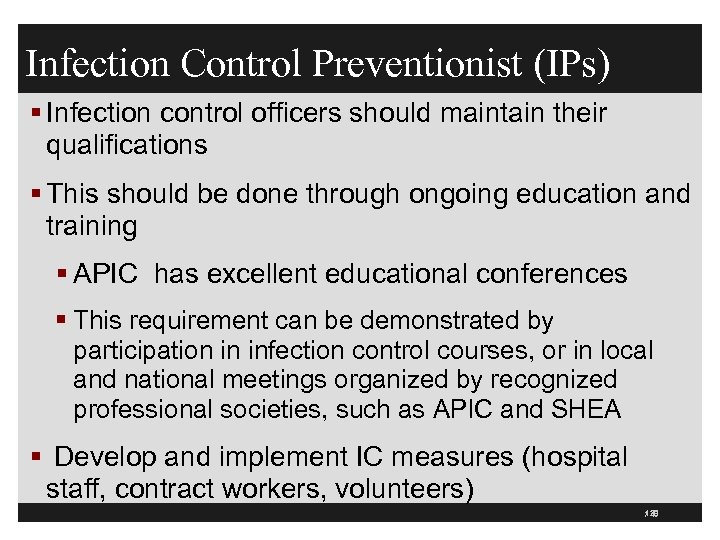 Infection Control Preventionist (IPs) § Infection control officers should maintain their qualifications § This should be done through ongoing education and training § APIC has excellent educational conferences § This requirement can be demonstrated by participation in infection control courses, or in local and national meetings organized by recognized professional societies, such as APIC and SHEA § Develop and implement IC measures (hospital staff, contract workers, volunteers) 128 / 40
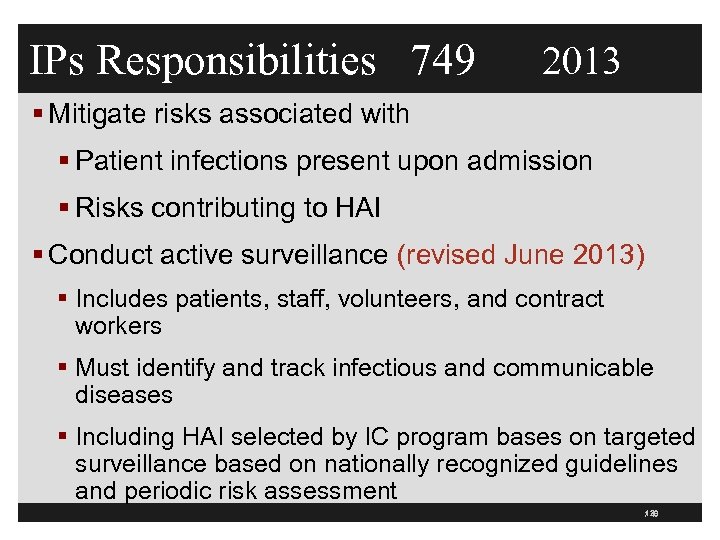 IPs Responsibilities 749 2013 § Mitigate risks associated with § Patient infections present upon admission § Risks contributing to HAI § Conduct active surveillance (revised June 2013) § Includes patients, staff, volunteers, and contract workers § Must identify and track infectious and communicable diseases § Including HAI selected by IC program bases on targeted surveillance based on nationally recognized guidelines and periodic risk assessment 129 / 40
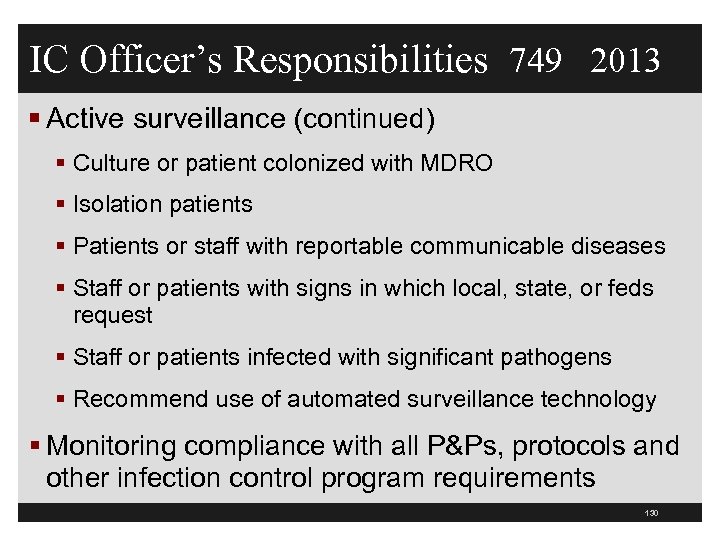 IC Officer’s Responsibilities 749 2013 § Active surveillance (continued) § Culture or patient colonized with MDRO § Isolation patients § Patients or staff with reportable communicable diseases § Staff or patients with signs in which local, state, or feds request § Staff or patients infected with significant pathogens § Recommend use of automated surveillance technology § Monitoring compliance with all P&Ps, protocols and other infection control program requirements 130
 IPs Responsibilities 749 § Evaluate and revise of the program, when indicated § Coordinate with federal, state, and local emergency preparedness and health authorities to address communicable disease threats, bioterrorism, and outbreaks § As required by law § Comply with the reportable disease requirements of the local health authority § Integrate IC program into hospital-wide QAPI 131 / 40
 Infection Control (IC) A- 749 § Long list of IC policies that hospitals must have § The 22 policies are now organized under 5 sections § Maintain a sanitary physical environment § Hospital staff related measures (evaluate hospital staff immunization status for infectious diseases as per CDC and APIC, how you screen hospital staff for infections likely to cause significant infectious disease to others, policy on when staff are restricted from working) / 40
 IC Policies Include: § New employee orientation (include handwashing) § How to mitigate risk when patient admitted with infection § Must be consistent with the CDC isolation guidelines § Staff knowledge of PPE § Mitigate risk that cause or contribute to HAI § SCIP measures, appropriate hair removal, timely antibiotics in OR, DC in 24 hours except 48 hours for cardiac patients, beta blockers during perioperative periods for select cardiac patients, proper sterilization of equipment, etc. / 40
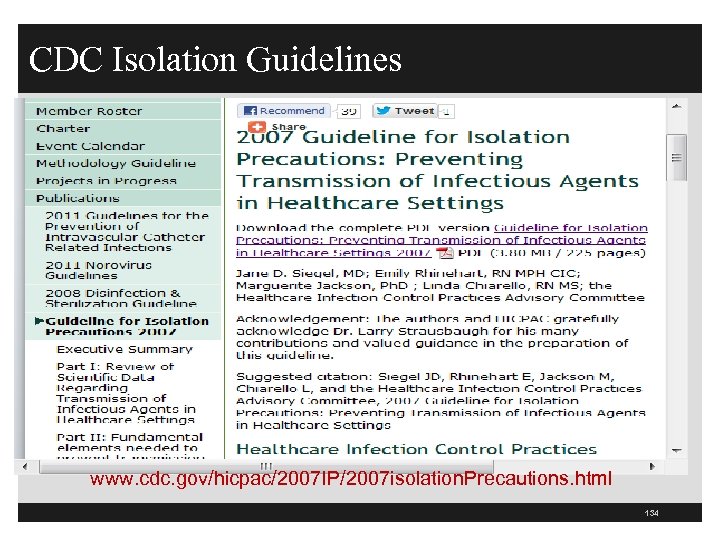 CDC Isolation Guidelines www. cdc. gov/hicpac/2007 IP/2007 isolation. Precautions. html 134
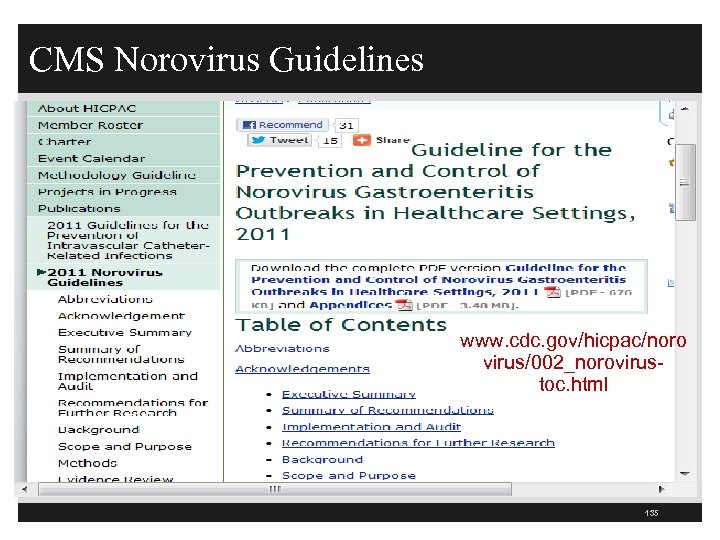 CMS Norovirus Guidelines www. cdc. gov/hicpac/noro virus/002_norovirustoc. html 135
 CDC Coronavirus Guidance § CDC has interim infection prevention and control recommendations § Recommend standard, contact, and airborne precautions for patients hospitalized with Middle East Respiratory Syndrome Coronavirus (MERSCo. V) § Suspect high rate of mortality, limited human to human transmission, unknown mode of transmission § Similar to coronavirus that caused severe acute respiratory syndrome (SARS) § See New England Journal of Medicine, June 19, 2013, "Hospital Outbreak of Middle East Respiratory Syndrome Coronavirus. “ at http: //www. nejm. org/doi/full/10. 1056/NEJMoa 1306742? query=TOC&#t=abstract 136
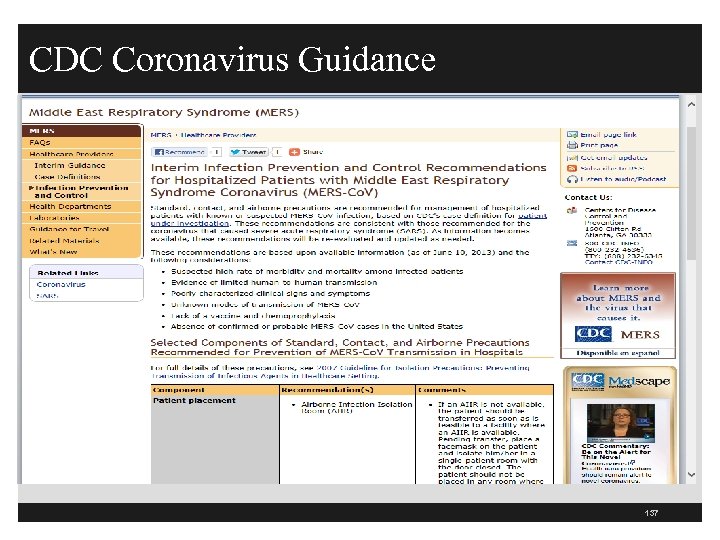 CDC Coronavirus Guidance 137
 IC Policies Include: § Isolation procedures for: § Highly immuno-suppressed patients (HIV or chemo patients) § Trach care, respiratory care, burns, and other similar situations § HAI risk mitigation § Promotion of hand hygiene § Measures to prevent organisms that are antibiotic resistant such as MRSA and VRE § Central line bundle, VAP bundle or sepsis bundle, prompt removal of foley catheter § Use of disinfectants, antiseptics, and germicides in accordance with manufacturers instructions / 40
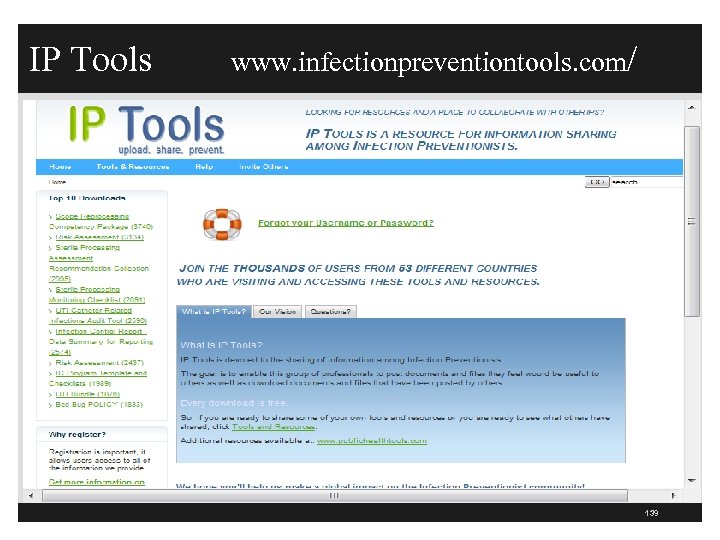 IP Tools www. infectionpreventiontools. com/ 139
 IC Policies Include: § Appropriate use of facility and medical equipment (hepa filters, negative pressure room, UV lights and other equipment) to prevent the spread of infectious agents § Education on infection and communicable diseases for patients, visitors, care givers, and staff § Active surveillance system, method for getting data to determine if there is a problem § Policy on getting cultures from patients, etc. / 40
 Policies and Organization § Need IC officer (now called IP or Infection Preventionist) and IC committee § IC officer must develop and implement policies on control of infection and communicable diseases § Person must be designated in writing who is qualified through education and experience § Lists the responsibilities of this personconsider putting into job description / 40
 Infection Control §The IP must develop a system for identifying, reporting, investigating, and controlling infections and communicable diseases of patients and personnel §Applies to both healthcare-associated infections (HAI) and communityacquired infection 142 / 40
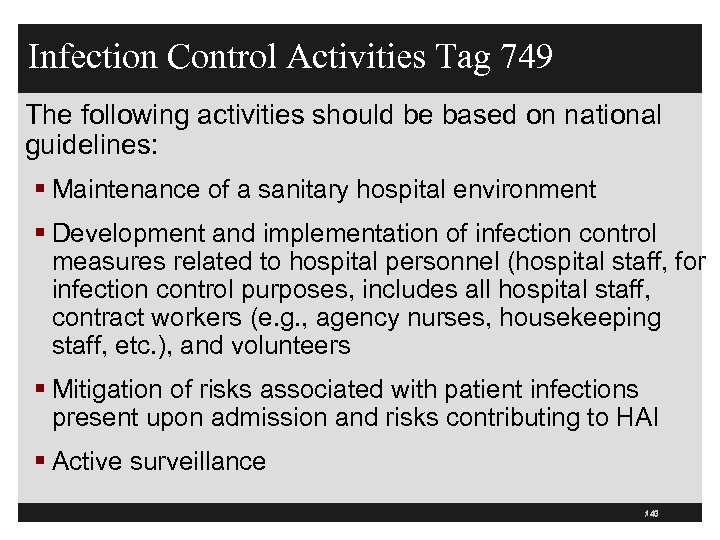 Infection Control Activities Tag 749 The following activities should be based on national guidelines: § Maintenance of a sanitary hospital environment § Development and implementation of infection control measures related to hospital personnel (hospital staff, for infection control purposes, includes all hospital staff, contract workers (e. g. , agency nurses, housekeeping staff, etc. ), and volunteers § Mitigation of risks associated with patient infections present upon admission and risks contributing to HAI § Active surveillance 143 / 40
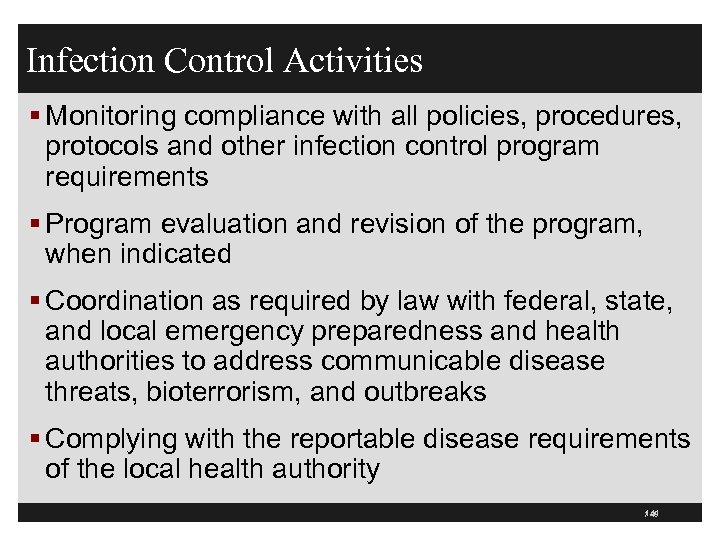 Infection Control Activities § Monitoring compliance with all policies, procedures, protocols and other infection control program requirements § Program evaluation and revision of the program, when indicated § Coordination as required by law with federal, state, and local emergency preparedness and health authorities to address communicable disease threats, bioterrorism, and outbreaks § Complying with the reportable disease requirements of the local health authority 144 / 40
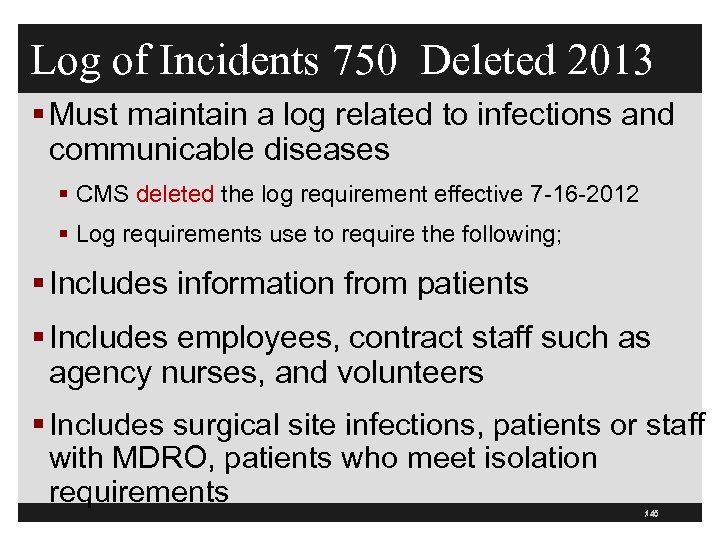 Log of Incidents 750 Deleted 2013 § Must maintain a log related to infections and communicable diseases § CMS deleted the log requirement effective 7 -16 -2012 § Log requirements use to require the following; § Includes information from patients § Includes employees, contract staff such as agency nurses, and volunteers § Includes surgical site infections, patients or staff with MDRO, patients who meet isolation requirements 145 / 40
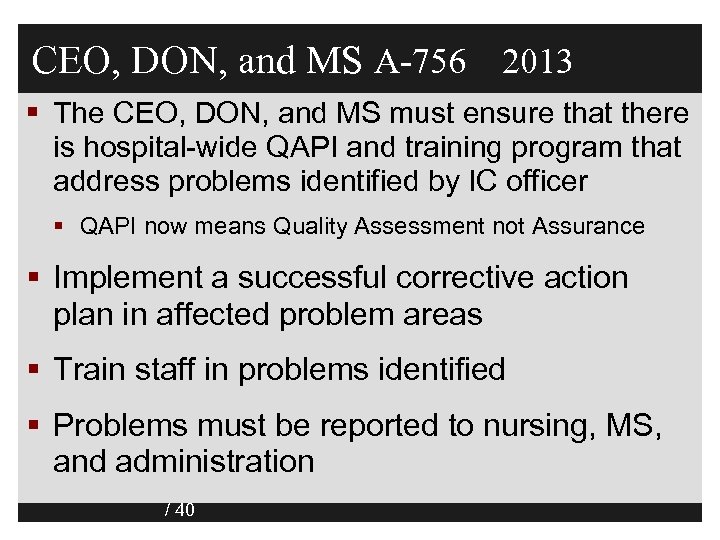 CEO, DON, and MS A-756 2013 § The CEO, DON, and MS must ensure that there is hospital-wide QAPI and training program that address problems identified by IC officer § QAPI now means Quality Assessment not Assurance § Implement a successful corrective action plan in affected problem areas § Train staff in problems identified § Problems must be reported to nursing, MS, and administration / 40
 The End! Questions? ? ? § Sue Dill Calloway RN, Esq. CPHRM, CCMSCP § AD, BA, BSN, MSN, JD § President of Patient Safety and Education § Board Member Emergency Medicine Patient Safety Foundation www. empsf. org § 614 791 -1468 § sdill 1@columbus. rr. com 147
 The End § Are you up to the challenge? § Additional slides § Infection control websites / 40