


 Скачать презентацию CMS Incentive Program for Meaningful Use of HIT
b18ff3e7562e1e5f349197dc7a108a6c.ppt
- Количество слайдов: 74
 CMS Incentive Program for Meaningful Use of HIT and Reporting Quality of Care Measures Association of Black Cardiologists Practice Management Conference and Expo 2011 Tampa, FL January 15, 2011 Richard E. Wild, MD, JD, MBA, FACEP Chief Medical Officer CMS Region 4, Atlanta
 Disclaimers This presentation was current at the time it was published or uploaded onto the web. Medicare policy changes frequently so links to the source documents have been provided within the document for your reference. This presentation was prepared as a tool to assist providers and is not intended to grant rights or impose obligations. Although every reasonable effort has been made to assure the accuracy of the information within these pages, the ultimate responsibility for the correct submission of claims and response to any remittance advice lies with the provider of services. The Centers for Medicare & Medicaid Services (CMS) employees, agents, and staff make no representation, warranty, or guarantee that this compilation of Medicare information is error-free and will bear no responsibility or liability for the results or consequences of the use of this guide. This publication is a general summary that explains certain aspects of the Medicare Program, but is not a legal document. The official Medicare Program provisions are contained in the relevant laws, regulations, and rulings. (CPT only, copyright 2008 American Medical Association. All rights reserved. CPT is a registered trademark of the American Medical Association. Applicable FARSDFARS Restrictions Apply to Government Use. Fee schedules, relative value units, conversion factors and/or related components are not assigned by the AMA, are not part of CPT, and the AMA is not recommending their use. The AMA does not directly or indirectly practice medicine or dispense medical services. The AMA assumes no liability for data contained or not contained herein. )
 Presentation Overview § Problems with US Healthcare Today, Quality and Cost § HIT and Congressional Initiatives to address Quality and Cost § CMS’ E. HR Incentive Program for Meaningful Use of HIT
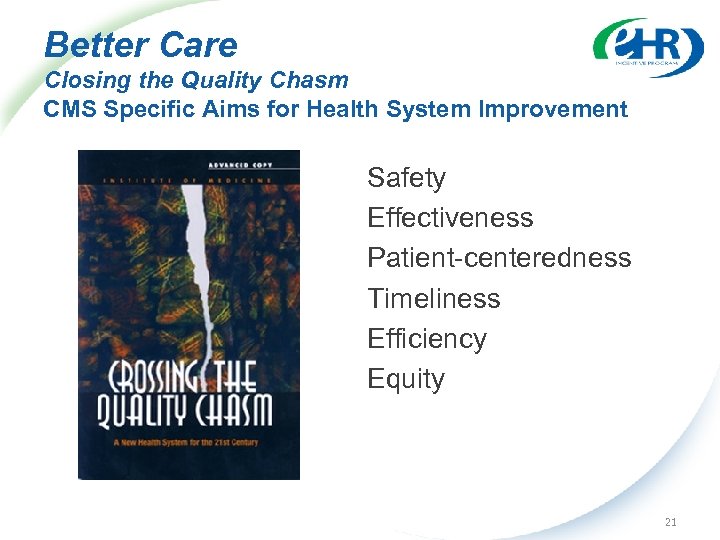
 CMS’ Quality Improvement Roadmap § Vision: The right care for every person every time Institute of Medicine: Crossing the Quality Chasm: A New Health System for the 21 st Century, March, 2001. § Make care: § Safe § Effective § Efficient: absence of waste, overuse, misuse, and errors § Patient-centered § Timely § Equitable
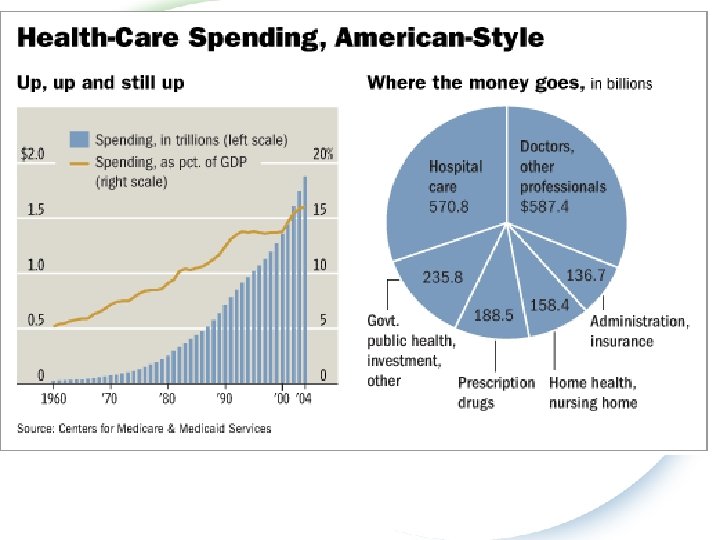
 What’s Wrong with US Healthcare Today? Too Costly? Inefficient? Disparities in Access and Quality? Evidence Base foundation often lacking? Lack of Prevention focus? Fragmentation of care, between providers and sites of care? (Silos, care transitions) Poor information and data sharing and transfer? Patient safety and quality ? (Compare to aviation industry? ) A payment system that rewards providing services rather than outcomes? Coordinated, accountable or Uncoordinated, Unaccountable care?
 Aviation or Health Care ?
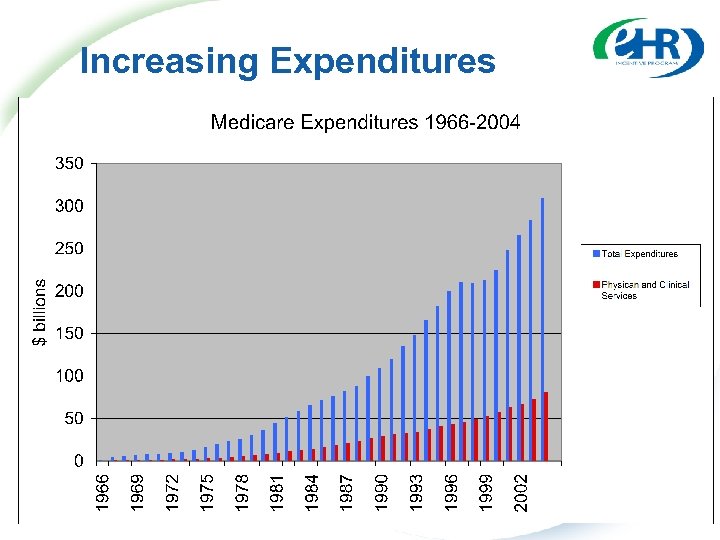 Increasing Expenditures
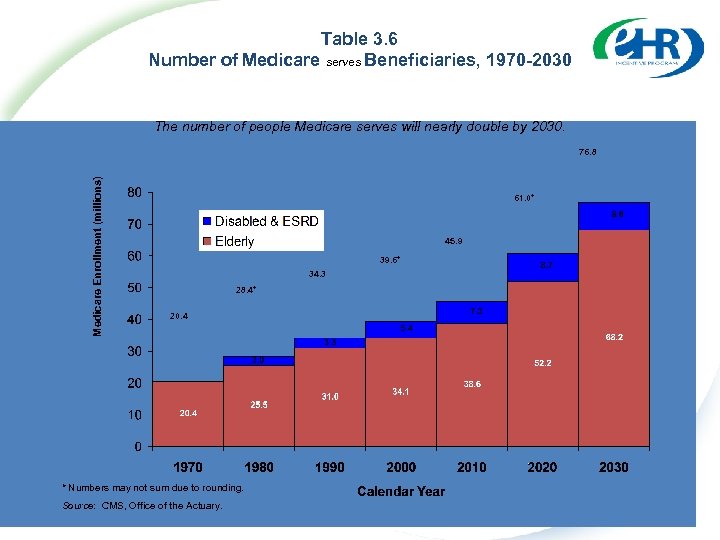 Table 3. 6 Number of Medicare serves Beneficiaries, 1970 -2030 The number of people Medicare serves will nearly double by 2030. Medicare Enrollment (millions) 76. 8 61. 0* 45. 9 39. 6* 34. 3 28. 4* 20. 4 * Numbers may not sum due to rounding. Source: CMS, Office of the Actuary.
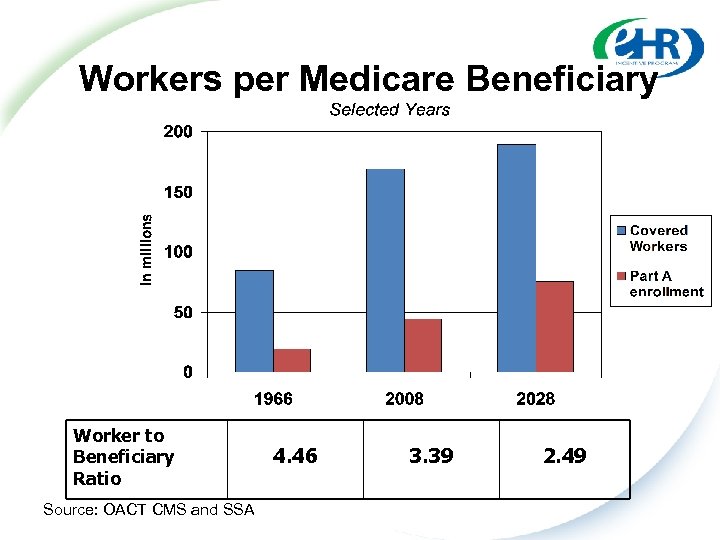 Workers per Medicare Beneficiary Worker to Beneficiary Ratio Source: OACT CMS and SSA 4. 46 3. 39 2. 49
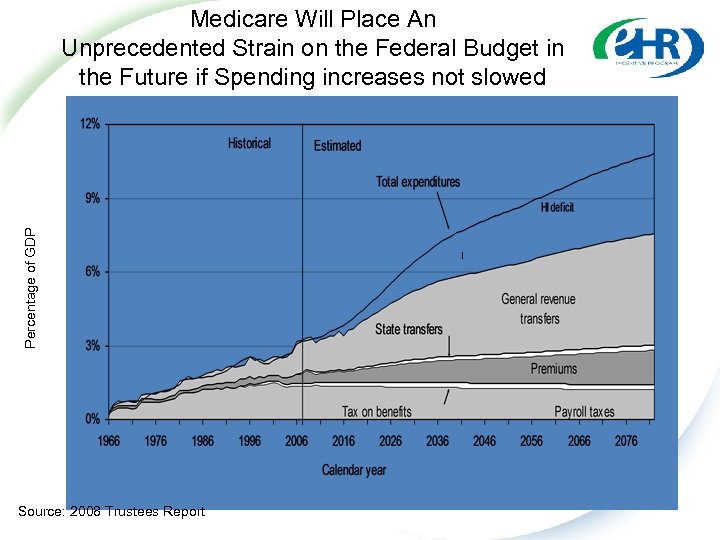 Percentage of GDP Medicare Will Place An Unprecedented Strain on the Federal Budget in the Future if Spending increases not slowed Source: 2008 Trustees Report
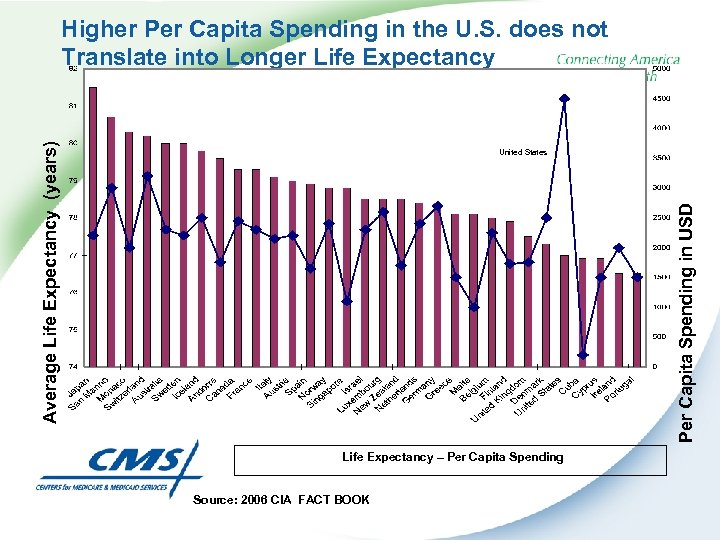 Average Life Expectancy (years) Higher Per Capita Spending in the U. S. does not Translate into Longer Life Expectancy Per Capita Spending in USD United States Life Expectancy – Per Capita Spending Source: 2006 CIA FACT BOOK
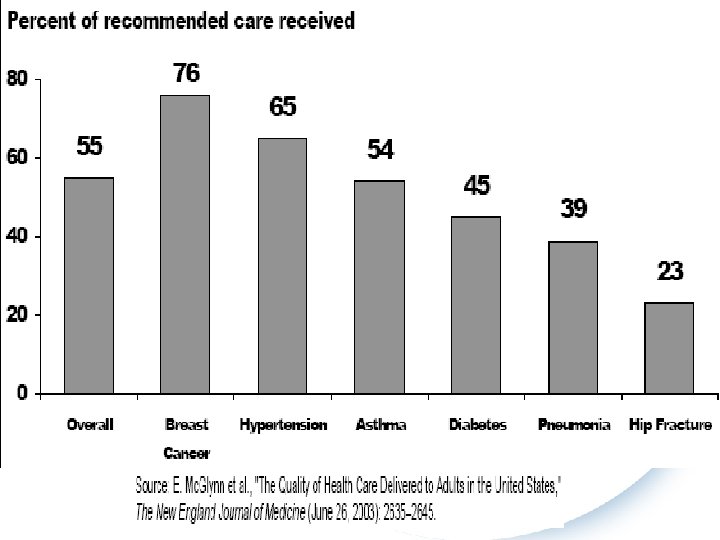
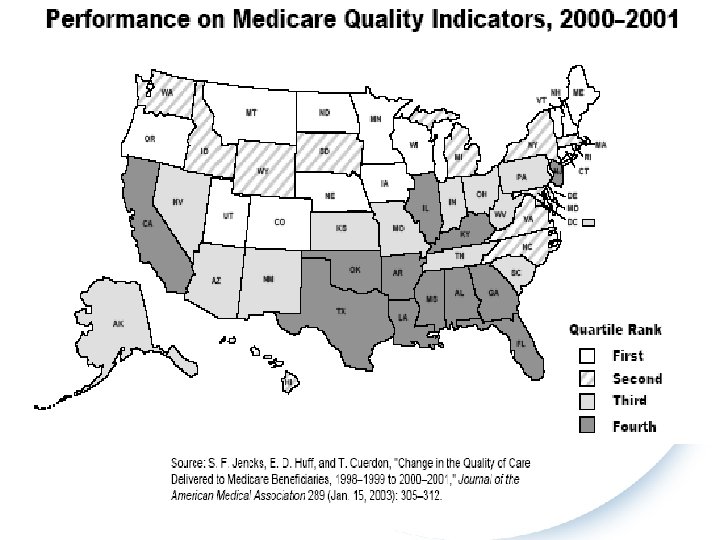
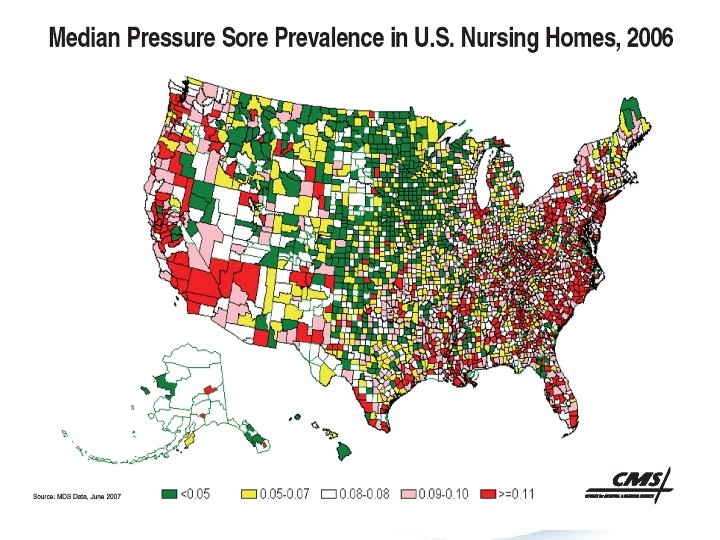
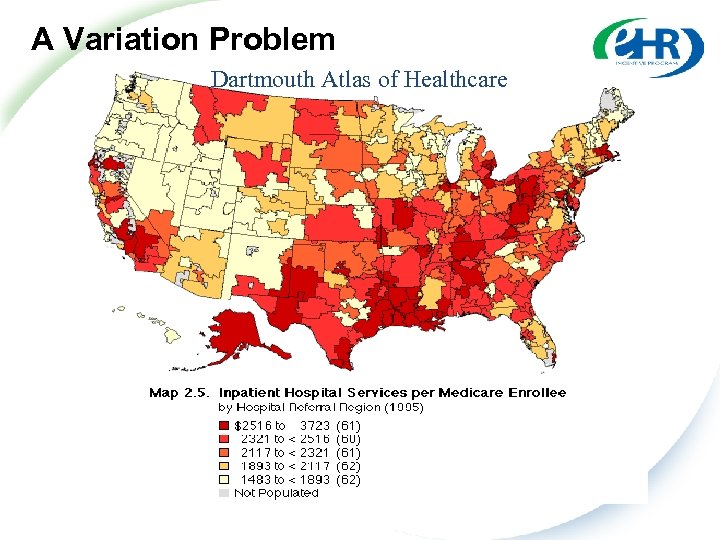 A Variation Problem Dartmouth Atlas of Healthcare
 HIT Overview § HIT and Congressional Initiatives § ARRA of 2009, HITECH ACT, established CMS E. HR incentive program for Meaningful Use of HIT § Recent Studies: Archives of Internal Medicine, Jan. 26 2009, Amarasingham, et. al, “Clinical Information Technologies and Inpatient Outcomes, a Multiple Hospital Study” -Hospitals with automated notes and records, order entry and clinical decision support had fewer complications, lower mortality rates, and lower costs.
 Post The Affordable Care Act Strategic Value of Meaningful Use
 The Triple Goals of CMS Better Care • Patient Safety • Quality • Patient Experience Reduce Per Capita Cost • Reduce unnecessary and unjustified medical cost • Reduce administrative cost thru process simplification Improve Population Health • Decrease health disparities • Improve chronic care management and outcome • Improve community health status
 Better Care Closing the Quality Chasm CMS Specific Aims for Health System Improvement Safety Effectiveness Patient-centeredness Timeliness Efficiency Equity 21
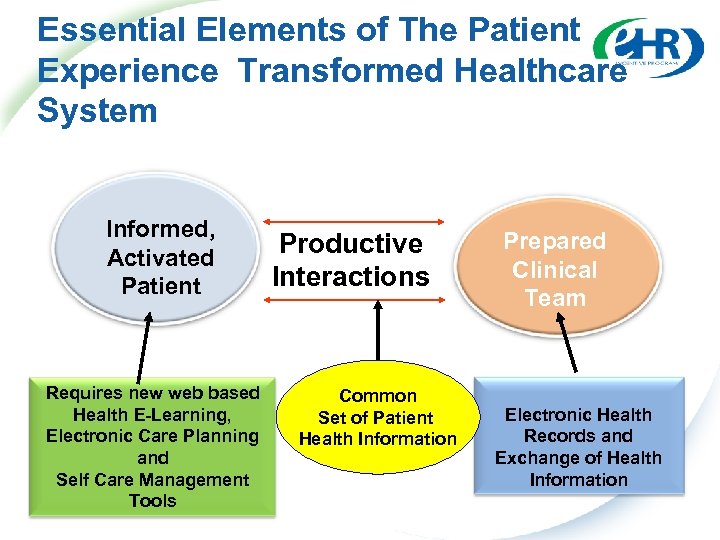 Essential Elements of The Patient Experience Transformed Healthcare System Informed, Activated Patient Requires new web based Health E-Learning, Electronic Care Planning and Self Care Management Tools Productive Interactions Common Set of Patient Health Information Prepared Clinical Team Electronic Health Records and Exchange of Health Information
 The CMS Vision of Leveraging Meaningful Use of HIT
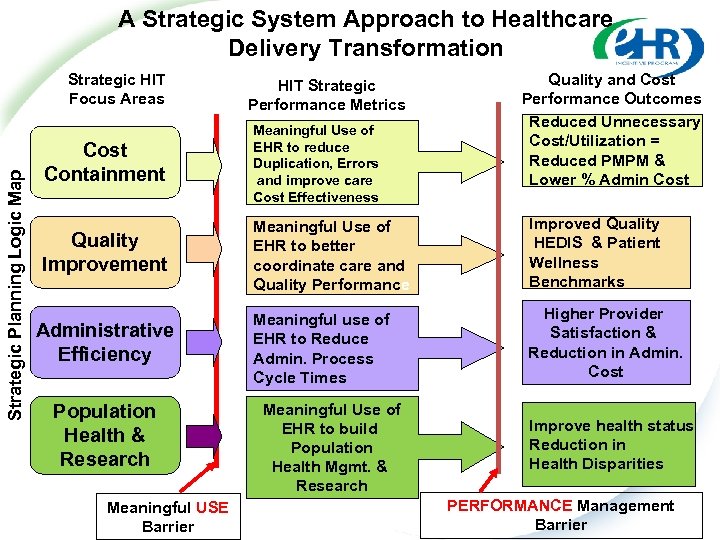 A Strategic System Approach to Healthcare Delivery Transformation Strategic Planning Logic Map Strategic HIT Focus Areas HIT Strategic Performance Metrics Quality and Cost Performance Outcomes Reduced Unnecessary Cost/Utilization = Reduced PMPM & Lower % Admin Cost Containment Meaningful Use of EHR to reduce Duplication, Errors and improve care Cost Effectiveness Quality Improvement Meaningful Use of EHR to better coordinate care and Quality Performance Improved Quality HEDIS & Patient Wellness Benchmarks Meaningful use of EHR to Reduce Admin. Process Cycle Times Higher Provider Satisfaction & Reduction in Admin. Cost Administrative Efficiency Population Health & Research Meaningful USE Barrier Meaningful Use of EHR to build Population Health Mgmt. & Research Improve health status Reduction in Health Disparities PERFORMANCE Management Barrier
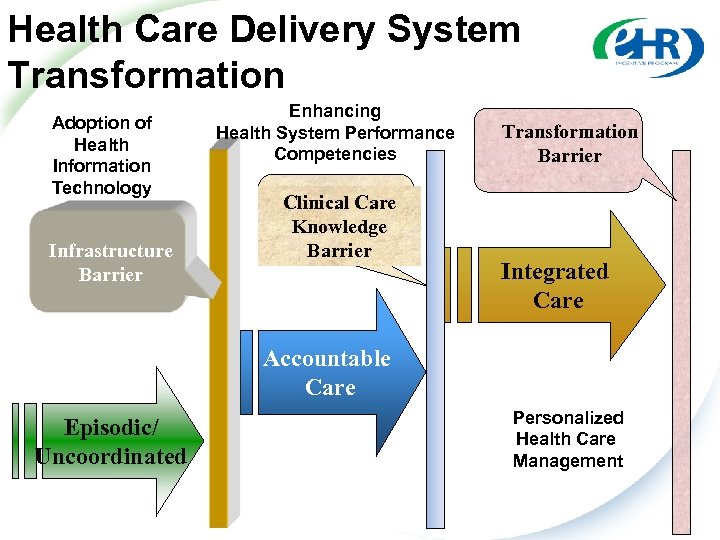 Health Care Delivery System Transformation Adoption of Health Information Technology Infrastructure Barrier Enhancing Health System Performance Competencies Clinical Care Knowledge Barrier Transformation Barrier Integrated Care Accountable Care Episodic/ Uncoordinated Personalized Health Care Management
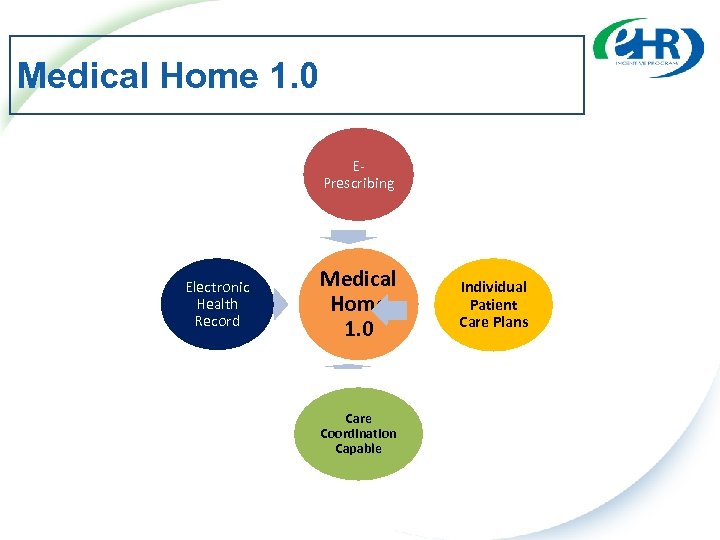 Medical Home 1. 0 EPrescribing Electronic Health Record Medical Home 1. 0 Care Coordination Capable Individual Patient Care Plans
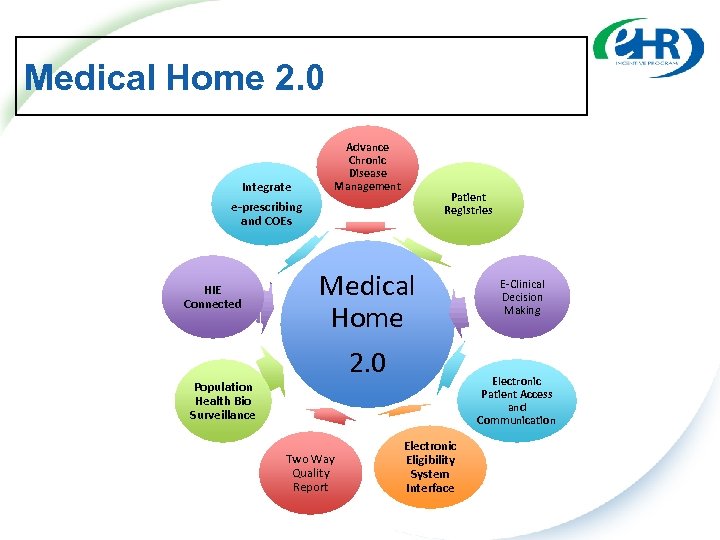 Medical Home 2. 0 Integrate Advance Chronic Disease Management Patient Registries e-prescribing and COEs HIE Connected Population Health Bio Surveillance Medical Home 2. 0 Two Way Quality Report Electronic Eligibility System Interface E-Clinical Decision Making Electronic Patient Access and Communication
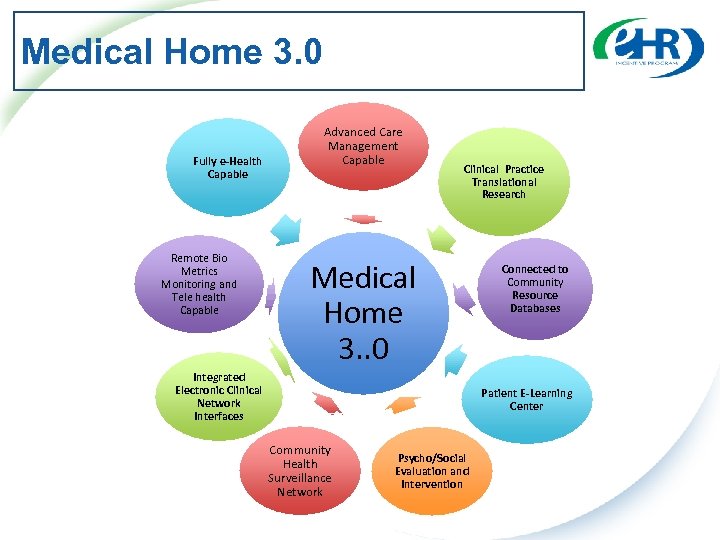 Medical Home 3. 0 Fully e-Health Capable Remote Bio Metrics Monitoring and Tele health Capable Advanced Care Management Capable Clinical Practice Translational Research Medical Home 3. . 0 Integrated Electronic Clinical Network Interfaces Connected to Community Resource Databases Patient E-Learning Center Community Health Surveillance Network Psycho/Social Evaluation and Intervention
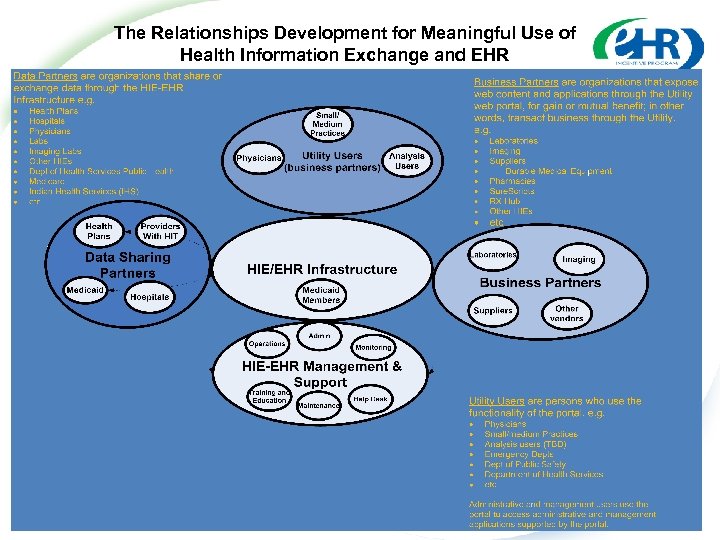 The Relationships Development for Meaningful Use of Health Information Exchange and EHR
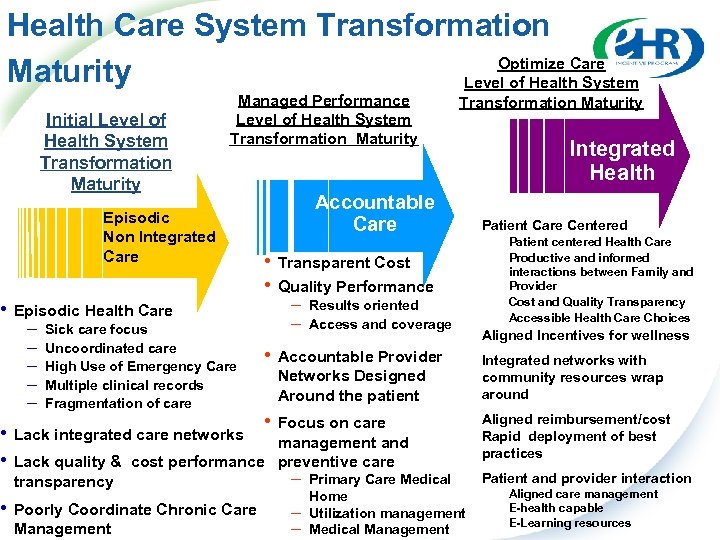 Health Care System Transformation Optimize Care Maturity Level of Health System Initial Level of Health System Transformation Maturity Managed Performance Level of Health System Transformation Maturity Episodic Non Integrated Care • Episodic Health Care – – – Sick care focus Uncoordinated care High Use of Emergency Care Multiple clinical records Fragmentation of care Accountable Care • Transparent Cost • Quality Performance – – Results oriented Access and coverage • Accountable Provider Networks Designed Around the patient • Focus on care • Lack integrated care networks management and • Lack quality & cost performance preventive care transparency • Poorly Coordinate Chronic Care Management – – – Transformation Maturity Integrated Health • Patient Care Centered – Patient centered Health Care – Productive and informed interactions between Family and Provider – Cost and Quality Transparency – Accessible Health Care Choices – Aligned Incentives for wellness • Integrated networks with community resources wrap around • Aligned reimbursement/cost Rapid deployment of best practices Primary Care Medical • Patient and provider interaction – Aligned care management Home – E-health capable Utilization management – E-Learning resources Medical Management
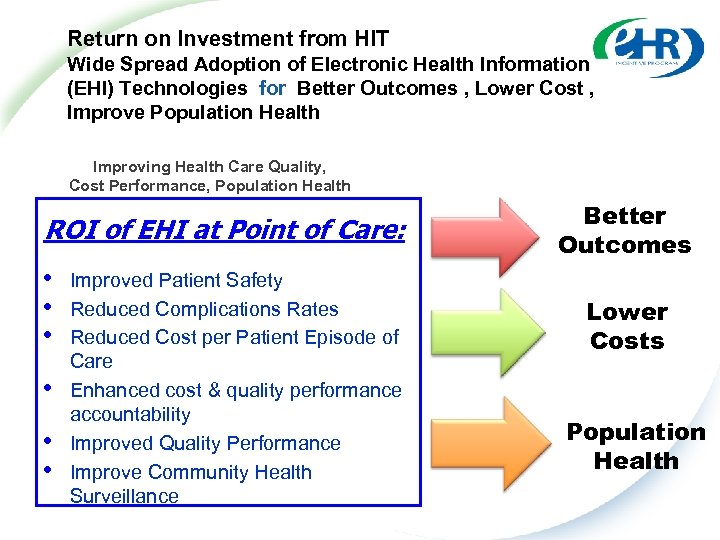 Return on Investment from HIT Wide Spread Adoption of Electronic Health Information (EHI) Technologies for Better Outcomes , Lower Cost , Improve Population Health Improving Health Care Quality, Cost Performance, Population Health ROI of EHI at Point of Care: • • • Improved Patient Safety Reduced Complications Rates Reduced Cost per Patient Episode of Care Enhanced cost & quality performance accountability Improved Quality Performance Improve Community Health Surveillance Better Outcomes Lower Costs Population Health
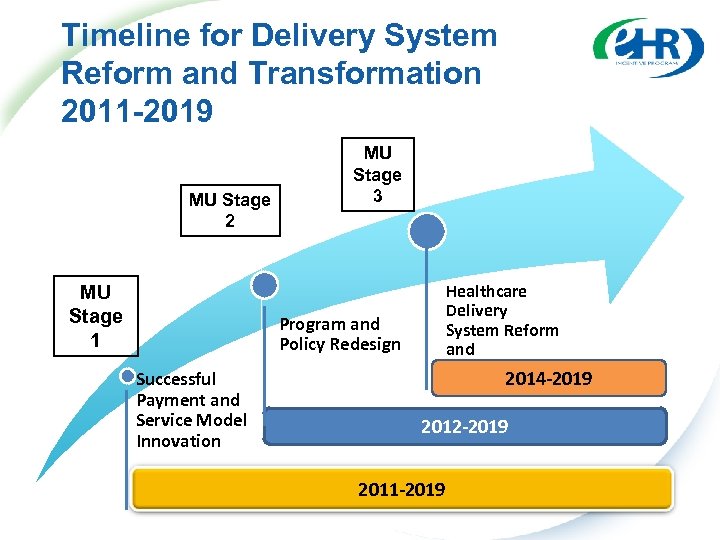 Timeline for Delivery System Reform and Transformation 2011 -2019 MU Stage 2 MU Stage 1 MU Stage 3 Healthcare Delivery System Reform and Transformation Program and Policy Redesign Successful Payment and Service Model Innovation 2014 -2019 2012 -2019 2011 -2019
 Medicare & Medicaid EHR Incentive Program Final Rule Implementing the American Recovery & Reinvestment Act of 2009
 What the Final Rule Does • Harmonizes MU criteria across CMS programs as much as possible • Closely links with the ONC Certification and Standards final rules • Builds on the recommendations of the HIT Policy Committee and Public Commenters • Coordinates with existing CMS quality initiatives • Provides a platform that allows for a staged implementation of EHRs over time 35
 Eligibility Overview for the E. HR Incentive Program • Medicare Fee-For-Service (FFS) • Eligible Professionals (EPs) • Eligible hospitals and critical access hospitals (CAHs) • Medicare Advantage (MA) • MA EPs • MA-affiliated eligible hospitals • Medicaid • EPs • Eligible hospitals 36
 Who is Eligible to Participate? • Eligibility determined in law • Hospital-based EPs are NOT eligible for incentives • DEFINITION: 90% or more of their covered professional services in either an inpatient (POS 21) or emergency room (POS 23) of a hospital • Definition of hospital-based determined in law • Incentives are based on the individual, not the practice
 Who is a Medicare Eligible Provider? Eligible Providers in Medicare FFS Eligible Professionals (EPs) Doctor of Medicine or Osteopathy Doctor of Dental Surgery or Dental Medicine Doctor of Podiatric Medicine Doctor of Optometry Chiropractor Eligible Hospitals Acute Care Hospitals* Critical Access Hospitals (CAHs) *Subsection (d) hospitals that are paid under the PPS and are located in the 50 States or Washington, DC (including Maryland) 38
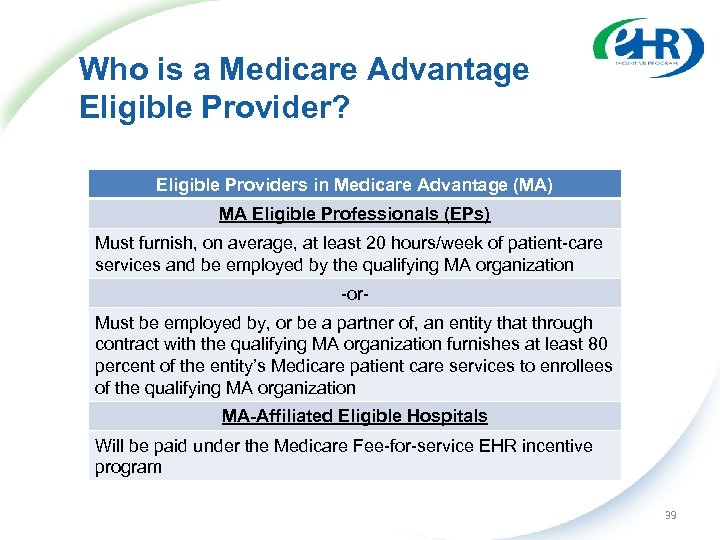 Who is a Medicare Advantage Eligible Provider? Eligible Providers in Medicare Advantage (MA) MA Eligible Professionals (EPs) Must furnish, on average, at least 20 hours/week of patient-care services and be employed by the qualifying MA organization -or. Must be employed by, or be a partner of, an entity that through contract with the qualifying MA organization furnishes at least 80 percent of the entity’s Medicare patient care services to enrollees of the qualifying MA organization MA-Affiliated Eligible Hospitals Will be paid under the Medicare Fee-for-service EHR incentive program 39
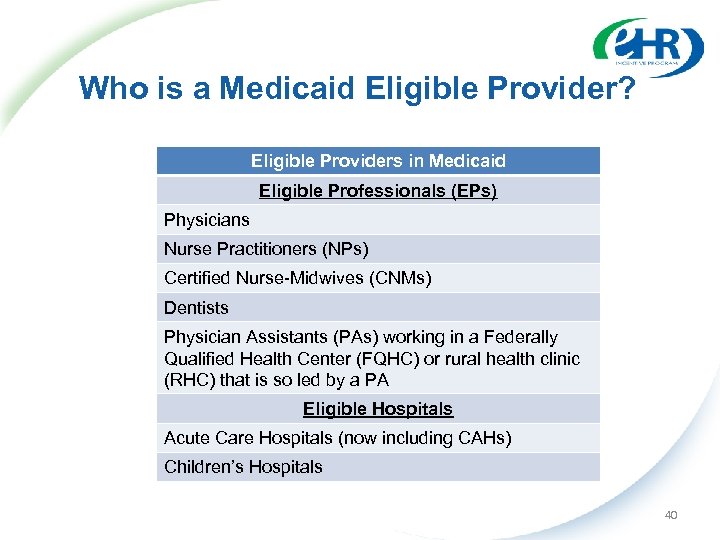 Who is a Medicaid Eligible Provider? Eligible Providers in Medicaid Eligible Professionals (EPs) Physicians Nurse Practitioners (NPs) Certified Nurse-Midwives (CNMs) Dentists Physician Assistants (PAs) working in a Federally Qualified Health Center (FQHC) or rural health clinic (RHC) that is so led by a PA Eligible Hospitals Acute Care Hospitals (now including CAHs) Children’s Hospitals 40
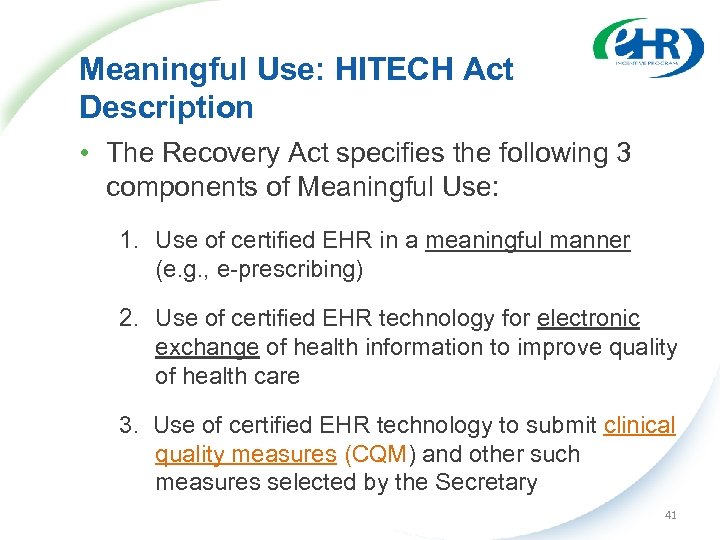 Meaningful Use: HITECH Act Description • The Recovery Act specifies the following 3 components of Meaningful Use: 1. Use of certified EHR in a meaningful manner (e. g. , e-prescribing) 2. Use of certified EHR technology for electronic exchange of health information to improve quality of health care 3. Use of certified EHR technology to submit clinical quality measures (CQM) and other such measures selected by the Secretary 41
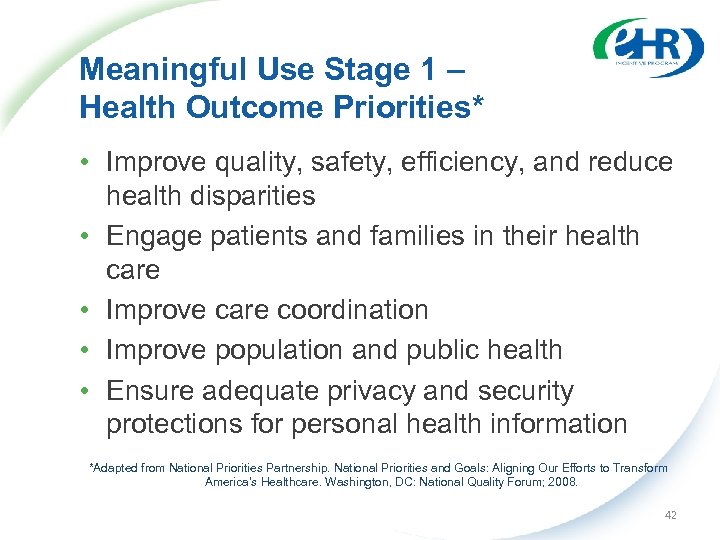 Meaningful Use Stage 1 – Health Outcome Priorities* • Improve quality, safety, efficiency, and reduce health disparities • Engage patients and families in their health care • Improve care coordination • Improve population and public health • Ensure adequate privacy and security protections for personal health information *Adapted from National Priorities Partnership. National Priorities and Goals: Aligning Our Efforts to Transform America’s Healthcare. Washington, DC: National Quality Forum; 2008. 42
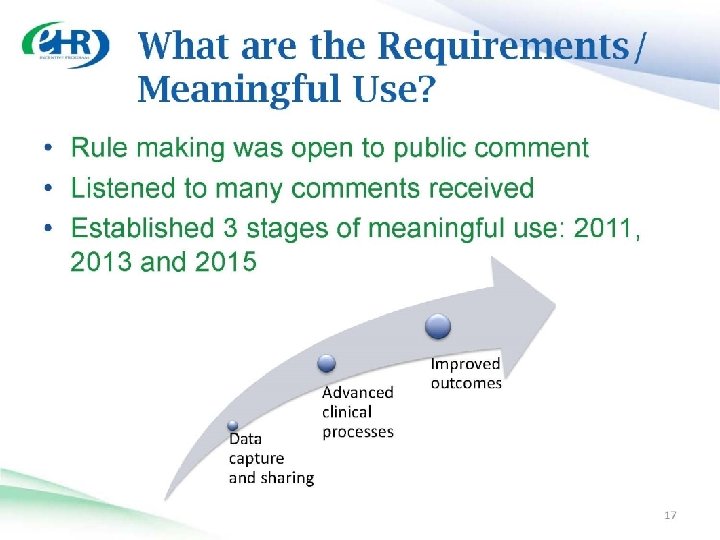
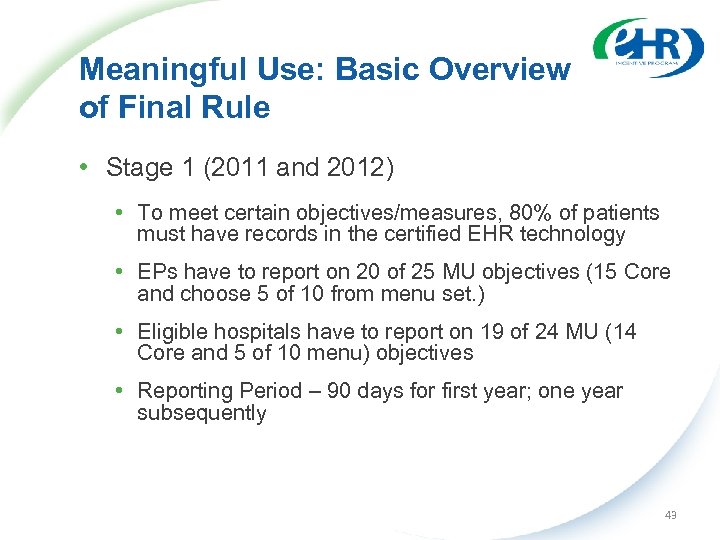 Meaningful Use: Basic Overview of Final Rule • Stage 1 (2011 and 2012) • To meet certain objectives/measures, 80% of patients must have records in the certified EHR technology • EPs have to report on 20 of 25 MU objectives (15 Core and choose 5 of 10 from menu set. ) • Eligible hospitals have to report on 19 of 24 MU (14 Core and 5 of 10 menu) objectives • Reporting Period – 90 days for first year; one year subsequently 43
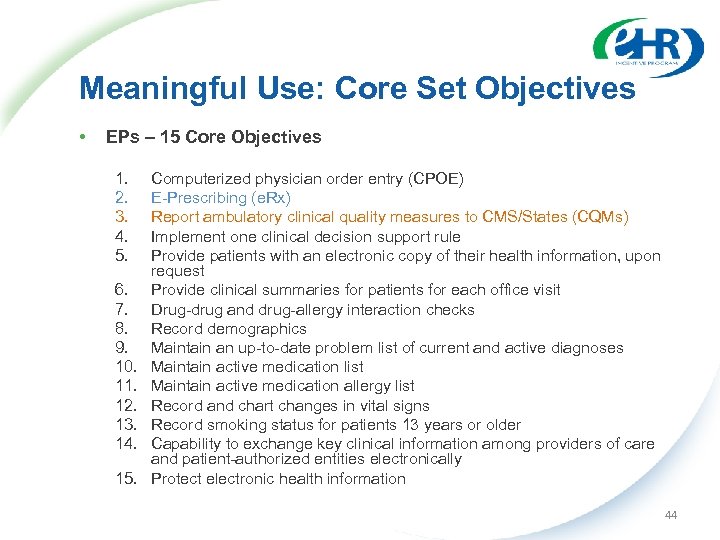 Meaningful Use: Core Set Objectives • EPs – 15 Core Objectives 1. 2. 3. 4. 5. 6. 7. 8. 9. 10. 11. 12. 13. 14. 15. Computerized physician order entry (CPOE) E-Prescribing (e. Rx) Report ambulatory clinical quality measures to CMS/States (CQMs) Implement one clinical decision support rule Provide patients with an electronic copy of their health information, upon request Provide clinical summaries for patients for each office visit Drug-drug and drug-allergy interaction checks Record demographics Maintain an up-to-date problem list of current and active diagnoses Maintain active medication list Maintain active medication allergy list Record and chart changes in vital signs Record smoking status for patients 13 years or older Capability to exchange key clinical information among providers of care and patient-authorized entities electronically Protect electronic health information 44
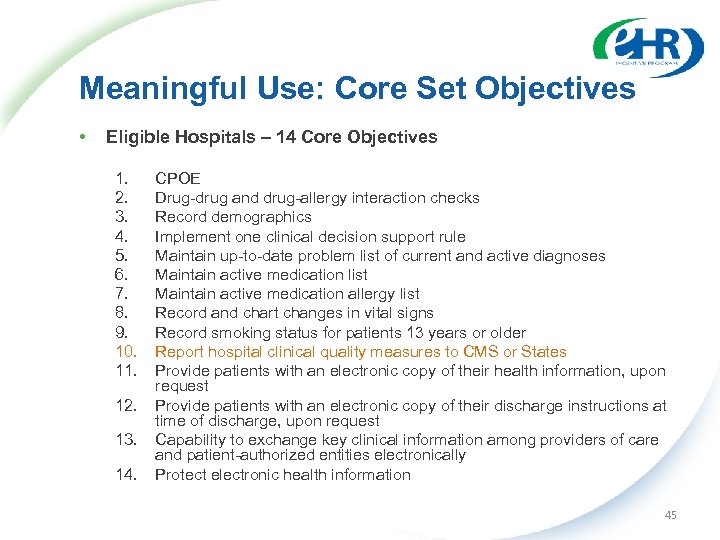 Meaningful Use: Core Set Objectives • Eligible Hospitals – 14 Core Objectives 1. 2. 3. 4. 5. 6. 7. 8. 9. 10. 11. 12. 13. 14. CPOE Drug-drug and drug-allergy interaction checks Record demographics Implement one clinical decision support rule Maintain up-to-date problem list of current and active diagnoses Maintain active medication list Maintain active medication allergy list Record and chart changes in vital signs Record smoking status for patients 13 years or older Report hospital clinical quality measures to CMS or States Provide patients with an electronic copy of their health information, upon request Provide patients with an electronic copy of their discharge instructions at time of discharge, upon request Capability to exchange key clinical information among providers of care and patient-authorized entities electronically Protect electronic health information 45
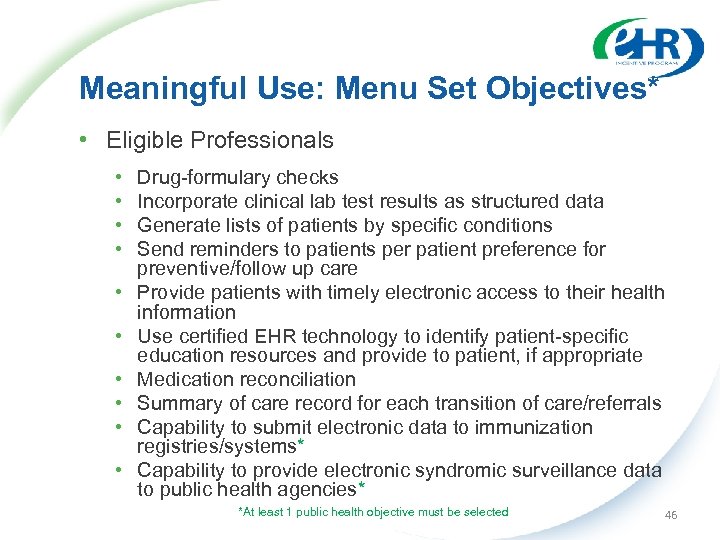 Meaningful Use: Menu Set Objectives* • Eligible Professionals • • • Drug-formulary checks Incorporate clinical lab test results as structured data Generate lists of patients by specific conditions Send reminders to patients per patient preference for preventive/follow up care Provide patients with timely electronic access to their health information Use certified EHR technology to identify patient-specific education resources and provide to patient, if appropriate Medication reconciliation Summary of care record for each transition of care/referrals Capability to submit electronic data to immunization registries/systems* Capability to provide electronic syndromic surveillance data to public health agencies* *At least 1 public health objective must be selected 46
 Meaningful Use: Menu Set Objectives* • Eligible Hospitals • • • Drug-formulary checks Record advanced directives for patients 65 years or older Incorporate clinical lab test results as structured data Generate lists of patients by specific conditions Use certified EHR technology to identify patient-specific education resources and provide to patient, if appropriate Medication reconciliation Summary of care record for each transition of care/referrals Capability to submit electronic data to immunization registries/systems* Capability to provide electronic submission of reportable lab results to public health agencies* Capability to provide electronic syndromic surveillance data to public health agencies* *At least 1 public health objective must be selected 47
 Meaningful Use: Stage 2 • Intend to propose 2 additional Stages through future rulemaking. Future Stages will expand upon Stage 1 criteria. • Stage 1 menu set will be transitioned into core set for Stage 2 • Will reevaluate measures – possibly higher thresholds • Will include greater emphasis on health information exchange across institutional boundaries 48
 Meaningful Use: Denominators • Two types of percentage-based measures are included to address the burden of demonstrating MU 1. Denominator is all patients seen or admitted during the EHR reporting period • The denominator is all patients regardless of whether their records are kept using certified EHR technology 2. Denominator is actions or subsets of patients seen or admitted during the EHR reporting period • The denominator only includes patients, or actions taken on behalf of those patients, whose records are kept using certified EHR technology 49
 Meaningful Use: Applicability of Objectives and Measures • Some MU objectives are not applicable to every provider’s clinical practice, thus they would not have any eligible patients or actions for the measure denominator. Exclusions do not count against the 5 deferred measures • In these cases, the EP, eligible hospital, or CAH would be excluded from having to meet that measure • E. g. , Dentists who do not perform immunizations; Chiropractors do not e-prescribe 50
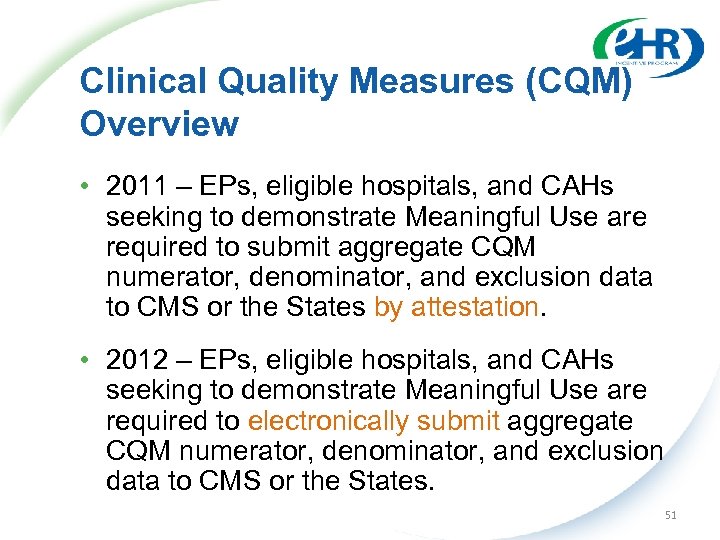 Clinical Quality Measures (CQM) Overview • 2011 – EPs, eligible hospitals, and CAHs seeking to demonstrate Meaningful Use are required to submit aggregate CQM numerator, denominator, and exclusion data to CMS or the States by attestation. • 2012 – EPs, eligible hospitals, and CAHs seeking to demonstrate Meaningful Use are required to electronically submit aggregate CQM numerator, denominator, and exclusion data to CMS or the States. 51
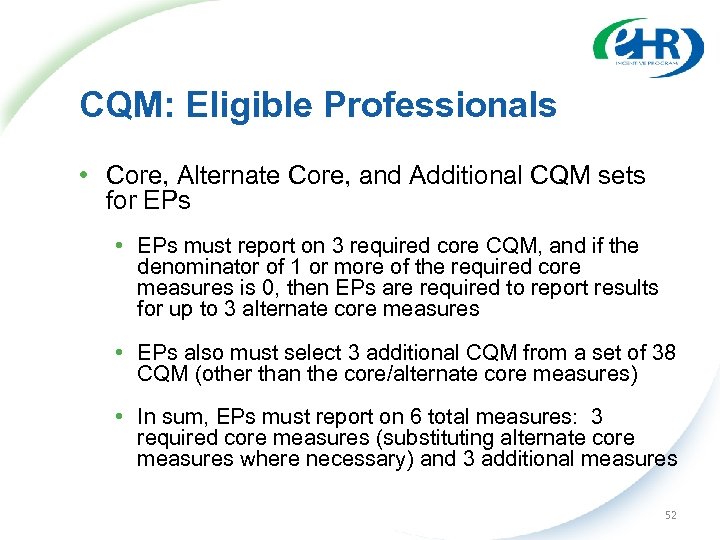 CQM: Eligible Professionals • Core, Alternate Core, and Additional CQM sets for EPs • EPs must report on 3 required core CQM, and if the denominator of 1 or more of the required core measures is 0, then EPs are required to report results for up to 3 alternate core measures • EPs also must select 3 additional CQM from a set of 38 CQM (other than the core/alternate core measures) • In sum, EPs must report on 6 total measures: 3 required core measures (substituting alternate core measures where necessary) and 3 additional measures 52
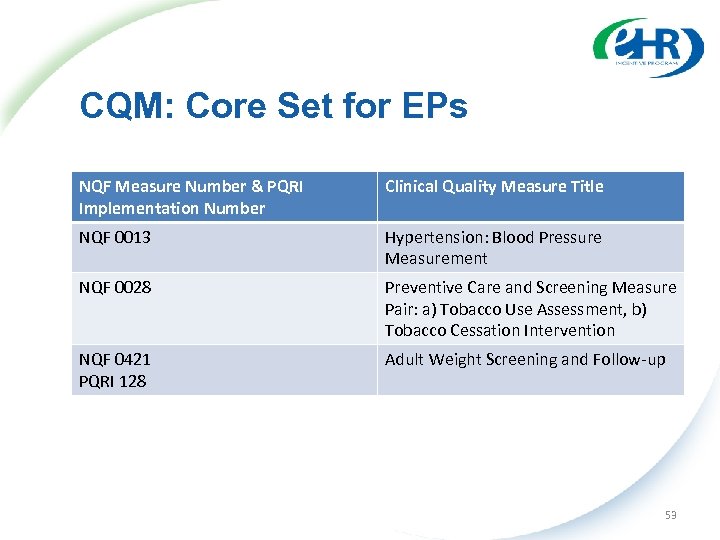 CQM: Core Set for EPs NQF Measure Number & PQRI Implementation Number Clinical Quality Measure Title NQF 0013 Hypertension: Blood Pressure Measurement NQF 0028 Preventive Care and Screening Measure Pair: a) Tobacco Use Assessment, b) Tobacco Cessation Intervention NQF 0421 PQRI 128 Adult Weight Screening and Follow-up 53
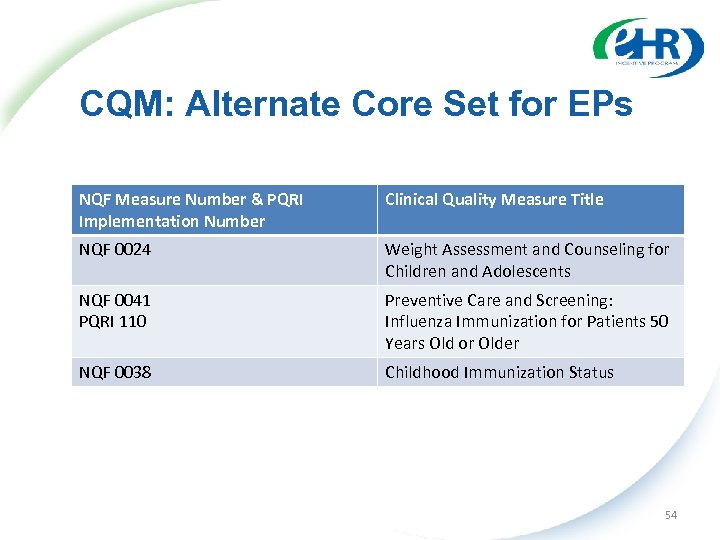 CQM: Alternate Core Set for EPs NQF Measure Number & PQRI Implementation Number Clinical Quality Measure Title NQF 0024 Weight Assessment and Counseling for Children and Adolescents NQF 0041 PQRI 110 Preventive Care and Screening: Influenza Immunization for Patients 50 Years Old or Older NQF 0038 Childhood Immunization Status 54
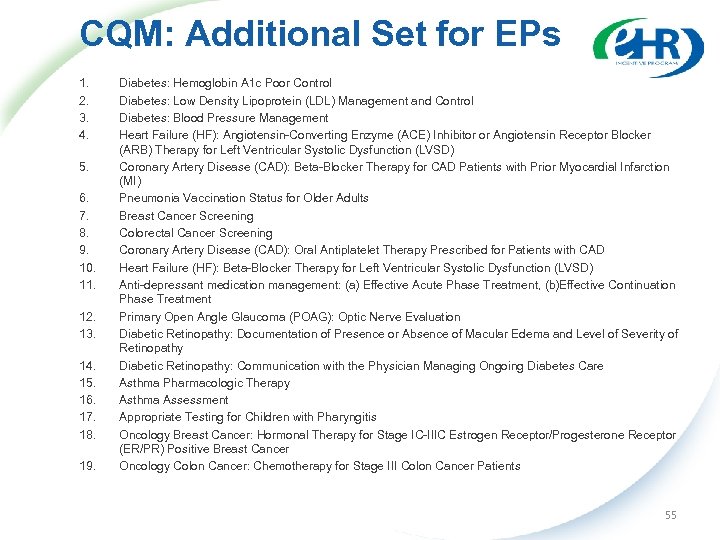 CQM: Additional Set for EPs 1. 2. 3. 4. 5. 6. 7. 8. 9. 10. 11. 12. 13. 14. 15. 16. 17. 18. 19. Diabetes: Hemoglobin A 1 c Poor Control Diabetes: Low Density Lipoprotein (LDL) Management and Control Diabetes: Blood Pressure Management Heart Failure (HF): Angiotensin-Converting Enzyme (ACE) Inhibitor or Angiotensin Receptor Blocker (ARB) Therapy for Left Ventricular Systolic Dysfunction (LVSD) Coronary Artery Disease (CAD): Beta-Blocker Therapy for CAD Patients with Prior Myocardial Infarction (MI) Pneumonia Vaccination Status for Older Adults Breast Cancer Screening Colorectal Cancer Screening Coronary Artery Disease (CAD): Oral Antiplatelet Therapy Prescribed for Patients with CAD Heart Failure (HF): Beta-Blocker Therapy for Left Ventricular Systolic Dysfunction (LVSD) Anti-depressant medication management: (a) Effective Acute Phase Treatment, (b)Effective Continuation Phase Treatment Primary Open Angle Glaucoma (POAG): Optic Nerve Evaluation Diabetic Retinopathy: Documentation of Presence or Absence of Macular Edema and Level of Severity of Retinopathy Diabetic Retinopathy: Communication with the Physician Managing Ongoing Diabetes Care Asthma Pharmacologic Therapy Asthma Assessment Appropriate Testing for Children with Pharyngitis Oncology Breast Cancer: Hormonal Therapy for Stage IC-IIIC Estrogen Receptor/Progesterone Receptor (ER/PR) Positive Breast Cancer Oncology Colon Cancer: Chemotherapy for Stage III Colon Cancer Patients 55
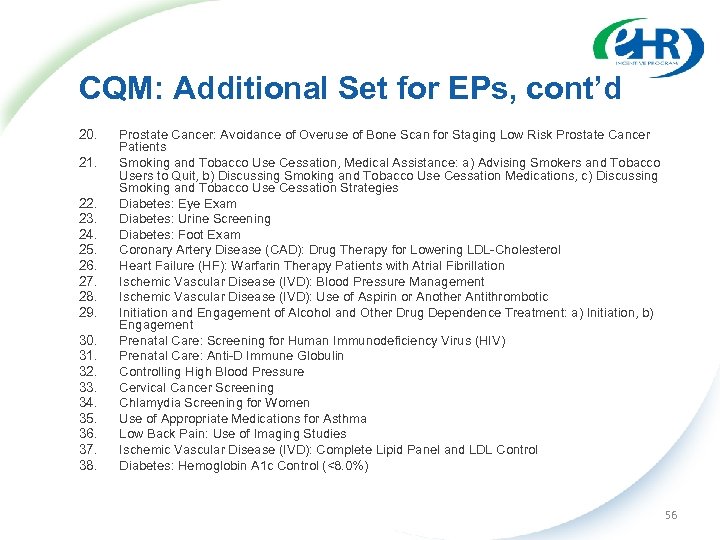 CQM: Additional Set for EPs, cont’d 20. 21. 22. 23. 24. 25. 26. 27. 28. 29. 30. 31. 32. 33. 34. 35. 36. 37. 38. Prostate Cancer: Avoidance of Overuse of Bone Scan for Staging Low Risk Prostate Cancer Patients Smoking and Tobacco Use Cessation, Medical Assistance: a) Advising Smokers and Tobacco Users to Quit, b) Discussing Smoking and Tobacco Use Cessation Medications, c) Discussing Smoking and Tobacco Use Cessation Strategies Diabetes: Eye Exam Diabetes: Urine Screening Diabetes: Foot Exam Coronary Artery Disease (CAD): Drug Therapy for Lowering LDL-Cholesterol Heart Failure (HF): Warfarin Therapy Patients with Atrial Fibrillation Ischemic Vascular Disease (IVD): Blood Pressure Management Ischemic Vascular Disease (IVD): Use of Aspirin or Another Antithrombotic Initiation and Engagement of Alcohol and Other Drug Dependence Treatment: a) Initiation, b) Engagement Prenatal Care: Screening for Human Immunodeficiency Virus (HIV) Prenatal Care: Anti-D Immune Globulin Controlling High Blood Pressure Cervical Cancer Screening Chlamydia Screening for Women Use of Appropriate Medications for Asthma Low Back Pain: Use of Imaging Studies Ischemic Vascular Disease (IVD): Complete Lipid Panel and LDL Control Diabetes: Hemoglobin A 1 c Control (<8. 0%) 56
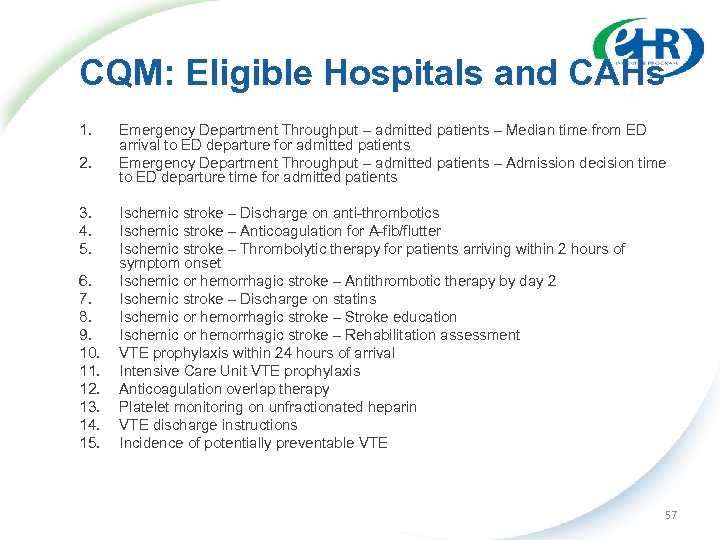 CQM: Eligible Hospitals and CAHs 1. 2. 3. 4. 5. 6. 7. 8. 9. 10. 11. 12. 13. 14. 15. Emergency Department Throughput – admitted patients – Median time from ED arrival to ED departure for admitted patients Emergency Department Throughput – admitted patients – Admission decision time to ED departure time for admitted patients Ischemic stroke – Discharge on anti-thrombotics Ischemic stroke – Anticoagulation for A-fib/flutter Ischemic stroke – Thrombolytic therapy for patients arriving within 2 hours of symptom onset Ischemic or hemorrhagic stroke – Antithrombotic therapy by day 2 Ischemic stroke – Discharge on statins Ischemic or hemorrhagic stroke – Stroke education Ischemic or hemorrhagic stroke – Rehabilitation assessment VTE prophylaxis within 24 hours of arrival Intensive Care Unit VTE prophylaxis Anticoagulation overlap therapy Platelet monitoring on unfractionated heparin VTE discharge instructions Incidence of potentially preventable VTE 57
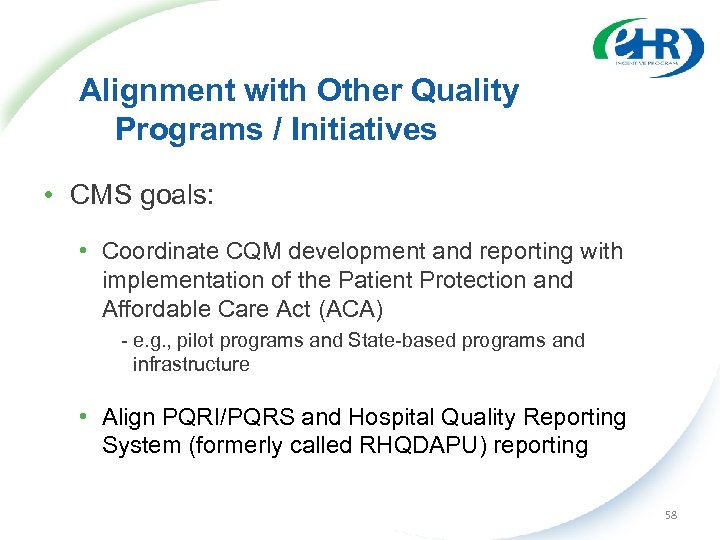 Alignment with Other Quality Programs / Initiatives • CMS goals: • Coordinate CQM development and reporting with implementation of the Patient Protection and Affordable Care Act (ACA) - e. g. , pilot programs and State-based programs and infrastructure • Align PQRI/PQRS and Hospital Quality Reporting System (formerly called RHQDAPU) reporting 58
 Medicaid Only: Adopt/Implement/ Upgrade (A/I/U) • First participation year only for Medicaid providers • Adopted – Acquired and Installed • Ex: Evidence of installation prior to incentive • Implemented – Commenced Utilization of • Ex: Staff training, data entry of patient demographic information into E. H. R • Upgraded – Expanded • Upgraded to certified EHR technology or added new functionality to meet the definition of certified EHR technology • Must use certified EHR technology • No EHR reporting period 59
 States’ Flexibility to Revise Meaningful Use • States can seek CMS prior approval to require 4 MU objectives be core for their Medicaid providers: • Generate lists of patients by specific conditions for quality improvement, reduction of disparities, research, or outreach (can specify particular conditions) • Reporting to immunization registries, reportable lab results, and syndromic surveillance (can specify for their providers how to test the data submission and to which specific destination) 60
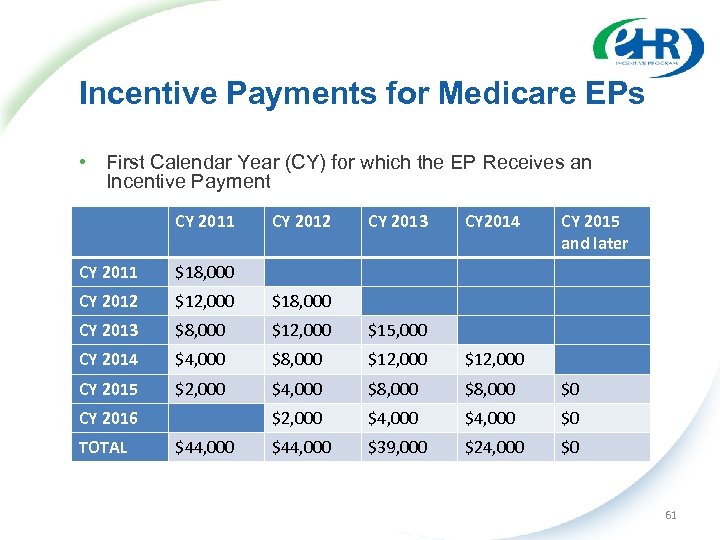 Incentive Payments for Medicare EPs • First Calendar Year (CY) for which the EP Receives an Incentive Payment CY 2011 CY 2012 CY 2013 CY 2014 CY 2015 and later CY 2011 $18, 000 CY 2012 $12, 000 $18, 000 CY 2013 $8, 000 $12, 000 $15, 000 CY 2014 $4, 000 $8, 000 $12, 000 CY 2015 $2, 000 $4, 000 $8, 000 $0 $2, 000 $4, 000 $0 $44, 000 $39, 000 $24, 000 $0 CY 2016 TOTAL $44, 000 61
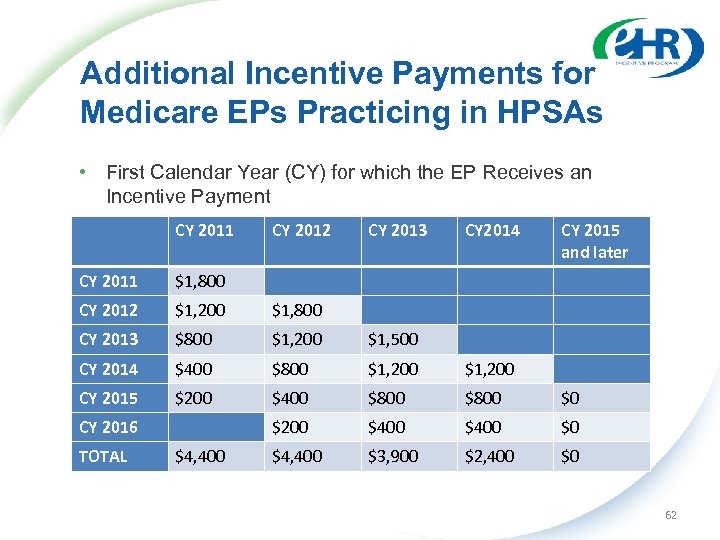 Additional Incentive Payments for Medicare EPs Practicing in HPSAs • First Calendar Year (CY) for which the EP Receives an Incentive Payment CY 2011 CY 2012 CY 2013 CY 2014 CY 2015 and later CY 2011 $1, 800 CY 2012 $1, 200 $1, 800 CY 2013 $800 $1, 200 $1, 500 CY 2014 $400 $800 $1, 200 CY 2015 $200 $400 $800 $0 $200 $400 $0 $4, 400 $3, 900 $2, 400 $0 CY 2016 TOTAL $4, 400 62
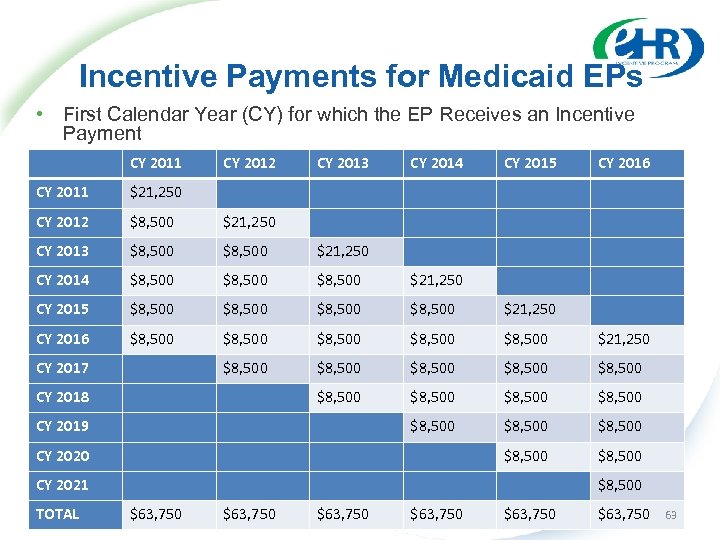 Incentive Payments for Medicaid EPs • First Calendar Year (CY) for which the EP Receives an Incentive Payment CY 2011 CY 2012 CY 2013 CY 2014 CY 2015 CY 2016 CY 2011 $21, 250 CY 2012 $8, 500 $21, 250 CY 2013 $8, 500 $21, 250 CY 2014 $8, 500 $21, 250 CY 2015 $8, 500 $21, 250 CY 2016 $8, 500 $8, 500 $21, 250 $8, 500 $8, 500 $8, 500 $8, 500 CY 2017 CY 2018 CY 2019 CY 2020 CY 2021 TOTAL $8, 500 $63, 750 $63, 750 63
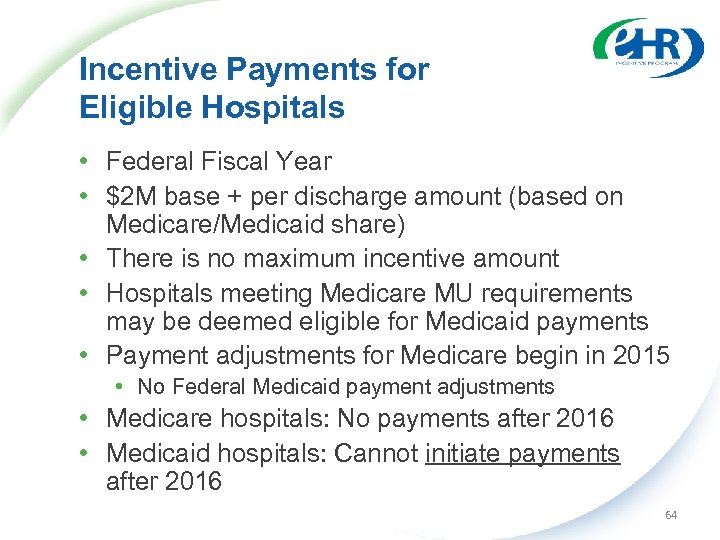 Incentive Payments for Eligible Hospitals • Federal Fiscal Year • $2 M base + per discharge amount (based on Medicare/Medicaid share) • There is no maximum incentive amount • Hospitals meeting Medicare MU requirements may be deemed eligible for Medicaid payments • Payment adjustments for Medicare begin in 2015 • No Federal Medicaid payment adjustments • Medicare hospitals: No payments after 2016 • Medicaid hospitals: Cannot initiate payments after 2016 64
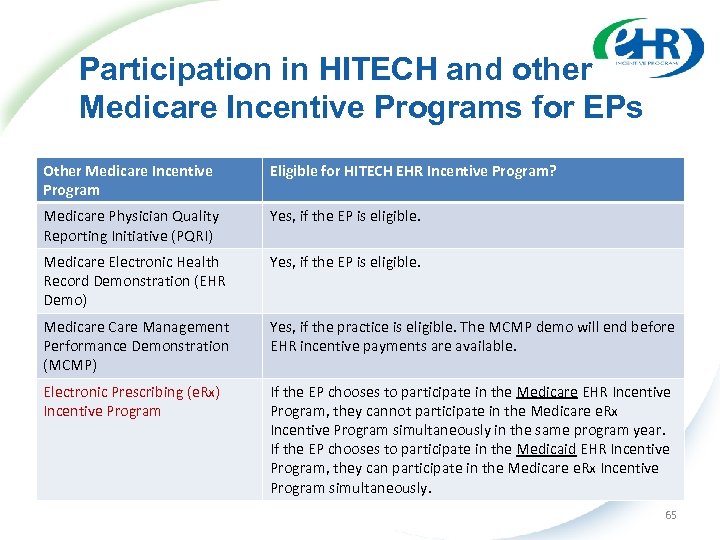 Participation in HITECH and other Medicare Incentive Programs for EPs Other Medicare Incentive Program Eligible for HITECH EHR Incentive Program? Medicare Physician Quality Reporting Initiative (PQRI) Yes, if the EP is eligible. Medicare Electronic Health Record Demonstration (EHR Demo) Yes, if the EP is eligible. Medicare Care Management Performance Demonstration (MCMP) Yes, if the practice is eligible. The MCMP demo will end before EHR incentive payments are available. Electronic Prescribing (e. Rx) Incentive Program If the EP chooses to participate in the Medicare EHR Incentive Program, they cannot participate in the Medicare e. Rx Incentive Program simultaneously in the same program year. If the EP chooses to participate in the Medicaid EHR Incentive Program, they can participate in the Medicare e. Rx Incentive Program simultaneously. 65
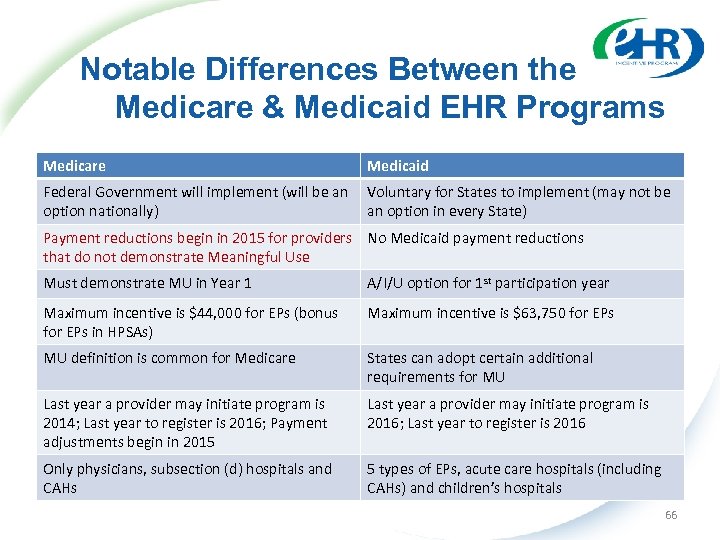 Notable Differences Between the Medicare & Medicaid EHR Programs Medicare Medicaid Federal Government will implement (will be an option nationally) Voluntary for States to implement (may not be an option in every State) Payment reductions begin in 2015 for providers No Medicaid payment reductions that do not demonstrate Meaningful Use Must demonstrate MU in Year 1 A/I/U option for 1 st participation year Maximum incentive is $44, 000 for EPs (bonus for EPs in HPSAs) Maximum incentive is $63, 750 for EPs MU definition is common for Medicare States can adopt certain additional requirements for MU Last year a provider may initiate program is 2014; Last year to register is 2016; Payment adjustments begin in 2015 Last year a provider may initiate program is 2016; Last year to register is 2016 Only physicians, subsection (d) hospitals and CAHs 5 types of EPs, acute care hospitals (including CAHs) and children’s hospitals 66
 EHR Incentive Program Timeline • • • January 2011 – Registration for the EHR Incentive Programs begins January 2011 – For Medicaid providers, States may launch their programs if they so choose April 2011 – Attestation for the Medicare EHR Incentive Program begins May 2011 – EHR incentive payments begin November 30, 2011 – Last day for eligible hospitals and CAHs to register and attest to receive an incentive payment for FFY 2011 February 29, 2012 – Last day for EPs to register and attest to receive an incentive payment for CY 2011 2015 – Medicare payment adjustments begin for EPs and eligible hospitals that are not meaningful users of EHR technology 2016 – Last year to receive a Medicare EHR incentive payment; Last year to initiate participation in Medicaid EHR Incentive Program 2021 – Last year to receive Medicaid EHR incentive payment 67
 Next Steps • Summer/Fall 2010 – Outreach and education campaign • CMS to issue State Medicaid Directors Letter with policy guidance on the implementation of the Medicaid EHR Incentive Program • Early 2011 – EPs and eligible hospitals can register for the Medicare and Medicaid EHR Incentive Programs • More Information: http: //www. cms. gov/EHRIncentive. Programs 68
 What You Need to Participate • All providers must: • Register via the EHR Incentive Program website • Be enrolled in Medicare FFS, MA, or Medicaid (FFS or managed care) • Have a National Provider Identifier (NPI) • Use certified EHR technology • Medicaid providers may adopt, implement, or upgrade in their first year • All Medicare providers and Medicaid eligible hospitals must be enrolled in PECOS • www. cms. gov/EHRIncentive. Programs 69
 What You Need to Participate • Registration requirements include: • • • Name of the eligible professional National Provider Identifier (NPI) Business address and business phone Taxpayer Identification Number (TIN) to which the provider would like their incentive payment made Medicare or Medicaid program selection (may only switch once after receiving an incentive payment before 2015) for EPs State selection for Medicaid providers
 What You Need to Participate • Registration: Medicaid Specific Details • States will interface with to the EHR Incentive Program registration website • States will ask providers to provide and/or attest to additional information in order to make accurate and timely payments, such as: • • Patient Volume Licensure A/I/U or Meaningful Use Certified EHR Technology
 What You Need to Participate • Certified EHR Technology: • Required in order to achieve meaningful use • Standards and certification criteria announced on July 13, 2010. See http: //healthit. hhs. gov/standardsandcertification for more information • ONC in process of authorizing “testing and certification bodies” for temporary certification program • Certified products are expected to be available in the Fall • List of certified EHRs and EHR modules will be posted on ONC web site (CHPL) • Visit http: //healthit. hhs. gov/certification for more information • Email ONC. Certification@hhs. gov with questions
 Resources to Get Help and Learn More • Get information, tip sheets and more at CMS’ official website for the EHR incentive programs: www. cms. gov/EHRIncentive. Programs • Learn about certification and certified EHRs, as well as other ONC programs designed to support providers as they make the transition: http: //healthit. hhs. gov 73
 More information: • http: //www. cms. gov/EHRIncentive. Programs Questions? THANK YOU 74