


 Скачать презентацию CMS HOSPITAL CONDITIONS OF PARTICIPATION COPS 2016 Part
616bf8f2dec38f5cfc6a84756ba77846.ppt
- Количество слайдов: 177
 CMS HOSPITAL CONDITIONS OF PARTICIPATION (COPS) 2016 Part 4 of 4 What PPS Hospitals Need to Know
 Speaker § Sue Dill Calloway RN, Esq. CPHRM, CCMSCP § AD, BA, BSN, MSN, JD § President of Patient Safety and Education Consulting § 5447 Fawnbrook Lane § Dublin, Ohio 43017 § 614 791 -1468 (Call with Questions, No emails) § sdill 1@columbus. rr. com § Questions to CMS at hospitalscg@cms. hhs. gov 2
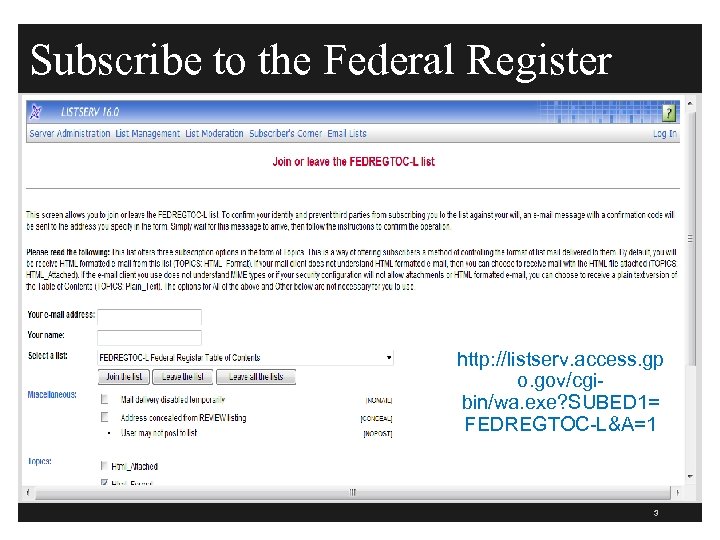 Subscribe to the Federal Register http: //listserv. access. gp o. gov/cgibin/wa. exe? SUBED 1= FEDREGTOC-L&A=1 3
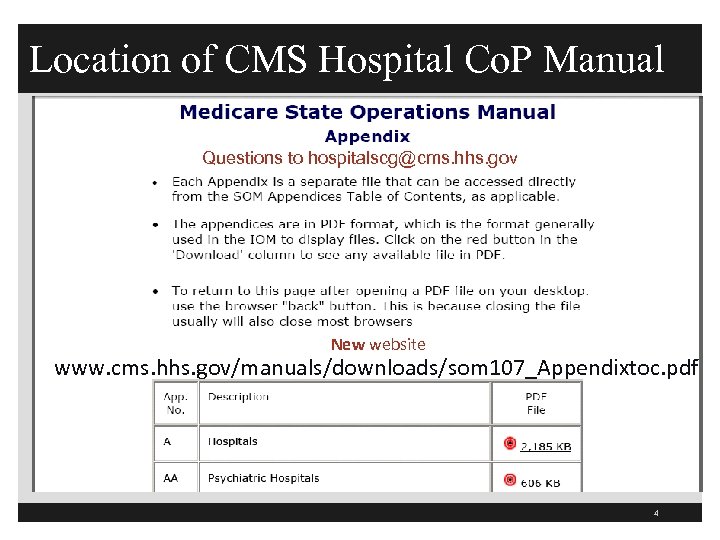 Location of CMS Hospital Co. P Manual Questions to hospitalscg@cms. hhs. gov New website www. cms. hhs. gov/manuals/downloads/som 107_Appendixtoc. pdf 4
 Physical Environment 700 § Hospital must be constructed, arranged, and maintained to ensure the safety of patient § And to provide diagnosis and treatment and for services appropriate for the community § This Co. P applies to all locations of the hospital, all campuses, all satellites 5
 Physical Environment § Hospital’s maintenance and hospital departments responsible for the buildings and equipment must be incorporated into the QAPI program § Must also be in compliance with the QAPI requirements § Survey of physical environment should be conducted by one surveyor § LIFE SAFETY CODE survey may be conducted by specially trained surveyor § LS code very important and being hit hard in the surveys 6
 7
7
 Buildings 701 § Condition of physical plant and overall hospital environment must be developed and maintained for the safety and well being of patients § Making sure that a routine and PM activities are done, as manufacturer requires and by state and federal law § Conduct ongoing maintenance inspections § Routine and PM and testing activities should be incorporated into hospital QAPI plan 8
 Buildings Emergency Preparedness 701 § Includes developing and implementing emergency preparedness plans and capabilities § Must coordinate with federal, state, and local emergency preparedness and health authority (Department of Health) § To identify risks for their area (natural disasters, bio -terrorism threats, disruption of utilities like water, sewer, electrical, communication, fuel, nuclear accident) § Lists 14 things to consider in developing this 9
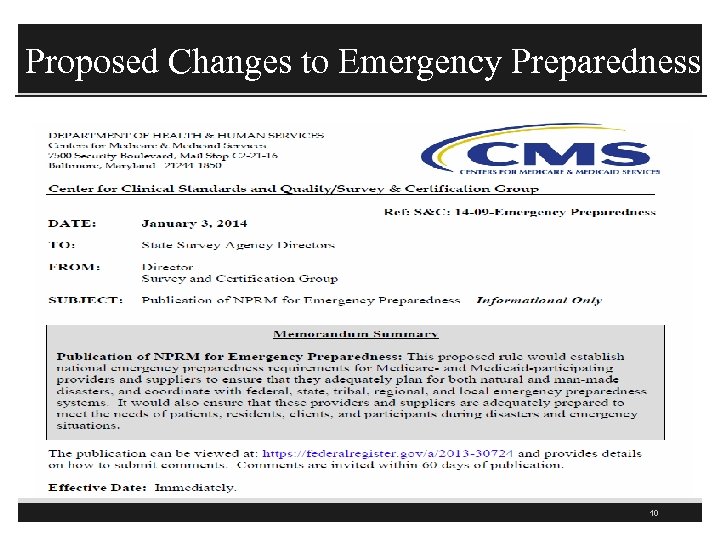 Proposed Changes to Emergency Preparedness 10
 Emergency Preparedness Resources §There are many other organizations that have resources on emergency preparedness: §The Joint Commission §National Incident Management System (NIMS) §Hospital Incident Command Systems (HICS) 11
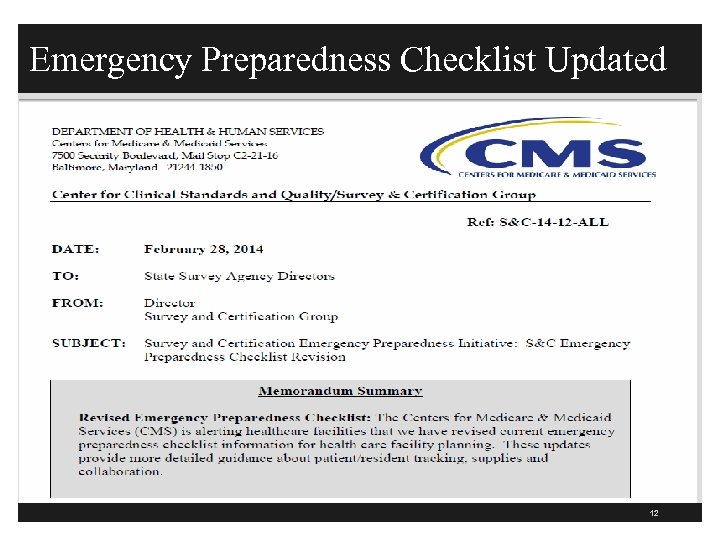 Emergency Preparedness Checklist Updated 12
 Emergency Preparedness § Transfer of hospital equipment to another facility § Transfer or discharge of patients to home or other hospitals § Security of patients and walk in patients and supplies from misappropriation § Pharmacy, food, and other supplies and equipment that may be needed § Communication among staff § Training needed to implement emergency procedure 13
 Emergency Gas and Water § Must be facilities for emergency gas and water supply (703) § To provide care to inpatients § Includes making arrangements with local utility company for emergency sources of gas/water § One source of water is Federal Emergency Management Agency (FEMA) § Gas includes propane, natural gas, fuel oil, as well as gases used such as oxygen, nitrous oxide, nitrogen 14
 Trash 713 § Proper storage and disposal of trash § Trash includes bio-hazardous waste § Storage of trash must be in accordance with state and federal law (EPA, CDC, OSHA, state environmental health and safety regulations) § Need policies for storage and disposal of trash 15
 Fire Control Plan 715 § Need fire control plan § Must contain section on prompt reporting of fires, extinguishing fires, protection of patients and guests, evacuation and cooperation with fire fighting authorities § Surveyor will review fire plan § Verify all fires are reported to state officials § Will interview staff to make sure they know what to do during a fire § Amended for alcohol based hand dispensers 16
 Facilities 722 § Keep written evidence of regular inspections and approval by state or local fire control agencies § Maintain adequate facilities for its service designed and maintained in accordance with federal, state, and local laws § Toilets, sinks, and equipment should be accessible § Make sure water acceptable for its intended use such as drinking, lab water, irrigation § Review water quality monitoring 17
 Facilities 724 2 -21 -2014 § Standard: Facilities, supplies, and equipment must be maintained to ensure an acceptable level of quality and safety § Must make sure condition of hospital is maintained in a manner to provide for acceptable level of safety for patients, visitors, and staff § Need supplies to meet patient needs § Ensure against theft or contamination of supplies § Need emergency supplies such as when a disaster occurs 18
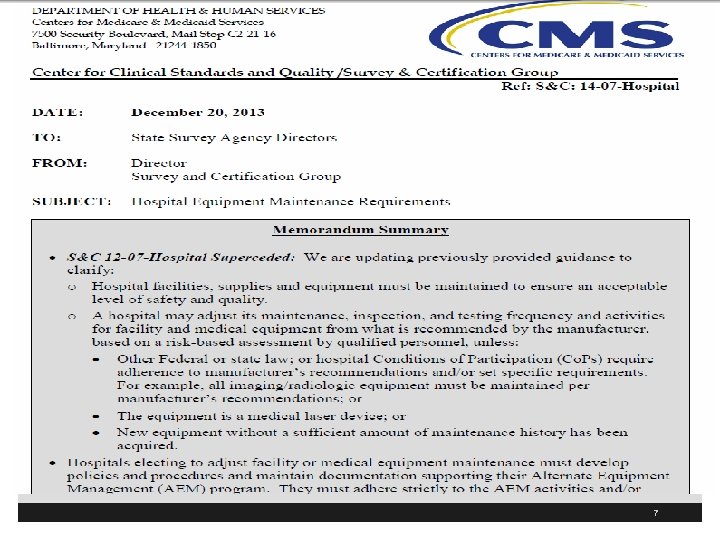
 Facilities 724 § Need equipment when needed for patient care, emergency use, or if there is a disaster § Includes elevators, generators, air compressors, medical equipment, vacuum, etc. § Equipment inspected and tested before use § Maintain records of who is competent to do preventive maintenance § Need equipment maintenance policies and inventories of equipment § Follow manufacturers recommendations and see alternative equipment management program (AEM) 19
 Ventilation, Light, Temperature § There must be proper ventilation, light, and temperature controls in pharmacy, food preparation and other appropriate areas § Proper ventilation in areas using ethylene oxide, nitrous oxide, xylene, pentamidine, glutaraldehyde, or other hazardous substances § Temperature controls in pharmacy and food preparation § Amended 1 -31 -2014 20
 Ventilation, Light, Temperature § Ventilation where O 2 is transferred from one container to another § In isolation rooms and lab locations § Adequate lighting in patient rooms and food and medication preparation areas (shown to reduce medication errors) § Anesthetizing locations where nonflammable inhalation anesthetic agents are used § Will review temp monitoring records 21
 Ventilation, Light, Temperature 726 § Temperature, humidity, and airflow in OR within acceptable standards to inhibit microbial growth § Remember 2 CMS memos and effect of lowering the humidity to 20% § Each OR room should have a separate temperature control - have temp and humidity tracking logs § Incorporate AORN – American Association of peri. Operative Registered Nurses should be incorporated into hospital policy along with Facilities Guidelines Institute (FGI) 22
 CMS Memo April 19, 2013 § CMS issues memo related to the relative humidity (RH) § AORN use to say temperature maintained between 68 -73 degrees and humidity between 30 -60% in OR, PACU, cath lab, endoscopy rooms and instrument processing areas § CMS says if no state law can write policy or procedure or process to implement the waiver § Waiver allows RH between 20 -60% § In anesthetizing locations- see definition in memo 23
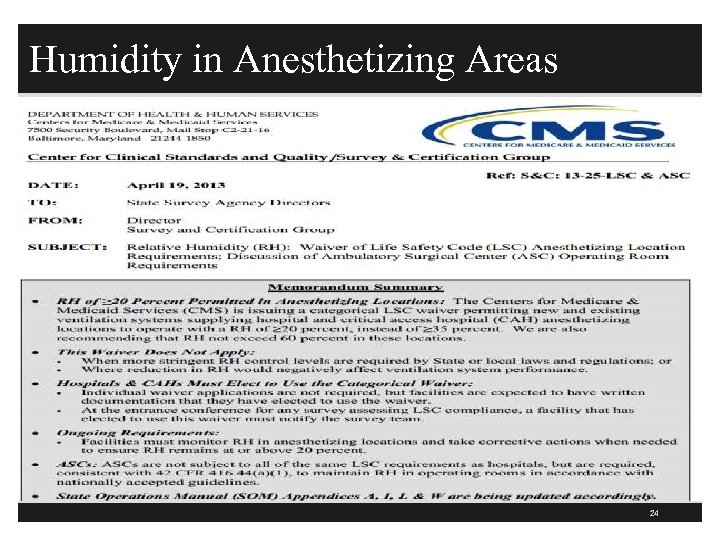 Humidity in Anesthetizing Areas 24
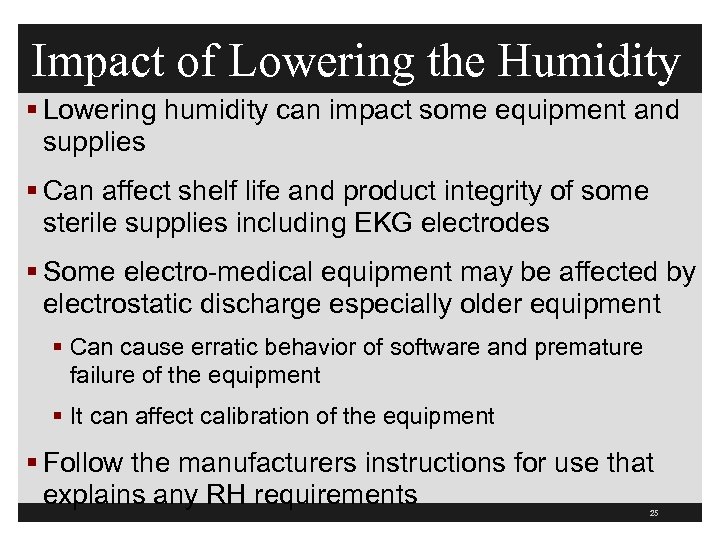 Impact of Lowering the Humidity § Lowering humidity can impact some equipment and supplies § Can affect shelf life and product integrity of some sterile supplies including EKG electrodes § Some electro-medical equipment may be affected by electrostatic discharge especially older equipment § Can cause erratic behavior of software and premature failure of the equipment § It can affect calibration of the equipment § Follow the manufacturers instructions for use that explains any RH requirements 25
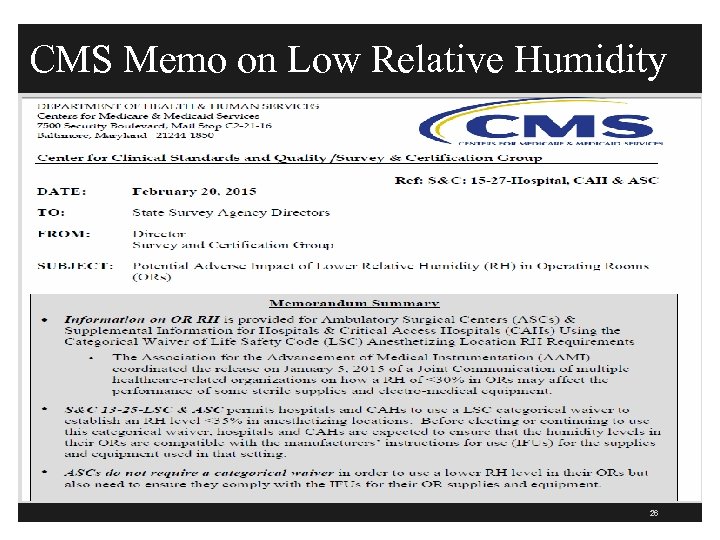 CMS Memo on Low Relative Humidity 26
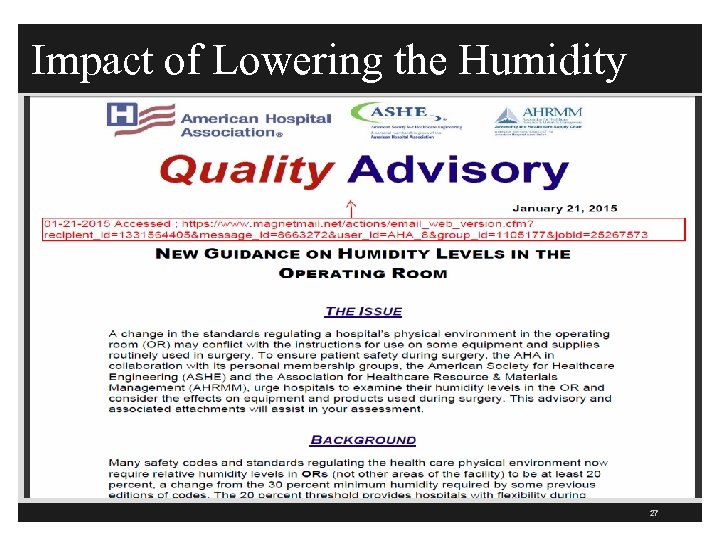 Impact of Lowering the Humidity 27
 Lowering Humidity Can Have Other Effects 28
 Infection Control 747 § Updated to reflect changing infectious and communicable disease threats § Including current knowledge and best practices § Very important in today’s healthcare environment § CDC estimates there are 1. 7 million HAI in hospitals every year and 75, 000 deaths § CMS gets $50 million dollar grant to enforce and HHS 1 billion dollars to reduce HAI § Interpretive guidelines are 12 pages long 1 www. cms. hhs. gov/Survey. Certification. Gen. Info/PMSR/list. asp 29
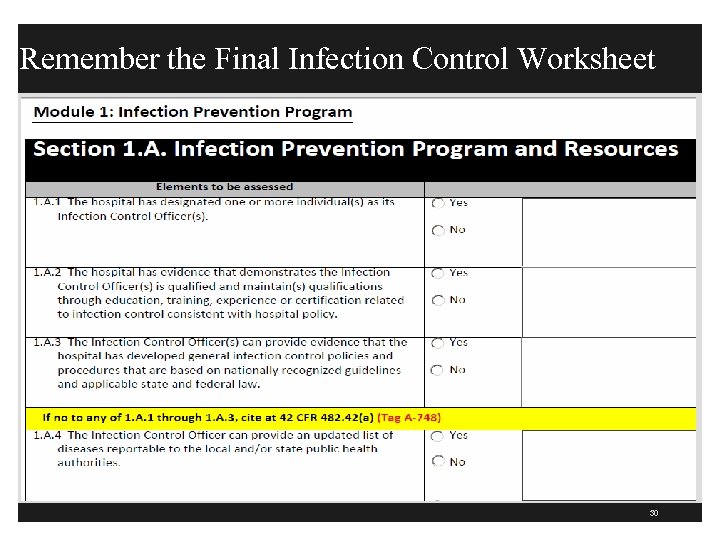 Remember the Final Infection Control Worksheet 30
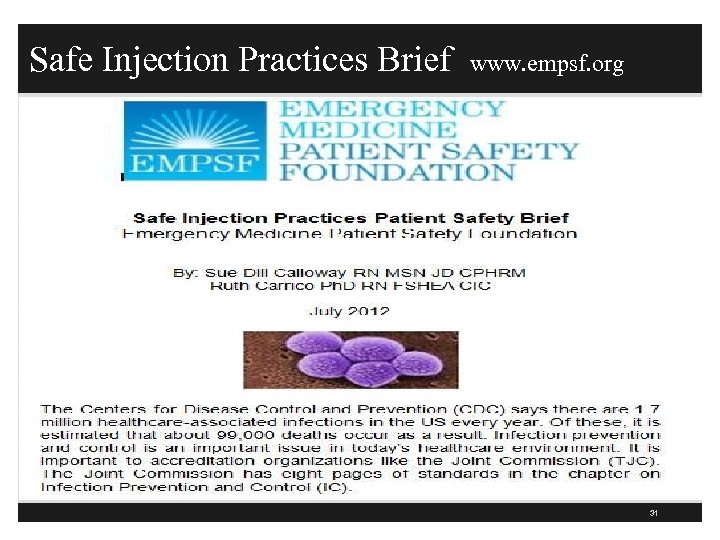 Safe Injection Practices Brief www. empsf. org 31
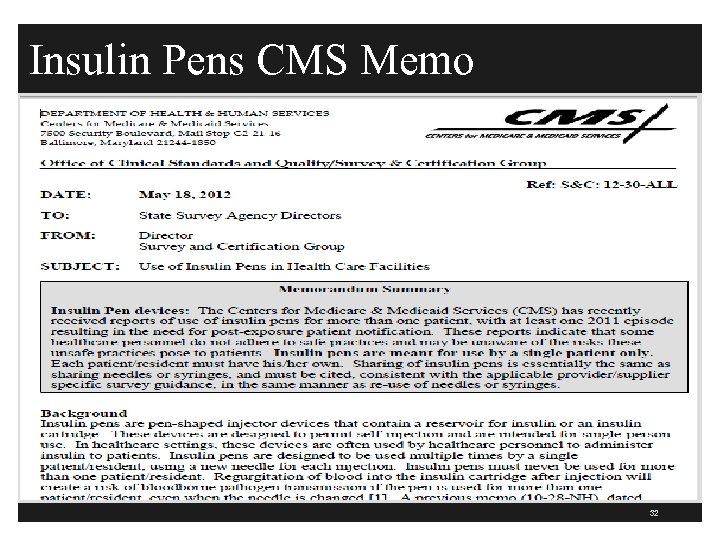 Insulin Pens CMS Memo 32
 CMS Memo on Insulin Pens § Regurgitation of blood into the insulin cartridge after injection can occur creating a risk if used on more than one patient § Hospital needs to have a policy and procedure § Staff should be educated regarding the safe use of insulin pens § More than 2, 000 patients were notified in 2011 because an insulin pen was used on more than one patient § CDC issues reminder on same and has free flier 33
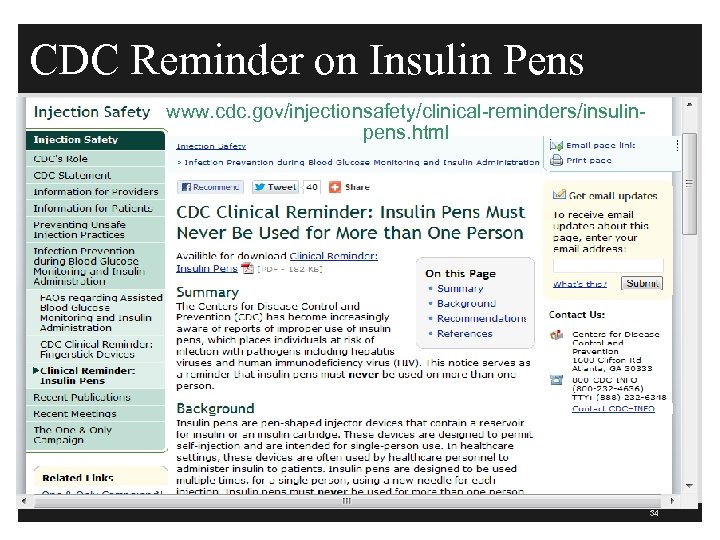 CDC Reminder on Insulin Pens www. cdc. gov/injectionsafety/clinical-reminders/insulinpens. html 34
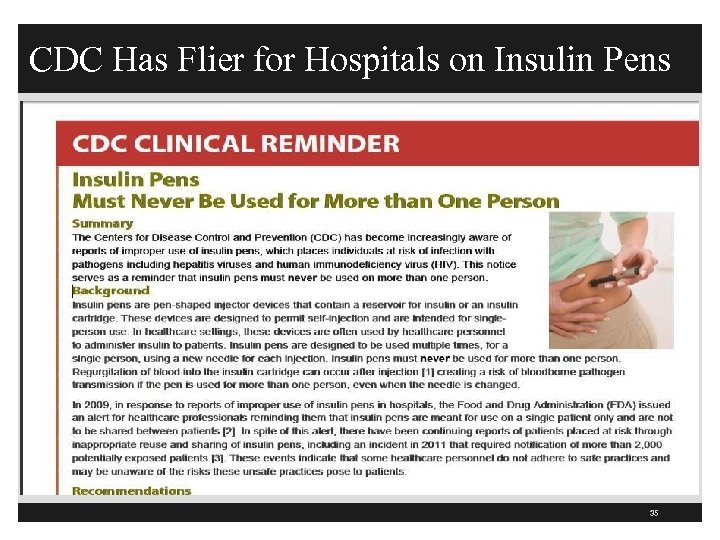 CDC Has Flier for Hospitals on Insulin Pens 35
 Insulin Pen Posters and Brochures Available www. oneandonlycampaign. or g/content/insulin-pen-safety 36
 37
37
 Infection Control § TJC has chapter on Infection Prevention and Control § APIC and CMS now calls infection preventionists (IPs) § Hospital must have sanitary environment to avoid sources and transmission of infection and communicable diseases (750) § Active IC program for prevention, control, and investigation of infections and communicable diseases 38
 Infection Control (IC) § Standards apply to all departments of hospitals both on and off campus § Infection prevention must include monitoring of housekeeping and maintenance including construction activities § Areas to monitor include food storage preparation, serving and dish rooms, refrigerators, ice machines, air handlers, autoclave rooms, venting systems, inpatient rooms, supply storage and equipment cleaning 39
 Infection Control (IC) 747 § Must follow all standards of care and practice (APIC (Association for Professionals in Infection Control and Epidemiology), CDC, SHEA (Society for Healthcare Epidemiology of America), OSHA, etc. § Need to investigate infections and communicable diseases for inpatients and from personnel working in hospitals including volunteers § Must have active surveillance program that includes specific measures for infection detection, data collection, analysis monitoring, and evaluations of preventive interventions 40
 Infection Control § Must have sampling or other mechanism in place to identify and monitor infections and communicable diseases § Infection control must be integrated in QAPI § Surveillance activities should be conducted in accordance with recognized surveillance practices such as those used by CDC NHSN (National Healthcare Safety Net) § Requirement for hospitals to report certain central line or Ca. UTI infections to NHSN 41
 IC Officer’s Responsibilities § Many have added these to their job descriptions § Maintain sanitary hospital environment (ventilation and water controls, construction make sure safe environment, safe air handling in areas of special ventilations such as the OR and isolation rooms, techniques for food sanitation, cleaning and disinfecting surfaces, carpeting and furniture, how is pest control done, and disposal of trash along with nonregulated waste) 42
 IC Officer’s Responsibilities § Develop and implement IC measures (hospital staff, contract workers, volunteers) § Mitigation of risks associated with patient infections present upon admission and risks contributing to HAI § Active surveillance § Hospital must identify and track the following categories § HAI selected by IC program targeted strategies based on national guidelines and periodic risk assessments § Patients or staff with reportable communicable diseases 43
 IC Officer’s Responsibilities § Active surveillance (continued) § Culture of patient colonized with MDRO § Isolation patients § Staff or patients with signs in which local, state, or feds request § Staff or patients infected with significant pathogens § Recommend use of automated surveillance technology § Monitoring compliance with all P&Ps, protocols and other infection control program requirements 44
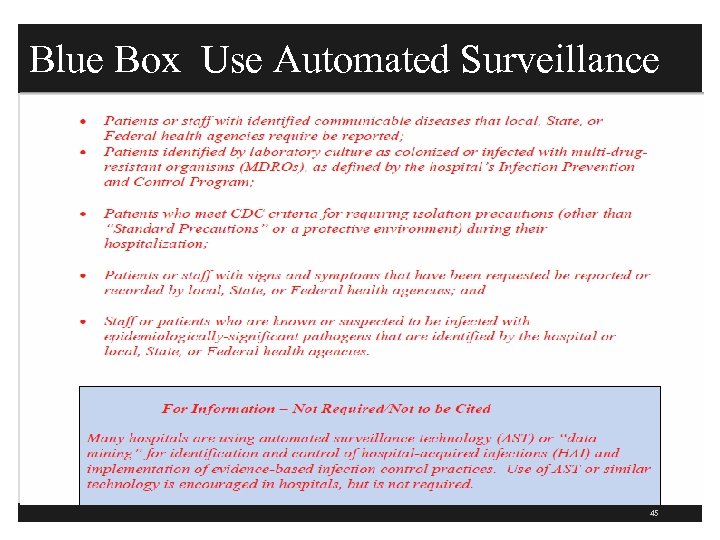 Blue Box Use Automated Surveillance 45
 IC Officer’s Responsibilities § Program evaluation and revision of the program, when indicated § Coordination as required by law with federal, state, and local emergency preparedness and health authorities to address communicable disease threats, bioterrorism and outbreaks § Complying with the reportable disease requirements of the local health authority § Make sure IC program is integrated into hospital wide QAPI (now stands for quality assessment and performance improvement) 46
 Infection Control (IC) § Long list of IC policies that hospitals must have § Maintain a sanitary physical environment § Hospital staff related measures (evaluate hospital staff immunization status for infectious diseases as per CDC and APIC, how you screen hospital staff for infections likely to cause significant infectious disease to others, policy on when staff are restricted from working) 47
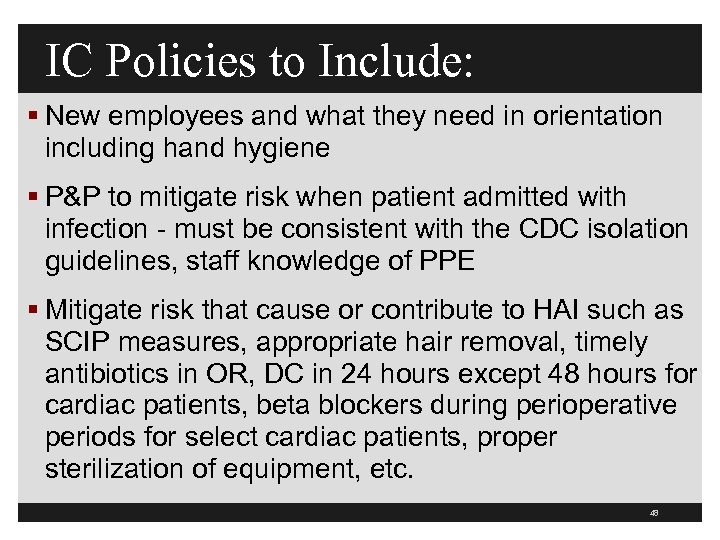 IC Policies to Include: § New employees and what they need in orientation including hand hygiene § P&P to mitigate risk when patient admitted with infection - must be consistent with the CDC isolation guidelines, staff knowledge of PPE § Mitigate risk that cause or contribute to HAI such as SCIP measures, appropriate hair removal, timely antibiotics in OR, DC in 24 hours except 48 hours for cardiac patients, beta blockers during perioperative periods for select cardiac patients, proper sterilization of equipment, etc. 48
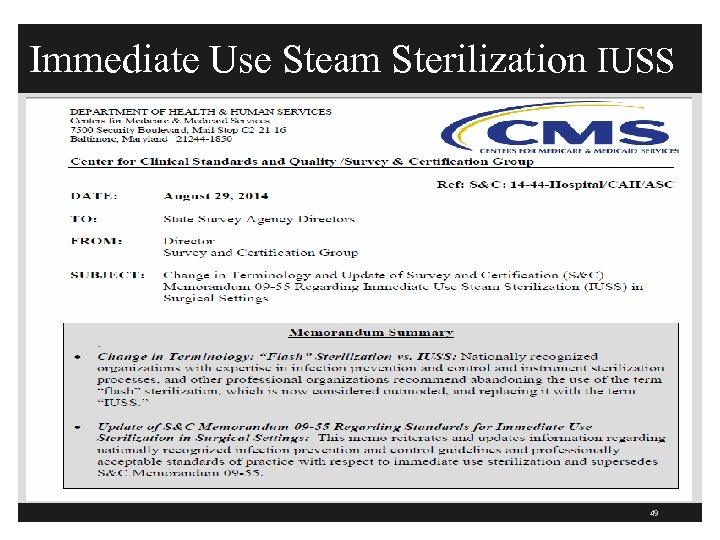 Immediate Use Steam Sterilization IUSS 49
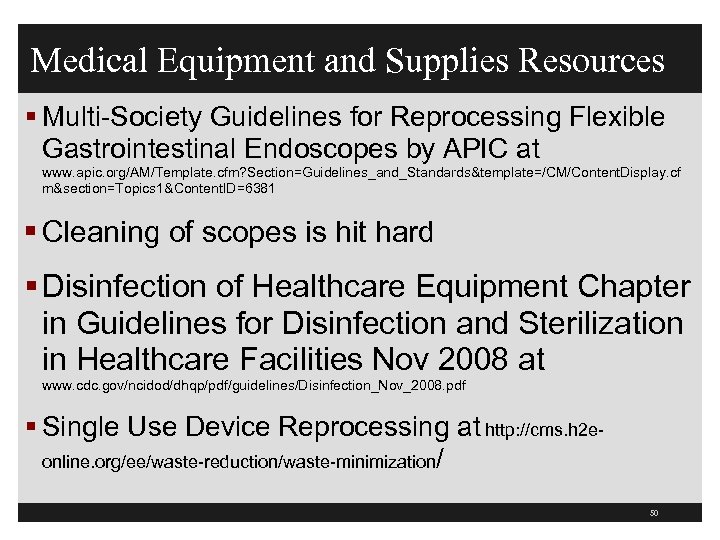 Medical Equipment and Supplies Resources § Multi-Society Guidelines for Reprocessing Flexible Gastrointestinal Endoscopes by APIC at www. apic. org/AM/Template. cfm? Section=Guidelines_and_Standards&template=/CM/Content. Display. cf m§ion=Topics 1&Content. ID=6381 § Cleaning of scopes is hit hard § Disinfection of Healthcare Equipment Chapter in Guidelines for Disinfection and Sterilization in Healthcare Facilities Nov 2008 at www. cdc. gov/ncidod/dhqp/pdf/guidelines/Disinfection_Nov_2008. pdf § Single Use Device Reprocessing at http: //cms. h 2 eonline. org/ee/waste-reduction/waste-minimization/ 50
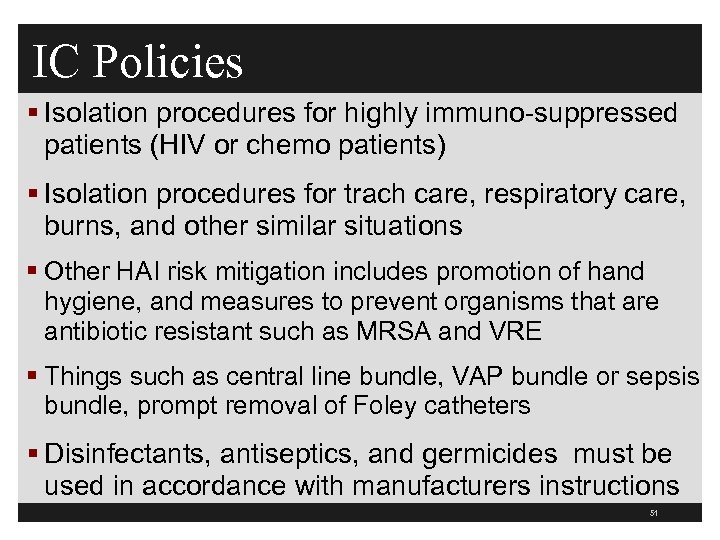 IC Policies § Isolation procedures for highly immuno-suppressed patients (HIV or chemo patients) § Isolation procedures for trach care, respiratory care, burns, and other similar situations § Other HAI risk mitigation includes promotion of hand hygiene, and measures to prevent organisms that are antibiotic resistant such as MRSA and VRE § Things such as central line bundle, VAP bundle or sepsis bundle, prompt removal of Foley catheters § Disinfectants, antiseptics, and germicides must be used in accordance with manufacturers instructions 51
 IC Policies § Appropriate use of facility and medical equipment such as hepa filters and negative pressure room, UV lights and other equipment to prevent the spread of infectious agents § Patients, visitors, care givers, and staff must receive education on infection and communicable diseases § There must be active surveillance system, method for getting data to determine if there is a problem § Policy on getting cultures from patients, etc. 52
 Policies and Organization § Need IC officer and IC committee § IC officer must develop and implement policies on control of infection and communicable diseases § Person must be designated in writing who is qualified through education and experience § Lists the responsibilities of this person § Consider putting into job description 53
 CEO, DON, and MS 756 § The CEO, DON, and MS must ensure that there is hospital wide QAPI and training program that address problems identified by IC officer § And implement a successful corrective action plan in affected problem areas § Train staff in problems identified § Problems must be reported to nursing, MS, and administration 54
 Discharge Planning § CMS issues 39 page memo on May 17, 2013 and final transmittal July 19, 2013 and final worksheet § Rewrote all the discharge planning standards and watch for 2016 changes § Includes advisory practices (blue boxes) to promote better patient outcomes § Only suggestions and will not cite hospitals § A number of tags were eliminated § The prior 24 standards have been consolidated into 13 55
 Proposed Changes to Discharge Planning § CMS proposed changes to discharge planning which are mammoth § Published in Federal Register November 3, 2015 § Comment period ended January 4, 2016 § Will publish final changes in the Federal Register § Then CMS will amend the interpretive guidelines § Then CMS will revise the discharge planning worksheet § On face track so stay tuned! 56
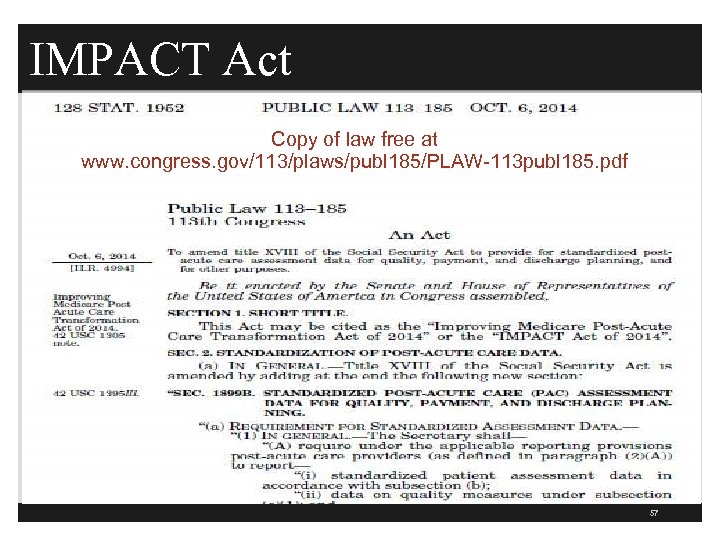 IMPACT Act Copy of law free at www. congress. gov/113/plaws/publ 185/PLAW-113 publ 185. pdf 57
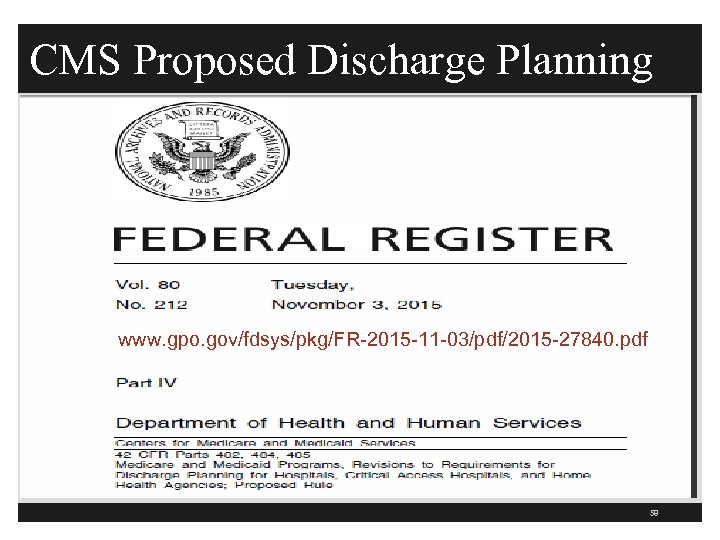 CMS Proposed Discharge Planning www. gpo. gov/fdsys/pkg/FR-2015 -11 -03/pdf/2015 -27840. pdf 58
 Proposed Discharge Planning Changes § Would need to incorporate many new things into the discharge planning evaluation form so will need to redo – Such as admitting diagnosis, relevant co-morbidities, past medical history, past surgical history, anticipated needs, readmission risk, and relevant psychosocial history and more § Hospitals and CAHs must do discharge plan within 24 hours of admission § A discharge plan must be done before the patient is discharged home or transferred to another facility § Applies to inpatients and certain outpatients § Does not apply to emergency transfers 59
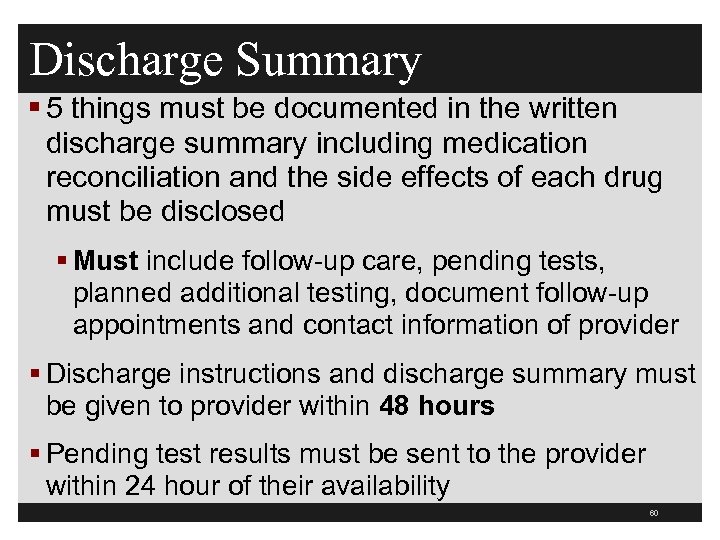 Discharge Summary § 5 things must be documented in the written discharge summary including medication reconciliation and the side effects of each drug must be disclosed § Must include follow-up care, pending tests, planned additional testing, document follow-up appointments and contact information of provider § Discharge instructions and discharge summary must be given to provider within 48 hours § Pending test results must be sent to the provider within 24 hour of their availability 60
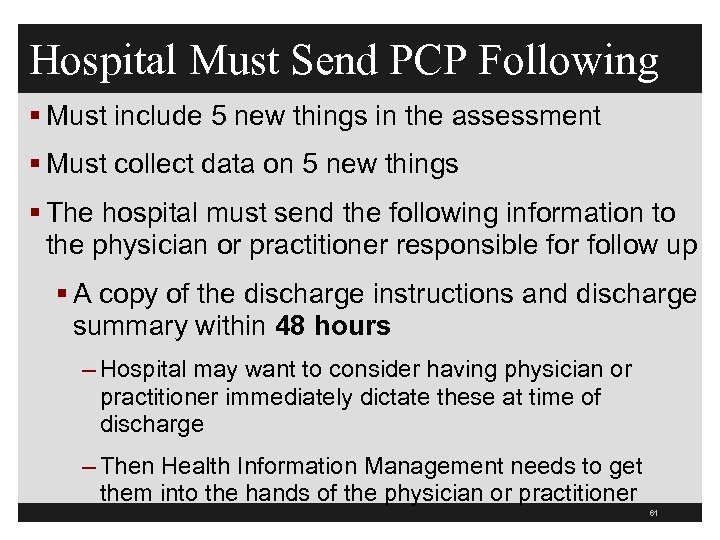 Hospital Must Send PCP Following § Must include 5 new things in the assessment § Must collect data on 5 new things § The hospital must send the following information to the physician or practitioner responsible for follow up § A copy of the discharge instructions and discharge summary within 48 hours – Hospital may want to consider having physician or practitioner immediately dictate these at time of discharge – Then Health Information Management needs to get them into the hands of the physician or practitioner 61
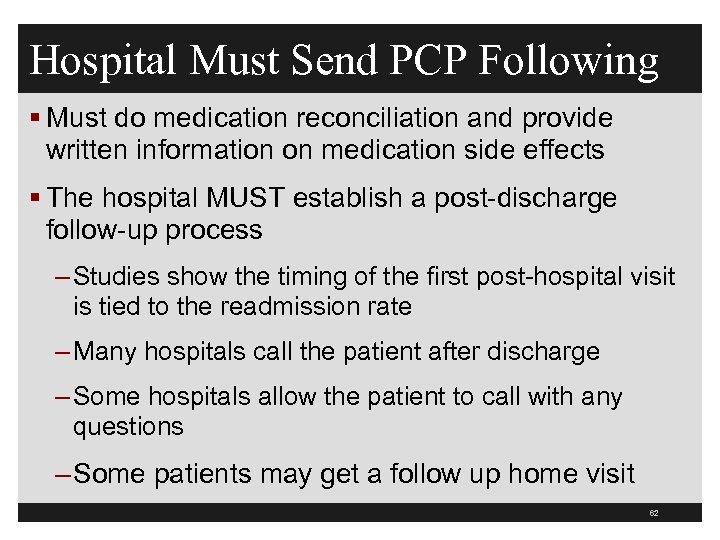 Hospital Must Send PCP Following § Must do medication reconciliation and provide written information on medication side effects § The hospital MUST establish a post-discharge follow-up process – Studies show the timing of the first post-hospital visit is tied to the readmission rate – Many hospitals call the patient after discharge – Some hospitals allow the patient to call with any questions – Some patients may get a follow up home visit 62
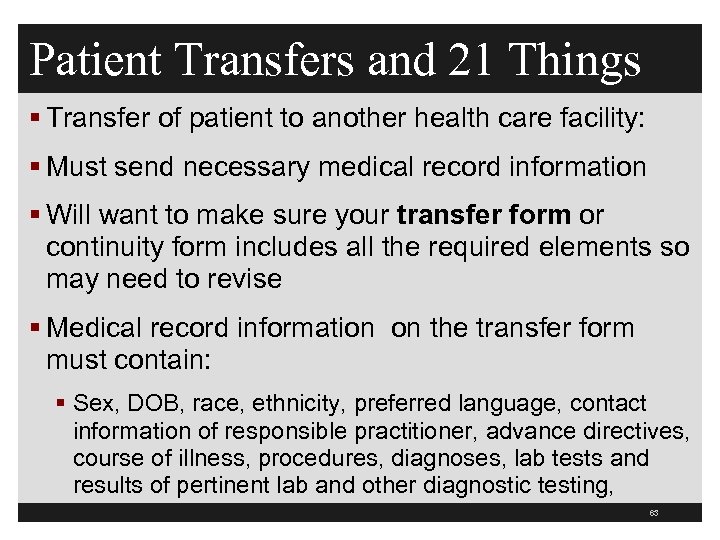 Patient Transfers and 21 Things § Transfer of patient to another health care facility: § Must send necessary medical record information § Will want to make sure your transfer form or continuity form includes all the required elements so may need to revise § Medical record information on the transfer form must contain: § Sex, DOB, race, ethnicity, preferred language, contact information of responsible practitioner, advance directives, course of illness, procedures, diagnoses, lab tests and results of pertinent lab and other diagnostic testing, 63
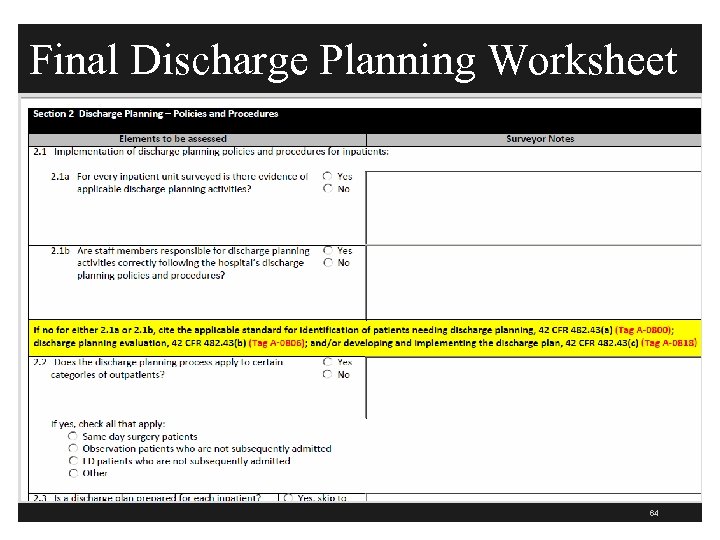 Final Discharge Planning Worksheet 64
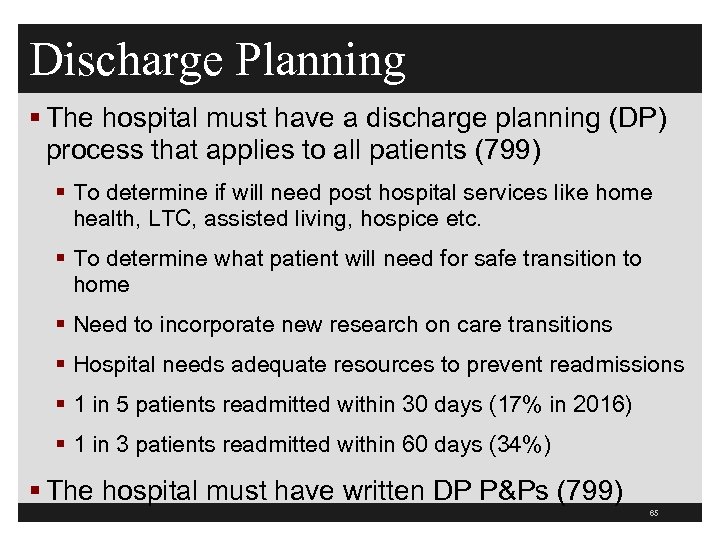 Discharge Planning § The hospital must have a discharge planning (DP) process that applies to all patients (799) § To determine if will need post hospital services like home health, LTC, assisted living, hospice etc. § To determine what patient will need for safe transition to home § Need to incorporate new research on care transitions § Hospital needs adequate resources to prevent readmissions § 1 in 5 patients readmitted within 30 days (17% in 2016) § 1 in 3 patients readmitted within 60 days (34%) § The hospital must have written DP P&Ps (799) 65
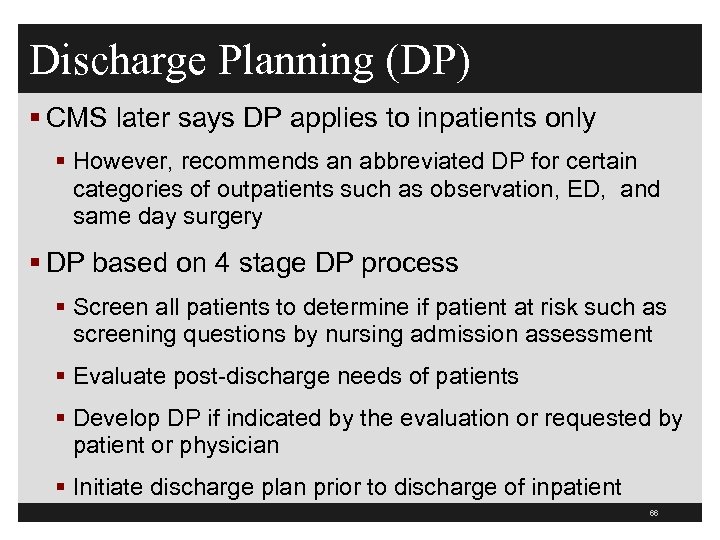 Discharge Planning (DP) § CMS later says DP applies to inpatients only § However, recommends an abbreviated DP for certain categories of outpatients such as observation, ED, and same day surgery § DP based on 4 stage DP process § Screen all patients to determine if patient at risk such as screening questions by nursing admission assessment § Evaluate post-discharge needs of patients § Develop DP if indicated by the evaluation or requested by patient or physician § Initiate discharge plan prior to discharge of inpatient 66
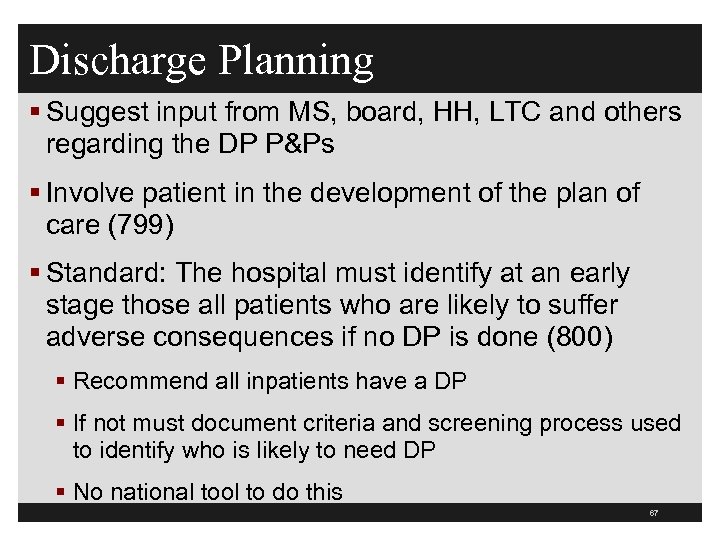 Discharge Planning § Suggest input from MS, board, HH, LTC and others regarding the DP P&Ps § Involve patient in the development of the plan of care (799) § Standard: The hospital must identify at an early stage those all patients who are likely to suffer adverse consequences if no DP is done (800) § Recommend all inpatients have a DP § If not must document criteria and screening process used to identify who is likely to need DP § No national tool to do this 67
 Discharge Planning § Must do at least 48 hours in advance of discharge § If patient’s stay is less than 48 hours then must make sure DP is done before patient’s discharge § Must make sure no evidence that patient’s discharge was delayed due to hospital’s failure to do DP (800) § DP P&Ps must state how staff will become aware of any changes in the patient’s condition (800) § If patient is transferred must still include information on post hospital needs (800) 68
 Discharge Planning § CMS instructs the surveyors to conduct discharge tracers on open and closed inpatient records § Standard: The hospital must provide a DP evaluation to patients at risk, or requested by the patient or doctor (806) § Must include the likelihood of needing post hospital services like home health, hospice, RT, rehab, nutritional consult, dialysis, supplies, meals on wheels, transport, housekeeping, or LTC § Is the patient going to need any special equipment (walker, BS commode, etc. ) or modifications to the home § Must include an assessment if the patient can do self care or others can do the care 69
 Discharge Planning § Must evaluate if patient can return to their home § If from a LTC, hospice, assisted living then is the patient able to return (806) § Hospitals are expected to have knowledge of capabilities of the LTC and Medical homes and services provided (806) § May need to coordinate with insurers and Medicaid § Discuss ability to pay out of pocket expenses § Expected to have know about community resources § Such as Aging and Disability Resources or Center for Independent Living 70
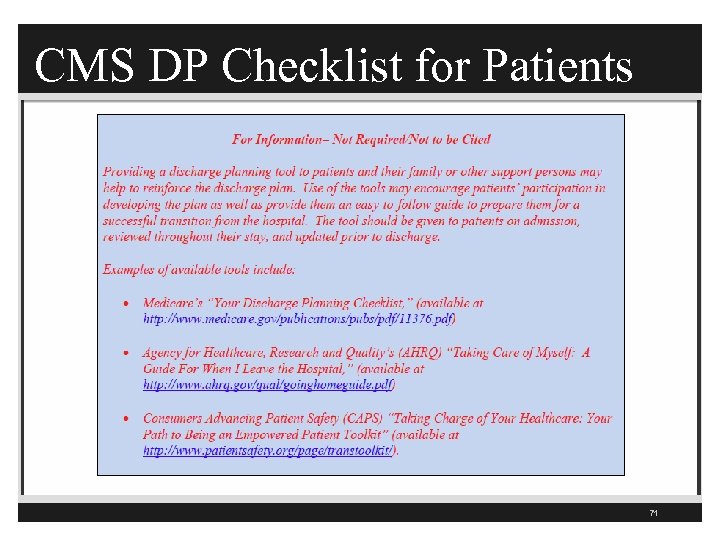 CMS DP Checklist for Patients 71
 Discharge Planning § Standard: A RN, SW, or other appropriately qualified person must develop or supervise the development of the DP evaluation (807) § Written P&P must say who is qualified § Standard: the DP evaluation must be completed timely to avoid unnecessary delays (810) § Standard: The hospital must discuss the results of the DP evaluation with the patient (811) § Standard: The DP evaluation must be in the medical record (812) 72
 Discharge Planning § Standard: RN, SW, or other qualified person must develop the discharge plan if the DP evaluation indicates it is needed (818) § DP is part of the plan of care § Standard: The physician may request a DP if hospital does not determine it is needed (819) § Standard: The hospital must implement the DP plan (820) § Standard: The hospital must reassess the discharge plan if factors affect the plan (821) 73
 Discharge Planning § Standard: If patient needs HH or LTC must provide patients a list (823) and document list was given § Standard: Hospital must transfer or refer patients to the appropriate facility or agency for follow up care (837) § Standard: the hospital must reassess it’s DP process on an on-going basis and review the discharge plans to ensure they meet the patient’s needs (843) § Must track readmissions § Must review P&P to make sure DP is ongoing on at least a quarterly basis 74
 Organ, Tissue, and Eye 884 § Hospital must have written P&P to address its organ procurement § Must have agreement with OPO § Must timely notify OPO if death is imminent or patient has died § OPO to determine medical suitability for organ donation § Defines what must be in your written agreement (definitions, criteria for referral, access to your death record information) § TJC has similar standards in TS or transplant safety chapter 75
 OPO Agreements with Hospitals § CMS has a section in the hospital Co. P on OPO (Organ Procurement Organizations) § Hospitals must have a written agreement with the OPO § Must do the one call rule and notify the OPO if patient dies or death is imminent § OPOs are not required to have an agreement with a hospital that does not have an OR or a ventilator § OPO have to contract with hospitals that request it but limited to notification if no ventilator or OR 76
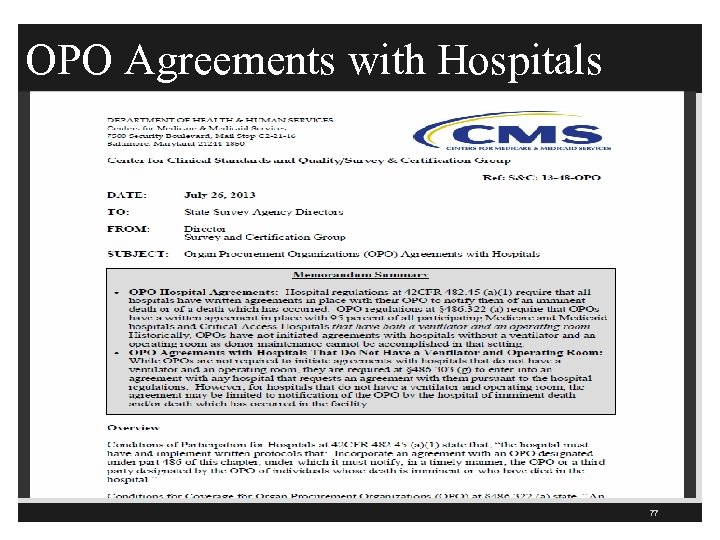 OPO Agreements with Hospitals 77
 Organ, Tissue, and Eye § Board must approve your organ procurement policy § Must integrate into hospital’s QAPI program § Surveyor will review written agreement with the OPO to make sure it has all the required information § Check off the long list to ensure all elements are present § Make sure you call the OPO and notify them of all deaths 78
 Tissue and Eye Bank § Need an agreement with at least one tissue and eye bank also or OPO can do all three § OPO is gatekeeper and notifies the tissue or eye bank chosen by the hospital § OPO determines medical suitability § Don’t need separate agreement with tissue bank if agreement with OPO to provide tissue and eye procurement 79
 Family Notification § Once OPO has selected a potential donor, person’s family must be informed of the donor’s family’s option § OPO and hospital will decide how and by whom the family will be approached § Have to work cooperatively with the OPO and in educating staff § OPO can review death records 80
 Organ Donation § Person to initiate request must be a designated requestor or organized representative of tissue or eye bank § Designated requestor must have completed course approved by OPO § Encourage discretion and sensitivity to the circumstances, views and beliefs of the families § Surveyor will review complaint file for relevant complaints 81
 Organ Donation Training § Patient care staff must be trained on organ donation issues § Training program at a minimum should include: consent process, importance of discretion, role of designated requestor, transplantation and donation, QI, and role of OPO § Train all new employees, when change in P&P, and when problems identified in QAPI process 82
 Organ Donation § Hospital must cooperate with OPO to review death records to improve identification of potential donors § Surveyor will verify P&P that hospital works with OPO § Maintain potential donors while necessary testing and placement of donated organs take place § Must have P&P to maintain viability of organs § Ensure patient is declared dead within acceptable timeframe 83
 Surgical Services 940 § If provide surgical services, service must be well organized § If outpatient surgery, must be consistent in quality with inpatient care § Must follow acceptable standards of practice; AMA, ACOS, APIC, AORN, ASPAN § Must be integrated into hospital wide QAPI § Will inspect all OR rooms § Access to OR and PACU must be limited to authorized personnel 84
 Surgical Services 940 § Conform to aseptic and sterile technique § Appropriate cleaning between cases § Room is suitable for kind of surgery performed § Equipment available for rapid and routine sterilization (immediate use steam sterilization) § And it is monitored, inspected and maintained by biomed program § Temperature and humidity controlled § ACS and AORN have P&P on many of these 85
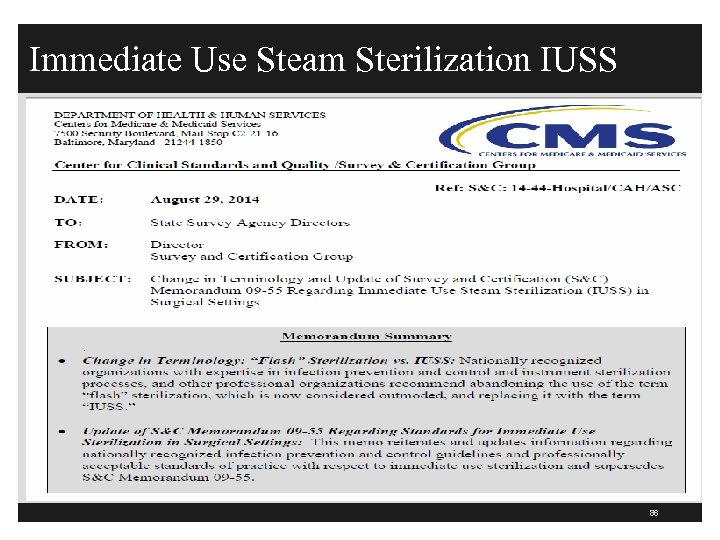 Immediate Use Steam Sterilization IUSS 86
 Surgery 942 § OR must be supervised by experienced RN or MD/DO § Must have specialized training in surgery and management of surgical service operation § Will review job description § LPN’s and OR techs can serve as scrub nurses under supervision of RN § Qualified RN may perform circulating duties in OR LPN or surgery tech may assist in circulating duties if allowed by state law 87
 Surgical Privileges § Surgical privileges must be delineated for all practitioners performing surgery, in accordance with competence of each practitioner § Surgery service must maintain roster specifying the surgical privilege § Privileges must be reviewed every two years § Current list of surgeons suspended must also be retained § Discussed in the earlier sections 88
 Surgical Privileges 945 § Must specify for each practitioner that performs surgical tasks including MD, DO, dentists, oral surgeon, podiatrists § RNFA, NP, surgical PA, surgical tech, et. al. § Must be based on compliance with what they are allowed to do under state law § If task requires it to be under supervision of MD/DO this means supervising doctor is present in the same room working with the patient 89
 Surgery Policies 951 § Aseptic and sterile surveillance and practice, including scrub technique § Identification of infected and non-infected cases § Housekeeping requirements/procedures § Patient care requirements § pre-op work area § patient consents and releases § safety practices § patient identification process and clinical procedures 90
 Surgery Policies 951 § Duties of scrub and circulating nurses § Safety practices § Surgical counts § Scheduling of patients for surgery § Personnel policies in OR § Resuscitative techniques § DNR status § Care of surgical specimens 91
 Surgery Policies 951 § Malignant hyperthermia § Make sure you have enough vials to treat § Protocols for all surgical procedures § Sterilization and disinfection procedures § Acceptable OR attire § See AORN standards § Handling infectious and biomedical waste § Outpatient surgery post op planning 92
 Preventing OR Fires 951 § Read detailed section on use of alcohol based skin prep and how to prevent an OR fire § AORN has very detailed policy on flammable prep in the OR and how to prevent fires § Special precautions developed by NFPA and incorporated into NPSG by TJC § ASA has good document on preventing fires in the OR § Pa Patient Safety Authority has great recommendations 93
 H&P 952 § See prior sections on H&P as this section is repeated § H&P no older than 30 days and updated prior to surgery § H&P must be on the chart before the patient goes to surgery § Except in emergencies § P&P specify what is an emergency 94
 Consent 955 § Informed consent is in three sections of the Co. Ps and each is different and not a repeat § Third section in the surgery chapter § Surgical services § Consent must be in chart before surgery § Exception for emergencies 95
 Informed Consent § Recommend anesthesia consent now (955) § Lists elements for well designed process, which are the optional elements § Mandatory elements were under MR section § Specifies what must be in the consent policy § Who can obtain § Which procedures need consent § Discussed under MR section 96
 Informed Consent Policy §Make sure consent is on chart before patient goes to surgery §Unless surgery is an emergency §Content of consent form §Process to obtain consent §If consent obtained outside hospital how to get it into medical records 97
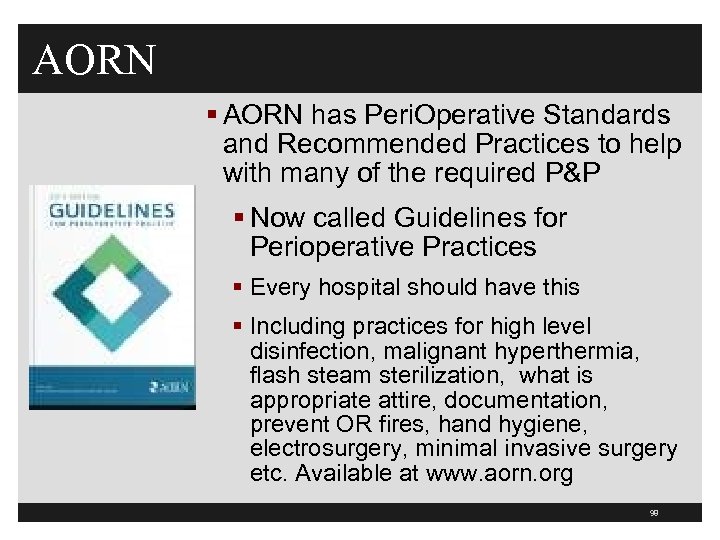 AORN § AORN has Peri. Operative Standards and Recommended Practices to help with many of the required P&P § Now called Guidelines for Perioperative Practices § Every hospital should have this § Including practices for high level disinfection, malignant hyperthermia, flash steam sterilization, what is appropriate attire, documentation, prevent OR fires, hand hygiene, electrosurgery, minimal invasive surgery etc. Available at www. aorn. org 98
 Informed Consent 955 § Must disclose if residents, RNFA, Surgical PAs Cardiovascular Techs are doing important tasks § Important surgical tasks include: opening and closing, dissecting tissue, removing tissue, harvesting grafts, transplanting tissue, administering anesthesia, implanting devices and placing invasive lines § But requirement to have this in writing in under optional list or well designed list 99
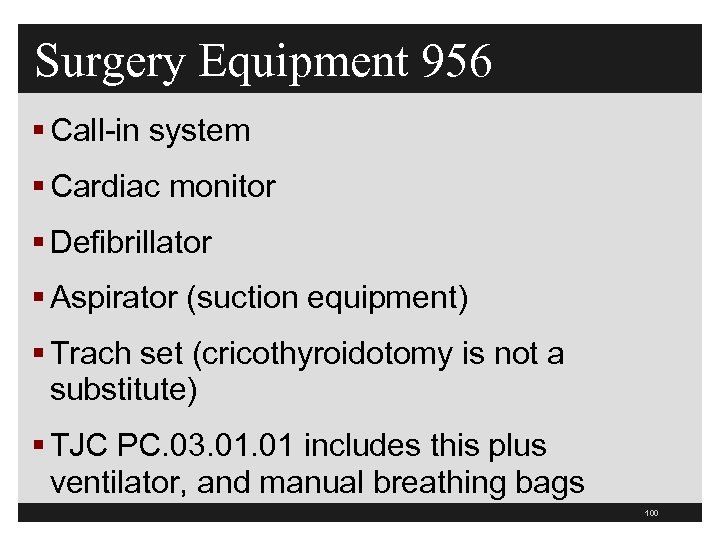 Surgery Equipment 956 § Call-in system § Cardiac monitor § Defibrillator § Aspirator (suction equipment) § Trach set (cricothyroidotomy is not a substitute) § TJC PC. 03. 01 includes this plus ventilator, and manual breathing bags 100
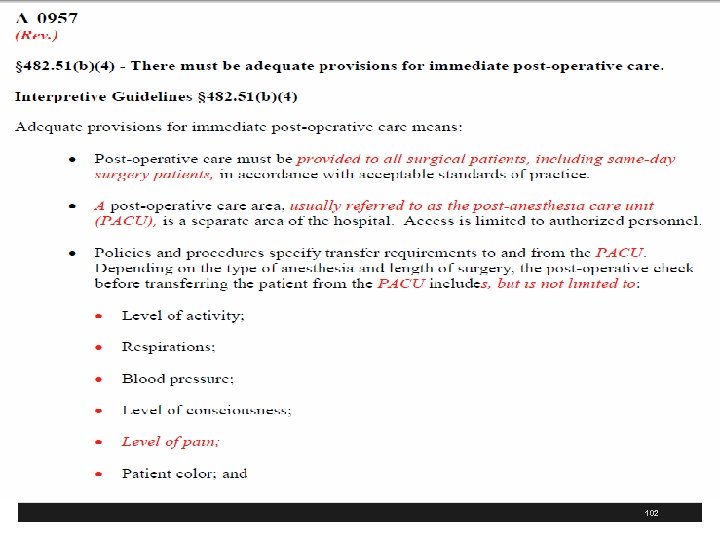
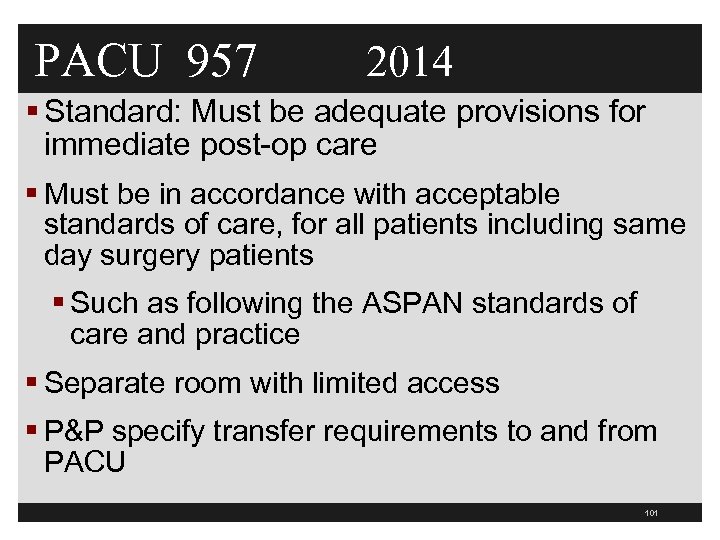 PACU 957 2014 § Standard: Must be adequate provisions for immediate post-op care § Must be in accordance with acceptable standards of care, for all patients including same day surgery patients § Such as following the ASPAN standards of care and practice § Separate room with limited access § P&P specify transfer requirements to and from PACU 101
 102
102
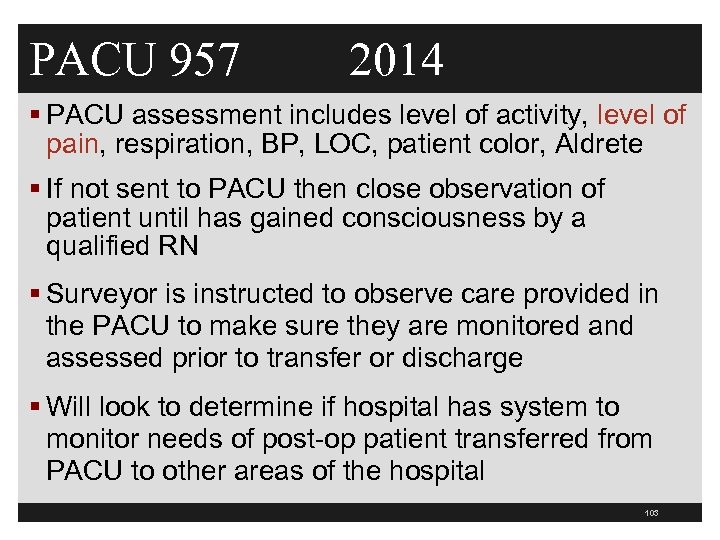 PACU 957 2014 § PACU assessment includes level of activity, level of pain, respiration, BP, LOC, patient color, Aldrete § If not sent to PACU then close observation of patient until has gained consciousness by a qualified RN § Surveyor is instructed to observe care provided in the PACU to make sure they are monitored and assessed prior to transfer or discharge § Will look to determine if hospital has system to monitor needs of post-op patient transferred from PACU to other areas of the hospital 103
 Post-Operative Monitoring 2014 § Hospitals are expected to have P&P on the minimum scope and frequency of monitoring in post -PACU setting § Must be consistent with the standard of care § Concerned about post-op patients receiving opioids § Concern about risk for over-sedation and respiratory depression § Once out of PACU not monitored as frequently § Need appropriate assessment to prevent these complications (See Tag 405) 104
 ASPAN www. aspan. org/Home. aspx 105
 OR Register 958 § Patient’s name, identification number § Date of surgery § Total time of surgery § Name of surgeons, nursing personnel, anesthesiologist, and assistants § Type of anesthesia § Operative findings, pre-op and post-op diagnosis § Age of patient § See TJC RC. 02. 01. 03 which are now the same 106
 Operative Report 959 § CMS tells you what has to be in operative report just like TJC § Name and identity of patient § Date and time of surgery § Name of surgeons, assistants § Pre-op and post-op diagnosis § Name of procedure § Type of anesthesia 107
 Operative Report 959 § Complications and description of techniques and tissue removed § Grafts, tissue, devises implanted § Name and description of significant surgical tasks done by others § See list as includes activities such as opening, closing, harvesting grafts 108
 Anesthesia 1000 § Must be provided in well organized manner under qualified doctor § Must be integrated into hospital QAPI § MS establish criteria for director’s qualifications § Will review job description of director - see elements § Wherever anesthesia is done such as in radiology, OB, OR, outpatient surgery areas, ECT, emergency department § State exemption process of MD supervision for CRNA 109
 CMS Anesthesia Standards Changes § Hospitals are expected to have P&P on when medications that fall along the analgesia-anesthesia continuum are considered anesthesia § P&P must be based on nationally recognized guidelines § Must specify the qualifications of practitioners who can administer analgesia § CMS further clarified pre-anesthesia and postanesthesia evaluations § CMS added FAQs which are very helpful § Hospitals should review these as many changes and clarifications were made 110
 Anesthesia Definitions 1000 § If hospital provides any degree of anesthesia service must comply with all Co. Ps and put definitions in P&P § Anesthesia involves administration of medication to produce a blunting or loss of; § pain perception (analgesia) § Voluntary and involuntary movements § Memory and or consciousness § Analgesia is use of medication to provide pain relief thru blocking pain receptor in peripheral and or CNS where patient does not lose consciousness § It is a continuum 111
 Monitored Anesthesia Care (MAC) Definition § MAC is anesthesia care that includes monitoring of patient by an anesthesia professional (like anesthesiologist or CRNA) § Include potential to convert to a general or regional anesthetic § Deep sedation/analgesia is included in a MAC § Deep sedation where drug induced depression of consciousness during which patient can not easily be aroused but responds purposefully following repeated or painful stimulus 112
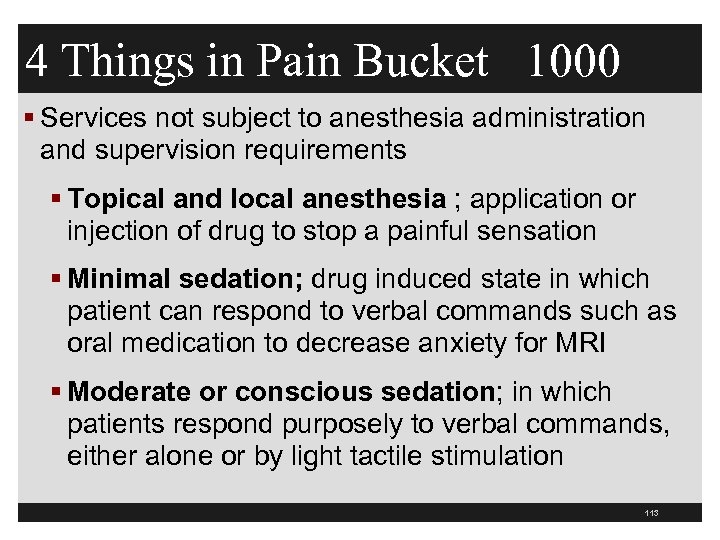 4 Things in Pain Bucket 1000 § Services not subject to anesthesia administration and supervision requirements § Topical and local anesthesia ; application or injection of drug to stop a painful sensation § Minimal sedation; drug induced state in which patient can respond to verbal commands such as oral medication to decrease anxiety for MRI § Moderate or conscious sedation; in which patients respond purposely to verbal commands, either alone or by light tactile stimulation 113
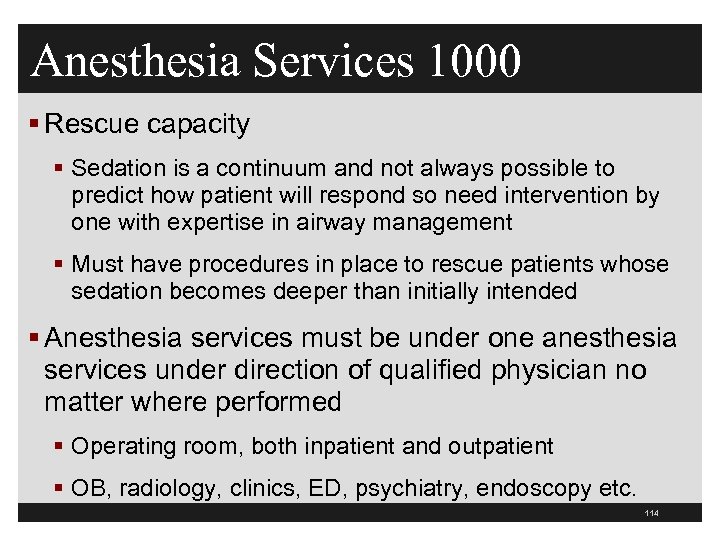 Anesthesia Services 1000 § Rescue capacity § Sedation is a continuum and not always possible to predict how patient will respond so need intervention by one with expertise in airway management § Must have procedures in place to rescue patients whose sedation becomes deeper than initially intended § Anesthesia services must be under one anesthesia services under direction of qualified physician no matter where performed § Operating room, both inpatient and outpatient § OB, radiology, clinics, ED, psychiatry, endoscopy etc. 114
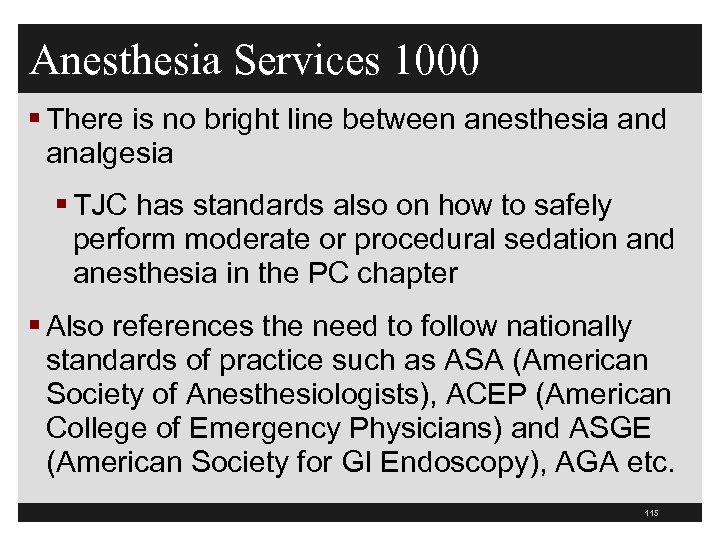 Anesthesia Services 1000 § There is no bright line between anesthesia and analgesia § TJC has standards also on how to safely perform moderate or procedural sedation and anesthesia in the PC chapter § Also references the need to follow nationally standards of practice such as ASA (American Society of Anesthesiologists), ACEP (American College of Emergency Physicians) and ASGE (American Society for GI Endoscopy), AGA etc. 115
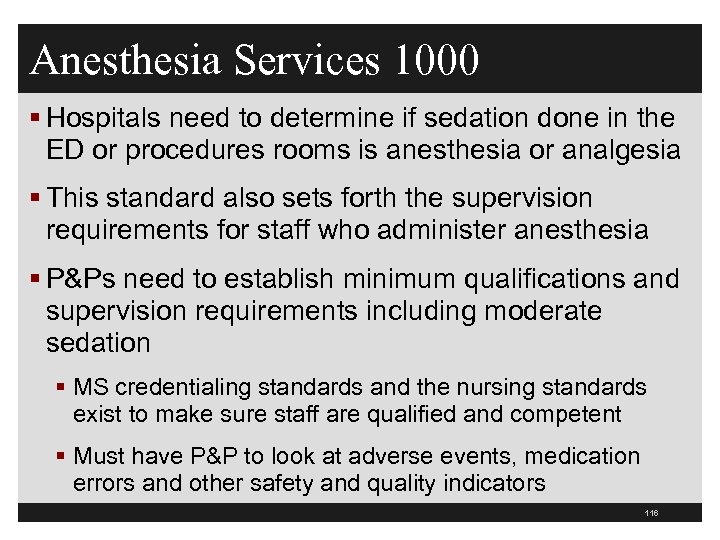 Anesthesia Services 1000 § Hospitals need to determine if sedation done in the ED or procedures rooms is anesthesia or analgesia § This standard also sets forth the supervision requirements for staff who administer anesthesia § P&Ps need to establish minimum qualifications and supervision requirements including moderate sedation § MS credentialing standards and the nursing standards exist to make sure staff are qualified and competent § Must have P&P to look at adverse events, medication errors and other safety and quality indicators 116
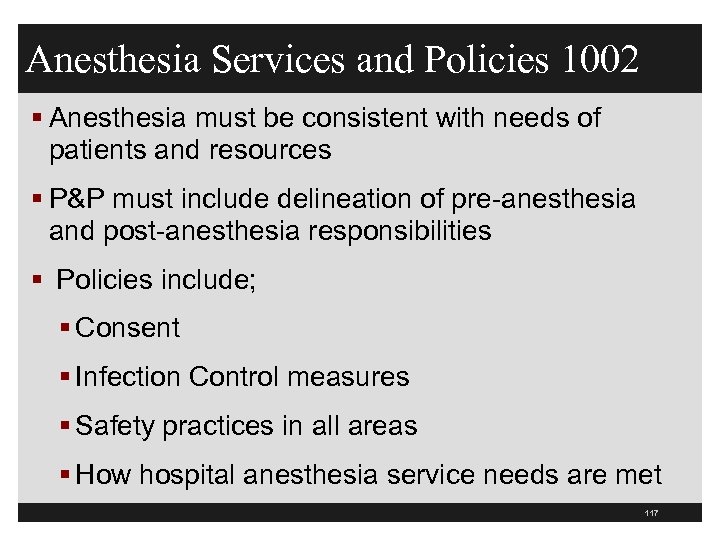 Anesthesia Services and Policies 1002 § Anesthesia must be consistent with needs of patients and resources § P&P must include delineation of pre-anesthesia and post-anesthesia responsibilities § Policies include; § Consent § Infection Control measures § Safety practices in all areas § How hospital anesthesia service needs are met 117
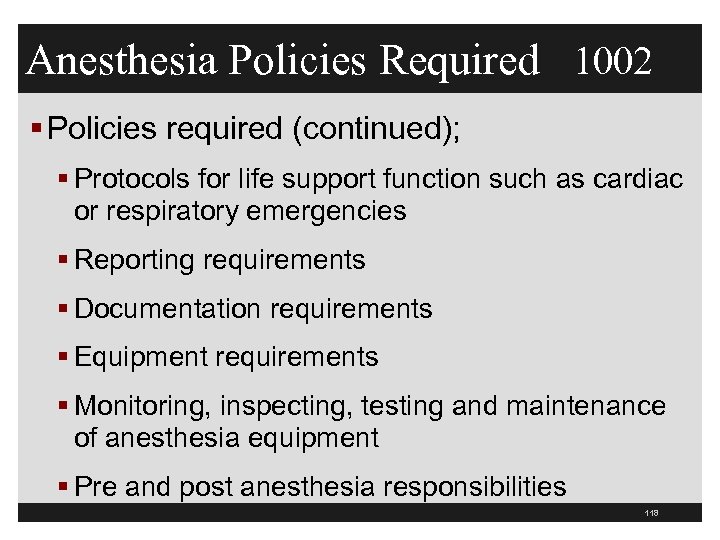 Anesthesia Policies Required 1002 § Policies required (continued); § Protocols for life support function such as cardiac or respiratory emergencies § Reporting requirements § Documentation requirements § Equipment requirements § Monitoring, inspecting, testing and maintenance of anesthesia equipment § Pre and post anesthesia responsibilities 118
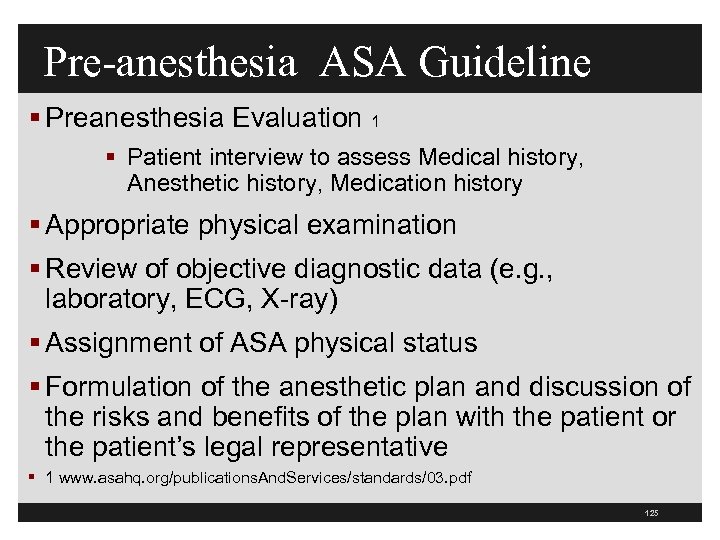
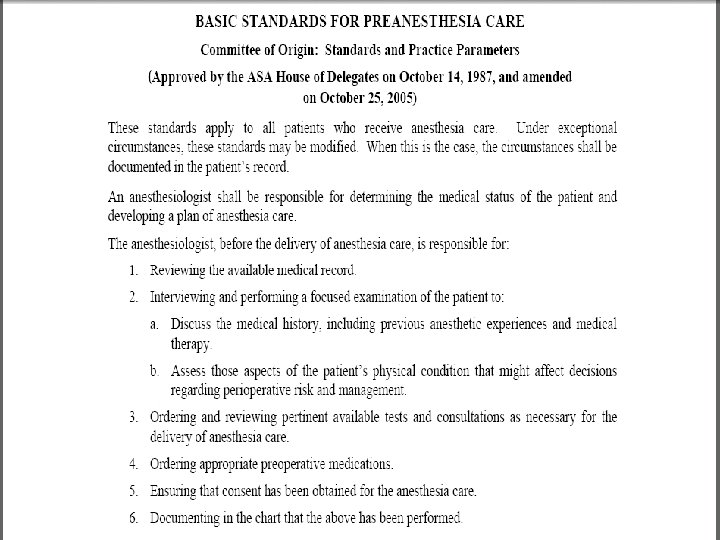
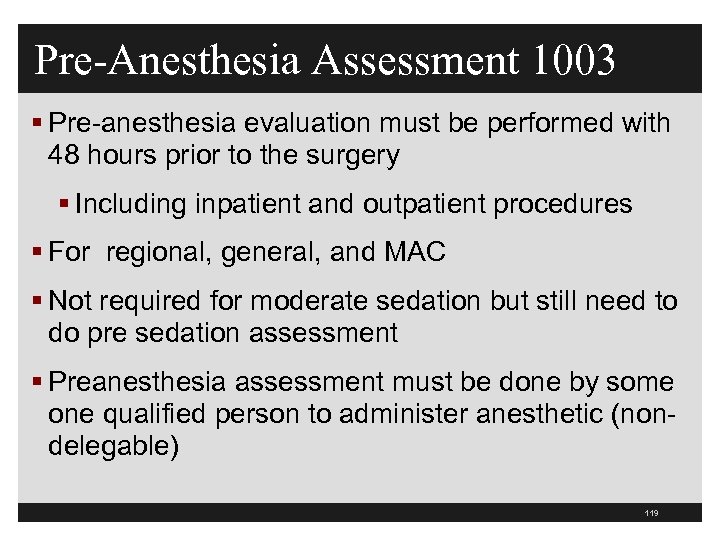 Pre-Anesthesia Assessment 1003 § Pre-anesthesia evaluation must be performed with 48 hours prior to the surgery § Including inpatient and outpatient procedures § For regional, general, and MAC § Not required for moderate sedation but still need to do pre sedation assessment § Preanesthesia assessment must be done by some one qualified person to administer anesthetic (nondelegable) 119
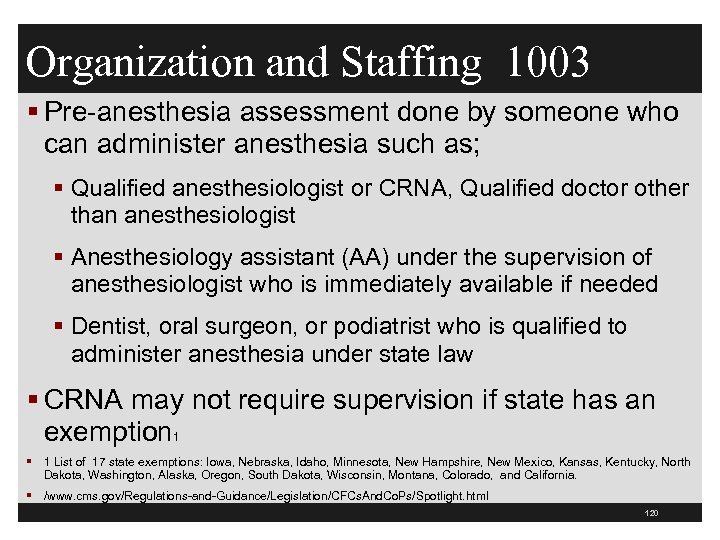 Organization and Staffing 1003 § Pre-anesthesia assessment done by someone who can administer anesthesia such as; § Qualified anesthesiologist or CRNA, Qualified doctor other than anesthesiologist § Anesthesiology assistant (AA) under the supervision of anesthesiologist who is immediately available if needed § Dentist, oral surgeon, or podiatrist who is qualified to administer anesthesia under state law § CRNA may not require supervision if state has an exemption 1 § 1 List of 17 state exemptions: Iowa, Nebraska, Idaho, Minnesota, New Hampshire, New Mexico, Kansas, Kentucky, North Dakota, Washington, Alaska, Oregon, South Dakota, Wisconsin, Montana, Colorado, and California. § /www. cms. gov/Regulations-and-Guidance/Legislation/CFCs. And. Co. Ps/Spotlight. html 120
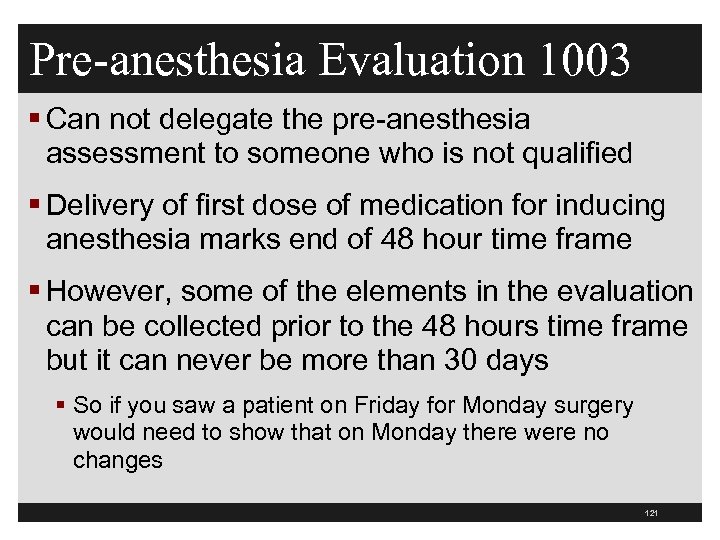 Pre-anesthesia Evaluation 1003 § Can not delegate the pre-anesthesia assessment to someone who is not qualified § Delivery of first dose of medication for inducing anesthesia marks end of 48 hour time frame § However, some of the elements in the evaluation can be collected prior to the 48 hours time frame but it can never be more than 30 days § So if you saw a patient on Friday for Monday surgery would need to show that on Monday there were no changes 121
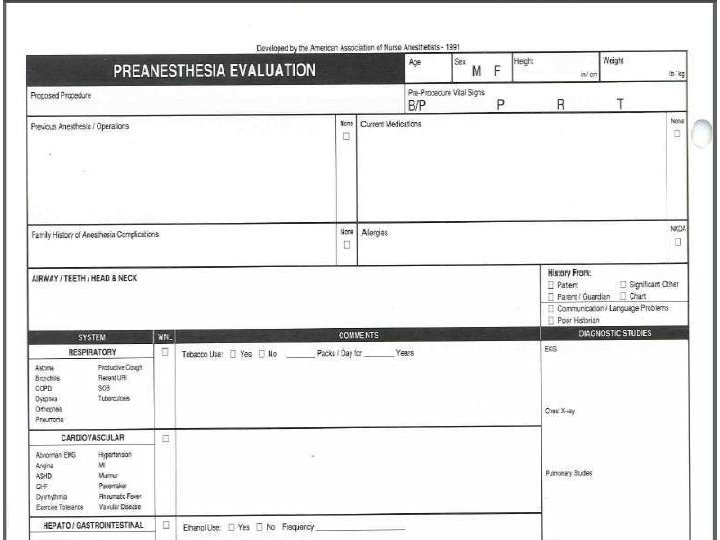
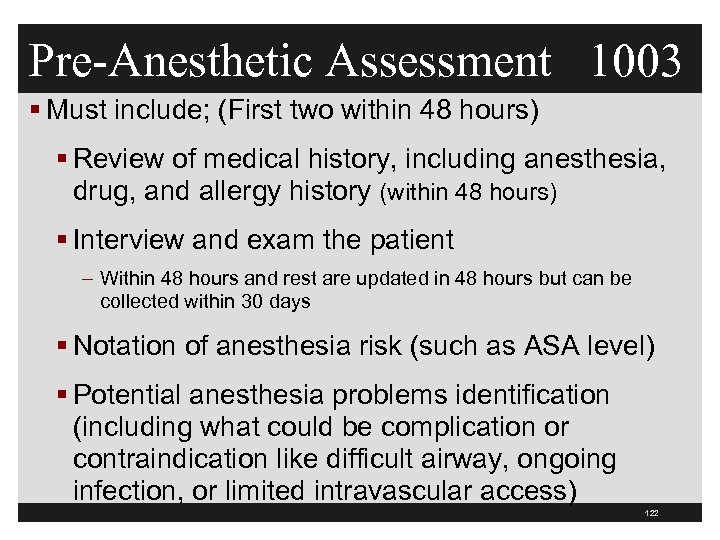 Pre-Anesthetic Assessment 1003 § Must include; (First two within 48 hours) § Review of medical history, including anesthesia, drug, and allergy history (within 48 hours) § Interview and exam the patient – Within 48 hours and rest are updated in 48 hours but can be collected within 30 days § Notation of anesthesia risk (such as ASA level) § Potential anesthesia problems identification (including what could be complication or contraindication like difficult airway, ongoing infection, or limited intravascular access) 122
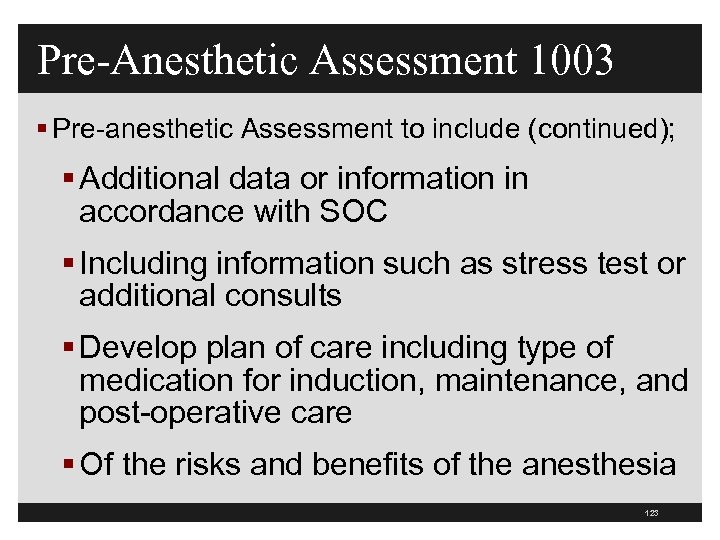 Pre-Anesthetic Assessment 1003 § Pre-anesthetic Assessment to include (continued); § Additional data or information in accordance with SOC § Including information such as stress test or additional consults § Develop plan of care including type of medication for induction, maintenance, and post-operative care § Of the risks and benefits of the anesthesia 123
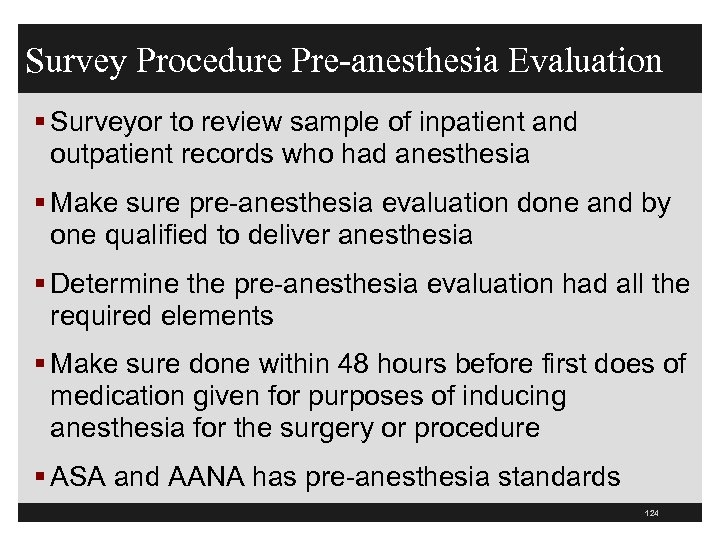 Survey Procedure Pre-anesthesia Evaluation § Surveyor to review sample of inpatient and outpatient records who had anesthesia § Make sure pre-anesthesia evaluation done and by one qualified to deliver anesthesia § Determine the pre-anesthesia evaluation had all the required elements § Make sure done within 48 hours before first does of medication given for purposes of inducing anesthesia for the surgery or procedure § ASA and AANA has pre-anesthesia standards 124
 Pre-anesthesia ASA Guideline § Preanesthesia Evaluation 1 § Patient interview to assess Medical history, Anesthetic history, Medication history § Appropriate physical examination § Review of objective diagnostic data (e. g. , laboratory, ECG, X-ray) § Assignment of ASA physical status § Formulation of the anesthetic plan and discussion of the risks and benefits of the plan with the patient or the patient’s legal representative § 1 www. asahq. org/publications. And. Services/standards/03. pdf 125
 126
126
 127
127
 Intra-Operative Anesthesia Record 1004 §Need policies related to the intra-operative anesthesia §Need intra-operative anesthesia record for patients who have general, regional, or MAC §Intra-operative Record must contain the following: § Include name and hospital id number § Name of practitioner who administer anesthesia § Techniques used and patient position, including insertion of any intravascular or airway devices 128
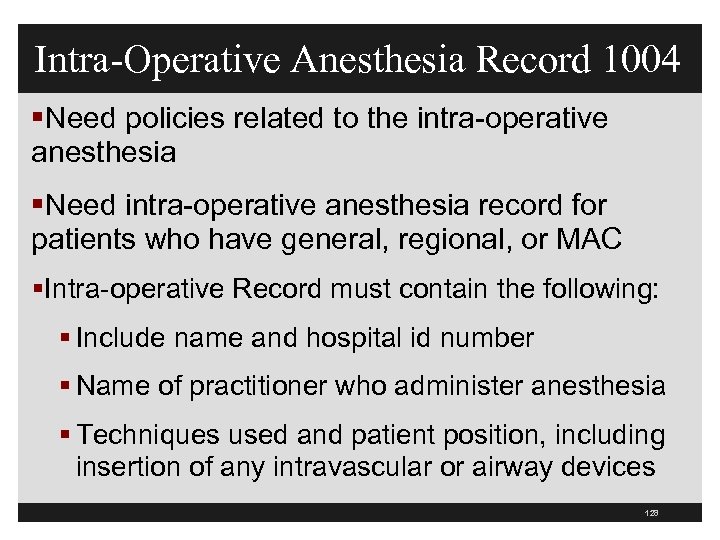
 Intra-Operative Anesthesia Record § Intra-operative Record must contain the following (continued): § Name, dosage, route and time of drugs § Name and amount of IV fluids § Blood/blood products § Oxygenation and ventilation parameters § Time based documentation of continuous vital signs § Complications, adverse reactions, problems during anesthesia with symptom, VS, treatment rendered and response to treatment 129
 Post-anesthesia Evaluation 1005 § Post-anesthesia evaluation must be done by some one who is qualified to give anesthesia § Must be done no later than 48 hours after the surgery or procedure requiring anesthesia services § Must be completed as required by hospital policies and procedures § Must be completed as required by any state specific laws § P&Ps must be approved by the MS § P&Ps must reflect current standards of care 130
 Post Anesthesia Evaluation 1005 § Document in chart within 48 hours for patients receiving anesthesia services (general, regional, MAC) § For inpatients and outpatients now § So may have to call some outpatients if not seen before they left the hospital § Note different for CAH hospitals under their manual § Does not have to be done by the same person who administered the anesthesia 131
 Post Anesthesia Evaluation § Has to be done only by anesthesia person (CRNA, AA, anesthesiologist) or qualified doctor § 48 hours starts at time patient moved into PACU or designated recovery area (SICU etc. ) § Evaluation can not generally be done at point of movement to the recovery area since patient not recovered from anesthesia § Patient must be sufficiently recovered so as to participate in the evaluation e. g. answer questions, perform simple tasks etc. 132
 Post Anesthesia Evaluation § For same day surgeries may be done after discharge if allowed by P&P and state law § If the patient is still intubated and in the ICU still need to do within the 48 hours § Would just document that the patient is unable to participate § If patient requires long acting anesthesia that would last beyond the 48 hours would just document this and note that full recovery from regional anesthesia has not occurred 133
 Post-Anesthesia Assessment Includes 1005 § Respiratory function with respiratory rate, airway patency and oxygen saturation § CV function including pulse rate and BP § Mental status, § Temperature § Pain § Nausea and vomiting § Post-operative hydration 134
 Post-Anesthesia Survey Procedure § Surveyor is review medical records for patients having anesthesia and make sure postanesthesia evaluation is in the chart § Surveyor to make sure done by practitioner who is qualified to give anesthesia § Surveyor to make sure all postanesthesia evaluations are done within 48 hours § Surveyor to make sure all the required elements are documented for the postanesthesia evaluation 135
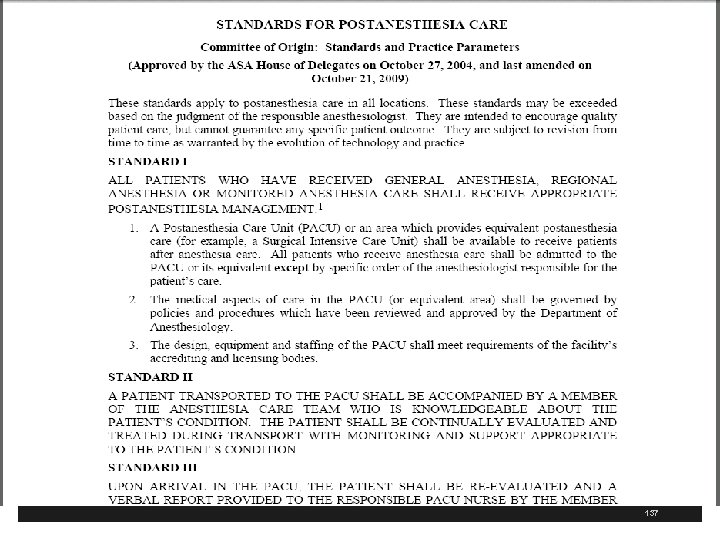
 Post Anesthesia ASA Guidelines § Patient evaluation on admission and discharge from the postanesthesia care unit § A time-based record of vital signs and level of consciousness § A time-based record of drugs administered, their dosage and route of administration § Type and amounts of intravenous fluids administered, including blood and blood products § Any unusual events including postanesthesia or post procedural complications § Postanesthesia visits 136
 137
137
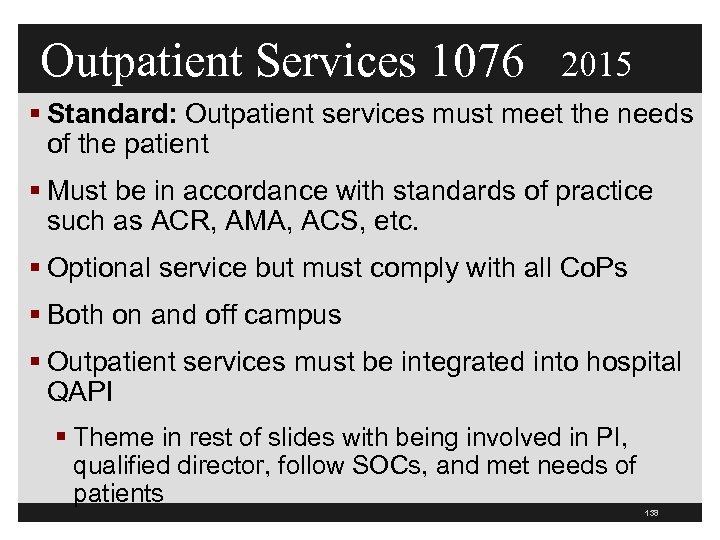 Outpatient Services 1076 2015 § Standard: Outpatient services must meet the needs of the patient § Must be in accordance with standards of practice such as ACR, AMA, ACS, etc. § Optional service but must comply with all Co. Ps § Both on and off campus § Outpatient services must be integrated into hospital QAPI § Theme in rest of slides with being involved in PI, qualified director, follow SOCs, and met needs of patients 138
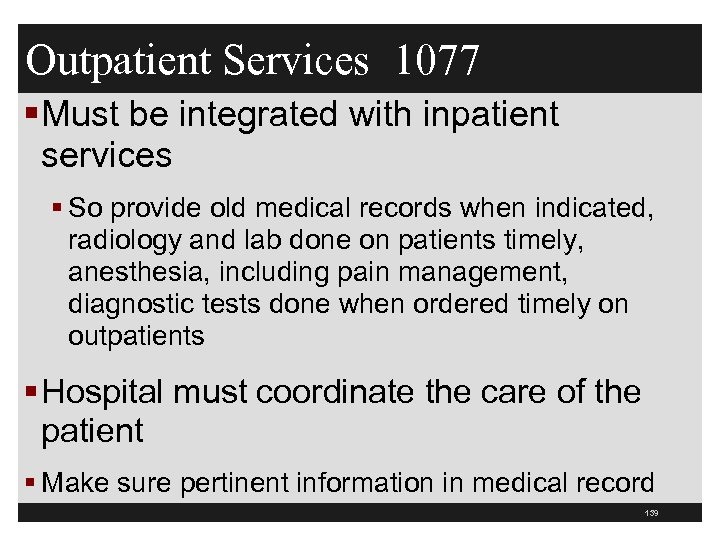 Outpatient Services 1077 § Must be integrated with inpatient services § So provide old medical records when indicated, radiology and lab done on patients timely, anesthesia, including pain management, diagnostic tests done when ordered timely on outpatients § Hospital must coordinate the care of the patient § Make sure pertinent information in medical record 139
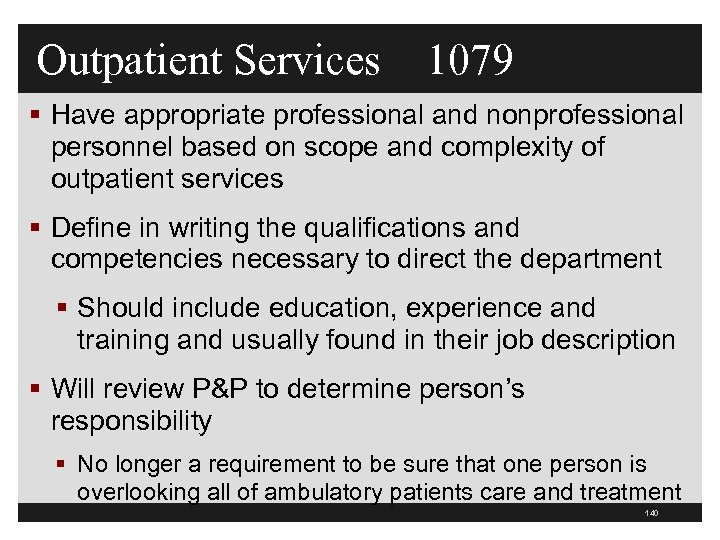 Outpatient Services 1079 § Have appropriate professional and nonprofessional personnel based on scope and complexity of outpatient services § Define in writing the qualifications and competencies necessary to direct the department § Should include education, experience and training and usually found in their job description § Will review P&P to determine person’s responsibility § No longer a requirement to be sure that one person is overlooking all of ambulatory patients care and treatment 140
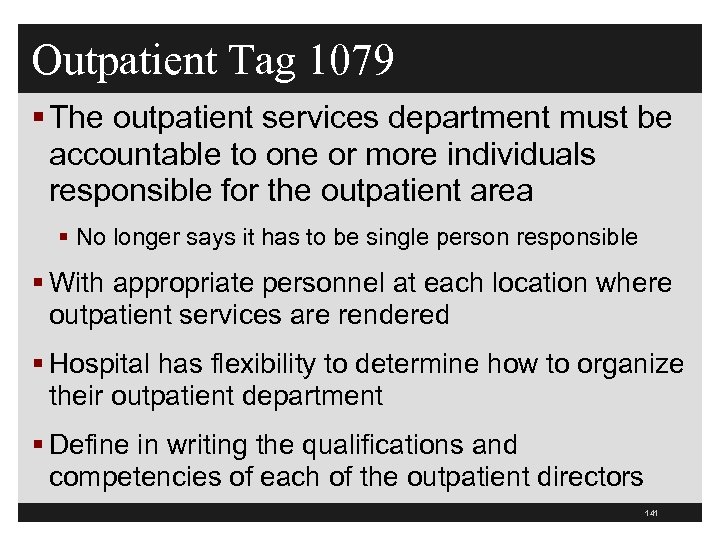 Outpatient Tag 1079 § The outpatient services department must be accountable to one or more individuals responsible for the outpatient area § No longer says it has to be single person responsible § With appropriate personnel at each location where outpatient services are rendered § Hospital has flexibility to determine how to organize their outpatient department § Define in writing the qualifications and competencies of each of the outpatient directors 141
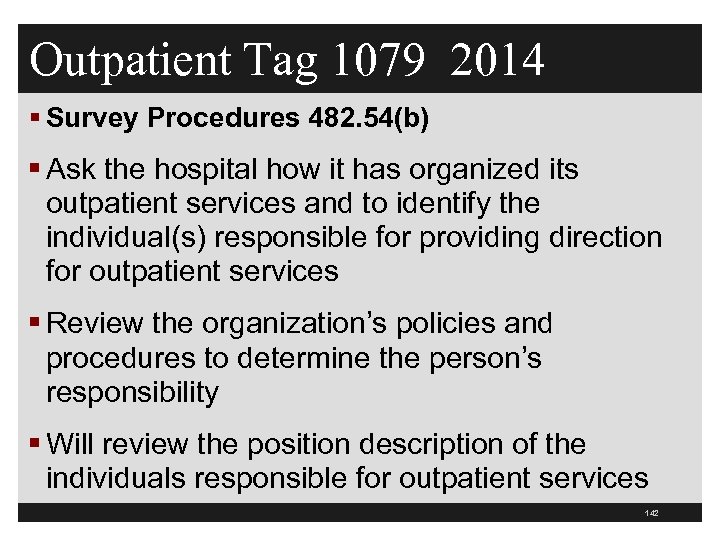 Outpatient Tag 1079 2014 § Survey Procedures 482. 54(b) § Ask the hospital how it has organized its outpatient services and to identify the individual(s) responsible for providing direction for outpatient services § Review the organization’s policies and procedures to determine the person’s responsibility § Will review the position description of the individuals responsible for outpatient services 142
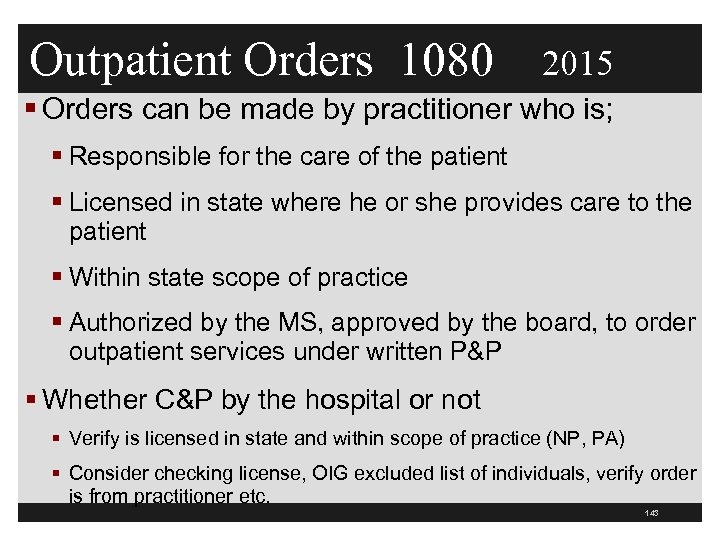 Outpatient Orders 1080 2015 § Orders can be made by practitioner who is; § Responsible for the care of the patient § Licensed in state where he or she provides care to the patient § Within state scope of practice § Authorized by the MS, approved by the board, to order outpatient services under written P&P § Whether C&P by the hospital or not § Verify is licensed in state and within scope of practice (NP, PA) § Consider checking license, OIG excluded list of individuals, verify order is from practitioner etc. 143
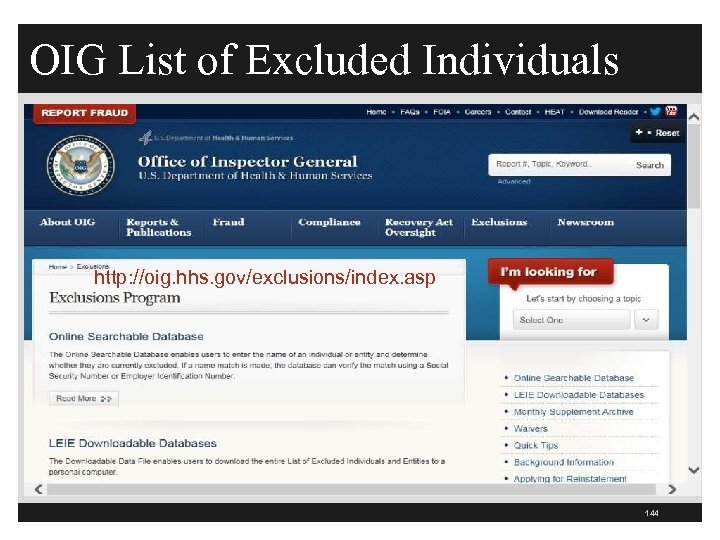 OIG List of Excluded Individuals http: //oig. hhs. gov/exclusions/index. asp 144
 Outpatient Services 1081 2015 § Standard: Outpatient Services must meet the needs of the patients in accordance with standards of practice § Like AMA, ACR, ACS, etc. § It is optional to have outpatient services but if hospital provides outpatient services must follow Co. Ps § Services, equipment, staff, and facilities must be appropriate § Orders for outpatients may be made by practitioner responsible for the care of the patient 145
 Emergency Services 1100 §Hospital must meet needs of patients §Must follow acceptable standards of practice such as ACEP and ENA §Must be integrated into hospital wide QAPI §Need qualified MS director (MD or DO) §Remember other section affecting the ED at tag 91 146
 Emergency Services § Services must be integrated with other departments in hospital § Surgery, lab, medical records, et al. § Includes communications between departments § Immediate availability of services, equipment, and resources of hospital § Length of time to transport between departments is appropriate 147
 Emergency Services § Other departments must provide emergency patients the care within safe and appropriate times § If offer urgent care on premises or in provider based clinics must follow these regulations § Remember there is a separate COP on EMTALA § Most common deficiency among hospitals § Will review policies, including triage policy 148
 Emergency Services § Must have appropriate equipment § Periodic assessments of needs (ESI levels) § Work with state and feds in emergency preparedness § Surveyor will interview staff to see if knowledgeable about blood, IV fluid, parenteral administration of electrolytes, injuries to extremities, CNS and prevention of infection 149
 Rehab Services 1123 2015 § Standard: If provides rehab, PT, OT, speech language pathology, audiology, must be staffed and organized to ensure safety of patients § These staff must be qualified as specified by MS and state law § Meet standards - American Physical Therapy Association, American Speech and Hearing Association, American Occupational Therapy Association, American College of Physicians, AMA § Read what must be in the plan of care 150
 Rehab Services § Must be integrated into hospital wide QAPI § Must have proper equipment and personnel § Scope of service should be defined in writing § Review medical records to verify each person documents § Director must be knowledgeable and experience and capable § Will review job description § Services must be furnished in accordance with written plan of care 151
 Rehab Services 1132 2015 § Must be given in accordance with order of practitioner including outpatient orders § No longer says physician only § Orders must be incorporated in the medical record § Orders by one authorized by the MS to order and by P&P § Could be PA, CNS, NP as allowed per hospital P&P § Document order (1133) § Must be consistent with state scope of practice § Plan of care must meet criteria such as based on assessment, measurable short and long term goals, updated as needed 152
 Respiratory Services 1151 § Must meet needs of patients § Acceptable standard of practice § Appropriate equipment and number of qualified personnel § Scope of service should be defined in writing § Director who is doctor with experience to supervise service § List of written policies you must have 153
 Respiratory Policies § Equipment assembly, operation, PM § Safety practices including IC for sterile supplies, biohaz waste, posting of signs and gas line id § CPR § Pulmonary function testing § Procedures to follow in the advent of adverse reactions to treatments or interventions § Therapeutic percussion and vibration § Bronchopulmonary drainage 154
 Respiratory Policies § Mechanical ventilation § Aerosol, humidification, and therapeutic gas administration § Storage, access and control of medications § ABG procedure for analyzing § CMS working on changes to respiratory and rehab section so stayed tuned § Need order but can be from physician or LIP as allowed by state (scope of practice) and hospital and PA or NP credentialed by Medical Staff 155
 Respiratory Services 1164 (Last Co. P) § If blood gases or other clinical lab tests are performed in unit then the applicable lab standards must be met § Need order of practitioner (1163, 2015) including outpatient orders § One licensed and qualified and within scope of practice § Such as NP, PA, CNS § Will review medical records § Will review to make sure all required policies and procedures are written 156
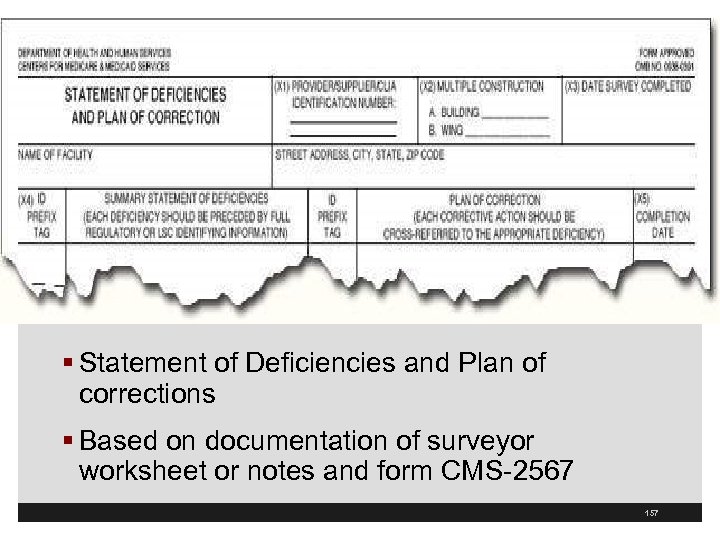 § Statement of Deficiencies and Plan of corrections § Based on documentation of surveyor worksheet or notes and form CMS-2567 157
 The End! Questions? ? ? § Sue Dill Calloway RN, Esq. CPHRM § AD, BA, BSN, MSN, JD § President of Patient Safety and Education Consulting § 5447 Fawnbrook Lane § Dublin, Ohio 43017 § 614 791 -1468 (Call with questions, No emails) § sdill 1@columbus. rr. com § Nuclear medicine slides follow and resources 158
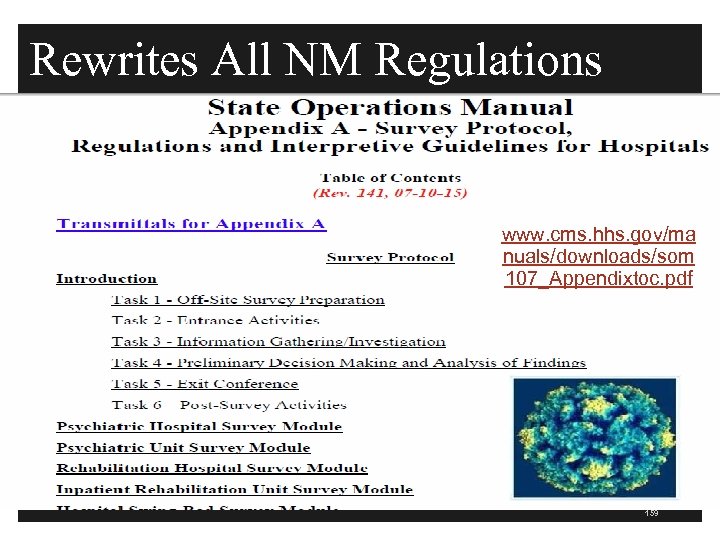 Rewrites All NM Regulations www. cms. hhs. gov/ma nuals/downloads/som 107_Appendixtoc. pdf 159
 Nuclear Medicine 1025 2015 § Services must meet needs of patients § Optional service § Radioactive material must be prepared, labeled, uses, transported, stored and disposed of in accordance with acceptable standards of practice § Will not discuss but be sure to provide to your director if you do nuclear medicine the revised standards in 2015 160
 Nuclear Medicine 2015 1026 § Need to follow standards of practice (1026) § Must follow state or federal laws § Must follow recommendations by national professional organizations such as: § ACR, Radiologic Society of North America, the Society of Nuclear Medicine and Molecular Imaging, the American Society of Nuclear Cardiology, and the American Association of Physicists in Medicine § Hospital can run or have a contracted service § Same risks such as patient can develop cancer 161
 Nuclear Medicine 2015 1026 § Use as low as reasonably achievable (ALARA) § Must be integrated into QAPI program § Lists indicators of potential quality and safety problems § Wrong radiopharmaceutical is used § Lack of premedication or no IV access so procedure is cancelled § Need a qualified NM medical director (1027) approved by the Medical Staff § Had written scope to show what services are offered 162
 Nuclear Medicine 2015 § Radioactive material must be prepared, labeled, used, transported, stored, and disposed of in accordance with acceptable standards of practice (1035) § Must have a policy addressing the use of radioactive materials in the hospital § Must have clear signage § Must protect high risk patients; pregnant, children, multiple NM studies § Monitor staff monitoring devices such as dosimeters 163
 Nuclear Medicine 2015 § If lab tests done in NM service must meet CLIA (1038) § Equipment and supplies must be appropriate (1044) § Must be maintain for safe and efficient performance § Must be in good operating condition § Must have signed and dated reports of interpretations, consultations, and procedures (1051) § Must be signed by MS who interpreted it § Must keep copies for 5 years 164
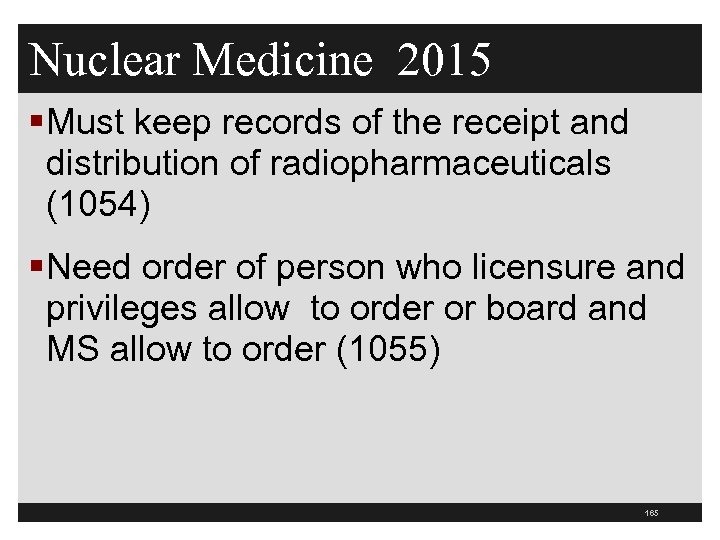 Nuclear Medicine 2015 §Must keep records of the receipt and distribution of radiopharmaceuticals (1054) §Need order of person who licensure and privileges allow to order or board and MS allow to order (1055) 165
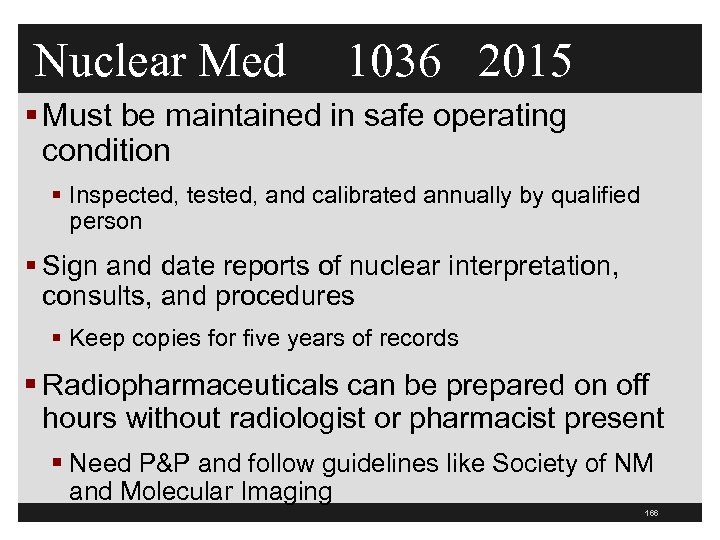 Nuclear Med 1036 2015 § Must be maintained in safe operating condition § Inspected, tested, and calibrated annually by qualified person § Sign and date reports of nuclear interpretation, consults, and procedures § Keep copies for five years of records § Radiopharmaceuticals can be prepared on off hours without radiologist or pharmacist present § Need P&P and follow guidelines like Society of NM and Molecular Imaging 166
 SNMMI Website www. snmmi. org/ 167
 168
168
 NM Tech Scope of Practice 169
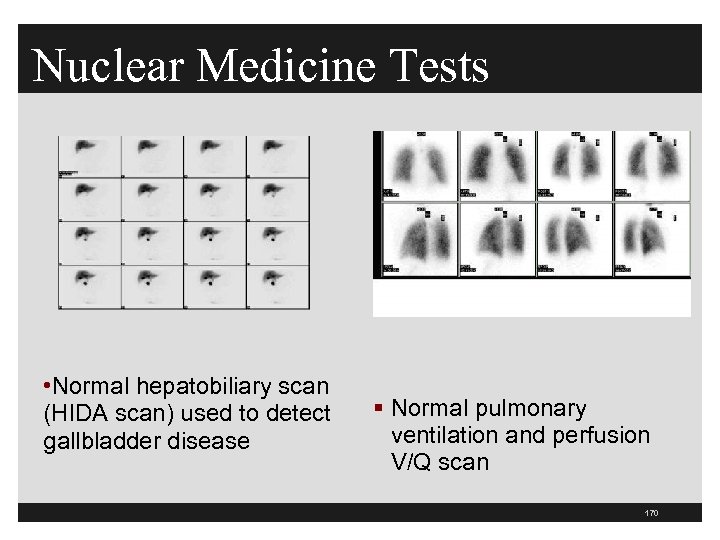 Nuclear Medicine Tests • Normal hepatobiliary scan (HIDA scan) used to detect gallbladder disease § Normal pulmonary ventilation and perfusion V/Q scan 170
 Websites § Center for Disease Control CDC – www. cdc. gov § Food and Drug Administration - www. fda. gov § Association of peri. Operative Registered Nurses at AORN www. aorn. org § American Institute of Architects AIA - www. aia. org § Occupational Safety and Health Administration OSHA – www. osha. gov § National Institutes of Health NIH - www. nih. gov § United States Dept of Agriculture USDA - www. usda. gov § Emergency Nurses Association ENA - www. ena. org 171
 Websites § American College of Emergency Physicians ACEP www. acep. org § Joint Commission www. Joint. Commission. org § Centers for Medicare and Medicaid Services CMS www. cms. hhs. gov § American Association for Respiratory Care AARC www. aarc. org § American College of Surgeons ACS -www. facs. org § American Nurses Association ANA - www. ana. org § AHRQ is www. ahrq. gov § American Hospital Association AHA - www. aha. org 172
 Websites § U. S. Pharmacopeia (USP) www. usp. org § U. S. Food and Drug Administration Med. Watch www. fda. gov/medwatch § Institute for Healthcare Improvement - www. ihi. org § AHRQ at www. ahrq. gov § Drug Enforcement Administration –www. dea. gov (copy of controlled substance act) § US Pharmacopeia - www. usp. org, (USP 797 book for sale) § National Patient Safety Foundation at the AMA -www. amaassn. org/med-sci/npsf/htm § The Institute for Safe Medication Practices - www. ismp. org 173
 Websites § CMS Life Safety Code page http: //new. cms. hhs. gov/CFCs. And. Co. Ps/07_LSC. asp § American College of Radiology- www. acr. org § Federal Emergency Management Agency (FEMA)www. fema. gov § Sentinel event alerts at www. jointcommission. org § American Pharmaceutical Association www. aphanet. org § American Society of Heath-System Pharmacists www. ashp. org 174
 Websites § Enhancing Patient Safety and Errors in Healthcare www. mederrors. com § National Coordinating Council for Medication Error Reporting and Prevention - www. nccmerp. org, § FDA's Recalls, Market Withdrawals and Safety Alerts Page: www. fda. gov/opacom/7 alerts. html § Association for Professionals in Infection Control and Epidemiology (APIC) infection control guidelines at www. apic. org § Centers for Disease Control and Prevention - www. cdc. gov § Occupational Health and Safety Administration (OSHA) at www. osha. gov 175
 Infection Control Websites § The National Institute for Occupational Safety and Health NIOSH at www. cdc. gov/niosh/homepage. html § AORN at www. aorn. org § Society for Healthcare Epidemiology of America (SHEA) at www. shea-online. org 176
 The End! Questions? ? Sue Dill Calloway RN, Esq. CPHRM AD, BA, BSN, MSN, JD 5447 Fawnbrook Lane Dublin, Ohio 43017 614791 -1468 sdill 1@columbus. rr. com www. empsf. org 177