 Скачать презентацию CMS Global Calorimeter Trigger J Brooke D Cussans
cd95b4d0c903074ca8a2f24ed489932f.ppt
- Количество слайдов: 22



CMS Global Calorimeter Trigger J. Brooke, D. Cussans, R. Frazier, G. Heath, S. Nash, D. Newbold University of Bristol S. Galagadera, A. Shah, S. Madani Rutherford Laboratory à CMS Level-1 Trigger à GCT Design à Module implementation à Firmware à Lessons Learnt Dave Newbold, University of Bristol LECC 04, Boston
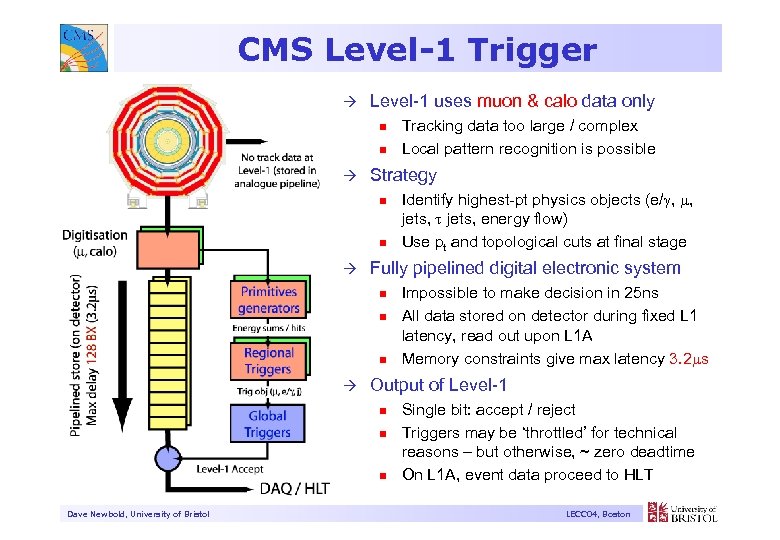
CMS Level-1 Trigger à Level-1 uses muon & calo data only n n à Strategy n n à n n Impossible to make decision in 25 ns All data stored on detector during fixed L 1 latency, read out upon L 1 A Memory constraints give max latency 3. 2 ms Output of Level-1 n n n Dave Newbold, University of Bristol Identify highest-pt physics objects (e/g, m, jets, t jets, energy flow) Use pt and topological cuts at final stage Fully pipelined digital electronic system n à Tracking data too large / complex Local pattern recognition is possible Single bit: accept / reject Triggers may be ‘throttled’ for technical reasons – but otherwise, ~ zero deadtime On L 1 A, event data proceed to HLT LECC 04, Boston
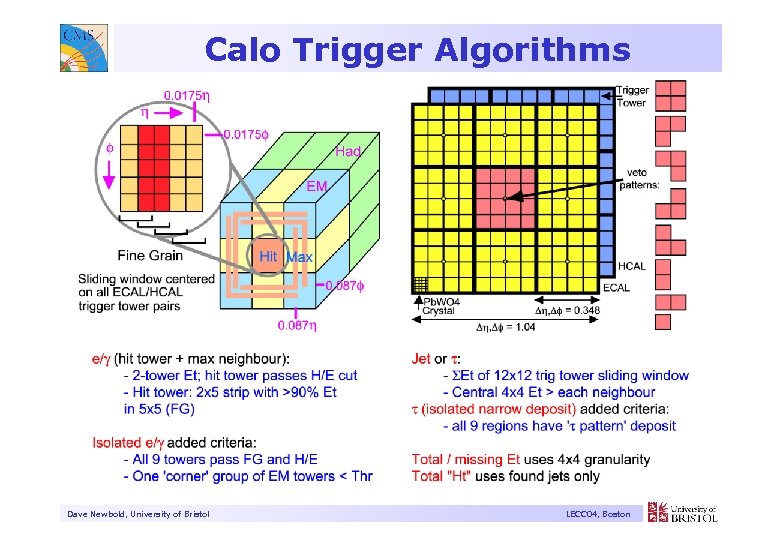
Calo Trigger Algorithms Dave Newbold, University of Bristol LECC 04, Boston
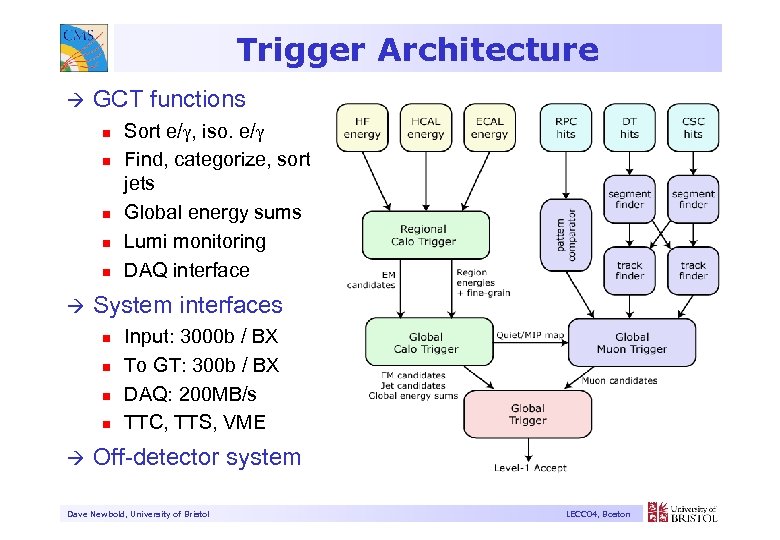
Trigger Architecture à GCT functions n n n à System interfaces n n à Sort e/g, iso. e/g Find, categorize, sort jets Global energy sums Lumi monitoring DAQ interface Input: 3000 b / BX To GT: 300 b / BX DAQ: 200 MB/s TTC, TTS, VME Off-detector system Dave Newbold, University of Bristol LECC 04, Boston
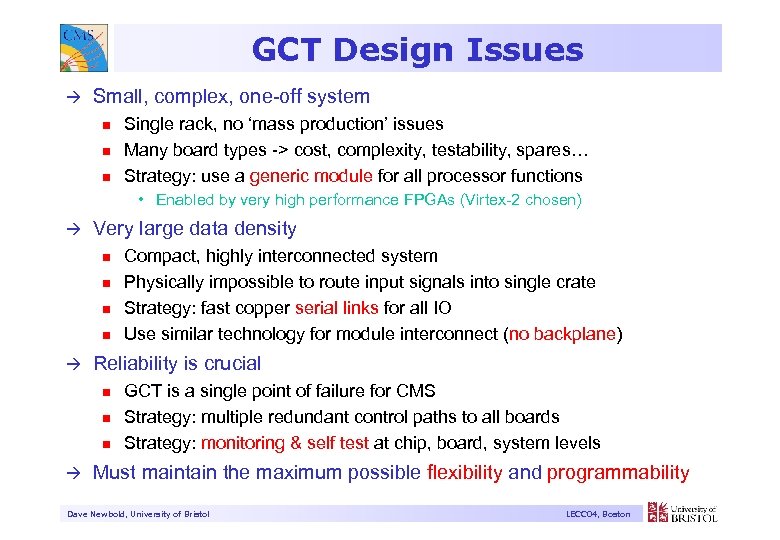
GCT Design Issues à Small, complex, one-off system n n n Single rack, no ‘mass production’ issues Many board types -> cost, complexity, testability, spares… Strategy: use a generic module for all processor functions • Enabled by very high performance FPGAs (Virtex-2 chosen) à Very large data density n n à Reliability is crucial n n n à Compact, highly interconnected system Physically impossible to route input signals into single crate Strategy: fast copper serial links for all IO Use similar technology for module interconnect (no backplane) GCT is a single point of failure for CMS Strategy: multiple redundant control paths to all boards Strategy: monitoring & self test at chip, board, system levels Must maintain the maximum possible flexibility and programmability Dave Newbold, University of Bristol LECC 04, Boston
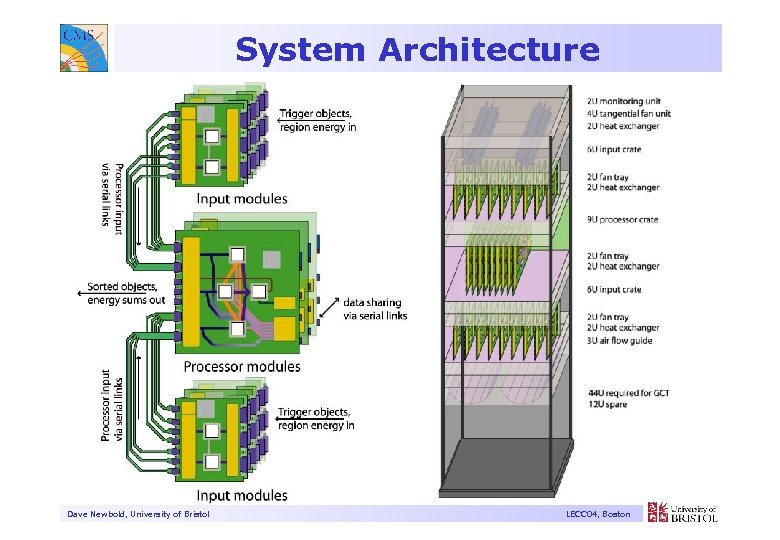
System Architecture Dave Newbold, University of Bristol LECC 04, Boston
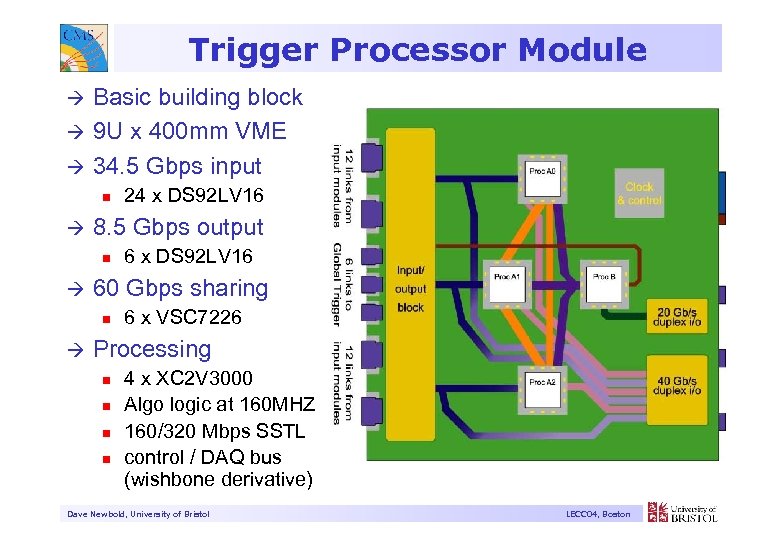
Trigger Processor Module Basic building block à 9 U x 400 mm VME à 34. 5 Gbps input à n à 8. 5 Gbps output n à 6 x DS 92 LV 16 60 Gbps sharing n à 24 x DS 92 LV 16 6 x VSC 7226 Processing n n 4 x XC 2 V 3000 Algo logic at 160 MHZ 160/320 Mbps SSTL control / DAQ bus (wishbone derivative) Dave Newbold, University of Bristol LECC 04, Boston
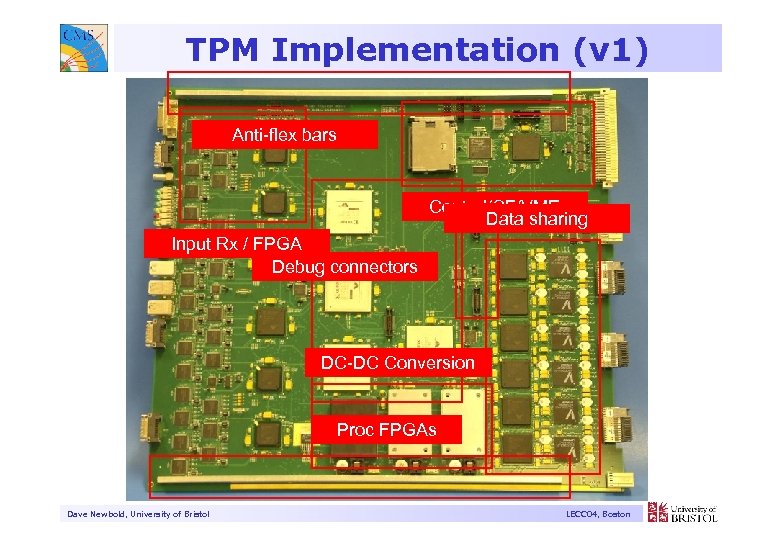
TPM Implementation (v 1) Anti-flex bars Control/CF/VME Data sharing Input Rx / FPGA Debug connectors DC-DC Conversion Proc FPGAs Dave Newbold, University of Bristol LECC 04, Boston
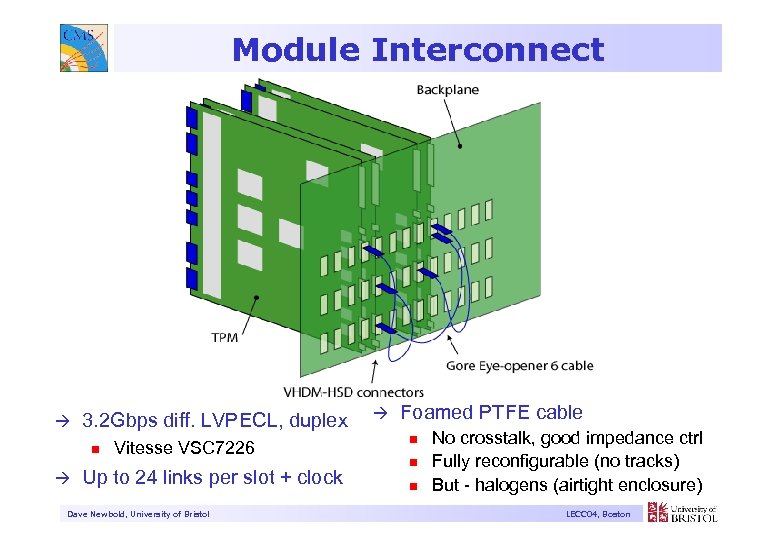
Module Interconnect à 3. 2 Gbps diff. LVPECL, duplex n à Vitesse VSC 7226 Up to 24 links per slot + clock Dave Newbold, University of Bristol à Foamed PTFE cable n n n No crosstalk, good impedance ctrl Fully reconfigurable (no tracks) But - halogens (airtight enclosure) LECC 04, Boston
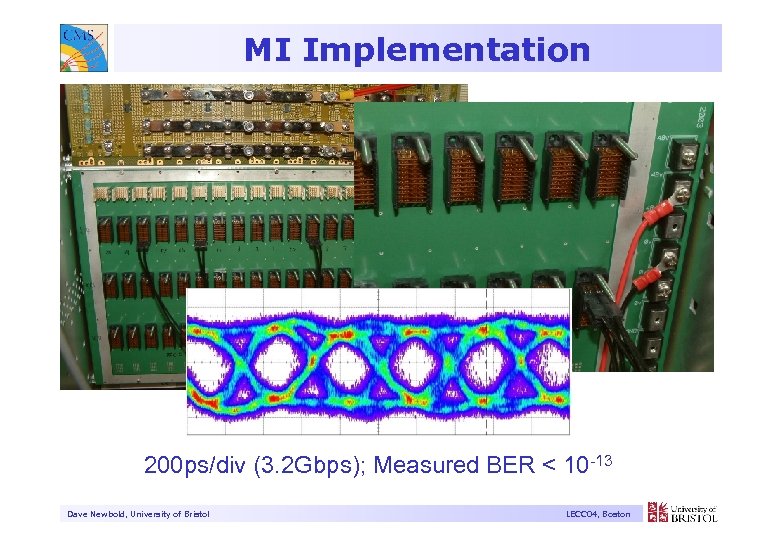
MI Implementation 200 ps/div (3. 2 Gbps); Measured BER < 10 -13 Dave Newbold, University of Bristol LECC 04, Boston
Input Module à Function n à Implementation n à Retime and synchronize 80 MHz parallel ECL data Bit-by-bit deskew allows use of low cost cables Serialize + send to TPM Simple, low-cost module Wide common mode range receivers Single Virtex-2 FPGA oversamples and formats data Clock / control n n Provided by TPM Data capture / playback for debugging of system Dave Newbold, University of Bristol LECC 04, Boston
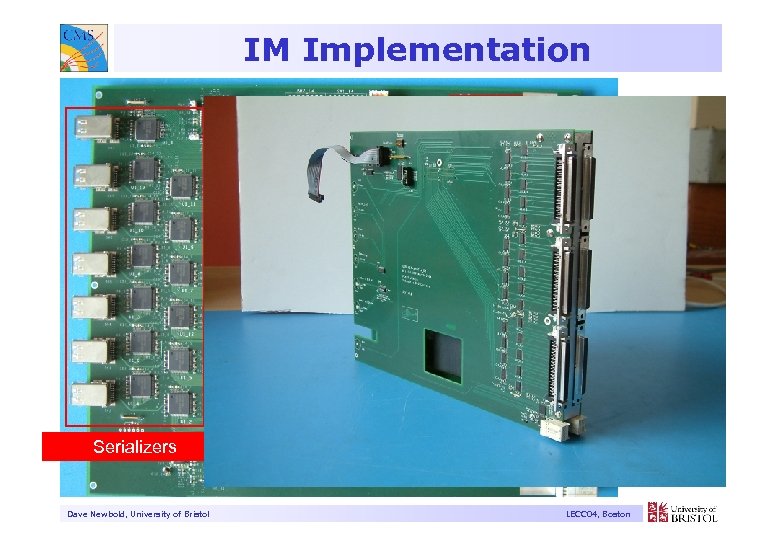
IM Implementation Daughterboard Connector Sync FPGA Diff. line receivers Serializers Dave Newbold, University of Bristol LECC 04, Boston
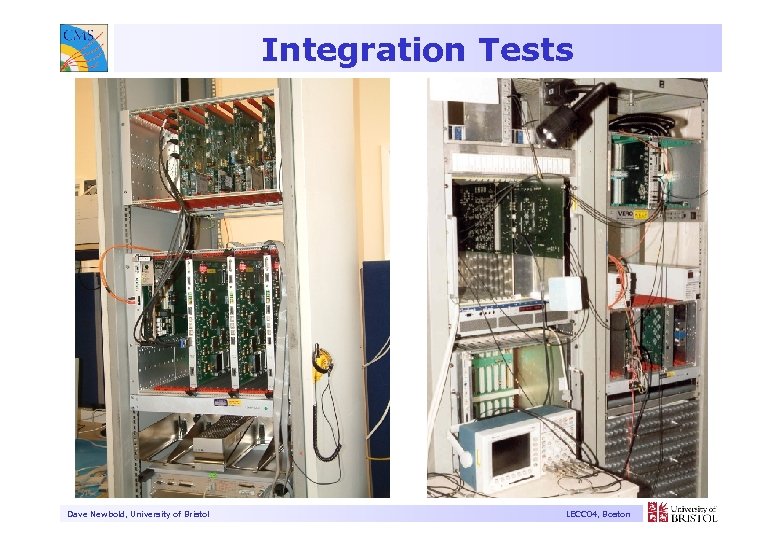
Integration Tests Dave Newbold, University of Bristol LECC 04, Boston
Communications Module à Function n n à Timing n n n à Single TTCrq daughterboard for GCT system (fibre input) 40 MHz clock distributed via point-to-point rear links TTC control signals distributed to ‘DAQ TPM’ and thence to system DAQ n n à Distribute master clock throughout system Accommodate CMS-specific control / DAQ interfaces Slink-64 daughtercard for final DAQ system VME 64 interface for ‘private DAQ’ during commissioning Other interfaces n n n Link to throttling system in case of buffer overflow or error Controls multidrop JTAG backplane General-purpose control / monitoring ports Dave Newbold, University of Bristol LECC 04, Boston
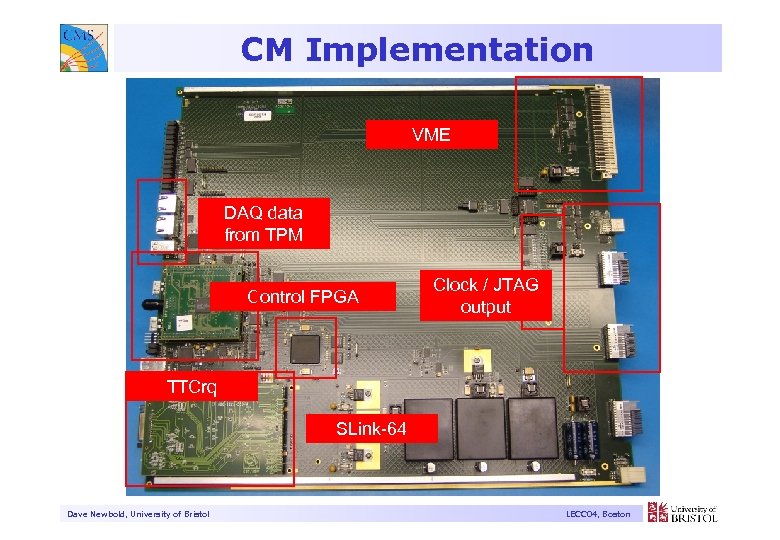
CM Implementation VME DAQ data from TPM Control FPGA Clock / JTAG output TTCrq SLink-64 Dave Newbold, University of Bristol LECC 04, Boston
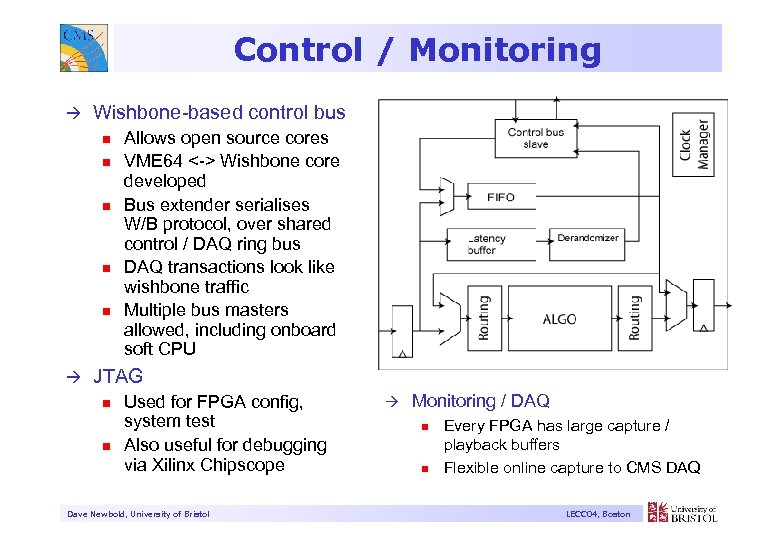
Control / Monitoring à Wishbone-based control bus n n n à Allows open source cores VME 64 <-> Wishbone core developed Bus extender serialises W/B protocol, over shared control / DAQ ring bus DAQ transactions look like wishbone traffic Multiple bus masters allowed, including onboard soft CPU JTAG n n Used for FPGA config, system test Also useful for debugging via Xilinx Chipscope Dave Newbold, University of Bristol à Monitoring / DAQ n n Every FPGA has large capture / playback buffers Flexible online capture to CMS DAQ LECC 04, Boston
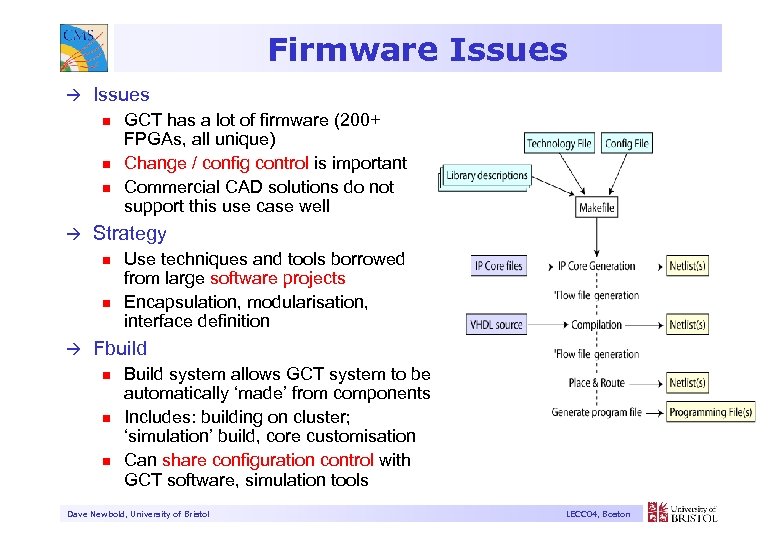
Firmware Issues à Issues n n n à Strategy n n à GCT has a lot of firmware (200+ FPGAs, all unique) Change / config control is important Commercial CAD solutions do not support this use case well Use techniques and tools borrowed from large software projects Encapsulation, modularisation, interface definition Fbuild n n n Build system allows GCT system to be automatically ‘made’ from components Includes: building on cluster; ‘simulation’ build, core customisation Can share configuration control with GCT software, simulation tools Dave Newbold, University of Bristol LECC 04, Boston
Lessons Learnt (so far!) à Design n The ‘generic module’ approach is useful and cost-effective • Trade-off in board versus system complexity seems to have paid off n Very high density communication over serial links can be made to work • Power, clock, signal path quality are all important à Implementation n Getting an 18 -layer 400 mm board fabricated reliably is not so easy • Rework becomes more and more difficult n n Dedicated debugging connectors / nets are now essential Integration and board checkout take longer than you think • Almost everything is needed to get anything to work à Software / firmware n n à GCT boards are almost a ‘software system’ now Automate and integrate firmware / software build from the start JTAG n Does the job, but actually becoming difficult to implement reliably! Dave Newbold, University of Bristol LECC 04, Boston
Summary à GCT n n à Project status n n n à All modules implemented in final or prototype versions System integration and test now proceeding No critical show-stoppers so far Lessons from implementation n à Small but complex system, challenging to implement at low cost Generic module / configurable backplane approach used Process of board design -> fab -> test is now very long and challenging Built in capacity for debug / self-test / monitor is essential Automated approach needed to firmware build and config control GCT ready for action in 2006! n Integration with CMS L 1 trigger starting in 2005 Dave Newbold, University of Bristol LECC 04, Boston
Backup: CMS Trigger Strategy à Driven by LHC physics conditions n n à Trigger combinations n n n à >20 Ge. V limit on single-lepton thresholds due to quark decay + p 0 b/g Most interesting states decay to two or more trigger objects – can use lower thresholds for objects in combination -> Find trigger objects locally, combine and cut only at last stage Large uncertainties in background (and perhaps signal) n n n à Decays of rare and heavy particles against large “soft” QCD b/g Many decays involve intermediate W / Z; H -> gg also important -> Identify high-pt leptons* and photons (*including t) Low pt thresholds motivated by efficiency for W / Z / light Higgs Flexibility and control of rate are both vital -> All trigger thresholds and conditions must be programmable Trigger architecture is fixed, but this is a function of detector geometry Must have high and well-understood efficiency n -> Need to include overlapping and minbias triggers to measure e Dave Newbold, University of Bristol LECC 04, Boston
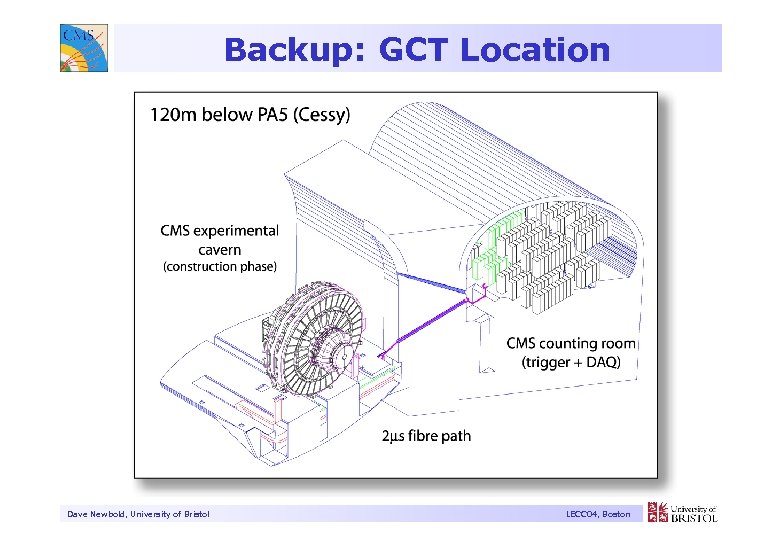
Backup: GCT Location Dave Newbold, University of Bristol LECC 04, Boston
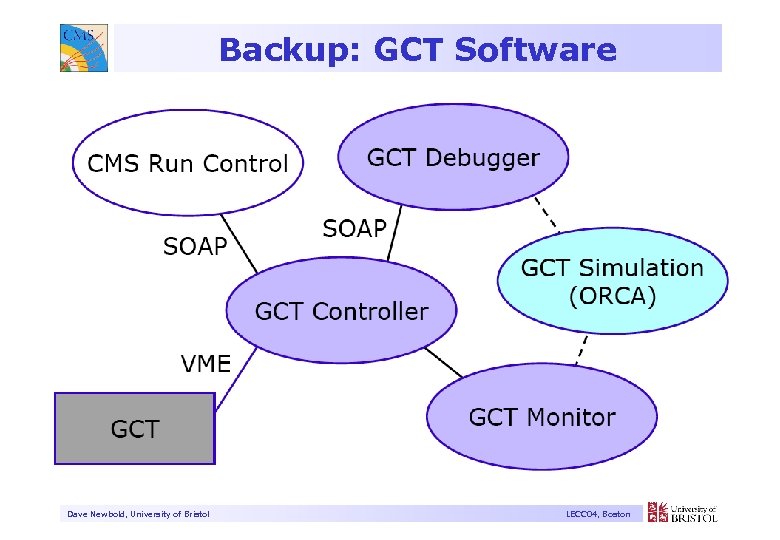
Backup: GCT Software Dave Newbold, University of Bristol LECC 04, Boston
Скачать презентацию CMS Global Calorimeter Trigger J Brooke D Cussans
cd95b4d0c903074ca8a2f24ed489932f.ppt