


 Скачать презентацию CMS DISASTER MANAGEMENT 2012 LIFE SAFETY CODE
b26ac2167c2d0518d1f5357e9cf92667.ppt
- Количество слайдов: 155
 CMS DISASTER MANAGEMENT, 2012 LIFE SAFETY CODE & 2012 HEALTH CARE FACILITIES CODE KENNETH DAILY, LNHA KENN@QISSURVEY. COM NOVEMBER 2016
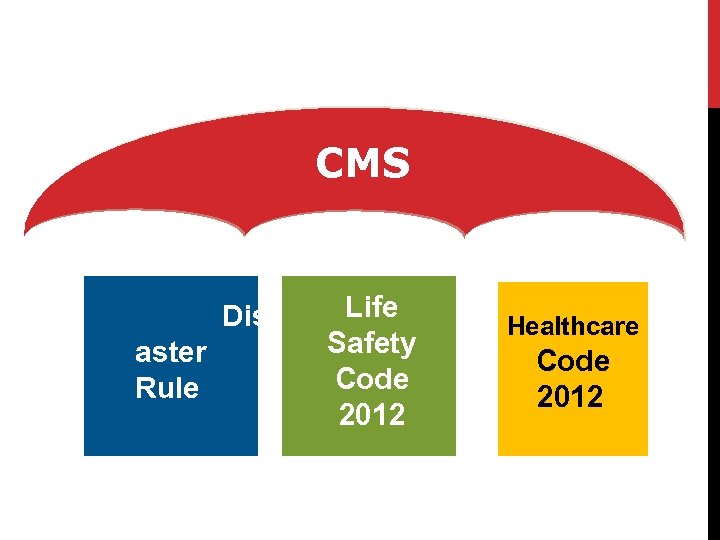 CMS Dis aster Rule Life Safety Code 2012 Healthcare Code 2012
 CMS EMERGENCY RULE CMS ACTIONS On September 2016 CMS released FINAL disaster rule, Emergency Preparedness Standards for Medicare and Medicaid Participating Providers and Suppliers Develop comprehensive disaster management program: Mitigation, Preparedness, Response and Recovery
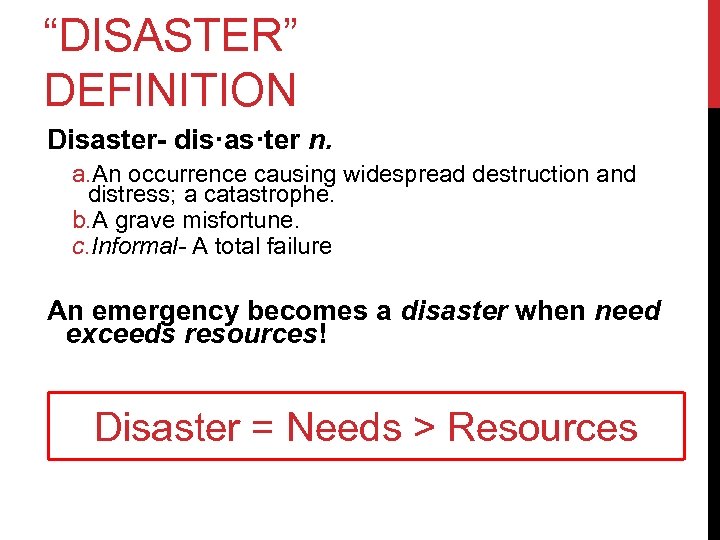 “DISASTER” DEFINITION Disaster- dis·as·ter n. a. An occurrence causing widespread destruction and distress; a catastrophe. b. A grave misfortune. c. Informal- A total failure An emergency becomes a disaster when need exceeds resources! Disaster = Needs > Resources
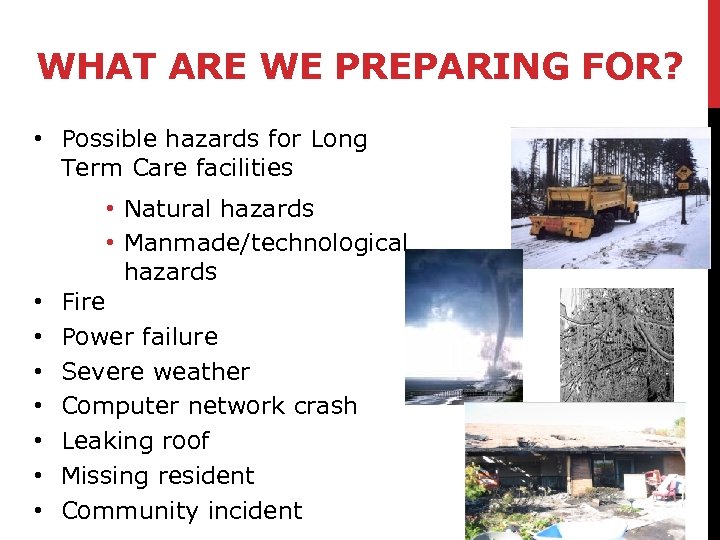 WHAT ARE WE PREPARING FOR? • Possible hazards for Long Term Care facilities • Natural hazards • Manmade/technological hazards • • Fire Power failure Severe weather Computer network crash Leaking roof Missing resident Community incident
 KEY ISSUES FACING LTC’S • Outdated plans with no annual review protocol • Low awareness level of IC & Surge Plans • Few “All Hazards” plans • Multiple contracts • Little involvement with local EM resources • “Shelter in Place” • Lacking systems to track residents, meds, belongings • Limited security management plan in place
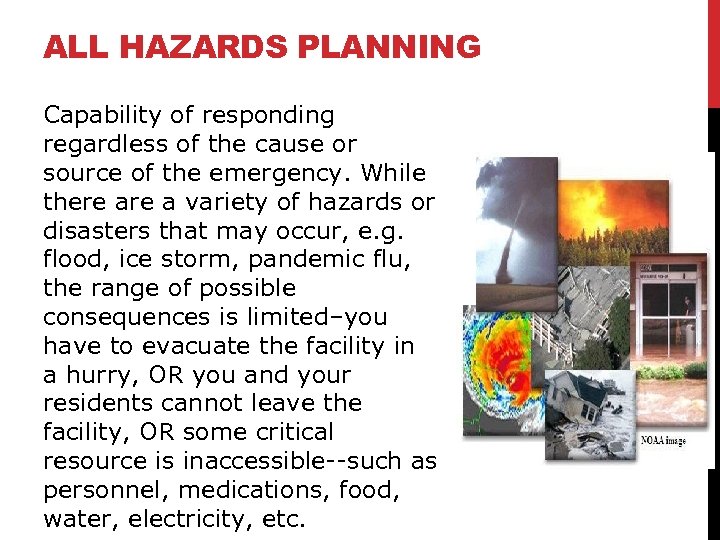 ALL HAZARDS PLANNING Capability of responding regardless of the cause or source of the emergency. While there a variety of hazards or disasters that may occur, e. g. flood, ice storm, pandemic flu, the range of possible consequences is limited–you have to evacuate the facility in a hurry, OR you and your residents cannot leave the facility, OR some critical resource is inaccessible--such as personnel, medications, food, water, electricity, etc.
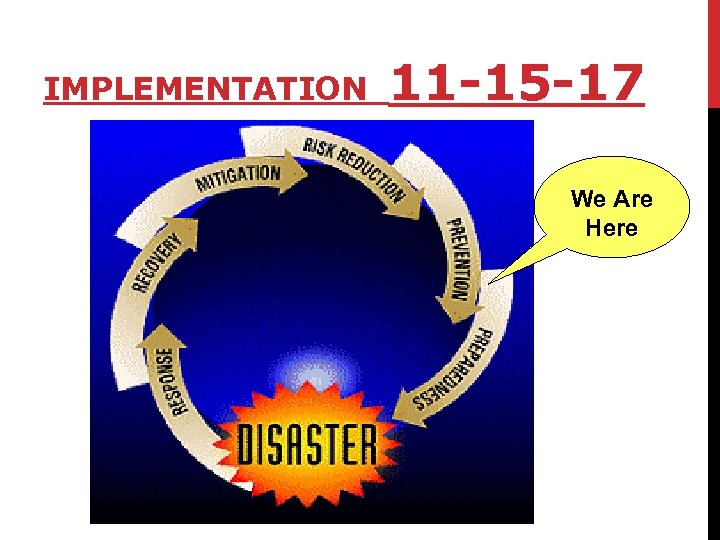 IMPLEMENTATION 11 -15 -17 We Are Here
 4 KEY ELEMENTS • Risk Assessment • Policy and Procedures • Communications Plan • Training and Education
 4 KEY REQUIREMENTS Risk assessment Facilities will perform a risk assessment that uses an "allhazards" approach prior to establishing an emergency plan. An all-hazards risk assessment will be used to identify the essential components to be integrated into the facility emergency plan. An all-hazards approach is an integrated approach to emergency preparedness planning that focuses on capacities and capabilities that are critical to preparedness for a full spectrum of emergencies or disasters. This approach is specific to the location of the provider and considers the particular types of hazards most likely to occur in their areas.
 HVA - HAZARD VULNERABILITY ASSESSMENT Hazards are such things as internal and external threats to a facility Risk is the likelihood of a hazard occurring and there is a loss, damage or any other undesirable event. HTVA examine ways to avoid, address and reduce Develop a plan for all potential disasters • Climate • Topography • Relative location to oceans/seas • Building Structure • Hazardous Materials • Services/Maintenance
 HAZARD VULNERABILITY ANALYSIS Who needs to be involved? • Administrator • Food Service • Director of Nursing • Housekeeping/ Laundry • Social Services • Maintenance/ Plant Operations • Activities • Business Office • Others? ?
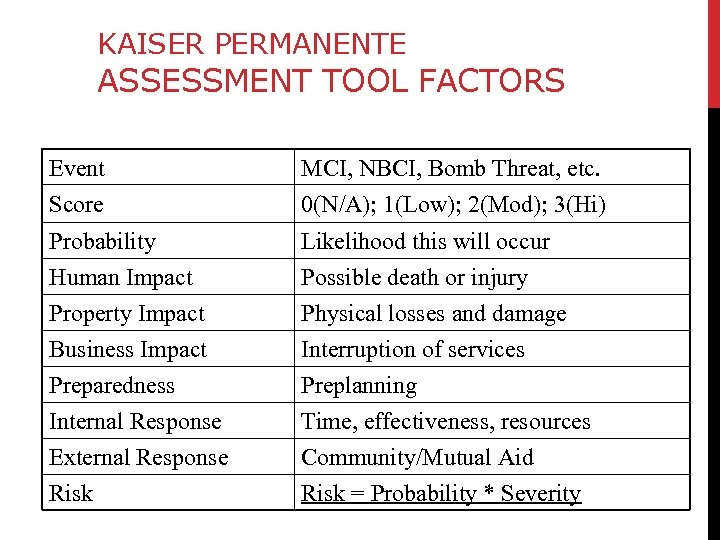 KAISER PERMANENTE ASSESSMENT TOOL FACTORS Event Score MCI, NBCI, Bomb Threat, etc. 0(N/A); 1(Low); 2(Mod); 3(Hi) Probability Human Impact Likelihood this will occur Possible death or injury Property Impact Business Impact Preparedness Internal Response External Response Risk Physical losses and damage Interruption of services Preplanning Time, effectiveness, resources Community/Mutual Aid Risk = Probability * Severity
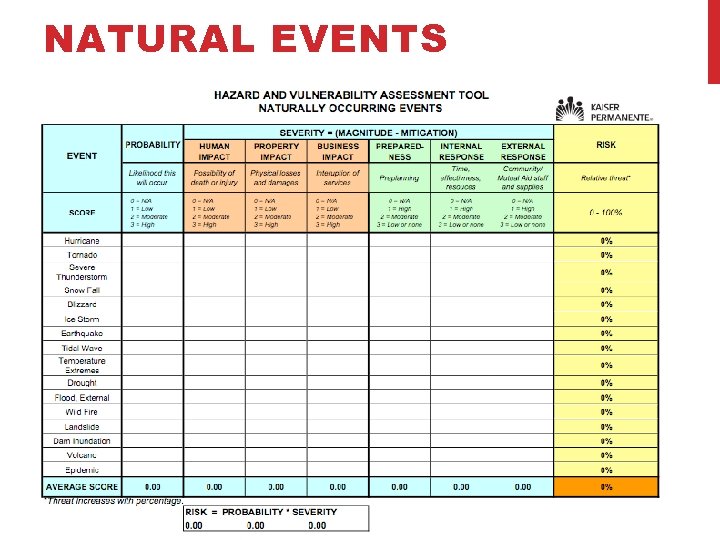 NATURAL EVENTS
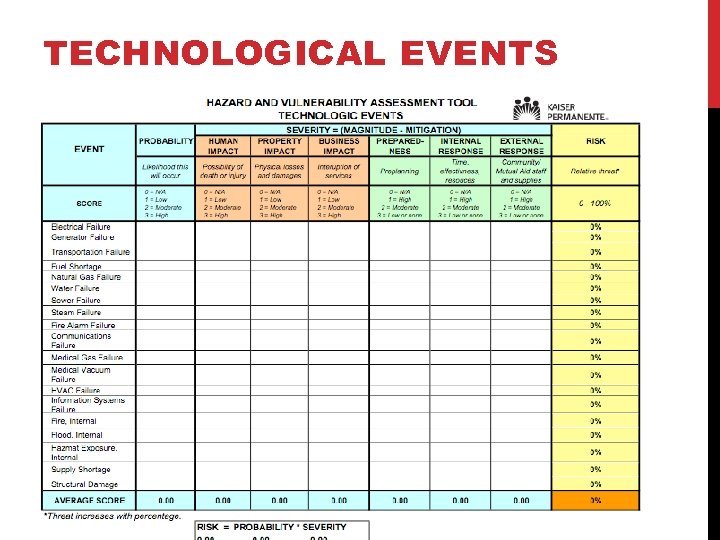 TECHNOLOGICAL EVENTS
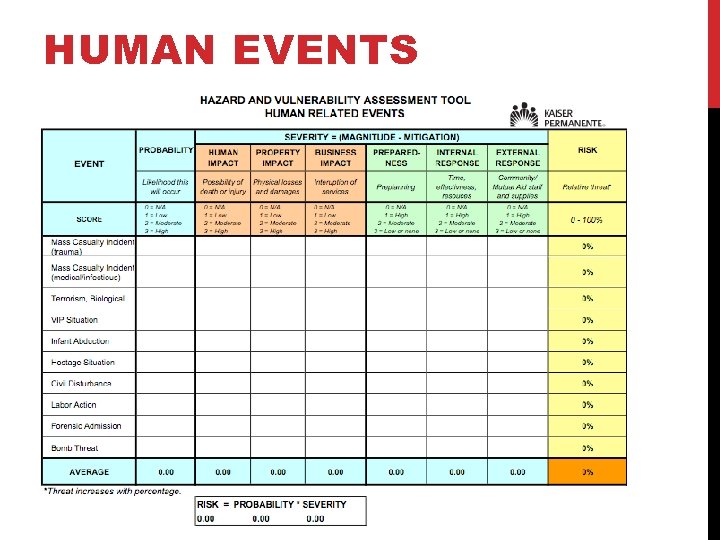 HUMAN EVENTS
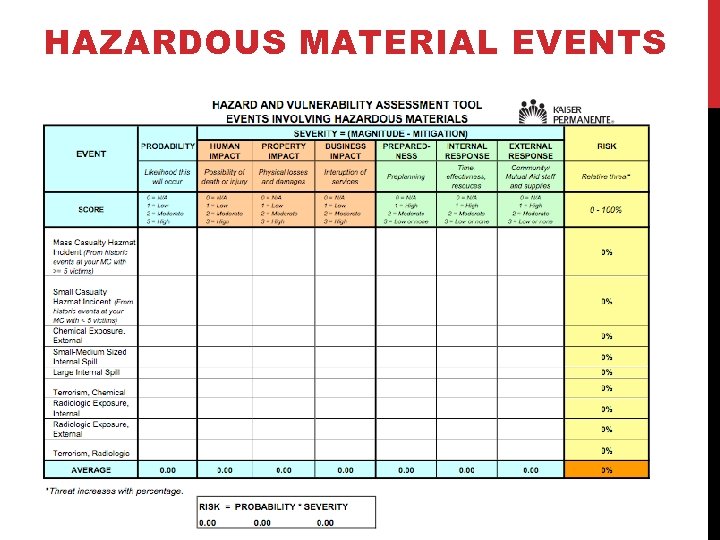 HAZARDOUS MATERIAL EVENTS
 4 KEY REQUIREMENTS Policies and procedures • CMS requires that facilities develop and implement policies and procedures that support the successful execution of the emergency plan • Takes into account the risks identified during the risk assessment process.
 CMS: DEVELOPMENT EMERGENCY PLAN Gather all available relevant information when developing the emergency plan. This information includes, but is not limited to: • Copies of any state and local emergency planning regulations or requirements • Facility personnel names and contact information • Contact information of local and state emergency managers • A facility organization chart • Building construction and Life Safety systems information • Specific information about the characteristics and needs of the individuals for whom care is provided
 STANDARDIZED TEMPLATE FOR POLICIES AND PROCEDURES • Found many different methods for structuring policy and procedure manual • Decided to use format that included purpose statement, policy, procedure, references/legal authority • Could possibly add other components such as: responsible staff, definitions, supplies needed, related policies • Key to keep the policy and procedure as SIMPLE as possible
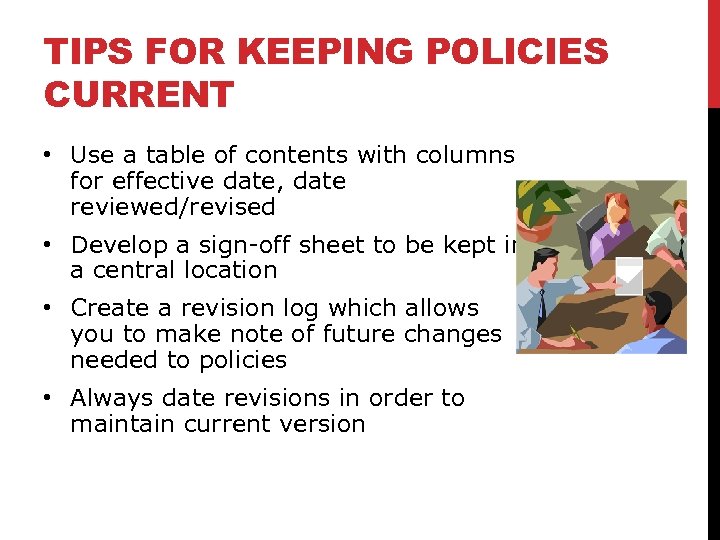 TIPS FOR KEEPING POLICIES CURRENT • Use a table of contents with columns for effective date, date reviewed/revised • Develop a sign-off sheet to be kept in a central location • Create a revision log which allows you to make note of future changes needed to policies • Always date revisions in order to maintain current version
 4 KEY REQUIREMENTS Communication plan • CMS expects facilities to develop and maintain an emergency preparedness communication plan • Patient care must be well-coordinated within the facility, and with state and local public health departments and emergency management agencies • Policies, procedures, and an incident command structure to ensure employees follow protocols during an emergency in contacting each other, stakeholders, the media, and others. • The Media Plan is an essential part of the Communications plan
 PLAN AHEAD • Brainstorm possible scenarios/responses • How will we operate without internet, cell service, wired service? • How do we use social media? • What records would residents need in a mass evacuation? • Who are our county or city contacts? • Check records of resident relocation and staff contacts for accuracy • Practice how to handle media inquiries, including social media • Practice how to handle inquiries from families (who may be in a panic) • Prepare a memo to update staff on the emergency preparedness plan
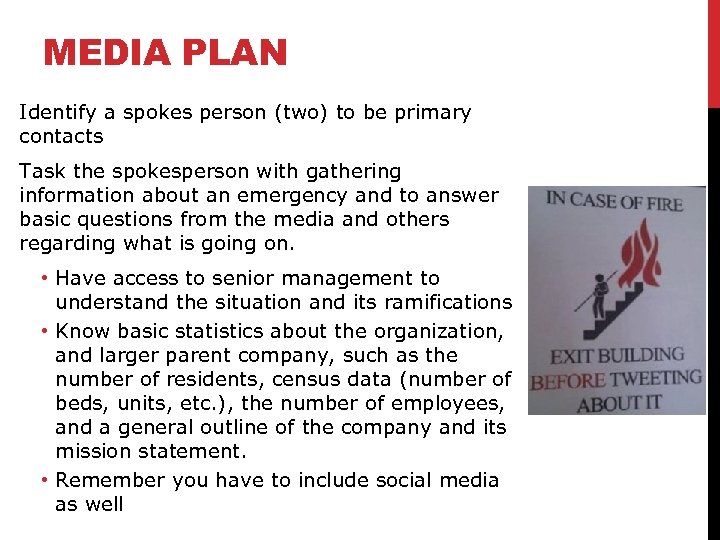 MEDIA PLAN Identify a spokes person (two) to be primary contacts Task the spokesperson with gathering information about an emergency and to answer basic questions from the media and others regarding what is going on. • Have access to senior management to understand the situation and its ramifications • Know basic statistics about the organization, and larger parent company, such as the number of residents, census data (number of beds, units, etc. ), the number of employees, and a general outline of the company and its mission statement. • Remember you have to include social media as well
 WHAT IS INCIDENT COMMAND STRUCTURE? • Organizational crisis management system • Apply NHICS concepts throughout • Early planning for transition to consequence management • Management system designed to integrate resources from numerous organizations into a single response structure using common terminology and processes • What it is NOT… A complete, ready-to-go, “disaster plan”
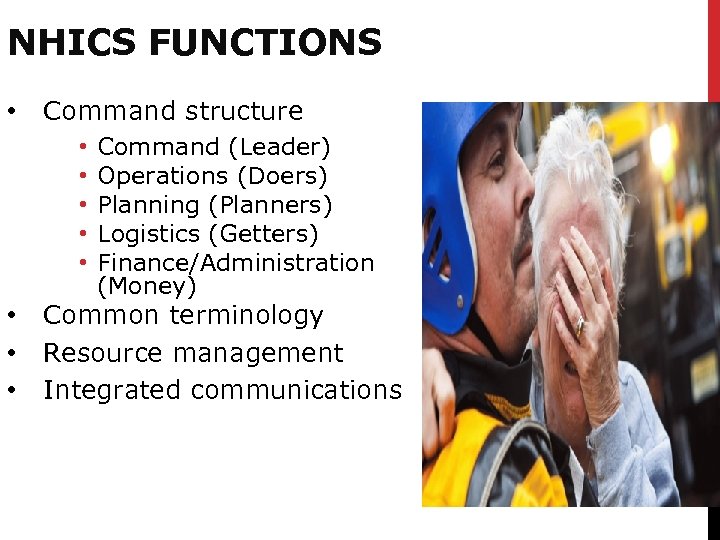 NHICS FUNCTIONS • Command structure • • Command (Leader) Operations (Doers) Planning (Planners) Logistics (Getters) Finance/Administration (Money) Common terminology Resource management Integrated communications
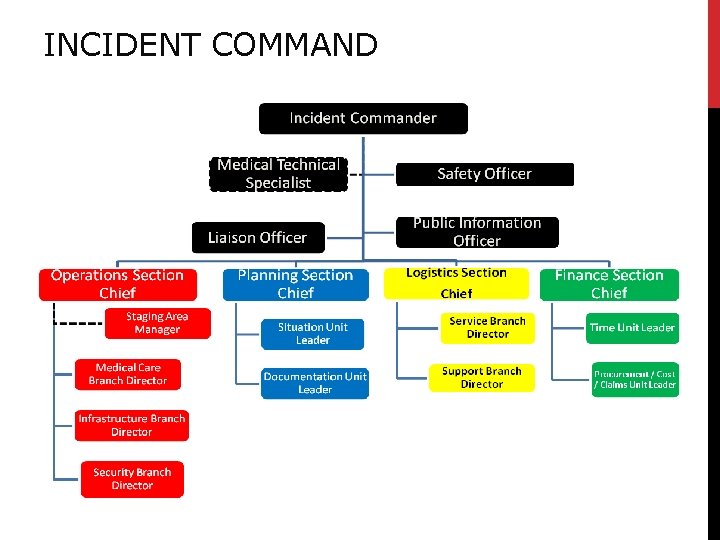 INCIDENT COMMAND
 INCIDENT MANAGEMENT TEAM (IMT) FUNCTIONS • Incident Commander ▫ Only position always activated in an incident ▫ Sets the objectives, devises strategies and priorities, and maintains overall responsibility for managing incident • Operations ▫ Conducts tactical operations (e. g. , resident services, clean up) to carry out the plan using defined objectives and directing all needed resources
 IMT FUNCTIONS (CONT. ) • Planning ▫ collects and evaluates information for decision support, maintains resource status information, prepares documents such as the Incident Action Plan, and maintains documentation for incident reports • Logistics ▫ provides support, resources, and other essential services to meet the operational objectives • Finance/Administration ▫ monitors costs related to incident and provides accounting, procurement, time recording, and cost analyses
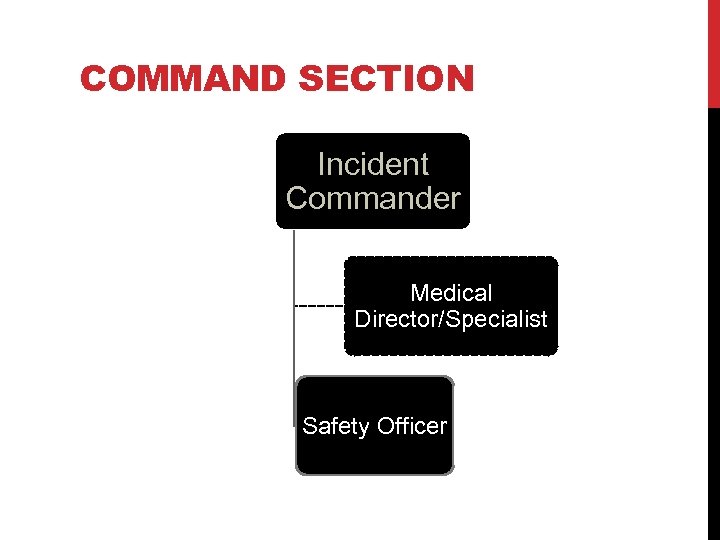 COMMAND SECTION Incident Commander Medical Director/Specialist Safety Officer
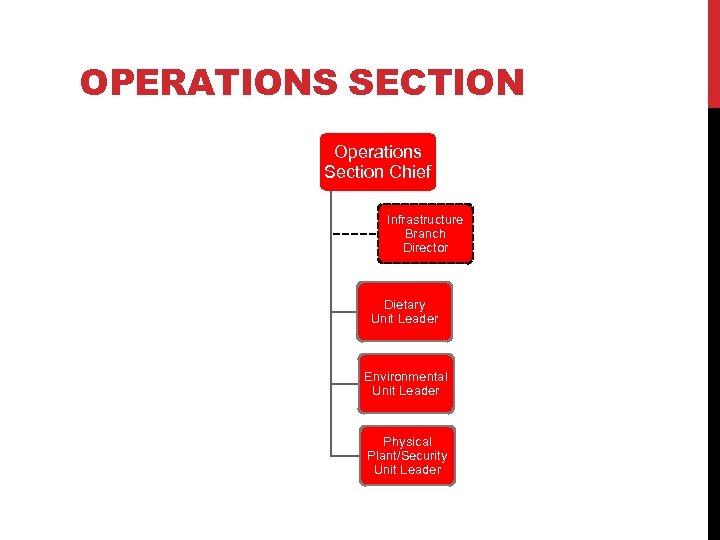 OPERATIONS SECTION Operations Section Chief Infrastructure Branch Director Dietary Unit Leader Environmental Unit Leader Physical Plant/Security Unit Leader
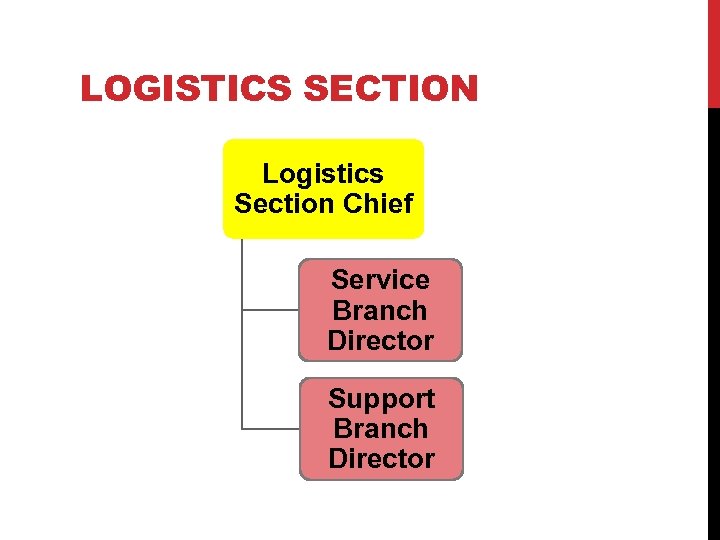 LOGISTICS SECTION Logistics Section Chief Service Branch Director Support Branch Director
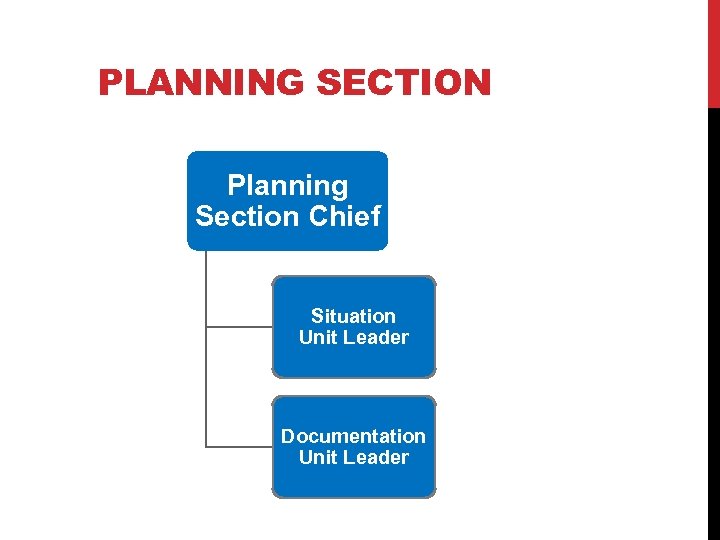 PLANNING SECTION Planning Section Chief Situation Unit Leader Documentation Unit Leader
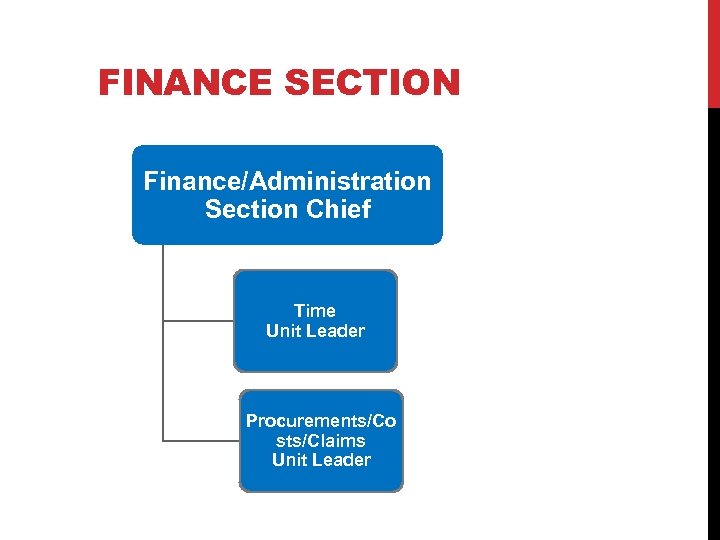 FINANCE SECTION Finance/Administration Section Chief Time Unit Leader Procurements/Co sts/Claims Unit Leader
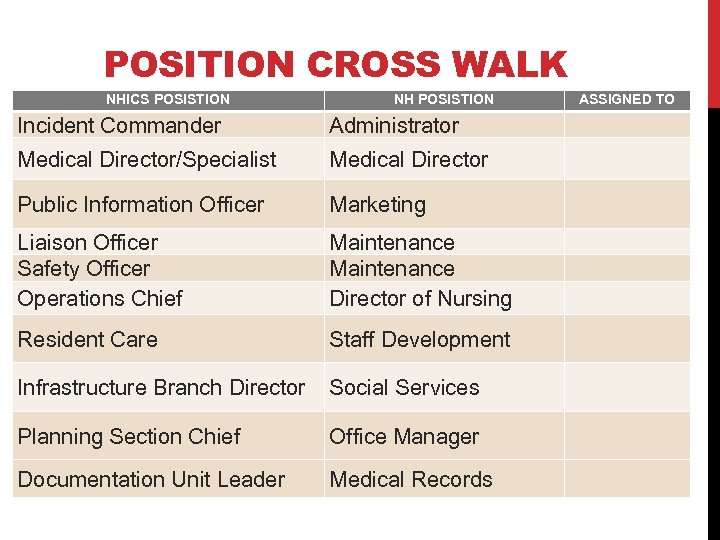 POSITION CROSS WALK NHICS POSISTION NH POSISTION Incident Commander Administrator Medical Director/Specialist Medical Director Public Information Officer Marketing Liaison Officer Safety Officer Operations Chief Maintenance Director of Nursing Resident Care Staff Development Infrastructure Branch Director Social Services Planning Section Chief Office Manager Documentation Unit Leader Medical Records ASSIGNED TO
 4 KEY REQUIREMENTS Training and testing • CMS is requiring that a facility develop and maintain an emergency preparedness training and testing program. • The training program must include initial training for new staff as well as on-going training for existing staff in emergency preparedness • Facilities must offer annual emergency preparedness training so that staff can demonstrate knowledge of emergency procedures. • Facilities must also conduct drills and exercises to test the emergency plan to identify gaps and areas for improvement.
 TABLETOP EXERCISE • Emergency training activity which takes place in a classroom setting • Work through events/ circumstances • Focus on both team and individual performance • Readiness of policies and resources to meet challenges of situations • Appropriate response • Communication strategies to ensure flow of information
 DEVELOP AND CONDUCT TTE Develop three to five objectives for the TTE Consider the amount of time available and scope Objectives to consider • Needs of the facility • Available of resource • Training needs of personnel • Flow of information and communication • Regulatory compliance
 DISCUSS AND DOCUMENT TTE What were the outcomes? • Did you meet the objectives • If the objectives were not met, why • What important issues were identified What were the strengths and weaknesses identified • Policy and procedure • Personnel issues • Access to needed resources (internal and external) • Communication issues • Community
 END
END
 CMS ANNOUNCEMENT May 2016 • Life Safety Code • Health Care Code • • • EFFECTVE DATE 7/5/16 CMS has confirmed that effective 11/1 facilities must meet any new daily, weekly, or quarterly BUT will not yet be required to meet the new annual, 3 -year, or 5 -year requirements. • The FIRST annual test/inspection activity that is a new requirement of the 2012 LSC is due July 5, 2017. • The FIRST 3 -year activity is due July 5, 2019 • The FIRST 5 -year is due July 5, 2021.
 EFFECTIVE JULY 5 TH Chapter 19 – Existing – MOST FACILITIES Chapter 18 -New Facilities • All approvals completed on or after effective date REMEMBER • Facility cannot reduce to ‘existing’ if you were previously new • Example – new 2000 required 8’ corridors where existing 2012 allow 4’ corridors
 NFPA 101 - LIFE SAFETY CODE© Promulgated by the National Fire Protection Association (NFPA) (not a government agency) Code Versions 2003, 2006, 2009, 2012 NOT 2015
 NFPA 101 Chapter 1 – Administration Chapter 2 – Mandatory References Chapter 3 - Definitions Chapter 4 - General Chapter 5 – Performance-based Chapter 6 – Hazards Chapter 7 - Egress Chapter 8 – Fire Protection Features Chapter 9 – Service/ Fire Protection Chapter 10 – Interior Finish, Contents/Furnishings Chapters 11 -42 Occupancies (Healthcare 18 -19) Chapter 43 – Renovations (NEW)
 REFERENCE CODES NFPA 10 – Fire Extinguisher – 2010 NFPA 13 – Sprinklers – 2010 NFPA 25 – Sprinkler Testing – 2010 NFPA 70– Electrical – 2009 NFPA 96 – Range Hood – 2011 NFPA 72 –Fire Alarm - 2010 NFPA 101 A – FSES – 2013 NFPA 80 – Fire Doors – 2010 NFPA 110 – Generators - 2011 NFPA 220 – Construction - 2010
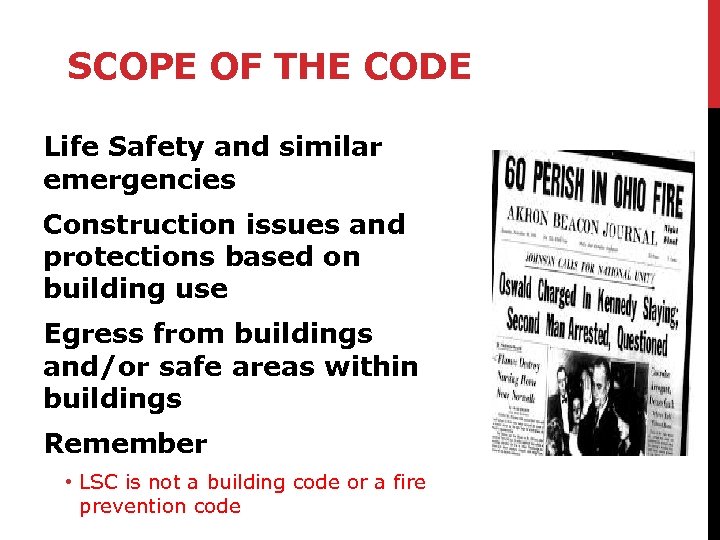 SCOPE OF THE CODE Life Safety and similar emergencies Construction issues and protections based on building use Egress from buildings and/or safe areas within buildings Remember • LSC is not a building code or a fire prevention code
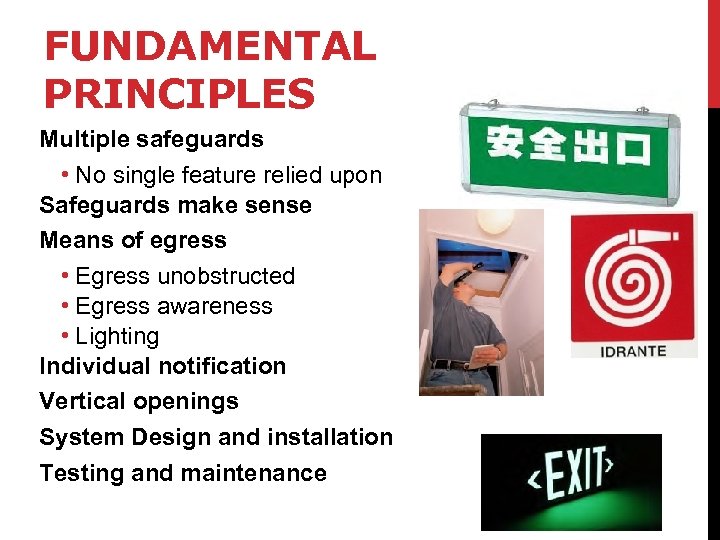 FUNDAMENTAL PRINCIPLES Multiple safeguards • No single feature relied upon Safeguards make sense Means of egress • Egress unobstructed • Egress awareness • Lighting Individual notification Vertical openings System Design and installation Testing and maintenance
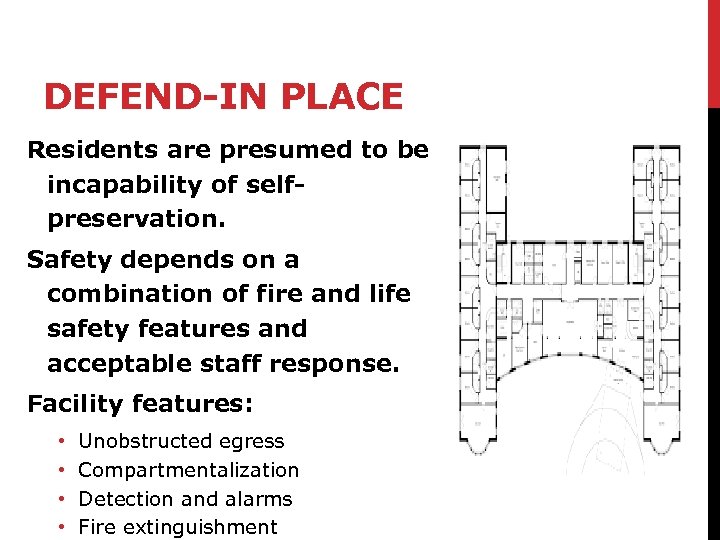 DEFEND-IN PLACE Residents are presumed to be incapability of selfpreservation. Safety depends on a combination of fire and life safety features and acceptable staff response. Facility features: • • Unobstructed egress Compartmentalization Detection and alarms Fire extinguishment
 INSPECTION, TESTING AND MAINTENANCE AND RECORD KEEPING A majority of the citations of the TOP 10 deficiencies are a result of inspection, testing or maintenance issues, with many involving just record keeping If deficient issues are discovered by Contractor’s testing or inspection report, you must fix it immediately A minimum of 2 staff members must know where all ITM records are located and have access
 WHO DO I FOLLOW? Normally each facility has a many of AHJs (Authority Having Jurisdiction) who many enforce the code in various ways • CMS/State • State Fire Marshal’s Office • Local Fire Department or City Code Officials • Design and Building Professionals Insurance Carrier • Manufacturers and Suppliers
 NFPA 99 HEALTH CARE FACILITIES CODE • Standard becomes a Code • The code is intended for professionals involved in the design, construction, maintenance, and inspection of health care facilities, in addition to the design, manufacture, and testing of appliances and equipment used in patient care rooms of the health care facilities • Unique because the code is based on Risk Assessment as determined by the facility
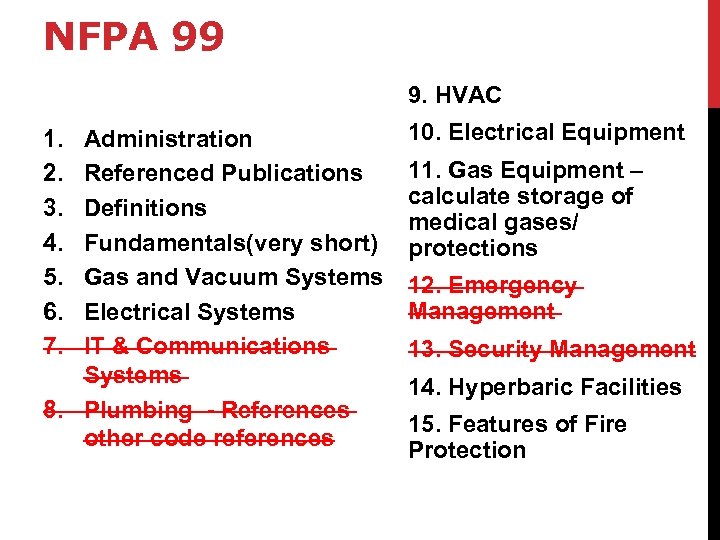 NFPA 99 9. HVAC 1. 2. 3. 4. 5. 6. 7. Administration Referenced Publications Definitions Fundamentals(very short) Gas and Vacuum Systems Electrical Systems IT & Communications Systems 8. Plumbing - References other code references 10. Electrical Equipment 11. Gas Equipment – calculate storage of medical gases/ protections 12. Emergency Management 13. Security Management 14. Hyperbaric Facilities 15. Features of Fire Protection
 HOW IT WORKS • Determine what the room or equipment is used for. • Determine the risk to the patient. • Select the appropriate risk category. • Select the systems or procedures in the code that are prescribed by that level of risk category. • Assessment tool
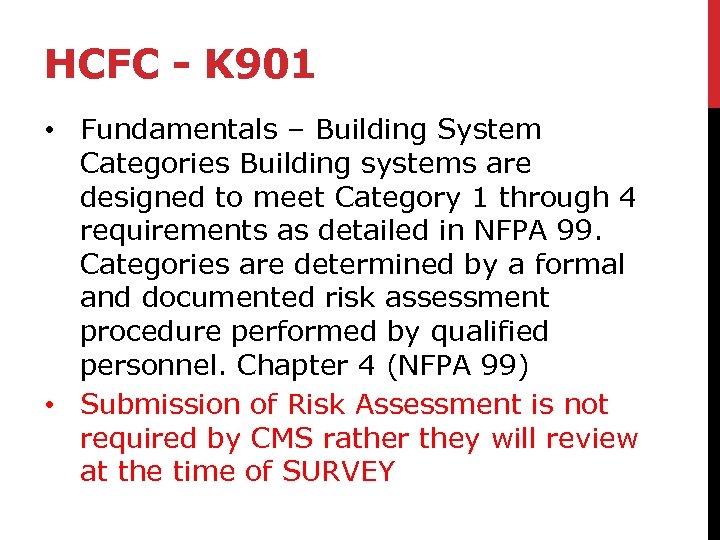 HCFC - K 901 • Fundamentals – Building System Categories Building systems are designed to meet Category 1 through 4 requirements as detailed in NFPA 99. Categories are determined by a formal and documented risk assessment procedure performed by qualified personnel. Chapter 4 (NFPA 99) • Submission of Risk Assessment is not required by CMS rather they will review at the time of SURVEY
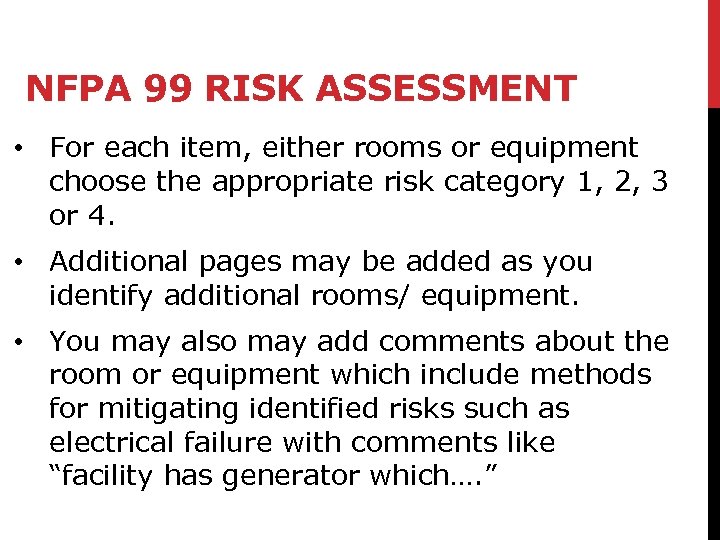 NFPA 99 RISK ASSESSMENT • For each item, either rooms or equipment choose the appropriate risk category 1, 2, 3 or 4. • Additional pages may be added as you identify additional rooms/ equipment. • You may also may add comments about the room or equipment which include methods for mitigating identified risks such as electrical failure with comments like “facility has generator which…. ”
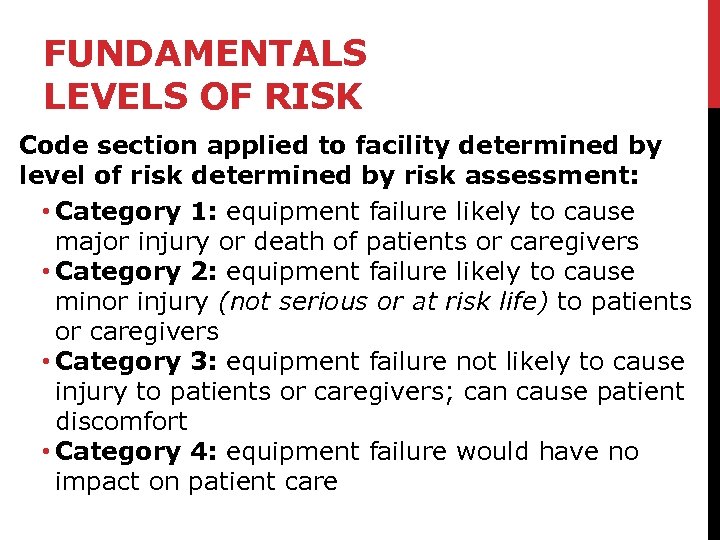 FUNDAMENTALS LEVELS OF RISK Code section applied to facility determined by level of risk determined by risk assessment: • Category 1: equipment failure likely to cause major injury or death of patients or caregivers • Category 2: equipment failure likely to cause minor injury (not serious or at risk life) to patients or caregivers • Category 3: equipment failure not likely to cause injury to patients or caregivers; can cause patient discomfort • Category 4: equipment failure would have no impact on patient care
 LSC SURVEY PROCESS
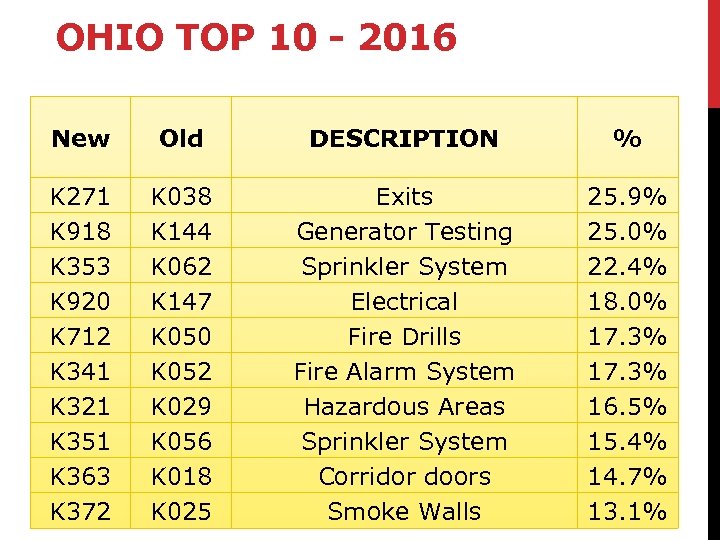 OHIO TOP 10 - 2016 New Old DESCRIPTION % K 271 K 918 K 353 K 920 K 712 K 341 K 321 K 351 K 363 K 372 K 038 K 144 K 062 K 147 K 050 K 052 K 029 K 056 K 018 K 025 Exits Generator Testing Sprinkler System Electrical Fire Drills Fire Alarm System Hazardous Areas Sprinkler System Corridor doors Smoke Walls 25. 9% 25. 0% 22. 4% 18. 0% 17. 3% 16. 5% 15. 4% 14. 7% 13. 1%
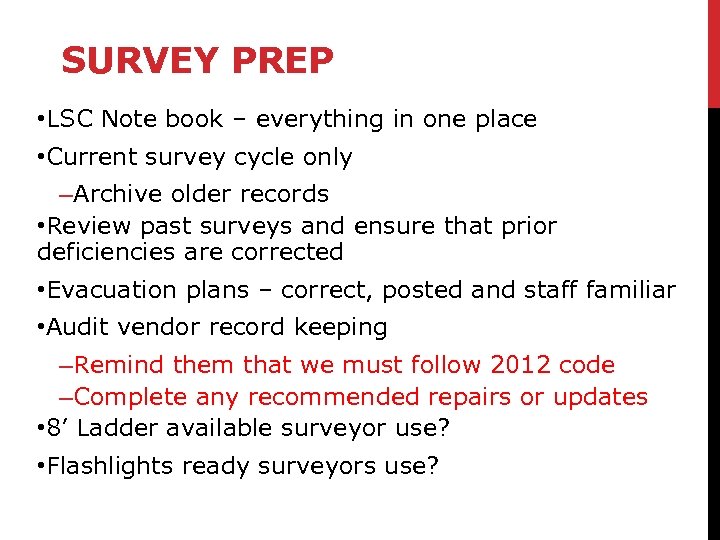 SURVEY PREP • LSC Note book – everything in one place • Current survey cycle only – Archive older records • Review past surveys and ensure that prior deficiencies are corrected • Evacuation plans – correct, posted and staff familiar • Audit vendor record keeping – Remind them that we must follow 2012 code – Complete any recommended repairs or updates • 8’ Ladder available surveyor use? • Flashlights ready surveyors use?
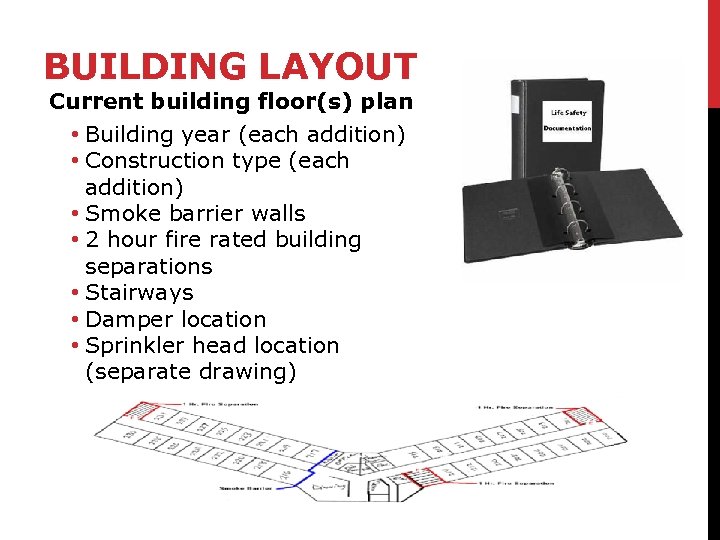 BUILDING LAYOUT Current building floor(s) plan • Building year (each addition) • Construction type (each addition) • Smoke barrier walls • 2 hour fire rated building separations • Stairways • Damper location • Sprinkler head location (separate drawing)
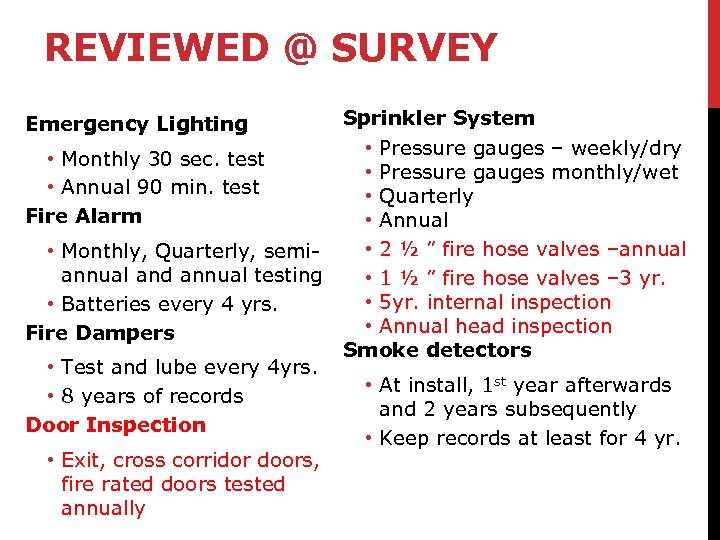 REVIEWED @ SURVEY Emergency Lighting • Monthly 30 sec. test • Annual 90 min. test Fire Alarm • Monthly, Quarterly, semiannual and annual testing • Batteries every 4 yrs. Fire Dampers • Test and lube every 4 yrs. • 8 years of records Door Inspection • Exit, cross corridor doors, fire rated doors tested annually Sprinkler System • Pressure gauges – weekly/dry • Pressure gauges monthly/wet • Quarterly • Annual • 2 ½ ” fire hose valves –annual • 1 ½ ” fire hose valves – 3 yr. • 5 yr. internal inspection • Annual head inspection Smoke detectors • At install, 1 st year afterwards and 2 years subsequently • Keep records at least for 4 yr.
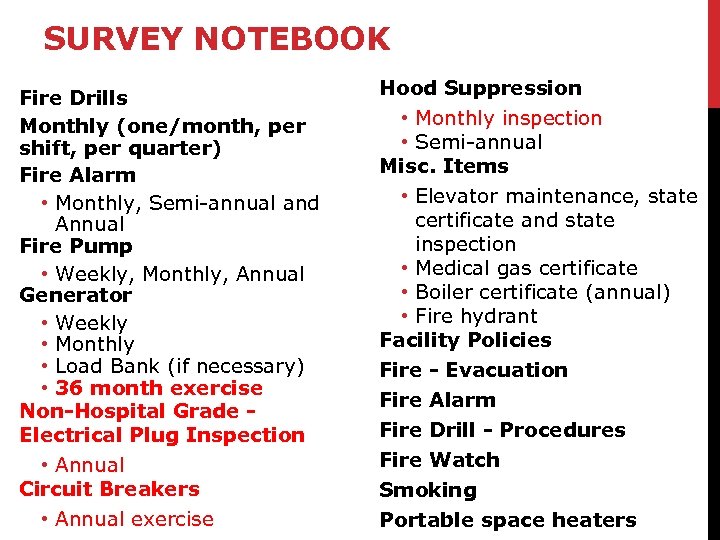 SURVEY NOTEBOOK Fire Drills Monthly (one/month, per shift, per quarter) Fire Alarm • Monthly, Semi-annual and Annual Fire Pump • Weekly, Monthly, Annual Generator • Weekly • Monthly • Load Bank (if necessary) • 36 month exercise Non-Hospital Grade Electrical Plug Inspection • Annual Circuit Breakers • Annual exercise Hood Suppression • Monthly inspection • Semi-annual Misc. Items • Elevator maintenance, state certificate and state inspection • Medical gas certificate • Boiler certificate (annual) • Fire hydrant Facility Policies Fire - Evacuation Fire Alarm Fire Drill - Procedures Fire Watch Smoking Portable space heaters
 So what is NEW….
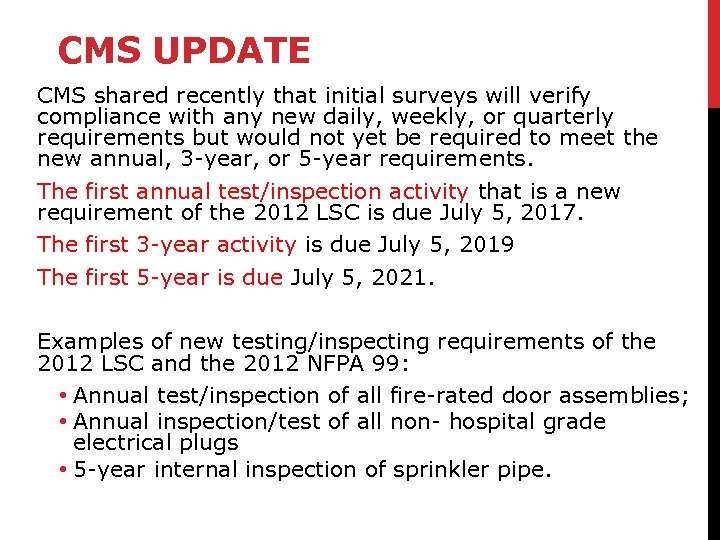 CMS UPDATE CMS shared recently that initial surveys will verify compliance with any new daily, weekly, or quarterly requirements but would not yet be required to meet the new annual, 3 -year, or 5 -year requirements. The first annual test/inspection activity that is a new requirement of the 2012 LSC is due July 5, 2017. The first 3 -year activity is due July 5, 2019 The first 5 -year is due July 5, 2021. Examples of new testing/inspecting requirements of the 2012 LSC and the 2012 NFPA 99: • Annual test/inspection of all fire-rated door assemblies; • Annual inspection/test of all non- hospital grade electrical plugs • 5 -year internal inspection of sprinkler pipe.
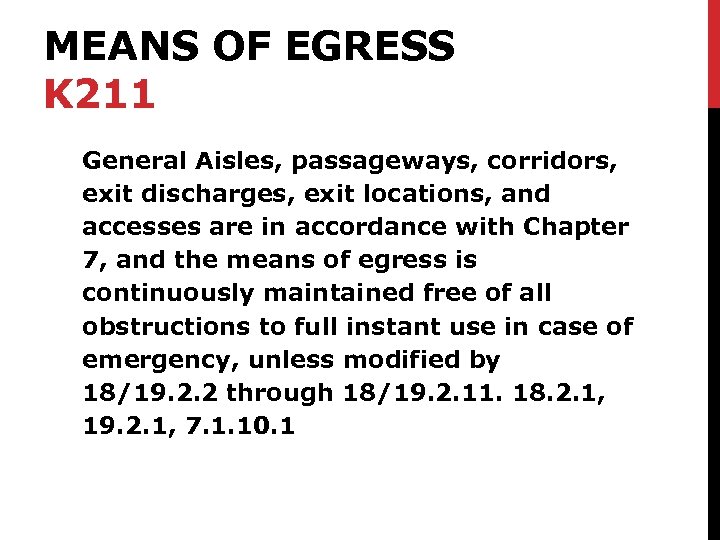 MEANS OF EGRESS K 211 General Aisles, passageways, corridors, exit discharges, exit locations, and accesses are in accordance with Chapter 7, and the means of egress is continuously maintained free of all obstructions to full instant use in case of emergency, unless modified by 18/19. 2. 2 through 18/19. 2. 11. 18. 2. 1, 19. 2. 1, 7. 1. 10. 1
 DISCHARGE FROM Exit discharge is arranged EXITS and provides a level K 271 walking surface with respect to changes in elevation and shall be maintained free of obstructions. Additionally, the exit discharge shall be a hard packed all-weather travel surface in accordance with CMS Survey and Certification Letter 05 -38. 18. 2. 7, 19. 2. 7, S&C 05 -38
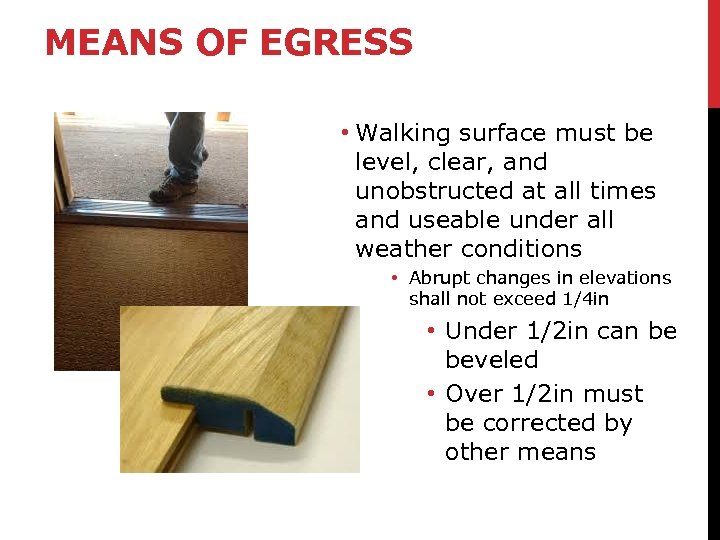 MEANS OF EGRESS • Walking surface must be level, clear, and unobstructed at all times and useable under all weather conditions • Abrupt changes in elevations shall not exceed 1/4 in • Under 1/2 in can be beveled • Over 1/2 in must be corrected by other means
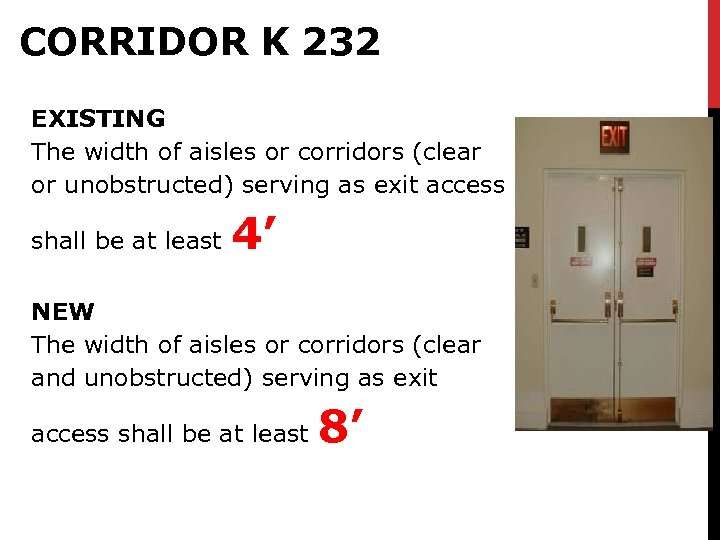 CORRIDOR K 232 EXISTING The width of aisles or corridors (clear or unobstructed) serving as exit access shall be at least 4’ NEW The width of aisles or corridors (clear and unobstructed) serving as exit access shall be at least 8’
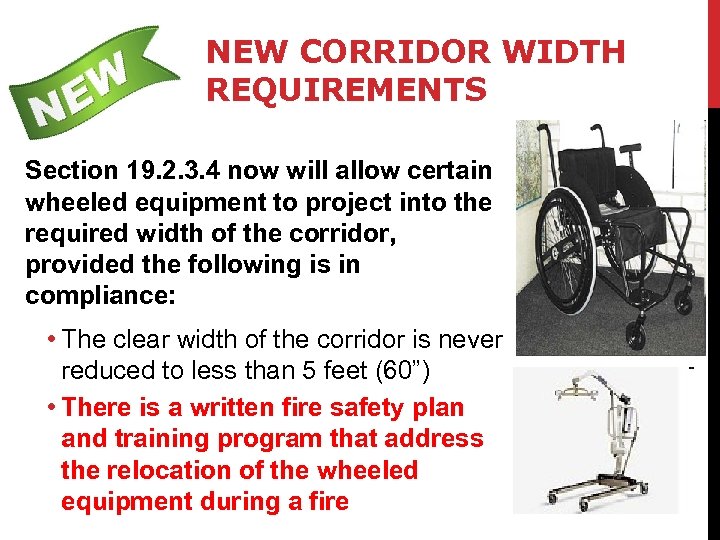 NEW CORRIDOR WIDTH REQUIREMENTS Section 19. 2. 3. 4 now will allow certain wheeled equipment to project into the required width of the corridor, provided the following is in compliance: • The clear width of the corridor is never reduced to less than 5 feet (60”) • There is a written fire safety plan and training program that address the relocation of the wheeled equipment during a fire
 ITEMS IN THE CORRIDOR PERMITTED NOT PERMITTED Food service carts in use Beds Housekeeping carts in use Medication carts in use Trash containers greater than 32 gals Isolation carts in use Desks Crash carts Chairs Portable lift equipment Tables Transport equipment Computers on wheels Bird cages
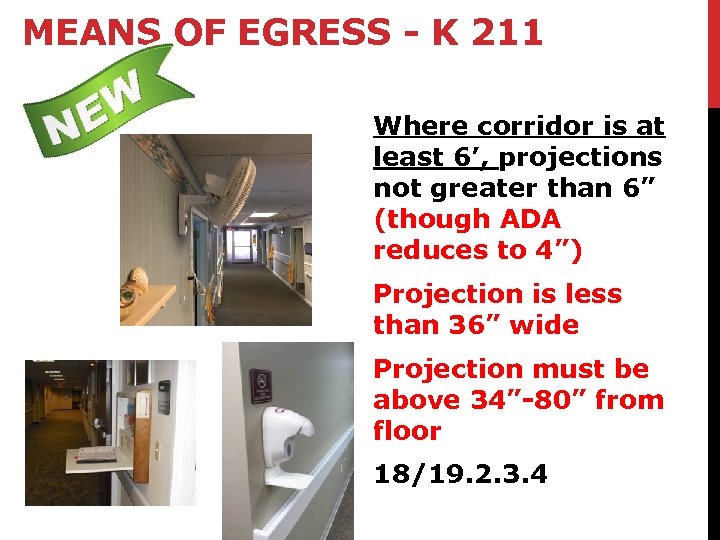 MEANS OF EGRESS - K 211 Where corridor is at least 6’, projections not greater than 6” (though ADA reduces to 4”) Projection is less than 36” wide Projection must be above 34”-80” from floor 18/19. 2. 3. 4
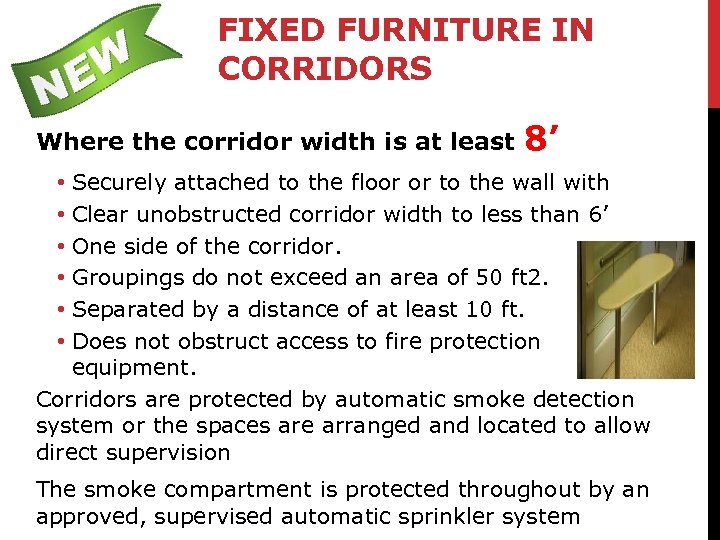 FIXED FURNITURE IN CORRIDORS Where the corridor width is at least 8’ • Securely attached to the floor or to the wall with • Clear unobstructed corridor width to less than 6’ • One side of the corridor. • Groupings do not exceed an area of 50 ft 2. • Separated by a distance of at least 10 ft. • Does not obstruct access to fire protection equipment. Corridors are protected by automatic smoke detection system or the spaces are arranged and located to allow direct supervision The smoke compartment is protected throughout by an approved, supervised automatic sprinkler system
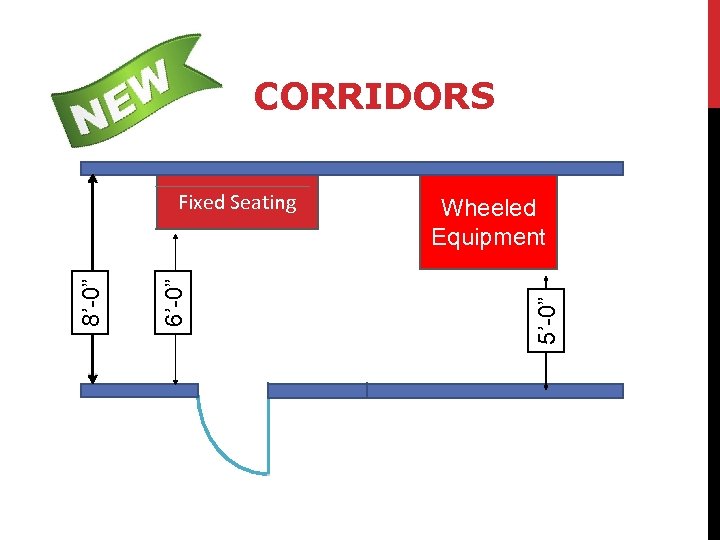 CORRIDORS Wheeled Equipment 5’-0” 6’-0” 8’-0” Fixed Seating
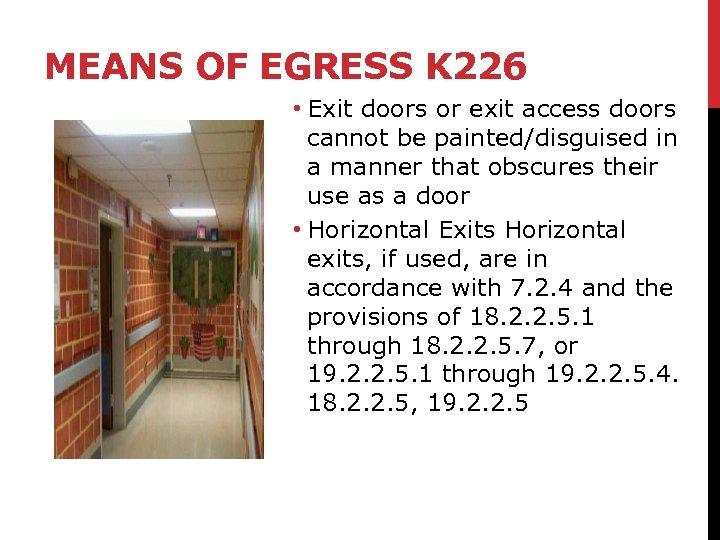 MEANS OF EGRESS K 226 • Exit doors or exit access doors cannot be painted/disguised in a manner that obscures their use as a door • Horizontal Exits Horizontal exits, if used, are in accordance with 7. 2. 4 and the provisions of 18. 2. 2. 5. 1 through 18. 2. 2. 5. 7, or 19. 2. 2. 5. 1 through 19. 2. 2. 5. 4. 18. 2. 2. 5, 19. 2. 2. 5
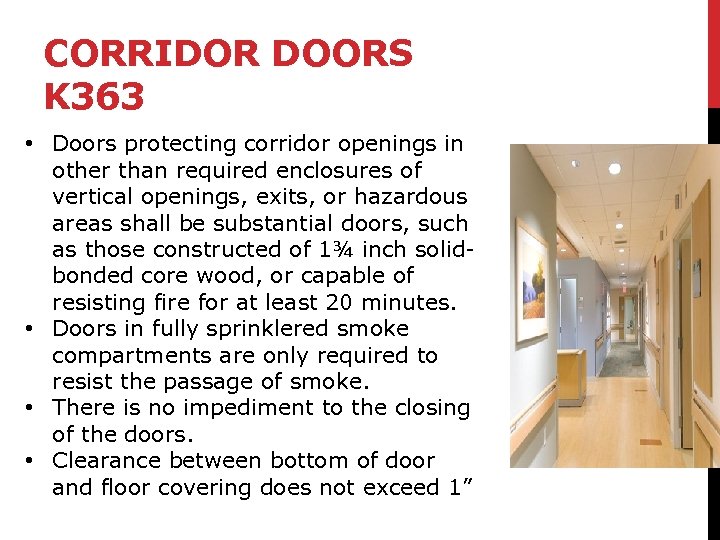 CORRIDOR DOORS K 363 • Doors protecting corridor openings in other than required enclosures of vertical openings, exits, or hazardous areas shall be substantial doors, such as those constructed of 1¾ inch solidbonded core wood, or capable of resisting fire for at least 20 minutes. • Doors in fully sprinklered smoke compartments are only required to resist the passage of smoke. • There is no impediment to the closing of the doors. • Clearance between bottom of door and floor covering does not exceed 1”
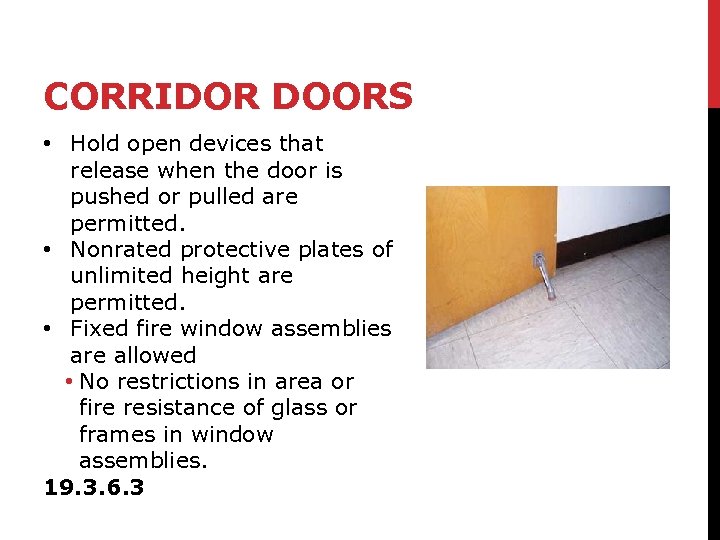 CORRIDOR DOORS • Hold open devices that release when the door is pushed or pulled are permitted. • Nonrated protective plates of unlimited height are permitted. • Fixed fire window assemblies are allowed • No restrictions in area or fire resistance of glass or frames in window assemblies. 19. 3. 6. 3
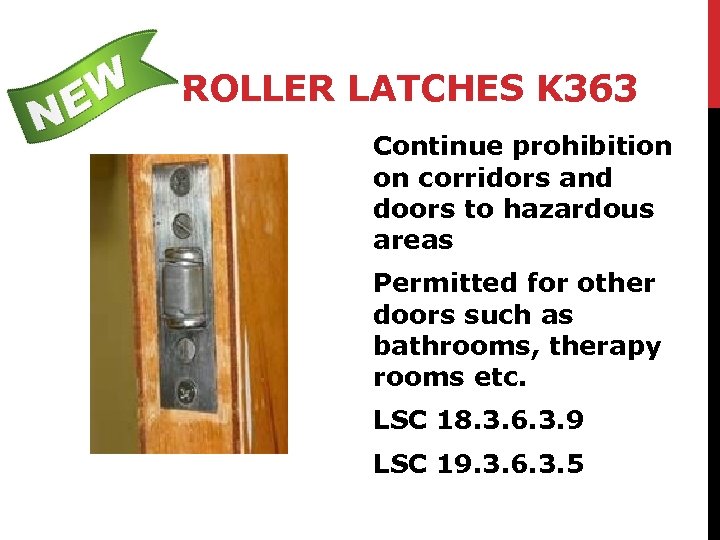 ROLLER LATCHES K 363 Continue prohibition on corridors and doors to hazardous areas Permitted for other doors such as bathrooms, therapy rooms etc. LSC 18. 3. 6. 3. 9 LSC 19. 3. 6. 3. 5
 DOORS TESTING K 363 Inspection and testing requirements for fire-rated door assemblies in accordance with NFPA 80 Inspection and testing requirements for smoke door assemblies in accordance with NFPA 105 • Applies to new and existing installations • Inspected and tested not less than annually • Written record shall be signed and kept for inspection • Repairs shall be made “without delay”
 DOOR INSPECTION NFPA 80 Door leaves equipped with panic hardware or fire exit hardware Door assemblies in exit enclosures – typically stairwells and exit passageways Electrically controlled egress doors by a door-mounted release device, such as panic hardware with an integral request-to-exit switch Door assemblies with special locking arrangements including • Delayed Egress Locking Systems • Access-Controlled Egress Door Assemblies • Elevator Lobby Exit Access Door Assemblies Locking
 DOOR INSPECTION Fire-rated door assemblies • A visual inspection includes the following: • No holes or breaks of door or frame • No signs of damage to the door, frame, hinges, and hardware • No parts are missing or broken • Door clearances are appropriate • Self-closing device operating properly • If installed, the coordinator is working • Latching hardware operates • No auxiliary hardware installed that would interfere with operation • No field modifications that would void the label • Gasketing and edge seals, if required, are inspected
 DOOR INSPECTION NFPA 105 Smoke door assemblies shall be inspected annually. • Doors shall be operated to confirm full closure. • Hardware and gaskets shall be inspected annually, and any parts found to be damaged or inoperative shall be replaced. • Tin clad and Kalamein doors shall be inspected regularly for dry rot. • A written record shall be maintained and shall be made available to the authority having jurisdiction.
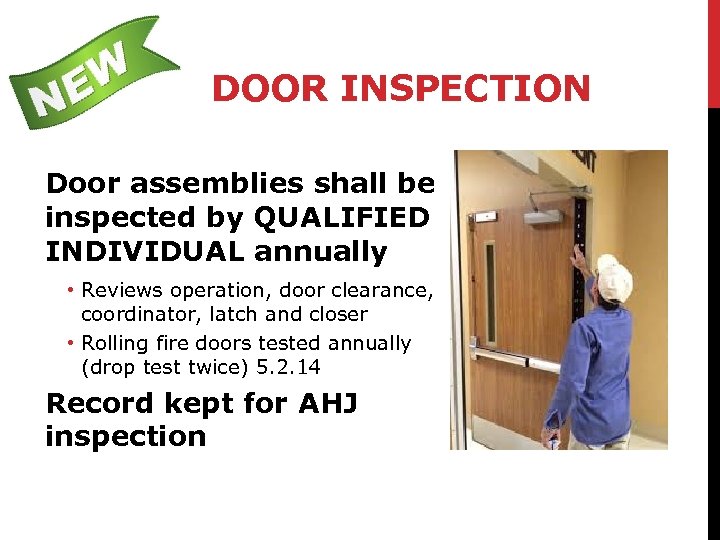 DOOR INSPECTION Door assemblies shall be inspected by QUALIFIED INDIVIDUAL annually • Reviews operation, door clearance, coordinator, latch and closer • Rolling fire doors tested annually (drop test twice) 5. 2. 14 Record kept for AHJ inspection
 LOCKING DOORS - K 363 Lock on doors in the path of egress is not permitted unless complies with: • Clinical needs locks where individuals pose a security risk provided staff can unlock doors (dementia and psychiatric units) • Delay egress locks permitted the facility is fully sprinklered or smoke detected A change from 2000 LSC is that there is no longer limitation for one delayed egress or locked door in the means of egress
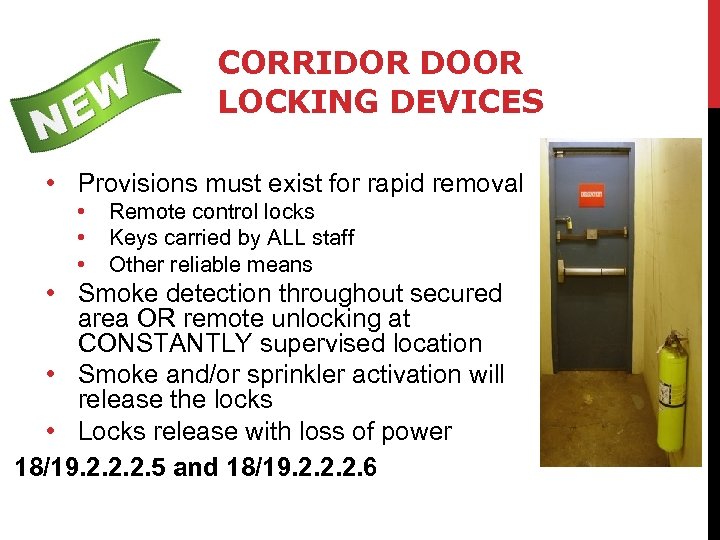 CORRIDOR DOOR LOCKING DEVICES • Provisions must exist for rapid removal • • • Remote control locks Keys carried by ALL staff Other reliable means • Smoke detection throughout secured area OR remote unlocking at CONSTANTLY supervised location • Smoke and/or sprinkler activation will release the locks • Locks release with loss of power 18/19. 2. 2. 2. 5 and 18/19. 2. 2. 2. 6
 DELAYED EGRESS LOCKS Permitted provided: • Releases with/in 15 seconds or 30 seconds per AHJ • <15 lb. for < 3 seconds to initiate • Unlocks with the loss of power • Unlocks with the initiation of fire alarm and/or smoke detector • Emergency lighting at door • Instructional sign @ door PUSH UNTIL ALARM SOUNDS DOOR CAN BE OPENED IN 15 SECONDS
 SPRINKLER SYSTEM K 351 • Sprinklers must be installed throughout a facility in accordance with NFPA 13 • Complete sprinkler system required for all nursing homes, regardless of construction type by Aug. 13, 2013 • S&C Memo 09 -04 • Waivers and FSESs for lack of sprinklers in certain areas will no longer be permitted after that date • There will be no extensions to complete sprinkler installation
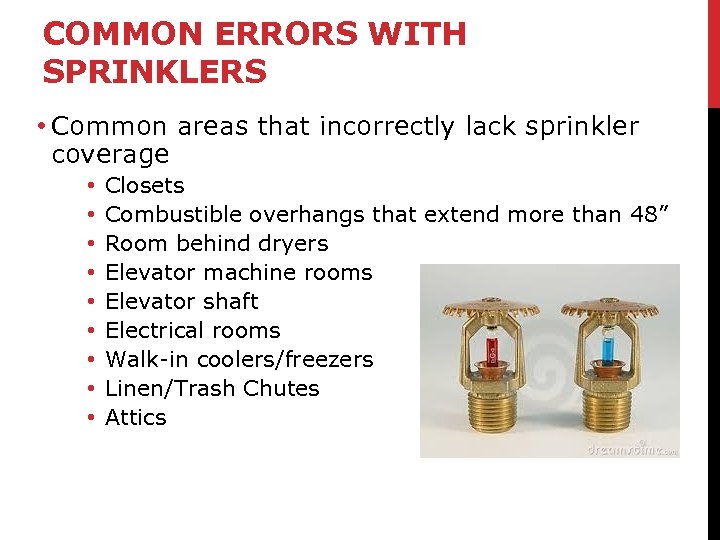 COMMON ERRORS WITH SPRINKLERS • Common areas that incorrectly lack sprinkler coverage • • • Closets Combustible overhangs that extend more than 48” Room behind dryers Elevator machine rooms Elevator shaft Electrical rooms Walk-in coolers/freezers Linen/Trash Chutes Attics
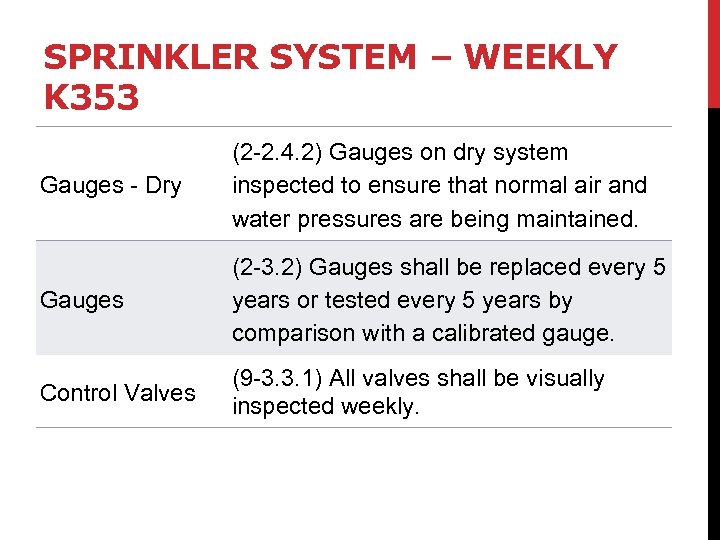 SPRINKLER SYSTEM – WEEKLY K 353 Gauges - Dry (2 -2. 4. 2) Gauges on dry system inspected to ensure that normal air and water pressures are being maintained. Gauges (2 -3. 2) Gauges shall be replaced every 5 years or tested every 5 years by comparison with a calibrated gauge. Control Valves (9 -3. 3. 1) All valves shall be visually inspected weekly.
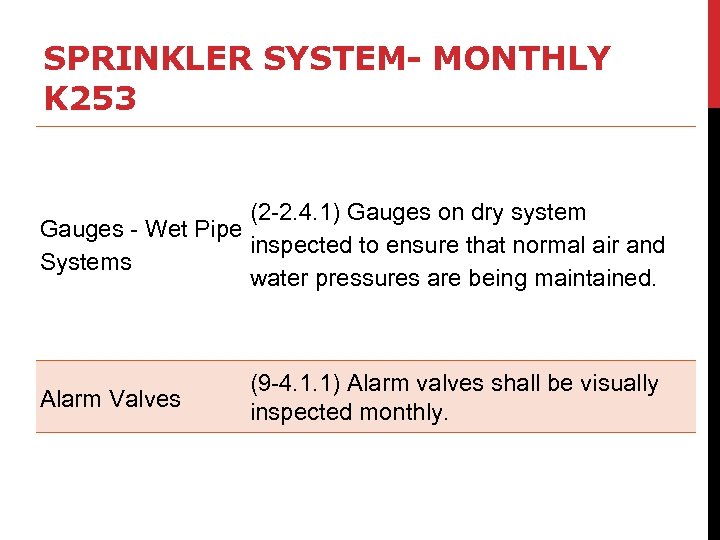 SPRINKLER SYSTEM- MONTHLY K 253 (2 -2. 4. 1) Gauges on dry system Gauges - Wet Pipe inspected to ensure that normal air and Systems water pressures are being maintained. Alarm Valves (9 -4. 1. 1) Alarm valves shall be visually inspected monthly.
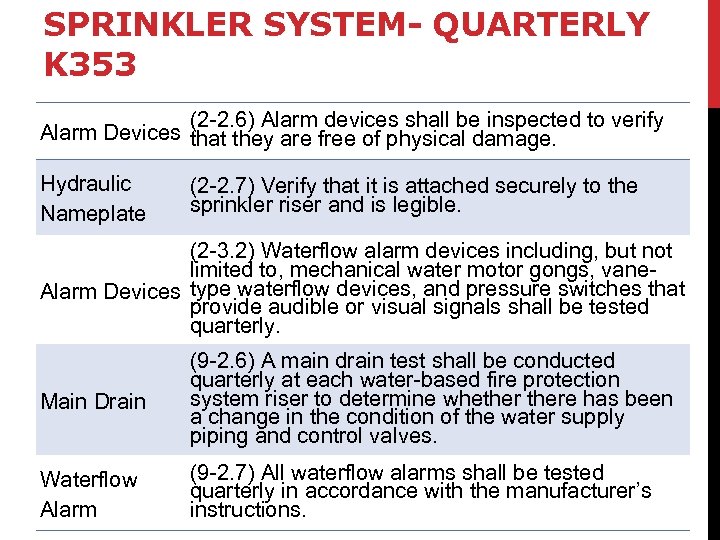 SPRINKLER SYSTEM- QUARTERLY K 353 (2 -2. 6) Alarm devices shall be inspected to verify Alarm Devices that they are free of physical damage. Hydraulic Nameplate (2 -2. 7) Verify that it is attached securely to the sprinkler riser and is legible. (2 -3. 2) Waterflow alarm devices including, but not limited to, mechanical water motor gongs, vane. Alarm Devices type waterflow devices, and pressure switches that provide audible or visual signals shall be tested quarterly. Main Drain (9 -2. 6) A main drain test shall be conducted quarterly at each water-based fire protection system riser to determine whethere has been a change in the condition of the water supply piping and control valves. Waterflow Alarm (9 -2. 7) All waterflow alarms shall be tested quarterly in accordance with the manufacturer’s instructions.
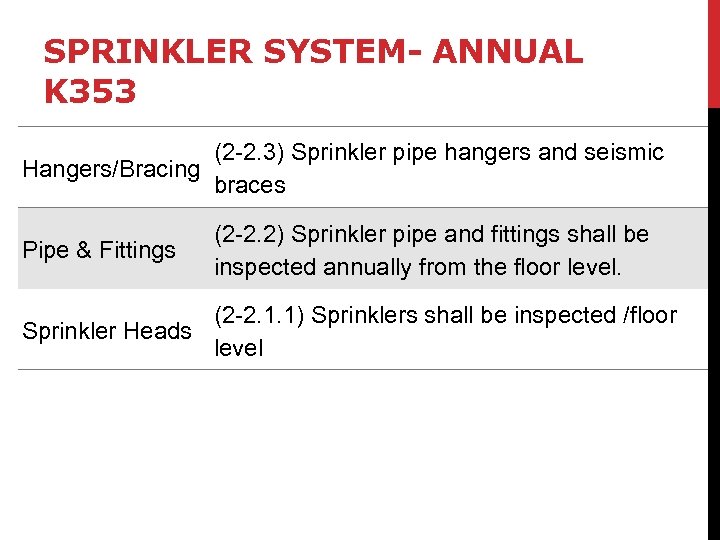 SPRINKLER SYSTEM- ANNUAL K 353 (2 -2. 3) Sprinkler pipe hangers and seismic Hangers/Bracing braces Pipe & Fittings (2 -2. 2) Sprinkler pipe and fittings shall be inspected annually from the floor level. (2 -2. 1. 1) Sprinklers shall be inspected /floor Sprinkler Heads level
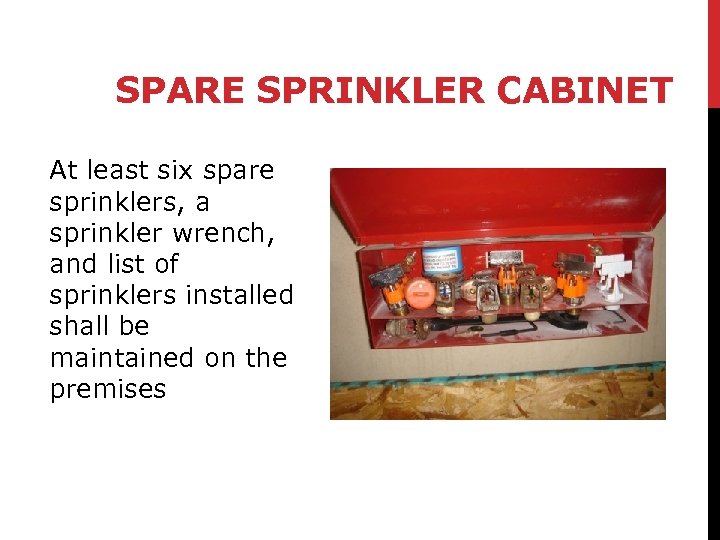 SPARE SPRINKLER CABINET At least six spare sprinklers, a sprinkler wrench, and list of sprinklers installed shall be maintained on the premises
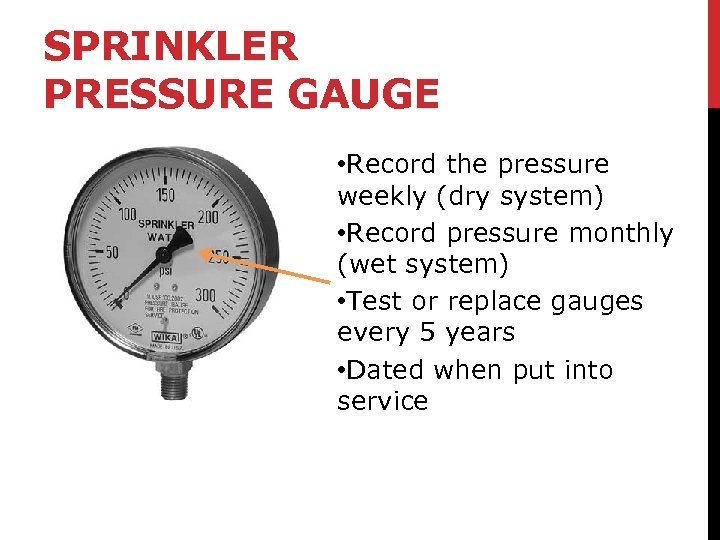 SPRINKLER PRESSURE GAUGE • Record the pressure weekly (dry system) • Record pressure monthly (wet system) • Test or replace gauges every 5 years • Dated when put into service
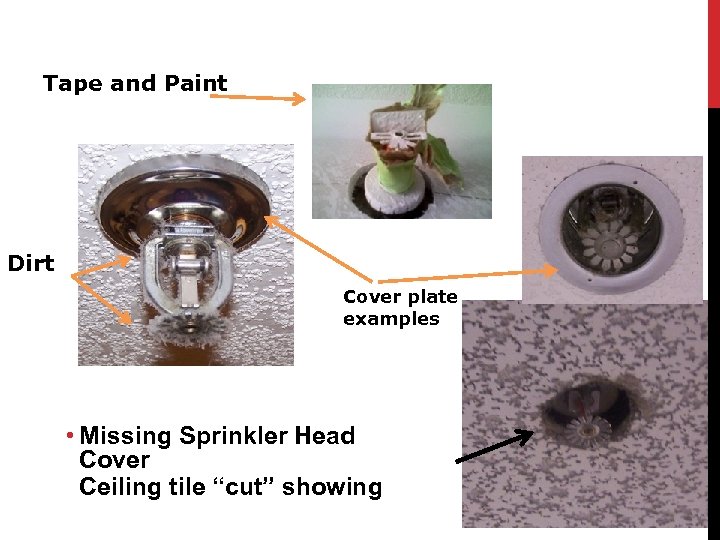 Tape and Paint Dirt Cover plate examples • Missing Sprinkler Head Cover Ceiling tile “cut” showing
 SPRINKLER VALVES 2 1/2” fire hose valves are required to be tested annually by opening and closing valve 1 1/2” fire hose valves are required to be tested every 3 years by opening and closing valve Opening the valve does not mean full flow but just enough to get a squirt
 SPRINKLERS Once every 5 years an internal inspection must be conducted of the sprinkler piping at two locations • At one end of the main (drain system and remove the end cap) • Remove one sprinkler head at the end of branch • If there is presence of foreign materials further testing may be required
 SPRINKLER FIRE WATCH NFPA 25 formerly required evacuation or fire watch of facilities if a sprinkler system was out of service for more than 4 hours in a 24 -hour period. This has been changed to 10 hours in 24 -hour period Developed to accommodate a “work day” but can be at anytime
 OHIO LICENSURE Ohio’s fire code requires the fire watch for when a fire alarm and/or sprinkler system is out for 4 or more hours in a 24 -hour period. No change in policy
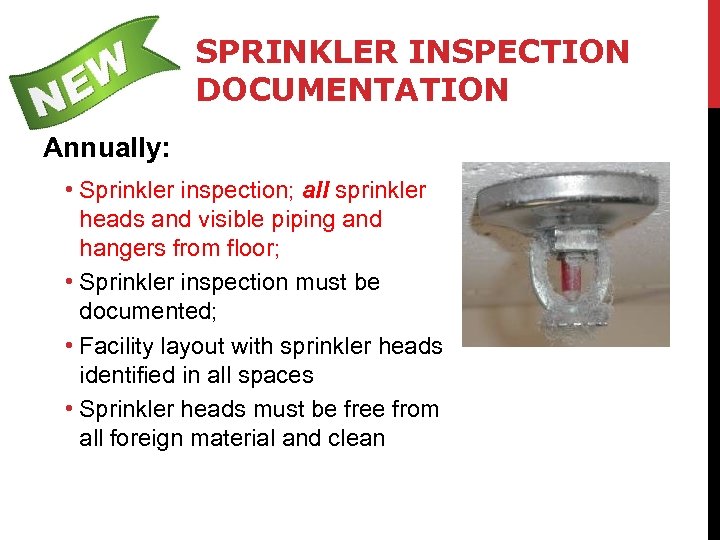 SPRINKLER INSPECTION DOCUMENTATION Annually: • Sprinkler inspection; all sprinkler heads and visible piping and hangers from floor; • Sprinkler inspection must be documented; • Facility layout with sprinkler heads identified in all spaces • Sprinkler heads must be free from all foreign material and clean
 NFPA 25 – SPRINKLER ANTI-FREEZE Issue concerns use of anti-freeze solutions in wet sprinkler systems NFPA adopted TIA 11 -1, 11 -3 and 11 -4 • Resulting from potential combustibility of anti-freeze solution when released • Specific concentrations • glycerin (<50%) • propylene glycol (<40%) • Both are considered low and will not protect at temps lower than 19 F. • Systems installed prior to 9/30/12 will have 10 years to replace or use listed solution • Requires use of only LISTED anti-freeze solution • Requires annual testing of anti-freeze solution
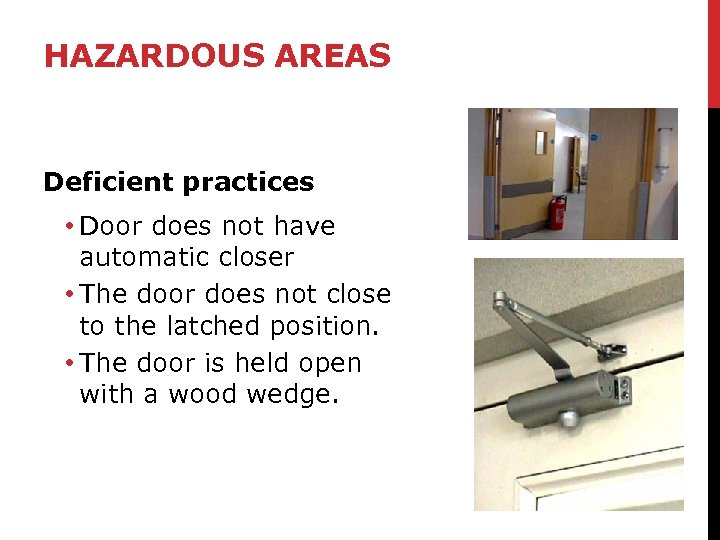 HAZARDOUS AREAS Deficient practices • Door does not have automatic closer • The door does not close to the latched position. • The door is held open with a wood wedge.
 CHAPTER 43 - CHANGE OF USE Change in the purpose or level of activity within a space that involves the application of the code No change in occupancy • Comply with EXISTING in new use area unless hazardous • Hazardous areas comply with NEW requirements except for nursing facilities • Where room is less than 250 sq. ft.
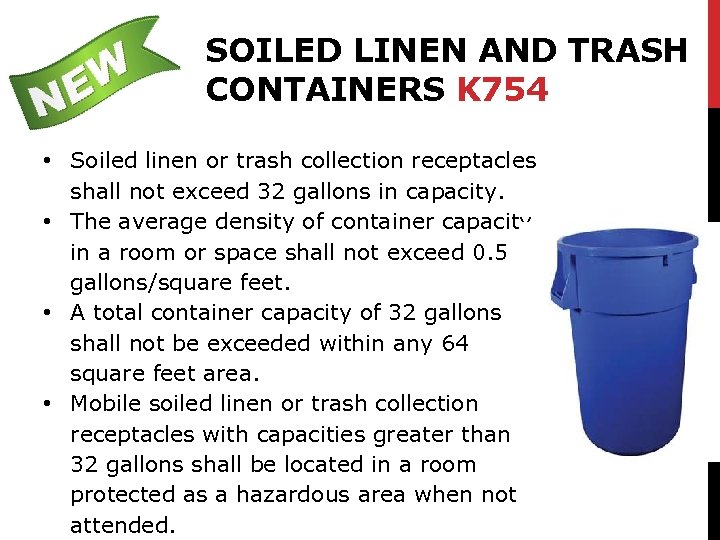 SOILED LINEN AND TRASH CONTAINERS K 754 • Soiled linen or trash collection receptacles shall not exceed 32 gallons in capacity. • The average density of container capacity in a room or space shall not exceed 0. 5 gallons/square feet. • A total container capacity of 32 gallons shall not be exceeded within any 64 square feet area. • Mobile soiled linen or trash collection receptacles with capacities greater than 32 gallons shall be located in a room protected as a hazardous area when not attended.
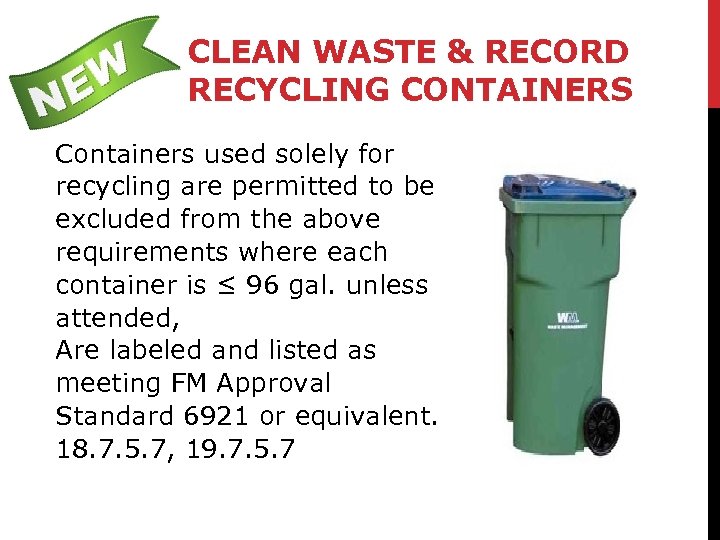 CLEAN WASTE & RECORD RECYCLING CONTAINERS Containers used solely for recycling are permitted to be excluded from the above requirements where each container is ≤ 96 gal. unless attended, Are labeled and listed as meeting FM Approval Standard 6921 or equivalent. 18. 7. 5. 7, 19. 7. 5. 7
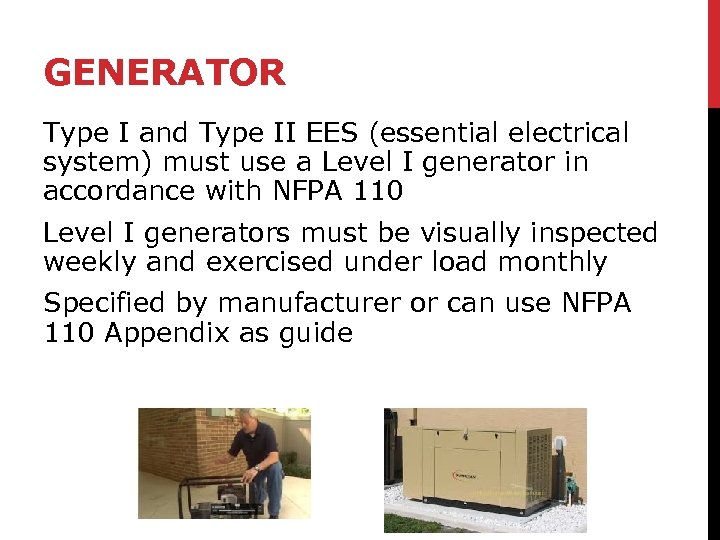 GENERATOR Type I and Type II EES (essential electrical system) must use a Level I generator in accordance with NFPA 110 Level I generators must be visually inspected weekly and exercised under load monthly Specified by manufacturer or can use NFPA 110 Appendix as guide
 GENERATOR REQUIREMENTS 2 sets of instruction manuals for generator components. These manuals must, at a minimum, contain the following: • A detailed explanation of the operation • Instructions for routine maintenance • Detailed repair instructions • An illustrated parts list and part numbers • Illustrated and schematic drawings of electrical wiring systems, including operating and safety devices, control panels, instrumentation and annunciators
 GENERATOR TESTING K 918 • All Level 1 generators shall be exercised for 4 continuous hours every 36 months • Diesel: Run at Min 30% nameplate k. W rating, or Min exhaust gas temp • Nat Gas: Run at available load • The test must begin with manually tripping the transfer switch
 WEEKLY GENERATOR INSPECTION Checked with the unit stopped or running • Fuel levels, day tank float switch; piping, hoses • Connectors; operating fuel pressure; and for any obstructions to tank vents and overflow piping • Oil (check for proper oil level and oil operating pressure; lube oil heater) • Cooling system • Exhaust system • Electrical • Prime Mover/Generator
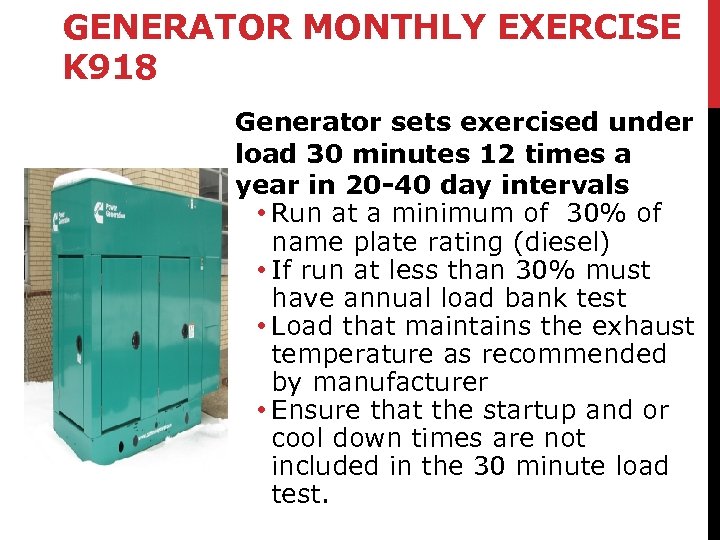 GENERATOR MONTHLY EXERCISE K 918 Generator sets exercised under load 30 minutes 12 times a year in 20 -40 day intervals • Run at a minimum of 30% of name plate rating (diesel) • If run at less than 30% must have annual load bank test • Load that maintains the exhaust temperature as recommended by manufacturer • Ensure that the startup and or cool down times are not included in the 30 minute load test.
 GENERATOR K 915 • Emergency generator sets are required to have a minimum of a 90 minute fuel supply. • Natural gas generators need proof that fuel source is reliable • Letter from fuel supplier confirming reasonable reliability • Facility must have a contingency plan and a written agreement for the re-supplying of fuel in an emergency situation. • Life safety branch has an alternate source of power that will be effective for 1 1/2 hours.
 GENERATOR COMPLIANCE NFPA 110 8. 4. 2. 4 Spark-ignited generator sets shall be exercised at least once a month with the available EPSS load for 30 minutes or until the water temperature and the oil pressure have stabilized. NFPA 110 (8. 4. 2)(2) …whereas it doesn’t specify a minimum load for spark ignited engine sets (8. 4. 2. 4), thus there is no minimum load for natural gas generators
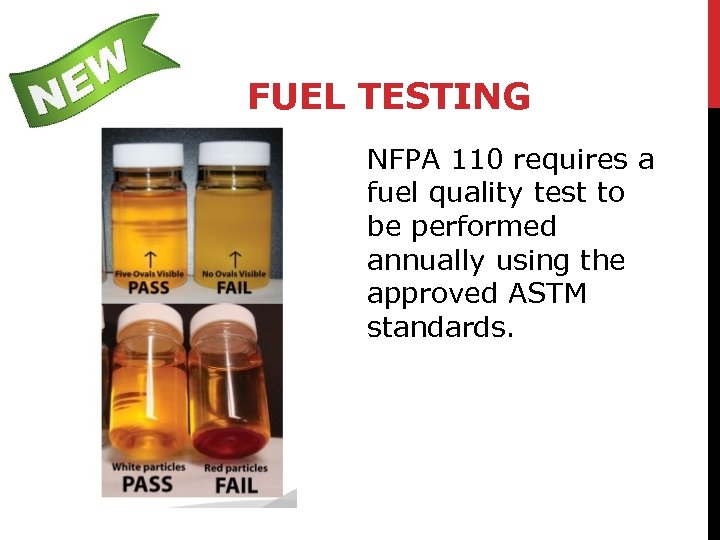 FUEL TESTING NFPA 110 requires a fuel quality test to be performed annually using the approved ASTM standards.
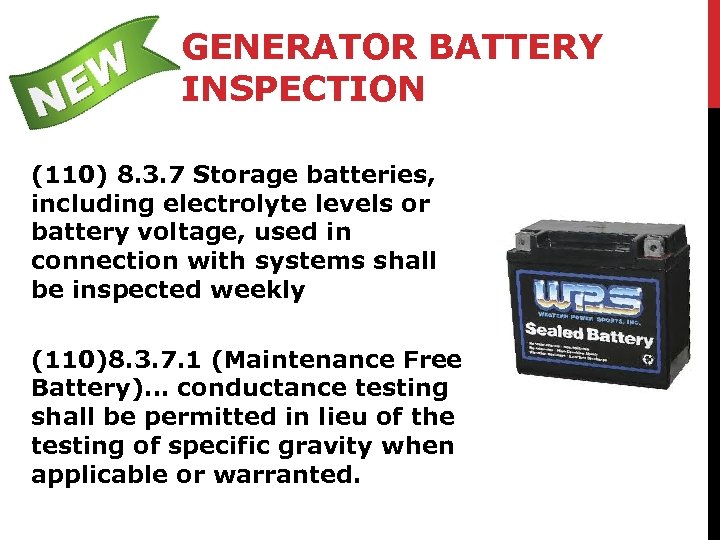 GENERATOR BATTERY INSPECTION (110) 8. 3. 7 Storage batteries, including electrolyte levels or battery voltage, used in connection with systems shall be inspected weekly (110)8. 3. 7. 1 (Maintenance Free Battery)… conductance testing shall be permitted in lieu of the testing of specific gravity when applicable or warranted.
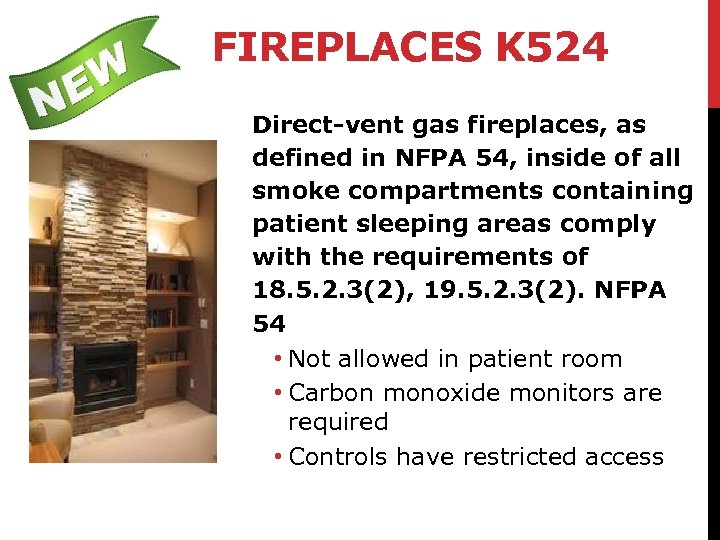 FIREPLACES K 524 Direct-vent gas fireplaces, as defined in NFPA 54, inside of all smoke compartments containing patient sleeping areas comply with the requirements of 18. 5. 2. 3(2), 19. 5. 2. 3(2). NFPA 54 • Not allowed in patient room • Carbon monoxide monitors are required • Controls have restricted access
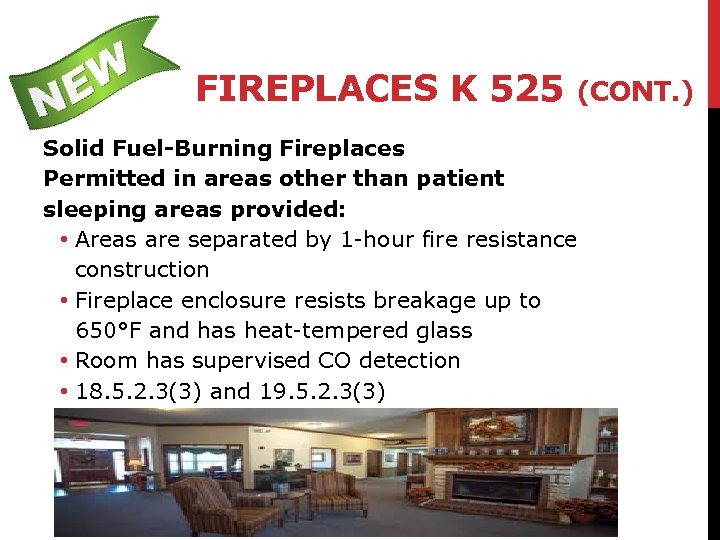 FIREPLACES K 525 (CONT. ) Solid Fuel-Burning Fireplaces Permitted in areas other than patient sleeping areas provided: • Areas are separated by 1 -hour fire resistance construction • Fireplace enclosure resists breakage up to 650°F and has heat-tempered glass • Room has supervised CO detection • 18. 5. 2. 3(3) and 19. 5. 2. 3(3)
 EVACUATION AND RELOCATION PLAN K 711 For health care occupancies, the proper protection of patients shall require the prompt and effective response of health care personnel. The basic response required of staff shall include the following: • (1) Removal of all occupants directly involved with the fire emergency • (2) Transmission of an appropriate fire alarm signal to warn other building occupants and summon staff • (3) Confinement of the effects of the fire by closing doors to isolate the fire area • (4) Relocation of patients as detailed in the health care occupancy’s fire safety plan
 FIRE SAFETY PLAN K 711 A written health care occupancy fire safety plan shall provide for all of the following: (1) Use of alarms (2) Transmission of alarms to fire dept. (3) Emergency phone call to fire dept. (4) Response to alarms (5) Isolation of fire (6) Evacuation of immediate area (7) Evacuation of smoke compartment (8) Preparation for evacuation (9) Extinguishment of fire
 FIRE DRILLS K 712 Simulation of emergency fire conditions. Fire drills include a fire alarm signal Conducted monthly per shift for 4 drills on each shift per year. • One drill per shift per quarter. • Different locations in the facility • Differing time of drills on each shift • Differing days of the week including weekends. • All departments are involved. • Documented observations of staff response. • Equipment functioning, doors released, alarms sounding, staff monitor exits, etc. • Residents are not evacuated during the drill. • Transmission to fire station Where drills are conducted between 9: 00 PM and 6: 00 AM, a coded announcement may be used instead of audible alarms.
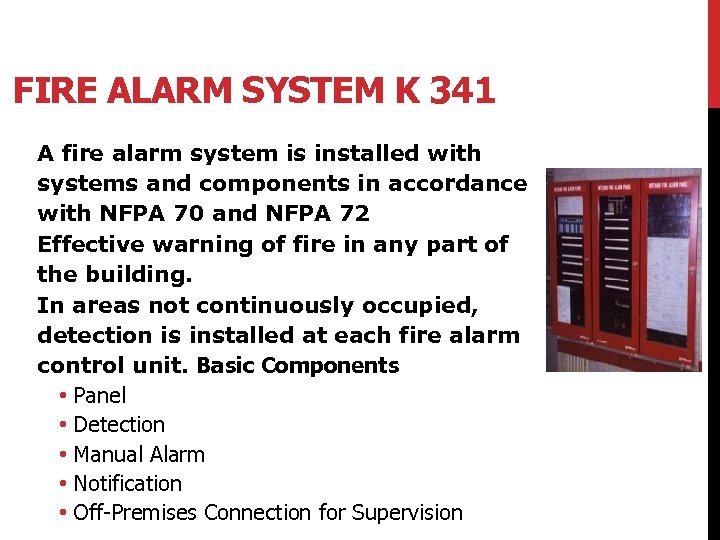 FIRE ALARM SYSTEM K 341 A fire alarm system is installed with systems and components in accordance with NFPA 70 and NFPA 72 Effective warning of fire in any part of the building. In areas not continuously occupied, detection is installed at each fire alarm control unit. Basic Components • Panel • Detection • Manual Alarm • Notification • Off-Premises Connection for Supervision
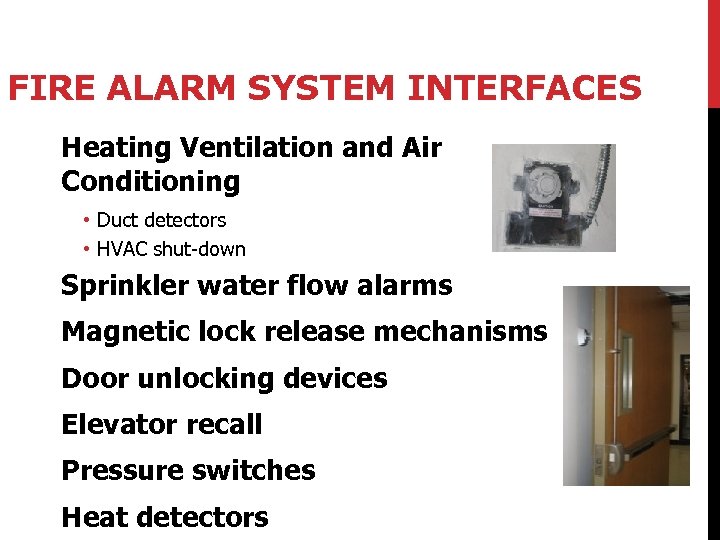 FIRE ALARM SYSTEM INTERFACES Heating Ventilation and Air Conditioning • Duct detectors • HVAC shut-down Sprinkler water flow alarms Magnetic lock release mechanisms Door unlocking devices Elevator recall Pressure switches Heat detectors
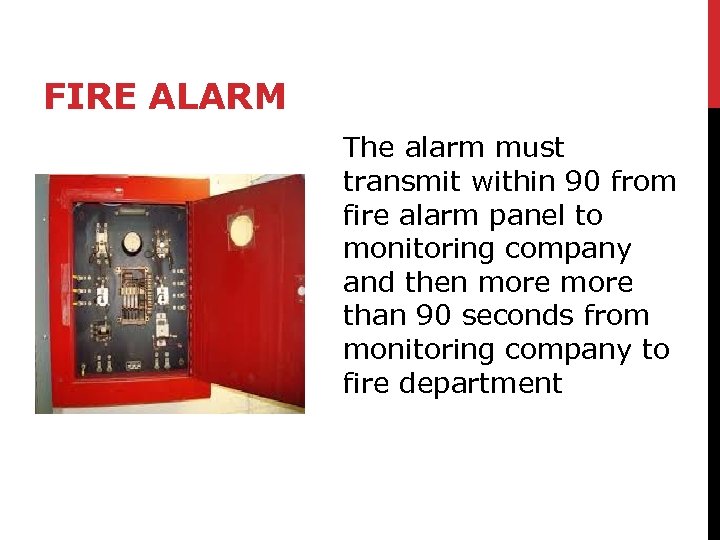 FIRE ALARM The alarm must transmit within 90 from fire alarm panel to monitoring company and then more than 90 seconds from monitoring company to fire department
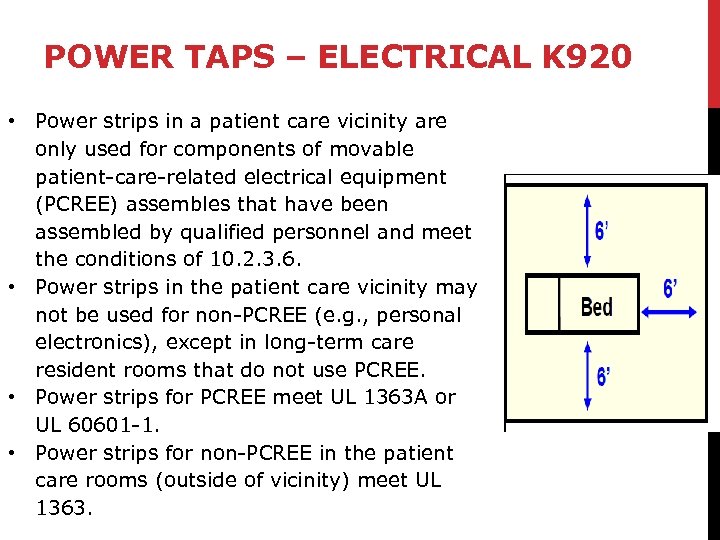 POWER TAPS – ELECTRICAL K 920 • Power strips in a patient care vicinity are only used for components of movable patient-care-related electrical equipment (PCREE) assembles that have been assembled by qualified personnel and meet the conditions of 10. 2. 3. 6. • Power strips in the patient care vicinity may not be used for non-PCREE (e. g. , personal electronics), except in long-term care resident rooms that do not use PCREE. • Power strips for PCREE meet UL 1363 A or UL 60601 -1. • Power strips for non-PCREE in the patient care rooms (outside of vicinity) meet UL 1363.
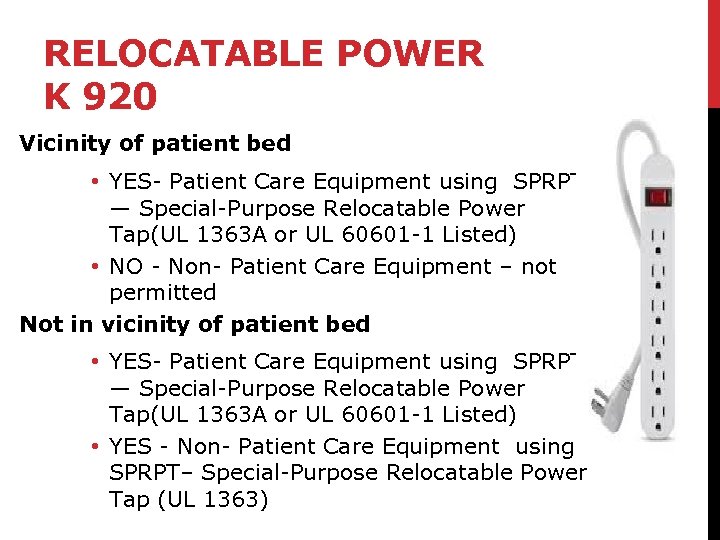 RELOCATABLE POWER K 920 Vicinity of patient bed • YES- Patient Care Equipment using SPRPT — Special-Purpose Relocatable Power Tap(UL 1363 A or UL 60601 -1 Listed) • NO - Non- Patient Care Equipment – not permitted Not in vicinity of patient bed • YES- Patient Care Equipment using SPRPT — Special-Purpose Relocatable Power Tap(UL 1363 A or UL 60601 -1 Listed) • YES - Non- Patient Care Equipment using SPRPT– Special-Purpose Relocatable Power Tap (UL 1363)
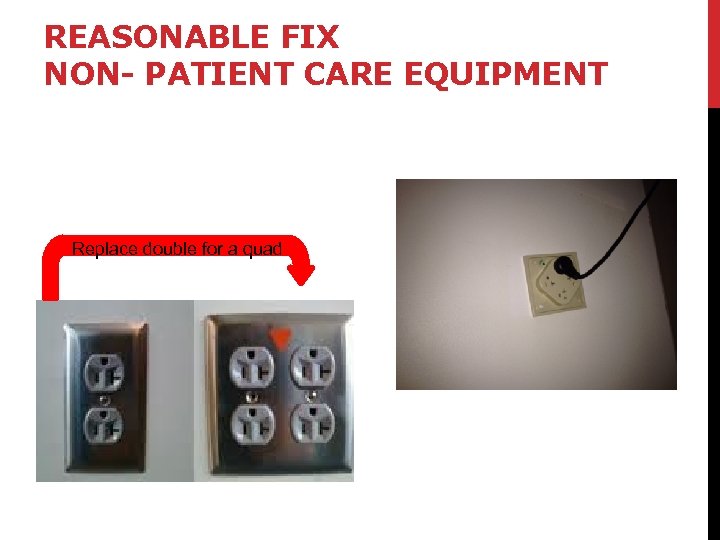 REASONABLE FIX NON- PATIENT CARE EQUIPMENT Replace double for a quad
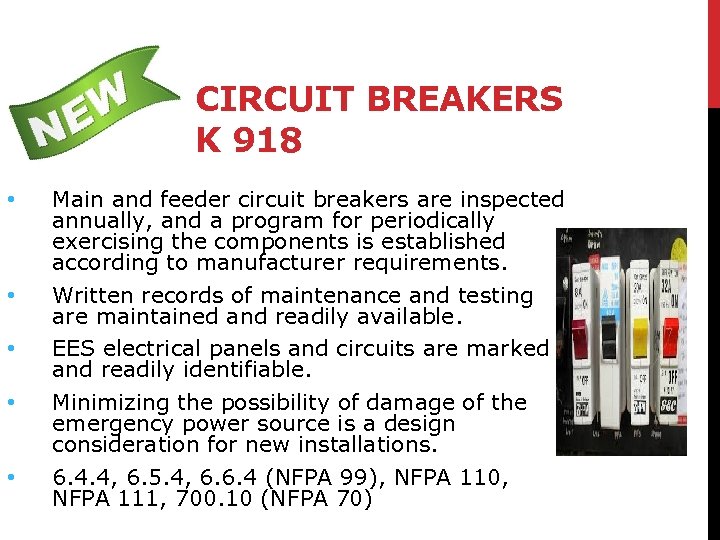 CIRCUIT BREAKERS K 918 • • • Main and feeder circuit breakers are inspected annually, and a program for periodically exercising the components is established according to manufacturer requirements. Written records of maintenance and testing are maintained and readily available. EES electrical panels and circuits are marked and readily identifiable. Minimizing the possibility of damage of the emergency power source is a design consideration for new installations. 6. 4. 4, 6. 5. 4, 6. 6. 4 (NFPA 99), NFPA 110, NFPA 111, 700. 10 (NFPA 70)
 ELECTRICAL EQUIPMENT – TESTING K 921 • The physical integrity, resistance, leakage current, and touch current tests for fixed and portable patientcare related electrical equipment is performed. • All PCREE used in patient care rooms is tested before being put into service and after any repair or modification. • Electrical equipment instructions and maintenance manuals are readily available, and safety labels and condensed operating instructions on the appliance are legible. • A record of electrical equipment tests, repairs, and modifications is maintained for a period of time to demonstrate compliance in accordance with the facility's policy. • 10. 3, 10. 5. 2. 1. 2, 10. 5. 2. 5, 10. 5. 3, 10. 5. 6, 10. 5. 8
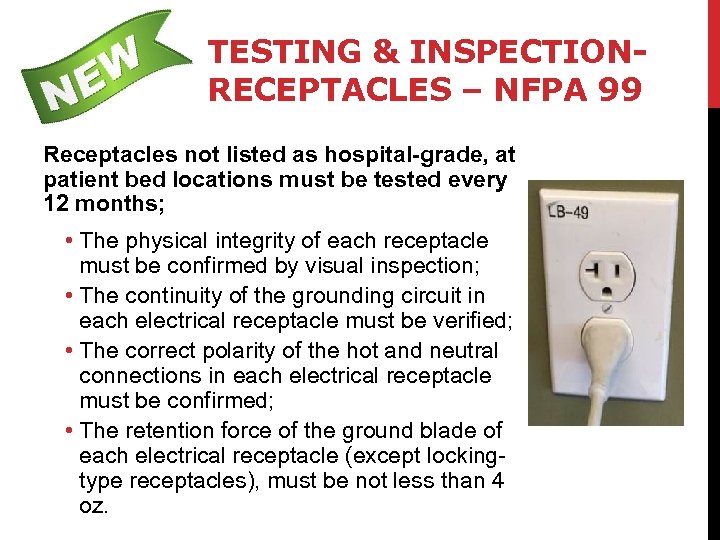 TESTING & INSPECTION- RECEPTACLES – NFPA 99 Receptacles not listed as hospital-grade, at patient bed locations must be tested every 12 months; • The physical integrity of each receptacle must be confirmed by visual inspection; • The continuity of the grounding circuit in each electrical receptacle must be verified; • The correct polarity of the hot and neutral connections in each electrical receptacle must be confirmed; • The retention force of the ground blade of each electrical receptacle (except lockingtype receptacles), must be not less than 4 oz.
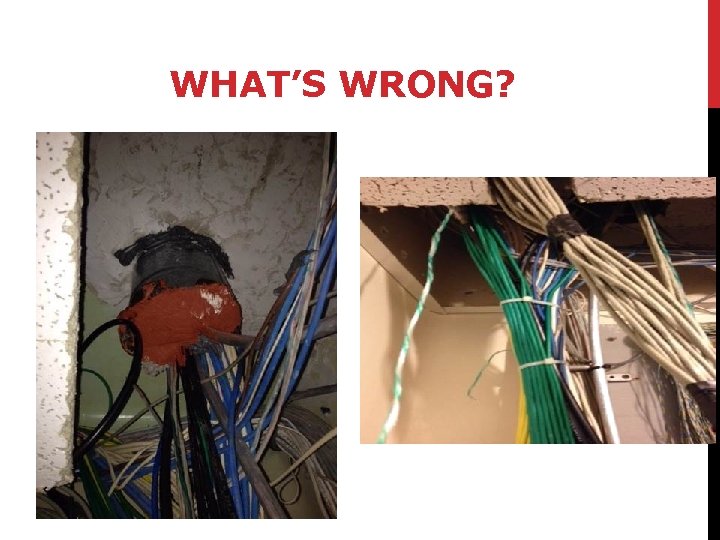 WHAT’S WRONG?
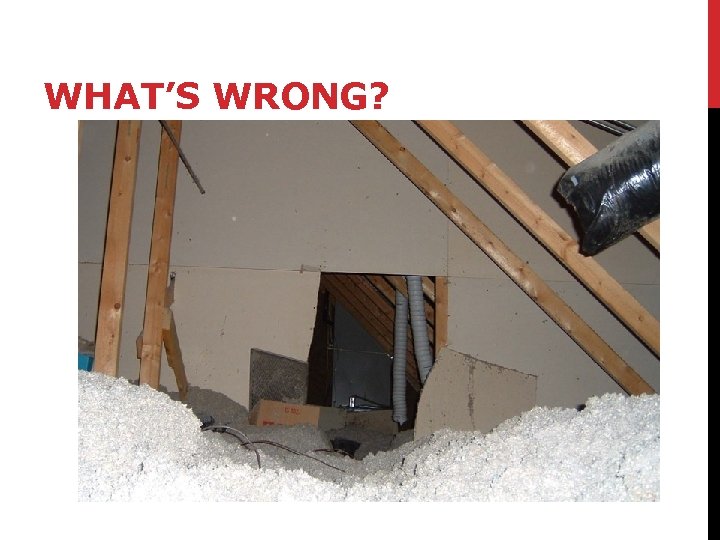 WHAT’S WRONG?
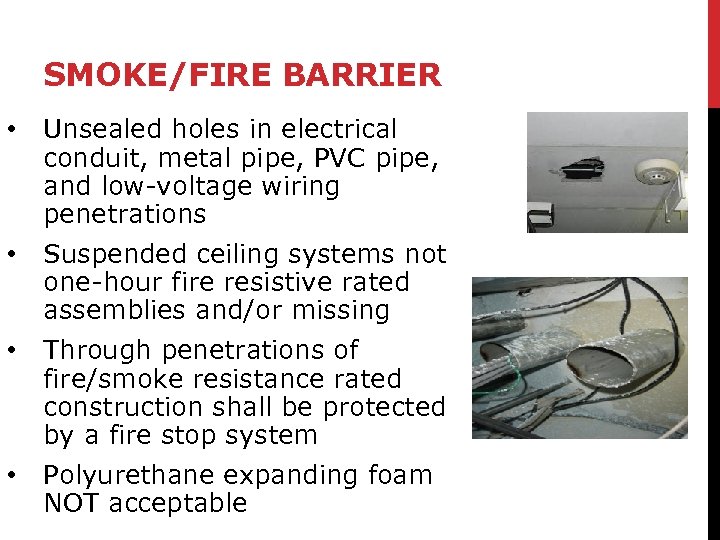 SMOKE/FIRE BARRIER • Unsealed holes in electrical conduit, metal pipe, PVC pipe, and low-voltage wiring penetrations • Suspended ceiling systems not one-hour fire resistive rated assemblies and/or missing • Through penetrations of fire/smoke resistance rated construction shall be protected by a fire stop system • Polyurethane expanding foam NOT acceptable
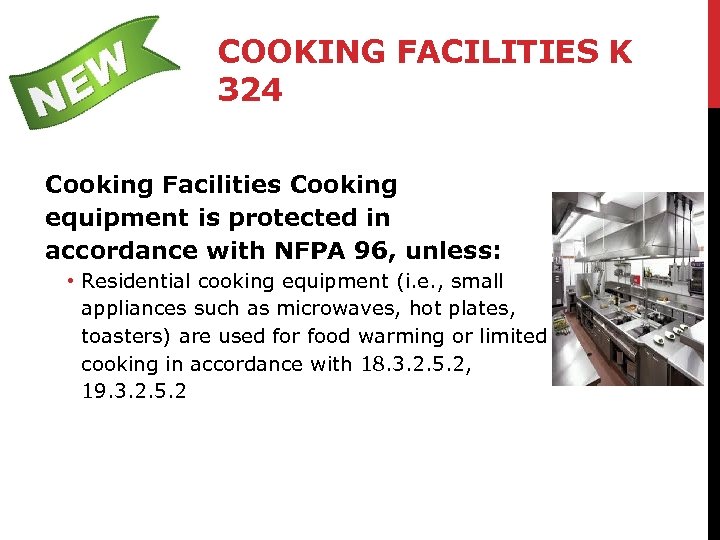 COOKING FACILITIES K 324 Cooking Facilities Cooking equipment is protected in accordance with NFPA 96, unless: • Residential cooking equipment (i. e. , small appliances such as microwaves, hot plates, toasters) are used for food warming or limited cooking in accordance with 18. 3. 2. 5. 2, 19. 3. 2. 5. 2
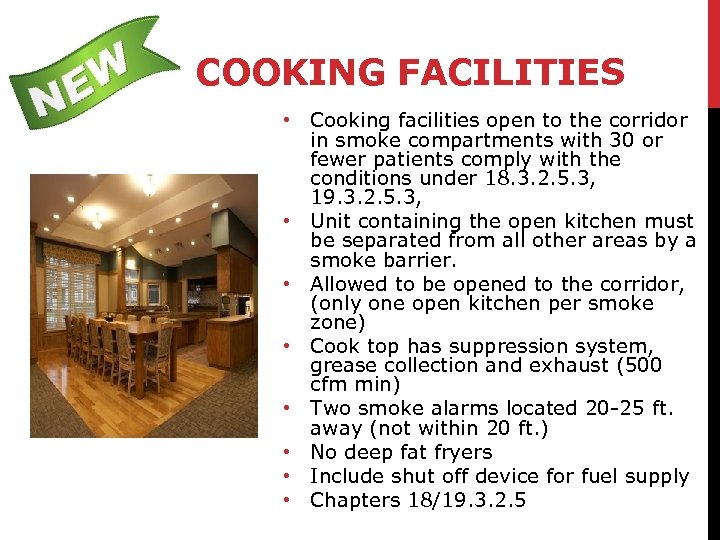 COOKING FACILITIES • Cooking facilities open to the corridor in smoke compartments with 30 or fewer patients comply with the conditions under 18. 3. 2. 5. 3, 19. 3. 2. 5. 3, • Unit containing the open kitchen must be separated from all other areas by a smoke barrier. • Allowed to be opened to the corridor, (only one open kitchen per smoke zone) • Cook top has suppression system, grease collection and exhaust (500 cfm min) • Two smoke alarms located 20 -25 ft. away (not within 20 ft. ) • No deep fat fryers • Include shut off device for fuel supply • Chapters 18/19. 3. 2. 5
 KITCHEN HOOD EXTINGUISHING SYSTEMS NFPA 17 A Monthly Inspection: • Ensure system is in its proper place; • Manual actuators are not obstructed; • Tamper seals and indicators are intact; • Maintenance tag is in place; • No obvious physical damage that might prevent operation; • Ensure pressure gauge is in operable range; • Nozzle blow-off caps are intact and undamaged; • The protected equipment has not been replaced, modified or relocated.
 KITCHEN HOOD EXTINGUISHING Semi-annual Maintenance: • • • Check to see hazard has not changed; Examine all detectors; Examine expellant gas containers; Examine agent containers; Examine releasing devices; Verify that agent distribution piping is not obstructed • Operate system without releasing agent; • Fixed temperature fusible links must be replaced semi-annually, and destroyed once removed.
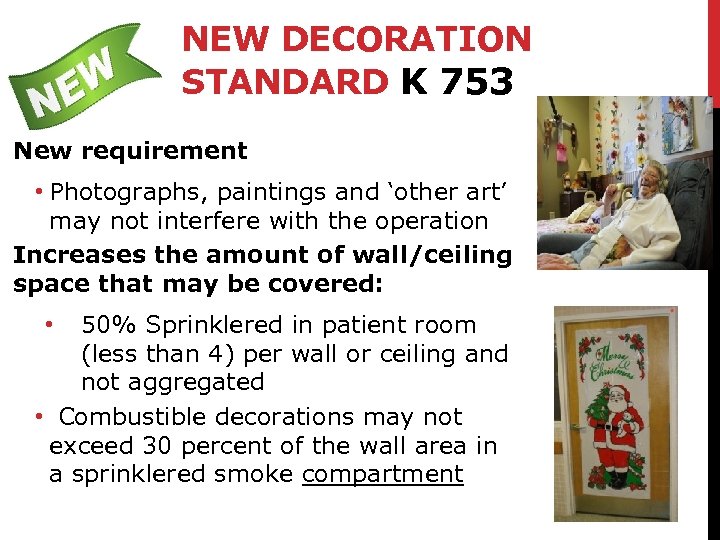 NEW DECORATION STANDARD K 753 New requirement • Photographs, paintings and ‘other art’ may not interfere with the operation Increases the amount of wall/ceiling space that may be covered: 50% Sprinklered in patient room (less than 4) per wall or ceiling and not aggregated • Combustible decorations may not exceed 30 percent of the wall area in a sprinklered smoke compartment •
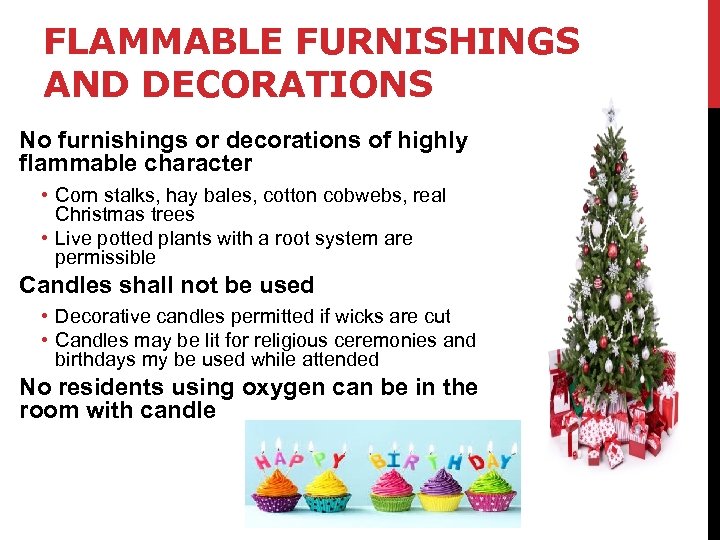 FLAMMABLE FURNISHINGS AND DECORATIONS No furnishings or decorations of highly flammable character • Corn stalks, hay bales, cotton cobwebs, real Christmas trees • Live potted plants with a root system are permissible Candles shall not be used • Decorative candles permitted if wicks are cut • Candles may be lit for religious ceremonies and birthdays my be used while attended No residents using oxygen can be in the room with candle
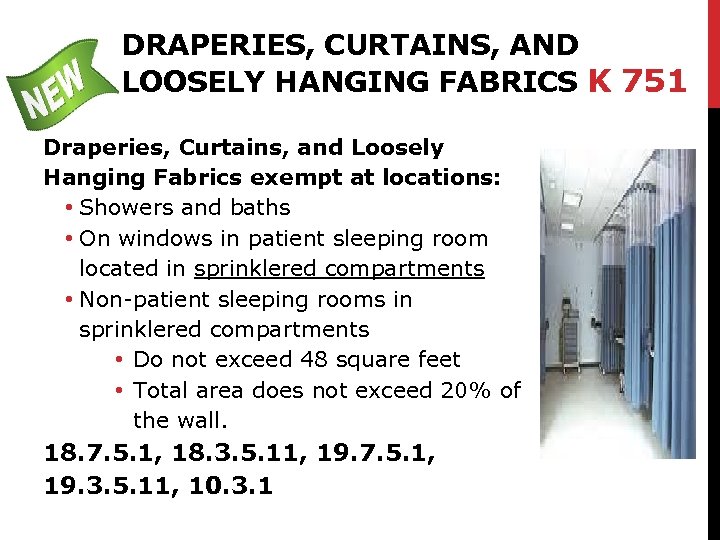 DRAPERIES, CURTAINS, AND LOOSELY HANGING FABRICS K 751 Draperies, Curtains, and Loosely Hanging Fabrics exempt at locations: • Showers and baths • On windows in patient sleeping room located in sprinklered compartments • Non-patient sleeping rooms in sprinklered compartments • Do not exceed 48 square feet • Total area does not exceed 20% of the wall. 18. 7. 5. 1, 18. 3. 5. 11, 19. 7. 5. 1, 19. 3. 5. 11, 10. 3. 1
 UPHOLSTERED FURNITURE AND MATTRESSES K 752 Newly introduced upholstered furniture and mattresses meets Class I or char length, and heat release unless the building is fully sprinklered. Upholstered furniture and mattresses belonging to nursing home residents do not have to meet these requirements as all nursing homes are required to be fully sprinklered. 18. 7. 5. 2, 18. 7. 5. 4, 19. 7. 5. 2, 19. 7. 5. 4
 CYLINDER AND CONTAINER STORAGE K 923 • A precautionary sign readable from 5 feet is of a cylinder storage room, wording as a minimum "CAUTION: OXIDIZING GAS(ES) STORED WITHIN NO SMOKING". • Empty cylinders are segregated from full cylinders. • Empty cylinders are marked to avoid confusion. • Cylinders stored in the open are protected from weather. 11. 3. 1, 11. 3. 2, 11. 3. 3, 11. 3. 4, 11. 6. 5 (NFPA 99)
 HANDLING MEDICAL GASES Personnel concerned with the application, maintenance and handling of medical gases and cylinders are trained on the risk. Facilities provide continuing education, including safety guidelines and usage requirements. Equipment is serviced only by personnel trained in the maintenance and operation of equipment. 11. 5. 2. 1 (NFPA 99)
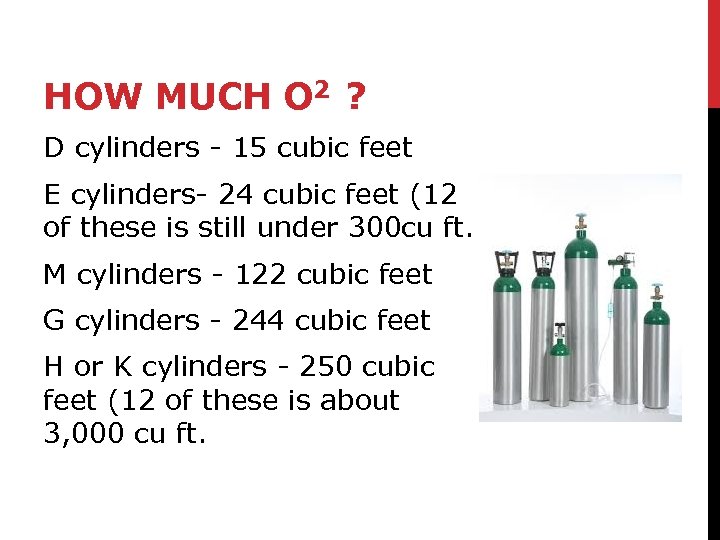 HOW MUCH O 2 ? D cylinders - 15 cubic feet E cylinders- 24 cubic feet (12 of these is still under 300 cu ft. M cylinders - 122 cubic feet G cylinders - 244 cubic feet H or K cylinders - 250 cubic feet (12 of these is about 3, 000 cu ft.
 O 2 STORAGE • Storage up to 300 cuft can be kept in an area that is not a designated storage area medical gas may be accessible as operational supply rather than storage, properly secured • An individual container of medical gas placed in a patient room for “as needed” (but regular) individual use is not required to be stored in an enclosure, when properly secured.
 STORAGE O 2 Storage less than 3, 000 cu ft. • Storage between 300 cuft and 3000 cuft must be in a storage room • Out door enclosure or indoor inside a room of non combustible or limited combustible (dry wall) with door that can be secured. • Minimum distance of 5 feet from combustible or incompatible materials when fully sprinklered • No smoking, or open flames are electrical heating • Cylinder valve protection caps • Cylinders chained and supported in stand or cart
 STORAGE O 2 – MORE THAN 3000 CU. FT. • Storage locations are designed, constructed, and ventilated in accordance with 5. 1. 3. 3. 2 and 5. 1. 3. 3. 3. Storage over 3000 cuft must be in a 1 hr FRR enclosure • 45 min FRR self-closing and latching door • Vented outside Comply with no other storage in this room Whenever you store more than 3, 000 cu ft. of O 2 cylinders (12 H tanks or 124 E tanks) there are many more conditions that must be met.
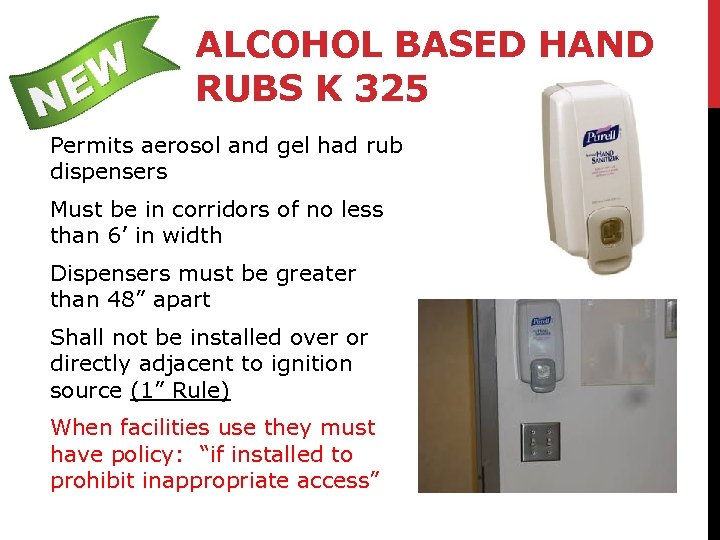 ALCOHOL BASED HAND RUBS K 325 Permits aerosol and gel had rub dispensers Must be in corridors of no less than 6’ in width Dispensers must be greater than 48” apart Shall not be installed over or directly adjacent to ignition source (1” Rule) When facilities use they must have policy: “if installed to prohibit inappropriate access”
 BUILDING REHABILITATION Chapter 43 addresses work associated: • Repairs • Renovations • Modifications • Reconstructions • Changes of use or occupancy classification • Additions This new chapter of the LSC must be used whenever these types of work occur in existing healthcare facilities
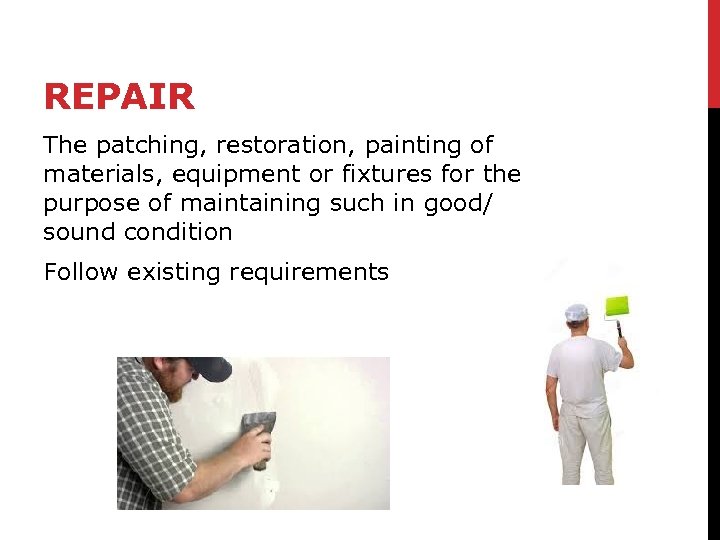 REPAIR The patching, restoration, painting of materials, equipment or fixtures for the purpose of maintaining such in good/ sound condition Follow existing requirements
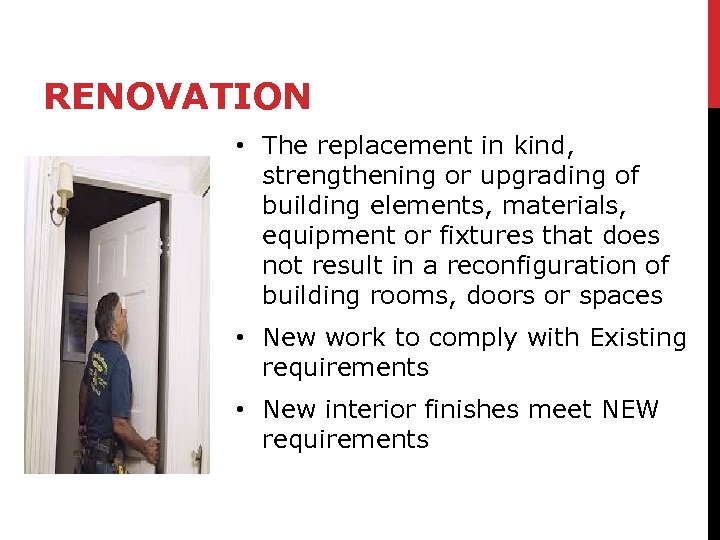 RENOVATION • The replacement in kind, strengthening or upgrading of building elements, materials, equipment or fixtures that does not result in a reconfiguration of building rooms, doors or spaces • New work to comply with Existing requirements • New interior finishes meet NEW requirements
 MODIFICATION • The reconfiguration of any space, the addition, relocation or elimination of any door or window, the addition of elimination of load-bearing element, the reconfiguration or extension of any system or the install of additional equipment • Newly constructed elements, systems, equipment shall comply with NEW requirements
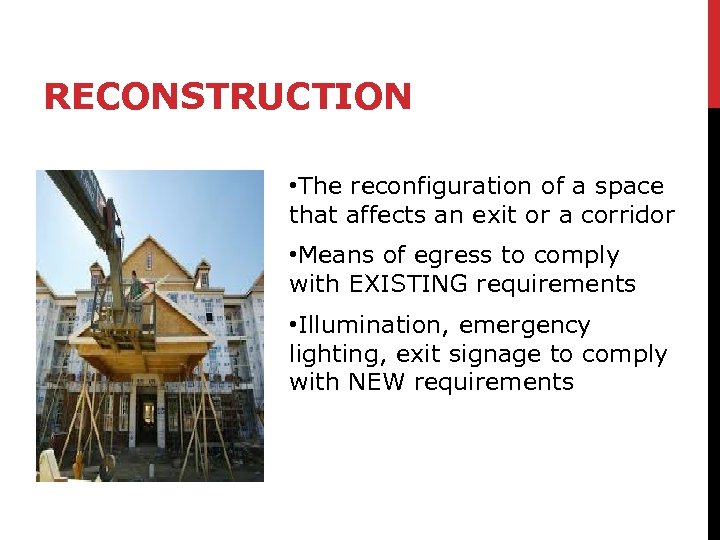 RECONSTRUCTION • The reconfiguration of a space that affects an exit or a corridor • Means of egress to comply with EXISTING requirements • Illumination, emergency lighting, exit signage to comply with NEW requirements
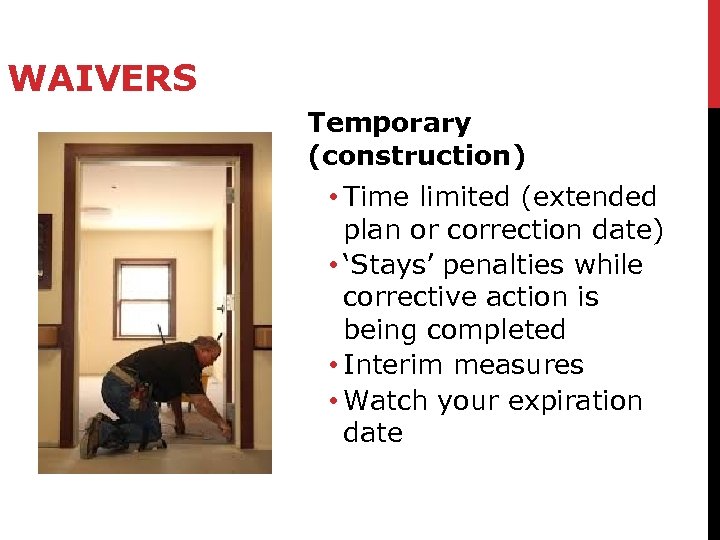 WAIVERS Temporary (construction) • Time limited (extended plan or correction date) • ‘Stays’ penalties while corrective action is being completed • Interim measures • Watch your expiration date
 ANNUAL WAIVERS The provider must demonstrate that: • The waiver can not adversely affect resident health and safety • It will impose an unreasonable hardship on the facility to meet a specific LSC requirement. CMS looks for facility to implement measures above and beyond requirements – equalivancies
 FIRE SAFETY EVALUATION SYSTEM FSES provides alternative approach to compliance with the 2000 Life Safety Code. Section 1. 5 of the Life Safety Code permits alternative compliance with the Code under equivalency concepts where such equivalency is approved by the authority having jurisdiction Numerical value derived from four basic equivalency functions: • Containment safety • Extinguishment safety • People movement • General safety
 OHCA DISASTER AND LSC TRAININGS • What News Bites and other Bulletins • NFPA 99 HEALTH CARE FACILITIES CODE - RISK ANALYSIS WEBINAR Dec 8 th • LSC PRIMER • LSC BOOT CAMP • DISASTER SUMMITT • NURSING HOME INCIDENT COMMAND • HAZARD VUNERABILITY ANAYSIS -WHAT IS IT AND HOW DO IT? WEBINAR
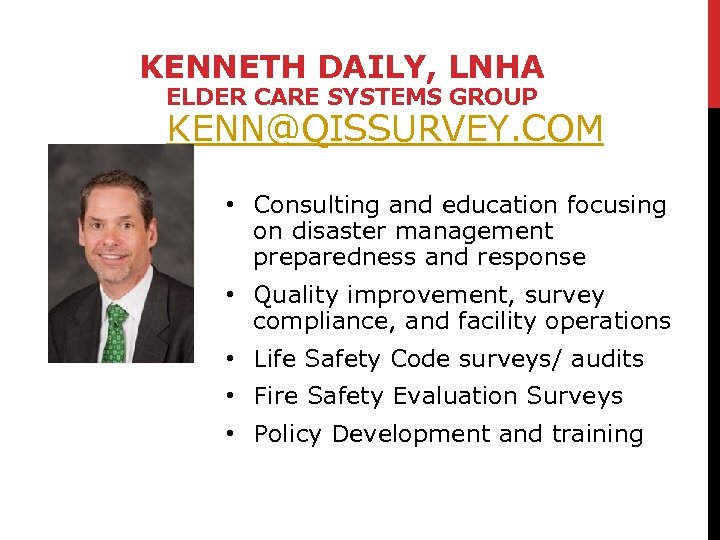 KENNETH DAILY, LNHA ELDER CARE SYSTEMS GROUP KENN@QISSURVEY. COM • Consulting and education focusing on disaster management preparedness and response • Quality improvement, survey compliance, and facility operations • Life Safety Code surveys/ audits • Fire Safety Evaluation Surveys • Policy Development and training