


 Скачать презентацию Cmp E 476 Spring 2000 Notes on SSL
2ed719356937e7e2be109a2109a9ad9c.ppt
- Количество слайдов: 17
 Cmp. E 476 Spring 2000 Notes on SSL and SET Dr. M. Ufuk Caglayan Department of Computer Engineering Bogazici University, Istanbul caglayan@boun. edu. tr March 29, 2000 M. Ufuk Caglayan, Cmp. E 476 Spring 2000, SSL and SET Notes, March 29, 2000 Page 1 of 17
 SSL (Secure Socket Layer) - 1 • Properties – By Netscape, currently Version 3, open, widely used in point-to-point safe transfer of information, such as a credit card number • Architecture : two layers – Record Protocol over TCP and Handshake, Change Cipher Spec, Alert protocols over Record Protocol. HTTP uses Record Protocol M. Ufuk Caglayan, Cmp. E 476 Spring 2000, SSL and SET Notes, March 29, 2000 Page 2 of 17
 SSL - 2 • SSL connection – Peer to peer, transient, associated with one session • SSL session – Between client and server, by handshake protocol – Defines a set of cryptographic security parameters which can be shared among multiple connections – To avoid expensive negotiation new security parameters M. Ufuk Caglayan, Cmp. E 476 Spring 2000, SSL and SET Notes, March 29, 2000 Page 3 of 17
 SSL - 3 • Session state – Id, X 509 v 3 certificate of the peer, compression algorithm, cipher spec (encryption, hash and all their parameters), master secret (48 bytes), resumability for new connections • Connection state – Server/client random numbers, write MAC keys, write keys for conventional encryption, CBC mode IV, 64 bit sequence numbers M. Ufuk Caglayan, Cmp. E 476 Spring 2000, SSL and SET Notes, March 29, 2000 Page 4 of 17
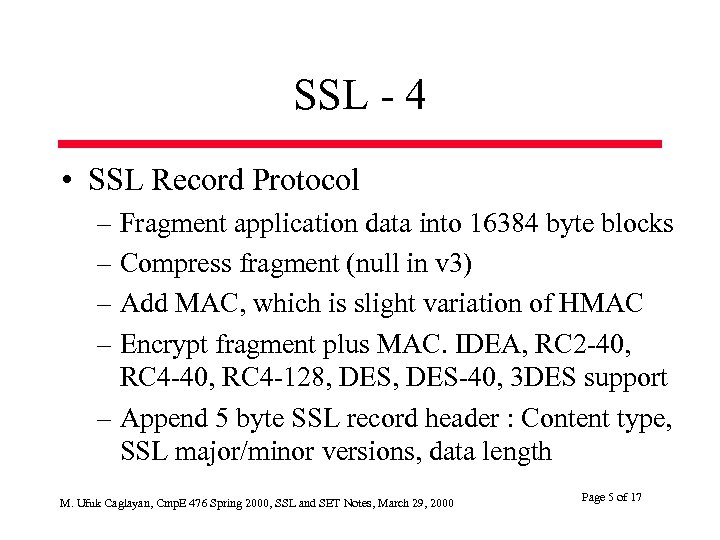 SSL - 4 • SSL Record Protocol – Fragment application data into 16384 byte blocks – Compress fragment (null in v 3) – Add MAC, which is slight variation of HMAC – Encrypt fragment plus MAC. IDEA, RC 2 -40, RC 4 -128, DES-40, 3 DES support – Append 5 byte SSL record header : Content type, SSL major/minor versions, data length M. Ufuk Caglayan, Cmp. E 476 Spring 2000, SSL and SET Notes, March 29, 2000 Page 5 of 17
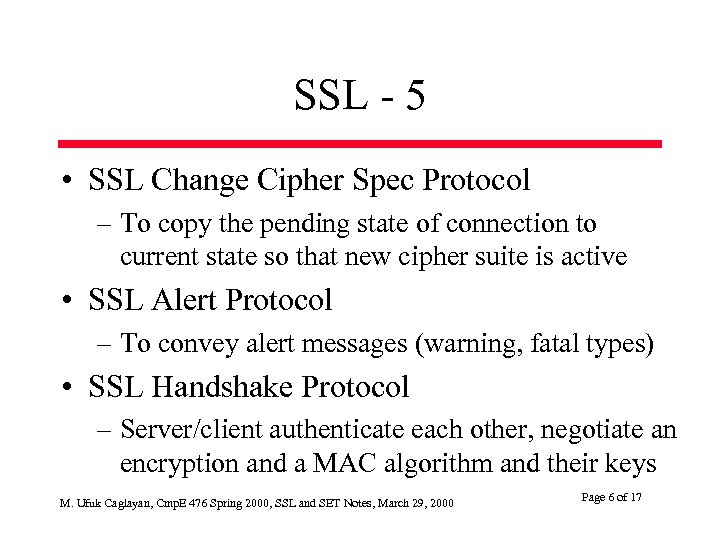 SSL - 5 • SSL Change Cipher Spec Protocol – To copy the pending state of connection to current state so that new cipher suite is active • SSL Alert Protocol – To convey alert messages (warning, fatal types) • SSL Handshake Protocol – Server/client authenticate each other, negotiate an encryption and a MAC algorithm and their keys M. Ufuk Caglayan, Cmp. E 476 Spring 2000, SSL and SET Notes, March 29, 2000 Page 6 of 17
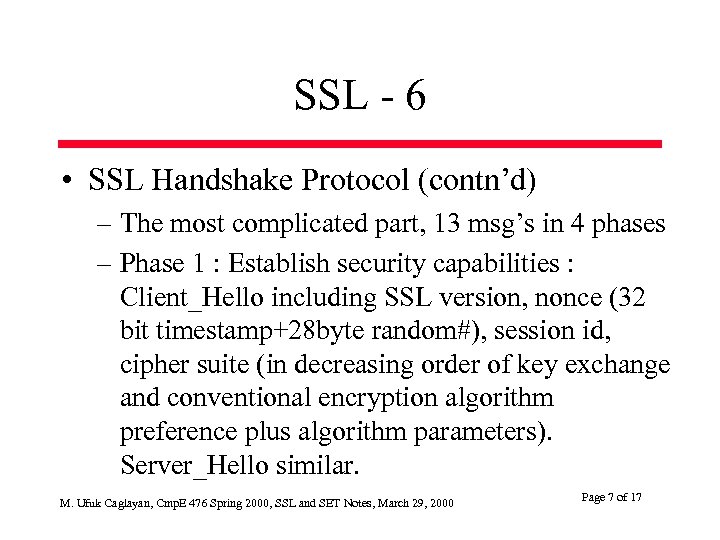 SSL - 6 • SSL Handshake Protocol (contn’d) – The most complicated part, 13 msg’s in 4 phases – Phase 1 : Establish security capabilities : Client_Hello including SSL version, nonce (32 bit timestamp+28 byte random#), session id, cipher suite (in decreasing order of key exchange and conventional encryption algorithm preference plus algorithm parameters). Server_Hello similar. M. Ufuk Caglayan, Cmp. E 476 Spring 2000, SSL and SET Notes, March 29, 2000 Page 7 of 17
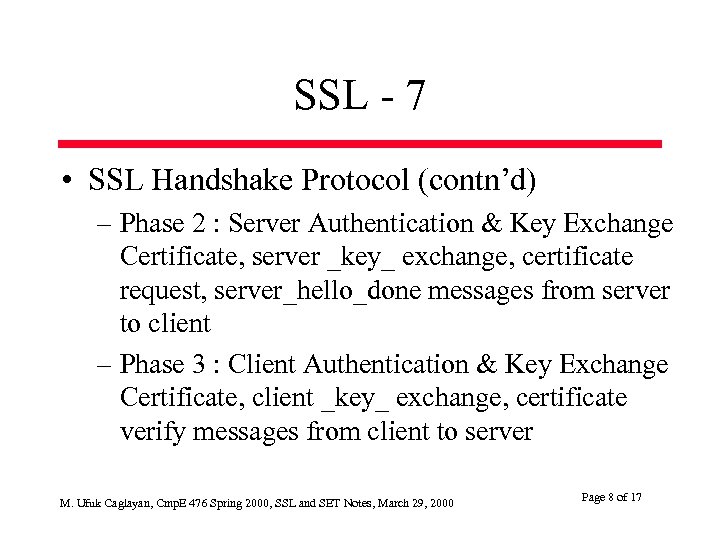 SSL - 7 • SSL Handshake Protocol (contn’d) – Phase 2 : Server Authentication & Key Exchange Certificate, server _key_ exchange, certificate request, server_hello_done messages from server to client – Phase 3 : Client Authentication & Key Exchange Certificate, client _key_ exchange, certificate verify messages from client to server M. Ufuk Caglayan, Cmp. E 476 Spring 2000, SSL and SET Notes, March 29, 2000 Page 8 of 17
 SSL - 8 • SSL Handshake Protocol (contn’d) – Phase 4 : Finish change_cipher_spec and finish messages from client to server and change_cipher_spec and finish messages from server to client – The idea here in 4 phases is to assure identities, agree on key exchange algorithm, exchange keys exchange nonces to prevent replays and agree on conventional encryption and hash algorithms. M. Ufuk Caglayan, Cmp. E 476 Spring 2000, SSL and SET Notes, March 29, 2000 Page 9 of 17
 SSL vs TLS • TLS : Transport Layer Security – Internet Society IETF standardization initiative to produce Internet standard version of SSL – TLS Version 3. 1 is SSL Version 3 with minor modifications – TLS uses HMAC, SSL uses an earlier version of HMAC (concatenation vs XOR’ing of padded bytes with secret key), additional alert codes M. Ufuk Caglayan, Cmp. E 476 Spring 2000, SSL and SET Notes, March 29, 2000 Page 10 of 17
 Secure Electronic Transaction SET - 1 • An open encryption and security spec, mainly for credit card transactions • Initiated by Master. Card and VISA, many companies involved in its creation • Version 1, Feb. 1996 • SET is not a payment system, complex spec in 3 books, 971 pp (SSL 63 pp, TLS 71 pp) M. Ufuk Caglayan, Cmp. E 476 Spring 2000, SSL and SET Notes, March 29, 2000 Page 11 of 17
 SET - 2 • SET participants – Card holder, Merchant, (Card) Issuer, Acquirer (Merchant’s Bank), Payment Gateway, Certification Authority (CA) • Sequence of Events in using SET – Customer opens credit card account with issuer – Customer receives a X. 509 v 3 certificate – Merchants opens account with acquirer M. Ufuk Caglayan, Cmp. E 476 Spring 2000, SSL and SET Notes, March 29, 2000 Page 12 of 17
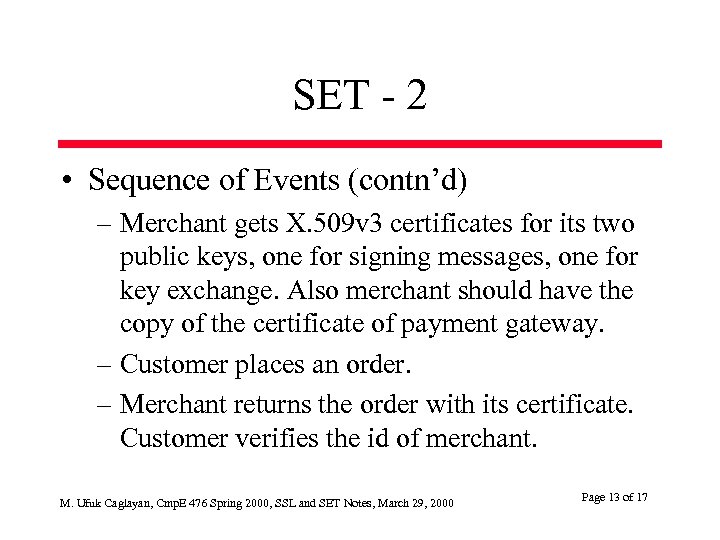 SET - 2 • Sequence of Events (contn’d) – Merchant gets X. 509 v 3 certificates for its two public keys, one for signing messages, one for key exchange. Also merchant should have the copy of the certificate of payment gateway. – Customer places an order. – Merchant returns the order with its certificate. Customer verifies the id of merchant. M. Ufuk Caglayan, Cmp. E 476 Spring 2000, SSL and SET Notes, March 29, 2000 Page 13 of 17
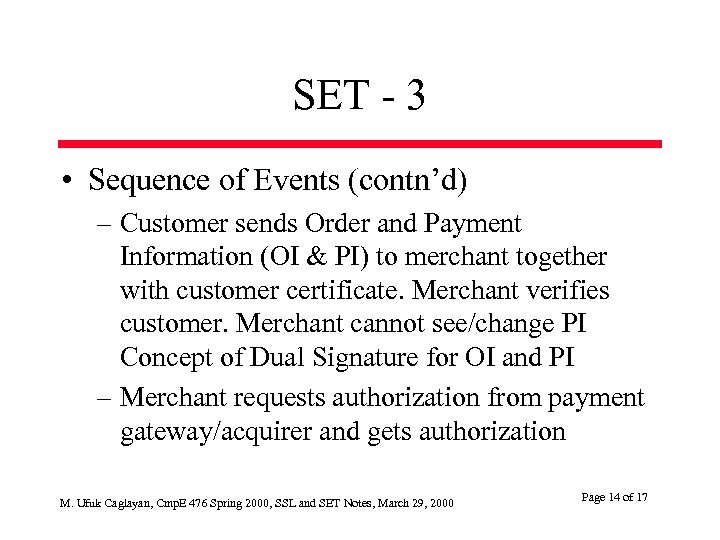 SET - 3 • Sequence of Events (contn’d) – Customer sends Order and Payment Information (OI & PI) to merchant together with customer certificate. Merchant verifies customer. Merchant cannot see/change PI Concept of Dual Signature for OI and PI – Merchant requests authorization from payment gateway/acquirer and gets authorization M. Ufuk Caglayan, Cmp. E 476 Spring 2000, SSL and SET Notes, March 29, 2000 Page 14 of 17
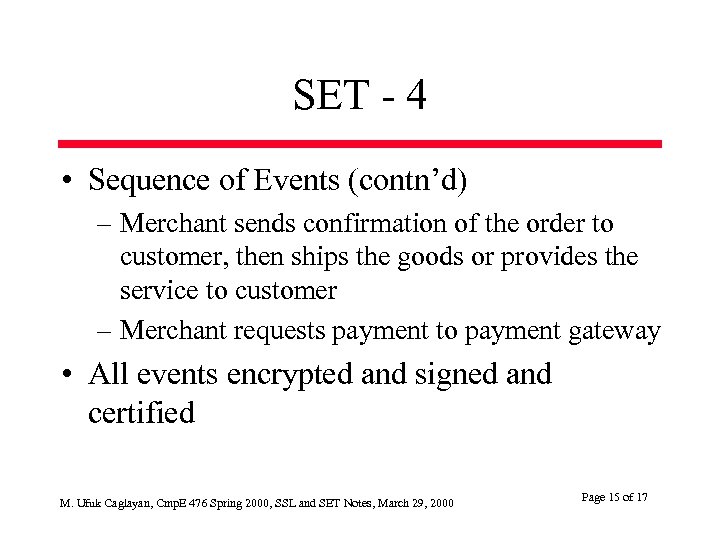 SET - 4 • Sequence of Events (contn’d) – Merchant sends confirmation of the order to customer, then ships the goods or provides the service to customer – Merchant requests payment to payment gateway • All events encrypted and signed and certified M. Ufuk Caglayan, Cmp. E 476 Spring 2000, SSL and SET Notes, March 29, 2000 Page 15 of 17
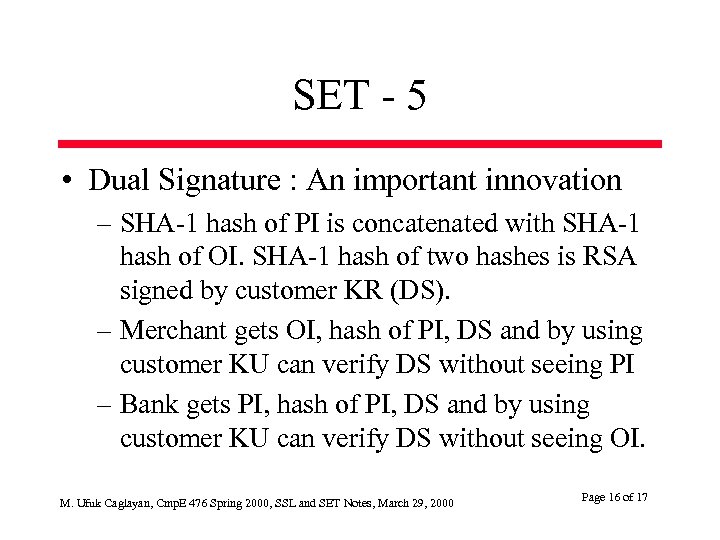 SET - 5 • Dual Signature : An important innovation – SHA-1 hash of PI is concatenated with SHA-1 hash of OI. SHA-1 hash of two hashes is RSA signed by customer KR (DS). – Merchant gets OI, hash of PI, DS and by using customer KU can verify DS without seeing PI – Bank gets PI, hash of PI, DS and by using customer KU can verify DS without seeing OI. M. Ufuk Caglayan, Cmp. E 476 Spring 2000, SSL and SET Notes, March 29, 2000 Page 16 of 17
 SET - 6 • Has strong cryptography, • Transactions result in many SET messages, • Difficult for individual cardholders to get X. 509 v 3 certificates Therefore, SET is expensive to use and it will probably be used only for large amount transactions, i. e. organizational macro payments. M. Ufuk Caglayan, Cmp. E 476 Spring 2000, SSL and SET Notes, March 29, 2000 Page 17 of 17