 Скачать презентацию CMIS 564 E R Modeling Dr Bordoloi Based on
40a9ea7287a61b5b708b1cb39e7378af.ppt
- Количество слайдов: 48



CMIS 564: E/R Modeling Dr. Bordoloi Based on Chapter 3; Modern Database Management 6 th Edition Jeffrey A. Hoffer, Mary B. Prescott, Fred R. Mc. Fadden © Prentice Hall, 2002 1
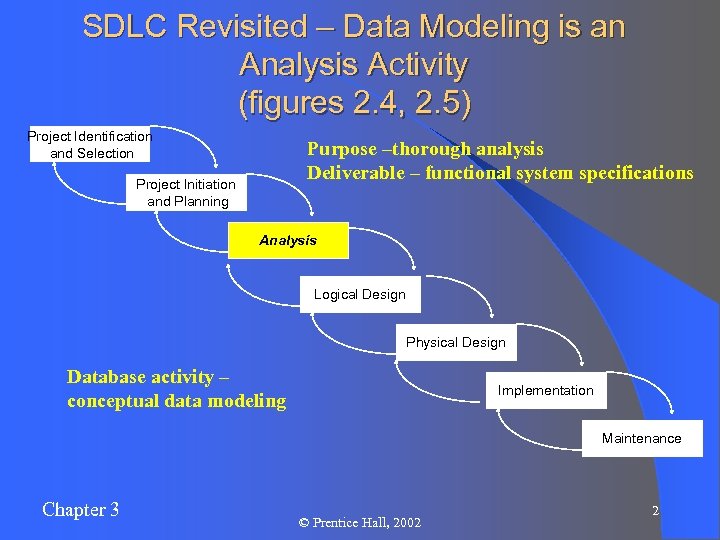
SDLC Revisited – Data Modeling is an Analysis Activity (figures 2. 4, 2. 5) Project Identification and Selection Purpose –thorough analysis Deliverable – functional system specifications Project Initiation and Planning Analysis Logical Design Physical Design Database activity – conceptual data modeling Implementation Maintenance Chapter 3 © Prentice Hall, 2002 2
Business Rules l Statements that define or constrain some aspect of the business l Assert business structure l Control/influence business behavior l Expressed in terms familiar to end users l Automated through DBMS software Chapter 3 © Prentice Hall, 2002 3
A Good Business Rule is: l l l l Declarative – what, not how Precise – clear, agreed-upon meaning Atomic – one statement Consistent – internally and externally Expressible – structured, natural language Distinct – non-redundant Business-oriented – understood by business people Chapter 3 © Prentice Hall, 2002 4
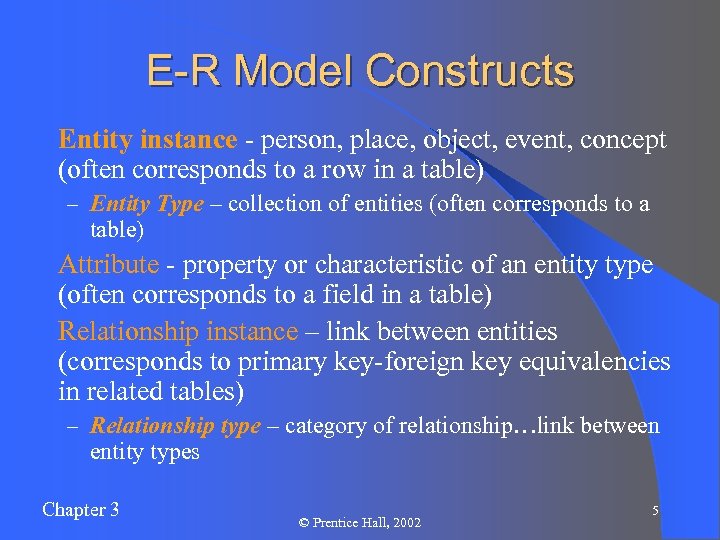
E-R Model Constructs l Entity instance - person, place, object, event, concept (often corresponds to a row in a table) – Entity Type – collection of entities (often corresponds to a table) Attribute - property or characteristic of an entity type (often corresponds to a field in a table) l Relationship instance – link between entities (corresponds to primary key-foreign key equivalencies in related tables) l – Relationship type – category of relationship…link between entity types Chapter 3 © Prentice Hall, 2002 5
Entities l Any real-world thing (person, place, object, concept, activity) about which an enterprise records data l Entities are named with a noun Chapter 3 © Prentice Hall, 2002 6
Entities l An entity instance is a single identifiable realworld thing, e. g. , Jack Spratt l An entity type is a set of entity instances sharing the same common properties (‘attributes’), characterized by: – Name - a noun, e. g. , EMPLOYEE – Description - defines which instances belong to the entity type – Identifier - a property (or a joint set of properties) which uniquely identify entity instances Chapter 3 © Prentice Hall, 2002 7
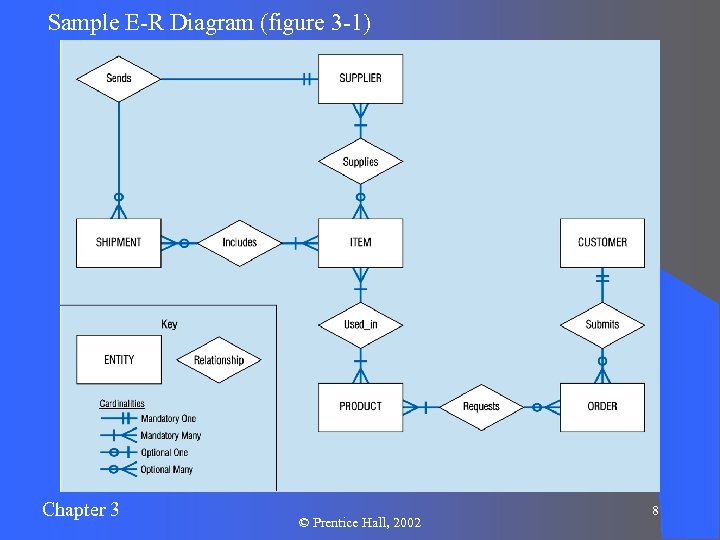
Sample E-R Diagram (figure 3 -1) Chapter 3 © Prentice Hall, 2002 8
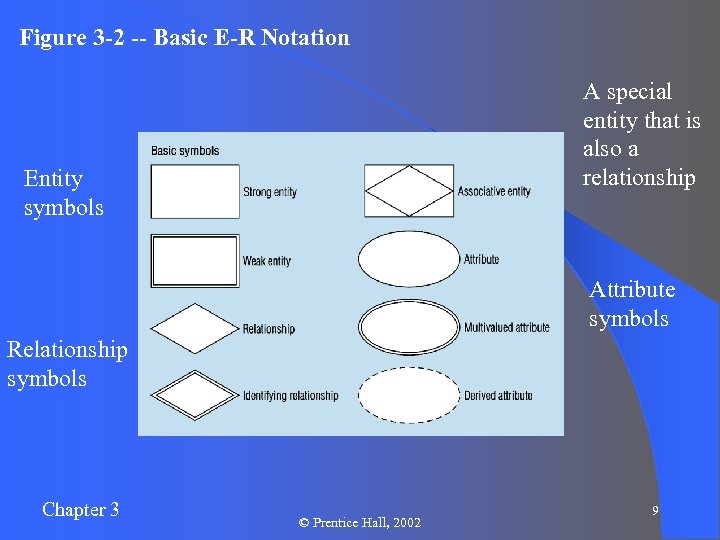
Figure 3 -2 -- Basic E-R Notation A special entity that is also a relationship Entity symbols Attribute symbols Relationship symbols Chapter 3 © Prentice Hall, 2002 9
What Should an Entity Be? l SHOULD BE: – An object that will have many instances in the database – An object that will be composed of multiple attributes – An object that we are trying to model – Must have an identifier l SHOULD NOT BE: – A user of the database system – An output of the database system (e. g. a report) Chapter 3 © Prentice Hall, 2002 10
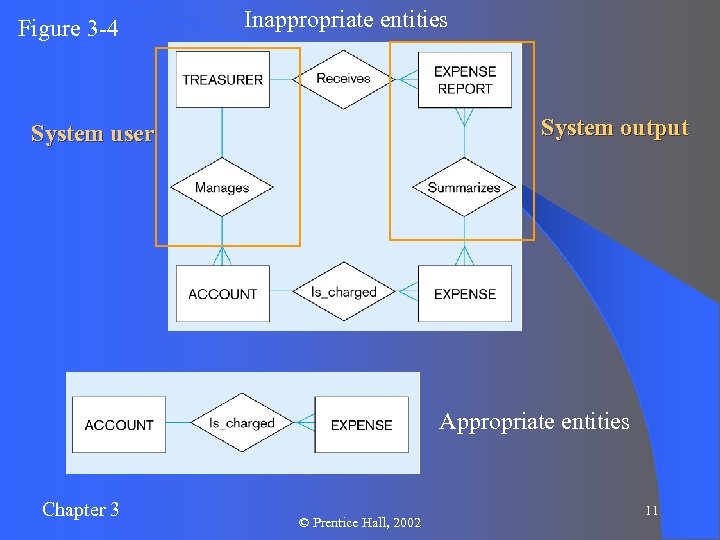
Figure 3 -4 Inappropriate entities System output System user Appropriate entities Chapter 3 © Prentice Hall, 2002 11
Attributes l Attribute - property or characteristic of an entity type l Classifications of attributes: – Simple versus Composite Attribute – Single-Valued versus Multivalued Attribute – Stored versus Derived Attributes – Identifier Attributes Chapter 3 © Prentice Hall, 2002 12
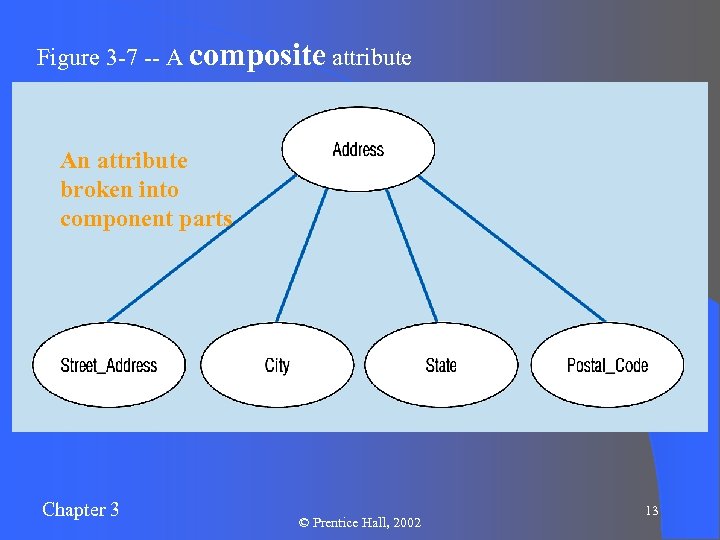
Figure 3 -7 -- A composite attribute An attribute broken into component parts Chapter 3 © Prentice Hall, 2002 13
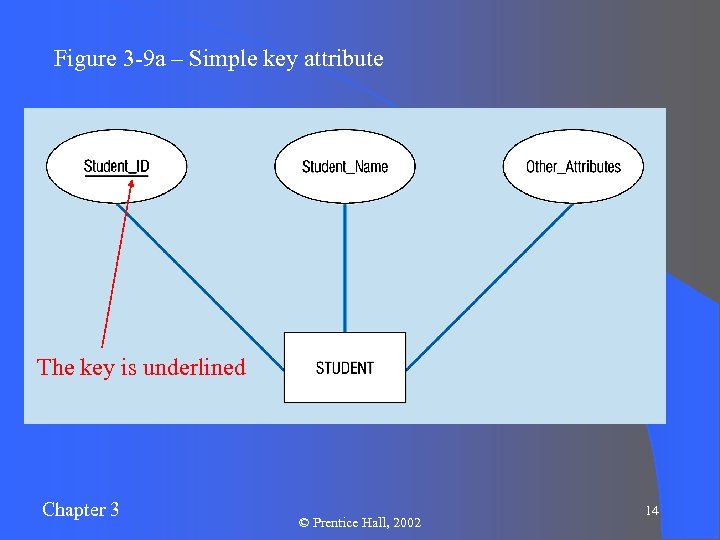
Figure 3 -9 a – Simple key attribute The key is underlined Chapter 3 © Prentice Hall, 2002 14
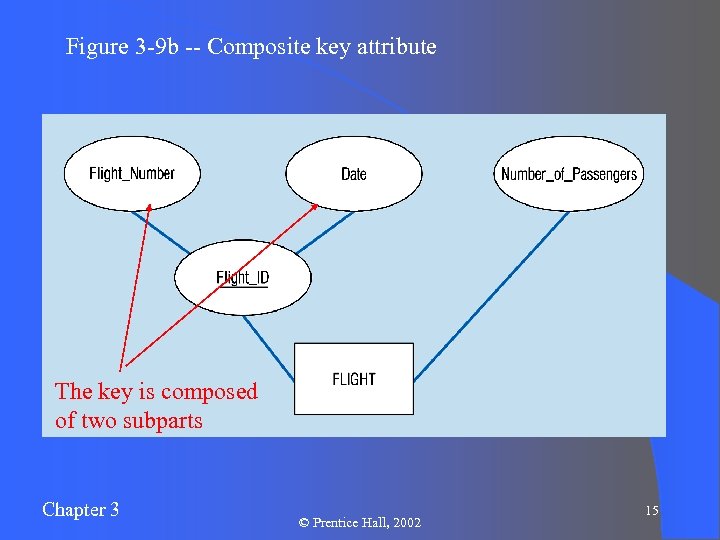
Figure 3 -9 b -- Composite key attribute The key is composed of two subparts Chapter 3 © Prentice Hall, 2002 15
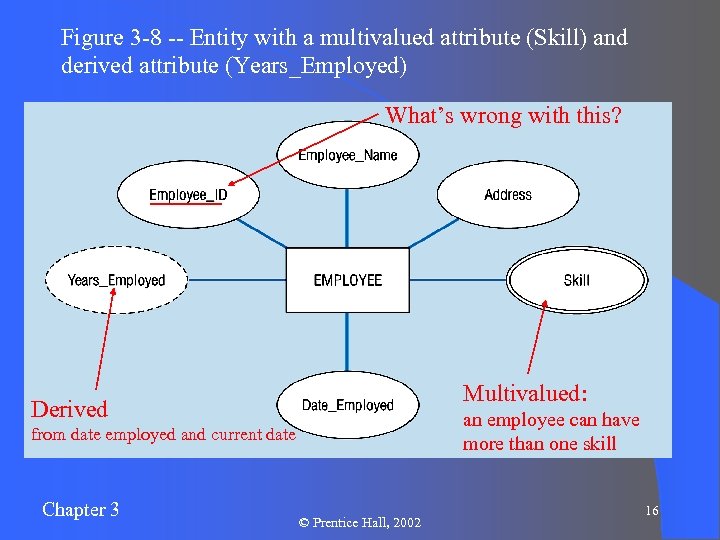
Figure 3 -8 -- Entity with a multivalued attribute (Skill) and derived attribute (Years_Employed) What’s wrong with this? Multivalued: Derived an employee can have more than one skill from date employed and current date Chapter 3 © Prentice Hall, 2002 16
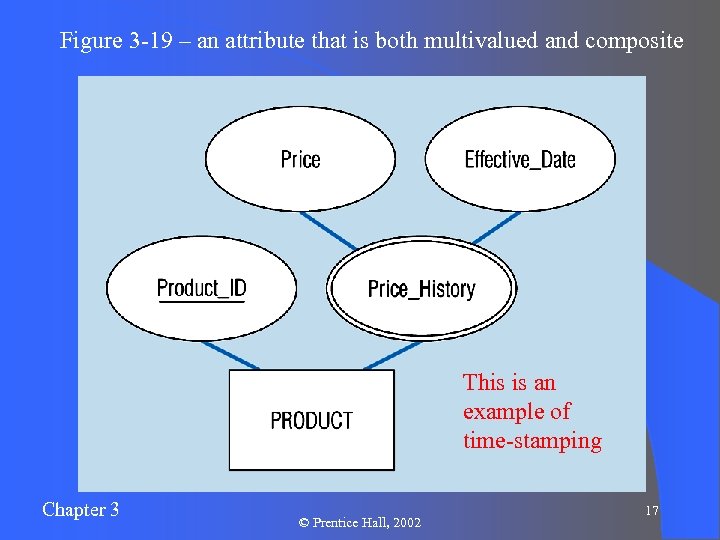
Figure 3 -19 – an attribute that is both multivalued and composite This is an example of time-stamping Chapter 3 © Prentice Hall, 2002 17
Identifiers (Keys) l Identifier (Key) - An attribute (or combination of attributes) that uniquely identifies individual instances of an entity type l Simple Key versus Composite Key l Candidate Key – an attribute that could be a key…satisfies the requirements for being a key Chapter 3 © Prentice Hall, 2002 18
Identifier l An attribute (or a joint set of attributes) which uniquely identify the entity instances of an entity l An identifier should be: – Unique and known (must not be ‘NULL’) – Short (preferably) – Stable (preferably) Chapter 3 © Prentice Hall, 2002 19
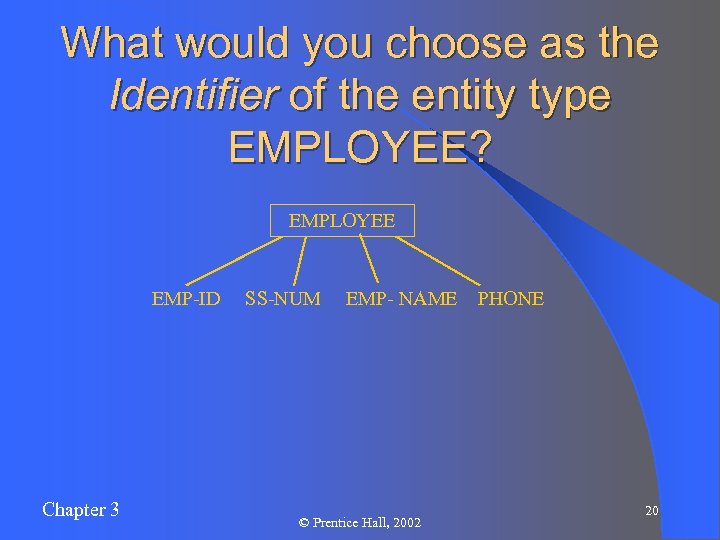
What would you choose as the Identifier of the entity type EMPLOYEE? EMPLOYEE EMP-ID Chapter 3 SS-NUM EMP- NAME © Prentice Hall, 2002 PHONE 20
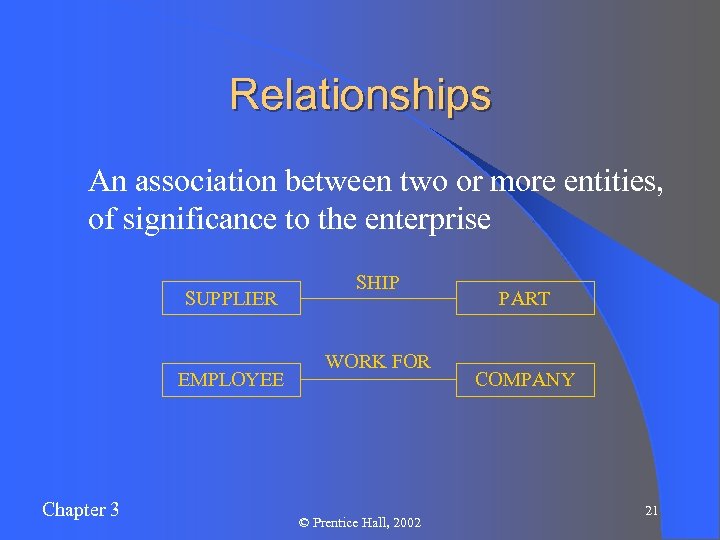
Relationships l An association between two or more entities, of significance to the enterprise SUPPLIER EMPLOYEE Chapter 3 SHIP WORK FOR © Prentice Hall, 2002 PART COMPANY 21
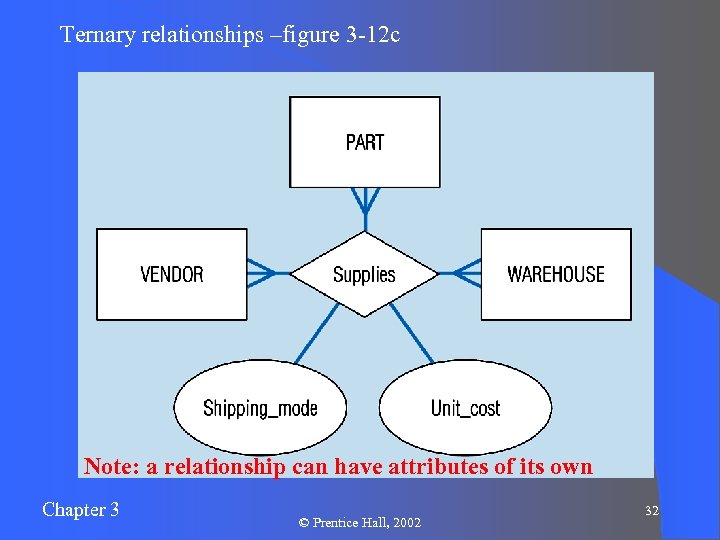
More on Relationships l Relationship Types vs. Relationship Instances – The relationship type is modeled as the diamond and lines between entity types…the instance is between specific entity instances l Relationships can have attributes – These describe features pertaining to the association between the entities in the relationship Two entities can have more than one type of relationship between them (multiple relationships) l Associative Entity = combination of relationship and entity l – More on this later Chapter 3 © Prentice Hall, 2002 22
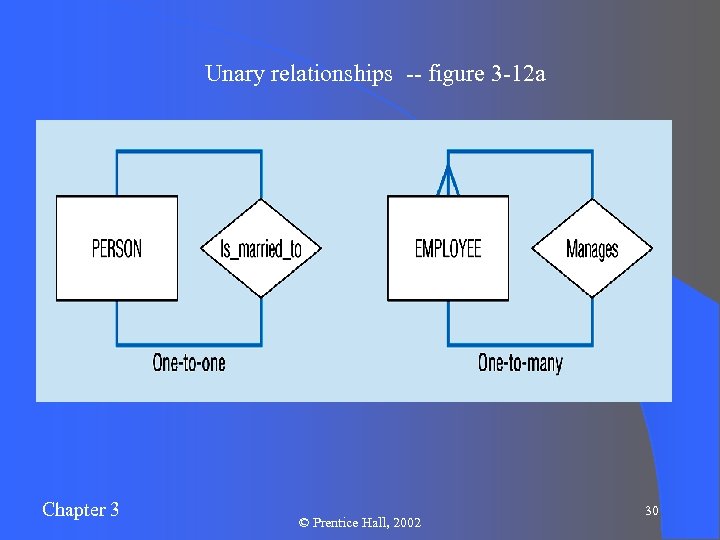
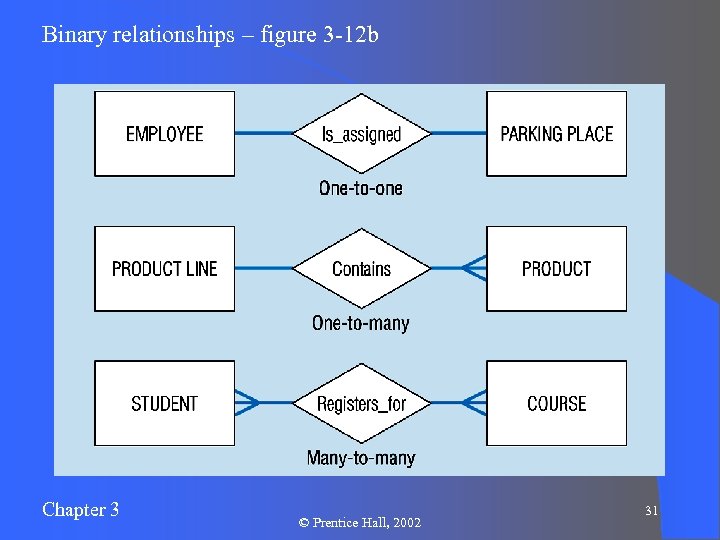
Degree of Relationships l. Degree of a Relationship is the number of entity types that participate in it – Unary Relationship – Binary Relationship – Ternary Relationship Chapter 3 © Prentice Hall, 2002 23
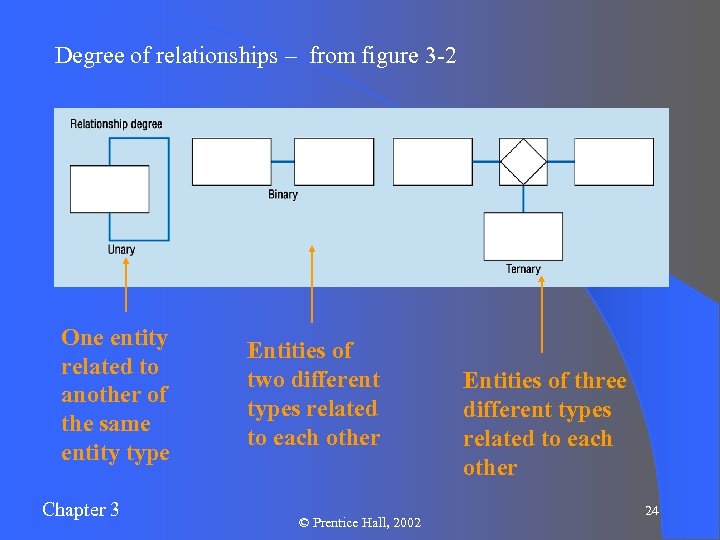
Degree of relationships – from figure 3 -2 One entity related to another of the same entity type Chapter 3 Entities of two different types related to each other © Prentice Hall, 2002 Entities of three different types related to each other 24
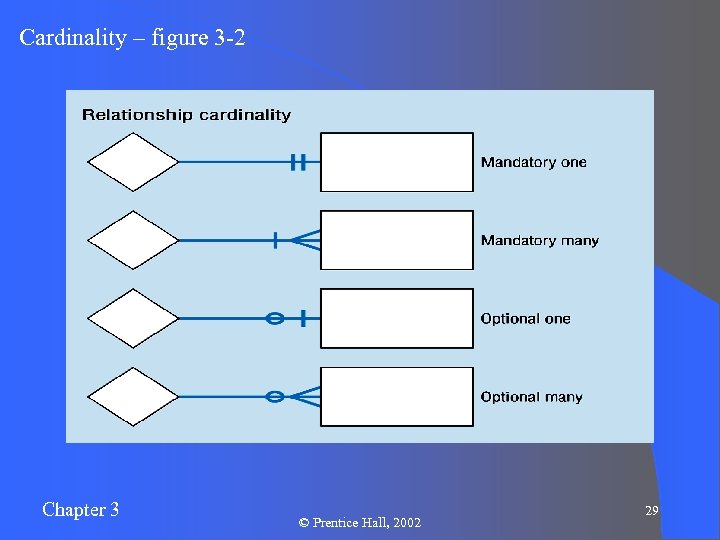
Cardinality Constraints l. A binary relationship (E 1, E 2) has two directions, left and right l Each direction has cardinality constraints, described as maximum and mimimu. Chapter 3 © Prentice Hall, 2002 25
Cardinality Constraints l Cardinality Constraints - the number of instances of one entity that can or must be associated with each instance of another entity. l Maximum Cardinality (can be) – The maximum number Minimum Cardinality (must be) – If zero, then optional – If one or more, then mandatory Chapter 3 © Prentice Hall, 2002 26
Cardinality of Relationships l One – to – One – Each entity in the relationship will have exactly one related entity l One – to – Many – An entity on one side of the relationship can have many related entities, but an entity on the other side will have a maximum of one related entity l Many – to – Many – Entities on both sides of the relationship can have many related entities on the other side Chapter 3 © Prentice Hall, 2002 27
Cardinality Constraints l Cardinality Constraints - the number of instances of one entity that can or must be associated with each instance of another entity. l Minimum Cardinality – If zero, then optional – If one or more, then mandatory l Maximum Cardinality – The maximum number Chapter 3 © Prentice Hall, 2002 28
Cardinality – figure 3 -2 Chapter 3 © Prentice Hall, 2002 29
Unary relationships -- figure 3 -12 a Chapter 3 © Prentice Hall, 2002 30
Binary relationships – figure 3 -12 b Chapter 3 © Prentice Hall, 2002 31
Ternary relationships –figure 3 -12 c Note: a relationship can have attributes of its own Chapter 3 © Prentice Hall, 2002 32
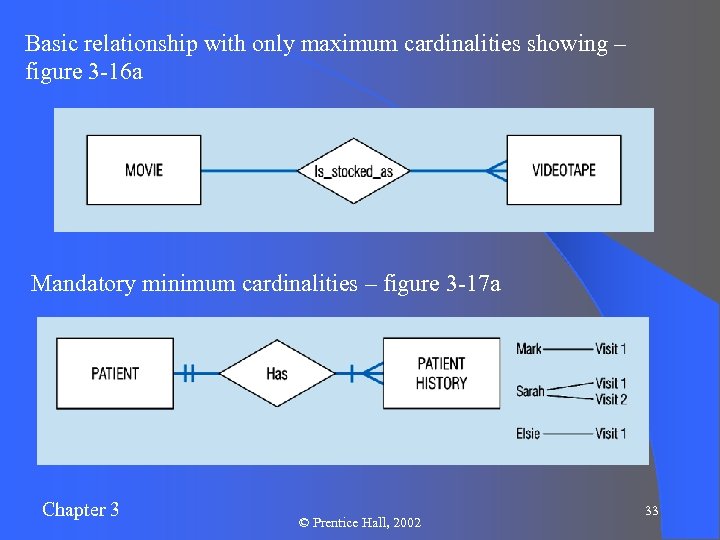
Basic relationship with only maximum cardinalities showing – figure 3 -16 a Mandatory minimum cardinalities – figure 3 -17 a Chapter 3 © Prentice Hall, 2002 33
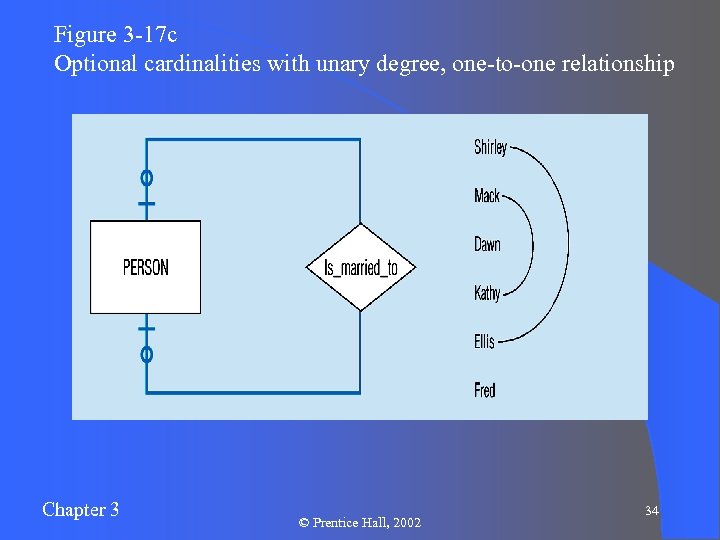
Figure 3 -17 c Optional cardinalities with unary degree, one-to-one relationship Chapter 3 © Prentice Hall, 2002 34
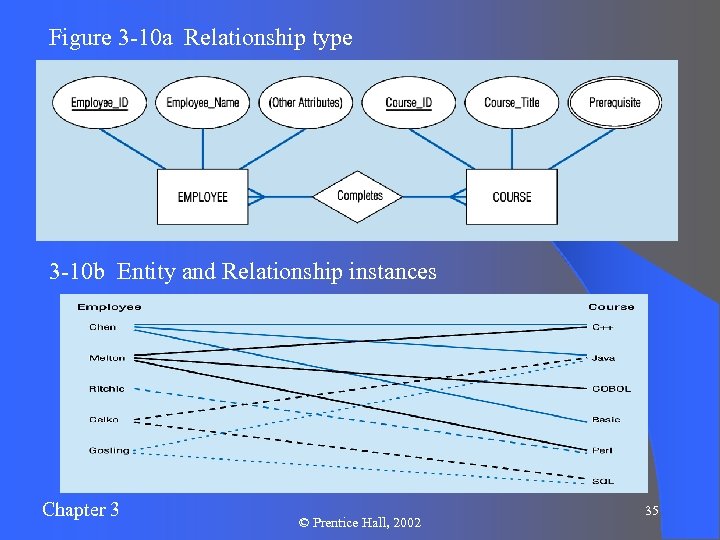
Figure 3 -10 a Relationship type 3 -10 b Entity and Relationship instances Chapter 3 © Prentice Hall, 2002 35
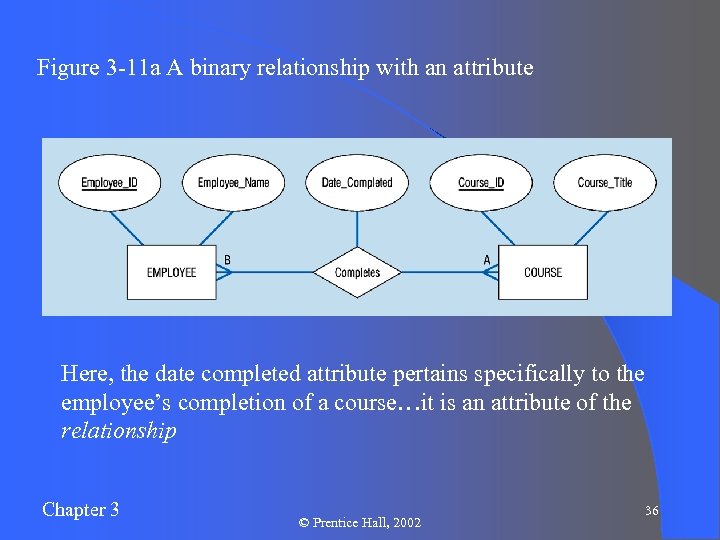
Figure 3 -11 a A binary relationship with an attribute Here, the date completed attribute pertains specifically to the employee’s completion of a course…it is an attribute of the relationship Chapter 3 © Prentice Hall, 2002 36
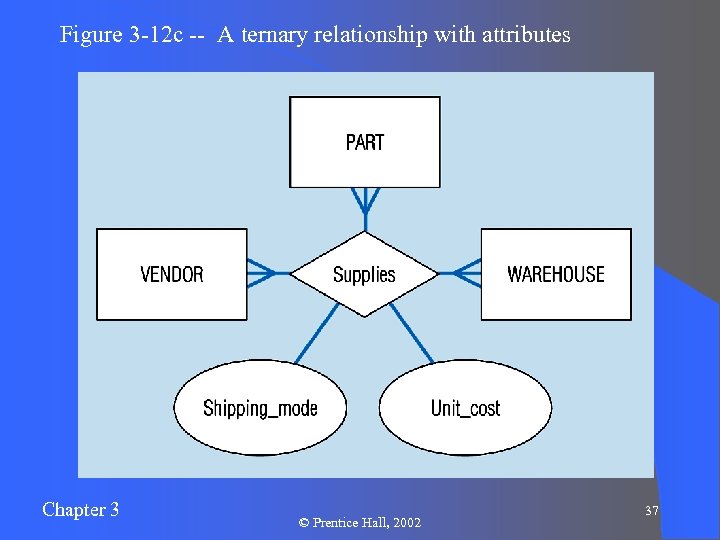
Figure 3 -12 c -- A ternary relationship with attributes Chapter 3 © Prentice Hall, 2002 37
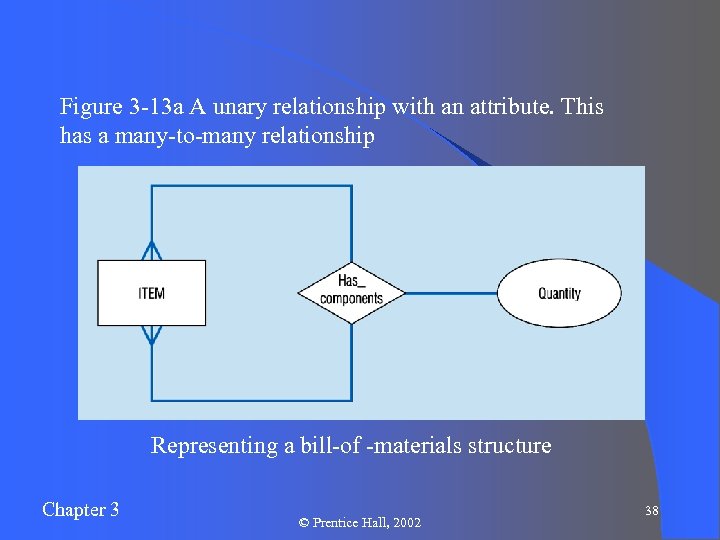
Figure 3 -13 a A unary relationship with an attribute. This has a many-to-many relationship Representing a bill-of -materials structure Chapter 3 © Prentice Hall, 2002 38
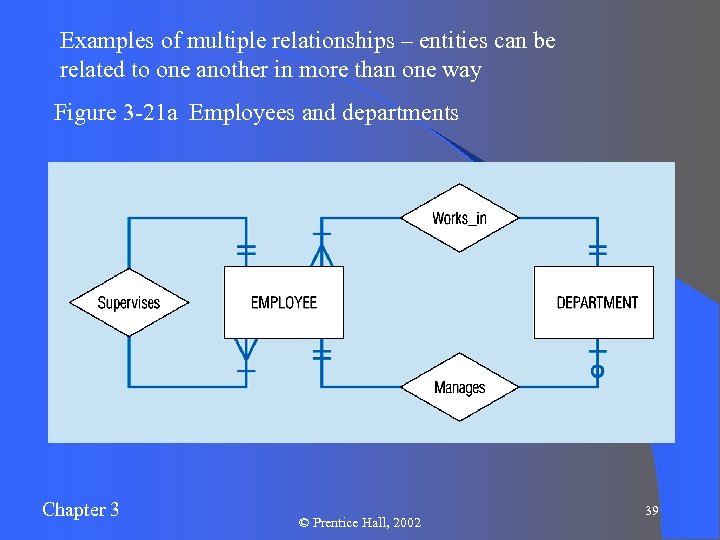
Examples of multiple relationships – entities can be related to one another in more than one way Figure 3 -21 a Employees and departments Chapter 3 © Prentice Hall, 2002 39
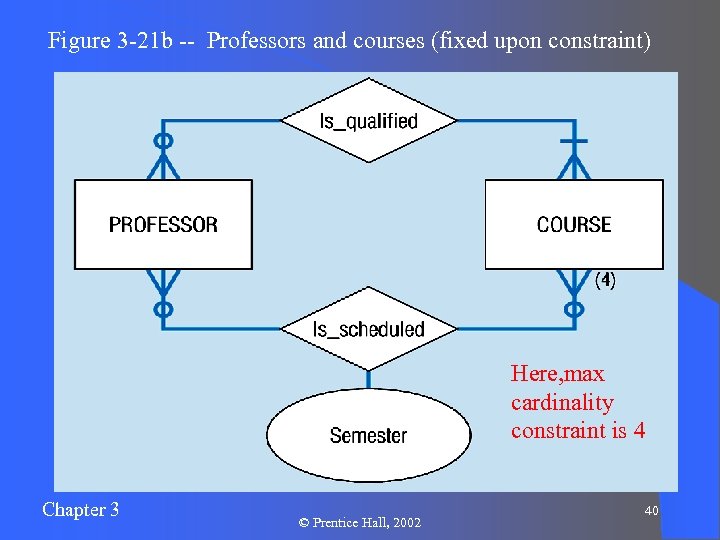
Figure 3 -21 b -- Professors and courses (fixed upon constraint) Here, max cardinality constraint is 4 Chapter 3 © Prentice Hall, 2002 40
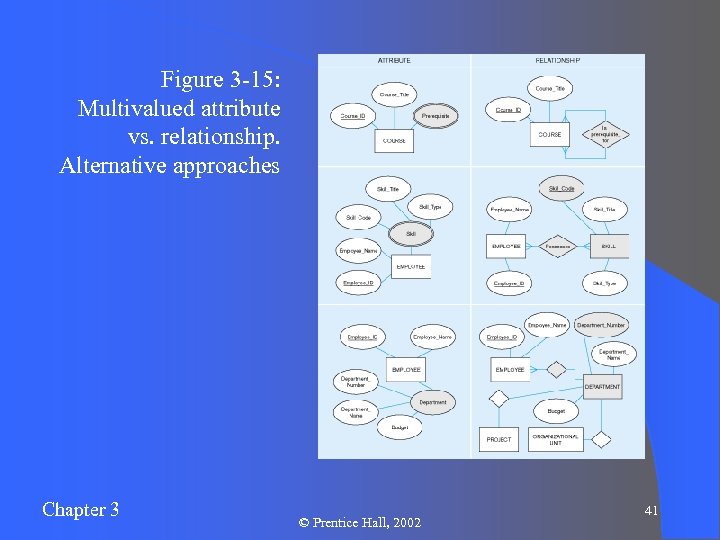
Figure 3 -15: Multivalued attribute vs. relationship. Alternative approaches Chapter 3 © Prentice Hall, 2002 41
Dependent and Independent Entities l Entity B is existence-dependent on entity A when – Some instance of A must exist before B can exist – If A ceases to exist, B must also cease to exist l An independent entity is not existence-dependent on any other entity l Independent Entity – Strong Entity l Dependent Entity – Weak Entity l Diagramming convention Chapter 3 © Prentice Hall, 2002 42
Strong vs. Weak Entities, and Identifying Relationships l Strong entities – exist independently of other types of entities – has its own unique identifier – represented with single-line rectangle l Weak entity – dependent on a strong entity…cannot exist on its own – Does not have a unique identifier – represented with double-line rectangle l Identifying relationship – links strong entities to weak entities – represented with double line diamond Chapter 3 © Prentice Hall, 2002 43
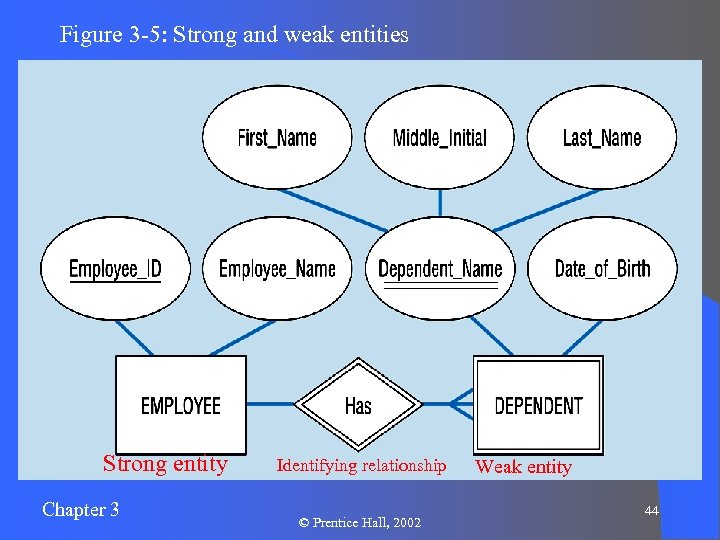
Figure 3 -5: Strong and weak entities Strong entity Chapter 3 Identifying relationship © Prentice Hall, 2002 Weak entity 44
Associative Entities entity – it has attributes l It’s an l AND it’s a l When should a relationship associative entity? relationship – it links entities together with attributes instead be an – All relationships for the associative entity should be many – The associative entity could have meaning independent of the other entities – The associative entity preferably has a unique identifier, and should also have other attributes – The associative may be participating in other relationships other than the entities of the associated relationship – Ternary relationships should be converted to associative entities (p 102) Chapter 3 © Prentice Hall, 2002 45
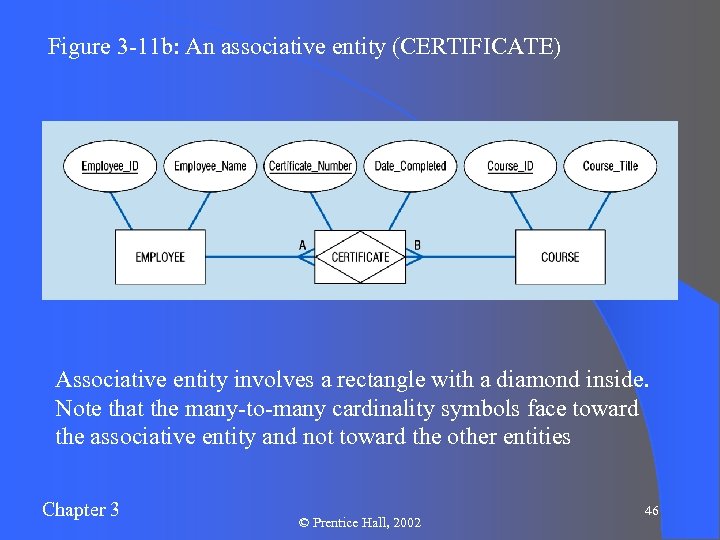
Figure 3 -11 b: An associative entity (CERTIFICATE) Associative entity involves a rectangle with a diamond inside. Note that the many-to-many cardinality symbols face toward the associative entity and not toward the other entities Chapter 3 © Prentice Hall, 2002 46
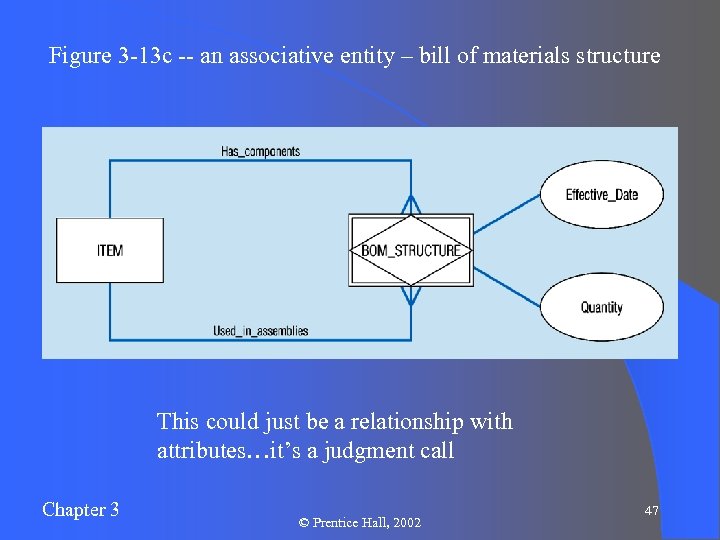
Figure 3 -13 c -- an associative entity – bill of materials structure This could just be a relationship with attributes…it’s a judgment call Chapter 3 © Prentice Hall, 2002 47
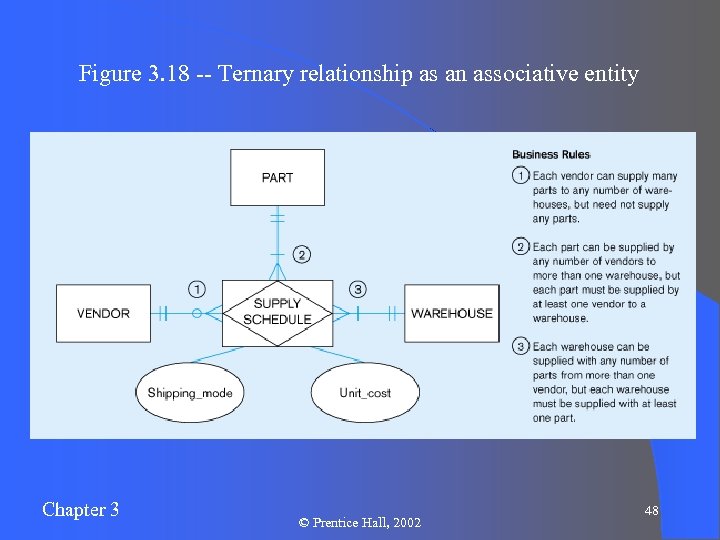
Figure 3. 18 -- Ternary relationship as an associative entity Chapter 3 © Prentice Hall, 2002 48
Скачать презентацию CMIS 564 E R Modeling Dr Bordoloi Based on
40a9ea7287a61b5b708b1cb39e7378af.ppt