


 Скачать презентацию CMI as a Precursor to the EIT Michael
5de9c1a35634799515e398d88f891916.ppt
- Количество слайдов: 23
 CMI as a Precursor to the EIT Michael Kelly (Director 2003 -5: Prof Mike Gregory CBE 2005 - ) 24 November 2008 Bratislava 15 November 2005 Strasbourg
 What was CMI? • A $100 M initiative of the UK Chancellor of the Exchequer in 2000 for six years • 2 Strategic Partners – BT & BP (£ 2. 5 million) + Gatsby Trust (£ 5 M) + £ 6 M from other ‘industry’ • 100% funded by the UK • 50%: 50% owned by CU and MIT • CMI’s objective was to improve UK competitiveness and productivity and entrepreneurship, through: – improving knowledge exchange – practice and models – changing UK university culture – a long-term project • Now a residual CU-MIT Partnership Programme 2
 CMI Mission To enhance the competitiveness, productivity and entrepreneurship of the UK economy… By improving the effectiveness of knowledge exchange between university and industry, educating leaders, creating new ideas, and developing programmes for change in universities, industry and government … Using an enduring partnership of Cambridge and MIT, and an extended network of participants. 3
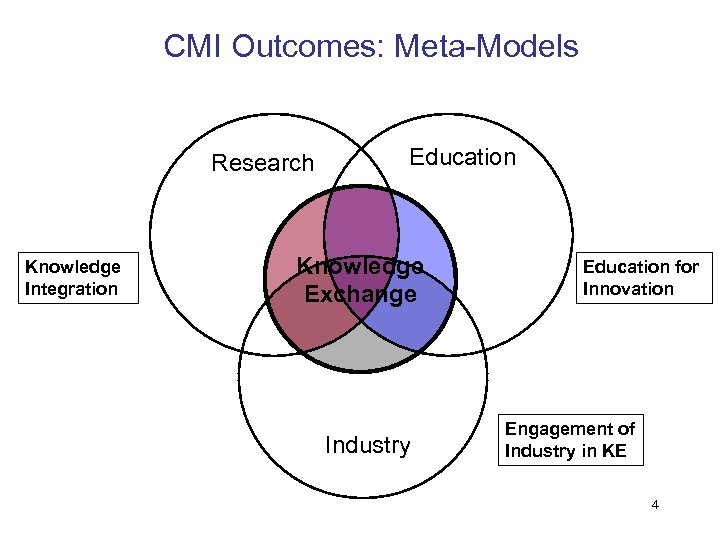 CMI Outcomes: Meta-Models Research Knowledge Integration Education Knowledge Exchange Industry Education for Innovation Engagement of Industry in KE 4
 Education for Innovation • Education for innovation requires: – Deep conceptual understanding – Personal and interpersonal skills – Self efficacy • Leading to new curricula (bio-engineering, projects to bring out skills, mixed technicalbusiness MPhils, undergraduate exchange, …. . 5
 Knowledge Integration in Research • Knowledge integration in research requires: – Fundamental new ideas, developed with a consideration of use – Awareness of the needs of society and industry – The development of integrated communities • Leading formation of Knowledge Integration Communities around emerging technologies - aviation, drug discovery, communications, technology management, quantum computing, … • New ones being developed in financial sector, future healthcare systems, energy reliability, future cities, and the creative industries 6
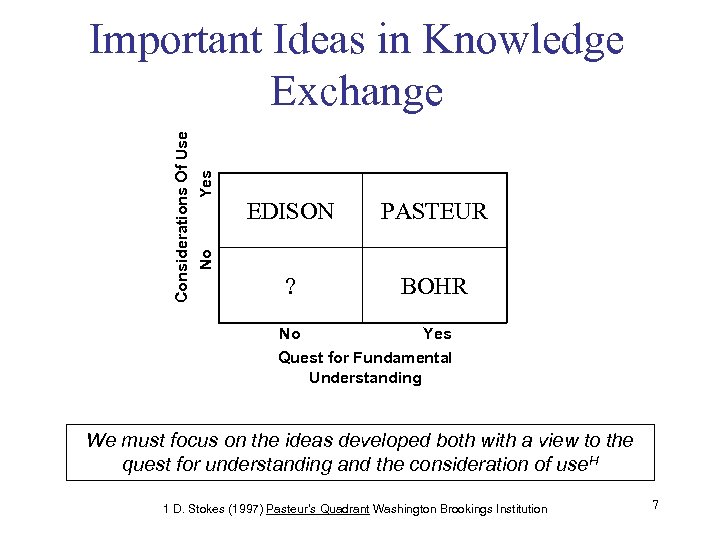 Considerations Of Use No Yes Important Ideas in Knowledge Exchange EDISON PASTEUR ? BOHR No Yes Quest for Fundamental Understanding We must focus on the ideas developed both with a view to the quest for understanding and the consideration of use. H 1 D. Stokes (1997) Pasteur’s Quadrant Washington Brookings Institution 7
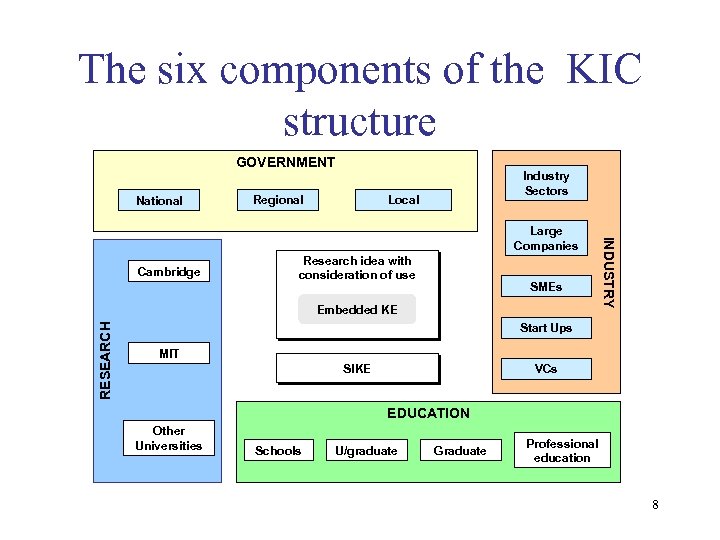 The six components of the KIC structure GOVERNMENT National Industry Sectors Local Regional Cambridge Research idea with consideration of use SMEs RESEARCH Embedded KE INDUSTRY Large Companies Start Ups MIT SIKE VCs EDUCATION Other Universities Schools U/graduate Graduate Professional education 8
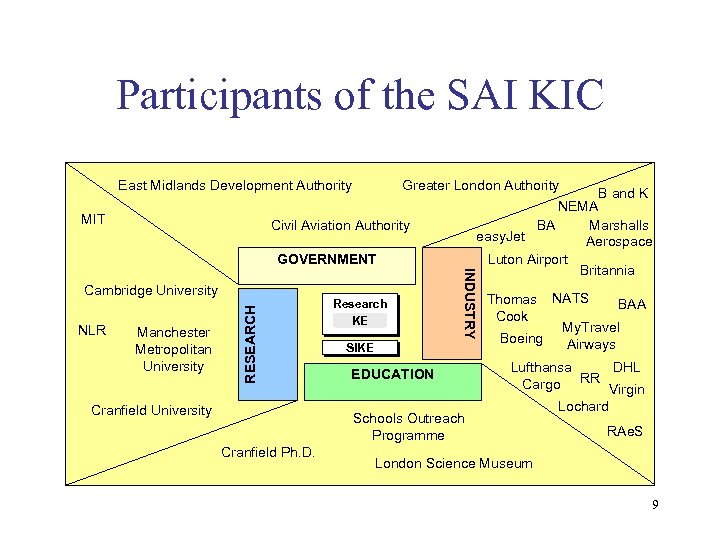 Participants of the SAI KIC East Midlands Development Authority MIT NLR Manchester Metropolitan University RESEARCH Cambridge University Cranfield University Research idea KE INDUSTRY Greater London Authority B and K NEMA Marshalls Civil Aviation Authority BA easy. Jet Aerospace GOVERNMENT Luton Airport Britannia SIKE EDUCATION Schools Outreach Programme Cranfield Ph. D. Thomas Cook Boeing NATS BAA My. Travel Airways DHL Lufthansa RR Cargo Virgin Lochard RAe. S London Science Museum 9
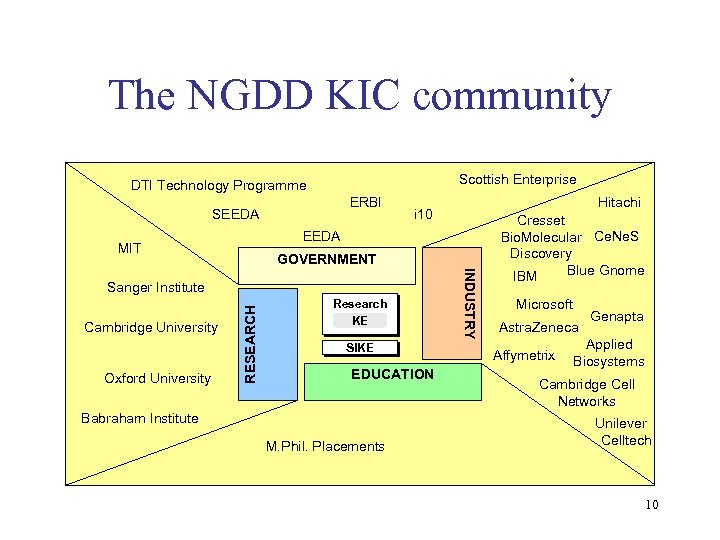 The NGDD KIC community Scottish Enterprise DTI Technology Programme ERBI SEEDA MIT GOVERNMENT RESEARCH Oxford University Research idea KE SIKE EDUCATION Babraham Institute M. Phil. Placements INDUSTRY Sanger Institute Cambridge University Hitachi i 10 Cresset Bio. Molecular Ce. Ne. S Discovery Blue Gnome IBM Microsoft Astra. Zeneca Affymetrix Genapta Applied Biosystems Cambridge Cell Networks Unilever Celltech 10
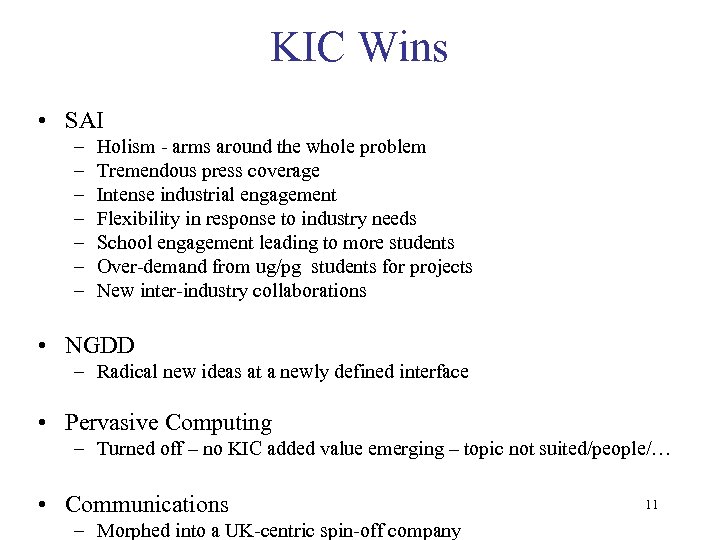 KIC Wins • SAI – – – – Holism - arms around the whole problem Tremendous press coverage Intense industrial engagement Flexibility in response to industry needs School engagement leading to more students Over-demand from ug/pg students for projects New inter-industry collaborations • NGDD – Radical new ideas at a newly defined interface • Pervasive Computing – Turned off – no KIC added value emerging – topic not suited/people/… • Communications – Morphed into a UK-centric spin-off company 11
 Engaging Industry in Knowledge Exchange • Engaging industry in knowledge exchange requires: – Proactively engaging industry in prolonged interaction – Educating and empowering agents of innovation and KE – Promoting a culture in universities and industry, and promotes university involvement in the problems of industry and society • Leading to systematic dialogue with whole industry sectors, e. g. ground transport, construction, retail, leisure, …. , 12
 Early MIT Successes (Sector Interest Groups) • The International Motor Vehicle Federation • The Lean Manufacturing Initiative • The University as a neutral ground to engage on issues of interest to the whole sector • The University as the source of very wideranging expertise. 13
 Sector Interest Groups • CMI uses its brand to bring together senior executives in a sector of the economy to engage in a systematic dialogue with a range of senior academics. • The academics listen in the initial stages - this is important for sector buy-in! • The aim is to identify the strategic issues that offer threats or opportunities to whole sectors (regionally, nationally, globally) on the time-scale of ten years. • From an agreed identification of the issues, joint programmes of research, education, policy development, …. . are framed and agreed • Funding sources to carry out the work are agreed • The cycle repeats on an annual basis. • THIS SHOULD BE THE MODUS OPERANDI FOR EIT 14 KIC FORMATION
 Scope of Engaging Industry (at end 2005 – more came later) • Over 150 companies involved with our research projects and KICs. • Over 40 companies involved with our MPhil projects • Over 50 companies involved in our SIG process • Dozens of companies involved with our educational programmes 15
 The Regions • CMI as the Cambridge SEC - source of material for other SECs. • Summits – RDA based • Regional Innovation Strategy - LDA, EEDA, SEEDA - CMI a partner • Scottish Enterprise Building robust academic-industry links • Other projects on SIKE etc in regions. 16
 ‘Home Runs’ • Praxis - course for Tech Transfer • KICs - e. g. the Silent Aircraft Initiative, holism • Many research breakthroughs: Aging infrastructure, light weight metals, biomaterials, rhodococcus, energy-efficient buildings, … • MPhils, New Curricula, Skills projects… • SIGs - the call to industry • Policy inputs to HMG. • Student exchange - privately supported 17 – etc
 Personal Post-Reflection in 2008 • Final report: ‘Accelerating Innovation by Crossing Boundaries’ at //www. cambridge-mit. org/downloads/ • Why no Phase II? • Some embedded practices – could have been more • Widespread emulation of CMI by RCUK, EIT, … • MIT has follow-up work with Portugal!! • Aging Infrastructure lessons 18
 Summary of CMI • Value over and above business as usual • Bold and innovative experiments at the academic-industrial interface • Knowledge exchange as the key focus • International role model • Large effort on metrics and assessment • Policy inputs • Holism and integration the key attribute 19
 A Final, Personal, Note on EIT • MIT evolved over decades - the EIT sponsors will have to be patient - 30 years minimum • Is MIT’s success in the US transportable to EU? • MIT acts locally in greater Boston: 0. 25 M students and a very strong high-tech hinterland • Brand is earned, not bought. • Culture/Ethos takes time to develop and be recognised. • EIT will never work if faculty are civil servants • EIT reacting with ETH, KTH, TUM, IC, EP? • Does not come cheap: MIT >$1 B /annum • Is building enough (the only dated suggestion from 2005!!!) • Don’t start unless you are determined to succeed, and can see the way, i. e. sustained united political will coupled with strong and 20 independent academic leadership.
 KICS for 2009 • Climate resilience, energy efficiency and sustainability of the EU built environment • Future demographics – the nature of the EU community and society with an aging, more diverse, and multi-ethic population • The Future Health of Europe – prevention before cure of illness and disease • A Resilient Economy – first- and secondmover advantage in a rapidly changing world 21
 Thank You and Further Discussion 22
 Keys to MIT • Founding charter - mens et manus, industrial arts, land grant … • Technology “culture” pervasive - “A great university polarized around science and technology” • Industry influence ever-present - visiting committees, MIT Corporation, entrepreneurship centre, … • Interdisciplinary problem-based approach - enabled in part by a unified campus and faculty (e. g. Engineering-Sloan) • Flexibility and responsiveness to external opportunities - Radar (Rad. Lab), Educational Technology (Open Courseware) • Supporting infrastructure - ILP, TLO, which are explicitly charge with creating long term relationships and intermediating with industry • Culture - risk acceptable, entrepreneurship celebrated, … • Clarity and flexibility of policy - IP, outside professional activities • Close linkage of research and education - transfer of research results to education, UROP, intellectual continuum • Bold strong academic leaders - Bush, Draper, Vest, … MIT is both a member of the networks and source of best practice 23