 Скачать презентацию CME as a Bridge To Quality Presentation to
db8cfb3bfbf789b5e440d571485dba93.ppt
- Количество слайдов: 46



![CME as a Bridge To Quality Presentation to [type here to replace this text]](https://present5.com/presentation/db8cfb3bfbf789b5e440d571485dba93/image-1.jpg "CME as a Bridge To Quality Presentation to [type here to replace this text]")
CME as a Bridge To Quality Presentation to [type here to replace this text] © 2008 ACCME
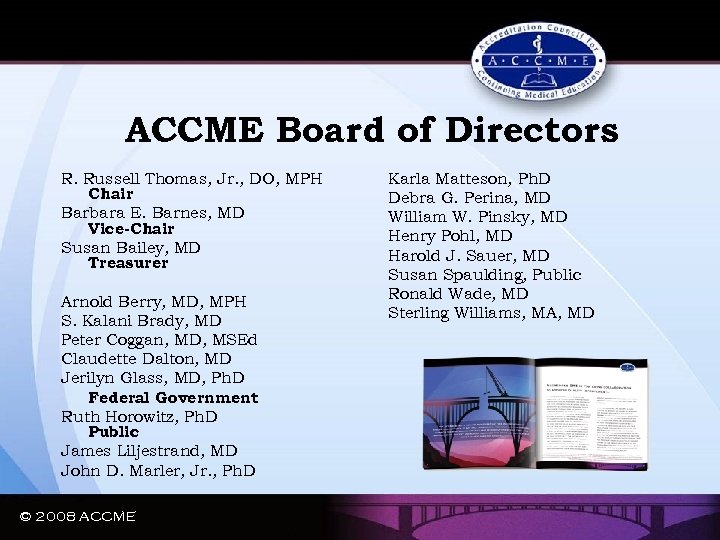
ACCME Board of Directors R. Russell Thomas, Jr. , DO, MPH Chair Barbara E. Barnes, MD Vice-Chair Susan Bailey, MD Treasurer Arnold Berry, MD, MPH S. Kalani Brady, MD Peter Coggan, MD, MSEd Claudette Dalton, MD Jerilyn Glass, MD, Ph. D Federal Government Ruth Horowitz, Ph. D Public James Liljestrand, MD John D. Marler, Jr. , Ph. D © 2008 ACCME Karla Matteson, Ph. D Debra G. Perina, MD William W. Pinsky, MD Henry Pohl, MD Harold J. Sauer, MD Susan Spaulding, Public Ronald Wade, MD Sterling Williams, MA, MD
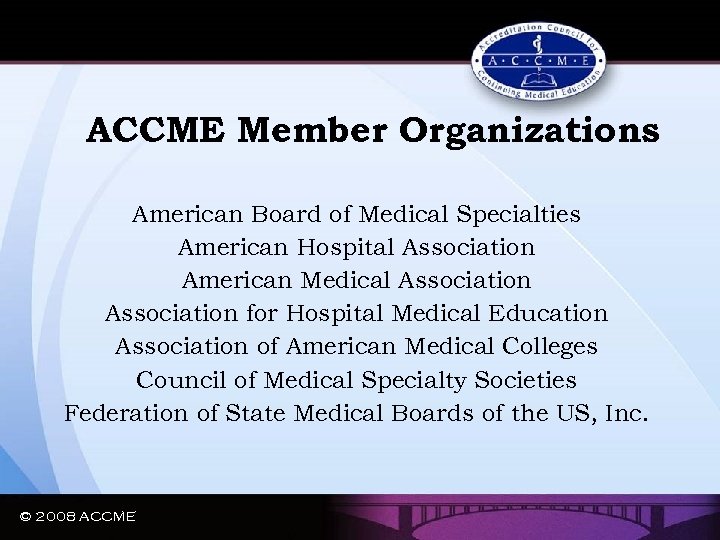
ACCME Member Organizations American Board of Medical Specialties American Hospital Association American Medical Association for Hospital Medical Education Association of American Medical Colleges Council of Medical Specialty Societies Federation of State Medical Boards of the US, Inc. © 2008 ACCME
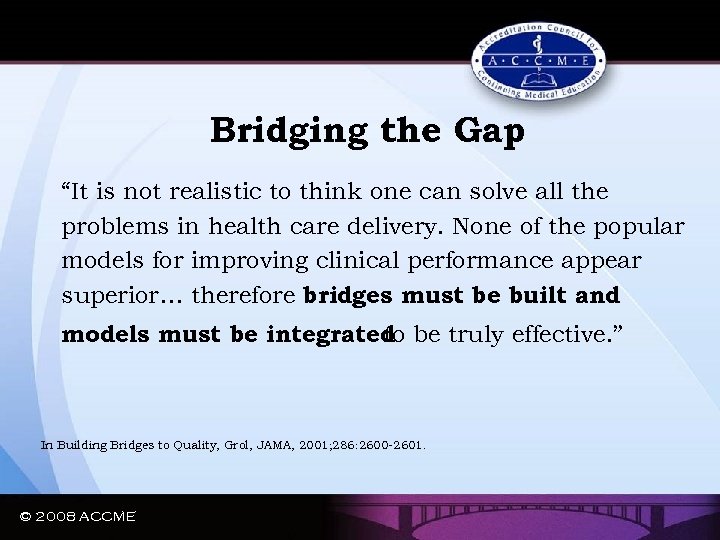
Bridging the Gap “It is not realistic to think one can solve all the problems in health care delivery. None of the popular models for improving clinical performance appear superior… therefore bridges must be built and models must be integrated be truly effective. ” to In Building Bridges to Quality, Grol, JAMA, 2001; 286: 2600 -2601. © 2008 ACCME
ACCME’s Role Accredited CME is an essential component of continuing physician professional development in the eyes of the ACCME member organizations For almost 30 years, the ACCME system for accredited continuing medical education has provided standards, criteria, and policies that define what it means to be a provider of CME © 2008 ACCME
ACCME Recognizes… US health care is at a crossroads and Accredited CME is being asked to provide solutions. It is a critical time for CME to address the competency and performance gaps of physicians… © 2008 ACCME
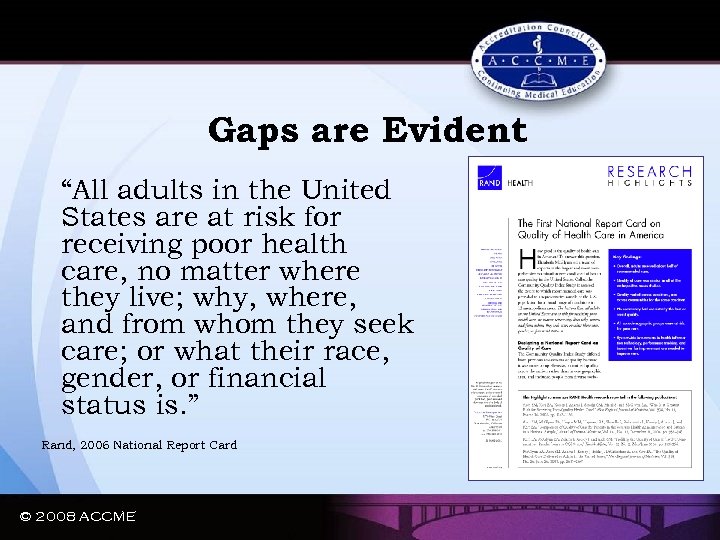
Gaps are Evident “All adults in the United States are at risk for receiving poor health care, no matter where they live; why, where, and from whom they seek care; or what their race, gender, or financial status is. ” Rand, 2006 National Report Card © 2008 ACCME
Accredited CME • Connects current practice to best practice • Is one of our nation’s strategic assets for improving care • Is an important partner for change to your physicians and your community of practice • An essential link between the life-long learning of physicians and State and Federal requirements for physician licensure and Maintenance of Certification™ © 2008 ACCME
You Need to Understand Your stakeholders need to understand just how important this role of CME is to the healthcare mission of your organization It is a critical time for CME to make absolutely sure that it is widely known what CME, – is doing – will be doing – is capable of doing © 2008 ACCME
It’s a Critical Time It’s time to call a meeting to discuss… CME as a Bridge to Quality © 2008 ACCME
Cementing the Construct… © 2008 ACCME
Meeting Agenda Accredited CME… • Linked to practice and focused on quality gaps • Supports Maintenance of Certification® • Requirement of maintenance of licensure • Fostering collaboration to address QI • Addressing interdisciplinary teams • Independent of commercial interests Education that mattersto patient care © 2008 ACCME
Background Is CME effective? – Highest level of research evidence says “yes” – 2007 Metasynthesis from US Agency for Healthcare Research and Quality Rand, 2006 National Report Card © 2008 ACCME
CME AS A BRIDGE TO QUALITY Accredited CMEis linked to practice and focused on healthcare quality gaps. © 2008 ACCME
Synonymous with Practice-Based Learning and Improvement • Activities are linked to practice-based needs (Updated Criterion 2) • Content of CME matches the scope of the learner’s practice (Updated Criterion 4) • Measurements of change in competence, performance or patient outcomes will be available (Updated Criterion 11) © 2008 ACCME
Practice Improvement 16. The provider operates in a manner that integrates CME into the process for improving professional practice. 19. The 17. The provider utilizes noneducation strategies to enhance change as an adjunct to its activities/educational interventions (e. g. , reminders, patient feedback). 20. The provider builds bridges with other stakeholders through collaboration and cooperation. 18. The provider identifies factors outside the provider’s control that impact on patient outcomes. © 2008 ACCME provider implements educational strategies to remove, overcome or address barriers to physician change. 21. The provider participates within an institutional or system framework for quality improvement. 22. The provider is positioned to influence the scope and content of activities/educational interventions.
CME AS A BRIDGE TO QUALITY Accredited CMEsupports physicians’ maintenance of certification. © 2008 ACCME
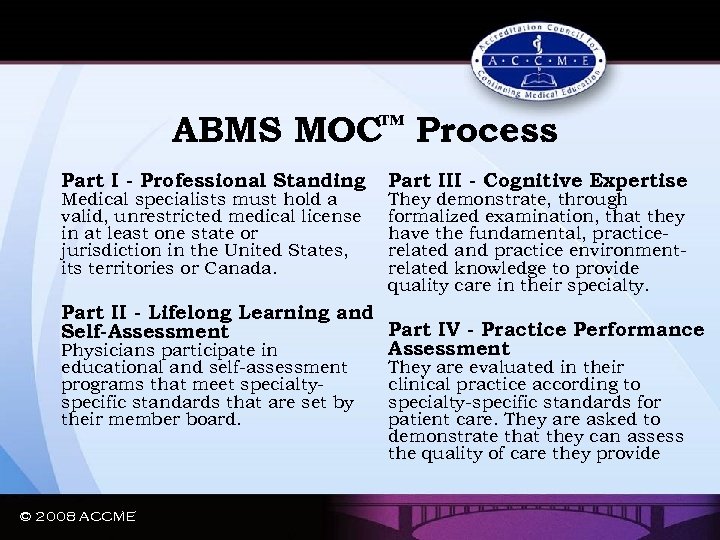
ABMS MOC™ Process Part I - Professional Standing Medical specialists must hold a valid, unrestricted medical license in at least one state or jurisdiction in the United States, its territories or Canada. Part III - Cognitive Expertise They demonstrate, through formalized examination, that they have the fundamental, practicerelated and practice environmentrelated knowledge to provide quality care in their specialty. Part II - Lifelong Learning and Part IV - Practice Performance Self-Assessment Physicians participate in educational and self-assessment programs that meet specialtyspecific standards that are set by their member board. © 2008 ACCME They are evaluated in their clinical practice according to specialty-specific standards for patient care. They are asked to demonstrate that they can assess the quality of care they provide
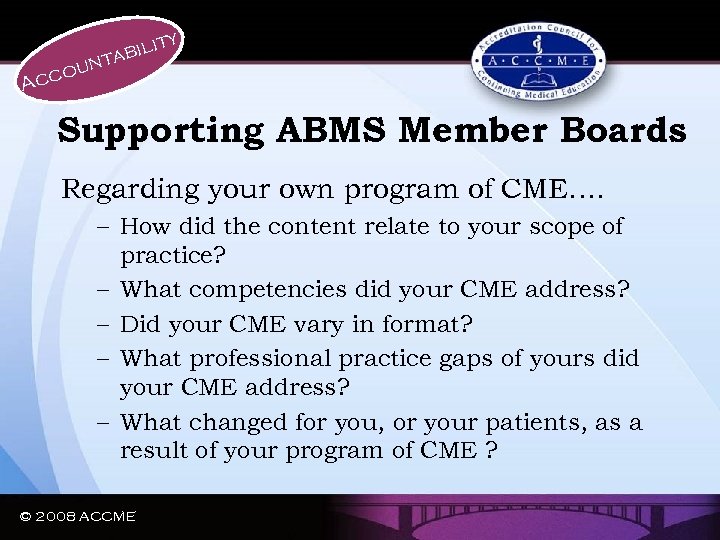
it abil t y n cou Ac Supporting ABMS Member Boards Regarding your own program of CME…. – How did the content relate to your scope of practice? – What competencies did your CME address? – Did your CME vary in format? – What professional practice gaps of yours did your CME address? – What changed for you, or your patients, as a result of your program of CME ? © 2008 ACCME
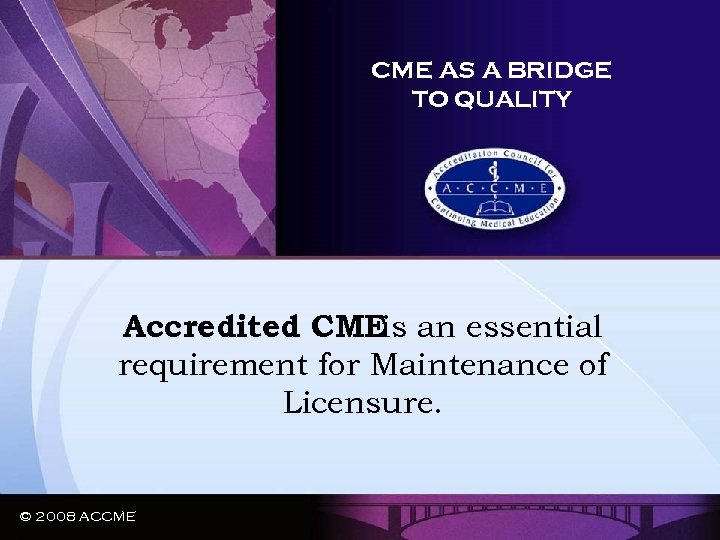
CME AS A BRIDGE TO QUALITY Accredited CMEis an essential requirement for Maintenance of Licensure. © 2008 ACCME
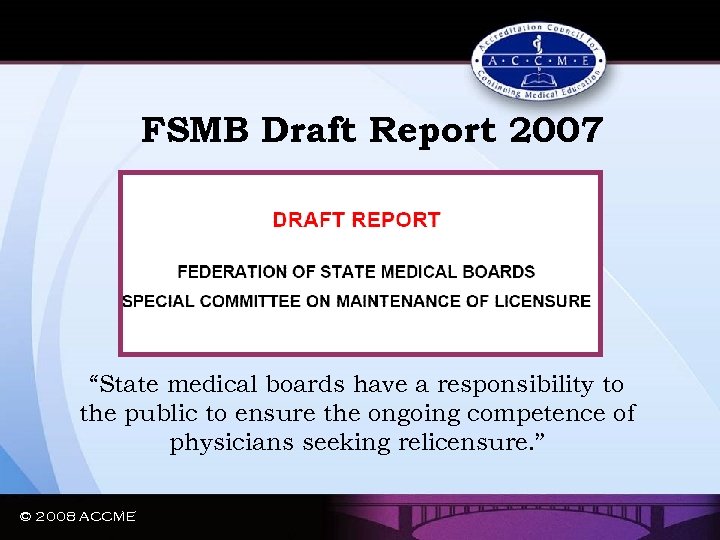
FSMB Draft Report 2007 “State medical boards have a responsibility to the public to ensure the ongoing competence of physicians seeking relicensure. ” © 2008 ACCME
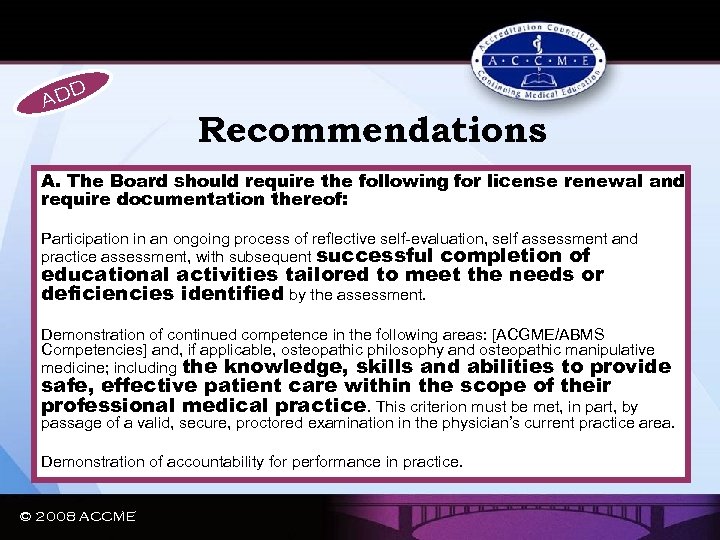
D AD Recommendations A. The Board should require the following for license renewal and require documentation thereof: Participation in an ongoing process of reflective self-evaluation, self assessment and practice assessment, with subsequent successful completion of educational activities tailored to meet the needs or deficiencies identified by the assessment. Demonstration of continued competence in the following areas: [ACGME/ABMS Competencies] and, if applicable, osteopathic philosophy and osteopathic manipulative medicine; including the knowledge, skills and abilities to provide safe, effective patient care within the scope of their professional medical practice. This criterion must be met, in part, by passage of a valid, secure, proctored examination in the physician’s current practice area. Demonstration of accountability for performance in practice. © 2008 ACCME
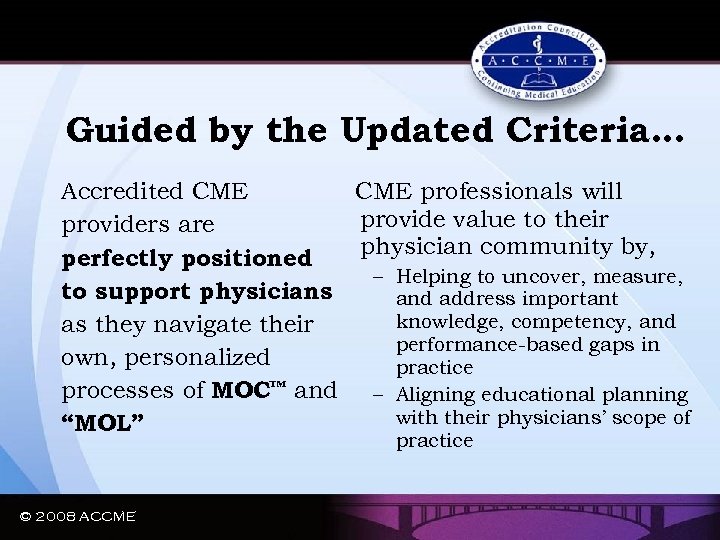
Guided by the Updated Criteria… Accredited CME professionals will provide value to their providers are physician community by, perfectly positioned – Helping to uncover, measure, to support physicians and address important knowledge, competency, and as they navigate their performance-based gaps in own, personalized practice processes of MOC™ and – Aligning educational planning with their physicians’ scope of “MOL” practice © 2008 ACCME
CME AS A BRIDGE TO QUALITY Accredited CMEis fostering collaboration to address quality improvement. © 2008 ACCME
ACCME Will Reward Providers That… • Work towards understanding the healthcare environment in which their physicians practice • Seek solutions beyond their own boundaries • Identify and remove obstacles that stand between current care and best care for patients. © 2008 ACCME
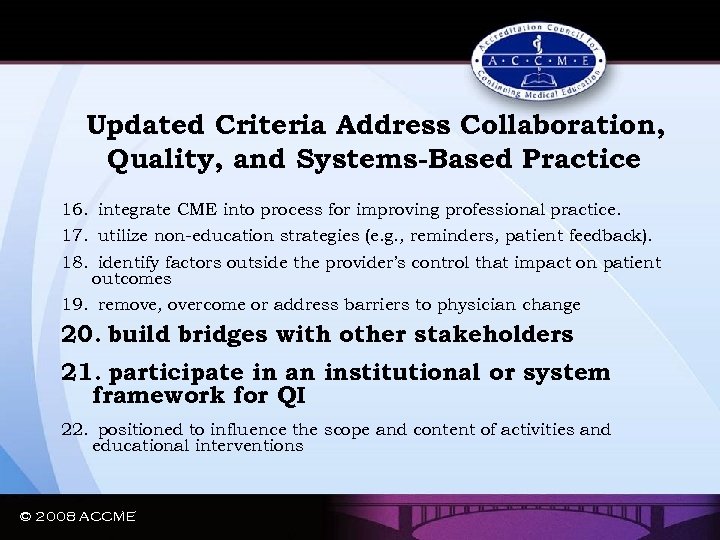
Updated Criteria Address Collaboration, Quality, and Systems-Based Practice 16. integrate CME into process for improving professional practice. 17. utilize non-education strategies (e. g. , reminders, patient feedback). 18. identify factors outside the provider’s control that impact on patient outcomes 19. remove, overcome or address barriers to physician change 20. build bridges with other stakeholders 21. participate in an institutional or system framework for QI 22. positioned to influence the scope and content of activities and educational interventions © 2008 ACCME
ACCME as an example • Striving to embody the model of learning and change described in the Updated Criteriaby providing outreach, education, and coordination to nurture innovation and interaction among key stakeholders • In 2007, these efforts have culminated in productive relationships with multiple healthcare stakeholders © 2008 ACCME
Examples • • • Metropolitan Chicago Breast Cancer Task Force Five regional members of the CMS Better Quality Information to Improve Care for Medicare Beneficiaries pilot program The White House Office of National Drug Control Policy © 2008 ACCME
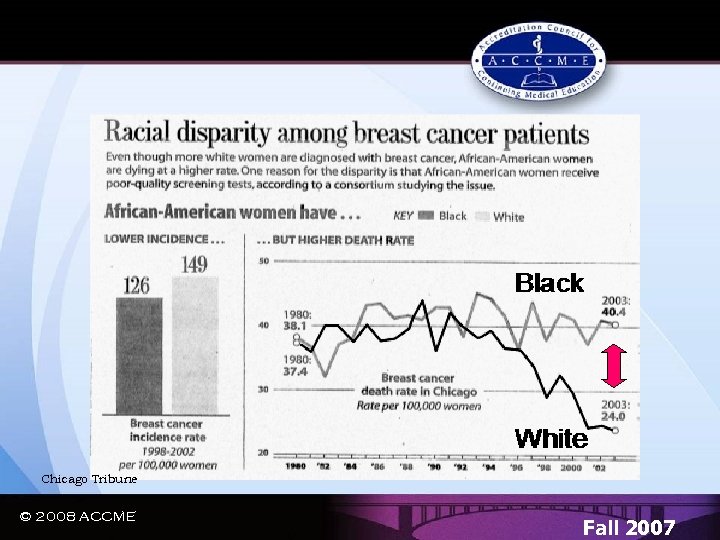
A Regional Quality Gap…. Chicago Tribune © 2008 ACCME Fall 2007
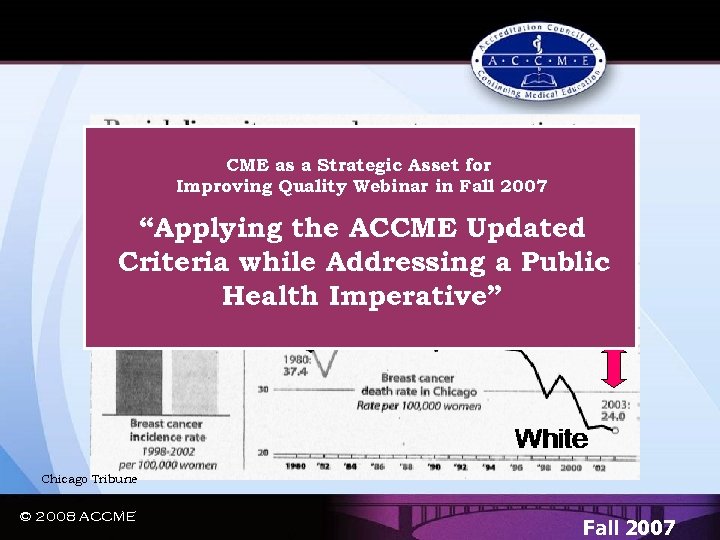
A Regional Quality Gap…. CME as a Strategic Asset for Improving Quality Webinar in Fall 2007 “Applying the ACCME Updated Criteria while Addressing a Public Health Imperative” Chicago Tribune © 2008 ACCME Fall 2007
A Regional Quality Gap…. CME as a Strategic Asset for Improving Quality Webinar in Fall 2007 “Applying the ACCME Updated Criteria while Addressing a Public Health Imperative” A cooperative effort of the Accreditation Council for Continuing Medical Education and The Illinois State Medical Society Chicago Tribune © 2008 ACCME Fall 2007
A Regional Quality Gap…. CME as a Strategic Asset for Improving Quality Webinar in Fall 2007 David A. Ansell, MD, MPH “Applying the ACCME Updated Chief Medical Officer Criteria Rush University Medical Centera Public while Addressing Health Imperative” Murray Kopelow, MD Chief Executive Officer A cooperative effort of for Accreditation Council the Continuing Medical Education Accreditation Council for Continuing Medical Education and The Illinois State Medical Society Chicago Tribune © 2008 ACCME
CME AS A BRIDGE TO QUALITY Accredited CMEis addressing interdisciplinary team practice. © 2008 ACCME
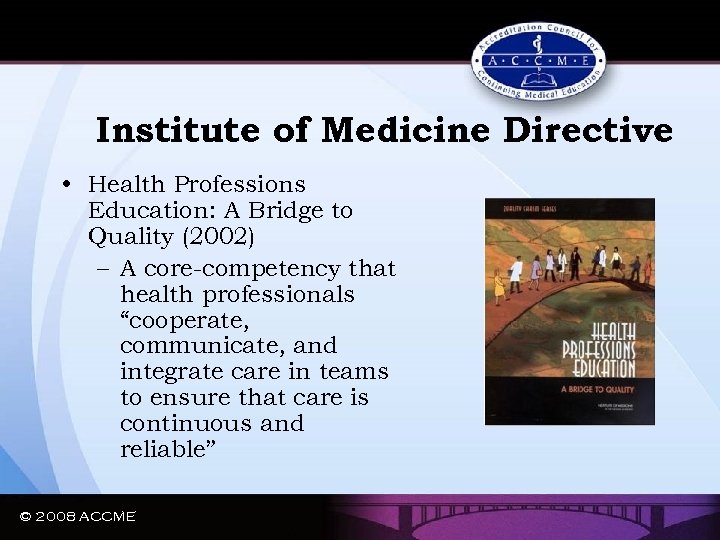
Institute of Medicine Directive • Health Professions Education: A Bridge to Quality (2002) – A core-competency that health professionals “cooperate, communicate, and integrate care in teams to ensure that care is continuous and reliable” © 2008 ACCME
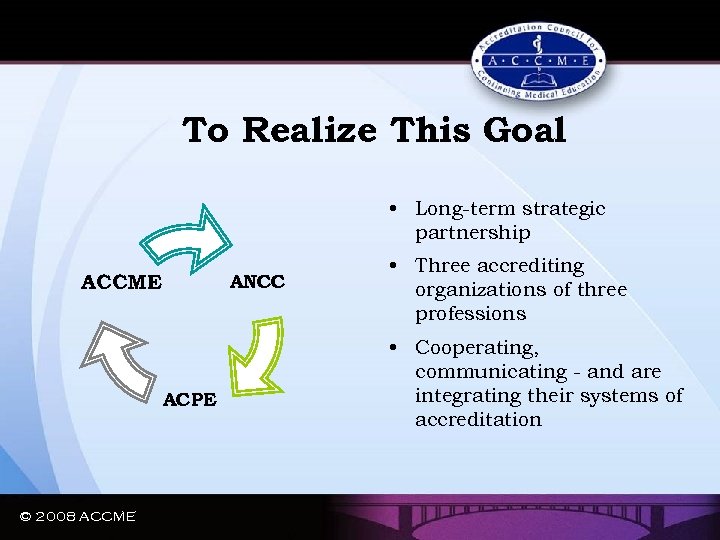
To Realize This Goal • Long-term strategic partnership ACCME ANCC ACPE © 2008 ACCME • Three accrediting organizations of three professions • Cooperating, communicating - and are integrating their systems of accreditation
Since 1998/2005 • All three organizations have actively collaborated to explore areas of synergy • A statement of shared values and future collaborative projects, accepted by the leadership of all three organizations in 2006 © 2008 ACCME
Fruits of Our Collaboration • Alignment of critical aspects of accreditation Requirements and Processes physicians, for nurses, and pharmacists • Shared commitment to safeguard education from commercial interests • Both the ANCC and ACPE adopted the ACCME Standards for Commercial Support™ 2007 in © 2008 ACCME
Committed to Future Collaboration • More standardized terminology for accreditation • Common or shared approaches for accreditation processes • Creation of a special accreditation that rewards providers who engage in multidisciplinary education planned for and by the entire healthcare team © 2008 ACCME
CME AS A BRIDGE TO QUALITY Accredited CMEis independent of commercial interests. © 2008 ACCME
An Endeavor For Medicine, By Medicine When CME fails to be exclusively oriented to measured gaps in the delivery of care we cease to be relevant physicians-in-practice to and we fail the needsof patient care. © 2008 ACCME
Face Validity Our most important stakeholder – the American public demands that the – CME system provide demonstrable value without influence from industry © 2008 ACCME
ACCME Commitment The ACCME is resolutein its efforts to ensure that CME is, – Provided through a valid and credible accreditation system – Independent of commercial interests – Free of commercial bias in all CME topic selection, planning decision, and presentation content © 2008 ACCME
Definition of “Independence” “The concepts of independencefrom industry and collaborationwith industry in the development of [CME] content are mutually exclusive. ” ACCME Board of Directors, Executive Summary from November 2007 Board Meeting © 2008 ACCME
“Independence” (Cont’d) Although commercial interests may provide commercial support for educational activities as defined by the ACCME’s Standards for Commercial Support: Standards to Ensure Independence there is no role for ACCME… defined commercial interests in the development or evaluation of accredited CME activities ACCME Board of Directors, Executive Summary from November 2007 Board Meeting © 2008 ACCME
You Must Accept • Commercial interests’ influence erode the public’s confidence in CME and introduce obstacles for the ACCME system, accredited providers, and their stakeholders. • ACCME will work quickly and effectively to monitor and remove bias and influence from accredited CME • ACCME continues to seek discussion among stakeholders © 2008 ACCME
Taking Action • You have a story to tell • Accredited CME is aligned to the current and future needs of medicine • It is a critical time for CME to make absolutely sure that it is widely known what CME – is doing – will be doing – is capable of doing © 2008 ACCME
Скачать презентацию CME as a Bridge To Quality Presentation to
db8cfb3bfbf789b5e440d571485dba93.ppt