 Скачать презентацию Clustering Technology For Scaleability Jim Gray Microsoft Research
c77d40f3f9c6917334ec129f48235106.ppt
- Количество слайдов: 11




Clustering Technology For Scaleability Jim Gray Microsoft Research http: //www. research. Microsoft. com/~Gray
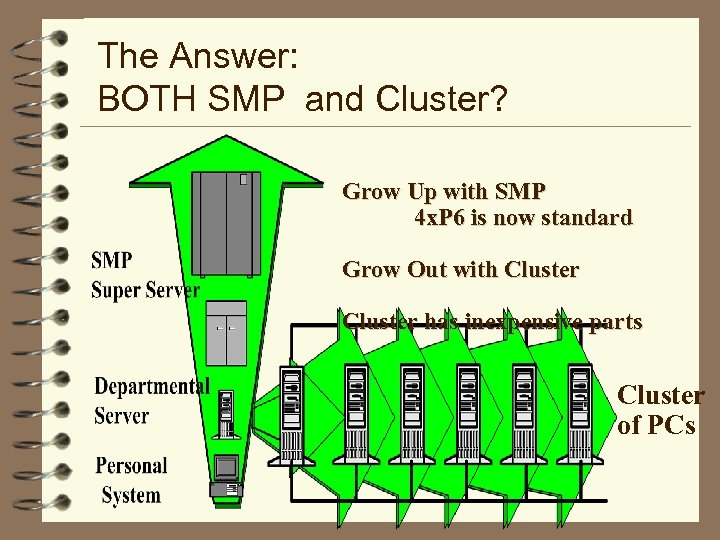
The Answer: BOTH SMP and Cluster? Grow Up with SMP 4 x. P 6 is now standard Grow Out with Cluster has inexpensive parts Cluster of PCs
Clusters being built 4 Teradata 500 nodes (50 k$/slice) 4 Tandem, VMScluster 150 nodes (100 k$/slice) 4 Intel, 9, 000 nodes @ 55 M$ ( 6 k$/slice) 4 IBM: 512 nodes @ 100 m$ (200 k$/slice) 4 PC clusters (bare handed) at dozens of nodes web servers (msn, Point. Cast, …), DB servers 4 KEY TECHNOLOGY HERE IS THE APPS. – Apps distribute data – Apps distribute execution
So, What’s New? 4 When slices cost 50 k$, you buy 10 or 20. 4 When slices cost 5 k$ you buy 100 or 200. 4 Manageability, programmability, usability become key issues (total cost of ownership). 4 PCs are MUCH easier to use and program
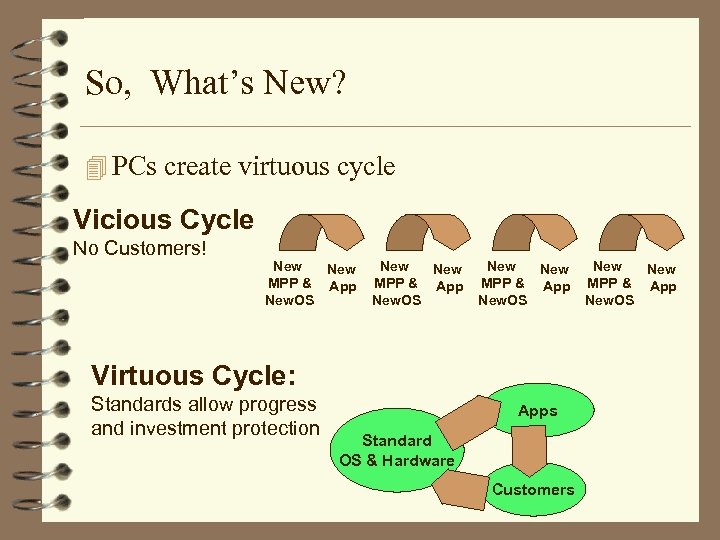
So, What’s New? 4 PCs create virtuous cycle Vicious Cycle No Customers! New New MPP & App New. OS Virtuous Cycle: Standards allow progress and investment protection Apps Standard OS & Hardware Customers New MPP & App New. OS
What is Wolfpack? 4 A consortium of 60 HW & SW vendors (everybody who is anybody) 4 A set of APIs for clustering and fault tolerance 4 An enhancement to NT™ Server (in beta test ) 4 Key concepts – – – System: a particular node Cluster: a collection of systems working together resource: a hardware or software module resource dependency: one resource needs another resource group: fails over as a unit: dependencies do not cross group boundaries
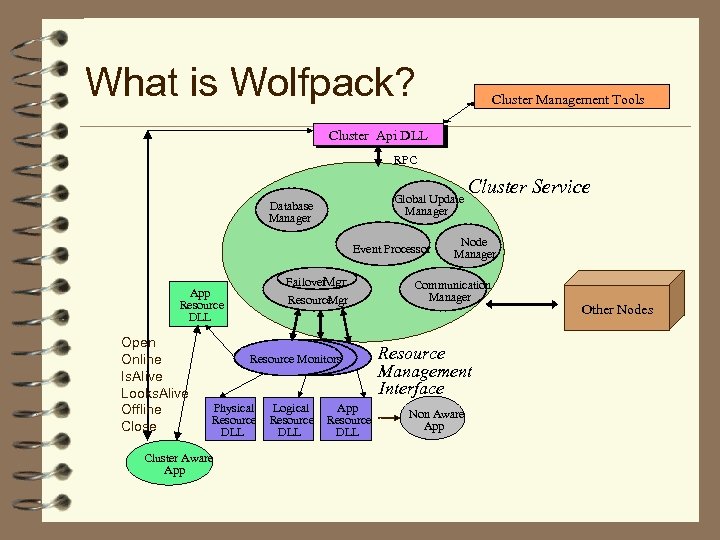
What is Wolfpack? Cluster Management Tools Cluster Api DLL RPC Global Update Manager Database Manager Event Processor Failover Mgr Resource Mgr App Resource DLL Open Online Is. Alive Looks. Alive Offline Close Resource Monitors Physical Resource DLL Cluster Aware App Logical Resource DLL App Resource DLL Cluster Service Node Manager Communication Manager Resource Management Interface Non Aware App Other Nodes
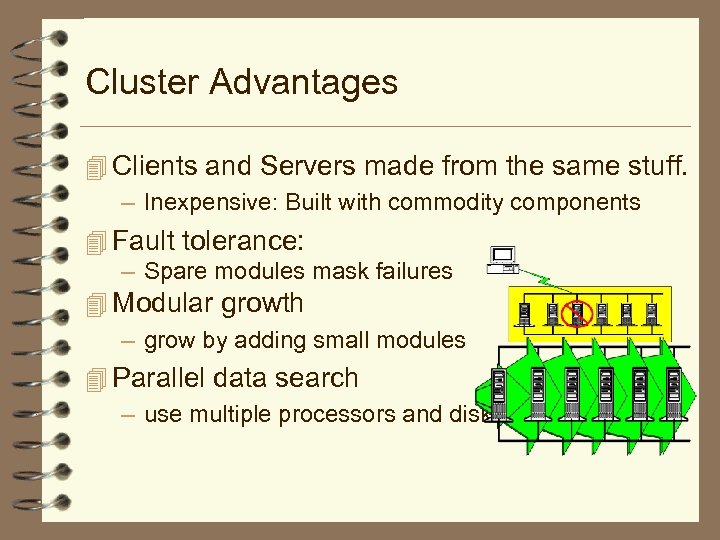
Cluster Advantages 4 Clients and Servers made from the same stuff. – Inexpensive: Built with commodity components 4 Fault tolerance: – Spare modules mask failures 4 Modular growth – grow by adding small modules 4 Parallel data search – use multiple processors and disks
Single System Image: Is It Important? 4 Yes, if you don’t have it you fail – parallel MPPs vs Tandem, Teradata, VAXcluster. 4 NUMA & Cluster: – some things are farther away. – Must program in parallel to • utilize multiple cpus, disks, wires 4 OS, DBMS, TPmonitor, Web Server, ORB give transparency: load balance data and programs. 4 Administrator, Programmer, User – do not want to know about program & data location
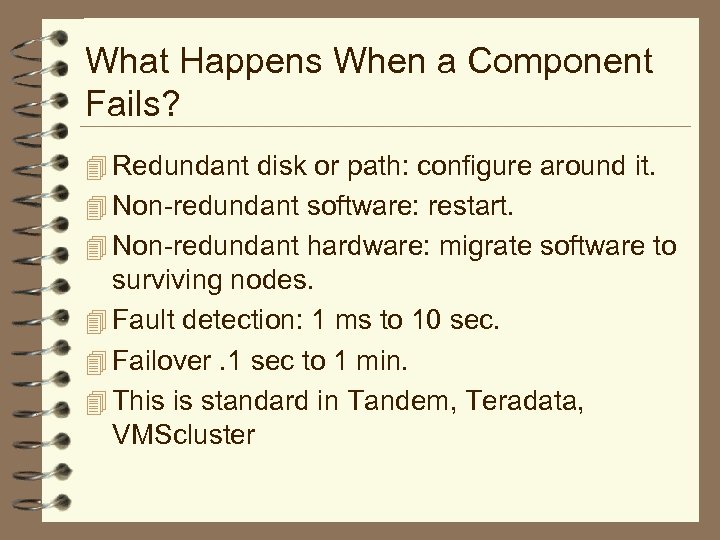
What Happens When a Component Fails? 4 Redundant disk or path: configure around it. 4 Non-redundant software: restart. 4 Non-redundant hardware: migrate software to surviving nodes. 4 Fault detection: 1 ms to 10 sec. 4 Failover. 1 sec to 1 min. 4 This is standard in Tandem, Teradata, VMScluster
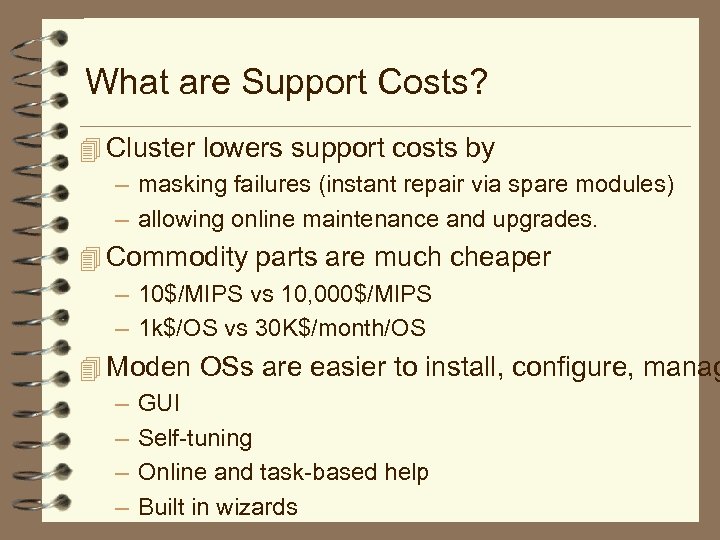
What are Support Costs? 4 Cluster lowers support costs by – masking failures (instant repair via spare modules) – allowing online maintenance and upgrades. 4 Commodity parts are much cheaper – 10$/MIPS vs 10, 000$/MIPS – 1 k$/OS vs 30 K$/month/OS 4 Moden OSs are easier to install, configure, manag – GUI – Self-tuning – Online and task-based help – Built in wizards
Скачать презентацию Clustering Technology For Scaleability Jim Gray Microsoft Research
c77d40f3f9c6917334ec129f48235106.ppt