


 Скачать презентацию Clustering Algorithms Michael L Nelson CS 432 532 Old
e728c3be2f8432c22009491ffe18d39d.ppt
- Количество слайдов: 45
 Clustering Algorithms Michael L. Nelson CS 432/532 Old Dominion University This work is licensed under a Creative Commons Attribution. Non. Commercial-Share. Alike 3. 0 Unported License This course is based on Dr. Mc. Cown's class
 Chapter 3: Clustering • We want to cluster our information because we want to: – find unknown groups or patterns – visualize our results • Clustering is an example of unsupervised learning – we don't know what the correct answer is before we start – supervised learning examples in later chapters
 First Things First… • Items to be clustered need numerical scores that "describe" the items • Some examples: – Customers can be described by the amount of purchases they make each month – Movies can be described by the ratings given to them by critics – Documents can be described by the number of times they use certain words
 Finding Similar Web Pages • Given N of the web pages, how would we cluster them? • Extract terms – Break each string by whitespace – Convert to lowercase – Remove HTML tags – Find frequency of each term in each document – Remove common terms (i. e. , stop words, high TF) and very unique terms (i. e. , high IDF) You don’t always remove/extract what you really want: http: //ws-dl. blogspot. com/2017/03/2017 -03 -20 -survey-of-5 -boilerplate. html
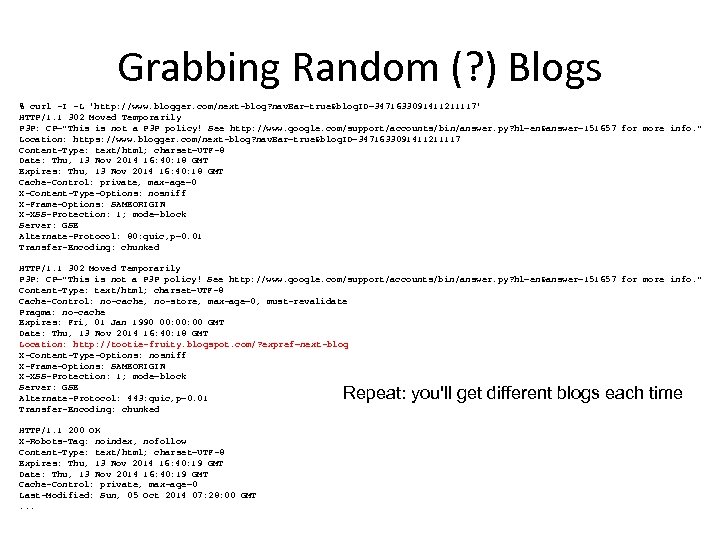
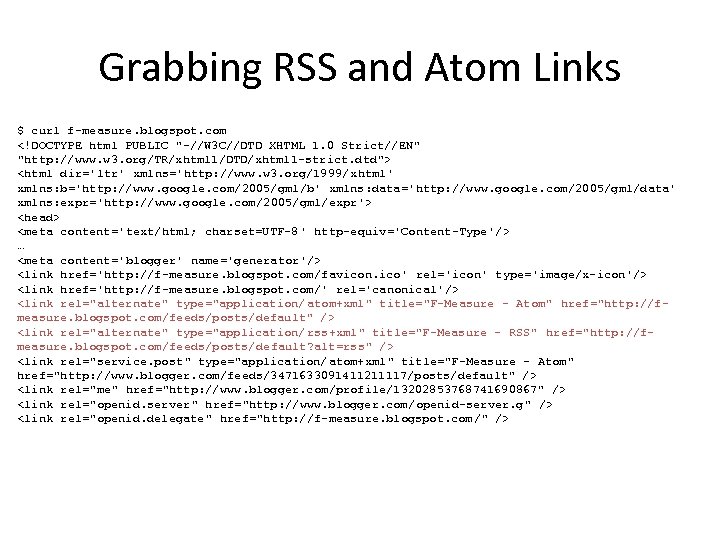
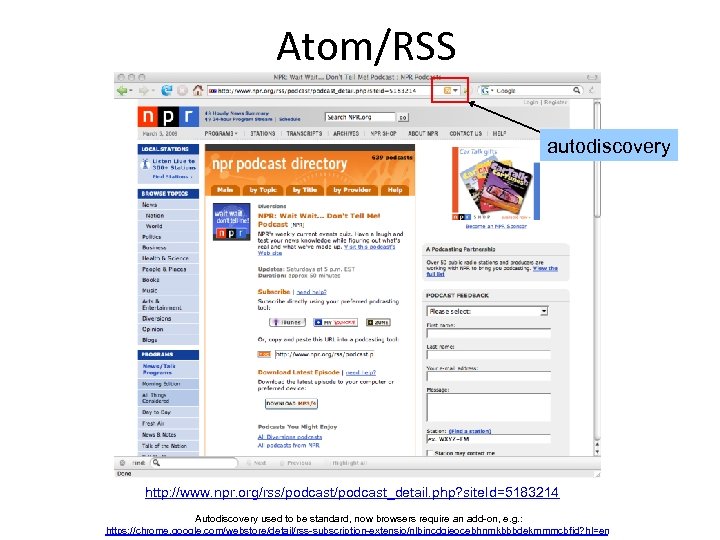
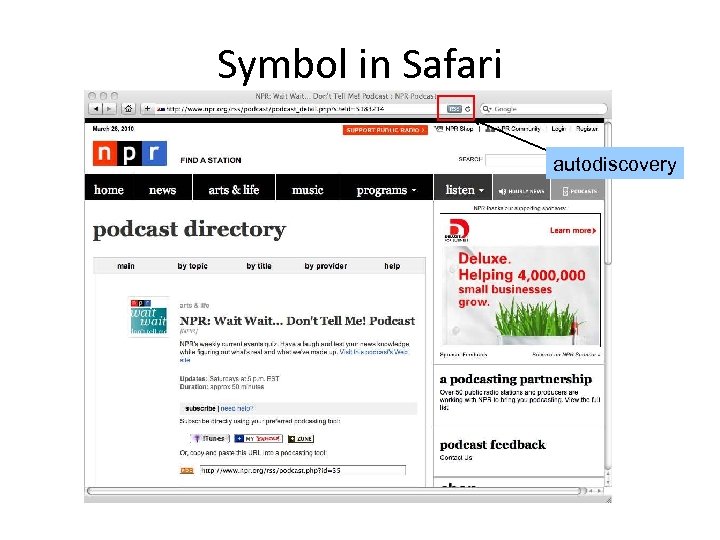
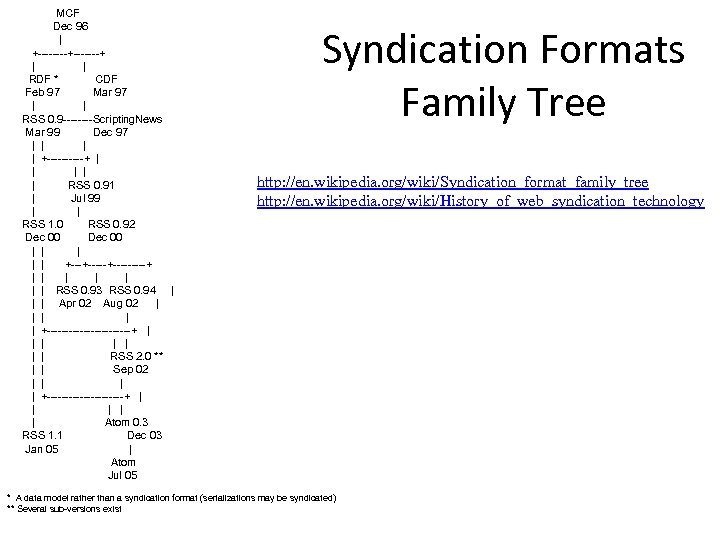
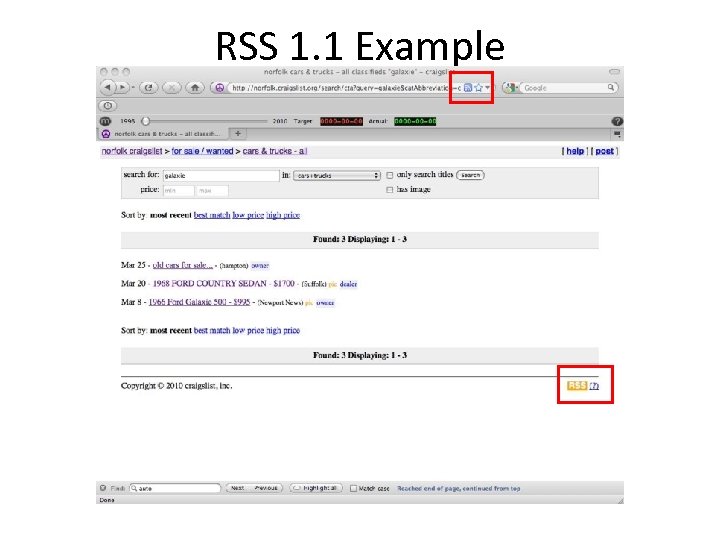
 Grabbing Blog Feeds • Humans read blogs, newsfeeds, etc. in HTML, but machines read blogs in the XML-based syndication formats RSS or Atom – http: //en. wikipedia. org/wiki/RSS_(file_format) – http: //en. wikipedia. org/wiki/Atom_(standard) • Examples (look for autodiscovery icon) – – http: //pilotonline. com/ http: //f-measure. blogspot. com/ http: //en. wikipedia. org/wiki/DJ_Shadow http: //norfolk. craigslist. org/cta/
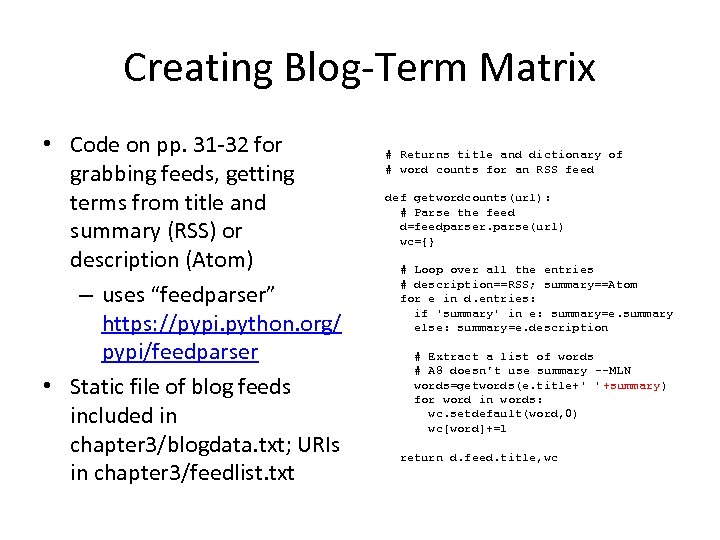 Creating Blog-Term Matrix • Code on pp. 31 -32 for grabbing feeds, getting terms from title and summary (RSS) or description (Atom) – uses “feedparser” https: //pypi. python. org/ pypi/feedparser • Static file of blog feeds included in chapter 3/blogdata. txt; URIs in chapter 3/feedlist. txt # Returns title and dictionary of # word counts for an RSS feed def getwordcounts(url): # Parse the feed d=feedparser. parse(url) wc={} # Loop over all the entries # description==RSS; summary==Atom for e in d. entries: if 'summary' in e: summary=e. summary else: summary=e. description # Extract a list of words # A 8 doesn’t use summary --MLN words=getwords(e. title+' ' +summary) for word in words: wc. setdefault(word, 0) wc[word]+=1 return d. feed. title, wc
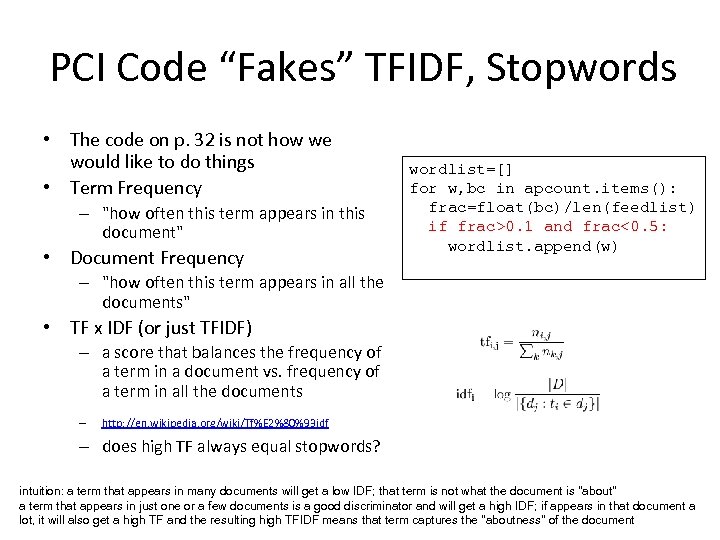 PCI Code “Fakes” TFIDF, Stopwords • The code on p. 32 is not how we would like to do things • Term Frequency – "how often this term appears in this document" • Document Frequency wordlist=[] for w, bc in apcount. items(): frac=float(bc)/len(feedlist) if frac>0. 1 and frac<0. 5: wordlist. append(w) – "how often this term appears in all the documents" • TF x IDF (or just TFIDF) – a score that balances the frequency of a term in a document vs. frequency of a term in all the documents – http: //en. wikipedia. org/wiki/Tf%E 2%80%93 idf – does high TF always equal stopwords? intuition: a term that appears in many documents will get a low IDF; that term is not what the document is "about" a term that appears in just one or a few documents is a good discriminator and will get a high IDF; if appears in that document a lot, it will also get a high TF and the resulting high TFIDF means that term captures the "aboutness" of the document
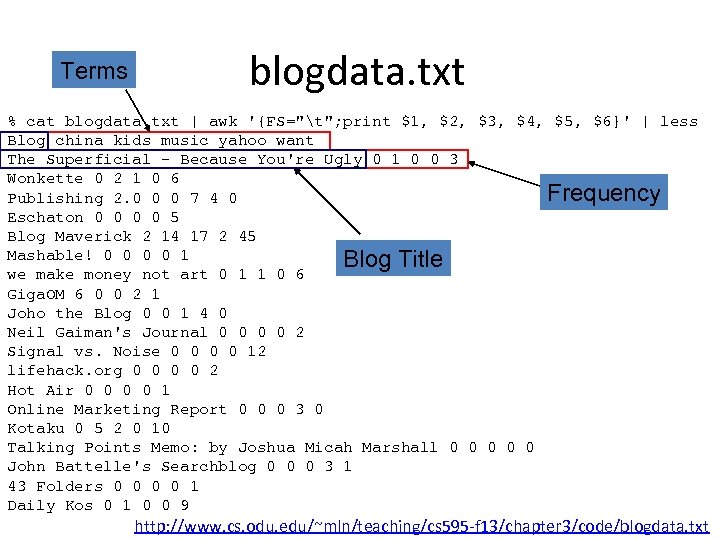 Terms blogdata. txt % cat blogdata. txt | awk '{FS="t"; print $1, $2, $3, $4, $5, $6}' | less Blog china kids music yahoo want The Superficial - Because You're Ugly 0 1 0 0 3 Wonkette 0 2 1 0 6 Frequency Publishing 2. 0 0 0 7 4 0 Eschaton 0 0 5 Blog Maverick 2 14 17 2 45 Mashable! 0 0 1 Blog Title we make money not art 0 1 1 0 6 Giga. OM 6 0 0 2 1 Joho the Blog 0 0 1 4 0 Neil Gaiman's Journal 0 0 2 Signal vs. Noise 0 0 12 lifehack. org 0 0 2 Hot Air 0 0 1 Online Marketing Report 0 0 0 3 0 Kotaku 0 5 2 0 10 Talking Points Memo: by Joshua Micah Marshall 0 0 0 John Battelle's Searchblog 0 0 0 3 1 43 Folders 0 0 1 Daily Kos 0 1 0 0 9 http: //www. cs. odu. edu/~mln/teaching/cs 595 -f 13/chapter 3/code/blogdata. txt
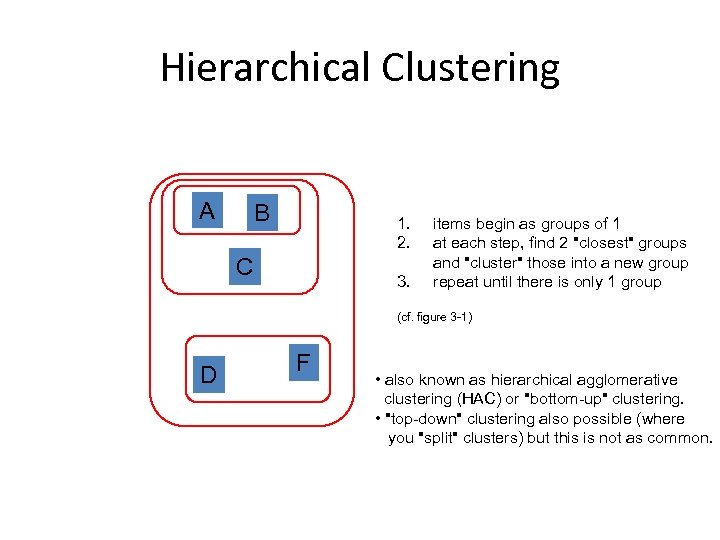 Hierarchical Clustering A B 1. 2. C 3. items begin as groups of 1 at each step, find 2 "closest" groups and "cluster" those into a new group repeat until there is only 1 group (cf. figure 3 -1) D F • also known as hierarchical agglomerative clustering (HAC) or "bottom-up" clustering. • "top-down" clustering also possible (where you "split" clusters) but this is not as common.
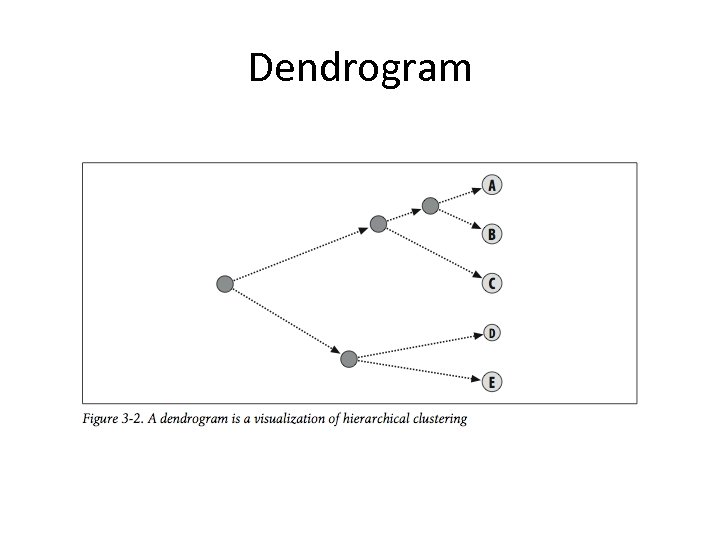 Dendrogram
![def hcluster(rows, distance=pearson): distances={} currentclustid=-1 # Clusters are initially just the rows clust=[bicluster(rows[i], id=i)](https://present5.com/presentation/e728c3be2f8432c22009491ffe18d39d/image-11.jpg "def hcluster(rows, distance=pearson): distances={} currentclustid=-1 # Clusters are initially just the rows clust=[bicluster(rows[i], id=i)") def hcluster(rows, distance=pearson): distances={} currentclustid=-1 # Clusters are initially just the rows clust=[bicluster(rows[i], id=i) for i in range(len(rows))] while len(clust)>1: lowestpair=(0, 1) closest=distance(clust[0]. vec, clust[1]. vec) # loop through every pair looking for the smallest distance # Pearson defined on p. 35; distance=1 -similarity --MLN for i in range(len(clust)): for j in range(i+1, len(clust)): # distances is the cache of distance calculations if (clust[i]. id, clust[j]. id) not in distances: distances[(clust[i]. id, clust[j]. id)]=distance(clust[i]. vec, clust[j]. vec) d=distances[(clust[i]. id, clust[j]. id)] if d
def hcluster(rows, distance=pearson): distances={} currentclustid=-1 # Clusters are initially just the rows clust=[bicluster(rows[i], id=i) for i in range(len(rows))] while len(clust)>1: lowestpair=(0, 1) closest=distance(clust[0]. vec, clust[1]. vec) # loop through every pair looking for the smallest distance # Pearson defined on p. 35; distance=1 -similarity --MLN for i in range(len(clust)): for j in range(i+1, len(clust)): # distances is the cache of distance calculations if (clust[i]. id, clust[j]. id) not in distances: distances[(clust[i]. id, clust[j]. id)]=distance(clust[i]. vec, clust[j]. vec) d=distances[(clust[i]. id, clust[j]. id)] if d
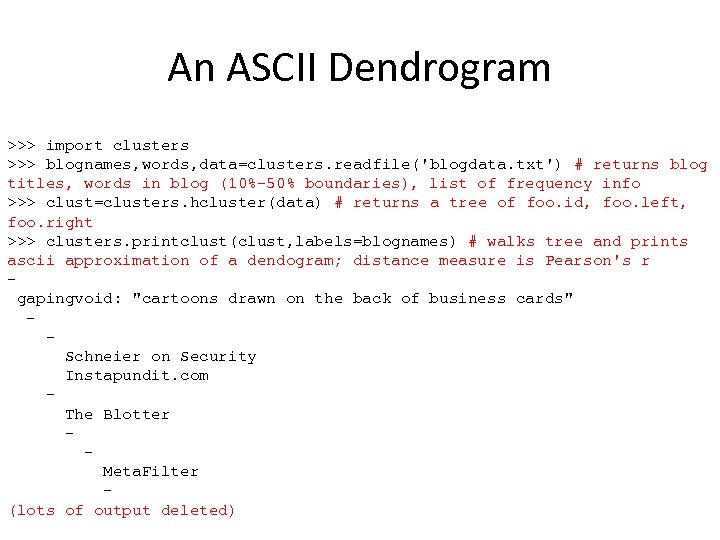 An ASCII Dendrogram >>> import clusters >>> blognames, words, data=clusters. readfile('blogdata. txt') # returns blog titles, words in blog (10%-50% boundaries), list of frequency info >>> clust=clusters. hcluster(data) # returns a tree of foo. id, foo. left, foo. right >>> clusters. printclust(clust, labels=blognames) # walks tree and prints ascii approximation of a dendogram; distance measure is Pearson's r gapingvoid: "cartoons drawn on the back of business cards" Schneier on Security Instapundit. com The Blotter Meta. Filter (lots of output deleted)
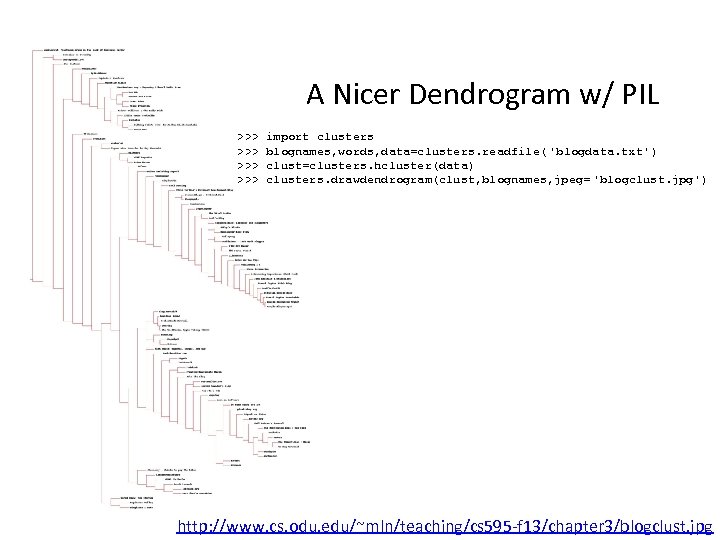 A Nicer Dendrogram w/ PIL >>> >>> import clusters blognames, words, data=clusters. readfile( 'blogdata. txt') clust=clusters. hcluster(data) clusters. drawdendrogram(clust, blognames, jpeg= 'blogclust. jpg') http: //www. cs. odu. edu/~mln/teaching/cs 595 -f 13/chapter 3/blogclust. jpg
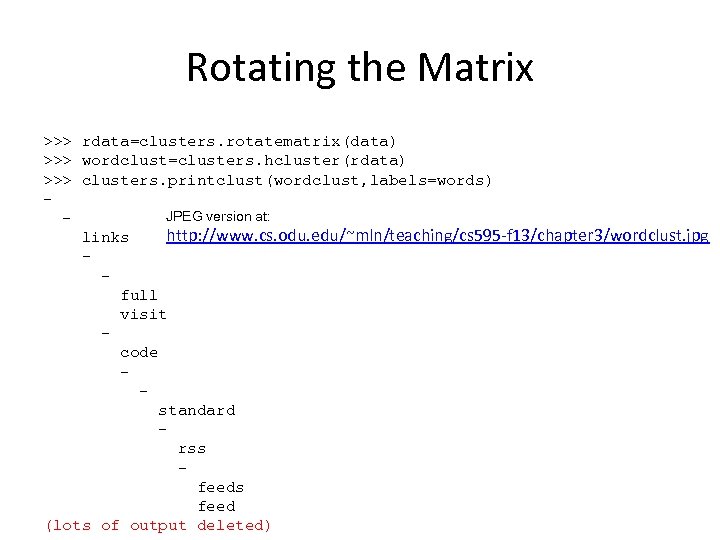 Rotating the Matrix >>> rdata=clusters. rotatematrix(data) >>> wordclust=clusters. hcluster(rdata) >>> clusters. printclust(wordclust, labels=words) JPEG version at: http: //www. cs. odu. edu/~mln/teaching/cs 595 -f 13/chapter 3/wordclust. jpg links full visit code standard rss feed (lots of output deleted)
 K-Means Clustering • Hierarchical clustering: – is computationally expensive – needs additional work to figure out the right "groups" • K-Means clustering: – groups data into k clusters – how do you pick k? well… how many clusters do you think you might need? – n. b. results are not always the same!
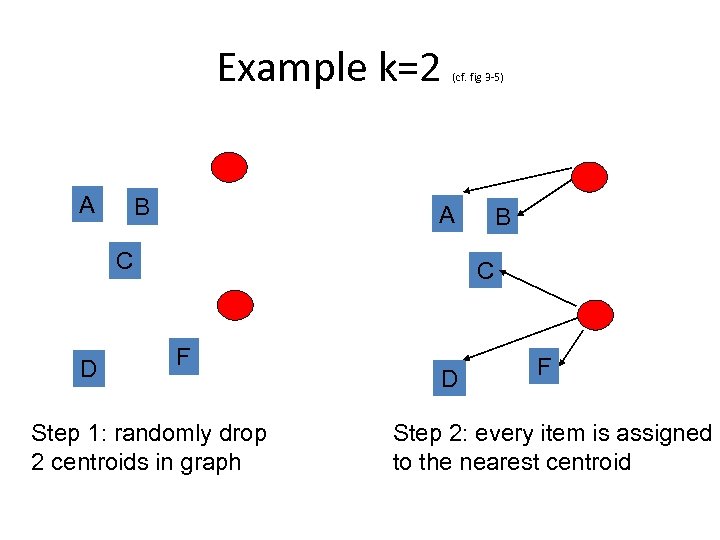 Example k=2 A B (cf. fig 3 -5) A C D B C F Step 1: randomly drop 2 centroids in graph D F Step 2: every item is assigned to the nearest centroid
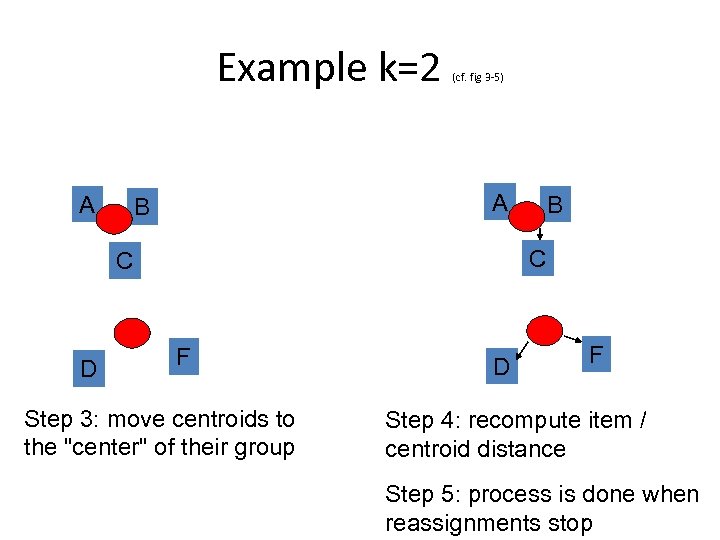 Example k=2 A (cf. fig 3 -5) A B C C D B F Step 3: move centroids to the "center" of their group D F Step 4: recompute item / centroid distance Step 5: process is done when reassignments stop
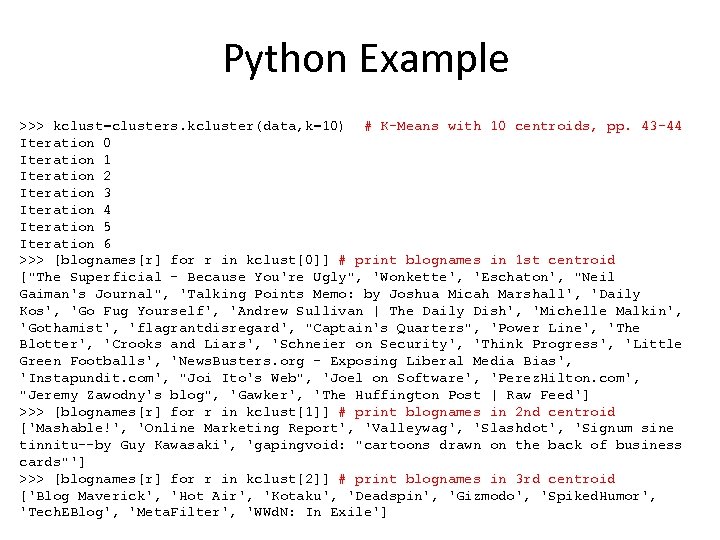 Python Example >>> kclust=clusters. kcluster(data, k=10) # K-Means with 10 centroids, pp. 43 -44 Iteration 0 Iteration 1 Iteration 2 Iteration 3 Iteration 4 Iteration 5 Iteration 6 >>> [blognames[r] for r in kclust[0]] # print blognames in 1 st centroid ["The Superficial - Because You're Ugly", 'Wonkette', 'Eschaton', "Neil Gaiman's Journal", 'Talking Points Memo: by Joshua Micah Marshall', 'Daily Kos', 'Go Fug Yourself', 'Andrew Sullivan | The Daily Dish', 'Michelle Malkin', 'Gothamist', 'flagrantdisregard', "Captain's Quarters", 'Power Line', 'The Blotter', 'Crooks and Liars', 'Schneier on Security', 'Think Progress', 'Little Green Footballs', 'News. Busters. org - Exposing Liberal Media Bias', 'Instapundit. com', "Joi Ito's Web", 'Joel on Software', 'Perez. Hilton. com', "Jeremy Zawodny's blog", 'Gawker', 'The Huffington Post | Raw Feed'] >>> [blognames[r] for r in kclust[1]] # print blognames in 2 nd centroid ['Mashable!', 'Online Marketing Report', 'Valleywag', 'Slashdot', 'Signum sine tinnitu--by Guy Kawasaki', 'gapingvoid: "cartoons drawn on the back of business cards"'] >>> [blognames[r] for r in kclust[2]] # print blognames in 3 rd centroid ['Blog Maverick', 'Hot Air', 'Kotaku', 'Deadspin', 'Gizmodo', 'Spiked. Humor', 'Tech. EBlog', 'Meta. Filter', 'WWd. N: In Exile']
 Zebo Data • zebo. com was a product review / wishlist site – pp. 45 -46 describe how to download data from the site – chapter 3/zebo. txt is a static version – http: //www. zebo. com/ • note: zebo. com is defunct • IA: http: //web. archive. org/web/*/zebo. com • history: http: //mashable. com/2006/09/18/how-theheck-did-zebo-get-4 -million-users/
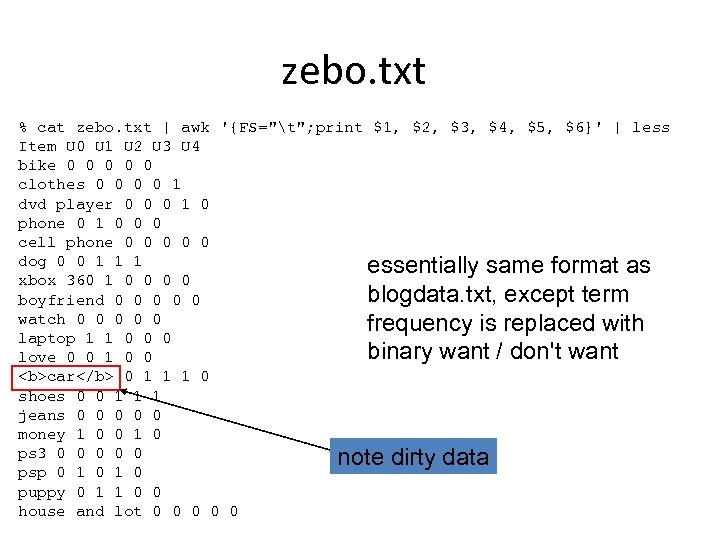 zebo. txt % cat zebo. txt | awk '{FS="t"; print $1, $2, $3, $4, $5, $6}' | less Item U 0 U 1 U 2 U 3 U 4 bike 0 0 0 clothes 0 0 1 dvd player 0 0 0 1 0 phone 0 1 0 0 0 cell phone 0 0 0 dog 0 0 1 1 1 essentially same format as xbox 360 1 0 0 blogdata. txt, except term boyfriend 0 0 0 watch 0 0 0 frequency is replaced with laptop 1 1 0 0 0 binary want / don't want love 0 0 1 0 0 car 0 1 1 1 0 shoes 0 0 1 1 1 jeans 0 0 0 money 1 0 0 1 0 ps 3 0 0 0 note dirty data psp 0 1 0 puppy 0 1 1 0 0 house and lot 0 0 0
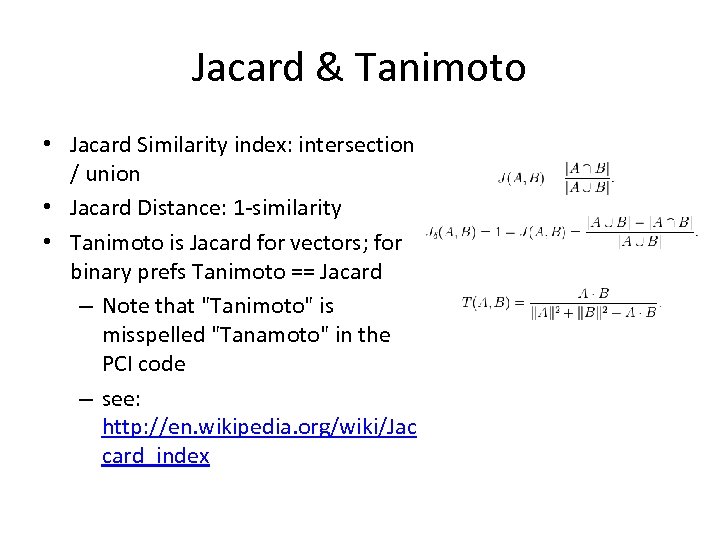 Jacard & Tanimoto • Jacard Similarity index: intersection / union • Jacard Distance: 1 -similarity • Tanimoto is Jacard for vectors; for binary prefs Tanimoto == Jacard – Note that "Tanimoto" is misspelled "Tanamoto" in the PCI code – see: http: //en. wikipedia. org/wiki/Jac card_index
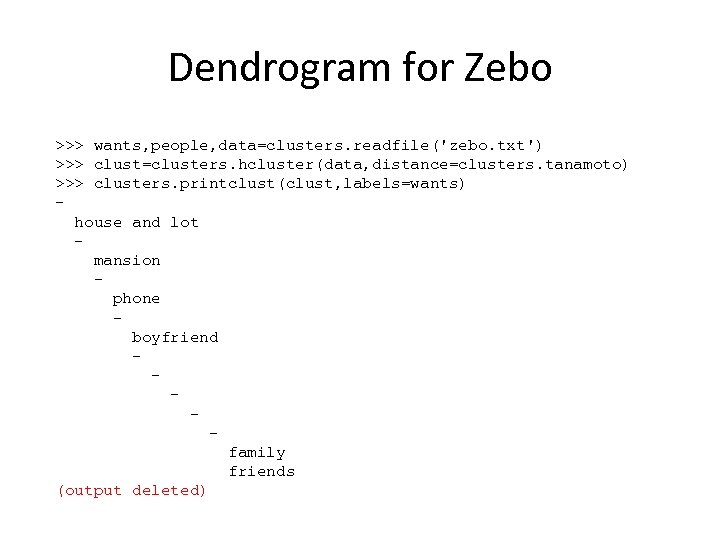 Dendrogram for Zebo >>> wants, people, data=clusters. readfile('zebo. txt') >>> clust=clusters. hcluster(data, distance=clusters. tanamoto) >>> clusters. printclust(clust, labels=wants) house and lot mansion phone boyfriend family friends (output deleted)
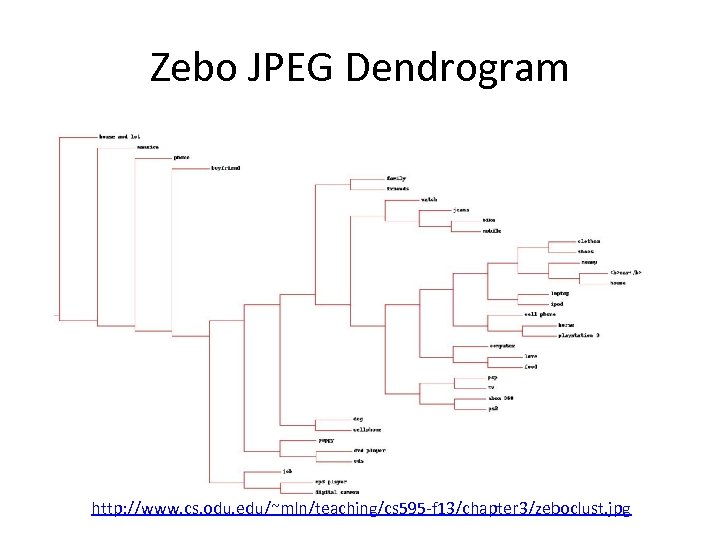 Zebo JPEG Dendrogram http: //www. cs. odu. edu/~mln/teaching/cs 595 -f 13/chapter 3/zeboclust. jpg
![k=4 for Zebo >>> kclust=clusters. kcluster(data, k=4) Iteration 0 Iteration 1 >>> [wants[r] for](https://present5.com/presentation/e728c3be2f8432c22009491ffe18d39d/image-24.jpg "k=4 for Zebo >>> kclust=clusters. kcluster(data, k=4) Iteration 0 Iteration 1 >>> [wants[r] for") k=4 for Zebo >>> kclust=clusters. kcluster(data, k=4) Iteration 0 Iteration 1 >>> [wants[r] for r in kclust[0]] ['clothes', 'dvd player', 'xbox 360', 'car', 'jeans', 'house and lot', 'tv', 'horse', 'mobile', 'cds', 'friends'] >>> [wants[r] for r in kclust[1]] ['phone', 'cell phone', 'watch', 'puppy', 'family', 'house', 'mansion', 'computer'] >>> [wants[r] for r in kclust[2]] ['bike', 'boyfriend', 'mp 3 player', 'ipod', 'digital camera', 'cellphone', 'job'] >>> [wants[r] for r in kclust[3]] ['dog', 'laptop', 'love', 'shoes', 'money', 'ps 3', 'psp', 'food', 'playstation 3']
k=4 for Zebo >>> kclust=clusters. kcluster(data, k=4) Iteration 0 Iteration 1 >>> [wants[r] for r in kclust[0]] ['clothes', 'dvd player', 'xbox 360', 'car', 'jeans', 'house and lot', 'tv', 'horse', 'mobile', 'cds', 'friends'] >>> [wants[r] for r in kclust[1]] ['phone', 'cell phone', 'watch', 'puppy', 'family', 'house', 'mansion', 'computer'] >>> [wants[r] for r in kclust[2]] ['bike', 'boyfriend', 'mp 3 player', 'ipod', 'digital camera', 'cellphone', 'job'] >>> [wants[r] for r in kclust[3]] ['dog', 'laptop', 'love', 'shoes', 'money', 'ps 3', 'psp', 'food', 'playstation 3']
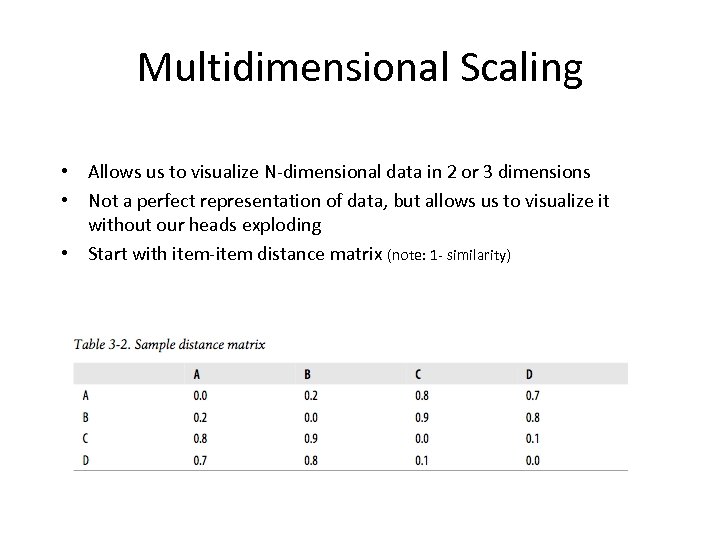 Multidimensional Scaling • Allows us to visualize N-dimensional data in 2 or 3 dimensions • Not a perfect representation of data, but allows us to visualize it without our heads exploding • Start with item-item distance matrix (note: 1 - similarity)
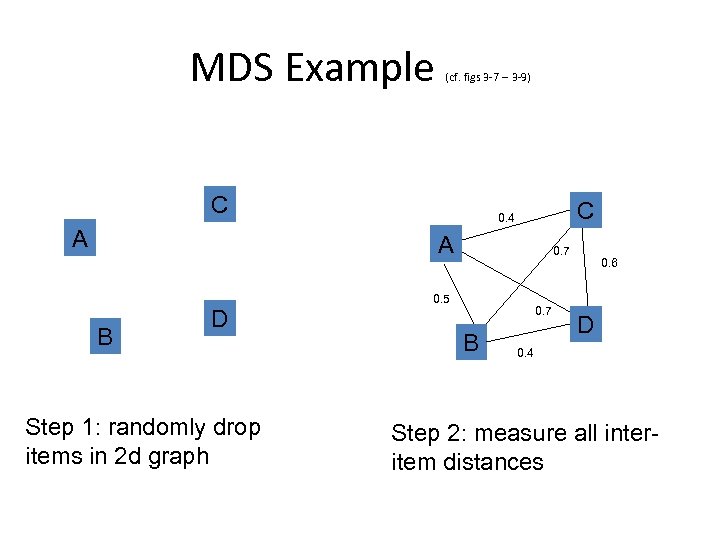 MDS Example (cf. figs 3 -7 -- 3 -9) C A C 0. 4 A B D Step 1: randomly drop items in 2 d graph 0. 7 0. 5 0. 7 B 0. 6 D 0. 4 Step 2: measure all interitem distances
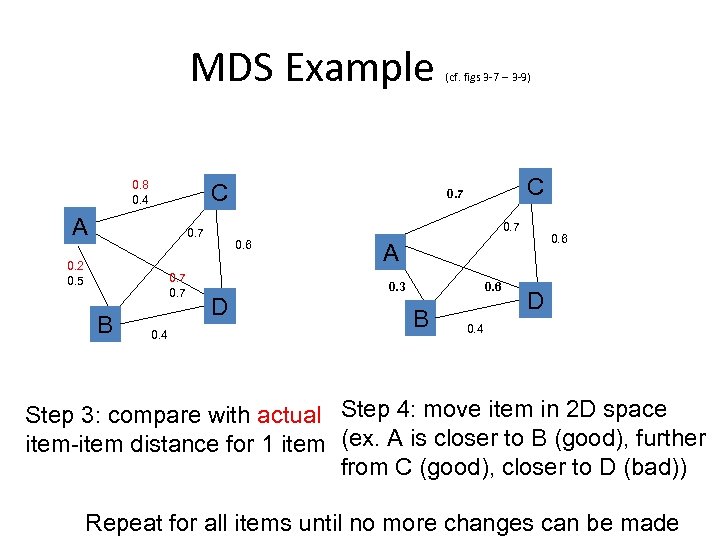 MDS Example 0. 8 0. 4 C A 0. 7 B 0. 4 C 0. 7 0. 2 0. 5 (cf. figs 3 -7 -- 3 -9) 0. 6 D 0. 6 A 0. 3 0. 6 B D 0. 4 Step 3: compare with actual Step 4: move item in 2 D space item-item distance for 1 item (ex. A is closer to B (good), further from C (good), closer to D (bad)) Repeat for all items until no more changes can be made
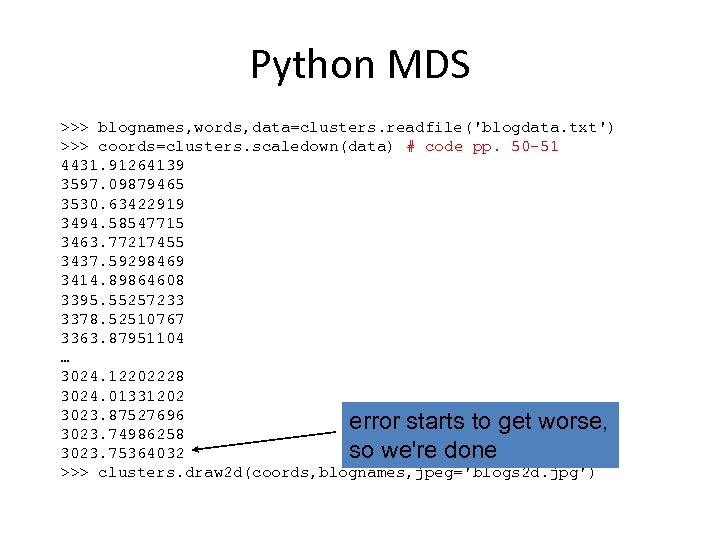 Python MDS >>> blognames, words, data=clusters. readfile('blogdata. txt') >>> coords=clusters. scaledown(data) # code pp. 50 -51 4431. 91264139 3597. 09879465 3530. 63422919 3494. 58547715 3463. 77217455 3437. 59298469 3414. 89864608 3395. 55257233 3378. 52510767 3363. 87951104 … 3024. 12202228 3024. 01331202 3023. 87527696 error starts to get worse, 3023. 74986258 so we're done 3023. 75364032 >>> clusters. draw 2 d(coords, blognames, jpeg='blogs 2 d. jpg')
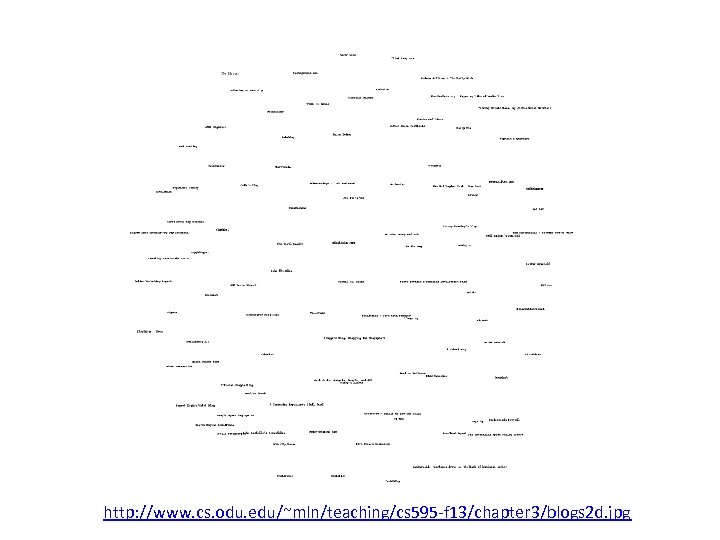 http: //www. cs. odu. edu/~mln/teaching/cs 595 -f 13/chapter 3/blogs 2 d. jpg
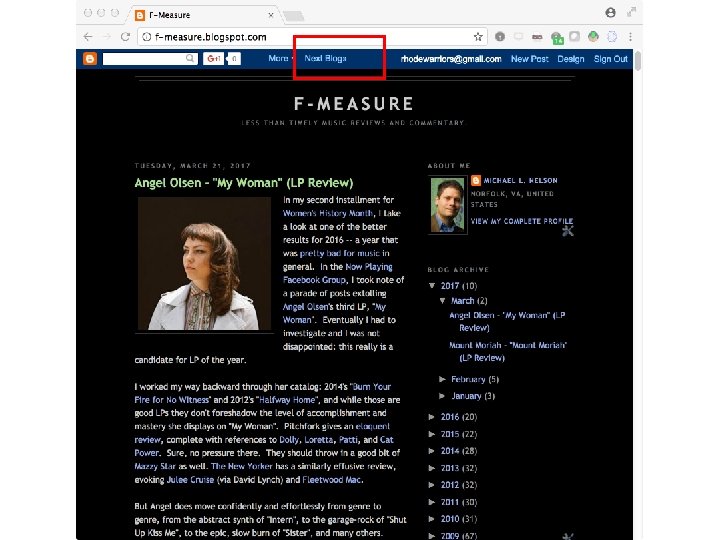
 Grabbing Random (? ) Blogs % curl -I -L 'http: //www. blogger. com/next-blog? nav. Bar=true&blog. ID=3471633091411211117' HTTP/1. 1 302 Moved Temporarily P 3 P: CP="This is not a P 3 P policy! See http: //www. google. com/support/accounts/bin/answer. py? hl=en&answer=151657 for more info. " Location: https: //www. blogger. com/next-blog? nav. Bar=true&blog. ID=3471633091411211117 Content-Type: text/html; charset=UTF-8 Date: Thu, 13 Nov 2014 16: 40: 18 GMT Expires: Thu, 13 Nov 2014 16: 40: 18 GMT Cache-Control: private, max-age=0 X-Content-Type-Options: nosniff X-Frame-Options: SAMEORIGIN X-XSS-Protection: 1; mode=block Server: GSE Alternate-Protocol: 80: quic, p=0. 01 Transfer-Encoding: chunked HTTP/1. 1 302 Moved Temporarily P 3 P: CP="This is not a P 3 P policy! See http: //www. google. com/support/accounts/bin/answer. py? hl=en&answer=151657 for more info. " Content-Type: text/html; charset=UTF-8 Cache-Control: no-cache, no-store, max-age=0, must-revalidate Pragma: no-cache Expires: Fri, 01 Jan 1990 00: 00 GMT Date: Thu, 13 Nov 2014 16: 40: 18 GMT Location: http: //tootie-fruity. blogspot. com/? expref=next-blog X-Content-Type-Options: nosniff X-Frame-Options: SAMEORIGIN X-XSS-Protection: 1; mode=block Server: GSE Alternate-Protocol: 443: quic, p=0. 01 Transfer-Encoding: chunked Repeat: you'll get different blogs each time HTTP/1. 1 200 OK X-Robots-Tag: noindex, nofollow Content-Type: text/html; charset=UTF-8 Expires: Thu, 13 Nov 2014 16: 40: 19 GMT Date: Thu, 13 Nov 2014 16: 40: 19 GMT Cache-Control: private, max-age=0 Last-Modified: Sun, 05 Oct 2014 07: 28: 00 GMT. . .
 Grabbing RSS and Atom Links $ curl f-measure. blogspot. com
 Atom/RSS autodiscovery http: //www. npr. org/rss/podcast_detail. php? site. Id=5183214 Autodiscovery used to be standard, now browsers require an add-on, e. g. : https: //chrome. google. com/webstore/detail/rss-subscription-extensio/nlbjncdgjeocebhnmkbbbdekmmmcbfjd? hl=en
 Symbol in Safari autodiscovery
 MCF Dec 96 | +----+-------+ | | RDF * CDF Feb 97 Mar 97 | | RSS 0. 9 ----Scripting. News Mar 99 Dec 97 | | +-----+ | | | RSS 0. 91 | Jul 99 | | RSS 1. 0 RSS 0. 92 Dec 00 | | | +-----+-----+ | | | | RSS 0. 93 RSS 0. 94 | | | Apr 02 Aug 02 | | | +------------+ | | | | RSS 2. 0 ** | | Sep 02 | | +-----------+ | | | Atom 0. 3 RSS 1. 1 Dec 03 Jan 05 | Atom Jul 05 Syndication Formats Family Tree http: //en. wikipedia. org/wiki/Syndication_format_family_tree http: //en. wikipedia. org/wiki/History_of_web_syndication_technology * A data model rather than a syndication format (serializations may be syndicated) ** Several sub-versions exist
 Syndication Data Model container metadata… fuzzy semantics -- the metadata is alternatively about the thing linked to as well the description of the thing linked to. and sometimes the metadata is the data… metadata… links… Title: Description: Date: …
 RSS Data Model channel container metadata… links… items metadata… links… metadata…
 RSS 2. 0 Example http: //www. npr. org/rss/podcast. php? id=35
 RSS 1. 1 Example
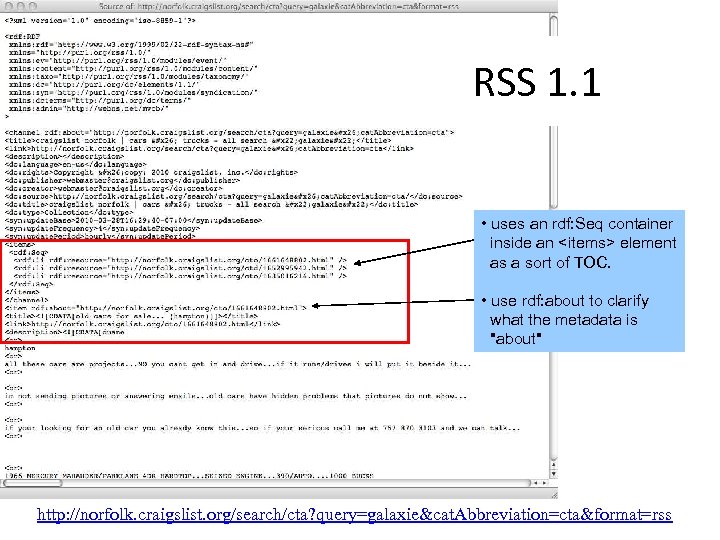 RSS 1. 1 • uses an rdf: Seq container inside an
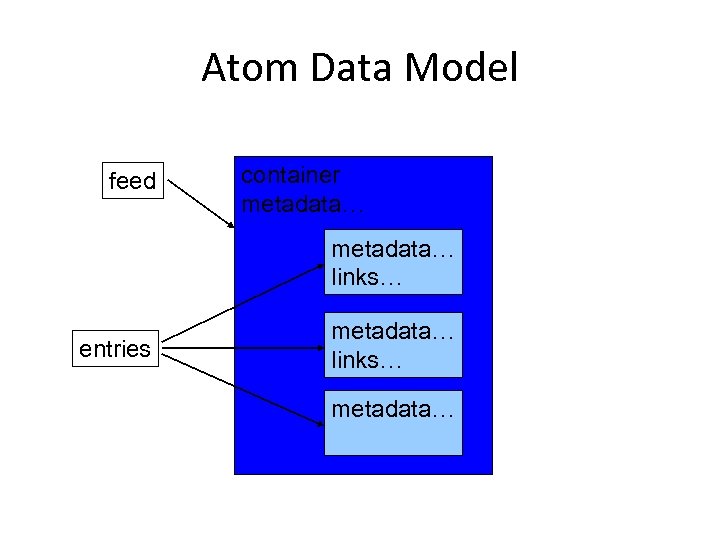 Atom Data Model feed container metadata… links… entries metadata… links… metadata…
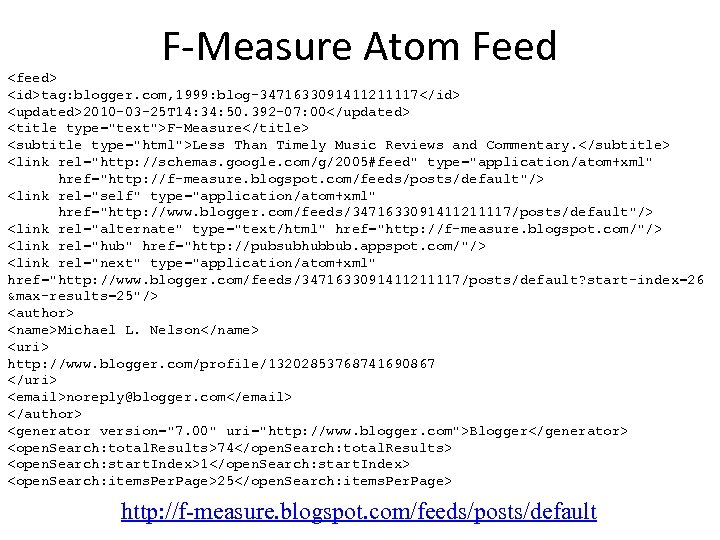 F-Measure Atom Feed
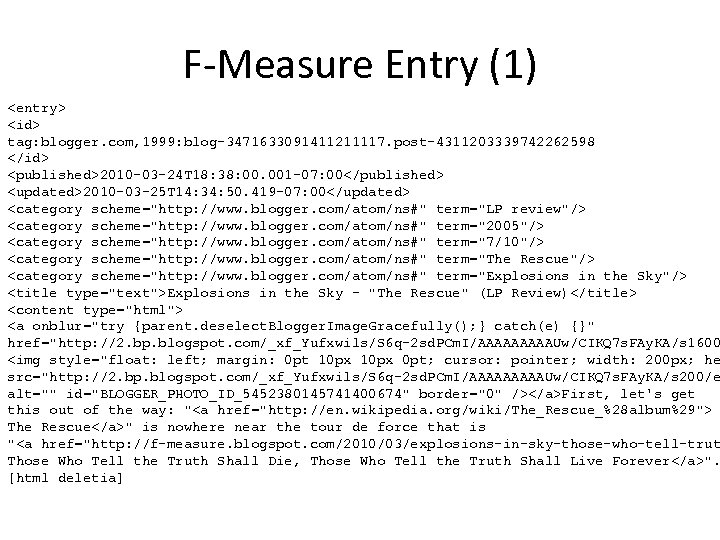 F-Measure Entry (1)
F-Measure Entry (2)
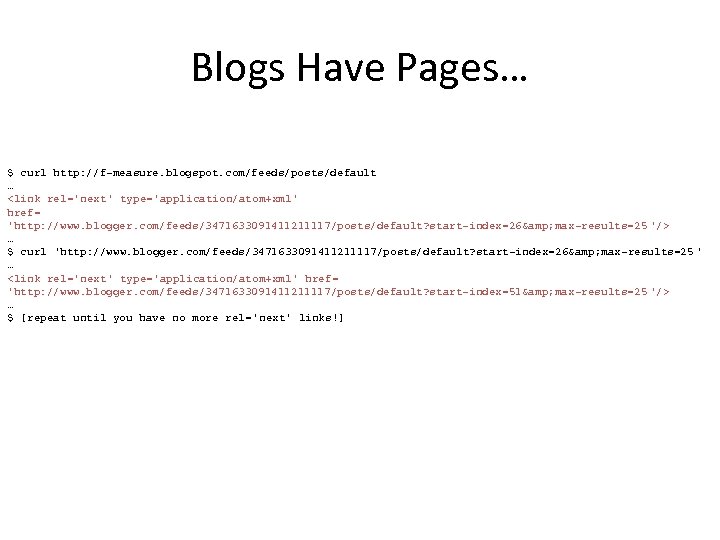 Blogs Have Pages… $ curl http: //f-measure. blogspot. com/feeds/posts/default … … $ curl 'http: //www. blogger. com/feeds/3471633091411211117/posts/default? start-index=26& max-results=25 ' … … $ [repeat until you have no more rel='next' links!]