


 Скачать презентацию Cluster Monte Carlo Algorithms Jian-Sheng Wang National University
ffacaa7afe01f9bf80d8b94909938aff.ppt
- Количество слайдов: 50
 Cluster Monte Carlo Algorithms: Jian-Sheng Wang National University of Singapore 1
 Outline • Introduction to Monte Carlo and statistical mechanical models • Cluster algorithms • Replica Monte Carlo 2
 1. Introduction to MC and Statistical Mechanical Models 3
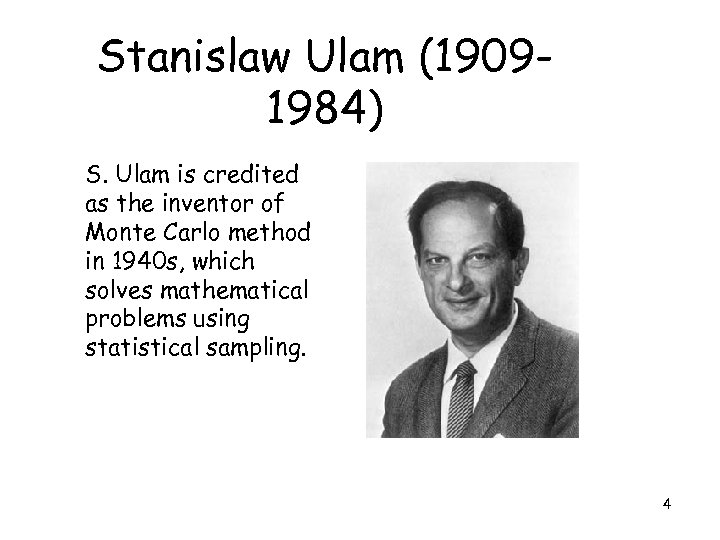 Stanislaw Ulam (19091984) S. Ulam is credited as the inventor of Monte Carlo method in 1940 s, which solves mathematical problems using statistical sampling. 4
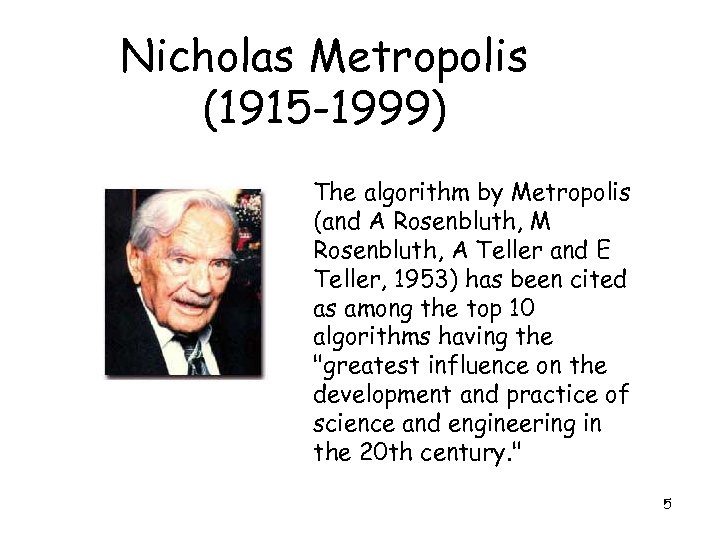 Nicholas Metropolis (1915 -1999) The algorithm by Metropolis (and A Rosenbluth, M Rosenbluth, A Teller and E Teller, 1953) has been cited as among the top 10 algorithms having the "greatest influence on the development and practice of science and engineering in the 20 th century. " 5
 The Name of the Game Metropolis coined the name “Monte Carlo”, from its gambling Casino. Monte-Carlo, Monaco 6
 Use of Monte Carlo Methods • Solving mathematical problems (numerical integration, numerical partial differential equation, integral equation, etc) by random sampling • Using random numbers in an essential way • Simulation of stochastic processes 7
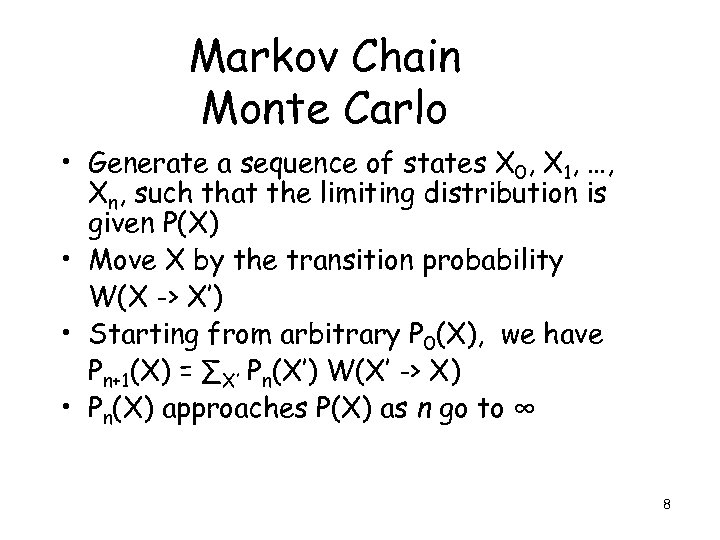 Markov Chain Monte Carlo • Generate a sequence of states X 0, X 1, …, Xn, such that the limiting distribution is given P(X) • Move X by the transition probability W(X -> X’) • Starting from arbitrary P 0(X), we have Pn+1(X) = ∑X’ Pn(X’) W(X’ -> X) • Pn(X) approaches P(X) as n go to ∞ 8
 > 0](https://present5.com/presentation/ffacaa7afe01f9bf80d8b94909938aff/image-9.jpg "Necessary and sufficient conditions for convergence • Ergodicity [Wn](X - > X’) > 0") Necessary and sufficient conditions for convergence • Ergodicity [Wn](X - > X’) > 0 For all n > nmax, all X and X’ • Detailed Balance P(X) W(X -> X’) = P(X’) W(X’ -> X) 9
Necessary and sufficient conditions for convergence • Ergodicity [Wn](X - > X’) > 0 For all n > nmax, all X and X’ • Detailed Balance P(X) W(X -> X’) = P(X’) W(X’ -> X) 9
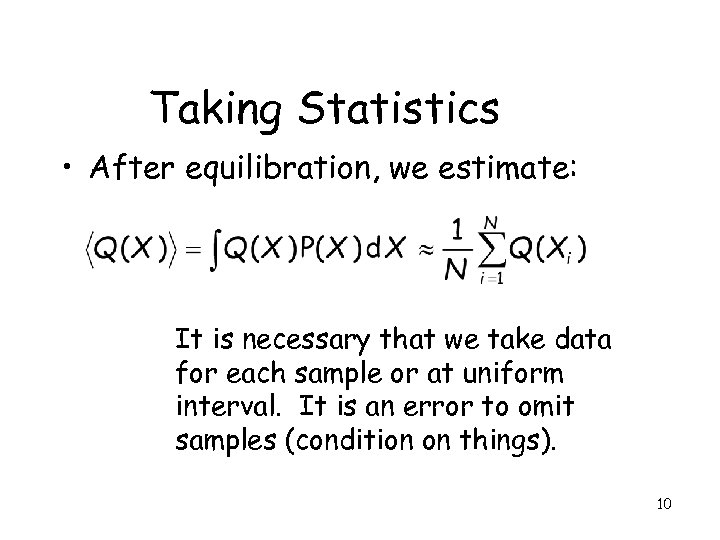 Taking Statistics • After equilibration, we estimate: It is necessary that we take data for each sample or at uniform interval. It is an error to omit samples (condition on things). 10
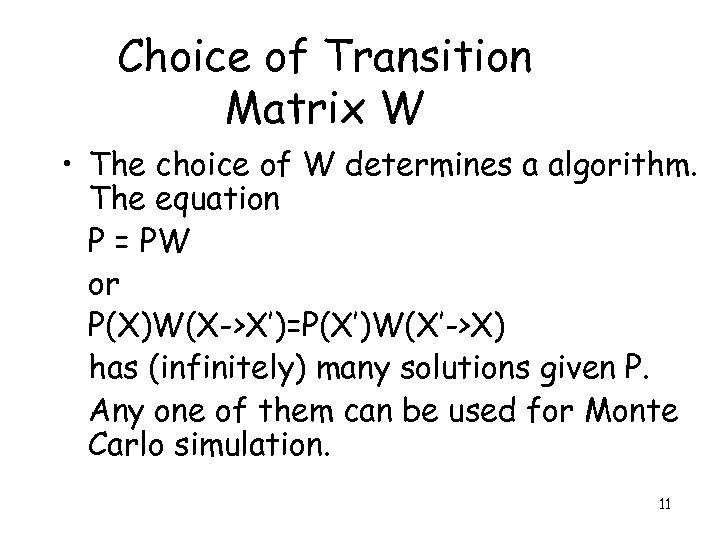 Choice of Transition Matrix W • The choice of W determines a algorithm. The equation P = PW or P(X)W(X->X’)=P(X’)W(X’->X) has (infinitely) many solutions given P. Any one of them can be used for Monte Carlo simulation. 11
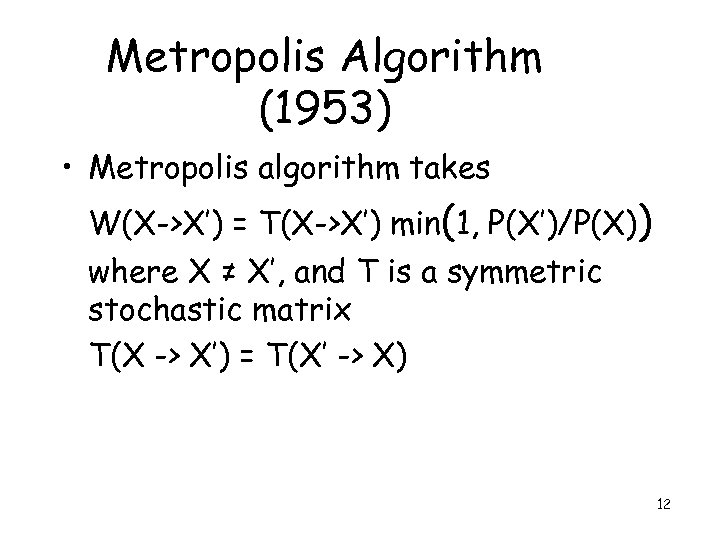 Metropolis Algorithm (1953) • Metropolis algorithm takes W(X->X’) = T(X->X’) min(1, P(X’)/P(X)) where X ≠ X’, and T is a symmetric stochastic matrix T(X -> X’) = T(X’ -> X) 12
 13
13
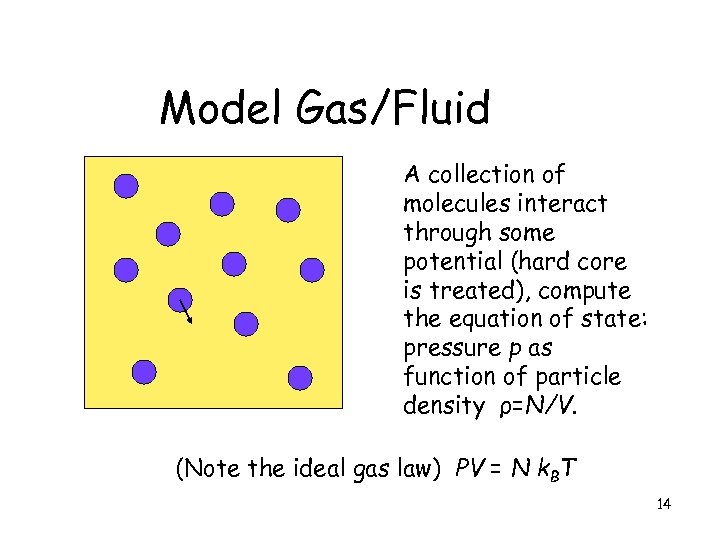 Model Gas/Fluid A collection of molecules interact through some potential (hard core is treated), compute the equation of state: pressure p as function of particle density ρ=N/V. (Note the ideal gas law) PV = N k. BT 14
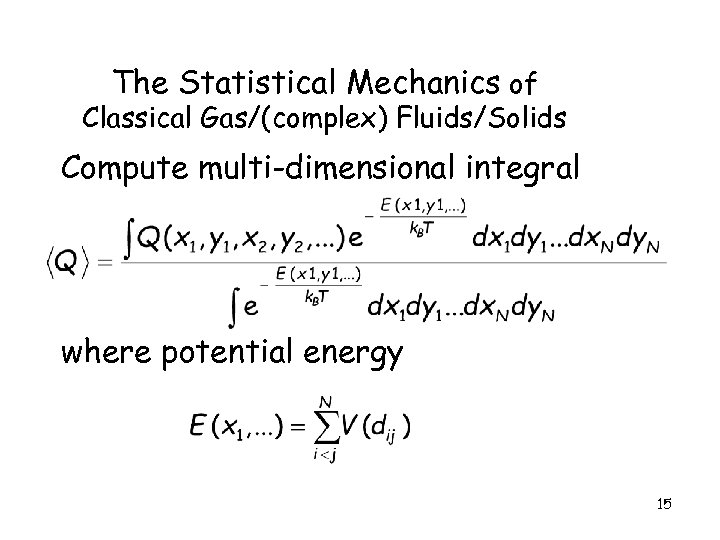 The Statistical Mechanics of Classical Gas/(complex) Fluids/Solids Compute multi-dimensional integral where potential energy 15
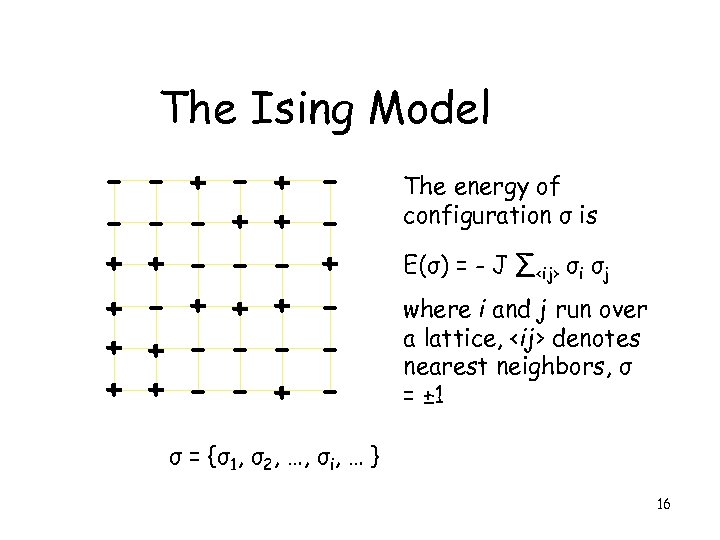 The Ising Model + + + + + - The energy of configuration σ is E(σ) = - J ∑
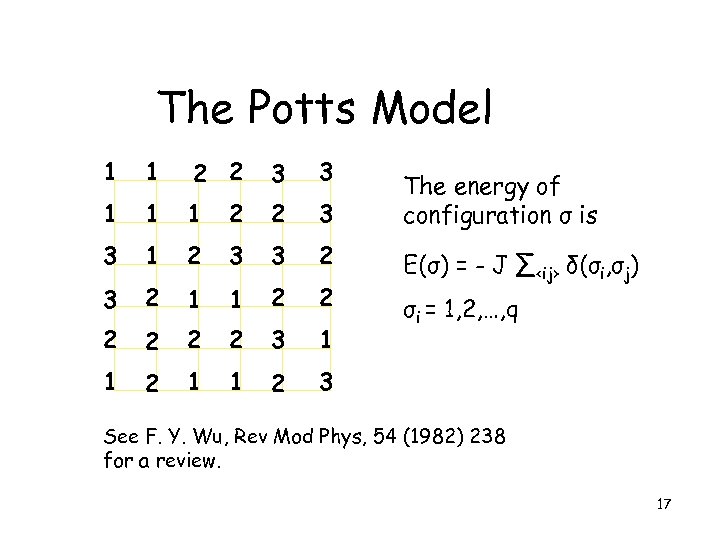 The Potts Model 1 1 2 2 3 3 1 2 3 3 2 1 1 2 2 2 3 1 1 2 3 The energy of configuration σ is E(σ) = - J ∑
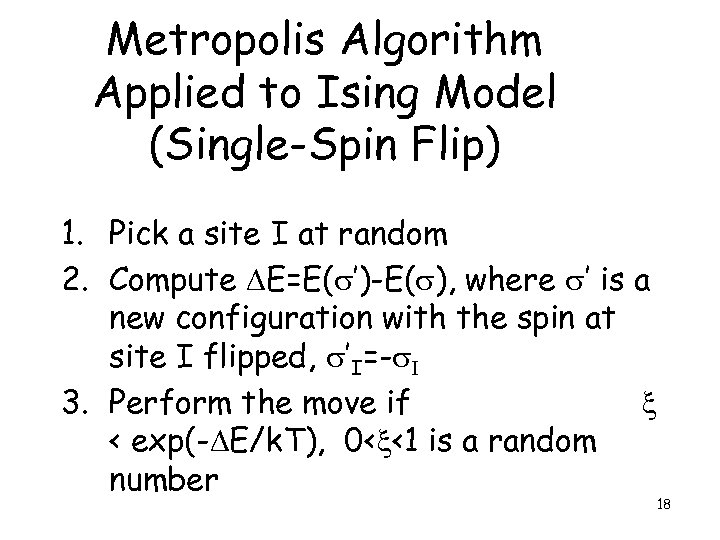 Metropolis Algorithm Applied to Ising Model (Single-Spin Flip) 1. Pick a site I at random 2. Compute DE=E(s’)-E(s), where s’ is a new configuration with the spin at site I flipped, s’I=-s. I 3. Perform the move if x < exp(-DE/k. T), 0
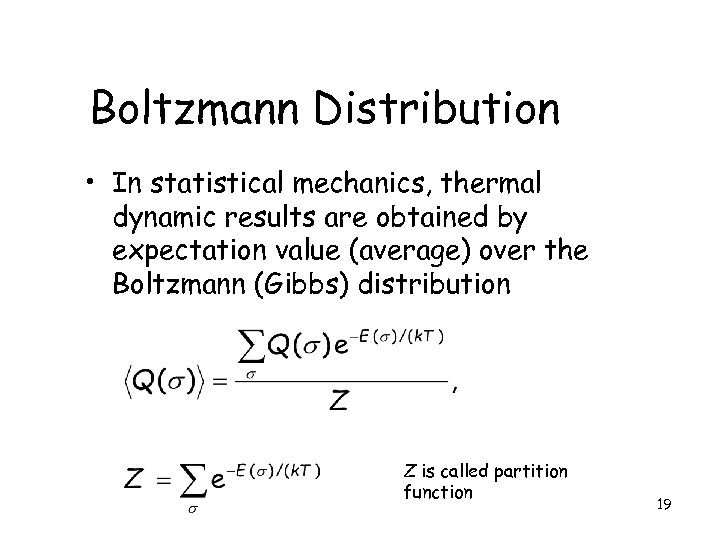 Boltzmann Distribution • In statistical mechanics, thermal dynamic results are obtained by expectation value (average) over the Boltzmann (Gibbs) distribution Z is called partition function 19
 2. Swendsen-Wang algorithm 20
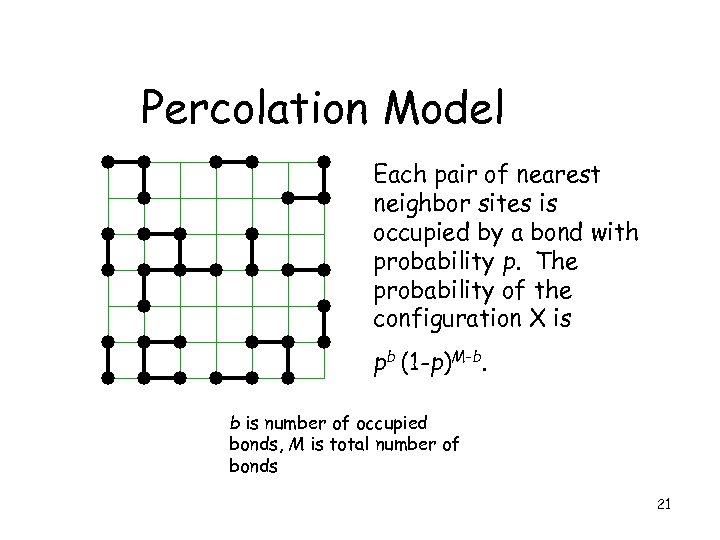 Percolation Model Each pair of nearest neighbor sites is occupied by a bond with probability p. The probability of the configuration X is pb (1 -p)M-b. b is number of occupied bonds, M is total number of bonds 21
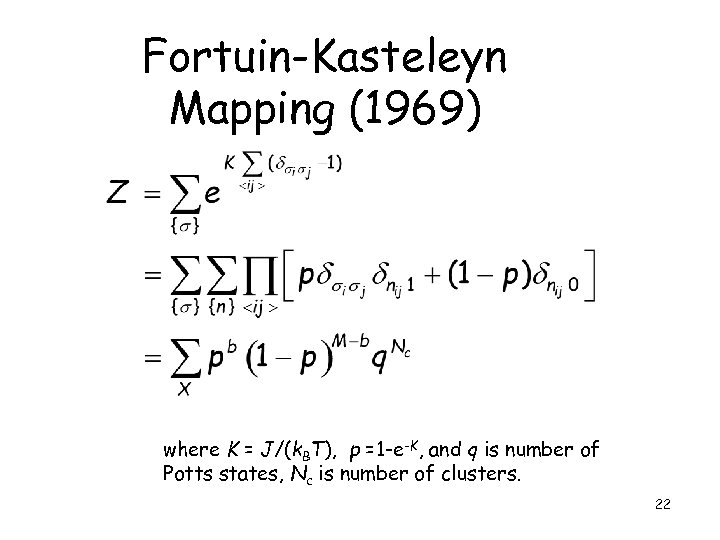 Fortuin-Kasteleyn Mapping (1969) where K = J/(k. BT), p =1 -e-K, and q is number of Potts states, Nc is number of clusters. 22
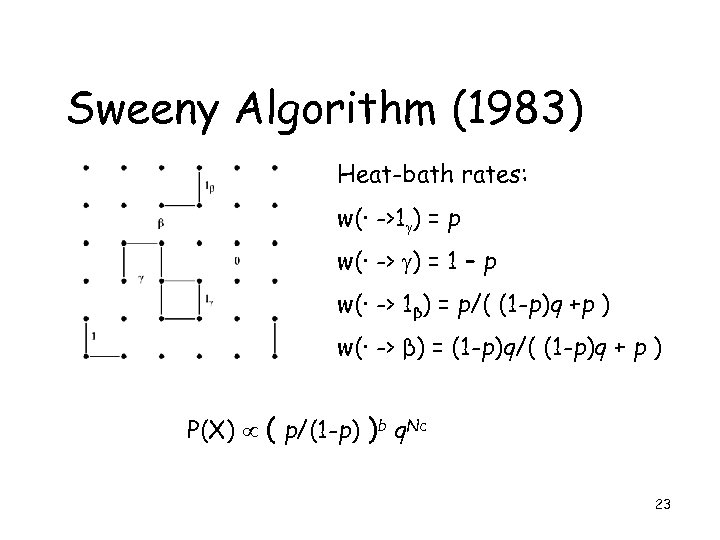 Sweeny Algorithm (1983) Heat-bath rates: w(· ->1 ) = p w(· -> ) = 1 – p w(· -> 1β) = p/( (1 -p)q +p ) w(· -> β) = (1 -p)q/( (1 -p)q + p ) P(X) ( p/(1 -p) )b q. Nc 23
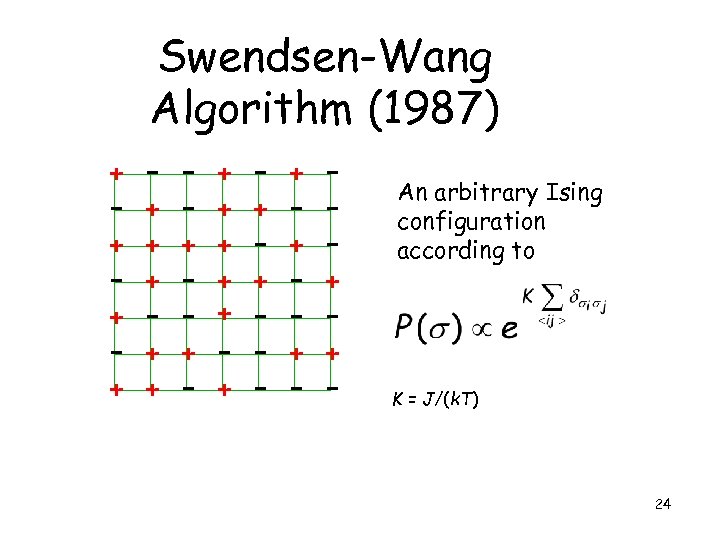 Swendsen-Wang Algorithm (1987) + - + + + - + - + + - - + - + - - An arbitrary Ising configuration according to + + - - K = J/(k. T) 24
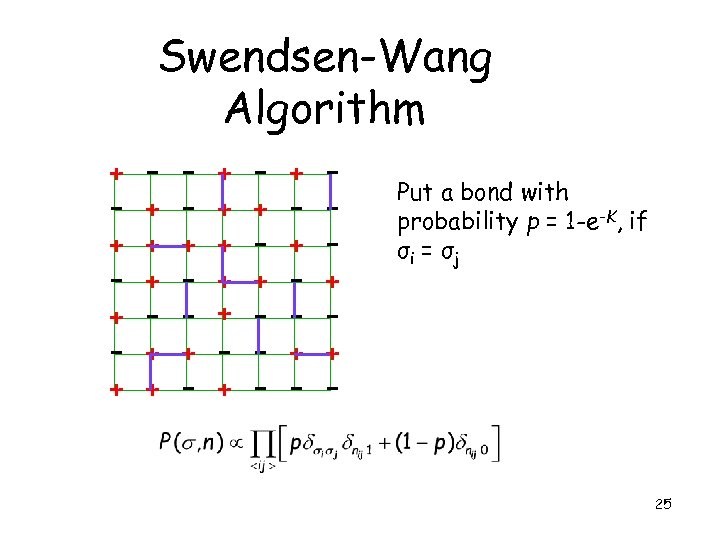 Swendsen-Wang Algorithm + - + + + - + - + + - - + - + - - Put a bond with probability p = 1 -e-K, if σi = σj + + - - 25
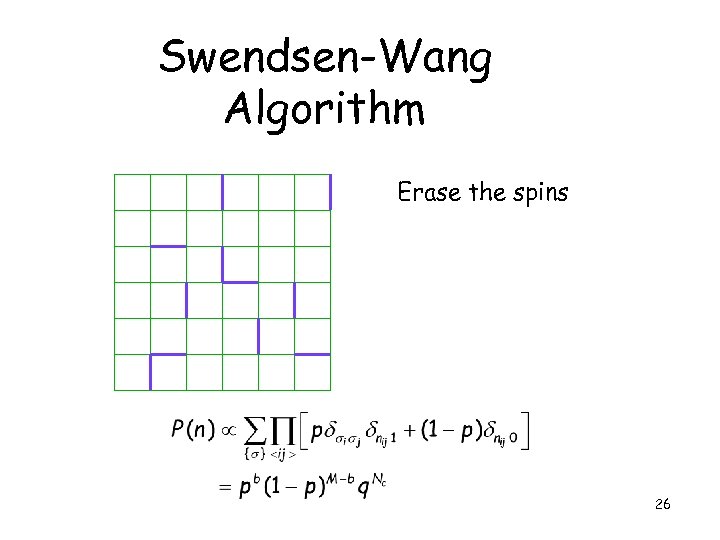 Swendsen-Wang Algorithm Erase the spins 26
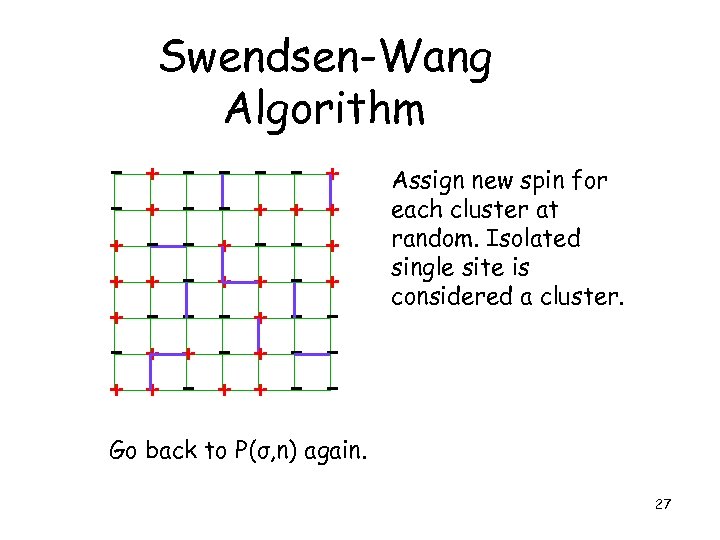 Swendsen-Wang Algorithm - + + + - - + + + - + - + + + + - Assign new spin for each cluster at random. Isolated single site is considered a cluster. Go back to P(σ, n) again. 27
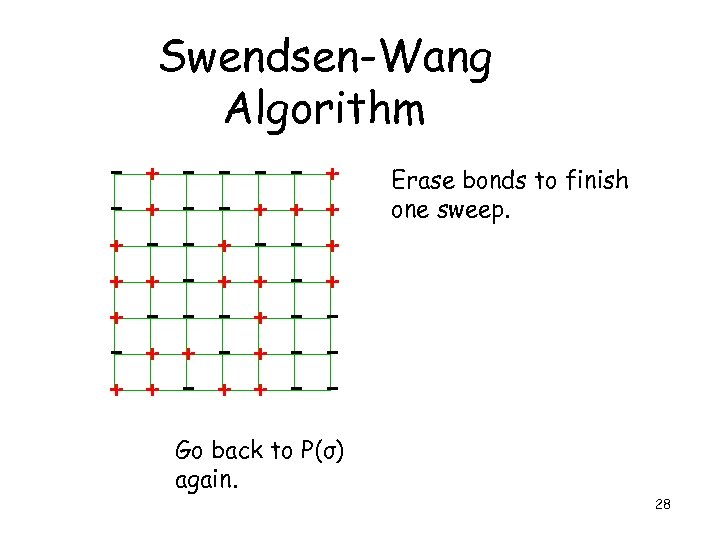 Swendsen-Wang Algorithm - + + + - - + + + - + - + + + + Erase bonds to finish one sweep. - Go back to P(σ) again. 28
 Identifying the Clusters • Hoshen-Kompelman algorithm (1976) can be used. • Each sweep takes O(N). 29
 Measuring Error • Let Qt be some quantity of interest at time step t, then sample average is QN = (1/N) ∑t Qt • We treat QN as a random variable. By central limit theorem, QN is normal distributed with a mean
 and variance σN 2 =
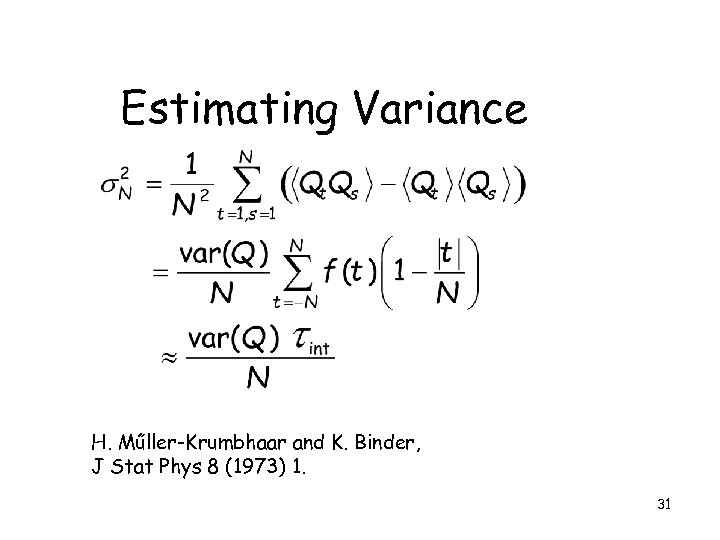 Estimating Variance H. Műller-Krumbhaar and K. Binder, J Stat Phys 8 (1973) 1. 31
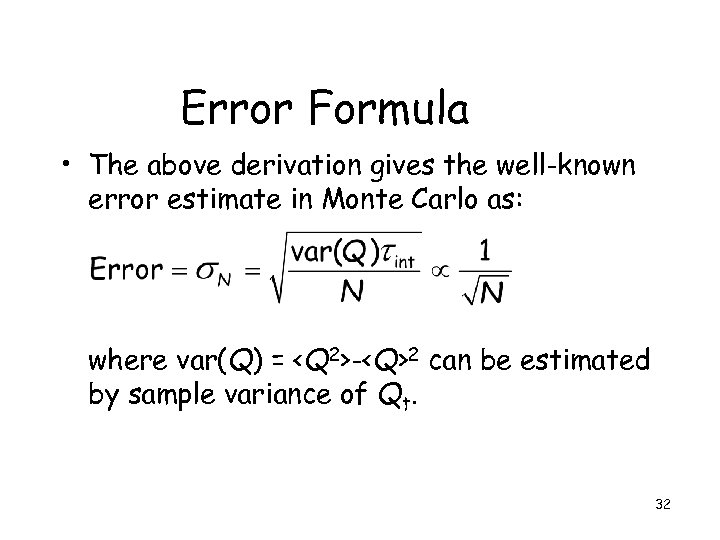 Error Formula • The above derivation gives the well-known error estimate in Monte Carlo as: where var(Q) =
 -
2 can be estimated by sample variance of Qt. 32
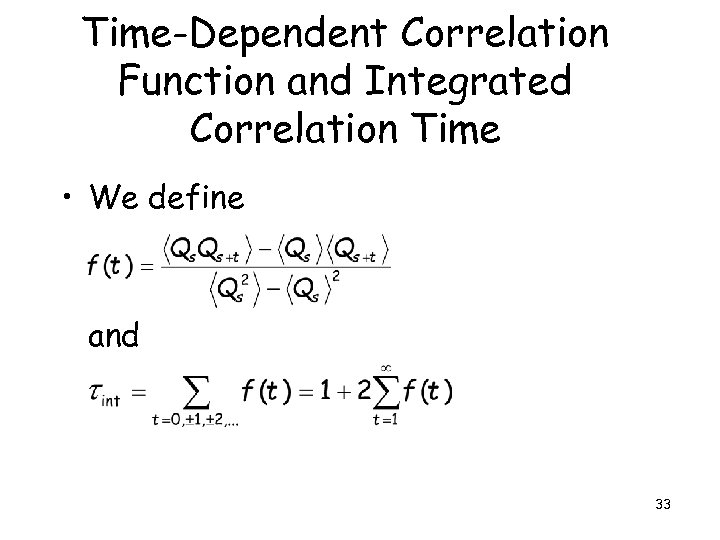 Time-Dependent Correlation Function and Integrated Correlation Time • We define and 33
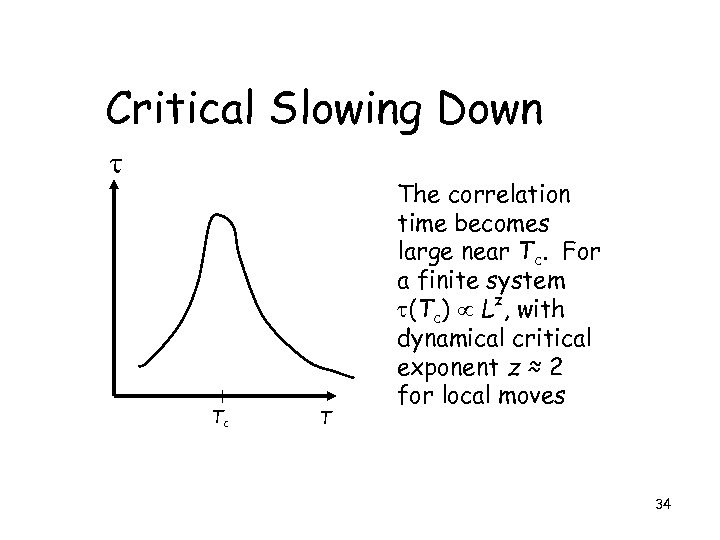 Critical Slowing Down Tc T The correlation time becomes large near Tc. For a finite system (Tc) Lz, with dynamical critical exponent z ≈ 2 for local moves 34
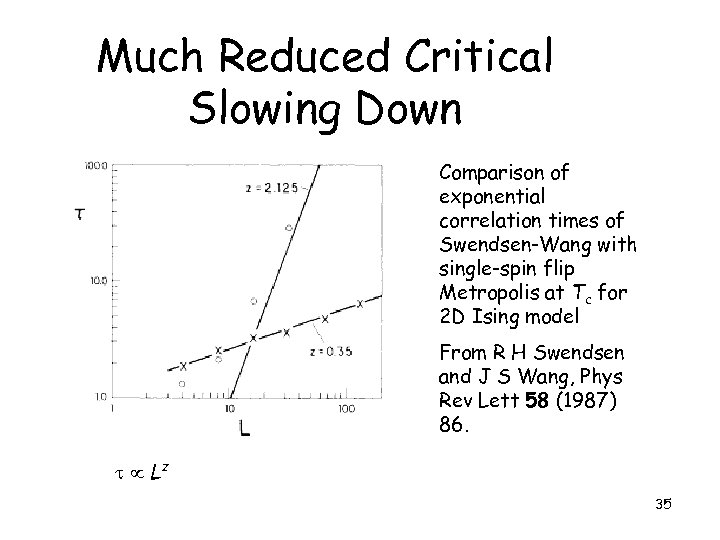 Much Reduced Critical Slowing Down Comparison of exponential correlation times of Swendsen-Wang with single-spin flip Metropolis at Tc for 2 D Ising model From R H Swendsen and J S Wang, Phys Rev Lett 58 (1987) 86. Lz 35
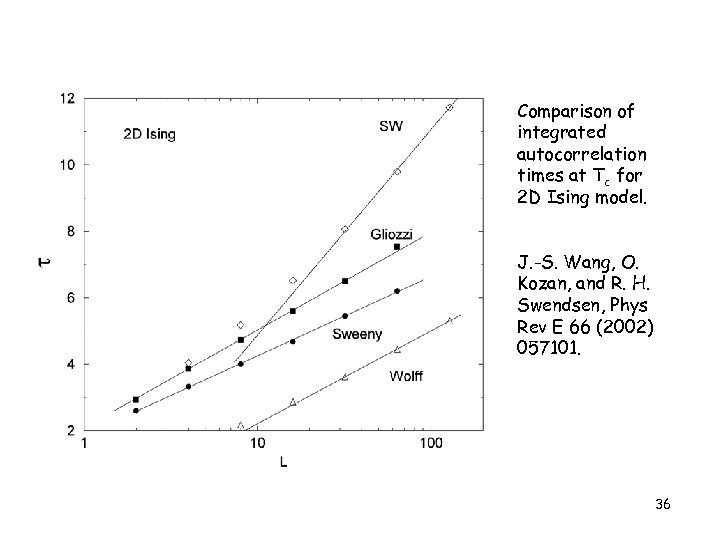 Comparison of integrated autocorrelation times at Tc for 2 D Ising model. J. -S. Wang, O. Kozan, and R. H. Swendsen, Phys Rev E 66 (2002) 057101. 36
![Wolff Single-Cluster Algorithm void flip(int i, int s 0) { int j, nn[Z]; s[i]](https://present5.com/presentation/ffacaa7afe01f9bf80d8b94909938aff/image-37.jpg "Wolff Single-Cluster Algorithm void flip(int i, int s 0) { int j, nn[Z]; s[i]") Wolff Single-Cluster Algorithm void flip(int i, int s 0) { int j, nn[Z]; s[i] = - s 0; neighbor(i, nn); for(j = 0; j < Z; ++j) { if(s 0 == s[nn[j]] && drand 48() < p) flip(nn[j], s 0); } 37
Wolff Single-Cluster Algorithm void flip(int i, int s 0) { int j, nn[Z]; s[i] = - s 0; neighbor(i, nn); for(j = 0; j < Z; ++j) { if(s 0 == s[nn[j]] && drand 48() < p) flip(nn[j], s 0); } 37
 Replica Monte Carlo 38
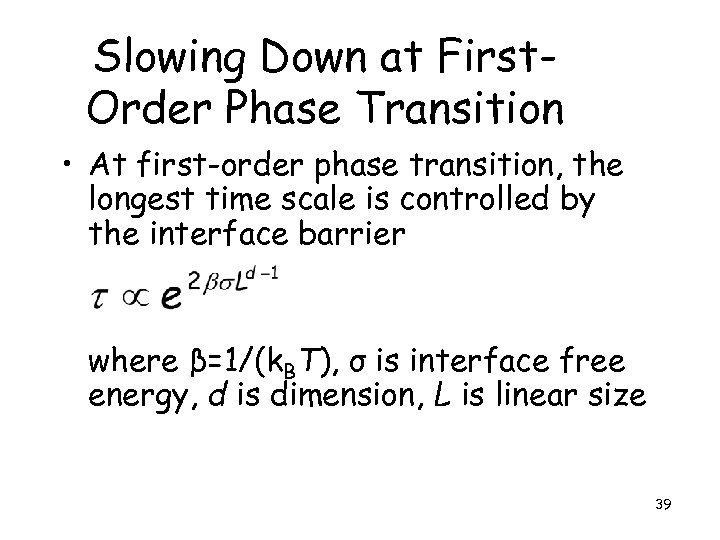 Slowing Down at First. Order Phase Transition • At first-order phase transition, the longest time scale is controlled by the interface barrier where β=1/(k. BT), σ is interface free energy, d is dimension, L is linear size 39
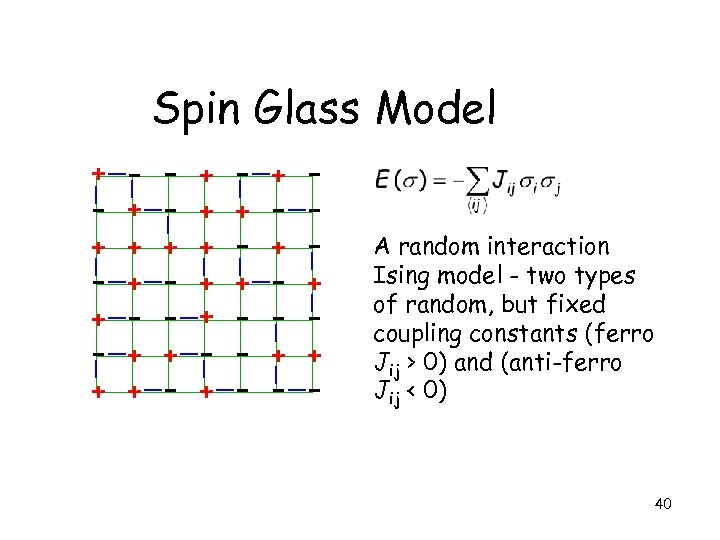 Spin Glass Model + - + + + - + - + + - - + - + - + + - - A random interaction Ising model - two types of random, but fixed coupling constants (ferro Jij > 0) and (anti-ferro Jij < 0) 40
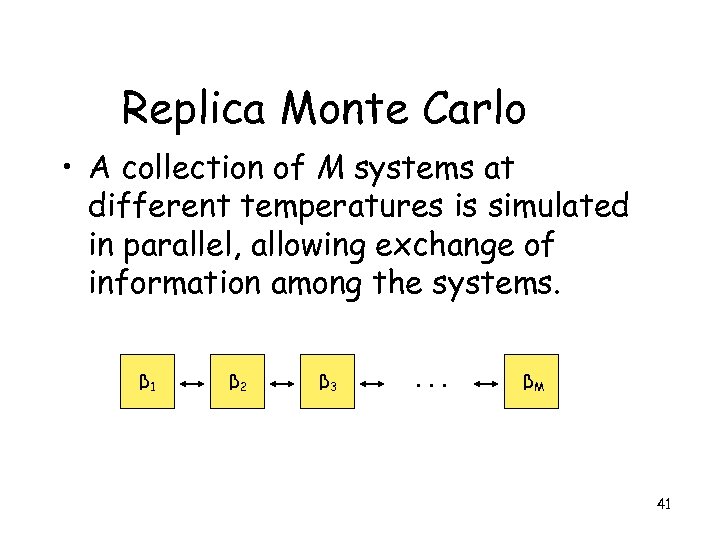 Replica Monte Carlo • A collection of M systems at different temperatures is simulated in parallel, allowing exchange of information among the systems. β 1 β 2 β 3 . . . βM 41
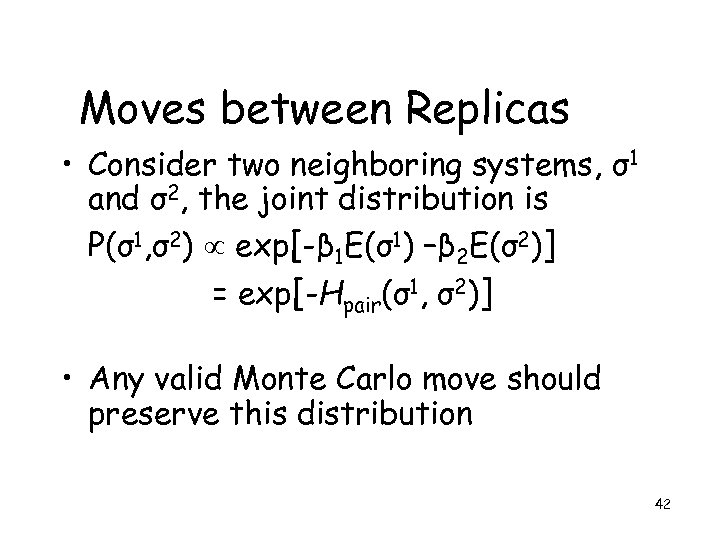 Moves between Replicas • Consider two neighboring systems, σ1 and σ2, the joint distribution is P(σ1, σ2) exp[-β 1 E(σ1) –β 2 E(σ2)] = exp[-Hpair(σ1, σ2)] • Any valid Monte Carlo move should preserve this distribution 42
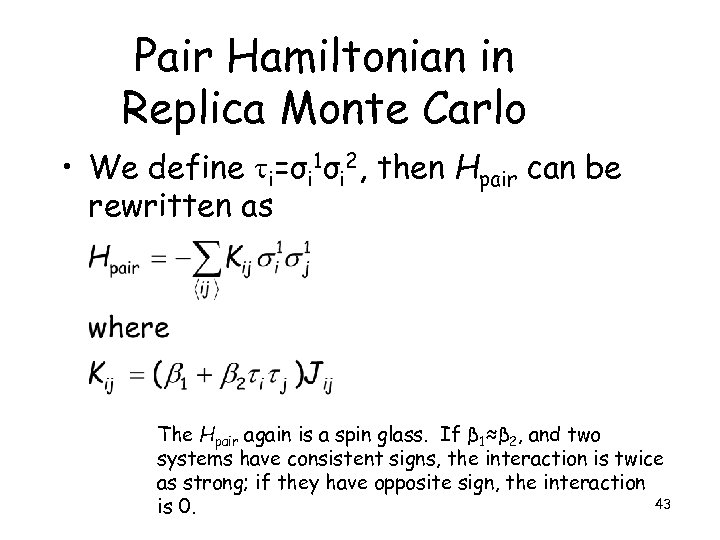 Pair Hamiltonian in Replica Monte Carlo • We define i=σi 1σi 2, then Hpair can be rewritten as The Hpair again is a spin glass. If β 1≈β 2, and two systems have consistent signs, the interaction is twice as strong; if they have opposite sign, the interaction 43 is 0.
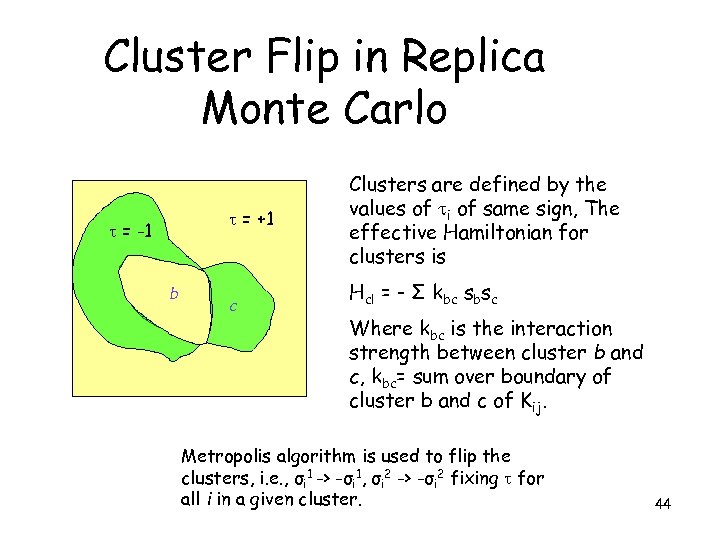 Cluster Flip in Replica Monte Carlo = +1 = -1 b c Clusters are defined by the values of i of same sign, The effective Hamiltonian for clusters is Hcl = - Σ kbc sbsc Where kbc is the interaction strength between cluster b and c, kbc= sum over boundary of cluster b and c of Kij. Metropolis algorithm is used to flip the clusters, i. e. , σi 1 -> -σi 1, σi 2 -> -σi 2 fixing for all i in a given cluster. 44
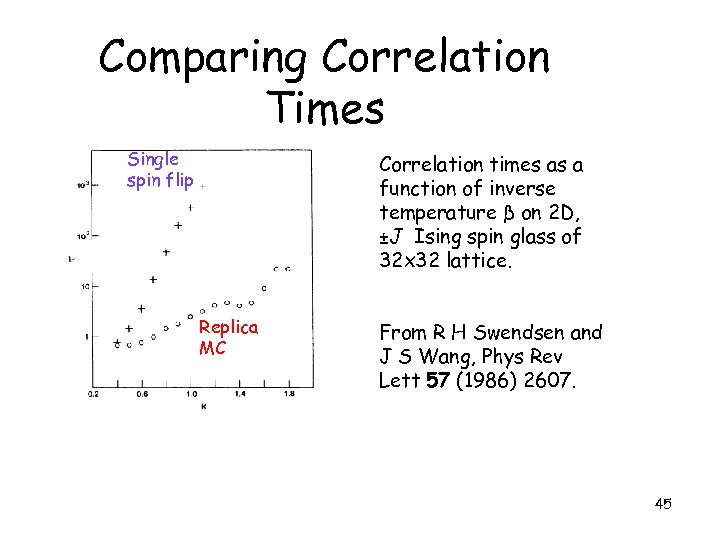 Comparing Correlation Times Single spin flip Correlation times as a function of inverse temperature β on 2 D, ±J Ising spin glass of 32 x 32 lattice. Replica MC From R H Swendsen and J S Wang, Phys Rev Lett 57 (1986) 2607. 45
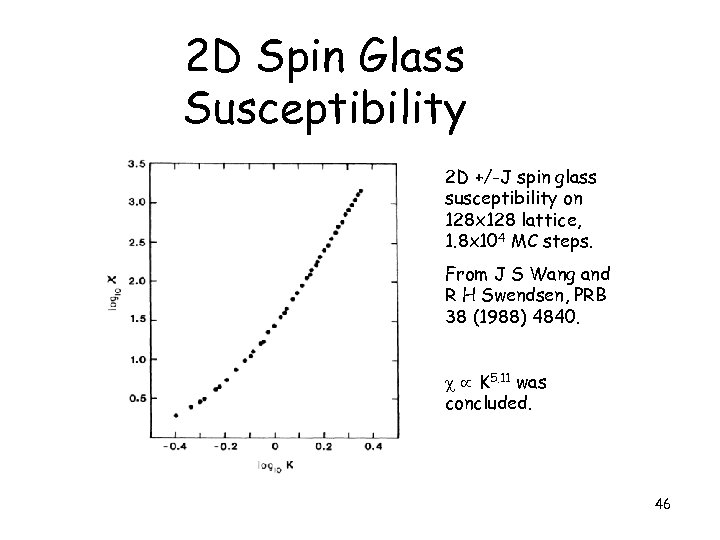 2 D Spin Glass Susceptibility 2 D +/-J spin glass susceptibility on 128 x 128 lattice, 1. 8 x 10⁴ MC steps. From J S Wang and R H Swendsen, PRB 38 (1988) 4840. K 5. 11 was concluded. 46
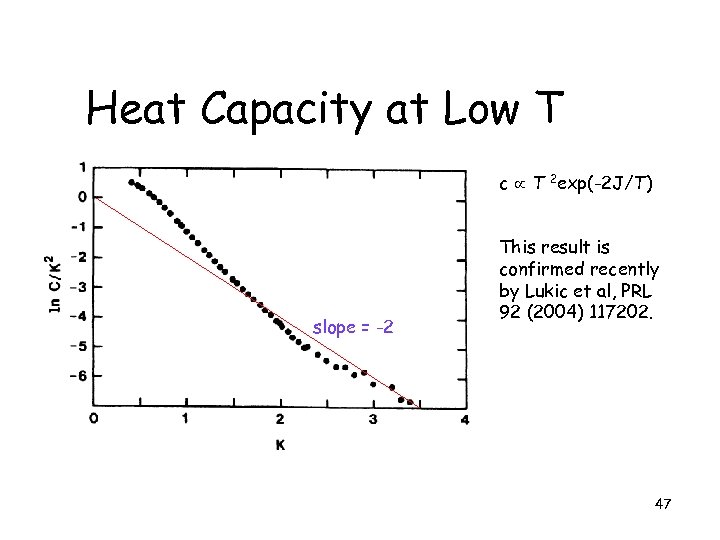 Heat Capacity at Low T c T 2 exp(-2 J/T) slope = -2 This result is confirmed recently by Lukic et al, PRL 92 (2004) 117202. 47
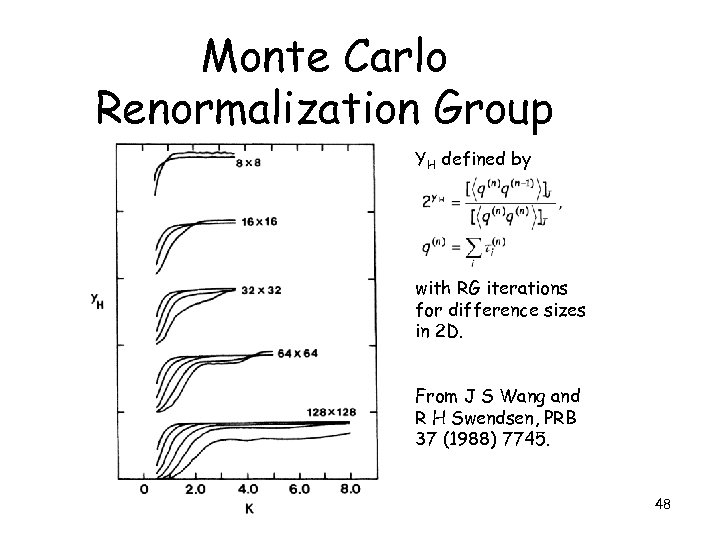 Monte Carlo Renormalization Group YH defined by with RG iterations for difference sizes in 2 D. From J S Wang and R H Swendsen, PRB 37 (1988) 7745. 48
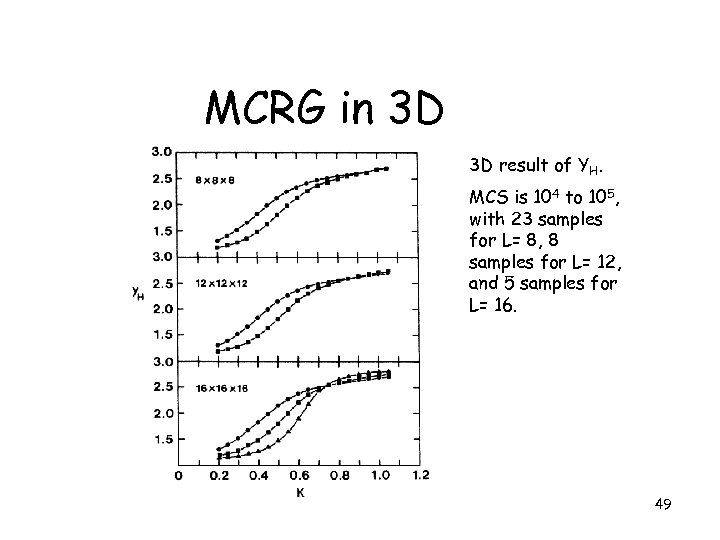 MCRG in 3 D 3 D result of YH. MCS is 104 to 105, with 23 samples for L= 8, 8 samples for L= 12, and 5 samples for L= 16. 49
 Conclusion • Monte Carlo methods have broad applications • Cluster algorithms eliminate the difficulty of critical slowing down • Replica Monte Carlo works on frustrated and disordered systems 50