 Скачать презентацию Cluster Computing with Linux Prabhaker Mateti Wright State
22eba27b23ceaa31fd794c2099783e39.ppt
- Количество слайдов: 129



Cluster Computing with Linux Prabhaker Mateti Wright State University Mateti, Linux Clusters
Abstract Cluster computing distributes the computational load to collections of similar machines. This talk describes what cluster computing is, the typical Linux packages used, and examples of large clusters in use today. This talk also reviews cluster computing modifications of the Linux kernel. Mateti, Linux Clusters 2
What Kind of Computing, did you say? l l l Sequential Concurrent Parallel Distributed Networked Migratory l l l Cluster Grid Pervasive Quantum Optical Molecular Mateti, Linux Clusters 3
Fundamentals Overview Mateti, Linux Clusters
Fundamentals Overview Granularity of Parallelism l Synchronization l Message Passing l Shared Memory l Mateti, Linux Clusters 5
Granularity of Parallelism Fine-Grained Parallelism l Medium-Grained Parallelism l Coarse-Grained Parallelism l NOWs (Networks of Workstations ( l Mateti, Linux Clusters 6
Fine-Grained Machines l l Tens of thousands of Processor Elements l l Interconnection Networks l l Slow (bit serial) Small Fast Private RAM Shared Memory Message Passing Single Instruction Multiple Data (SIMD) Mateti, Linux Clusters 7
Medium-Grained Machines l Typical Configurations l Thousands of processors l Processors have power between coarse- and fine-grained Either shared or distributed memory l Traditionally: Research Machines l Single Code Multiple Data (SCMD) l Mateti, Linux Clusters 8
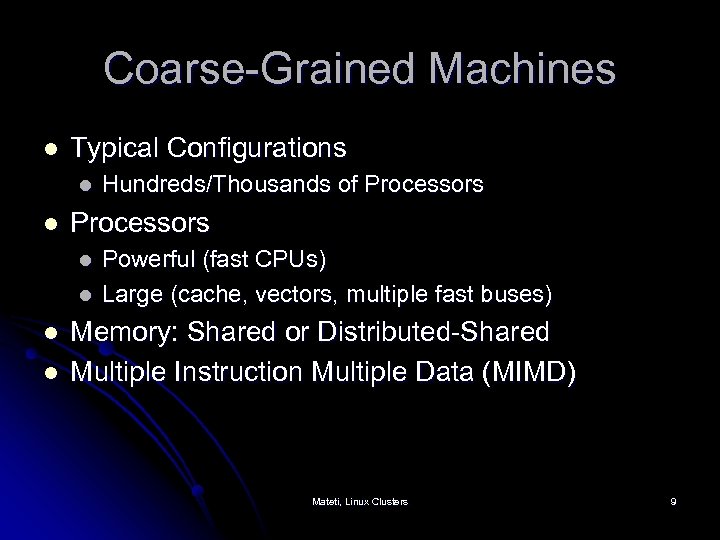
Coarse-Grained Machines l Typical Configurations l l Processors l l Hundreds/Thousands of Processors Powerful (fast CPUs) Large (cache, vectors, multiple fast buses) Memory: Shared or Distributed-Shared Multiple Instruction Multiple Data (MIMD) Mateti, Linux Clusters 9
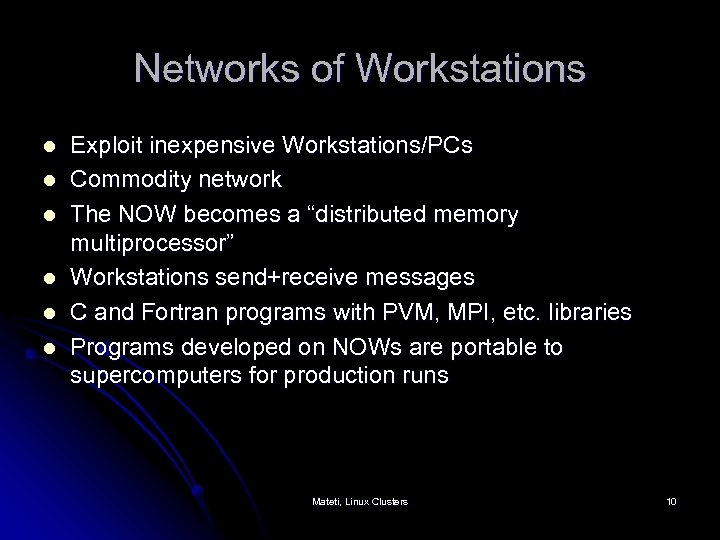
Networks of Workstations l l l Exploit inexpensive Workstations/PCs Commodity network The NOW becomes a “distributed memory multiprocessor” Workstations send+receive messages C and Fortran programs with PVM, MPI, etc. libraries Programs developed on NOWs are portable to supercomputers for production runs Mateti, Linux Clusters 10
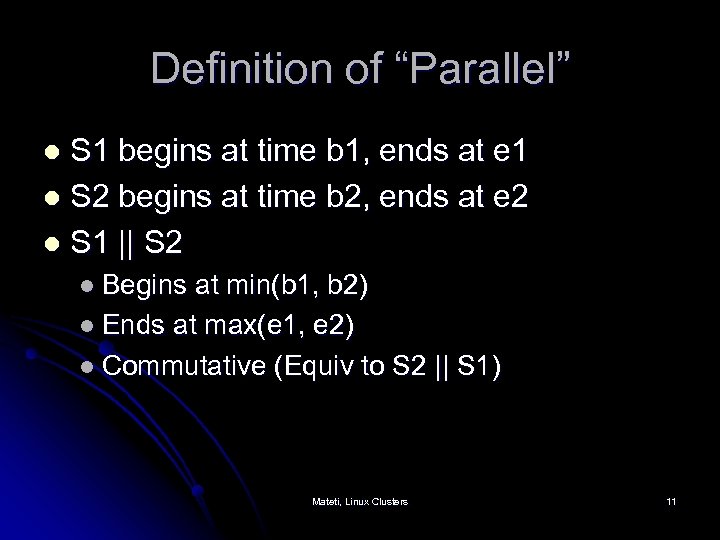
Definition of “Parallel” S 1 begins at time b 1, ends at e 1 l S 2 begins at time b 2, ends at e 2 l S 1 || S 2 l l Begins at min(b 1, b 2) l Ends at max(e 1, e 2) l Commutative (Equiv to S 2 || S 1) Mateti, Linux Clusters 11
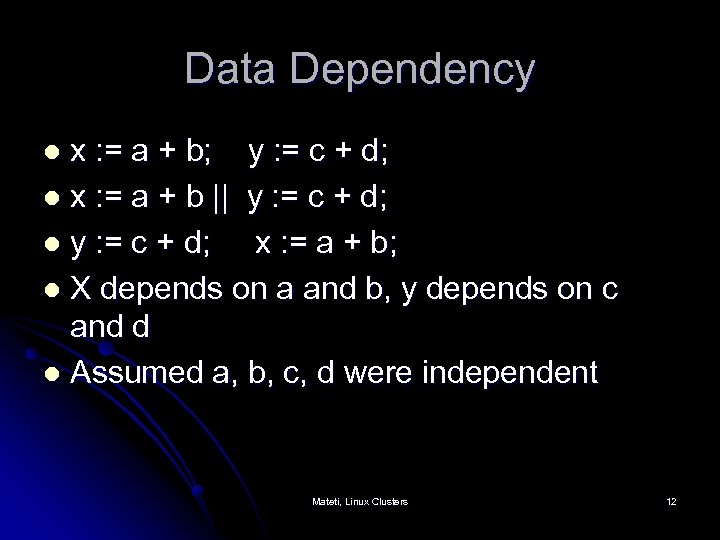
Data Dependency x : = a + b; y : = c + d; l x : = a + b || y : = c + d; l y : = c + d; x : = a + b; l X depends on a and b, y depends on c and d l Assumed a, b, c, d were independent l Mateti, Linux Clusters 12
Types of Parallelism Result: Data structure can be split into parts of same structure. l Specialist: Each node specializes. Pipelines. l Agenda: Have list of things to do. Each node can generalize. l Mateti, Linux Clusters 13
Result Parallelism l Also called l l l Embarrassingly Parallel Perfect Parallel Computations that can be subdivided into sets of independent tasks that require little or no communication l l Monte Carlo simulations F(x, y, z) Mateti, Linux Clusters 14
Specialist Parallelism l l Different operations performed simultaneously on different processors E. g. , Simulating a chemical plant; one processor simulates the preprocessing of chemicals, one simulates reactions in first batch, another simulates refining the products, etc. Mateti, Linux Clusters 15
Agenda Parallelism: MW Model l Manager l l l Initiates computation Tracks progress Handles worker’s requests Interfaces with user Workers l l l Spawned and terminated by manager Make requests to manager Send results to manager Mateti, Linux Clusters 16
Embarrassingly Parallel Result Parallelism is obvious l Ex 1: Compute the square root of each of the million numbers given. l Ex 2: Search for a given set of words among a billion web pages. l Mateti, Linux Clusters 17
Reduction Combine several sub-results into one l Reduce r 1 r 2 … rn with op l Becomes r 1 op r 2 op … op rn l Hadoop is based on this idea l Mateti, Linux Clusters 18
Shared Memory Process A writes to a memory location l Process B reads from that memory location l Synchronization is crucial l Excellent speed l Semantics? … l Mateti, Linux Clusters 19
Shared Memory l Needs hardware support: l multi-ported memory l Atomic operations: l Test-and-Set l Semaphores Mateti, Linux Clusters 20
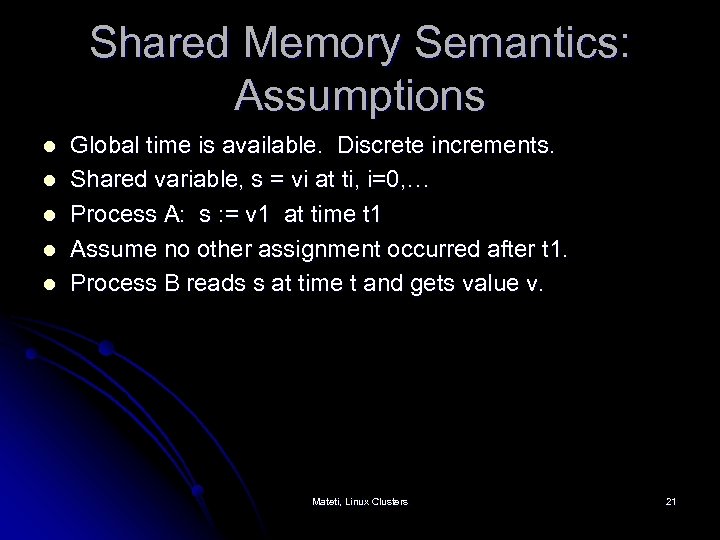
Shared Memory Semantics: Assumptions l l l Global time is available. Discrete increments. Shared variable, s = vi at ti, i=0, … Process A: s : = v 1 at time t 1 Assume no other assignment occurred after t 1. Process B reads s at time t and gets value v. Mateti, Linux Clusters 21
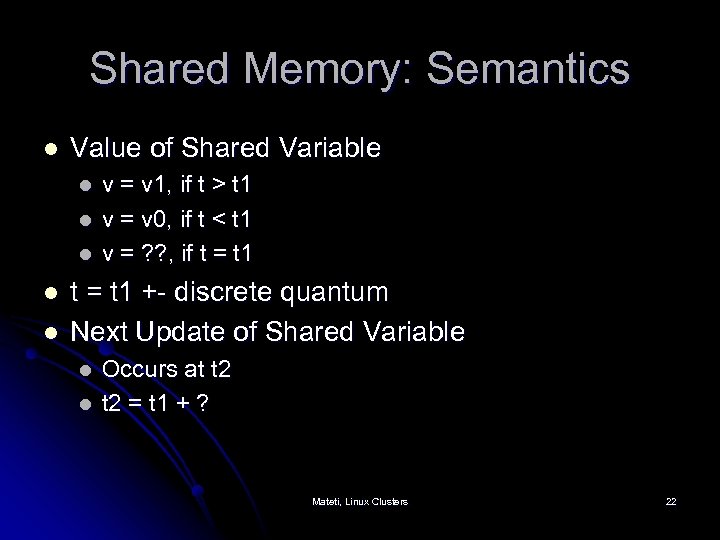
Shared Memory: Semantics l Value of Shared Variable l l l v = v 1, if t > t 1 v = v 0, if t < t 1 v = ? ? , if t = t 1 +- discrete quantum Next Update of Shared Variable l l Occurs at t 2 = t 1 + ? Mateti, Linux Clusters 22
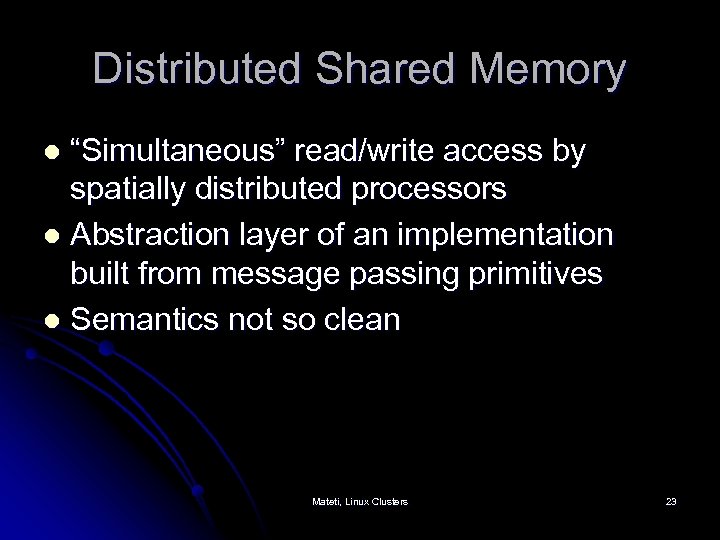
Distributed Shared Memory “Simultaneous” read/write access by spatially distributed processors l Abstraction layer of an implementation built from message passing primitives l Semantics not so clean l Mateti, Linux Clusters 23
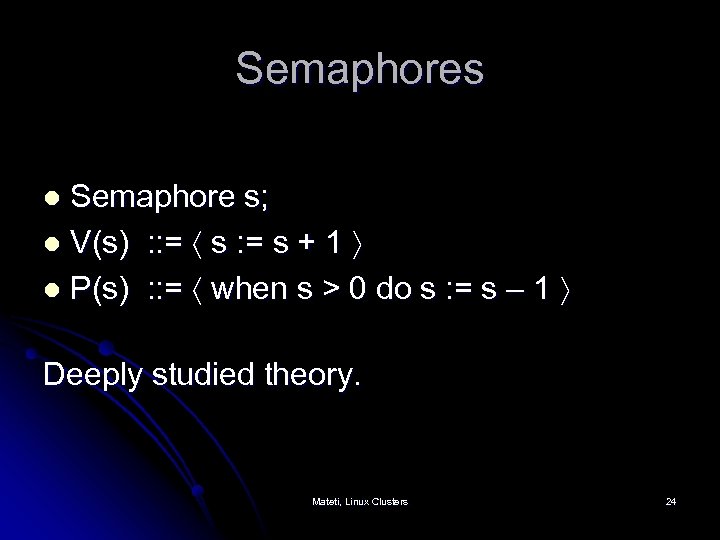
Semaphores Semaphore s; l V(s) : : = s : = s + 1 l P(s) : : = when s > 0 do s : = s – 1 l Deeply studied theory. Mateti, Linux Clusters 24
Condition Variables Condition C; l C. wait() l C. signal() l Mateti, Linux Clusters 25
Distributed Shared Memory A common address space that all the computers in the cluster share. l Difficult to describe semantics. l Mateti, Linux Clusters 26
Distributed Shared Memory: Issues l Distributed l Spatially l LAN l WAN l No global time available Mateti, Linux Clusters 27
Distributed Computing No shared memory l Communication among processes l l Send a message l Receive a message Asynchronous l Synergy among processes l Mateti, Linux Clusters 28
Messages are sequences of bytes moving between processes l The sender and receiver must agree on the type structure of values in the message l “Marshalling”: data layout so that there is no ambiguity such as “four chars” v. “one integer. ” l Mateti, Linux Clusters 29
Message Passing Process A sends a data buffer as a message to process B. l Process B waits for a message from A, and when it arrives copies it into its own local memory. l No memory shared between A and B. l Mateti, Linux Clusters 30
Message Passing l Obviously, l l l Messages cannot be received before they are sent. A receiver waits until there is a message. Asynchronous l l Sender never blocks, even if infinitely many messages are waiting to be received Semi-asynchronous is a practical version of above with large but finite amount of buffering Mateti, Linux Clusters 31
Message Passing: Point to Point l Q: send(m, P) l Send message M to process P l P: recv(x, Q) l Receive message from process Q, and place it in variable x l The message data l Type of x must match that of m l As if x : = m Mateti, Linux Clusters 32
Broadcast One sender Q, multiple receivers P l Not all receivers may receive at the same time l Q: broadcast (m) l l Send message M to processes l P: recv(x, Q) l Receive message from process Q, and place it in variable x Mateti, Linux Clusters 33
Synchronous Message Passing Sender blocks until receiver is ready to receive. l Cannot send messages to self. l No buffering. l Mateti, Linux Clusters 34
Asynchronous Message Passing Sender never blocks. l Receiver receives when ready. l Can send messages to self. l Infinite buffering. l Mateti, Linux Clusters 35
Message Passing l Speed not so good l Sender copies message into system buffers. l Message travels the network. l Receiver copies message from system buffers into local memory. l Special virtual memory techniques help. l Programming Quality l less error-prone cf. shared memory Mateti, Linux Clusters 36
Computer Architectures Mateti, Linux Clusters 37
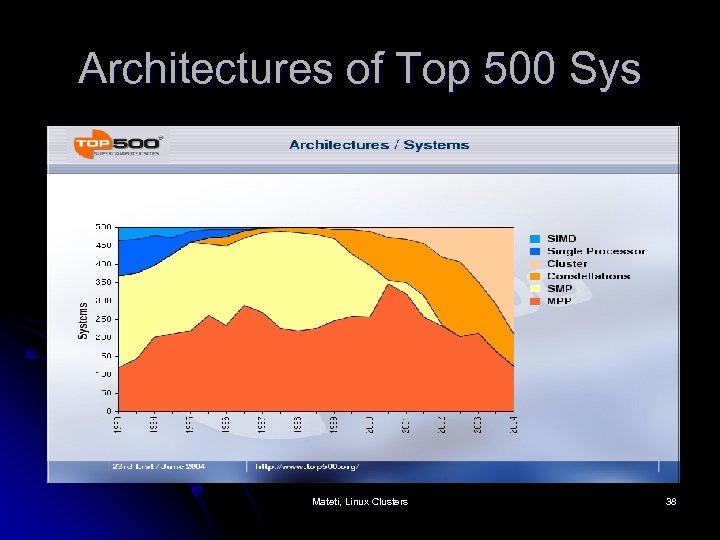
Architectures of Top 500 Sys Mateti, Linux Clusters 38
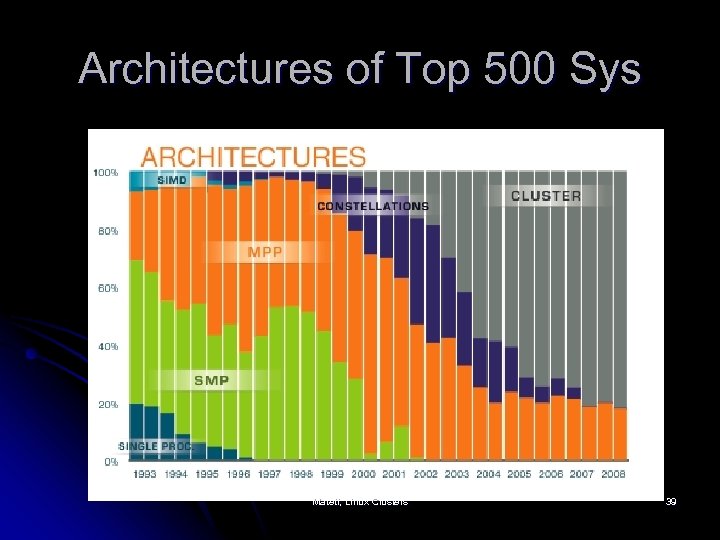
Architectures of Top 500 Sys Mateti, Linux Clusters 39
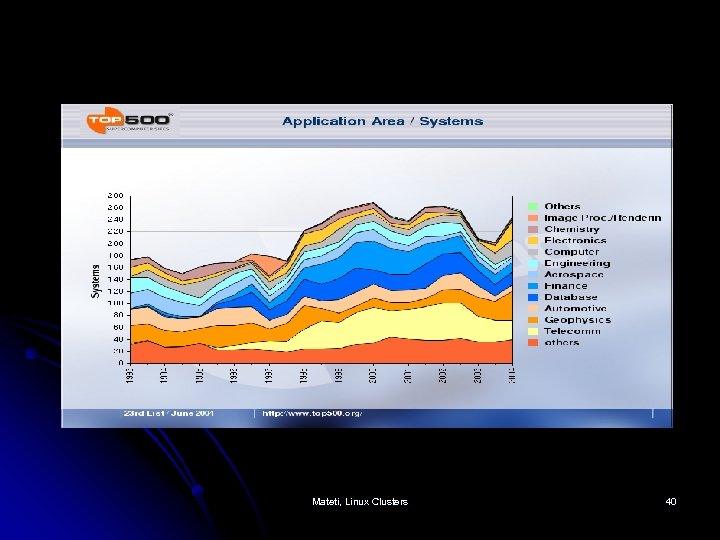
Mateti, Linux Clusters 40
“Parallel” Computers l Traditional supercomputers l SIMD, MIMD, pipelines l Tightly coupled shared memory l Bus level connections l Expensive to buy and to maintain l Cooperating networks of computers Mateti, Linux Clusters 41
Traditional Supercomputers l Very high starting cost l Expensive hardware l Expensive software High maintenance l Expensive to upgrade l Mateti, Linux Clusters 42
Computational Grids “Grids are persistent environments that enable software applications to integrate instruments, displays, computational and information resources that are managed by diverse organizations in widespread locations. ” Mateti, Linux Clusters 43
Computational Grids Individual nodes can be supercomputers, or NOW l High availability l Accommodate peak usage l LAN : Internet : : NOW : Grid l Mateti, Linux Clusters 44
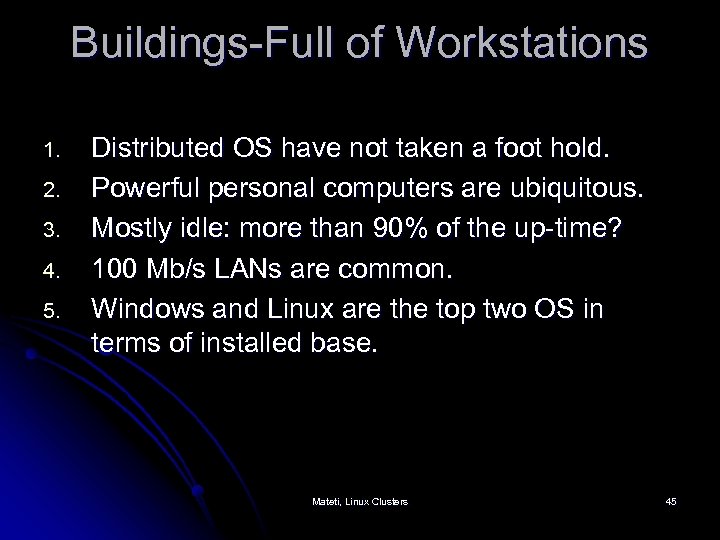
Buildings-Full of Workstations 1. 2. 3. 4. 5. Distributed OS have not taken a foot hold. Powerful personal computers are ubiquitous. Mostly idle: more than 90% of the up-time? 100 Mb/s LANs are common. Windows and Linux are the top two OS in terms of installed base. Mateti, Linux Clusters 45
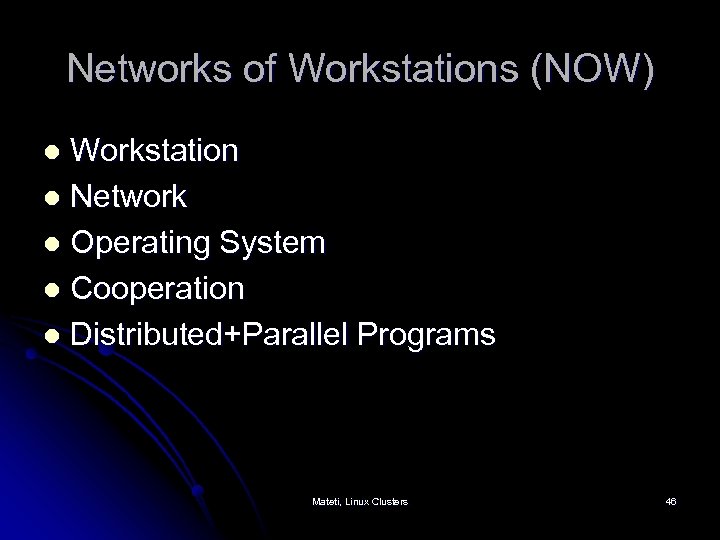
Networks of Workstations (NOW) Workstation l Network l Operating System l Cooperation l Distributed+Parallel Programs l Mateti, Linux Clusters 46
What is a Workstation ? PC? Mac? Sun? … l “Workstation OS” l Mateti, Linux Clusters 47
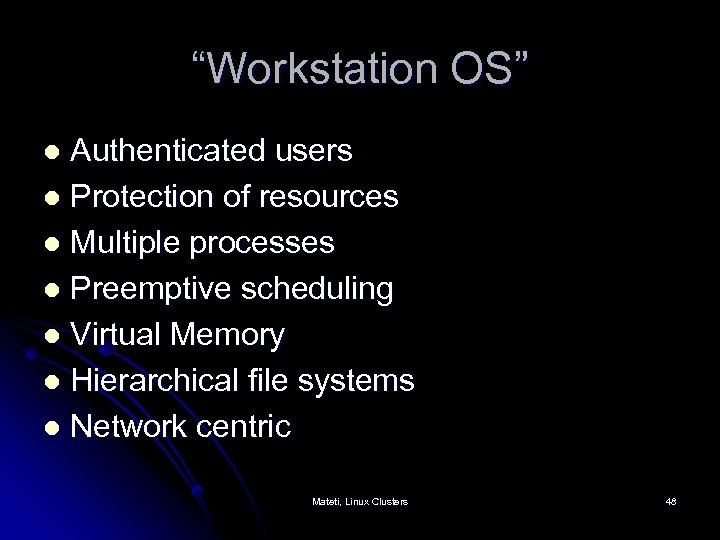
“Workstation OS” Authenticated users l Protection of resources l Multiple processes l Preemptive scheduling l Virtual Memory l Hierarchical file systems l Network centric l Mateti, Linux Clusters 48
Clusters of Workstations Inexpensive alternative to traditional supercomputers l High availability l l Lower down time l Easier access l Development platform with production runs on traditional supercomputers Mateti, Linux Clusters 49
Clusters of Workstations Dedicated Nodes l Come-and-Go Nodes l Mateti, Linux Clusters 50
Clusters with Part Time Nodes l l l Cycle Stealing: Running of jobs on a workstation that don't belong to the owner. Definition of Idleness: E. g. , No keyboard and no mouse activity Tools/Libraries l l l Condor PVM MPI Mateti, Linux Clusters 51
Cooperation Workstations are “personal” l Others use slows you down l… l Willing to share l Willing to trust l Mateti, Linux Clusters 52
Cluster Characteristics Commodity off the shelf hardware l Networked l Common Home Directories l Open source software and OS l Support message passing programming l Batch scheduling of jobs l Process migration l Mateti, Linux Clusters 53
Beowulf Cluster l l l l Dedicated nodes Single System View Commodity of the shelf hardware Internal high speed network Open source software and OS Support parallel programming such as MPI, PVM Full trust in each other l l Login from one node into another without authentication Mateti, Linux Clusters Shared file system subtree 54
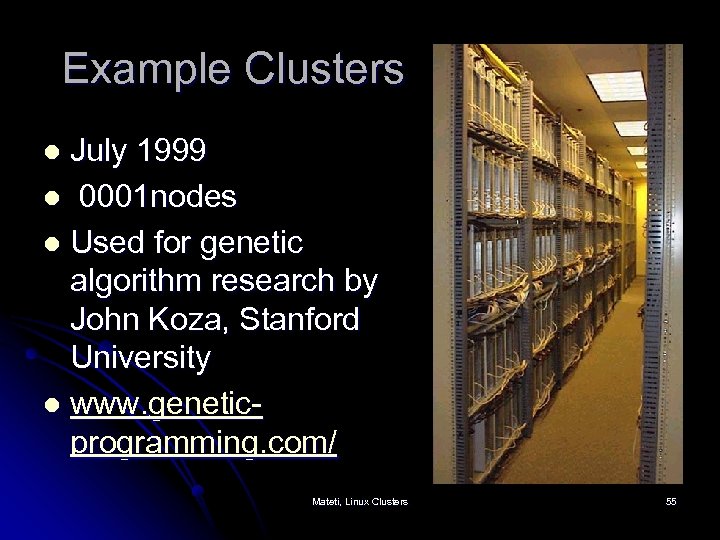
Example Clusters July 1999 l 0001 nodes l Used for genetic algorithm research by John Koza, Stanford University l www. geneticprogramming. com/ l Mateti, Linux Clusters 55
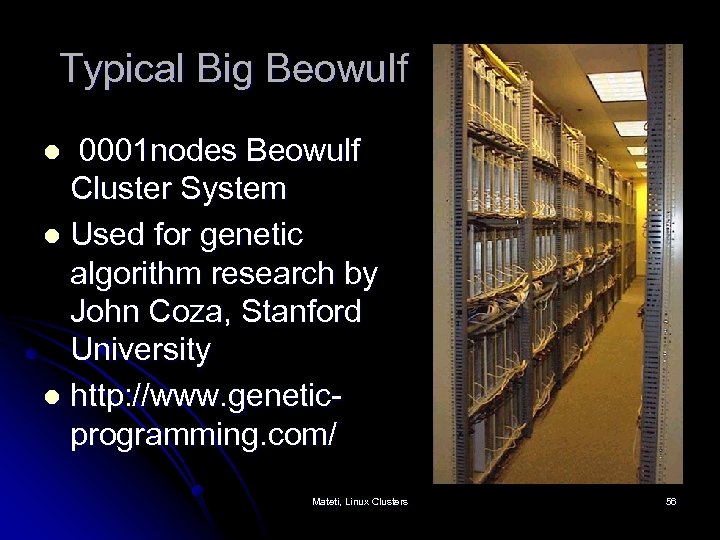
Typical Big Beowulf 0001 nodes Beowulf Cluster System l Used for genetic algorithm research by John Coza, Stanford University l http: //www. geneticprogramming. com/ l Mateti, Linux Clusters 56
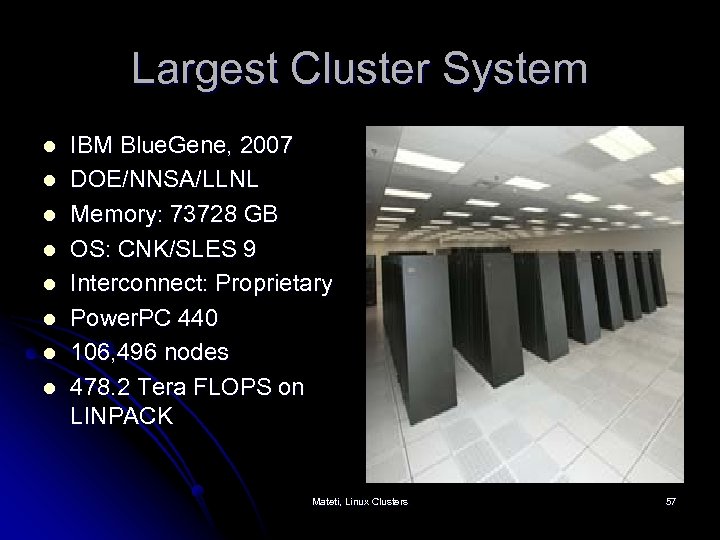
Largest Cluster System l l l l IBM Blue. Gene, 2007 DOE/NNSA/LLNL Memory: 73728 GB OS: CNK/SLES 9 Interconnect: Proprietary Power. PC 440 106, 496 nodes 478. 2 Tera FLOPS on LINPACK Mateti, Linux Clusters 57
2008 World’s Fastest: Roadrunner Operating System: Linux l Interconnect Infiniband l 129600 cores: Power. XCell 8 i 3200 MHz l 1105 TFlops l at DOE/NNSA/LANL l Mateti, Linux Clusters 58
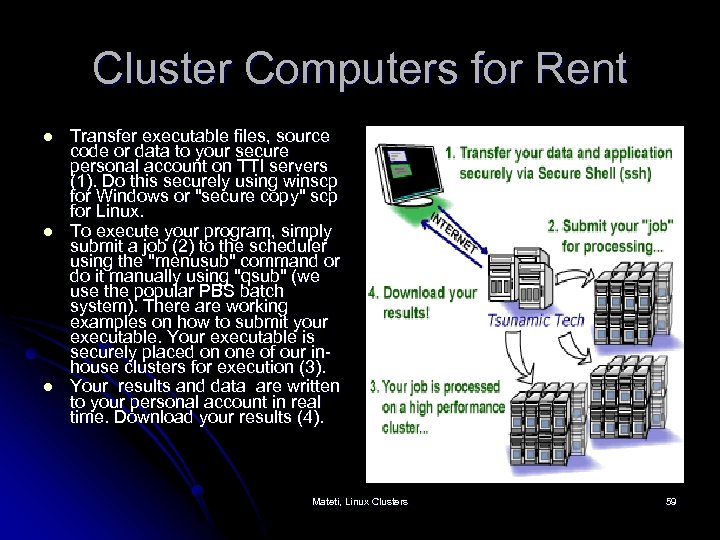
Cluster Computers for Rent l l l Transfer executable files, source code or data to your secure personal account on TTI servers (1). Do this securely using winscp for Windows or "secure copy" scp for Linux. To execute your program, simply submit a job (2) to the scheduler using the "menusub" command or do it manually using "qsub" (we use the popular PBS batch system). There are working examples on how to submit your executable. Your executable is securely placed on one of our inhouse clusters for execution (3). Your results and data are written to your personal account in real time. Download your results (4). Mateti, Linux Clusters 59
Turnkey Cluster Vendors l l l l Fully integrated Beowulf clusters with commercially supported Beowulf software systems are available from : HP www. hp. com/solutions/enterprise/highavailability/ IBM www. ibm. com/servers/eserver/clusters/ Northrop Grumman. com Accelerated Servers. com Penguin Computing. com www. aspsys. com/clusters www. pssclabs. com Mateti, Linux Clusters 60
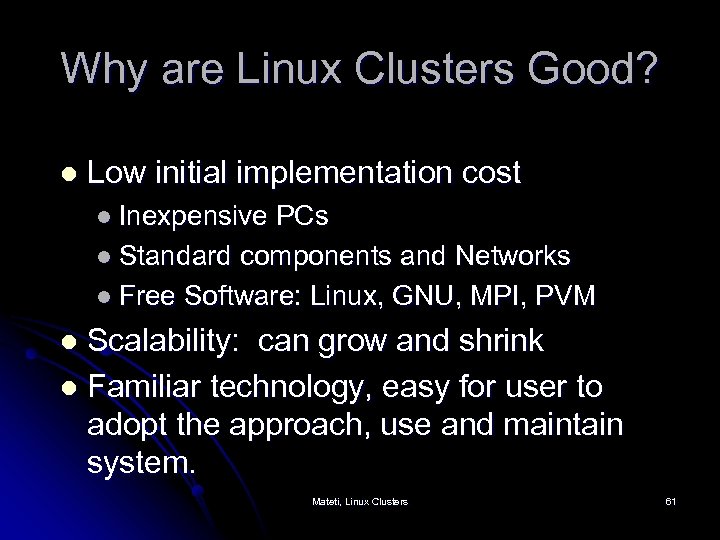
Why are Linux Clusters Good? l Low initial implementation cost l Inexpensive PCs l Standard components and Networks l Free Software: Linux, GNU, MPI, PVM Scalability: can grow and shrink l Familiar technology, easy for user to adopt the approach, use and maintain system. l Mateti, Linux Clusters 61
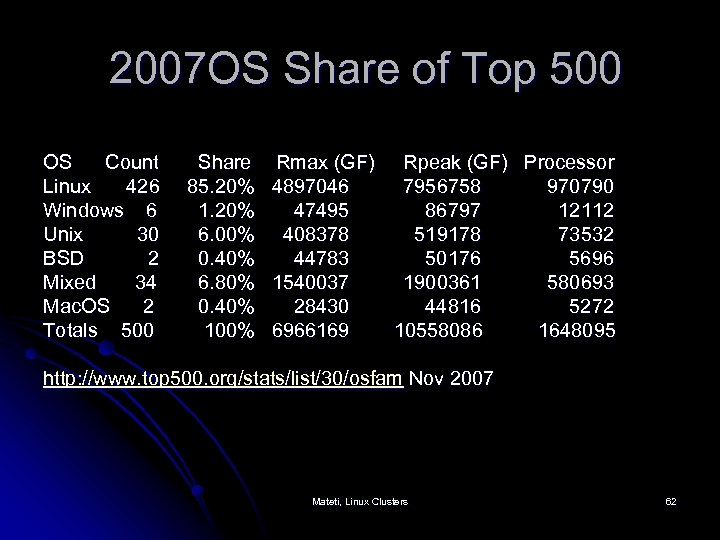
2007 OS Share of Top 500 OS Count Linux 426 Windows 6 Unix 30 BSD 2 Mixed 34 Mac. OS 2 Totals 500 Share Rmax (GF) Rpeak (GF) Processor 85. 20% 4897046 7956758 970790 1. 20% 47495 86797 12112 6. 00% 408378 519178 73532 0. 40% 44783 50176 5696 6. 80% 1540037 1900361 580693 0. 40% 28430 44816 5272 100% 6966169 10558086 1648095 http: //www. top 500. org/stats/list/30/osfam Nov 2007 Mateti, Linux Clusters 62
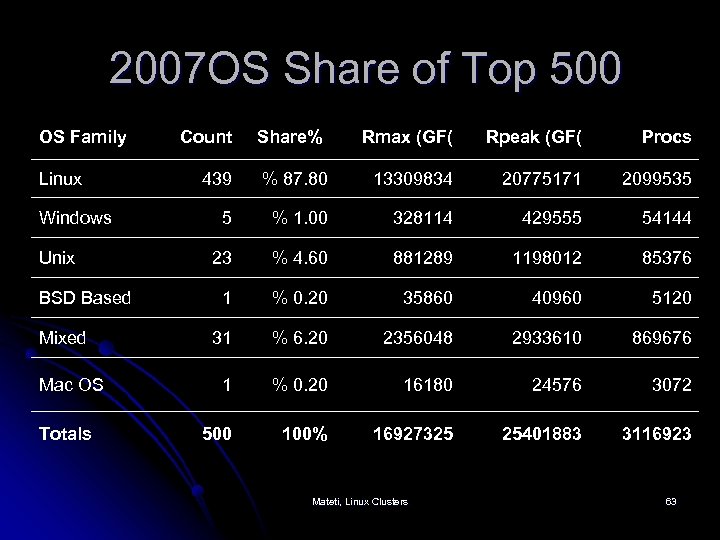
2007 OS Share of Top 500 OS Family Linux Windows Unix BSD Based Mixed Mac OS Totals Count Share% Rmax (GF( Rpeak (GF( Procs 439 % 87. 80 13309834 20775171 2099535 5 % 1. 00 328114 429555 54144 23 % 4. 60 881289 1198012 85376 1 % 0. 20 35860 40960 5120 31 % 6. 20 2356048 2933610 869676 1 % 0. 20 16180 24576 3072 500 100% 16927325 25401883 3116923 Mateti, Linux Clusters 63
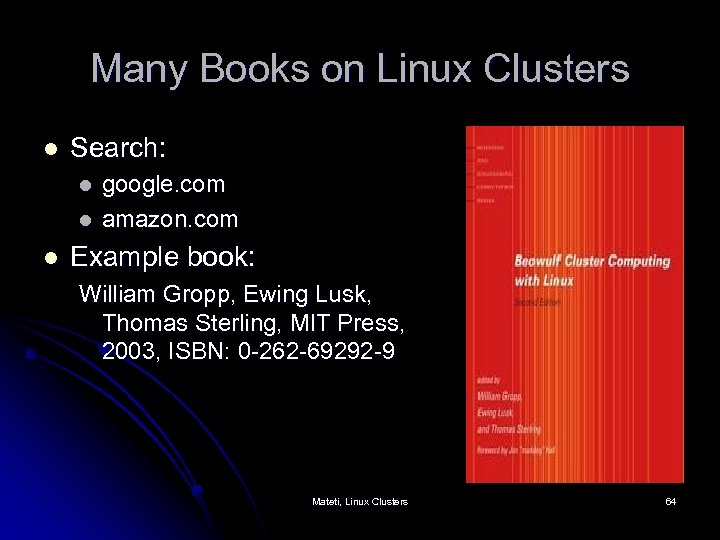
Many Books on Linux Clusters l Search: l l l google. com amazon. com Example book: William Gropp, Ewing Lusk, Thomas Sterling, MIT Press, 2003, ISBN: 0 -262 -69292 -9 Mateti, Linux Clusters 64
Why Is Beowulf Good? l Low initial implementation cost l Inexpensive PCs l Standard components and Networks l Free Software: Linux, GNU, MPI, PVM Scalability: can grow and shrink l Familiar technology, easy for user to adopt the approach, use and maintain system. l Mateti, Linux Clusters 65
Single System Image Common filesystem view from any node l Common accounts on all nodes l Single software installation point l Easy to install and maintain system l Easy to use for end-users l Mateti, Linux Clusters 66
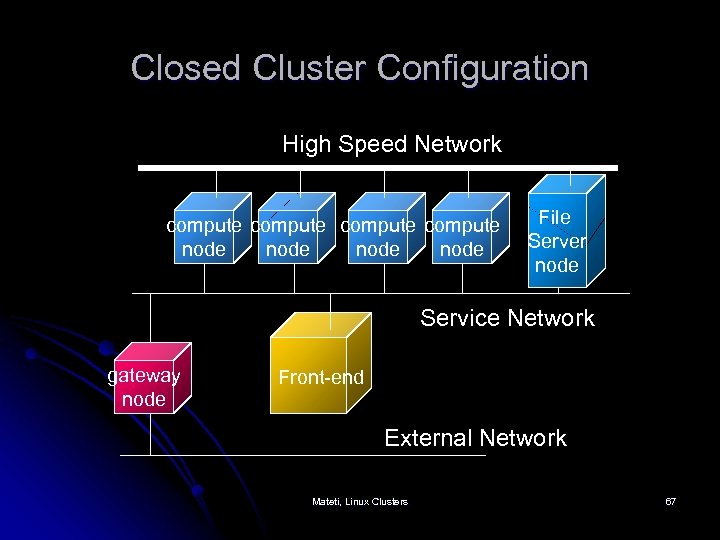
Closed Cluster Configuration High Speed Network compute node File Server node Service Network gateway node Front-end External Network Mateti, Linux Clusters 67
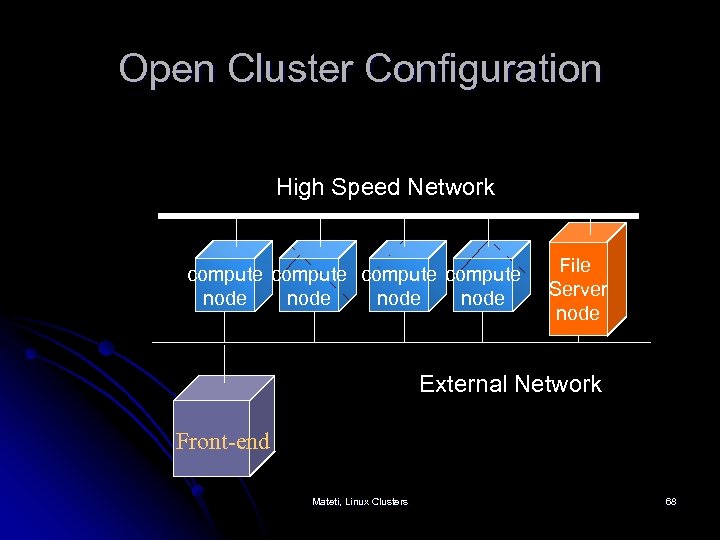
Open Cluster Configuration High Speed Network compute node File Server node External Network Front-end Mateti, Linux Clusters 68
DIY Interconnection Network Most popular: Fast Ethernet l Network topologies l l Mesh l Torus l Switch v. Hub Mateti, Linux Clusters 69
Software Components l Operating System l Linux, Free. BSD, … l “Parallel” Programs l PVM, MPI, … Utilities l Open source l Mateti, Linux Clusters 70
Cluster Computing Ordinary programs run as-is on clusters is not cluster computing l Cluster computing takes advantage of : l l Result parallelism l Agenda parallelism l Reduction operations l Process-grain parallelism Mateti, Linux Clusters 71
Google Linux Clusters l GFS: The Google File System l thousands of terabytes of storage across thousands of disks on over a thousand machines 150 million queries per day l Average response time of 0. 25 sec l Near-100% uptime l Mateti, Linux Clusters 72
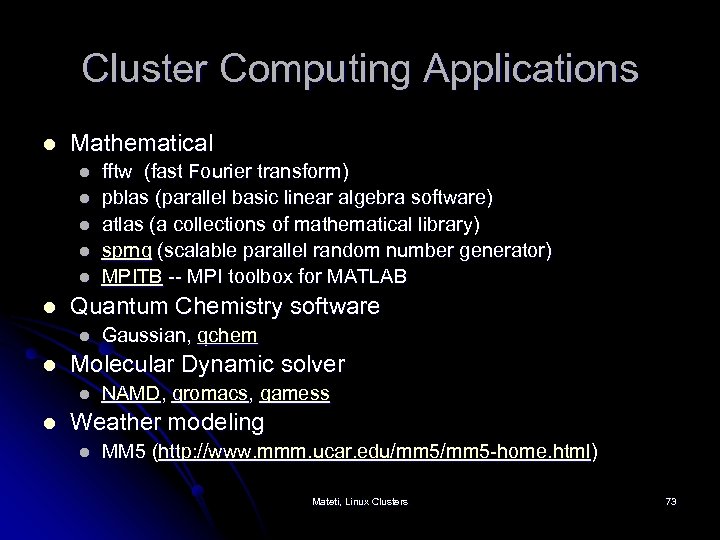
Cluster Computing Applications l Mathematical l l l Quantum Chemistry software l l Gaussian, qchem Molecular Dynamic solver l l fftw (fast Fourier transform) pblas (parallel basic linear algebra software) atlas (a collections of mathematical library) sprng (scalable parallel random number generator) MPITB -- MPI toolbox for MATLAB NAMD, gromacs, gamess Weather modeling l MM 5 (http: //www. mmm. ucar. edu/mm 5 -home. html) Mateti, Linux Clusters 73
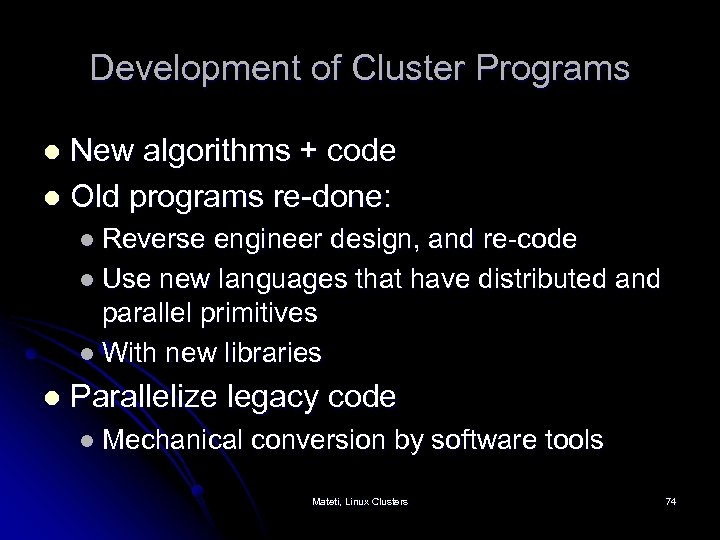
Development of Cluster Programs New algorithms + code l Old programs re-done: l l Reverse engineer design, and re-code l Use new languages that have distributed and parallel primitives l With new libraries l Parallelize legacy code l Mechanical conversion by software tools Mateti, Linux Clusters 74
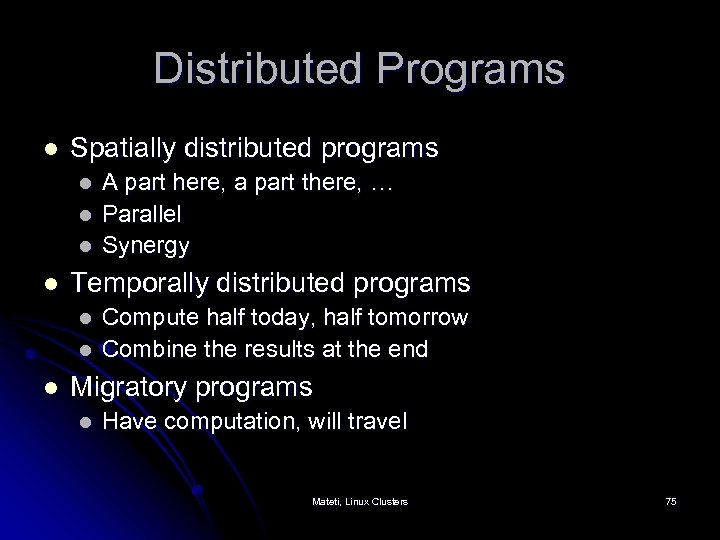
Distributed Programs l Spatially distributed programs l l Temporally distributed programs l l l A part here, a part there, … Parallel Synergy Compute half today, half tomorrow Combine the results at the end Migratory programs l Have computation, will travel Mateti, Linux Clusters 75
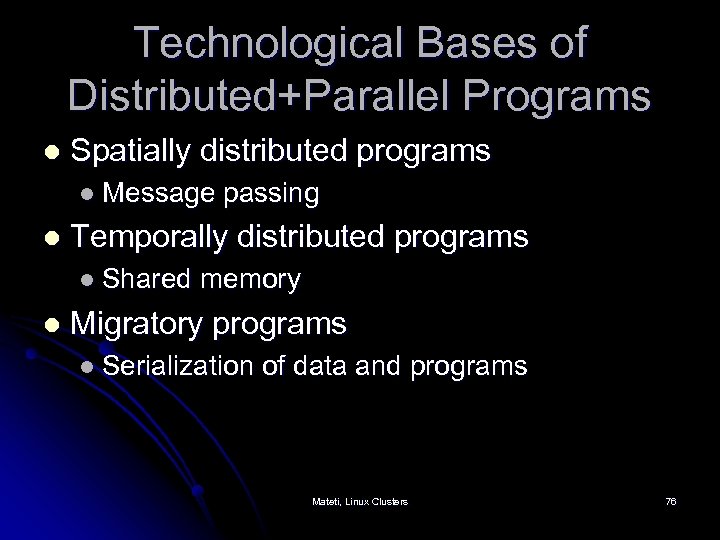
Technological Bases of Distributed+Parallel Programs l Spatially distributed programs l Message passing l Temporally distributed programs l Shared memory l Migratory programs l Serialization of data and programs Mateti, Linux Clusters 76
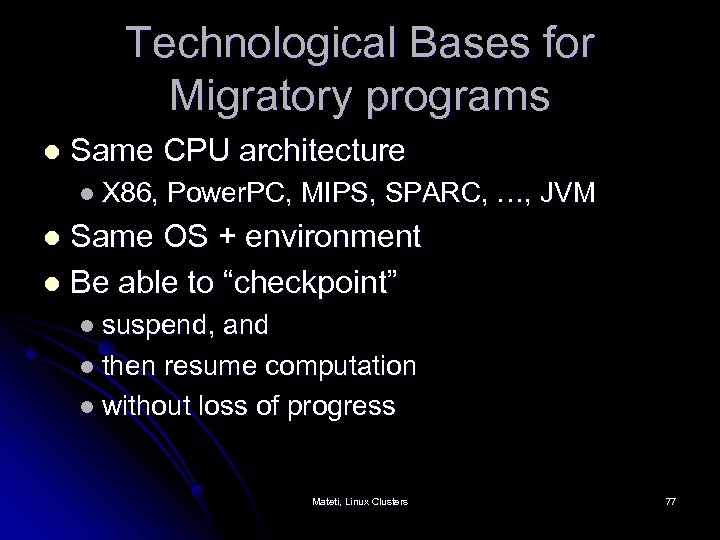
Technological Bases for Migratory programs l Same CPU architecture l X 86, Power. PC, MIPS, SPARC, …, JVM Same OS + environment l Be able to “checkpoint” l l suspend, and l then resume computation l without loss of progress Mateti, Linux Clusters 77
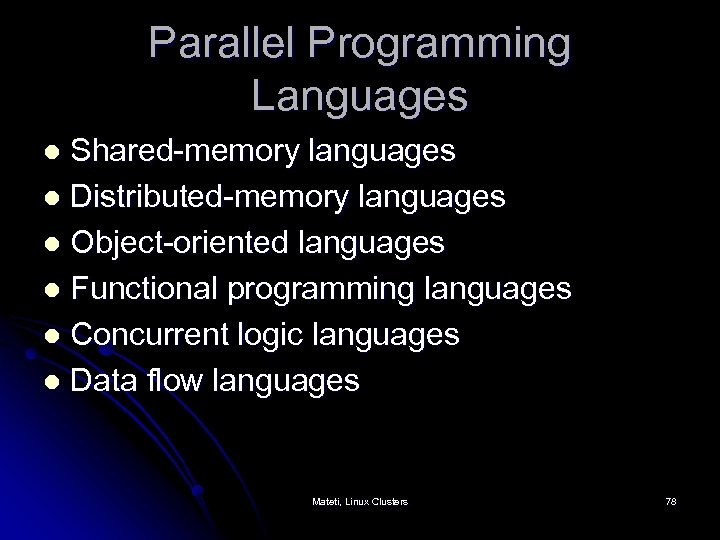
Parallel Programming Languages Shared-memory languages l Distributed-memory languages l Object-oriented languages l Functional programming languages l Concurrent logic languages l Data flow languages l Mateti, Linux Clusters 78
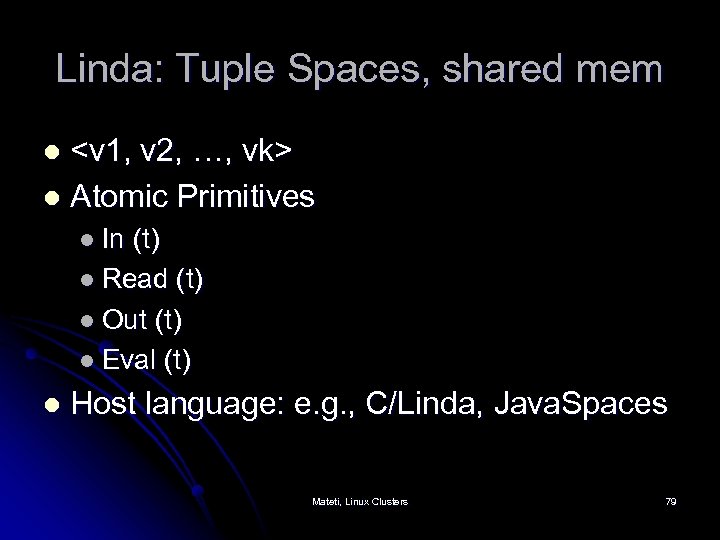
Linda: Tuple Spaces, shared mem <v 1, v 2, …, vk> l Atomic Primitives l l In (t) l Read (t) l Out (t) l Eval (t) l Host language: e. g. , C/Linda, Java. Spaces Mateti, Linux Clusters 79
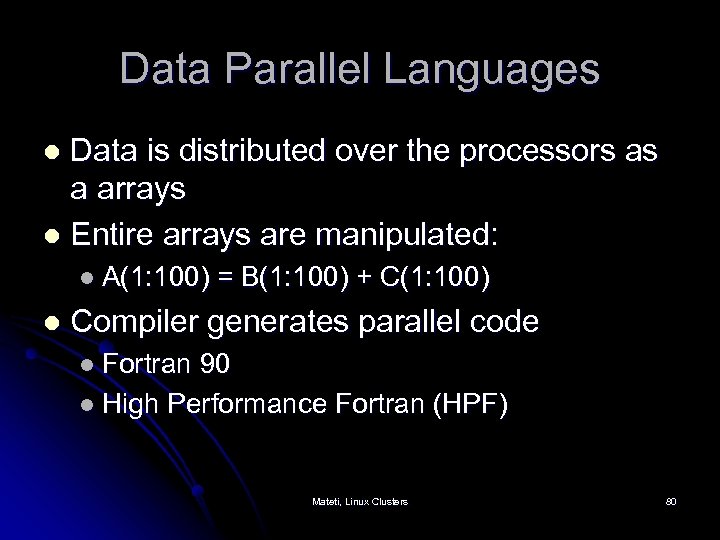
Data Parallel Languages Data is distributed over the processors as a arrays l Entire arrays are manipulated: l l A(1: 100) = B(1: 100) + C(1: 100) l Compiler generates parallel code l Fortran 90 l High Performance Fortran (HPF) Mateti, Linux Clusters 80
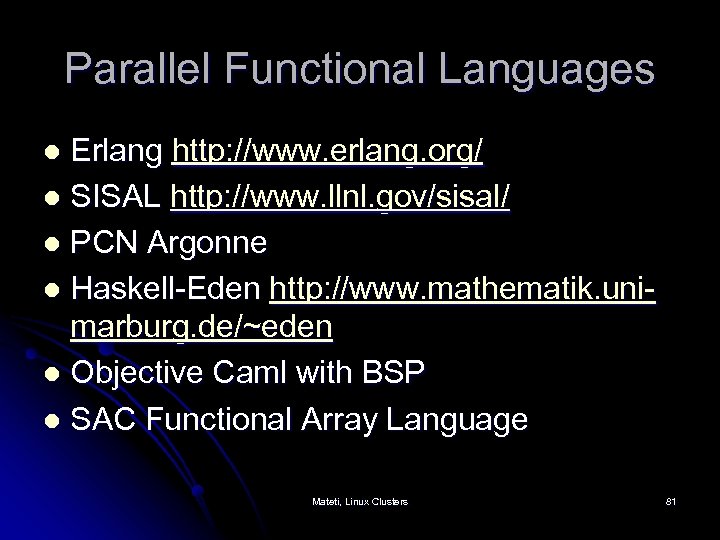
Parallel Functional Languages Erlang http: //www. erlang. org/ l SISAL http: //www. llnl. gov/sisal/ l PCN Argonne l Haskell-Eden http: //www. mathematik. unimarburg. de/~eden l Objective Caml with BSP l SAC Functional Array Language l Mateti, Linux Clusters 81
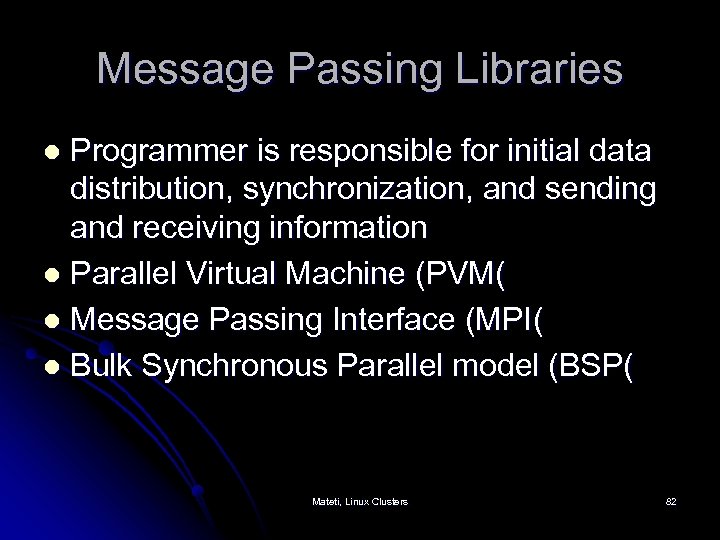
Message Passing Libraries Programmer is responsible for initial data distribution, synchronization, and sending and receiving information l Parallel Virtual Machine (PVM( l Message Passing Interface (MPI( l Bulk Synchronous Parallel model (BSP( l Mateti, Linux Clusters 82
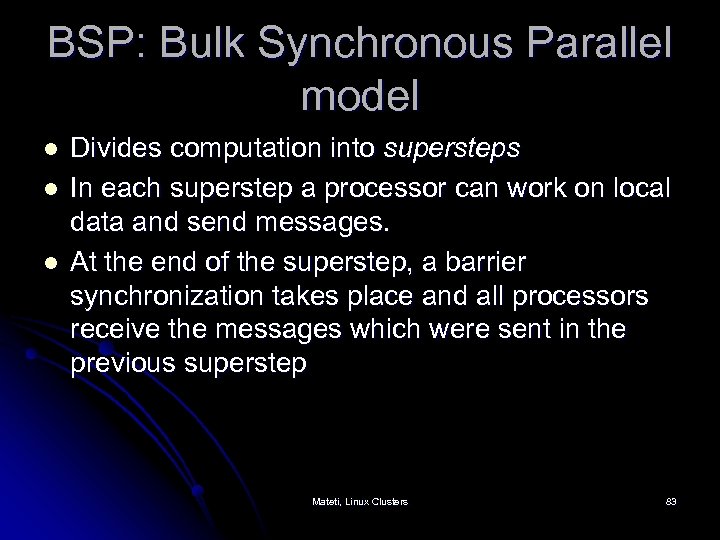
BSP: Bulk Synchronous Parallel model l Divides computation into supersteps In each superstep a processor can work on local data and send messages. At the end of the superstep, a barrier synchronization takes place and all processors receive the messages which were sent in the previous superstep Mateti, Linux Clusters 83
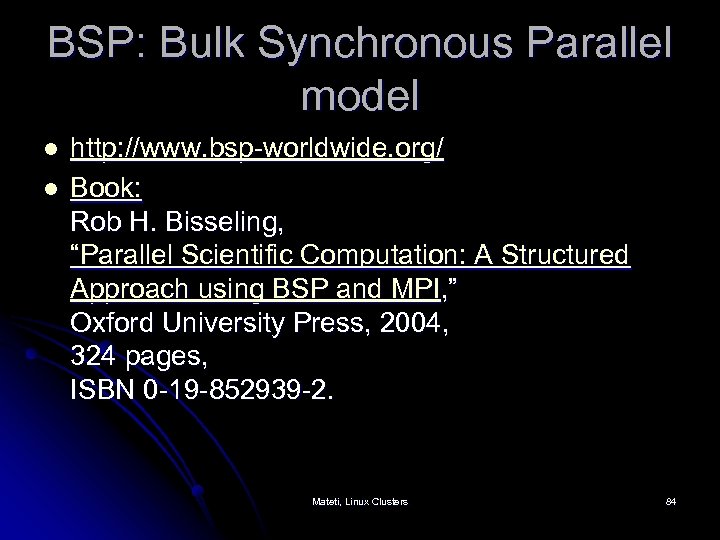
BSP: Bulk Synchronous Parallel model l l http: //www. bsp-worldwide. org/ Book: Rob H. Bisseling, “Parallel Scientific Computation: A Structured Approach using BSP and MPI, ” Oxford University Press, 2004, 324 pages, ISBN 0 -19 -852939 -2. Mateti, Linux Clusters 84
BSP Library l Small number of subroutines to implement l process creation, l remote data access, and l bulk synchronization. l Linked to C, Fortran, … programs Mateti, Linux Clusters 85
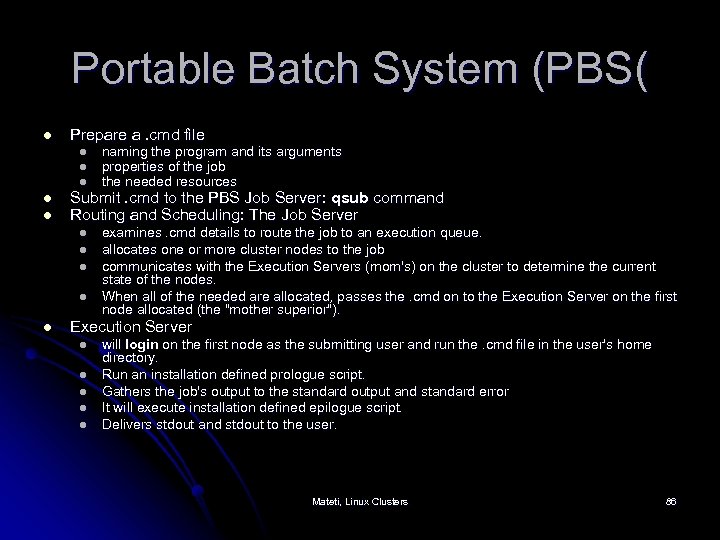
Portable Batch System (PBS( l Prepare a. cmd file l l l l naming the program and its arguments properties of the job the needed resources examines. cmd details to route the job to an execution queue. allocates one or more cluster nodes to the job communicates with the Execution Servers (mom's) on the cluster to determine the current state of the nodes. When all of the needed are allocated, passes the. cmd on to the Execution Server on the first node allocated (the "mother superior"). Submit. cmd to the PBS Job Server: qsub command Routing and Scheduling: The Job Server l l l Execution Server l l l will login on the first node as the submitting user and run the. cmd file in the user's home directory. Run an installation defined prologue script. Gathers the job's output to the standard output and standard error It will execute installation defined epilogue script. Delivers stdout and stdout to the user. Mateti, Linux Clusters 86
TORQUE, an open source PBS l l Tera-scale Open-source Resource and QUEue manager (TORQUE) enhances Open. PBS Fault Tolerance l l Scheduling Interface Scalability l l l Additional failure conditions checked/handled Node health check script support Significantly improved server to MOM communication model Ability to handle larger clusters (over 15 TF/2, 500 processors) Ability to handle larger jobs (over 2000 processors) Ability to support larger server messages Logging http: //www. supercluster. org/projects/torque/ Mateti, Linux Clusters 87
PVM, and MPI Message passing primitives l Can be embedded in many existing programming languages l Architecturally portable l Open-sourced implementations l Mateti, Linux Clusters 88
Parallel Virtual Machine (PVM ( PVM enables a heterogeneous collection of networked computers to be used as a single large parallel computer. l Older than MPI l Large scientific/engineering user community l http: //www. csm. ornl. gov/pvm/ l Mateti, Linux Clusters 89
Message Passing Interface (MPI( http: //www-unix. mcs. anl. gov/mpi/ l MPI-2. 0 http: //www. mpi-forum. org/docs/ l MPICH: www. mcs. anl. gov/mpich/ by Argonne National Laboratory and Missisippy State University l LAM: http: //www. lam-mpi. org/ l http: //www. open-mpi. org/ l Mateti, Linux Clusters 90
Open. MP for shared memory Distributed shared memory API l User-gives hints as directives to the compiler l http: //www. openmp. org l Mateti, Linux Clusters 91
SPMD Single program, multiple data l Contrast with SIMD l Same program runs on multiple nodes l May or may not be lock-step l Nodes may be of different speeds l Barrier synchronization l Mateti, Linux Clusters 92
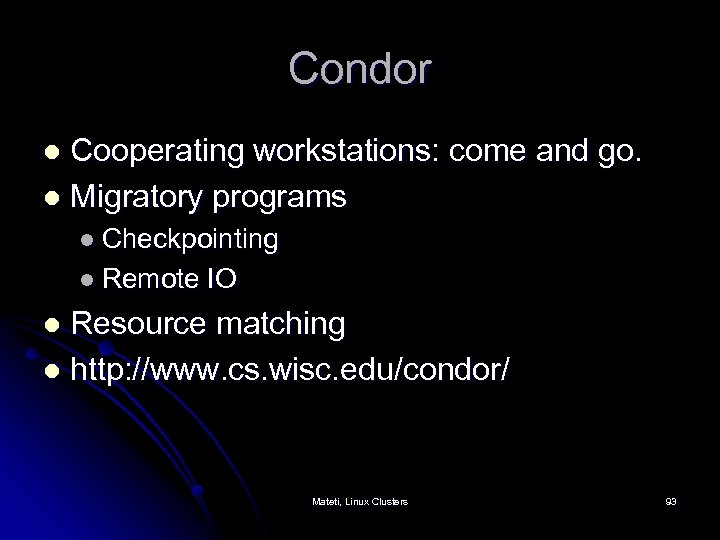
Condor Cooperating workstations: come and go. l Migratory programs l l Checkpointing l Remote IO Resource matching l http: //www. cs. wisc. edu/condor/ l Mateti, Linux Clusters 93
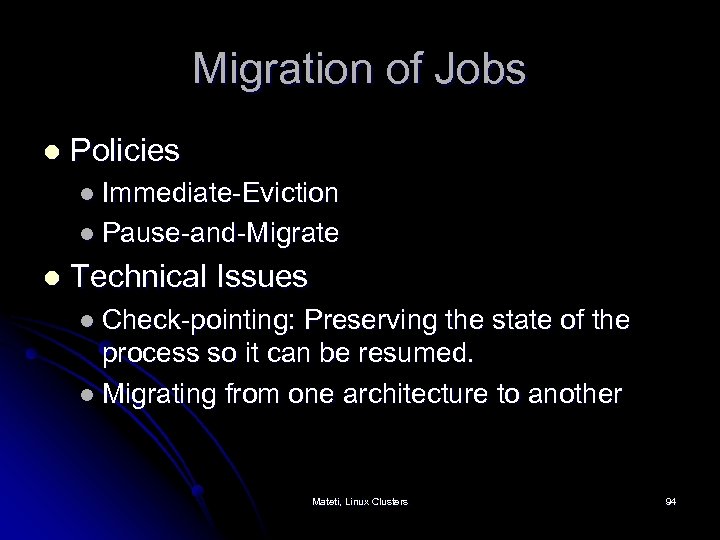
Migration of Jobs l Policies l Immediate-Eviction l Pause-and-Migrate l Technical Issues l Check-pointing: Preserving the state of the process so it can be resumed. l Migrating from one architecture to another Mateti, Linux Clusters 94
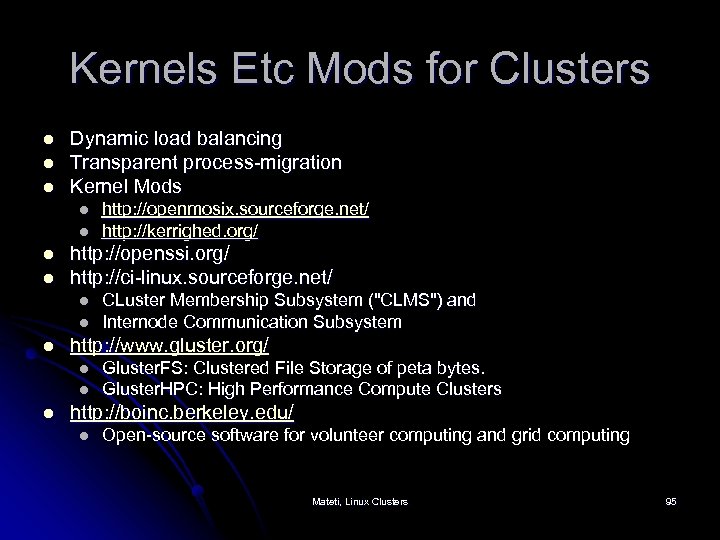
Kernels Etc Mods for Clusters l l l Dynamic load balancing Transparent process-migration Kernel Mods l l http: //openssi. org/ http: //ci-linux. sourceforge. net/ l l l CLuster Membership Subsystem ("CLMS") and Internode Communication Subsystem http: //www. gluster. org/ l l l http: //openmosix. sourceforge. net/ http: //kerrighed. org/ Gluster. FS: Clustered File Storage of peta bytes. Gluster. HPC: High Performance Compute Clusters http: //boinc. berkeley. edu/ l Open-source software for volunteer computing and grid computing Mateti, Linux Clusters 95
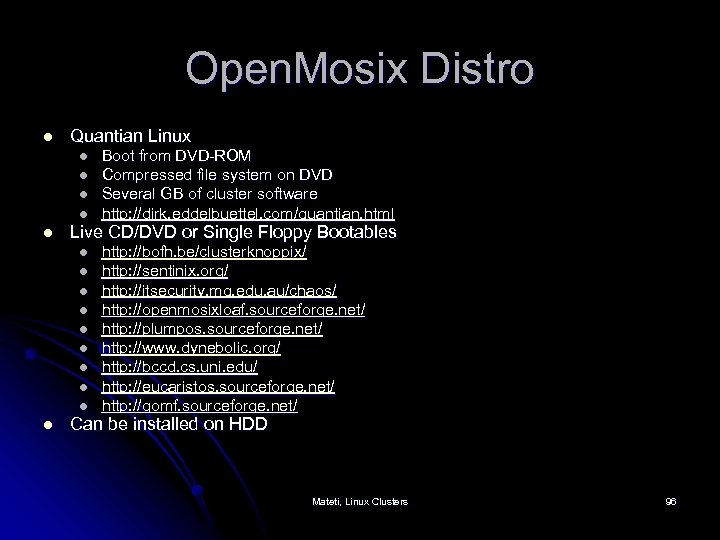
Open. Mosix Distro l Quantian Linux l l l Live CD/DVD or Single Floppy Bootables l l l l l Boot from DVD-ROM Compressed file system on DVD Several GB of cluster software http: //dirk. eddelbuettel. com/quantian. html http: //bofh. be/clusterknoppix/ http: //sentinix. org/ http: //itsecurity. mq. edu. au/chaos/ http: //openmosixloaf. sourceforge. net/ http: //plumpos. sourceforge. net/ http: //www. dynebolic. org/ http: //bccd. cs. uni. edu/ http: //eucaristos. sourceforge. net/ http: //gomf. sourceforge. net/ Can be installed on HDD Mateti, Linux Clusters 96
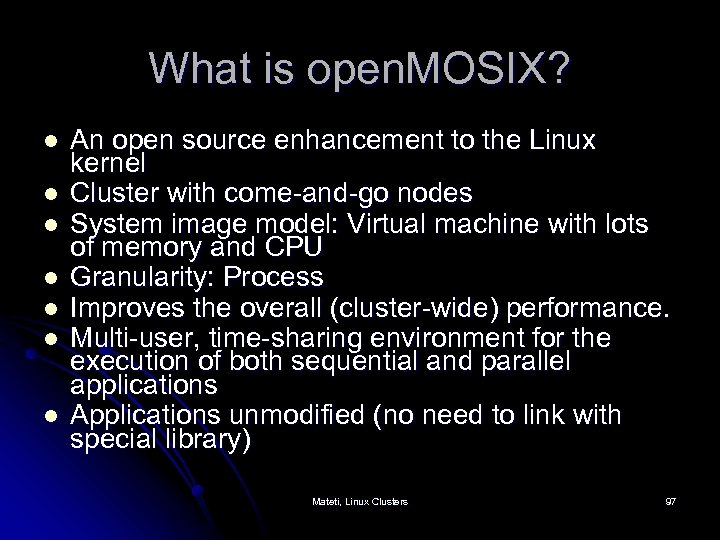
What is open. MOSIX? l l l l An open source enhancement to the Linux kernel Cluster with come-and-go nodes System image model: Virtual machine with lots of memory and CPU Granularity: Process Improves the overall (cluster-wide) performance. Multi-user, time-sharing environment for the execution of both sequential and parallel applications Applications unmodified (no need to link with special library) Mateti, Linux Clusters 97
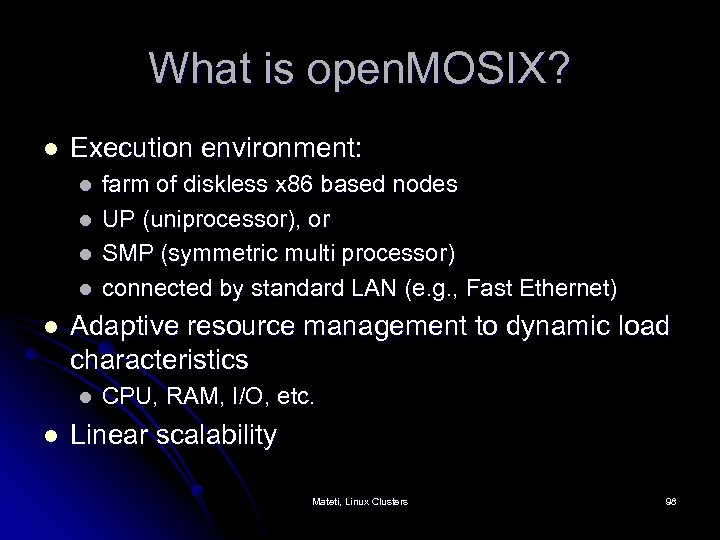
What is open. MOSIX? l Execution environment: l l l Adaptive resource management to dynamic load characteristics l l farm of diskless x 86 based nodes UP (uniprocessor), or SMP (symmetric multi processor) connected by standard LAN (e. g. , Fast Ethernet) CPU, RAM, I/O, etc. Linear scalability Mateti, Linux Clusters 98
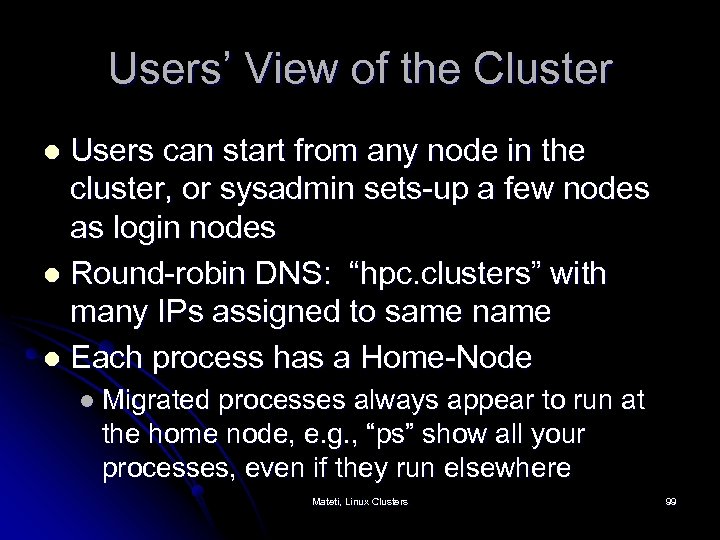
Users’ View of the Cluster Users can start from any node in the cluster, or sysadmin sets-up a few nodes as login nodes l Round-robin DNS: “hpc. clusters” with many IPs assigned to same name l Each process has a Home-Node l l Migrated processes always appear to run at the home node, e. g. , “ps” show all your processes, even if they run elsewhere Mateti, Linux Clusters 99
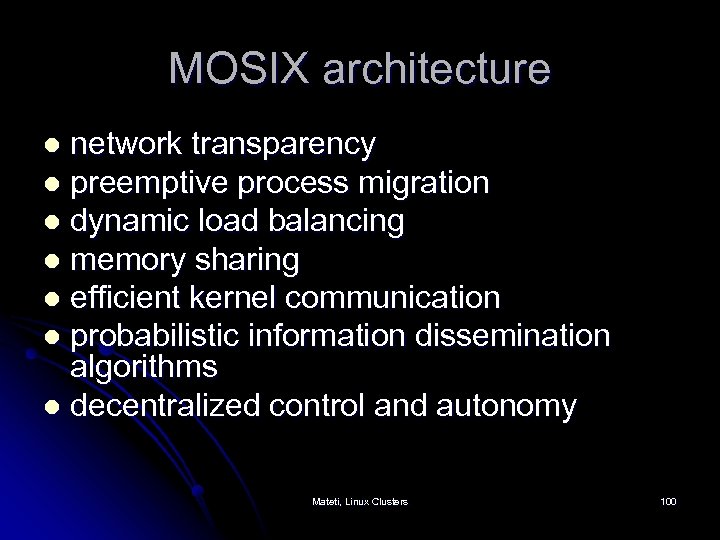
MOSIX architecture network transparency l preemptive process migration l dynamic load balancing l memory sharing l efficient kernel communication l probabilistic information dissemination algorithms l decentralized control and autonomy l Mateti, Linux Clusters 100
A two tier technology l Information gathering and dissemination l l l Support scalable configurations by probabilistic dissemination algorithms Same overhead for 16 nodes or 2056 nodes Pre-emptive process migration that can migrate any process, anywhere, anytime - transparently l l Supervised by adaptive algorithms that respond to global resource availability Transparent to applications, no change to user interface Mateti, Linux Clusters 101
Tier 1: Information gathering and dissemination l In each unit of time (e. g. , 1 second) each node gathers information about: l CPU(s) speed, load and utilization l Free memory l Free proc-table/file-table slots Info sent to a randomly selected node l Scalable - more nodes better scattering l Mateti, Linux Clusters 102
Tier 2: Process migration Load balancing: reduce variance between pairs of nodes to improve the overall performance l Memory ushering: migrate processes from a node that nearly exhausted its free memory, to prevent paging l Parallel File I/O: bring the process to the file-server, direct file I/O from migrated processes l Mateti, Linux Clusters 103
Network transparency The user and applications are provided a virtual machine that looks like a single machine. l Example: Disk access from diskless nodes on fileserver is completely transparent to programs l Mateti, Linux Clusters 104
Preemptive process migration Any user’s process, trasparently and at any time, can/may migrate to any other node. l The migrating process is divided into: l l system context (deputy) that may not be migrated from home workstation (UHN); l user context (remote) that can be migrated on a diskless node; Mateti, Linux Clusters 105
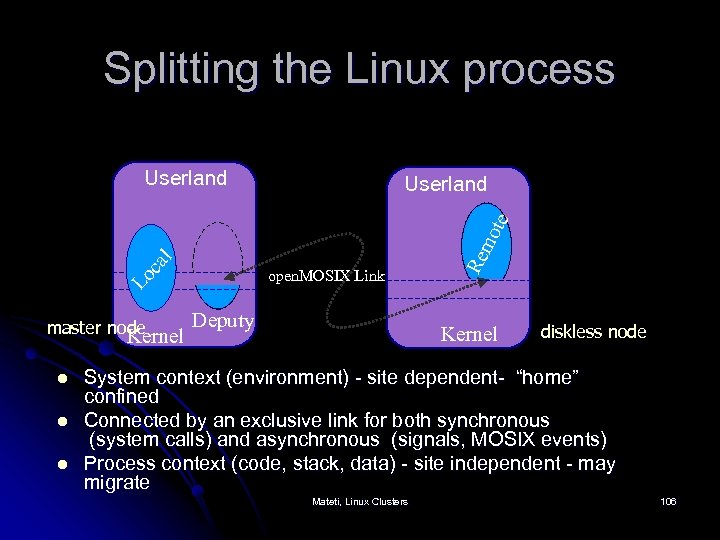
Splitting the Linux process Userland open. MOSIX Link Deputy master node Kernel l Re m Lo ca l ote Userland Kernel diskless node System context (environment) - site dependent- “home” confined Connected by an exclusive link for both synchronous (system calls) and asynchronous (signals, MOSIX events) Process context (code, stack, data) - site independent - may migrate Mateti, Linux Clusters 106
Dynamic load balancing l l Initiates process migrations in order to balance the load of farm responds to variations in the load of the nodes, runtime characteristics of the processes, number of nodes and their speeds makes continuous attempts to reduce the load differences among nodes the policy is symmetrical and decentralized l l all of the nodes execute the same algorithm the reduction of the load differences is performed indipendently by any pair of nodes Mateti, Linux Clusters 107
Memory sharing l l l places the maximal number of processes in the farm main memory, even if it implies an uneven load distribution among the nodes delays as much as possible swapping out of pages makes the decision of which process to migrate and where to migrate it is based on the knoweldge of the amount of free memory in other nodes Mateti, Linux Clusters 108
Efficient kernel communication Reduces overhead of the internal kernel communications (e. g. between the process and its home site, when it is executing in a remote site( l Fast and reliable protocol with low startup latency and high throughput l Mateti, Linux Clusters 109
Probabilistic information dissemination algorithms l l Each node has sufficient knowledge about available resources in other nodes, without polling measure the amount of available resources on each node receive resources indices that each node sends at regular intervals to a randomly chosen subset of nodes the use of randomly chosen subset of nodes facilitates dynamic configuration and overcomes node failures Mateti, Linux Clusters 110
Decentralized control and autonomy Each node makes its own control decisions independently. l No master-slave relationships l Each node is capable of operating as an independent system l Nodes may join or leave the farm with minimal disruption l Mateti, Linux Clusters 111
File System Access l l MOSIX is particularly efficient for distributing and executing CPU-bound processes However, the processes are inefficient with significant file operations l l I/O accesses through the home node incur high overhead “Direct FSA” is for better handling of I/O: l l l Reduce the overhead of executing I/O oriented system-calls of a migrated process performs I/O operations locally, in the current node, not via the home node processes migrate more freely Mateti, Linux Clusters 112
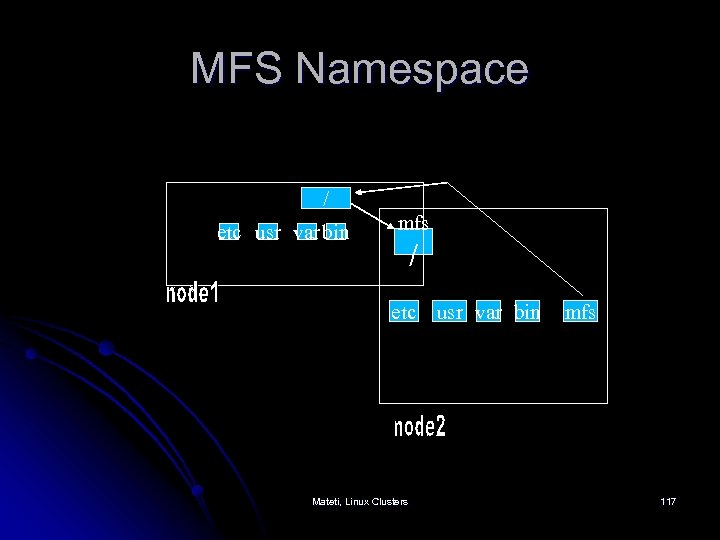
DFSA Requirements l l l DFSA can work with any file system that satisfies some properties. Unique mount point: The FS are identically mounted on all. File consistency: when an operation is completed in one node, any subsequent operation on any other node will see the results of that operation Required because an open. MOSIX process may perform consecutive syscalls from different nodes Time-stamp consistency: if file A is modified after B, A must have a timestamp > B's timestamp Mateti, Linux Clusters 113
DFSA Conforming FS Global File System (GFS( l open. MOSIX File System (MFS( l Lustre global file system l General Parallel File System (GPFS( l Parallel Virtual File System (PVFS( l Available operations: all common filesystem and I/O system-calls l Mateti, Linux Clusters 114
Global File System (GFS( l l Provides local caching and cache consistency over the cluster using a unique locking mechanism Provides direct access from any node to any storage entity GFS + process migration combine the advantages of load-balancing with direct disk access from any node - for parallel file operations Non-GNU License (SPL) Mateti, Linux Clusters 115
The MOSIX File System (MFS( l l Provides a unified view of all files and all mounted FSs on all the nodes of a MOSIX cluster as if they were within a single file system. Makes all directories and regular files throughout an open. MOSIX cluster available from all the nodes Provides cache consistency Allows parallel file access by proper distribution of files (a process migrates to the node with the needed files) Mateti, Linux Clusters 116
MFS Namespace / etc usr var bin mfs / etc usr var bin Mateti, Linux Clusters mfs 117
Lustre: A scalable File System l l l http: //www. lustre. org/ Scalable data serving through parallel data striping Scalable meta data Separation of file meta data and storage allocation meta data to further increase scalability Object technology - allowing stackable, valueadd functionality Distributed operation Mateti, Linux Clusters 118
Parallel Virtual File System (PVFS) http: //www. parl. clemson. edu/pvfs/ l User-controlled striping of files across nodes l Commodity network and storage hardware l MPI-IO support through ROMIO l Traditional Linux file system access through the pvfs-kernel package l The native PVFS library interface l Mateti, Linux Clusters 119
General Parallel File Sys (GPFS) l l www. ibm. com/servers/eserver/clusters/software/ gpfs. html “GPFS for Linux provides world class performance, scalability, and availability for file systems. It offers compliance to most UNIX file standards for end user applications and administrative extensions for ongoing management and tuning. It scales with the size of the Linux cluster and provides NFS Export capabilities outside the cluster. ” Mateti, Linux Clusters 120
Mosix Ancillary Tools l l l l Kernel debugger Kernel profiler Parallel make (all exec() become mexec()) open. Mosix pvm open. Mosix mm 5 open. Mosix HMMER open. Mosix Mathematica Mateti, Linux Clusters 121
Cluster Administration LTSP (www. ltsp. org( l Clump. Os (www. clumpos. org( l Mps l Mtop l Mosctl l Mateti, Linux Clusters 122
Mosix commands & files l l l setpe – starts and stops Mosix on the current node tune – calibrates the node speed parameters mtune – calibrates the node MFS parameters migrate – forces a process to migrate mosctl – comprehensive Mosix administration tool mosrun, nomig, runhome, runon, cpujob, iojob, nodecay, fastdecay, slowdecay – various way to start a program in a specific way mon & mosixview – CLI and graphic interface to monitor the cluster status /etc/mosix. map – contains the IP numbers of the cluster nodes /etc/mosgates – contains the number of gateway nodes present in the cluster /etc/overheads – contains the output of the ‘tune’ command to be loaded at startup /etc/mfscosts – contains the output of the ‘mtune’ command to be loaded at startup /proc/mosix/admin/* - various files, sometimes binary, to check and control Mosix Mateti, Linux Clusters 123
Monitoring l Cluster monitor - ‘mosmon’(or ‘qtop’) l l l Applet/CGI based monitoring tools - display cluster properties l l l Displays load, speed, utilization and memory information across the cluster. Uses the /proc/hpc/info interface for the retrieving information Access via the Internet Multiple resources open. Mosixview with X GUI Mateti, Linux Clusters 124
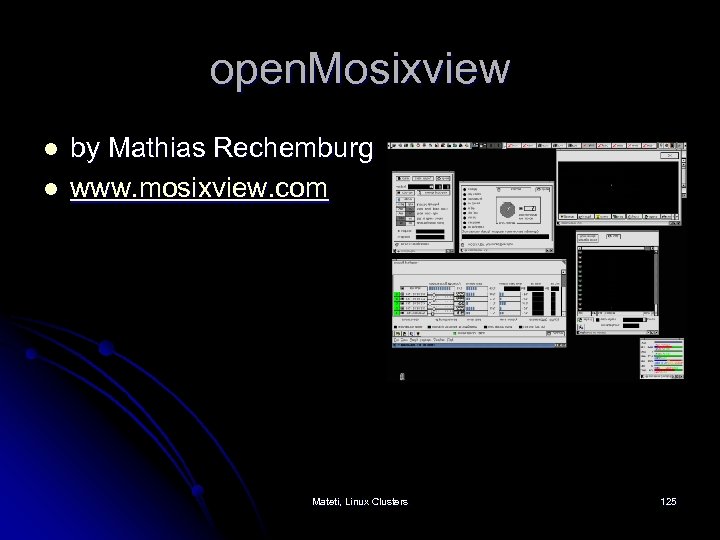
open. Mosixview l l by Mathias Rechemburg www. mosixview. com Mateti, Linux Clusters 125
Qlusters OS l l l http: //www. qlusters. com/ Based in part on open. Mosix technology Migrating sockets Network RAM already implemented Cluster Installer, Configurator, Monitor, Queue Manager, Launcher, Scheduler Partnership with IBM, Compaq, Red Hat and Intel Mateti, Linux Clusters 126
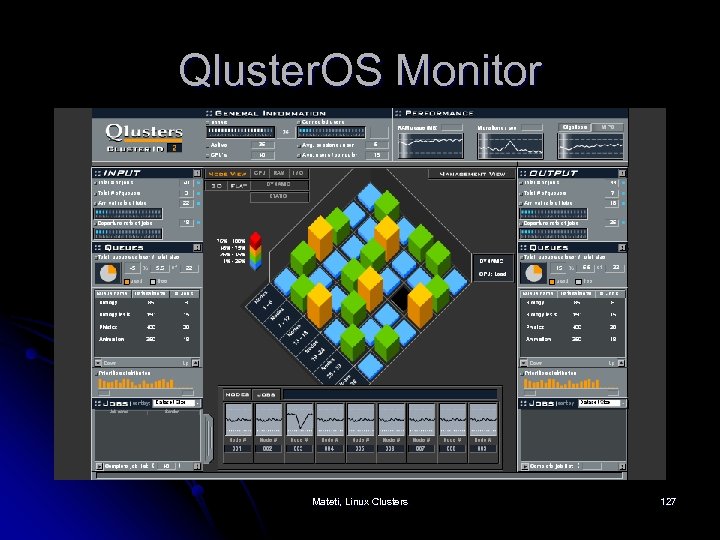
Qluster. OS Monitor Mateti, Linux Clusters 127
More Information on Clusters l l l www. ieeetfcc. org/ IEEE Task Force on Cluster Computing. (now Technical Committee on Scalable Computing TCSC). lcic. org/ “a central repository of links and information regarding Linux clustering, in all its forms. ” www. beowulf. org resources for of clusters built on commodity hardware deploying Linux OS and open source software. linuxclusters. com/ “Authoritative resource for information on Linux Compute Clusters and Linux High Availability Clusters. ” www. linuxclustersinstitute. org/ “To provide education and advanced technical training for the deployment and use of Linux-based computing clusters to the high-performance computing community worldwide. ” Mateti, Linux Clusters 128
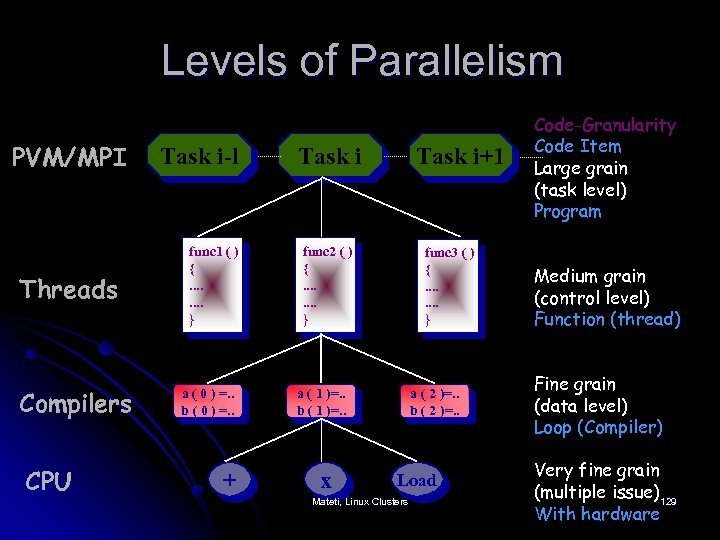
Levels of Parallelism PVM/MPI Threads Compilers CPU Task i-l func 1 ( ) {. . . . } a ( 0 ) =. . b ( 0 ) =. . + Task i+1 func 2 ( ) {. . . . } func 3 ( ) {. . . . } a ( 1 )=. . b ( 1 )=. . x a ( 2 )=. . b ( 2 )=. . Load Mateti, Linux Clusters Code-Granularity Code Item Large grain (task level) Program Medium grain (control level) Function (thread) Fine grain (data level) Loop (Compiler) Very fine grain (multiple issue)129 With hardware
Скачать презентацию Cluster Computing with Linux Prabhaker Mateti Wright State
22eba27b23ceaa31fd794c2099783e39.ppt