


 Скачать презентацию Cloud Computing Is It Powerful And Can It
c09cb0001fe779a7ea11896cc8e32c20.ppt
- Количество слайдов: 36
 Cloud Computing: Is It Powerful, And Can It Lead To Bankruptcy? G. Bruce Berriman gbb@ipac. caltech. edu http: //astrocompute. wordpress. com Infrared Processing and Analysis Center, Caltech Space Telescope Science Institute, February 2012. 1
 Collaborators Ewa Deelman Gideon Juve Mats Rynge Jens-S Völcker Information Sciences Institute, USC 2
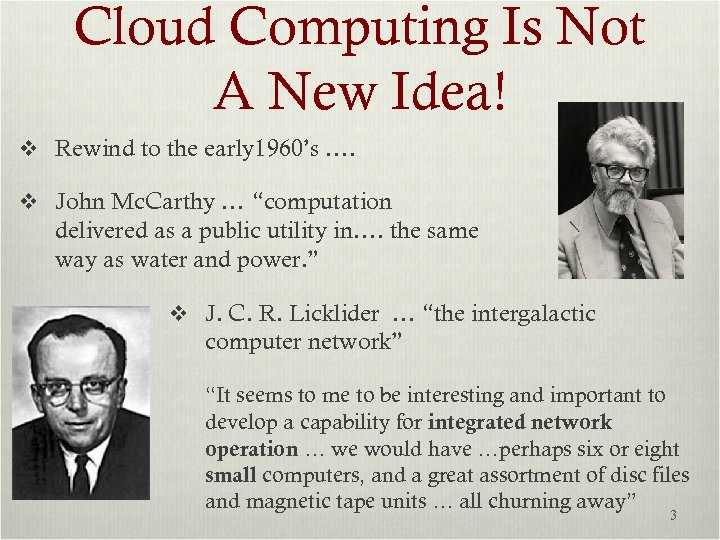 Cloud Computing Is Not A New Idea! v Rewind to the early 1960’s …. v John Mc. Carthy … “computation delivered as a public utility in…. the same way as water and power. ” v J. C. R. Licklider … “the intergalactic computer network” “It seems to me to be interesting and important to develop a capability for integrated network operation … we would have …perhaps six or eight small computers, and a great assortment of disc files and magnetic tape units … all churning away” 3
 The Idea Was Dormant For 35 Years v … until the internet started to offer significant bandwidth. v Salesforce. com, Amazon Web Services started to offer applications over the internet (1999 -2002). v Amazon Elastic Compute cloud (2006) offered first widely accessible on-demand computing. v By 2009, browser based apps such as Google Apps had hit their stride. 4
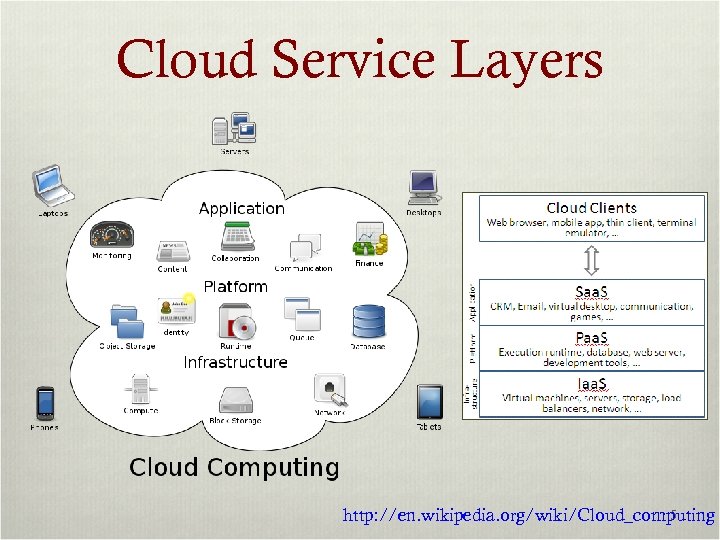 Cloud Service Layers 5 http: //en. wikipedia. org/wiki/Cloud_computing
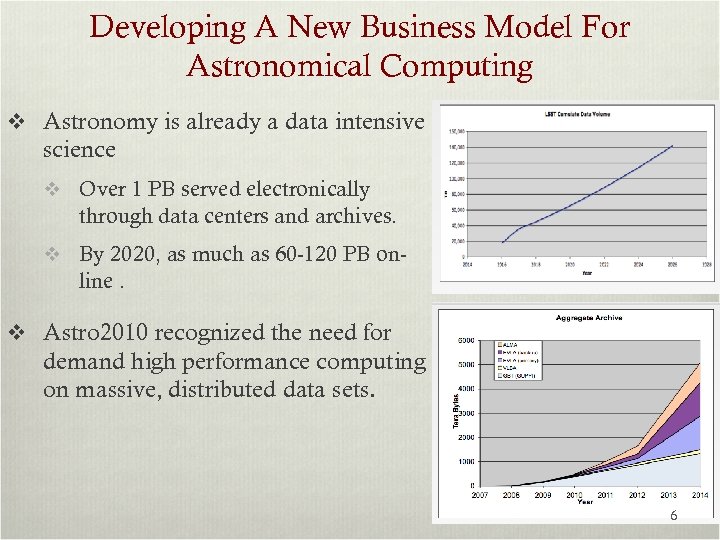 Developing A New Business Model For Astronomical Computing v Astronomy is already a data intensive science v Over 1 PB served electronically through data centers and archives. v By 2020, as much as 60 -120 PB on- line. v Astro 2010 recognized the need for demand high performance computing on massive, distributed data sets. 6
 How Useful Is Cloud Computing For Scientific Workflow Applications? v Loosely-coupled parallel applications v Many domains: astronomy, biology, earth science. v Potentially very large: 10 K tasks common, >1 M not uncommon v Potentially data-intensive: 10 GB common, >1 TB not uncommon v Data communicated via files v Shared storage system, or network transfers 1. What is performance/cost of different cloud resource configurations for workflow applications? 2. What is performance of cloud and workflow applications? 3. What is virtualization overhead on cloud? 7
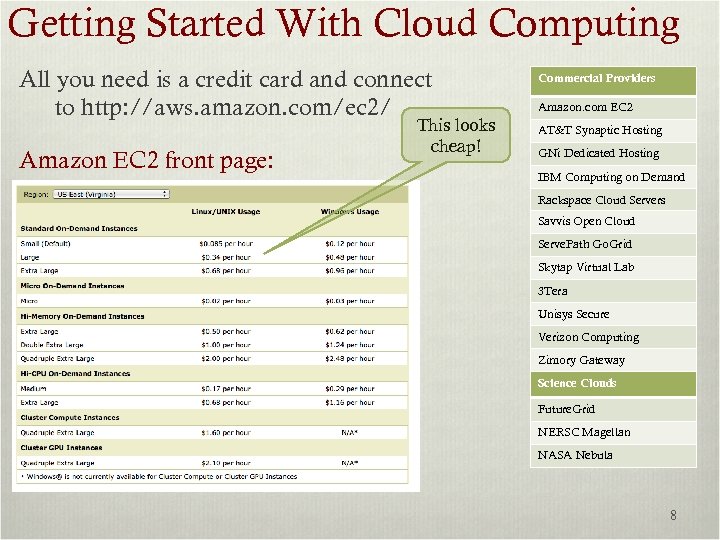 Getting Started With Cloud Computing All you need is a credit card and connect to http: //aws. amazon. com/ec 2/ Amazon EC 2 front page: This looks cheap! Commercial Providers Amazon. com EC 2 AT&T Synaptic Hosting GNi Dedicated Hosting IBM Computing on Demand Rackspace Cloud Servers Savvis Open Cloud Serve. Path Go. Grid Skytap Virtual Lab 3 Tera Unisys Secure Verizon Computing Zimory Gateway Science Clouds Future. Grid NERSC Magellan NASA Nebula 8
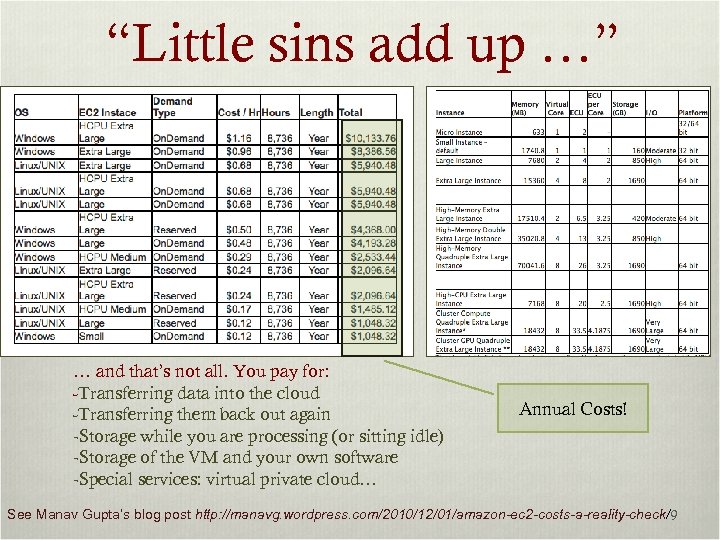 “Little sins add up …” … and that’s not all. You pay for: -Transferring data into the cloud -Transferring them back out again -Storage while you are processing (or sitting idle) -Storage of the VM and your own software -Special services: virtual private cloud… Annual Costs! See Manav Gupta’s blog post http: //manavg. wordpress. com/2010/12/01/amazon-ec 2 -costs-a-reality-check/9
 What Amazon EC 2 Does v Creates as many independent virtual machines as you wish. v Reserves the storage space you need. v Gives you a refund if their equipment fails. v Bills you. 10
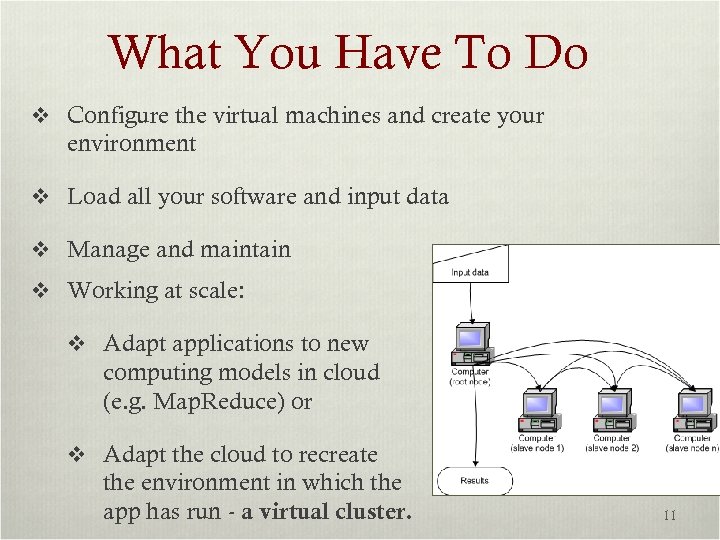 What You Have To Do v Configure the virtual machines and create your environment v Load all your software and input data v Manage and maintain v Working at scale: v Adapt applications to new computing models in cloud (e. g. Map. Reduce) or v Adapt the cloud to recreate the environment in which the app has run - a virtual cluster. 11
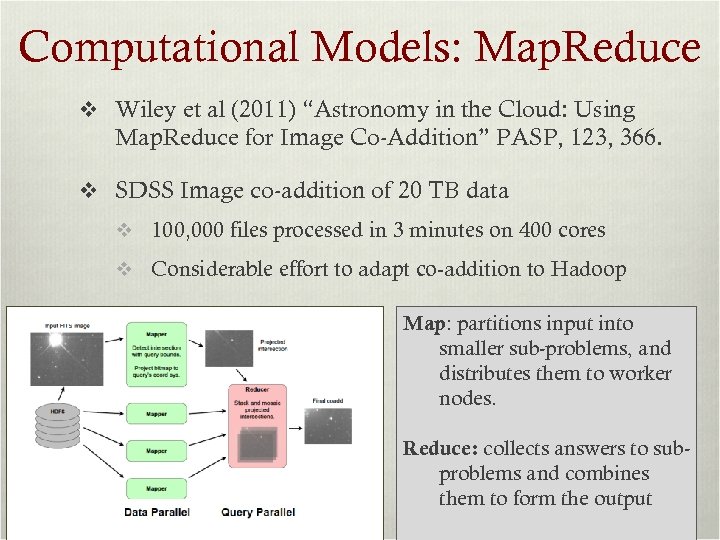 Computational Models: Map. Reduce v Wiley et al (2011) “Astronomy in the Cloud: Using Map. Reduce for Image Co-Addition” PASP, 123, 366. v SDSS Image co-addition of 20 TB data v 100, 000 files processed in 3 minutes on 400 cores v Considerable effort to adapt co-addition to Hadoop Map: partitions input into smaller sub-problems, and distributes them to worker nodes. Reduce: collects answers to subproblems and combines them to form the output 12
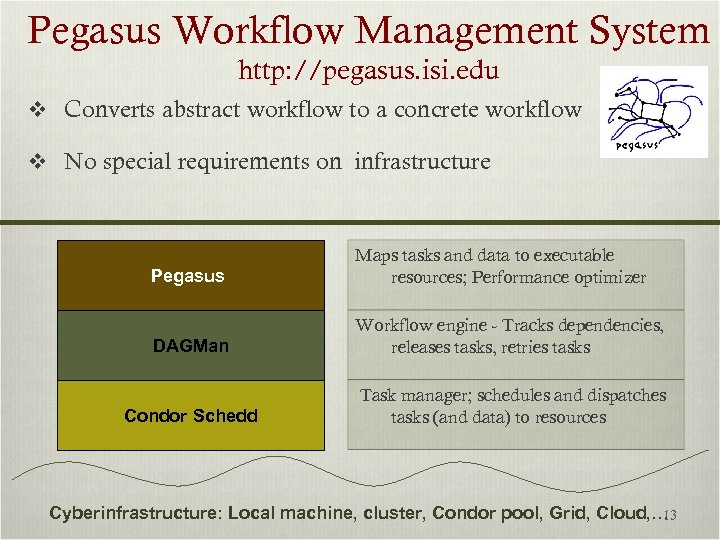 Pegasus Workflow Management System http: //pegasus. isi. edu v Converts abstract workflow to a concrete workflow v No special requirements on infrastructure Pegasus Maps tasks and data to executable resources; Performance optimizer DAGMan Workflow engine - Tracks dependencies, releases tasks, retries tasks Condor Schedd Task manager; schedules and dispatches tasks (and data) to resources Cyberinfrastructure: Local machine, cluster, Condor pool, Grid, Cloud, … 13
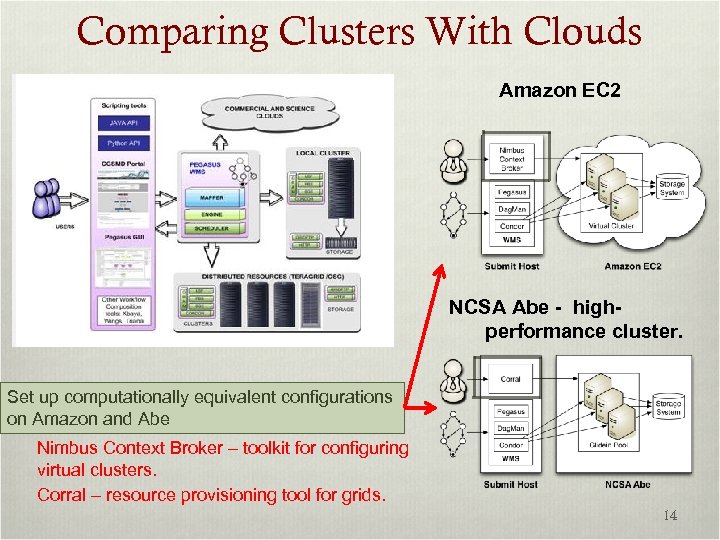 Comparing Clusters With Clouds Amazon EC 2 NCSA Abe - highperformance cluster. Set up computationally equivalent configurations on Amazon and Abe Nimbus Context Broker – toolkit for configuring virtual clusters. Corral – resource provisioning tool for grids. 14
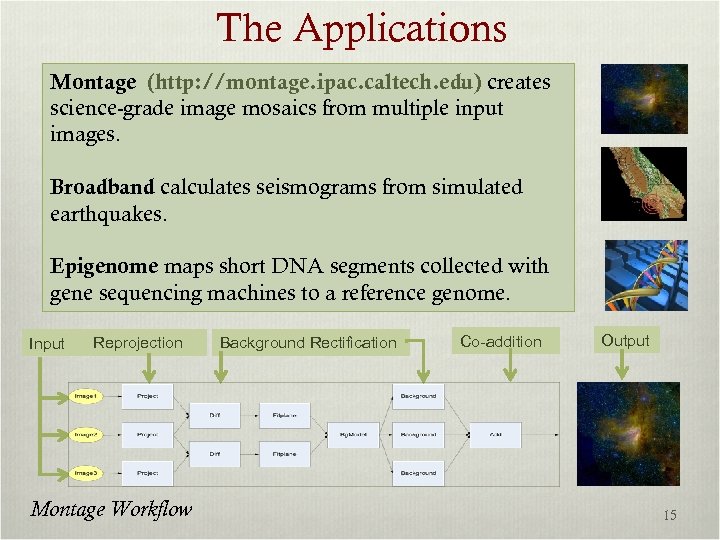 The Applications Montage (http: //montage. ipac. caltech. edu) creates science-grade image mosaics from multiple input images. Broadband calculates seismograms from simulated earthquakes. Epigenome maps short DNA segments collected with gene sequencing machines to a reference genome. Input Reprojection Montage Workflow Background Rectification Co-addition Output 15
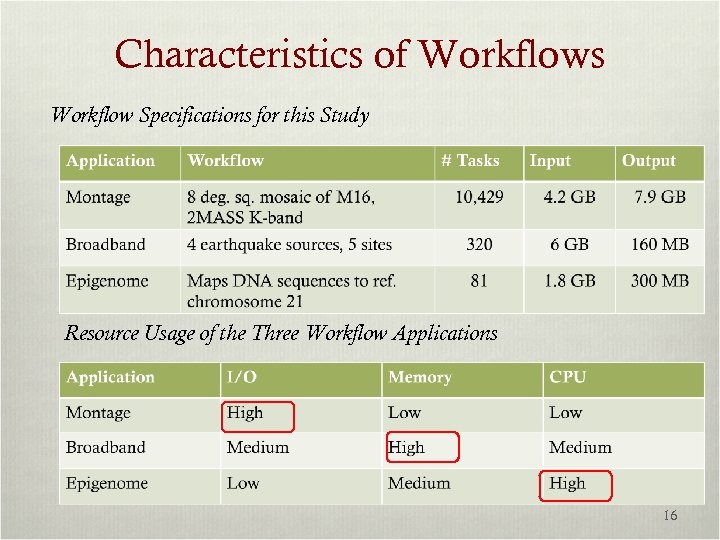 Characteristics of Workflows Workflow Specifications for this Study Resource Usage of the Three Workflow Applications 16
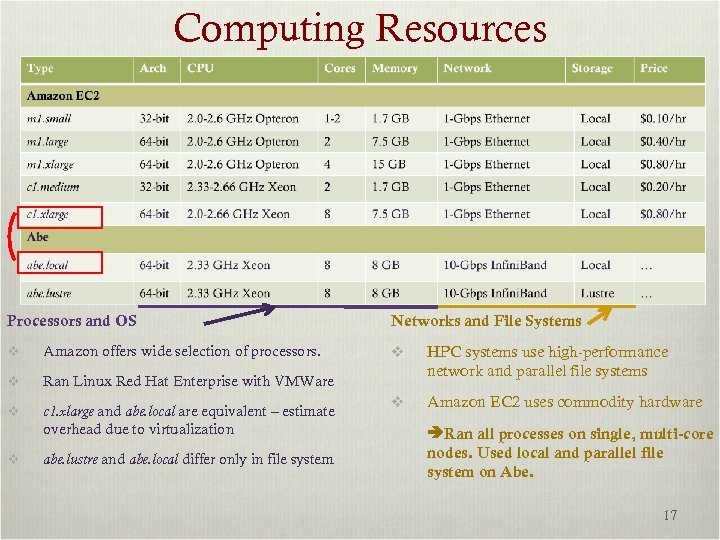 Computing Resources Processors and OS v Amazon offers wide selection of processors. v Ran Linux Red Hat Enterprise with VMWare v c 1. xlarge and abe. local are equivalent – estimate overhead due to virtualization Networks and File Systems v abe. lustre and abe. local differ only in file system v HPC systems use high-performance network and parallel file systems v Amazon EC 2 uses commodity hardware Ran all processes on single, multi-core nodes. Used local and parallel file system on Abe. 17
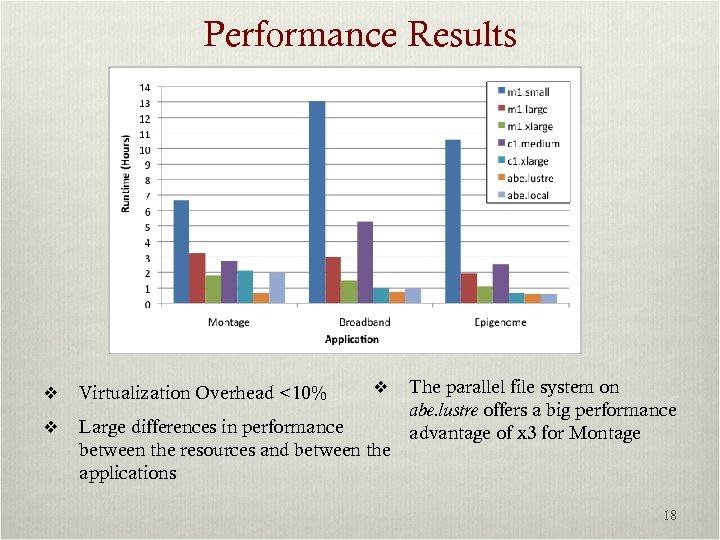 Performance Results v v Virtualization Overhead <10% v Large differences in performance between the resources and between the applications The parallel file system on abe. lustre offers a big performance advantage of x 3 for Montage 18
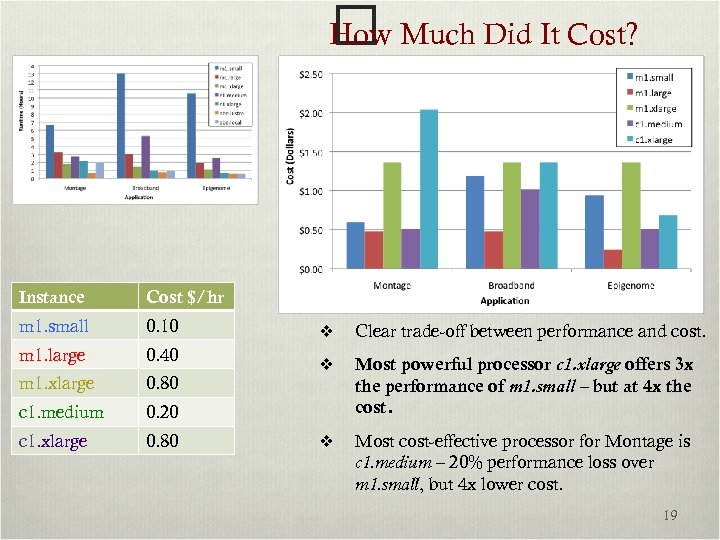 How Much Did It Cost? Instance Cost $/hr Montage: m 1. small 0. 10 v Clear trade-off between performance and cost. m 1. large 0. 40 m 1. xlarge 0. 80 v c 1. medium 0. 20 Most powerful processor c 1. xlarge offers 3 x the performance of m 1. small – but at 4 x the cost. c 1. xlarge 0. 80 v Most cost-effective processor for Montage is c 1. medium – 20% performance loss over m 1. small, but 4 x lower cost. 19
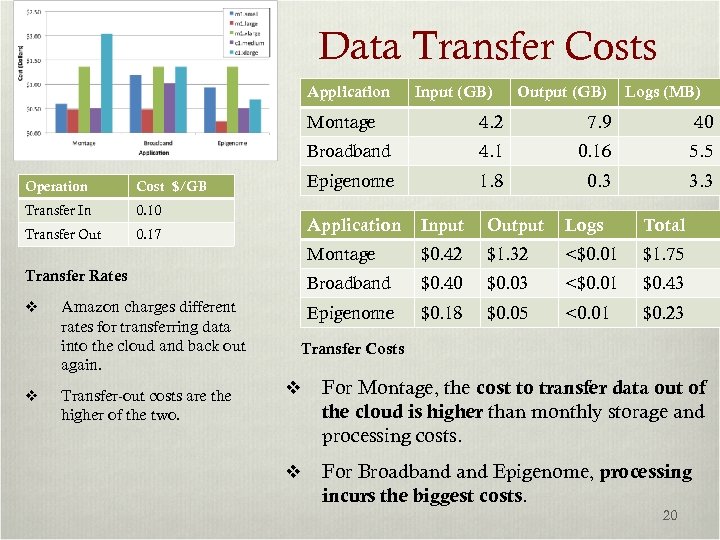 Data Transfer Costs Application Input (GB) Output (GB) Logs (MB) Montage Transfer In 0. 10 Transfer Out 0. 17 40 4. 1 0. 16 5. 5 Epigenome Cost $/GB 7. 9 Broadband Operation 4. 2 1. 8 0. 3 3. 3 Application v v Amazon charges different rates for transferring data into the cloud and back out again. Transfer-out costs are the higher of the two. Output Logs Total Montage $0. 42 $1. 32 <$0. 01 $1. 75 Broadband $0. 40 $0. 03 <$0. 01 $0. 43 Epigenome Transfer Rates Input $0. 18 $0. 05 <0. 01 $0. 23 Transfer Costs v For Montage, the cost to transfer data out of the cloud is higher than monthly storage and processing costs. v For Broadband Epigenome, processing incurs the biggest costs. 20
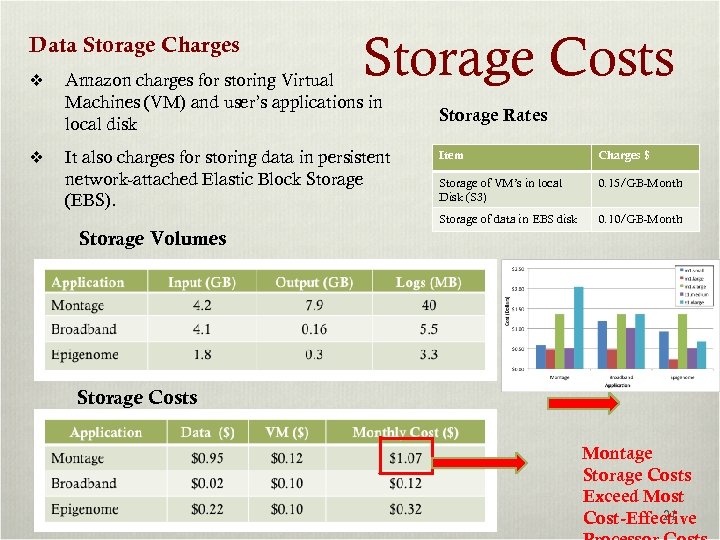 Data Storage Charges v v Storage Costs Amazon charges for storing Virtual Machines (VM) and user’s applications in local disk It also charges for storing data in persistent network-attached Elastic Block Storage (EBS). Storage Rates Item Charges $ Storage of VM’s in local Disk (S 3) 0. 15/GB-Month Storage of data in EBS disk 0. 10/GB-Month Storage Volumes Storage Costs Montage Storage Costs Exceed Most 21 Cost-Effective
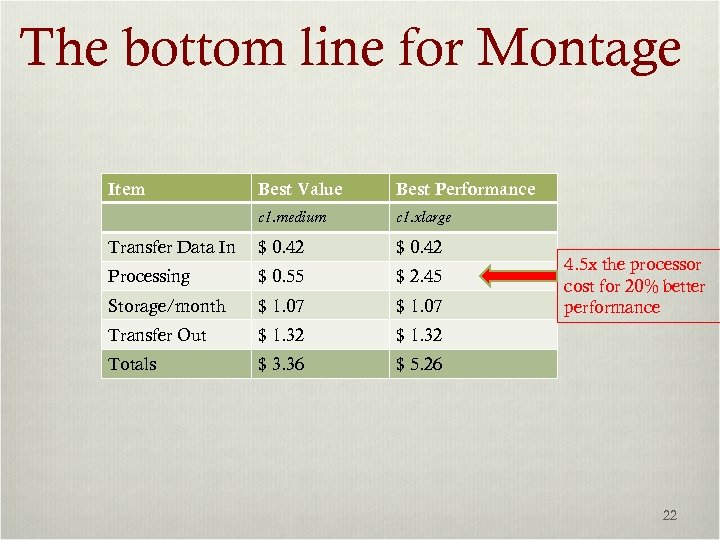 The bottom line for Montage Item Best Value Best Performance c 1. medium c 1. xlarge Transfer Data In $ 0. 42 Processing $ 0. 55 $ 2. 45 Storage/month $ 1. 07 Transfer Out $ 1. 32 Totals $ 3. 36 $ 5. 26 4. 5 x the processor cost for 20% better performance 22
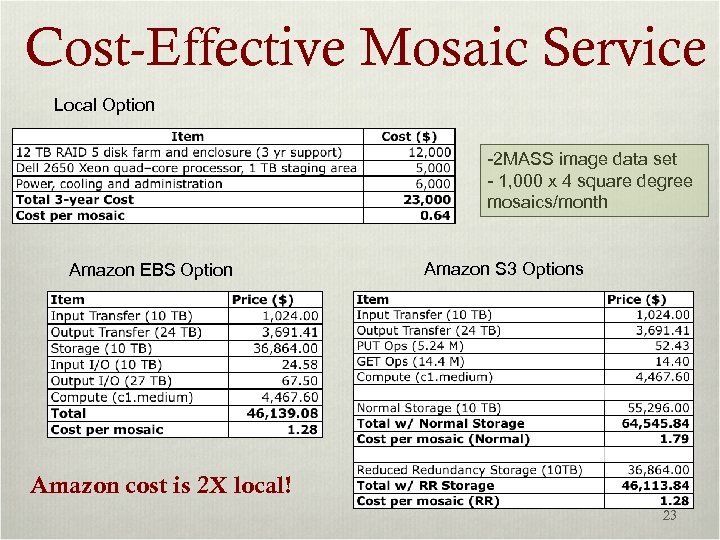 Cost-Effective Mosaic Service Local Option -2 MASS image data set - 1, 000 x 4 square degree mosaics/month Amazon EBS Option Amazon S 3 Options Amazon cost is 2 X local! 23
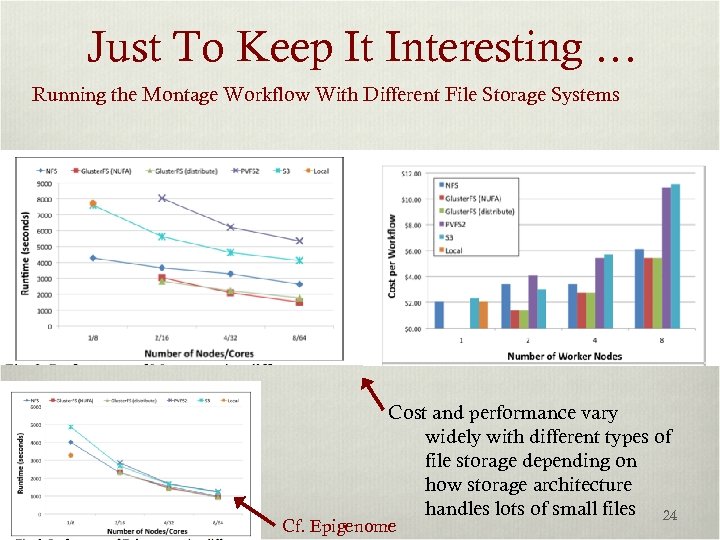 Just To Keep It Interesting … Running the Montage Workflow With Different File Storage Systems Cost and performance vary widely with different types of file storage depending on how storage architecture handles lots of small files 24 Cf. Epigenome
 When Should I Use The Cloud? v The answer is…. it depends on your application and use case. v Recommended best practice: Perform a cost-benefit analysis to identify the most cost-effective processing and data storage strategy. Tools to support this would be beneficial. v Amazon offers the best value v For compute- and memory-bound applications. v For one-time bulk-processing tasks, providing excess capacity under load, and running test-beds. v Parallel file systems and high-speed networks offer the best performance for I/O-bound applications. v Mass storage is very expensive on Amazon EC 2 25
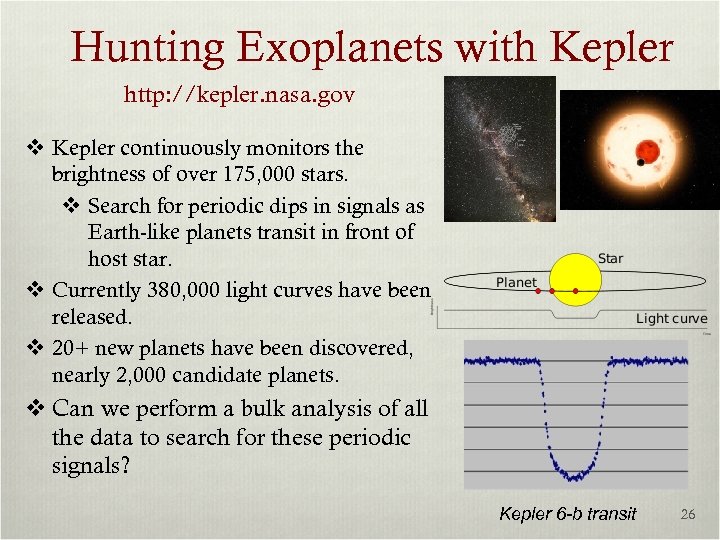 Hunting Exoplanets with Kepler http: //kepler. nasa. gov v Kepler continuously monitors the brightness of over 175, 000 stars. v Search for periodic dips in signals as Earth-like planets transit in front of host star. v Currently 380, 000 light curves have been released. v 20+ new planets have been discovered, nearly 2, 000 candidate planets. v Can we perform a bulk analysis of all the data to search for these periodic signals? Kepler 6 -b transit 26
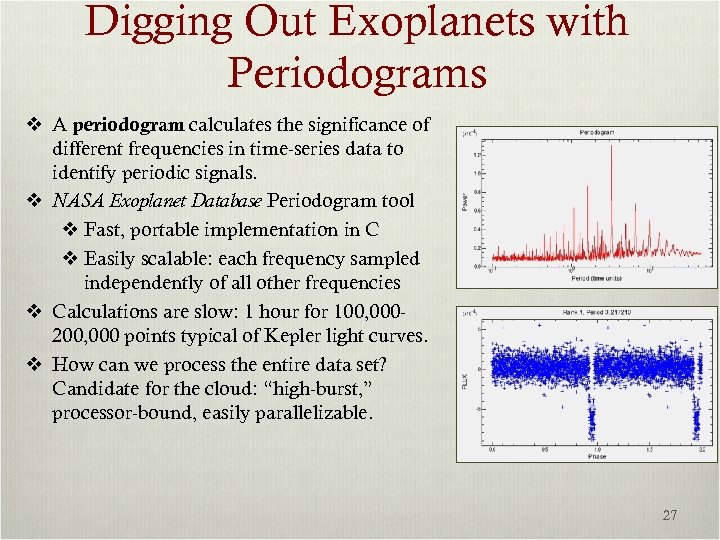 Digging Out Exoplanets with Periodograms v A periodogram calculates the significance of different frequencies in time-series data to identify periodic signals. v NASA Exoplanet Database Periodogram tool v Fast, portable implementation in C v Easily scalable: each frequency sampled independently of all other frequencies v Calculations are slow: 1 hour for 100, 000200, 000 points typical of Kepler light curves. v How can we process the entire data set? Candidate for the cloud: “high-burst, ” processor-bound, easily parallelizable. 27
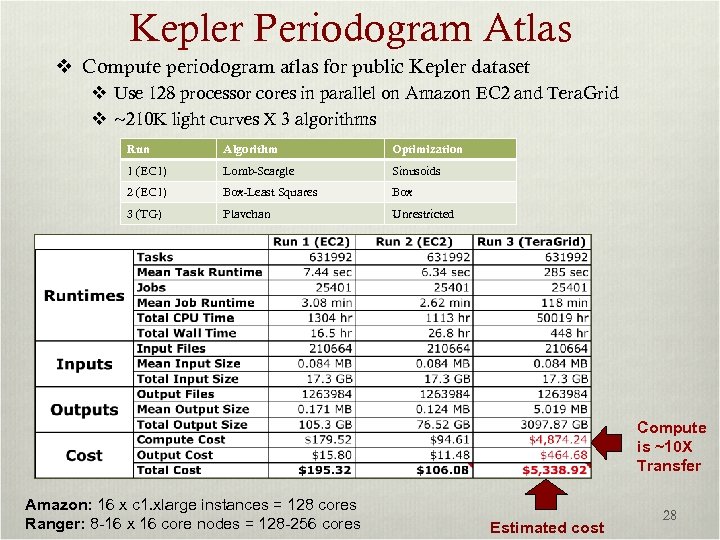 Kepler Periodogram Atlas v Compute periodogram atlas for public Kepler dataset v Use 128 processor cores in parallel on Amazon EC 2 and Tera. Grid v ~210 K light curves X 3 algorithms Run Algorithm Optimization 1 (EC 1) Lomb-Scargle Sinusoids 2 (EC 1) Box-Least Squares Box 3 (TG) Plavchan Unrestricted Compute is ~10 X Transfer Amazon: 16 x c 1. xlarge instances = 128 cores Ranger: 8 -16 x 16 core nodes = 128 -256 cores Estimated cost 28
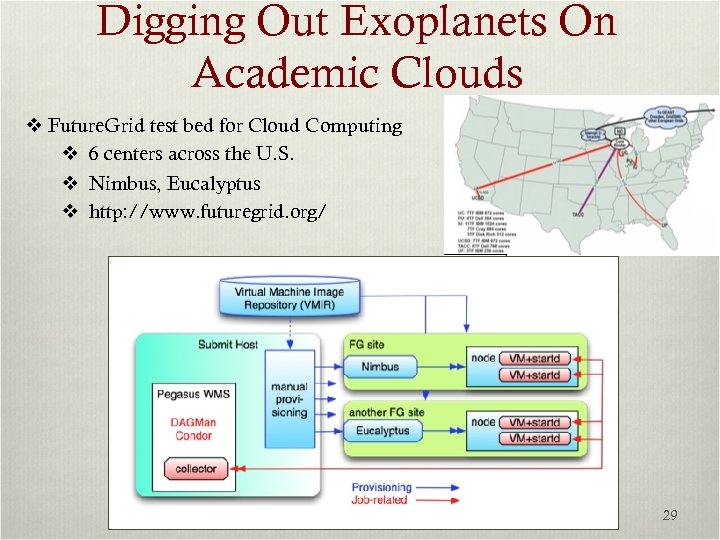 Digging Out Exoplanets On Academic Clouds v Future. Grid test bed for Cloud Computing v 6 centers across the U. S. v Nimbus, Eucalyptus v http: //www. futuregrid. org/ 29
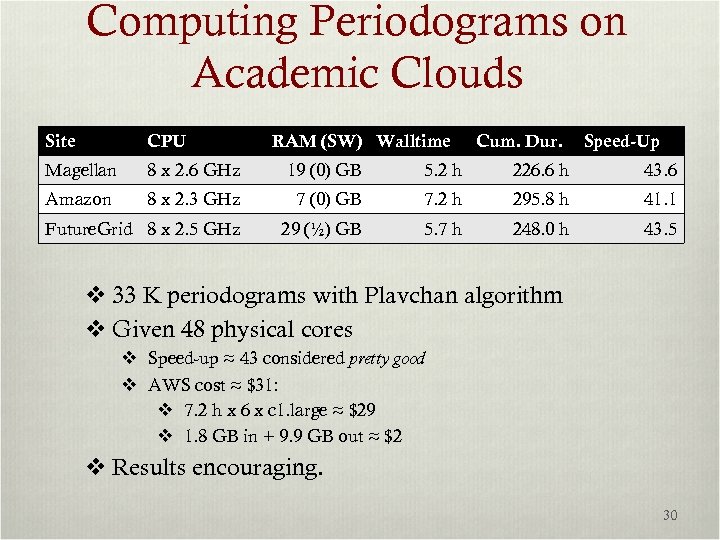 Computing Periodograms on Academic Clouds Site CPU RAM (SW) Walltime Cum. Dur. Speed-Up Magellan 8 x 2. 6 GHz 19 (0) GB 5. 2 h 226. 6 h 43. 6 Amazon 8 x 2. 3 GHz 7 (0) GB 7. 2 h 295. 8 h 41. 1 Future. Grid 8 x 2. 5 GHz 29 (½) GB 5. 7 h 248. 0 h 43. 5 v 33 K periodograms with Plavchan algorithm v Given 48 physical cores v Speed-up ≈ 43 considered pretty good v AWS cost ≈ $31: v 7. 2 h x 6 x c 1. large ≈ $29 v 1. 8 GB in + 9. 9 GB out ≈ $2 v Results encouraging. 30
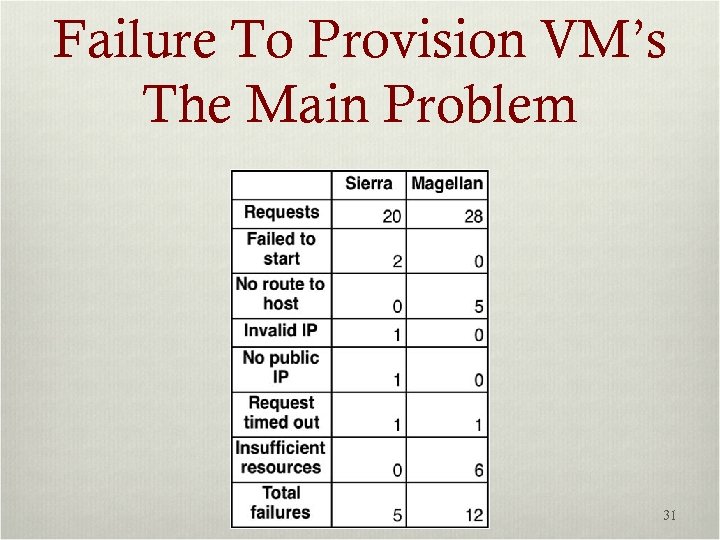 Failure To Provision VM’s The Main Problem 31
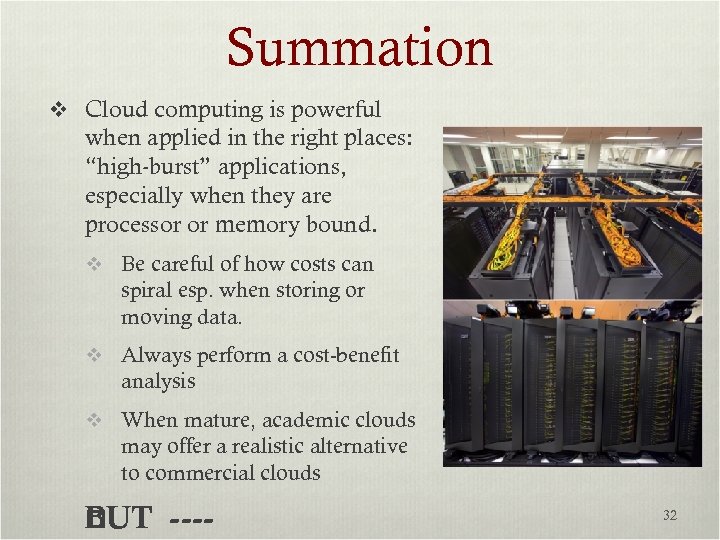 Summation v Cloud computing is powerful when applied in the right places: “high-burst” applications, especially when they are processor or memory bound. v Be careful of how costs can spiral esp. when storing or moving data. v Always perform a cost-benefit analysis v When mature, academic clouds may offer a realistic alternative to commercial clouds B UT ---- 32
 Caveat Emptor! v “Cloud Computing as it exists today is not ready for High Performance Computing because v Large overheads to convert to Cloud environments v Virtual instances under perform bare-metal systems and v The cloud is less cost-effective than most large centers” Shane Canon et al. (2011). “Debunking some Common Misconceptions of Science in the Cloud. ” Science Cloud Workshop, San Jose, CA. http: //datasys. cs. iit. edu/events/Science. Cloud 2011/ v Similar Conclusions in Magellan Final Report (December 2011) http: //science. energy. gov/ascr/ 33
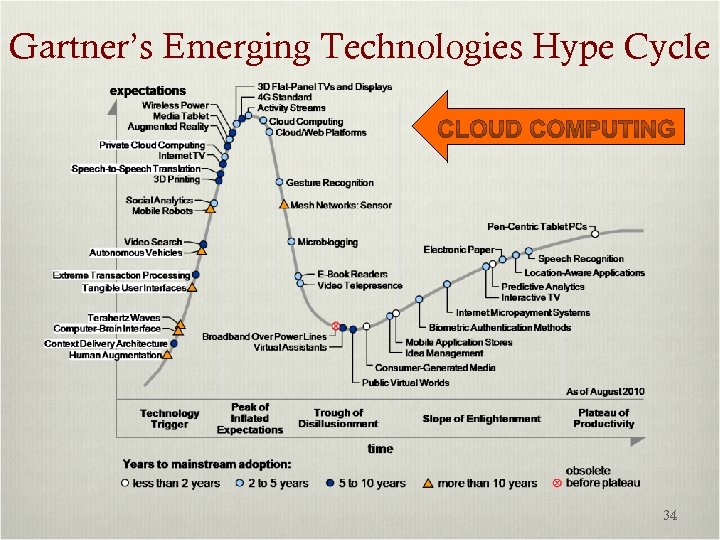 Gartner’s Emerging Technologies Hype Cycle 34
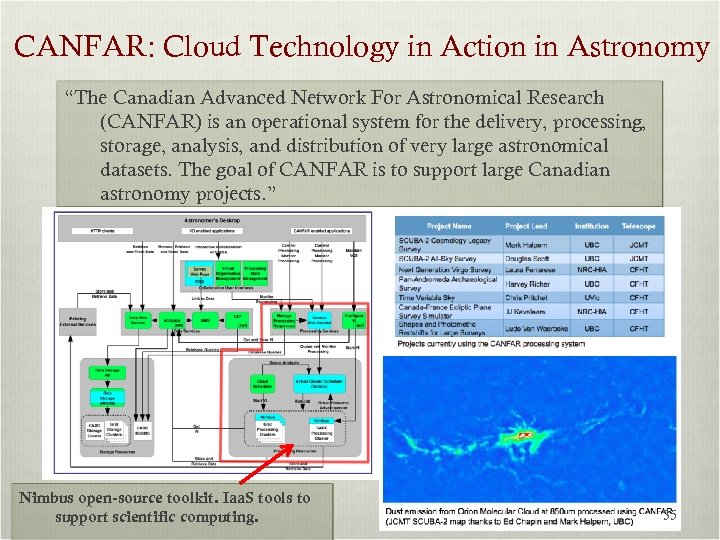 CANFAR: Cloud Technology in Action in Astronomy “The Canadian Advanced Network For Astronomical Research (CANFAR) is an operational system for the delivery, processing, storage, analysis, and distribution of very large astronomical datasets. The goal of CANFAR is to support large Canadian astronomy projects. ” Nimbus open-source toolkit. Iaa. S tools to support scientific computing. 35
 Where Can I Learn More? v The Application of Cloud Computing to Scientific Workflows: A Study of Cost and Performance. G. Berriman et al. 2012. Invited Review Paper Submitted to Special e. Science Edition of Philosophical Transactions of the Royal Society A. v Scientific Workflow Applications on Amazon EC 2. G. Juve et al. Cloud Computing Workshop in Conjunction with e-Science 2009 (Oxford, UK). http: //arxiv. org/abs/1005. 2718 v Data Sharing Options for Scientific Workflows on Amazon EC 2, G. Juve et al. Proceedings of Supercomputing 10 (SC 10), 2010. http: //arxiv. org/abs/1010. 4822 v The Application of Cloud Computing to Astronomy: A Study of Cost and Performance. G. B. Berriman et al. 2010. Proceedings of “e-Science in Astronomy” Workshop. Brisbane. http: //arxiv. org/abs/1006. 4860 v Astronomy in the Cloud: Using Map. Reduce for Image Co-Addition. K. Wiley et al. 2011. PASP, 123, 366. v Magellan Final Report, December 2011. http: //science. energy. gov/ascr/. Summary: http: //www. isgtw. org/feature/assessing-science-cloud v Bruce Berriman’s blog, “Astronomy Computing Today, ” at http: //astrocompute. wordpress. com 36