


 Скачать презентацию Closing the governance gap on illicit fisheries activities
41f1845951e2fe2a065bd578f43f5ba5.ppt
- Количество слайдов: 29
 Closing the governance gap on illicit fisheries activities Kieran Kelleher Fisheries Team Leader THE WORLD BANK Washington DC
 key messages illicit fisheries activities are a symptom of weak governance policy and anti-corruption measures need to supplement direct efforts to combat illicit fishing activities a responsible fishing industry is fundamental some of the solutions are not within the fisheries sector but fall under a broader governance agenda PROFISH Global Program on Fisheries
 contents 1. World Bank perspective 2. examples 3. actions 4. tackling corruption ALLFISH - building a responsible international seafood industry ‘name and shame lists’ conclusions PROFISH Global Program on Fisheries
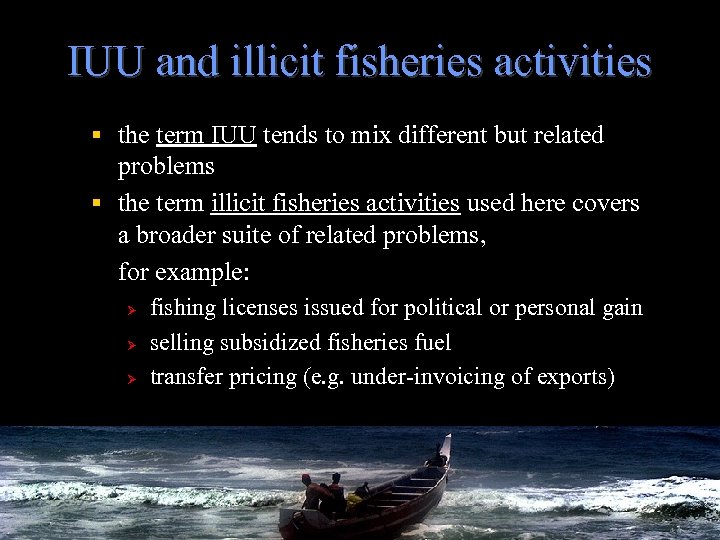 IUU and illicit fisheries activities the term IUU tends to mix different but related problems the term illicit fisheries activities used here covers a broader suite of related problems, for example: Ø Ø Ø fishing licenses issued for political or personal gain selling subsidized fisheries fuel transfer pricing (e. g. under-invoicing of exports)
 illicit fisheries activities are part of a broader governance failure The World Bank defines governance as the set of traditions and institutions by which authority in a country is exercised. It includes: (1) the process by which governments are selected, monitored and replaced, (2) the capacity of the government to effectively formulate and implement sound policies, and policies (3) the respect of citizens and the state for the institutions that govern economic and social interactions among them. effective institutions hearts and minds operational mechanisms
 the World Bank measures six dimensions of governance* 1. 2. 3. 4. 5. 6. political stability and absence of violence regulatory quality government effectiveness rule of law; and control of corruption voice and accountability * See World Bank Institute: Governance indicators by country all six influence the level of illicit fishing activities
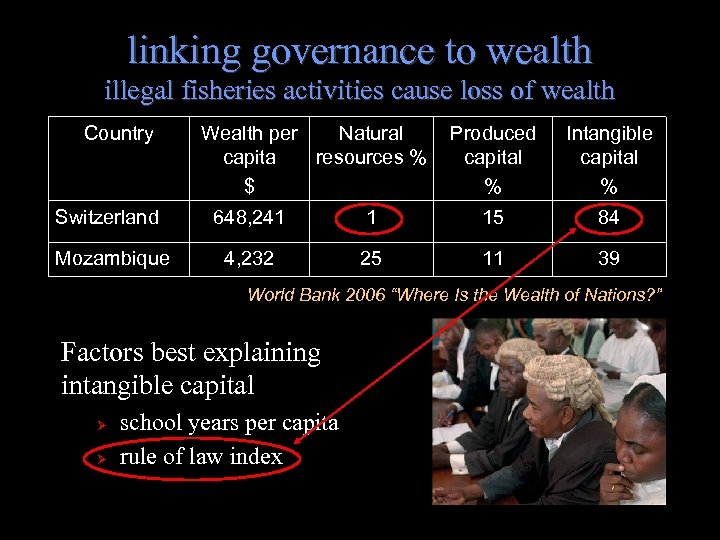 linking governance to wealth illegal fisheries activities cause loss of wealth Country Wealth per Natural capita resources % $ Produced capital % Intangible capital % Switzerland 648, 241 1 15 84 Mozambique 4, 232 25 11 39 World Bank 2006 “Where Is the Wealth of Nations? ” Factors best explaining intangible capital Ø Ø school years per capita rule of law index
 2. impacts and examples impacts examples Ø the story of the ice plant and the President Ø what can we learn from parking fines? Ø not just legal – but legitimate!
 illicit fisheries activities have a wide range of impacts on the profits of legitimate businesses on fish resources & market prices – illicit fish discounted on public revenues – licenses, expert taxes, profit taxes on reputation of exporting country and exporters undermines regulatory fabric and rule of law Ø organized trade in illicit fish often requires corrupt officials (judges, police, politicians) Ø ‘survival of the most corrupt’ often a disproportionate impact on the poor (dynamiting, fishing in area reserved for small-scale fishers) on maritime security – Somalia, G. Guinea, Caribbean Somalia
 the ice plant story and the letter to the President the Ice Company signed a 20 -year contract to operate the ice plant in the country’s main fishing Port. but the Ice Company found that a Supply Company had an exclusive contract to supply the Port with water and electricity so the Ice Company could not buy the water or electricity directly from the Electricity and Water Company but the Supply Company was charging about 30 times the price charged by the electricity company. so the Ice Company closed the ice plant to avoid loss. after years of argument and lack of ice for the fishers a contract for direct supply of electricity was signed. then a new fisheries minister ordered the Port to cut this direct supply of water and electricity. as a last resort the Ice Company wrote ‘this letter’ to the President
 its not just deterrence Diplomats and parking fines in New York UN diplomats New York exempt from parking fines no deterrence/ penalty so parking tickets: UK, Switzerland, Canada … 0 Ø Russia …. . 30, 000 tickets Ø Chad, Nigeria, middle eastern highest correlation with WB governance score so not just deterrence but ‘culture’ of respect for rule of law Ø The Economist Aug 10 th 2006
 the ‘rule of law’ must be seen to be ‘legitimate’ Norway: “it is prohibited to catch …” EC: “it is prohibited to have on board …” “a Danish skipper was caught with more then 40% illegal fish on board. To the media the skipper says: ‘I was in Norwegian zone and because of their discard ban, I had to keep the fish on board’. … the Danish Ministry argues to us: ‘the skipper has no excuse for having illegal catch onboard – he have to sail in Danish waters and dumped the catch there’. ” – K. B. Christensen, Danish Society for a Living Sea sensible, cost effective regulations laws that have the support of the fishers
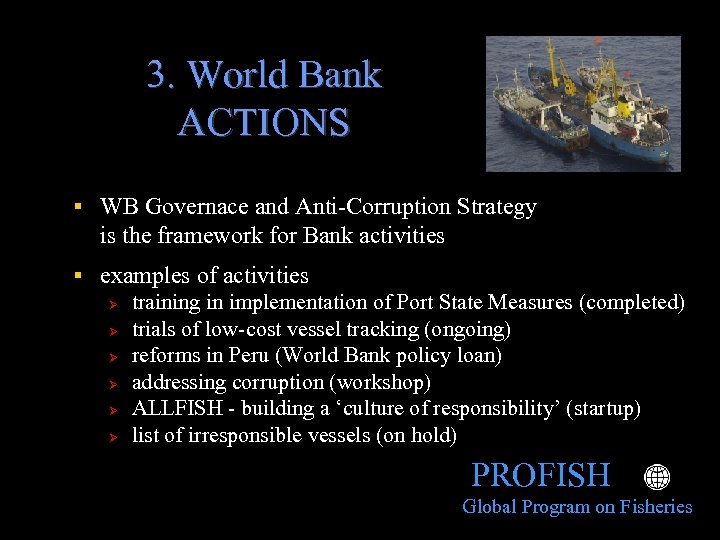 3. World Bank ACTIONS WB Governace and Anti-Corruption Strategy is the framework for Bank activities examples of activities Ø training in implementation of Port State Measures (completed) Ø trials of low-cost vessel tracking (ongoing) Ø reforms in Peru (World Bank policy loan) Ø addressing corruption (workshop) Ø ALLFISH - building a ‘culture of responsibility’ (startup) Ø list of irresponsible vessels (on hold) PROFISH Global Program on Fisheries
 simple cost-effective measures training in Port State measures in Dakar and Nuadhibou Ø Ø Ø port level cooperation, practical guidelines and training police, port inspectors, sanitary authorities, customs, ships agents, coast guard working together Bank/ Netherlands funding, FAO implementation cost-effective tracking of small fishing vessels in Maldives (trials) Ø Ø GPS + cell phone (no satellite) …. $100 / unit? provide effort and location information link to catch data Bank/ Iceland funding
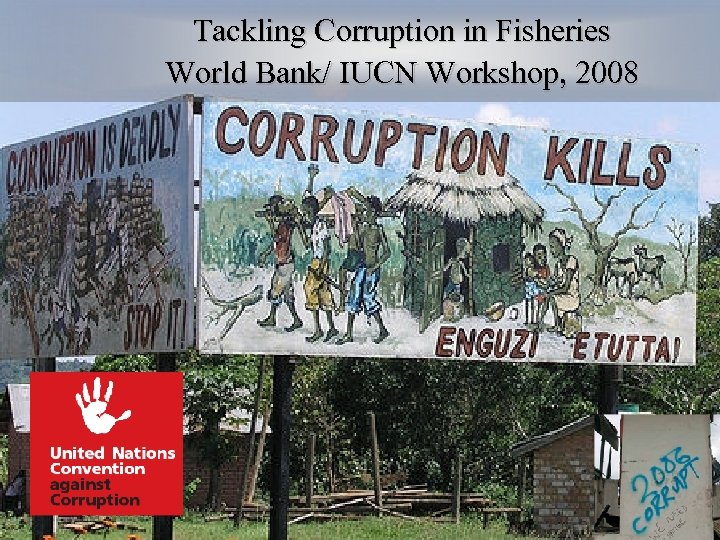 Tackling Corruption in Fisheries World Bank/ IUCN Workshop, 2008
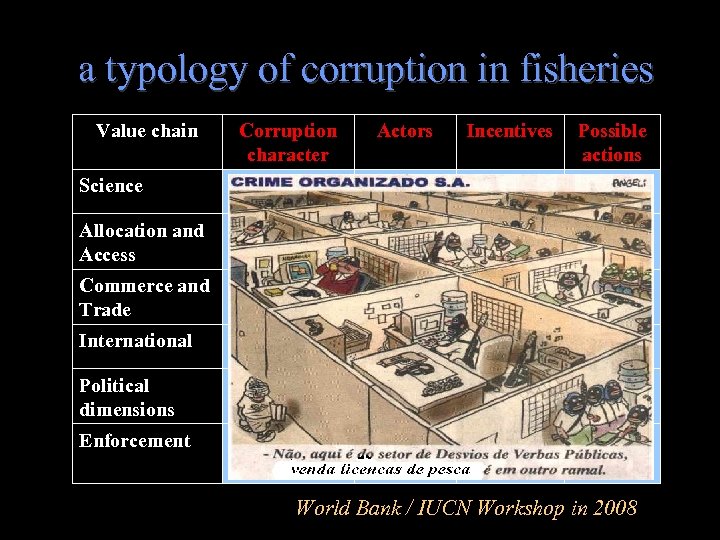 a typology of corruption in fisheries Value chain Corruption character Actors Incentives Possible actions Science Allocation and Access Commerce and Trade International Political dimensions Enforcement World Bank / IUCN Workshop in 2008
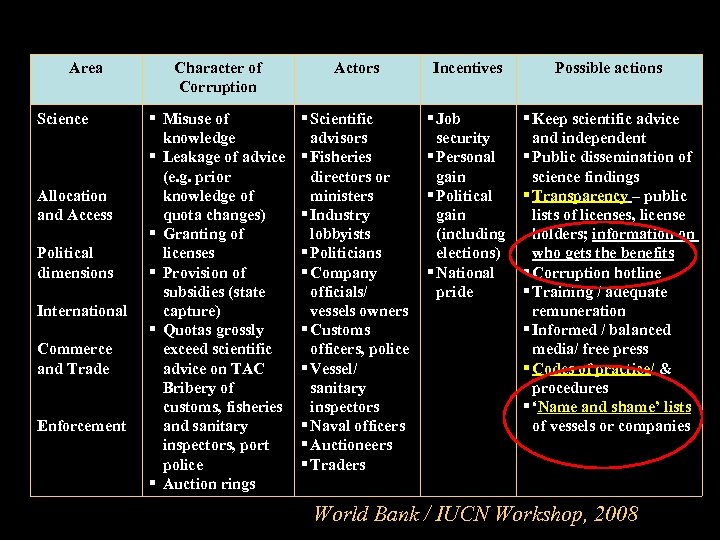 Area Science Allocation and Access Political dimensions International Commerce and Trade Enforcement Character of Corruption Actors Incentives Possible actions Misuse of knowledge Leakage of advice (e. g. prior knowledge of quota changes) Granting of licenses Provision of subsidies (state capture) Quotas grossly exceed scientific advice on TAC Bribery of customs, fisheries and sanitary inspectors, port police Auction rings Scientific advisors Fisheries directors or ministers Industry lobbyists Politicians Company officials/ vessels owners Customs officers, police Vessel/ sanitary inspectors Naval officers Auctioneers Traders Job security Personal gain Political gain (including elections) National pride Keep scientific advice and independent Public dissemination of science findings Transparency – public lists of licenses, license holders; information on who gets the benefits Corruption hotline Training / adequate remuneration Informed / balanced media/ free press Codes of practice/ & procedures ‘Name and shame’ lists of vessels or companies World Bank / IUCN Workshop, 2008
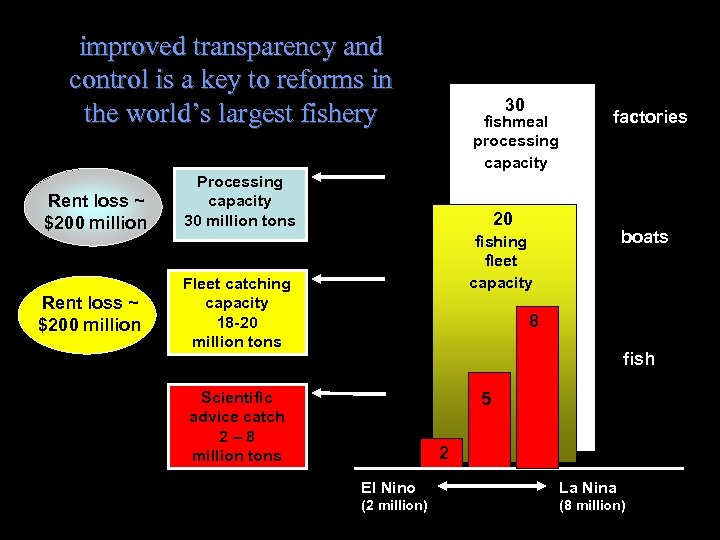 improved transparency and control is a key to reforms in the world’s largest fishery Rent loss ~ $200 million 30 fishmeal processing capacity Processing capacity 30 million tons factories 20 boats fishing fleet capacity Fleet catching capacity 18 -20 million tons 8 8 Scientific advice catch 2– 8 million tons fish 5 2 El Nino La Nina (2 million) (8 million)
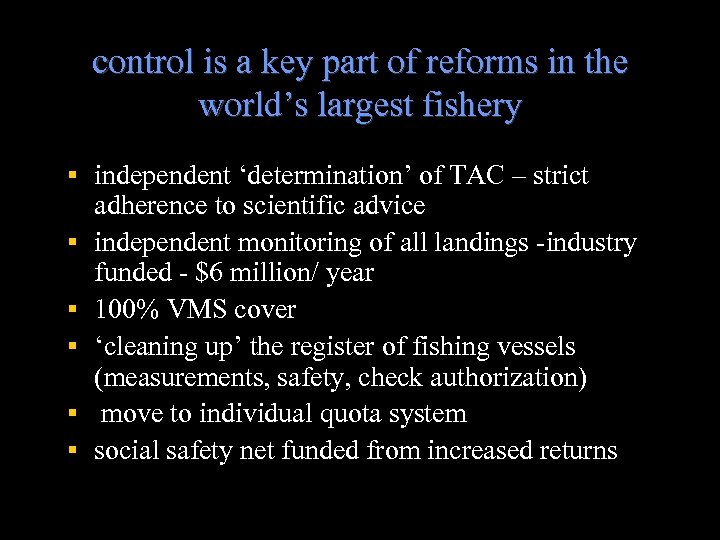 control is a key part of reforms in the world’s largest fishery independent ‘determination’ of TAC – strict adherence to scientific advice independent monitoring of all landings -industry funded - $6 million/ year 100% VMS cover ‘cleaning up’ the register of fishing vessels (measurements, safety, check authorization) move to individual quota system social safety net funded from increased returns
 ALLFISH Alliance for Responsible Fisheries targeted actions to establish a vision of a responsible industry
 start small and build on lessons partners Ø Ø International Coalition of Fisheries Associations (ICFA secretariat) – currently mainly OECD countries FAO, World Bank, (others in discussion: GEF, GTZ, NEPAD, GAA, ISSF…) core values of sustainable fisheries are shared by public and private sector stakeholders ICFA commitment to Ø Ø Ø sustainable and socially-responsible supply chains expansion to developing countries be inclusive of small-scale producers
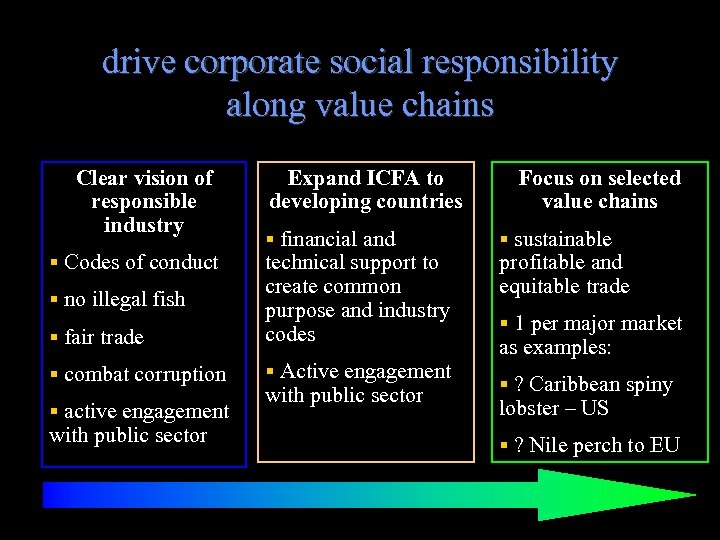 drive corporate social responsibility along value chains Clear vision of responsible industry Codes of conduct Expand ICFA to developing countries financial and fair trade technical support to create common purpose and industry codes combat corruption Active engagement no illegal fish active engagement with public sector Focus on selected value chains sustainable profitable and equitable trade 1 per major market as examples: ? Caribbean spiny lobster – US ? Nile perch to EU
 ALLFISH: first steps in a global public private partnership 3 -year window to structure and pilot global codes of industry conduct and build corporate social responsibility deliver a clear vision of a responsible private sector – environmentally sustainable, profitable, equitable a structured approach for engagement of the private sector focus on developing country seafood export value chains build public private partnerships along selected seafood value chains communicate informed and balanced positions on issues – e. g. endangered species, trade barriers, subsidies
 name and shame lists of irresponsible vessels A. RFMO lists plus B. ‘national lists’ of primary offenders – foreign vessels ‘convicted’ of fishing without a license link to beneficial ownership gradually compile at regional – global level Bank efforts – liability issue with IUCN – ‘on hold’
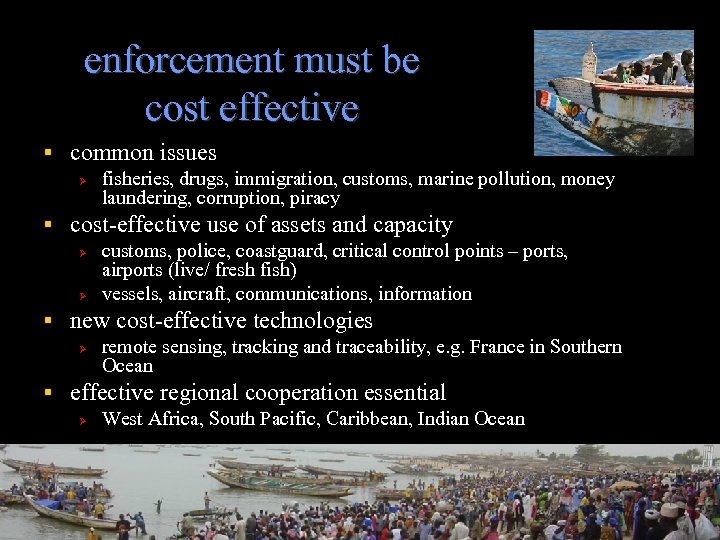 enforcement must be cost effective common issues Ø fisheries, drugs, immigration, customs, marine pollution, money laundering, corruption, piracy cost-effective use of assets and capacity Ø Ø customs, police, coastguard, critical control points – ports, airports (live/ fresh fish) vessels, aircraft, communications, information new cost-effective technologies Ø remote sensing, tracking and traceability, e. g. France in Southern Ocean effective regional cooperation essential Ø West Africa, South Pacific, Caribbean, Indian Ocean
 conclusions illegal fishing is a symptom of weak governance policy and anti-corruption measures need to supplement direct efforts to combat illegal fishing a responsible fishing industry is fundamental some of the solutions are not within the fisheries sector PROFISH Global Program on Fisheries
 References World Bank fisheries: www. worldbank. org/fish World Bank governance indicators: http: //go. worldbank. org/5 QM 8 VLZRW 0 Where Is the Wealth of Nations? http: //siteresources. worldbank. org/INTEEI/2145781110886258964/20748034/All. pdf The Sunken Billions: www. worldbank. org/sunkenbillions Changing the Face of the Waters. The Challenge and Promise of Sustainable Aquaculture: http: //wwwwds. worldbank. org/external/default/WDSContent. Server/WDSP/IB/2007/12/03 /000020953_20071203133332/Rendered/PDF/416940 PAPER 0 Fa 1808213701 5501 PUBLIC 1. pdf
 www. worldbank. org/fish PROFISH Global Program on Fisheries
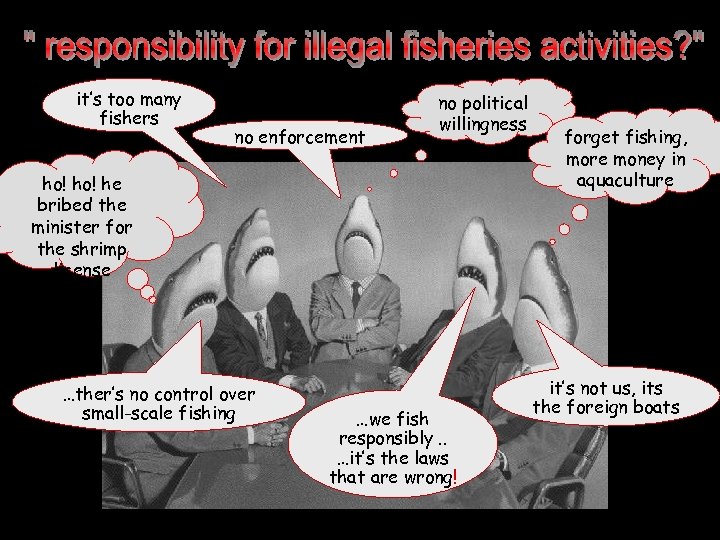 it’s too many fishers no enforcement no political willingness ho! he bribed the minister for the shrimp license …ther’s no control over small-scale fishing 10 th Annual Forum Crisis …we fish responsibly. . on the Global …it’s the laws that are wrong! forget fishing, more money in aquaculture it’s not us, its the foreign boats Fish