 Скачать презентацию Closely Held Businesses Spring 2018 Law 6062 Section
30c7eca9168a4bb8eb44fb4365e5b0b8.ppt
- Количество слайдов: 95



Closely Held Businesses Spring 2018, Law 6062, Section 1 Don Weidner ØRequired Text: Shawn J. Bayern, Closely Held Organizations (2014) ØThe text covers agency, partnerships, limited liability companies and closely-held corporations. ØI shall include some supplemental materials either in the slides or through separate distribution. Ø Primarily on the law and ethics of law firms. ØThe Syllabus cites a few background sources. ØSlide sets will initially be posted on Canvas. They will be created and modified throughout the semester and the latest modifications can be accessed directly from my web page. ØThe Exam will be three hours and closed-book. Ø And either completely or mostly essay Ø With no more than 45 minutes of multiple-choice questions
Why Use Agents? ØAssume I am leaving for vacation on a bareboat charter of a sailboat in a part of the world with no internet access. May I authorize someone to sell my home for me in my absence? Ø What parameters might that authorization have? Ø What formalities might be required? ØWhen I (as a “principal”) retain someone to act on my behalf and subject to my control (an “agent”), two kinds of questions can arise: 1. The extent to which a third party and I become obligated to one another because of the agent’s conduct; and 2. The extent to which the agent and I become obligated to one another. Donald J. Weidner 2
Restatement Definition of Agency ØRestatement Third, Agency § 1. 01: Ø “Agency is the fiduciary relationship that arises when [1] one person (a ‘principal’) manifests assent to another person (an ‘agent’) that the agent [2] shall act on the principal’s behalf and [3] subject to the principal’s control, and [4] the agent manifests assent or otherwise consents so to act. ” ØOne an agency relation is found to exist, the law of agency provides rules to determine 1. The extent to which the agent can bind the principal to third parties and bind those third parties to the principal; and 2. The extent of the duties that the principal and the agent have to one another. Donald J. Weidner 3
Authority—Binding Principals and Third Parties ØAn agent has “authority” when an agent has the power to bind the principal and a third party to a contract. Ø Leaving both the principal and the third party liable to each other for any breach of the contract. ØMost basically, an agent can bind the principal and a third party by “actual authority” or “apparent authority. ” Ø There is also the related doctrine that a third party may hold a “principal” liable on theory of “agency by estoppel” Donald J. Weidner 4
Actual Authority ØRestatement (Third), Agency, § 2. 01; Actual Authority Ø “An agent acts with actual authority when, at the time of taking action that has legal consequences for the principal, the agent reasonably believes, in accordance with the principal’s manifestations to the agent, that the principal wishes the agent so to act. ” Ø To emphasize: actual authority is determined by the agent’s reasonable belief Ø Provided it is based on the principal’s manifestations to the agent ØAssume when I set off on my sail I authorize my friend Jay to buy a 23 foot Mako if he can purchase one just a few years old in excellent condition for under $50, 000. Assume he finds one but the seller won’t sell without also selling the boat trailer he has been using with it. ØRestatement (Third), agency, § 2. 02(1): Scope of Actual Authority Ø “An agent has actual authority to take action designated or implied in the principal’s manifestations to the agent and acts necessary or incidental to achieving the principal’s objectives, as the agent reasonably understands the principal’s manifestations and objectives when the agent determines how to act. ” Donald J. Weidner 5
Actual Authority (cont’d) ØThe agent has actual authority to do exactly what the principal has clearly and unequivocally instructed. ØIn addition, the agent also has actual authority when, at the time of taking action that has consequences for the principal, the agent reasonably believes, “in accordance with the principal’s manifestations to the agent, that the principal wishes the agent so to act. ” Ø An agent’s “actual” authority also includes cases in which the principal does not subjectively intend to give the agent authority, but the agent reasonably thinks the principal did so intend. Ø Reasonable belief of the agent is key Ø “That is, if P issues confusing instructions to A, whether A has actual authority or not is decided from the perspective of a reasonable person in A’s position. ” Donald J. Weidner 6
Actual Authority (cont’d) ØThe reasonableness of the agent’s interpretation of the agent’s authority is judged at the moment “when the agent determines how to act. ” Ø If the agent subsequently learns something new about the principal’s intentions, it can immediately impact the agent’s actual authority. Ø The purpose of the rule is to protect principals by making sure that agents cannot unreasonably act for them in light of newly acquired information. Ø For example, an agent’s express authority to do something on behalf of the principal may end if the agent learns that the principal no longer needs it done. ØNote: An agent can be liable to the principal for damages the agent causes to the principal by exceeding the agent’s actual authority. Ø “If the agent’s interpretation is reasonable at the time the agent acts, the agent is not subject to liability to the principal even if, after the fact, the principal can demonstrate that the agent’s interpretation was erroneous. ” Text at 14. Ø Is there a “know (or control) your agent” rule? Donald J. Weidner 7
Apparent Authority ØRestatement (Third), Agency § 2. 03; Apparent Authority Ø “Apparent authority is the power held by an agent or other actor to affect a principal’s legal relations with third parties when a third party reasonably believes the actor has authority to act on behalf of the principal and that belief is traceable to the principal’s manifestations. ” ØConsider Restatement Illustration 1 at text p. 6. P owns a granary and employs A to manage it. P’s employment agreement with A states that A may not enter into purchase transactions that exceed $5, 000. This is an unusual limit in the granary business. However, P told A to tell T that A’s authority to purchase grain was unlimited. A enters into a contract on A’s behalf to purchase $10, 000 worth of grain from T. Ø Does A’s apparent authority bind P to purchase $10, 000 grain from T? ØApparent authority is determined from the perspective of a reasonable third party if it is traceable to the principal’s manifestations. Ø Is it necessary to say, as the Restatement does, that A had actual authority to (mis)represent his authority? What if A had not given that? Ø It is less costly for the Principal to select, train and monitor A than for a third party to investigate idiosyncratic instructions. Donald J. Weidner 8
Agency by Estoppel ØUnder the doctrine of agency by estoppel, “a third party may hold a principal liable if (1) the third party reasonably believes that an agent is acting for the principal and suffers a loss as a result, (2) the principal has notice of this, and (3) the principal doesn’t take reasonable steps to correct the third party’s misrepresentation. ” ØThe text notes two main differences between apparent authority and agency by estoppel: Ø “First, agency by estoppel can cause a principal to be liable even if the principal gave no affirmative indication to the third party that the agent was authorized—something that is normally required for apparent authority. ” Ø There is no requirement that the third party’s reasonable belief in authority be traceable to the “manifestations of the principal. ” Ø “Second, agency by estoppel lets injured parties recover only for their loss in reliance on the misunderstanding. Essentially, it lets them recover reliance damages rather than expectation damages. By contrast, if there is apparent authority, the third party can recover expectation damages from the principal. ” Ø Expectation damages: put plaintiff as if the contract had been fully performed Ø Reliance: restore plaintiff as if the contract had never been entered into Donald J. Weidner 9
Liability of the Agent on the Contract Liability to the Principal. ØIf an agent binds a principal to a contract the Principal did not intend, but did so based on a reasonable interpretation of the principal’s manifestations, the agent has actual authority and is not liable to the principal. ØIf an agent acts with apparent but not actual authority, “the principal is liable to the third party on the contract that the agent has made, but the agent may also be liable to the principal for any losses the principal suffers as a result of the agent’s” error or intentional exceeding of actual authority. Ø For example, if the Agent binds the principal to a contract that was expressly unauthorized, the Principal may sue the agent for any losses the Principal incurs Donald J. Weidner 10
Liability of the Agent on the Contract (cont’d) Liability to the Third Party. The law answers the question of the contractual liability of the agent to the third party by asking how much information the third party had about the principal. 1. Disclosed Principal. “If the agent with authority tells the third party whom he’s working for—that is, if the agent ‘discloses’ the identity of the principal to the third party—then the agent is not considered a party to the contract and is not ordinarily liable if the principal breaches. ” 2. Undisclosed Principal. If the agent doesn’t inform the third party that the agent is working for a principal—for example, if the agent pretends that the agent is operating on the agent’s own behalf rather than acting for another—then the agent is a party to the contract, and the third party can recover against the agent. Ø Both the undisclosed principal (by actual authority) and the agent (by apparent intent) can be liable to the third party Donald J. Weidner 11
Liability of the Agent on the Contract (cont’d) ØPartially Disclosed (or Unidentified) Principal. A principal is stated to be “partially disclosed” or “unidentified” when the agent informs the third party that the agent is acting for a third party but does not identify that third party. The case of the unidentified principal “normally works similarly to cases of undisclosed principals; both the agent and the principal can be liable to a third party. ” ØThe Restatement (Third), Agency, explains at text p. 8: Ø “Without notice of a principal’s identity, a third party will be unable to assess the principal’s reputation, assets, and other indicia of creditworthiness and ability to perform under the contract. ” Ø But what if the third party were not relying on the liability of the agent signing the contract? Ø That could be explicit in the contract. Donald J. Weidner 12
Curto v. Illini Manors, Inc. (2010) ØWife “entered into a contract” with the Nursing Home to admit and care for Husband. The care contract named Husband as the resident and wife as the “Guardian/Responsible Party. ” Ø Wife signed the form on the preprinted signature line that designated her as the “Legal Representative. ” Ø Husband did not sign the care contract. Ø“The parties also entered into a separate arbitration agreement, which provided that ‘any and all disputes arising hereunder shall be submitted to binding arbitration and not to a court for determination. ’” In the arbitration agreement, “each party waived its right to a trial by jury. ” Ø Wife signed the arbitration agreement above the line that stated “Signature of Resident Representative. ” Ø Husband did not sign the arbitration agreement. Donald J. Weidner 13
Curto v. Illini Manors, Inc. (cont’d) ØWife sued nursing home under Illinois Nursing Home Care Act for personal injuries her Husband suffered while a resident at the nursing home and his wrongful death. Wife also sued for personal claims she had under various statutes for his wrongful death and for medical expenses. ØNursing home filed a motion to dismiss the lawsuits and to compel arbitration. It argued that Wife was Husband’s agent and thus bound him and his estate to honor the arbitration agreement. ØCourt below: one spouse is not an agent of the other for purposes of the arbitration agreement. ØIn general: the agency of a spouse “is a question of fact to be proved by direct or circumstantial evidence. ” Ø The party claiming an agency relationship has the burden to prove it. Ø“The terms and extent of an agency relationship depend on the terms of the agreement between the principal and the agent and the intent of the parties. ” Donald J. Weidner 14
Curto v. Illini Manors, Inc. (cont’d) A. Did Wife have actual authority to bind Husband to the arbitration agreement? ØDid Husband make “manifestations” that supported a reasonable belief in Wife that she had his authority to enter the arbitration agreement? ØActual authority can be express or implied. ØExpress authority can arise by a contract, a power of attorney, or a court-ordered guardianship. ØHowever, the scope of these grants is an issue Ø Cases have held that the grant of a power of attorney to make medical decisions did not a grant of the power to waive the principal’s legal rights under an arbitration agreement Ø Contrast Owens (p. 12), which held that attorney-in-fact was authorized to enter into an arbitration agreement as part of a contract admitting nursing home residents. Donald J. Weidner 15
![Curto v. Illini Manors, Inc. (cont’d) Ø“Implied [actual] authority. . . is actual authority](https://present5.com/presentation/30c7eca9168a4bb8eb44fb4365e5b0b8/image-16.jpg "Curto v. Illini Manors, Inc. (cont’d) Ø“Implied [actual] authority. . . is actual authority")
Curto v. Illini Manors, Inc. (cont’d) Ø“Implied [actual] authority. . . is actual authority circumstantially proved. ” Ø “It arises when the conduct of the principal, reasonably interpreted, causes the agent to believe that the principal desires him to act on the principal’s behalf. ” Ø Recall, actual authority is based upon the agent’s reasonable belief “in accordance with the principal’s manifestations. ” Ø Can the implication be established by a prior course of dealing on similar matters. Ø Has husband acquiesced in a prior course of conduct? Donald J. Weidner 16
Curto v. Illini Manors, Inc. (cont’d) ØConsider Restatement (Third) § 2. 01 comment c, p. 14. Ø“An agent must interpret a principal’s manifestations and determine how to act. ” Ø “The context in which the relationship is situated, including the nature of the principal’s objectives and the custom generally followed in such circumstances, affects how the agent should interpret the principal’s manifestations. ” Ø What is the custom in the area when an agent has authority to enter into a care agreement? ØIf the principal states directions in general or open-ended terms, the agent will have to exercise more discretion than if the direction were detailed. Ø “It should be foreseeable to the principal that an agent’s exercise of discretion may not result in the decision the principal would make individually. ” Donald J. Weidner 17
Curto v. Illini Manors, Inc. (cont’d) B. Did Wife have apparent authority to sign the arbitration agreement on behalf of Husband? ØAccording to the court: “Apparent authority arises when a principal creates a reasonable impression to a third party that the agent has the authority to perform a given act. ” Ø The third party reasonably believes there is an agent with authority because of manifestations of the principal. ØHad Husband made any manifestations? ØThe court stated: “An agent’s authority may be presumed by the principal’s silence if the principal knowingly allows another to act for him as his agent. ” Ø How did the court decide that was not the case here? Ø Even after citing Career Concepts, in which the sales manager was held to have apparent authority to contract with a placement agency because the company authorized him to enter other contracts and interview potential employees. Donald J. Weidner 18
Curto v. Illini Manors, Inc. (cont’d) C. Was Husband liable under theory of agency by estoppel, Ø under which a third party may hold a principal liable if (1) the third party reasonably believes that an agent is acting for the principal and suffers a loss as a result, (2) the principal has notice of this, and (3) the principal does not take reasonable steps to correct the third party’s omissions. Ø Court did not mention this theory ØRecall, under agency by estoppel, a principal can be liable even if the principal gave no manifestations to the third party that the agent was authorized. D. Should Wife be held to have agreed to submit her own personal claims to arbitration? ØThe court said no, without fully explaining. Ø She signed arbitration agreement as “Resident Representative. ” Donald J. Weidner 19
Curto v. Illini Manors, Inc. (cont’d) E. Is Wife a Party to the Contract Because She had No Authority to Bind the Disclosed Principal, her Husband? Ø On theory that, otherwise, the contract assumed the third party had rights as against someone ØThe general rule is that an agent is not a party to a contract that the agent signs when the agent purports to bind a disclosed principal but lacks actual or apparent authority. Ø The “fact that an agent acted without power to subject the principal to liability does not make the agent a party to the contract. This is because an agent who only purports to bind a disclosed principal to a contract does not promise to render any of the performance purportedly required from the principal. ” Restatement (Third), § 6. 04, cmt. b. Donald J. Weidner 20
Curto v. Illini Manors, Inc. (cont’d) F. Was Wife liable under her implied warranties of authority? Ø Court did not discuss. ØAn agent who acts without actual authority breaches warranties of authority made expressly or impliedly to third parties with whom the agent deals. Ø“A person who purports to make a contract, representation or conveyance to or with a third party on behalf of another person, lacking power to bind that person, gives an implied warranty of authority to the third party and is subject to liability to the third party for damages for loss caused by breach of that warranty, including loss of the benefit expected from performance by the principal, ” unless on of three exceptions applies. Restatement (Third) § 6. 10. ØWhat would the Nursing Home’s damages be for breach of the warranty of authority? Donald J. Weidner 21
Note on Ratification (p. 16) G. Did Husband subsequently Ratify the Arbitration Agreement? Ø Court did not discuss. ØA principal can start off not being bound by a contract that was entered into by a purported agent who had no authority to bind the principal. That is, when the contract was first signed, the principal is not a party to it and will have no rights or liabilities on account of it. ØHowever, the principal can subsequently become bound to the contract if the principal is held to ratify it. ØRestatement (Third) Ch. 4: “By ratifying an act, a principal triggers the legal consequences that would flow had the act been that of an agent acting with actual authority. ” ØRatification “retroactively creates the effects of actual authority. ” Id. Ø“Ratification also exonerates the agent against claims otherwise available to the principal on the basis that the agent’s unauthorized action has caused loss to the principal. ” Id. Donald J. Weidner 22
Note on Ratification (cont’d) ØRatification can be either express or implied. Express Ø A principal can ratify an agent’s conduct by “manifesting assent” (ex. , “I am going to honor that contract even though it was entered into without my authority”) or Implied Ø by engaging in “conduct that justifies a reasonable assumption that the person consents to becoming subject to the act’s legal consequences. ” Id. Ø One way there can be a reasonable assumption of ratification is through “conduct justifiable only on the assumption that the person consents to be bound by the act’s legal consequences. For example, knowing acceptance of the benefit of a transaction ratifies the act of entering into the transaction. ” Ø Did the Husband engage in any conduct that could only be explained if he consented to be bound by the wife’s purported signature on his behalf? Donald J. Weidner 23
Note on Ratification (cont’d) Ø“The act of ratification is a unilateral act of the ratifier because its legal effect does not depend on communication to the agent or a third party. ” Id. ØThis presumably means that the Husband’s ratification did not need to be communicated either to Wife or to Nursing Home Ø However, courts will not allow a purported principal to use the possibility of a secret ratification “as a way to speculate (on, for example, changes in market price) at a third party’s expense. ” Text. Ø “In particular, ratification becomes unavailable after a third party makes any attempt to withdraw from the transaction or after ‘any material change in circumstances that would make it inequitable to bind the third party, unless the third party chooses to be bound. ’” Ø“A principal may not ratify only one element of a single act or transaction; if the principal wishes to retain the benefits of an agent’s action, the principal must also become subject to the legal consequences of the totality of the agent’s conduct. ” Ø In Curto, if Husband accepted the care contract by moving in and being cared for, was the arbitration agreement part of the “transaction” he ratified? Donald J. Weidner 24
Note on Inherent Authority (Inherent Agency Powers) H. Was the Husband Bound by the Inherent Agency Power of Wife? Ø Court did not discuss ØThe Restatement (Second) of Agency defined a third kind of authority called “inherent authority” or “inherent agency power. ” ØThe concept seems to be the authority to bind, or power to bind, that arises out of the agency relationship itself. ØRestatement (Second), Agency § 8 A says that an agent’s inherent authority or inherent agency power includes “the power of an agent which is derived not from [1] authority, [2] apparent authority or [3] estoppel, but solely from the agency relation. ” ØIt “exists for the protection of persons harmed by or dealing with a servant or other agent. ” Donald J. Weidner 25
Note on Inherent Authority (Inherent Agency Powers) (cont’d) Ø“The core idea behind inherent authority is that it handles inevitable errors that arise when agents are involved. ” Ø“A principal might. . . expect the agent to commit hard-to-avoid errors. ” ØPerhaps the implicit notion is a “know your agent rule” like the “know your partner rule” implicit in the Revised Uniform Partnership Act provisions that treat partners as agents. ØVicarious Liability in Tort. When the agent is an employee and the errors lead to torts within the scope of employment, the result is vicarious liability in tort (respondeat superior). ØInherent authority suggests Vicarious Liability in Contract. ØThe Third Restatement eliminated the inherent authority concept as unnecessary. Donald J. Weidner 26
Note on Inherent Authority (Inherent Agency Powers) (cont’d) ØConsider the example of a store with “corporate policy” that prohibits store employees from accepting returns of merchandise (no customer refunds). Suppose, in accordance with this policy, a customer is told at the time of sale that there will be no refunds. If a store manager subsequently allows a customer to return an item and give a refund, is the store bound? ØActual authority (express or implied)? ØApparent authority? ØAgency by estoppel? ØInherent agency power? Ø “On appropriately general understandings of actual authority. . . or apparent authority. . . the Third Restatement suggests the concept of inherent authority is unnecessary. ” Donald J. Weidner 27
Note on Inherent Authority (Inherent Agency Powers) (cont’d) ØIn particular, the Third Restatement makes an allowance for situations in which it is “reasonable for the agent to believe that the principal wishes the agent to construe the instructions in light of changed circumstances. ” ØRestatement Illustration #20 (p. 15). “P retains A, directing A to buy Blackacre but to offer no more than $250, 000. A subsequently learns that Blackacre has increased substantially in value and, if purchased for $300, 000, would represent a bargain. As A knows, it is financially feasible for P to pay $300, 000 for Blackacre. ” The Restatement concludes: Ø “A does not have actual authority to bid more than $250, 000 for Blackacre. ” Donald J. Weidner 28
Note on Inherent Authority (Inherent Agency Powers) (cont’d) ØRestatement Illustration #22 modifies Illustration # 20 by providing that P owns and operates a golf course on land that almost entirely surrounds Blackacre. A has notice of P’s long-term business plan to enhance the aesthetic and athletic qualities of the course and thereby make it more profitable. At the auction of Blackacre, A learns for the first time that there will be one other bidder, B. A also learns that B’s plan for using Blackacre is to construct a cement factory on it. A is unable to contact P to relay this information and receive further instructions. A succeeds in purchasing Blackacre for P by bidding $260, 000. Ø The Restatement concludes: “A acted with actual authority. ” Ø“In Illustration 22, it is reasonable for A to construe P’s instructions in light of the changed circumstances that B’s bid represents in light of P’s business purpose, known to A, and P’s financial capability, also known to A, to pay more than $250, 000 for Blackacre. In contrast, in Illustration 20, no circumstance makes it reasonable for A to exceed P’s stated limit. ” Donald J. Weidner 29
Note on Inherent Authority (Inherent Agency Powers) (cont’d) ØComment e further provides that, regardless of the explanation for the agent’s lapse from instructions of the principal, “the agent does not have actual authority to disregard instructions unless it is reasonable for the agent to believe that the principal wishes the agent to do so. ” Donald J. Weidner 30
ICC v. Holmes Transportation (1993) ØThe determination of an attorney-client relationship “is a question of fact, or, at most, a mixed question of law and fact. ” ØThere was a first question whether the attorney had signed a consent decree on behalf of the purported principal. ØThen the question was, if the attorney had signed on behalf of the purported principal, did the attorney have authority to do so. ØAlthough the “general powers” of an attorney to represent a client “do not entail the authority either to settle a case or to make substantial modifications” to a contract, the “principal’s consent to be bound may be implied by showing the agent’s actual or apparent authority to act in the principal’s behalf. ” Donald J. Weidner 31
Holmes Transportation (cont’d) Ø“An agent’s actual authority to bind his principal may be implied. . . in circumstances where the principal has acquiesced in or adopted conduct by the agent which is reasonably considered to encompass the authority to undertake the subject conduct on the principal’s behalf. ” Ø Is this an “appropriately general understanding” of actual authority? Ø Sounds a bit like ratification? ØIn Holmes Transportation, the previous authority to negotiate and execute an escrow agreement was held to encompass the authority to subsequently modify it as necessary. ØIf Wife had actual authority to sign the admission and care contract because Husband acquiesced in a course of her conduct acting as agent for many transactions, can her actual authority be “reasonably considered to encompass” the authority to enter into the arbitration agreement to resolve disputes under it? Donald J. Weidner 32
Johnson v. Hospital Service Plan (1957) ØPlaintiff’s infant daughter was injured by an allegedly negligent insured driver. She was taken to Newark City Hospital and treated there for 70 days. ØDaughter was covered by her father’s insurance policy with Blue Cross. Her hospital bill was $1, 190 but Blue Cross only paid the hospital $100. Blue Cross cited an agreement that it had first entered into 12 years earlier with a predecessor City Hospital Medical Director. The contract: Ø with modifications, was in effect from 1944 through 1956, though either party could cancel it on 60 days’ notice; Ø which initially provided a daily rate, was subsequently amended to require Blue Cross to pay no more than a flat fee of $100, no matter how intensive the treatment or how long care lasted (up to 90 days); and Ø has always provided that the payment from Blue Cross would constitute payment in full to the City. Donald J. Weidner 33
Johnson v. Hospital Service Plan (cont’d) ØThe City accepted the $100 check from Blue Cross but said it was owed more. City said its Hospital Director had no authority to enter into the agreement that limited the amount due from Blue Cross (and from the patient) to $100. ØCity filed a lien for the remaining $1, 090 against the proceeds of plaintiff’s settlement with the negligent driver and his insurance company. Ø Because of the lien, the insurance company refused to pay that amount to the Plaintiff. ØPlaintiff sued for a declaratory judgment absolving him of any liability to the City for his daughter’s care. He argued that either the $100 paid by Blue Cross to the Hospital on his behalf constituted payment in full or that, if the agreement between the Blue Cross and the city were held invalid, Blue Cross was obligated to pay to discharge the City’s lien. Ø He was absolved and dropped from the suit, which then became a suit between the City and Blue Cross. Donald J. Weidner 34
Johnson v. Hospital Service Plan (cont’d) ØThe trial court said the Hospital Director had authority to enter the agreement and that, even if he had not, the City had subsequently ratified the agreement. Ø It cancelled the City’s lien. ØHospital provided principally for charitable care of indigents. A 1937 Ordinance provided that non-indigents could be served if they paid costs at a rate to be fixed “by the Director. ” ØIn 1944, State determined Hospital was a “possible participant” in the Blue Cross plan. Ø Ensuing discussions led to Hospital Director entering into agreement with Blue Cross on rates. ØIn light of its conclusion that the City had ratified the contract, the New Jersey Supreme Court declined to interpret state statutes “to determine in which local official the authority to contract with the Plan resides. ” Ø Should directors of individual hospitals have such authority? Donald J. Weidner 35
Johnson v. Hospital Service Plan (cont’d) ØWhat if statute had required a state official to approve such contracts? ØA “municipality can ratify a contract entered into by an unauthorized agent so long as such contract is within the corporate powers and not ultra vires in the primary sense as entirely beyond the municipal jurisdiction. ” Ø Ratification possible only if municipality could have authorized it. ØThe “responsible officials” who should have made the agreement “are not bound by their subsequent acceptance of it through the means of ratification unless they were acquainted with all the material facts. ” ØCourt found no express ratification but implied ratification. Ø Mere silence, performance of contract, acceptance of benefits, can suffice. Donald J. Weidner 36
Johnson v. Hospital Service Plan (cont’d) ØApparently, the “very officer charged by the City. . . with the authority to negotiate such contracts knew of its consummation in 1944 and was also familiar with the rates which the [Blue Cross] plan undertook to pay. ” Ø The then-Director of the Department of Public Affairs said he “may have directed” then-Medical Director to enter into the agreement and further stated that he had “undoubtedly” approved any rates established during his term in office. ØThe Mayor and the Director of the Department of Health “admitted” that in the December 1954 hearings on the proposed 1955 budget, they “learned of the 1944 agreement and subsequent modifications, limiting the City to a flat payment of $100 for Blue Cross subscribers. Ø“Nevertheless, no steps were taken to abrogate the arrangement and the city continued to receive benefits under it. ” Ø In just a few months! Donald J. Weidner 37
Johnson v. Hospital Service Plan (cont’d) ØWhat of the “customary time lag incident to municipal proceedings” that prevented a finding of ratification in the repainted fire truck case? ØNote that ratification may take more than one level of approval, for example, it was not enough for fire commissioners to ratify an unauthorized purchase, the mayor’s consent was essential. The key is the “municipal body charged with the responsibility for making the purchases” must have knowledge of the purchases or there can be no implied ratification. ØHeld: if the City Hospital medical directors had no authority to enter agreements with Blue Cross, “the city by its course of conduct has by this time rectified the deficiency through implied ratification. ” Ø“Additionally, the doctrine of estoppel applies against municipal corporations. ” Donald J. Weidner 38
Johnson v. Hospital Service Plan (cont’d) ØWithout ratification, an injustice would be perpetrated. Blue Cross “has undergone a considerable change in position” in reliance on the authority of the Hospital medical director “and the city’s continued compliance with full knowledge of the agreement is directly responsible for the Plan’s payment of benefits over the course of 11 years. ” Ø What is Blue Cross’s change in position? Ø Who had “full knowledge” for 11 years? ØCity says: this is a horrible plan for us. Since the $100 payment in full provision was added, starting in 1953, we have received far less money than we would have received under the regular rates! ØWhat does the court say in response? ØWhat if it weren’t Blue Cross but “Cousin Vinny’s Cross? Ø See reference to “fair and reasonable plan” approved by “disinterested state officials. ” ØNote: the remedies for ratification and estoppel are different. Ratification gives the plaintiff Donald J. expectation damages, estoppel full Weidner 39 does not.
Progress Printing Corp. v. Jane Byrne Political Committee (1992) ØAppeal from a judgment holding that a campaign had ratified contracts. ØCandidate told Printer that Griffin was in charge of the Campaign’s printing arrangements and Printer sent detailed invoices to Griffin. ØCampaign rejected the invoices, saying the orders were not properly authorized and the Campaign never knew the details. ØThe designated agent breached his duty “to gain knowledge of the transactions by simply reviewing the invoices, a breach that has the same legal effect as actual knowledge of the facts and which may be imputed to his principal. ” ØIn addition, the benefits of the transaction “were retained in that the campaign staff accepted the materials, which were then used without question. ” ØThe principal’s ignorance of the facts was “the direct result of its expressly designated agent’s neglect. ” Ø Was there neglect in Hospital Donald J. Weidner Service Plan? 40
Peter Tiersma, The Language of Silence (p. 22) ØOne class of cases involves agents acting in a way that could reasonably have been included within their authority, but may not have been. ØIn this situation, courts have held that the principal, by remaining silent or inactive, has acquiesced in the act, this indicating that the conduct was authorized. ØRestatement of Agency: “persons ordinarily express dissent to acts done on their behalf with they have not authorized or of which they do not approve. ” ØThe principal’s silence—failure to express dissent—”indicates that the parties understood that such acts were authorized. ” Ø“Acquiescence is possible only when the agent’s conduct is arguably within his authority. ” Donald J. Weidner 41
The Language of Silence (cont’d) ØRatification may be inferred from a failure to repudiate a transaction. ØIn some cases, courts impose ratification upon the principal because the principal acts in a way that is inconsistent with nonaffirmance or nonratification of the transaction. Ø Ex. , by receiving property the principal would only be entitled to if the transaction had been authorized. ØIn other cases, the operative principle is estoppel. The principal does something that misleads a third party into believing that the transaction is authorized or ratified, or does not correct an obviously mistaken impression. ØThe actual intention of the principal is not controlling in either case. Donald J. Weidner 42
Terminating an Agency Relationship ØA principal has the power to terminate an agency relationship even if the principal does not have the right to terminate. ØExample: Performer signs a three-year contract with Manager. Performer promises to pay Manager 15% of all gross receipts from performer’s services. It also gives Manager authority to bind Performer to new contracts, collect payments from the third parties and give Performer the payments after subtracting and retaining the Manager’s 15% fee. ØIf Performer terminates wrongfully, Manager may sue for damages but not specific performance. ØNote: actual authority terminates, not necessarily apparent authority. ØIt is especially important to note one grant of a power that does not fall under the general agency rule: a power “given as security” (or “coupled with an interest”) is not terminated at will simply because the Principal wishes. Donald J. Weidner 43
Termination of Power Given as Security (Text at 25) Ø“The chief idea is that when an agency power is given as part of a contract to ensure that the promisee [the agent] will be able to serve his own interests, rather than to act as a representative of the principal’s interests, the principal cannot unilaterally revoke that power because doing so would undermine the contract. ” Ø That is, the relationship is NOT one of agency. Ø“The typical example is that a contract gives A power to sell something of B’s if B defaults on a loan [A made to B]; B cannot unilaterally terminate such a power. The. . . power isn’t especially personal, and A isn’t really B’s agent; B has simply given A the power to do something in order to compensate A for the risk of B’s default in an ordinary, non-agency contract. ” Donald J. Weidner 44
The Agent’s Duty of Care ØRestatement (Third), Agency § 8. 08: Duty of Care, Competence, and Diligence “Subject to any agreement with the principal, an agent has a duty to the principal to act with the care, competence, and diligence normally exercised by agents in similar circumstances. Special skills or knowledge possessed by an agent are circumstances to be taken into account in determining whether the agent acted with due care and diligence. If an agent claims to possess special skills or knowledge, the agent has a duty to the principal to act with the care, competence, and diligence normally exercised by agents with such skills or knowledge. ” Donald J. Weidner 45
The Agent’s Duty of Care (cont’d) ØIllustration 2 (p. 26). Consider singer P who retains talent agent A to represent P in negotiations with recording companies. Unlike most other talent agents, A had a background as a professional investment manager. P asks A to manage P’s investment portfolio. ØAssume that A manages P’s investment portfolio in a way that falls short of the competence expected of a professional investment manager and that a loss to P results. ØIs A liable for that loss? What if A never told P of A’s background or training in investment portfolio management? ØRestatement’s answer: “A is subject to liability if A failed to act with the care, competence, or diligence normally expected by agents who undertake to manage property of a principal. ” Donald J. Weidner 46
The Agent’s Duty of Care (cont’d) ØComment b to § 8. 08 provides: “The duties stated in this section will often overlap with an agent’s duties of performance that are express or implied terms of a contract between principal and agent. However, the duties stated in this section are tort-law duties because they ‘denote the fact that the actor is required to conduct himself in a particular manner at the risk that if he does not do so he becomes subject to liability to another to whom the duty is owed for any injury sustained by such other, of which that actor’s conduct is a legal cause. ’” “Tort law imposes duties of care on an agent because [1] the agent undertakes to act on behalf of the principal, [2] because the principal’s reliance on that undertaking is foreseeable by the agent, and [3] because it is often socially useful that an agent fulfill the agent’s undertaking to the principal. ” Donald J. Weidner 47
The Agent’s Duty of Care (cont’d) ØContext matters. Other provisions of statutory or regulatory law, or ethical rules, may modify the general rule or remedy for breach. ØStatutes or regulations govern specific types of agents. Ø For example, the Model Business Corporation Act provides that a corporate officer, in performing the officer’s duties, must act “with the care that a person in like position would reasonably exercise under similar circumstances. . ” Ø The Revised Uniform Partnership Act states that a partner owes a duty of care that is limited to “refraining from engaging in grossly negligent or reckless conduct, intentional misconduct, or a knowing violation of law. ” ØSome exculpatory provisions are unenforceable as a matter of professional ethics, such as a provision in a lawyer’s engagement agreement with a client in which the client waives the right to recover for the lawyer’s professional malpractice. Ø Or perhaps merely a purported right to waive a claim of punitive damages. Donald J. Weidner 48
The Agent’s Duty of Care (cont’d) ØAssume “Captain Don” loves boats. He has owned and chartered sailboats and powerboats but has limited technical skills and does not work on his own boat. A friend of Don is a busy guy, with more money than sense. He gives Don $50, 000 to buy a boat for him. Don does so, without having the boat inspected. The boat turns out to have an engine defect that would have been revealed by the inspection of a competent marine mechanic. ØIs Don liable to his Friend for the loss caused by the failure to inspect? What do examples 5, 6 (p. 26) suggest? Don is not competent to conduct a mechanical inspection. ØAccording to the Restatement: “In general, the standard of care applicable to a gratuitous agent should reflect what it is reasonable to expect under the circumstances. Relevant circumstances include the skill, experience, and professional status that the agent has or purports to have. Thus, providing a service gratuitously may subject an agent to duties of competence and diligence” as if the agent were compensated. Donald J. Weidner 49
Carrier v. Mc. Llarky (1997) ØPlaintiff Homeowner retained Defendant Plumber to install a replacement hot water heater. Plumber told Homeowner the old unit might still be under warranty and that he would try to obtain for Homeowner a credit against the cost of the unit from the manufacturer. ØPlumber took the old unit to Plumber’s supplier to return it to the manufacturer. The supplier said that the old unit was no longer covered by warranty. ØHomeowner sued Plumber for breach of his duties as an agent. ØWas the Plumber the Agent of the Homeowner? Ø Court: question of fact ØCourt: “An agency relationship is created when a principal gives authority to another to act on his or her behalf and the agent consents to do so. ” Ø How does this differ from the Restatement definition? Donald J. Weidner 50
Carrier v. Mc. Llarky (cont’d) ØWhat duty did Plumber have with respect to obtaining credit on the warranty? Ø“Under ordinary circumstances, the promise to act as an agent is interpreted as a promise only to make reasonable efforts to accomplish the desired results. ” Ø“The degree of skill required by an agent in pursuit of the principal’s objective is limited to the level of competence which is common among those engaged in like businesses or pursuits. ” ØThere was evidence that Plumber acted as any normal dealer would have acted by returning it to the supplier. Ø Did Plumber sell the heater to Plaintiff, or just agree to install it? Ø Was plumber simply doing the Plaintiff a favor? Ø Has he agreed to act subject to her control? Donald J. Weidner 51
Oxford Shipping Co. v. New Hampshire Trading Corp. (1982) ØOxford owned one cargo ship, the “Eastern Saga, ” which Avon subchartered to ship scrap metal it was selling to Yuslan. Ø Oxford retained a captain and crew. Ø Oxford also retained Tager Steamship Agency “to issue bills of lading and perform other tasks associated with loading and shipping the scrap. ” ØAvon tried to cheat Yuslan by loading only 17, 000 tons of scrap rather than the 20, 000 tons Avon promised. Ø“Avon used various false documents to conceal the fraud, including bills of lading issues by Tager that overstated the weight of the scrap by several thousand tons. ” Ø Tager apparently relied on letter of representation from the seller to Avon ØOxford’s captain and first officer apparently knew that the ship had been “short weighted. ” Although they failed to report either to Oxford or to Yuslan, they did not affirmatively participate in the wrongdoing of Avon or Tager Ø They refused to take on additional water ballast to make the ship look more heavily-laden Donald J. Weidner 52
Oxford Shipping Co. v. New Hampshire Trading Corp. (cont’d) ØThe Eastern Saga was confiscated in North Korea after the authorities discovered that it had been “short weighted. ” ØBecause it accepted the bills of lading, Yuslan automatically paid through letters of credit—it paid for the shortfall. ØYuslan sued, among others, Oxford, to recover for the value of the shortfall. Oxford also had to post a bond to recover possession of the Eastern Saga. ØThe opinion addresses Oxford’s claims against Tager: Ø Contract claim: seeks to find an implied contractual term forbidding Tager from issuing a false bill of lading; Ø Tort claim: seeks to find a negligent act. Ø Fraudulent misrepresentation: intention to deceive. Ø Court says unnecessary to get to fraudulent misrepresentation Donald J. Weidner 53
Oxford Shipping Co. v. New Hampshire Trading Corp. (cont’d) ØCourt: these claims “boil down” to an assertion that Tager, in issuing false bills of lading, breached a fiduciary duty that it owed to Oxford. Ø “As Oxford’s agent, Tager owed Oxford a ‘fiduciary’ duty of care. ” ØWhat was the fiduciary duty? Ø To be strictly liable for a failure to accurately determine the weight of the cargo before making out the bill of lading? Ø To use reasonable care to accurately determine the weight of the cargo before making out the bill of lading? ØTager argued successfully in the court below that the contributory negligence of Oxford’s captain and first mate should be imputed to Oxford to bar Oxford’s recovery against Tager. Ø 1 st Cir: The courts that have imputed the negligence of one agent to bar the principal’s recovery from another agent have reasoned by analogy to a different situation without understanding the difference. Donald J. Weidner 54
Oxford Shipping Co. v. New Hampshire Trading Corp. (cont’d) ØAnalogy to the situation in which Principal A seeks to recover damages from a third party driver who negligently collides with Principal’s truck. “In such circumstances, courts often have held that the contributory negligence of [the Principal’s] driver, if sufficient to bar the driver’s own recover is sufficient to bar recovery by [the Principal] as well. The servant’s or agent’s contributory negligence is ‘imputed’ to the master or principal. ” ØCourt: This rule is presumably grounded on theory that the Principal should be recovering from the agent, rather than the third party. Ø But it makes no sense to apply it if the third party is another agent of the Principal and each agent can raise the defense of the other agent’s negligence. Ø This “waning defense” of contributory negligence should not be “extended by imputation. ” Donald J. Weidner 55
Agents as Fiduciaries ØIn general, a fiduciary is someone entrusted with a matter of another. ØRecall Restatement (Third), Agency § 1. 01: Ø “Agency is the fiduciary relationship that arises when [1] one person (a ‘principal’) manifests assent to another person (an ‘agent’) that [2] the agent shall act on the principal’s behalf and [3] subject to the principal’s control, and [4] the agent manifests assent or otherwise consents so to act. ” ØComment e indicates reasons it might matter that the agent’s obligations are classified as “fiduciary” and not merely contractual: Ø “First, if an agent breaches a fiduciary duty of loyalty, distinctive remedies are available to the principal. ” Ø “Moreover, burdens of proof are often allocated differently in cases alleging brief of fiduciary obligation than in civil litigation generally. ” Ø “A different limitation period may apply, and it may not begin to run until the principal discovers the breach of duty. ” Donald J. Weidner 56
The “Overarching” Fiduciary Standard: Act Loyally for Principal’s Benefit in All Matters ا 8. 01 states a “General Fiduciary Principle: ” Ø “An agent has a fiduciary duty to act loyally for the principal’s benefit in all matters connected with the agency relationship. ” ØComment describes this as an “overarching standard that unifies the more specific rules of loyalty” stated in four other sections. ØComment also anticipates the possibility of punitive damages: Ø “A breach of fiduciary duty may also subject the agent to liability for punitive damages when the circumstances satisfy generally applicable standards for their imposition. ” (referencing Restatement Second, Torts Section 908(2)). “In these respects, the consequences of a breach of fiduciary duty do not differ from those of other torts that an agent may commit against a principal. ” Ø In general, the Restatement of Torts focuses on damages “against a person to punish him for his outrageous conduct and to deter him and others like him from similar conduct in the future. ” Donald J. Weidner 57
Post-Termination Duties with Respect to Property or Confidential Information ØComment c to the overarching principle: Ø “An agent’s fiduciary duty to a principal is generally coterminous with the duration of the agency relationship. However, an agent may be subject to post-termination duties applicable to the agent’s use of property of the principal and confidential information provided by the principal or otherwise acquired in the course of the agency relationship. ” Ø The Reporter’s Notes also discuss the vulnerability of the principal, especially when fiduciaries deal with entrusted property over extended periods. ØComment d(1) also provides: “Intentionally causing an agent to breach the agent’s fiduciary duty to the principal is a well-established theory of liability. ” Ø A firm recruiting another’s agent may be liable for causing the agent to violate its duty to its current principal. ØSee also Comment b to § 8. 02: Ø “A third party who provides substantial assistance or encouragement to an agent in breaching the agent’s duty to the principal is also subject to liability to the principal. ” Donald J. Weidner 58
First Specific Fiduciary Duty: Refrain from Acquiring Material Benefit from Third Party ا 8. 02 provides (p. 31): Ø “An agent has a duty not to acquire a material benefit from a third party in connection with transactions conducted or other actions taken on behalf of the principal or otherwise through the agent’s use of the agent’s position. ” ØComment b discusses the rationale for the rule: Ø “This rule stems from the ordinary expectation that a person who acts as an agent does so to further the interests of the principal and that it is the principal who should benefit from turns of good fortune that may occur in connection with transactions that the agent undertakes on the principal’s behalf. This expectation may stem from the fact when the agent acts with actual or apparent authority, the principal risks being bound by transactions that may turn out to be disadvantageous to the principal in some respects. ” Ø A principal who has the downside risk should have the upside potential? ØComment b also provides: “An agent’s duty under the rule stated in this section is also limited by the scope of the agency relationship, including its duration. ” Donald J. Weidner 59
Refrain from Acquiring Material Benefit from Third Party Through Position as Agent (cont’d) ØSee Illustration 1 (p. 31): P, who owns a racehorse, Grace, engages A, a jockey, to ride Grace in an upcoming race. P agrees to pay A a fee of $500. T, who has made a large bet that Grace will win the race, promises to pay A $5, 000 if Grace wins the race. T asks A not to tell P about T’s promise. Neither A nor T tells P about T’s promise. Grace, ridden by A, wins the race. Ø What, if anything, is improper about what A and T have done? Ø Has P been injured at all? ØWhat remedies does P have against A and T? Ø “The principal may recover any material benefit received by the agent through the agent’s breach, the value of the benefit, or proceeds of the benefit retained by the agent. ” Ø Here, “T knowingly provided substantial assistance and encouragement to A in A’s breach of duty to P. ” Donald J. Weidner 60
Refrain from Acquiring Material Benefit from Third Party Through Position as Agent (cont’d) ØThe text states at p. 32 that the § 8. 02 comment makes clear that “a principal may recover from an agent even when the agent’s breach does not harm her—that is, even if she is not materially worse because of the agent’s brief. ” Ø Is that how you see the situation in the case of the racehorse Grace? Ø“There are other ways that remedies for breaches of fiduciary duties can be quite broad. [Potential remedies include] injunction, rescission of contracts, tort damages (including punitive damages), and early termination of the agent’s contract with the principal. ” Ø“A further potential remedy, unusual in other contexts, is the forfeiture of the disloyal agent’s salary or other compensation. ” Donald J. Weidner 61
Refrain from Acquiring Material Benefit from Third Party Through Position as Agent (cont’d) Ø“Forfeiture [of compensation] may be the only available remedy when it is difficult to prove that harm to a principal resulted from the agent’s breach or when the agent realizes no profit through the breach. In many cases, forfeiture enables a remedy to be determined at much lower cost to litigants. Forfeiture may also have a valuable deterrent effect because its availability signals agents that some adverse consequence will follow a breach of fiduciary duty. ” ØForfeiture can be of some or all of the compensation paid over the period of disloyalty. Donald J. Weidner 62
Second Specific Fiduciary Duty: Refrain from Acting as or on Behalf of Adverse Party ا 8. 03 Provides: Ø “An agent has a duty not to deal with the principal as or on behalf of an adverse party in a transaction connected with the agency relationship. ” ØIllustration 4. P, who owns Blackacre, lists it for sale with A, telling A that P would consider selling Blackacre in exchange for installment payments over 15 years, with a down payment of at least $7, 500. P agrees to pay A a 5% commission. A presents P with an offer from T for $210, 000 but does not tell P that A has agreed to lend T the $7, 500 required for the down payment. P accepts T’s offer. Ø Has A breached a fiduciary duty? Ø Has any harm been done to P? Donald J. Weidner 63
Third Specific Fiduciary Duty: Refrain from Competing ا 8. 04 provides: Ø “Throughout the duration of an agency relationship, an agent has a duty to refrain from competing with the principal and from taking action on behalf of or otherwise assisting the principal’s competitors. During that time, an agent may take action, not otherwise wrongful, to prepare for competition following termination of the agency relationship. ” ØThe Home Service case we are about to consider raises questions about the kinds of preparations to compete that are legitimate. ØSo does the Wells Fargo case and the cases about associates and partners leaving law firms. Donald J. Weidner 64
Comment to No Competition Rule ØComment e to § 8. 04 underscores that the duty to refrain from competition is limited to the “duration of an agency relationship. ” Ø Unless otherwise agreed. Ø Many businesses have covenant not to compete clauses. Ø“A former agent may use skills and more general knowledge, although learned in the course of work done for the former principal. In such competition. ” Ø“However, a former agent’s right to compete with the principal is not absolute and does not privilege conduct that would be tortious if committed by a third party. ” Ø“A former agent remains subject to duties concerning confidential information and property of the principal. ” (citing § 8. 05 on the use of the principal’s property or confidential information) Donald J. Weidner 65
Comment to No Competition Rule (cont’d) Ø“If a former agent continues to have a confidential relationship with the principal, for example by furnishing advice to the principal on which the principal relies, the former agent may owe fiduciary duties to the principal derived from their confidential relationship that prohibit competition on that ground. ” Donald J. Weidner 66
Fourth Specific Fiduciary Duty: Refrain from Personal Use of Principal’s Property or Confidential Information ا 8. 05 provides: Ø “An agent has a duty (1) not to use property of the principal for the agent’s own purposes or those of a third party; and (2) not to use or communicate confidential information of the principal for the agent’s own purposes or those of a third party. ” ØIllustration. P, who owns a stable of horses, employs A to take care of them. While P is absent for a month, and without P’s consent, A permits A’s friends to ride P’s horses for free. Being ridden is beneficial to the horses and imposes no additional cost on P. Ø Should A be liable to P for anything? Donald J. Weidner 67
Reading v. Regem (1948) ØSergeant in the Royal Army Medical Corps was stationed at the general hospital in Cairo. Repeatedly, TP would present Sergeant with a lorry with contents unknown. Sergeant, in full uniform, boarded the lorry and escorted it through Cairo. It was allowed to pass without being inspected by the civilian police. Sergeant was paid 2, 000 -3, 000 pounds per trip. ØThe Crown wants the money, relying on the fact that it is the employer. ØSergeant wants to keep the money, saying he acquired it on his own time while acting outside the scope of his employment. ØCourt: “This was not, in this case, a fiduciary relationship. ” He “was not acting in the course of his employment. ” ØHowever, the use of the property supplied by the Crown, his uniform, and his position in the army, were the only reason he got the money. Donald J. Weidner 68
Reading v. Regem (cont’d) ØThis is not a case in which his status as an agent merely provided him the opportunity to make money. ØAn agent who gambles while on the job is entitled to keep his winnings. “The master has a claim for damages for breach of contract but he has no claim to the money. ” Ø The mere fact that service gave him the opportunity is not sufficient for the principal to recover the money. ØOn appeal to the House of Lords: He is not acting in the course of his employment, but “he is taking advantage of the position which his employment gives him and for reward so gained he is answerable to his master none the less, though obtaining of the money is a criminal act. ” Donald J. Weidner 69
![Reading v. Regem (cont’d) Ø“[T]he right of the master to demand payment of the](https://present5.com/presentation/30c7eca9168a4bb8eb44fb4365e5b0b8/image-70.jpg "Reading v. Regem (cont’d) Ø“[T]he right of the master to demand payment of the")
Reading v. Regem (cont’d) Ø“[T]he right of the master to demand payment of the money is often imputed to a promise implied from his relationship to the servant. I doubt whether it is necessary to raise such an implication in order to show that the money has been received to the master’s use, but even if it were it may well be contended that there is no illegality in a servant promising to hand over to his master any sums he gains by use of his position. ” Ø The default rule is a promise by the agent to pay the principal sums received because of his employment? ØNor would the principal be affirming a criminal act: “he would only be saying that as between himself and the servant would not set up his own wrong as a defence. Any third party’s claim to the money would not be affected. . ” Donald J. Weidner 70
Town & Country House & Home Service v. Newberry (1958) ØPlaintiff house cleaning business sends teams of men to clean at regular intervals “in a hurry” pursuant to the instructions of the homeowner but without the homeowner’s supervision. The householder is supplied with liability insurance and the business pledges confidentiality. ØAfter three years as at-will employees of the plaintiff, “three employees and their wives” quit and formed defendant corporation to engage in a competing business. ØThe plaintiff “asks [a] to restrain [the individual defendants and their new corporation] from engaging in the same business as plaintiff, [b] from soliciting its customers, and [c] for an accounting and damages. ” Donald J. Weidner 71
Town & Country House & Home Service v. Newberry (cont’d) ØThree different courts take three different approaches. ØThe trial court dismissed the complaint on the ground that there were no negative covenants under the employment contract, the methods and techniques are not confidential or secret and that the defendants did not violate any duty to the plaintiff by soliciting its customers after leaving its employ. “The contracts and acquaintances with customers were held not to have been the result of a confidential relationship between plaintiff and defendants or the result of the disclosure of secret or confidential material. ” ØThe intermediate appellate court reversed, concluding that, while they were employed, they violated their obligations to their employer by agreeing and encouraging one another to terminate their employment en masse, conspiring to purchase equipment and supplies, form a competing corporation, and solicit their employer’s customers. Ø It did not matter that they were acting “after hours. ” Donald J. Weidner 72
Town & Country House & Home Service v. Newberry (cont’d) ØThe New York Court of Appeals distinguished the Duane Jones case, in which the departing employees appropriated overnight upwards of 50% of the business of the old firm, 90% of its skilled employees, and a majority of the entire work force. The “dominating purpose” was to “damage and paralyze the plaintiff corporation to enable the defendants to seize it or force a sale to them on their own terms. ” The defendant employees there were all executives who had been soliciting the customers of the old firm while they were still employed. Ø That is, you have a right to take an action, but not for an inappropriate purposes? Ø“Here, . . . there was no departure of most of the key men and nothing in reference to the interruption or paralysis of plaintiff’s business. ” Donald J. Weidner 73
Town & Country House & Home Service v. Newberry (cont’d) ØAt the time of the defendants’ departure, there were 240 customers and 7 crews. Defendants solicited about 40 of plaintiff’s customers and did not solicit anyone who was not a customer of plaintiff. Only 13 of these transferred to defendants, the rest refused to move. Ø“It would be different if these customers had been equally available to” plaintiff and defendants. Ø“The only trade secret which could be involved in this business is plaintiff’s list of customers. ” ØA “solicitor of business” may “not solicit” the customers of his former employers “who are not openly engaged in business in advertised locations or whose availability as patrons cannot readily be ascertained but ‘whose trade and patronage have been secured by years of business effort and advertising, and the expenditure of time and money, constituting a part of the good-will of a business which enterprise and foresight have built up. ” Donald J. Weidner 74
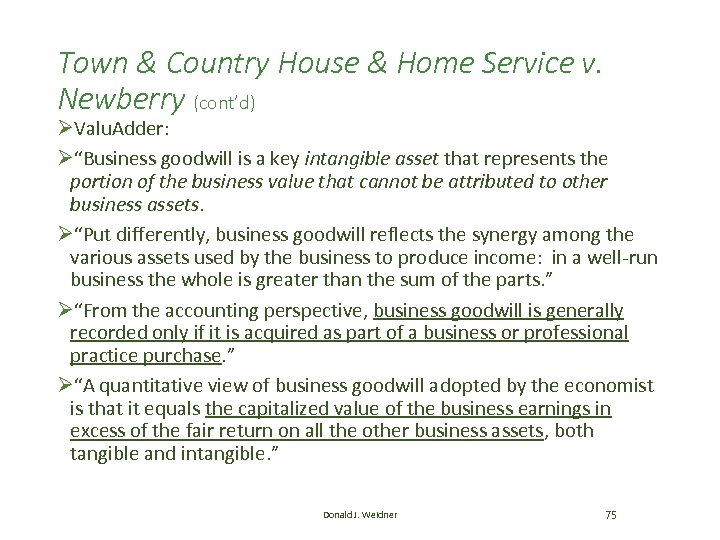
Town & Country House & Home Service v. Newberry (cont’d) ØValu. Adder: Ø“Business goodwill is a key intangible asset that represents the portion of the business value that cannot be attributed to other business assets. Ø“Put differently, business goodwill reflects the synergy among the various assets used by the business to produce income: in a well-run business the whole is greater than the sum of the parts. ” Ø“From the accounting perspective, business goodwill is generally recorded only if it is acquired as part of a business or professional practice purchase. ” Ø“A quantitative view of business goodwill adopted by the economist is that it equals the capitalized value of the business earnings in excess of the fair return on all the other business assets, both tangible and intangible. ” Donald J. Weidner 75
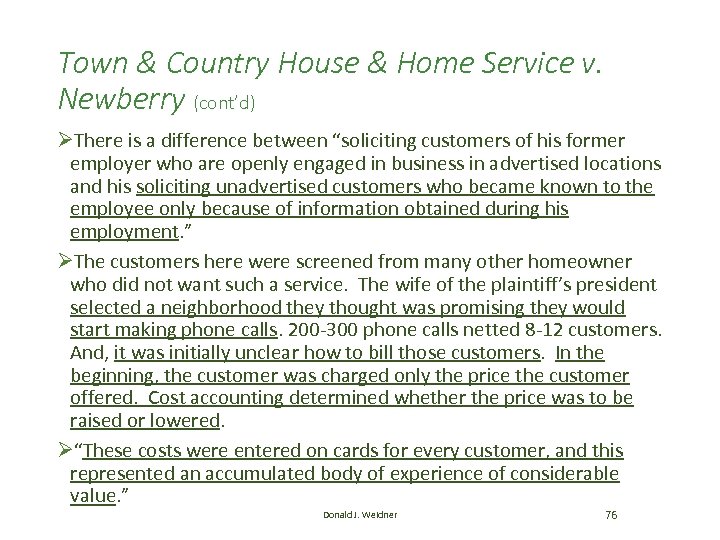
Town & Country House & Home Service v. Newberry (cont’d) ØThere is a difference between “soliciting customers of his former employer who are openly engaged in business in advertised locations and his soliciting unadvertised customers who became known to the employee only because of information obtained during his employment. ” ØThe customers here were screened from many other homeowner who did not want such a service. The wife of the plaintiff’s president selected a neighborhood they thought was promising they would start making phone calls. 200 -300 phone calls netted 8 -12 customers. And, it was initially unclear how to bill those customers. In the beginning, the customer was charged only the price the customer offered. Cost accounting determined whether the price was to be raised or lowered. Ø“These costs were entered on cards for every customer, and this represented an accumulated body of experience of considerable value. ” Donald J. Weidner 76
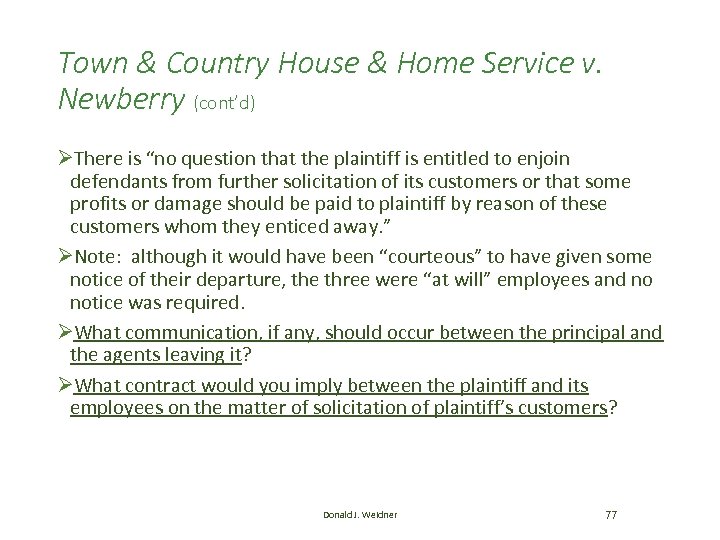
Town & Country House & Home Service v. Newberry (cont’d) ØThere is “no question that the plaintiff is entitled to enjoin defendants from further solicitation of its customers or that some profits or damage should be paid to plaintiff by reason of these customers whom they enticed away. ” ØNote: although it would have been “courteous” to have given some notice of their departure, the three were “at will” employees and no notice was required. ØWhat communication, if any, should occur between the principal and the agents leaving it? ØWhat contract would you imply between the plaintiff and its employees on the matter of solicitation of plaintiff’s customers? Donald J. Weidner 77
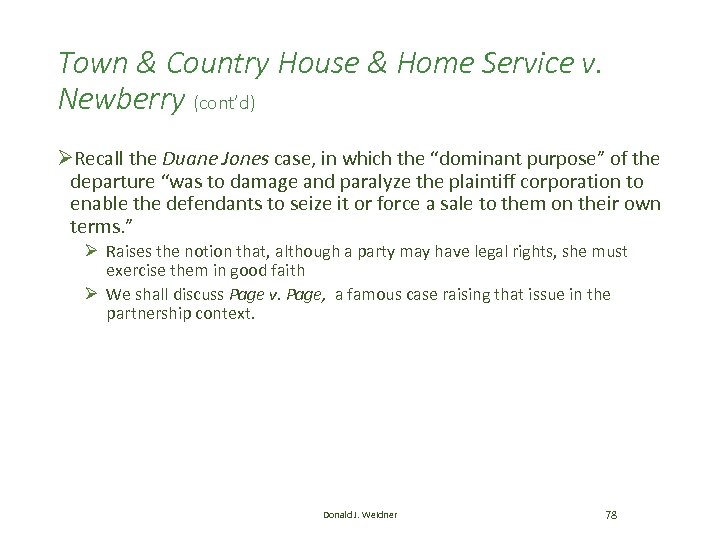
Town & Country House & Home Service v. Newberry (cont’d) ØRecall the Duane Jones case, in which the “dominant purpose” of the departure “was to damage and paralyze the plaintiff corporation to enable the defendants to seize it or force a sale to them on their own terms. ” Ø Raises the notion that, although a party may have legal rights, she must exercise them in good faith Ø We shall discuss Page v. Page, a famous case raising that issue in the partnership context. Donald J. Weidner 78
Agency Law—Going Beyond Preparation to Compete ØIn Wells Fargo Ins. Services USA, Inc. v. Tyndell, 2016 WL 7191692 (E. D. Wash. 2016), five employees left WFIS, an insurance brokerage firm with offices around the country. Prior to their departure, they formed an LLC to run a competing brokerage firm. Within two weeks of their departure, 200 Wells clients had submitted “Broker of Record” notices to Wells that they were moving their business to the LLC. 98% of the “client roster” of the LLC consisted of former Wells clients. ØIn discussing whether a mandatory preliminary injunction was appropriate, the court said that Wells was likely to succeed on the merits of its claim that the departing employees had breached their fiduciary duties. ØThe agent owes fiduciary duties to the employer or principal, and “one of these duties is the duty to act loyally for the principal’s benefit in all matters connected with the agency relationship. ” Donald J. Weidner 79
![Agency Law—Active Solicitation Exceeds Preparation to Compete (cont’d) Ø“This duty [1] prevents a current](https://present5.com/presentation/30c7eca9168a4bb8eb44fb4365e5b0b8/image-80.jpg "Agency Law—Active Solicitation Exceeds Preparation to Compete (cont’d) Ø“This duty [1] prevents a current")
Agency Law—Active Solicitation Exceeds Preparation to Compete (cont’d) Ø“This duty [1] prevents a current employee from competing with the employer. . [2] It also prevents an employee from using the employer’s property, including confidential information, for the employee‘s own purposes. ” ØWells had the burden of showing that each of the defendants crossed the line from “mere preparation” for competition to “active solicitation. ” ØGiven the timing of the client moves to the LLC, and given that virtually all of the LLC’s clients came from Wells, Wells would “likely” meet that burden. Donald J. Weidner 80
Departure of Litigation Associate—Implied Contract or Fiduciary Duties? ØHypo: Associate is hired by Firm, a plaintiff’s personal injury law firm that handles cases on a contingent-fee basis. Firm pays Associate a salary and provides an office, professional staff, marketing for the firm and its lawyers, and pays all costs and expenses associated with client matters. Firm decides to accept a case that it deems to have a significant chance of a modest recovery. Firm assigns the case to Associate, a complaint is filed and discovery begins. During the course of discovery, facts are unearthed that make both the likelihood of recovery and the magnitude of recovery seem much greater. Associate resigns, sets up his own firm, and the client follows. ØIs Firm entitled to the contingent fee? Ø Or, is the firm only entitled to quantum meruit for the work done while the client was still at Firm. Donald J. Weidner 81
Litigation Associates—An Implied Contract Approach ØHaynes v. Dalton, 848 S. W. 2 d 664 (Tenn. Ct. App. 1992). Senior orally agreed to provide office space and overhead to Associate in exchange for 40% of Associate’s fees. Senior also provided support staff, insurance, CLE reimbursement and some payments of professional fees. Four years later, Associate left Senior’s office, taking his pending cases. They had no termination agreement. ØSenior sued for an accounting for the fees on the cases initiated while Associate was in Senior’s office. Senior contended he was entitled to 40% of the fees without regard to when the work was done. Associate said he was entitled to all the fees after he left, especially since there was no agreement to the contrary. ØCourt: “Theories of implied contract are designed precisely for situations in which there is no express agreement. ” Id. at 665. Donald J. Weidner 82
![Litigation Associates—An Implied Contract Approach (cont’d) Ø“To allow [Associate] to benefit from [Senior’s] overhead](https://present5.com/presentation/30c7eca9168a4bb8eb44fb4365e5b0b8/image-83.jpg "Litigation Associates—An Implied Contract Approach (cont’d) Ø“To allow [Associate] to benefit from [Senior’s] overhead")
Litigation Associates—An Implied Contract Approach (cont’d) Ø“To allow [Associate] to benefit from [Senior’s] overhead and receive all fees without reimbursement to [Senior] a percentage of such fees would unjustly enrich [Associate] and violate the parties’ oral agreement. ” ØThe court adopted a formula that used “a fraction to calculate the actual time [Senior’s] overhead contributed to the resolution of any one case. ” Ø Originally based on an approach Associate had urged below to calculate recovery for the Senior based on quantum meruit ØThe numerator was the number of months the file was in Senior’s office and the denominator was the total number of months the file existed. ØSenior recovered that fraction multiplied by 40% of the ultimate fee. ØNo mention of agency law or the fiduciary duties of associates. Ø What would those fiduciary duties require? Donald J. Weidner 83
Recap of Agent’s Fiduciary Duties ØRecall the Restatement (Third) taxonomy of fiduciary duties. ØOverarching Principle: Act Loyally to the Principal 1. No material benefit from a third party 2. No acting as or on behalf of an adverse party 3. No competing while you are an agent 4. No use of Principal’s property or confidential information Ø How would Home Service apply to this situation? Ø In the law firm context, ethical considerations loom large. Donald J. Weidner 84
Ethical Considerations: Client’s Right to Counsel of Choice ØFlorida Rule 4 -5. 8(b) provides: “Clients have the right to expect that they may choose counsel when legal services are required and, with few exceptions, nothing that lawyers and law firms do shall have any effect on the exercise of that right. ” ØRule 4 -5. 6(a) prohibits an agreement “that restricts the rights of lawyers to practice after termination of the relationship, except an agreement concerning benefits upon retirement. ” ØThe Comment explains: “An agreement restricting the right of lawyers to practice after leaving a firm not only limits their professional autonomy, but also limits the freedom of clients to choose a lawyer. ” (emphasis added) 85 Donald J. Weidner
Ethical Considerations: Client’s Right to Counsel of Choice (cont’d) ØRule 4 -5. 6 is not a per se prohibition against severance agreements, which may contain “reasonable and fair compensation provisions designed to avoid disputes requiring time-consuming quantum meruit analysis. ” Ø“Severance agreements, on the other hand, that contain punitive clauses, the effect of which are to restrict competition or encroach upon a client’s inherent right to select counsel, are prohibited. ” 86 Donald J. Weidner
Use of Confidential Information—Adler, Barish ØAdler, Barish, Daniels, Levin & Creskoff v. Epstein, 393 A. 2 d 1175 (Pa. 1978), affirmed an injunction against a group of salaried associates who left a firm and started their own firm. ØWhile still working for their employer firm, they took several steps toward starting their new firm. They: Ø Retained counsel Ø Signed a lease of office space Ø Obtained a $150, 000 line of credit, offering as security a list of 85 firm cases on which they had been working, and their legal fees, exceeding $500, 000 Ø Made numerous contacts with clients ØThey subsequently called and wrote clients and sent them forms to discharge the old firm and retain the new firm. ØCourt said the solicitations violated the Code of Professional Responsibility in effect at the time, which barred a lawyer’s self recommendation “to a non-lawyer who has not sought his advice regarding employment of a lawyer. ” Code of Prof. Resp. , DR 2103(A)(1974). Donald J. Weidner 87
Confidential Information—Adler, Barish (cont’d) ØIn particular, the package sent to the clients, including the selfaddressed stamped envelopes, provided the associates “a means of benefitting from a client’s immediate, perhaps ill-considered, response to the circumstances. ” ØUnder the circumstances of this case, the interests of informed client choice cut against the competing associates: Ø The associates “were actively attempting to induce the clients to change law firms in the middle of their active cases. [The associates’] concern for their new line of credit and the success of their new law firm gave them an immediate, personally created financial interest in the client’s decisions. In this atmosphere, [the associates’] contacts posed too great a risk that clients would not have the opportunity to make a careful, informed decision. ” Id. at 428. ØA departure from recognized ethical codes is significant in determining whether the conduct was proper under the Restatement (Second) of Torts on interference with contractual relations. Donald J. Weidner 88
Use of Confidential Information—Adler Barish(cont’d) ØThe behavior adversely affected the “informed and reliable decisionmaking” of the clients and hurt the former firm. ØIt is no defense that agents can compete with the former principal after termination. The right of the associates “to pursue their own business interests” after termination “is not absolute. ” Ø “[Unless] otherwise agreed, after the termination of the agency, the agent. . . has a duty to the principal not to take advantage of a still subsisting confidential relation created during the prior agency relation. ” Restatement (Second) of Agency § 396(d) (1958). ØThe associates’ “contacts were possible because [their former firm] trusted [the associates] with the high responsibility of developing its clients’ cases. From this position of trust and responsibility, [the associates] were able to gain knowledge of the details, and status, of each case to which [they] had been assigned. ” Ø“In the atmosphere surrounding [their] departure, [their client] contacts unduly suggested a course of action for [the firm’s] clients and unfairly prejudiced [the firm]. No public interest is served in condoning use of confidential information which has these effects. Clients too easily may suffer in the end. ” Donald J. Weidner 89
Trade Secrets Ø Fred Siegel Co. , L. P. A. v. Arter & Hadden, 707 N. E. 2 d 853 (Ohio 1998): departing associate may have taken trade secrets. Ø Uniform Trade Secrets Act (with 1985 Amendments) § 1(4) provides: Ø (4) “Trade secret” means information, including a formula, pattern, compilation, program, device, method, technique, or process, that: (i) derives independent economic value, actual or potential, from not being generally known to, and not being readily ascertainable by proper means by, other persons who can obtain economic value from its disclosure or use, and (ii) is the subject of efforts that are reasonable under the circumstances to maintain its secrecy. Donald J. Weidner 90
Trade Secrets (cont’d) ØFred Siegel states that whether a law firm’s particular knowledge or process is a trade secret is a question for the trier of fact. Ø “Where information is alleged to be a trade secret, a factfinder may consider, e. g. , the amount of effort or money expended in obtaining and developing the information, as well as the amount of time and expense it would take for others to acquire and duplicate the information. The Siegel client list was sixty-three pages in length and included the names of property owners, contact persons, addresses, and telephone numbers of hundreds of clients. The extensive accumulation of property owner names, contacts, addresses, and phone numbers contained in the Siegel client list may well be shown at trial to represent the investment of Siegel time and effort over a long period. ” Id. at 862 -63 (citations omitted). Ø A strong dissent said that, because of the ethical rules protecting client choice, “the mere listing of clients’ names cannot confer trade secret protection. * * * Useful information formatted into an attorney’s or law firm’s client list, however, may be protectable as a trade secret. ” Donald J. Weidner 91
Tortious Interference ØFred Siegal, supra, also said that, although a departing associate and her new firm may compete for clients of the former firm, they must do so fairly or face claims of tortious interference with existing contractual relations. Ø Citing Restatement (Second) of Torts, § 768 (1976), stating that, even if a contract is at will, the person intentionally causing another “not to continue” it must “not employ wrongful means. ” Ø“The evidence is ambiguous as to whether [the departing associate] and [her new firm] used information acquired through improper means in their competitive efforts, e. g. , information protected as trade secrets, or information as to [the former firm’s] fee arrangements with clients that may have been wrongfully disclosed. ” Donald J. Weidner 92
Explicit Contracts with Law Associates: Ethical Considerations of Lawyer Autonomy and Client Choice ØMiller v. Jacobs & Goodman, P. A. , 699 So. 2 d 729 (Fla. 5 th DCA 1997): plaintiff’s personal injury firm represented clients on a contingent fee basis. Associates agreed not to solicit firm clients. They also agreed that, if they leave with a client, the firm is to receive 75% of the fees earned. ØDeparting associates took 100 cases and claimed that the provision was invalid because it placed an economic burden on the client’s right to choose: associates might decline representation because of lower compensation. ØCourt sounded as if it disagreed: “Florida courts are uniform in enforcing such fee splitting arrangements between lawyers and law firms. ” ØSaying further: The Florida Rules “may not be used to invalidate or render void fee splitting agreements. ” 93 Donald J. Weidner
Explicit Contracts with Law Associates: Ethical Considerations of Lawyer Autonomy and Client Choice (cont’d) Ø“We reject [the] argument that such agreements are unenforceable as against public policy because they place an undue economic burden on a client’s freedom to choose representation. ” Ø Ethics Opinion 93 -4 suggests the opposite in a 50/50 split of “any fees. ” Not mentioned: hourly fees were at issue. ØBut the court held: “In the instant parties’ employment agreement, however, we find the liquidation clause to be unenforceable and invalid due to its failure to adequately measure damages. ” Ø“Because the stipulated formula was not an agreed-upon sole remedy and [the firm] was free to pursue additional remedies, the provision cannot be upheld as a valid liquidated damages clause. ” 94 Donald J. Weidner
Explicit Contracts with Law Associates: Ethical Considerations of Lawyer Autonomy and Client Choice (cont’d) ØUnclear how court would treat a split of hourly fees or a split not as damages for breach of a covenant not to solicit clients. ØOn remand, Firm received approximately 46% of the fees. Affirmed Miller v. Jacobs & Goodman, P. A. , 820 So. 2 d 438 (5 th DCA 2002). ØNeither 5 th DCA opinion discussed whether the no solicitation provision was itself unenforceable or sanctionable. ØCompare In re Hanley, 19 N. E. 3 d 756 (IN 2014), in which an attorney included in his employment agreement a noncompete clause that associates could not practice Social Security disability law for two years after leaving firm. Attorney was sanctioned for the provision even though he did not attempt to enforce it. 95 Donald J. Weidner
Скачать презентацию Closely Held Businesses Spring 2018 Law 6062 Section
30c7eca9168a4bb8eb44fb4365e5b0b8.ppt