 Скачать презентацию Closed Eco — Systems CES BIOS 1
40c07a168dc4755e37f6a8f3fc38101a.ppt
- Количество слайдов: 19



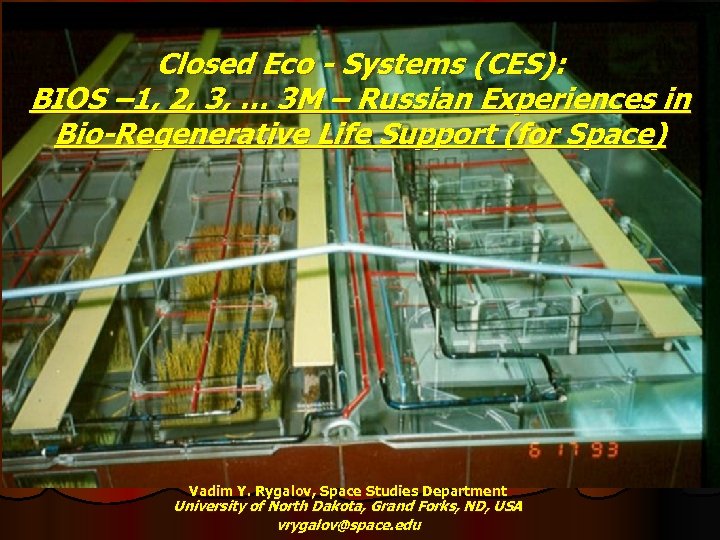
Closed Eco - Systems (CES): BIOS – 1, 2, 3, … 3 M – Russian Experiences in Bio-Regenerative Life Support (for Space) Vadim Y. Rygalov, Space Studies Department University of North Dakota, Grand Forks, ND, USA vrygalov@space. edu
Agenda BIOS-3 M LS system: Russian CES tests Human Subjects and Plant ‘Conveyors’ Brief historic outline LS functions (inside vs. outside of the system) Air, water, food… (general outline) Technical-Engineering Ecological Human Factors (HF) Biological components of LSS Physical-Chemical components of LSS Major Life Support (LS) cycles in the BIOS-3 Categories of Instabilities in Bio-Regenerative LS and Countermeasures ? ? ?
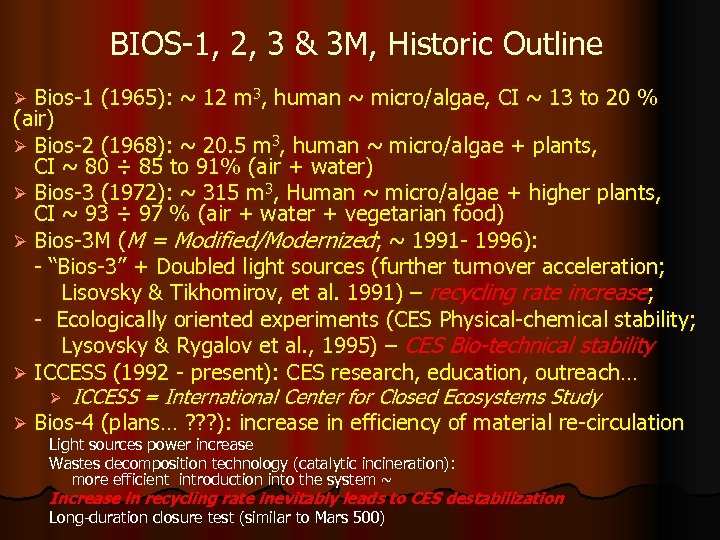
BIOS-1, 2, 3 & 3 M, Historic Outline Bios-1 (1965): ~ 12 m 3, human ~ micro/algae, CI ~ 13 to 20 % (air) Ø Bios-2 (1968): ~ 20. 5 m 3, human ~ micro/algae + plants, CI ~ 80 ÷ 85 to 91% (air + water) Ø Bios-3 (1972): ~ 315 m 3, Human ~ micro/algae + higher plants, CI ~ 93 ÷ 97 % (air + water + vegetarian food) Ø Bios-3 M (M = Modified/Modernized; ~ 1991 - 1996): - “Bios-3” + Doubled light sources (further turnover acceleration; Lisovsky & Tikhomirov, et al. 1991) – recycling rate increase; - Ecologically oriented experiments (CES Physical-chemical stability; Lysovsky & Rygalov et al. , 1995) – CES Bio-technical stability Ø ICCESS (1992 - present): CES research, education, outreach… Ø ICCESS = International Center for Closed Ecosystems Study Ø Bios-4 (plans… ? ? ? ): increase in efficiency of material re-circulation Ø Light sources power increase Wastes decomposition technology (catalytic incineration): more efficient introduction into the system ~ Increase in recycling rate inevitably leads to CES destabilization Long-duration closure test (similar to Mars 500)
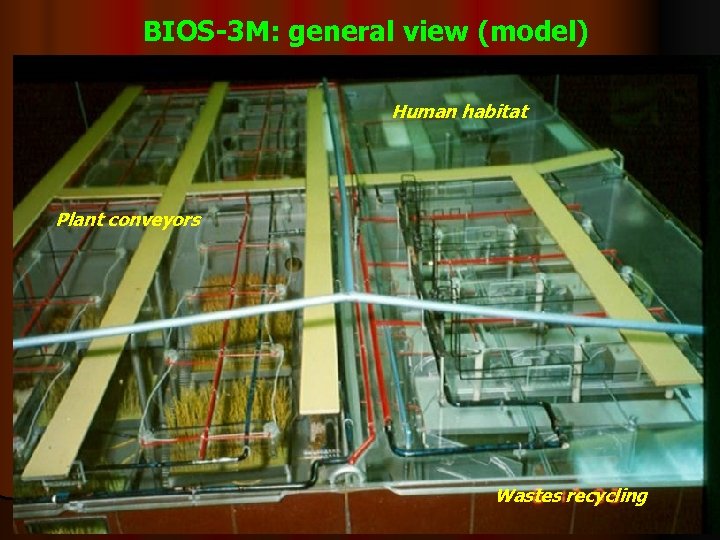
BIOS-3 M: general view (model) Human habitat Plant conveyors Wastes recycling
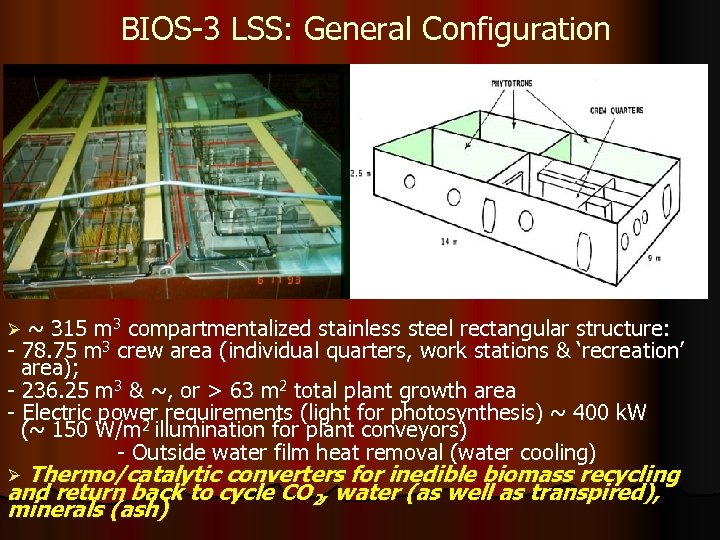
BIOS-3 LSS: General Configuration ~ 315 m 3 compartmentalized stainless steel rectangular structure: - 78. 75 m 3 crew area (individual quarters, work stations & ‘recreation’ area); - 236. 25 m 3 & ~, or > 63 m 2 total plant growth area - Electric power requirements (light for photosynthesis) ~ 400 k. W (~ 150 W/m 2 illumination for plant conveyors) - Outside water film heat removal (water cooling) Ø Thermo/catalytic converters for inedible biomass recycling and return back to cycle CO 2, water (as well as transpired), minerals (ash) Ø
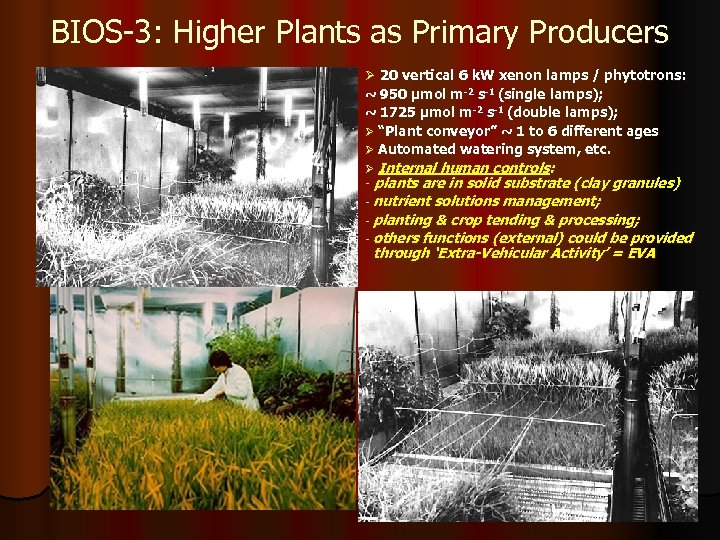
BIOS-3: Higher Plants as Primary Producers Ø 20 vertical 6 k. W xenon lamps / phytotrons: ~ 950 μmol m-2 s-1 (single lamps); ~ 1725 μmol m-2 s-1 (double lamps); Ø “Plant conveyor” ~ 1 to 6 different ages Ø Automated watering system, etc. Ø Internal human controls: - plants are in solid substrate (clay granules) nutrient solutions management; - planting & crop tending & processing; - others functions (external) could be provided through ‘Extra-Vehicular Activity’ = EVA -
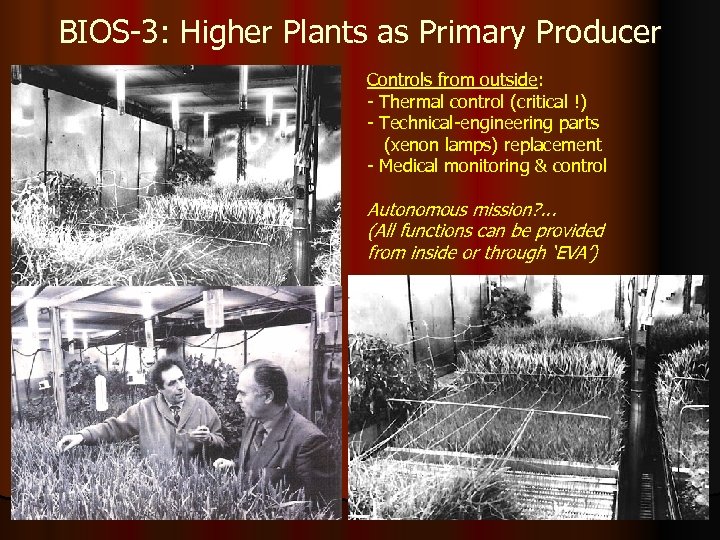
BIOS-3: Higher Plants as Primary Producer Controls from outside: - Thermal control (critical !) - Technical-engineering parts (xenon lamps) replacement - Medical monitoring & control Autonomous mission? . . . (All functions can be provided from inside or through ‘EVA’)
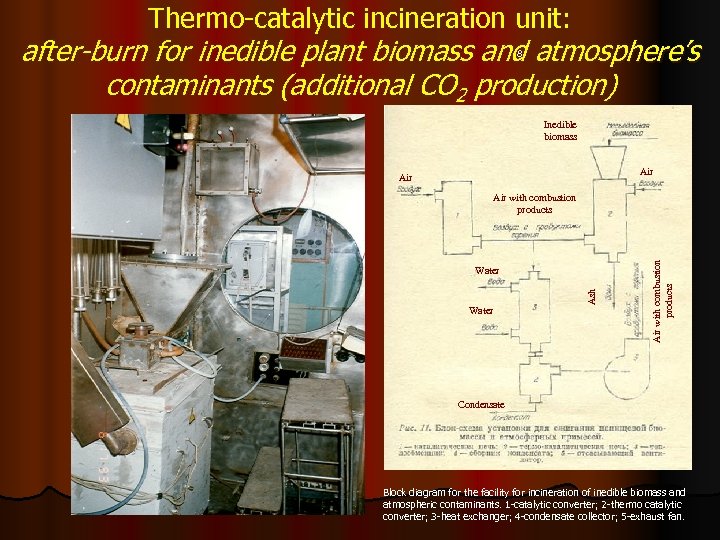
Thermo-catalytic incineration unit: after-burn for inedible plant biomass and atmosphere’s contaminants (additional CO 2 production) 8 Inedible biomass Air Ash Water Air with combustion products Condensate Block diagram for the facility for incineration of inedible biomass and atmospheric contaminants. 1 -catalytic converter; 2 -thermo catalytic converter; 3 -heat exchanger; 4 -condensate collector; 5 -exhaust fan.
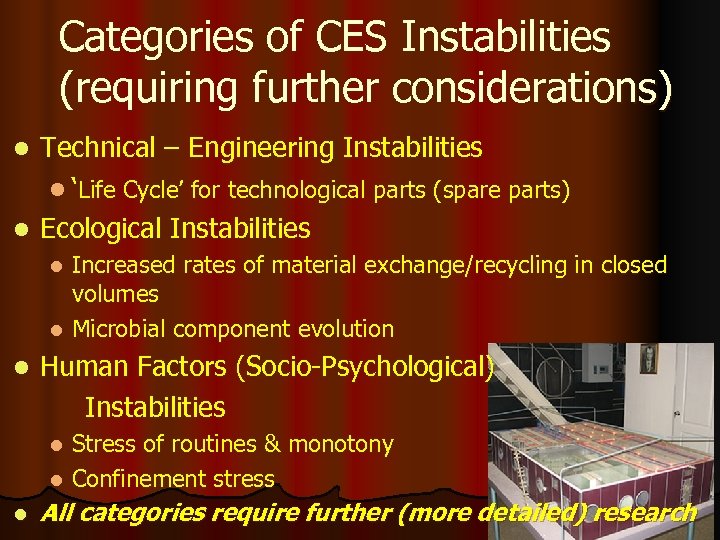
Categories of CES Instabilities (requiring further considerations) Technical – Engineering Instabilities l ‘Life Cycle’ for technological parts (spare parts) l Ecological Instabilities l Increased rates of material exchange/recycling in closed volumes l Microbial component evolution l l Human Factors (Socio-Psychological) Instabilities Stress of routines & monotony l Confinement stress l l All categories require further (more detailed) research
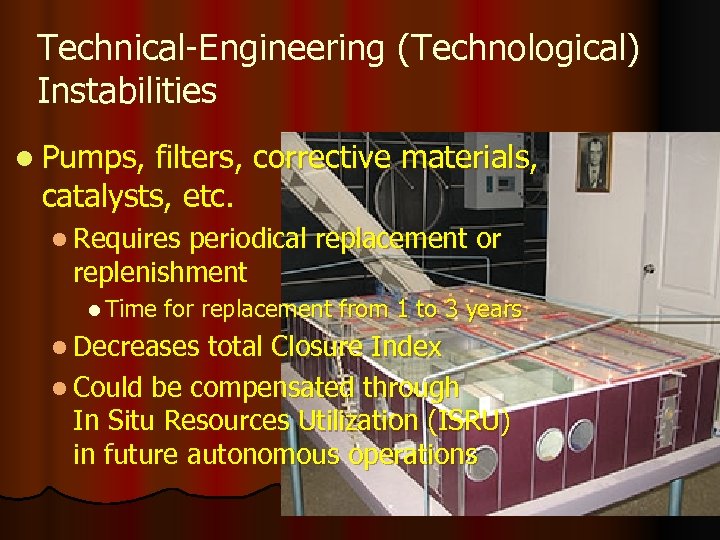
Technical-Engineering (Technological) Instabilities l Pumps, filters, corrective materials, catalysts, etc. l Requires periodical replacement or replenishment l Time for replacement from 1 to 3 years l Decreases total Closure Index l Could be compensated through In Situ Resources Utilization (ISRU) in future autonomous operations
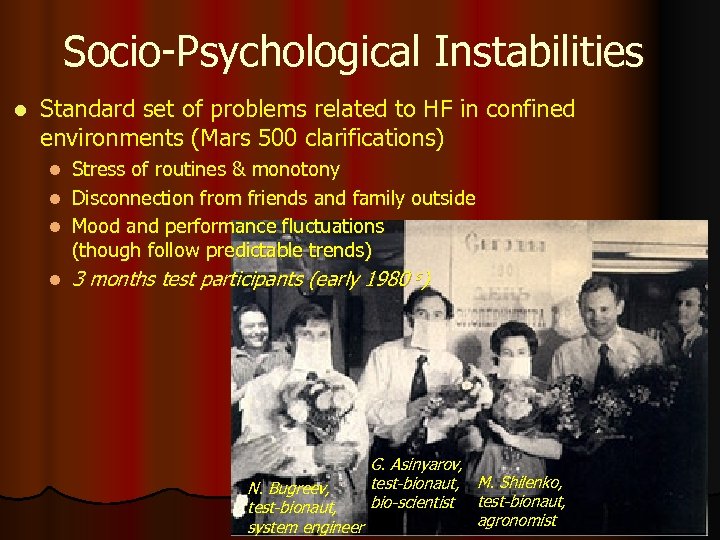
Socio-Psychological Instabilities l Standard set of problems related to HF in confined environments (Mars 500 clarifications) Stress of routines & monotony l Disconnection from friends and family outside l Mood and performance fluctuations (though follow predictable trends) l l 3 months test participants (early 1980 s) G. Asinyarov, test-bionaut, M. Shilenko, N. Bugreev, bio-scientist test-bionaut, agronomist system engineer
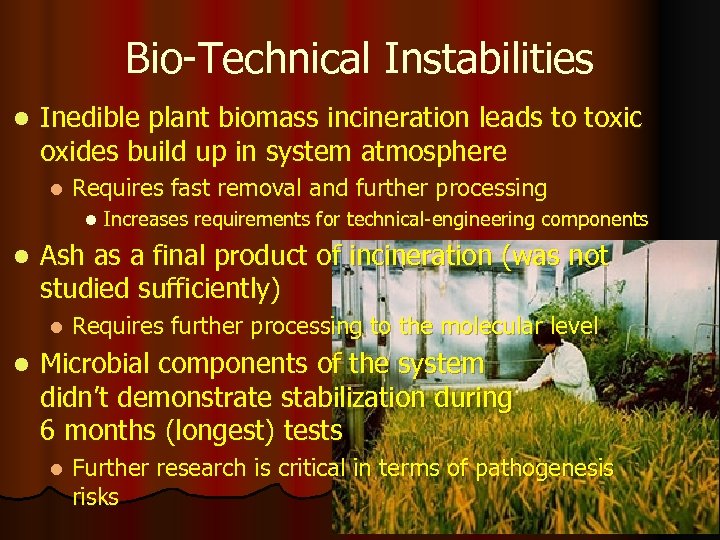
Bio-Technical Instabilities l Inedible plant biomass incineration leads to toxic oxides build up in system atmosphere l Requires fast removal and further processing l l Ash as a final product of incineration (was not studied sufficiently) l l Increases requirements for technical-engineering components Requires further processing to the molecular level Microbial components of the system didn’t demonstrate stabilization during 6 months (longest) tests l Further research is critical in terms of pathogenesis risks
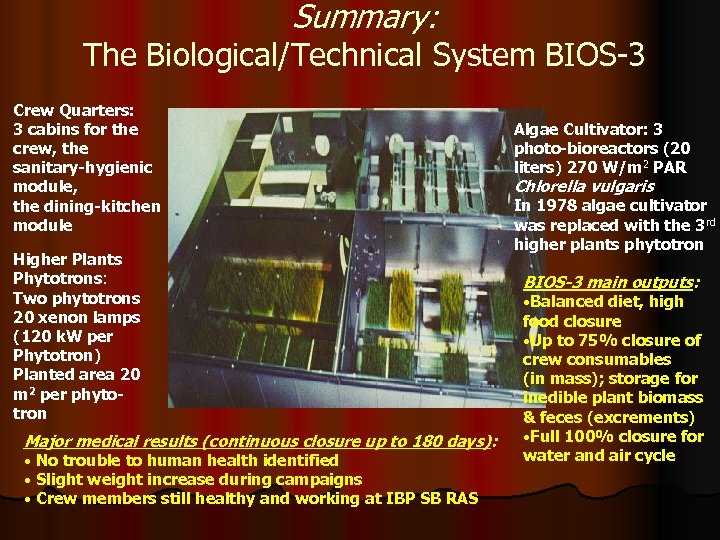
Summary: The Biological/Technical System BIOS-3 Crew Quarters: 3 cabins for the crew, the sanitary-hygienic module, the dining-kitchen module Higher Plants Phytotrons: Two phytotrons 20 xenon lamps (120 k. W per Phytotron) Planted area 20 m 2 per phytotron Major medical results (continuous closure up to 180 days): • No trouble to human health identified • Slight weight increase during campaigns • Crew members still healthy and working at IBP SB RAS Algae Cultivator: 3 photo-bioreactors (20 liters) 270 W/m 2 PAR Chlorella vulgaris In 1978 algae cultivator was replaced with the 3 rd higher plants phytotron BIOS-3 main outputs: • Balanced diet, high food closure • Up to 75% closure of crew consumables (in mass); storage for inedible plant biomass & feces (excrements) • Full 100% closure for water and air cycle
Conclusions (The Status form: BIOS-3 & Analogs Approach) Ø BIOS-3 similar Life Support Systems (LSS) are probably the best for long- term space application up to date (characteristics need to be further confirmed): - Closure Index ~ 93 -97 % (with mineral salts stored in advance); - Autonomy ~ 5 to 7 years (‘human factors’ are major limitation for tests duration); - System manufacturing cost is reasonable (~ $ 350, 000/crew member); - System operational cost < 5 to 7 hours/(Earth day*person); - Positive physiological & psychological effects; - Active Human Control (intervention) is required and sufficient for system’s functional/operational stability; - LSS Reliability (ground based tests) ≥ Regular space mission reliability Additional research is required regarding entire system/space environment interaction (ISS Bio/Regenerative Module) Ø Long-term ground based research for Reduced Resources Bio/Regenerative LSS is required Ø System operation & functioning are performed at the limits of stability; So Human Factor active involvement is crucial Ø
Related Sources (Links) BIOS-3 at the Wikipedia BIOS-3 facility as a part of the BIOSMHARS (BIOcontamination Specific Modelling in HAbitats Related to Space) project Man-Made Closed Ecological Systems (J. I. Gitelson, G. M. Lisovsky and R. D. Mac. Elroy, Taylor and Francis (CRC Press), 2003, ISBN 10: 0415299985 / ISBN 13: 9780415299985, 402 pages) Bios-3: Siberian experiments in bioregenerative life support - Attempts to purify air and grow food for space exploration in a sealed environment began in 1972 (Salisbury F. B. ; Gitelson J. I. ; Lisovsky G. M. , Bio. Science, 1997, 47 (9): 575 -585)
Acknowledgements l UND 16 Space Studies l Institute of Biophysics SB RAS & RAS l NASA KSC Space Life Sciences Lab l Colleagues around the globe
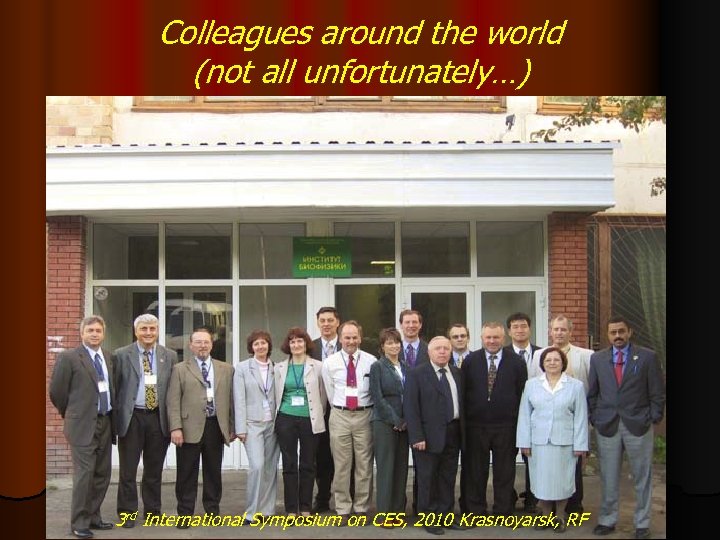
Colleagues around the world (not all unfortunately…) 3 rd International Symposium on CES, 2010 Krasnoyarsk, RF
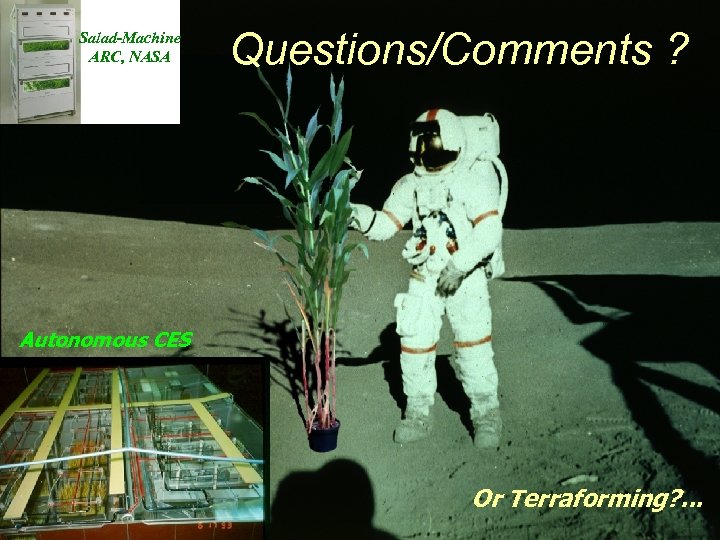
Salad-Machine ARC, NASA Questions/Comments ? Autonomous CES 18 Or Terraforming? . . .
 Скачать презентацию Closed Eco — Systems CES BIOS 1
40c07a168dc4755e37f6a8f3fc38101a.ppt