


 Скачать презентацию Close Critical and Generative Reading Meeting Michigan s Reading
bd3c4458258daf805d9f9962dabaa9c4.ppt
- Количество слайдов: 45
 Close, Critical, and Generative Reading: Meeting Michigan’s Reading Standards Michigan Reading Association March 20, 2016 Dr. Elaine Weber, Macomb MISD Victoria Les, St Clair RESA Susan Codere Kelly, Mission. Literacy. com
 Goals for the Presentation • Revisit the four questions of Close and Critical Reading and how they are supported by the Michigan Reading Standards • The third question, “What does the text mean? ” has been difficult and we have a different way of approaching this question. • Two standards RI 7 and RI 9 fall into the category of Critical Reading but expect two or more texts. These will also be addressed.
 Close and Critical Reading and Michigan Reading Standards Handout Key Ideas and Details 1. Read closely to determine what the text says explicitly and to make logical inferences from it; cite specific textual evidence when writing or speaking to support conclusions drawn from the text. 2. Determine central ideas or themes of a text and analyze their development; summarize the key supporting details and ideas. 3. Analyze how and why individuals, events, and ideas develop and interact over the course of a text. Craft and Structure 4. Interpret words and phrases as they are used in a text, including determining technical, connotative, and figurative meanings, and analyze how specific word choices shape meaning or tone. 5. Analyze the structure of texts, including how specific sentences, paragraphs, and larger portions of the text (e. g. a section, chapter, scene, or stanza) relate to each other and the whole. 6. Assess how point of view or purpose shapes the content and style of a text. Integration of Knowledge and Ideas 7. Integrate and evaluate content presented in diverse media and formats, including visually and quantitatively, as well as in words. 8. Delineate and evaluate the argument and specific claims in a text, including the validity of the reasoning as well as the relevance and sufficiency of the evidence. 9. Analyze how two or more texts address similar themes or topics in order to build knowledge or to compare the approaches the authors take
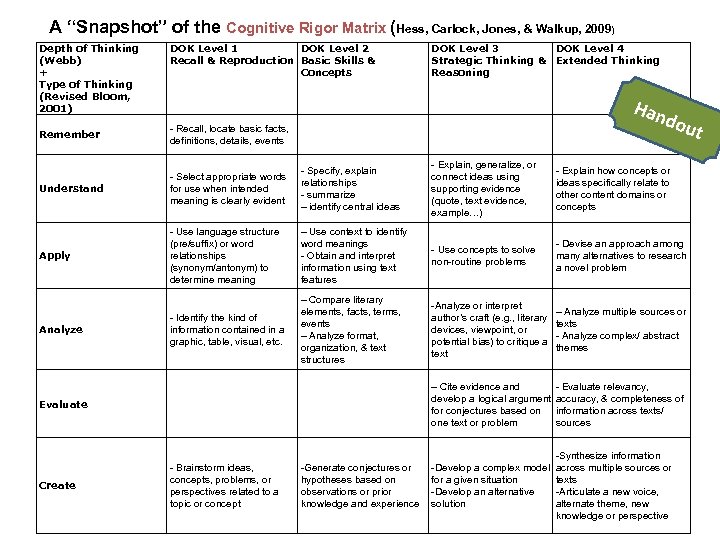 A “Snapshot” of the Cognitive Rigor Matrix (Hess, Carlock, Jones, & Walkup, 2009) Depth of Thinking (Webb) + Type of Thinking (Revised Bloom, 2001) DOK Level 1 DOK Level 2 Recall & Reproduction Basic Skills & Concepts DOK Level 3 DOK Level 4 Strategic Thinking & Extended Thinking Reasoning Han dou Remember - Recall, locate basic facts, definitions, details, events Understand - Select appropriate words for use when intended meaning is clearly evident - Specify, explain relationships - summarize – identify central ideas - Explain, generalize, or connect ideas using supporting evidence (quote, text evidence, example…) - Explain how concepts or ideas specifically relate to other content domains or concepts Apply - Use language structure (pre/suffix) or word relationships (synonym/antonym) to determine meaning – Use context to identify word meanings - Obtain and interpret information using text features - Use concepts to solve non-routine problems - Devise an approach among many alternatives to research a novel problem - Identify the kind of information contained in a graphic, table, visual, etc. – Compare literary elements, facts, terms, events – Analyze format, organization, & text structures -Analyze or interpret author’s craft (e. g. , literary devices, viewpoint, or potential bias) to critique a text – Analyze multiple sources or texts - Analyze complex/ abstract themes Analyze – Cite evidence and - Evaluate relevancy, develop a logical argument accuracy, & completeness of for conjectures based on information across texts/ one text or problem sources Evaluate Create - Brainstorm ideas, concepts, problems, or perspectives related to a topic or concept -Generate conjectures or hypotheses based on observations or prior knowledge and experience -Develop a complex model for a given situation -Develop an alternative solution -Synthesize information across multiple sources or texts -Articulate a new voice, alternate theme, new knowledge or perspective t
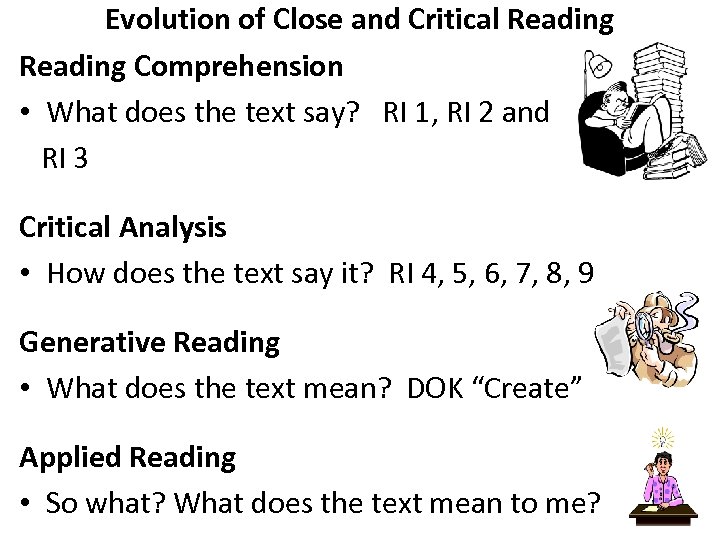 Evolution of Close and Critical Reading Comprehension • What does the text say? RI 1, RI 2 and RI 3 Critical Analysis • How does the text say it? RI 4, 5, 6, 7, 8, 9 Generative Reading • What does the text mean? DOK “Create” Applied Reading • So what? What does the text mean to me?
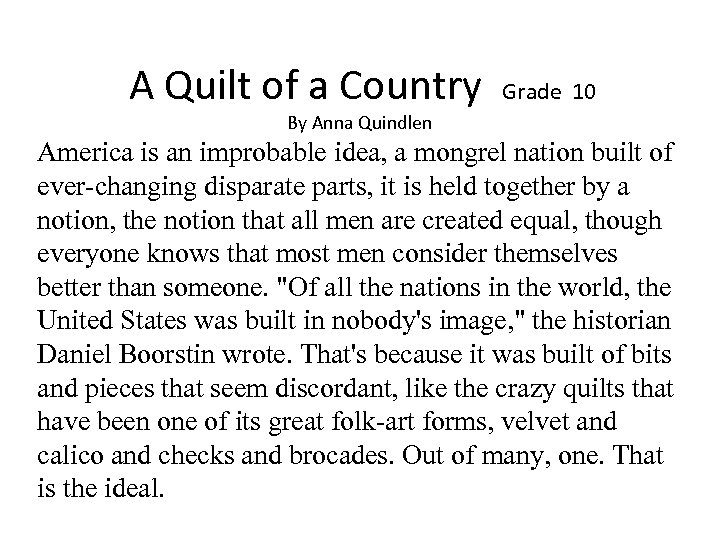 A Quilt of a Country Grade 10 By Anna Quindlen America is an improbable idea, a mongrel nation built of ever-changing disparate parts, it is held together by a notion, the notion that all men are created equal, though everyone knows that most men consider themselves better than someone. "Of all the nations in the world, the United States was built in nobody's image, " the historian Daniel Boorstin wrote. That's because it was built of bits and pieces that seem discordant, like the crazy quilts that have been one of its great folk-art forms, velvet and calico and checks and brocades. Out of many, one. That is the ideal.
 What do you want your students to learn from this text? Comprehend the Text? To answer the question. What does the text say?
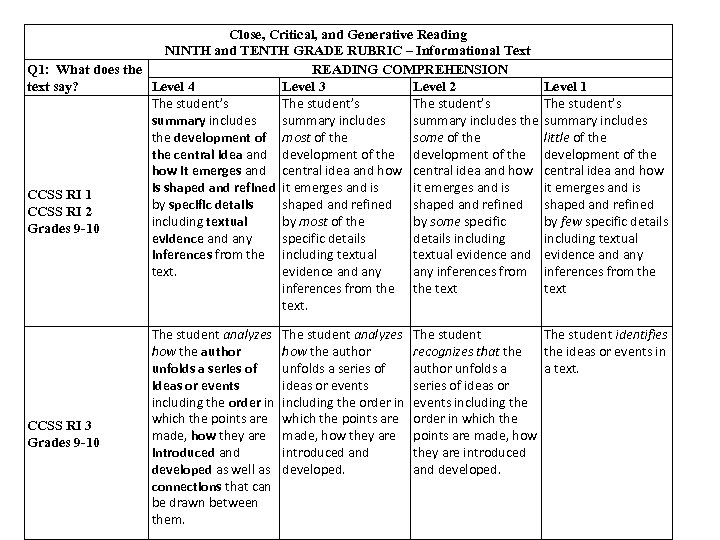 Close, Critical, and Generative Reading NINTH and TENTH GRADE RUBRIC – Informational Text READING COMPREHENSION Q 1: What does the text say? Level 4 Level 3 Level 2 Level 1 The student’s summary includes the development of most of the some of the little of the central idea and development of the how it emerges and central idea and how is shaped and refined it emerges and is CCSS RI 1 by specific details shaped and refined CCSS RI 2 including textual by most of the by some specific by few specific details Grades 9 -10 evidence and any specific details including textual inferences from the including textual evidence and any text. evidence and any inferences from the text. CCSS RI 3 Grades 9 -10 The student analyzes how the author unfolds a series of ideas or events including the order in which the points are made, how they are introduced and developed as well as connections that can be drawn between them. The student analyzes how the author unfolds a series of ideas or events including the order in which the points are made, how they are introduced and developed. The student identifies recognizes that the ideas or events in author unfolds a a text. series of ideas or events including the order in which the points are made, how they are introduced and developed.
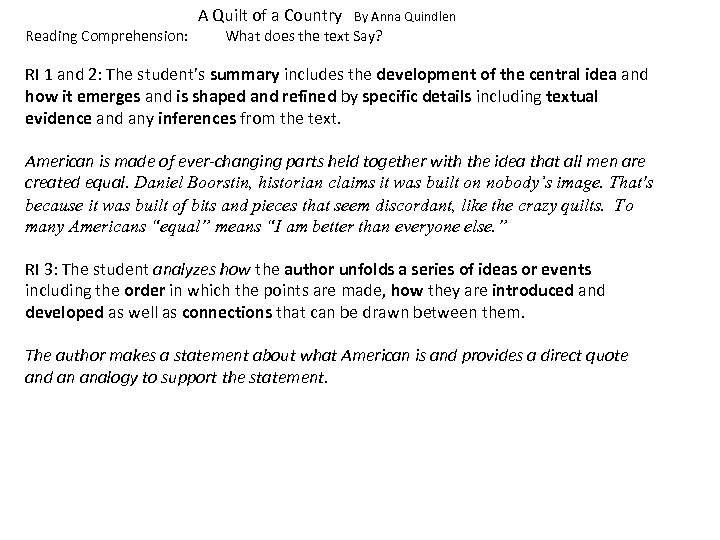 A Quilt of a Country By Anna Quindlen Reading Comprehension: What does the text Say? RI 1 and 2: The student’s summary includes the development of the central idea and how it emerges and is shaped and refined by specific details including textual evidence and any inferences from the text. American is made of ever-changing parts held together with the idea that all men are created equal. Daniel Boorstin, historian claims it was built on nobody’s image. That's because it was built of bits and pieces that seem discordant, like the crazy quilts. To many Americans “equal” means “I am better than everyone else. ” RI 3: The student analyzes how the author unfolds a series of ideas or events including the order in which the points are made, how they are introduced and developed as well as connections that can be drawn between them. The author makes a statement about what American is and provides a direct quote and an analogy to support the statement.
 What do you want your students to learn from this text? How the text says it Critical Reading
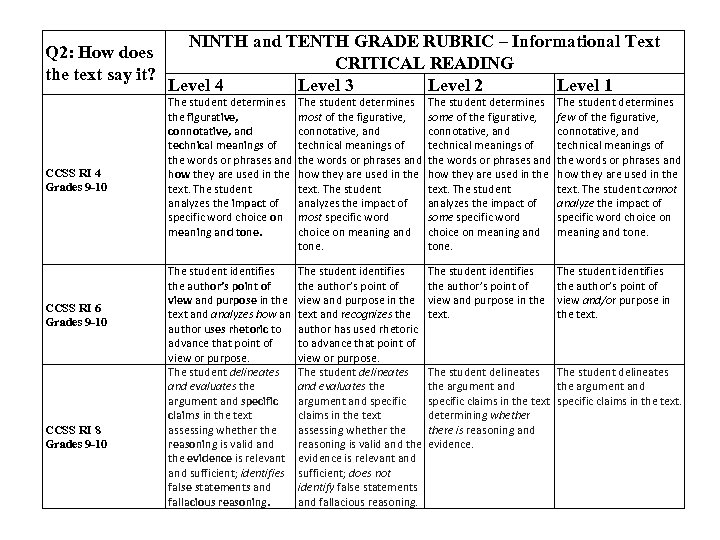 Q 2: How does the text say it? NINTH and TENTH GRADE RUBRIC – Informational Text CRITICAL READING Level 4 Level 3 Level 2 Level 1 CCSS RI 4 Grades 9 -10 The student determines the figurative, most of the figurative, some of the figurative, few of the figurative, connotative, and technical meanings of the words or phrases and how they are used in the text. The student cannot analyzes the impact of analyze the impact of specific word choice on most specific word some specific word choice on meaning and tone. CCSS RI 6 Grades 9 -10 CCSS RI 8 Grades 9 -10 The student identifies the author’s point of view and purpose in the text and analyzes how an author uses rhetoric to advance that point of view or purpose. The student delineates and evaluates the argument and specific claims in the text assessing whether the reasoning is valid and the evidence is relevant and sufficient; identifies false statements and fallacious reasoning. The student identifies the author’s point of view and purpose in the text and recognizes the text. author has used rhetoric to advance that point of view or purpose. The student delineates and evaluates the argument and specific claims in the text determining whether assessing whethere is reasoning and reasoning is valid and the evidence is relevant and sufficient; does not identify false statements and fallacious reasoning. The student identifies the author’s point of view and/or purpose in the text. The student delineates the argument and specific claims in the text.
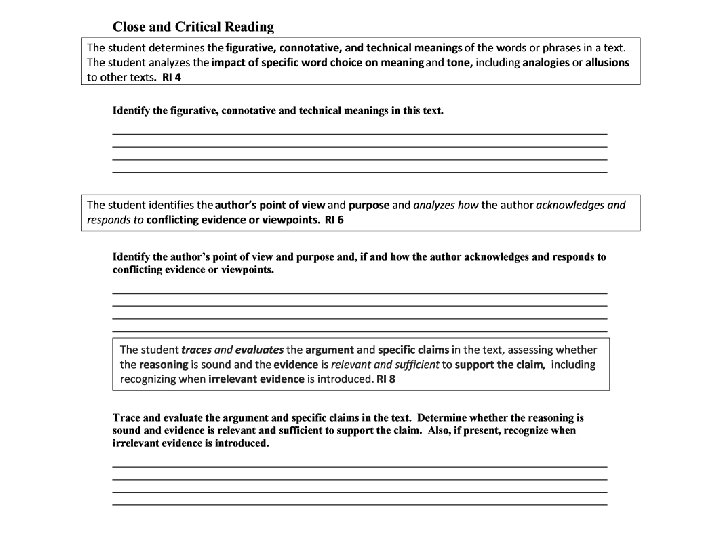
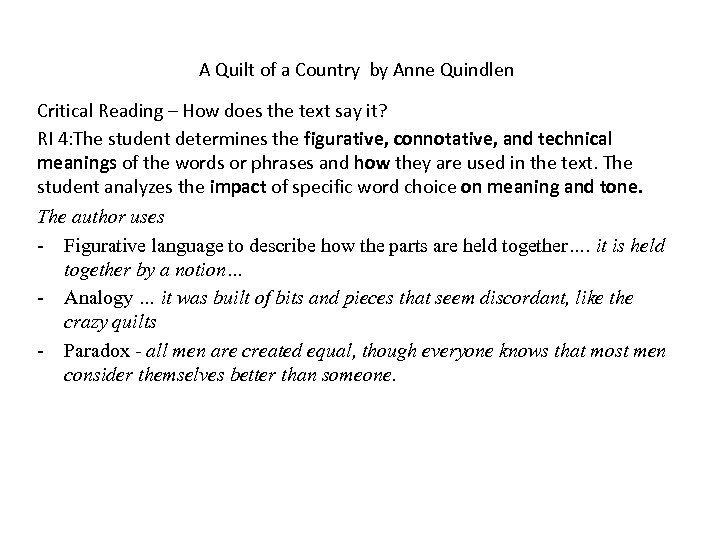 A Quilt of a Country by Anne Quindlen Critical Reading – How does the text say it? RI 4: The student determines the figurative, connotative, and technical meanings of the words or phrases and how they are used in the text. The student analyzes the impact of specific word choice on meaning and tone. The author uses - Figurative language to describe how the parts are held together…. it is held together by a notion… - Analogy … it was built of bits and pieces that seem discordant, like the crazy quilts - Paradox - all men are created equal, though everyone knows that most men consider themselves better than someone.
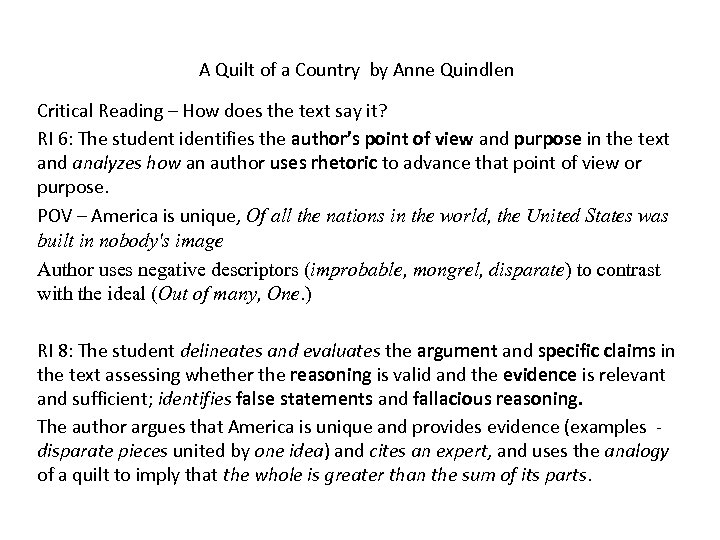 A Quilt of a Country by Anne Quindlen Critical Reading – How does the text say it? RI 6: The student identifies the author’s point of view and purpose in the text and analyzes how an author uses rhetoric to advance that point of view or purpose. POV – America is unique, Of all the nations in the world, the United States was built in nobody's image Author uses negative descriptors (improbable, mongrel, disparate) to contrast with the ideal (Out of many, One. ) RI 8: The student delineates and evaluates the argument and specific claims in the text assessing whether the reasoning is valid and the evidence is relevant and sufficient; identifies false statements and fallacious reasoning. The author argues that America is unique and provides evidence (examples - disparate pieces united by one idea) and cites an expert, and uses the analogy of a quilt to imply that the whole is greater than the sum of its parts.
 What can your students learn from this text? What the text means Generative Reading
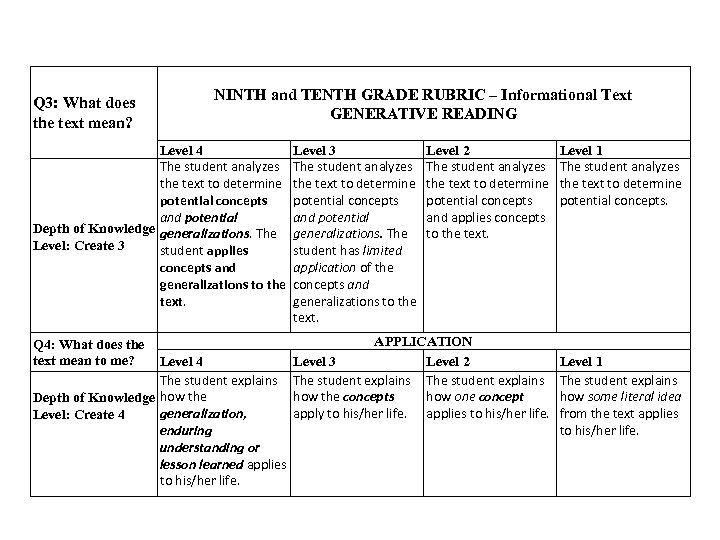 Q 3: What does the text mean? NINTH and TENTH GRADE RUBRIC – Informational Text GENERATIVE READING Level 4 Level 3 The student analyzes the text to determine potential concepts and potential Depth of Knowledge generalizations. The Level: Create 3 student applies student has limited concepts and application of the generalizations to the concepts and text. generalizations to the text. Q 4: What does the text mean to me? Depth of Knowledge Level: Create 4 Level 2 The student analyzes the text to determine potential concepts and applies concepts to the text. APPLICATION Level 4 Level 3 Level 2 The student explains how the concepts how one concept generalization, apply to his/her life. applies to his/her life. enduring understanding or lesson learned applies to his/her life. Level 1 The student analyzes the text to determine potential concepts. Level 1 The student explains how some literal idea from the text applies to his/her life.
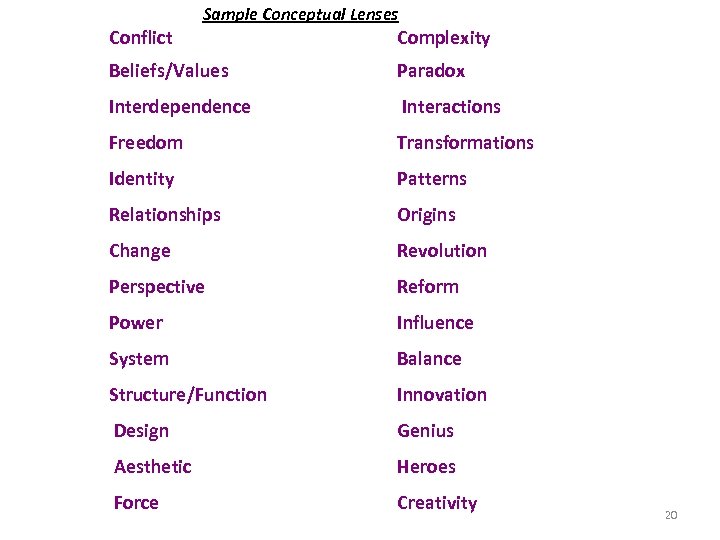
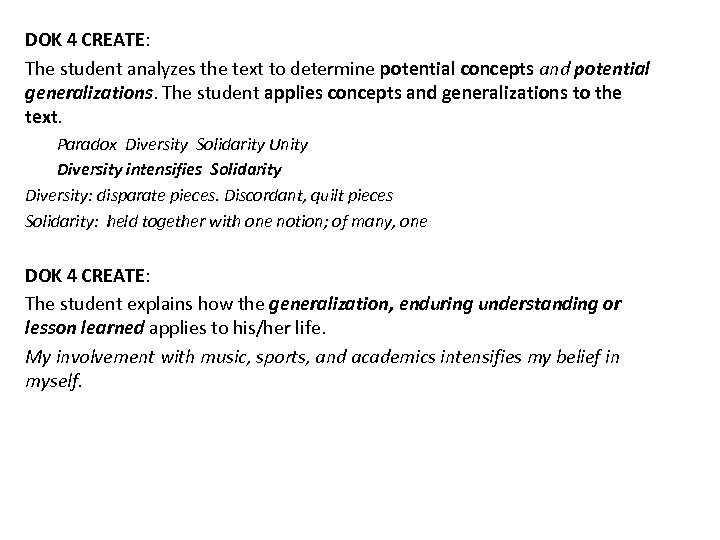
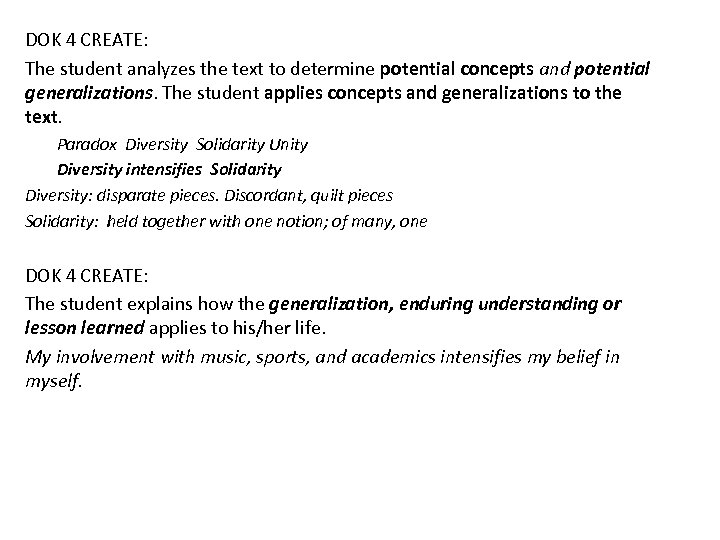 DOK 4 CREATE: The student analyzes the text to determine potential concepts and potential generalizations. The student applies concepts and generalizations to the text. Paradox Diversity Solidarity Unity Diversity intensifies Solidarity Diversity: disparate pieces. Discordant, quilt pieces Solidarity: held together with one notion; of many, one DOK 4 CREATE: The student explains how the generalization, enduring understanding or lesson learned applies to his/her life. My involvement with music, sports, and academics intensifies my belief in myself.
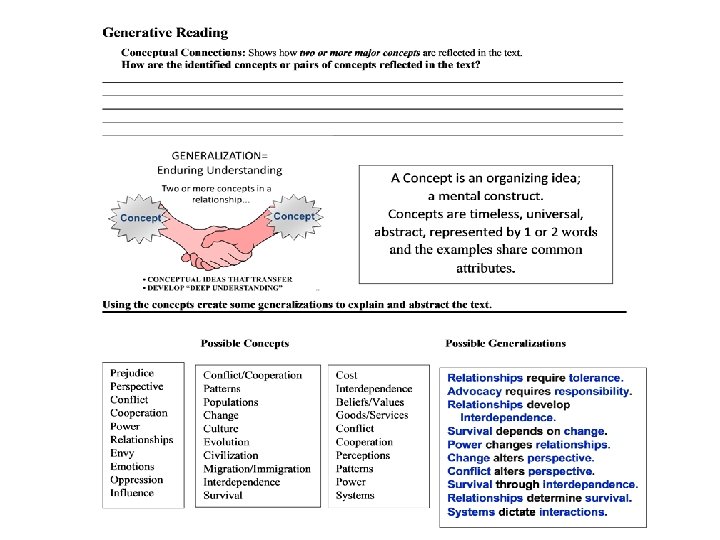
 Concept A concept is an organizing idea; a mental construct. . . • • • Timeless Universal Abstract Represented by 1 or 2 words Examples share common attributes 17
 It is the conceptual mind that… v creates connections to prior experience and finds relevance; v synergistically works with factual level knowledge to develop the intellect; v creates deeper understanding at the factual and conceptual levels; v recognizes the transferablity of knowledge; v creates the motivation for learning. 18
 When we teach to the levels of concepts and enduring understanding we are teaching for deep understanding and the transfer of knowledge. 19
 Conflict Sample Conceptual Lenses Complexity Beliefs/Values Paradox Interdependence Interactions Freedom Transformations Identity Patterns Relationships Origins Change Revolution Perspective Reform Power Influence System Balance Structure/Function Innovation Design Genius Aesthetic Heroes Force Creativity 20
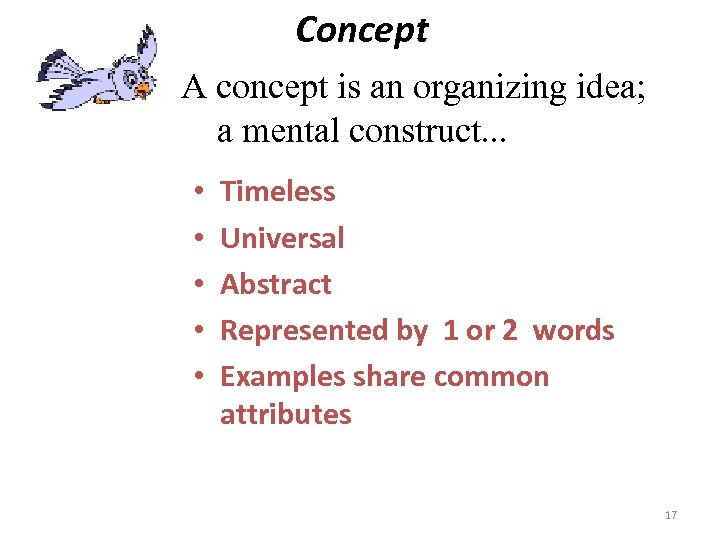
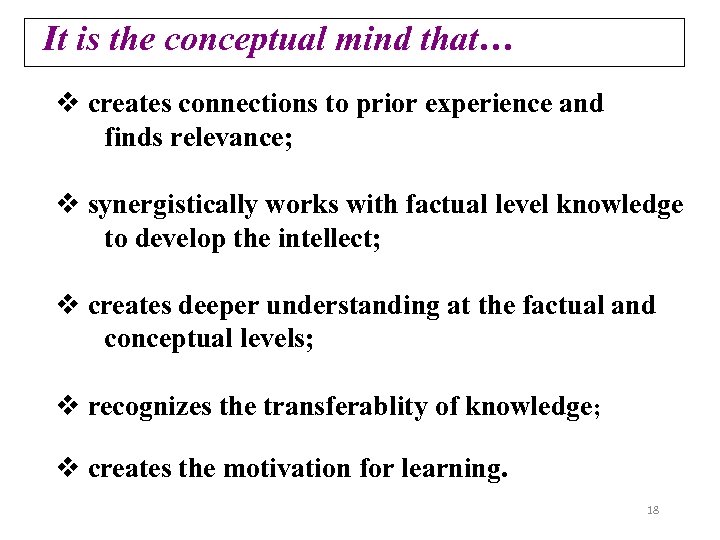
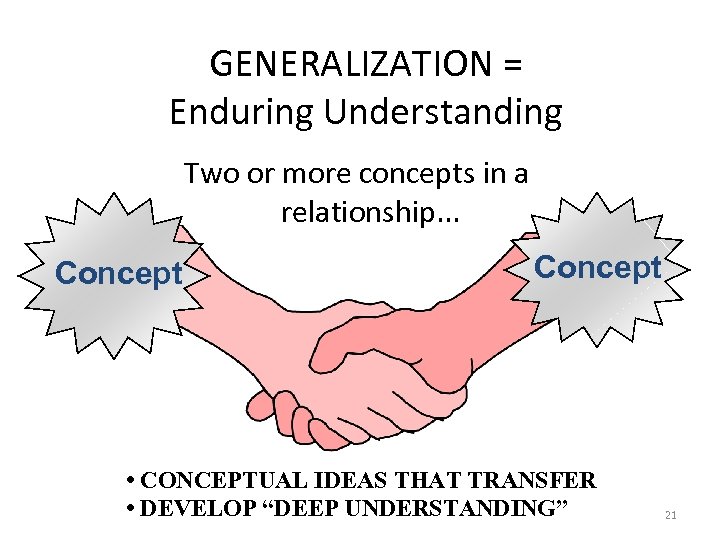 GENERALIZATION = Enduring Understanding Two or more concepts in a relationship. . . Concept • CONCEPTUAL IDEAS THAT TRANSFER • DEVELOP “DEEP UNDERSTANDING” 21
 Enduring Understanding Enduring understanding goes beyond facts and skills to focus on larger concepts, principles, or processes. • Broad and Abstract • Universal in Application • Generally Timeless • Represented by different examples that support the generalization
 • Our nation is built upon a history of immigration, dating back to our first pioneers, the Pilgrims. For more than three centuries, we have welcomed generations of immigrants to our melting pot of hyphenated America: British-Americans; Italian-Americans; Irish. Americans; Jewish-Americans; Mexican. Americans; Chinese-Americans; Indian. Americans. Ami Bera
 http: //www. livescience. com/289 45 -american-culture. html
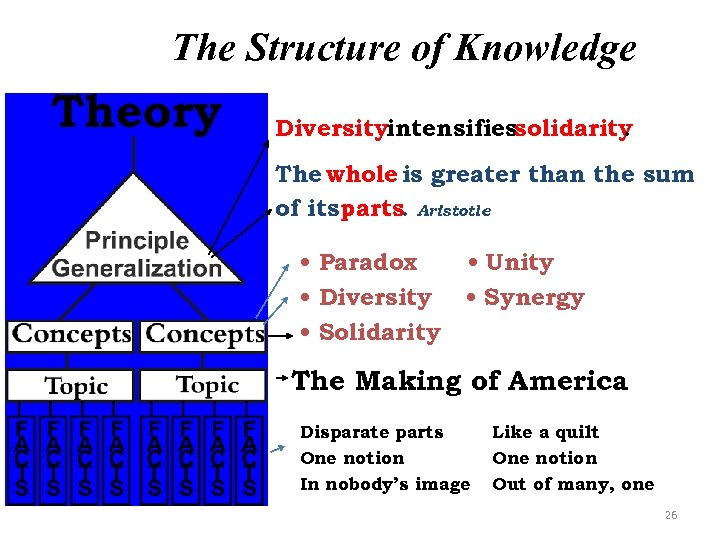 The Structure of Knowledge Diversityintensifiessolidarity. The whole is greater than the sum of its parts. Aristotle • Paradox • Unity • Diversity • Synergy • Solidarity The Making of America Disparate parts One notion In nobody’s image Like a quilt One notion Out of many, one 26
 DOK 4 CREATE: The student analyzes the text to determine potential concepts and potential generalizations. The student applies concepts and generalizations to the text. Paradox Diversity Solidarity Unity Diversity intensifies Solidarity Diversity: disparate pieces. Discordant, quilt pieces Solidarity: held together with one notion; of many, one DOK 4 CREATE: The student explains how the generalization, enduring understanding or lesson learned applies to his/her life. My involvement with music, sports, and academics intensifies my belief in myself.
 Note: These standards need two or more texts! Michigan Reading Standards RI 7 and RI 9 • Integration of Knowledge and Ideas 7. Integrate and evaluate content presented in diverse media and formats, including visually and quantitatively, as well as in words. 9. Analyze how two or more texts address similar themes or topics in order to build knowledge or to compare the approaches the authors take.
 Michigan Reading Standard RI 7 • Integrate (put together) and evaluate (assess or judge) content (information) presented in diverse media and formats, including visually and quantitatively, as well as in words. Cross-text questions What are disparate parts of America? What role does diversity play in American culture?
 M-Step Performance Task (Sample) You’ve been asked to write a persuasive essay for a pro-America blog. Provide evidence that each author proposed the idea that “America is unique. ”
 8 th Grade Rosa Parks Your Turn Rosa Parks was born February 4, 1913 in Tuskegee, Alabama. She spent her childhood in Alabama. When she was 11, she enrolled in the Montgomery Industrial School for Girls. Later, she worked as a seamstress in Montgomery. Rosa Parks has been called the "mother of the civil rights movement" and one of the most important citizens of the 20 th century. In the early 1950 s, the bus system in Montgomery, as in many parts of the United States, was segregated. Blacks were required to board the bus at the front, buy their tickets, and then re-board the bus in the back. Sometimes, they weren’t able to get on the bus again before it drove away. They were not allowed to sit in the front of the bus, which sometimes made it difficult to get off at the right stop. Even if they were sitting in the “black section, ” they were still required to give their seats up to white passengers if the “white section” was full. In December of 1955, Rosa Parks refused to give up her seat on a city bus to a white passenger. The bus driver had her arrested. She was tried and convicted of violating a local ordinance. Her act sparked a citywide boycott of the bus system. This refusal to ride the bus introduced the country to a clergyman named Martin Luther King, Jr. who gained national prominence, leading the protest with the words: “There comes a time that people get tired. ” Eventually, the U. S. Supreme Court made a decision outlawing segregation on city buses. In December 1956, Montgomery’s public transportation system was legally integrated. Over the next four decades, Rosa Parks helped make her fellow Americans aware of the history of the civil rights struggle. This pioneer in the struggle for racial equality earned many honors, including the Martin Luther King Jr. Nonviolent Peace Prize, the Presidential Medal of Freedom, and the Congressional Gold Medal. She is an example of courage and determination and an inspirational symbol to all Americans. She recently died in Detroit, Michigan on October 24, 2005 at age 92.
 CCGR Resources on Mission. Literacy. com Close, Critical and Generative Reading Resources - Dec. 2015 Page Location: Literacy Tools --> Close Critical Reading --> CCR (for CCSS) Examples -->CCGR Dec. 2015 http: //missionliteracy. com/ccgr-resources-dec-2015. html
 Developing Enduring Understandings Harnessing the Power of Conceptual Thinking Pale Blue Dot Carl Sagan Read by Carl Sagan https: //www. youtube. com/watch? v=nl 5 dlb. Ch 8 l. Y Read along with Carl
 Developing Enduring Understandings Pale Blue Dot As you read: • Use 9 -10 CCGR Rubric • Notice language use / word choice • Identify concepts represented in the article • Generate and support possible generalizations
 Generative Reading MS CCGR Rubric – Given the concepts that form the generalization…, find most evidence in text that reflects te concepts. HS CCGR Rubric – The student analyzes the text to determine potential concepts and potential generalizations. The student applies concepts and generalizations to the text.
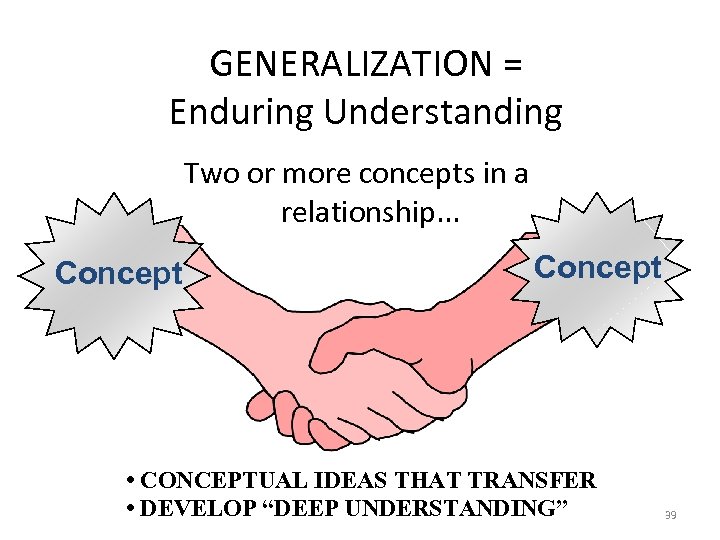 GENERALIZATION = Enduring Understanding Two or more concepts in a relationship. . . Concept • CONCEPTUAL IDEAS THAT TRANSFER • DEVELOP “DEEP UNDERSTANDING” 39
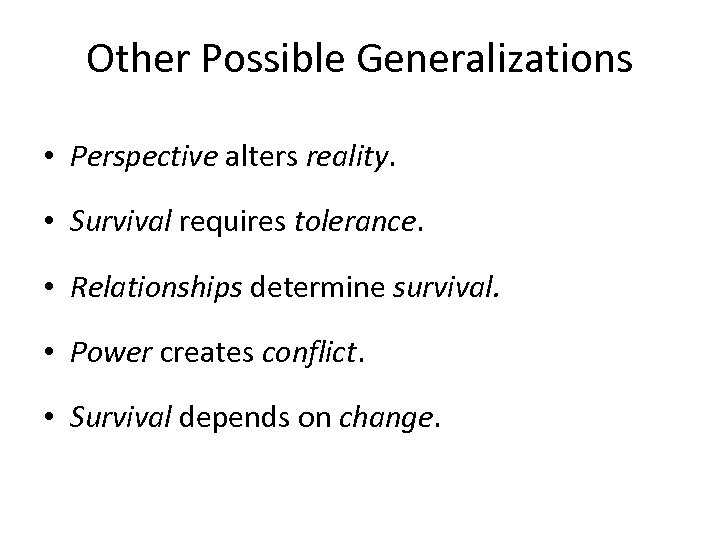
 Developing Generalizations • Identify two or more concepts in text • How are the identified concepts or pairs of concepts reflected in the text? • Generalization: Survival requires civility and preservation. (Literal)
 Other Possible Generalizations • Perspective alters reality. • Survival requires tolerance. • Relationships determine survival. • Power creates conflict. • Survival depends on change.
 SAT Essay Rubric Attribute Rubric Score 4 Rubric Score 3 Rubric Score 2 Rubric Score 1 Advanced Proficient Partial Inadequate • demonstrates thorough comprehension of the source text • shows an understanding of the text’s central idea(s) and of most important details and how they interrelate, demonstrating a comprehensive understanding of the text • is free of errors of fact or interpretation with regard to the text • demonstrates effective comprehension of the source text • shows an understanding of the text’s central idea(s) and important details Reading The response • makes skillful use of textual evidence (quotations, paraphrases, or both), demonstrating a complete understanding of the source text. The response • demonstrates some • demonstrates little or no comprehension of the source text • shows an understanding of • fails to show an the text’s central idea(s) but understanding of the text’s not of important details central idea(s), and may include only details without reference to central idea(s) • may contain numerous errors of fact and/or • is free of substantive errors • may contain errors of fact interpretation with regard to of fact and interpretation with and/or interpretation with regard to the text • makes little or no use of • makes limited and/or • makes appropriate use of textual evidence (quotations, haphazard use of textual paraphrases, or both), evidence (quotations, paraphrases, or both), demonstrating little or no paraphrases, or both), demonstrating an understanding of the source demonstrating some understanding of the source text.
 Attribute Analysis Rubric Score 4 Advanced Rubric Score 3 Proficient The response • offers an insightful analysis • offers an effective analysis of the source text and demonstrates a sophisticated demonstrates an understanding of the analytical task • offers a thorough, wellconsidered evaluation of the • competently evaluates the author’s use of evidence, reasoning, and/or stylistic and reasoning, and/or stylistic persuasive elements, and/or and persuasive elements, and/or feature(s) of the student’s own choosing Rubric Score 2 Partial The response • offers limited analysis of the source text and demonstrates only partial understanding of the analytical task • identifies and attempts to describe the author’s use of evidence, reasoning, and/or stylistic and persuasive elements, and/or feature(s) of the student’s own choosing, but merely asserts rather than explains their importance, or one or more aspects of the response’s analysis are unwarranted based on the text Rubric Score 1 Inadequate The response • offers little or no analysis or ineffective analysis of the source text and demonstrates little or no understanding of the analytic task • identifies without explanation some aspects of the author’s use of evidence, reasoning, and/or stylistic and persuasive elements, and/or feature(s) of the student’s choosing; Or numerous aspects of the response’s analysis are unwarranted based on the text • contains little or no support for claim(s) or point(s) made, • contains relevant, sufficient, • contains relevant and sufficient support for claim(s) or support is largely irrelevant and strategically chosen or point(s) made • contains little or no support for claim(s) or point(s) made • may not focus on features of point(s) made the text that are relevant to • focuses primarily on those • may lack a clear focus on addressing the task. • focuses consistently on those features of the text that are those features of the text most relevant to addressing that are most relevant to OR the task. addressing the task. • offers no discernible analysis (e. g. , is largely or exclusively summary).
 Attribute Writing Rubric Score 4 Advanced The response • is cohesive and demonstrates a highly effective use and command of language. • includes a precise central claim. • includes a skillful introduction and conclusion. • demonstrates a deliberate and highly effective progression of ideas both within paragraphs and throughout the essay. • has a wide variety in sentence structures. • demonstrates a consistent use of precise word choice. • maintains a formal style and objective tone. Rubric Score 3 Proficient The response • is mostly cohesive and demonstrates effective use and control of language. • includes a central claim or implicit controlling idea. • includes an effective introduction and conclusion. • demonstrates a clear progression of ideas both within paragraphs and throughout the essay. • has variety in sentence structures. • demonstrates some precise word choice. • maintains a formal style and objective tone. • shows a strong command of • shows a good control of the conventions of standard written English and is free or written English and is free of virtually free of errors significant errors that detract from the quality of writing. Rubric Score 2 Partial The response • demonstrates little or no cohesion and limited skill in the use and control of language. • may lack a clear central claim or controlling idea or may deviate from the claim or idea over the course of the response. • may include an ineffective introduction and/or conclusion. • may demonstrate some progression of ideas within paragraphs but not throughout the response. • has limited variety in sentence structures; sentence structures may be repetitive. • demonstrates general or vague word choice; word choice may be repetitive. • may deviate noticeably from a formal style and objective tone. • shows a limited control of the conventions of standard written English and contains errors that detract from the quality of writing and may impede understanding. Rubric Score 1 Inadequate The response • demonstrates little or no cohesion and inadequate skill in the use and control of language. • may lack a clear central claim or controlling idea. • lacks a recognizable introduction and conclusion. • does not have a discernible progression of ideas. • lacks variety in sentence structures; sentence structures may be repetitive. • demonstrates general and vague word choice; word choice may be poor or inaccurate. • may lack a formal style and objective tone. • shows a weak control of the conventions of standard written English and may contain numerous errors that undermine the quality of writing.
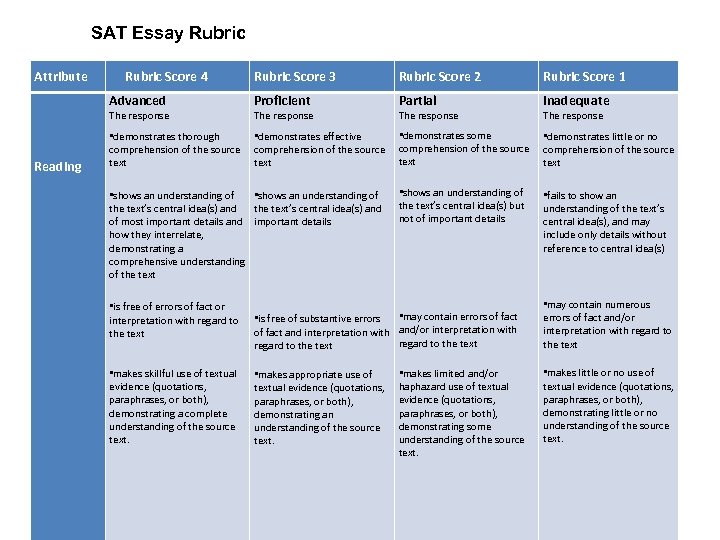
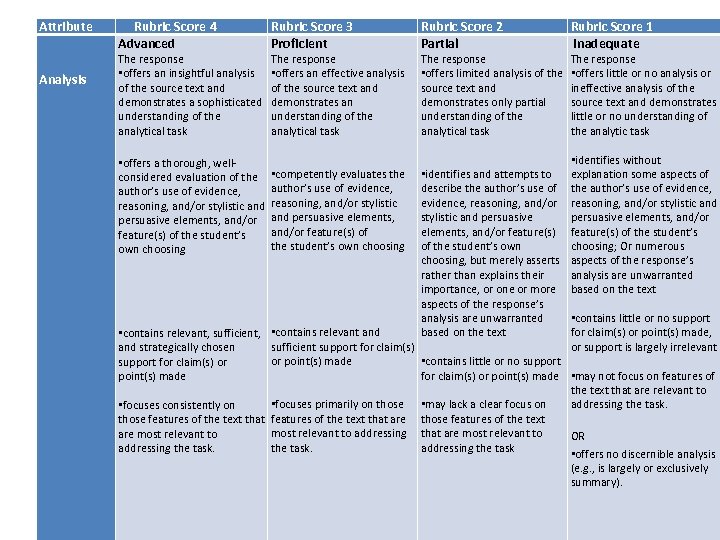
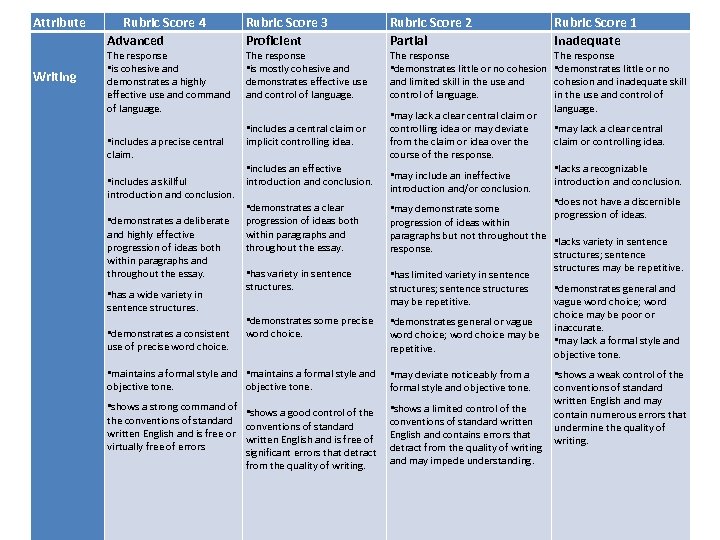
 The SAT Essay Prompt As you read the passage below, consider how the author uses • evidence, such as facts or examples, to support claims. • reasoning to develop ideas and to connect claims and evidence. • stylistic or persuasive elements, such as word choice or appeals to emotion, to add power to the ideas expressed.