


 Скачать презентацию Clodia Cicero the famous Roman lawyer delivered a
279196212c740b4542ab4d9d34b13493.ppt
- Количество слайдов: 35
 Clodia Cicero, the famous Roman lawyer, delivered a speech defending a man named Caelius against accusations of ‘impropriety’ and ‘treasonable activities’ including being involved in the conspiracy of Catiline. His defence was that those accusing Caelius were doing it for their own reasons, and that Clodia was behind the accusations, which she was bringing against Caelius out of spite.
 cum ex nobili genere in familiam clarissimam nupisses, cur tibi Caelius tam coniunctus fuit? • What does ‘ex nobili genere’ tell us about Clodia’s background? • ex nobili genere – ‘from a noble family’ – refers to Clodia’s family, the Claudians. They were one of the most ancient and famous families in Rome.
 cum ex nobili genere in familiam clarissimam nupisses, cur tibi Caelius tam coniunctus fuit? • ‘nupisses’ – what does this word tell us Clodia has done? • She has married • What do we know about the family she has married into? • They are ‘clarissimam’ – very famous. • Clodia married her cousin, Quintus Metellus Celer, and when he died suddenly, there were rumours that Clodia had poisoned him.
 cum ex nobili genere in familiam clarissimam nupisses, cur tibi Caelius tam coniunctus fuit? • Who is Cicero speaking to, and how do we know? • He is addressing Clodia – he calls her ‘you’ (tibi) • What Latin word is used to describe the relationship between Clodia and Caelius? • coniunctus = “intimate”
 cum ex nobili genere in familiam clarissimam nupisses, cur tibi Caelius tam coniunctus fuit? • What would the attitude of the audience (the jury in the legal case) have been to Caelius being described as intimate with Clodia? • Shocked – as a married or recently widowed woman, Clodia should not have been speaking to other men. Cicero uses a rhetorical question to emphasise this shocked attitude and to make it sound like an accusation (especially by saying that Caelius was ‘so intimate’ with her).
 cum ex nobili genere in familiam clarissimam nupisses, cur tibi Caelius tam coniunctus fuit? • Translate this passage • ‘When you, from a noble family, had married into a most renowned household, why was Caelius so intimate with you? ’
 neque enim cognatus fuit neque mariti tui amicus. • What two possible types of men might it have been acceptable for Clodia to be ‘intimate’ with? • either: cognatus – a relative • or: mariti…amicus – a friend of her husband’s
 quid igitur fuit nisi quaedam temeritas ac libido? • Cicero uses another rhetorical question to suggest that there is only one possible explanation. • Translate the phrase ‘quid igitur fuit nisi…’ • ‘What was it, then, except…’ • What is Cicero’s explanation? • ‘quaedam temeritas ac libido’ – some recklessness and lust
 neque enim cognatus fuit neque mariti tui amicus. quid igitur fuit nisi quaedam temeritas ac libido? • Translate this passage • He was neither a relative nor a friend of your husband. What was this, then, except some recklessness and lust?
 accusatores quidem libidines, amores, adulteria, Baias, convivia, cantus, navigia iactant; • Who are the ‘accusatores’ accusing? • Caelius • What does the use of the word ‘iactant’ suggest about their accusations? • ‘iactant’ literally means ‘throw’, so there is the suggestion that they are just throwing a random selection of accusations at Caelius to see which will stick – as if they are attacking him but in a very haphazard way
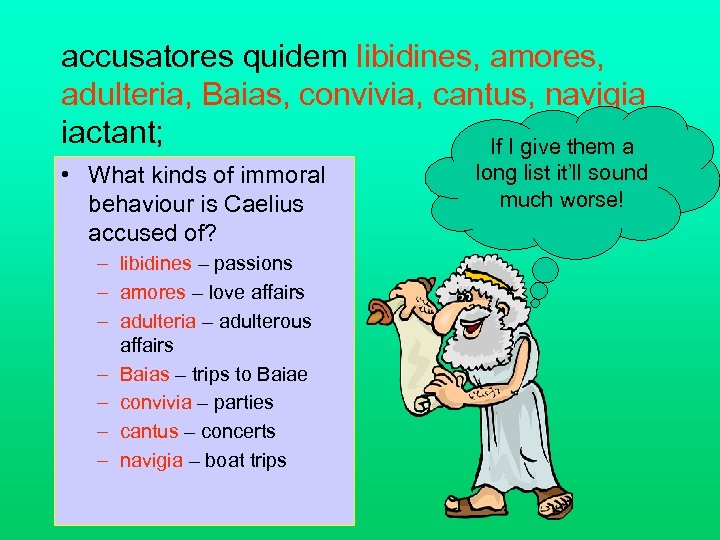 accusatores quidem libidines, amores, adulteria, Baias, convivia, cantus, navigia iactant; If I give them a • What kinds of immoral behaviour is Caelius accused of? – libidines – passions – amores – love affairs – adulteria – adulterous affairs – Baias – trips to Baiae – convivia – parties – cantus – concerts – navigia – boat trips long list it’ll sound much worse!
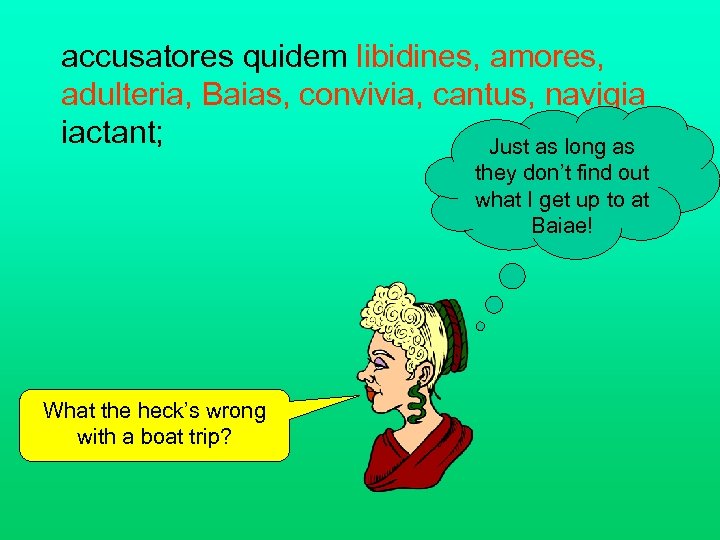 accusatores quidem libidines, amores, adulteria, Baias, convivia, cantus, navigia iactant; Just as long as they don’t find out what I get up to at Baiae! What the heck’s wrong with a boat trip?
 accusatores quidem libidines, amores, adulteria, Baias, convivia, cantus, navigia iactant; • Translate this passage • Indeed, the accusers allege passions, love affairs, adulterous liaisons, trips to Baiae, parties, concerts, boating trips…
 affirmantque se nihil te invita dicere. has accusationes, quas tu insane in forum iudicium deferri voluisti, aut refutare te opportet aut fateri nihil credendum esse neque crimini tuo neque testimonio. • • • Translate ‘affirmant se dicere’ ‘they claim that they say’ What type of construction is this? Indirect statement How do you know? Because there is a reporting verb (‘affirmant’) and then the person they say is doing something (in this case, the ‘accusatores’ themselves – ‘se’) has been put into the accusative and the verb has been put into the infinitive (‘dicere’)
 affirmantque se nihil te invita dicere. has accusationes, quas tu insane in forum iudicium deferri voluisti, aut refutare te opportet aut fateri nihil credendum esse neque crimini tuo neque testimonio. • Why is it important to Cicero’s argument that the accusatores say nothing without Clodia’s consent? • Because if this is the case, it suggests that she is behind the whole case against Caelius • Who wanted the accusations made public? • Clodia (‘tu…voluisti’)
 affirmantque se nihil te invita dicere. has accusationes, quas tu insane in forum iudicium deferri voluisti, aut refutare te opportet aut fateri nihil credendum esse neque crimini tuo neque testimonio. • Which word shows that Clodia has made a mistake in bringing these accusations in front of the court? • ‘insane’ – madly • Why is it a mistake? • Because Clodia also took part in all the things Caelius is accused of doing
 affirmantque se nihil te invita dicere. has accusationes, quas tu insane in forum iudicium deferri voluisti, aut refutare te opportet aut fateri nihil credendum esse neque crimini tuo neque testimonio. • Cicero gives Clodia two choices – refutare – deny the charges – fateri nihil credendum esse neque crimini tuo neque testimonio – admit that nothing she says should be believed, neither in her accusations nor her evidence
 affirmantque se nihil te invita dicere. has accusationes, quas tu insane in forum iudicium deferri voluisti, aut refutare te opportet aut fateri nihil credendum esse neque crimini tuo neque testimonio. • Why does admitting that she took part in these kinds of activities mean that Clodia’s accusations and evidence should not be trusted? • Because her character would be so badly blackened that she would be completely discredited in the eyes of the audience/jury
 affirmantque se nihil te invita dicere. has accusationes, quas tu insane in forum iudicium deferri voluisti, aut refutare te opportet aut fateri nihil credendum esse neque crimini tuo neque testimonio. • Translate this passage • They claim that they say nothing without your approval. Either you must refute these accusations, which you – madly – wanted to be reported in the forum and at the trial, or acknowledge that nothing in either your accusation or your evidence should be trusted.
 vicinum iuvenem conspexisti; candor eius te et proceritas, vultus oculique pepulerunt; saepius videre voluisti • Who is the ‘vicinum iuvenem’ – the young man next door? • Caelius – he rented an apartment from Clodia’s brother on the Palatine hill, close to Clodia’s house • Why does Cicero call him a ‘young man’ • It makes him sound vulnerable and innocent
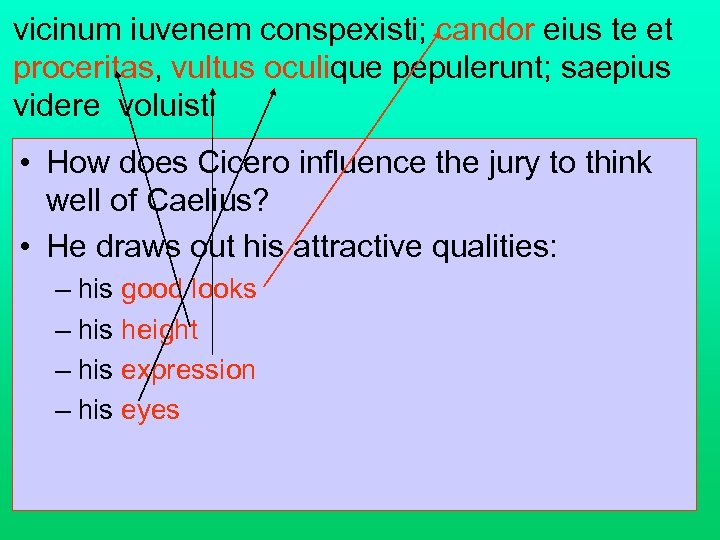 vicinum iuvenem conspexisti; candor eius te et proceritas, vultus oculique pepulerunt; saepius videre voluisti • How does Cicero influence the jury to think well of Caelius? • He draws out his attractive qualities: – his good looks – his height – his expression – his eyes
 vicinum iuvenem conspexisti; candor eius te et proceritas, vultus oculique pepulerunt; saepius videre voluisti • Look at the way Cicero portrays Clodia at this point – this section of the speech is full of her actions, to make her sound predatory and as if she is in control (women in Rome shouldn’t do too much, you see) – conspexisti – you caught sight of… – voluisti – you wanted… • She also sounds greedy and selfish…
 vicinum iuvenem conspexisti; candor eius te et proceritas, vultus oculique pepulerunt; saepius videre voluisti • Translate this passage: • You caught sight of the young man next door; his good looks and height, expression and eyes impressed you; you wanted to see him more often…
 fuisti non numquam in eisdem hortis; tu, femina nobilis, vis illum filium patris parci ac tenacis habere tuis divitiis devinctum • Where did Clodia go to ensnare Caelius? • eisdem hortis - the same gardens as him (even though these were probably the gardens of Clodia’s own villa, she still looks bad because of the way Cicero puts it)
 fuisti non numquam in eisdem hortis; tu, femina nobilis, vis illum filium patris parci ac tenacis habere tuis divitiis devinctum • How does Cicero call attention to Clodia’s noble birth and why? • ‘femina nobilis’ – it reminds the jury that she is a rich, well-connected woman (who shouldn’t be bringing shame on her family in this way) • it contrasts with Caelius’s relative poverty because his father keeps him on a small allowance
 fuisti non numquam in eisdem hortis; tu, femina nobilis, vis illum filium patris parci ac tenacis habere tuis divitiis devinctum • Which two words describe Caelius’s father? – parci – miserly – tenacis – stingy • Caelius’s father is from a poorer family than Clodia’s. It was traditional for fathers in Rome to keep control of the family finances until their sons married.
 fuisti non numquam in eisdem hortis; tu, femina nobilis, vis illum filium patris parci ac tenacis habere tuis divitiis devinctum • Translate the highlighted phrase • ‘You want to have him bound by your riches’ • The suggestion is that Clodia has tried to dazzle Caelius with her wealth and expects him to be glad to have an affair with her in order to escape from his poor background. The word ‘devinctum’ links to the idea of Clodia as the person who has ensnared Caelius • more of Clodia’s actions: fuisti, vis
 non potes; calcitrat, respuit, non putat tua dona esse tanti • ‘non potes’ – the last of the 2 nd person verbs; Cicero shifts control of the action to Caelius (3 rd person verbs) • What three things does Caelius do? – calcitrat – he resists – respuit – he rejects – non putat…- he does not think… • All the verbs from vis to putat are in the present tense, as if the whole love affair is playing out in front of the jury’s eyes – present tense verbs make action vivid • Caelius’s actions – rule of three (ascending tricolon)
 fuisti non numquam in eisdem hortis; tu, femina nobilis, vis illum filium patris parci ac tenacis habere tuis divitiis devinctum; non potes; calcitrat, respuit, non putat tua dona esse tanti • Translate this passage • You were sometimes in the same gardens as him; you, a noble woman, want to have him, the son of a miserly and stingy father, bound by your riches; you cannot; he resists, he rejects you, he does not think your gifts are worth so much
 confer te alio. emisti hortos prope Tiberim, in eo loco quo omnes iuvenes natandi causa veniunt. hinc licet condiciones cotidie legas; cur huic, te spernit, molesta es? • • • What kind of verb is ‘confer’ imperative – ‘take’ What is the literal meaning? ‘Take yourself somewhere else’ What meaning does it suggest? ‘Try another way’
 confer te alio. emisti hortos prope Tiberim, in eo loco quo omnes iuvenes natandi causa veniunt. hinc licet condiciones cotidie legas; cur huic, te spernit, molesta es? • • What does Clodia buy? Gardens near the River Tiber Why do the young men go there? ‘natandi causa’ – to swim (‘for the reason of swimming’) • The suggestion is that Clodia is making herself available to young men – she has bought herself a garden full of them!
 confer te alio. emisti hortos prope Tiberim, in eo loco quo omnes iuvenes natandi causa veniunt. hinc licet condiciones cotidie legas; cur huic, te spernit, molesta es? • What kind of ‘proposals’ (condiciones) can Clodia ‘pick up’ every day? • Sexual propositions – Cicero is accusing Clodia of easy promiscuity (her historical reputation suggests that this is fair enough!)
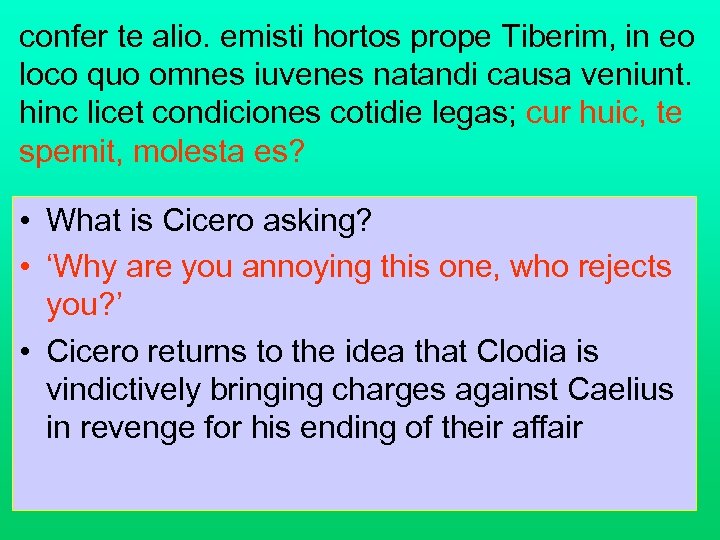 confer te alio. emisti hortos prope Tiberim, in eo loco quo omnes iuvenes natandi causa veniunt. hinc licet condiciones cotidie legas; cur huic, te spernit, molesta es? • What is Cicero asking? • ‘Why are you annoying this one, who rejects you? ’ • Cicero returns to the idea that Clodia is vindictively bringing charges against Caelius in revenge for his ending of their affair
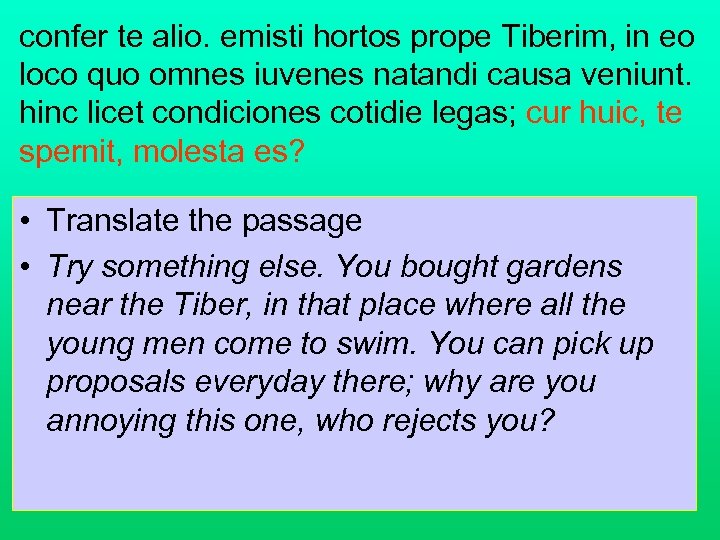 confer te alio. emisti hortos prope Tiberim, in eo loco quo omnes iuvenes natandi causa veniunt. hinc licet condiciones cotidie legas; cur huic, te spernit, molesta es? • Translate the passage • Try something else. You bought gardens near the Tiber, in that place where all the young men come to swim. You can pick up proposals everyday there; why are you annoying this one, who rejects you?
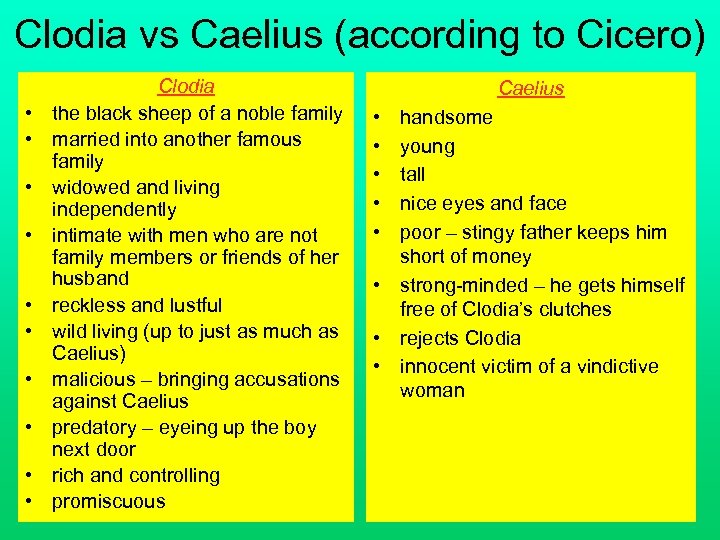 Clodia vs Caelius (according to Cicero) • • • Clodia the black sheep of a noble family married into another famous family widowed and living independently intimate with men who are not family members or friends of her husband reckless and lustful wild living (up to just as much as Caelius) malicious – bringing accusations against Caelius predatory – eyeing up the boy next door rich and controlling promiscuous Caelius • • • handsome young tall nice eyes and face poor – stingy father keeps him short of money • strong-minded – he gets himself free of Clodia’s clutches • rejects Clodia • innocent victim of a vindictive woman