 Скачать презентацию Clock Distribution Shmuel Wimer Bar Ilan Univ Eng
cb2e0b6eb7a2079b83d5c6d31e51b0cc.ppt
- Количество слайдов: 75



Clock Distribution Shmuel Wimer Bar Ilan Univ. Eng. Faculty Technion, EE Faculty July 2010 1
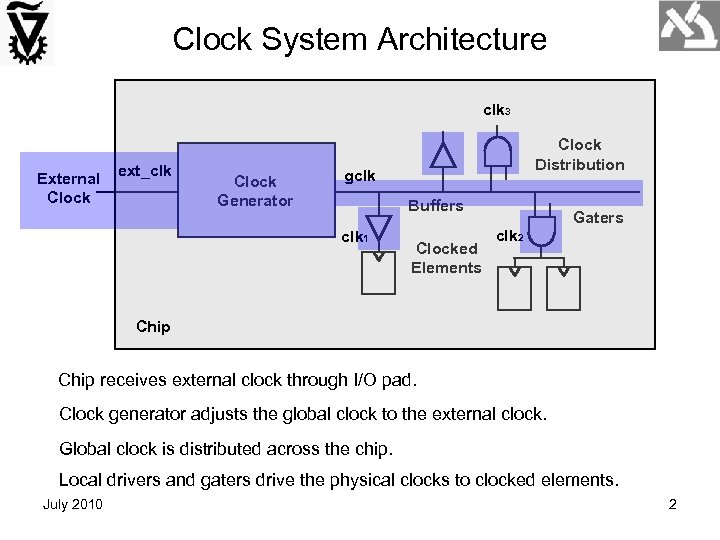
Clock System Architecture clk 3 External Clock ext_clk Clock Generator Clock Distribution gclk Buffers clk 1 Clocked Elements Gaters clk 2 Chip receives external clock through I/O pad. Clock generator adjusts the global clock to the external clock. Global clock is distributed across the chip. Local drivers and gaters drive the physical clocks to clocked elements. July 2010 2
Global Clock Generation • Receives external clock signal and produce the global clock distributed across the die. • A large skew occurs between external clock and the physical clocks at clocked elements due to delay of distribution network (wires, buffers, gaters). • Therefore, data at clocked elements is no more in sync with data at I/O pins. • Phased Locked Loop (PLL) compensates this delay. • PLL can perform frequency multiplication to obtain the required on-chip frequencies. July 2010 3
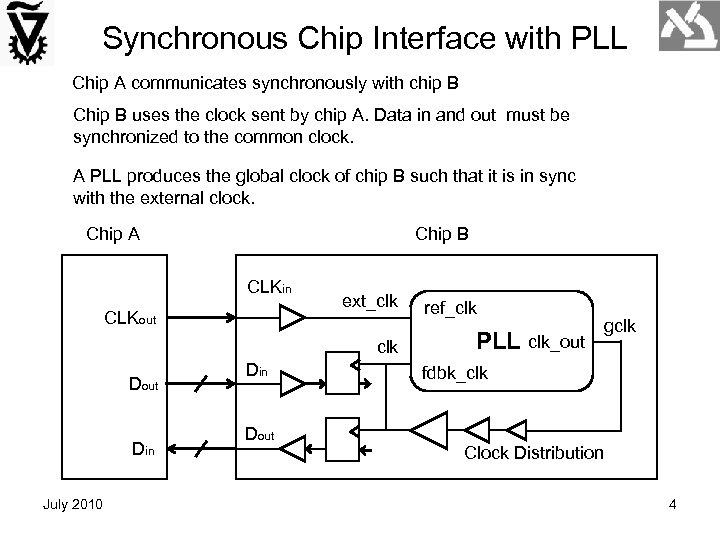
Synchronous Chip Interface with PLL Chip A communicates synchronously with chip B Chip B uses the clock sent by chip A. Data in and out must be synchronized to the common clock. A PLL produces the global clock of chip B such that it is in sync with the external clock. Chip A Chip B CLKin CLKout ext_clk Dout Din July 2010 Din Dout ref_clk PLL clk_out gclk fdbk_clk Clock Distribution 4
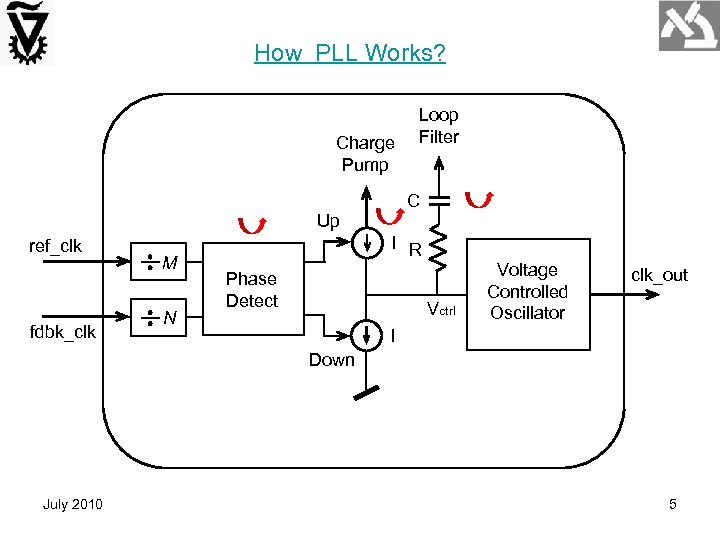
How PLL Works? Charge Pump Loop Filter C Up ref_clk fdbk_clk M N I R Phase Detect Vctrl Voltage Controlled Oscillator clk_out I Down July 2010 5
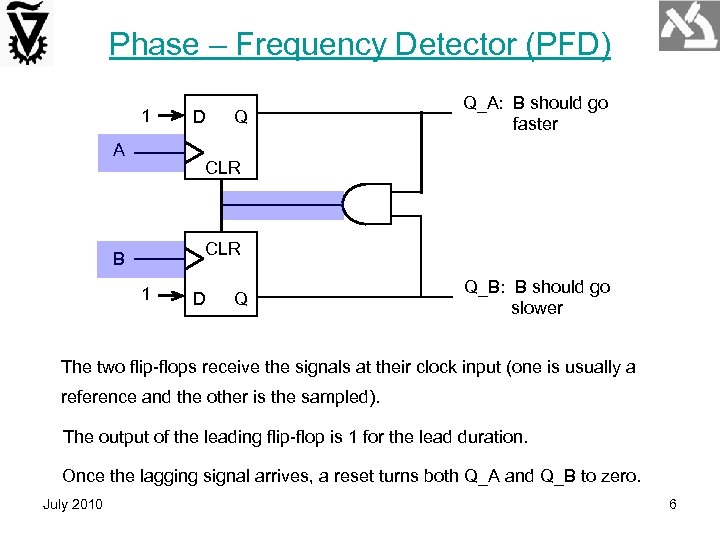
Phase – Frequency Detector (PFD) 1 A D Q Q_A: B should go faster CLR B 1 D Q Q_B: B should go slower The two flip-flops receive the signals at their clock input (one is usually a reference and the other is the sampled). The output of the leading flip-flop is 1 for the lead duration. Once the lagging signal arrives, a reset turns both Q_A and Q_B to zero. July 2010 6
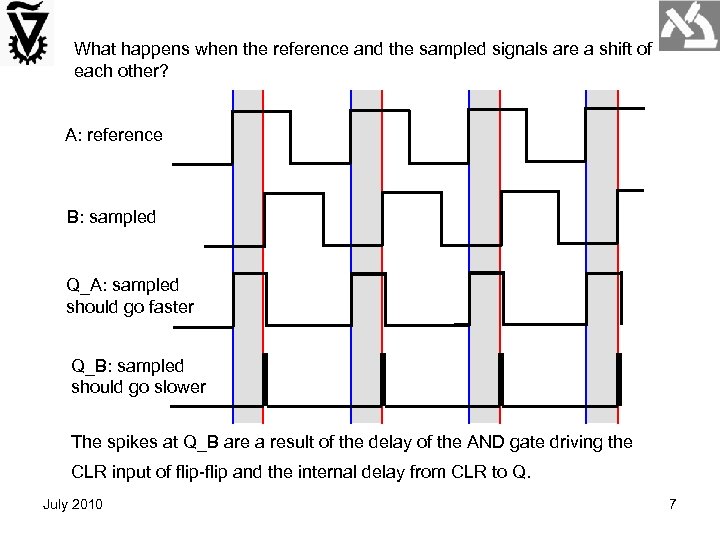
What happens when the reference and the sampled signals are a shift of each other? A: reference B: sampled Q_A: sampled should go faster Q_B: sampled should go slower The spikes at Q_B are a result of the delay of the AND gate driving the CLR input of flip-flip and the internal delay from CLR to Q. July 2010 7
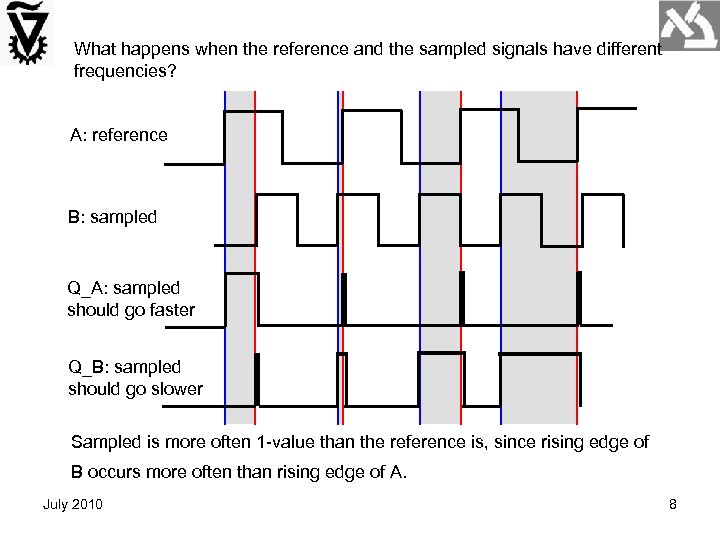
What happens when the reference and the sampled signals have different frequencies? A: reference B: sampled Q_A: sampled should go faster Q_B: sampled should go slower Sampled is more often 1 -value than the reference is, since rising edge of B occurs more often than rising edge of A. July 2010 8
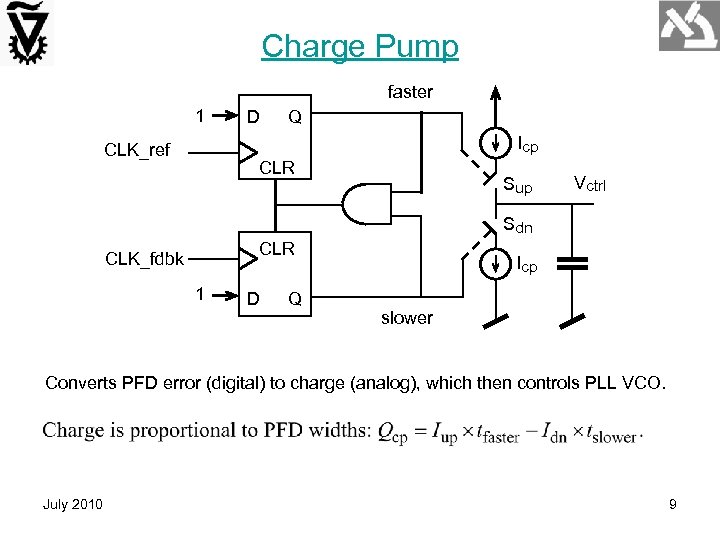
Charge Pump faster 1 D Q Icp CLK_ref CLR Sup Vctrl Sdn CLR CLK_fdbk 1 D Q Icp slower Converts PFD error (digital) to charge (analog), which then controls PLL VCO. July 2010 9
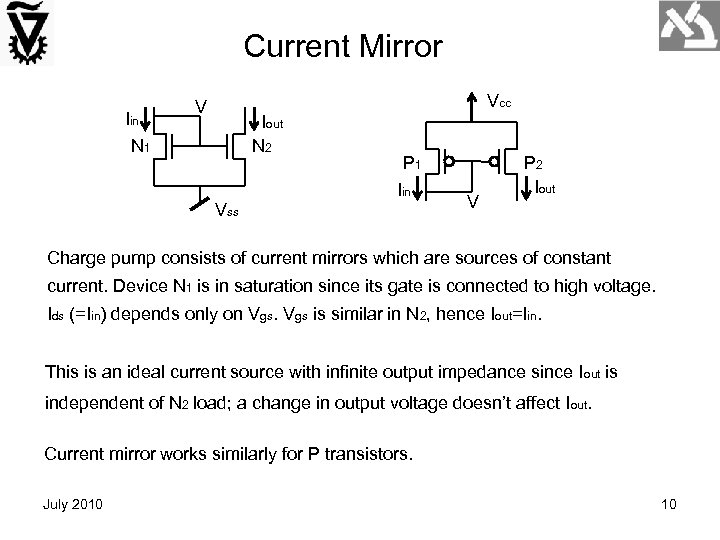
Current Mirror Iin Vcc V Iout N 2 N 1 Vss P 1 Iin V P 2 Iout Charge pump consists of current mirrors which are sources of constant current. Device N 1 is in saturation since its gate is connected to high voltage. Ids (=Iin) depends only on Vgs is similar in N 2, hence Iout=Iin. This is an ideal current source with infinite output impedance since Iout is independent of N 2 load; a change in output voltage doesn’t affect Iout. Current mirror works similarly for P transistors. July 2010 10
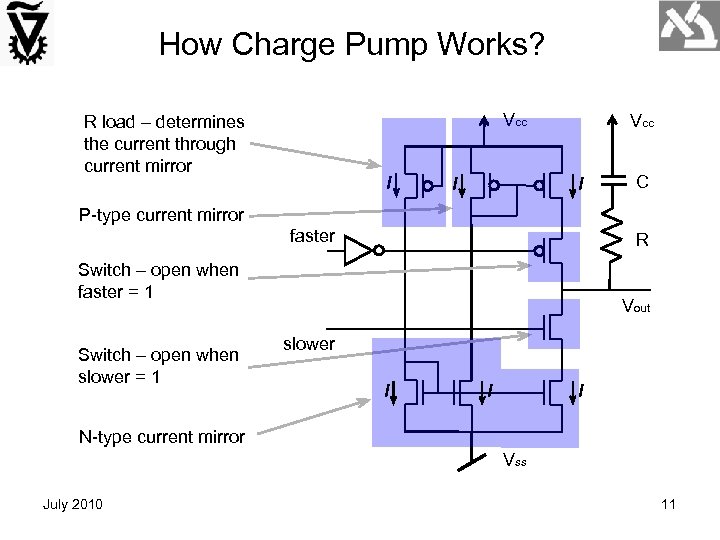
How Charge Pump Works? Vcc R load – determines the current through current mirror I I Vcc I C P-type current mirror faster R Switch – open when faster = 1 Switch – open when slower = 1 Vout slower I I I N-type current mirror Vss July 2010 11
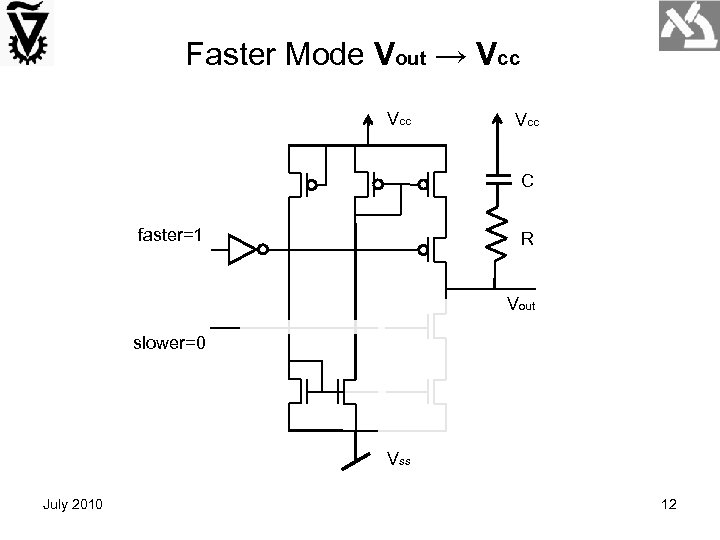
Faster Mode Vout → Vcc Vcc C faster=1 R Vout slower=0 Vss July 2010 12
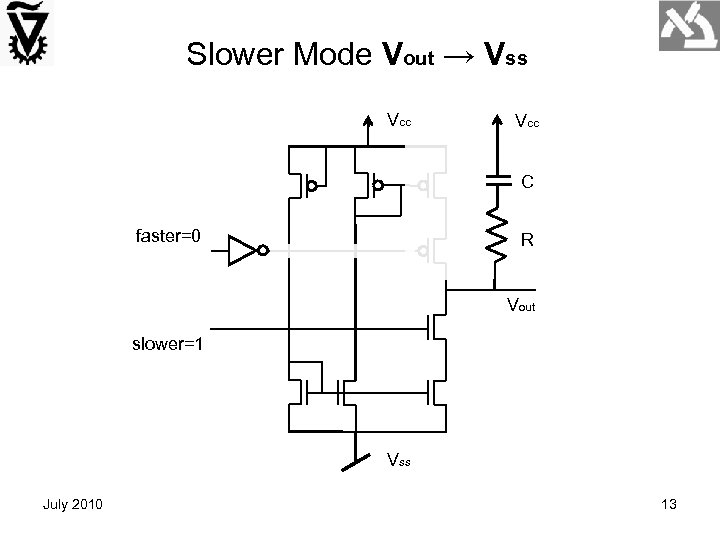
Slower Mode Vout → Vss Vcc C faster=0 R Vout slower=1 Vss July 2010 13
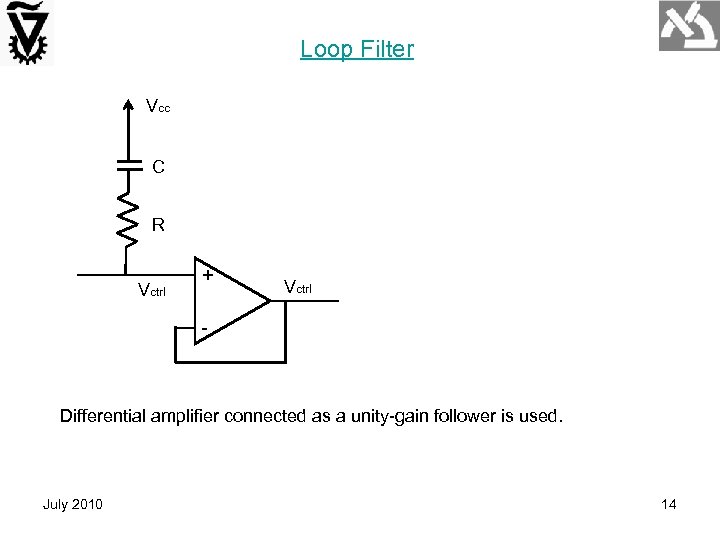
Loop Filter Vcc C R Vctrl + Vctrl - Differential amplifier connected as a unity-gain follower is used. July 2010 14
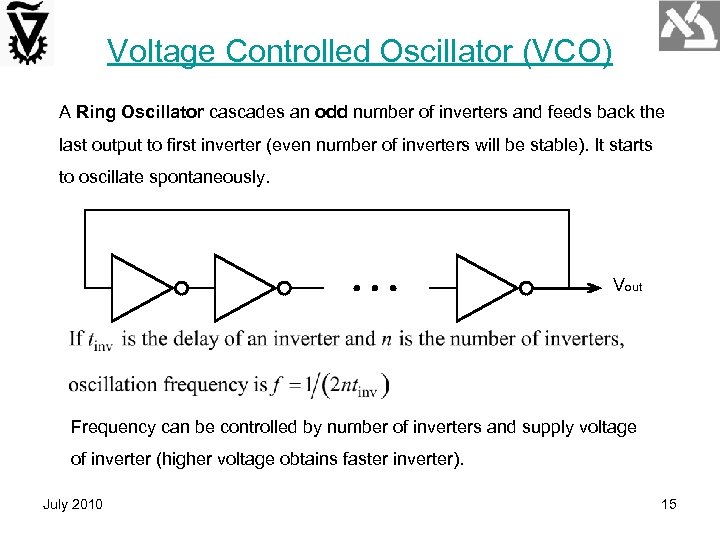
Voltage Controlled Oscillator (VCO) A Ring Oscillator cascades an odd number of inverters and feeds back the last output to first inverter (even number of inverters will be stable). It starts to oscillate spontaneously. Vout Frequency can be controlled by number of inverters and supply voltage of inverter (higher voltage obtains faster inverter). July 2010 15
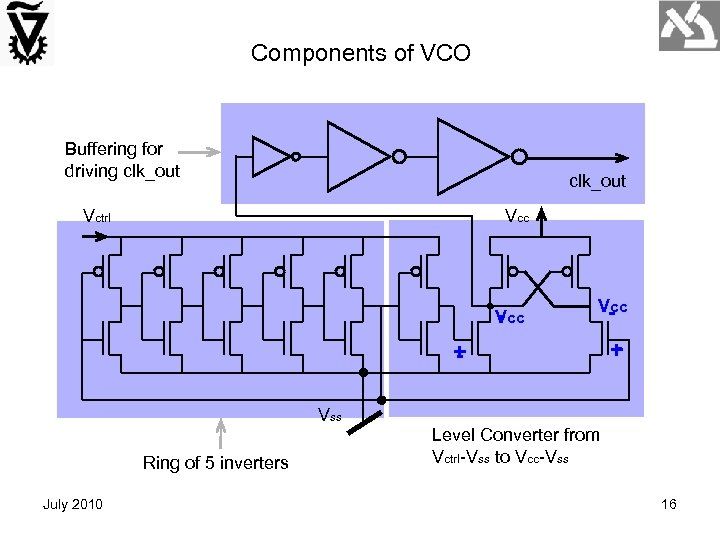
Components of VCO Buffering for driving clk_out Vctrl Vcc Vcc + Vss Ring of 5 inverters July 2010 + Level Converter from Vctrl-Vss to Vcc-Vss 16
Delay Locked Loop (DLL) • It is a variant of PLL that uses voltage-controlled delay line rather than oscillator. • It adjusts phase only. Frequency multiplication is impossible. • It is simpler than PLL, less sensitive to Vctrl noise and requires simpler loop filter. • It is very difficult to correctly design PLL and DLL. It requires expertise in control systems and analog circuit design. July 2010 17
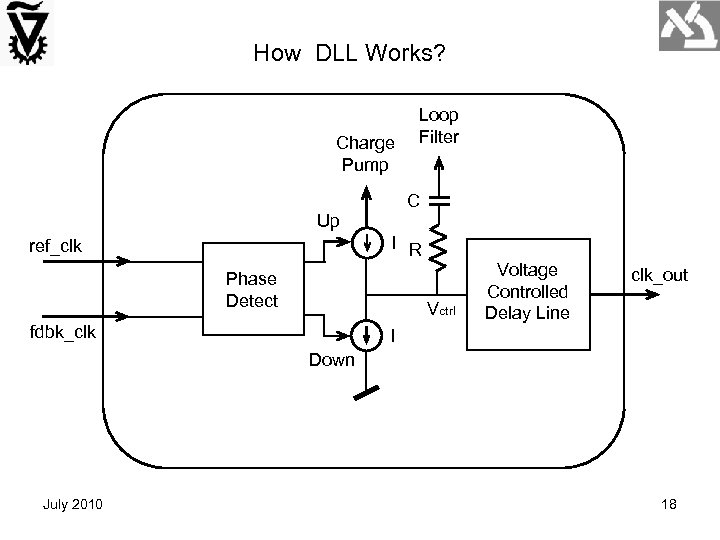
How DLL Works? Charge Pump Loop Filter C Up I R ref_clk Phase Detect Vctrl fdbk_clk Voltage Controlled Delay Line clk_out I Down July 2010 18
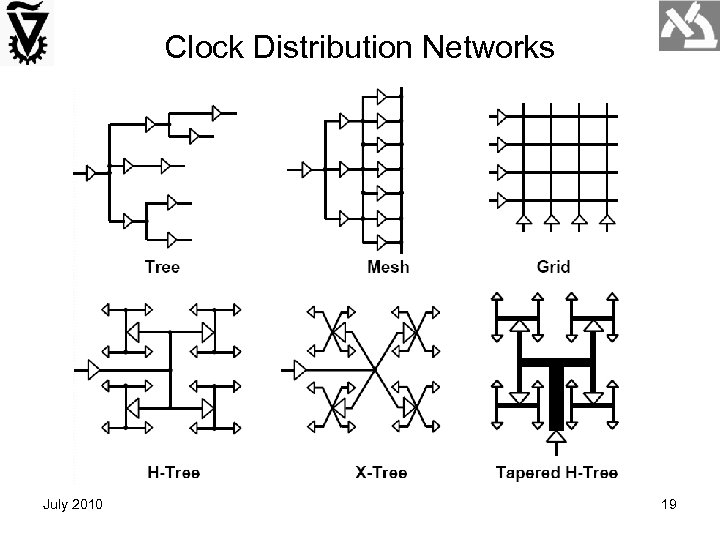
Clock Distribution Networks July 2010 19
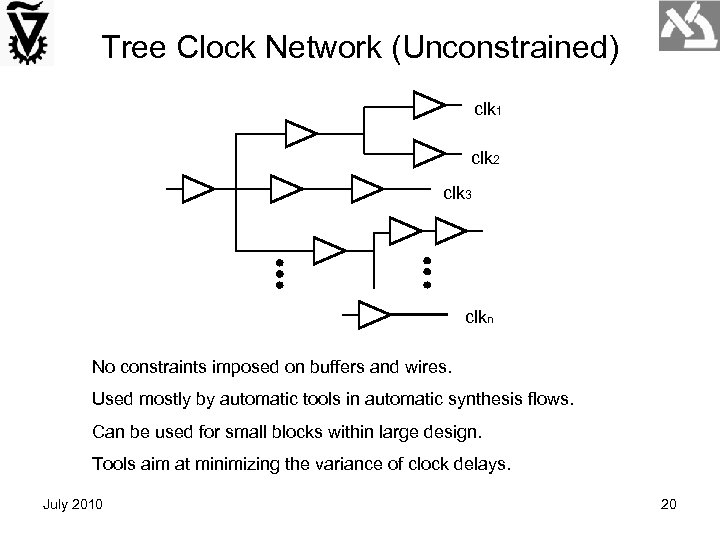
Tree Clock Network (Unconstrained) clk 1 clk 2 clk 3 clkn No constraints imposed on buffers and wires. Used mostly by automatic tools in automatic synthesis flows. Can be used for small blocks within large design. Tools aim at minimizing the variance of clock delays. July 2010 20
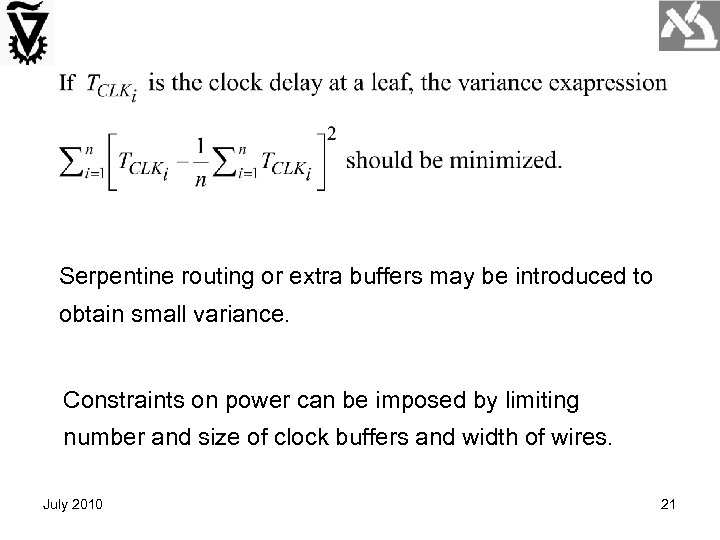
Serpentine routing or extra buffers may be introduced to obtain small variance. Constraints on power can be imposed by limiting number and size of clock buffers and width of wires. July 2010 21
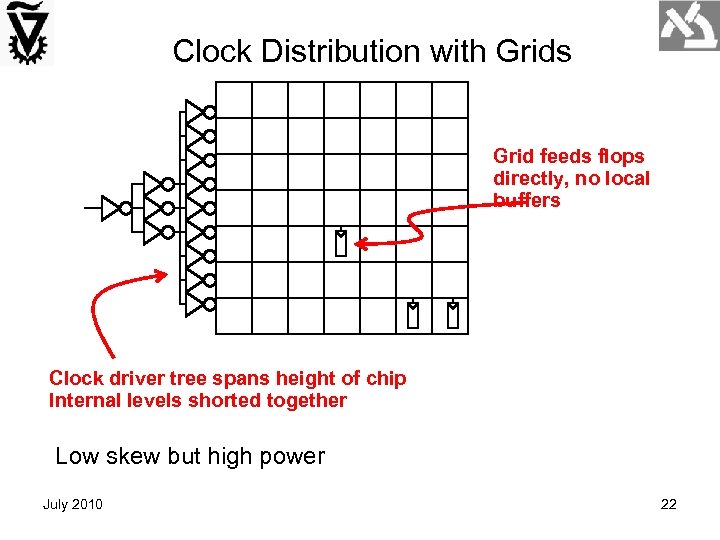
Clock Distribution with Grids Grid feeds flops directly, no local buffers Clock driver tree spans height of chip Internal levels shorted together Low skew but high power July 2010 22
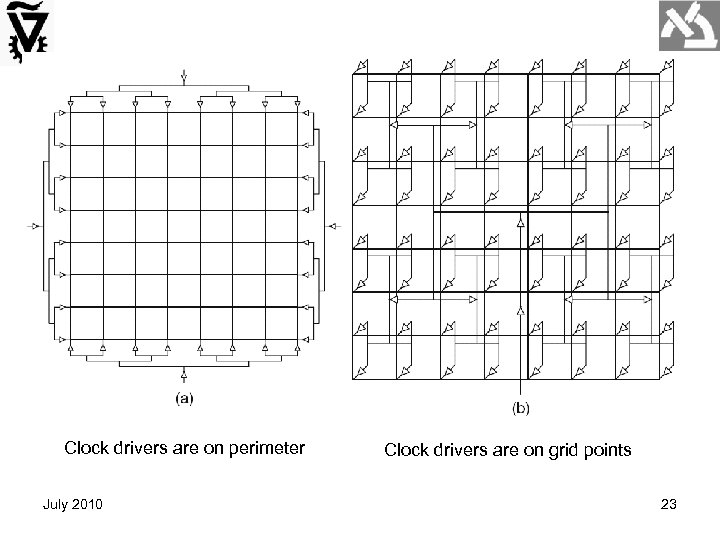
Clock drivers are on perimeter July 2010 Clock drivers are on grid points 23
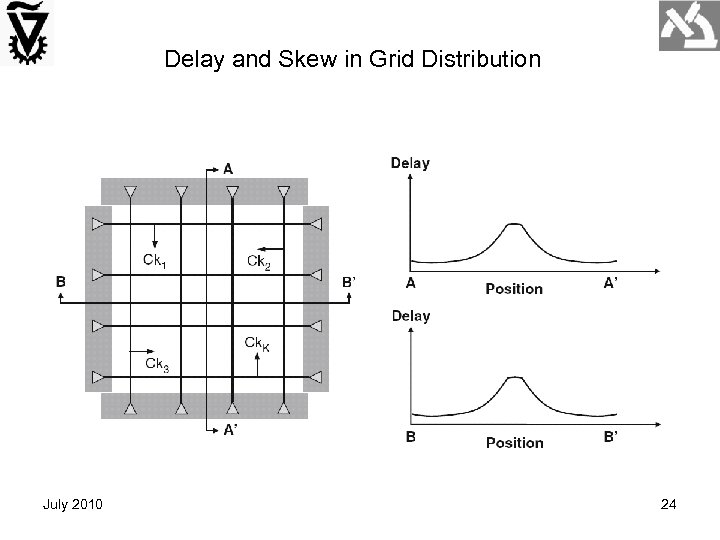
Delay and Skew in Grid Distribution July 2010 24
DEC’s Alpha Microprocessor Clocking July 2010 25
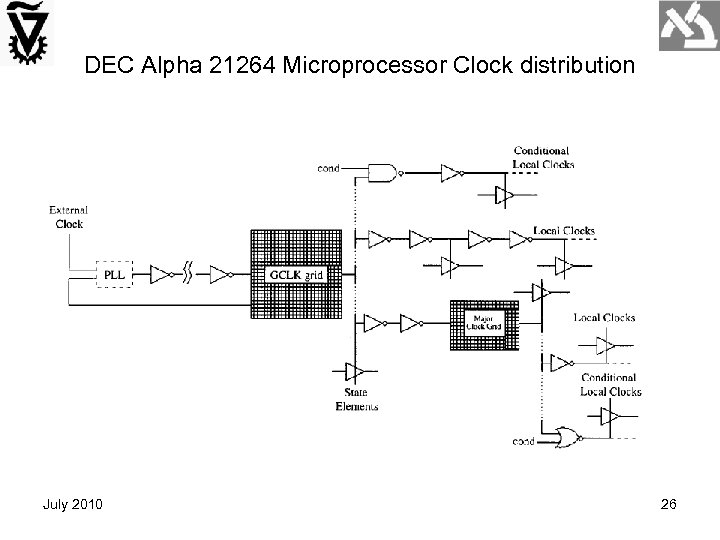
DEC Alpha 21264 Microprocessor Clock distribution July 2010 26
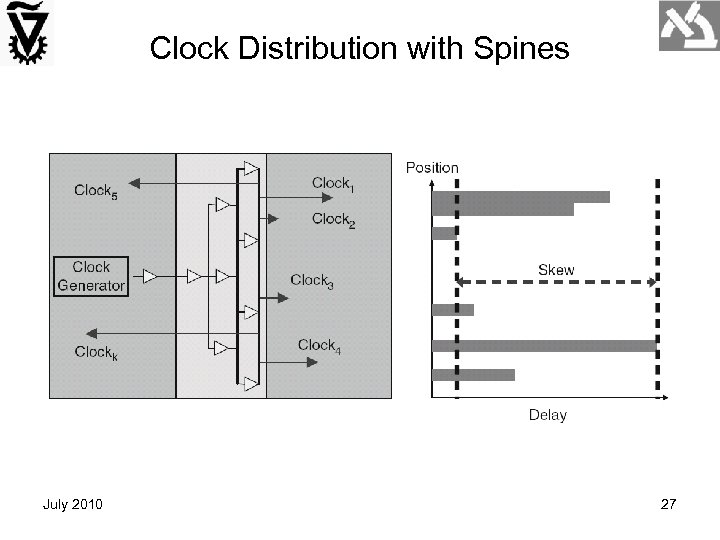
Clock Distribution with Spines July 2010 27
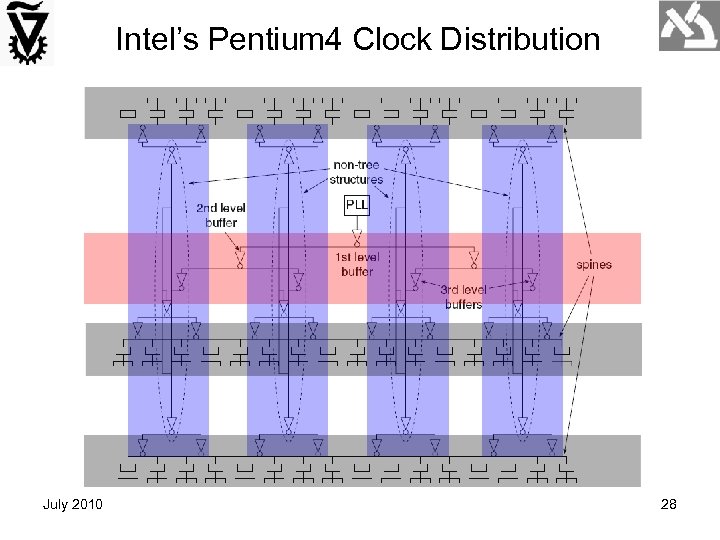
Intel’s Pentium 4 Clock Distribution July 2010 28
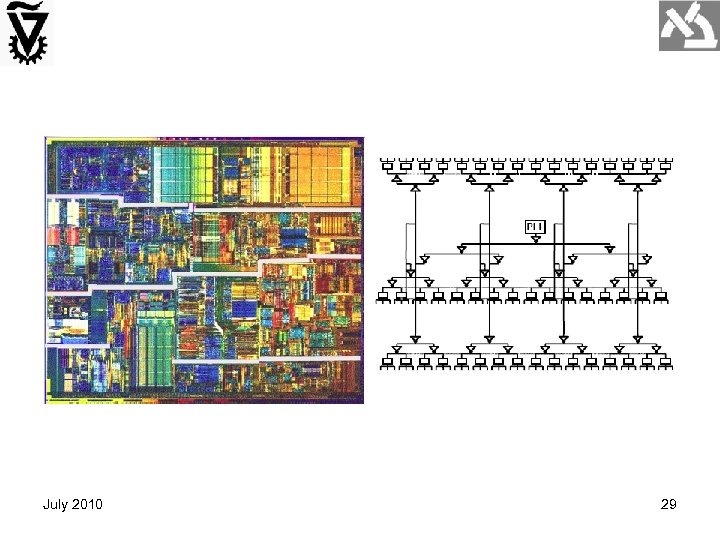
July 2010 29
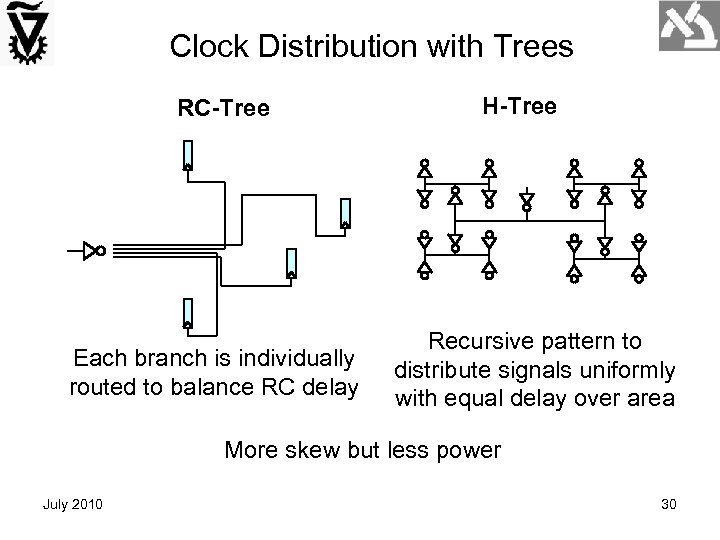
Clock Distribution with Trees RC-Tree Each branch is individually routed to balance RC delay H-Tree Recursive pattern to distribute signals uniformly with equal delay over area More skew but less power July 2010 30
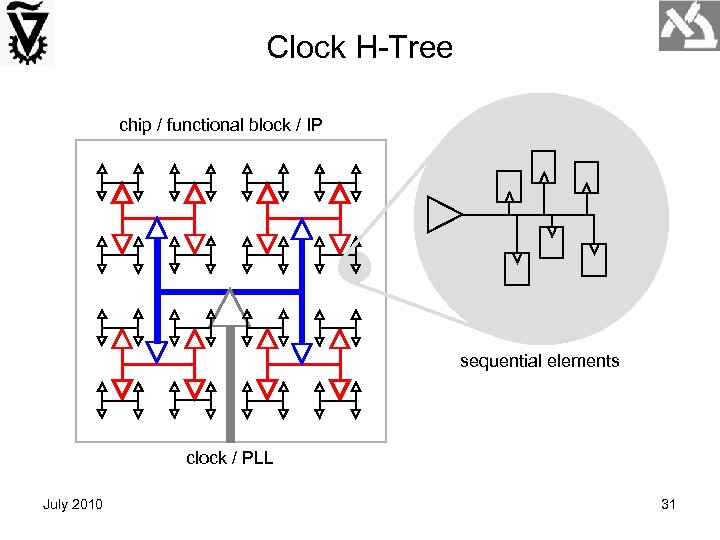
Clock H-Tree chip / functional block / IP sequential elements clock / PLL July 2010 31
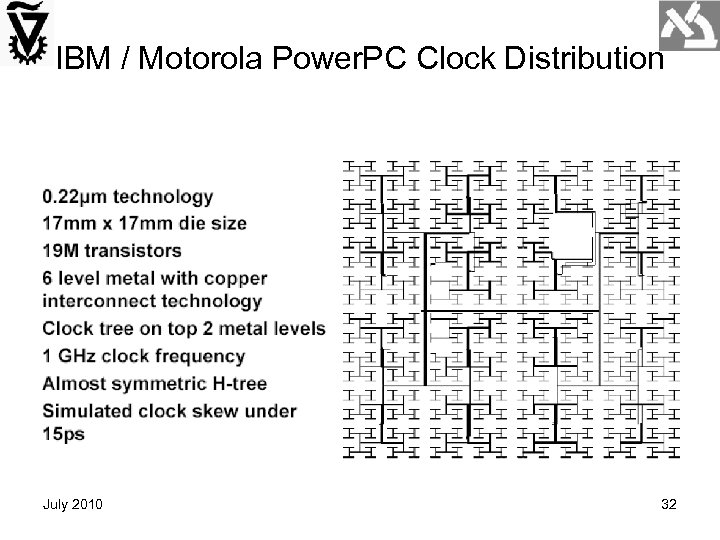
IBM / Motorola Power. PC Clock Distribution July 2010 32
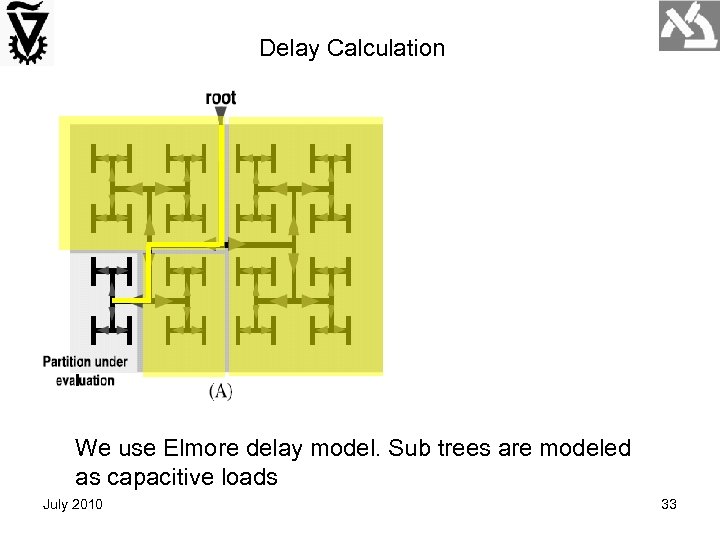
Delay Calculation We use Elmore delay model. Sub trees are modeled as capacitive loads July 2010 33
Clock Skew and Jitter • Clock should theoretically arrive simultaneously to all sequential circuits. • Practically it arrives in different times. The differences are called clock skews. • Skews result from paths mismatches, process variations and ambient conditions, resulting physical clocks. • Most systems distribute a global clock and then use local clock gaters located near clocked elements. Clock skew consists of the following components: July 2010 34
• Systematic is the portion existing under nominal conditions. It can be minimized by appropriate design. • Random is caused by process variations like devices’ channel length, oxide thickness, threshold voltage, wire thickness, width and space. It can be measured on silicon and adjusted by delay components. • Drift is caused by time-dependent environmental variations, occurring relatively slowly. Compensation of those must takes place periodically. • Jitter is rapid clock changes, occurring by power noise and clock generator jitter. It cannot be compensated. July 2010 35
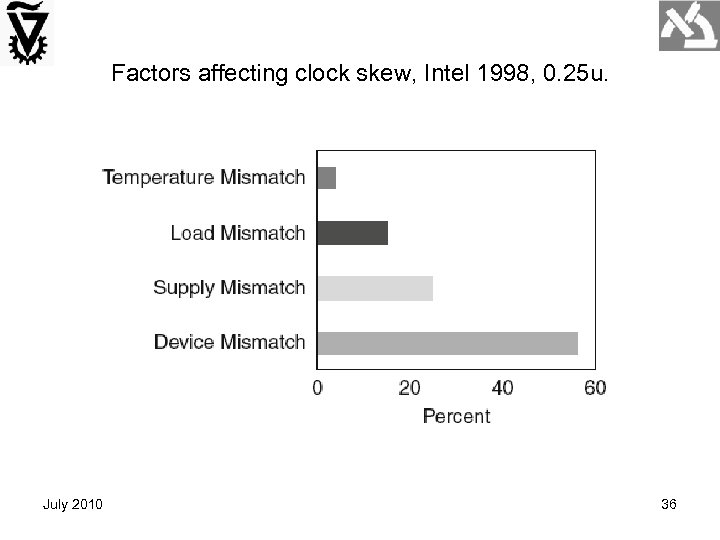
Factors affecting clock skew, Intel 1998, 0. 25 u. July 2010 36
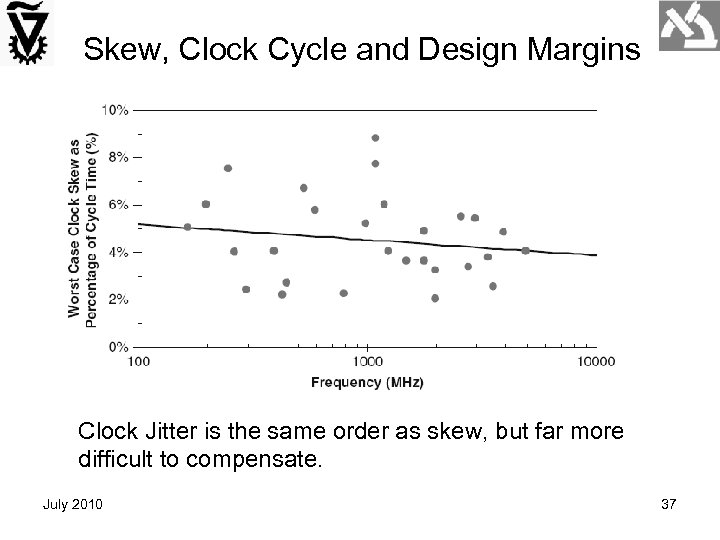
Skew, Clock Cycle and Design Margins Clock Jitter is the same order as skew, but far more difficult to compensate. July 2010 37
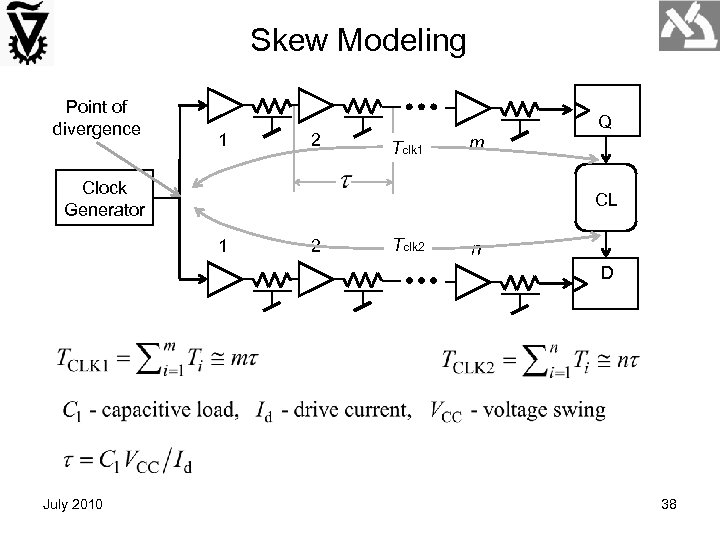
Skew Modeling Point of divergence 1 2 Q Tclk 1 m Clock Generator CL 1 2 Tclk 2 n D July 2010 38
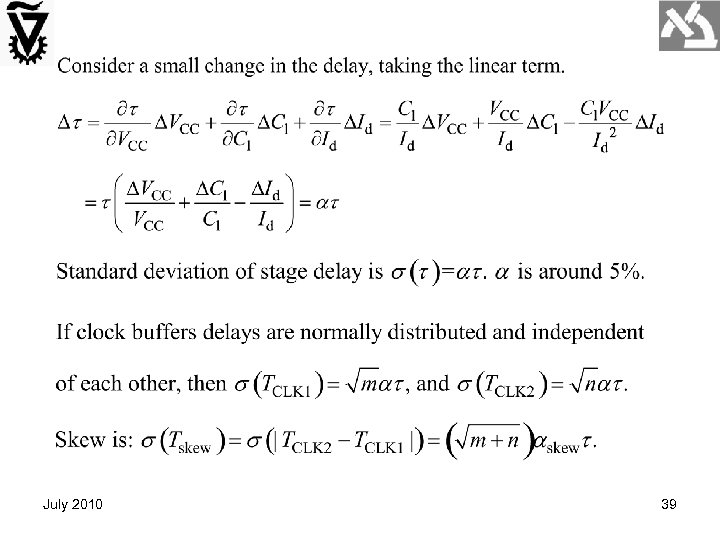
July 2010 39
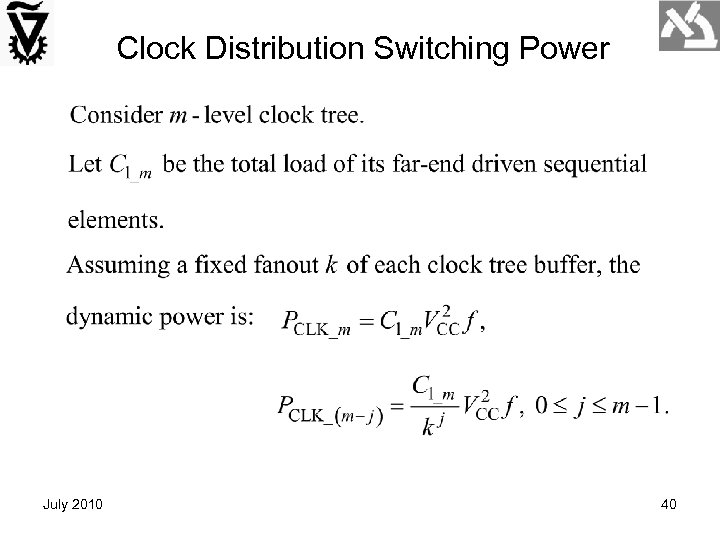
Clock Distribution Switching Power July 2010 40
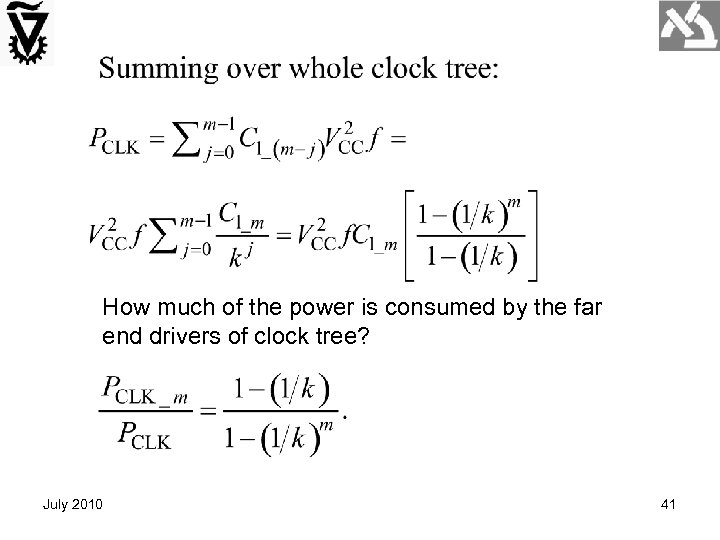
How much of the power is consumed by the far end drivers of clock tree? July 2010 41
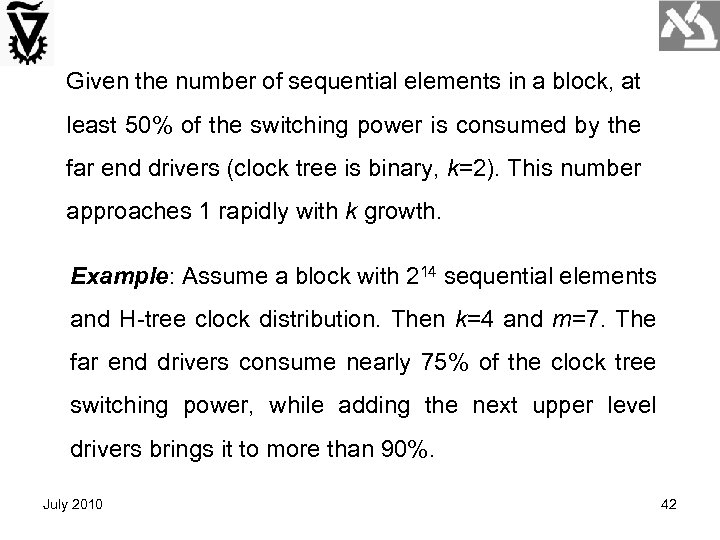
Given the number of sequential elements in a block, at least 50% of the switching power is consumed by the far end drivers (clock tree is binary, k=2). This number approaches 1 rapidly with k growth. Example: Assume a block with 214 sequential elements and H-tree clock distribution. Then k=4 and m=7. The far end drivers consume nearly 75% of the clock tree switching power, while adding the next upper level drivers brings it to more than 90%. July 2010 42
Active Clock De-Skewing • Compensates process variability, temperature gradients, imperfect design. • Can be implemented for global fixes (small HW overhead) or local fixes (high HW overhead). • Can be used at testing for one time fix (variability occurring during manufacturing), or dynamically concurrently with chip operation. • Its implementation is a difficult design challenge. July 2010 43
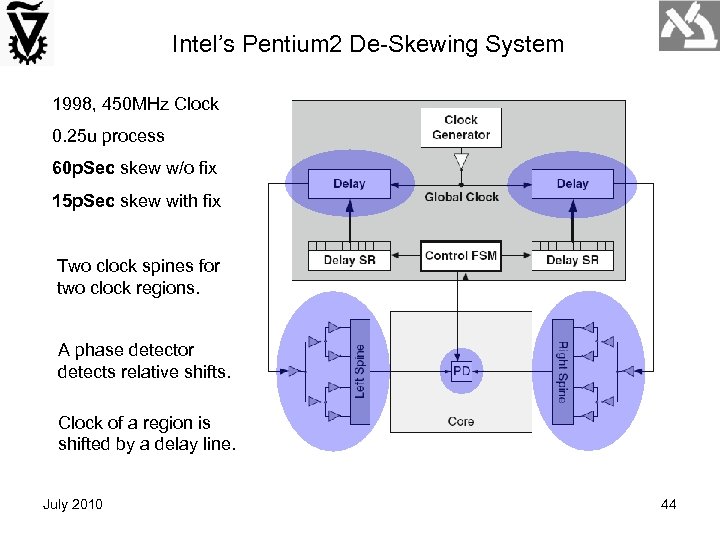
Intel’s Pentium 2 De-Skewing System 1998, 450 MHz Clock 0. 25 u process 60 p. Sec skew w/o fix 15 p. Sec skew with fix Two clock spines for two clock regions. A phase detector detects relative shifts. Clock of a region is shifted by a delay line. July 2010 44
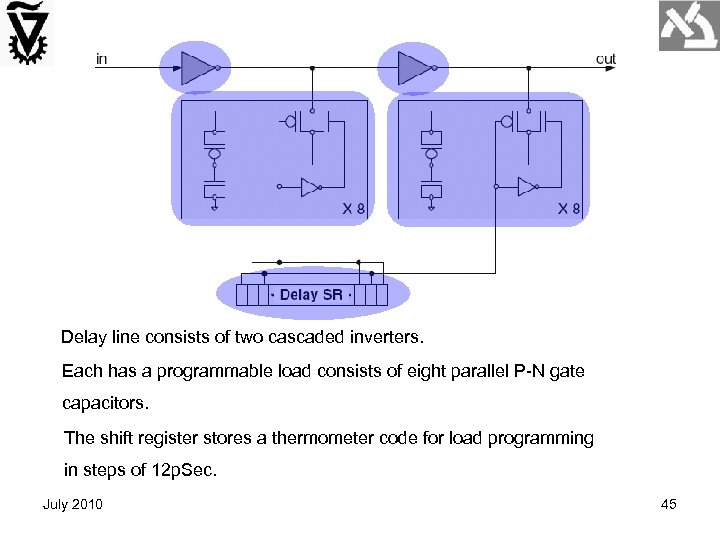
Delay line consists of two cascaded inverters. Each has a programmable load consists of eight parallel P-N gate capacitors. The shift register stores a thermometer code for load programming in steps of 12 p. Sec. July 2010 45
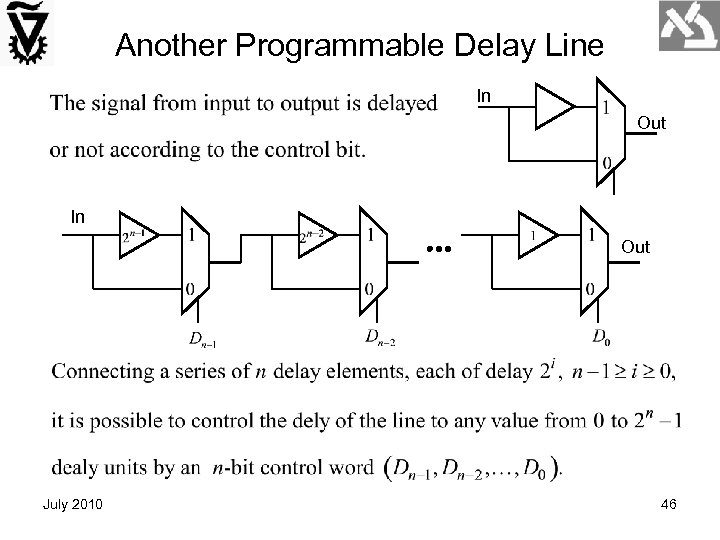
Another Programmable Delay Line In Out July 2010 46
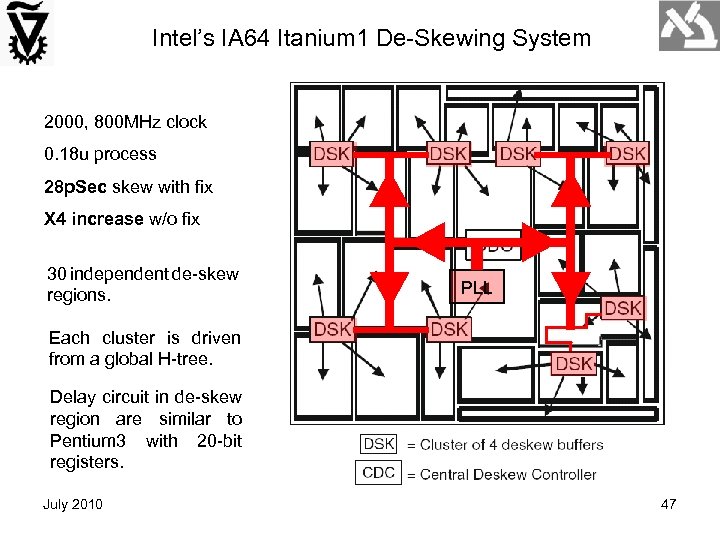
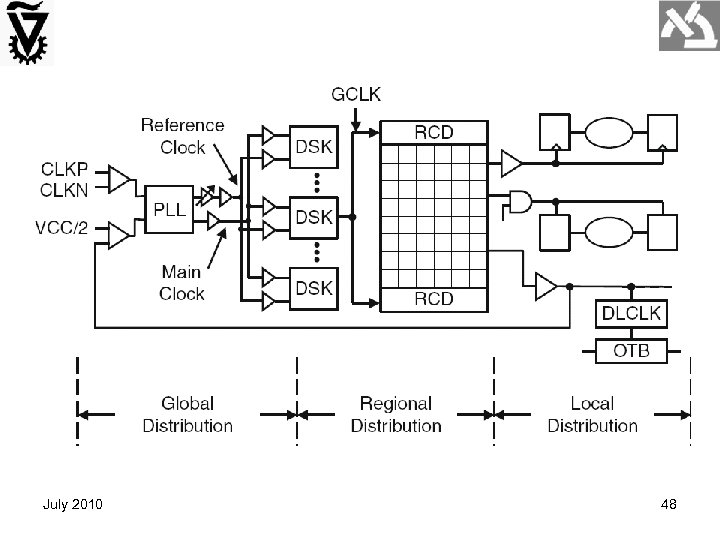
Intel’s IA 64 Itanium 1 De-Skewing System 2000, 800 MHz clock 0. 18 u process 28 p. Sec skew with fix X 4 increase w/o fix 30 independent de-skew regions. PLL Each cluster is driven from a global H-tree. Delay circuit in de-skew region are similar to Pentium 3 with 20 -bit registers. July 2010 47
July 2010 48
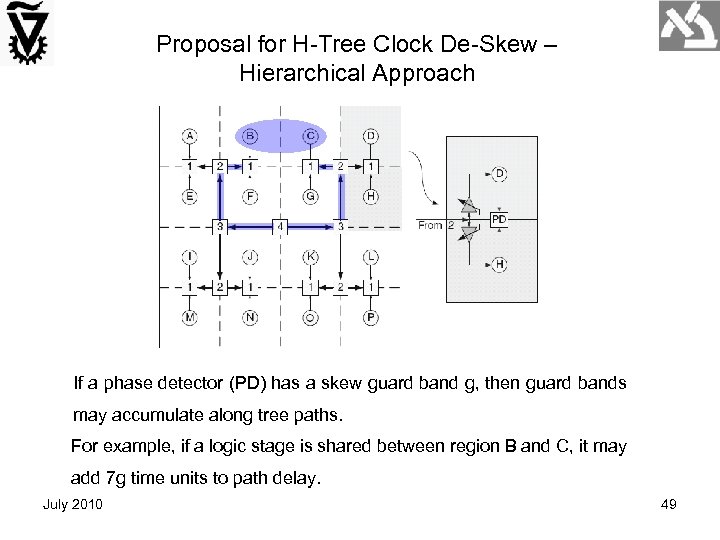
Proposal for H-Tree Clock De-Skew – Hierarchical Approach If a phase detector (PD) has a skew guard band g, then guard bands may accumulate along tree paths. For example, if a logic stage is shared between region B and C, it may add 7 g time units to path delay. July 2010 49
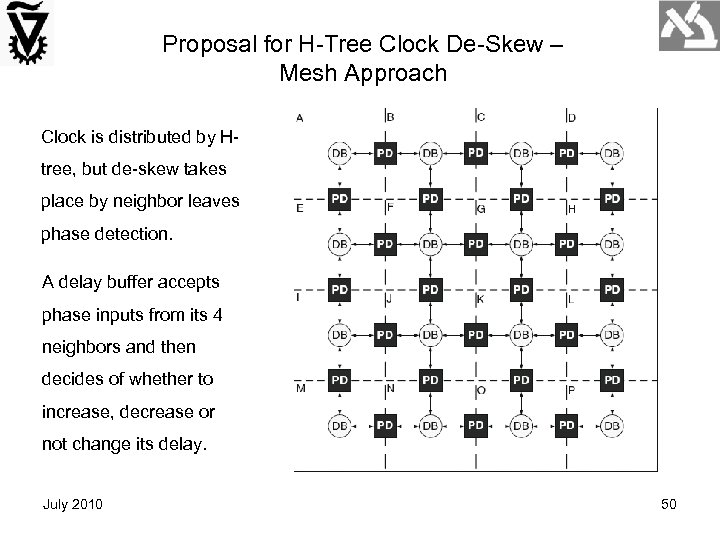
Proposal for H-Tree Clock De-Skew – Mesh Approach Clock is distributed by Htree, but de-skew takes place by neighbor leaves phase detection. A delay buffer accepts phase inputs from its 4 neighbors and then decides of whether to increase, decrease or not change its delay. July 2010 50
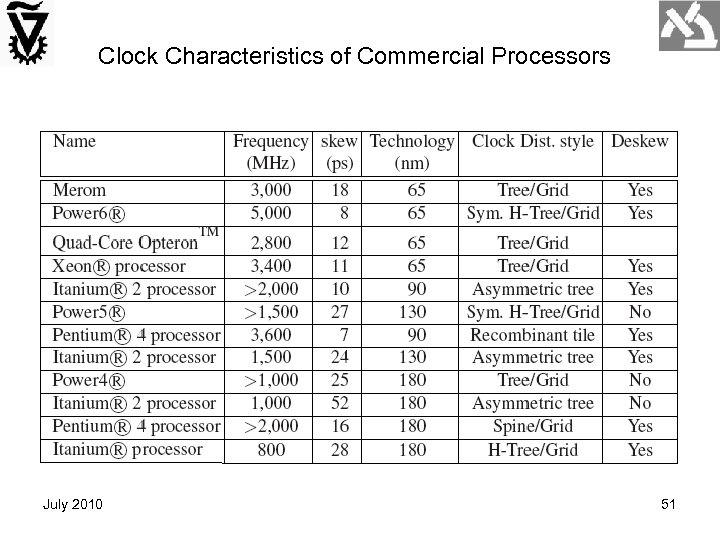
Clock Characteristics of Commercial Processors July 2010 51
Power Consumption in Chips • Clock power may reach 50% of total (dynamic + static). • Clock gating is very useful and standard design practice • Four gating methods: – Synthesis based, automated by EDA tools, RTL compilers, inserted into clock-tree – Clock enable signals manually defined by designer, inserted into clock-tree, FFs’ clock input – Data-Driven clock gating, inserted at FF-level – Auto-gated FF, inserted at latch-level 52
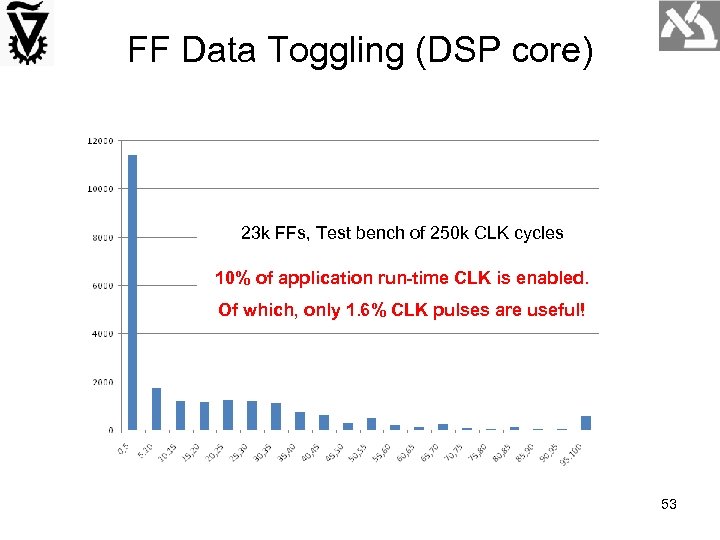
FF Data Toggling (DSP core) 23 k FFs, Test bench of 250 k CLK cycles 10% of application run-time CLK is enabled. Of which, only 1. 6% CLK pulses are useful! 53
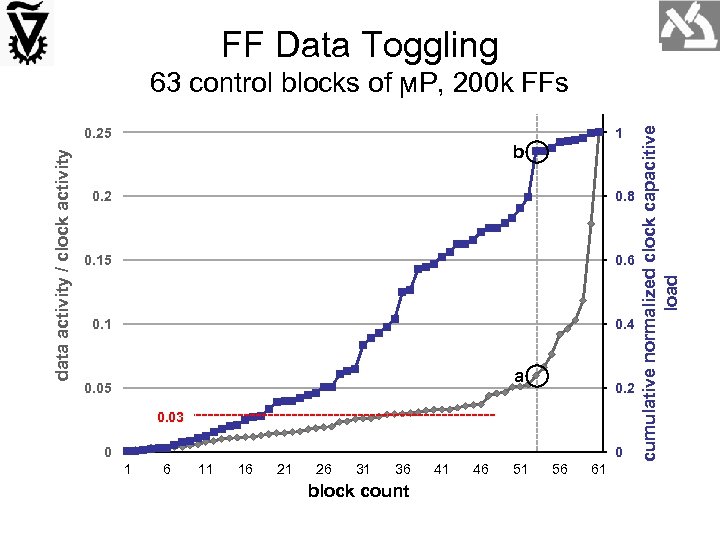
FF Data Toggling 1. 2 63 control blocks of ϻP, 200 k FFs data activity / clock activity 0. 25 1 b 0. 2 0. 8 0. 15 0. 6 0. 1 0. 4 a 0. 05 0. 2 0. 03 0 0 1 6 11 16 21 26 31 36 block count 41 46 51 56 61 cumulative normalized clock capacitive load 0. 3
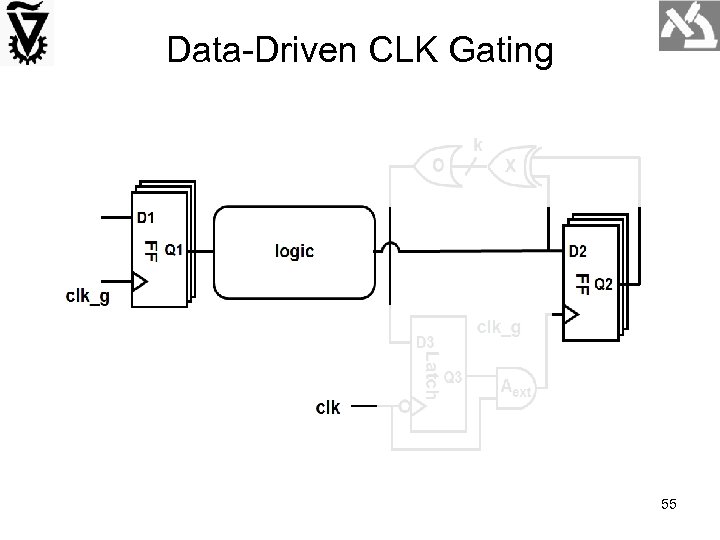
Data-Driven CLK Gating 55
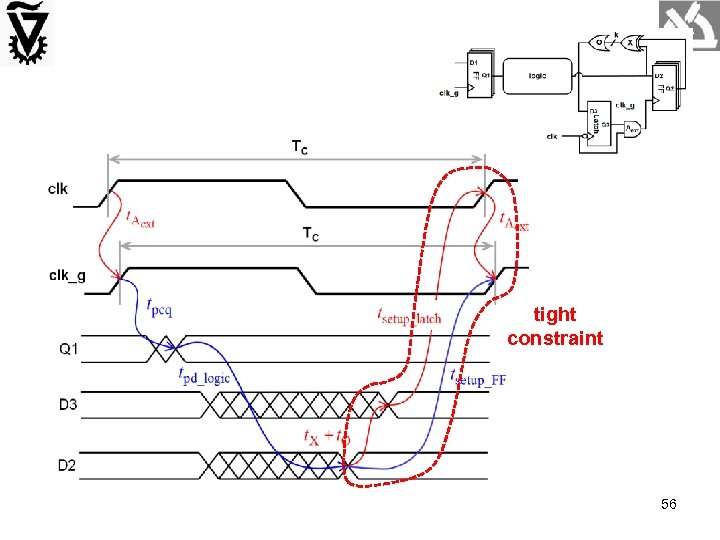
tight constraint 56
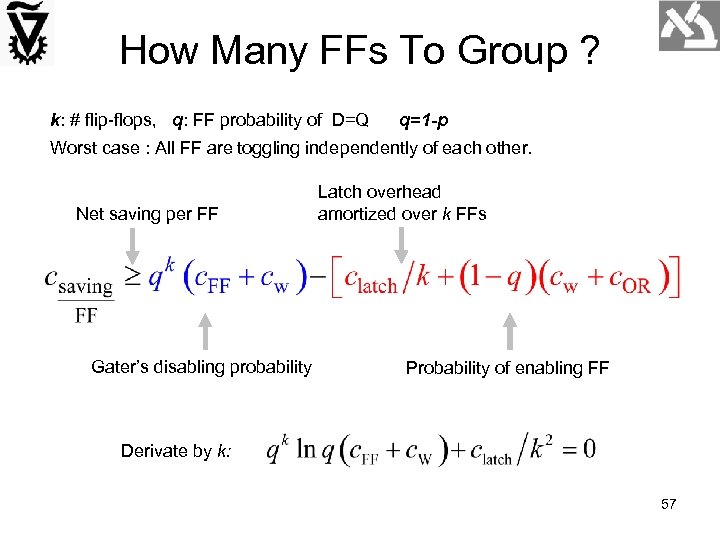
How Many FFs To Group ? k: # flip-flops, q: FF probability of D=Q q=1 -p Worst case : All FF are toggling independently of each other. Net saving per FF Gater’s disabling probability Latch overhead amortized over k FFs Probability of enabling FF Derivate by k: 57
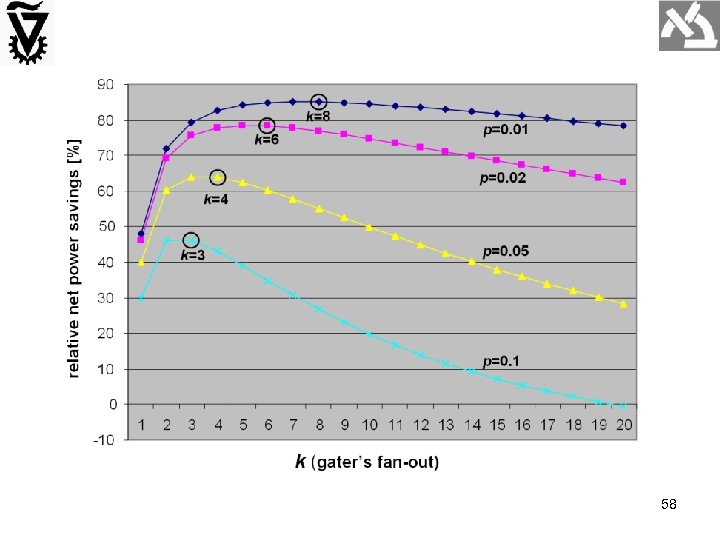
58
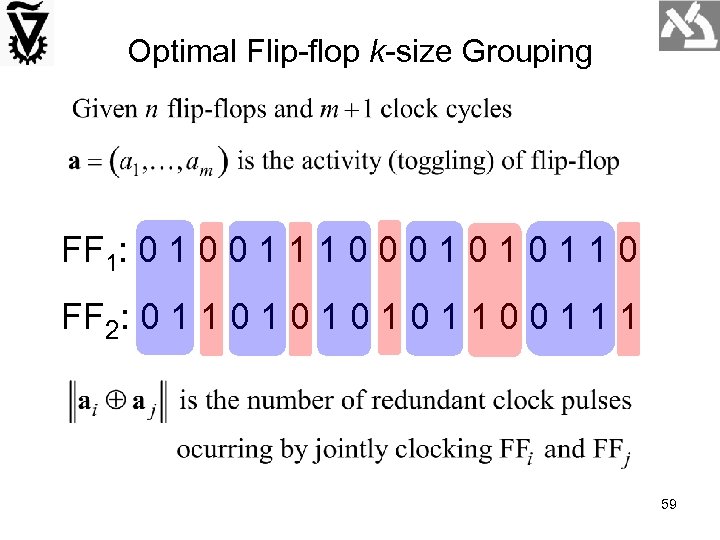
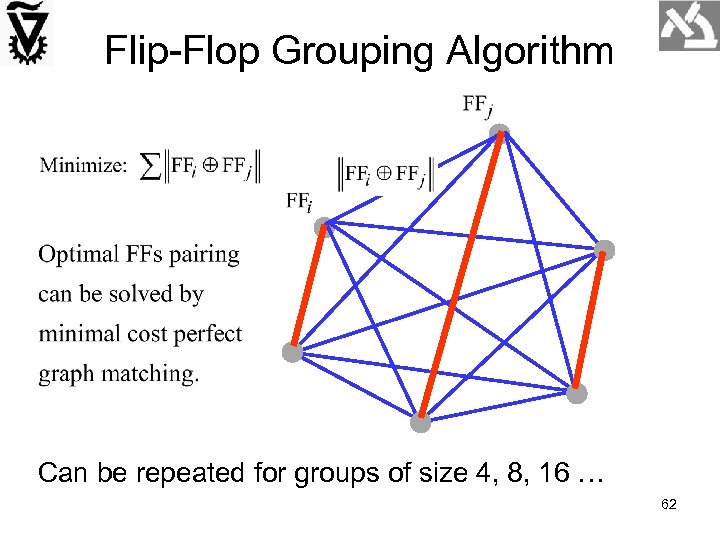
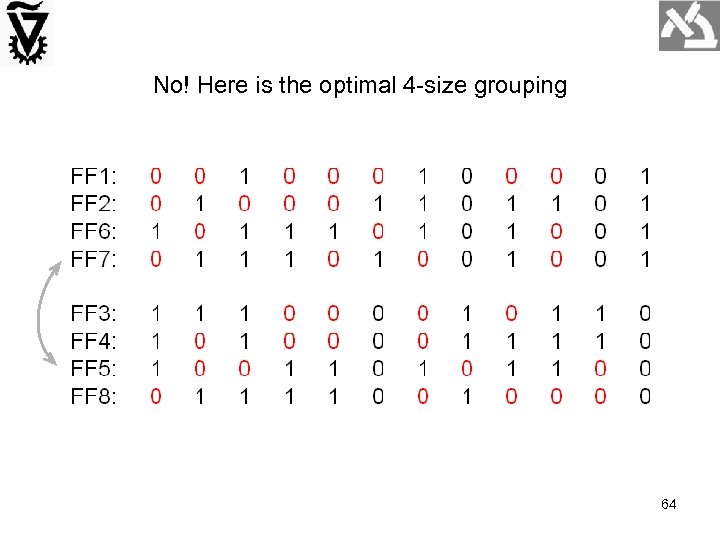
Optimal Flip-flop k-size Grouping FF 1: 0 1 0 0 1 1 1 0 0 0 1 0 1 1 0 FF 2: 0 1 1 0 1 0 1 1 0 0 1 1 1 59
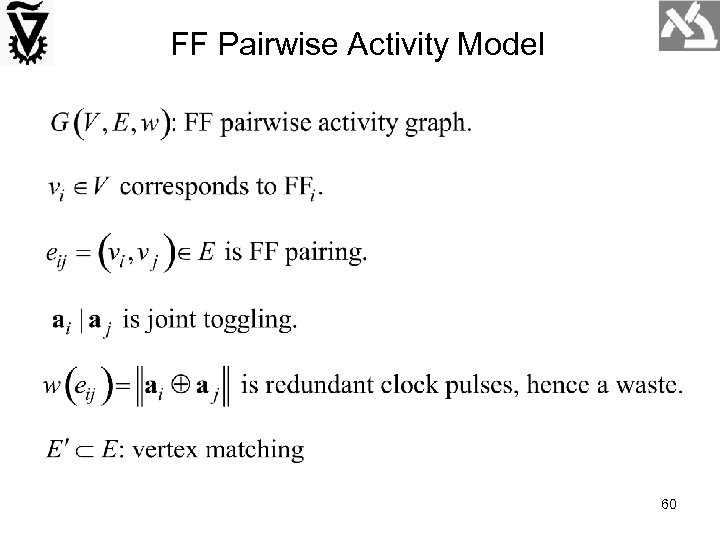
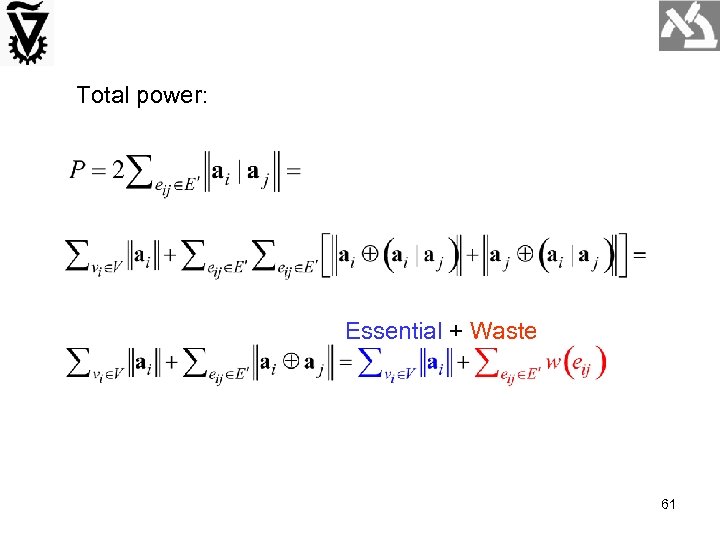
FF Pairwise Activity Model 60
Total power: Essential + Waste 61
Flip-Flop Grouping Algorithm Can be repeated for groups of size 4, 8, 16 … 62
Is repeated perfect matching optimal ? 63
No! Here is the optimal 4 -size grouping 64
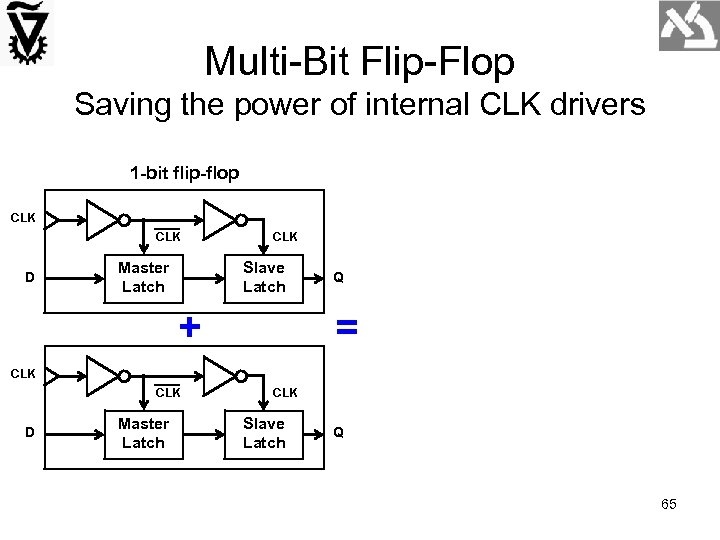
Multi-Bit Flip-Flop Saving the power of internal CLK drivers 1 -bit flip-flop 2 -bit flip-flop CLK D Master Latch CLK Slave Latch + Q = CLK D Master Latch CLK Slave Latch Q 1 CLK D 2 CLK Slave Latch D 1 Master Latch Slave Latch Q 2 Q 65
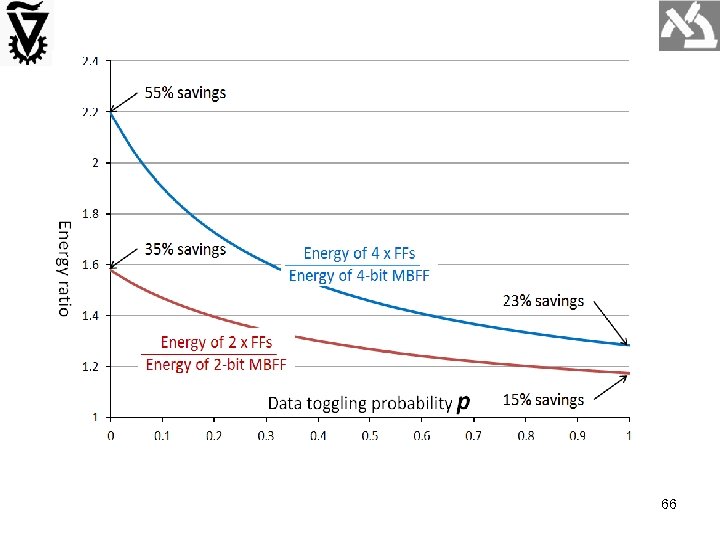
66
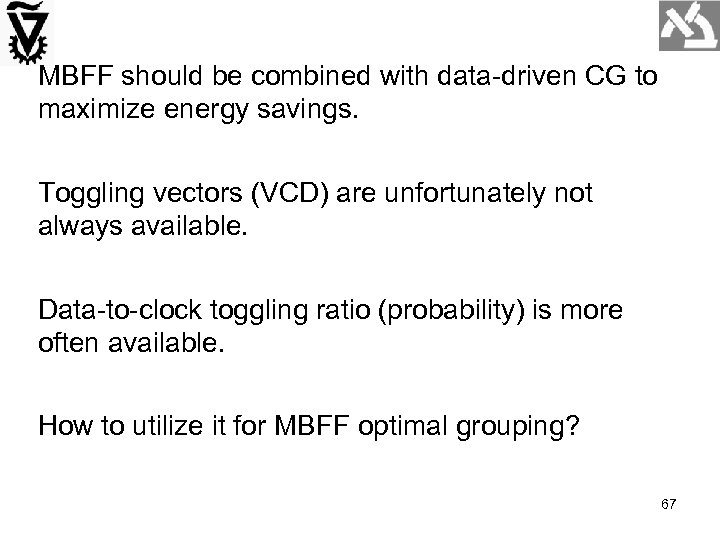
MBFF should be combined with data-driven CG to maximize energy savings. Toggling vectors (VCD) are unfortunately not always available. Data-to-clock toggling ratio (probability) is more often available. How to utilize it for MBFF optimal grouping? 67
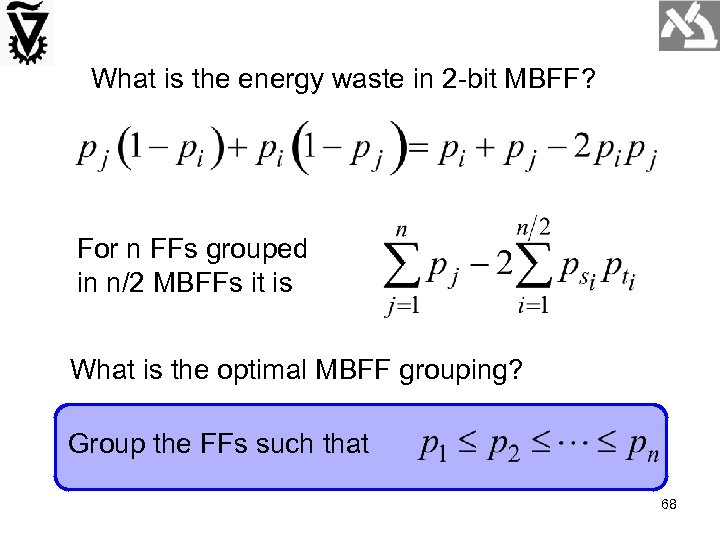
What is the energy waste in 2 -bit MBFF? For n FFs grouped in n/2 MBFFs it is What is the optimal MBFF grouping? Group the FFs such that 68
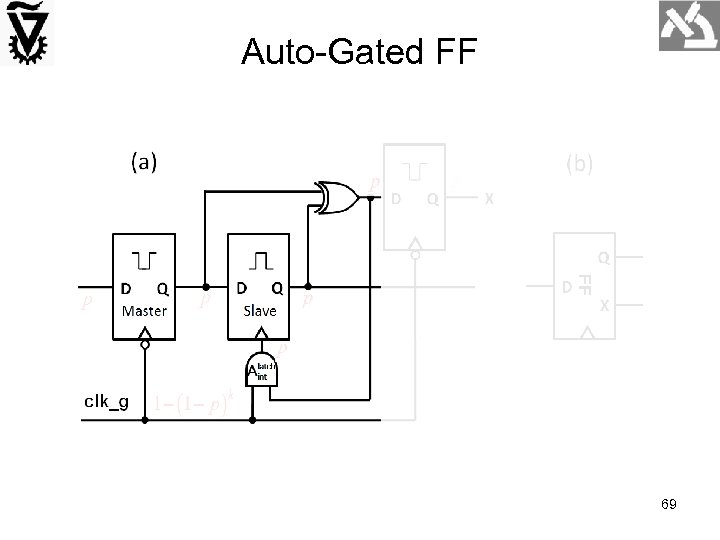
Auto-Gated FF 69
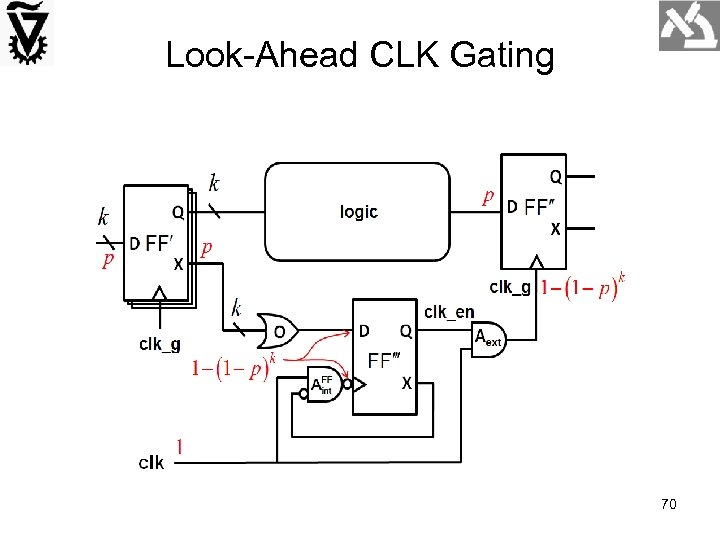
Look-Ahead CLK Gating 70
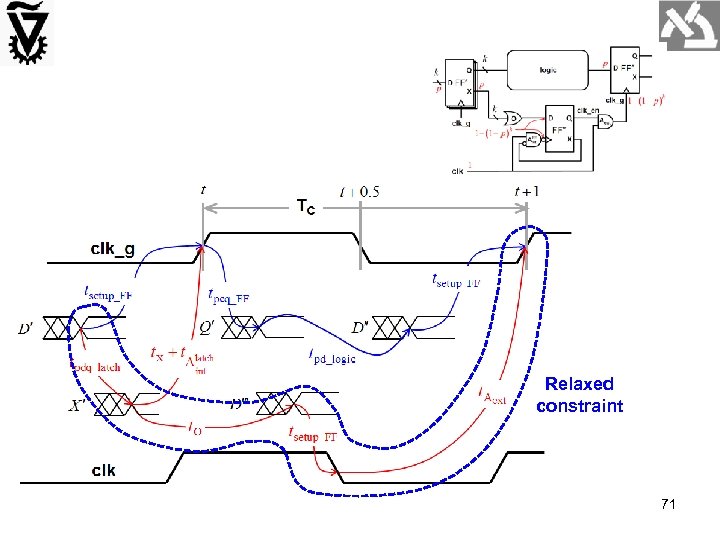
Relaxed constraint 71
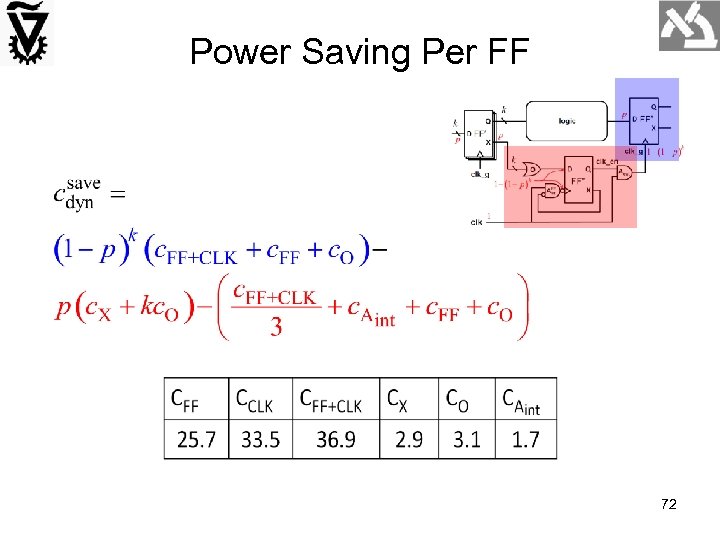
Power Saving Per FF 72
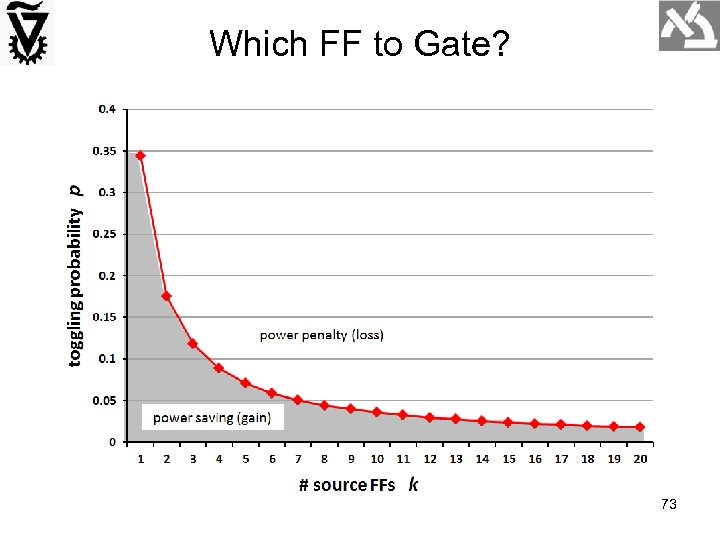
Which FF to Gate? 73
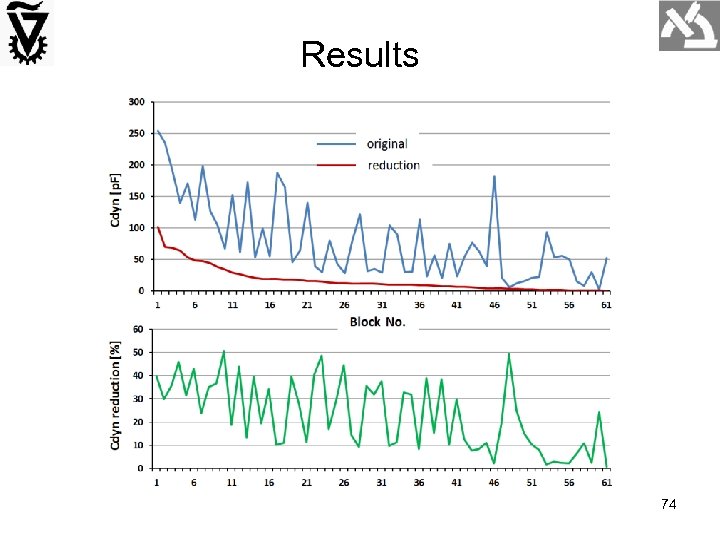
Results 74
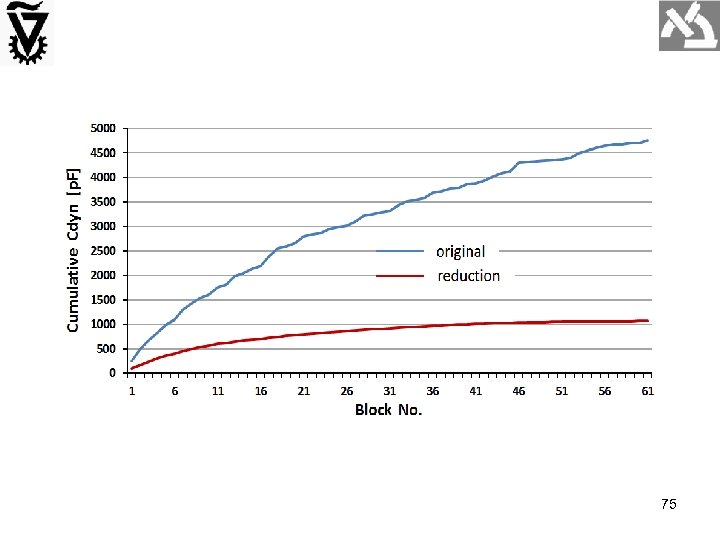
75
Скачать презентацию Clock Distribution Shmuel Wimer Bar Ilan Univ Eng
cb2e0b6eb7a2079b83d5c6d31e51b0cc.ppt