


 Скачать презентацию Clipper 1992 AT T announces the AT T 3600
8e7680c9893378c0c6f8eeffbfea03c4.ppt
- Количество слайдов: 26
 Clipper • 1992 AT&T announces the AT&T 3600 Telephone – Security Device (TSD), a commercial DES-encrypted phone add-on • The NSA goes ballistic – NSA convinces AT&T to use Clipper in the TSD in exchange for guaranteed government purchases – US government buys entire DES-based TSD production run of 9000, pays AT&T to retrofit them with Clipper • 15 April 1993, White House announces Clipper – CCEP laundered for public acceptability – Third-party access guaranteed through Law Enforcement Access Field (LEAF) – Originally LEEF, then LEAF, now DRF
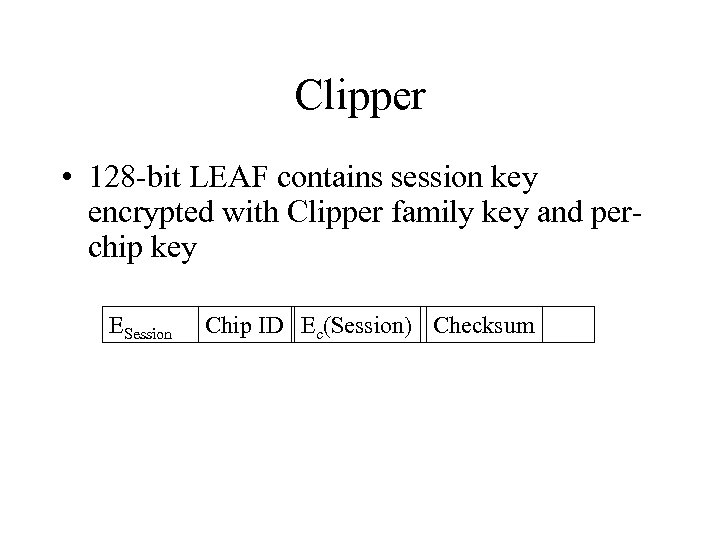 Clipper • 128 -bit LEAF contains session key encrypted with Clipper family key and perchip key ESession Chip ID Ec(Session) Checksum
 Clipper • Other party and third party decrypt LEAF with family key • Both use checksum to detect bogus LEAF • Third party looks up chip key in database, decrypts session key • To increase public acceptability the key database is stored by two different agencies • Communicate secure in the knowledge that only the worlds largest spy agency is listening
 Clipper Weaknesses • Assumes a “good” big brother • 80 -bit key is too weak • Skipjack algorithm used in Clipper had no public scrutiny • 16 -bit checksum can be defeated • Cipher operation mode (OFB) allows message forgery • Chip ID served to neatly tag and identify every communication
 Reactions to Clipper • 80% of Americans opposed it • Of over 300 submissions, only 2 were supportive • Clipper adopted as Escrowed Encryption Standard (EES) FIPS 185, in February 1994 – The legal machinations required to get this adopted fill a 200 -page law journal article • No one bought Clipper – AT&T shut down its product line – FOIA’d documents obtained later showed that the government had a secret key escrow policy which was the exact opposite of the publicly claimed Clipper policy
 Clipper • Skipjack (declassified in 1998) 1. Symmetric, 80 -bit key encryption/decryption algorithm; 2. Similar in function to DES (i. e. , basically a 64 -bit code book transformation that can be used in the same four modes of operation as specified for DES in FIPS 81); 3. 32 rounds of processing per single encrypt/decrypt operation; 4. Breakable if limited to 31 rounds 5. Design started by NSA in 1985; evaluation completed in 1990.
 S/MIME • Originally based on proprietary RSADSI standards and MIME – PKCS, Public Key Cryptography Standards • RC 2, RC 4 for data encryption • PKCS #1, RSA encryption, for key exchange • PKCS #7, cryptographic message syntax (CMS), for message formatting • Newer versions added non-proprietary and non-patented ciphers
 CMS • Cryptographic Message Syntax – Type-and-value format • Data content types – – – Data Signed data Encrypted data (conventional encryption) Enveloped data (PKC-encrypted) Digested (hashed) data Authenticated (MAC’d) data
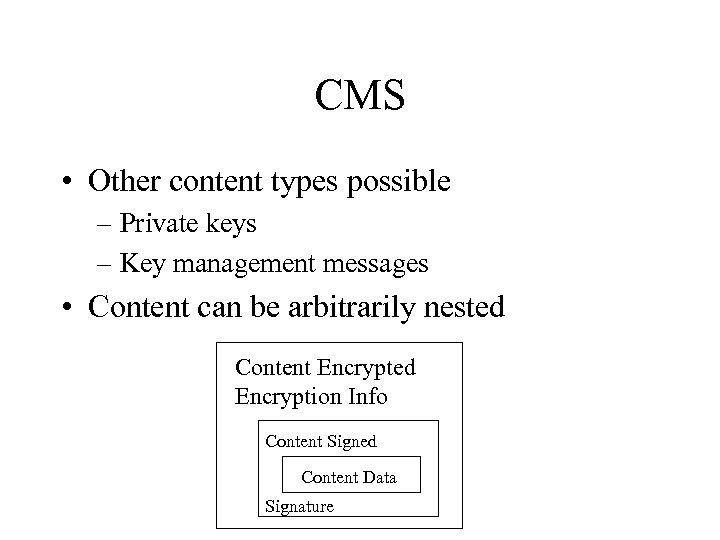 CMS • Other content types possible – Private keys – Key management messages • Content can be arbitrarily nested Content Encrypted Encryption Info Content Signed Content Data Signature
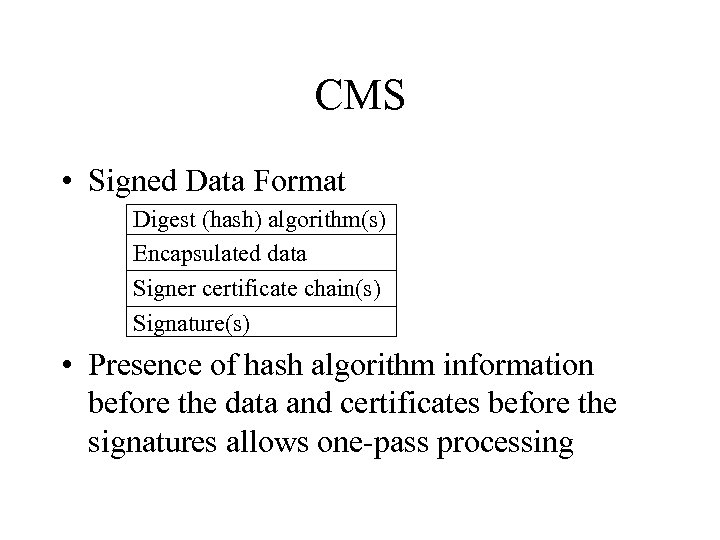 CMS • Signed Data Format Digest (hash) algorithm(s) Encapsulated data Signer certificate chain(s) Signature(s) • Presence of hash algorithm information before the data and certificates before the signatures allows one-pass processing
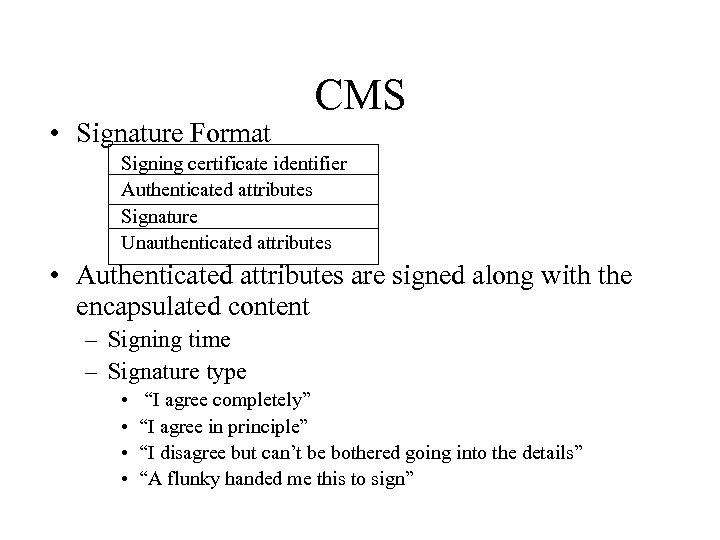 • Signature Format CMS Signing certificate identifier Authenticated attributes Signature Unauthenticated attributes • Authenticated attributes are signed along with the encapsulated content – Signing time – Signature type • • “I agree completely” “I agree in principle” “I disagree but can’t be bothered going into the details” “A flunky handed me this to sign”
 CMS – Receipt request – Security label – Mailing list information • Unauthenticated attributes provide a means of adding further information without breaking the original signature – Countersignature • Countersigns an existing signature • Signs signature on content rather than content itself, so other content doesn’t have to be present • Countersignatures can contain further countersignatures
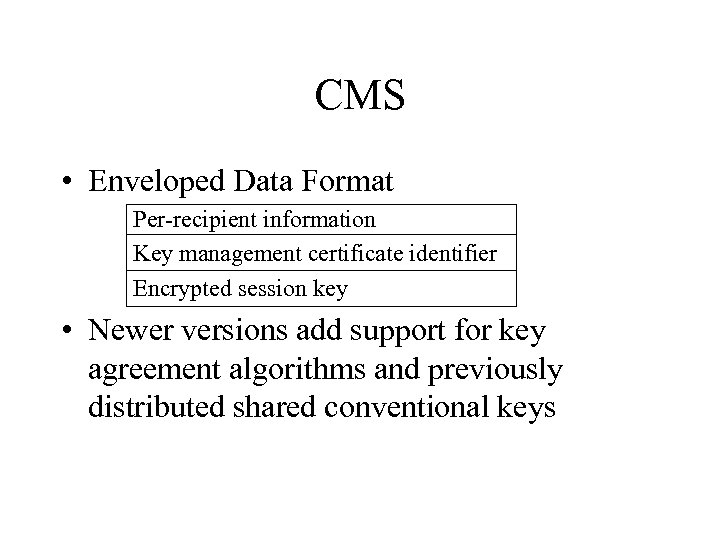 CMS • Enveloped Data Format Per-recipient information Key management certificate identifier Encrypted session key • Newer versions add support for key agreement algorithms and previously distributed shared conventional keys
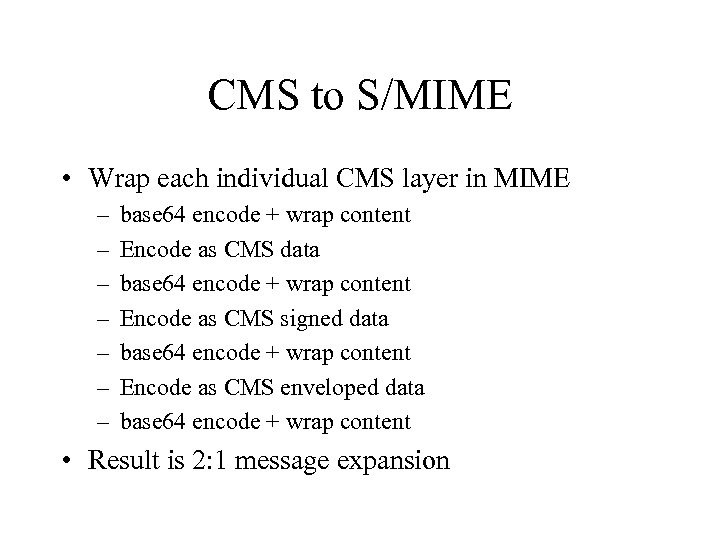 CMS to S/MIME • Wrap each individual CMS layer in MIME – – – – base 64 encode + wrap content Encode as CMS data base 64 encode + wrap content Encode as CMS signed data base 64 encode + wrap content Encode as CMS enveloped data base 64 encode + wrap content • Result is 2: 1 message expansion
 S/MIME • Earlier versions used mostly crippled crypto – Only way to interoperate was 40 -bit RC 2 • RC 2/40 is still the lowest-common-denominator default • User is given no warning of the use of crippled crypto – Message forwarding may result in security downgrade – S/MIME-cracking screen saver released in 1997, http: //www. counterpane. com/smime. html • Performs optimized attack using RC 2 key setup cycles • Looks for MIME header in decrypted data • Original S/MIME based on patented RSA and proprietary RC 2, rejected by IETF as a standard • IETF developed S/MIME v 3 using strong crypto and non-patented, non-proprietary technology
 SET • Secure Electronic Transactions • Based on two earlier protocols, STT (VISA/Microsoft) and SEPP (Master. Card/IBM) • STT – – One component of a larger architecture Provision for strong encryption Completely new system More carefully thought out from a security standpoint
 SET • SEPP – General architectural design rather than a precise specification – Lowest-common-denominator crypto – Fits in with existing infrastructure – More politically and commercially astute
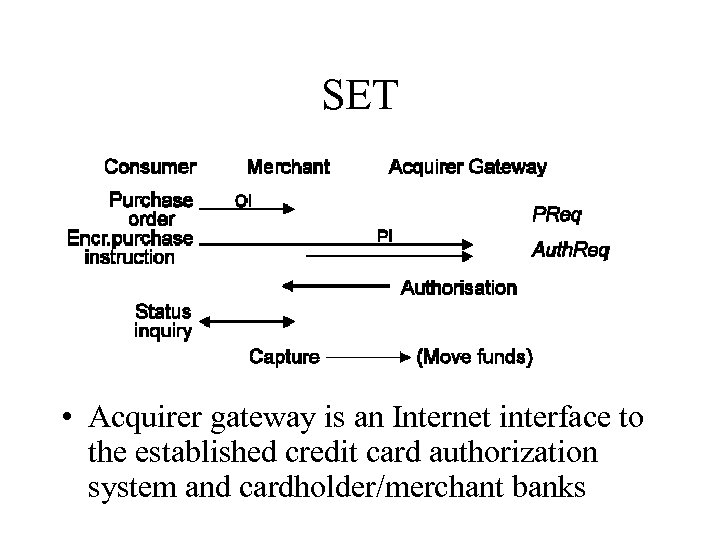 SET • Acquirer gateway is an Internet interface to the established credit card authorization system and cardholder/merchant banks
 SET • Card details are never disclosed to merchant – Encrypted purchase instruction (PI) can only be decrypted by the acquirer • In practice the acquirer usually reveals the card details to the merchant after approval, for purchase tracking purposes – PI is cryptographically tied to the order instruction (OI) processed by the merchant – Clients digital signature protects the merchant from client repudiation • Authorization request includes the consumer PI and merchant equivalent of the PI – Acquirer can confirm that the cardholder and merchant agree on the purchase details
 SET • Capture can take place later (eg when the goods are shipped) – User can perform an inquiry transaction to check the status • The whole SET protocol is vastly more complex than this
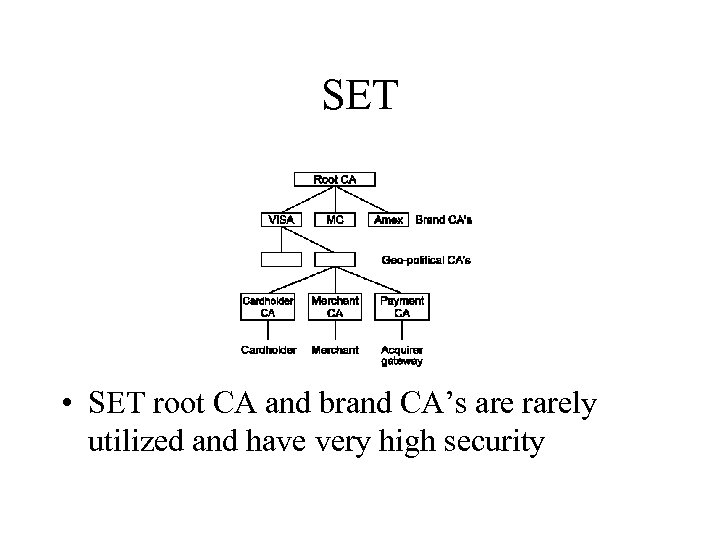 SET • SET root CA and brand CA’s are rarely utilized and have very high security
 SET • SET includes a complete PKI using customized X. 509 – Online certificate requests – Certificate distribution – Certificate revocation • SET certificates are implemented as an X. 509 profile with SET-specific extensions
 SET • Card-based infrastructure makes certificate management (relatively) easy – Users are identified by their cards – Certificates are revoked by cancelling the card – Because everything is done online, “certificate management” is easy – Acquirer gateways have long-term signature keys and short-term encryption keys • Encryption keys can be revoked by letting them expire
 SET Advantages • SET will enable e-commerce, eliminate world hunger, and close the ozone hole – SET prevents fraud in card not present transactions • SET eliminates the need for a middleman (the banks love this) • SET leverages the existing infrastructure
 SET (problems) • SET is the most complex (published) crypto protocol ever designed – > 3000 lines of ASN. 1 specification – 28 -stage (!) transaction process • “The SET reference implementation will be available by mid 1996” • “SET 1. 0 " " " mid 1997” • “SET 2. 0 " " " mid 1998” – Interoperability across different implementations is a problem • SET is awfully slow (6 RSA operations per transaction) – Great for crypto hardware accelerator manufacturers – For comparison, VISA interchange gateway currently has to handle 2000 pure DES-based transactions/second
 SET (problems) • Although SET was specifically designed for exportability, you could not export the reference implementation for long time • SET requires – Custom wallet software on the cardholders PC – Custom merchant software – Special transaction processing software (and hardware) at the acquirer gateway.