 Скачать презентацию Clinical Assessment for Systems Strengthening Cl ASS HARVARD BHP
aa72007b97d944dd50ec719cac91fed2.ppt
- Количество слайдов: 40



Clinical Assessment for Systems Strengthening (Cl. ASS) HARVARD‐BHP ASSESSMENT Briefing Meeting with CDC/Botswana JOSE “RAFI” MORALES, MD, FACOG CHIEF MEDICAL OFFICER January 25, 2010 HRSA, HIV/AIDS BUREAU, GLOBAL HIV/AIDS PROGRAM
Meeting with CDC/Botswana AGENDA 1. 2. 3. 4. 5. 6. 7. Introductions Cl. ASS Framework Overview Orientation on Tools Cl. ASS Harvard‐BHP Assessment Overview Discussion Logistics Way Forward
Purpose To provide HRSA with an approach to assess the administrative, clinical, and financial capacity of USG‐supported HIV/AIDS programs; To inform HRSA and relevant partners of existing technical assistance needs, identify available resources to address these needs, and enable technical and organizational strengthening at the international partner, local partner, and clinic site levels. To facilitate a process for HRSA and relevant partners to determine readiness and ensure a successful and sustainable transition of programs to local leadership.
Guiding Principles High quality services to people infected and affected with HIV/AIDS Systems strengthening through local capacity development; and Increased country ownership through transition of programs to local leadership
Partner Collaboration The Cl. ASS Framework is adaptable for specific country and program needs HRSA works with key partners to adapt and implement the Cl. ASS Areas for partner collaboration with Cl. ASS assessments include: Identifying the scope and nature of the assessment Site selection Participating on an assessment team Reviewing the assessment report and providing recommendations Leveraging existing technical assistance resources
Objectives Assess the quality of services and care provided to patients; Ensure that organizational systems, policies, and procedures are in place to accomplish program goals and objectives; Assess the organization’s capacity to provide the funded services and manage funding; Identify program strengths and weaknesses and provide appropriate consultation to enhance their capacity to provide high quality, cost competitive health care and services; Specify areas of system strengthening to enable organizations to sustain their HIV service delivery; and Identify model programs or program components that can be replicated in other communities or organizations.
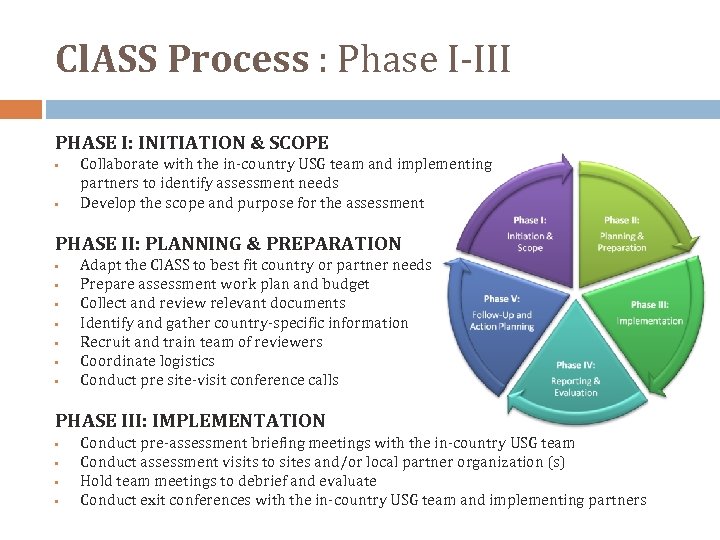
Cl. ASS Process : Phase I‐III PHASE I: INITIATION & SCOPE • • Collaborate with the in‐country USG team and implementing partners to identify assessment needs Develop the scope and purpose for the assessment PHASE II: PLANNING & PREPARATION • • Adapt the Cl. ASS to best fit country or partner needs Prepare assessment work plan and budget Collect and review relevant documents Identify and gather country‐specific information Recruit and train team of reviewers Coordinate logistics Conduct pre site‐visit conference calls PHASE III: IMPLEMENTATION • • Conduct pre‐assessment briefing meetings with the in‐country USG team Conduct assessment visits to sites and/or local partner organization (s) Hold team meetings to debrief and evaluate Conduct exit conferences with the in‐country USG team and implementing partners
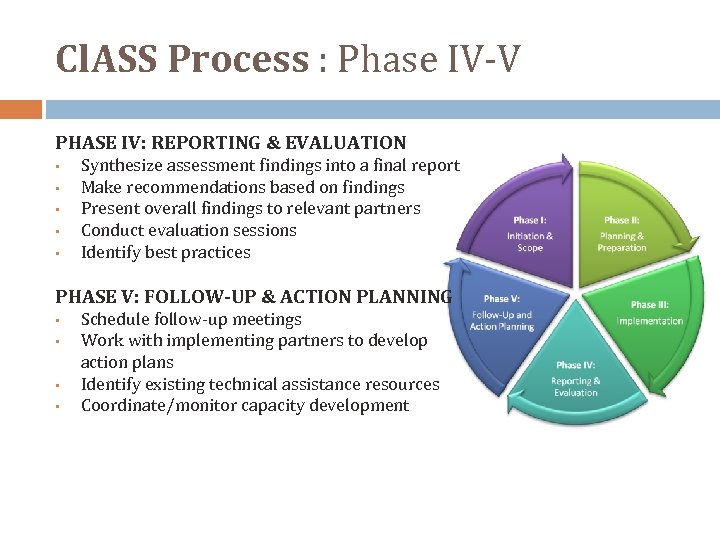
Cl. ASS Process : Phase IV‐V PHASE IV: REPORTING & EVALUATION • • • Synthesize assessment findings into a final report Make recommendations based on findings Present overall findings to relevant partners Conduct evaluation sessions Identify best practices PHASE V: FOLLOW-UP & ACTION PLANNING • • Schedule follow‐up meetings Work with implementing partners to develop action plans Identify existing technical assistance resources Coordinate/monitor capacity development
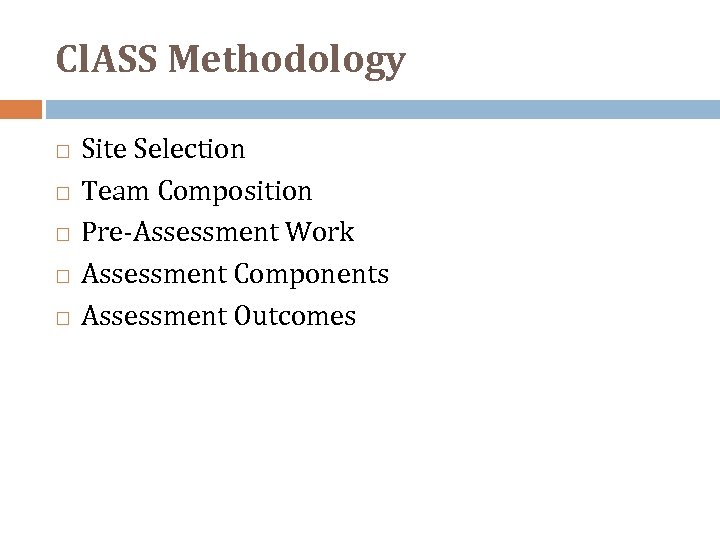
Cl. ASS Methodology Site Selection Team Composition Pre‐Assessment Work Assessment Components Assessment Outcomes
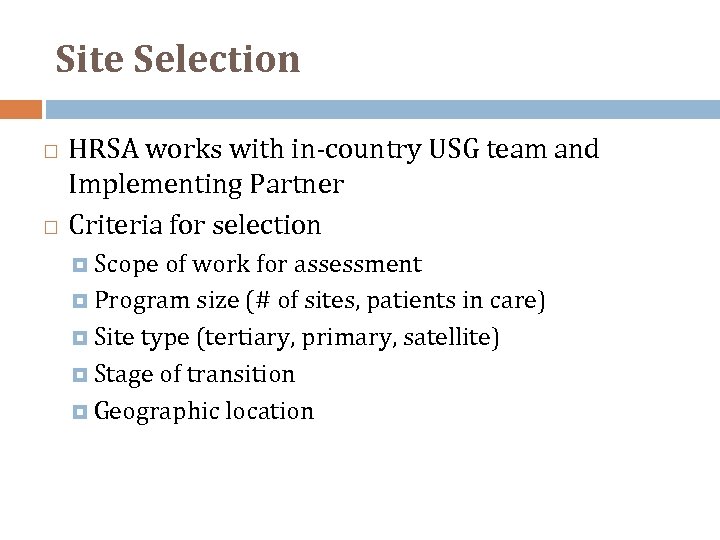
Site Selection HRSA works with in‐country USG team and Implementing Partner Criteria for selection Scope of work for assessment Program size (# of sites, patients in care) Site type (tertiary, primary, satellite) Stage of transition Geographic location
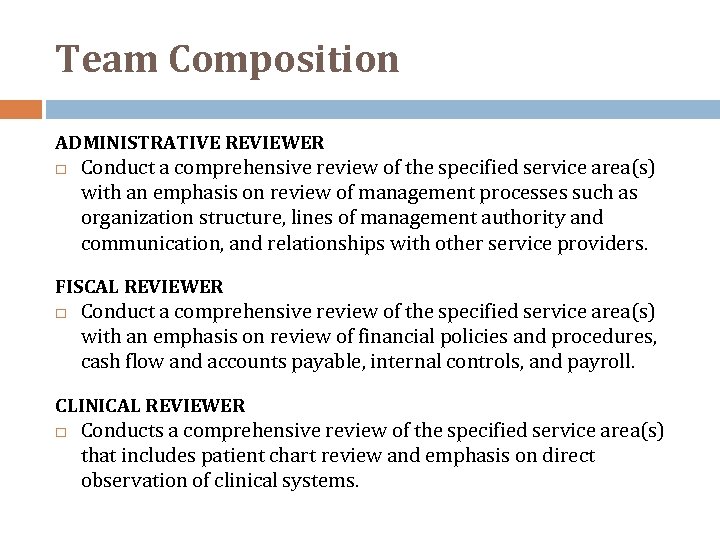
Team Composition ADMINISTRATIVE REVIEWER Conduct a comprehensive review of the specified service area(s) with an emphasis on review of management processes such as organization structure, lines of management authority and communication, and relationships with other service providers. FISCAL REVIEWER Conduct a comprehensive review of the specified service area(s) with an emphasis on review of financial policies and procedures, cash flow and accounts payable, internal controls, and payroll. CLINICAL REVIEWER Conducts a comprehensive review of the specified service area(s) that includes patient chart review and emphasis on direct observation of clinical systems.
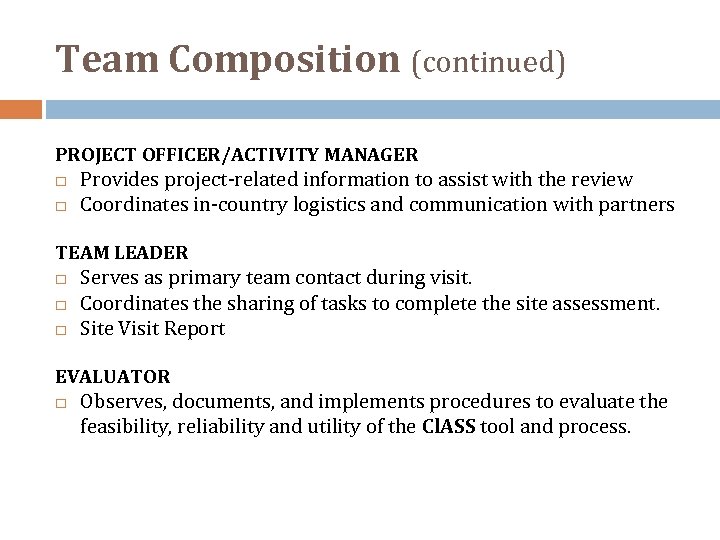
Team Composition (continued) PROJECT OFFICER/ACTIVITY MANAGER Provides project‐related information to assist with the review Coordinates in‐country logistics and communication with partners TEAM LEADER Serves as primary team contact during visit. Coordinates the sharing of tasks to complete the site assessment. Site Visit Report EVALUATOR Observes, documents, and implements procedures to evaluate the feasibility, reliability and utility of the Cl. ASS tool and process.
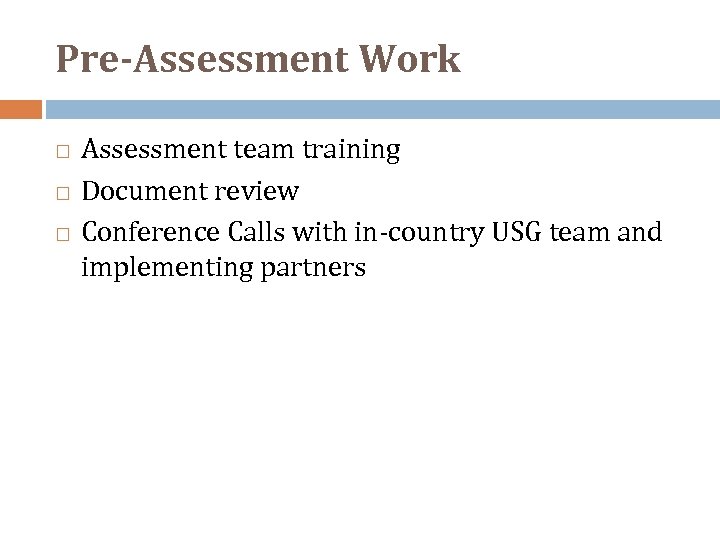
Pre-Assessment Work Assessment team training Document review Conference Calls with in‐country USG team and implementing partners
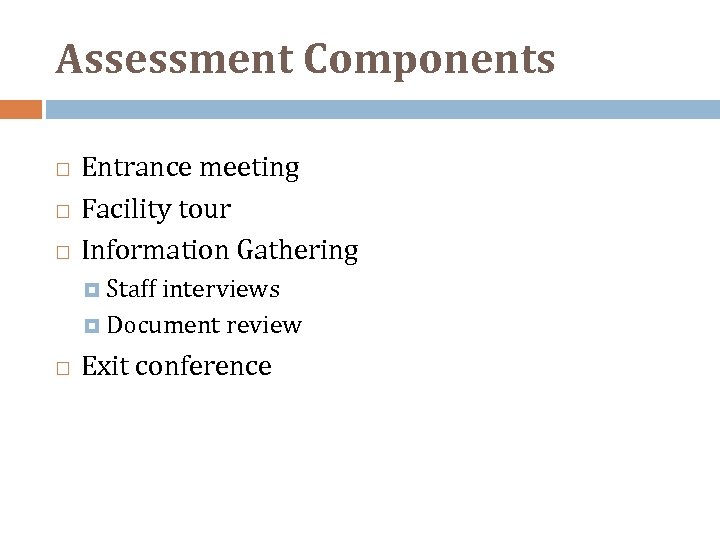
Assessment Components Entrance meeting Facility tour Information Gathering Staff interviews Document review Exit conference
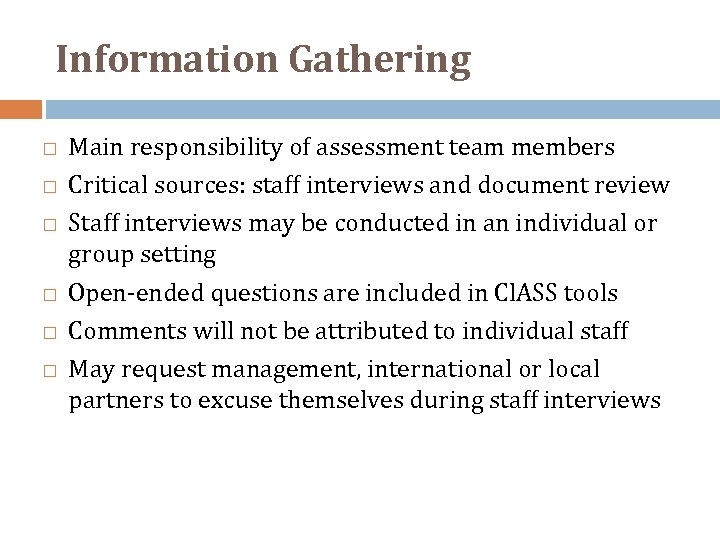
Information Gathering Main responsibility of assessment team members Critical sources: staff interviews and document review Staff interviews may be conducted in an individual or group setting Open‐ended questions are included in Cl. ASS tools Comments will not be attributed to individual staff May request management, international or local partners to excuse themselves during staff interviews
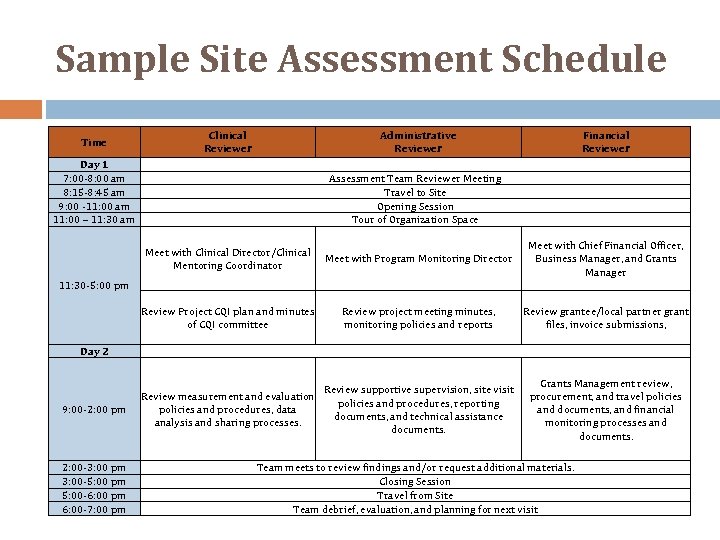
Sample Site Assessment Schedule Time Clinical Reviewer Administrative Reviewer Day 1 7: 00‐ 8: 00 am 8: 15‐ 8: 45 am 9: 00 ‐ 11: 00 am 11: 00 – 11: 30 am Financial Reviewer Assessment Team Reviewer Meeting Travel to Site Opening Session Tour of Organization Space Meet with Clinical Director/Clinical Mentoring Coordinator Meet with Program Monitoring Director Meet with Chief Financial Officer, Business Manager, and Grants Manager Review Project CQI plan and minutes of CQI committee Review project meeting minutes, monitoring policies and reports Review grantee/local partner grant files, invoice submissions, 11: 30‐ 5: 00 pm Day 2 9: 00‐ 2: 00 pm 2: 00‐ 3: 00 pm 3: 00‐ 5: 00 pm 5: 00‐ 6: 00 pm 6: 00‐ 7: 00 pm Review supportive supervision, site visit Review measurement and evaluation policies and procedures, reporting policies and procedures, data documents, and technical assistance analysis and sharing processes. documents. Grants Management review, procurement, and travel policies and documents, and financial monitoring processes and documents. Team meets to review findings and/or request additional materials. Closing Session Travel from Site Team debrief, evaluation, and planning for next visit
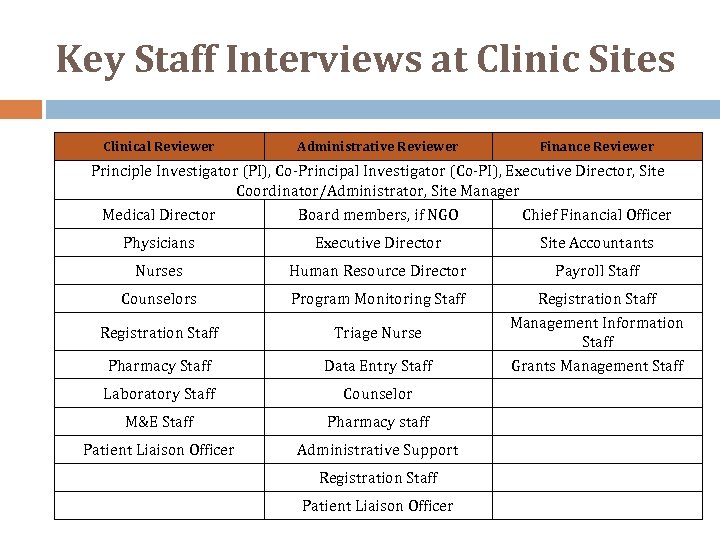
Key Staff Interviews at Clinic Sites Clinical Reviewer Administrative Reviewer Finance Reviewer Principle Investigator (PI), Co‐Principal Investigator (Co‐PI), Executive Director, Site Coordinator/Administrator, Site Manager Medical Director Board members, if NGO Chief Financial Officer Physicians Executive Director Site Accountants Nurses Human Resource Director Payroll Staff Counselors Program Monitoring Staff Registration Staff Triage Nurse Pharmacy Staff Data Entry Staff Registration Staff Management Information Staff Grants Management Staff Laboratory Staff Counselor M&E Staff Pharmacy staff Patient Liaison Officer Administrative Support Registration Staff Patient Liaison Officer
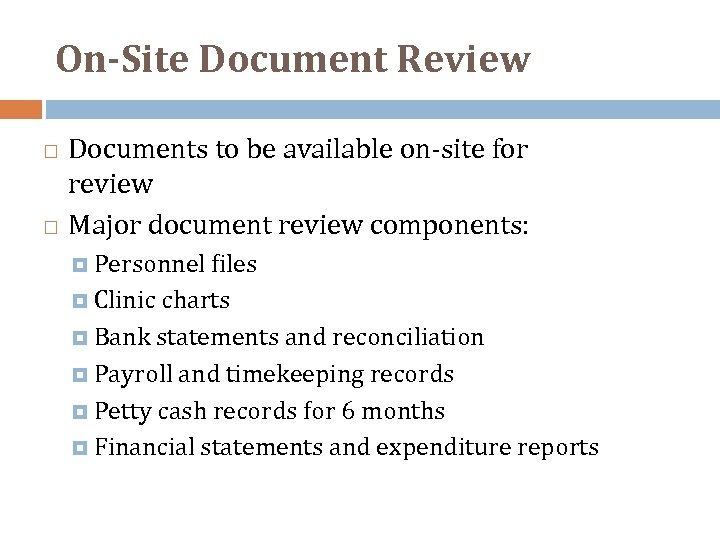
On-Site Document Review Documents to be available on‐site for review Major document review components: Personnel files Clinic charts Bank statements and reconciliation Payroll and timekeeping records Petty cash records for 6 months Financial statements and expenditure reports
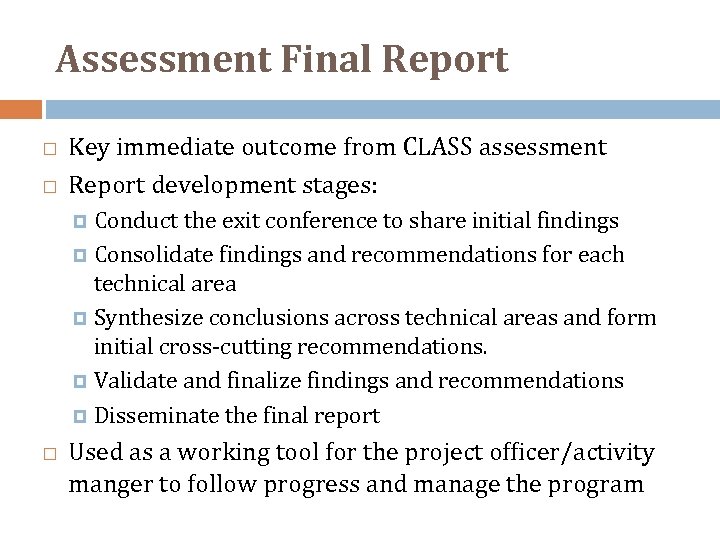
Assessment Final Report Key immediate outcome from CLASS assessment Report development stages: Conduct the exit conference to share initial findings Consolidate findings and recommendations for each technical area Synthesize conclusions across technical areas and form initial cross‐cutting recommendations. Validate and finalize findings and recommendations Disseminate the final report Used as a working tool for the project officer/activity manger to follow progress and manage the program
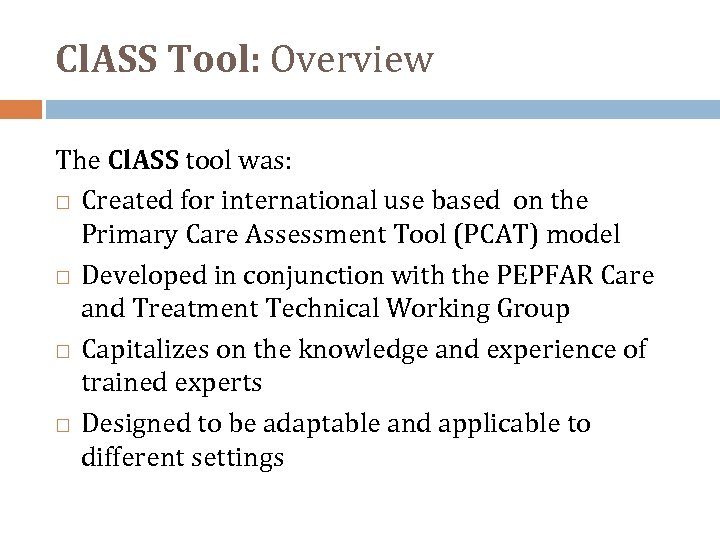
Cl. ASS Tool: Overview The Cl. ASS tool was: Created for international use based on the Primary Care Assessment Tool (PCAT) model Developed in conjunction with the PEPFAR Care and Treatment Technical Working Group Capitalizes on the knowledge and experience of trained experts Designed to be adaptable and applicable to different settings
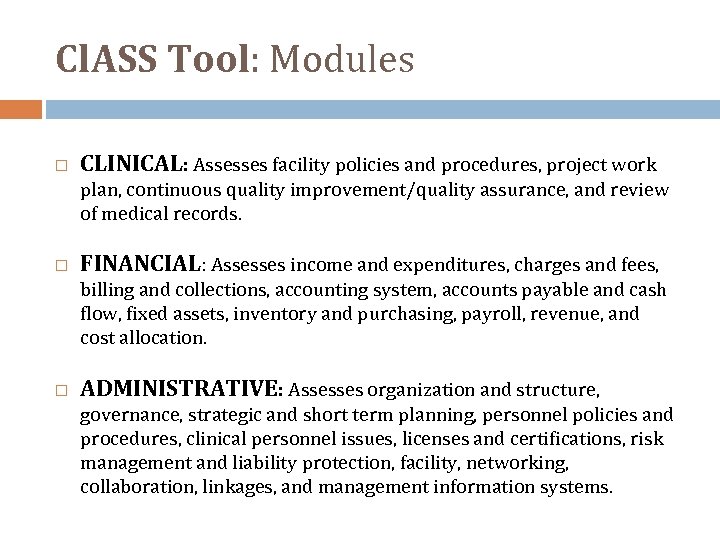
Cl. ASS Tool: Modules CLINICAL: Assesses facility policies and procedures, project work plan, continuous quality improvement/quality assurance, and review of medical records. FINANCIAL: Assesses income and expenditures, charges and fees, billing and collections, accounting system, accounts payable and cash flow, fixed assets, inventory and purchasing, payroll, revenue, and cost allocation. ADMINISTRATIVE: Assesses organization and structure, governance, strategic and short term planning, personnel policies and procedures, clinical personnel issues, licenses and certifications, risk management and liability protection, facility, networking, collaboration, linkages, and management information systems.
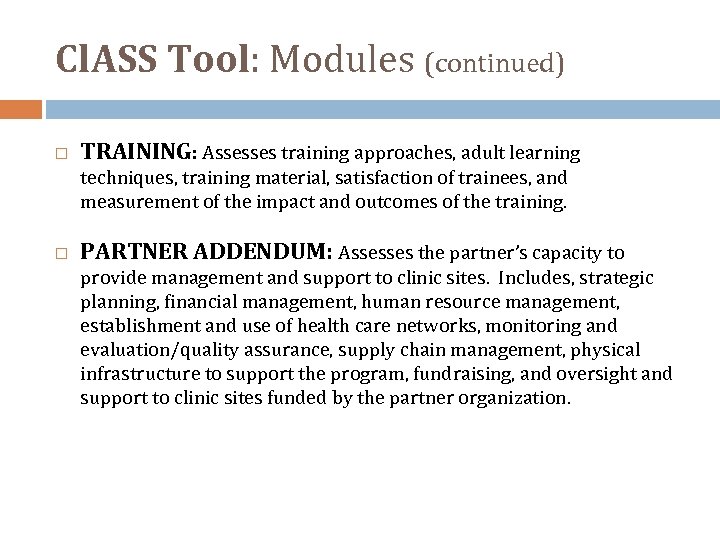
Cl. ASS Tool: Modules (continued) TRAINING: Assesses training approaches, adult learning techniques, training material, satisfaction of trainees, and measurement of the impact and outcomes of the training. PARTNER ADDENDUM: Assesses the partner’s capacity to provide management and support to clinic sites. Includes, strategic planning, financial management, human resource management, establishment and use of health care networks, monitoring and evaluation/quality assurance, supply chain management, physical infrastructure to support the program, fundraising, and oversight and support to clinic sites funded by the partner organization.
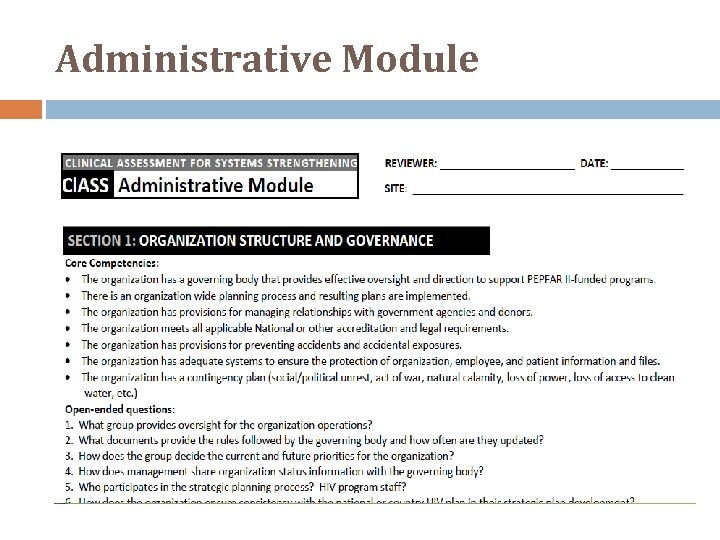
Administrative Module
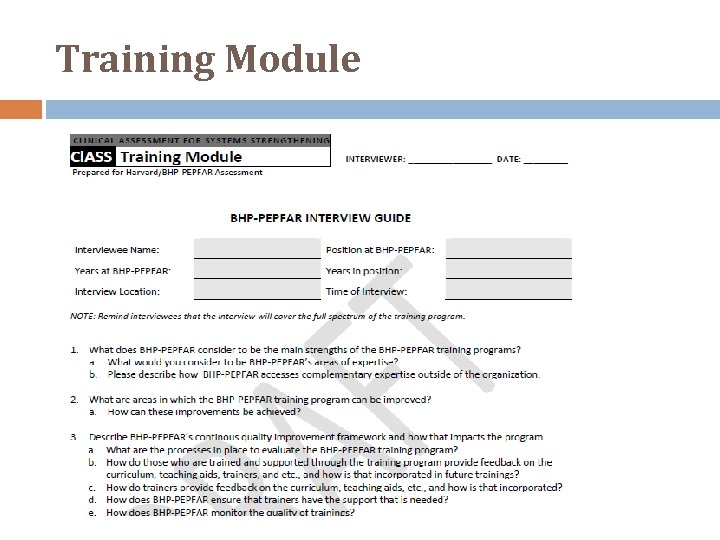
Training Module
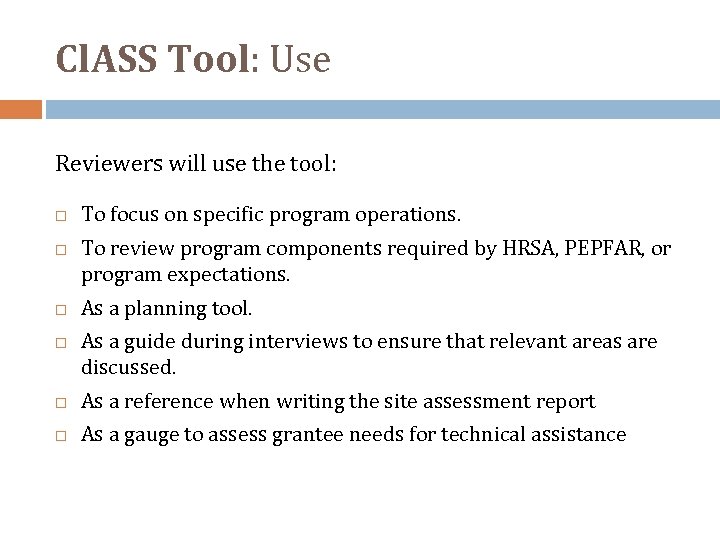
Cl. ASS Tool: Use Reviewers will use the tool: To focus on specific program operations. To review program components required by HRSA, PEPFAR, or program expectations. As a planning tool. As a guide during interviews to ensure that relevant areas are discussed. As a reference when writing the site assessment report As a gauge to assess grantee needs for technical assistance
Cl. ASS Harvard/BHP‐PEPFAR Assessment January 25‐February 5, 2010
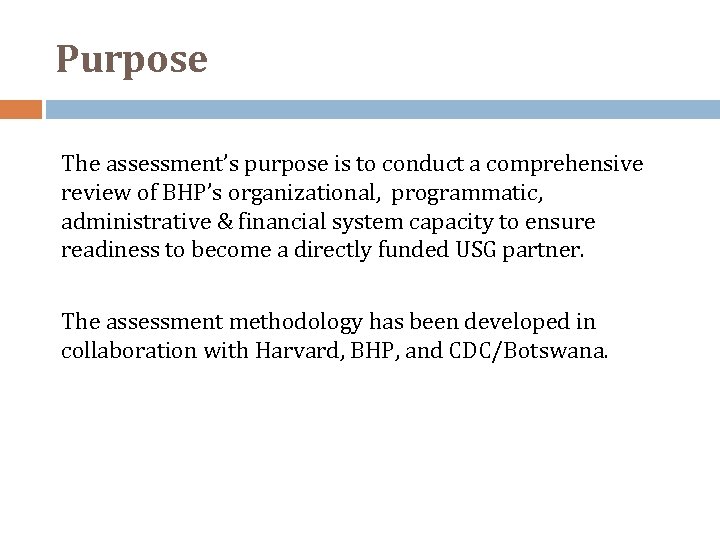
Purpose The assessment’s purpose is to conduct a comprehensive review of BHP’s organizational, programmatic, administrative & financial system capacity to ensure readiness to become a directly funded USG partner. The assessment methodology has been developed in collaboration with Harvard, BHP, and CDC/Botswana.
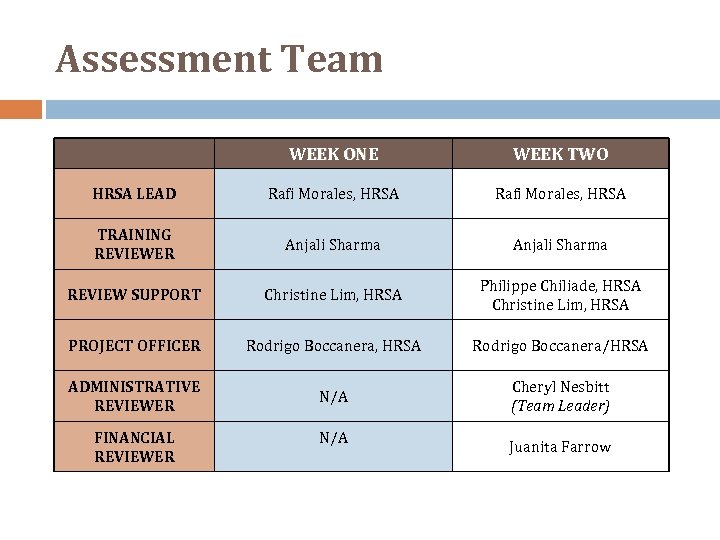
Assessment Team WEEK ONE WEEK TWO HRSA LEAD Rafi Morales, HRSA TRAINING REVIEWER Anjali Sharma REVIEW SUPPORT Christine Lim, HRSA Philippe Chiliade, HRSA Christine Lim, HRSA PROJECT OFFICER Rodrigo Boccanera, HRSA Rodrigo Boccanera/HRSA ADMINISTRATIVE REVIEWER N/A Cheryl Nesbitt (Team Leader) FINANCIAL REVIEWER N/A Juanita Farrow
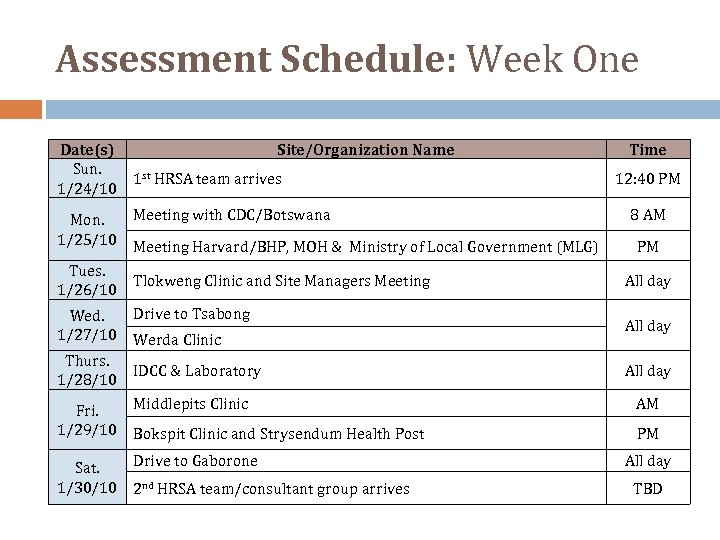
Assessment Schedule: Week One Date(s) Sun. 1/24/10 Mon. 1/25/10 Tues. 1/26/10 Wed. 1/27/10 Thurs. 1/28/10 Site/Organization Name 1 st HRSA team arrives Meeting with CDC/Botswana Meeting Harvard/BHP, MOH & Ministry of Local Government (MLG) Tlokweng Clinic and Site Managers Meeting Drive to Tsabong Werda Clinic IDCC & Laboratory Time 12: 40 PM 8 AM PM All day Fri. 1/29/10 Middlepits Clinic AM Bokspit Clinic and Strysendum Health Post PM Sat. 1/30/10 Drive to Gaborone 2 nd HRSA team/consultant group arrives All day TBD
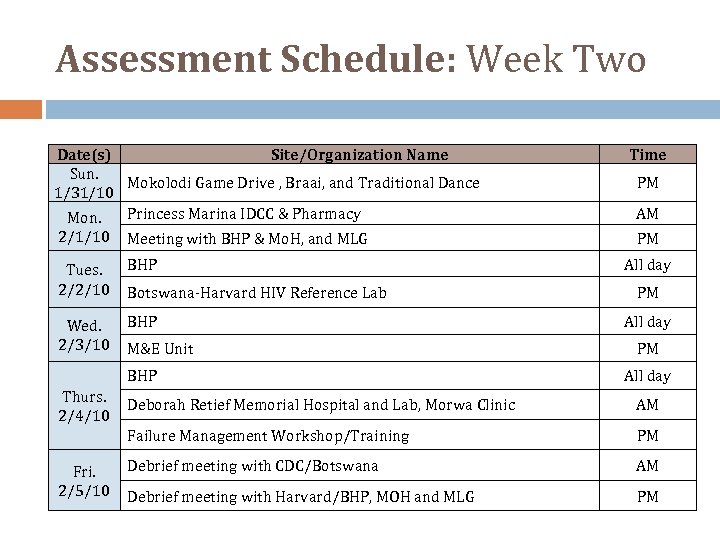
Assessment Schedule: Week Two Date(s) Site/Organization Name Sun. Mokolodi Game Drive , Braai, and Traditional Dance 1/31/10 Mon. Princess Marina IDCC & Pharmacy 2/1/10 Meeting with BHP & Mo. H, and MLG Tues. 2/2/10 BHP Wed. 2/3/10 BHP Botswana‐Harvard HIV Reference Lab M&E Unit BHP Thurs. 2/4/10 Time PM AM PM All day AM Failure Management Workshop/Training Fri. 2/5/10 Deborah Retief Memorial Hospital and Lab, Morwa Clinic PM Debrief meeting with CDC/Botswana AM Debrief meeting with Harvard/BHP, MOH and MLG PM
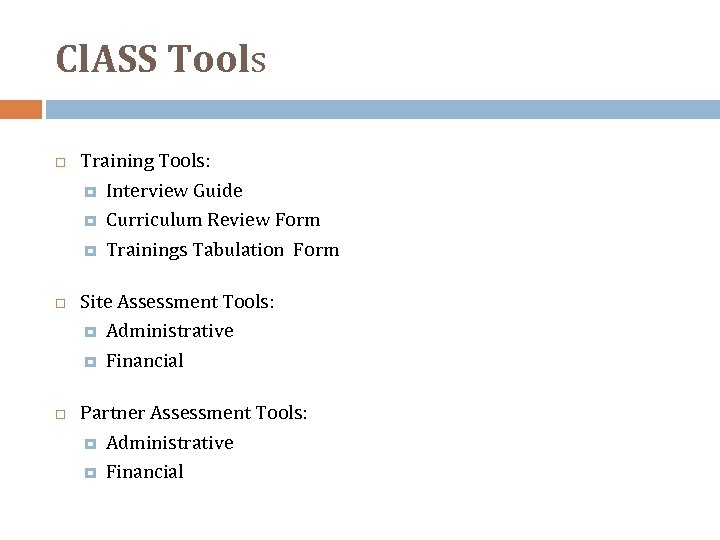
Cl. ASS Tools Training Tools: Interview Guide Curriculum Review Form Trainings Tabulation Form Site Assessment Tools: Administrative Financial Partner Assessment Tools: Administrative Financial
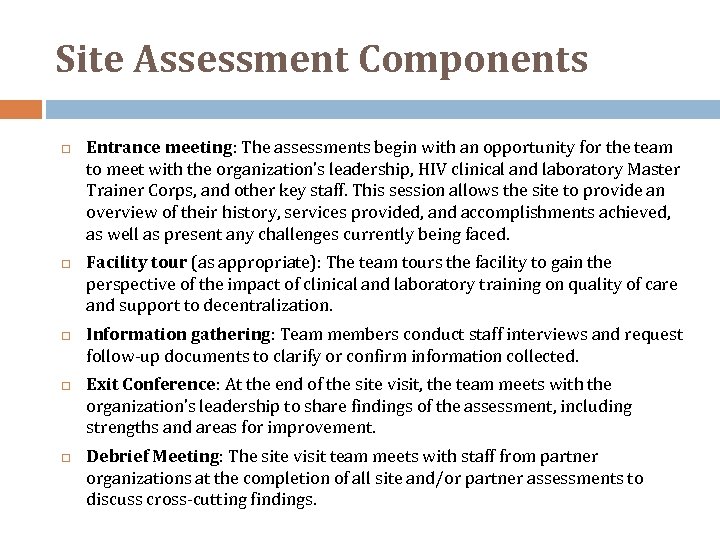
Site Assessment Components Entrance meeting: The assessments begin with an opportunity for the team to meet with the organization’s leadership, HIV clinical and laboratory Master Trainer Corps, and other key staff. This session allows the site to provide an overview of their history, services provided, and accomplishments achieved, as well as present any challenges currently being faced. Facility tour (as appropriate): The team tours the facility to gain the perspective of the impact of clinical and laboratory training on quality of care and support to decentralization. Information gathering: Team members conduct staff interviews and request follow‐up documents to clarify or confirm information collected. Exit Conference: At the end of the site visit, the team meets with the organization’s leadership to share findings of the assessment, including strengths and areas for improvement. Debrief Meeting: The site visit team meets with staff from partner organizations at the completion of all site and/or partner assessments to discuss cross‐cutting findings.
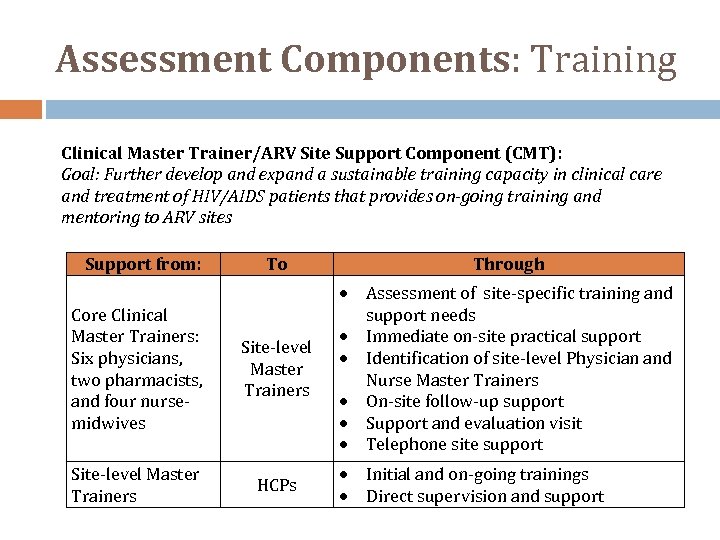
Assessment Components: Training Clinical Master Trainer/ARV Site Support Component (CMT): Goal: Further develop and expand a sustainable training capacity in clinical care and treatment of HIV/AIDS patients that provides on-going training and mentoring to ARV sites Support from: To Through Core Clinical Master Trainers: Six physicians, two pharmacists, and four nurse‐ midwives Site‐level Master Trainers HCPs Assessment of site‐specific training and support needs Immediate on‐site practical support Identification of site‐level Physician and Nurse Master Trainers On‐site follow‐up support Support and evaluation visit Telephone site support Initial and on‐going trainings Direct supervision and support
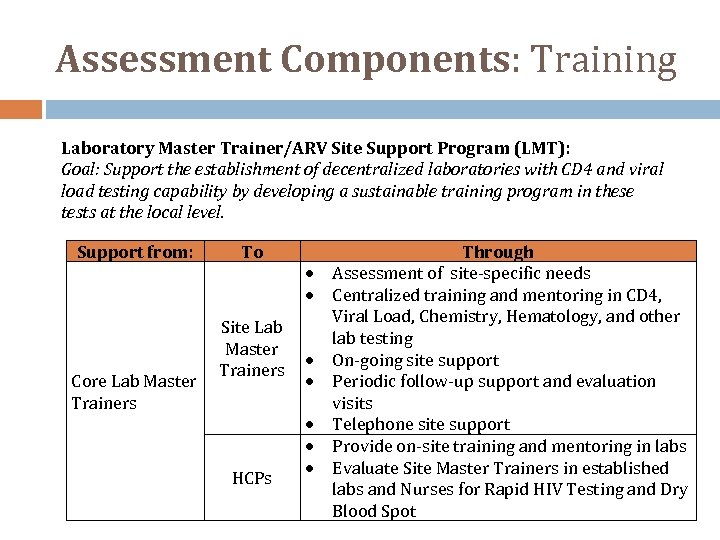
Assessment Components: Training Laboratory Master Trainer/ARV Site Support Program (LMT): Goal: Support the establishment of decentralized laboratories with CD 4 and viral load testing capability by developing a sustainable training program in these tests at the local level. Support from: Core Lab Master Trainers To Site Lab Master Trainers HCPs Through Assessment of site‐specific needs Centralized training and mentoring in CD 4, Viral Load, Chemistry, Hematology, and other lab testing On‐going site support Periodic follow‐up support and evaluation visits Telephone site support Provide on‐site training and mentoring in labs Evaluate Site Master Trainers in established labs and Nurses for Rapid HIV Testing and Dry Blood Spot
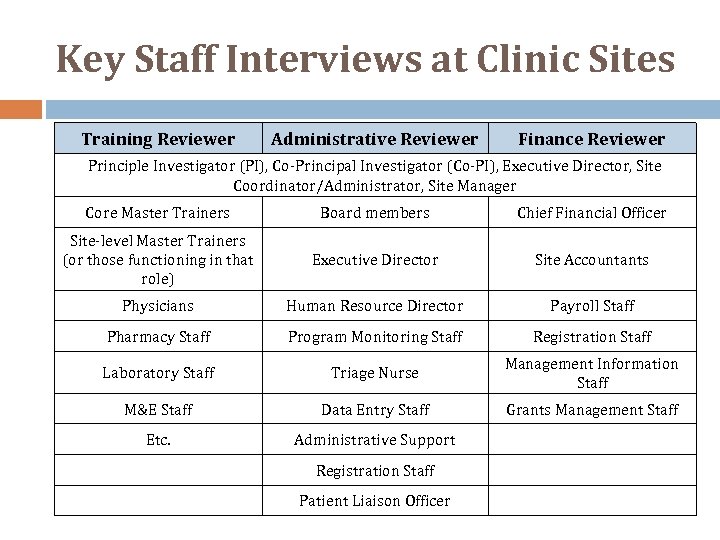
Key Staff Interviews at Clinic Sites Training Reviewer Administrative Reviewer Finance Reviewer Principle Investigator (PI), Co‐Principal Investigator (Co‐PI), Executive Director, Site Coordinator/Administrator, Site Manager Core Master Trainers Board members Chief Financial Officer Site‐level Master Trainers (or those functioning in that role) Executive Director Site Accountants Physicians Human Resource Director Payroll Staff Pharmacy Staff Program Monitoring Staff Registration Staff Laboratory Staff Triage Nurse Management Information Staff M&E Staff Data Entry Staff Grants Management Staff Etc. Administrative Support Registration Staff Patient Liaison Officer
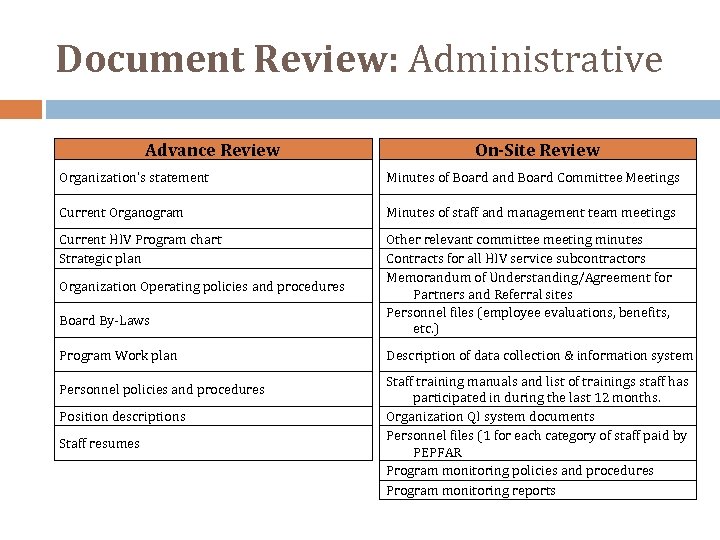
Document Review: Administrative Advance Review On-Site Review Organization’s statement Minutes of Board and Board Committee Meetings Current Organogram Minutes of staff and management team meetings Current HIV Program chart Strategic plan Other relevant committee meeting minutes Contracts for all HIV service subcontractors Memorandum of Understanding/Agreement for Partners and Referral sites Personnel files (employee evaluations, benefits, etc. ) Organization Operating policies and procedures Board By‐Laws Program Work plan Personnel policies and procedures Position descriptions Staff resumes Description of data collection & information system Staff training manuals and list of trainings staff has participated in during the last 12 months. Organization QI system documents Personnel files (1 for each category of staff paid by PEPFAR Program monitoring policies and procedures Program monitoring reports
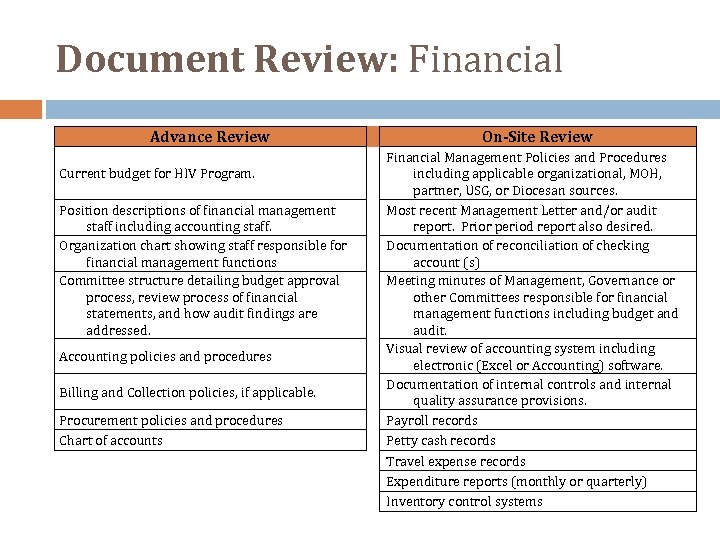
Document Review: Financial Advance Review Current budget for HIV Program. Position descriptions of financial management staff including accounting staff. Organization chart showing staff responsible for financial management functions Committee structure detailing budget approval process, review process of financial statements, and how audit findings are addressed. Accounting policies and procedures Billing and Collection policies, if applicable. Procurement policies and procedures Chart of accounts On-Site Review Financial Management Policies and Procedures including applicable organizational, MOH, partner, USG, or Diocesan sources. Most recent Management Letter and/or audit report. Prior period report also desired. Documentation of reconciliation of checking account (s) Meeting minutes of Management, Governance or other Committees responsible for financial management functions including budget and audit. Visual review of accounting system including electronic (Excel or Accounting) software. Documentation of internal controls and internal quality assurance provisions. Payroll records Petty cash records Travel expense records Expenditure reports (monthly or quarterly) Inventory control systems
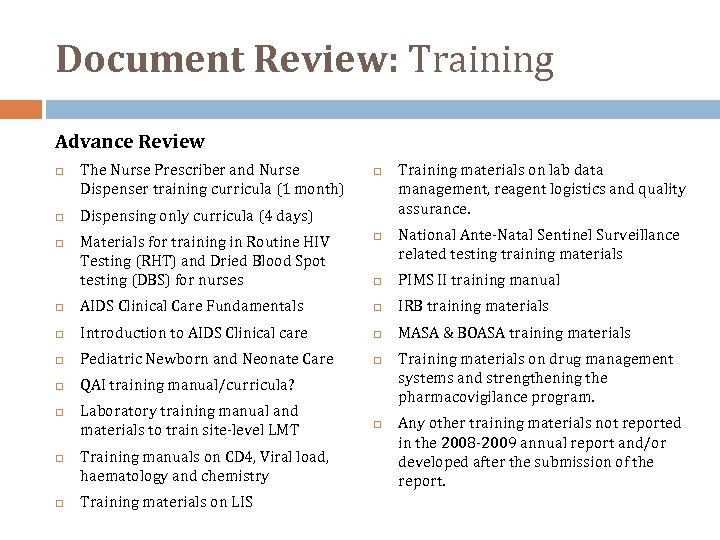
Document Review: Training Advance Review The Nurse Prescriber and Nurse Dispenser training curricula (1 month) Dispensing only curricula (4 days) Materials for training in Routine HIV Testing (RHT) and Dried Blood Spot testing (DBS) for nurses Training materials on lab data management, reagent logistics and quality assurance. National Ante‐Natal Sentinel Surveillance related testing training materials PIMS II training manual AIDS Clinical Care Fundamentals IRB training materials Introduction to AIDS Clinical care MASA & BOASA training materials Pediatric Newborn and Neonate Care QAI training manual/curricula? Laboratory training manual and materials to train site‐level LMT Training manuals on CD 4, Viral load, haematology and chemistry Training materials on LIS Training materials on drug management systems and strengthening the pharmacovigilance program. Any other training materials not reported in the 2008‐ 2009 annual report and/or developed after the submission of the report.
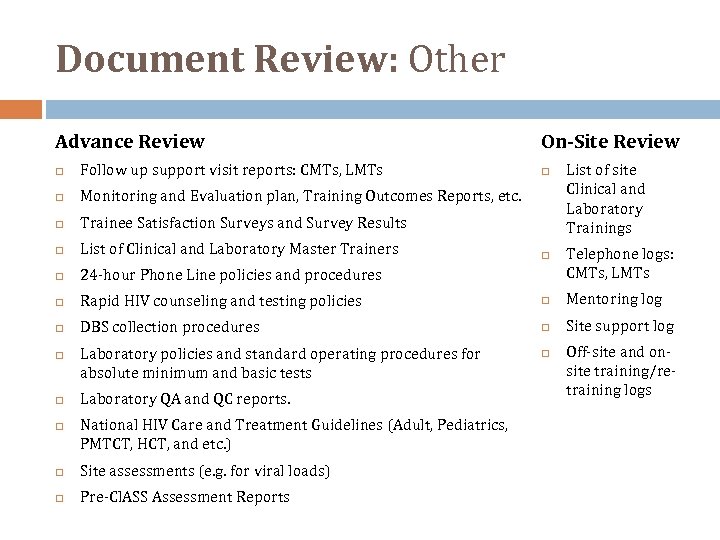
Document Review: Other Advance Review On-Site Review Follow up support visit reports: CMTs, LMTs Monitoring and Evaluation plan, Training Outcomes Reports, etc. Trainee Satisfaction Surveys and Survey Results List of Clinical and Laboratory Master Trainers 24‐hour Phone Line policies and procedures Rapid HIV counseling and testing policies Mentoring log DBS collection procedures Site support log Laboratory policies and standard operating procedures for absolute minimum and basic tests Laboratory QA and QC reports. National HIV Care and Treatment Guidelines (Adult, Pediatrics, PMTCT, HCT, and etc. ) Site assessments (e. g. for viral loads) Pre‐Cl. ASS Assessment Reports List of site Clinical and Laboratory Trainings Telephone logs: CMTs, LMTs Off‐site and on‐ site training/re‐ training logs
Discussion
Скачать презентацию Clinical Assessment for Systems Strengthening Cl ASS HARVARD BHP
aa72007b97d944dd50ec719cac91fed2.ppt