


 Скачать презентацию Clinical and Echocardiographic Outcomes at 30 Days with
74d3e686789cc43b5592c3a06032d1f7.ppt
- Количество слайдов: 40
 Clinical and Echocardiographic Outcomes at 30 Days with the SAPIEN 3 TAVR System in Inoperable, High-Risk and Intermediate-Risk AS Patients Susheel Kodali, MD on behalf of The PARTNER Trial Investigators ACC 2015 | San Diego | March 15, 2015
 Disclosure Statement of Financial Interest Susheel Kodali, MD Within the past 12 months, I or my spouse/partner have had a financial interest/arrangement or affiliation with the organization(s) listed below. Affiliation/Financial Relationship Company • Grant/Research Support • • Steering Committee • • SAB (Equity) • Thubrikar Aortic Valve, Inc • Honoraria • St. Jude Medical, Claret Medical Edwards Lifesciences, Medtronic, Boston Scientific, Claret Medical Edwards Lifesciences, Claret Medical, Meril
 Background • Based on randomized trials with first generation devices, transcatheter aortic valve replacement (TAVR) has been incorporated into the treatment strategy for high-risk and inoperable patients with severe AS. • Procedural complications remain a concern with TAVR, including stroke, vascular complications, paravalvular leak (PVL) and conduction disturbances. • Addressing these limitations will support TAVR use in lower risk populations.
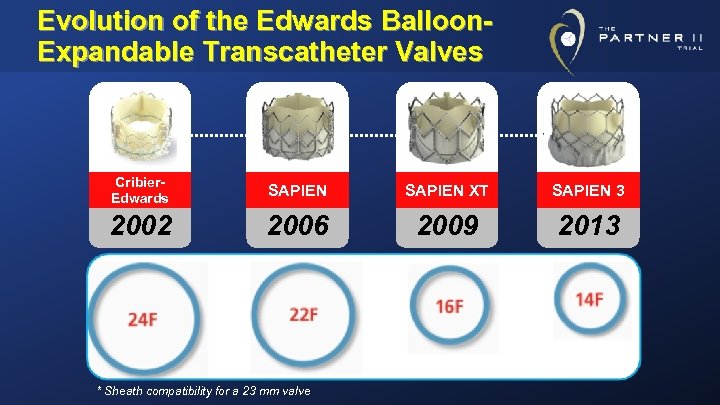 Evolution of the Edwards Balloon. Expandable Transcatheter Valves Cribier. Edwards SAPIEN XT SAPIEN 3 2002 2006 2009 2013 * Sheath compatibility for a 23 mm valve
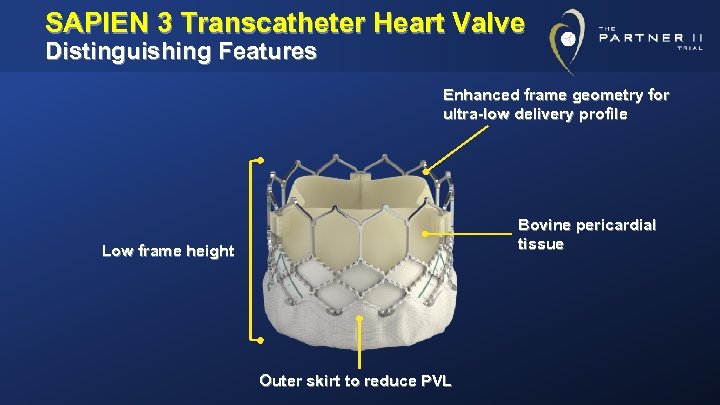 SAPIEN 3 Transcatheter Heart Valve Distinguishing Features Enhanced frame geometry for ultra-low delivery profile Bovine pericardial tissue Low frame height Outer skirt to reduce PVL
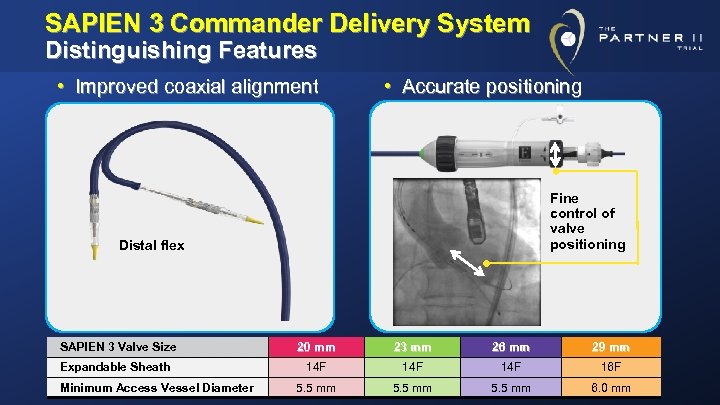 SAPIEN 3 Commander Delivery System Distinguishing Features • Improved coaxial alignment • Accurate positioning Fine control of valve positioning Distal flex SAPIEN 3 Valve Size 20 mm 23 mm 26 mm 29 mm Expandable Sheath 14 F 14 F 16 F 5. 5 mm 6. 0 mm Minimum Access Vessel Diameter
 The PARTNER II Program Purpose To evaluate the safety and efficacy of the SAPIEN 3 transcatheter heart valve system at 30 days in inoperable, high-risk, and intermediate-risk patients.
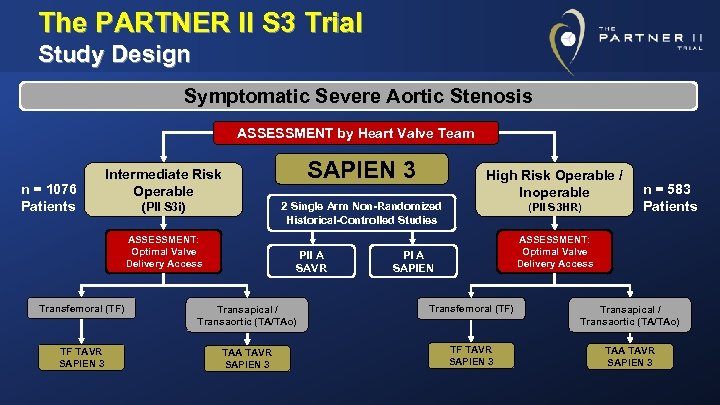 The PARTNER II S 3 Trial Study Design Symptomatic Severe Aortic Stenosis ASSESSMENT by Heart Valve Team n = 1076 Patients SAPIEN 3 Intermediate Risk Operable (PII S 3 i) High Risk Operable / Inoperable 2 Single Arm Non-Randomized Historical-Controlled Studies ASSESSMENT: Optimal Valve Delivery Access PII A SAVR (PII S 3 HR) n = 583 Patients ASSESSMENT: Optimal Valve Delivery Access PI A SAPIEN Transfemoral (TF) Transapical / Transaortic (TA/TAo) TF TAVR SAPIEN 3 TAA TAVR SAPIEN 3
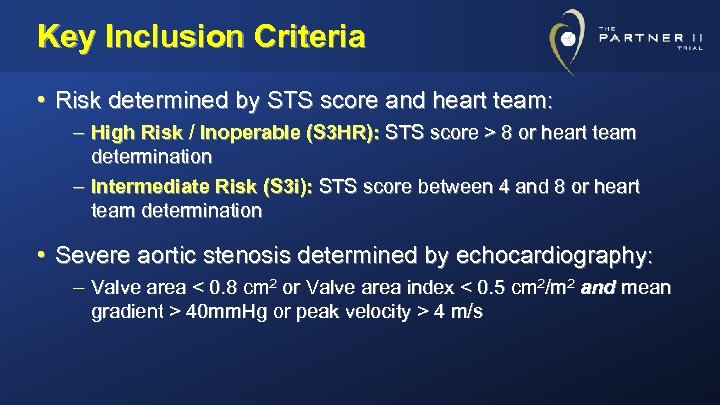 Key Inclusion Criteria • Risk determined by STS score and heart team: – High Risk / Inoperable (S 3 HR): STS score > 8 or heart team determination – Intermediate Risk (S 3 i): STS score between 4 and 8 or heart team determination • Severe aortic stenosis determined by echocardiography: – Valve area < 0. 8 cm 2 or Valve area index < 0. 5 cm 2/m 2 and mean gradient > 40 mm. Hg or peak velocity > 4 m/s
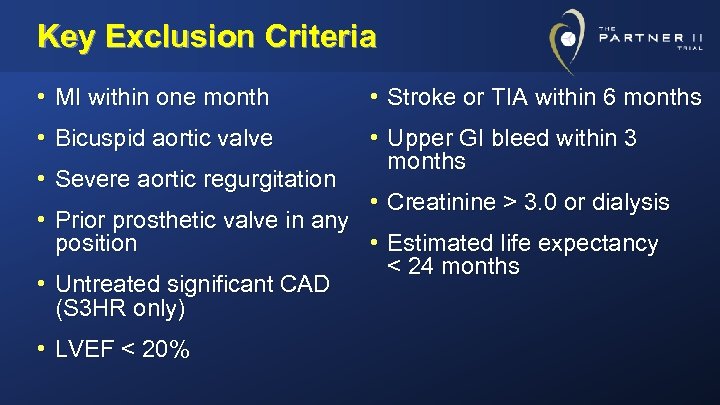 Key Exclusion Criteria • MI within one month • Stroke or TIA within 6 months • Bicuspid aortic valve • Upper GI bleed within 3 months • Severe aortic regurgitation • Creatinine > 3. 0 or dialysis • Prior prosthetic valve in any position • Estimated life expectancy < 24 months • Untreated significant CAD (S 3 HR only) • LVEF < 20%
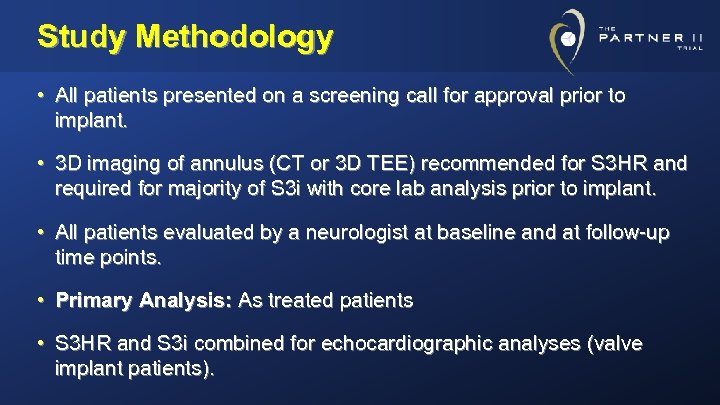 Study Methodology • All patients presented on a screening call for approval prior to implant. • 3 D imaging of annulus (CT or 3 D TEE) recommended for S 3 HR and required for majority of S 3 i with core lab analysis prior to implant. • All patients evaluated by a neurologist at baseline and at follow-up time points. • Primary Analysis: As treated patients • S 3 HR and S 3 i combined for echocardiographic analyses (valve implant patients).
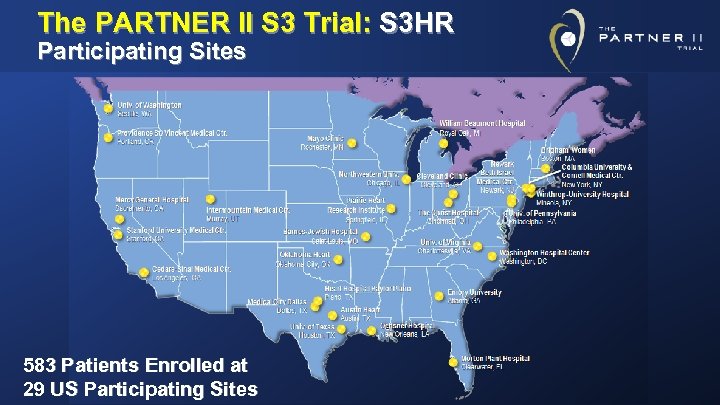 The PARTNER II S 3 Trial: S 3 HR Participating Sites 583 Patients Enrolled at 29 US Participating Sites
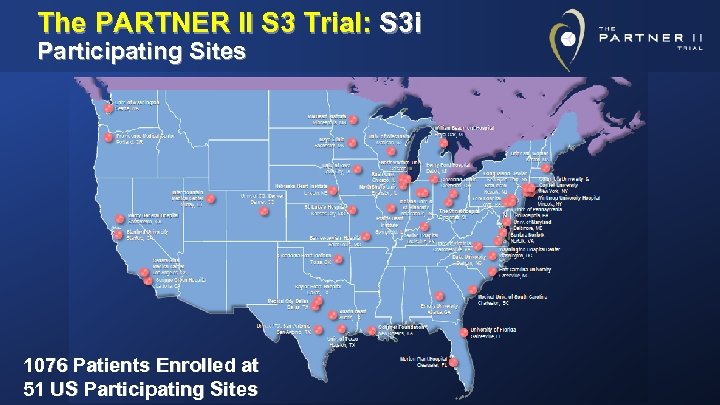 The PARTNER II S 3 Trial: S 3 i Participating Sites 1076 Patients Enrolled at 51 US Participating Sites
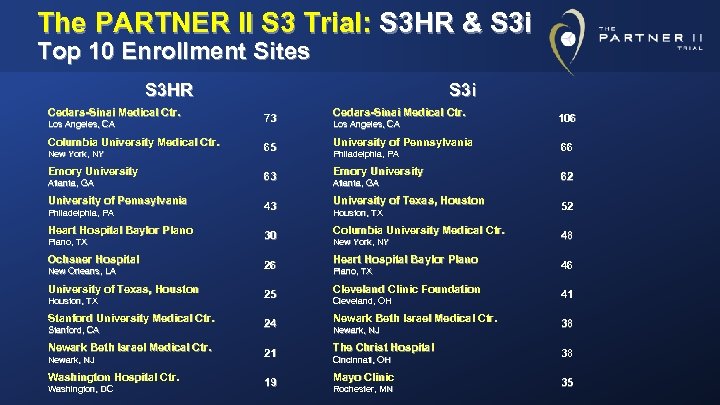 The PARTNER II S 3 Trial: S 3 HR & S 3 i Top 10 Enrollment Sites S 3 HR Cedars-Sinai Medical Ctr. Los Angeles, CA Columbia University Medical Ctr. New York, NY Emory University Atlanta, GA University of Pennsylvania Philadelphia, PA Heart Hospital Baylor Plano, TX Ochsner Hospital New Orleans, LA University of Texas, Houston, TX Stanford University Medical Ctr. Stanford, CA Newark Beth Israel Medical Ctr. Newark, NJ Washington Hospital Ctr. Washington, DC S 3 i 73 Cedars-Sinai Medical Ctr. 65 University of Pennsylvania 63 Emory University 43 University of Texas, Houston 30 Columbia University Medical Ctr. 26 Heart Hospital Baylor Plano 25 Cleveland Clinic Foundation 24 Newark Beth Israel Medical Ctr. 21 The Christ Hospital 19 Mayo Clinic Los Angeles, CA Philadelphia, PA Atlanta, GA Houston, TX New York, NY Plano, TX Cleveland, OH Newark, NJ Cincinnati, OH Rochester, MN 106 66 62 52 48 46 41 38 38 35
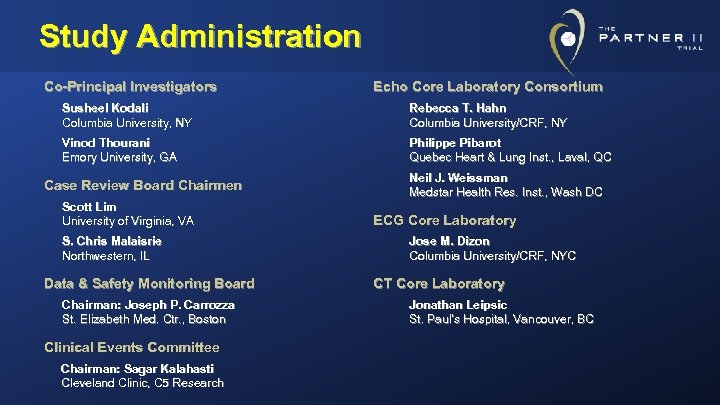 Study Administration Co-Principal Investigators Echo Core Laboratory Consortium Susheel Kodali Columbia University, NY Rebecca T. Hahn Columbia University/CRF, NY Vinod Thourani Emory University, GA Philippe Pibarot Quebec Heart & Lung Inst. , Laval, QC Case Review Board Chairmen Scott Lim University of Virginia, VA S. Chris Malaisrie Northwestern, IL Data & Safety Monitoring Board Chairman: Joseph P. Carrozza St. Elizabeth Med. Ctr. , Boston Clinical Events Committee Chairman: Sagar Kalahasti Cleveland Clinic, C 5 Research Neil J. Weissman Medstar Health Res. Inst. , Wash DC ECG Core Laboratory Jose M. Dizon Columbia University/CRF, NYC CT Core Laboratory Jonathan Leipsic St. Paul’s Hospital, Vancouver, BC
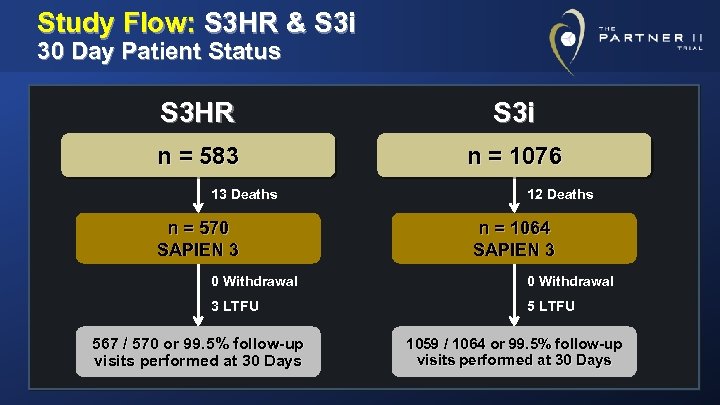 Study Flow: S 3 HR & S 3 i 30 Day Patient Status S 3 HR S 3 i n = 583 n = 1076 13 Deaths n = 570 SAPIEN 3 12 Deaths n = 1064 SAPIEN 3 0 Withdrawal 3 LTFU 567 / 570 or 99. 5% follow-up visits performed at 30 Days 1059 / 1064 or 99. 5% follow-up visits performed at 30 Days
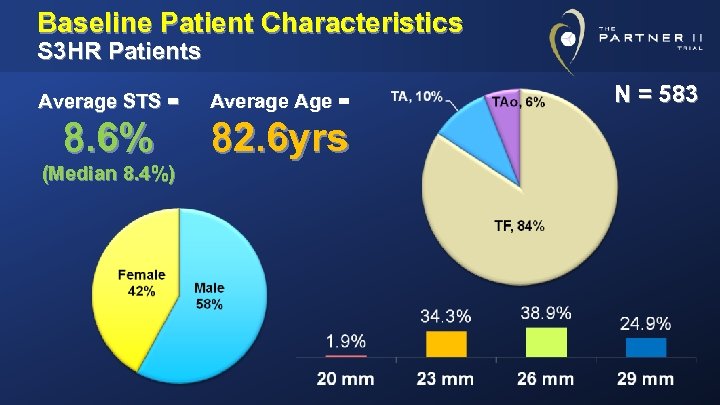 Baseline Patient Characteristics S 3 HR Patients Average STS = Average Age = 8. 6% 82. 6 yrs (Median 8. 4%) N = 583
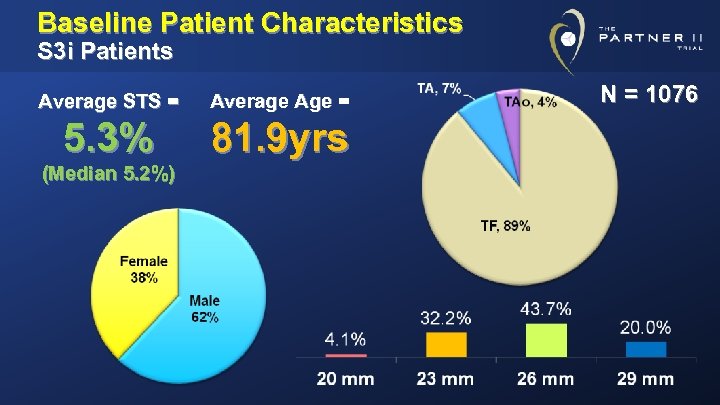 Baseline Patient Characteristics S 3 i Patients Average STS = Average Age = 5. 3% 81. 9 yrs (Median 5. 2%) N = 1076
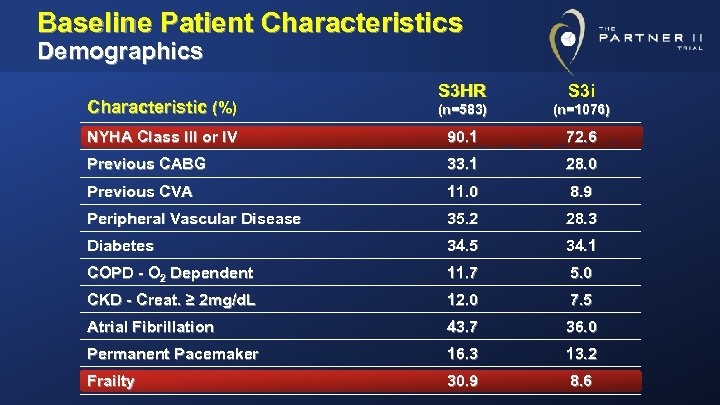 Baseline Patient Characteristics Demographics Characteristic (%) S 3 HR S 3 i (n=583) (n=1076) NYHA Class III or IV 90. 1 72. 6 Previous CABG 33. 1 28. 0 Previous CVA 11. 0 8. 9 Peripheral Vascular Disease 35. 2 28. 3 Diabetes 34. 5 34. 1 COPD - O 2 Dependent 11. 7 5. 0 CKD - Creat. ≥ 2 mg/d. L 12. 0 7. 5 Atrial Fibrillation 43. 7 36. 0 Permanent Pacemaker 16. 3 13. 2 Frailty 30. 9 8. 6
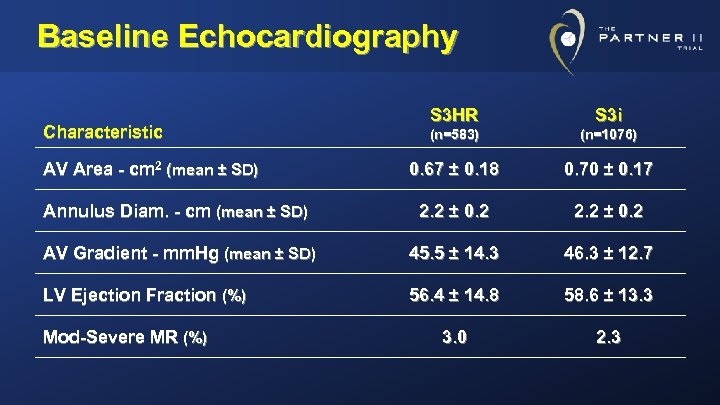 Baseline Echocardiography S 3 HR S 3 i (n=583) (n=1076) 0. 67 ± 0. 18 0. 70 ± 0. 17 Annulus Diam. - cm (mean ± SD) 2. 2 ± 0. 2 AV Gradient - mm. Hg (mean ± SD) 45. 5 ± 14. 3 46. 3 ± 12. 7 LV Ejection Fraction (%) 56. 4 ± 14. 8 58. 6 ± 13. 3 3. 0 2. 3 Characteristic AV Area - cm 2 (mean ± SD) Mod-Severe MR (%)
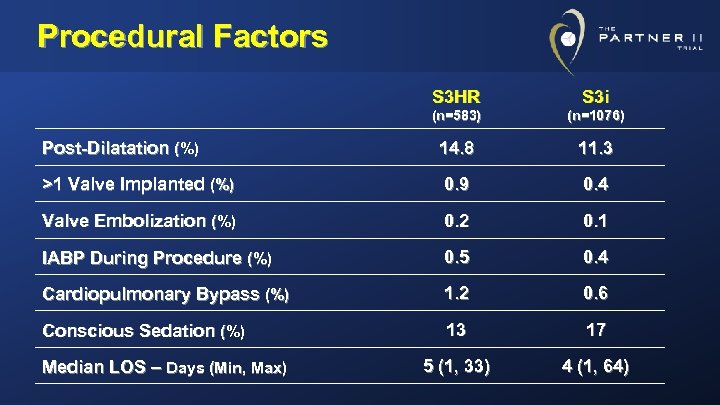 Procedural Factors S 3 HR S 3 i (n=583) (n=1076) Post-Dilatation (%) 14. 8 11. 3 >1 Valve Implanted (%) 0. 9 0. 4 Valve Embolization (%) 0. 2 0. 1 IABP During Procedure (%) 0. 5 0. 4 Cardiopulmonary Bypass (%) 1. 2 0. 6 Conscious Sedation (%) 13 17 5 (1, 33) 4 (1, 64) Median LOS – Days (Min, Max)
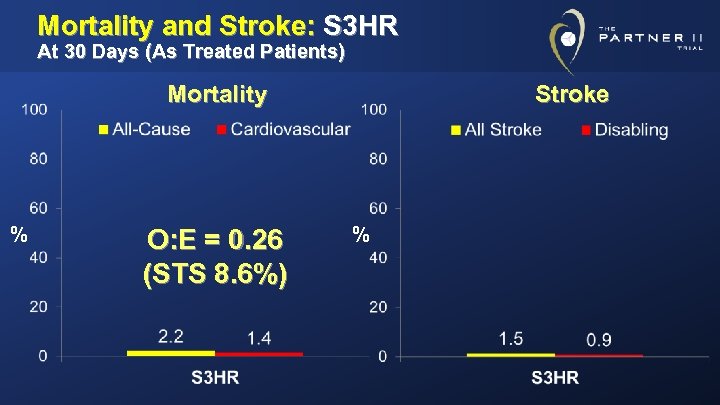 Mortality and Stroke: S 3 HR At 30 Days (As Treated Patients) Mortality % O: E = 0. 26 (STS 8. 6%) Stroke %
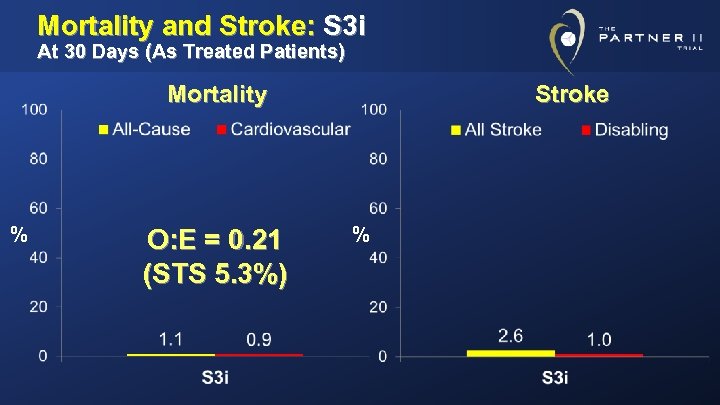 Mortality and Stroke: S 3 i At 30 Days (As Treated Patients) Mortality % O: E = 0. 21 (STS 5. 3%) Stroke %
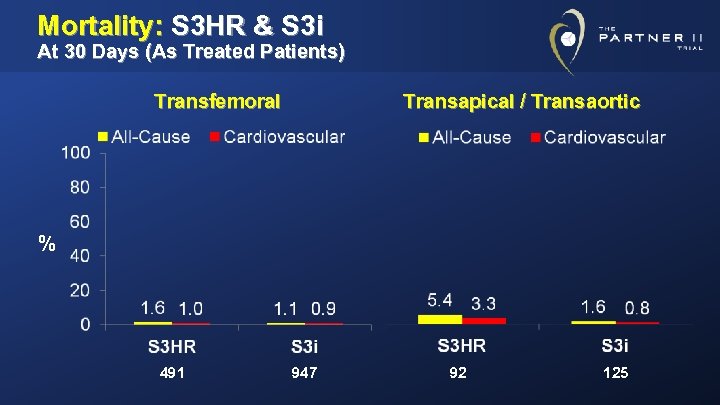 Mortality: S 3 HR & S 3 i At 30 Days (As Treated Patients) Transfemoral Transapical / Transaortic % 491 947 92 125
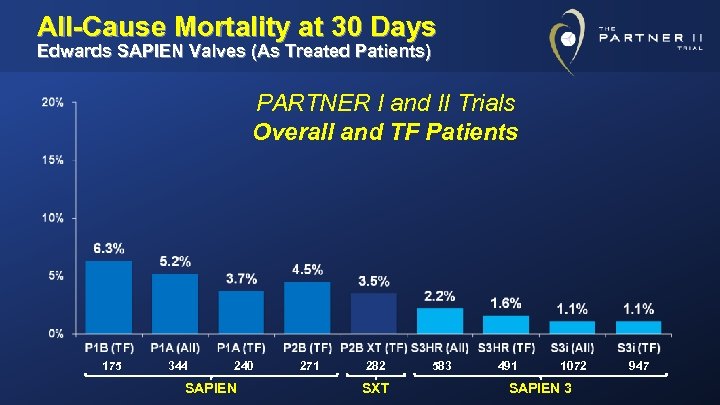 All-Cause Mortality at 30 Days Edwards SAPIEN Valves (As Treated Patients) PARTNER I and II Trials Overall and TF Patients 175 344 240 SAPIEN 271 282 SXT 583 491 1072 SAPIEN 3 947
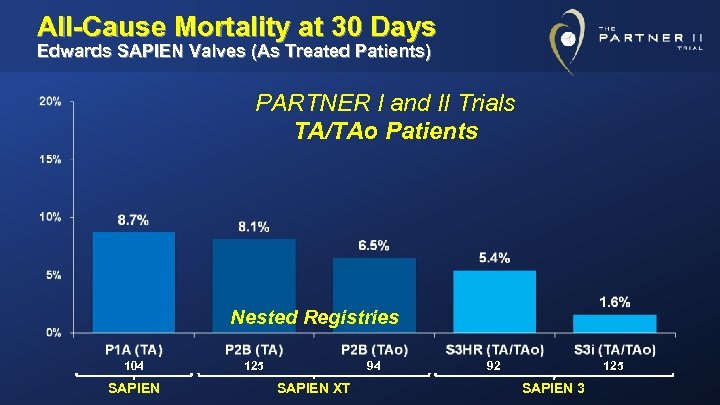 All-Cause Mortality at 30 Days Edwards SAPIEN Valves (As Treated Patients) PARTNER I and II Trials TA/TAo Patients Nested Registries 104 SAPIEN 125 94 SAPIEN XT 92 125 SAPIEN 3
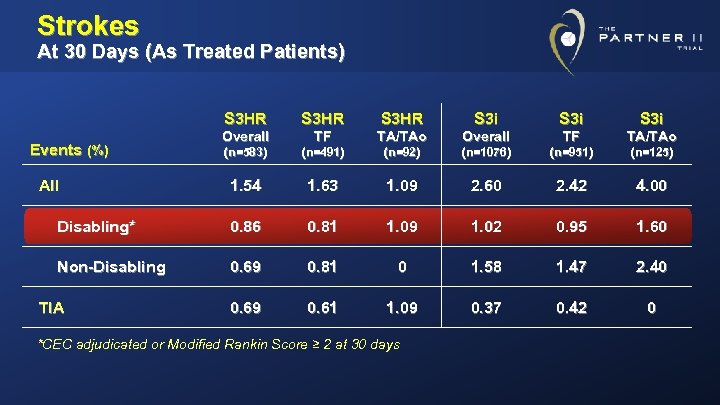 Strokes At 30 Days (As Treated Patients) S 3 HR S 3 i Overall TF TA/TAo (n=583) (n=491) (n=92) (n=1076) (n=951) (n=125) 1. 54 1. 63 1. 09 2. 60 2. 42 4. 00 Disabling* 0. 86 0. 81 1. 09 1. 02 0. 95 1. 60 Non-Disabling 0. 69 0. 81 0 1. 58 1. 47 2. 40 0. 69 0. 61 1. 09 0. 37 0. 42 0 Events (%) All TIA *CEC adjudicated or Modified Rankin Score ≥ 2 at 30 days
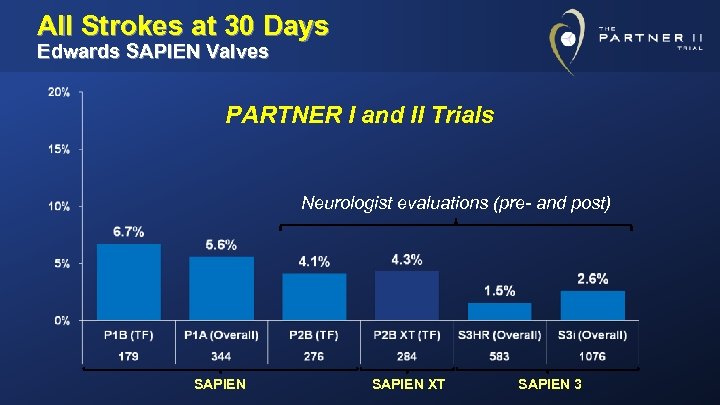 All Strokes at 30 Days Edwards SAPIEN Valves PARTNER I and II Trials Neurologist evaluations (pre- and post) SAPIEN XT SAPIEN 3
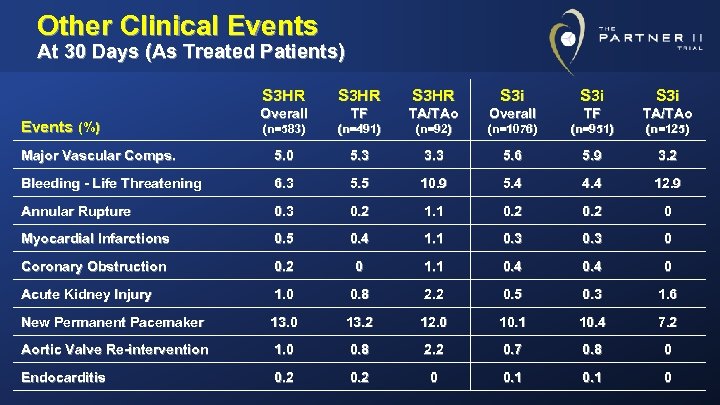 Other Clinical Events At 30 Days (As Treated Patients) S 3 HR S 3 i Overall TF TA/TAo (n=583) (n=491) (n=92) (n=1076) (n=951) (n=125) Major Vascular Comps. 5. 0 5. 3 3. 3 5. 6 5. 9 3. 2 Bleeding - Life Threatening 6. 3 5. 5 10. 9 5. 4 4. 4 12. 9 Annular Rupture 0. 3 0. 2 1. 1 0. 2 0 Myocardial Infarctions 0. 5 0. 4 1. 1 0. 3 0 Coronary Obstruction 0. 2 0 1. 1 0. 4 0 Acute Kidney Injury 1. 0 0. 8 2. 2 0. 5 0. 3 1. 6 New Permanent Pacemaker 13. 0 13. 2 12. 0 10. 1 10. 4 7. 2 Aortic Valve Re-intervention 1. 0 0. 8 2. 2 0. 7 0. 8 0 Endocarditis 0. 2 0 0. 1 0 Events (%)
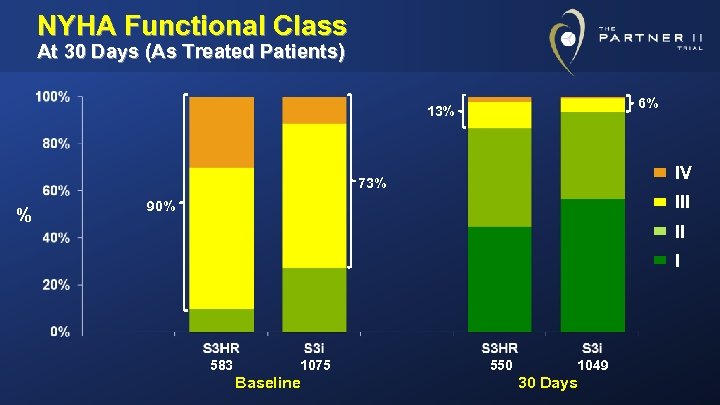 NYHA Functional Class At 30 Days (As Treated Patients) 6% 13% IV 73% % III 90% II I 583 1075 Baseline 550 1049 30 Days
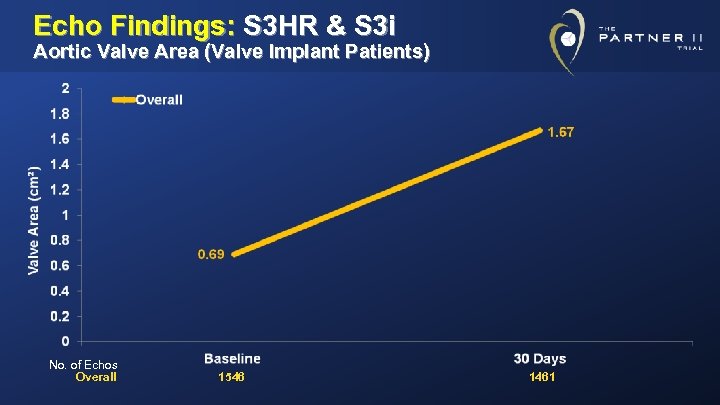 Echo Findings: S 3 HR & S 3 i Aortic Valve Area (Valve Implant Patients) No. of Echos Overall 1546 1461
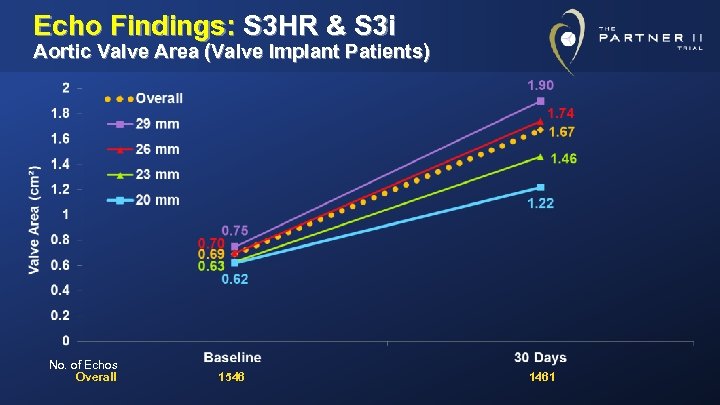 Echo Findings: S 3 HR & S 3 i Aortic Valve Area (Valve Implant Patients) No. of Echos Overall 1546 1461
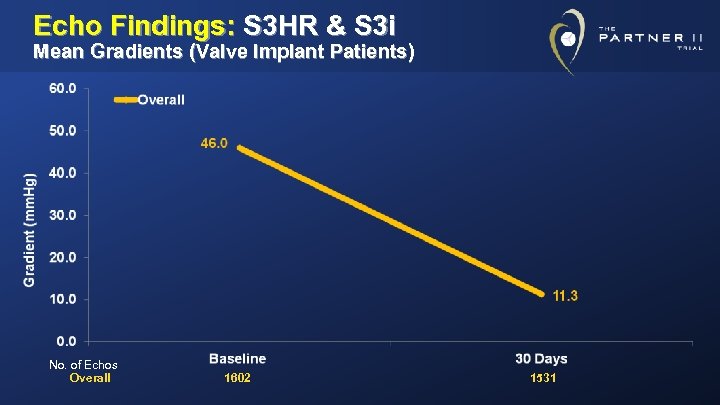 Echo Findings: S 3 HR & S 3 i Mean Gradients (Valve Implant Patients) No. of Echos Overall 1602 1531
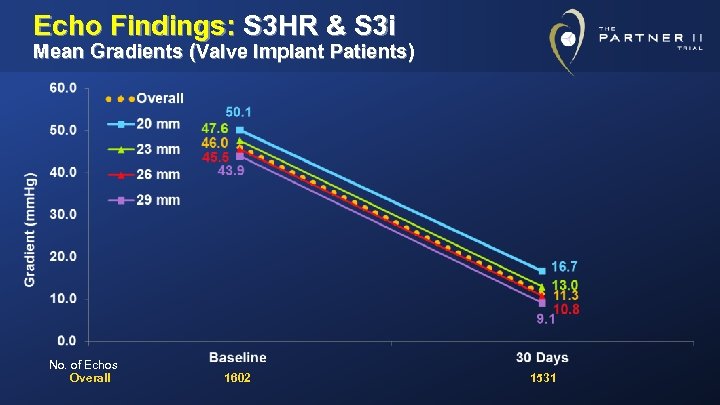 Echo Findings: S 3 HR & S 3 i Mean Gradients (Valve Implant Patients) No. of Echos Overall 1602 1531
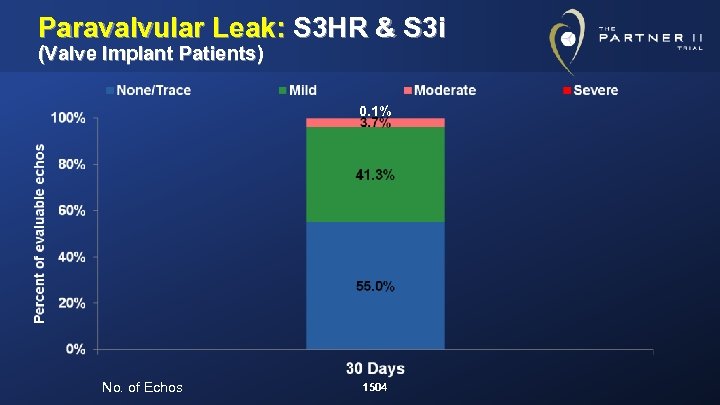 Paravalvular Leak: S 3 HR & S 3 i (Valve Implant Patients) 0. 1% No. of Echos 1504
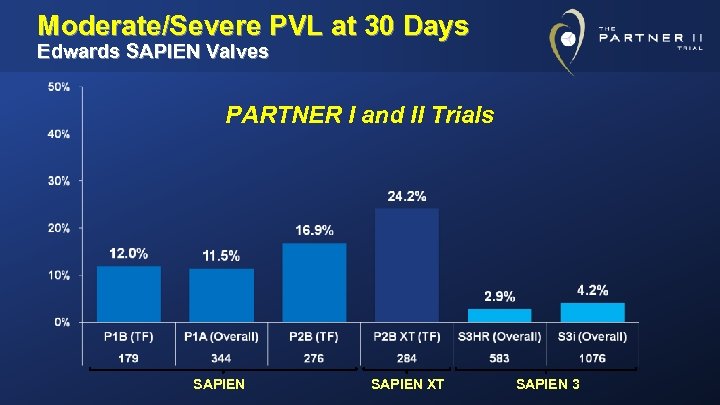 Moderate/Severe PVL at 30 Days Edwards SAPIEN Valves PARTNER I and II Trials SAPIEN XT SAPIEN 3
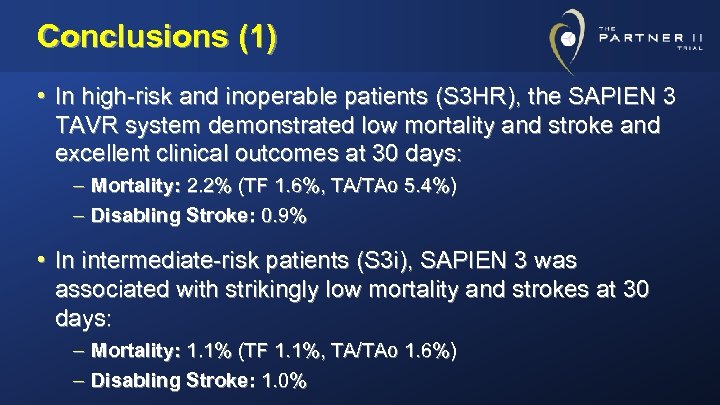 Conclusions (1) • In high-risk and inoperable patients (S 3 HR), the SAPIEN 3 TAVR system demonstrated low mortality and stroke and excellent clinical outcomes at 30 days: – Mortality: 2. 2% (TF 1. 6%, TA/TAo 5. 4%) – Disabling Stroke: 0. 9% • In intermediate-risk patients (S 3 i), SAPIEN 3 was associated with strikingly low mortality and strokes at 30 days: – Mortality: 1. 1% (TF 1. 1%, TA/TAo 1. 6%) – Disabling Stroke: 1. 0%
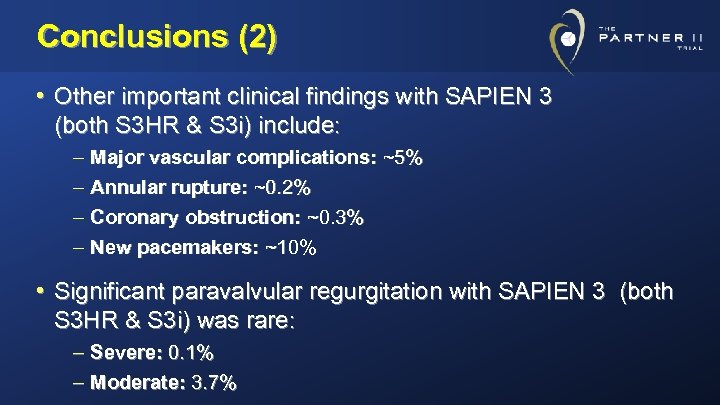 Conclusions (2) • Other important clinical findings with SAPIEN 3 (both S 3 HR & S 3 i) include: – Major vascular complications: ~5% – Annular rupture: ~0. 2% – Coronary obstruction: ~0. 3% – New pacemakers: ~10% • Significant paravalvular regurgitation with SAPIEN 3 (both S 3 HR & S 3 i) was rare: – Severe: 0. 1% – Moderate: 3. 7%
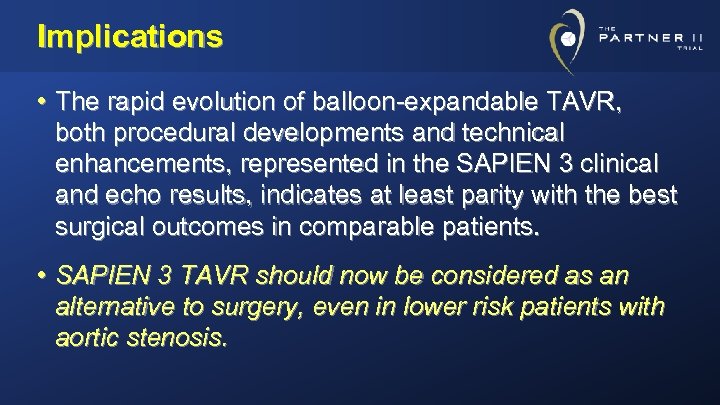 Implications • The rapid evolution of balloon-expandable TAVR, both procedural developments and technical enhancements, represented in the SAPIEN 3 clinical and echo results, indicates at least parity with the best surgical outcomes in comparable patients. • SAPIEN 3 TAVR should now be considered as an alternative to surgery, even in lower risk patients with aortic stenosis.
 Dedicated to the Memory of Mike Davidson, a Cherished Member of Our PARTNER Team