 Скачать презентацию Climate Services Dr Chet Koblinsky Director NOAA Climate
d70d3b787207750eb788571f9713bb46.ppt
- Количество слайдов: 20



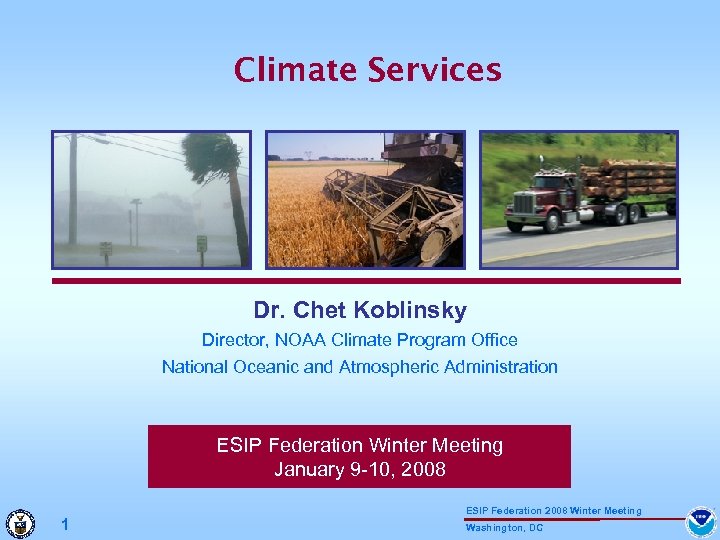
Climate Services Dr. Chet Koblinsky Director, NOAA Climate Program Office National Oceanic and Atmospheric Administration ESIP Federation Winter Meeting January 9 -10, 2008 1 ESIP Federation 2008 Winter Meeting Washington, DC
Outline • Society’s Demand for Climate Services • Background of Climate Services • Legislative Response to Emerging Demand • NOAA’s Current Capabilities • NOAA’s Strategy • Enterprise Model Example: NIDIS 2 ESIP Federation 2008 Winter Meeting Washington, DC
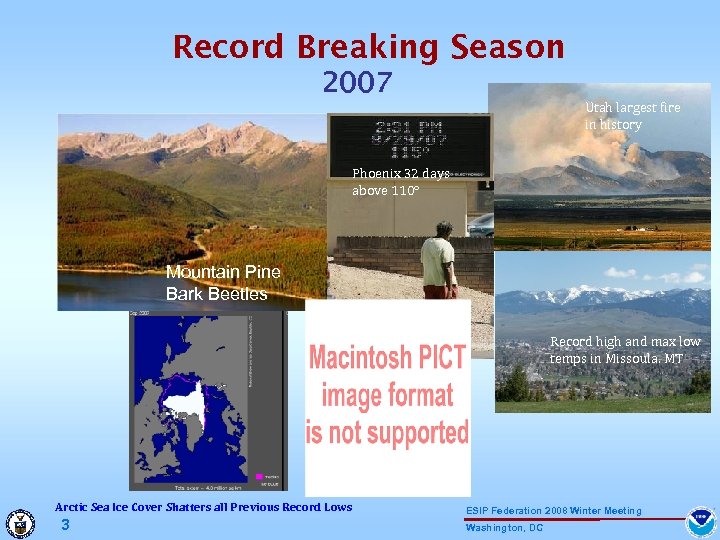
Record Breaking Season 2007 Utah largest fire in history Driest rainy season in Southern California Phoenix 32 days above 110° Mountain Pine Bark Beetles Record high and max low temps in Missoula. MT Arctic Sea Ice Cover Shatters all Previous Record Lows 3 ESIP Federation 2008 Winter Meeting Washington, DC
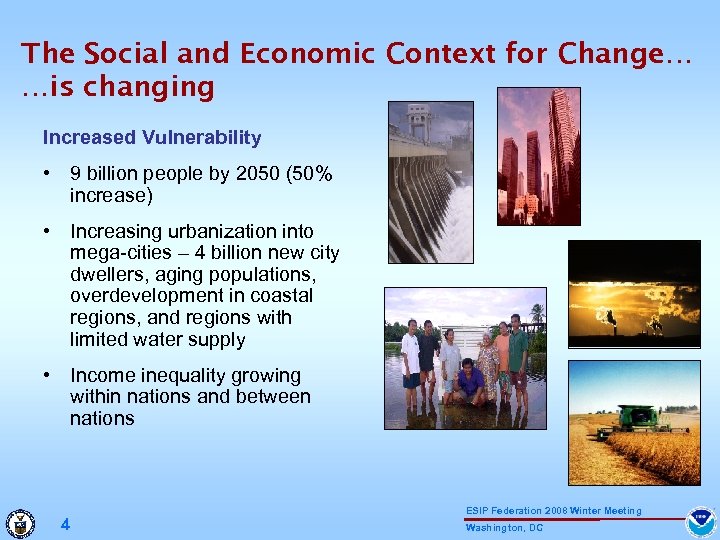
The Social and Economic Context for Change… …is changing Increased Vulnerability • 9 billion people by 2050 (50% increase) • Increasing urbanization into mega-cities – 4 billion new city dwellers, aging populations, overdevelopment in coastal regions, and regions with limited water supply • Income inequality growing within nations and between nations 4 ESIP Federation 2008 Winter Meeting Washington, DC
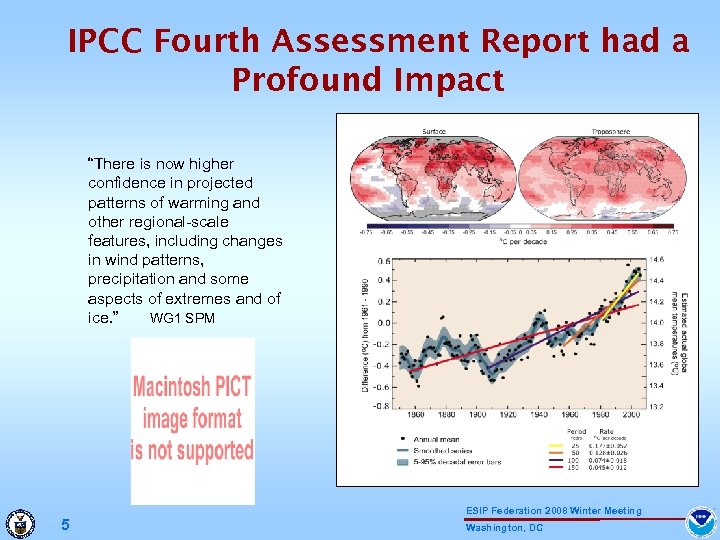
IPCC Fourth Assessment Report had a Profound Impact “There is now higher confidence in projected patterns of warming and other regional-scale features, including changes in wind patterns, precipitation and some aspects of extremes and of ice. ” WG 1 SPM 5 ESIP Federation 2008 Winter Meeting Washington, DC
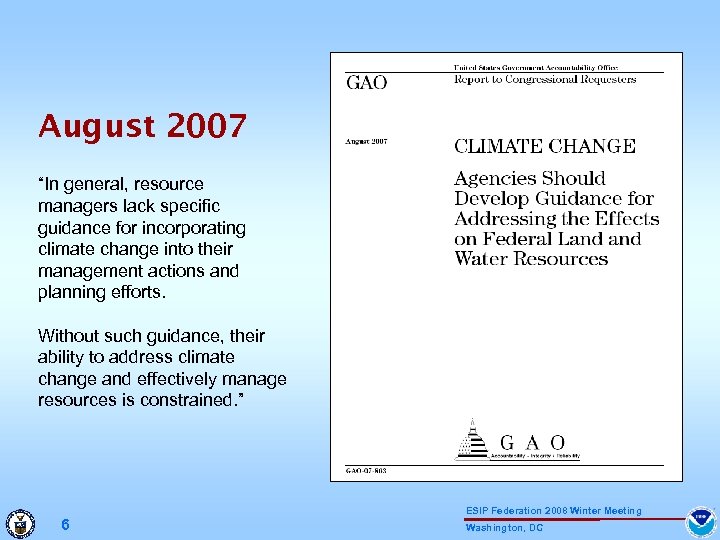
August 2007 “In general, resource managers lack specific guidance for incorporating climate change into their management actions and planning efforts. Without such guidance, their ability to address climate change and effectively manage resources is constrained. ” 6 ESIP Federation 2008 Winter Meeting Washington, DC
Legislative Response to Emerging Demand • S. 2355 - the Climate Change Adaptation Act – a national strategic plan for climate change adaptation – regional assessments of the vulnerability of coastal and ocean areas and resources to hazards associated with climate change, climate variability, and ocean acidification. • S. 2307 - the Global Change Research Improvement Act of 2007 – establishes a National Climate Service within NOAA. 7 ESIP Federation 2008 Winter Meeting Washington, DC
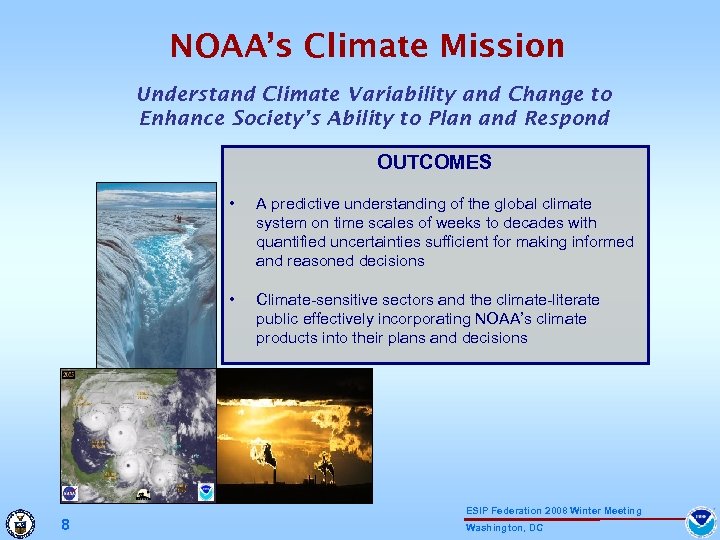
NOAA’s Climate Mission Understand Climate Variability and Change to Enhance Society’s Ability to Plan and Respond OUTCOMES • • 8 A predictive understanding of the global climate system on time scales of weeks to decades with quantified uncertainties sufficient for making informed and reasoned decisions Climate-sensitive sectors and the climate-literate public effectively incorporating NOAA’s climate products into their plans and decisions ESIP Federation 2008 Winter Meeting Washington, DC
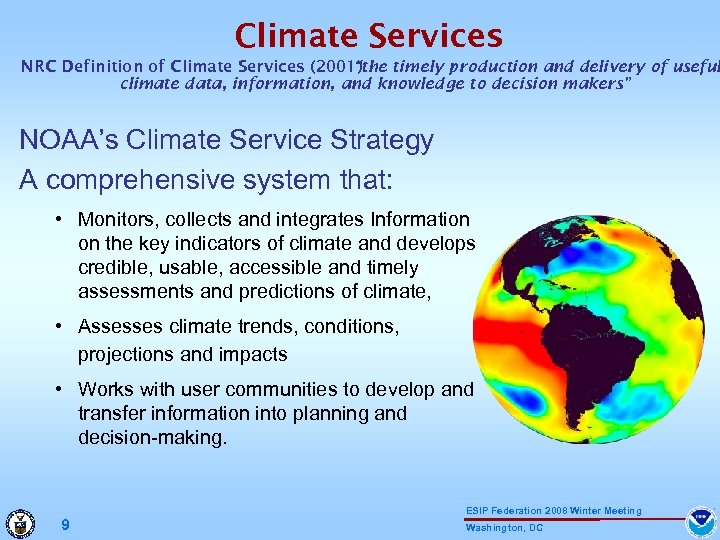
Climate Services NRC Definition of Climate Services (2001): “the timely production and delivery of useful climate data, information, and knowledge to decision makers” NOAA’s Climate Service Strategy A comprehensive system that: • Monitors, collects and integrates Information on the key indicators of climate and develops credible, usable, accessible and timely assessments and predictions of climate, • Assesses climate trends, conditions, projections and impacts • Works with user communities to develop and transfer information into planning and decision-making. 9 ESIP Federation 2008 Winter Meeting Washington, DC
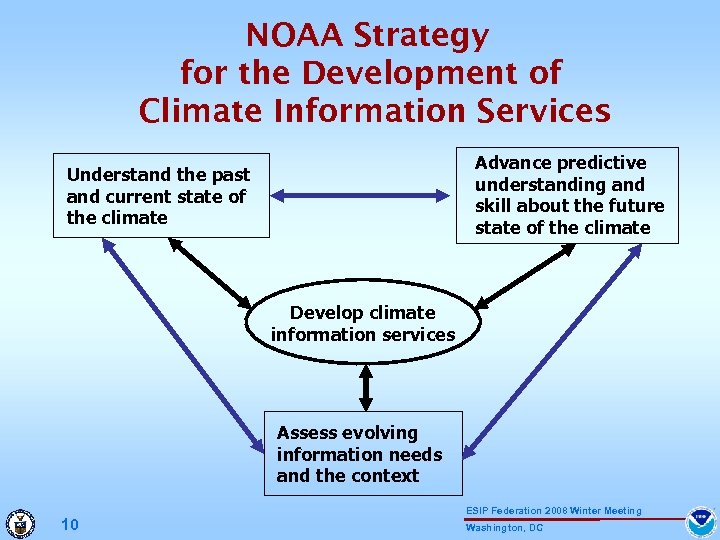
NOAA Strategy for the Development of Climate Information Services Advance predictive understanding and skill about the future state of the climate Understand the past and current state of the climate Develop climate information services Assess evolving information needs and the context 10 ESIP Federation 2008 Winter Meeting Washington, DC
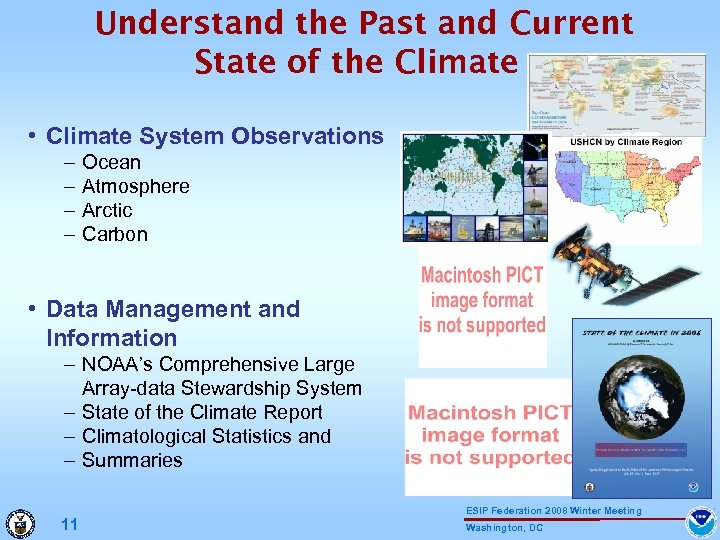
Understand the Past and Current State of the Climate • Climate System Observations – – Ocean Atmosphere Arctic Carbon • Data Management and Information – NOAA’s Comprehensive Large Array-data Stewardship System – State of the Climate Report – Climatological Statistics and – Summaries 11 ESIP Federation 2008 Winter Meeting Washington, DC
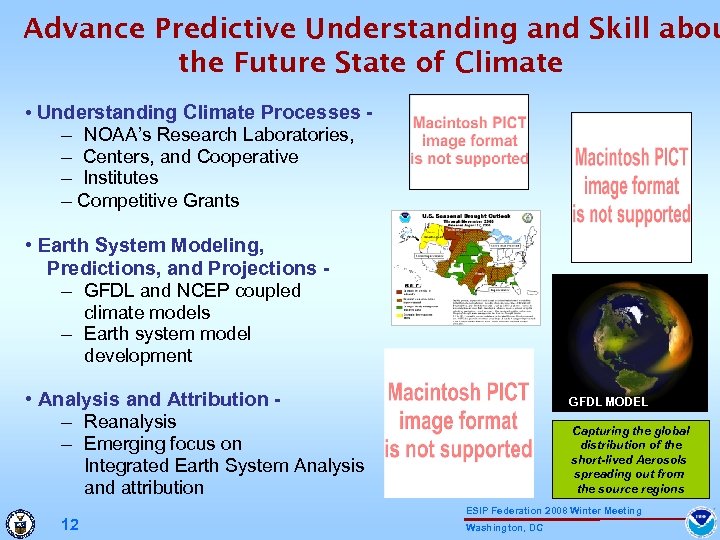
Advance Predictive Understanding and Skill abou the Future State of Climate • Understanding Climate Processes – NOAA’s Research Laboratories, – Centers, and Cooperative – Institutes – Competitive Grants • Earth System Modeling, Predictions, and Projections – GFDL and NCEP coupled climate models – Earth system model development • Analysis and Attribution – Reanalysis – Emerging focus on GFDL MODEL Capturing the global distribution of the short-lived Aerosols spreading out from the source regions Integrated Earth System Analysis and attribution 12 ESIP Federation 2008 Winter Meeting Washington, DC
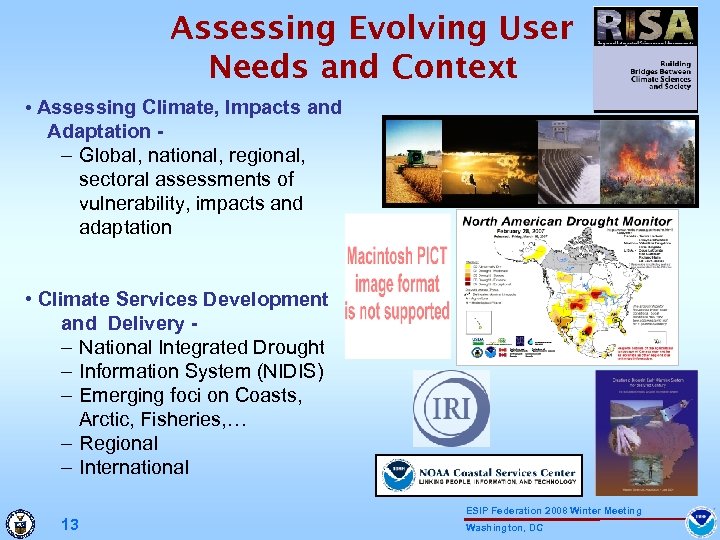
Assessing Evolving User Needs and Context • Assessing Climate, Impacts and Adaptation – Global, national, regional, sectoral assessments of vulnerability, impacts and adaptation • Climate Services Development and Delivery – National Integrated Drought – Information System (NIDIS) – Emerging foci on Coasts, Arctic, Fisheries, … – Regional – International 13 ESIP Federation 2008 Winter Meeting Washington, DC
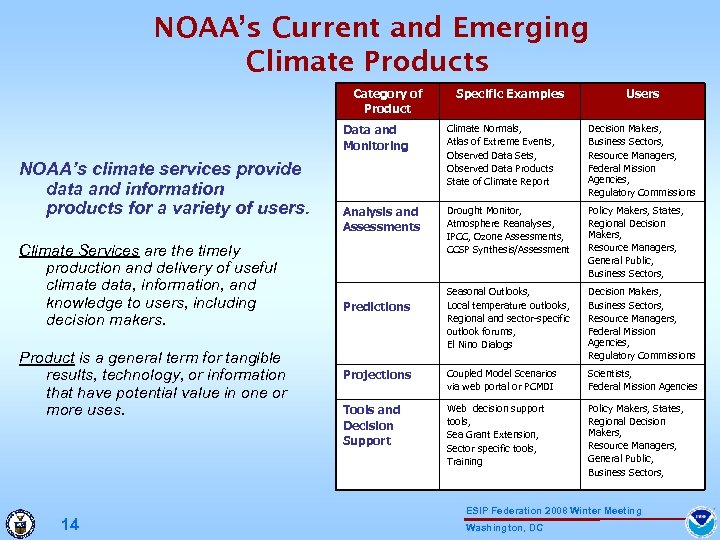
NOAA’s Current and Emerging Climate Products Category of Product Specific Examples Users Data and Monitoring NOAA’s climate services provide data and information products for a variety of users. Climate Services are the timely production and delivery of useful climate data, information, and knowledge to users, including decision makers. Product is a general term for tangible results, technology, or information that have potential value in one or more uses. 14 Climate Normals, Atlas of Extreme Events, Observed Data Sets, Observed Data Products State of Climate Report Decision Makers, Business Sectors, Resource Managers, Federal Mission Agencies, Regulatory Commissions Analysis and Assessments Drought Monitor, Atmosphere Reanalyses, IPCC, Ozone Assessments, CCSP Synthesis/Assessment Policy Makers, States, Regional Decision Makers, Resource Managers, General Public, Business Sectors, Seasonal Outlooks, Local temperature outlooks, Regional and sector-specific outlook forums, El Nino Dialogs Decision Makers, Business Sectors, Resource Managers, Federal Mission Agencies, Regulatory Commissions Projections Coupled Model Scenarios via web portal or PCMDI Scientists, Federal Mission Agencies Tools and Decision Support Web decision support tools, Sea Grant Extension, Sector specific tools, Training Policy Makers, States, Regional Decision Makers, Resource Managers, General Public, Business Sectors, Predictions ESIP Federation 2008 Winter Meeting Washington, DC
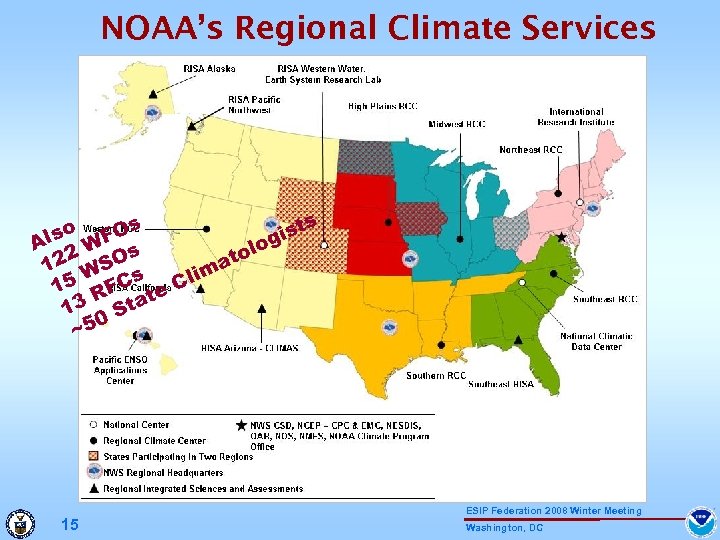
NOAA’s Regional Climate Services s ist so FOs Al W s log 2 ato 12 WSO m 5 Cs e Cli 1 RF t 13 Sta 0 ~5 15 ESIP Federation 2008 Winter Meeting Washington, DC
Need for Integrated Climate Services “Whatever approach is chosen, it must be able to create a national framework that will encourage an intimate connection between research, operations, and the support of decision making. Specific responsibility and resources must be assigned to the integration of multiple-agency programs. ” The Science of Regional and Global Change: Putting Knowledge to Work NRC, 2001 16 ESIP Federation 2008 Winter Meeting Washington, DC
National Integrated Drought Information System A result of requests by the Western Governors Associatio and the NIDIS act of 2006 • NIDIS is an example of a national effort led by NOAA to coordinate across federal agencies the monitoring, data, and models needed to provide: – Ongoing information on current and future drought conditions across the nation And – Region specific products for drought management, planning and adaptation, and education and outreach tools 17 ESIP Federation 2008 Winter Meeting Washington, DC
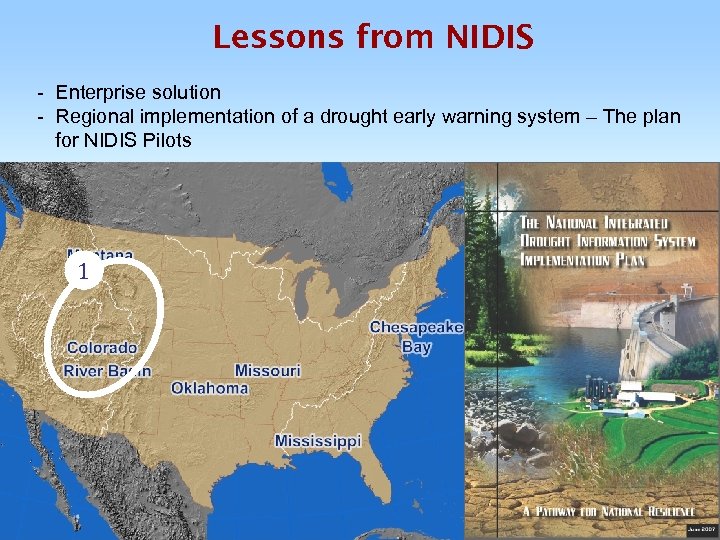
Lessons from NIDIS - Enterprise solution - Regional implementation of a drought early warning system – The plan for NIDIS Pilots 1
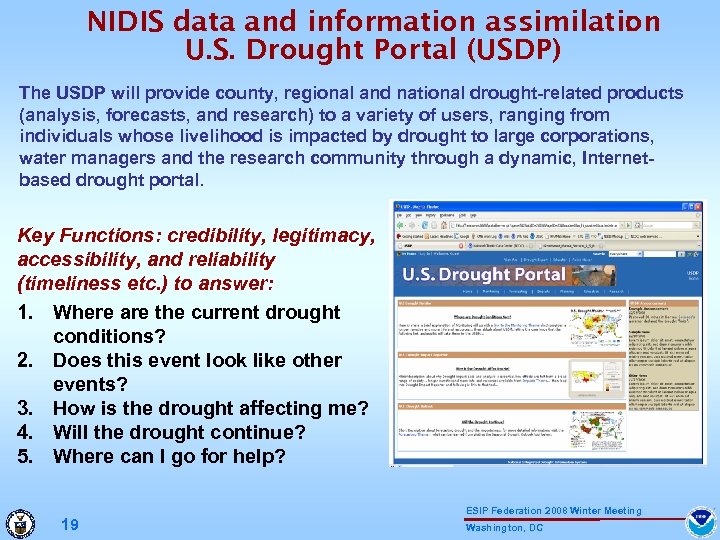
NIDIS data and information assimilation : U. S. Drought Portal (USDP) The USDP will provide county, regional and national drought-related products (analysis, forecasts, and research) to a variety of users, ranging from individuals whose livelihood is impacted by drought to large corporations, water managers and the research community through a dynamic, Internetbased drought portal. Key Functions: credibility, legitimacy, accessibility, and reliability (timeliness etc. ) to answer: 1. Where are the current drought conditions? 2. Does this event look like other events? 3. How is the drought affecting me? 4. Will the drought continue? 5. Where can I go for help? 19 ESIP Federation 2008 Winter Meeting Washington, DC
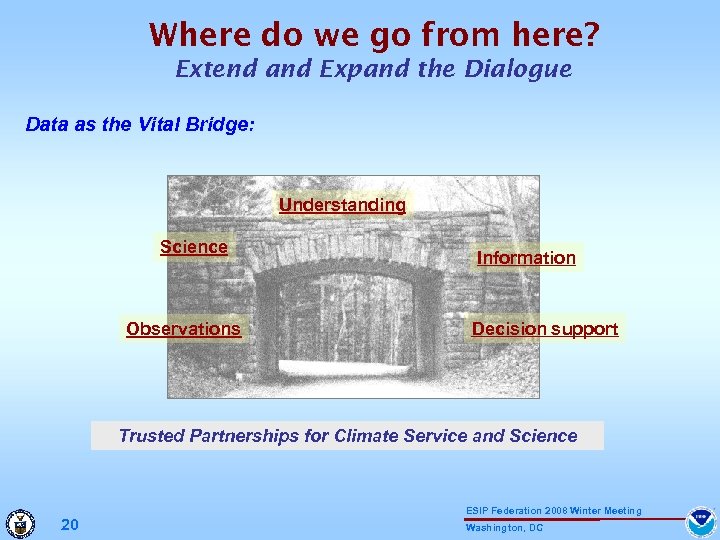
Where do we go from here? Extend and Expand the Dialogue Data as the Vital Bridge: Understanding Science Observations Information Decision support Trusted Partnerships for Climate Service and Science 20 ESIP Federation 2008 Winter Meeting Washington, DC
Скачать презентацию Climate Services Dr Chet Koblinsky Director NOAA Climate
d70d3b787207750eb788571f9713bb46.ppt