


 Скачать презентацию Climate Prediction Applications Postdoctoral Program CPAPP An Experiment
54ff2e2c3d5a4a2971c1166c2770c1fb.ppt
- Количество слайдов: 12
 Climate Prediction Applications Postdoctoral Program (CPAPP) An Experiment in Interfacing Climate and Society Lisa Goddard 1, Kelly Redmond 2, and Meg Austin 3 1 International Research Institute for Climate & Society 2 Desert Research Institute/Western Regional Climate Center 3 University Corporation for Atmospheric Research Email: austin@ucar. edu or goddard@iri. columbia. edu
 U. S. CLIVAR Prediction, Predictability & Applications Interface Panel (PPAI) Our mission is to foster improved practices in the provision, validation, and uses of climate information and forecasts through coordinated participation within U. S. and international climate science and applications communities.
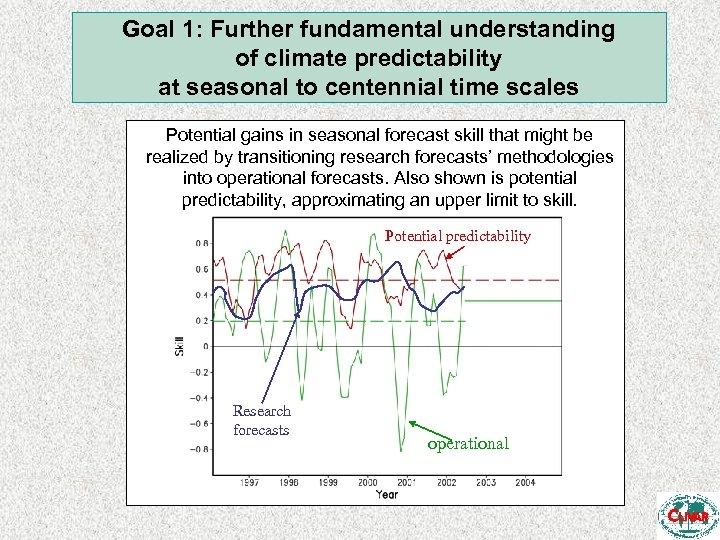 Goal 1: Further fundamental understanding of climate predictability at seasonal to centennial time scales Potential gains in seasonal forecast skill that might be realized by transitioning research forecasts’ methodologies into operational forecasts. Also shown is potential predictability, approximating an upper limit to skill. Potential predictability Research forecasts operational
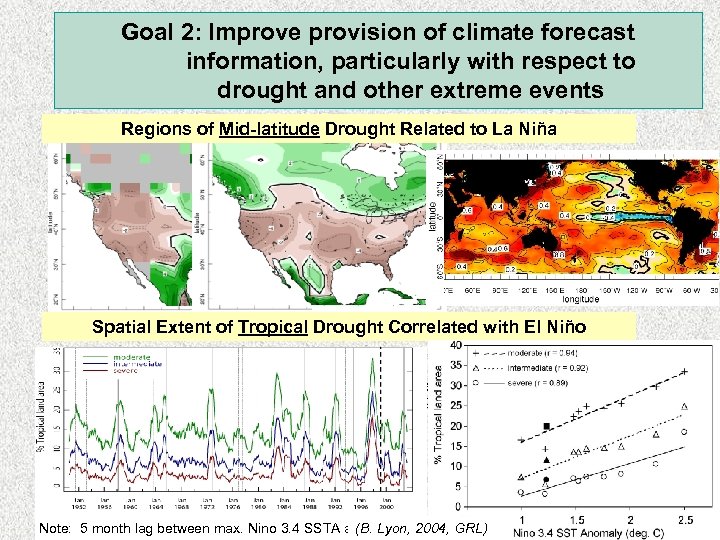 Goal 2: Improve provision of climate forecast information, particularly with respect to drought and other extreme events OBSERVED Rainfall (1998 -2004) Drought Related to La Niña MODEL SIMULATED Rainfall Regions of Mid-latitude Seager et al 2005 Spatial Extent of Tropical Drought Correlated with El Niño In some mid-latitudes regions drought appears to be related to La Niña-like conditions. (Seager et al. , 2005, Schubert et al. 2004, Barlow et al. 2002, Cole et al. 2002) Note: 5 month lag between max. Nino 3. 4 SSTA and extent peaks GRL) (B. Lyon, 2004,
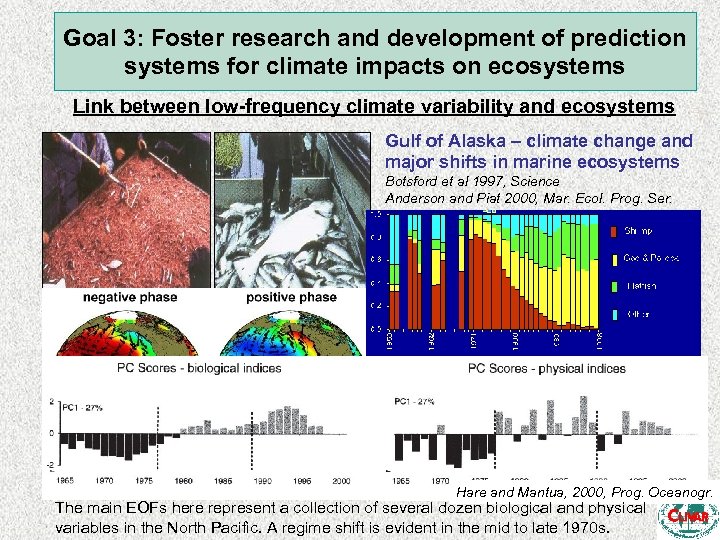 Goal 3: Foster research and development of prediction systems for climate impacts on ecosystems Link between low-frequency climate variability and ecosystems Gulf of Alaska – climate change and major shifts in marine ecosystems Botsford et al 1997, Science Anderson and Piat 2000, Mar. Ecol. Prog. Ser. Hare and Mantua, 2000, Prog. Oceanogr. The main EOFs here represent a collection of several dozen biological and physical variables in the North Pacific. A regime shift is evident in the mid to late 1970 s.
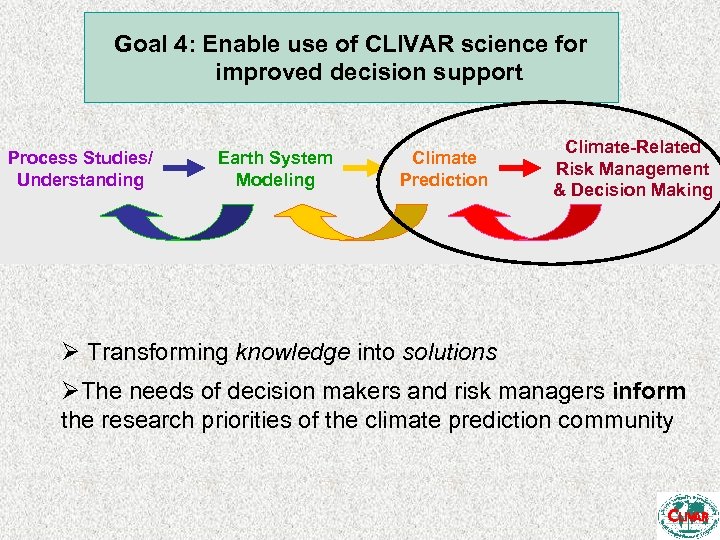 Goal 4: Enable use of CLIVAR science for improved decision support Process Studies/ Understanding Earth System Modeling Climate Prediction Climate-Related Risk Management & Decision Making Ø Transforming knowledge into solutions ØThe needs of decision makers and risk managers inform the research priorities of the climate prediction community
 Climate Prediction Applications Postdoc Program (CPAPP) Some novel aspects – * Bring together recent Ph. Ds with background in climate science with real-time decision makers involved in climate risk management. * Supervision of postdoctoral fellow by BOTH decision making institution and climate research institution. * Explicit “buy in” by decision making institution. Remaining salary provided by national funding agencies associated with US CLIVAR. “In kind” contributions from climate research institution.
 Climate Prediction Applications Postdoc Program (CPAPP) Institutional Partners – Climate Research Institutions: Involved in the development, production and application of climate information. Examples of such institutions include, but are not limited to, universities tied to the RISAs, Regional Climate Centers, and federal research facilities Decision Making Institutions: Involved in climate-related risk management and decision-making. Examples include national-, regional-, state-, or municipal-level agencies and organizations (public and non-profit) that manage or regulate natural resources or produce a public good.
 Climate Prediction Applications Postdoc Program (CPAPP) Status – Pilot phase – 3 -post-docs funded by NOAA at 50%. Rest of funding from Decision Making Institution. * January 2007 – Program prospectus ‘finalized’ * August 2007 – Meeting of Oversight Committee with institutional partners to develop program announcement and solidify process. * September 2007 – Post-doc Announcement of Opportunity issued * December 2007 – Initial post-doc applications due * January 2008 – Post-doc short-list provided with institutional statements * January 2008 – Institutional Partner Announcement of Opportunity issued
 Climate Prediction Applications Postdoc Program (CPAPP) Involvement … so far (projects to start mid-2008) Institutional Partners involved: * USBR + NOAA-ESRL: Western Water & Climate Change * Tampa Bay Water + U. Florida: Municipal Water & Climate Variability Post-doctoral interest: * 22 candidates * 7 short-listed candidates, now developing more detailed research proposals based on institutional statements of the problem.
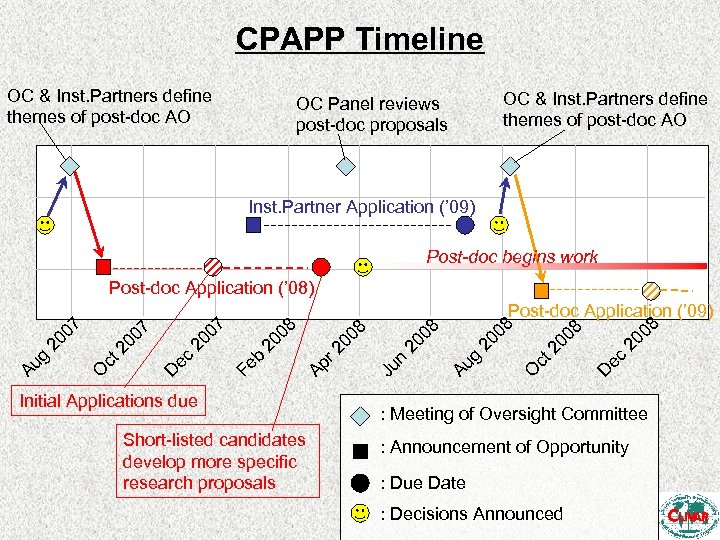 CPAPP Timeline OC & Inst. Partners define themes of post-doc AO OC Panel reviews post-doc proposals Inst. Partner Application (’ 09) Post-doc begins work Post-doc Application (’ 08) Initial Applications due Short-listed candidates develop more specific research proposals 20 08 ec D ct 2 O Au g 00 8 8 20 0 Ju n Ap r 2 00 8 8 20 0 Fe b 20 07 D ec 00 7 ct 2 O Au g 20 0 7 Post-doc Application (’ 09) : Meeting of Oversight Committee : Announcement of Opportunity : Due Date : Decisions Announced
 For more information please visit http: //www. vsp. ucar. edu or send email to Meg Austin: austin@ucar. edu (Program Administrator) Lisa Goddard: goddard@iri. columbia. edu (Chair of Oversight Committee) Thank You!