


 Скачать презентацию Climate Master Geothermal What When Where How
e09b782e5a6649a25e3fea26a4aada57.ppt
- Количество слайдов: 82
 Climate. Master Geothermal What, When, Where, & How
 What Is Geothermal?
 Boiler/Tower Systems
 Ground-Source (Geothermal)
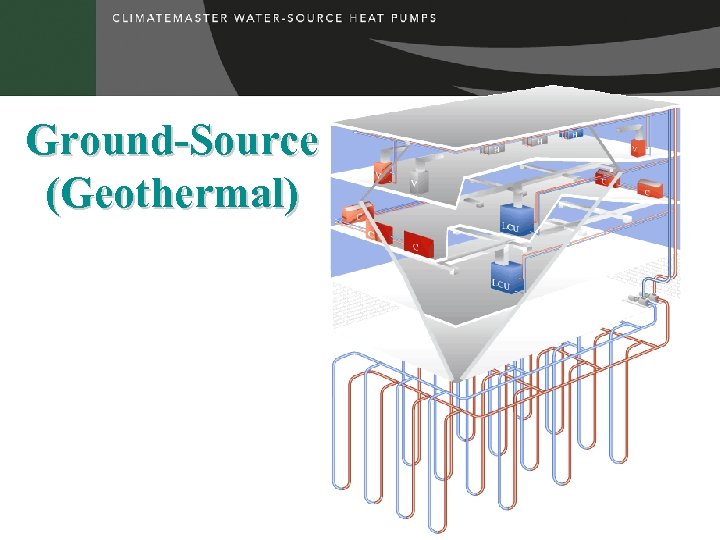
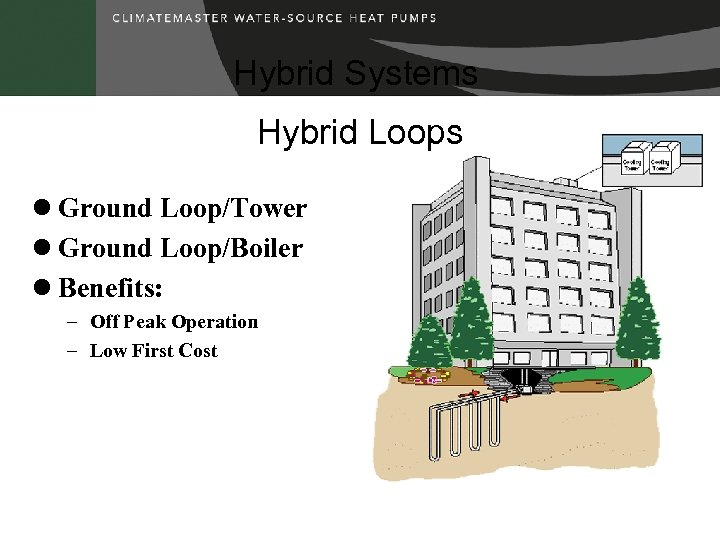
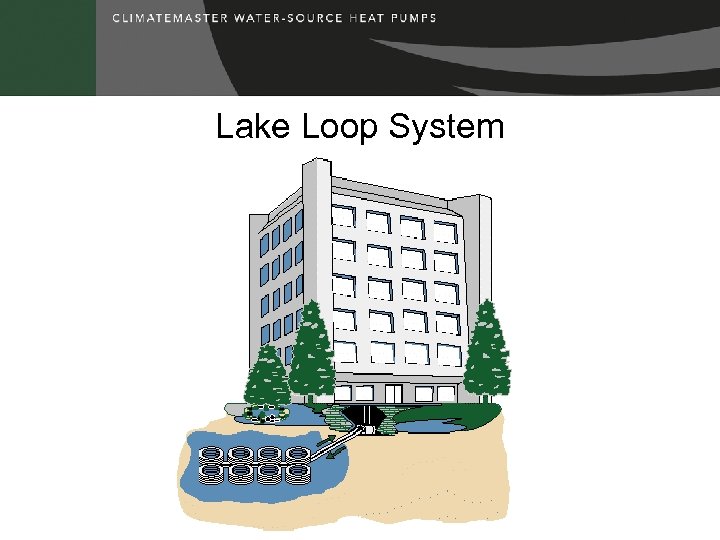
 Several Variations of Geothermal l Vertical Closed Loop l Horizontal Closed Loop l Hybrid (Geo and Tower/Boiler) l Lake Closed Loop l Closed to the Aquifer l Standing Column Well
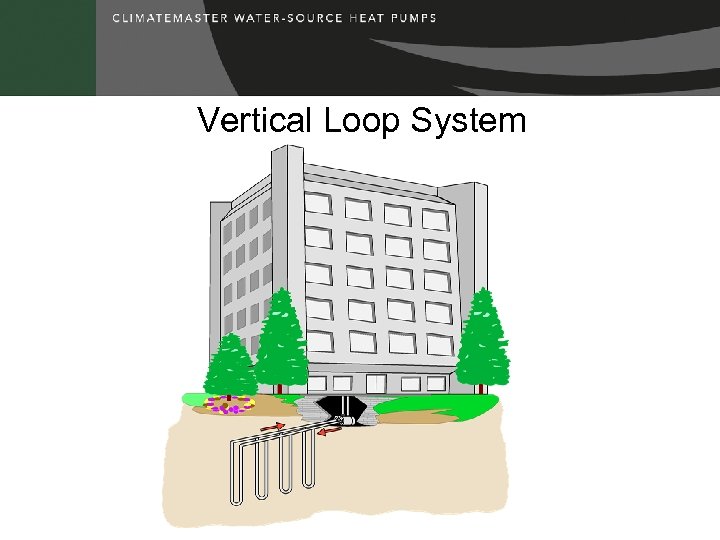 Vertical Loop System
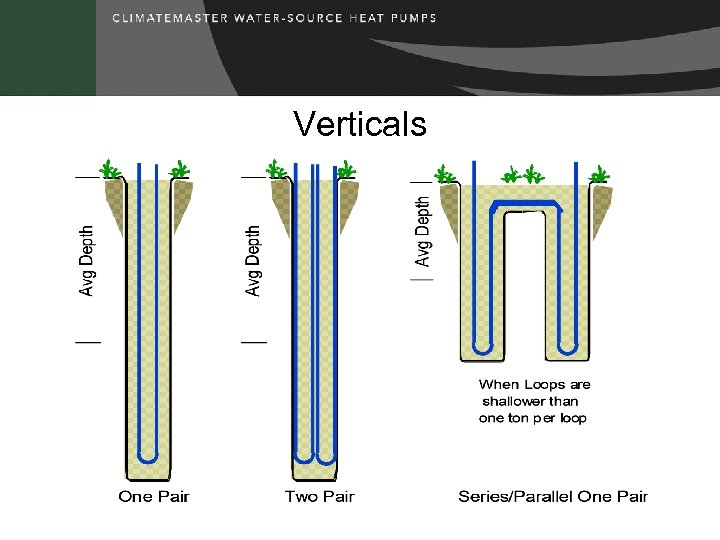 Verticals
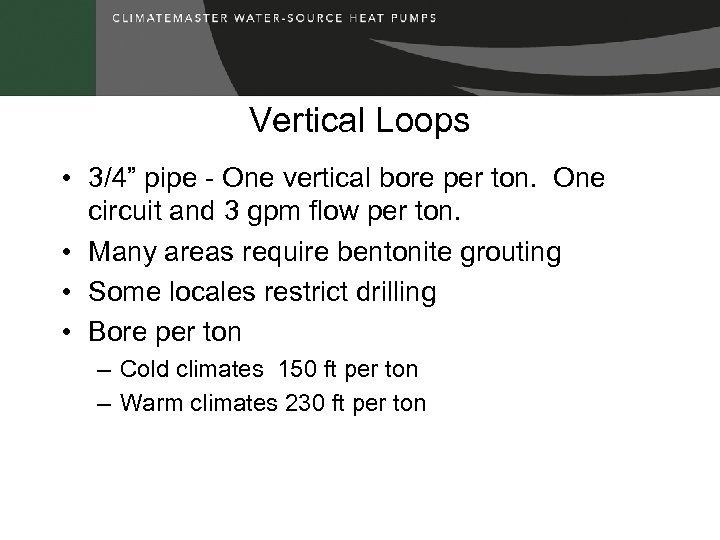 Vertical Loops • 3/4” pipe - One vertical bore per ton. One circuit and 3 gpm flow per ton. • Many areas require bentonite grouting • Some locales restrict drilling • Bore per ton – Cold climates 150 ft per ton – Warm climates 230 ft per ton
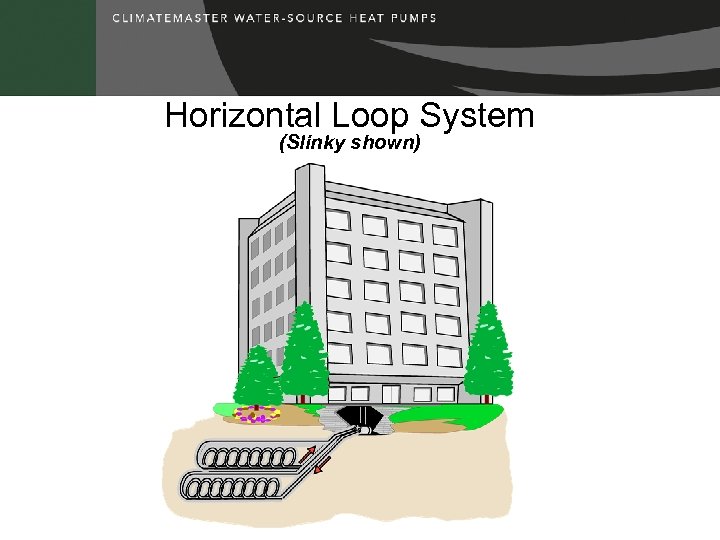 Horizontal Loop System (Slinky shown)
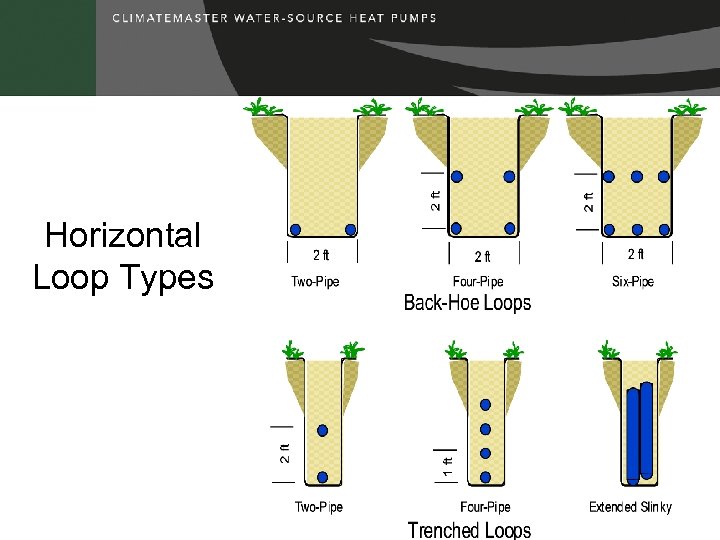 Horizontal Loop Types
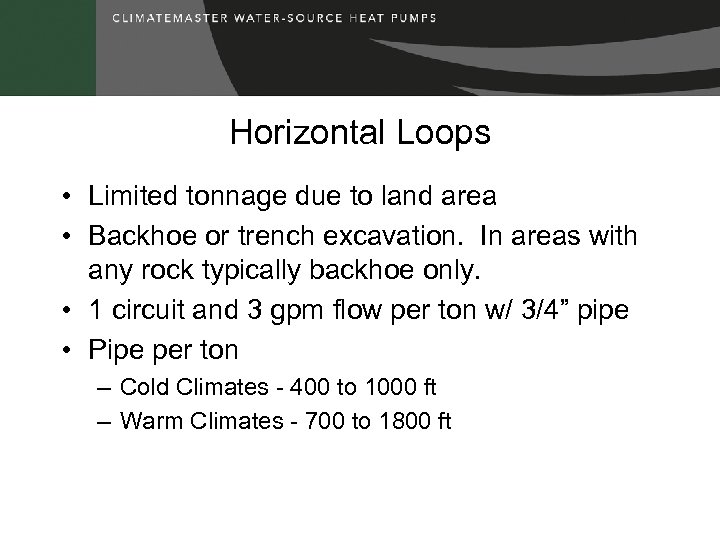 Horizontal Loops • Limited tonnage due to land area • Backhoe or trench excavation. In areas with any rock typically backhoe only. • 1 circuit and 3 gpm flow per ton w/ 3/4” pipe • Pipe per ton – Cold Climates - 400 to 1000 ft – Warm Climates - 700 to 1800 ft
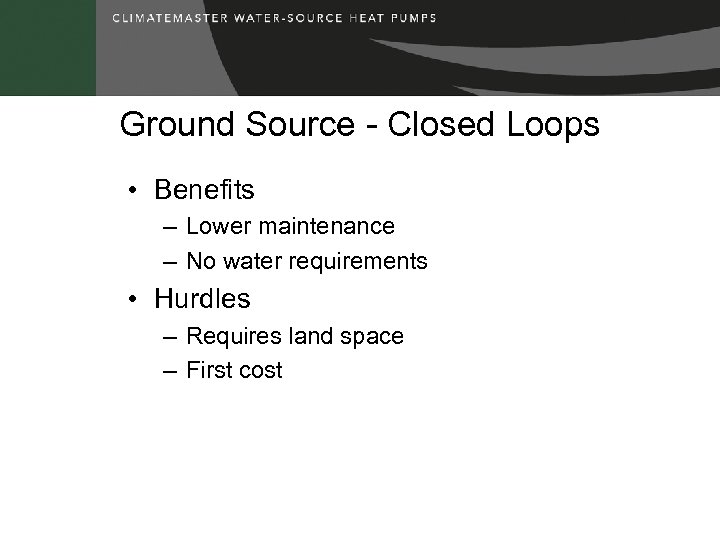 Ground Source - Closed Loops • Benefits – Lower maintenance – No water requirements • Hurdles – Requires land space – First cost
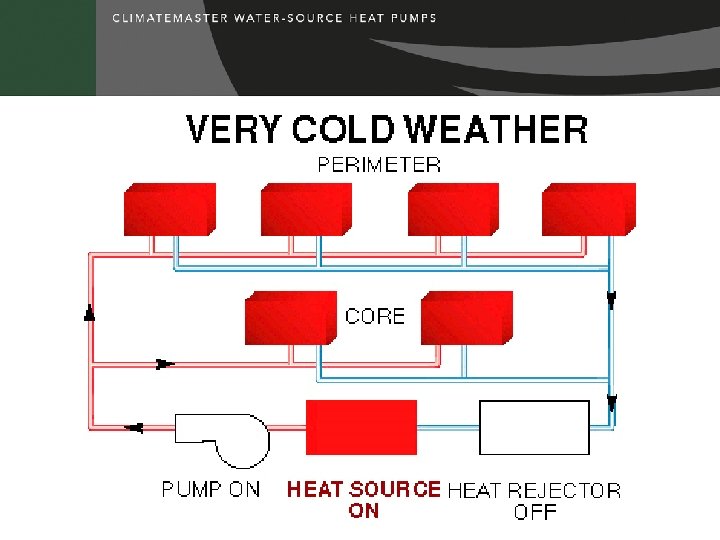
 Ground Loop • 3 gpm flow per ton of cooling • 1 circuit or flow path per ton of cooling w/ 3/4” loop pipe • Loop Temperatures – 40 - 90 deg F
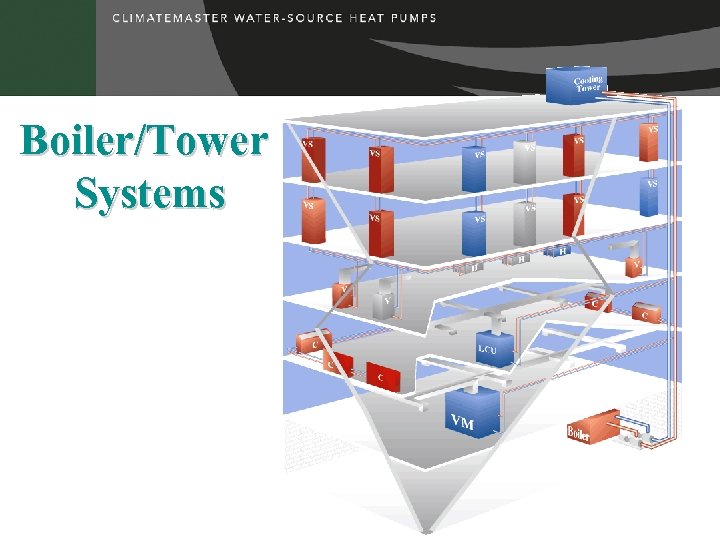
 Hybrid Systems Hybrid Loops l Ground Loop/Tower l Ground Loop/Boiler l Benefits: – Off Peak Operation – Low First Cost
 Lake Loop System
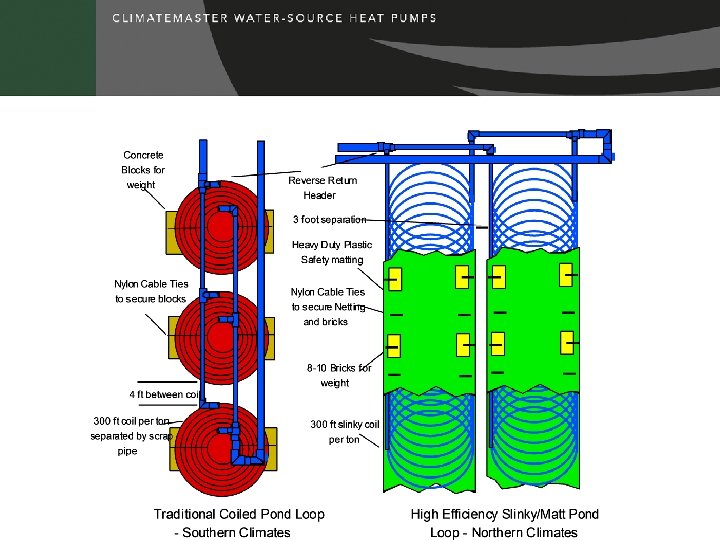
 Pond Loops • Least expensive ground loop • Minimum 300 ft 2 per ton and 9 feet deep • In north need ice cover for operation (no aeration). Utilizes 39 deg. F water temp. • Pond should be within 300’ of structure • 300 ft Pipe per ton
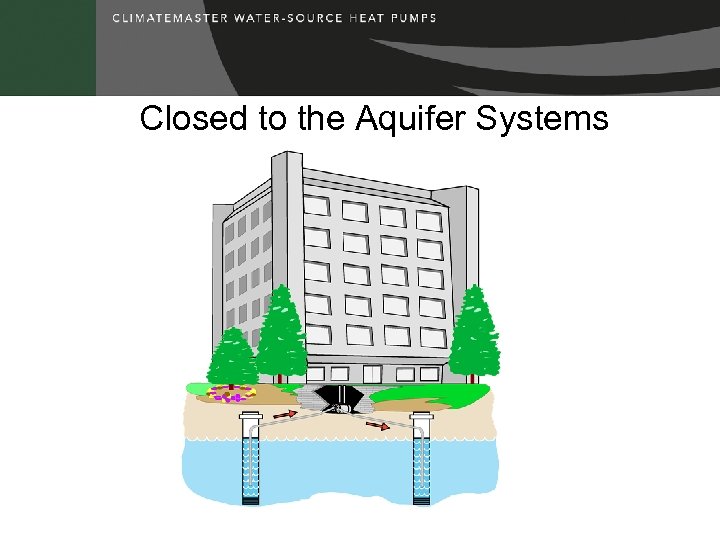 Closed to the Aquifer Systems
 Ground Water - Plate Frame HX • Benefits – Lower first cost – No land requirement – Isolated internal loop via HX • Hurdles – Requires annual HX maintenance – Requires injection well – Typically used only with more than 4 total units
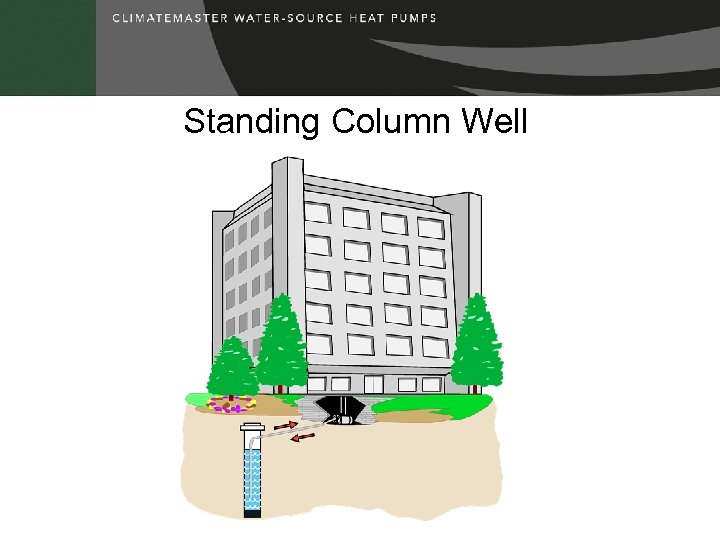 Standing Column Well
 Ground Water - Direct Use • Benefits – Lowest first cost – No land requirement • Hurdles – – Requires clean water and more maintenance Getting rid of water can be difficult Larger pump and pressure tank Typically used only with 3 or less total units
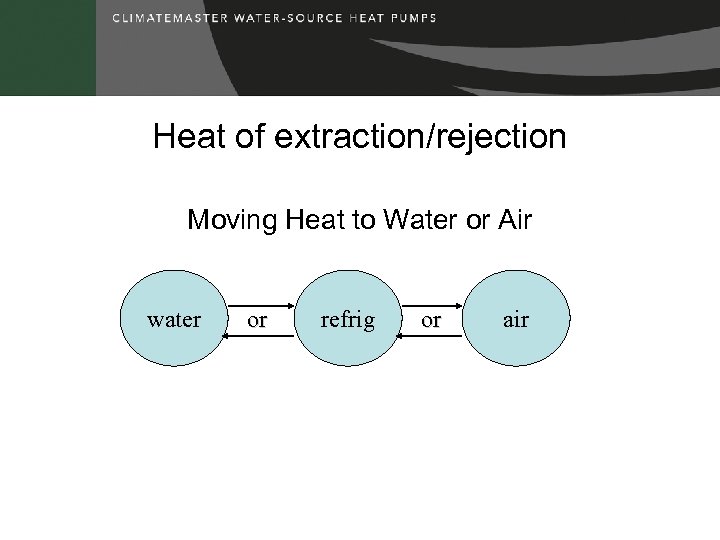 Heat of extraction/rejection Moving Heat to Water or Air water or refrig or air
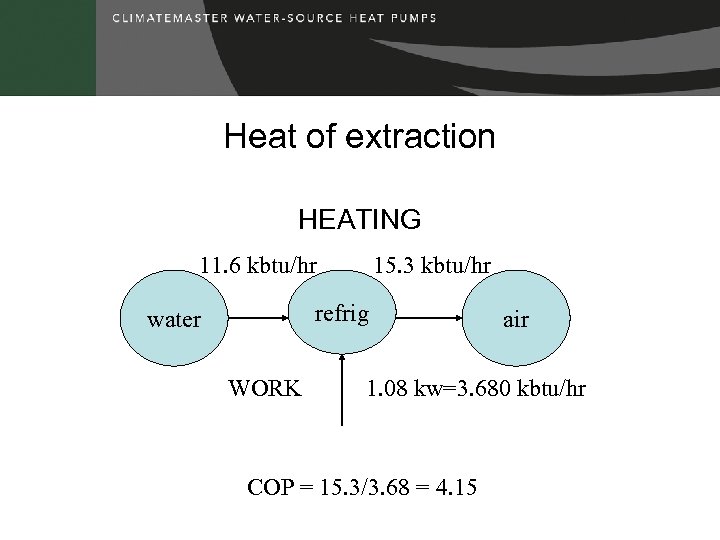 Heat of extraction HEATING 11. 6 kbtu/hr 15. 3 kbtu/hr refrig water WORK air 1. 08 kw=3. 680 kbtu/hr COP = 15. 3/3. 68 = 4. 15
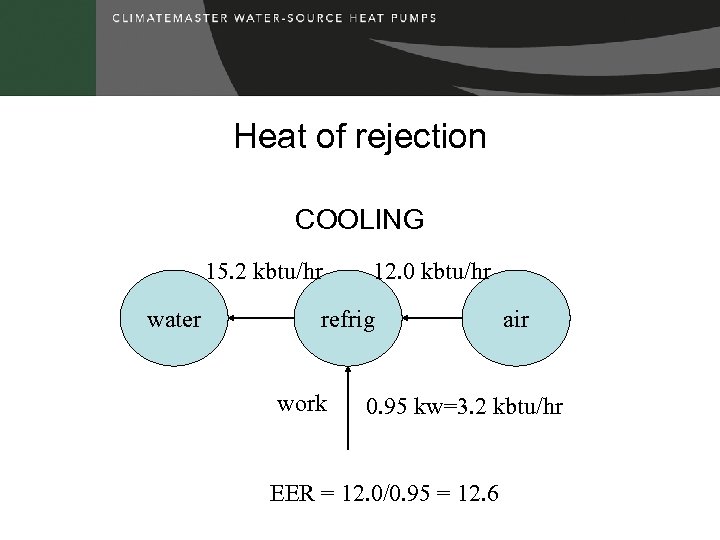 Heat of rejection COOLING 15. 2 kbtu/hr water 12. 0 kbtu/hr refrig work air 0. 95 kw=3. 2 kbtu/hr EER = 12. 0/0. 95 = 12. 6
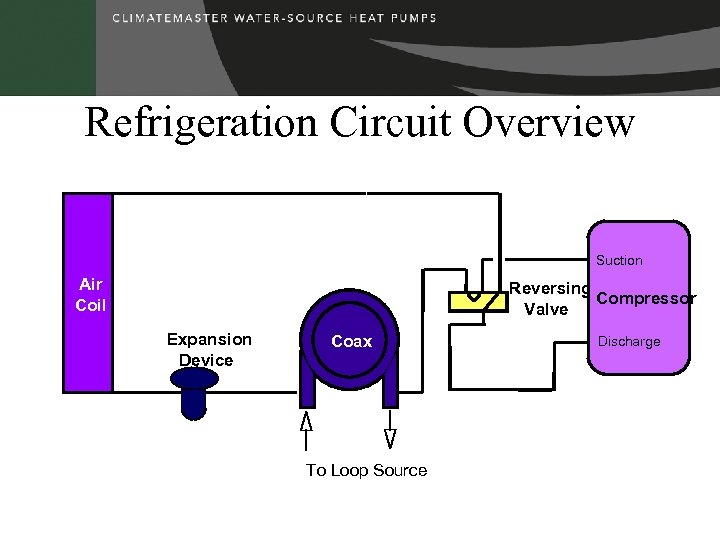 Refrigeration Circuit Overview Suction Air Coil Reversing Compressor Valve Expansion Device Coax To Loop Source Discharge
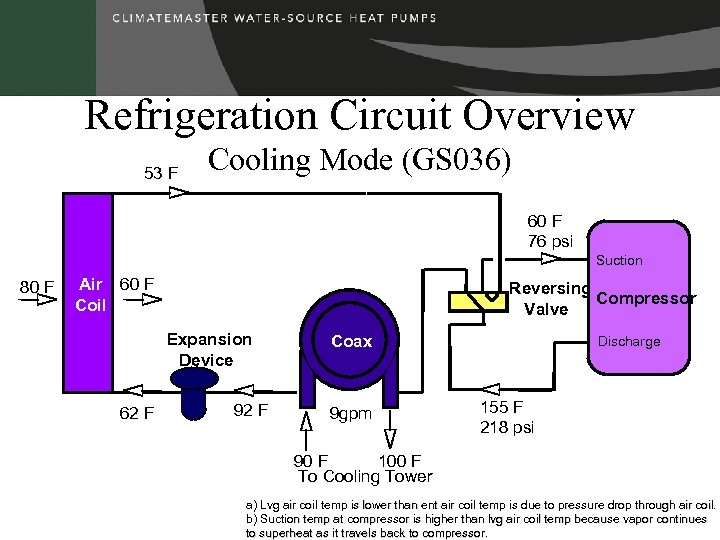 Refrigeration Circuit Overview 53 F Cooling Mode (GS 036) 60 F 76 psi Suction 80 F Air 60 F Coil Reversing Compressor Valve Expansion Device 62 F 92 F Coax 9 gpm Discharge 155 F 218 psi 90 F 100 F To Cooling Tower a) Lvg air coil temp is lower than ent air coil temp is due to pressure drop through air coil. b) Suction temp at compressor is higher than lvg air coil temp because vapor continues to superheat as it travels back to compressor.
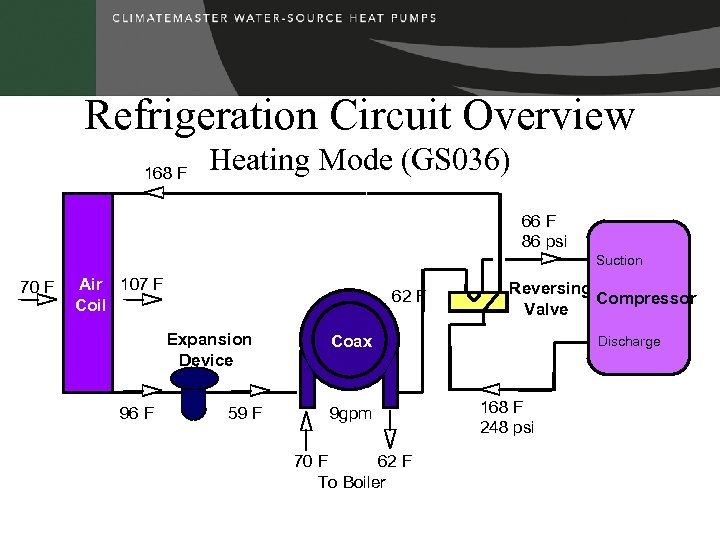 Refrigeration Circuit Overview 168 F Heating Mode (GS 036) 66 F 86 psi Suction 70 F Air 107 F Coil 62 F Expansion Device 96 F 59 F Reversing Compressor Valve Coax 9 gpm 70 F 62 F To Boiler Discharge 168 F 248 psi
 How did Geothermal Gain Momentum?
 History Behind Geothermal
 Late 70’s-Early 1980’s • Energy crisis: Fossil fuel shortages and price shocks • Dependence shifts to electricity • Opportunity builds for geothermal technology • Technical competence for geothermal water source heat pumps develops in the industry
 Mid 1980’s • Electric utilities experiencing “peak demands” • DSM (demand side management) becomes a strategic planning tool • Extensive monitoring reveals geothermal efficiency and market potential • Geothermal becomes recognized as DSM planning tool
 Late 1980’s • Performance Standards established for geothermal systems • Support grows from regulators, research groups and utilities • Substantial performance in utility DSM programs • A proven technology competitive with conventional fuels
 Early 1990’s • Geothermal systems increase in performance and functionality • EPA, DOE, EPRI (Electric Power Research Institute), NRECA (National Rural Electric Cooperative Assoc), EEI (Edison Electric Institute) recognize potential for geothermal • Utility geothermal DSM programs begin implementation
 Mid 1990’s • Geothermal recognized as key technology to reduce greenhouse gases • EPA and DOE release reports confirming industry growth potential • Government, utility, and industry consortium formed to assist in the development of the geothermal market
 Late 1990’s-Year 2000 • Geothermal becomes recognized as a major renewable energy source on an international scale
 History of Ground Source Heat Pumps Installations • Based upon water source heat pump from Florida of 1950’s • Ground loop development using iron and copper loops 1930’s and 40’s. PB and PE pipe made viable in late 1970’s. • Three regions of development in 1979: – OSU - J. Bose, J. Partin, G. Parker – Ft Wayne, IN - Dan Ellis – Ontario - Dave Hatherton
 Antifreeze Materials • Methanol - least expensive and good heat transfer • Ethanol - More expensive and best heat transfer • Propylene glycol - non-toxic and expensive, but lowest heat transfer
 Pipe and Fittings
 Pipe and Fittings Material • High Density polyethylene (HDPE )pipe developed for natural gas distribution industry • Socket or Butt heat fusion joints are stronger than the pipe wall itself • 3/4, 1, 1 -1/4, 1 -1/2, and 2” sizes common • Coils and straight lengths • Many fittings available in tee’s, elbow’s, and couplings
 Loop Design
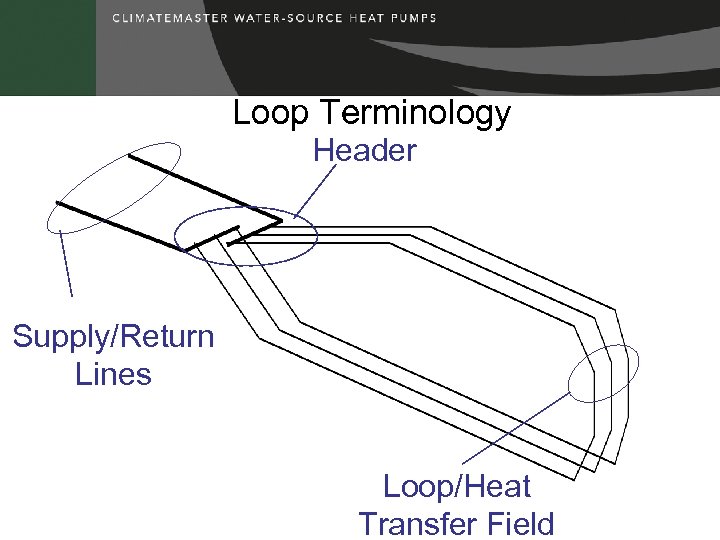 Loop Terminology Header Supply/Return Lines Loop/Heat Transfer Field
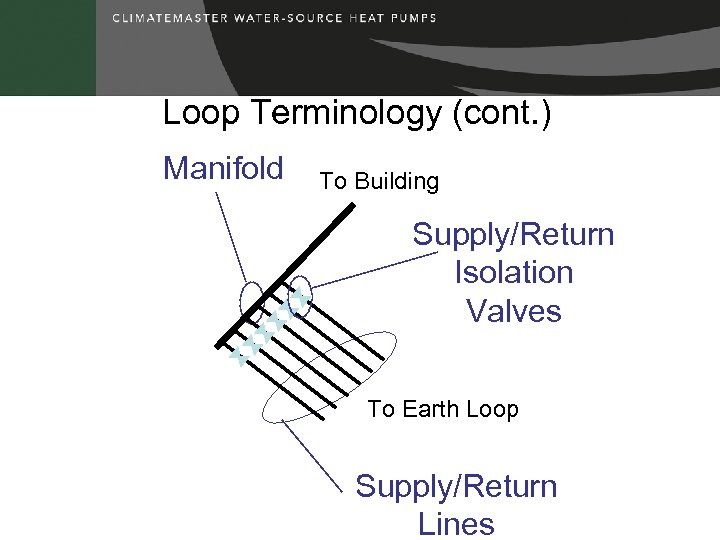 Loop Terminology (cont. ) Manifold To Building Supply/Return Isolation Valves To Earth Loop Supply/Return Lines
 Loop Design • Loop style and total trench/bore length obtained from software design • Goal is 2. 5 - 3 gpm flow per ton of capacity (minimum of 2. 25 gpm) • Loop circuiting is designed for: – Low pressure drop – Good heat transfer • Headers are piped in reverse return to even out pressure drop in parallel circuits
 Pumps • Option 1 - Redundant Alternate - Size single pump to handle complete circulation install duplicate redundant pump in parallel and control alternately • Option 2 - Redundant Staged - Install two pumps in parallel that can handle load and stage them with alternating controls
 • Option 3 - Variable speed pumps with solenoids at each unit • Option 4 - Distributed pumping - Install pumps at each heat pump with single pipe system and continuous circulation
 Circuit Design rules • 1 circuit per ton of capacity in 3/4” • 2. 5 - 3 gpm per ton of capacity
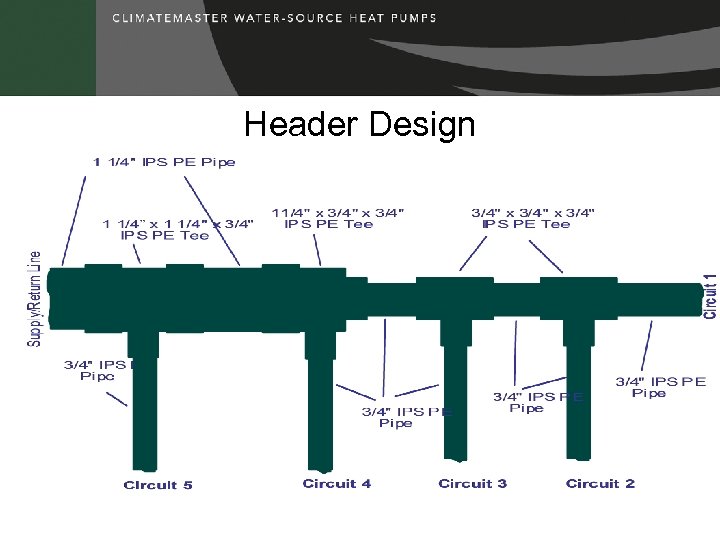 Header Design
 Design Do’s and Don’ts • Design air scoop/trap between building and earth loops to entrap air stemming from wshp maintenance • Utilize Mechanical room or outside pit to house manifold of supply/return lines with individual shut-offs and main loop to building • Ensure equipment is rated for temperature range of loop WLHP, GWHP or GLHP • In hybrid design size loop for heating load and tower for extra cooling required
 Flushing • Flush exterior loop first using system pumps. • Flush supply/return one at a time. • Flush interior loop with exterior isolated so as not to move air to earth loop
 Antifreeze • Antifreeze to 15 deg F below coldest loop temperature expected • Always add alcohols below water level to reduce fumes • Check antifreeze concentrations using the specific gravity charts
 Equipment
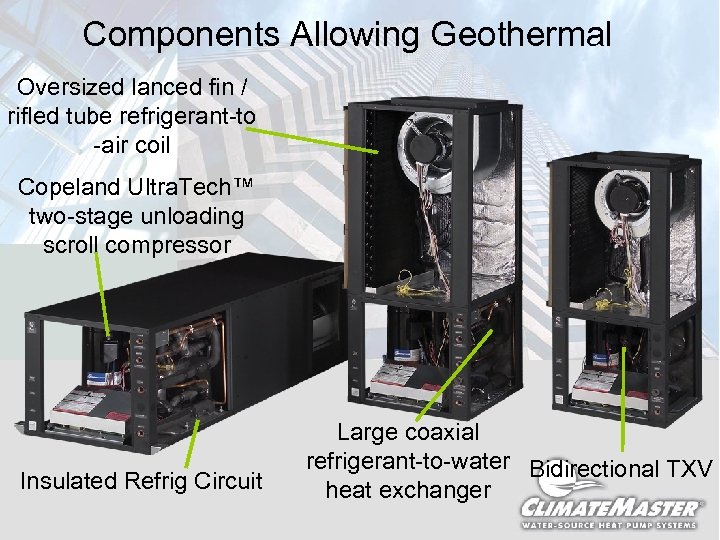 Components Allowing Geothermal Oversized lanced fin / rifled tube refrigerant-to -air coil Copeland Ultra. Tech™ two-stage unloading scroll compressor Insulated Refrig Circuit Large coaxial refrigerant-to-water Bidirectional TXV heat exchanger
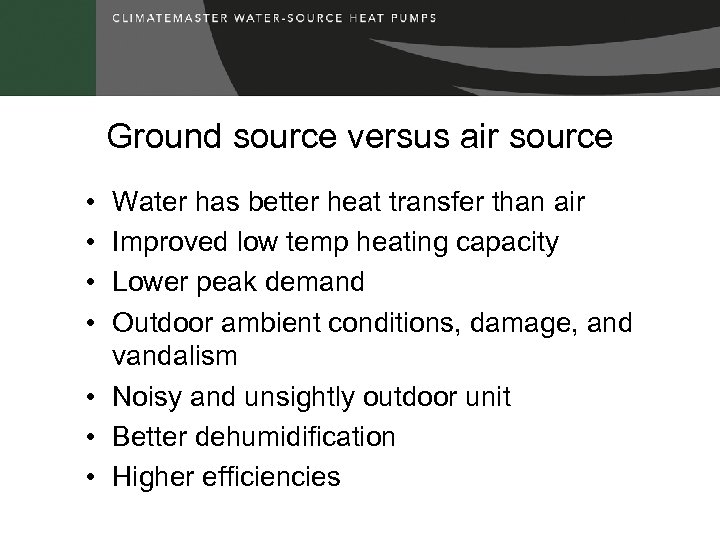 Ground source versus air source • • Water has better heat transfer than air Improved low temp heating capacity Lower peak demand Outdoor ambient conditions, damage, and vandalism • Noisy and unsightly outdoor unit • Better dehumidification • Higher efficiencies
 ARI Ratings Summary • ARI/ISO/ASHARE 13256 -1 Ground loop heat pump – Based upon typical extreme loop temperatures – Htg 32 deg. F and clg 77 deg. F
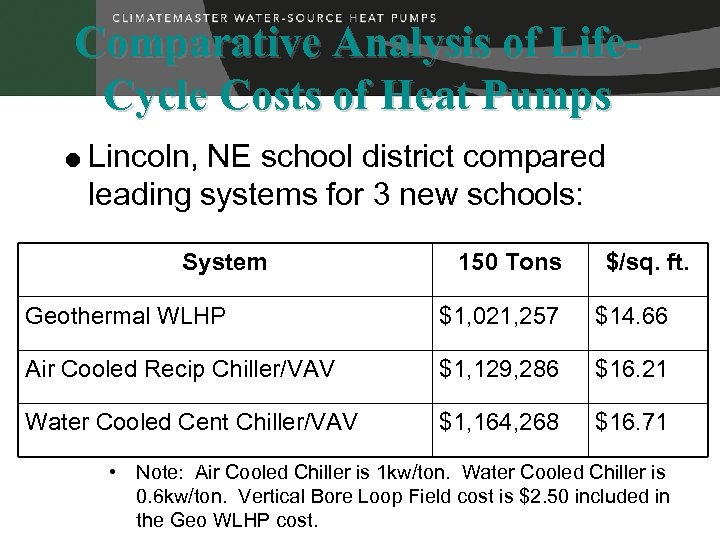 Comparative Analysis of Life. Cycle Costs of Heat Pumps = Lincoln, NE school district compared leading systems for 3 new schools: System 150 Tons $/sq. ft. Geothermal WLHP $1, 021, 257 $14. 66 Air Cooled Recip Chiller/VAV $1, 129, 286 $16. 21 Water Cooled Cent Chiller/VAV $1, 164, 268 $16. 71 • Note: Air Cooled Chiller is 1 kw/ton. Water Cooled Chiller is 0. 6 kw/ton. Vertical Bore Loop Field cost is $2. 50 included in the Geo WLHP cost.

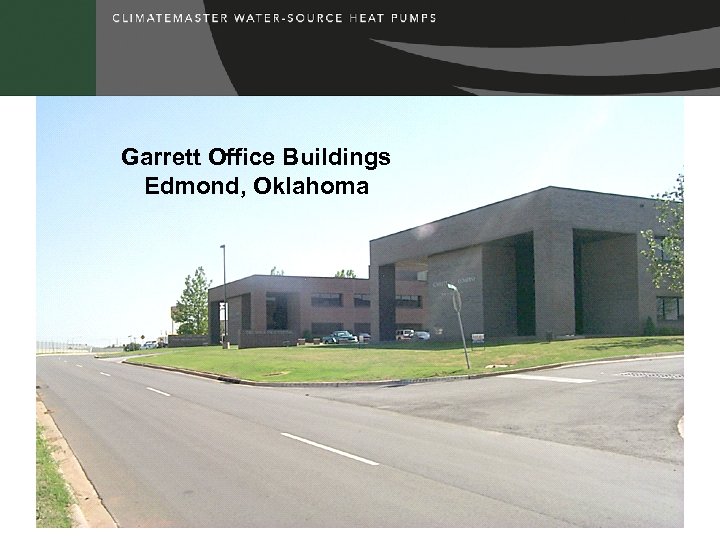 Garrett Office Buildings Edmond, Oklahoma
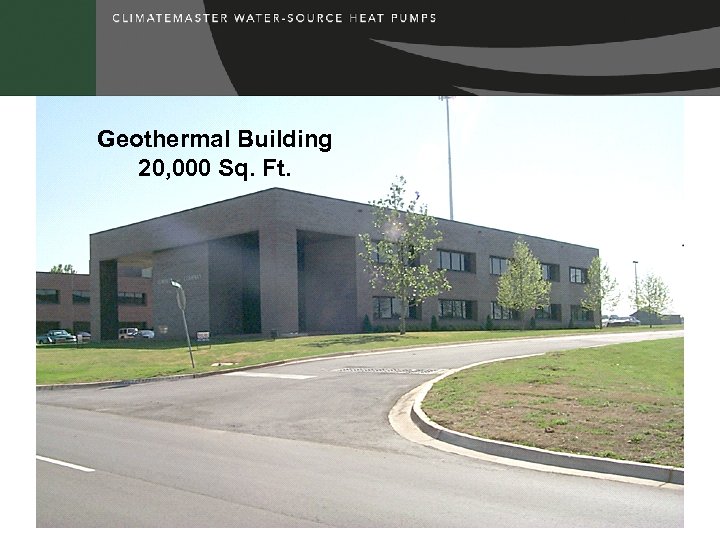 Geothermal Building 20, 000 Sq. Ft.
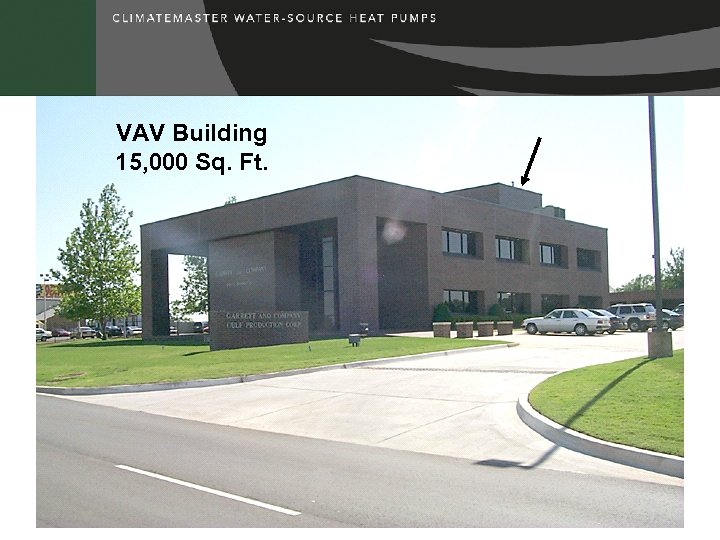 VAV Building 15, 000 Sq. Ft.
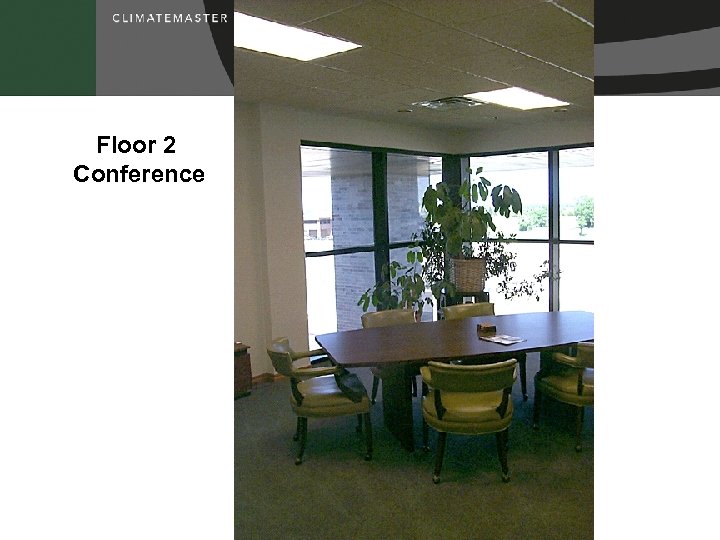 Floor 2 Conference
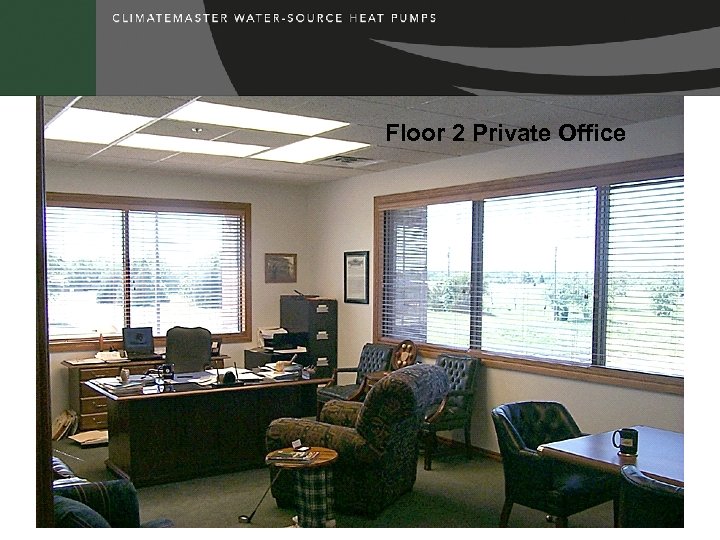 Floor 2 Private Office
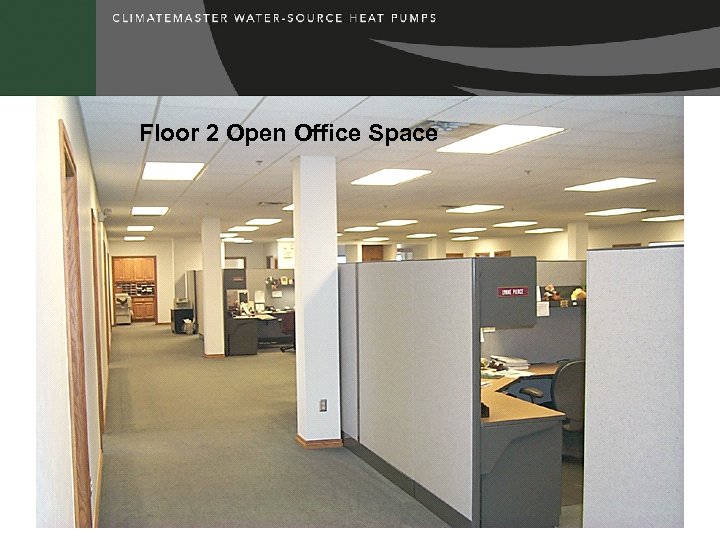 Floor 2 Open Office Space
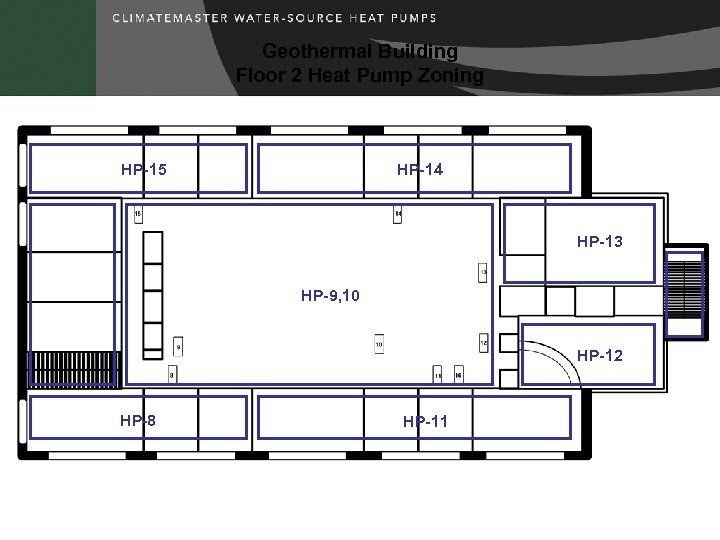 Geothermal Building Floor 2 Heat Pump Zoning HP-15 HP-14 HP-13 HP-9, 10 HP-12 HP-8 HP-11
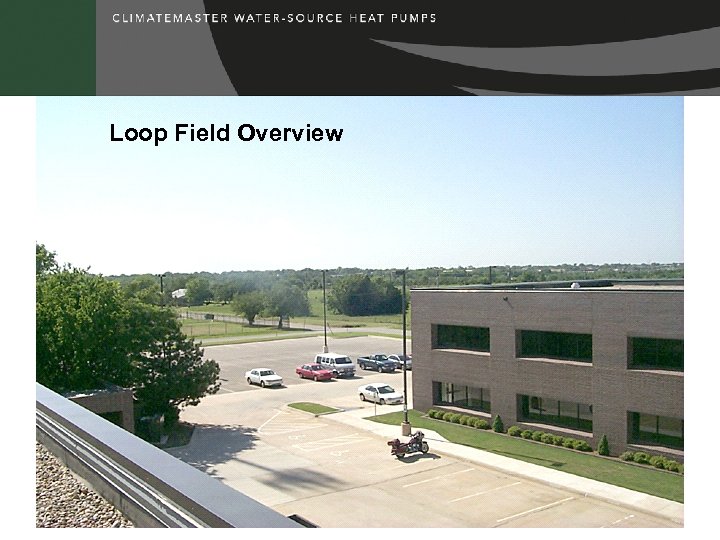 Loop Field Overview
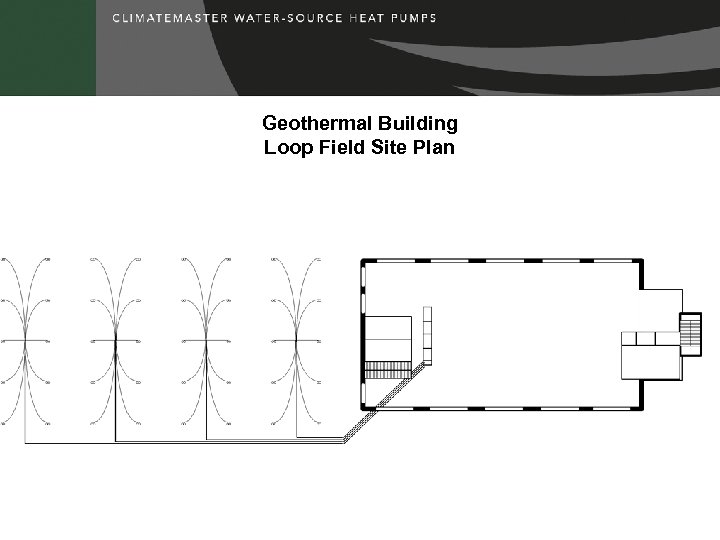 Geothermal Building Loop Field Site Plan
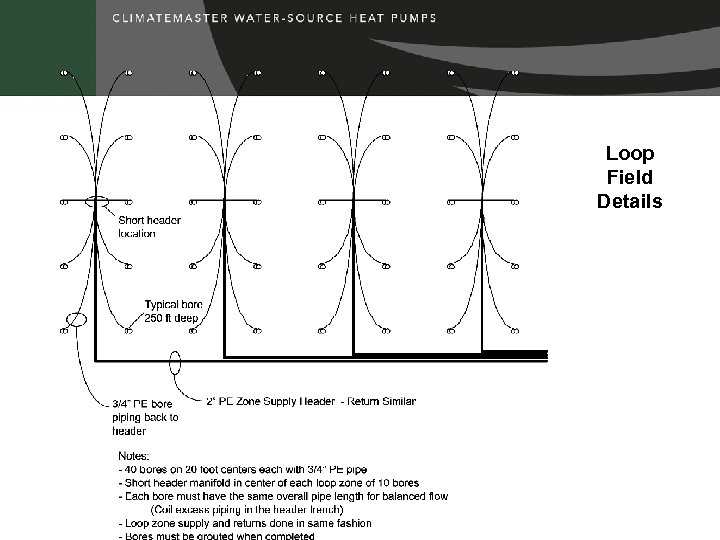 Loop Field Details
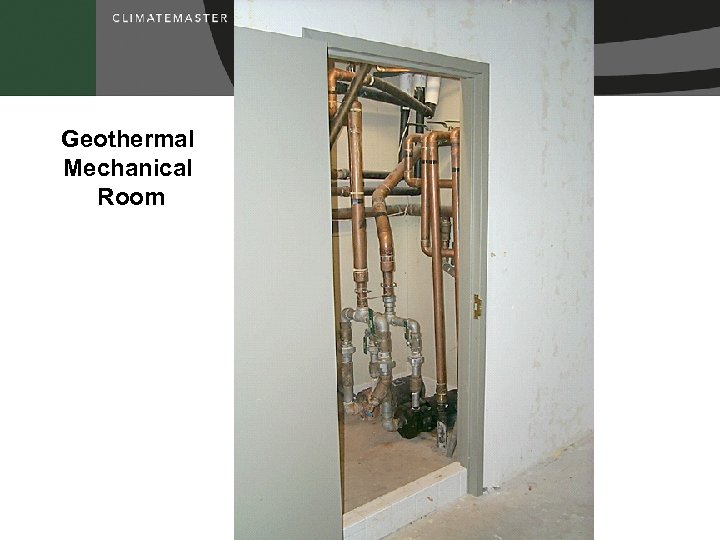 Geothermal Mechanical Room
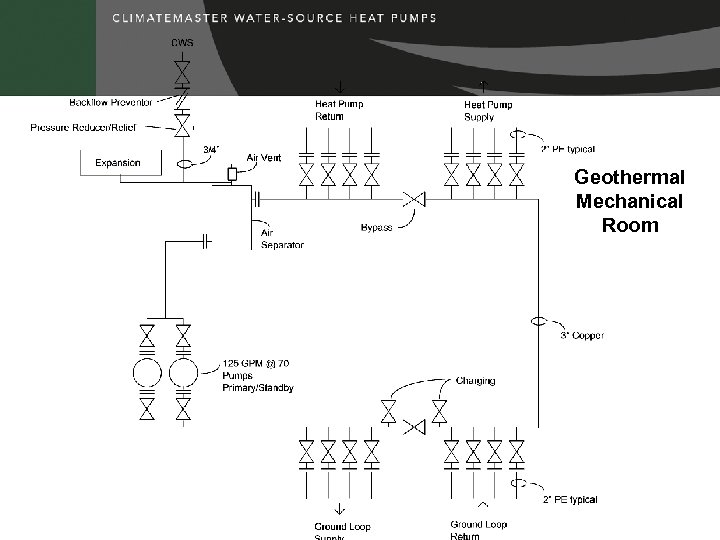 Geothermal Mechanical Room
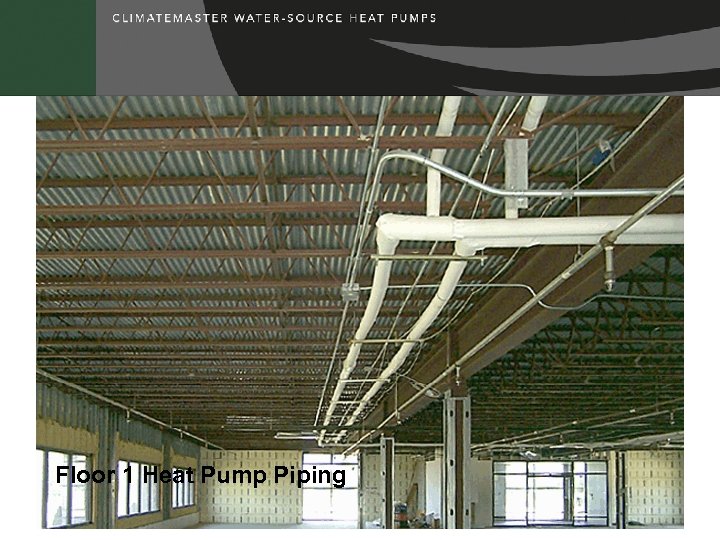 Floor 1 Heat Pump Piping
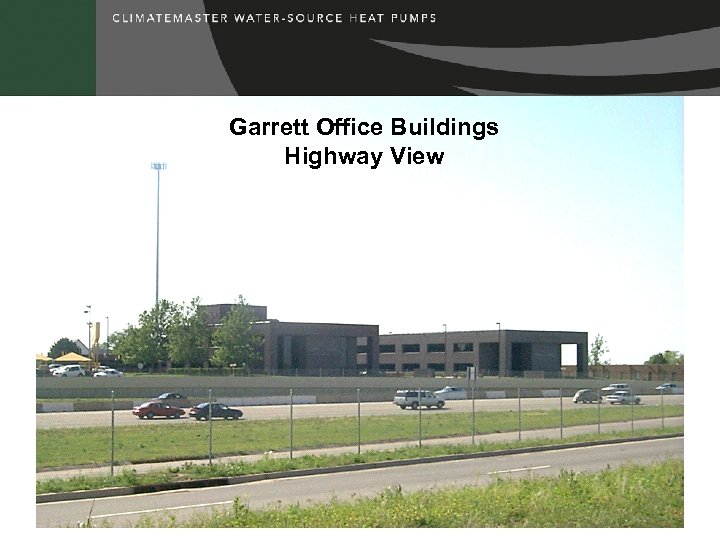 Garrett Office Buildings Highway View
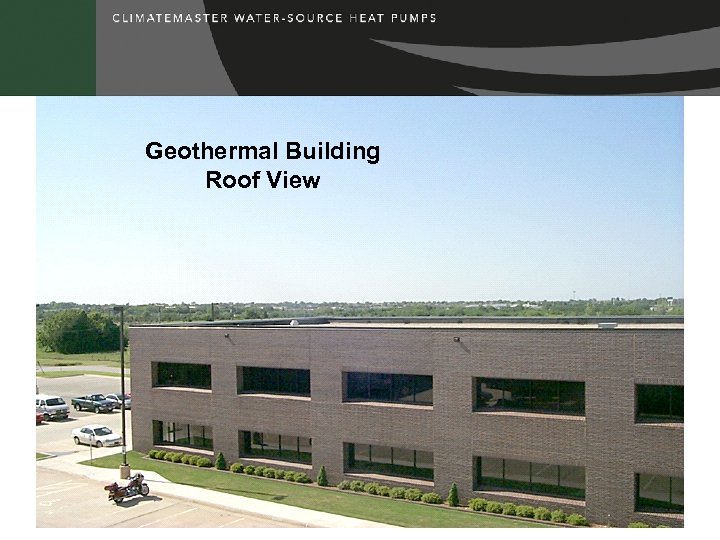 Geothermal Building Roof View
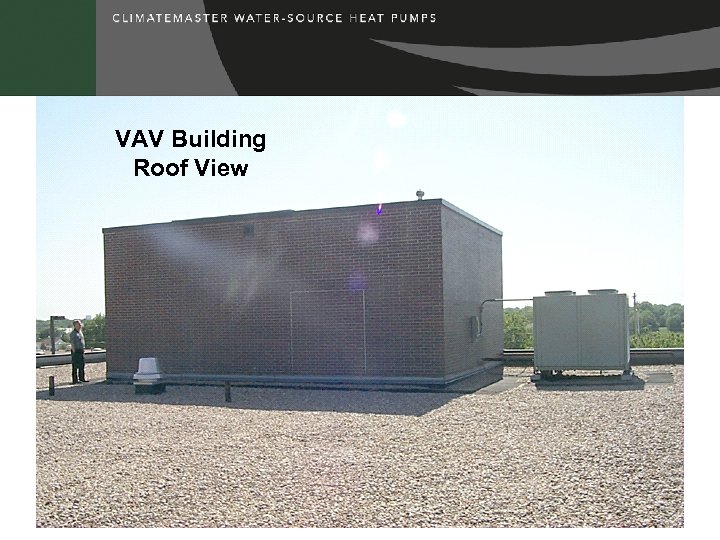 VAV Building Roof View
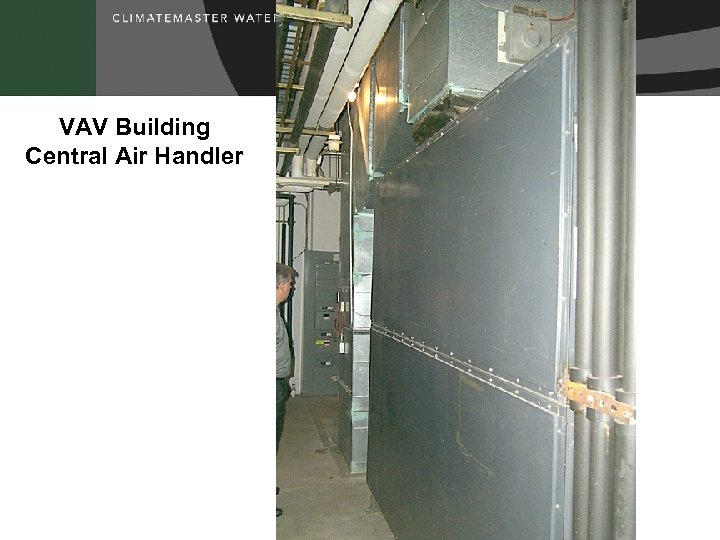 VAV Building Central Air Handler
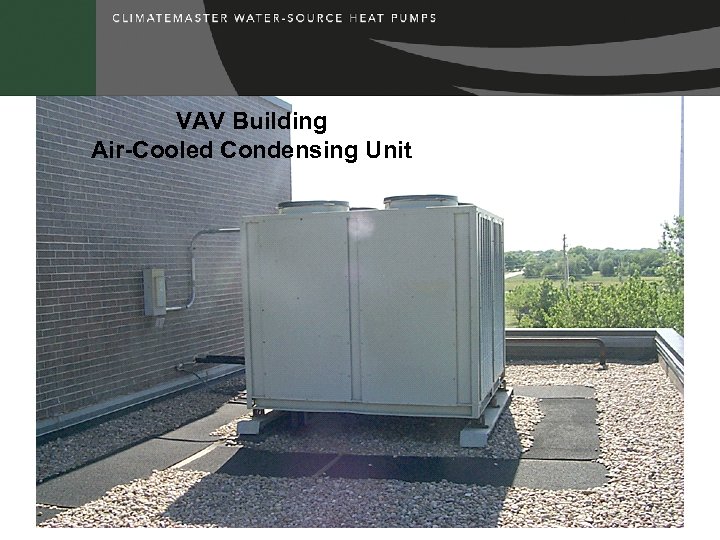 VAV Building Air-Cooled Condensing Unit
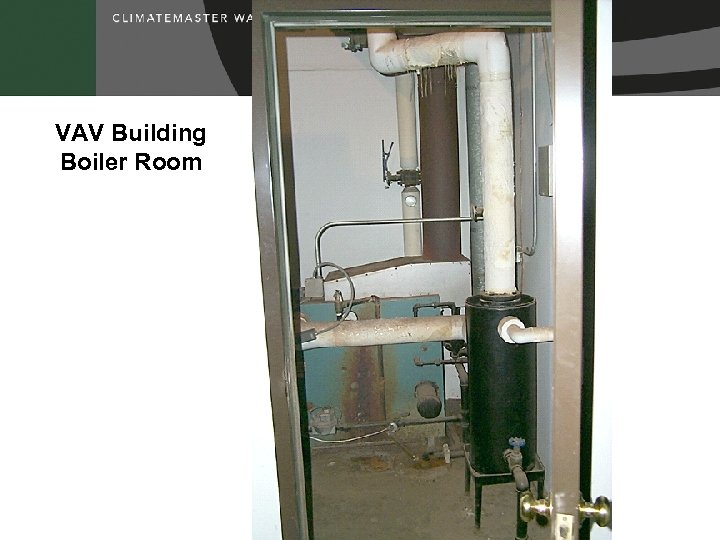 VAV Building Boiler Room
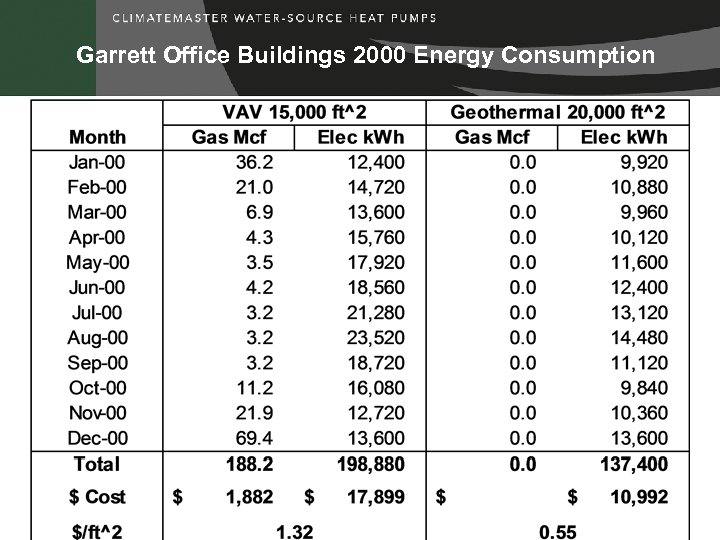 Garrett Office Buildings 2000 Energy Consumption
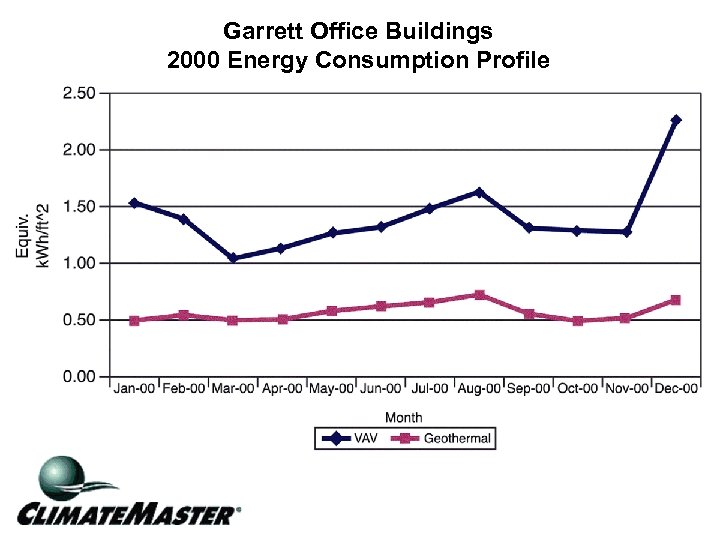 Garrett Office Buildings 2000 Energy Consumption Profile
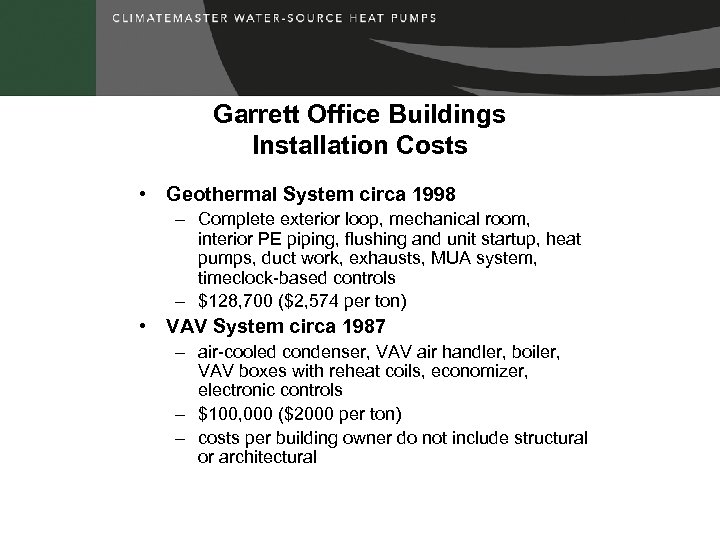 Garrett Office Buildings Installation Costs • Geothermal System circa 1998 – Complete exterior loop, mechanical room, interior PE piping, flushing and unit startup, heat pumps, duct work, exhausts, MUA system, timeclock-based controls – $128, 700 ($2, 574 per ton) • VAV System circa 1987 – air-cooled condenser, VAV air handler, boiler, VAV boxes with reheat coils, economizer, electronic controls – $100, 000 ($2000 per ton) – costs per building owner do not include structural or architectural
 Climate. Master Geothermal Heat Pumps