


 Скачать презентацию Climate Finance Inflows to South Africa Mitigation versus
8b5ad9f984cba4acf92415a7ac339db3.ppt
- Количество слайдов: 60
 Climate Finance Inflows to South Africa (Mitigation versus adaptation) 28 November 2017
 Financing the Transition to a Low-carbon and Climate Resilient Economy and Society • The Climate Change Flagship Programmes, in section 8 of the National Climate Change Response Policy (NCCRP) are South Africa’s response to implementing climate action at a national scale • They provide the greatest opportunity for high impact climate action in the near to medium term, responding to the three key challenges facing South Africa and other countries as global efforts to address climate change intensify: 1) Demonstrating the course of actions needed to respond to climate change effectively and efficiently unlocking and realising significant social and economic benefits; 2) Attracting resources at the scale required to enable meaningful transformation, i. e. at the scale that effectively limits atmospheric GHG emissions and/or enables adaptation to the impacts of unavoidable climate change;
 The Climate Change Flagship Programmes and National Climate Change Response Policy National Climate Change • “A set of Near-term Priority Flagship Response Programmes will be. Policy implemented…These programmes will include both the scaling-up of existing climate change initiatives and new initiatives that are ready to come on-stream” • 2014 -2019: Planning, Piloting NDP Vision 2030 and Investing (Outcome 10 Delivery Agreement) • Creation of an implementation framework • Unblocking regulatory constraints • Testing concepts and ideas to determine if these can be scaled up • Front-runners in the transition, catalysing sector-wide transformation • Build on existing expertise and experience of key sectors which have extensive experience in implementing climate change relevant policies and measures • Represent an important aspect of the practical implementation of the National Climate Change Response Policy (NCCRP) and National Development Plan (NDP)
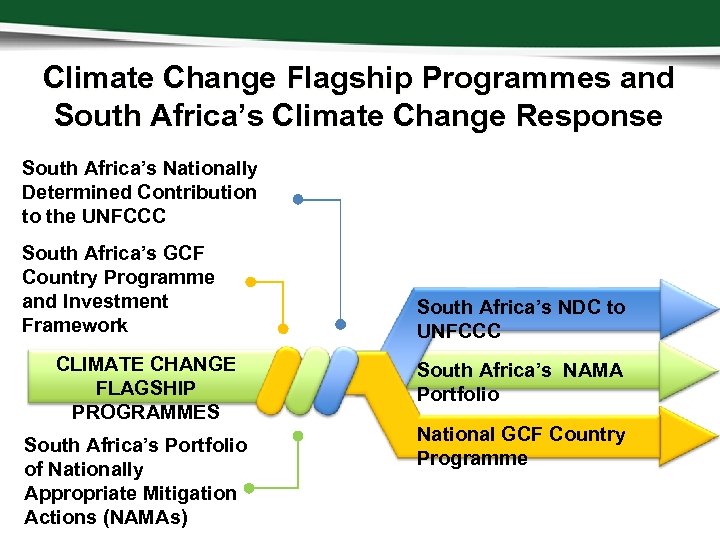 Climate Change Flagship Programmes and South Africa’s Climate Change Response South Africa’s Nationally Determined Contribution to the UNFCCC South Africa’s GCF Country Programme and Investment Framework CLIMATE CHANGE FLAGSHIP PROGRAMMES South Africa’s Portfolio of Nationally Appropriate Mitigation Actions (NAMAs) South Africa’s NDC to UNFCCC South Africa’s NAMA Portfolio National GCF Country Programme
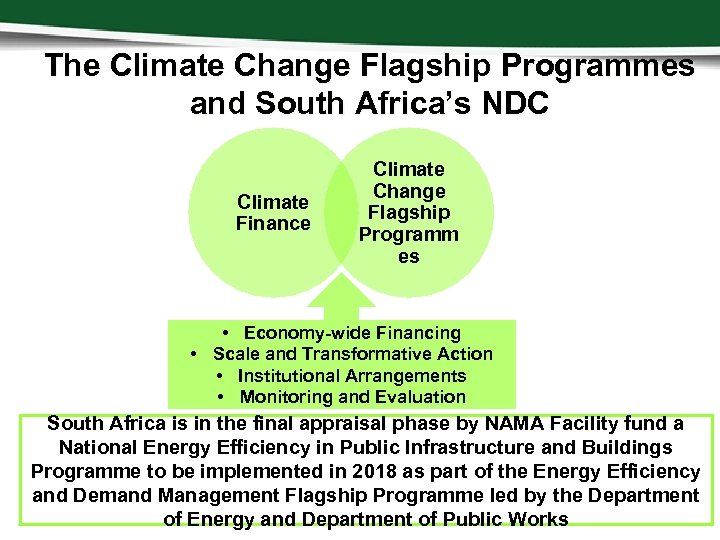 The Climate Change Flagship Programmes and South Africa’s NDC Climate Finance Climate Change Flagship Programm es • Economy-wide Financing • Scale and Transformative Action • Institutional Arrangements • Monitoring and Evaluation South Africa is in the final appraisal phase by NAMA Facility fund a National Energy Efficiency in Public Infrastructure and Buildings Programme to be implemented in 2018 as part of the Energy Efficiency and Demand Management Flagship Programme led by the Department of Energy and Department of Public Works
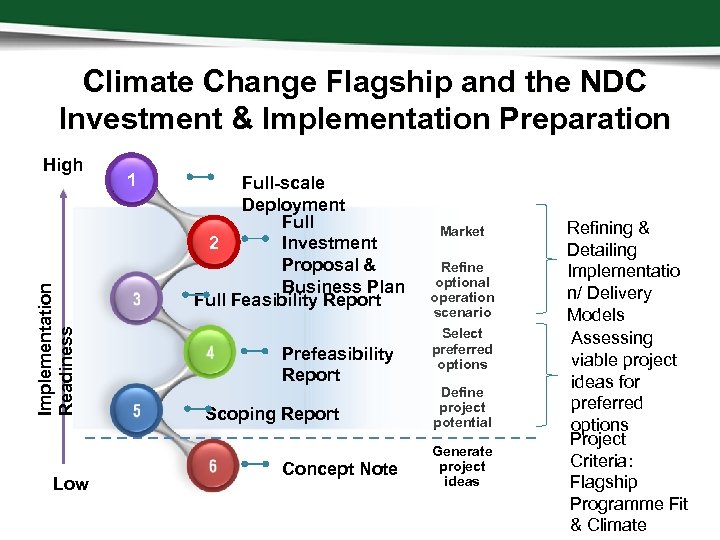 Climate Change Flagship and the NDC Investment & Implementation Preparation Implementation Readiness High Low 1 Full-scale Deployment Full 2 Investment Proposal & Business Plan Full Feasibility Report Prefeasibility Report Scoping Report Concept Note Market Refine optional operation scenario Select preferred options Define project potential Generate project ideas Refining & Detailing Implementatio n/ Delivery Models Assessing viable project ideas for preferred options Project Criteria: Flagship Programme Fit & Climate
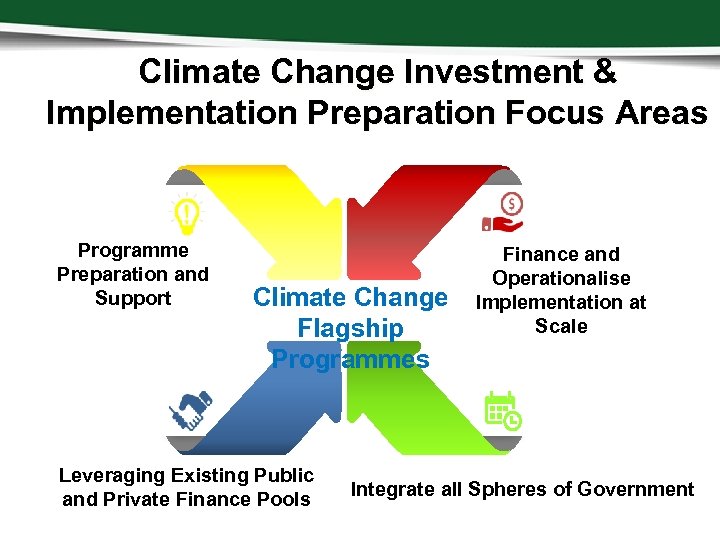 Climate Change Investment & Implementation Preparation Focus Areas Programme Preparation and Support Climate Change Flagship Programmes Leveraging Existing Public and Private Finance Pools Finance and Operationalise Implementation at Scale Integrate all Spheres of Government
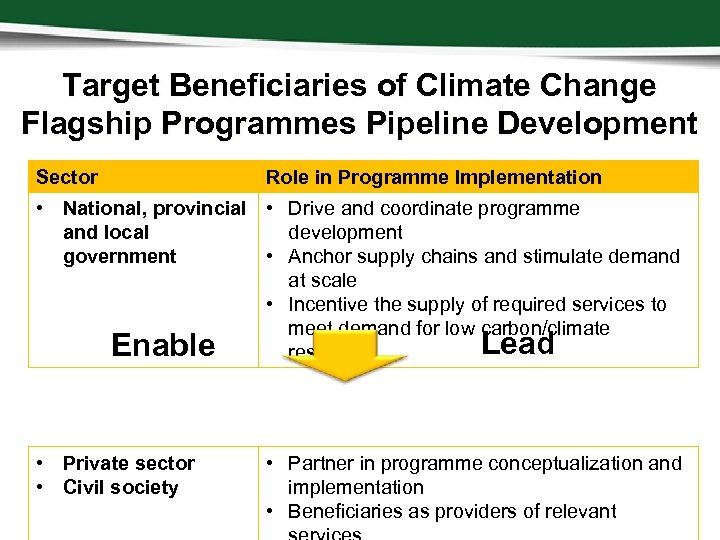 Target Beneficiaries of Climate Change Flagship Programmes Pipeline Development Sector Role in Programme Implementation • National, provincial • Drive and coordinate programme and local development government • Anchor supply chains and stimulate demand at scale • Incentive the supply of required services to meet demand for low carbon/climate Lead Enable resilience • Private sector • Civil society • Partner in programme conceptualization and implementation • Beneficiaries as providers of relevant
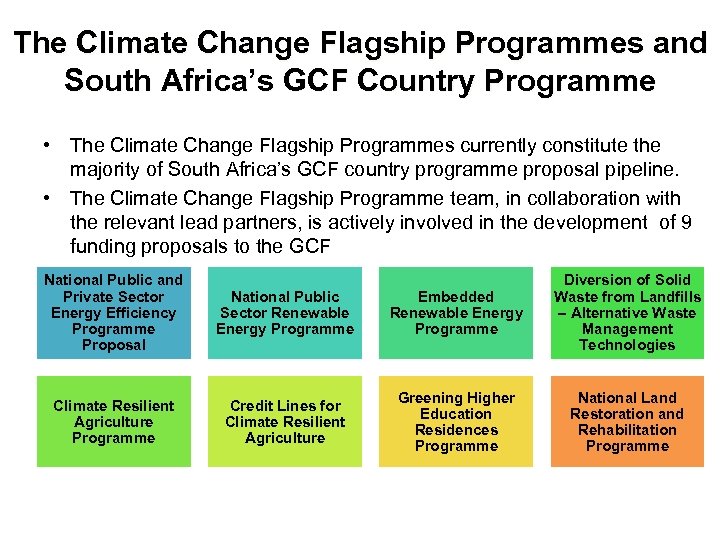 The Climate Change Flagship Programmes and South Africa’s GCF Country Programme • The Climate Change Flagship Programmes currently constitute the majority of South Africa’s GCF country programme proposal pipeline. • The Climate Change Flagship Programme team, in collaboration with the relevant lead partners, is actively involved in the development of 9 funding proposals to the GCF National Public and Private Sector Energy Efficiency Programme Proposal National Public Sector Renewable Energy Programme Embedded Renewable Energy Programme Diversion of Solid Waste from Landfills – Alternative Waste Management Technologies Climate Resilient Agriculture Programme Credit Lines for Climate Resilient Agriculture Greening Higher Education Residences Programme National Land Restoration and Rehabilitation Programme
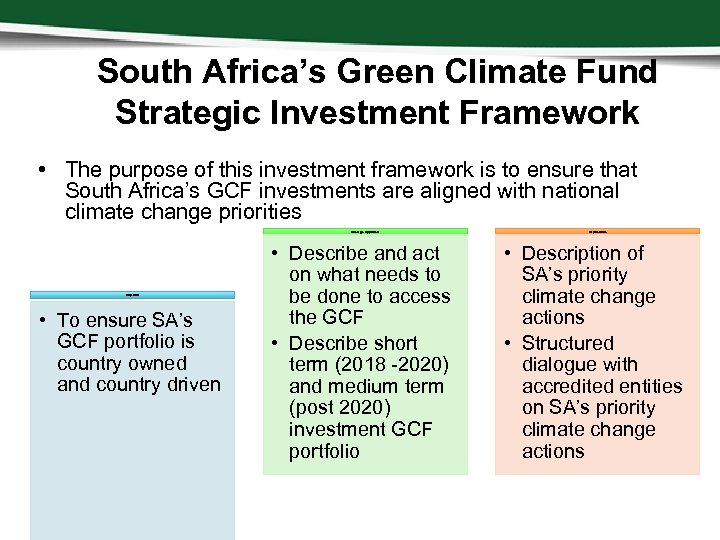 South Africa’s Green Climate Fund Strategic Investment Framework • The purpose of this investment framework is to ensure that South Africa’s GCF investments are aligned with national climate change priorities Strategic Approach Objective • To ensure SA’s GCF portfolio is country owned and country driven • Describe and act on what needs to be done to access the GCF • Describe short term (2018 -2020) and medium term (post 2020) investment GCF portfolio Key Actions • Description of SA’s priority climate change actions • Structured dialogue with accredited entities on SA’s priority climate change actions
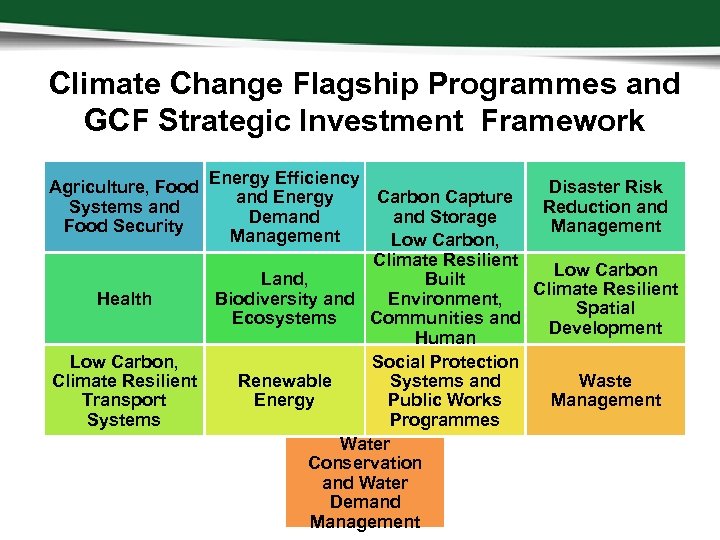 Climate Change Flagship Programmes and GCF Strategic Investment Framework Energy Efficiency Disaster Risk and Energy Carbon Capture Reduction and Demand Storage Management Low Carbon, Climate Resilient Low Carbon Built Land, Climate Resilient Environment, Health Biodiversity and Spatial Communities and Ecosystems Development Human Settlements Low Carbon, Social Protection Climate Resilient Renewable Systems and Waste Transport Energy Public Works Management Systems Programmes Water Conservation and Water Demand Management Agriculture, Food Systems and Food Security
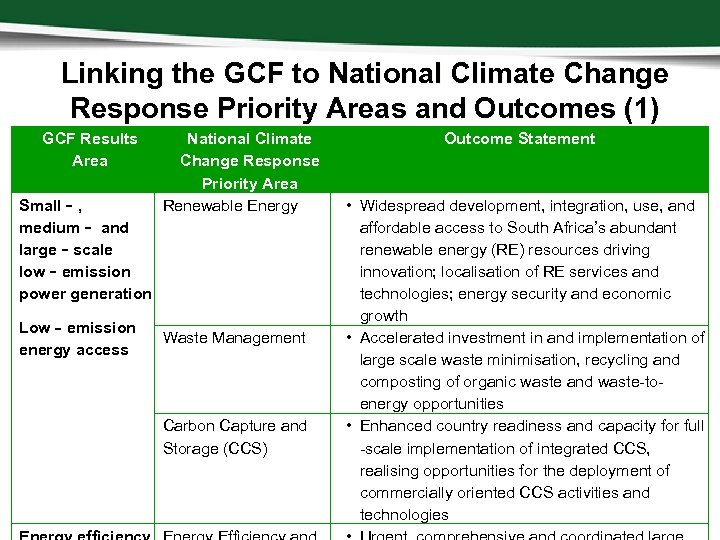 Linking the GCF to National Climate Change Response Priority Areas and Outcomes (1) GCF Results Area Small‐, medium‐ and large‐scale low‐emission power generation Low‐emission energy access National Climate Change Response Priority Area Renewable Energy Waste Management Carbon Capture and Storage (CCS) Outcome Statement • Widespread development, integration, use, and affordable access to South Africa’s abundant renewable energy (RE) resources driving innovation; localisation of RE services and technologies; energy security and economic growth • Accelerated investment in and implementation of large scale waste minimisation, recycling and composting of organic waste and waste-toenergy opportunities • Enhanced country readiness and capacity for full -scale implementation of integrated CCS, realising opportunities for the deployment of commercially oriented CCS activities and technologies
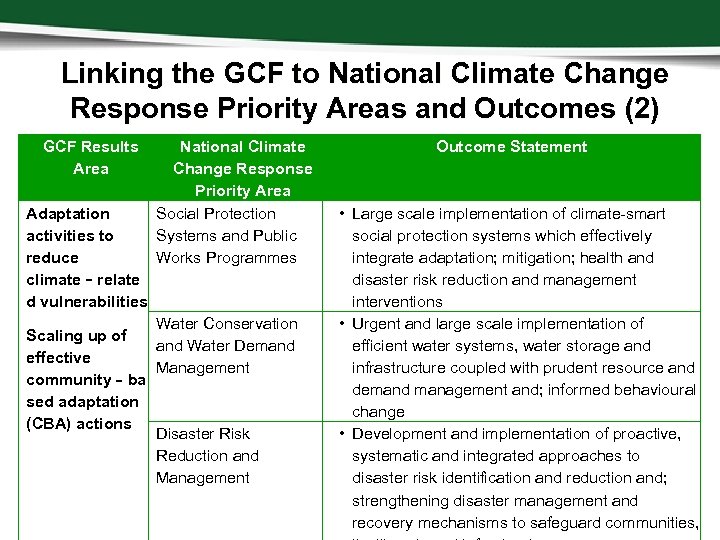 Linking the GCF to National Climate Change Response Priority Areas and Outcomes (2) GCF Results Area Adaptation activities to reduce climate‐relate d vulnerabilities National Climate Change Response Priority Area Social Protection Systems and Public Works Programmes Water Conservation Scaling up of and Water Demand effective Management community‐ba sed adaptation (CBA) actions Disaster Risk Reduction and Management Outcome Statement • Large scale implementation of climate-smart social protection systems which effectively integrate adaptation; mitigation; health and disaster risk reduction and management interventions • Urgent and large scale implementation of efficient water systems, water storage and infrastructure coupled with prudent resource and demand management and; informed behavioural change • Development and implementation of proactive, systematic and integrated approaches to disaster risk identification and reduction and; strengthening disaster management and recovery mechanisms to safeguard communities,
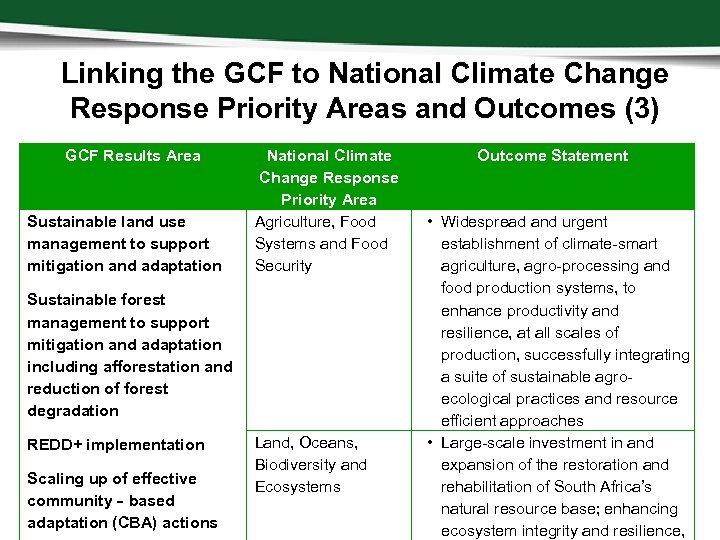 Linking the GCF to National Climate Change Response Priority Areas and Outcomes (3) GCF Results Area Sustainable land use management to support mitigation and adaptation National Climate Change Response Priority Area Agriculture, Food Systems and Food Security Sustainable forest management to support mitigation and adaptation including afforestation and reduction of forest degradation REDD+ implementation Scaling up of effective community‐based adaptation (CBA) actions Land, Oceans, Biodiversity and Ecosystems Outcome Statement • Widespread and urgent establishment of climate-smart agriculture, agro-processing and food production systems, to enhance productivity and resilience, at all scales of production, successfully integrating a suite of sustainable agroecological practices and resource efficient approaches • Large-scale investment in and expansion of the restoration and rehabilitation of South Africa’s natural resource base; enhancing ecosystem integrity and resilience,
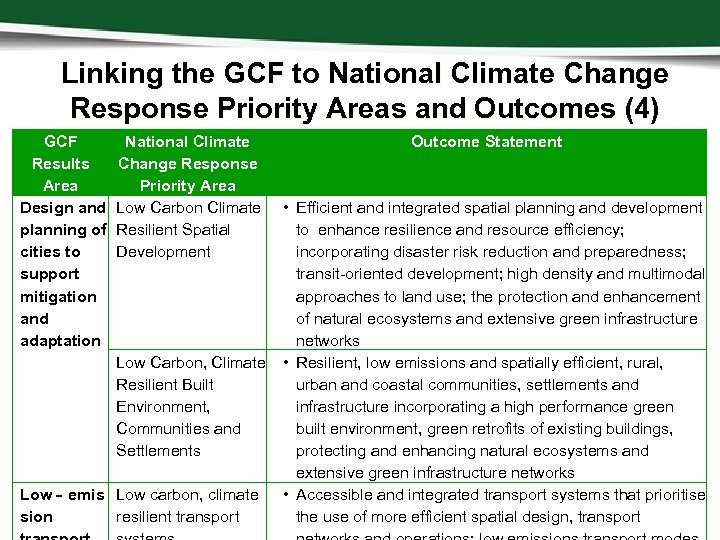 Linking the GCF to National Climate Change Response Priority Areas and Outcomes (4) GCF Results Area Design and planning of cities to support mitigation and adaptation National Climate Change Response Priority Area Low Carbon Climate Resilient Spatial Development Outcome Statement • Efficient and integrated spatial planning and development to enhance resilience and resource efficiency; incorporating disaster risk reduction and preparedness; transit-oriented development; high density and multimodal approaches to land use; the protection and enhancement of natural ecosystems and extensive green infrastructure networks Low Carbon, Climate • Resilient, low emissions and spatially efficient, rural, Resilient Built urban and coastal communities, settlements and Environment, infrastructure incorporating a high performance green Communities and built environment, green retrofits of existing buildings, Settlements protecting and enhancing natural ecosystems and extensive green infrastructure networks Low‐emis Low carbon, climate • Accessible and integrated transport systems that prioritise sion resilient transport the use of more efficient spatial design, transport
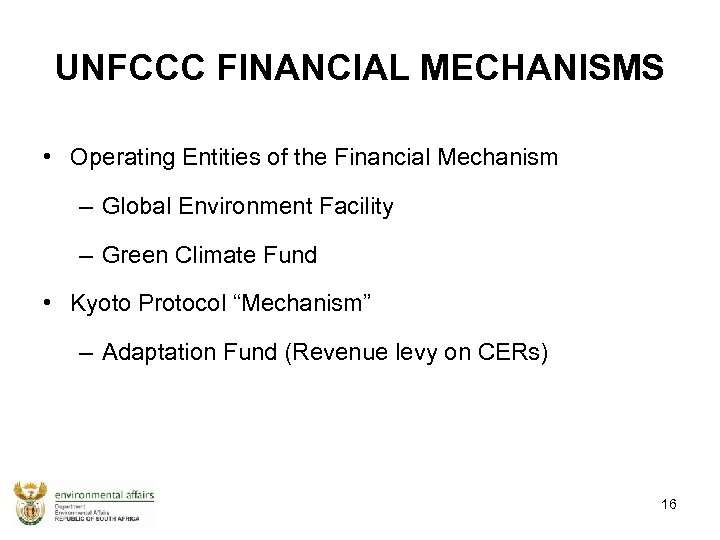 UNFCCC FINANCIAL MECHANISMS • Operating Entities of the Financial Mechanism – Global Environment Facility – Green Climate Fund • Kyoto Protocol “Mechanism” – Adaptation Fund (Revenue levy on CERs) 16
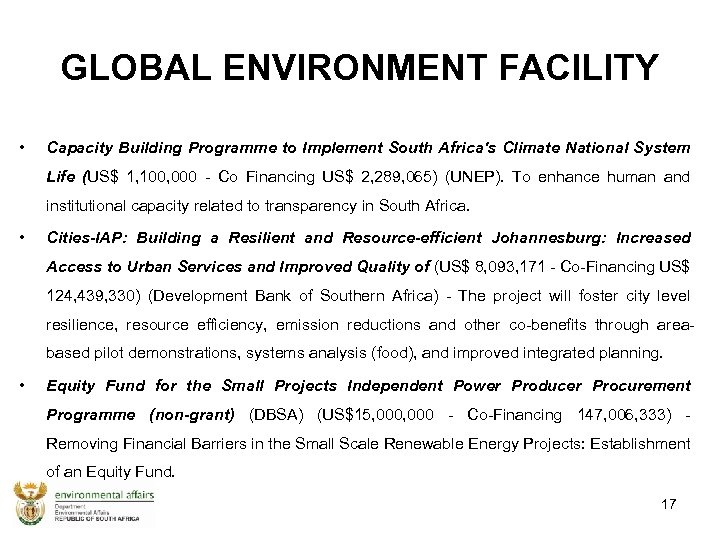 GLOBAL ENVIRONMENT FACILITY • Capacity Building Programme to Implement South Africa's Climate National System Life (US$ 1, 100, 000 - Co Financing US$ 2, 289, 065) (UNEP). To enhance human and institutional capacity related to transparency in South Africa. • Cities-IAP: Building a Resilient and Resource-efficient Johannesburg: Increased Access to Urban Services and Improved Quality of (US$ 8, 093, 171 - Co-Financing US$ 124, 439, 330) (Development Bank of Southern Africa) - The project will foster city level resilience, resource efficiency, emission reductions and other co-benefits through areabased pilot demonstrations, systems analysis (food), and improved integrated planning. • Equity Fund for the Small Projects Independent Power Producer Procurement Programme (non-grant) (DBSA) (US$15, 000 - Co-Financing 147, 006, 333) - Removing Financial Barriers in the Small Scale Renewable Energy Projects: Establishment of an Equity Fund. 17
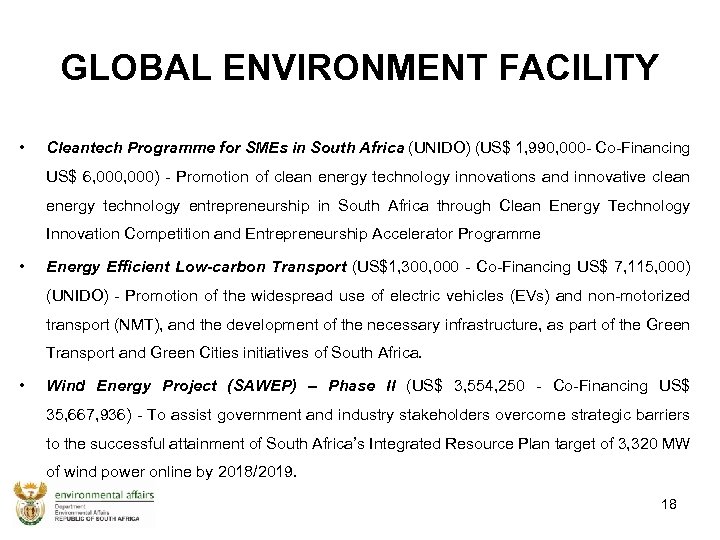 GLOBAL ENVIRONMENT FACILITY • Cleantech Programme for SMEs in South Africa (UNIDO) (US$ 1, 990, 000 - Co-Financing US$ 6, 000) - Promotion of clean energy technology innovations and innovative clean energy technology entrepreneurship in South Africa through Clean Energy Technology Innovation Competition and Entrepreneurship Accelerator Programme • Energy Efficient Low-carbon Transport (US$1, 300, 000 - Co-Financing US$ 7, 115, 000) (UNIDO) - Promotion of the widespread use of electric vehicles (EVs) and non-motorized transport (NMT), and the development of the necessary infrastructure, as part of the Green Transport and Green Cities initiatives of South Africa. • Wind Energy Project (SAWEP) – Phase II (US$ 3, 554, 250 - Co-Financing US$ 35, 667, 936) - To assist government and industry stakeholders overcome strategic barriers to the successful attainment of South Africa’s Integrated Resource Plan target of 3, 320 MW of wind power online by 2018/2019. 18
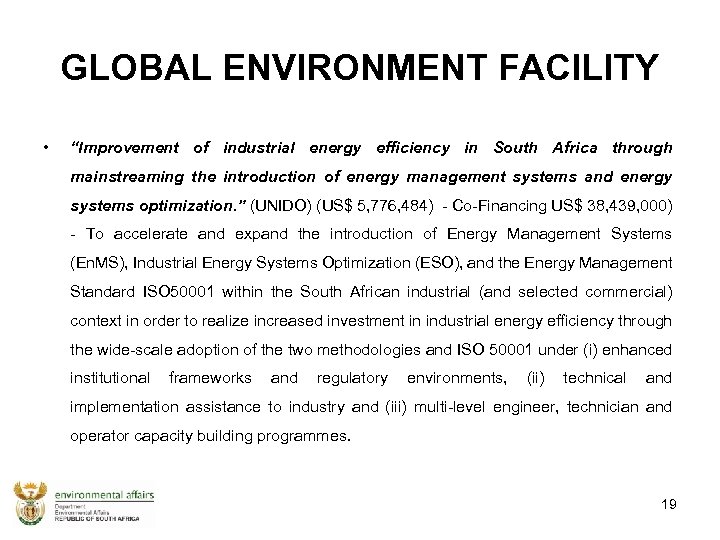 GLOBAL ENVIRONMENT FACILITY • “Improvement of industrial energy efficiency in South Africa through mainstreaming the introduction of energy management systems and energy systems optimization. ” (UNIDO) (US$ 5, 776, 484) - Co-Financing US$ 38, 439, 000) - To accelerate and expand the introduction of Energy Management Systems (En. MS), Industrial Energy Systems Optimization (ESO), and the Energy Management Standard ISO 50001 within the South African industrial (and selected commercial) context in order to realize increased investment in industrial energy efficiency through the wide-scale adoption of the two methodologies and ISO 50001 under (i) enhanced institutional frameworks and regulatory environments, (ii) technical and implementation assistance to industry and (iii) multi-level engineer, technician and operator capacity building programmes. 19
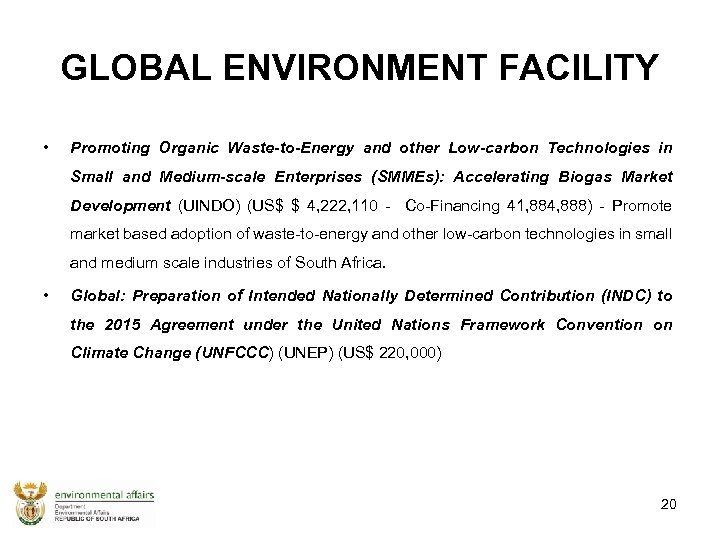 GLOBAL ENVIRONMENT FACILITY • Promoting Organic Waste-to-Energy and other Low-carbon Technologies in Small and Medium-scale Enterprises (SMMEs): Accelerating Biogas Market Development (UINDO) (US$ $ 4, 222, 110 - Co-Financing 41, 884, 888) - Promote market based adoption of waste-to-energy and other low-carbon technologies in small and medium scale industries of South Africa. • Global: Preparation of Intended Nationally Determined Contribution (INDC) to the 2015 Agreement under the United Nations Framework Convention on Climate Change (UNFCCC) (UNEP) (US$ 220, 000) 20
 ADAPTATION FUND 21
 The Adaptation Fund (AF) was established by the Parties to the Kyoto Protocol of the United Nations Framework Convention on Climate Change (UNFCCC), as a mechanism to finance concrete adaptation projects and programmes in developing country parties. The fund is capitalised mainly from a percentage of proceeds of the Clean Development Mechanism. Future capitalisation in discussion. Adaptation Fund resources are accessed via Multilateral Implementing Entities (MIEs) and National Implementing Entities (NIEs). Initial country cap of USD 10 million – but under revision Direct Access = the Big Innovation of the Adaptation Fund SANBI is South Africa’s National Implementing Entity (NIE) of the Adaptation Fund
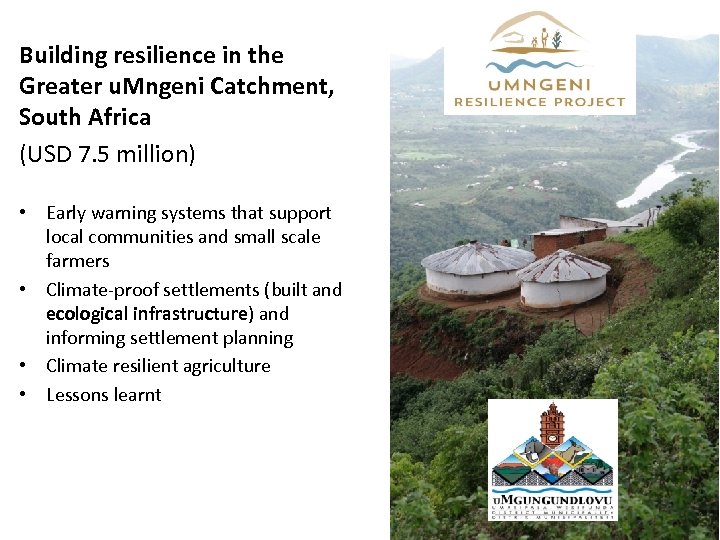 Building resilience in the Greater u. Mngeni Catchment, South Africa (USD 7. 5 million) • Early warning systems that support local communities and small scale farmers • Climate-proof settlements (built and ecological infrastructure) and informing settlement planning • Climate resilient agriculture • Lessons learnt
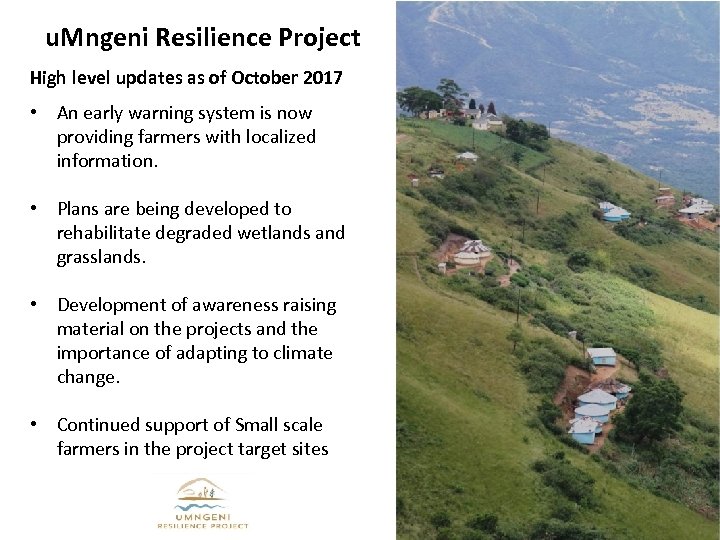 u. Mngeni Resilience Project High level updates as of October 2017 • An early warning system is now providing farmers with localized information. • Plans are being developed to rehabilitate degraded wetlands and grasslands. • Development of awareness raising material on the projects and the importance of adapting to climate change. • Continued support of Small scale farmers in the project target sites
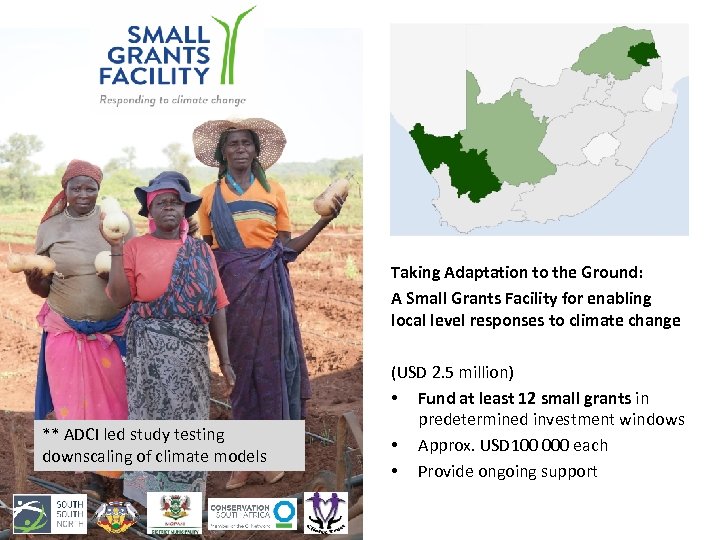 Taking Adaptation to the Ground: A Small Grants Facility for enabling local level responses to climate change ** ADCI led study testing downscaling of climate models (USD 2. 5 million) • Fund at least 12 small grants in predetermined investment windows • Approx. USD 100 000 each • Provide ongoing support
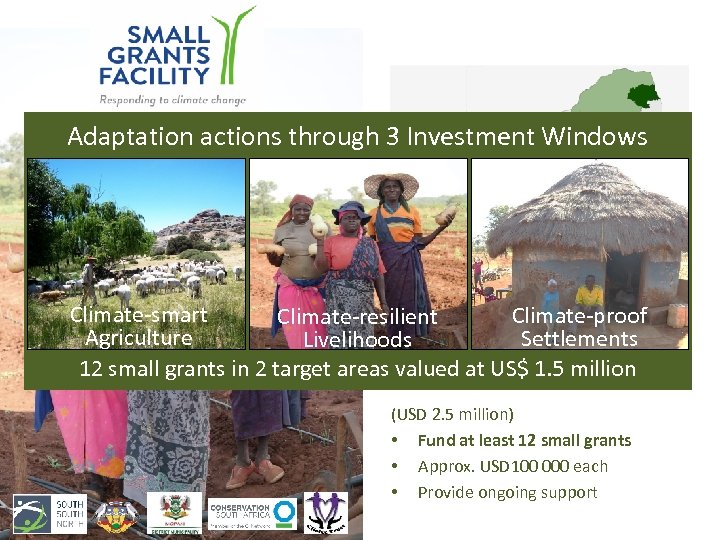 Adaptation actions through 3 Investment Windows Taking Climate-smart Climate-proof Climate-resilient Adaptation to the Ground: Agriculture Settlements A Small Grants Facility for enabling Livelihoods 12 small grants in 2 target areas local levelat US$ 1. 5 climate change valued responses to million (USD 2. 5 million) • Fund at least 12 small grants • Approx. USD 100 000 each • Provide ongoing support
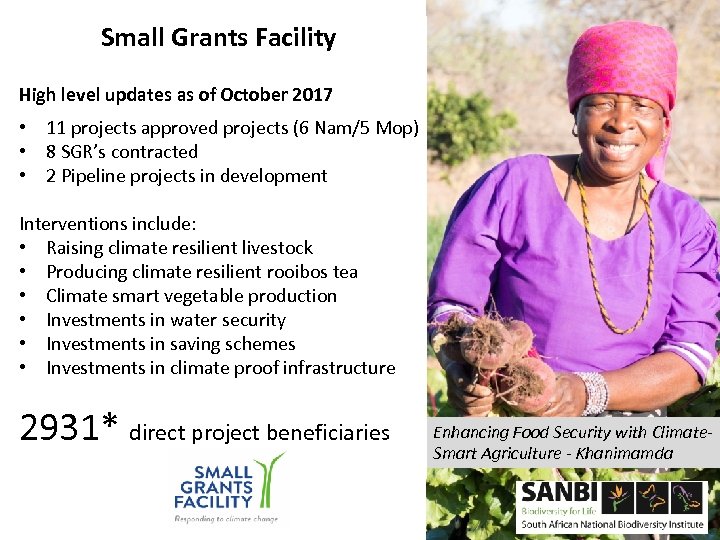 Small Grants Facility High level updates as of October 2017 • 11 projects approved projects (6 Nam/5 Mop) • 8 SGR’s contracted • 2 Pipeline projects in development Interventions include: • Raising climate resilient livestock • Producing climate resilient rooibos tea • Climate smart vegetable production • Investments in water security • Investments in saving schemes • Investments in climate proof infrastructure 2931* direct project beneficiaries Enhancing Food Security with Climate. Smart Agriculture - Khanimamda
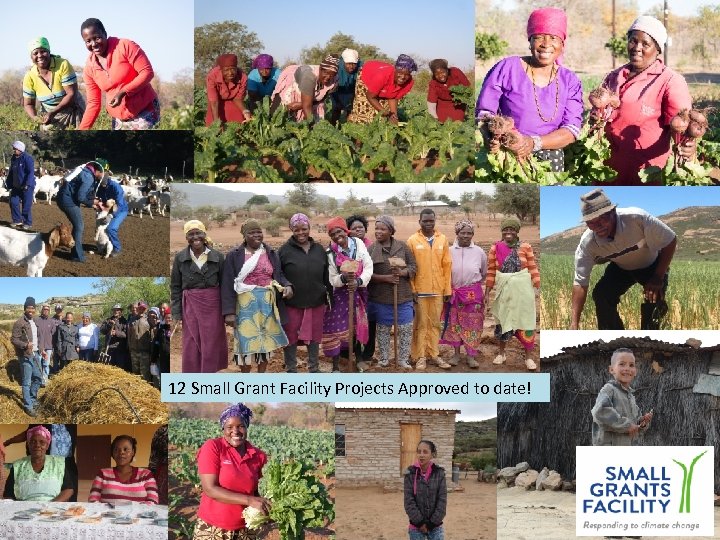 12 Small Grant Facility Projects Approved to date!
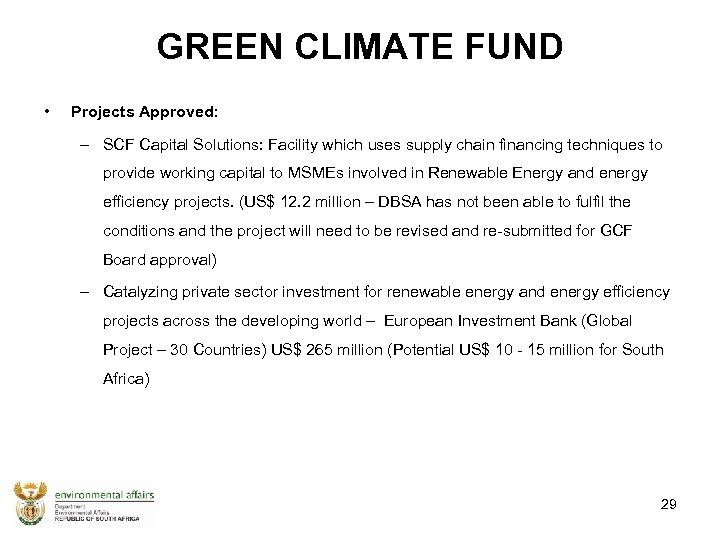 GREEN CLIMATE FUND • Projects Approved: – SCF Capital Solutions: Facility which uses supply chain financing techniques to provide working capital to MSMEs involved in Renewable Energy and energy efficiency projects. (US$ 12. 2 million – DBSA has not been able to fulfil the conditions and the project will need to be revised and re-submitted for GCF Board approval) – Catalyzing private sector investment for renewable energy and energy efficiency projects across the developing world – European Investment Bank (Global Project – 30 Countries) US$ 265 million (Potential US$ 10 - 15 million for South Africa) 29
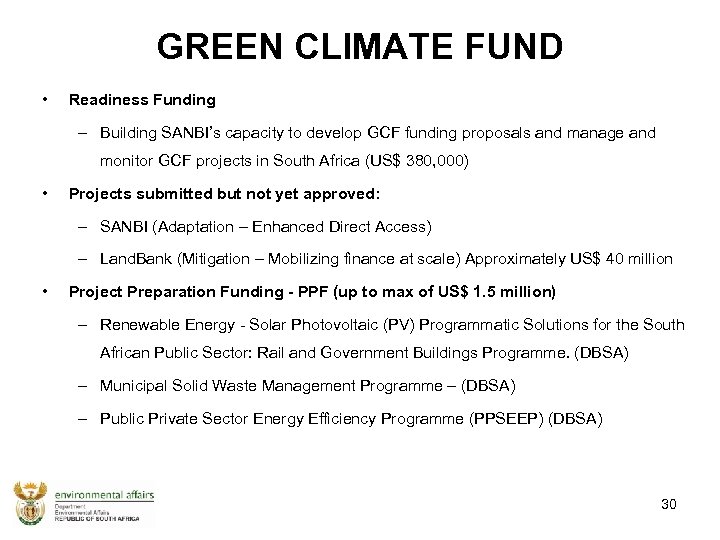 GREEN CLIMATE FUND • Readiness Funding – Building SANBI’s capacity to develop GCF funding proposals and manage and monitor GCF projects in South Africa (US$ 380, 000) • Projects submitted but not yet approved: – SANBI (Adaptation – Enhanced Direct Access) – Land. Bank (Mitigation – Mobilizing finance at scale) Approximately US$ 40 million • Project Preparation Funding - PPF (up to max of US$ 1. 5 million) – Renewable Energy - Solar Photovoltaic (PV) Programmatic Solutions for the South African Public Sector: Rail and Government Buildings Programme. (DBSA) – Municipal Solid Waste Management Programme – (DBSA) – Public Private Sector Energy Efficiency Programme (PPSEEP) (DBSA) 30
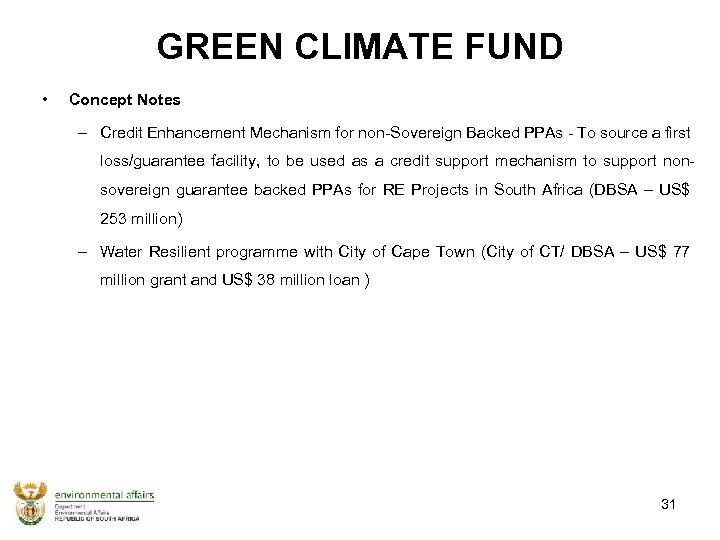 GREEN CLIMATE FUND • Concept Notes – Credit Enhancement Mechanism for non-Sovereign Backed PPAs - To source a first loss/guarantee facility, to be used as a credit support mechanism to support nonsovereign guarantee backed PPAs for RE Projects in South Africa (DBSA – US$ 253 million) – Water Resilient programme with City of Cape Town (City of CT/ DBSA – US$ 77 million grant and US$ 38 million loan ) 31
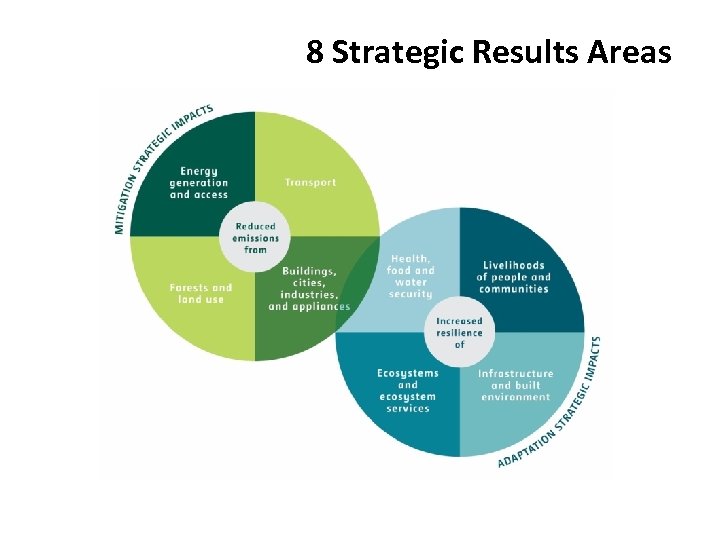 8 Strategic Results Areas
 MULTILTERAL DEVELOPMENT BANKS – WORLD BANK CLEAN TECHNOLOGY FUND • Eskom’s proposed 100 MW-capacity Upington Concentrated Solar Power (CSP) plant, (CTF = US$ 250 million – World Bank US$ 200 million and African Development Bank US$ 64. 4 million) • Development of a utility-scale wind power plant -- Phase 1 of Eskom’s Western Cape Province Wind Energy Facility, consisting of a 100 MW wind farm -- as well as support to pioneer private sector projects amounting to 100 MW new generation capacity - (CTF US$ 100 million – World Bank US$ 50 million and African Development Bank US$ 35. 6 million) 33
 MULTILTERAL DEVELOPMENT BANKS – WORLD BANK CLEAN TECHNOLOGY FUND • South Africa Sustainable Energy Acceleration Program - CTF = US$ 77. 5 million. This component addresses use of CTF funds to support private sector megawatt scale sustainable energy projects, including cogeneration energy efficiency projects and wind and solar renewable energy projects. More specifically the program seeks to encourage transformation of the private SE sector by establishing a series of direct, project level interventions in the wind, solar and cogeneration sectors, all of which are nascent but offer significant potential in South Africa. – Solar PV (US$ 42. 5 million – African Development Bank) – Solar PV (US$ 42. 5 million – International Finance Corporation) 34
 MULTILTERAL DEVELOPMENT BANKS – WORLD BANK CLEAN TECHNOLOGY FUND • Scale up energy efficiency investments by catalyzing the expansion of bank lending to the commercial and industrial sectors through lines of credit to commercial banks, contingent financing to foster energy service companies (ESCOs), and financial incentives or risk products to market leaders, such as large industrial customers - CTF US$ 7. 5 million. (International Finance Cooperation) 35
 BILATERAL FINANCE Germany • EPBP – Energy Efficiency in Public Building Programme (Do. E, DPW, DEA) Euro 4, 764, 400 (2017 - 2021) • Climate Support Programme (CSP) - Phase III 9 (DEA) Euro 16, 000 (2017 - 2020) Government of Flanders • Third Country Support Strategy (CSP III) Euro 25 million (2017 - 2021) focusing on Climate Change Adaptation Norway • Environmental Co-operation Programme Capacity Development Within the SA National Inventory Unit NOK 5 million (Norwegian kroner five million) (2014 - 2017) US • LEDS US$ 15 million (2015 -2020) • 36
 GREEN FUND 37
 • Financial year • Allocation 38
 Objectives of the Green Fund • To support initiatives that will contribute to South Africa’s transition to a • low carbon, climate resilient, resource efficient development path. Financial year • Allocation • To address market weaknesses to transition to a green economy by: Ø Ø Promoting innovative and high impact green programmes and projects, Reinforcing climate policy objectives through green interventions, Building an evidence base for the expansion of the green economy, and Attracting additional resources to support South Africa’s green economy development. • The Green Fund creates the space for catalytic financing 39
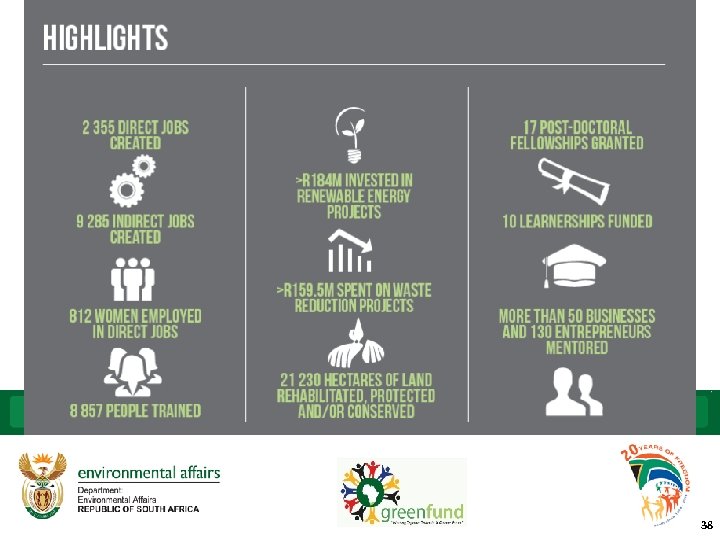
 Green Fund Projects • A total of 55 Projects have been approved (31 Investment, 16 Research and Policy development and 8 Capacity building) • 31 investment projects have been approved: – 12 projects are under implementation, – 8 projects were withdrawn and 1 project was cancelled as the projects failed to meet terms and conditions as per approval. – 10 projects have been completed • The total number of jobs created to date is 2 355 with the potential of increasing this number if projects are upscaled • Total allocation from National Treasury since April 2012 equaled R 1. 195 Billion 40
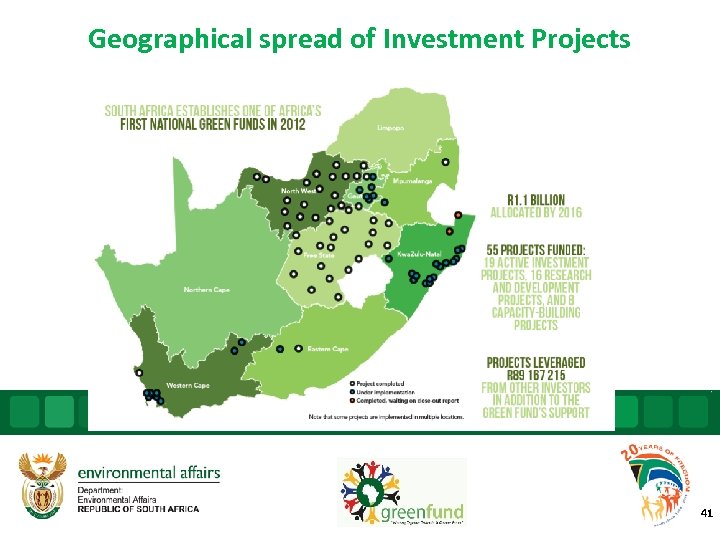 Geographical spread of Investment Projects • Financial year • Allocation 41
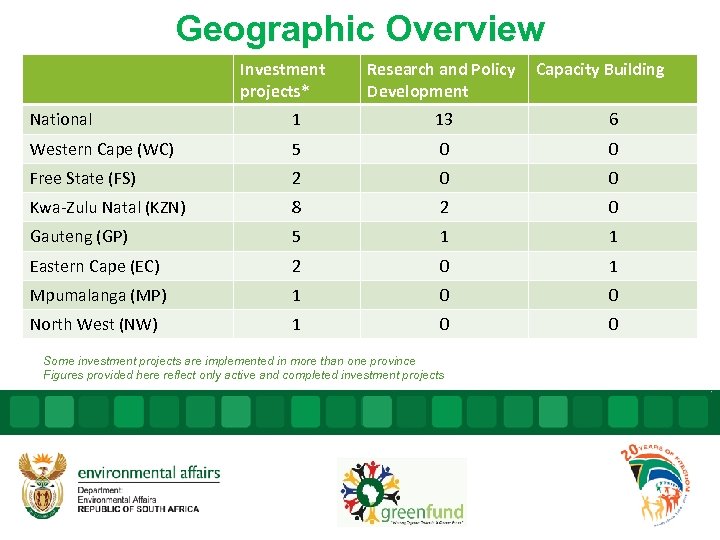 Geographic Overview Investment projects* Research and Policy Development Capacity Building National 1 13 6 Western Cape (WC) 5 0 0 Free State (FS) 2 0 0 Kwa-Zulu Natal (KZN) 8 2 0 Gauteng (GP) 5 1 1 Eastern Cape (EC) 2 0 1 Mpumalanga (MP) 1 0 0 North West (NW) 1 0 0 Some investment projects are implemented in more than one province Figures provided here reflect only active and completed investment projects
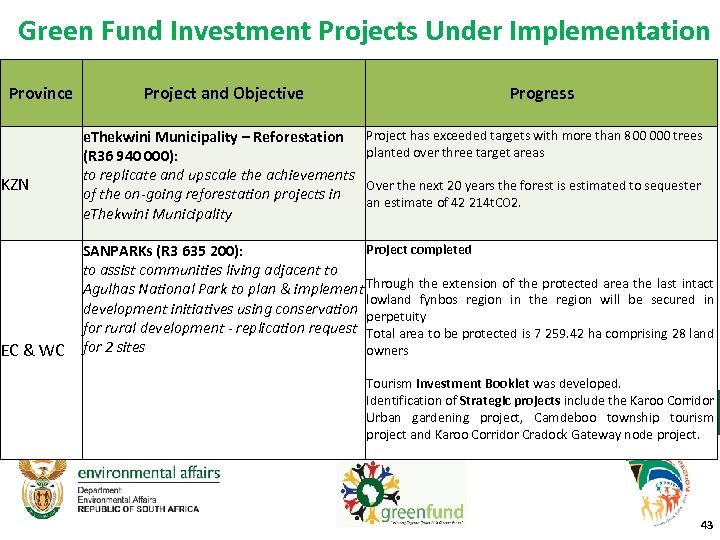 Green Fund Investment Projects Under Implementation Province KZN EC & WC Project and Objective e. Thekwini Municipality – Reforestation (R 36 940 000): to replicate and upscale the achievements of the on-going reforestation projects in e. Thekwini Municipality Progress Project has exceeded targets with more than 800 000 trees planted over three target areas Over the next 20 years the forest is estimated to sequester an estimate of 42 214 t. CO 2. Project completed SANPARKs (R 3 635 200): to assist communities living adjacent to Agulhas National Park to plan & implement Through the extension of the protected area the last intact lowland fynbos region in the region will be secured in development initiatives using conservation perpetuity for rural development - replication request Total area to be protected is 7 259. 42 ha comprising 28 land for 2 sites owners Tourism Investment Booklet was developed. Identification of Strategic projects include the Karoo Corridor Urban gardening project, Camdeboo township tourism project and Karoo Corridor Cradock Gateway node project. 43
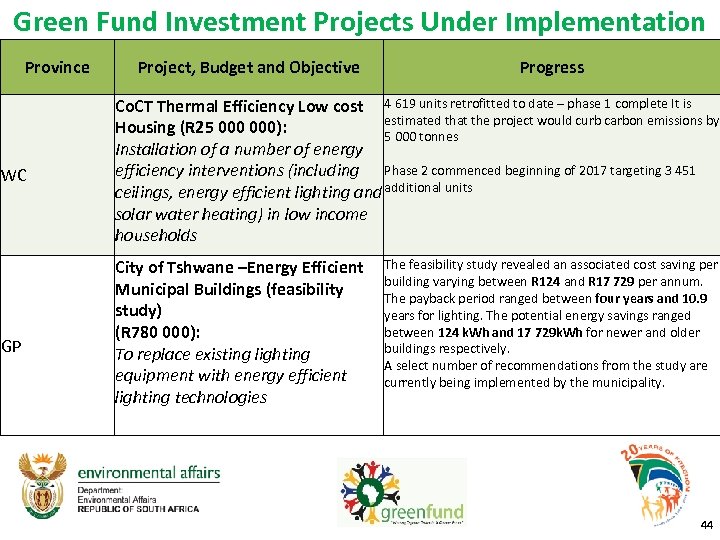 Green Fund Investment Projects Under Implementation Province WC GP Project, Budget and Objective Progress Co. CT Thermal Efficiency Low cost 4 619 units retrofitted to date – phase 1 complete It is estimated that the project would curb carbon emissions by Housing (R 25 000): 5 000 tonnes Installation of a number of energy efficiency interventions (including Phase 2 commenced beginning of 2017 targeting 3 451 ceilings, energy efficient lighting and additional units solar water heating) in low income households City of Tshwane –Energy Efficient Municipal Buildings (feasibility study) (R 780 000): To replace existing lighting equipment with energy efficient lighting technologies The feasibility study revealed an associated cost saving per building varying between R 124 and R 17 729 per annum. The payback period ranged between four years and 10. 9 years for lighting. The potential energy savings ranged between 124 k. Wh and 17 729 k. Wh for newer and older buildings respectively. A select number of recommendations from the study are currently being implemented by the municipality. 44
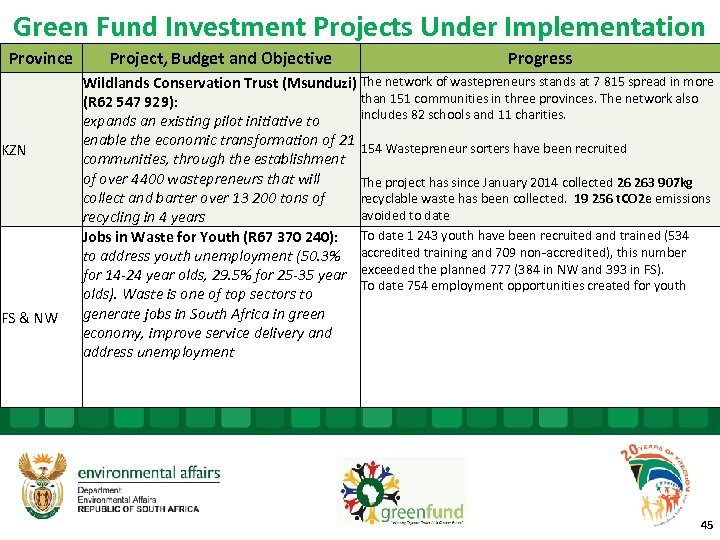 Green Fund Investment Projects Under Implementation Province KZN FS & NW Project, Budget and Objective Progress Wildlands Conservation Trust (Msunduzi) The network of wastepreneurs stands at 7 815 spread in more than 151 communities in three provinces. The network also (R 62 547 929): includes 82 schools and 11 charities. expands an existing pilot initiative to enable the economic transformation of 21 154 Wastepreneur sorters have been recruited communities, through the establishment of over 4400 wastepreneurs that will The project has since January 2014 collected 26 263 907 kg collect and barter over 13 200 tons of recyclable waste has been collected. 19 256 t. CO 2 e emissions avoided to date recycling in 4 years Jobs in Waste for Youth (R 67 370 240): To date 1 243 youth have been recruited and trained (534 to address youth unemployment (50. 3% accredited training and 709 non-accredited), this number for 14 -24 year olds, 29. 5% for 25 -35 year exceeded the planned 777 (384 in NW and 393 in FS). To date 754 employment opportunities created for youth olds). Waste is one of top sectors to generate jobs in South Africa in green economy, improve service delivery and address unemployment 45
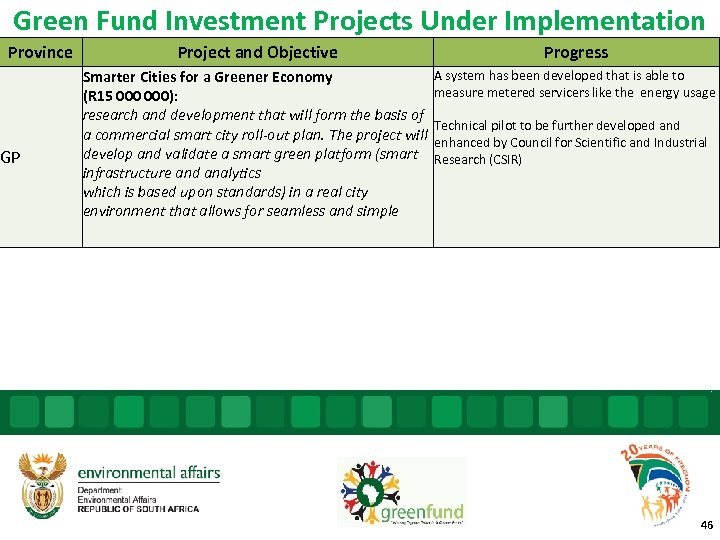 Green Fund Investment Projects Under Implementation Province GP Project and Objective Progress Smarter Cities for a Greener Economy (R 15 000): research and development that will form the basis of a commercial smart city roll-out plan. The project will develop and validate a smart green platform (smart infrastructure and analytics which is based upon standards) in a real city environment that allows for seamless and simple A system has been developed that is able to measure metered servicers like the energy usage Technical pilot to be further developed and enhanced by Council for Scientific and Industrial Research (CSIR) 46
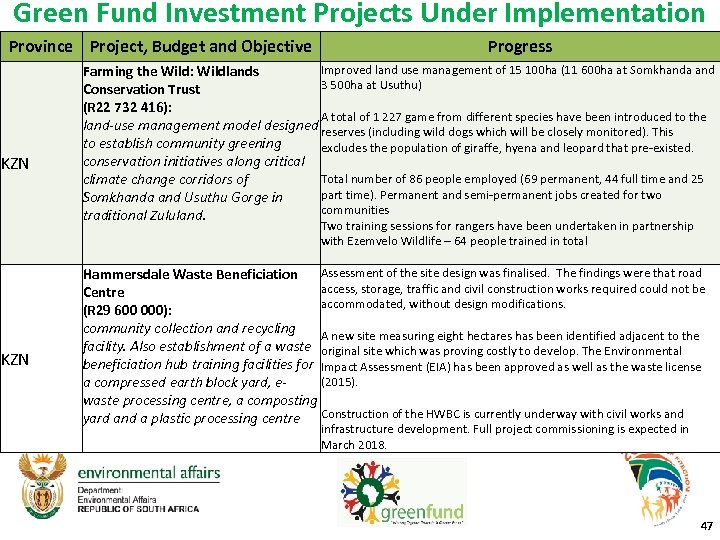 Green Fund Investment Projects Under Implementation Province Project, Budget and Objective KZN Progress Improved land use management of 15 100 ha (11 600 ha at Somkhanda and Farming the Wild: Wildlands 3 500 ha at Usuthu) Conservation Trust (R 22 732 416): A total of 1 227 game from different species have been introduced to the land-use management model designed reserves (including wild dogs which will be closely monitored). This to establish community greening excludes the population of giraffe, hyena and leopard that pre-existed. conservation initiatives along critical Total number of 86 people employed (69 permanent, 44 full time and 25 climate change corridors of part time). Permanent and semi-permanent jobs created for two Somkhanda and Usuthu Gorge in communities traditional Zululand. Two training sessions for rangers have been undertaken in partnership with Ezemvelo Wildlife – 64 people trained in total KZN Assessment of the site design was finalised. The findings were that road Hammersdale Waste Beneficiation access, storage, traffic and civil construction works required could not be Centre accommodated, without design modifications. (R 29 600 000): community collection and recycling A new site measuring eight hectares has been identified adjacent to the facility. Also establishment of a waste original site which was proving costly to develop. The Environmental beneficiation hub training facilities for Impact Assessment (EIA) has been approved as well as the waste license (2015). a compressed earth block yard, ewaste processing centre, a composting yard and a plastic processing centre Construction of the HWBC is currently underway with civil works and infrastructure development. Full project commissioning is expected in March 2018. 47
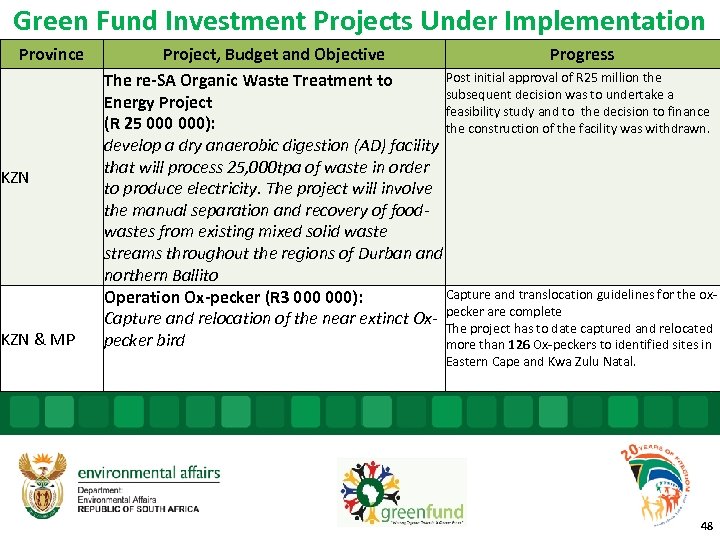 Green Fund Investment Projects Under Implementation Province KZN & MP Project, Budget and Objective Progress Post initial approval of R 25 million the The re-SA Organic Waste Treatment to subsequent decision was to undertake a Energy Project feasibility study and to the decision to finance (R 25 000): the construction of the facility was withdrawn. develop a dry anaerobic digestion (AD) facility that will process 25, 000 tpa of waste in order to produce electricity. The project will involve the manual separation and recovery of foodwastes from existing mixed solid waste streams throughout the regions of Durban and northern Ballito Capture and translocation guidelines for the ox. Operation Ox-pecker (R 3 000): Capture and relocation of the near extinct Ox- pecker are complete captured and relocated The project has to date pecker bird more than 126 Ox-peckers to identified sites in Eastern Cape and Kwa Zulu Natal. 48
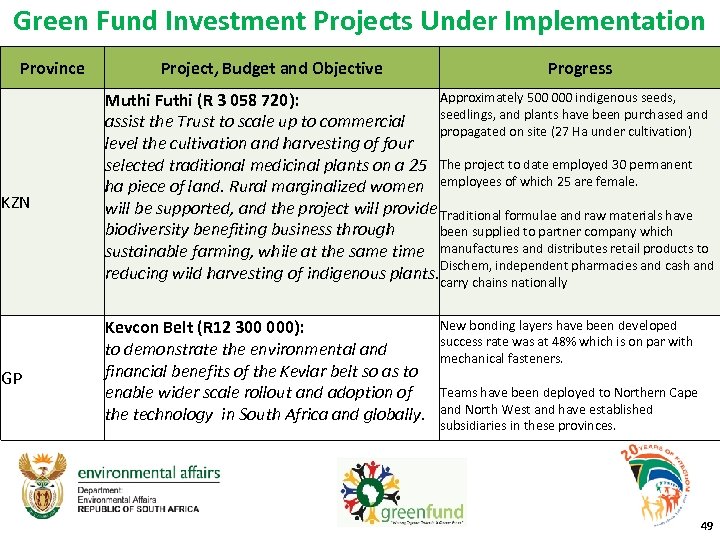 Green Fund Investment Projects Under Implementation Province KZN GP Project, Budget and Objective Progress Approximately 500 000 indigenous seeds, Muthi Futhi (R 3 058 720): seedlings, and plants have been purchased and assist the Trust to scale up to commercial propagated on site (27 Ha under cultivation) level the cultivation and harvesting of four selected traditional medicinal plants on a 25 The project to date employed 30 permanent ha piece of land. Rural marginalized women employees of which 25 are female. will be supported, and the project will provide Traditional formulae and raw materials have biodiversity benefiting business through been supplied to partner company which sustainable farming, while at the same time manufactures and distributes retail products to reducing wild harvesting of indigenous plants. Dischem, independent pharmacies and cash and carry chains nationally Kevcon Belt (R 12 300 000): to demonstrate the environmental and financial benefits of the Kevlar belt so as to enable wider scale rollout and adoption of the technology in South Africa and globally. New bonding layers have been developed success rate was at 48% which is on par with mechanical fasteners. Teams have been deployed to Northern Cape and North West and have established subsidiaries in these provinces. 49
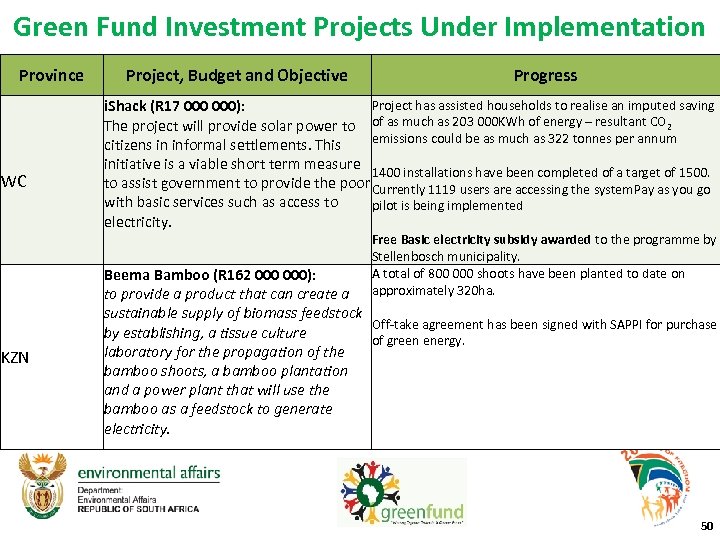 Green Fund Investment Projects Under Implementation Province WC Project, Budget and Objective Progress Project has assisted households to realise an imputed saving i. Shack (R 17 000): The project will provide solar power to of as much as 203 000 KWh of energy – resultant CO 2 emissions could be as much as 322 tonnes per annum citizens in informal settlements. This initiative is a viable short term measure 1400 installations have been completed of a target of 1500. to assist government to provide the poor Currently 1119 users are accessing the system. Pay as you go with basic services such as access to pilot is being implemented electricity. Free Basic electricity subsidy awarded to the programme by Stellenbosch municipality. A total of 800 000 shoots have been planted to date on approximately 320 ha. KZN Beema Bamboo (R 162 000): to provide a product that can create a sustainable supply of biomass feedstock Off-take agreement has been signed with SAPPI for purchase by establishing, a tissue culture of green energy. laboratory for the propagation of the bamboo shoots, a bamboo plantation and a power plant that will use the bamboo as a feedstock to generate electricity. 50
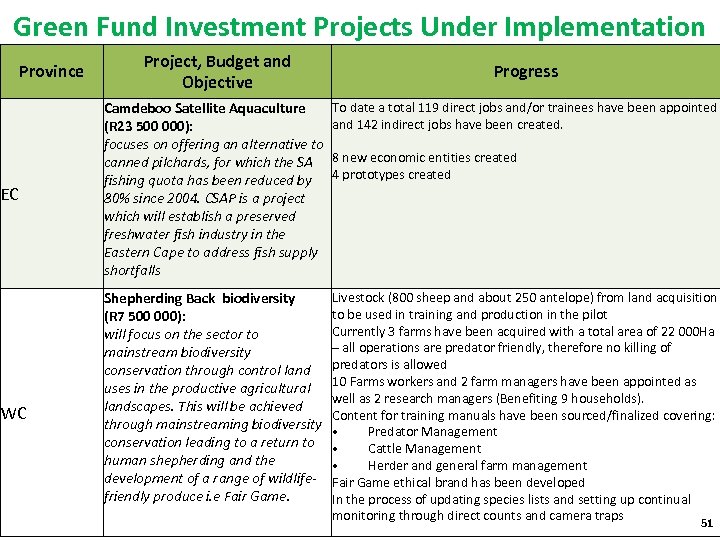 Green Fund Investment Projects Under Implementation Province EC WC Project, Budget and Objective Progress Camdeboo Satellite Aquaculture (R 23 500 000): focuses on offering an alternative to canned pilchards, for which the SA fishing quota has been reduced by 80% since 2004. CSAP is a project which will establish a preserved freshwater fish industry in the Eastern Cape to address fish supply shortfalls To date a total 119 direct jobs and/or trainees have been appointed and 142 indirect jobs have been created. Shepherding Back biodiversity (R 7 500 000): will focus on the sector to mainstream biodiversity conservation through control land uses in the productive agricultural landscapes. This will be achieved through mainstreaming biodiversity conservation leading to a return to human shepherding and the development of a range of wildlifefriendly produce i. e Fair Game. Livestock (800 sheep and about 250 antelope) from land acquisition to be used in training and production in the pilot Currently 3 farms have been acquired with a total area of 22 000 Ha – all operations are predator friendly, therefore no killing of predators is allowed 10 Farms workers and 2 farm managers have been appointed as well as 2 research managers (Benefiting 9 households). Content for training manuals have been sourced/finalized covering: • Predator Management • Cattle Management • Herder and general farm management Fair Game ethical brand has been developed In the process of updating species lists and setting up continual monitoring through direct counts and camera traps 51 8 new economic entities created 4 prototypes created
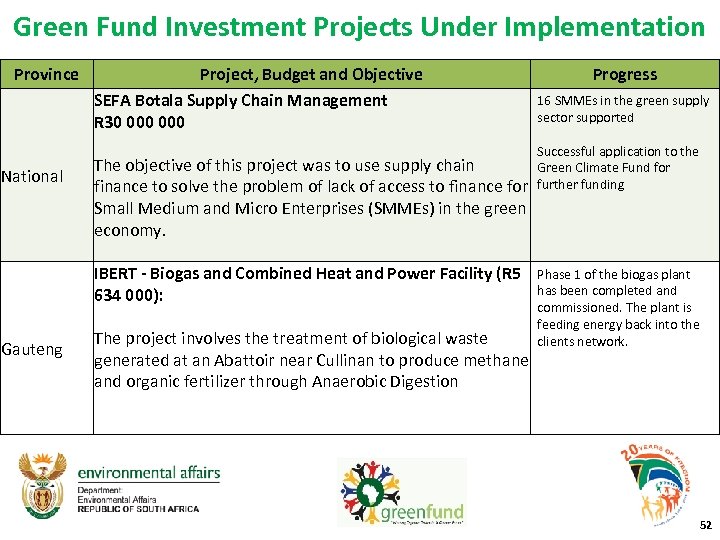 Green Fund Investment Projects Under Implementation Province National Project, Budget and Objective SEFA Botala Supply Chain Management R 30 000 The objective of this project was to use supply chain finance to solve the problem of lack of access to finance for Small Medium and Micro Enterprises (SMMEs) in the green economy. IBERT - Biogas and Combined Heat and Power Facility (R 5 634 000): Gauteng The project involves the treatment of biological waste generated at an Abattoir near Cullinan to produce methane and organic fertilizer through Anaerobic Digestion Progress 16 SMMEs in the green supply sector supported Successful application to the Green Climate Fund for further funding Phase 1 of the biogas plant has been completed and commissioned. The plant is feeding energy back into the clients network. 52
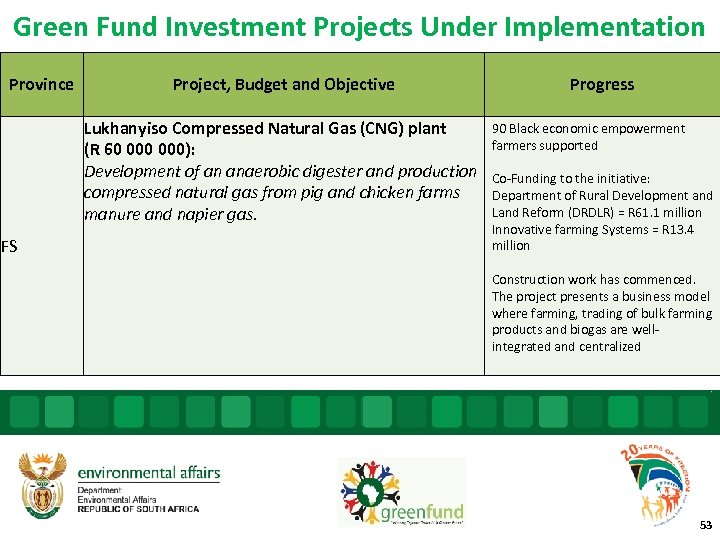 Green Fund Investment Projects Under Implementation Province Project, Budget and Objective Lukhanyiso Compressed Natural Gas (CNG) plant (R 60 000): Development of an anaerobic digester and production compressed natural gas from pig and chicken farms manure and napier gas. FS Progress 90 Black economic empowerment farmers supported Co-Funding to the initiative: Department of Rural Development and Land Reform (DRDLR) = R 61. 1 million Innovative farming Systems = R 13. 4 million Construction work has commenced. The project presents a business model where farming, trading of bulk farming products and biogas are wellintegrated and centralized 53
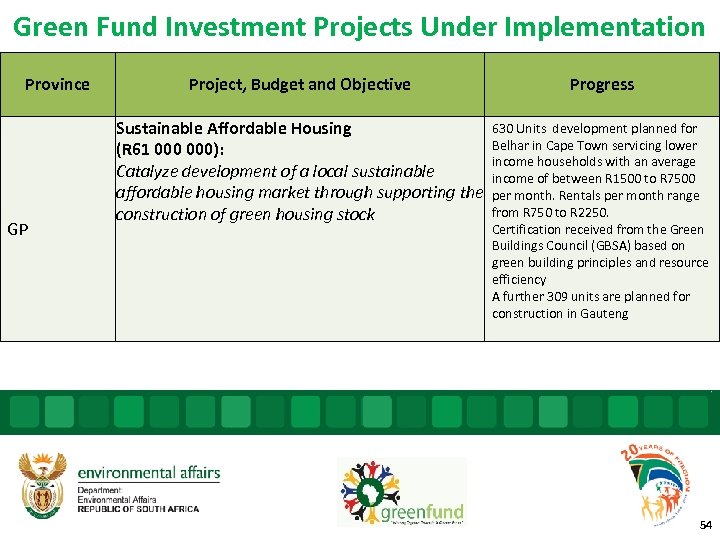 Green Fund Investment Projects Under Implementation Province GP Project, Budget and Objective Progress Sustainable Affordable Housing (R 61 000): Catalyze development of a local sustainable affordable housing market through supporting the construction of green housing stock 630 Units development planned for Belhar in Cape Town servicing lower income households with an average income of between R 1500 to R 7500 per month. Rentals per month range from R 750 to R 2250. Certification received from the Green Buildings Council (GBSA) based on green building principles and resource efficiency A further 309 units are planned for construction in Gauteng 54
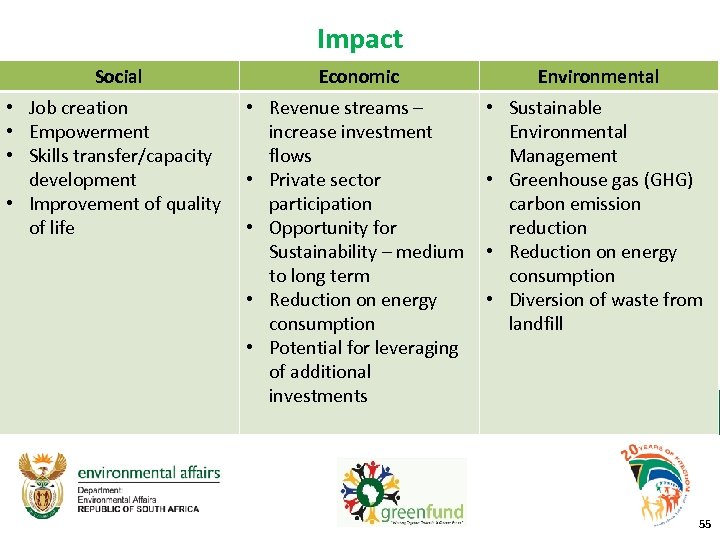 Impact Social Economic Environmental Revenue streams – increase investment flows Private sector participation Opportunity for Sustainability – medium to long term • Reduction on energy consumption • Potential for leveraging of additional investments • Sustainable Environmental Management • Greenhouse gas (GHG) carbon emission reduction • Reduction on energy consumption • Diversion of waste from landfill • Job creation • • Empowerment • transfer/capacity • Skills Financial year development • Allocation • • Improvement of quality of life • 55
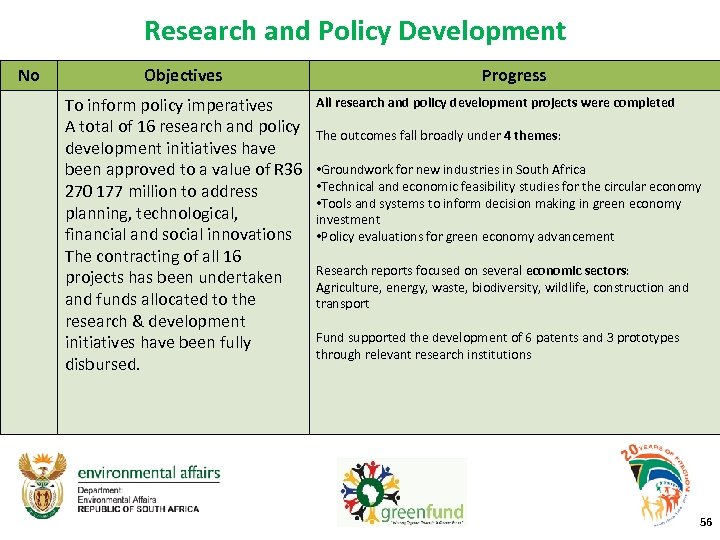 Research and Policy Development No Objectives To inform policy imperatives A total of 16 research and policy development initiatives have been approved to a value of R 36 270 177 million to address planning, technological, financial and social innovations The contracting of all 16 projects has been undertaken and funds allocated to the research & development initiatives have been fully disbursed. Progress All research and policy development projects were completed The outcomes fall broadly under 4 themes: • Groundwork for new industries in South Africa • Technical and economic feasibility studies for the circular economy • Tools and systems to inform decision making in green economy investment • Policy evaluations for green economy advancement Research reports focused on several economic sectors: Agriculture, energy, waste, biodiversity, wildlife, construction and transport Fund supported the development of 6 patents and 3 prototypes through relevant research institutions 56
 Capacity Building Initiatives • In order to assist in the transition to a green economy, the Green Fund supports strategic capacity building initiatives. • A total of 8 capacity development projects were approved to a value of approximately R 66 000. • Capacity building project timeframes vary from one to three years. 57
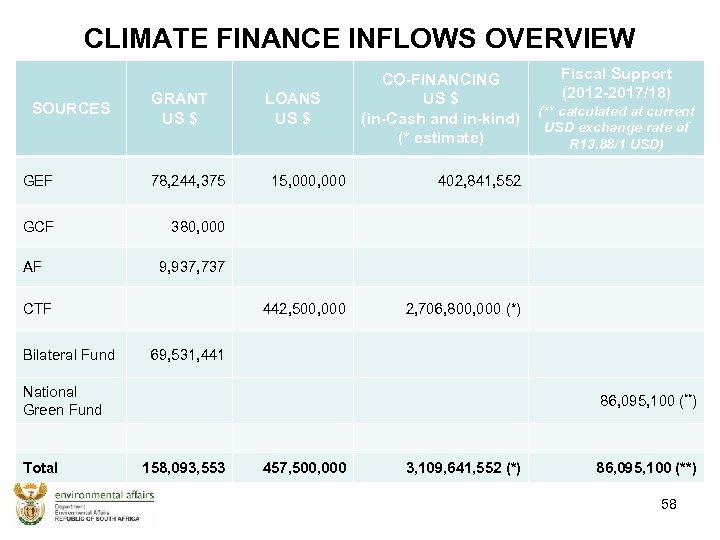 CLIMATE FINANCE INFLOWS OVERVIEW SOURCES GRANT US $ GEF 78, 244, 375 GCF LOANS US $ CO-FINANCING US $ (in-Cash and in-kind) (* estimate) 2, 706, 800, 000 (*) 9, 937, 737 CTF Bilateral Fund 402, 841, 552 442, 500, 000 (** calculated at current USD exchange rate of R 13. 88/1 USD) 380, 000 AF 15, 000 Fiscal Support (2012 -2017/18) 69, 531, 441 National Green Fund Total 86, 095, 100 (**) 158, 093, 553 457, 500, 000 3, 109, 641, 552 (*) 86, 095, 100 (**) 58
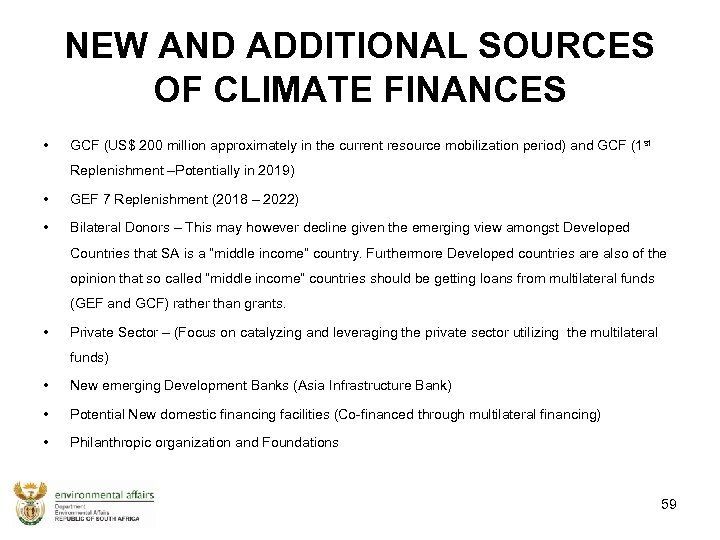 NEW AND ADDITIONAL SOURCES OF CLIMATE FINANCES • GCF (US$ 200 million approximately in the current resource mobilization period) and GCF (1 st Replenishment –Potentially in 2019) • GEF 7 Replenishment (2018 – 2022) • Bilateral Donors – This may however decline given the emerging view amongst Developed Countries that SA is a “middle income” country. Furthermore Developed countries are also of the opinion that so called “middle income” countries should be getting loans from multilateral funds (GEF and GCF) rather than grants. • Private Sector – (Focus on catalyzing and leveraging the private sector utilizing the multilateral funds) • New emerging Development Banks (Asia Infrastructure Bank) • Potential New domestic financing facilities (Co-financed through multilateral financing) • Philanthropic organization and Foundations 59
 60
60