


 Скачать презентацию Climate Data Homogenization Theory Enric Aguilar C 3
e0fb3afce8fa044567c1a8e11431309f.ppt
- Количество слайдов: 12
 Climate Data Homogenization Theory Enric Aguilar (C 3), with material from Lucie Vincent and Xuebin Zhang Climate Research Division, Environment Canada, Toronto, Canada
 Objective n Identify and adjust non-climatic variations caused by changes observing practices, observing time, site relocation, etc. These “inhomogeneities” can interfere with the proper assessment of any climate trends and extremes. 2
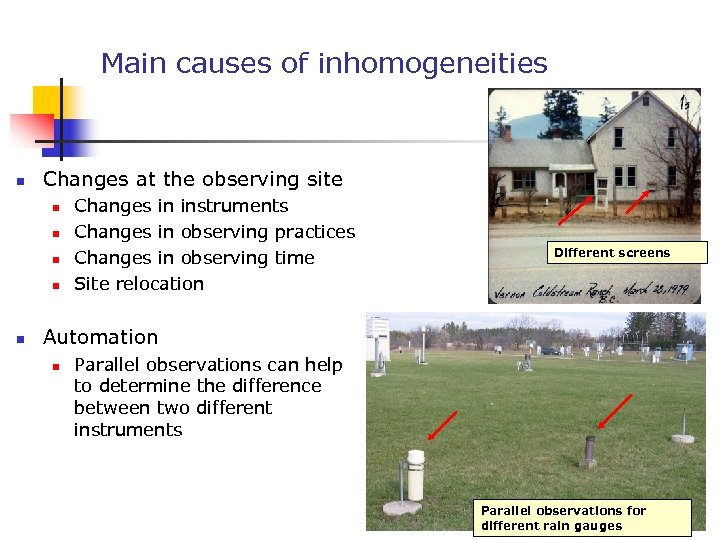 Main causes of inhomogeneities n Changes at the observing site n n n Changes in instruments Changes in observing practices Changes in observing time Site relocation Different screens Automation n Parallel observations can help to determine the difference between two different instruments Parallel observations for different rain gauges 3
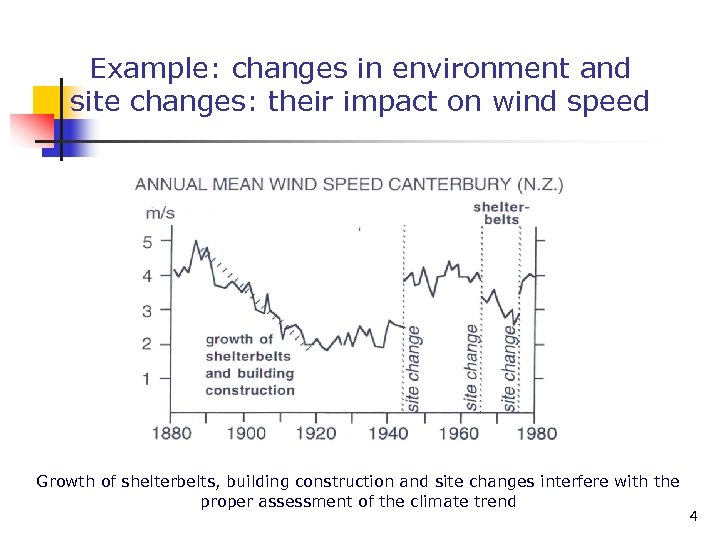 Example: changes in environment and site changes: their impact on wind speed Growth of shelterbelts, building construction and site changes interfere with the proper assessment of the climate trend 4
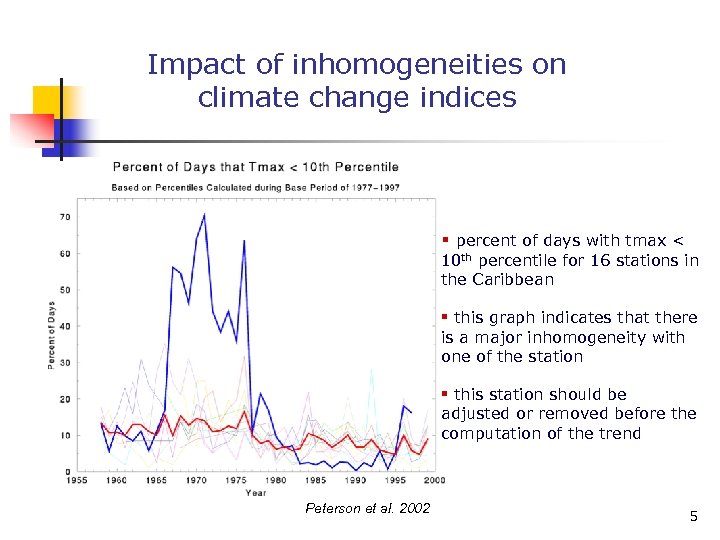 Impact of inhomogeneities on climate change indices § percent of days with tmax < 10 th percentile for 16 stations in the Caribbean § this graph indicates that there is a major inhomogeneity with one of the station § this station should be adjusted or removed before the computation of the trend Peterson et al. 2002 5
 Techniques for the detection and adjustment of inhomogeneities in climate time series § Many techniques have been developed for detecting and adjusting inhomogeneities in climate time series and they have been published in the scientific literature § Most of the techniques were based on statistical tests to identify the dates with the most probable inhomogeneities § Review of techniques: Peterson et al. , 1998: Homogeneity adjustments of in situ atmospheric climate data: a review. Int. J. of Climatol. , 18, 1493 -1517. Aguilar et al. , 2003: Guidelines on Climate Metadata and Homogenization, WCDMP No. 53, WMO-TD No. 1186. WMO, Geneva, 55 pp. 6
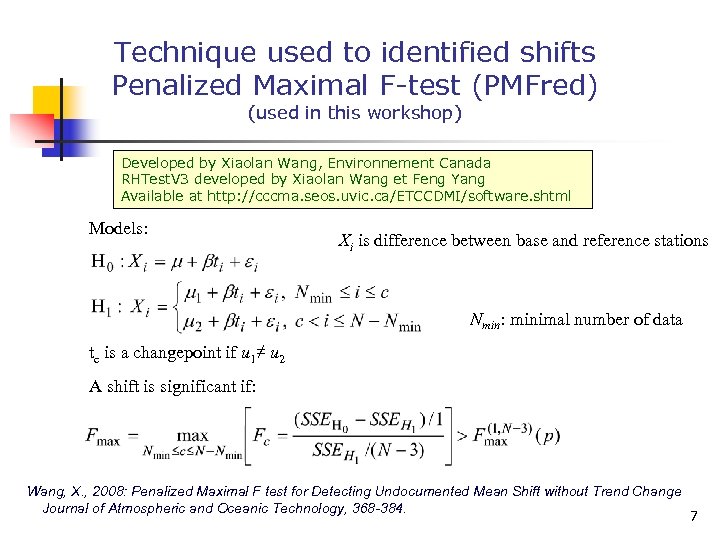 Technique used to identified shifts Penalized Maximal F-test (PMFred) (used in this workshop) Developed by Xiaolan Wang, Environnement Canada RHTest. V 3 developed by Xiaolan Wang et Feng Yang Available at http: //cccma. seos. uvic. ca/ETCCDMI/software. shtml Models: Xi is difference between base and reference stations Nmin: minimal number of data tc is a changepoint if u 1≠ u 2 A shift is significant if: Wang, X. , 2008: Penalized Maximal F test for Detecting Undocumented Mean Shift without Trend Change Journal of Atmospheric and Oceanic Technology, 368 -384. 7
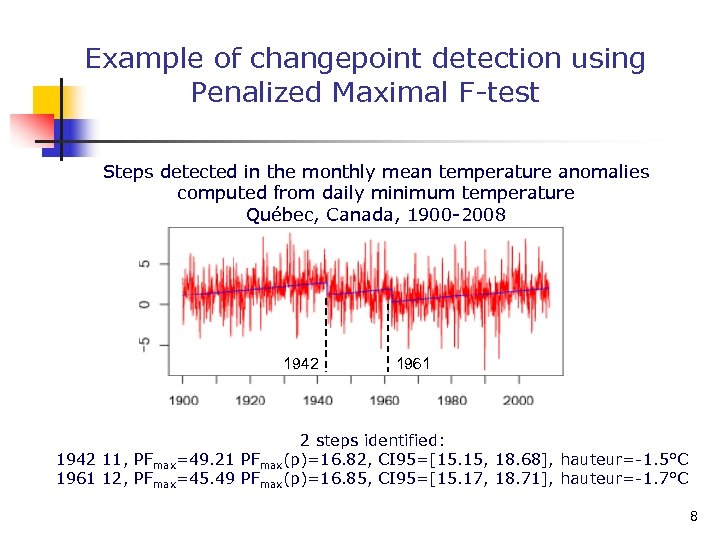 Example of changepoint detection using Penalized Maximal F-test Steps detected in the monthly mean temperature anomalies computed from daily minimum temperature Québec, Canada, 1900 -2008 1942 1961 2 steps identified: 1942 11, PFmax=49. 21 PFmax(p)=16. 82, CI 95=[15. 15, 18. 68], hauteur=-1. 5°C 1961 12, PFmax=45. 49 PFmax(p)=16. 85, CI 95=[15. 17, 18. 71], hauteur=-1. 7°C 8
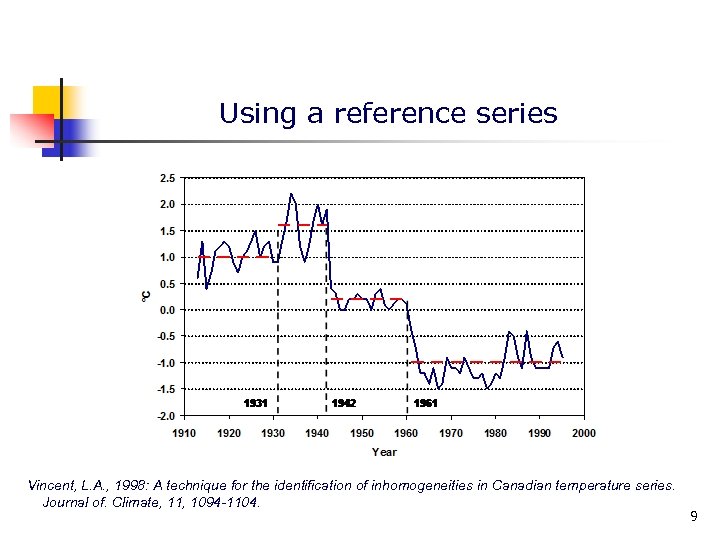 Using a reference series Vincent, L. A. , 1998: A technique for the identification of inhomogeneities in Canadian temperature series. Journal of. Climate, 11, 1094 -1104. 9
 Regional expertise is very important for the homogenization of the climate data!
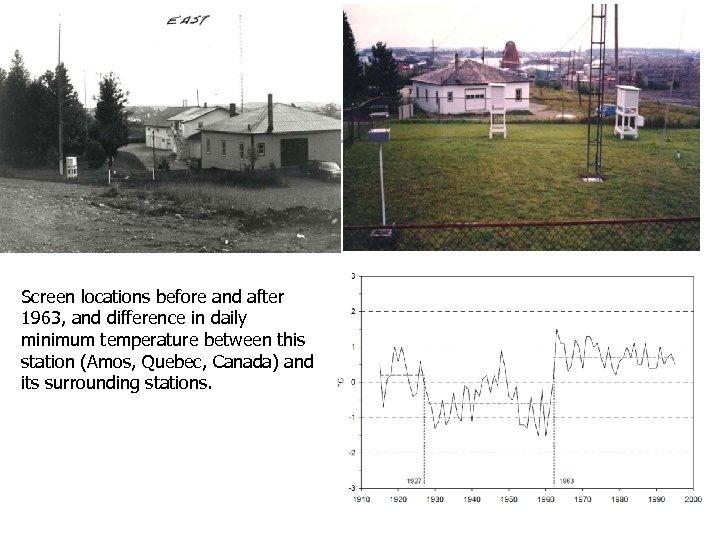 Screen locations before and after 1963, and difference in daily minimum temperature between this station (Amos, Quebec, Canada) and its surrounding stations.
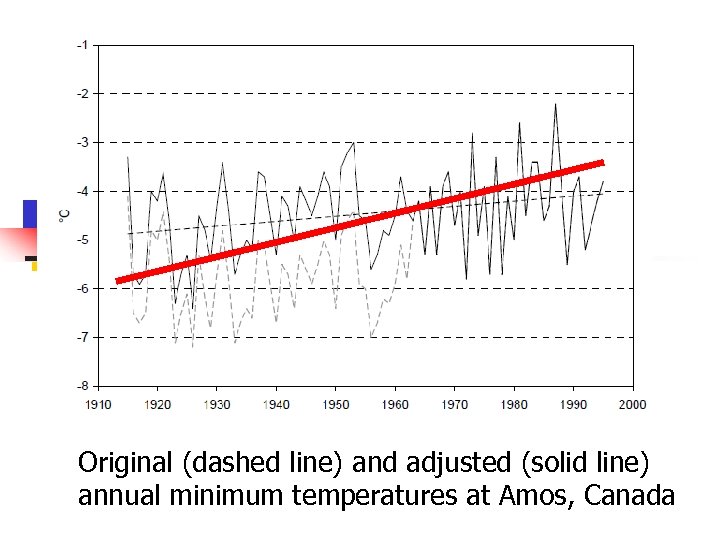 Original (dashed line) and adjusted (solid line) annual minimum temperatures at Amos, Canada