


 Скачать презентацию Climate Change The Move to Action AOSS 480
5f1e9fdc838cc91989896668a9fa4cf1.ppt
- Количество слайдов: 62
 Climate Change: The Move to Action (AOSS 480 // NRE 501) Richard B. Rood 734 -647 -3530 2525 Space Research Building (North Campus) rbrood@umich. edu http: //aoss. engin. umich. edu. /people/rbrood Winter 2008 March 6, 2008
 Class News • A ctools site for all – AOSS 480 001 W 08 • This is the official repository for lectures • Email climateaction@ctools. umich. edu • Class Web Site and Wiki – Climate Change: The Move to Action – Winter 2008 Term
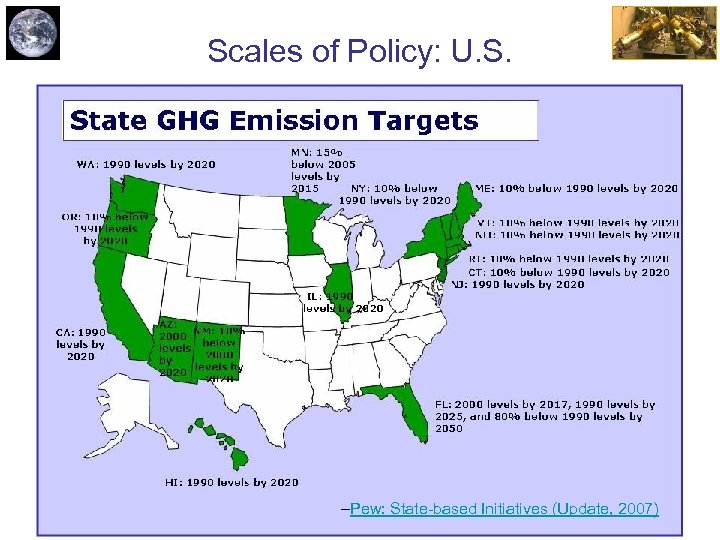
 Readings on Local Servers • Assigned – Jasanoff: The Fifth Branch (Chapter 1) – Pew: State-based Initiatives (2006) – Pew: State-based Initiatives (Update, 2007) • Of Interest – Rabe: Congressional Testimony (2007) – Pew: Beyond Kyoto • Foundational References – UNFCCC: Text of Convention – Kyoto Protocol: Text – Kyoto Protocol: Introduction and Summary
 A useful reference (not on server) • Barry Rabe: Statehouse and Greenhouse
 Lectures coming up • http: //www. snre. umich. edu/events
 Outline of Lecture • • Summary of Energy-Climate Relation Need for “carbon policy” IPCC: Formal science-policy interface Global policy of mitigation – UN Framework Convention for Climate Change • “Dangerous” climate change – Kyoto protocol • Market mechanisms • Regional, State and Local Policy
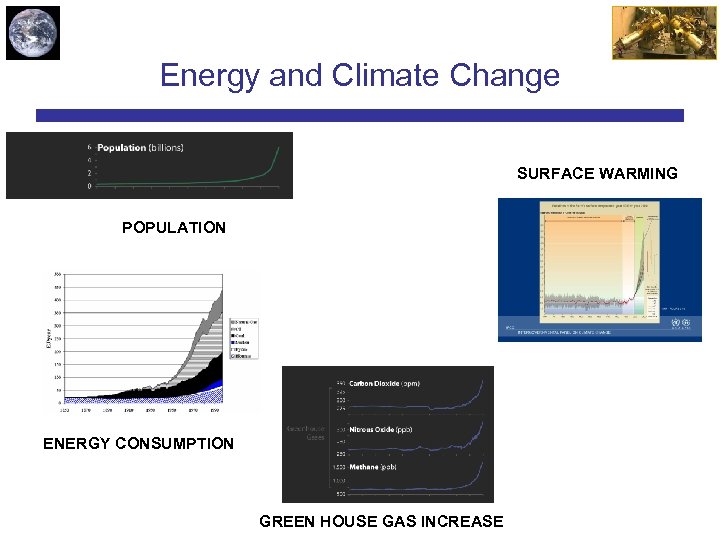 Energy and Climate Change SURFACE WARMING POPULATION ENERGY CONSUMPTION GREEN HOUSE GAS INCREASE
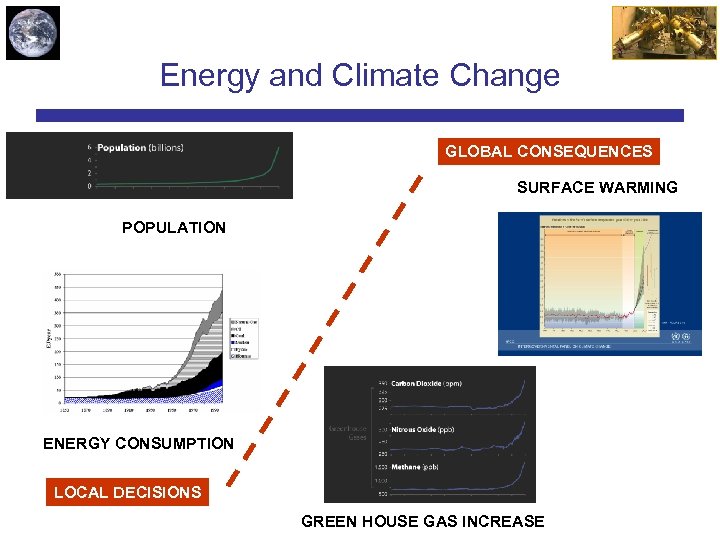 Energy and Climate Change GLOBAL CONSEQUENCES SURFACE WARMING POPULATION ENERGY CONSUMPTION LOCAL DECISIONS GREEN HOUSE GAS INCREASE
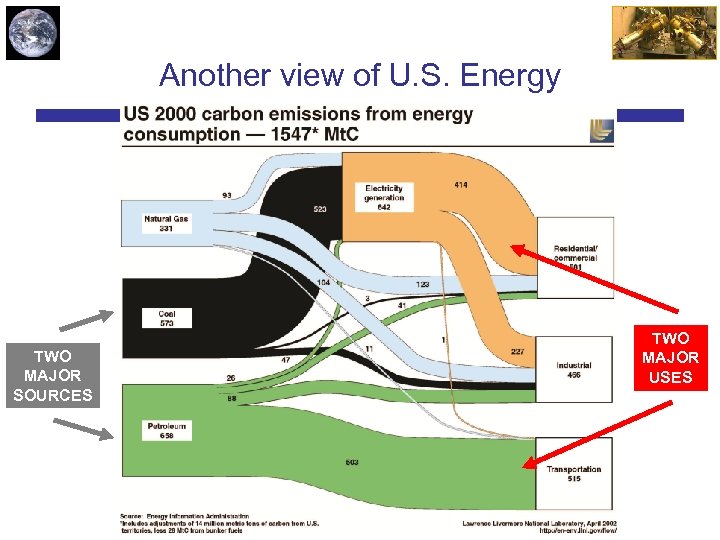 Another view of U. S. Energy TWO MAJOR SOURCES TWO MAJOR USES
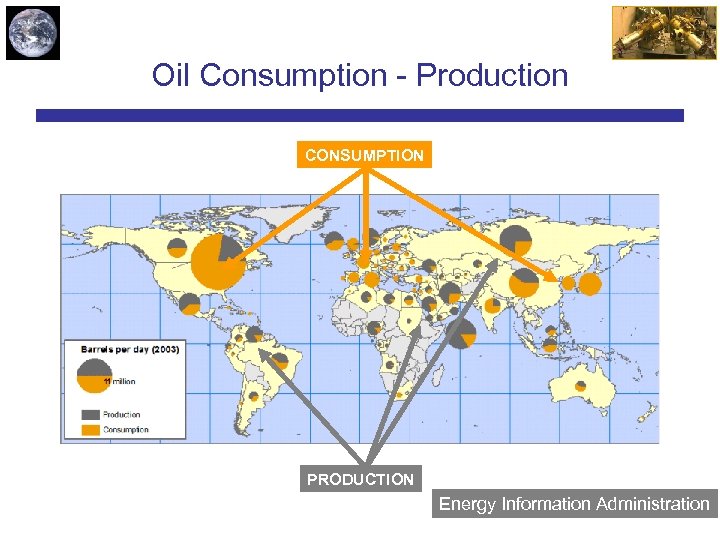 Oil Consumption - Production CONSUMPTION PRODUCTION Energy Information Administration
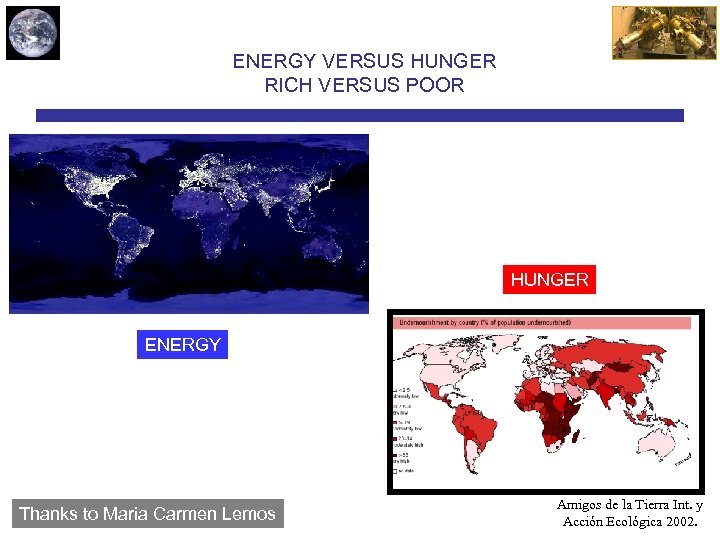 ENERGY VERSUS HUNGER RICH VERSUS POOR HUNGER ENERGY Thanks to Maria Carmen Lemos Amigos de la Tierra Int. y Acción Ecológica 2002.
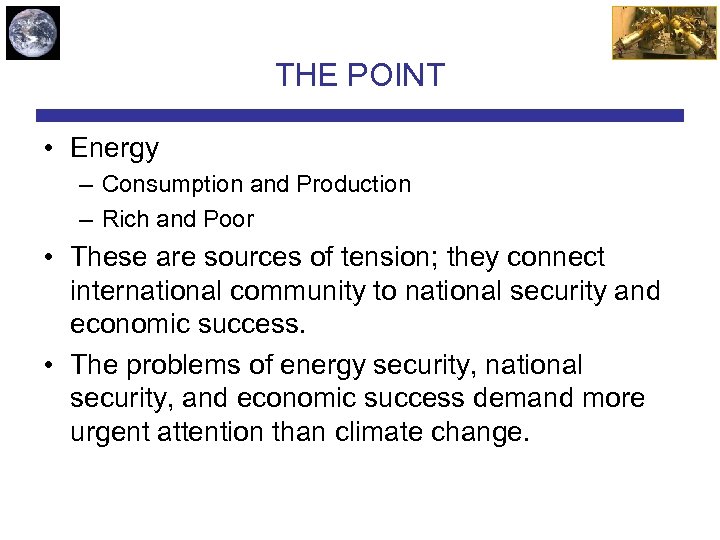 THE POINT • Energy – Consumption and Production – Rich and Poor • These are sources of tension; they connect international community to national security and economic success. • The problems of energy security, national security, and economic success demand more urgent attention than climate change.
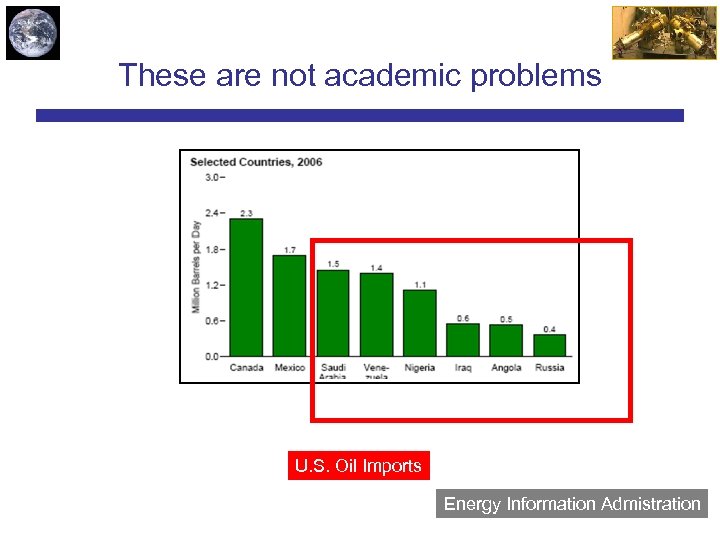 These are not academic problems U. S. Oil Imports Energy Information Admistration
 Again: Short-term versus long-term • This is a classic short-term versus long-term problem. – – Ethics Economics Reaction versus anticipation Adaptation versus mitigation • A way to provide rationality to the problem is to look at the near term, the long term, and how to get from now to next to where we need to be.
 Policy • A natural reaction to this situation is to look to government, to the development of policy to address the problems that we are faced with.
 Policy • What do we look to policy to accomplish? – From class discussion • Stimulate technology: Provide incentives or dis-incentives for behavior. (Often through financial or market forces. ) • Set regulations: Put bounds on some type of behavior, with penalties is the bounds are exceeded. • Make internal some sort of procedure or behavior or cost that is currently external. – A more abstract point of view • Represents collective values of society: what is acceptable and what is not. • Interface with the law? • Provides the constraints and limits, the checks and balances in which we run our economy.
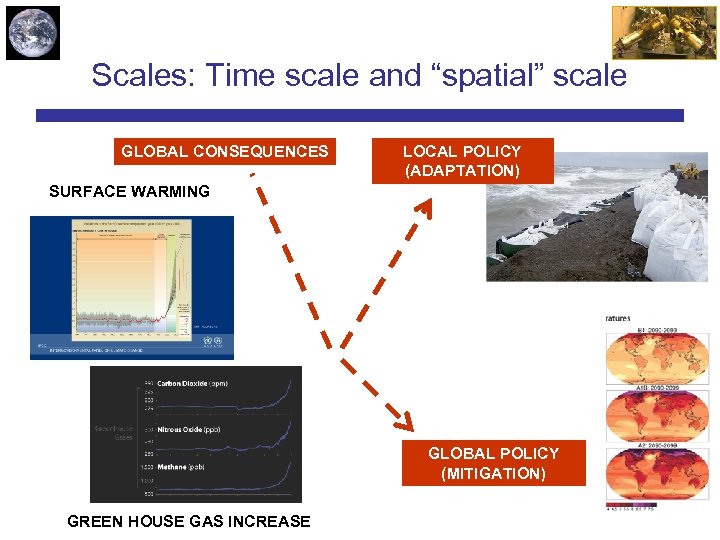
 Complexity • Need for energy policy – Energy security – Economic stability • de facto growth! – Localized solutions? • Need for climate policy – Mitigation: global – Adaptation: local
 NEED CARBON POLICY • We need a carbon policy which is integrated with energy policy. – Some alternative energy sources don’t do a whole much for reducing carbon dioxide in atmosphere. – Coal is our easy energy security • Without sequestration (carbon removal), coal makes the problem worse. • Concern: Quest for energy security-national security, demand for cheap energy will reduce priority we give to reduction of carbon dioxide in the atmosphere.
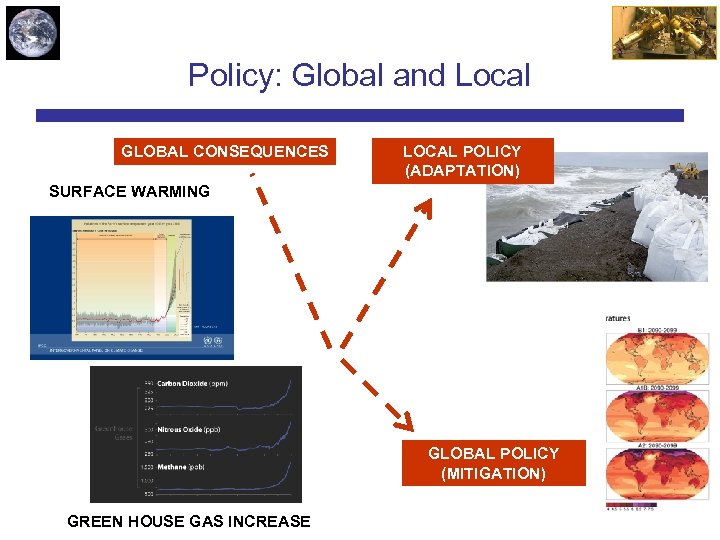 Policy: Global and Local GLOBAL CONSEQUENCES LOCAL POLICY (ADAPTATION) SURFACE WARMING GLOBAL POLICY (MITIGATION) GREEN HOUSE GAS INCREASE
 Carbon Policy • Carbon policy is viewed by many as an economic threat. – Justified position?
 Science-Policy Interface
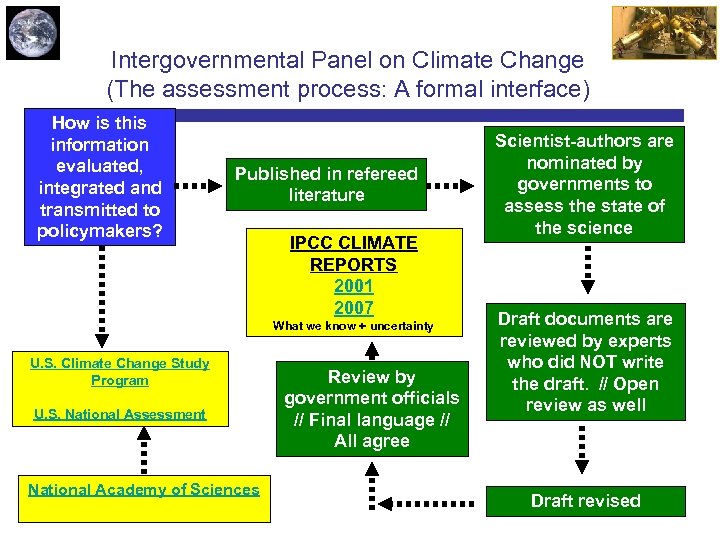 Intergovernmental Panel on Climate Change (The assessment process: A formal interface) How is this information evaluated, integrated and transmitted to policymakers? Published in refereed literature IPCC CLIMATE REPORTS 2001 2007 What we know + uncertainty U. S. Climate Change Study Program U. S. National Assessment National Academy of Sciences Review by government officials // Final language // All agree Scientist-authors are nominated by governments to assess the state of the science Draft documents are reviewed by experts who did NOT write the draft. // Open review as well Draft revised
 Global Policy: Mitigation
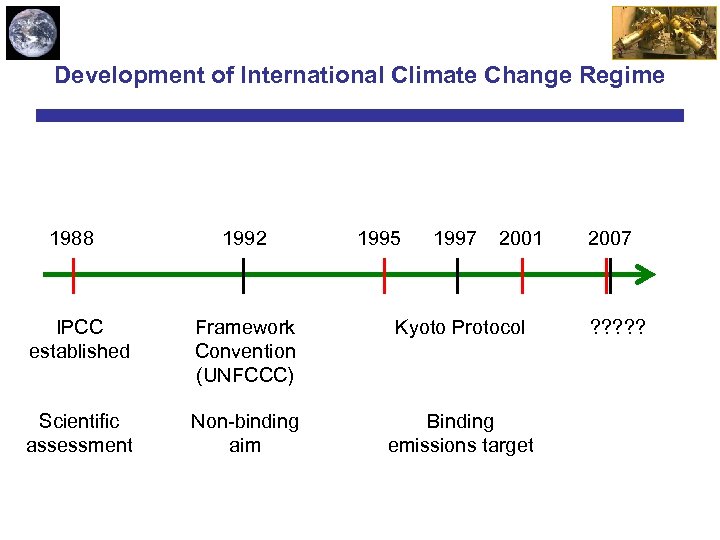 Development of International Climate Change Regime 1988 1992 1995 1997 2001 IPCC established Framework Convention (UNFCCC) Kyoto Protocol Scientific assessment Non-binding aim Binding emissions target 2007 ? ? ?
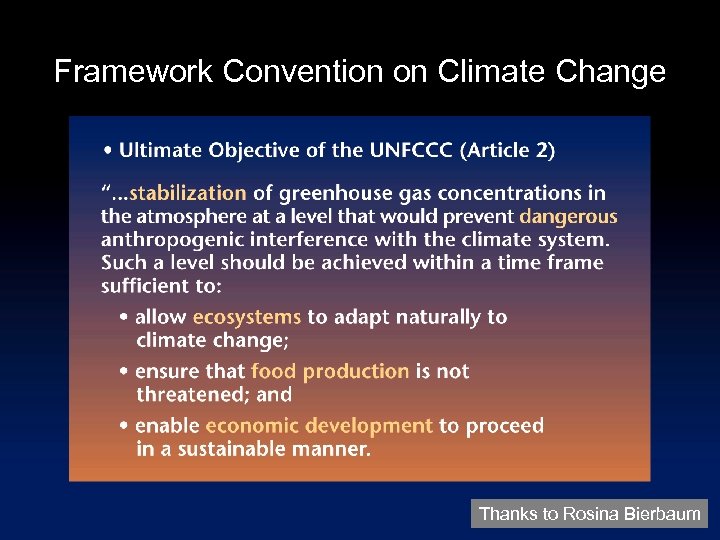
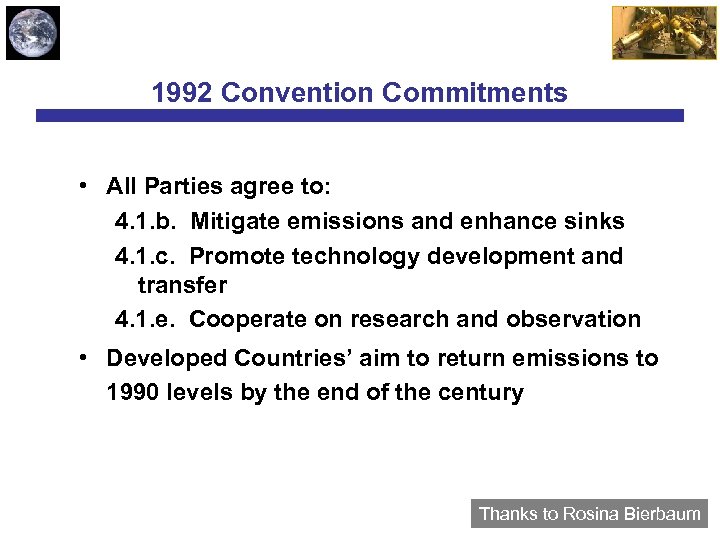
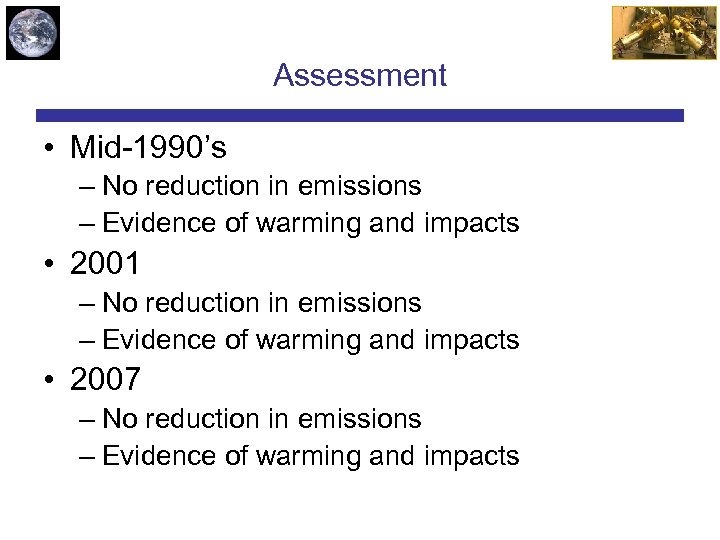
 Framework Convention on Climate Change (US in part of this. ) • UN Framework Convention on Climate Change (1992, non-binding, voluntary, 190 signers) – Reduce CO 2 Emissions in 2000 to 1990 levels – Inventories of greenhouse gas emissions – Mitigate Climate Change • Mid-1990’s – No reduction in emissions – Evidence of warming and impacts
 Framework Convention on Climate Change Thanks to Rosina Bierbaum
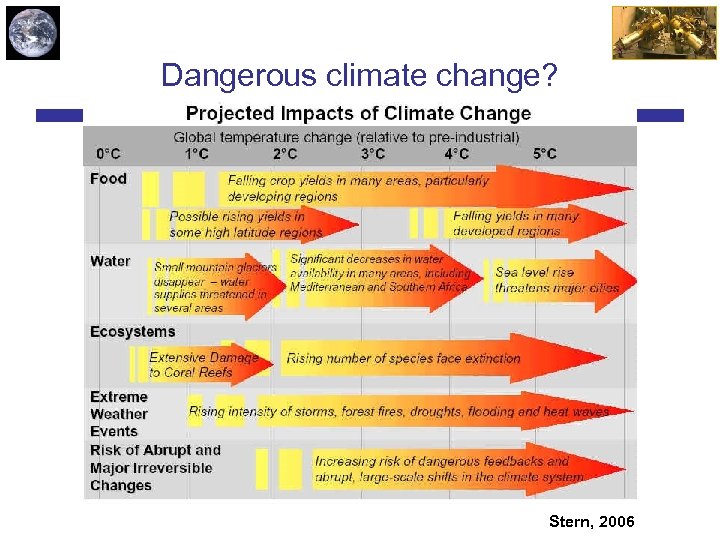 Dangerous climate change? Stern, 2006
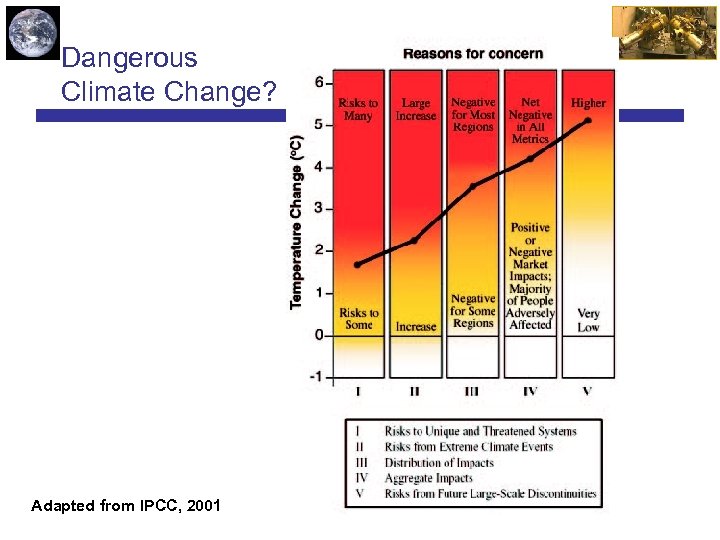 Dangerous Climate Change? Adapted from IPCC, 2001
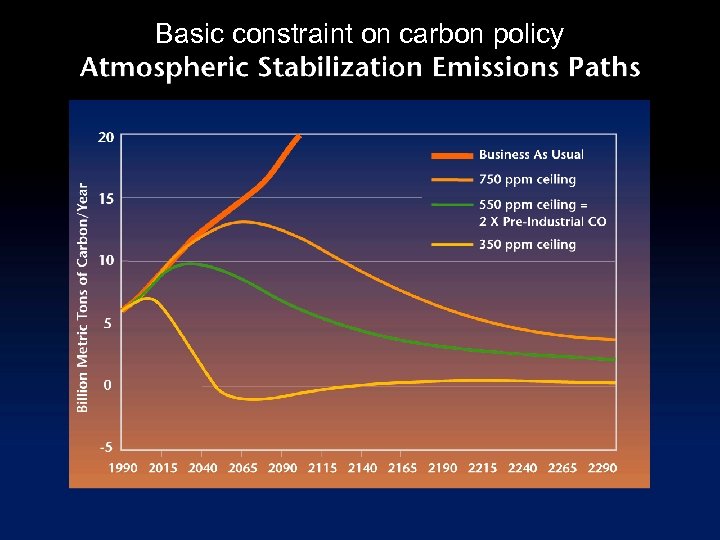
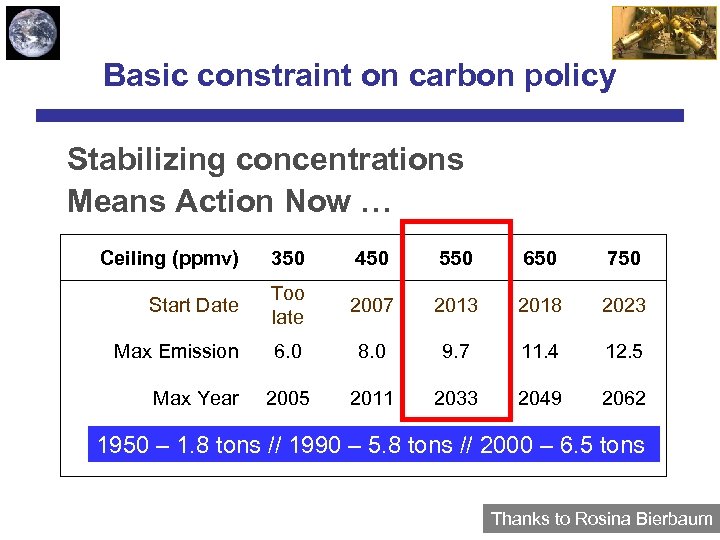
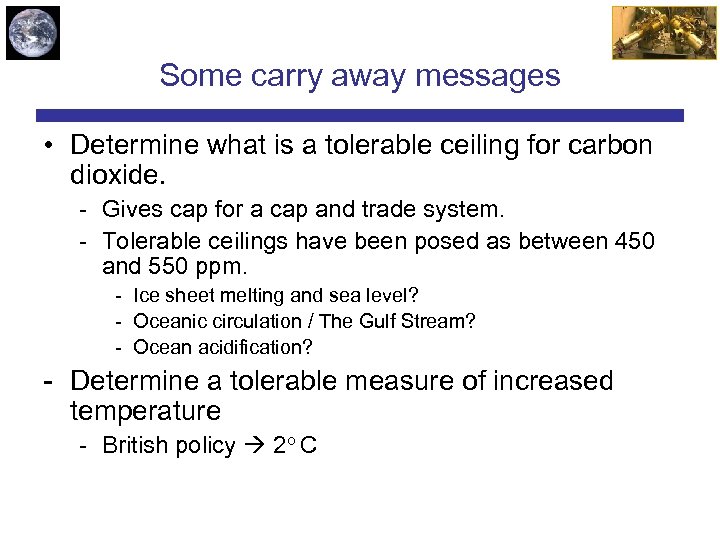 Some carry away messages • Determine what is a tolerable ceiling for carbon dioxide. - Gives cap for a cap and trade system. - Tolerable ceilings have been posed as between 450 and 550 ppm. - Ice sheet melting and sea level? - Oceanic circulation / The Gulf Stream? - Ocean acidification? - Determine a tolerable measure of increased temperature - British policy 2 o C
 Basic constraint on carbon policy
 Basic constraint on carbon policy Stabilizing concentrations Means Action Now … Ceiling (ppmv) Start Date Max Emission Max Year 350 450 550 650 750 Too late 2007 2013 2018 2023 6. 0 8. 0 9. 7 11. 4 12. 5 2005 2011 2033 2049 2062 1950 – 1. 8 tons // 1990 – 5. 8 tons // 2000 – 6. 5 tons Thanks to Rosina Bierbaum
 1992 Convention Commitments • All Parties agree to: 4. 1. b. Mitigate emissions and enhance sinks 4. 1. c. Promote technology development and transfer 4. 1. e. Cooperate on research and observation • Developed Countries’ aim to return emissions to 1990 levels by the end of the century Thanks to Rosina Bierbaum
 Assessment • Mid-1990’s – No reduction in emissions – Evidence of warming and impacts • 2001 – No reduction in emissions – Evidence of warming and impacts • 2007 – No reduction in emissions – Evidence of warming and impacts
 Kyoto Protocol followed 1995 assessments
 Kyoto Protocol • Kyoto Protocol (December, 1997, binding limits on or reduction of emissions) – Must be signed (155 signers (? 186)) and ratified • At least 55 countries • That represent 55 % or more of emissions – Open for signatures on March 16, 1998 – Went into effect on February 16, 2005 • After Russia signed and ratified
 Kyoto Protocol Requirements • Developed nations reduce their emissions 5. 2% below 1990 emissions – Reduction (increases) vary across countries – Relaxed a little over the years to attract signers – (Treaty: U. S. 7% reduction: Actual: 12% higher in 2004, 30% by 2012) • Addresses “six” greenhouse gases (CO 2, Methane CH 4, Nitrous Oxide N 2 O, hydrofluorocarbons, perfluorocarbons, sulphur hexafluoride) • Commitment period 2008 -2012 • Set of other activities – – Improve “local emission factors” Inventories of emissions and sinks Mitigation and adaptation plans Environmentally sound technology diffusion to developing nations
 Kyoto Protocol Issues • Amount and distribution for limits and reductions • What greenhouse gases to include • Developing countries in or out of emission requirements • Trading, market-based mechanisms • Role of removing greenhouse gases
 Kyoto Protocol: Important Add ons • Market-based mechanisms – Emissions trading – Joint implementation – Clean development mechanisms • “Common but differentiated responsibilities” Thanks to Rosina Bierbaum
 Flexibility in Achieving Targets • “What” flexibility – Targets apply to CO 2 -equivalent emissions of basket of six GHGs – Can use carbon sinks (e. g. forests) as offsets • “When” flexibility – Five-year commitment period – Banking • “Where” flexibility – Market mechanisms: ET, JI, CDM Thanks to Rosina Bierbaum
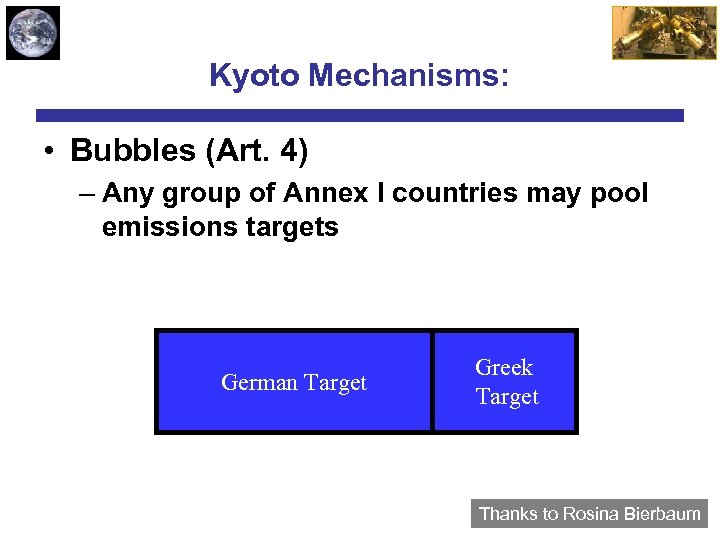 Kyoto Mechanisms: • Bubbles (Art. 4) – Any group of Annex I countries may pool emissions targets German Target Greek Target Thanks to Rosina Bierbaum
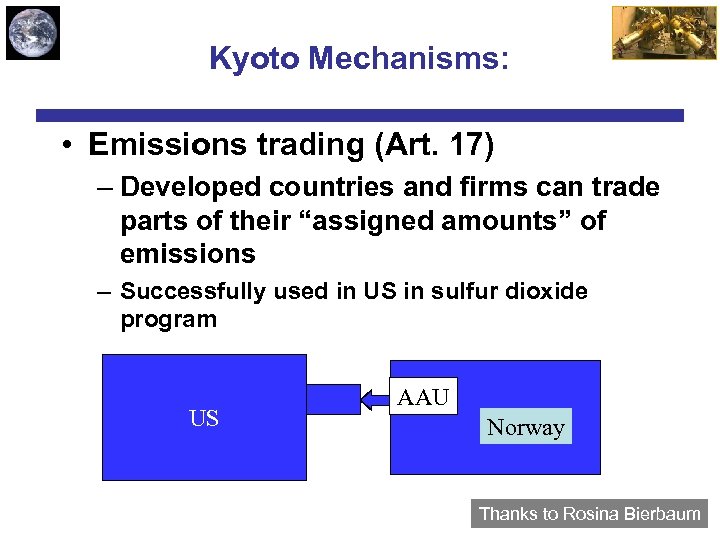 Kyoto Mechanisms: • Emissions trading (Art. 17) – Developed countries and firms can trade parts of their “assigned amounts” of emissions – Successfully used in US in sulfur dioxide program US AAU Norway Thanks to Rosina Bierbaum
 Kyoto Mechanisms: • Joint implementation (JI) (Art. 6) – One Annex I country undertakes a project in another country to reduce emissions or enhance sinks – The project generates an “emission reduction unit, ” which can be transferred – ERUs subtracted from transferor’s assigned amount and added to transferee’s assigned amount Thanks to Rosina Bierbaum
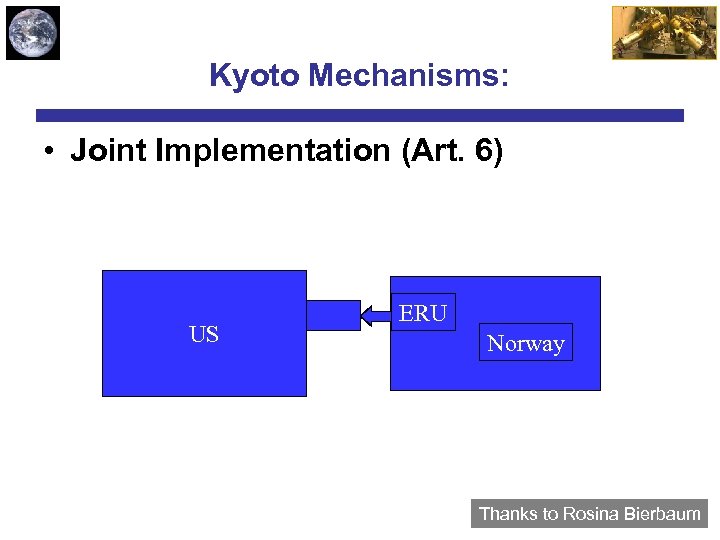 Kyoto Mechanisms: • Joint Implementation (Art. 6) US ERU Norway Thanks to Rosina Bierbaum
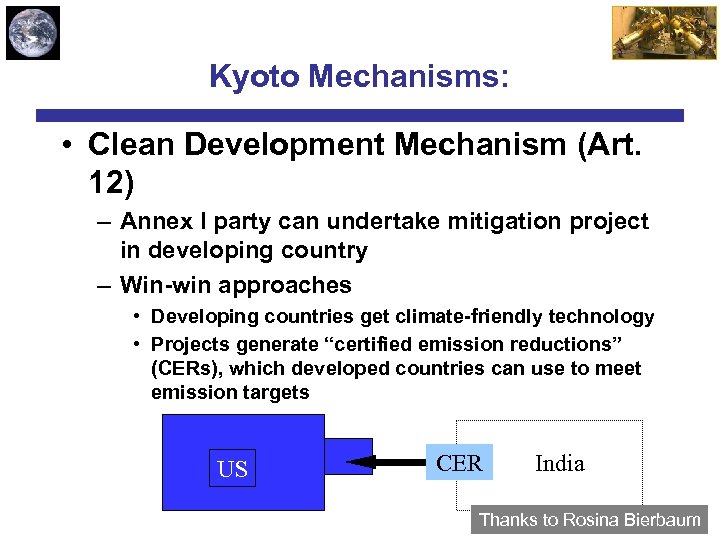 Kyoto Mechanisms: • Clean Development Mechanism (Art. 12) – Annex I party can undertake mitigation project in developing country – Win-win approaches • Developing countries get climate-friendly technology • Projects generate “certified emission reductions” (CERs), which developed countries can use to meet emission targets US CER India Thanks to Rosina Bierbaum
 Kyoto Protocol: Issues with Market-based Mechanisms • Trading with countries who do not have emission limits / non-ratifying countries • Integrity in the trading market – “false” credits – Reporting – Measurements – Verifying
 “Flaws” in Kyoto Protocol • Participation of Developing Countries – Large populations, large projected growth • Participation of the United States – 25 % of greenhouse gas emissions • Other “flaws” – Does not go far enough: Emission goals don’t adequately mitigate dangerous climate change – 2008 -2012 commitment period – then what?
 Elements of “U. S. Position” • Will not be ratified unless developing countries are included in emission limits • Continuing concerns – Impact on economic growth and gross national product • CO 2, currently, directly related to enterprise, economy … – Robustness of scientific justification and observations – Winners outweigh losers • Policy defines winners and losers in a different way.
 Issues of implementation • Rules that govern compliance • The rules of development and transfer of cleaner, low emission, technologies • The role of carbon sinks: trees, removal technology, …. • The reward/punishment for those who take the initiative to address their emissions unilaterally
 Constituencies in the community • “G-77” and China: ~130 developing countries, work by consensus (generally represent The Africa Group) – Economic development and emission limits – Sell their potential carbon credits for profit • The Alliance of Small Island States (AOSIS) – Tightest control on global emissions • Organization of Petroleum Export Countries (OPEC) – Protection of their economic well being
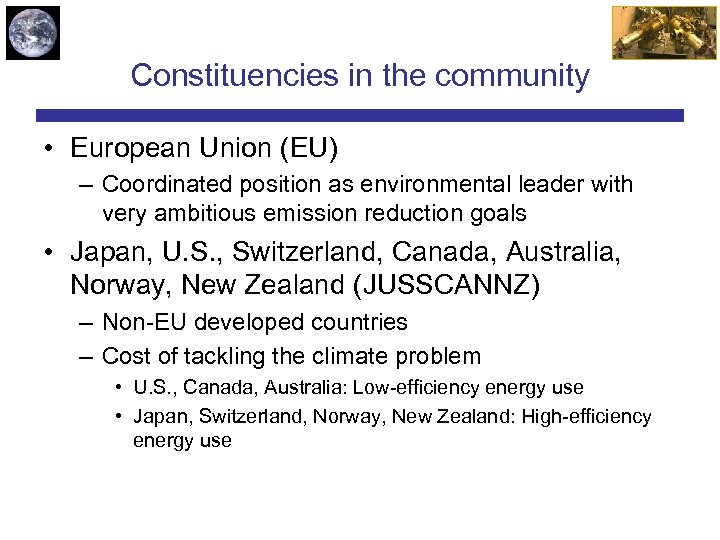 Constituencies in the community • European Union (EU) – Coordinated position as environmental leader with very ambitious emission reduction goals • Japan, U. S. , Switzerland, Canada, Australia, Norway, New Zealand (JUSSCANNZ) – Non-EU developed countries – Cost of tackling the climate problem • U. S. , Canada, Australia: Low-efficiency energy use • Japan, Switzerland, Norway, New Zealand: High-efficiency energy use
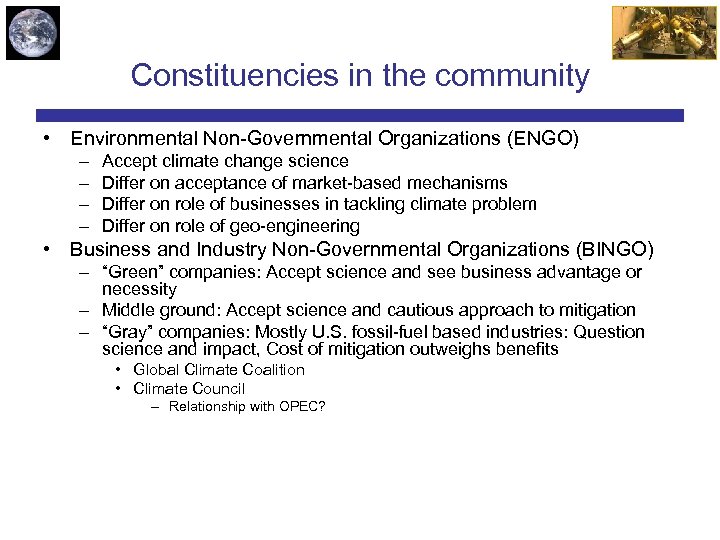 Constituencies in the community • Environmental Non-Governmental Organizations (ENGO) – – Accept climate change science Differ on acceptance of market-based mechanisms Differ on role of businesses in tackling climate problem Differ on role of geo-engineering • Business and Industry Non-Governmental Organizations (BINGO) – “Green” companies: Accept science and see business advantage or necessity – Middle ground: Accept science and cautious approach to mitigation – “Gray” companies: Mostly U. S. fossil-fuel based industries: Question science and impact, Cost of mitigation outweighs benefits • Global Climate Coalition • Climate Council – Relationship with OPEC?
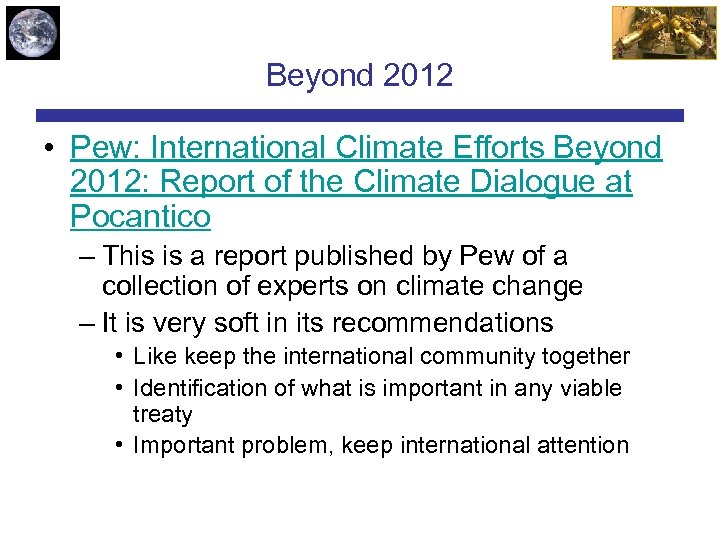 Beyond 2012 • Pew: International Climate Efforts Beyond 2012: Report of the Climate Dialogue at Pocantico – This is a report published by Pew of a collection of experts on climate change – It is very soft in its recommendations • Like keep the international community together • Identification of what is important in any viable treaty • Important problem, keep international attention
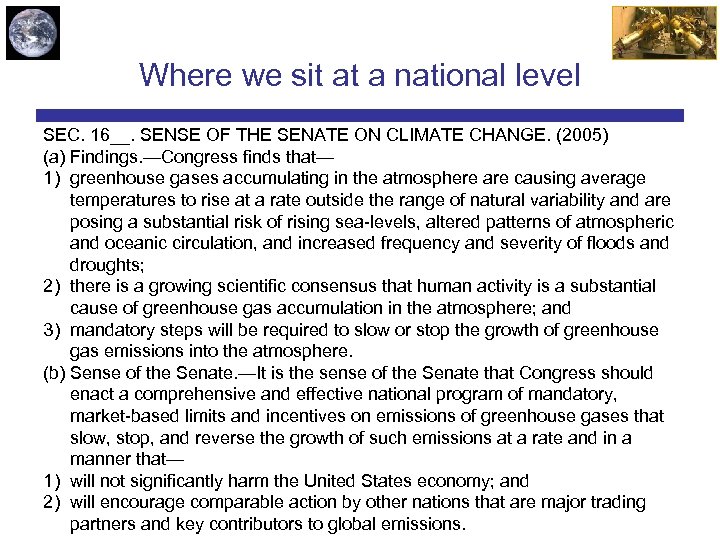 Where we sit at a national level SEC. 16__. SENSE OF THE SENATE ON CLIMATE CHANGE. (2005) (a) Findings. —Congress finds that— 1) greenhouse gases accumulating in the atmosphere are causing average temperatures to rise at a rate outside the range of natural variability and are posing a substantial risk of rising sea-levels, altered patterns of atmospheric and oceanic circulation, and increased frequency and severity of floods and droughts; 2) there is a growing scientific consensus that human activity is a substantial cause of greenhouse gas accumulation in the atmosphere; and 3) mandatory steps will be required to slow or stop the growth of greenhouse gas emissions into the atmosphere. (b) Sense of the Senate. —It is the sense of the Senate that Congress should enact a comprehensive and effective national program of mandatory, market-based limits and incentives on emissions of greenhouse gases that slow, stop, and reverse the growth of such emissions at a rate and in a manner that— 1) will not significantly harm the United States economy; and 2) will encourage comparable action by other nations that are major trading partners and key contributors to global emissions.
 Scales: Time scale and “spatial” scale GLOBAL CONSEQUENCES LOCAL POLICY (ADAPTATION) SURFACE WARMING GLOBAL POLICY (MITIGATION) GREEN HOUSE GAS INCREASE
 Scale • What is the best scale to measure vulnerability and adaptive capacity? – National: • inform states on needed policy response; allow for better decision making; allows for comparison of differential vulnerability – Regional • Impacts are likely not to be defined by national borders – Local • Ground truth • Allows for the understanding of the local factors that mediate sensitivity and resilience Thanks to Maria Carmen Lemos
 Regional based Initiatives • Changing very rapidly • Prone to a bubble burst?
 Scales of Policy: U. S. –Pew: State-based Initiatives (Update, 2007)
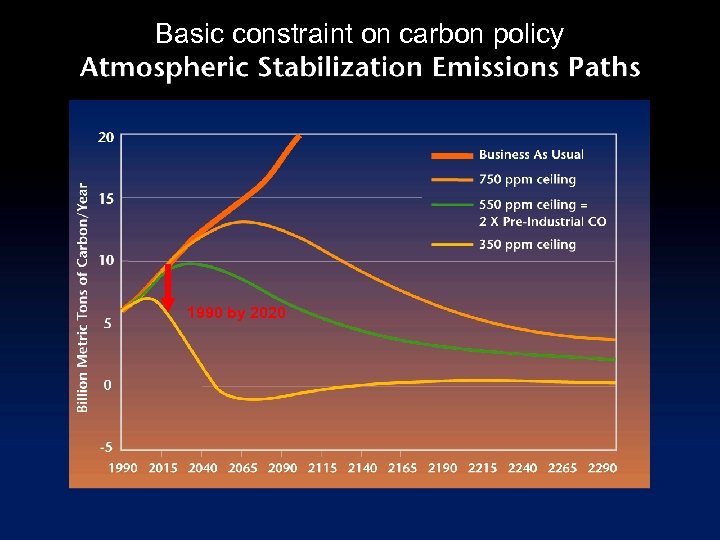 Basic constraint on carbon policy 1990 by 2020
 Motivations for State Activity • Economics – States (and cities) are very aggressive at promoting policy that they perceive as offering economic advantage. – Branding: To attract, for instance, the “creative class” • Belief and Culture – Reflection of political constituencies
 States can be viewed as: (from Rabe (2006)) • Hostile to climate change policy – Michigan (Auto industry, manufacturing) – Colorado (coal and energy) • Stealth interest? – Texas (aggressive renewable portfolio) – Nebraska (sequestration site) • Out in front – California (Water, water? ) – Northeast alliance
 Policy: Regional and State and Local • California Climate Change • Regional Greenhouse Gas Initiative • United Conference of Mayors – U. S. Mayors: Climate Protection Agreement • Map of US Mayors Climate Protection Agreement • Cool Cities
 What does this mean?