


 Скачать презентацию Climate Change The Move to Action AOSS 480
b608d427b11b5509e14aa7e266aeb27c.ppt
- Количество слайдов: 60
 Climate Change: The Move to Action (AOSS 480 // NRE 480) Richard B. Rood 734 -647 -3530 2525 Space Research Building (North Campus) rbrood@umich. edu http: //aoss. engin. umich. edu/people/rbrood Winter 2010 April 13, 2010
 Class News • Ctools site: AOSS 480 001 W 10 • On Line: 2008 Class – Reference list from course • Rood Blog Data Base
 Projects • Final presentation discussion; – April 22, 12: 00 – 4: 00, Place TBD. • After class meetings – 4/13: Transportation – 4/15: Near-term solutions
 Events • Pollack and Rood, Author’s Forum – A World Without Ice: A Conversation with Henry Pollack & Richard Rood • Wednesday, April 14, 2010 • 5: 30 PM • Library Gallery, room 100, Harlan Hatcher Graduate Library – For more info visit www. lsa. umich. edu/humin
 Readings • Stavins, R. N. A U. S. cap-and trade system to address global climate change. The Hamilton Project, 2007. (http: //www. brookings. edu/papers/2007/10 climat e_stavins. aspx) • Metcalf, G. E. A proposal for a U. S. carbon tax swap: an equitable tax reform to address global climate change. The Hamilton Project, 2007. (http: //ase. tufts. edu/econ/events/special. Events. D ocs/metcalf. Carbon. Tax. pdf)
 Introduced the idea of a market • There is some acceptable level of pollution. • There will be an “allowance” of the amount of pollution that can be emitted without penalty. Leads to a “cap. ” – Auction – Given away • If you use less than your allowance, you can trade it to someone who uses more.
 Basics of the Market • The expense of exceeding the cap will motivate reduction of pollution. – How can reduction be achieved? • Companies with efficient methods will develop something they can trade. – What is the cost of to compare with?
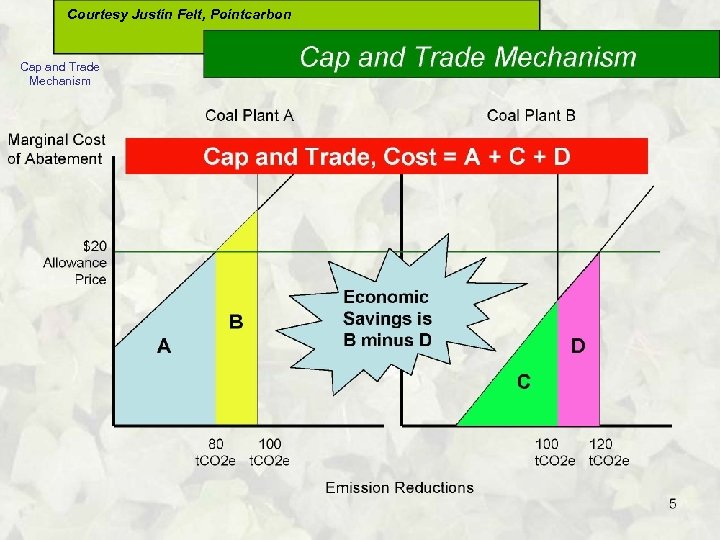 Courtesy Justin Felt, Pointcarbon Cap and Trade Mechanism
 Carbon Markets • California Climate Change • Regional Greenhouse Gas Initiative • EU ETS (Carbon Market) • Chicago Climate Exchange • Pointcarbon • World Bank State of the Carbon Market
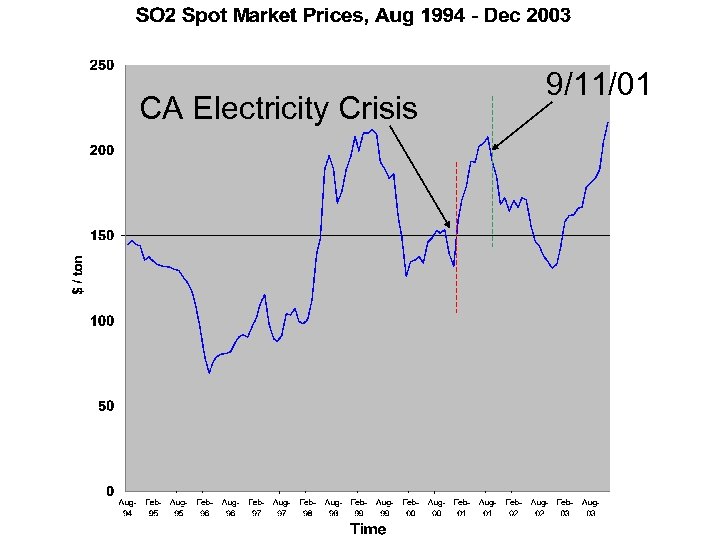
 Market-based Solutions • Based upon success of the sulfur market. – Provides flexibility in meeting the goal of reduced sulfur emissions • For large parts of the world, money and markets constitute the link between different elements of society, nations. – Infrastructure of developed society – Assumption that it is value based
 Sulfur Market as a paradigm for CO 2 Market • How is the same how is it different? • This is very important!
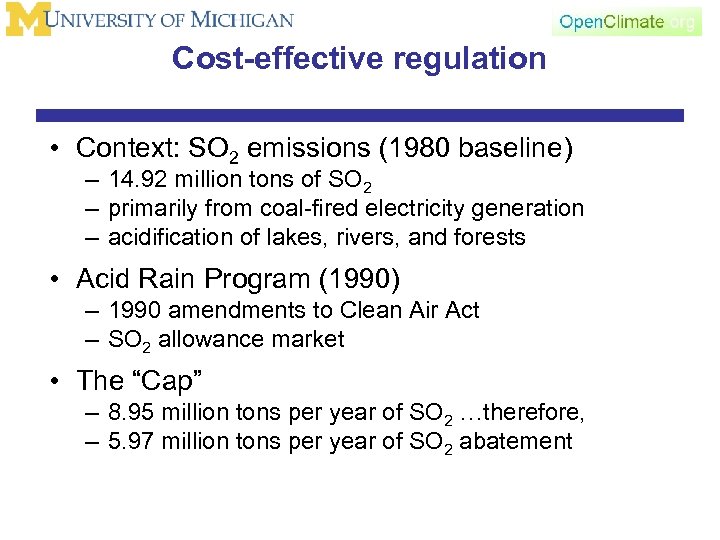 Cost-effective regulation • Context: SO 2 emissions (1980 baseline) – 14. 92 million tons of SO 2 – primarily from coal-fired electricity generation – acidification of lakes, rivers, and forests • Acid Rain Program (1990) – 1990 amendments to Clean Air Act – SO 2 allowance market • The “Cap” – 8. 95 million tons per year of SO 2 …therefore, – 5. 97 million tons per year of SO 2 abatement
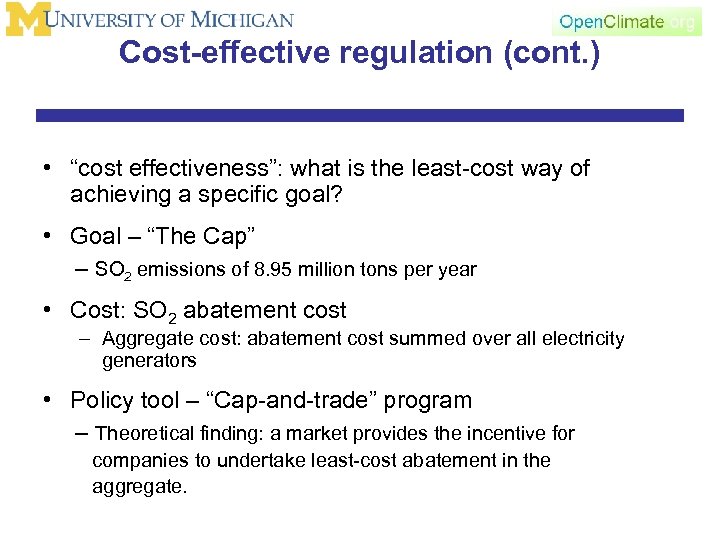 Cost-effective regulation (cont. ) • “cost effectiveness”: what is the least-cost way of achieving a specific goal? • Goal – “The Cap” – SO 2 emissions of 8. 95 million tons per year • Cost: SO 2 abatement cost – Aggregate cost: abatement cost summed over all electricity generators • Policy tool – “Cap-and-trade” program – Theoretical finding: a market provides the incentive for companies to undertake least-cost abatement in the aggregate.
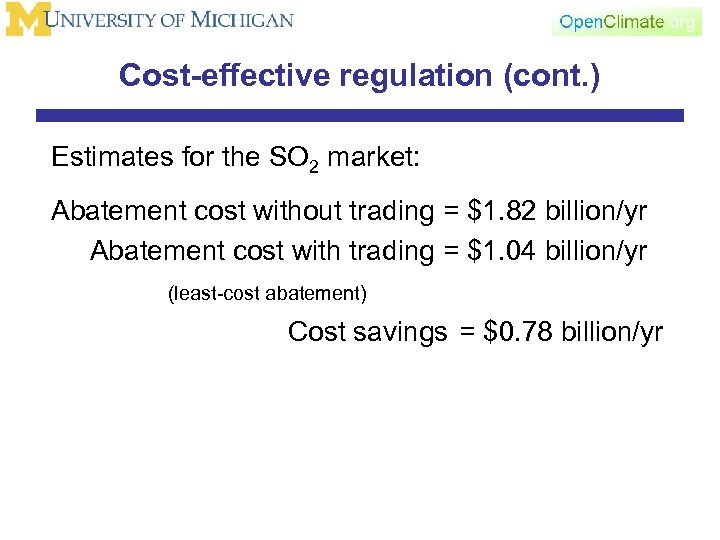 Cost-effective regulation (cont. ) Estimates for the SO 2 market: Abatement cost without trading = $1. 82 billion/yr Abatement cost with trading = $1. 04 billion/yr (least-cost abatement) Cost savings = $0. 78 billion/yr
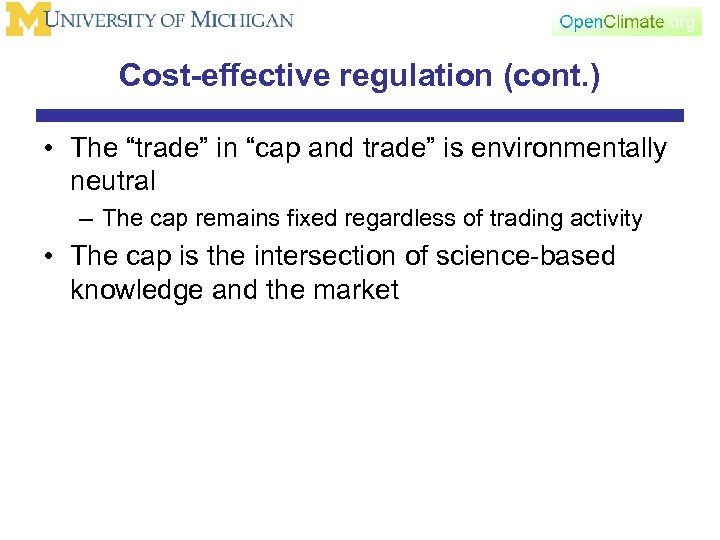 Cost-effective regulation (cont. ) • The “trade” in “cap and trade” is environmentally neutral – The cap remains fixed regardless of trading activity • The cap is the intersection of science-based knowledge and the market
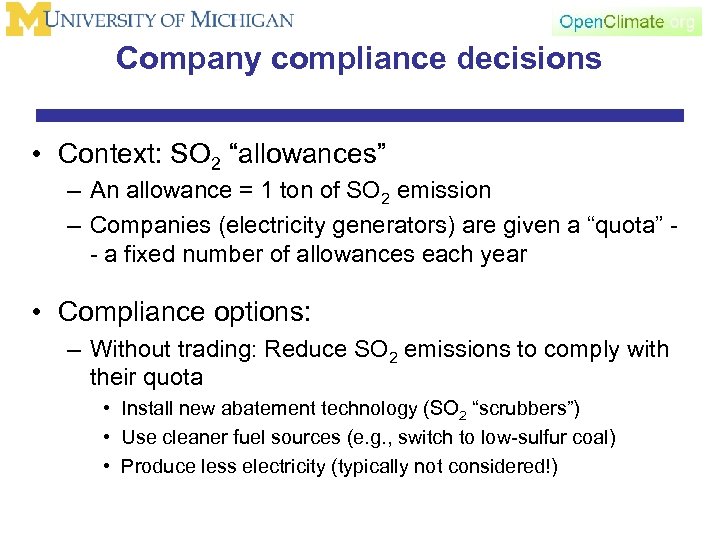 Company compliance decisions • Context: SO 2 “allowances” – An allowance = 1 ton of SO 2 emission – Companies (electricity generators) are given a “quota” - a fixed number of allowances each year • Compliance options: – Without trading: Reduce SO 2 emissions to comply with their quota • Install new abatement technology (SO 2 “scrubbers”) • Use cleaner fuel sources (e. g. , switch to low-sulfur coal) • Produce less electricity (typically not considered!)
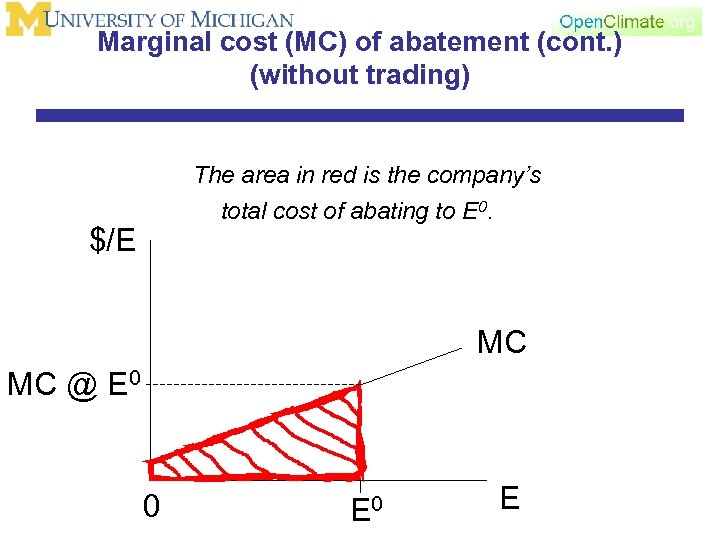 Marginal cost (MC) of abatement (cont. ) (without trading) The area in red is the company’s total cost of abating to E 0. $/E MC MC @ E 0 0 E
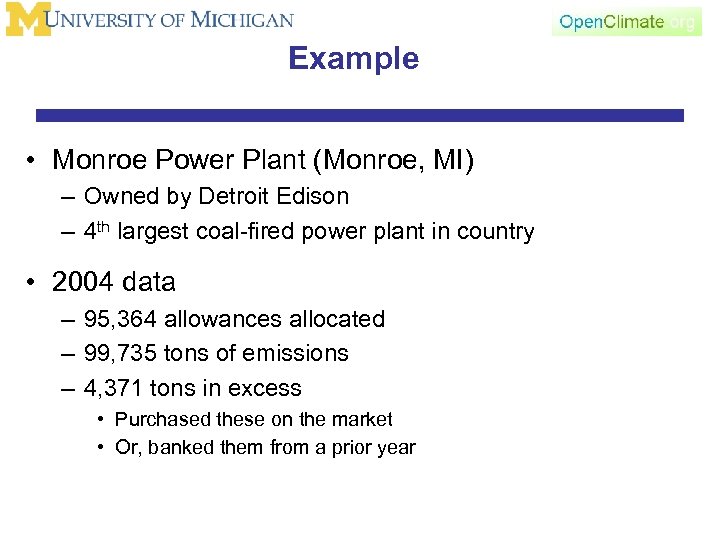 Example • Monroe Power Plant (Monroe, MI) – Owned by Detroit Edison – 4 th largest coal-fired power plant in country • 2004 data – 95, 364 allowances allocated – 99, 735 tons of emissions – 4, 371 tons in excess • Purchased these on the market • Or, banked them from a prior year
 Company compliance options (with trading as an option) • Compliance options: – Without trading: Reduce SO 2 emissions to comply with their quota (scrubbers, low-sulfur coal) – With trading: Same options as above plus • Purchase allowances at the market price (P)
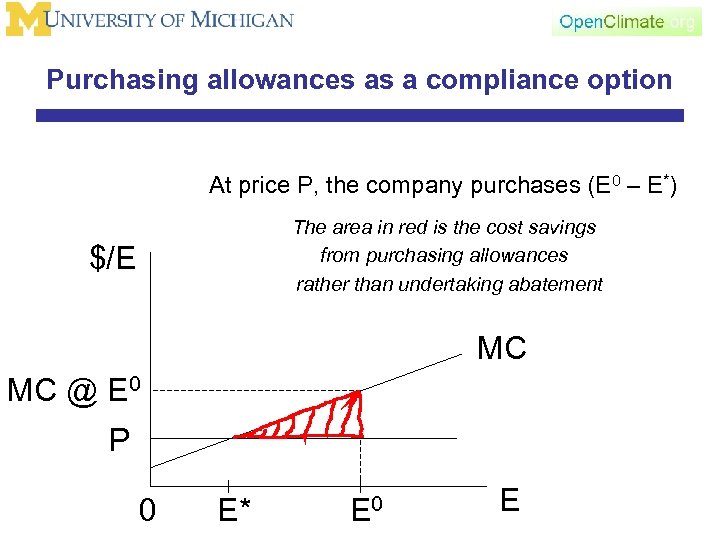 Purchasing allowances as a compliance option At price P, the company purchases (E 0 – E*) The area in red is the cost savings from purchasing allowances rather than undertaking abatement $/E MC MC @ E 0 P 0 E* E 0 E
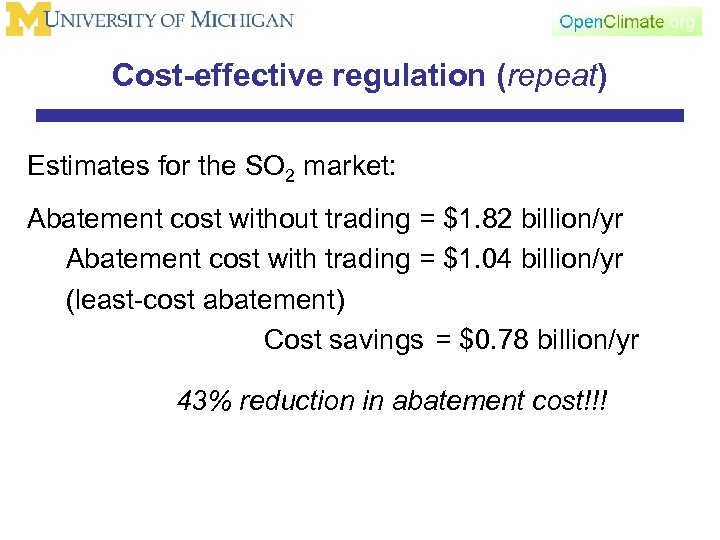 Cost-effective regulation (repeat) Estimates for the SO 2 market: Abatement cost without trading = $1. 82 billion/yr Abatement cost with trading = $1. 04 billion/yr (least-cost abatement) Cost savings = $0. 78 billion/yr 43% reduction in abatement cost!!!
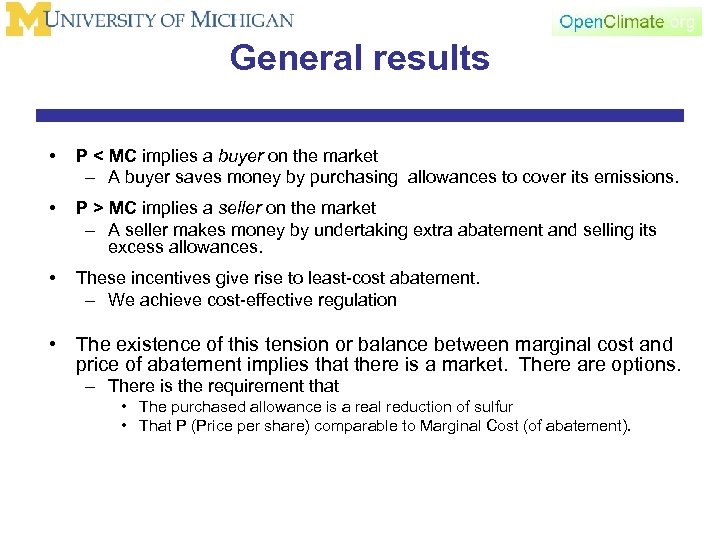 General results • P < MC implies a buyer on the market – A buyer saves money by purchasing allowances to cover its emissions. • P > MC implies a seller on the market – A seller makes money by undertaking extra abatement and selling its excess allowances. • These incentives give rise to least-cost abatement. – We achieve cost-effective regulation • The existence of this tension or balance between marginal cost and price of abatement implies that there is a market. There are options. – There is the requirement that • The purchased allowance is a real reduction of sulfur • That P (Price per share) comparable to Marginal Cost (of abatement).
 Some Specifics of Acid rain program and evidence on the SO 2 market
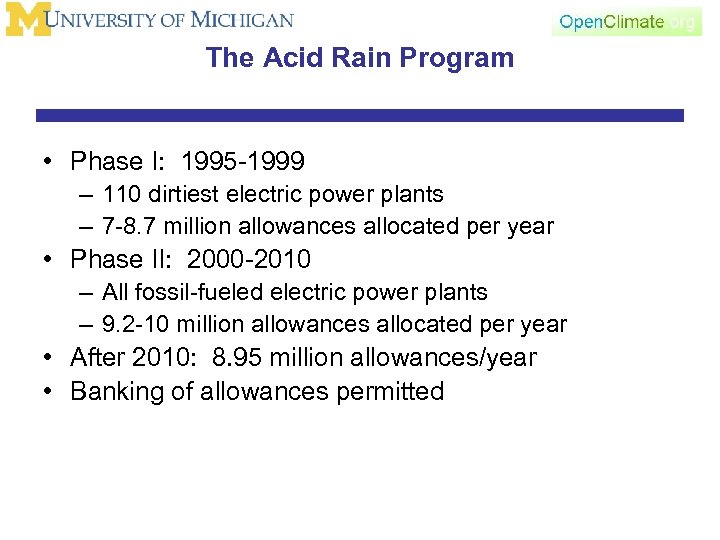 The Acid Rain Program • Phase I: 1995 -1999 – 110 dirtiest electric power plants – 7 -8. 7 million allowances allocated per year • Phase II: 2000 -2010 – All fossil-fueled electric power plants – 9. 2 -10 million allowances allocated per year • After 2010: 8. 95 million allowances/year • Banking of allowances permitted
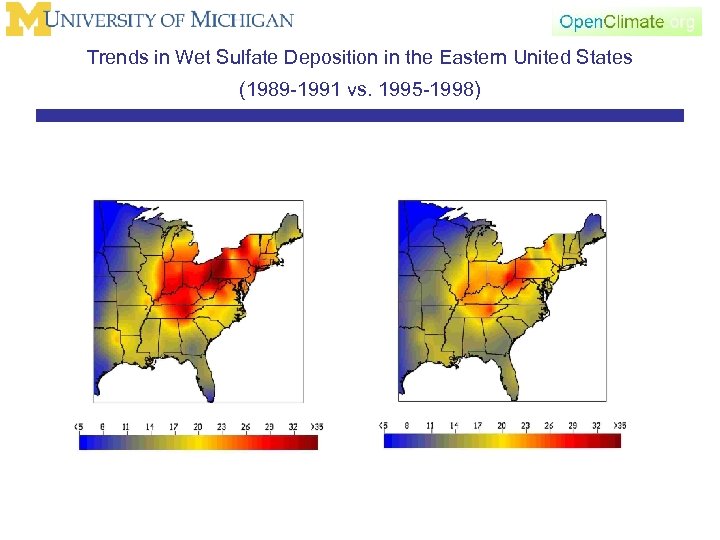 Trends in Wet Sulfate Deposition in the Eastern United States (1989 -1991 vs. 1995 -1998)
 CA Electricity Crisis 9/11/01
 CO 2 markets to implement climate policy • Kyoto Protocol (1997) – Participating nations: ~ 7 -8% below 1990 emissions – European Union’s CO 2 market most advanced – Expansion to all participating nations • Kyoto’s Flexibility Mechanisms – Emissions Trading System (ETS) • Can comply by purchasing CO 2 credits from the ETS market – Joint Implementation (JI) • Can comply by purchasing CO 2 credits from an entity in an industrialized country – Clean Development Mechanism (CDM) • Can comply by purchasing CO 2 credits from an entity in a developing country
 EU Market
 EU Market
 Miscellaneous issue: emission tax vs. cap-and-trade • Regulated firms strongly prefer cap-and-trade – quota distributed for free – enormous $$ value! – compare to: tax per unit of emissions • Monroe power plant example – 95, 364 SO 2 allowances allocated for free in 1994 – All allowances were used to cover emissions – What if taxed at $200/ton? 95, 365 * 200 = $19, 073, 000
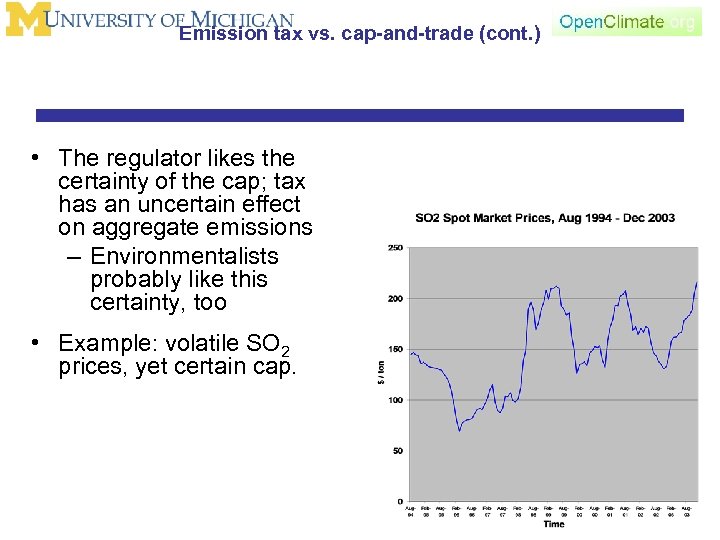 Emission tax vs. cap-and-trade (cont. ) • The regulator likes the certainty of the cap; tax has an uncertain effect on aggregate emissions – Environmentalists probably like this certainty, too • Example: volatile SO 2 prices, yet certain cap.
 Emission tax vs. cap-and-trade (cont. ) • What politician will support a tax program? – Clinton/Gore’s failed BTU tax, early in 1 st term • Cap-and-trade has been the “consensus” strategy – But is there any reason to expect it can reduce carbon dioxide? – What is its political viability? – Business support • US Climate Action Partnership
 Cap and Trade Viability • Jim Hansen talk … market and banking too open to gaming and corruption. No value added. – Already past the amount for dangerous climate change. • Rood and Thoumi that the carbon market and the science don’t line up. • Financial Interests of Advocates.
 Even newer news • Senators Ditching Cap and Trade • Senators Propose to Abandon Cap and Trade
 Conclude: Political economy of cap-and-trade programs • Environmentalist perspective – Set the cap as low as politically feasible • Business perspective – Maintain flexibility in compliance options – Cap and trade is most flexible • Regulator perspective – Buy-in from stakeholders • Good for environment and cost effective – Enforceable Many environmental organizations are now advocates for cap-and-trade programs
 Further Reading • Tom Tietenberg, Environmental and Natural Resource Economics, 7 th Edition, 2006. – It includes several chapters on environmental regulation—both principles and applications. • Ellerman, Joskow, Schmalensee, Montero, and Bailey, Markets for Clean Air: The U. S. Acid Rain Program, 2000. – An exhaustive evaluation of the acid rain program and SO 2 market by a team of great economists.
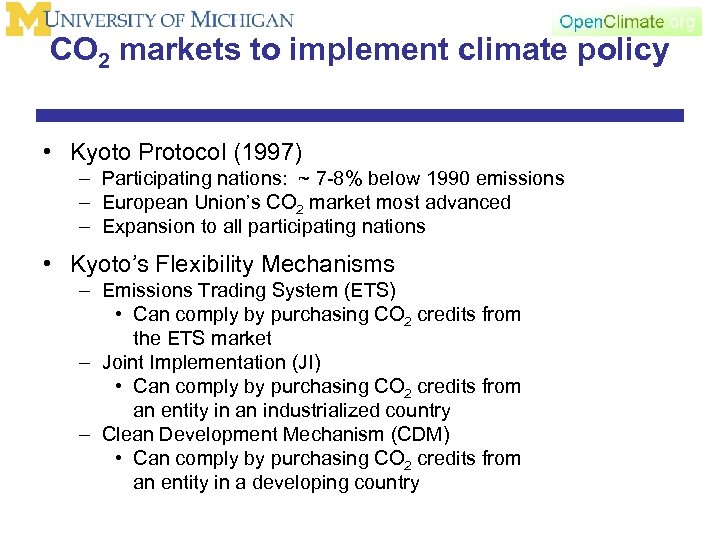
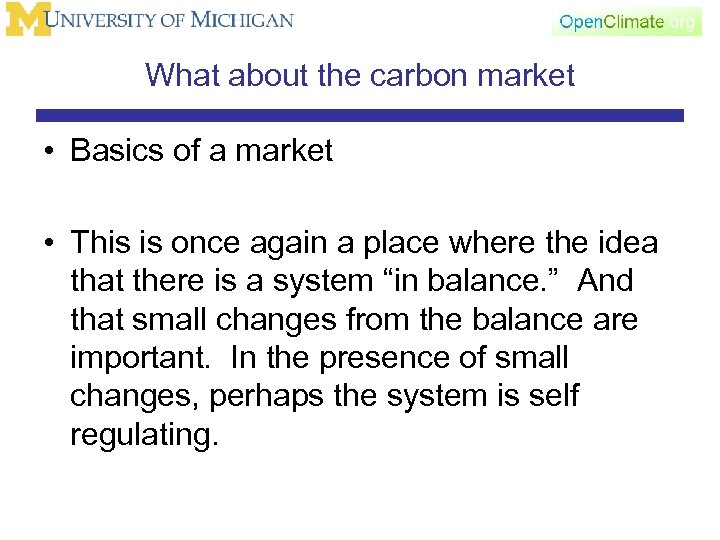
 Some Market Issues • How do we make a carbon market? • What is the role of allowances? – Savings relative to what baseline? • Cost of allowance relative to other choices?
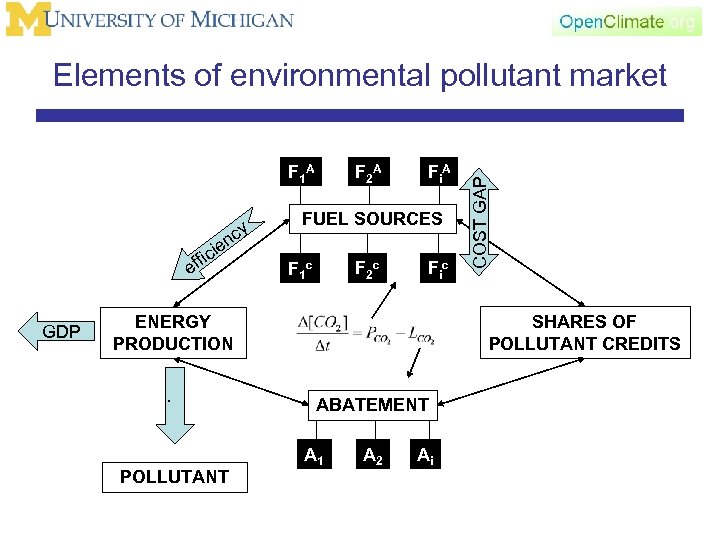
 F 1 A y nc ie fic ef GDP ENERGY PRODUCTION. POLLUTANT F 2 A Fi. A FUEL SOURCES F 2 c F 1 c Fic Common Unit of Transference Cost $ ABATEMENT A 1 A 2 Ai COST GAP Elements of environmental pollutant market SHARES OF POLLUTANT CREDITS
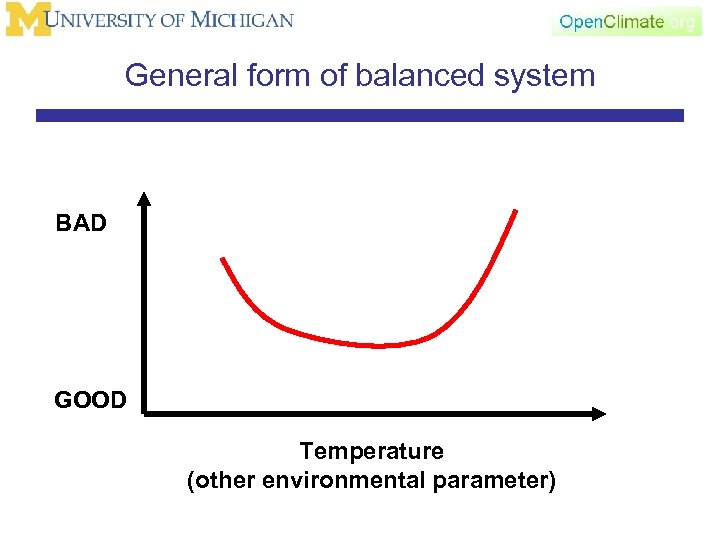
 What about the carbon market • Basics of a market • This is once again a place where the idea that there is a system “in balance. ” And that small changes from the balance are important. In the presence of small changes, perhaps the system is self regulating.
 F 1 A y nc ie fic ef GDP F 2 A Fi. A FUEL SOURCES F 2 c F 1 c Fic SHARES OF POLLUTANT CREDITS ENERGY PRODUCTION. POLLUTANT COST GAP Elements of environmental pollutant market ABATEMENT A 1 A 2 Ai
 Let’s Think about the Market • First, to be clear, this is another version of the continuity equation. PRODUCTION LOSS
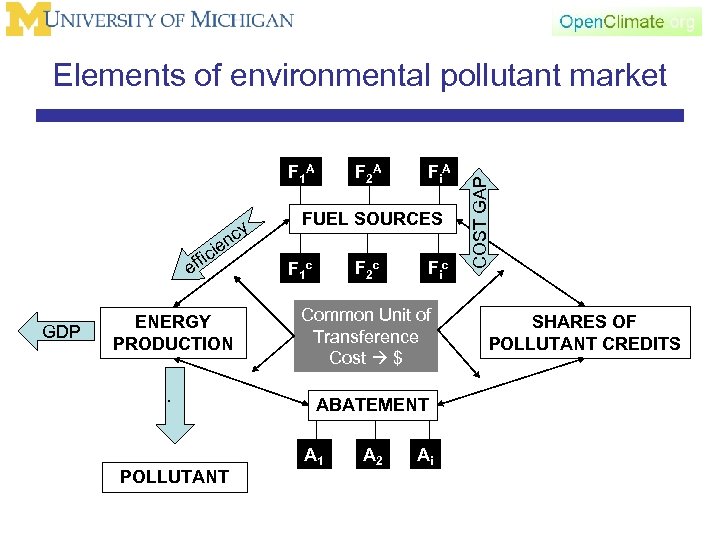
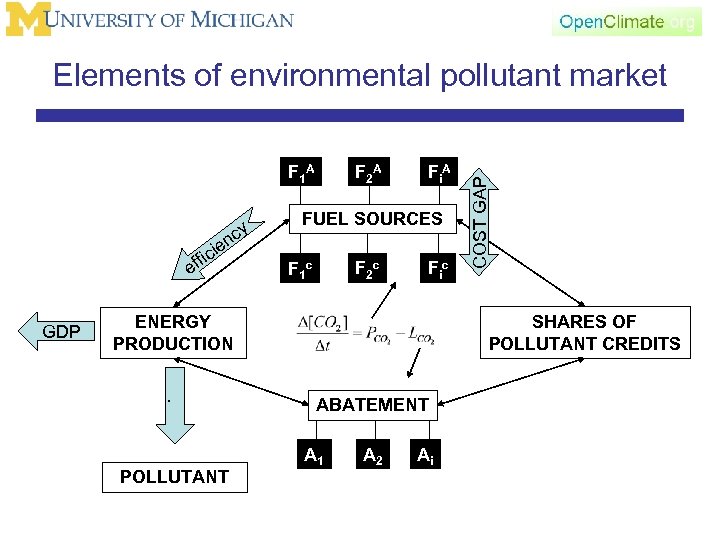
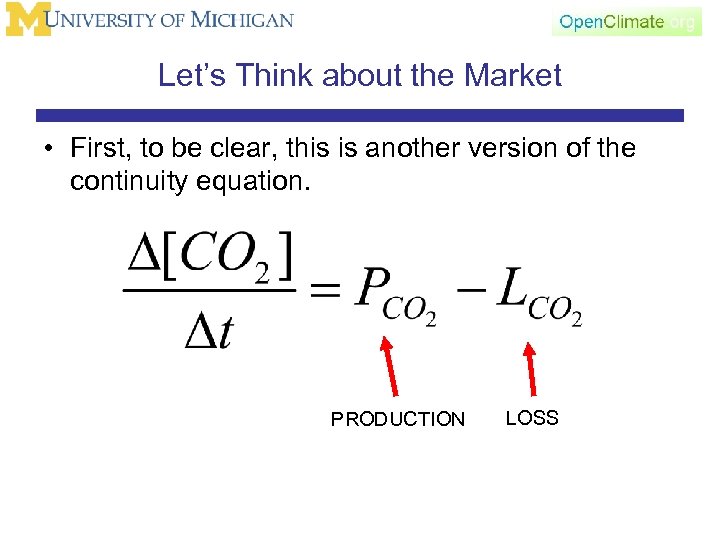
 PRODUCTION • For our problem: – Production comes from burning fossil fuels. – Here are the ways to reduce production • • Use less energy Consume less stuff Shrink the economy Find fuels that don’t emit carbon dioxide – Don’t increase other greenhouse gases exponentially!
 Production • The real way to address the climate change problem in the short term is to reduce production of carbon dioxide, and • the real way to do that is to consume less, – which will shrink the economy.
 Production • To maintain the growth of the economy and to address the climate change problem must de-correlate energy consumption from carbon dioxide emission. – This leads to alternative sources of energy.
 Alternative energy • According the Nathan Lewis, in the long-term there are three known sources of adequate energy for, say, more than a century or two. – Nuclear energy with breeder reactors – Solar energy, but requires new technology for efficiency and storage – Coal with sequestration • Other alternative energy, while important, do not scale with population and economic growth. • Technology, exploration, and discovery and development of new energy sources
 Current alternative energy COST GAP • With the presumption that cost of alternative energy needs to be comparable with fossil fuel sources there needs to be some way to bridge the cost gap. • Personal analysis: fee or tax policy seems reasonable to bridge this gap. – Short term, and would help to develop a market.
 Production • In the near term, by far the most effective way we have to reduce production of carbon dioxide is efficiency. – And this makes economic sense.
 Efficiency • But at this moment we have no way to really give valuation to efficiency. – Hence, historically, efficiency is often met with increased consumption. • How can this be changed? y nc ie fic ef – Cost of energy is high enough that it demands reduction – Efficiency is given valuation by market or policy (fee and tax? ) • Scale to help bridge the fuel cost gap? – Other? United Nations Foundation: Realizing Potential of Energy Efficiency
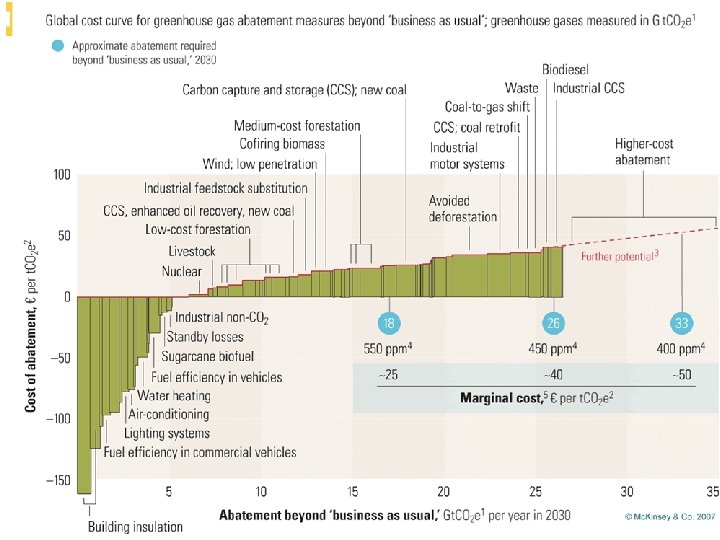 Mc. Kinsey 2007: Large
 F 1 A y nc ie fic ef GDP F 2 A Fi. A FUEL SOURCES F 2 c F 1 c Fic SHARES OF POLLUTANT CREDITS ENERGY PRODUCTION. POLLUTANT COST GAP Elements of environmental pollutant market ABATEMENT A 1 A 2 Ai
 Abatement • What are the forms of abatement?
 The abatement that we talk about • Terrestrial sink? – This is fragile, limited, and there is growing evidence that it does not “grow” to address the problem. • That is “carbon fertilization” is less effective than posed. • Oceanic sink? – Evidence of ocean “taking up less. ” – Other environmental impacts
 General form of balanced system BAD GOOD Temperature (other environmental parameter)
 Abatement • What are the forms of abatement? • Sequestration to keep carbon dioxide out of the atmosphere. • Some engineered way to remove carbon dioxide from the atmosphere. – Think about the energy of this requires something “biological” to use the Sun. ?
 Abatement • We don’t really have enough abatement options to make a market.
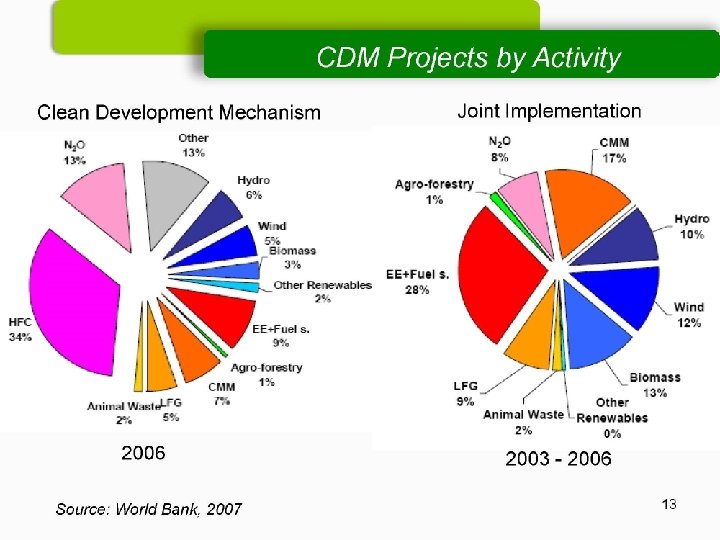
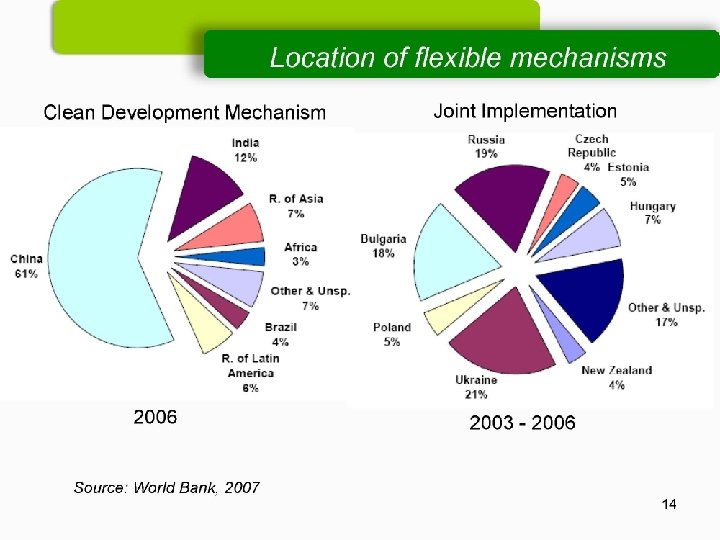
 Does a market do anything for CO 2 • Evidence to date – EU: Some accounting of reduction – Motivate interest in mitigation – Is it the way to get us started – Billions of dollars tied up
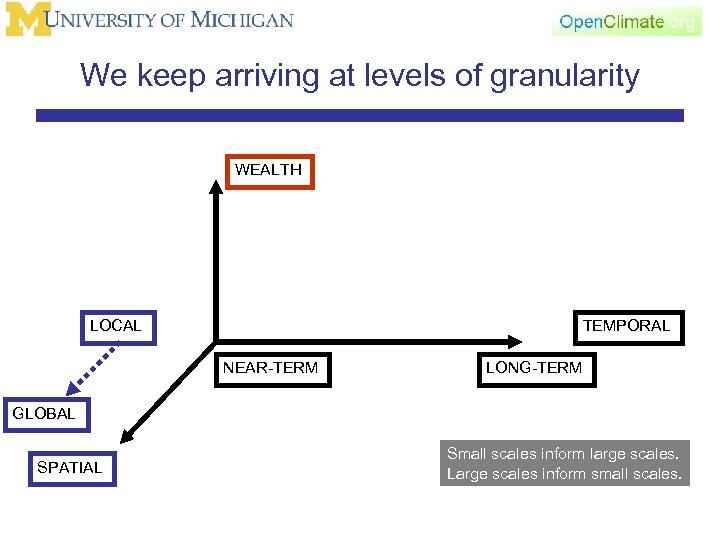
 Granularity
 Energy-Economy-Climate Change ECONOMY ENERGY CLIMATE CHANGE THESE THREE ARE BIG WHAT ARE THEIR ATTRIBUTES? _______________ HOW ARE THEY RELATED? _______________
 A moment with time scales ENERGY CLIMATE CHANGE ECONOMY 0 years 25 years 50 years 75 years 100 years
 We keep arriving at levels of granularity WEALTH LOCAL TEMPORAL NEAR-TERM LONG-TERM GLOBAL SPATIAL Small scales inform large scales. Large scales inform small scales.