 Скачать презентацию Climate Change Mitigation Strategies Potentials and Problems Edward
2431465b095e87411b72c276f64eb74c.ppt
- Количество слайдов: 30



Climate Change Mitigation Strategies— Potentials and Problems Edward S. Rubin Department of Engineering and Public Policy Department of Mechanical Engineering Carnegie Mellon University Pittsburgh, Pennsylvania Presentation to the Workshop on Climate Change, Engineered Systems and Society The National Academies Irvine, California June 7, 2011
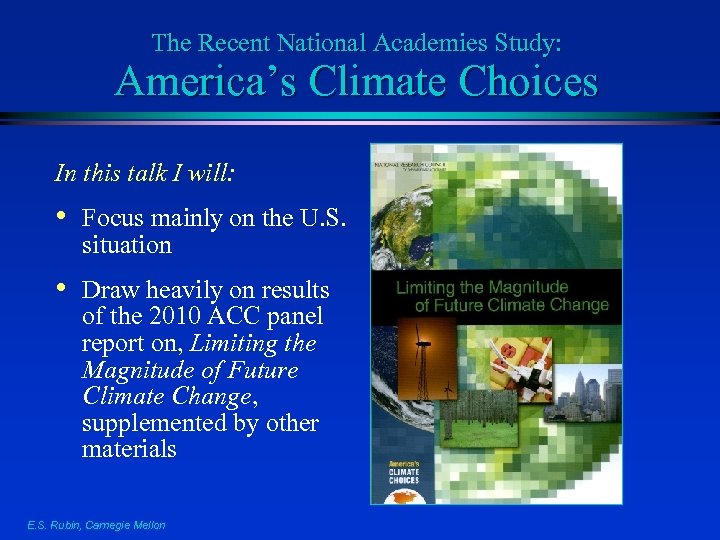
The Recent National Academies Study: America’s Climate Choices In this talk I will: • Focus mainly on the U. S. situation • Draw heavily on results of the 2010 ACC panel report on, Limiting the Magnitude of Future Climate Change, supplemented by other materials E. S. Rubin, Carnegie Mellon
The Congressional Request The National Academies should … “…investigate and study the serious and sweeping issues relating to global climate change and make recommendations regarding what steps must be taken and what strategies must be adopted in response to global climate change. . . ” (2008) Focus on actions to reduce domestic greenhouse gas emissions and other human drivers of climate change (such as changes in land use), but also consider the international dimensions of climate stabilization E. S. Rubin, Carnegie Mellon

Setting goals E. S. Rubin, Carnegie Mellon
The Goal of Stabilization • 1992 U. N. Framework Convention on Climate Change called for “stabilization of greenhouse gas concentrations in the atmosphere at a level that would prevent dangerous anthropogenic interference with the climate system” *192 countries are parties to the convention E. S. Rubin, Carnegie Mellon
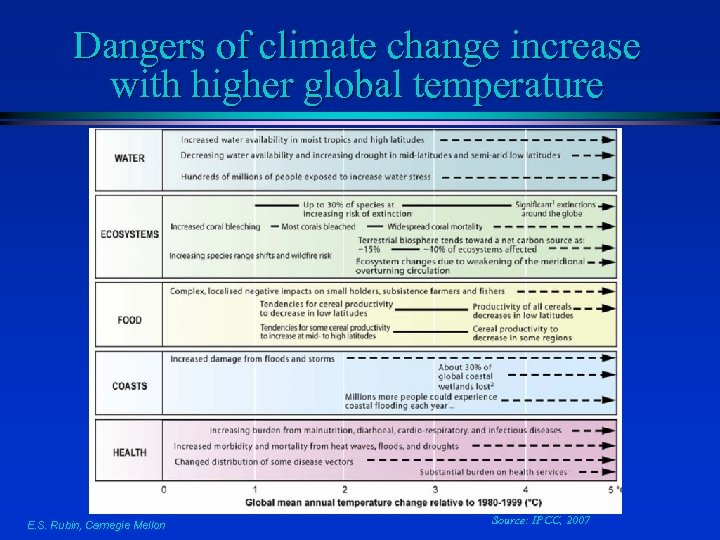
Dangers of climate change increase with higher global temperature E. S. Rubin, Carnegie Mellon Source: IPCC, 2007
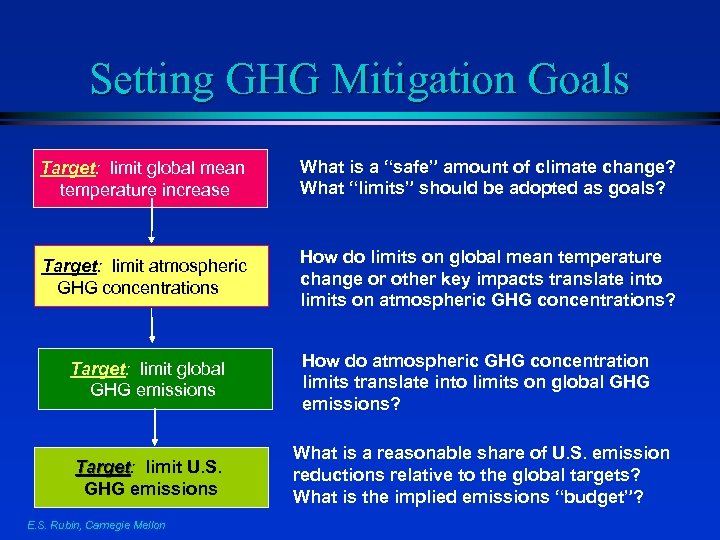
Setting GHG Mitigation Goals Target: limit global mean temperature increase What is a “safe” amount of climate change? What “limits” should be adopted as goals? Target: limit atmospheric GHG concentrations How do limits on global mean temperature change or other key impacts translate into limits on atmospheric GHG concentrations? Target: limit global GHG emissions How do atmospheric GHG concentration limits translate into limits on global GHG emissions? Target: limit U. S. Target GHG emissions What is a reasonable share of U. S. emission reductions relative to the global targets? What is the implied emissions “budget”? E. S. Rubin, Carnegie Mellon
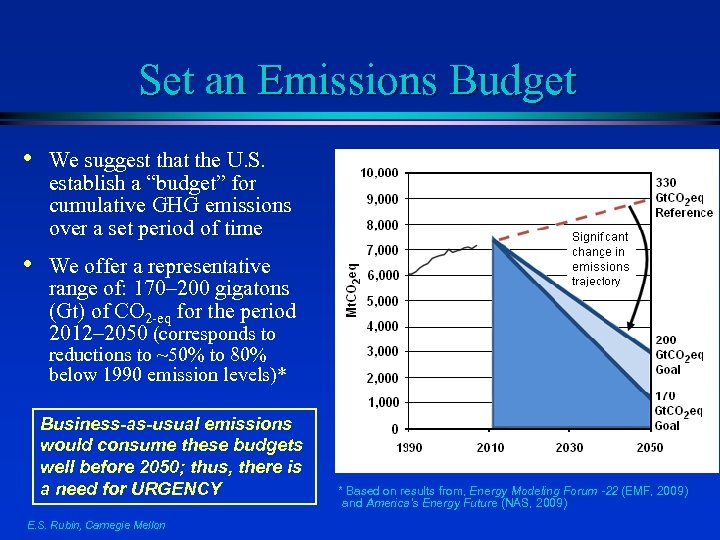
Set an Emissions Budget • We suggest that the U. S. establish a “budget” for cumulative GHG emissions over a set period of time • We offer a representative range of: 170– 200 gigatons (Gt) of CO 2 -eq for the period 2012– 2050 (corresponds to reductions to ~50% to 80% below 1990 emission levels)* Business-as-usual emissions would consume these budgets well before 2050; thus, there is a need for URGENCY E. S. Rubin, Carnegie Mellon * Based on results from, Energy Modeling Forum -22 (EMF, 2009) and America’s Energy Future (NAS, 2009)
Mitigation options E. S. Rubin, Carnegie Mellon
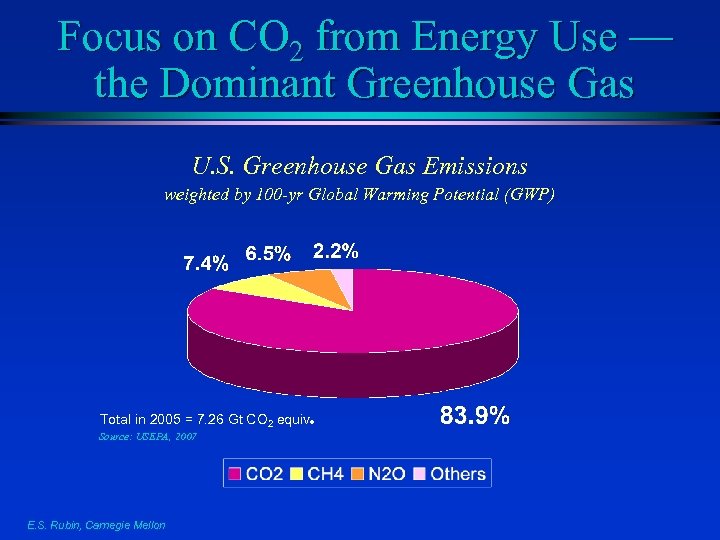
Focus on CO 2 from Energy Use — the Dominant Greenhouse Gas U. S. Greenhouse Gas Emissions weighted by 100 -yr Global Warming Potential (GWP) Total in 2005 = 7. 26 Gt CO 2 equiv Source: USEPA, 2007 E. S. Rubin, Carnegie Mellon .
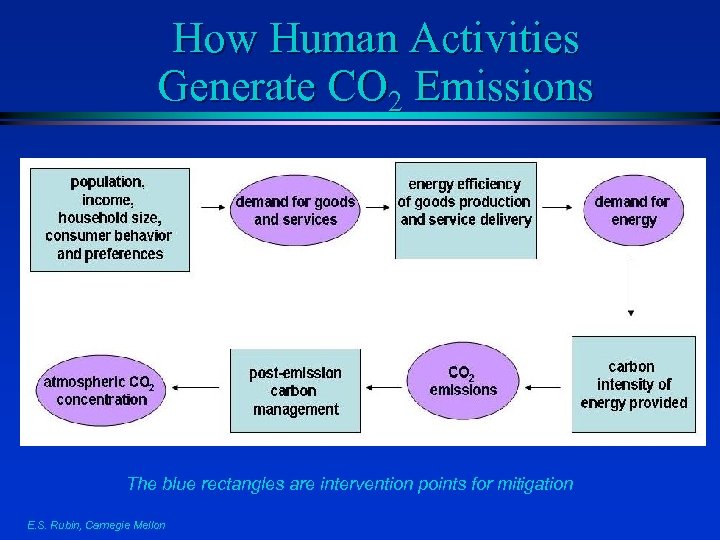
How Human Activities Generate CO 2 Emissions The blue rectangles are intervention points for mitigation E. S. Rubin, Carnegie Mellon
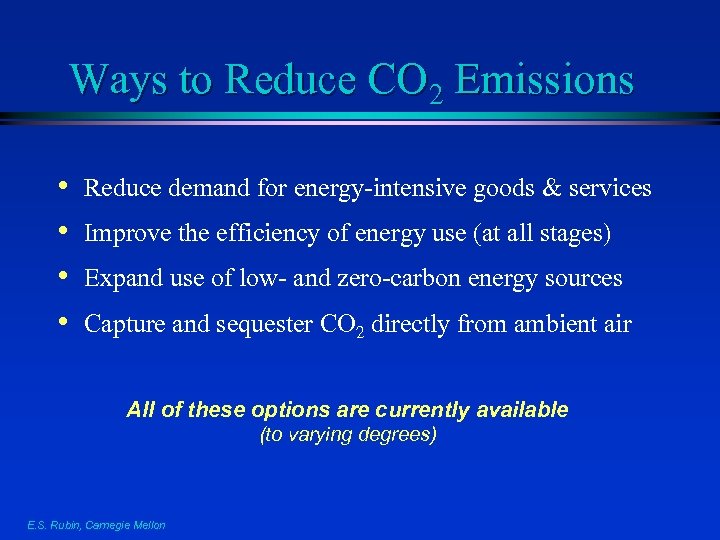
Ways to Reduce CO 2 Emissions • • Reduce demand for energy-intensive goods & services Improve the efficiency of energy use (at all stages) Expand use of low- and zero-carbon energy sources Capture and sequester CO 2 directly from ambient air All of these options are currently available (to varying degrees) E. S. Rubin, Carnegie Mellon
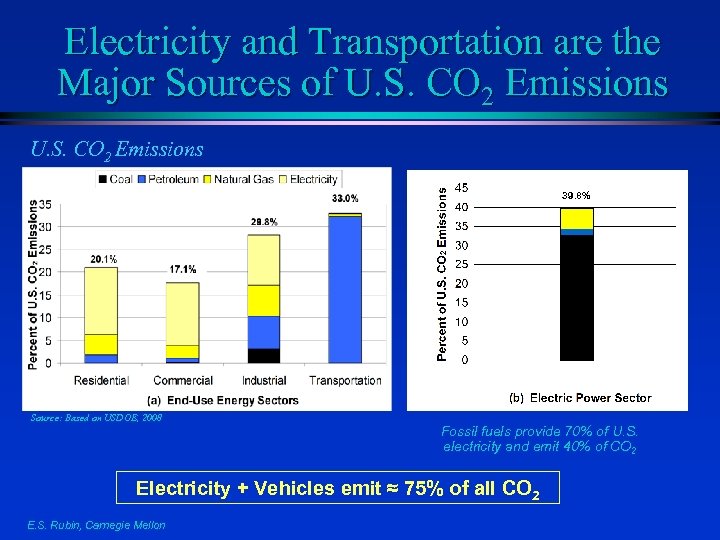
Electricity and Transportation are the Major Sources of U. S. CO 2 Emissions 39. 8% Source: Based on USDOE, 2008 Fossil fuels provide 70% of U. S. electricity and emit 40% of CO 2 Electricity + Vehicles emit ≈ 75% of all CO 2 E. S. Rubin, Carnegie Mellon
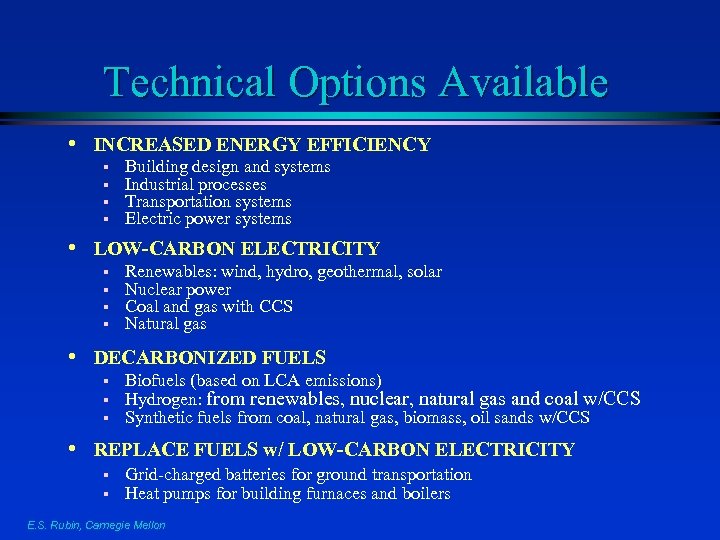
Technical Options Available • INCREASED ENERGY EFFICIENCY § § • LOW-CARBON ELECTRICITY § § • Renewables: wind, hydro, geothermal, solar Nuclear power Coal and gas with CCS Natural gas DECARBONIZED FUELS § § § • Building design and systems Industrial processes Transportation systems Electric power systems Biofuels (based on LCA emissions) Hydrogen: from renewables, nuclear, natural gas and coal w/CCS Synthetic fuels from coal, natural gas, biomass, oil sands w/CCS REPLACE FUELS w/ LOW-CARBON ELECTRICITY § § Grid-charged batteries for ground transportation Heat pumps for building furnaces and boilers E. S. Rubin, Carnegie Mellon
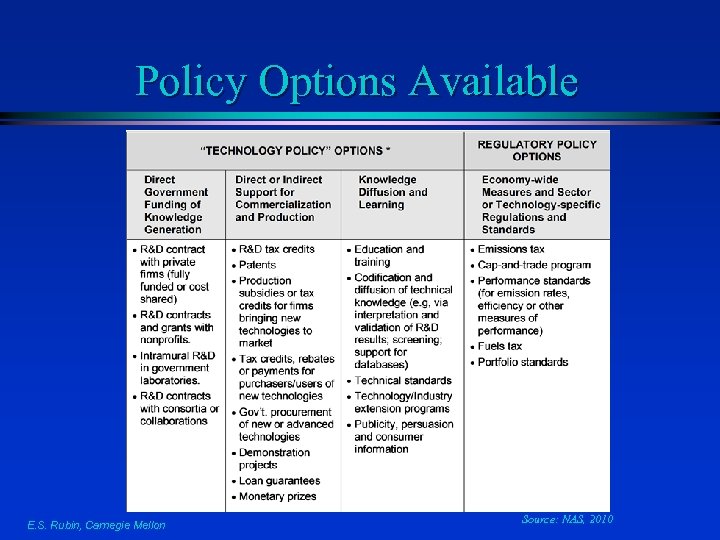
Policy Options Available E. S. Rubin, Carnegie Mellon Source: NAS, 2010
Mitigation: The Potential (the elegance of analytical solutions) E. S. Rubin, Carnegie Mellon
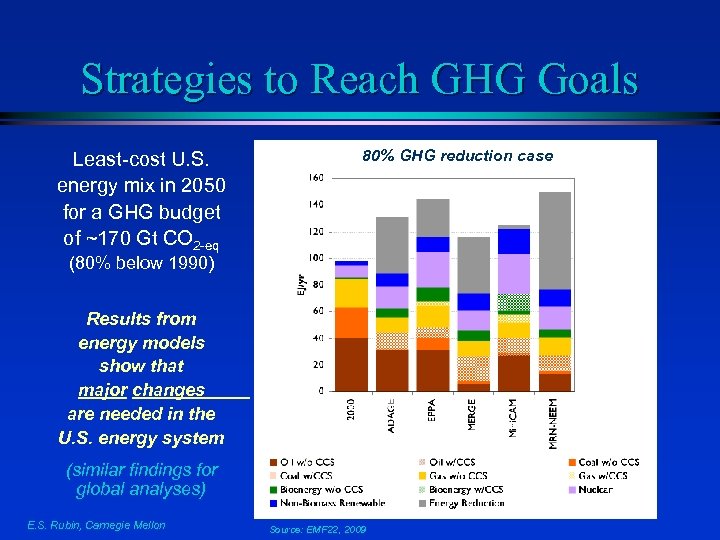
Strategies to Reach GHG Goals Least-cost U. S. energy mix in 2050 for a GHG budget of ~170 Gt CO 2 -eq 80% GHG reduction case (80% below 1990) Results from energy models show that major changes are needed in the U. S. energy system (similar findings for global analyses) E. S. Rubin, Carnegie Mellon Source: EMF 22, 2009
Feasible But Not Easy • An emissions budget in the range of 170– 200 Gt CO 2 -eq is technically possible, but could be very difficult to achieve • No single solution; different models project different mixes of energy sources and technologies • Within the electric power and transportation sectors, essentially all available options would have to be deployed, often at levels close to estimates of what is technically possible E. S. Rubin, Carnegie Mellon
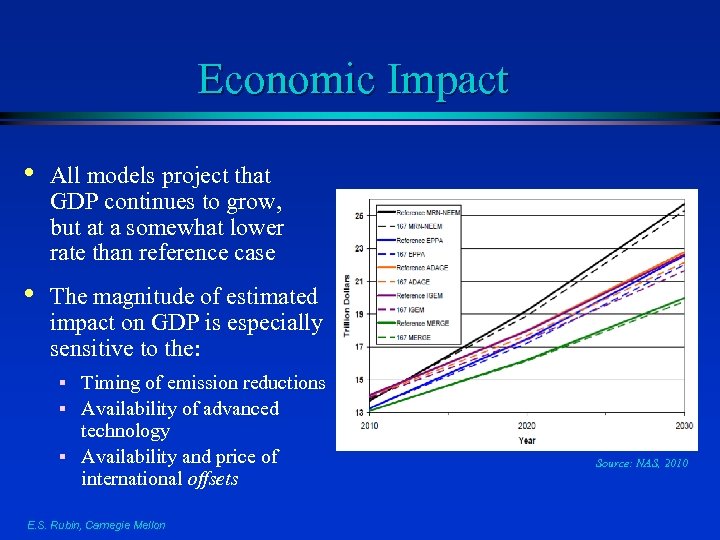
Economic Impact • All models project that GDP continues to grow, but at a somewhat lower rate than reference case • The magnitude of estimated impact on GDP is especially sensitive to the: Timing of emission reductions § Availability of advanced technology § Availability and price of international offsets § E. S. Rubin, Carnegie Mellon Source: NAS, 2010
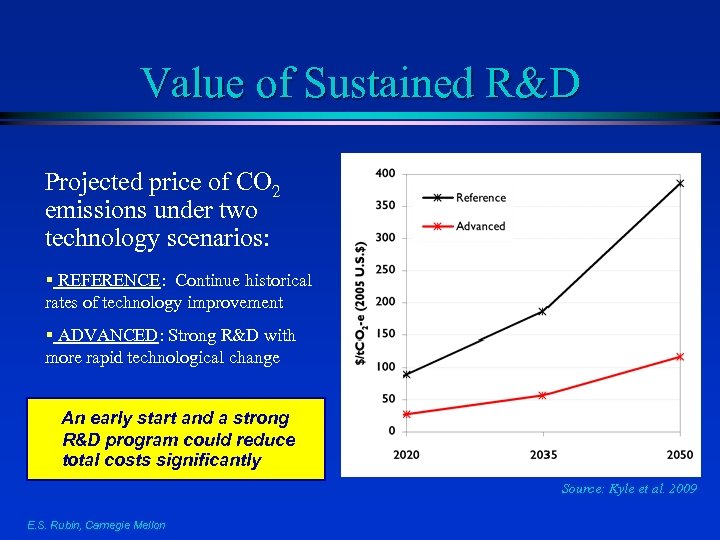
Value of Sustained R&D Projected price of CO 2 emissions under two technology scenarios: § REFERENCE: Continue historical rates of technology improvement § ADVANCED: Strong R&D with more rapid technological change An early start and a strong R&D program could reduce total costs significantly Source: Kyle et al. 2009 E. S. Rubin, Carnegie Mellon
Core Policy Recommendations 1. Adopt a mechanism for setting an economy-wide carbon pricing system 2. Complement the carbon price with other policies to: Realize the potential for energy efficiency and -carbon energy sources for electricity and transport § Accelerate the retirement, retrofitting or replacement of GHG emission-intensive infrastructure § Establish the feasibility of large-scale carbon capture and storage and new nuclear technologies § 3. low Create new technology choices by investing heavily in research and crafting policies to stimulate innovation Source: NAS, 2010 E. S. Rubin, Carnegie Mellon
Core Recommendations (con’t. ) 4. Consider potential equity implications when designing and implementing climate change-limiting policies, with special attention to disadvantaged populations 5. Establish the United States as a leader to stimulate other countries to adopt GHG reduction targets 6. Enable flexibility and experimentation with policies to reduce GHGs at the regional, state and local levels 7. Design policies that balance durability and consistency with flexibility and capacity for modification as we learn from experience Source: NAS, 2010 E. S. Rubin, Carnegie Mellon
Mitigation: The Problems (the messiness of real-world solutions) E. S. Rubin, Carnegie Mellon
Still No Political Consensus on Key Issues • • Importance and urgency of addressing climate change Role of developed vs. developing nations Cost of mitigation Best or preferred policy measure(s) Distribution of costs across society and regions Availability of some mitigation options (at scale) Acceptability of some mitigation options E. S. Rubin, Carnegie Mellon
Still No Global or National Mitigation Program • COP 15 (Copenhagen) failed to produce an international accord on GHG reductions • The 111 th U. S. Congress failed to enact a climate bill (after adoption by the House) E. S. Rubin, Carnegie Mellon
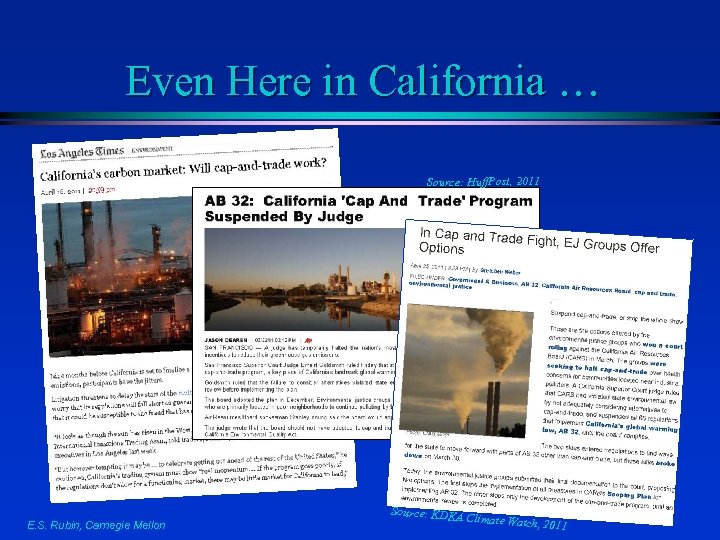
Even Here in California … Source: Huff. Post, 2011 E. S. Rubin, Carnegie Mellon Source: KDKA Climate Watch , 2011
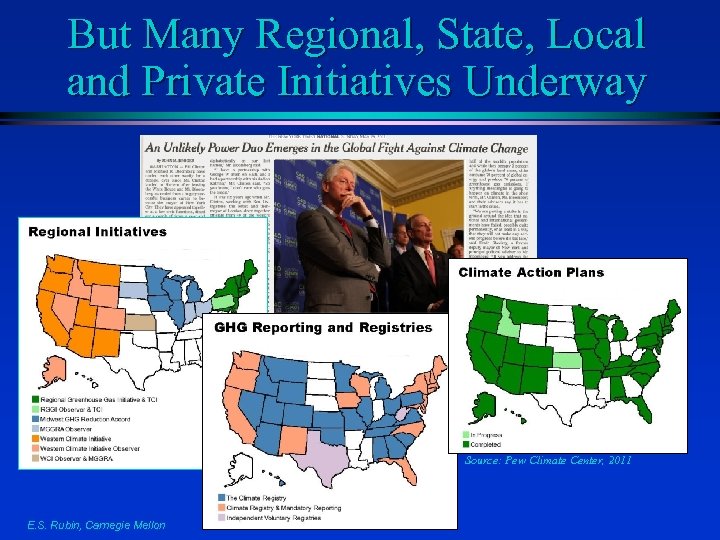
But Many Regional, State, Local and Private Initiatives Underway Source: Pew Climate Center, 2011 E. S. Rubin, Carnegie Mellon
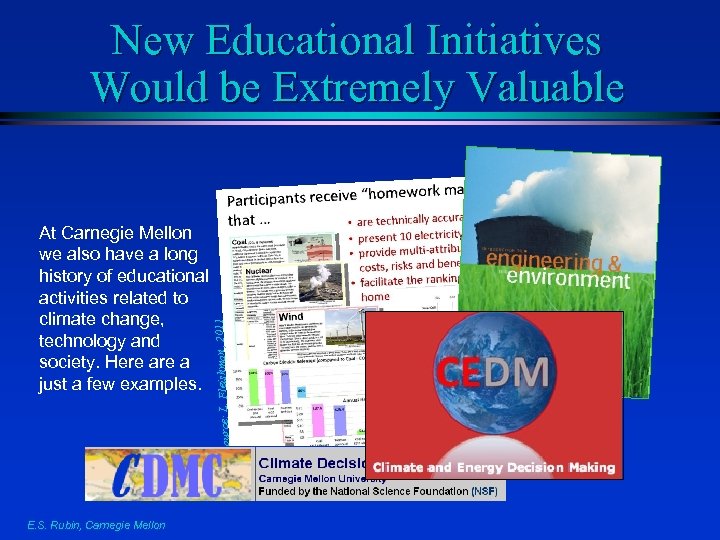
E. S. Rubin, Carnegie Mellon Source: L. Fleishman, 20 At Carnegie Mellon we also have a long history of educational activities related to climate change, technology and society. Here a just a few examples. 11 New Educational Initiatives Would be Extremely Valuable
What Will the Future Bring ? The climate problem is not going away ! E. S. Rubin, Carnegie Mellon Education can make a difference

Thank You rubin@cmu. edu E. S. Rubin, Carnegie Mellon
Скачать презентацию Climate Change Mitigation Strategies Potentials and Problems Edward
2431465b095e87411b72c276f64eb74c.ppt