


 Скачать презентацию Climate Change Learning Goals for the Module 1
1ee797f5278a3020bd7906207060fd69.ppt
- Количество слайдов: 53
 Climate Change Learning Goals for the Module: 1) Uncertainty 2) Historical development of the idea (hypotheses->theory->public acceptance) 3) Numerical modeling (Theoretical way of knowing) 4) Holistic science & systems thinking 5) Science interaction with Society
 Uncertainty -Uncertainty is always with us and can never be eliminated from our lives. Our understanding of the past and our anticipation of the future will always be obscured by uncertainty. -All decisions about the future, big and small, must be made in the absence of certainty. Waiting until uncertainty is eliminated before making decisions is always an implicit endorsement of the status quo, and often an excuse for maintaining it. Image from Google Books. -As the future unfolds, “mid-course corrections” can be made that take into account new information and new technology. -Uncertainty, far from being a barrier to progress, is actually a strong stimulus for and important ingredient of - creativity. 2
 IPCC: Critical aspects Validation - assessment of the accuracy of the model Attribution - the ability to assign causes to effects (distinguish causation from correlation) Prediction - specification, in advance, of events or changes in a system
 Relevance ********************** * SCIENCE ALERT * An E-mail Service of the News. Hour with Jim Lehrer * and the Online News. Hour ********************** November 19, 2007 * U. N. CLIMATE CHANGE REPORT The United Nations Intergovernmental Panel on Climate Change (IPCC) released its fourth and final report this week. The world will have to stop greenhouse gas emissions growth by 2015, and reduce emissions by up to 85 percent over the next 40 years, in order to avoid the worst effects of global warming, the panel found. The report will provide the basis for U. N. climate talks in Bali in December. For more News. Hour climate change coverage, visit www. pbs. org/newshour/indepth_coverage/science/globalwarming.
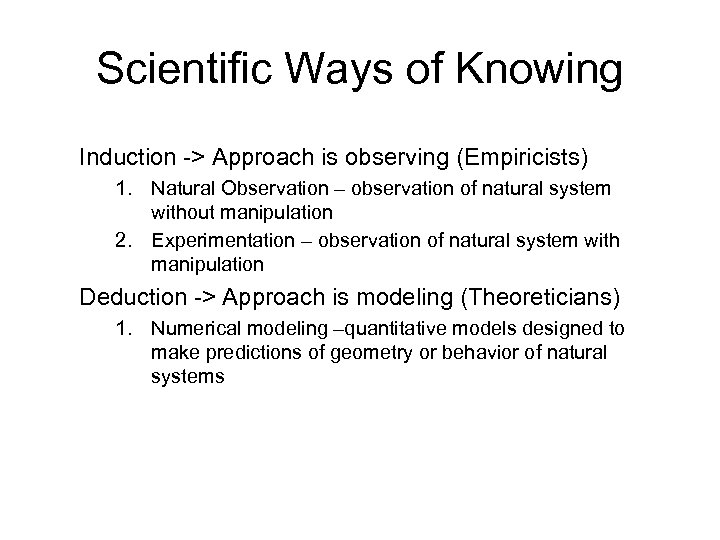 Scientific Ways of Knowing Induction -> Approach is observing (Empiricists) 1. Natural Observation – observation of natural system without manipulation 2. Experimentation – observation of natural system with manipulation Deduction -> Approach is modeling (Theoreticians) 1. Numerical modeling –quantitative models designed to make predictions of geometry or behavior of natural systems
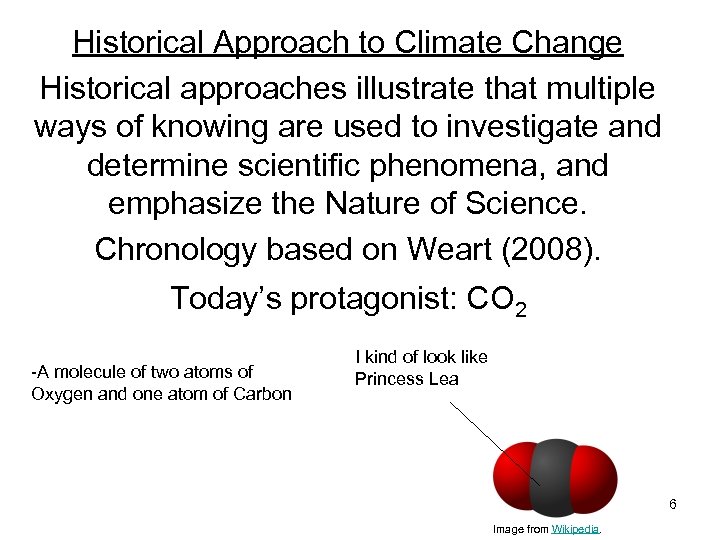 Historical Approach to Climate Change Historical approaches illustrate that multiple ways of knowing are used to investigate and determine scientific phenomena, and emphasize the Nature of Science. Chronology based on Weart (2008). Today’s protagonist: CO 2 -A molecule of two atoms of Oxygen and one atom of Carbon I kind of look like Princess Lea 6 Image from Wikipedia.
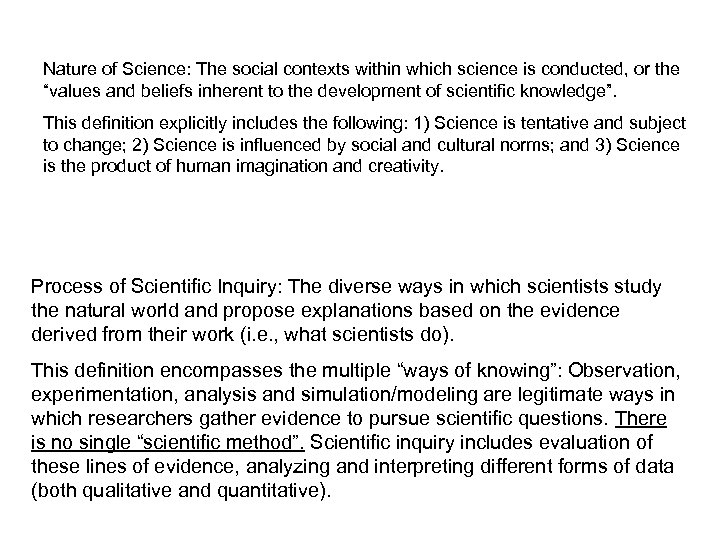 Nature of Science: The social contexts within which science is conducted, or the “values and beliefs inherent to the development of scientific knowledge”. This definition explicitly includes the following: 1) Science is tentative and subject to change; 2) Science is influenced by social and cultural norms; and 3) Science is the product of human imagination and creativity. Process of Scientific Inquiry: The diverse ways in which scientists study the natural world and propose explanations based on the evidence derived from their work (i. e. , what scientists do). This definition encompasses the multiple “ways of knowing”: Observation, experimentation, analysis and simulation/modeling are legitimate ways in which researchers gather evidence to pursue scientific questions. There is no single “scientific method”. Scientific inquiry includes evaluation of these lines of evidence, analyzing and interpreting different forms of data (both qualitative and quantitative).
 Climate Change Historical Approach Early research on climate was concerned about the cause of ice ages, not whether the climate change was occuring.
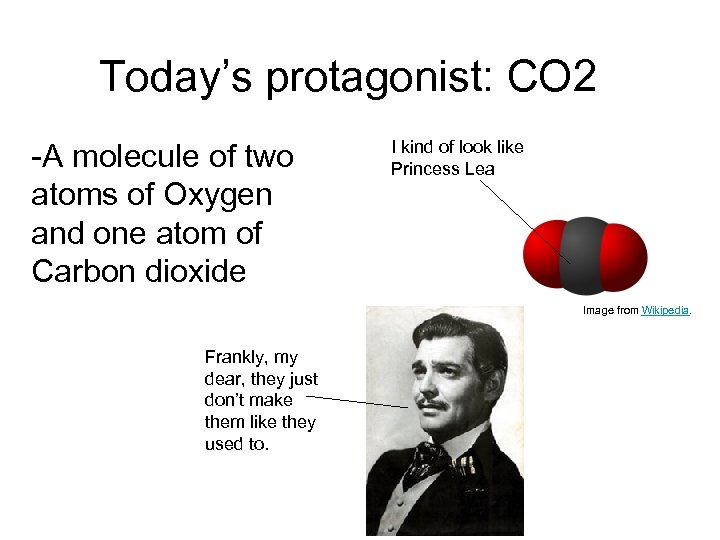 Today’s protagonist: CO 2 -A molecule of two atoms of Oxygen and one atom of Carbon dioxide I kind of look like Princess Lea Image from Wikipedia. Frankly, my dear, they just don’t make them like they used to.
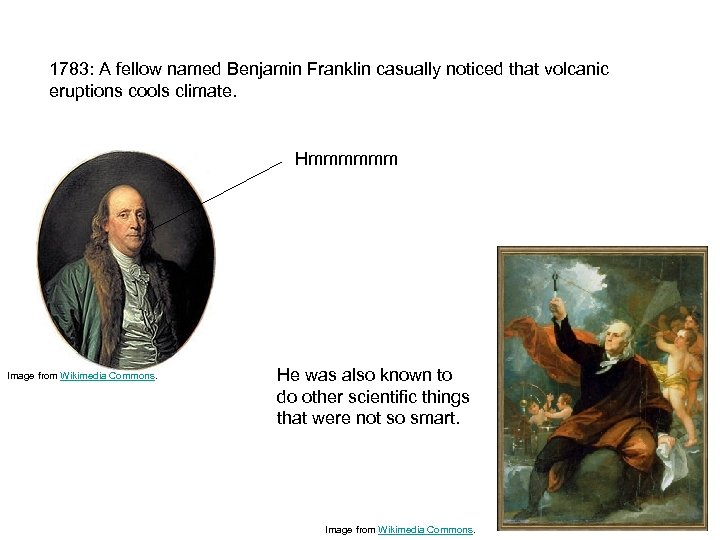 1783: A fellow named Benjamin Franklin casually noticed that volcanic eruptions cools climate. Hmmmmmm Image from Wikimedia Commons. He was also known to do other scientific things that were not so smart. Image from Wikimedia Commons.
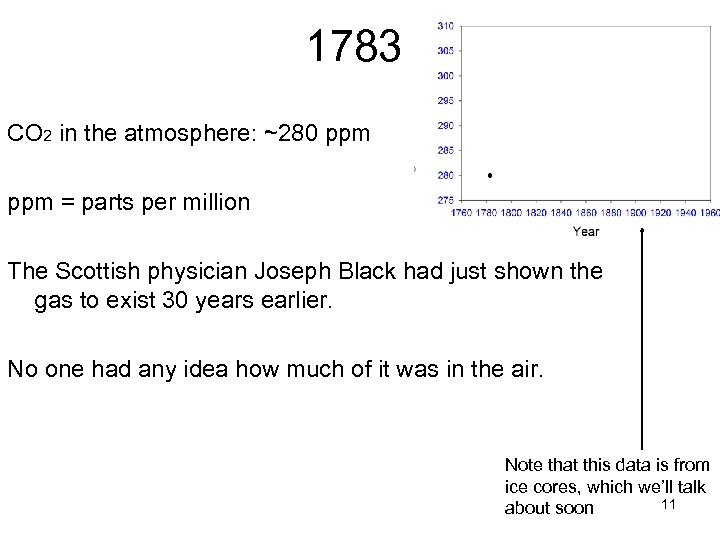 1783 CO 2 in the atmosphere: ~280 ppm = parts per million The Scottish physician Joseph Black had just shown the gas to exist 30 years earlier. No one had any idea how much of it was in the air. Note that this data is from ice cores, which we’ll talk 11 about soon
 1837 Louis Aggasiz (zoologist, technically an ichthyologist) proposes that huge areas of Europe were once covered by ice, and that the Earth experienced Ice Ages
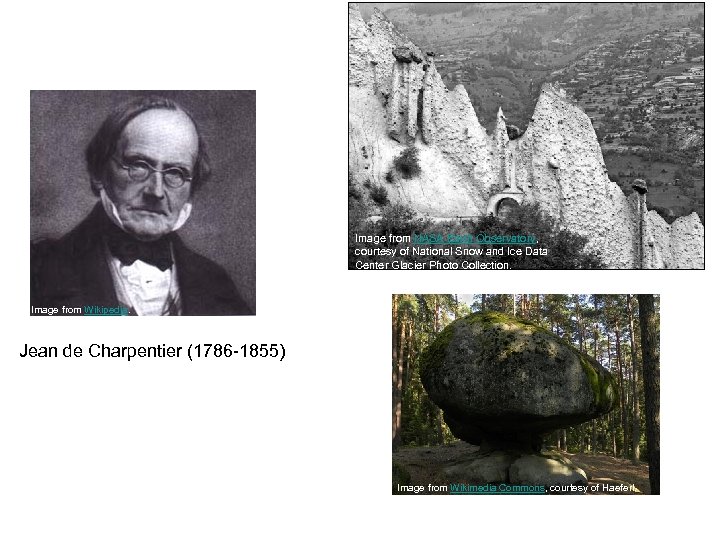 Image from NASA Earth Observatory, courtesy of National Snow and Ice Data Center Glacier Photo Collection. Image from Wikipedia. Jean de Charpentier (1786 -1855) Image from Wikimedia Commons, courtesy of Haeferl.
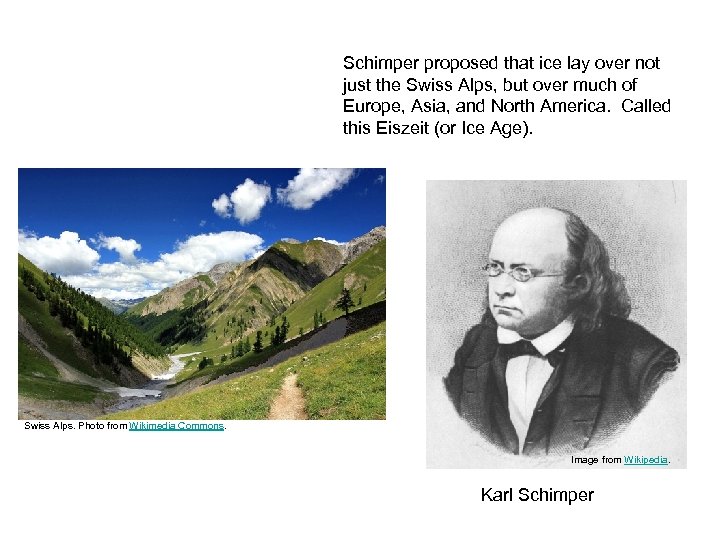 Schimper proposed that ice lay over not just the Swiss Alps, but over much of Europe, Asia, and North America. Called this Eiszeit (or Ice Age). Swiss Alps. Photo from Wikimedia Commons. Image from Wikipedia. Karl Schimper
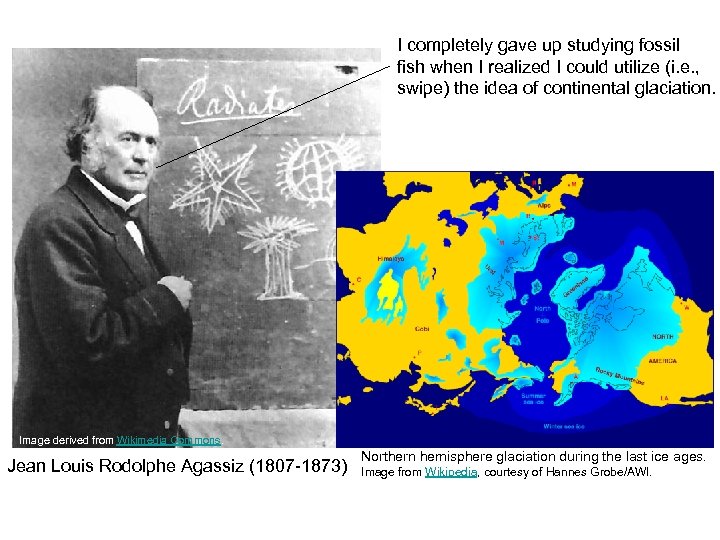 I completely gave up studying fossil fish when I realized I could utilize (i. e. , swipe) the idea of continental glaciation. Image derived from Wikimedia Commons. Jean Louis Rodolphe Agassiz (1807 -1873) Northern hemisphere glaciation during the last ice ages. Image from Wikipedia, courtesy of Hannes Grobe/AWI.
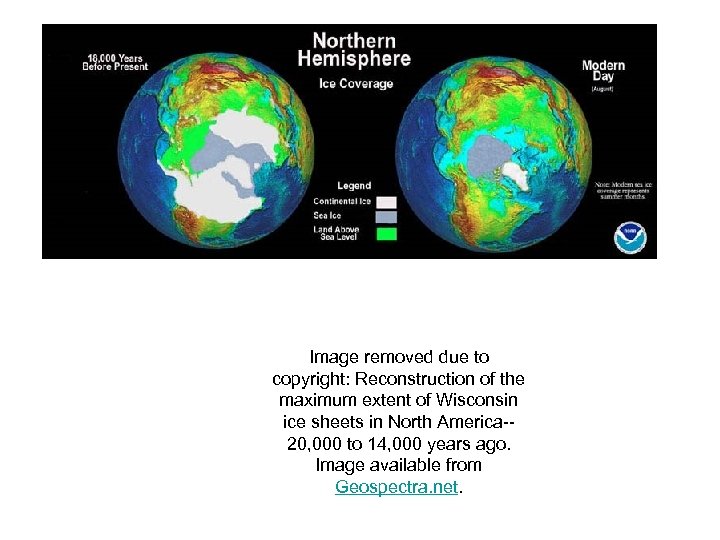 Image removed due to copyright: Reconstruction of the maximum extent of Wisconsin ice sheets in North America-20, 000 to 14, 000 years ago. Image available from Geospectra. net.
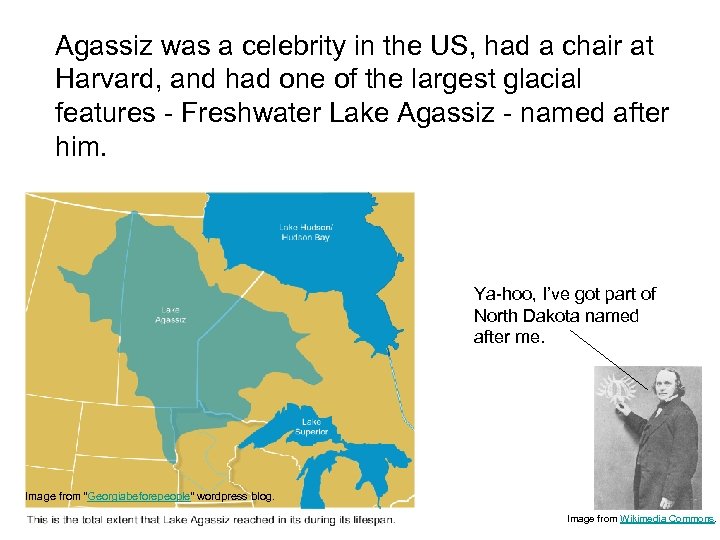 Agassiz was a celebrity in the US, had a chair at Harvard, and had one of the largest glacial features - Freshwater Lake Agassiz - named after him. Ya-hoo, I’ve got part of North Dakota named after me. Image from “Georgiabeforepeople” wordpress blog. Image from Wikimedia Commons.
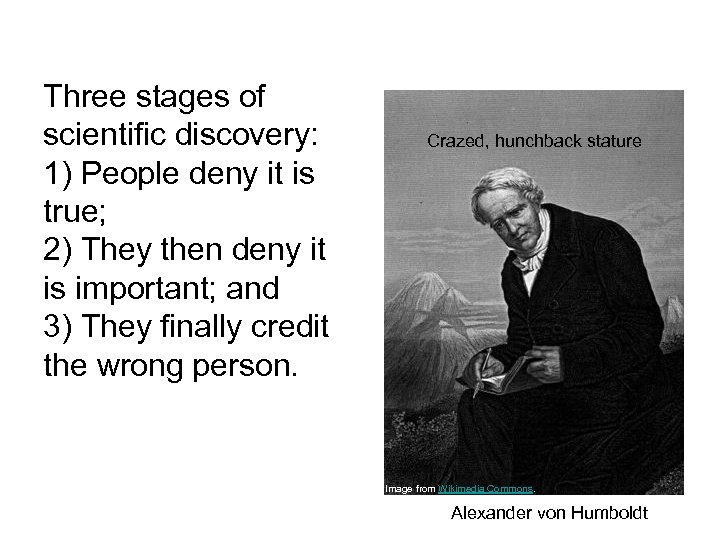 Three stages of scientific discovery: 1) People deny it is true; 2) They then deny it is important; and 3) They finally credit the wrong person. Crazed, hunchback stature Image from Wikimedia Commons. Alexander von Humboldt
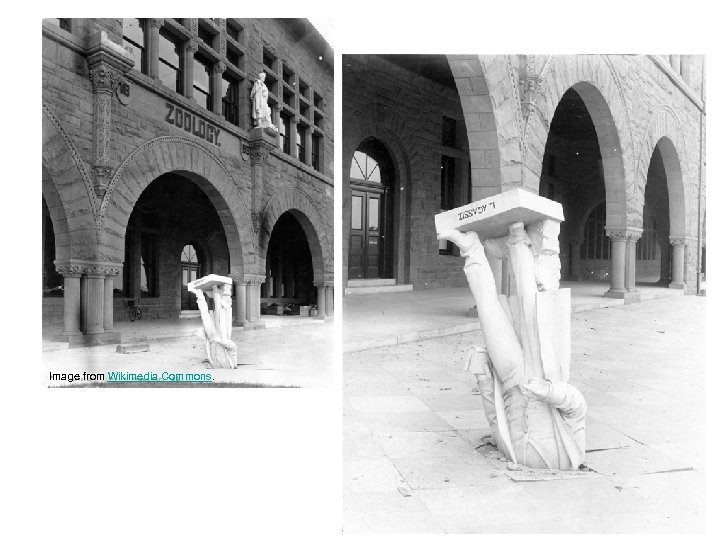 Image from Wikimedia Commons.
 1837 Carbon dioxide in the atmosphere: ~285 ppm Charles Thilorier described solid carbon dioxide three years earlier (1834). He opened a pressurized container of liquid carbon dioxide to find "snow" of solid CO 2. No one had any idea how much of it was in the air.
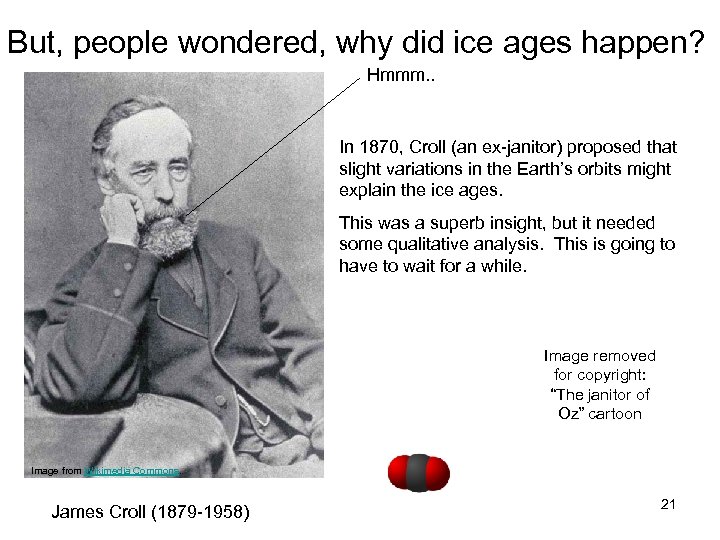 But, people wondered, why did ice ages happen? Hmmm. . In 1870, Croll (an ex-janitor) proposed that slight variations in the Earth’s orbits might explain the ice ages. This was a superb insight, but it needed some qualitative analysis. This is going to have to wait for a while. Image removed for copyright: “The janitor of Oz” cartoon Image from Wikimedia Commons. James Croll (1879 -1958) 21
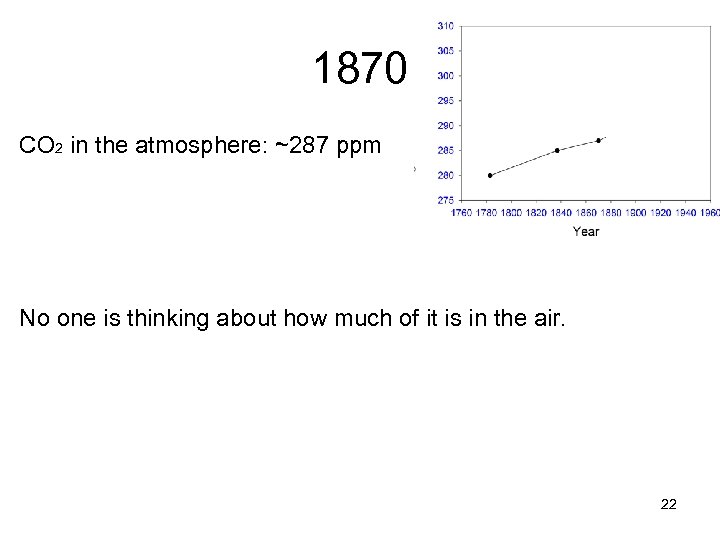 1870 CO 2 in the atmosphere: ~287 ppm No one is thinking about how much of it is in the air. 22
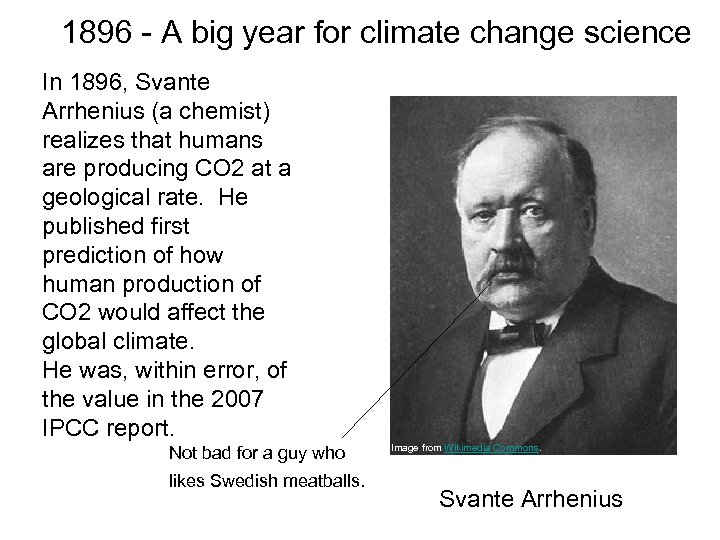 1896 - A big year for climate change science In 1896, Svante Arrhenius (a chemist) realizes that humans are producing CO 2 at a geological rate. He published first prediction of how human production of CO 2 would affect the global climate. He was, within error, of the value in the 2007 IPCC report. Not bad for a guy who likes Swedish meatballs. Image from Wikimedia Commons. Svante Arrhenius
 1896? The problem was recognized in 1896? Well, yes and no. The scientific community did not really accept this idea, which was way, way ahead of its time. I’m skeptical I think the measurements to prove this haven’t been done Doesn’t sound like such a bad idea, even if it is true.
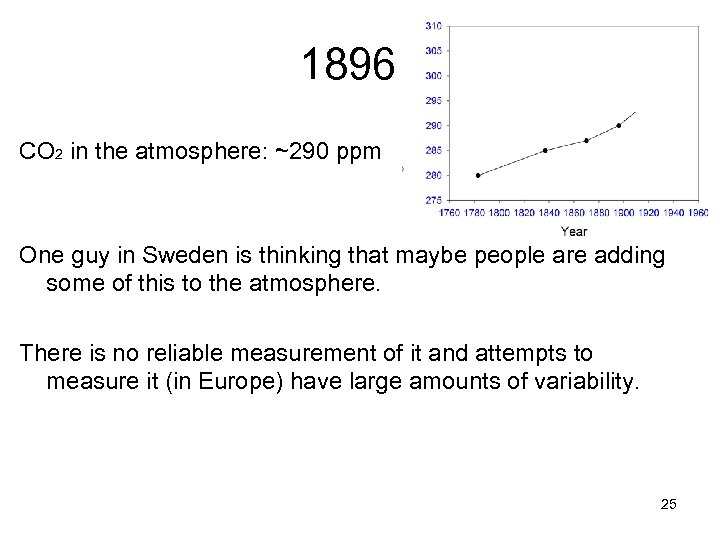 1896 CO 2 in the atmosphere: ~290 ppm One guy in Sweden is thinking that maybe people are adding some of this to the atmosphere. There is no reliable measurement of it and attempts to measure it (in Europe) have large amounts of variability. 25
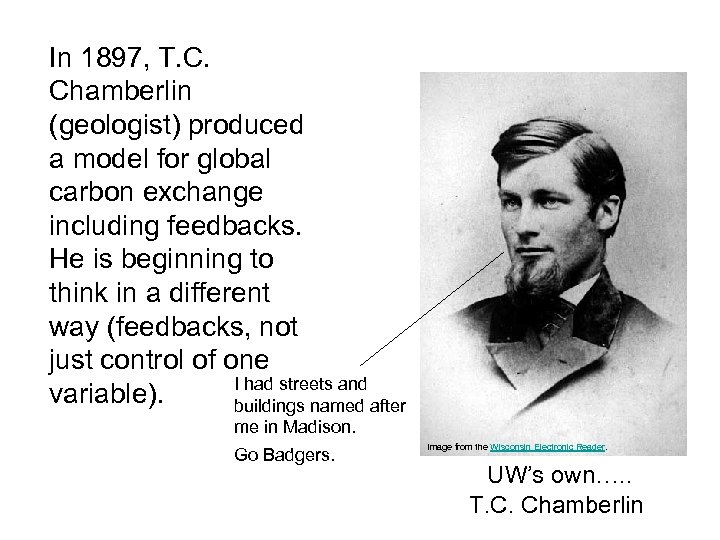 In 1897, T. C. Chamberlin (geologist) produced a model for global carbon exchange including feedbacks. He is beginning to think in a different way (feedbacks, not just control of one I had streets and variable). buildings named after me in Madison. Go Badgers. Image from the Wisconsin Electronic Reader. UW’s own…. . T. C. Chamberlin
 1896 -7 Carbon dioxide in the atmosphere: ~290 ppm One guy in Sweden is thinking that maybe people are adding some of this to the atmosphere. There is no reliable measurement of it and attempts to measure it (in Europe) have large amounts of variability.
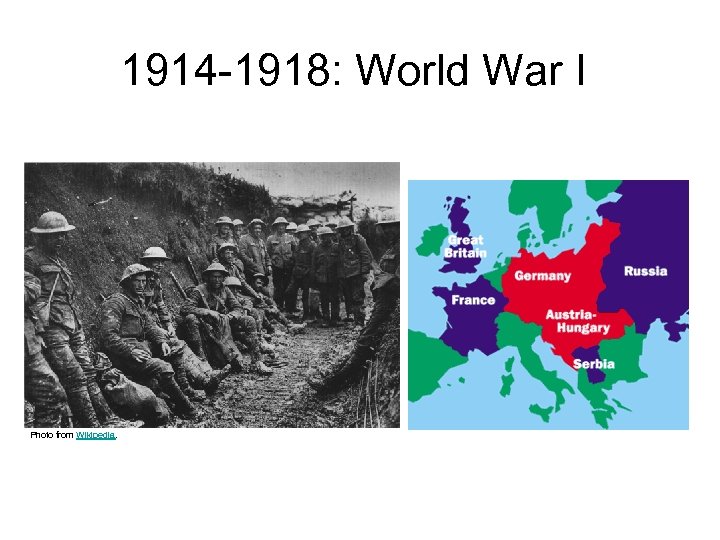 1914 -1918: World War I Photo from Wikipedia.
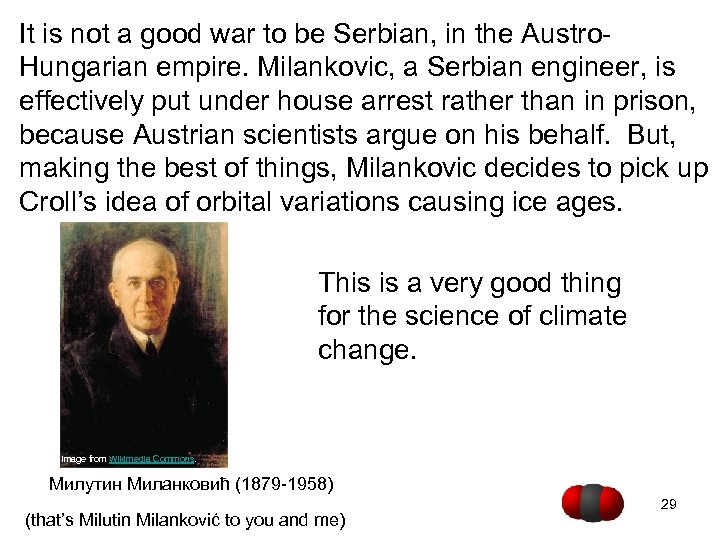 It is not a good war to be Serbian, in the Austro. Hungarian empire. Milankovic, a Serbian engineer, is effectively put under house arrest rather than in prison, because Austrian scientists argue on his behalf. But, making the best of things, Milankovic decides to pick up Croll’s idea of orbital variations causing ice ages. This is a very good thing for the science of climate change. Image from Wikimedia Commons. Милутин Миланковић (1879 -1958) (that’s Milutin Milanković to you and me) 29
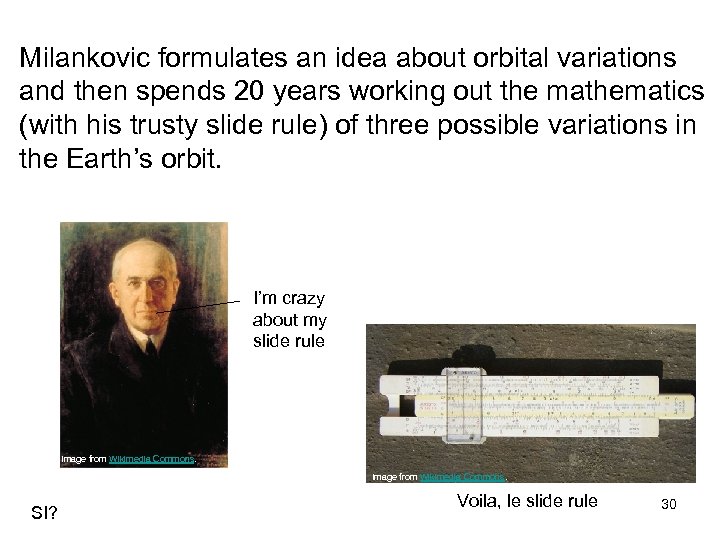 Milankovic formulates an idea about orbital variations and then spends 20 years working out the mathematics (with his trusty slide rule) of three possible variations in the Earth’s orbit. I’m crazy about my slide rule Image from Wikimedia Commons. SI? Voila, le slide rule 30
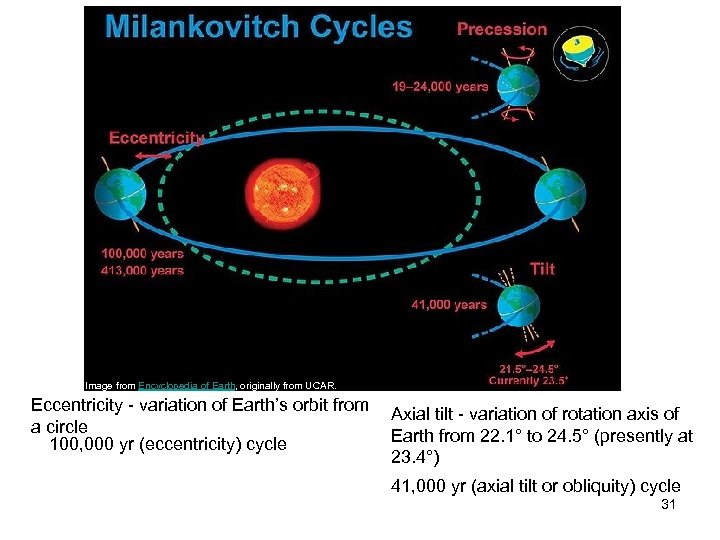 Image from Encyclopedia of Earth, originally from UCAR. Eccentricity - variation of Earth’s orbit from a circle 100, 000 yr (eccentricity) cycle Axial tilt - variation of rotation axis of Earth from 22. 1° to 24. 5° (presently at 23. 4°) 41, 000 yr (axial tilt or obliquity) cycle 31
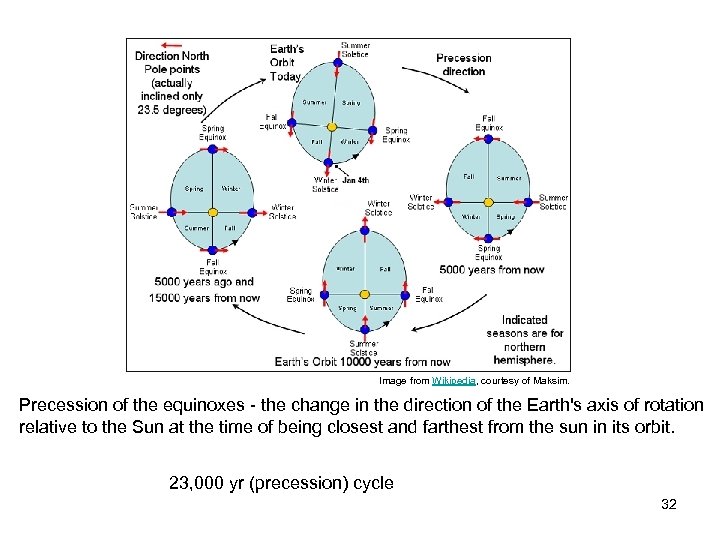 Image from Wikipedia, courtesy of Maksim. Precession of the equinoxes - the change in the direction of the Earth's axis of rotation relative to the Sun at the time of being closest and farthest from the sun in its orbit. 23, 000 yr (precession) cycle 32
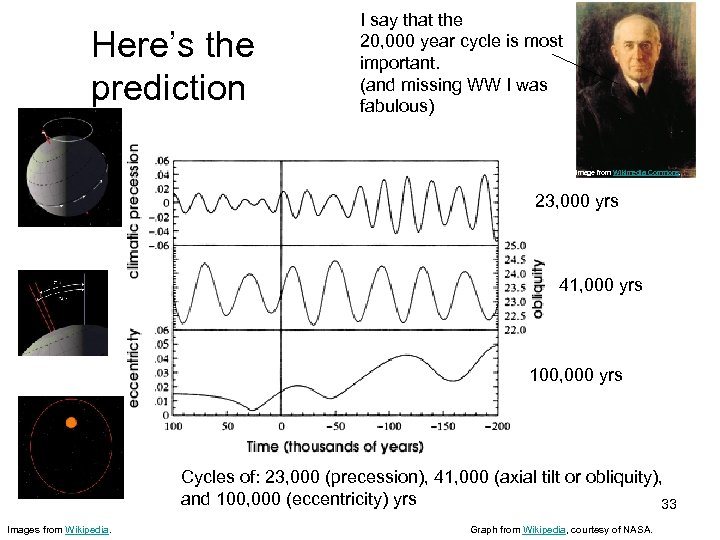 Here’s the prediction I say that the 20, 000 year cycle is most important. (and missing WW I was fabulous) Image from Wikimedia Commons. 23, 000 yrs 41, 000 yrs 100, 000 yrs Cycles of: 23, 000 (precession), 41, 000 (axial tilt or obliquity), and 100, 000 (eccentricity) yrs 33 Images from Wikipedia. Graph from Wikipedia, courtesy of NASA.
 In 1930, he publishes the results. Do people accept it? There is general acceptance that it happens, but there is not acceptance that it does anything to affect the climate. I’m skeptical I think the measurements to prove this haven’t been done Such a small variation in solar input could never cause a change in climate. 34
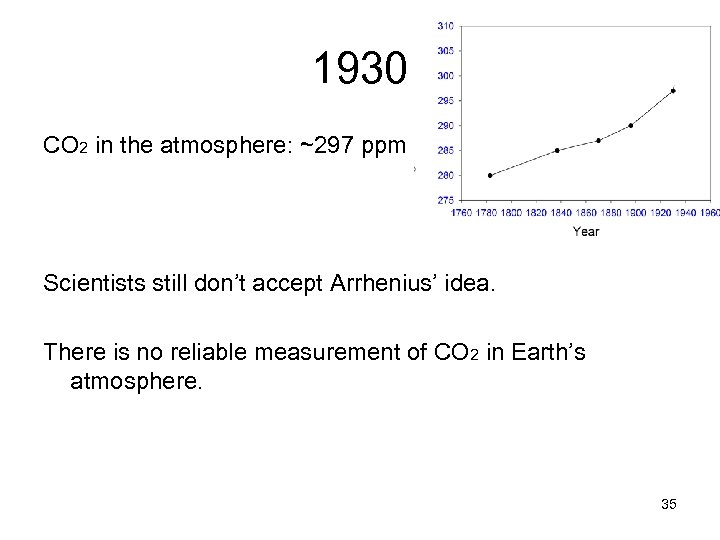 1930 CO 2 in the atmosphere: ~297 ppm Scientists still don’t accept Arrhenius’ idea. There is no reliable measurement of CO 2 in Earth’s atmosphere. 35
 1938: A hypothesis is born Callender proposes that anthropogenic (human-induced) global warming is underway. How did he know -> Natural Observation (Empirical).
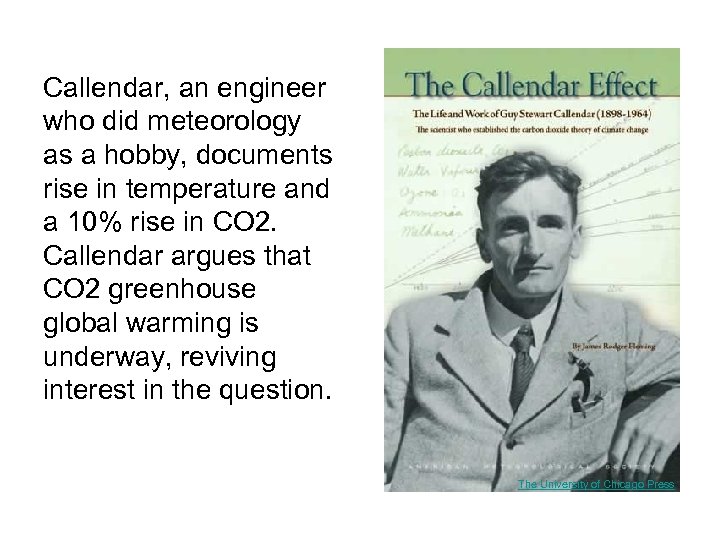 Callendar, an engineer who did meteorology as a hobby, documents rise in temperature and a 10% rise in CO 2. Callendar argues that CO 2 greenhouse global warming is underway, reviving interest in the question. The University of Chicago Press
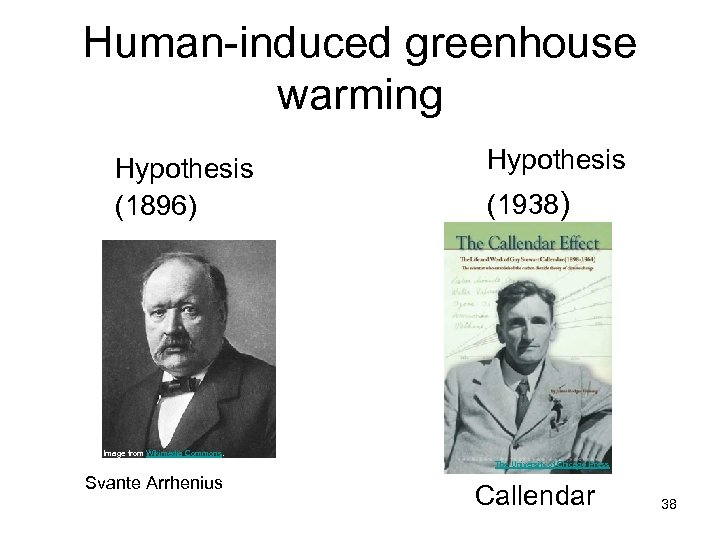 Human-induced greenhouse warming Hypothesis (1896) Hypothesis (1938) Image from Wikimedia Commons. The University of Chicago Press Svante Arrhenius Callendar 38
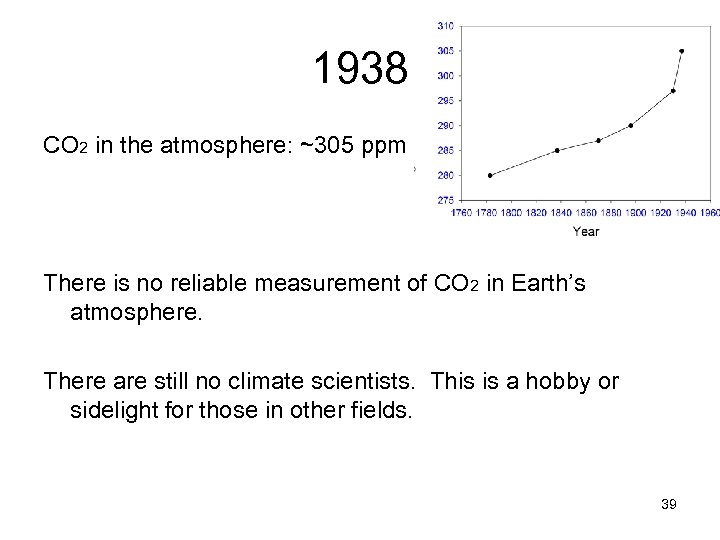 1938 CO 2 in the atmosphere: ~305 ppm There is no reliable measurement of CO 2 in Earth’s atmosphere. There are still no climate scientists. This is a hobby or sidelight for those in other fields. 39
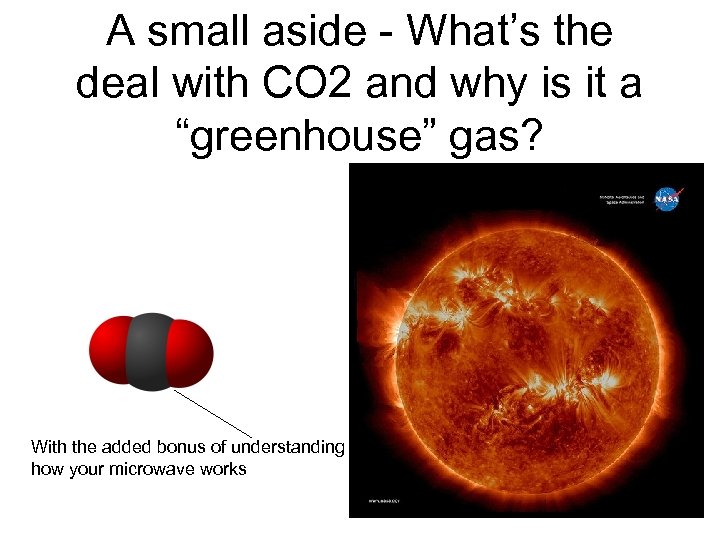 A small aside - What’s the deal with CO 2 and why is it a “greenhouse” gas? With the added bonus of understanding how your microwave works
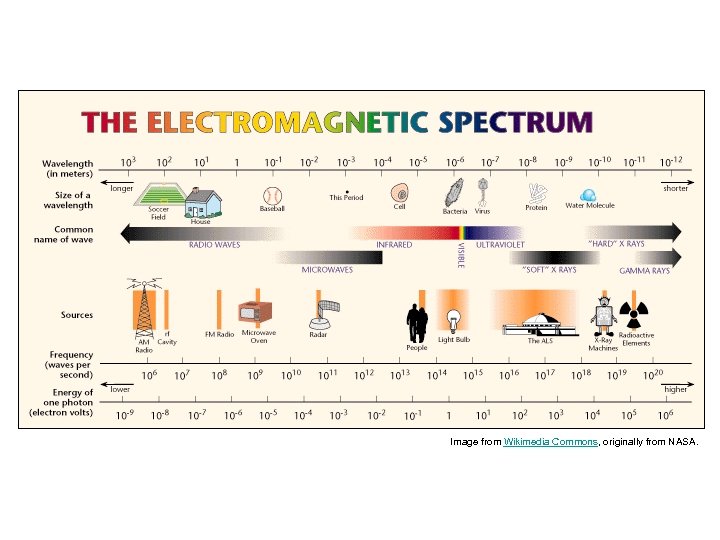 Image from Wikimedia Commons, originally from NASA.
 Image from Wikimedia Commons, originally from NASA. Image removed due to copyright: Electromagnetic radiation is self-propagating. See original image from University of Oregon.
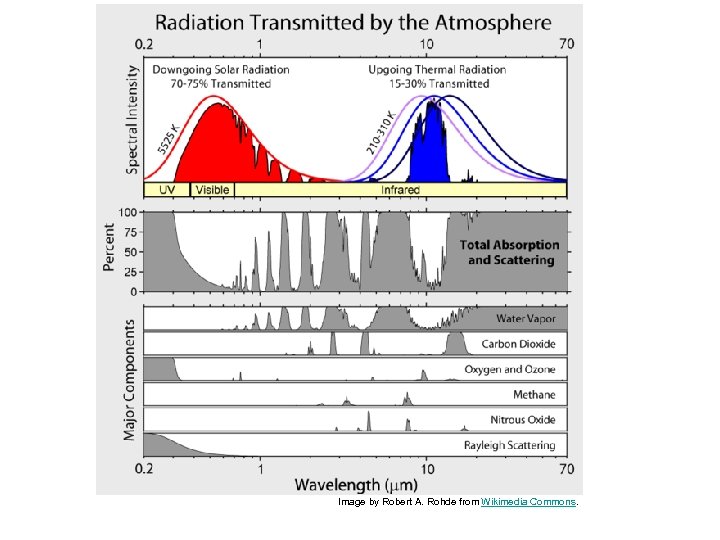 Image by Robert A. Rohde from Wikimedia Commons.
 Image removed due to copyright: Carbon Dioxide infrared absorption. Image available from Elmhurst. edu.
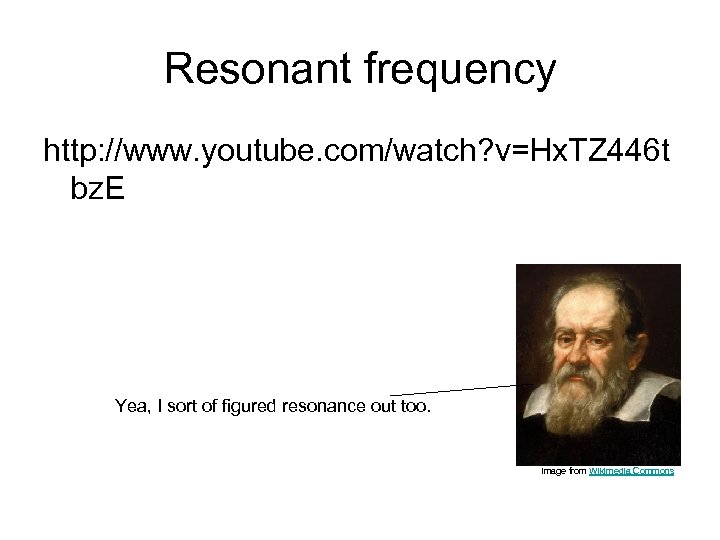 Resonant frequency http: //www. youtube. com/watch? v=Hx. TZ 446 t bz. E Yea, I sort of figured resonance out too. Image from Wikimedia Commons
 1939 At international meeting, community of scientists agree that the problem of ice ages is too difficult to solve with the tools at hand. The idea of ice ages, not global warming, is still the principal scientific focus.
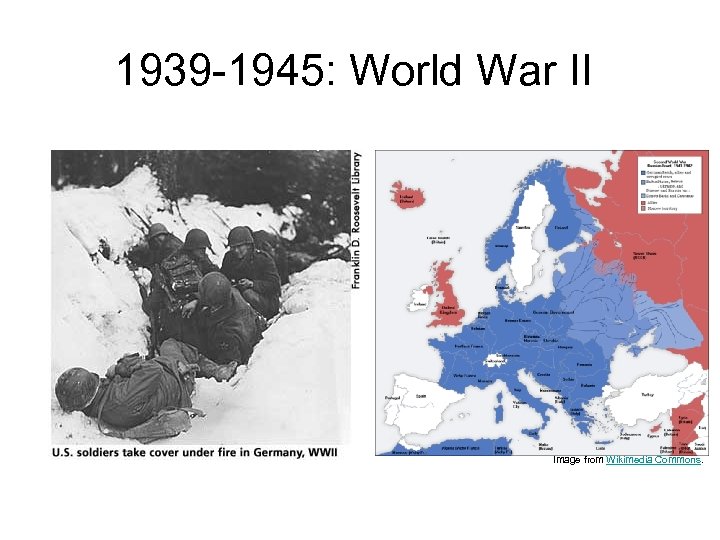 1939 -1945: World War II Image from Wikimedia Commons.
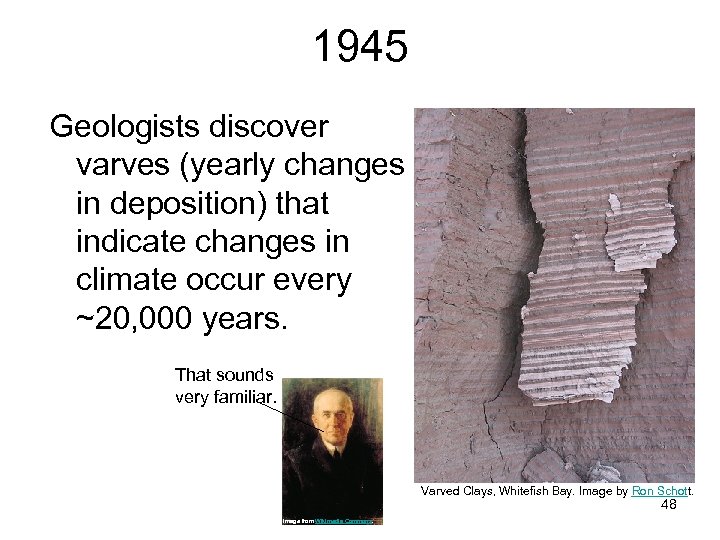 1945 Geologists discover varves (yearly changes in deposition) that indicate changes in climate occur every ~20, 000 years. That sounds very familiar. Varved Clays, Whitefish Bay. Image by Ron Schott. 48 Image from Wikimedia Commons.
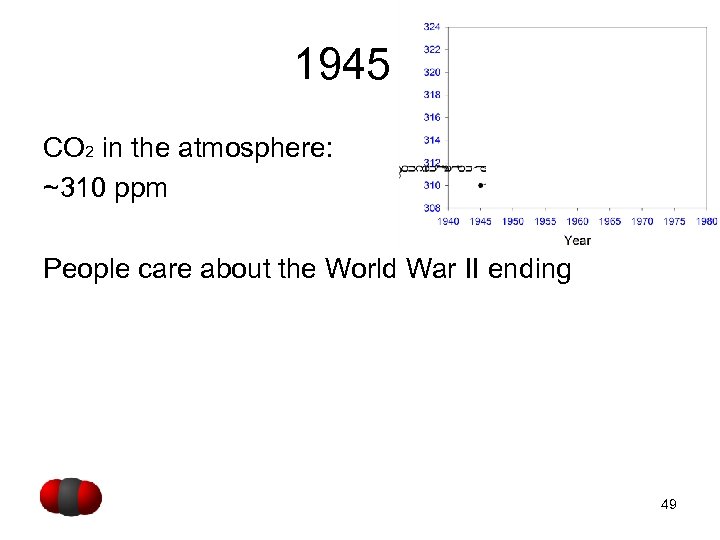 1945 CO 2 in the atmosphere: ~310 ppm People care about the World War II ending 49
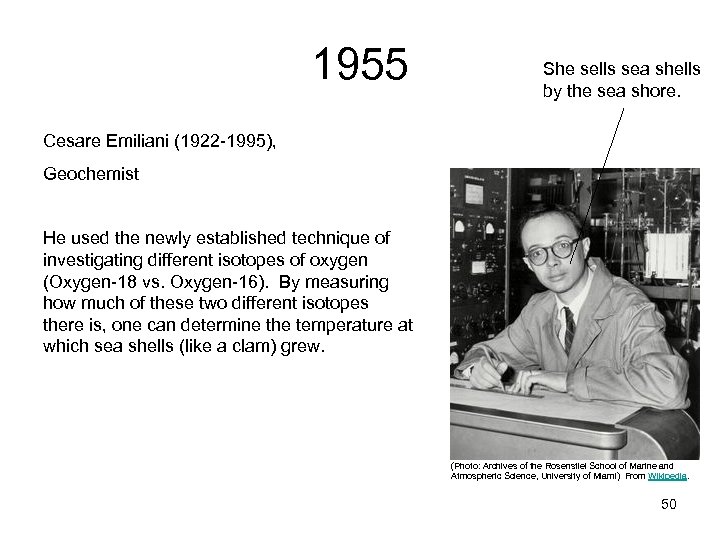 1955 She sells sea shells by the sea shore. Cesare Emiliani (1922 -1995), Geochemist He used the newly established technique of investigating different isotopes of oxygen (Oxygen-18 vs. Oxygen-16). By measuring how much of these two different isotopes there is, one can determine the temperature at which sea shells (like a clam) grew. (Photo: Archives of the Rosenstiel School of Marine and Atmospheric Science, University of Miami) From Wikipedia. 50
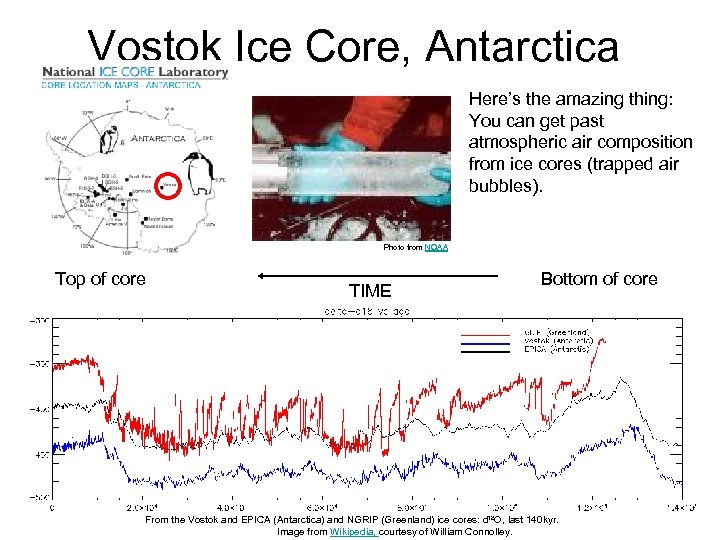 Vostok Ice Core, Antarctica Here’s the amazing thing: You can get past atmospheric air composition from ice cores (trapped air bubbles). Photo from NOAA Top of core TIME Bottom of core 51 From the Vostok and EPICA (Antarctica) and NGRIP (Greenland) ice cores: d 18 O, last 140 kyr. Image from Wikipedia, courtesy of William Connolley.
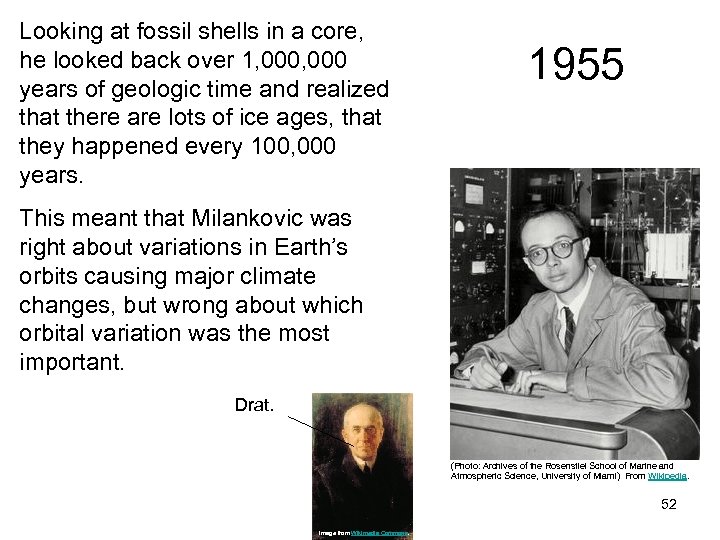 Looking at fossil shells in a core, he looked back over 1, 000 years of geologic time and realized that there are lots of ice ages, that they happened every 100, 000 years. 1955 This meant that Milankovic was right about variations in Earth’s orbits causing major climate changes, but wrong about which orbital variation was the most important. Drat. (Photo: Archives of the Rosenstiel School of Marine and Atmospheric Science, University of Miami) From Wikipedia. 52 Image from Wikimedia Commons.
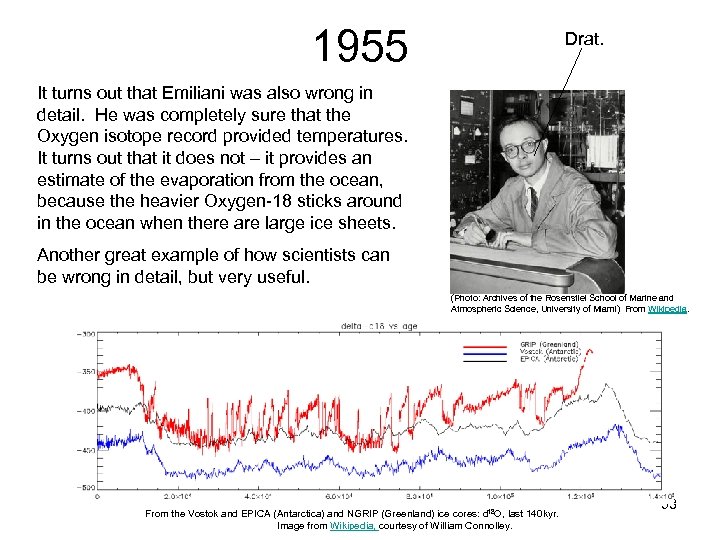 1955 Drat. It turns out that Emiliani was also wrong in detail. He was completely sure that the Oxygen isotope record provided temperatures. It turns out that it does not – it provides an estimate of the evaporation from the ocean, because the heavier Oxygen-18 sticks around in the ocean when there are large ice sheets. Another great example of how scientists can be wrong in detail, but very useful. (Photo: Archives of the Rosenstiel School of Marine and Atmospheric Science, University of Miami) From Wikipedia. From the Vostok and EPICA (Antarctica) and NGRIP (Greenland) ice cores: d 18 O, last 140 kyr. Image from Wikipedia, courtesy of William Connolley. 53