


 Скачать презентацию Climate Change and the Transport Sector State
4cec770bc5dd133a9e794f59c46d0156.ppt
- Количество слайдов: 17
 Climate Change and the Transport Sector – State Based Initiatives in the USA State Climate Action Plans: Medium Term GHG Emissions Reductions from the Transportation Sector Lewison Lem, Ph. D. Lewison. Lem@aol. com Postdoctoral Scholar University of California Transportation Center University of California, Berkeley (UCTC) and Senior Consultant Center for Climate Strategies (CCS) (http: //www. uctc. net/) (http: //www. climatestrategies. us/) Lem -- ADB Workshop Presentation May 2006
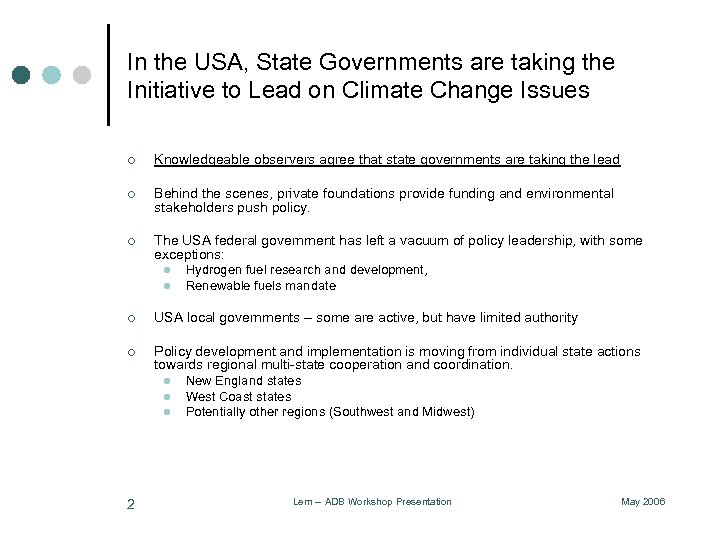 In the USA, State Governments are taking the Initiative to Lead on Climate Change Issues ¢ Knowledgeable observers agree that state governments are taking the lead ¢ Behind the scenes, private foundations provide funding and environmental stakeholders push policy. ¢ The USA federal government has left a vacuum of policy leadership, with some exceptions: l l Hydrogen fuel research and development, Renewable fuels mandate ¢ USA local governments – some are active, but have limited authority ¢ Policy development and implementation is moving from individual state actions towards regional multi-state cooperation and coordination. l l l 2 New England states West Coast states Potentially other regions (Southwest and Midwest) Lem -- ADB Workshop Presentation May 2006
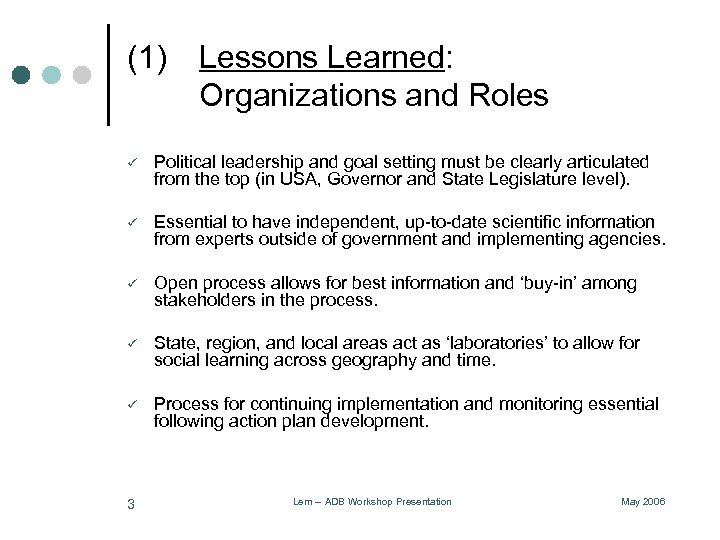 (1) Lessons Learned: Organizations and Roles ü Political leadership and goal setting must be clearly articulated from the top (in USA, Governor and State Legislature level). ü Essential to have independent, up-to-date scientific information from experts outside of government and implementing agencies. ü Open process allows for best information and ‘buy-in’ among stakeholders in the process. ü State, region, and local areas act as ‘laboratories’ to allow for social learning across geography and time. ü Process for continuing implementation and monitoring essential following action plan development. 3 Lem -- ADB Workshop Presentation May 2006
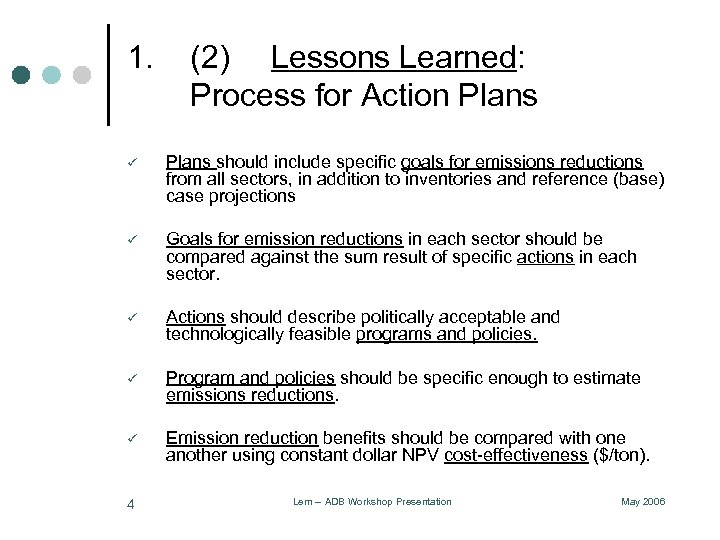 1. (2) Lessons Learned: Process for Action Plans ü Plans should include specific goals for emissions reductions from all sectors, in addition to inventories and reference (base) case projections ü Goals for emission reductions in each sector should be compared against the sum result of specific actions in each sector. ü Actions should describe politically acceptable and technologically feasible programs and policies. ü Program and policies should be specific enough to estimate emissions reductions. ü Emission reduction benefits should be compared with one another using constant dollar NPV cost-effectiveness ($/ton). 4 Lem -- ADB Workshop Presentation May 2006
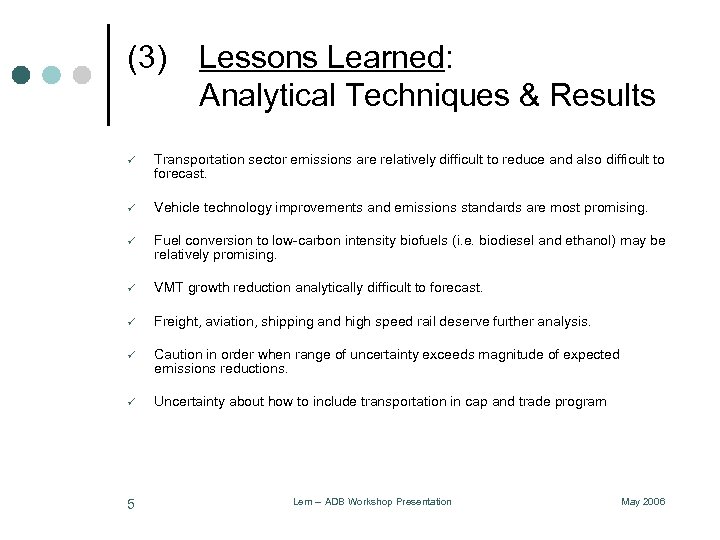 (3) Lessons Learned: Analytical Techniques & Results ü Transportation sector emissions are relatively difficult to reduce and also difficult to forecast. ü Vehicle technology improvements and emissions standards are most promising. ü Fuel conversion to low-carbon intensity biofuels (i. e. biodiesel and ethanol) may be relatively promising. ü VMT growth reduction analytically difficult to forecast. ü Freight, aviation, shipping and high speed rail deserve further analysis. ü Caution in order when range of uncertainty exceeds magnitude of expected emissions reductions. ü Uncertainty about how to include transportation in cap and trade program 5 Lem -- ADB Workshop Presentation May 2006
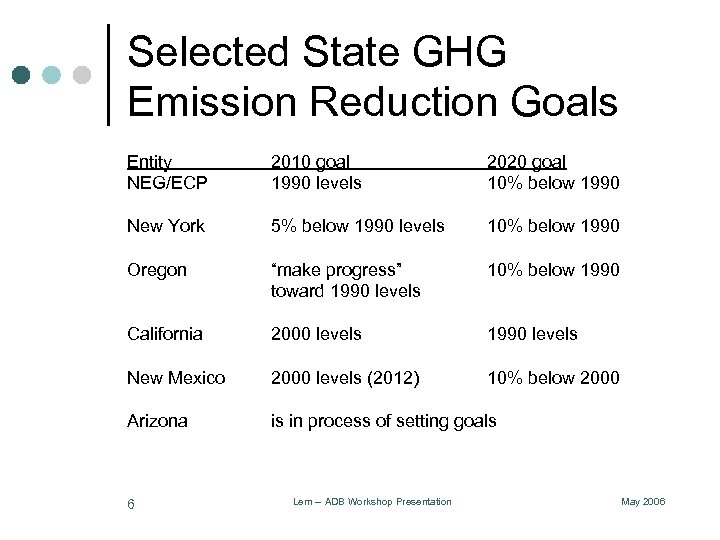 Selected State GHG Emission Reduction Goals Entity NEG/ECP 2010 goal 1990 levels 2020 goal 10% below 1990 New York 5% below 1990 levels 10% below 1990 Oregon “make progress” toward 1990 levels 10% below 1990 California 2000 levels 1990 levels New Mexico 2000 levels (2012) 10% below 2000 Arizona is in process of setting goals 6 Lem -- ADB Workshop Presentation May 2006
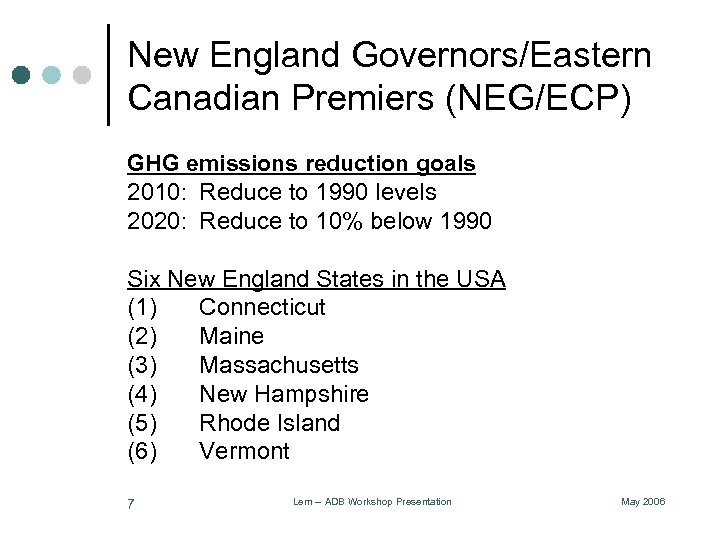 New England Governors/Eastern Canadian Premiers (NEG/ECP) GHG emissions reduction goals 2010: Reduce to 1990 levels 2020: Reduce to 10% below 1990 Six New England States in the USA (1) Connecticut (2) Maine (3) Massachusetts (4) New Hampshire (5) Rhode Island (6) Vermont 7 Lem -- ADB Workshop Presentation May 2006
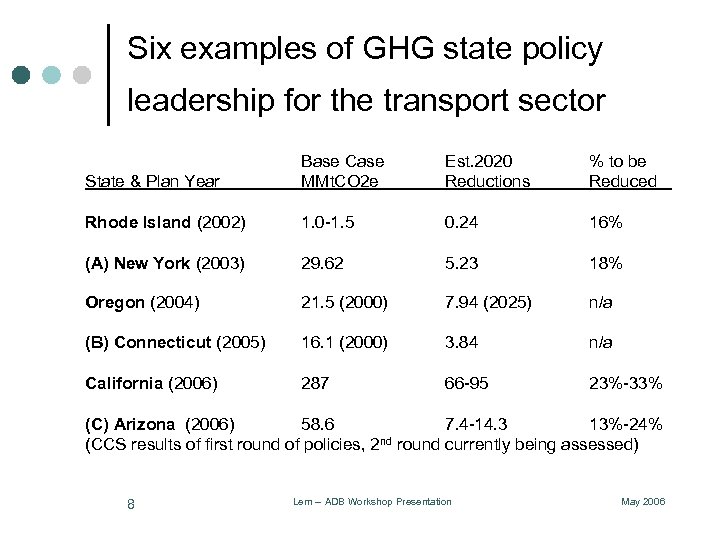 Six examples of GHG state policy leadership for the transport sector State & Plan Year Base Case MMt. CO 2 e Est. 2020 Reductions % to be Reduced Rhode Island (2002) 1. 0 -1. 5 0. 24 16% (A) New York (2003) 29. 62 5. 23 18% Oregon (2004) 21. 5 (2000) 7. 94 (2025) n/a (B) Connecticut (2005) 16. 1 (2000) 3. 84 n/a California (2006) 287 66 -95 23%-33% (C) Arizona (2006) 58. 6 7. 4 -14. 3 13%-24% (CCS results of first round of policies, 2 nd round currently being assessed) 8 Lem -- ADB Workshop Presentation May 2006
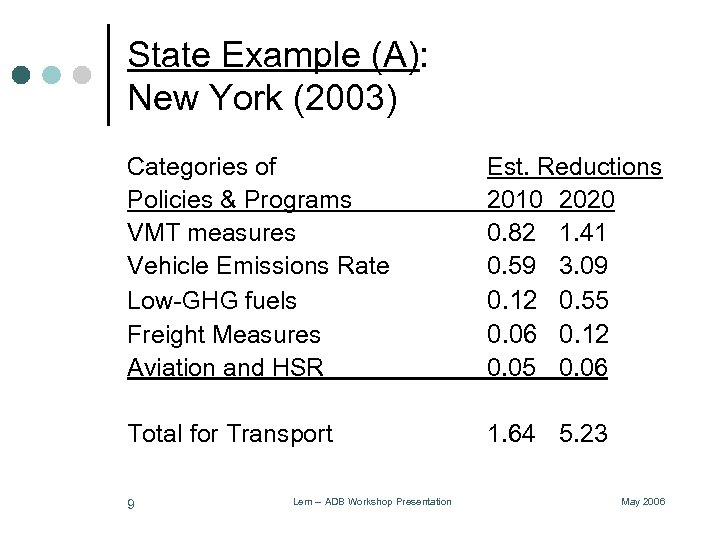 State Example (A): New York (2003) Categories of Policies & Programs VMT measures Vehicle Emissions Rate Low-GHG fuels Freight Measures Aviation and HSR Est. Reductions 2010 2020 0. 82 1. 41 0. 59 3. 09 0. 12 0. 55 0. 06 0. 12 0. 05 0. 06 Total for Transport 1. 64 5. 23 9 Lem -- ADB Workshop Presentation May 2006
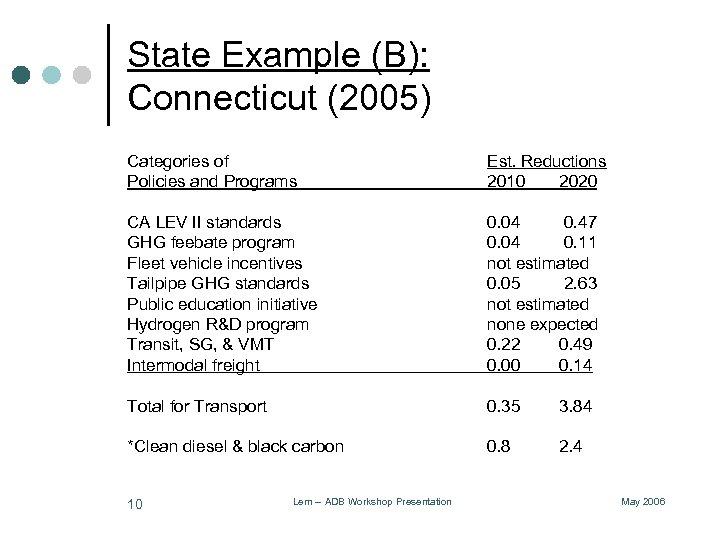 State Example (B): Connecticut (2005) Categories of Policies and Programs Est. Reductions 2010 2020 CA LEV II standards GHG feebate program Fleet vehicle incentives Tailpipe GHG standards Public education initiative Hydrogen R&D program Transit, SG, & VMT Intermodal freight 0. 04 0. 47 0. 04 0. 11 not estimated 0. 05 2. 63 not estimated none expected 0. 22 0. 49 0. 00 0. 14 Total for Transport 0. 35 3. 84 *Clean diesel & black carbon 0. 8 2. 4 10 Lem -- ADB Workshop Presentation May 2006
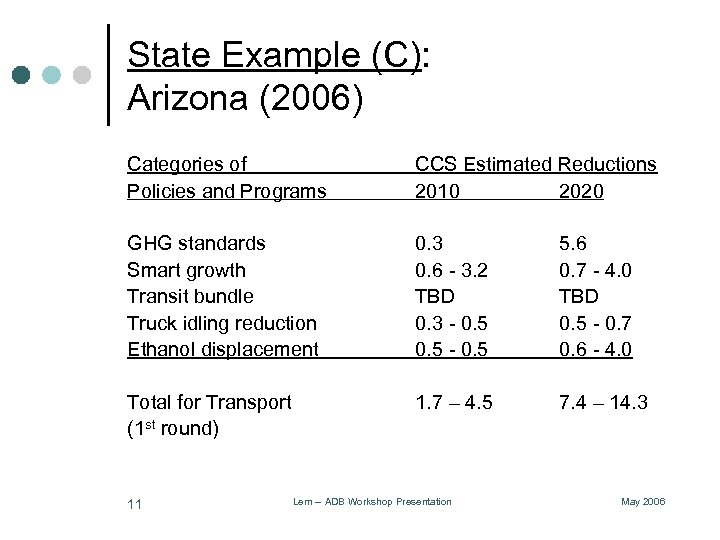 State Example (C): Arizona (2006) Categories of Policies and Programs CCS Estimated Reductions 2010 2020 GHG standards Smart growth Transit bundle Truck idling reduction Ethanol displacement 0. 3 0. 6 - 3. 2 TBD 0. 3 - 0. 5 5. 6 0. 7 - 4. 0 TBD 0. 5 - 0. 7 0. 6 - 4. 0 Total for Transport (1 st round) 1. 7 – 4. 5 7. 4 – 14. 3 11 Lem -- ADB Workshop Presentation May 2006
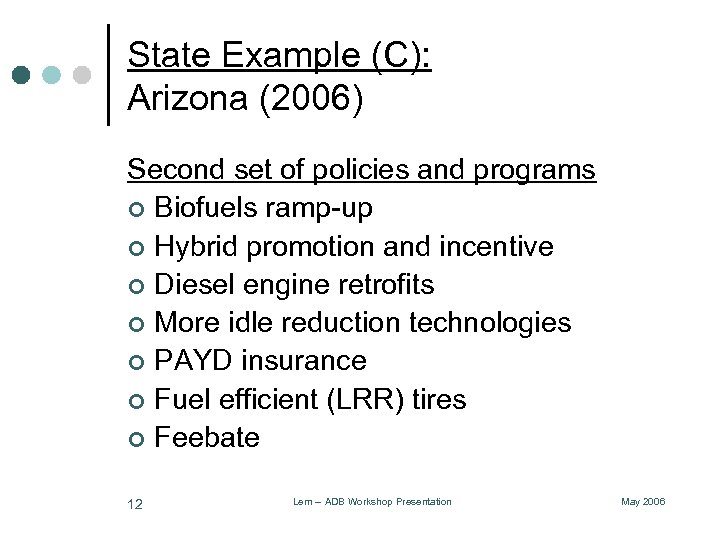 State Example (C): Arizona (2006) Second set of policies and programs ¢ Biofuels ramp-up ¢ Hybrid promotion and incentive ¢ Diesel engine retrofits ¢ More idle reduction technologies ¢ PAYD insurance ¢ Fuel efficient (LRR) tires ¢ Feebate 12 Lem -- ADB Workshop Presentation May 2006
 Projecting GHG Reductions from Light Duty Vehicle Emissions Standards: Comparison of Model Assumptions, Methods, and Results Lewison Lem, Ph. D. Senior Consultant Center for Climate Strategies Post. Doctoral Scholar and Lecturer University of California, Berkeley University of California Transportation Center Lem -- ADB Workshop Presentation May 2006
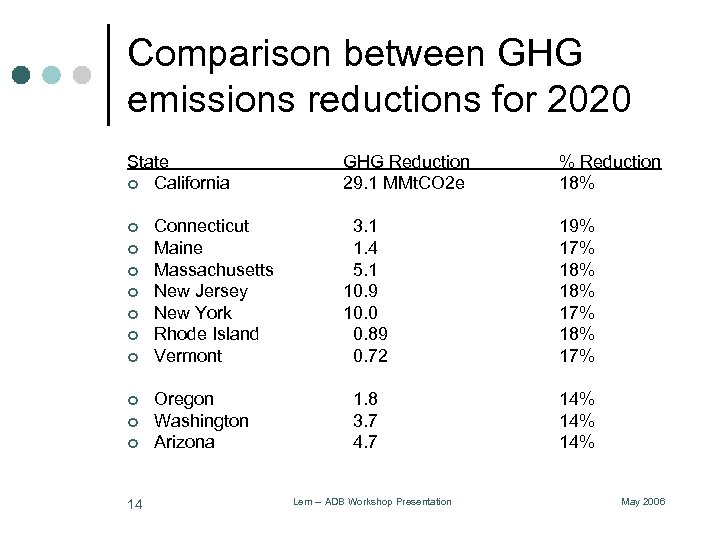 Comparison between GHG emissions reductions for 2020 State ¢ California ¢ ¢ ¢ ¢ ¢ 14 Connecticut Maine Massachusetts New Jersey New York Rhode Island Vermont Oregon Washington Arizona GHG Reduction 29. 1 MMt. CO 2 e % Reduction 18% 3. 1 1. 4 5. 1 10. 9 10. 0 0. 89 0. 72 19% 17% 18% 17% 1. 8 3. 7 4. 7 14% 14% Lem -- ADB Workshop Presentation May 2006
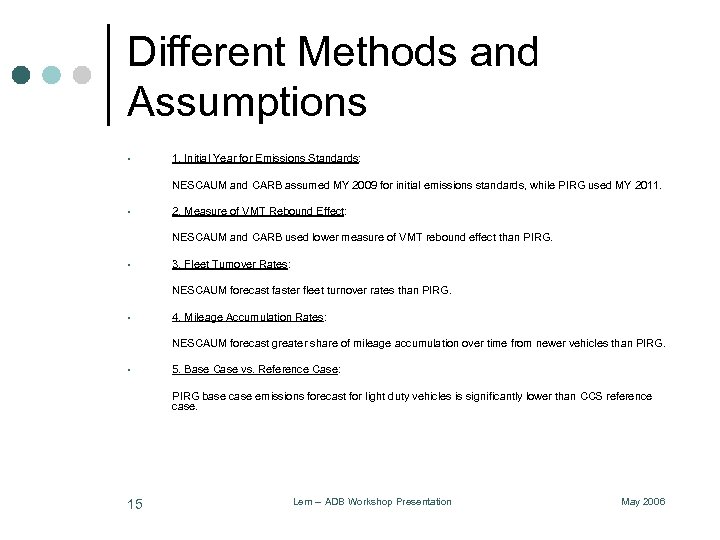 Different Methods and Assumptions § 1. Initial Year for Emissions Standards: NESCAUM and CARB assumed MY 2009 for initial emissions standards, while PIRG used MY 2011. § 2. Measure of VMT Rebound Effect: NESCAUM and CARB used lower measure of VMT rebound effect than PIRG. § 3. Fleet Turnover Rates: NESCAUM forecast faster fleet turnover rates than PIRG. § 4. Mileage Accumulation Rates: NESCAUM forecast greater share of mileage accumulation over time from newer vehicles than PIRG. § 5. Base Case vs. Reference Case: PIRG base case emissions forecast for light duty vehicles is significantly lower than CCS reference case. 15 Lem -- ADB Workshop Presentation May 2006
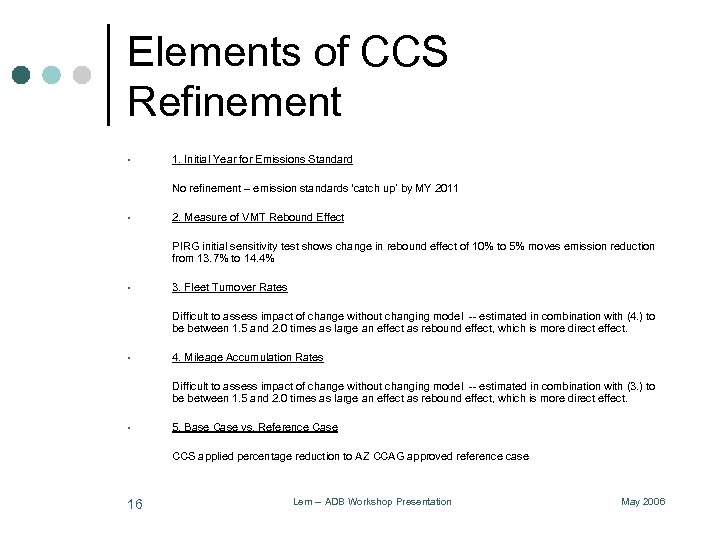 Elements of CCS Refinement § 1. Initial Year for Emissions Standard No refinement – emission standards ‘catch up’ by MY 2011 § 2. Measure of VMT Rebound Effect PIRG initial sensitivity test shows change in rebound effect of 10% to 5% moves emission reduction from 13. 7% to 14. 4% § 3. Fleet Turnover Rates Difficult to assess impact of change without changing model -- estimated in combination with (4. ) to be between 1. 5 and 2. 0 times as large an effect as rebound effect, which is more direct effect. § 4. Mileage Accumulation Rates Difficult to assess impact of change without changing model -- estimated in combination with (3. ) to be between 1. 5 and 2. 0 times as large an effect as rebound effect, which is more direct effect. § 5. Base Case vs. Reference Case CCS applied percentage reduction to AZ CCAG approved reference case 16 Lem -- ADB Workshop Presentation May 2006
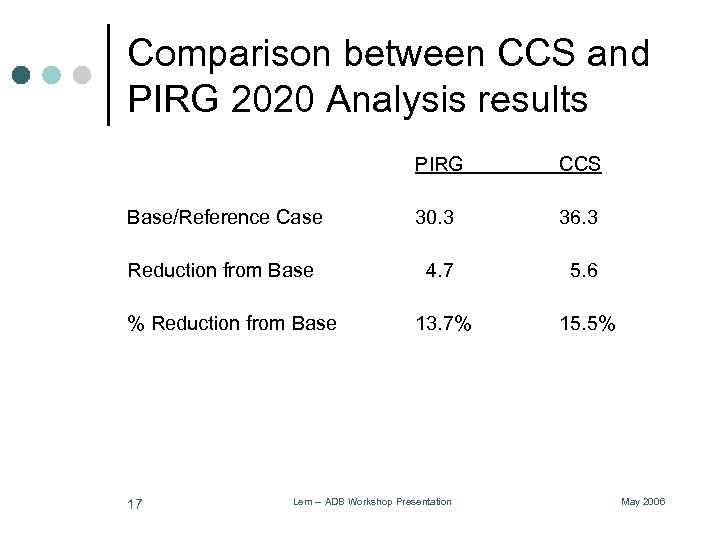 Comparison between CCS and PIRG 2020 Analysis results PIRG CCS Base/Reference Case 30. 3 36. 3 Reduction from Base 4. 7 5. 6 13. 7% 15. 5% % Reduction from Base 17 Lem -- ADB Workshop Presentation May 2006