 Скачать презентацию Climate Change Adaptation in IFAD Presented by Sheila
8859bd9d37729fb354004bb0fcae765a.ppt
- Количество слайдов: 10



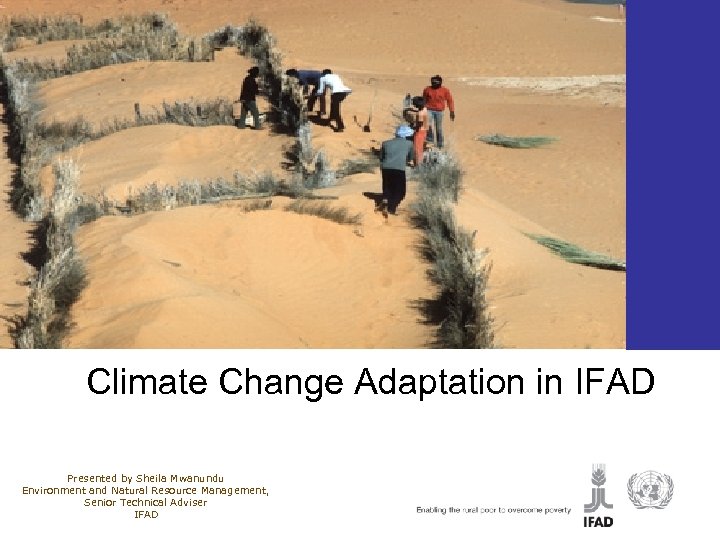
Climate Change Adaptation in IFAD Presented by Sheila Mwanundu Environment and Natural Resource Management, Senior Technical Adviser IFAD
Structure • • • Recent key developments Approach of the portfolio review Constraints Findings Direction for IFAD
Recent key developments • Strategic FMW 20072010 • KSF 5 “Risk and sustainability” • COSOPs • CEB involvement • PRG • IMI on Adaptation • Zero Carbon Group • President’s statements • Case studies • MDG-F Egypt proposal • Index based weather insurance pilot • Update of ESA Procedures • GECC Unit • VIII Repl. Paper: IFAD and Climate Change
Approach of the review • Background reading (IFAD documents & others) • Development of summary sheet • Review projects for NWP relevance 181 loans and 718 grants between 2000 -2006 • Report production (in progress)
Constraints • Limited assessment and synthesis of vulnerability and adaptation options in project design documents. • Complex and location-specific nature of climate change phenomena (beyond environment). • Limitation of the key-word search function in the available databases. • Documents for comprehensive analysis (i. e completion/evaluation reports, baseline studies) not available.
Findings 1 - Factors driving vulnerability • • • Climate risks: droughts, floods, storms, coastal/low lying regions. Vulnerability: (i) bio-physical: rainfall and seasonal distribution, growing seasons, water stress – significant pressure on natural resources; (ii) social/institutional: differences in roles and rights, information and market access, etc. ; (iii) technological: access/transfer, extension. Undetermined risks: food security, health, conflict, demographic patterns, infrastructure.
Findings 2 – IFAD’s activities related to CC - 6 (out of 9) areas of NWP: • • • Technologies for adaptation Economic diversification Research (grant programme) Adaptation planning practices Socio-economic information Climate related risks and extreme events - Limited experience on mitigation
Findings 3 - IFAD’s comparative advantage • • • Community empowerment - focus on vulnerable groups; Promoting access to land NR; Supporting Community-Based approaches; Addressing gender dimensions; Building on traditional/Indigenous Peoples’ knowledge; Pro-poor research – build scientific capacity and influence policy and institutional reform.
Directions for IFAD • Build in-house capacity (awareness and tools); • Expand climate risk vulnerability and adaptation in IFAD projects; • Step-up integrated adaptation/mitigation pro poor research (risk compensation products); • Expand role of ecosystem markets/GEF adaptation grant/carbon credits; • Policy dialogue (advocate for the rural poor); • Partnership with UN and other Dev. Agencies – selective and focused.
THANK YOU!
Скачать презентацию Climate Change Adaptation in IFAD Presented by Sheila
8859bd9d37729fb354004bb0fcae765a.ppt