


 Скачать презентацию Client-XXXXXX Europe S G A Review ELT Update 1
e59d2f30f5f4a40acef8e1b106c4b4ca.ppt
- Количество слайдов: 34
 Client-XXXXXX Europe S. G&A Review ELT Update 1 – Size of the Prize Wednesday 7 th July FINAL
 Contents and objectives Contents Objectives Overview of S. G&A Costs for Europe Review S. G&A benchmark findings Recommendations Understand overall S. G&A opportunities Summary of HR, Business Analysis and Facilities Management: Agree to proceed with Business Analysis for the detailing phase Business Analysis HR Facilities Management Outsourcing and Labour Arbitrage © 2004 Capgemini S. G&A Review: ELT Update 1 – July 2004 Page 2
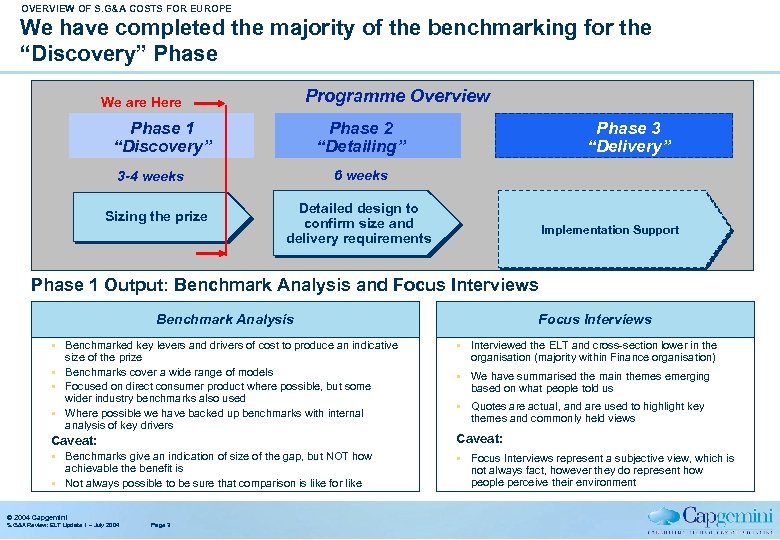 OVERVIEW OF S. G&A COSTS FOR EUROPE We have completed the majority of the benchmarking for the “Discovery” Phase Programme Overview We are Here Phase 1 “Discovery” Phase 2 “Detailing” 6 weeks 3 -4 weeks Sizing the prize Phase 3 “Delivery” Detailed design to confirm size and delivery requirements Implementation Support Phase 1 Output: Benchmark Analysis and Focus Interviews Benchmark Analysis Focus Interviews Benchmarked key levers and drivers of cost to produce an indicative size of the prize Benchmarks cover a wide range of models Focused on direct consumer product where possible, but some wider industry benchmarks also used Where possible we have backed up benchmarks with internal analysis of key drivers Interviewed the ELT and cross-section lower in the organisation (majority within Finance organisation) Caveat: Benchmarks give an indication of size of the gap, but NOT how achievable the benefit is Not always possible to be sure that comparison is like for like Focus Interviews represent a subjective view, which is not always fact, however they do represent how people perceive their environment © 2004 Capgemini S. G&A Review: ELT Update 1 – July 2004 Page 3 We have summarised the main themes emerging based on what people told us Quotes are actual, and are used to highlight key themes and commonly held views
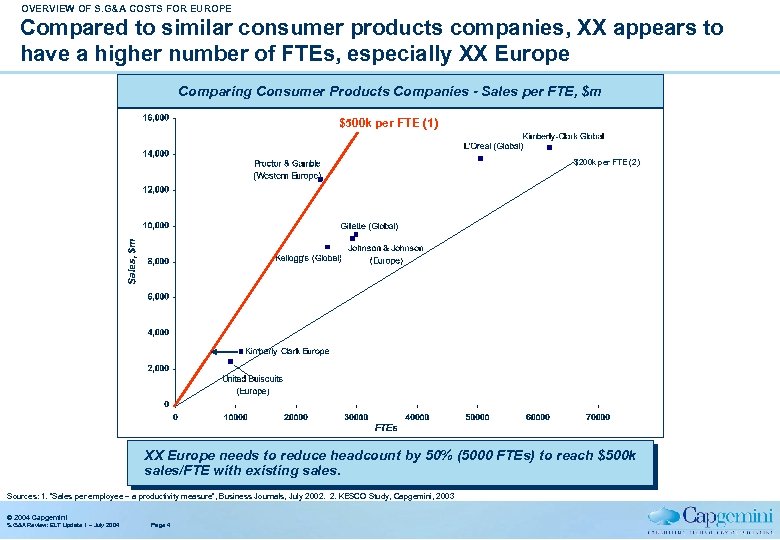 OVERVIEW OF S. G&A COSTS FOR EUROPE Compared to similar consumer products companies, XX appears to have a higher number of FTEs, especially XX Europe Comparing Consumer Products Companies - Sales per FTE, $m $500 k per FTE (1) $200 k per FTE (2) XX Europe needs to reduce headcount by 50% (5000 FTEs) to reach $500 k sales/FTE with existing sales. Sources: 1. “Sales per employee – a productivity measure”, Business Journals, July 2002. 2. KESCO Study, Capgemini, 2003 © 2004 Capgemini S. G&A Review: ELT Update 1 – July 2004 Page 4
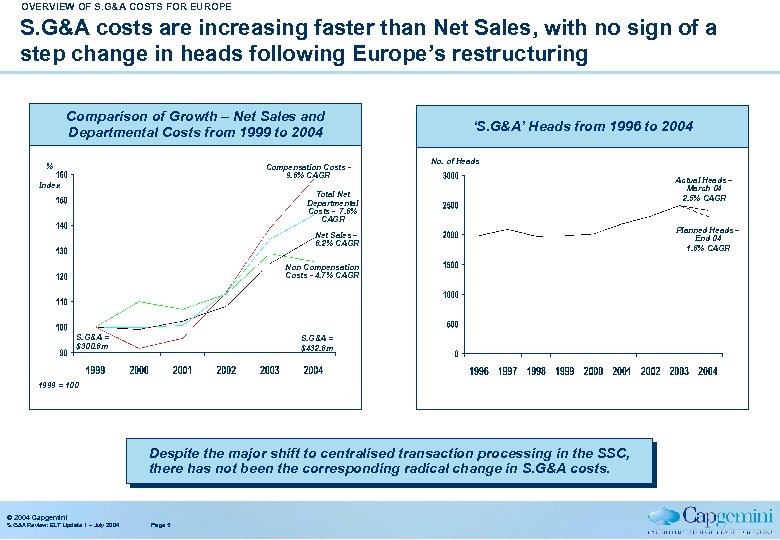 OVERVIEW OF S. G&A COSTS FOR EUROPE S. G&A costs are increasing faster than Net Sales, with no sign of a step change in heads following Europe’s restructuring Comparison of Growth – Net Sales and Departmental Costs from 1999 to 2004 % Compensation Costs 9. 6% CAGR ‘S. G&A’ Heads from 1996 to 2004 No. of Heads Index Total Net Departmental Costs - 7. 6% CAGR Net Sales – 6. 2% CAGR Non Compensation Costs - 4. 7% CAGR S. G&A = $300. 6 m S. G&A = $432. 6 m 1999 = 100 Despite the major shift to centralised transaction processing in the SSC, there has not been the corresponding radical change in S. G&A costs. © 2004 Capgemini S. G&A Review: ELT Update 1 – July 2004 Page 5 Actual Heads – March 04 2. 5% CAGR Planned Heads – End 04 1. 8% CAGR
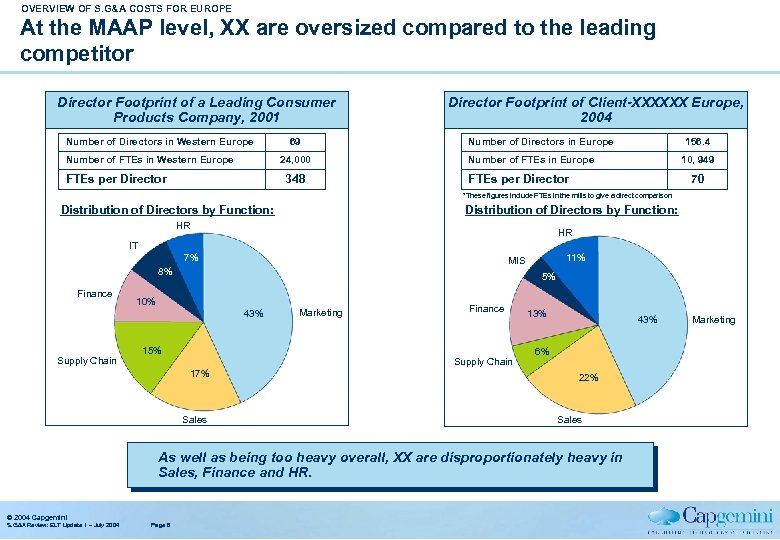 OVERVIEW OF S. G&A COSTS FOR EUROPE At the MAAP level, XX are oversized compared to the leading competitor Director Footprint of a Leading Consumer Products Company, 2001 Number of Directors in Western Europe Number of FTEs in Western Europe 69 24, 000 FTEs per Director 348 Director Footprint of Client-XXXXXX Europe, 2004 Number of Directors in Europe 156. 4 Number of FTEs in Europe 10, 949 FTEs per Director 70 *These figures include FTEs in the mills to give a direct comparison Distribution of Directors by Function: HR HR IT 7% Finance 5% 10% 43% Supply Chain 11% MIS 8% Marketing Finance 15% Supply Chain 17% Sales 13% 43% 6% 22% Sales As well as being too heavy overall, XX are disproportionately heavy in Sales, Finance and HR. © 2004 Capgemini S. G&A Review: ELT Update 1 – July 2004 Page 6 Marketing
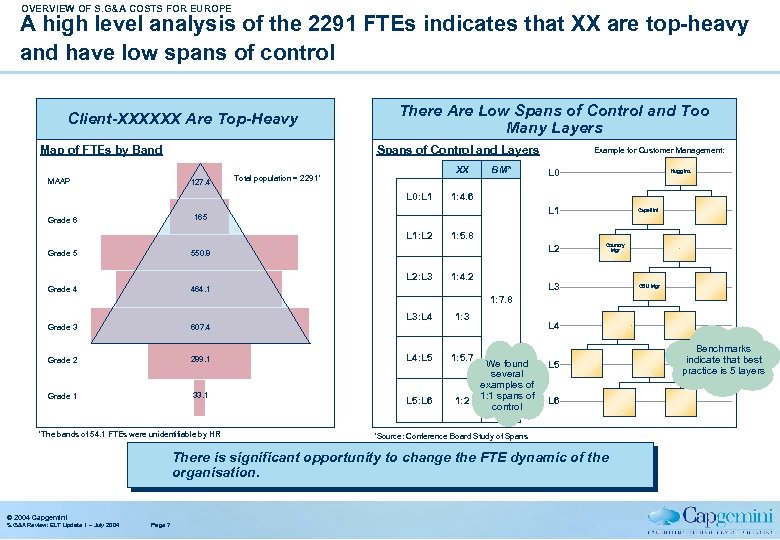 OVERVIEW OF S. G&A COSTS FOR EUROPE A high level analysis of the 2291 FTEs indicates that XX are top-heavy and have low spans of control Client-XXXXXX Are Top-Heavy Map of FTEs by Band MAAP There Are Low Spans of Control and Too Many Layers Spans of Control and Layers 127. 4 XX Total population = 2291* L 0: L 1 BM* L 2 464. 1 L 2: L 3 Capellini 1: 5. 8 550. 8 Grade 4 Huggins L 1: L 2 Grade 5 L 0 1: 4. 6 165 Grade 6 Example for Customer Management: 1: 4. 2 Country Mgr L 3 CBU Mgr 1: 7. 8 L 3: L 4 1: 3 289. 1 L 4: L 5 1: 5. 7 33. 1 L 5: L 6 1: 2 Grade 3 Grade 2 Grade 1 L 4 607. 4 *The bands of 54. 1 FTEs were unidentifiable by HR We found several examples of 1: 1 spans of control L 5 L 6 *Source: Conference Board Study of Spans There is significant opportunity to change the FTE dynamic of the organisation. © 2004 Capgemini S. G&A Review: ELT Update 1 – July 2004 Page 7 Benchmarks indicate that best practice is 5 layers
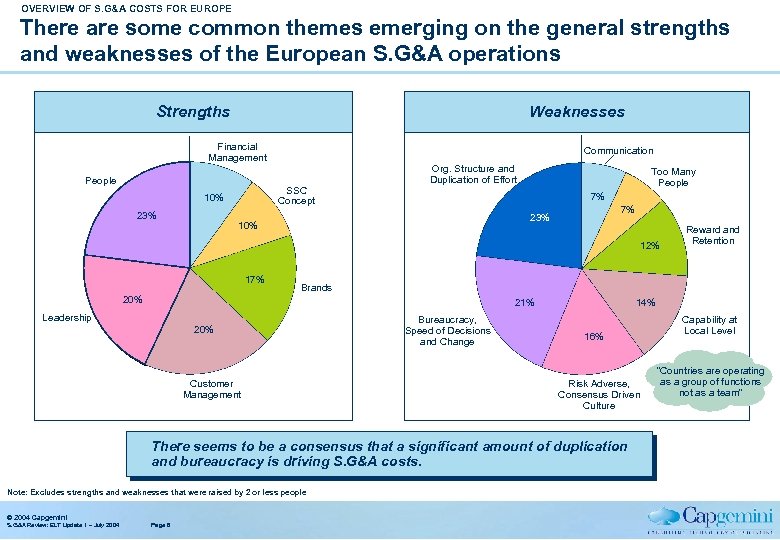 OVERVIEW OF S. G&A COSTS FOR EUROPE There are some common themes emerging on the general strengths and weaknesses of the European S. G&A operations Strengths Weaknesses Financial Management People SSC Concept 10% 23% Communication Org. Structure and Duplication of Effort Too Many People 7% 7% 23% 10% 12% 17% Brands 20% 21% Leadership 20% Customer Management Bureaucracy, Speed of Decisions and Change 14% 16% Risk Adverse, Consensus Driven Culture There seems to be a consensus that a significant amount of duplication and bureaucracy is driving S. G&A costs. Note: Excludes strengths and weaknesses that were raised by 2 or less people © 2004 Capgemini S. G&A Review: ELT Update 1 – July 2004 Page 8 Reward and Retention Capability at Local Level “Countries are operating as a group of functions not as a team”
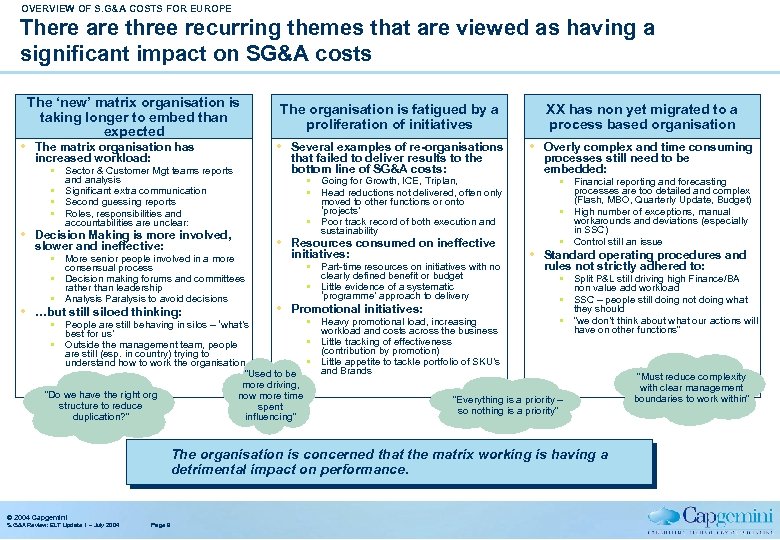 OVERVIEW OF S. G&A COSTS FOR EUROPE There are three recurring themes that are viewed as having a significant impact on SG&A costs The ‘new’ matrix organisation is taking longer to embed than expected The matrix organisation has increased workload: Sector & Customer Mgt teams reports and analysis Significant extra communication Second guessing reports Roles, responsibilities and accountabilities are unclear: Decision Making is more involved, slower and ineffective: More senior people involved in a more consensual process Decision making forums and committees rather than leadership Analysis Paralysis to avoid decisions …but still siloed thinking: The organisation is fatigued by a proliferation of initiatives XX has non yet migrated to a process based organisation Several examples of re-organisations that failed to deliver results to the bottom line of SG&A costs: Overly complex and time consuming processes still need to be embedded: Going for Growth, ICE, Triplan, Head reductions not delivered, often only moved to other functions or onto ‘projects’ Poor track record of both execution and sustainability Resources consumed on ineffective initiatives: Part-time resources on initiatives with no clearly defined benefit or budget Little evidence of a systematic ‘programme’ approach to delivery Promotional initiatives: People are still behaving in silos – ‘what’s best for us’ Outside the management team, people are still (esp. in country) trying to understand how to work the organisation “Used to be more driving, “Do we have the right org now more time structure to reduce spent duplication? ” influencing” Heavy promotional load, increasing workload and costs across the business Little tracking of effectiveness (contribution by promotion) Little appetite to tackle portfolio of SKU’s and Brands Financial reporting and forecasting processes are too detailed and complex (Flash, MBO, Quarterly Update, Budget) High number of exceptions, manual workarounds and deviations (especially in SSC) Control still an issue Standard operating procedures and rules not strictly adhered to: Split P&L still driving high Finance/BA non value add workload SSC – people still doing not doing what they should “we don’t think about what our actions will have on other functions” “Everything is a priority – so nothing is a priority” The organisation is concerned that the matrix working is having a detrimental impact on performance. © 2004 Capgemini S. G&A Review: ELT Update 1 – July 2004 Page 9 ”Must reduce complexity with clear management boundaries to work within”
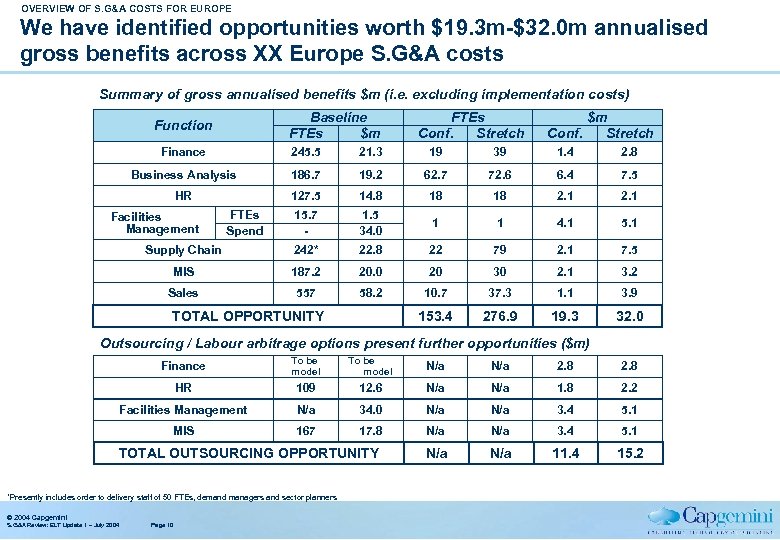 OVERVIEW OF S. G&A COSTS FOR EUROPE We have identified opportunities worth $19. 3 m-$32. 0 m annualised gross benefits across XX Europe S. G&A costs Summary of gross annualised benefits $m (i. e. excluding implementation costs) Baseline FTEs $m Function FTEs Conf. Stretch $m Conf. Stretch Finance 245. 5 21. 3 19 39 1. 4 2. 8 Business Analysis 186. 7 19. 2 62. 7 72. 6 6. 4 7. 5 HR 127. 5 14. 8 18 18 2. 1 15. 7 - 1. 5 34. 0 1 1 4. 1 5. 1 Supply Chain 242* 22. 8 22 79 2. 1 7. 5 MIS 187. 2 20. 0 20 30 2. 1 3. 2 Sales 557 58. 2 10. 7 37. 3 1. 1 3. 9 153. 4 276. 9 19. 3 32. 0 Facilities Management FTEs Spend TOTAL OPPORTUNITY Outsourcing / Labour arbitrage options present further opportunities ($m) Finance To be model N/a 2. 8 HR 109 12. 6 N/a 1. 8 2. 2 Facilities Management N/a 34. 0 N/a 3. 4 5. 1 MIS 167 17. 8 N/a 3. 4 5. 1 TOTAL OUTSOURCING OPPORTUNITY N/a 11. 4 15. 2 *Presently includes order to delivery staff of 50 FTEs, demand managers and sector planners © 2004 Capgemini S. G&A Review: ELT Update 1 – July 2004 Page 10
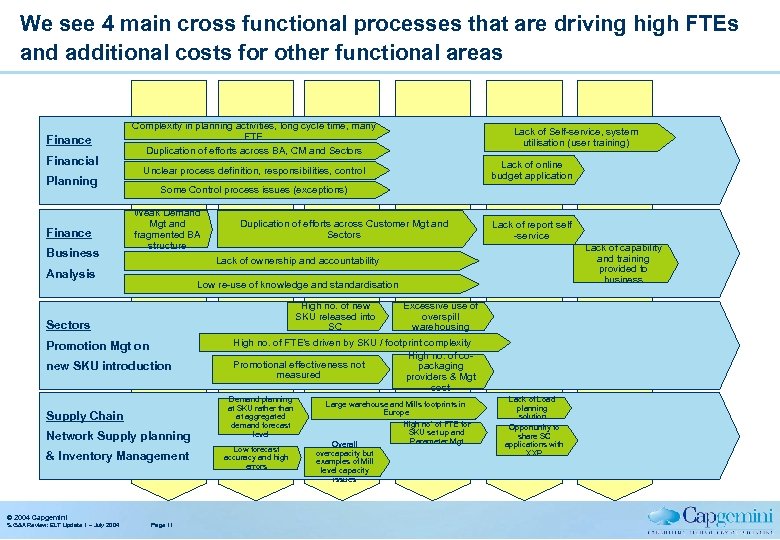 We see 4 main cross functional processes that are driving high FTEs and additional costs for other functional areas Complexity in planning activities, long cycle time, many FTE Duplication of efforts across BA, CM and Sectors Finance Financial Some Control process issues (exceptions) Weak Demand Mgt and fragmented BA structure Finance Analysis Duplication of efforts across Customer Mgt and Sectors Finance & SSC Lack of ownership and accountability Supply Chain Customer Management. Sectors Lack of report self -service MIS Low re-use of knowledge and standardisation High no. of new SKU released into SC Sectors Promotion Mgt on new SKU introduction Supply Chain Network Supply planning & Inventory Management © 2004 Capgemini S. G&A Review: ELT Update 1 – July 2004 Lack of online budget application Unclear process definition, responsibilities, control Planning Business Lack of Self-service, system utilisation (user training) Page 11 Excessive use of overspill warehousing High no. of FTE’s driven by SKU / footprint complexity High no. of co. Promotional effectiveness not packaging measured providers & Mgt cost Demand planning at SKU rather than at aggregated demand forecast level Low forecast accuracy and high errors Large warehouse and Mills footprints in Europe High no’ of FTE for SKU set up and Parameter Mgt Overall overcapacity but examples of Mill level capacity issues Lack of Load planning solution Opportunity to share SC applications with XXP Lack of capability and training HR provided to business
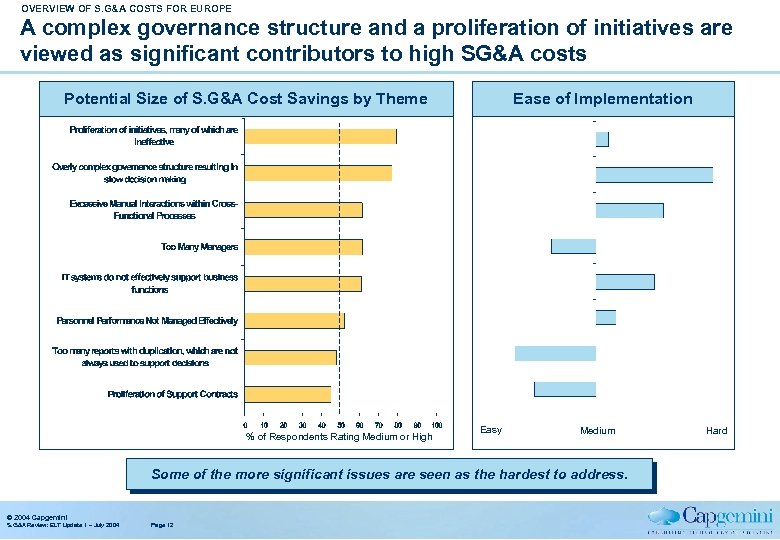 OVERVIEW OF S. G&A COSTS FOR EUROPE A complex governance structure and a proliferation of initiatives are viewed as significant contributors to high SG&A costs Potential Size of S. G&A Cost Savings by Theme % of Respondents Rating Medium or High Ease of Implementation Easy Medium Some of the more significant issues are seen as the hardest to address. © 2004 Capgemini S. G&A Review: ELT Update 1 – July 2004 Page 12 Hard
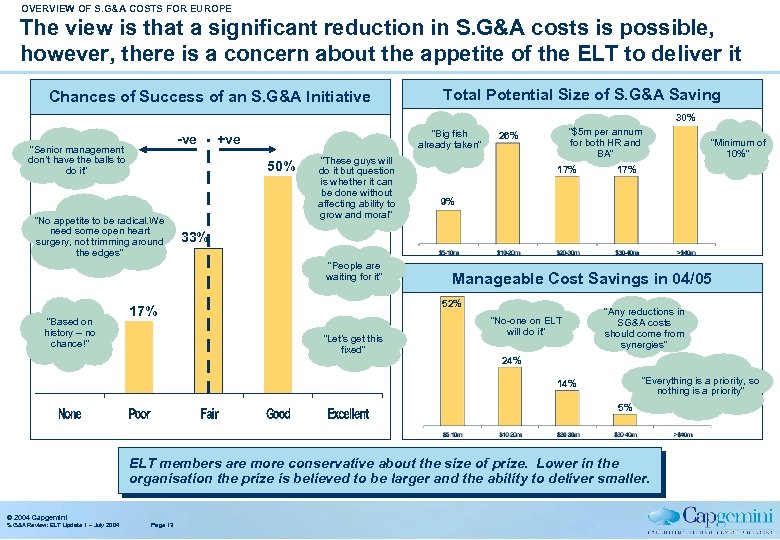 OVERVIEW OF S. G&A COSTS FOR EUROPE The view is that a significant reduction in S. G&A costs is possible, however, there is a concern about the appetite of the ELT to deliver it Chances of Success of an S. G&A Initiative Total Potential Size of S. G&A Saving 30% -ve “Senior management don’t have the balls to do it” “Big fish already taken” +ve 50% “No appetite to be radical. We need some open heart surgery, not trimming around the edges” “These guys will do it but question is whether it can be done without affecting ability to grow and moral” 26% 17% “Minimum of 10%” 17% 9% 33% “People are waiting for it” “Based on history – no chance!” “$5 m per annum for both HR and BA” Manageable Cost Savings in 04/05 52% 17% “Let’s get this fixed” “No-one on ELT will do it” “Any reductions in SG&A costs should come from synergies” 24% “Everything is a priority, so nothing is a priority” 14% 5% ELT members are more conservative about the size of prize. Lower in the organisation the prize is believed to be larger and the ability to deliver smaller. © 2004 Capgemini S. G&A Review: ELT Update 1 – July 2004 Page 13
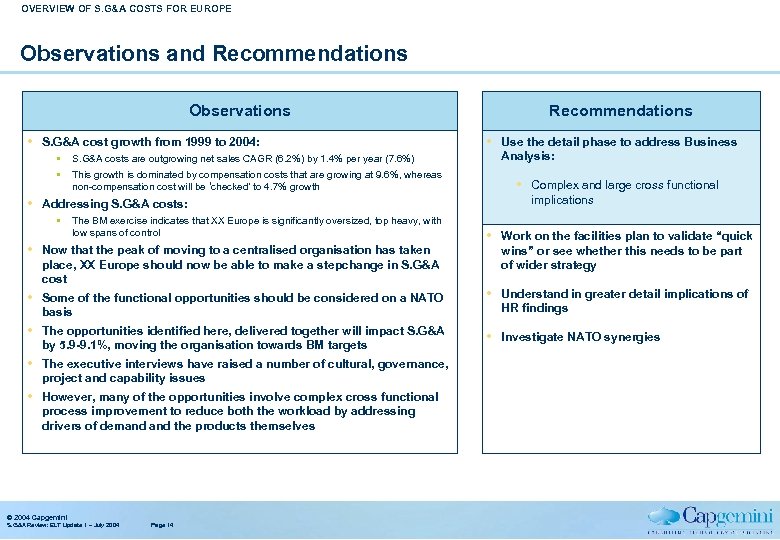 OVERVIEW OF S. G&A COSTS FOR EUROPE Observations and Recommendations Observations S. G&A cost growth from 1999 to 2004: • • S. G&A costs are outgrowing net sales CAGR (6. 2%) by 1. 4% per year (7. 6%) This growth is dominated by compensation costs that are growing at 9. 6%, whereas non-compensation cost will be ‘checked’ to 4. 7% growth Addressing S. G&A costs: • The BM exercise indicates that XX Europe is significantly oversized, top heavy, with low spans of control Now that the peak of moving to a centralised organisation has taken place, XX Europe should now be able to make a stepchange in S. G&A cost Some of the functional opportunities should be considered on a NATO basis The opportunities identified here, delivered together will impact S. G&A by 5. 9 -9. 1%, moving the organisation towards BM targets The executive interviews have raised a number of cultural, governance, project and capability issues However, many of the opportunities involve complex cross functional process improvement to reduce both the workload by addressing drivers of demand the products themselves © 2004 Capgemini S. G&A Review: ELT Update 1 – July 2004 Page 14 Recommendations Use the detail phase to address Business Analysis: Complex and large cross functional implications Work on the facilities plan to validate “quick wins” or see whether this needs to be part of wider strategy Understand in greater detail implications of HR findings Investigate NATO synergies
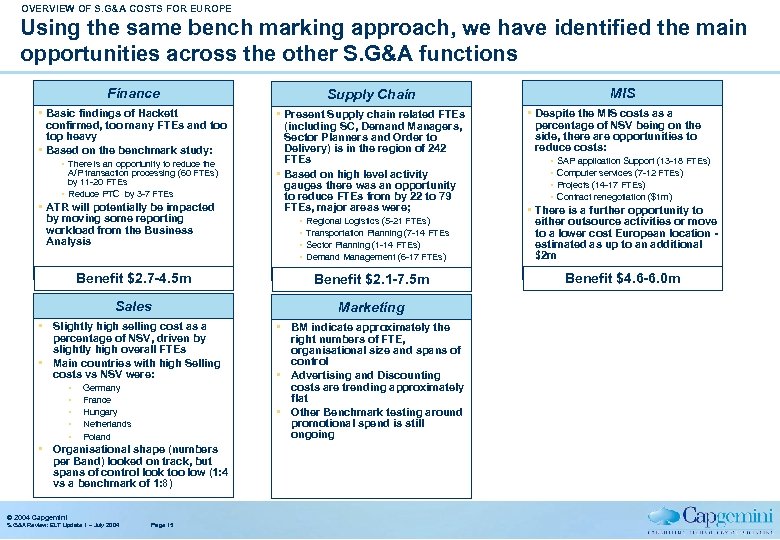 OVERVIEW OF S. G&A COSTS FOR EUROPE Using the same bench marking approach, we have identified the main opportunities across the other S. G&A functions Finance Supply Chain • Basic findings of Hackett confirmed, too many FTEs and too top heavy • Based on the benchmark study: • Present Supply chain related FTEs (including SC, Demand Managers, Sector Planners and Order to Delivery) is in the region of 242 FTEs • Based on high level activity gauges there was an opportunity to reduce FTEs from by 22 to 79 FTEs, major areas were; • There is an opportunity to reduce the A/P transaction processing (60 FTEs) by 11 -20 FTEs • Reduce PTC by 3 -7 FTEs • ATR will potentially be impacted by moving some reporting workload from the Business Analysis • • Regional Logistics (5 -21 FTEs) Transportation Planning (7 -14 FTEs Sector Planning (1 -14 FTEs) Demand Management (6 -17 FTEs) Benefit $2. 7 -4. 5 m Benefit $2. 1 -7. 5 m Sales Marketing • Slightly high selling cost as a percentage of NSV, driven by slightly high overall FTEs • Main countries with high Selling costs vs NSV were: • • • Germany France Hungary Netherlands Poland • Organisational shape (numbers per Band) looked on track, but spans of control look too low (1: 4 vs a benchmark of 1: 8) © 2004 Capgemini S. G&A Review: ELT Update 1 – July 2004 Page 15 • BM indicate approximately the right numbers of FTE, organisational size and spans of control • Advertising and Discounting costs are trending approximately flat • Other Benchmark testing around promotional spend is still ongoing MIS • Despite the MIS costs as a percentage of NSV being on the side, there are opportunities to reduce costs: • • SAP application Support (13 -18 FTEs) Computer services (7 -12 FTEs) Projects (14 -17 FTEs) Contract renegotiation ($1 m) • There is a further opportunity to either outsource activities or move to a lower cost European location estimated as up to an additional $2 m Benefit $4. 6 -6. 0 m
 Summary HR, Business Analysis and Facilities Management © 2004 Capgemini S. G&A Review: ELT Update 1 – July 2004 Page 16
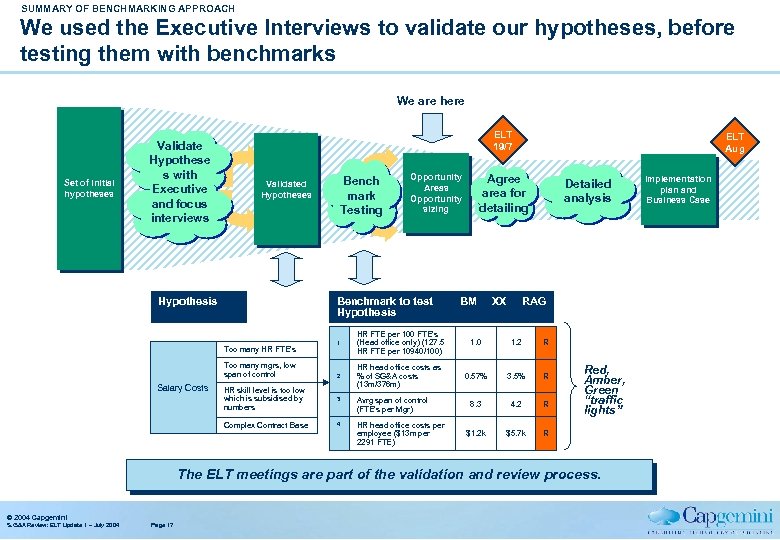 SUMMARY OF BENCHMARKING APPROACH We used the Executive Interviews to validate our hypotheses, before testing them with benchmarks We are here 246 Set of Initial hypotheses Validate Hypothese s with Executive and focus interviews ELT 19/7 Opportunity Areas Opportunity sizing Benchmark to test Hypothesis Too many HR FTE’s Too many mgrs, low span of control Salary Costs Bench mark Testing Validated Hypotheses ELT Aug Agree area for detailing BM XX Detailed analysis RAG 1 HR FTE per 100 FTE’s (Head office only) (127. 5 HR FTE per 10940/100) 1. 0 1. 2 R 2 HR head office costs as % of SG&A costs (13 m/376 m) 0. 57% 3. 5% R 8. 3 4. 2 R $1. 2 k $5. 7 k R HR skill level is too low which is subsidised by numbers 3 Avrg span of control (FTE’s per Mgr) Complex Contract Base 4 HR head office costs per employee ($13 m per 2291 FTE) Red, Amber, Green “traffic lights” The ELT meetings are part of the validation and review process. © 2004 Capgemini S. G&A Review: ELT Update 1 – July 2004 Page 17 Implementation plan and Business Case
 HR © 2004 Capgemini S. G&A Review: ELT Update 1 – July 2004 Page 18
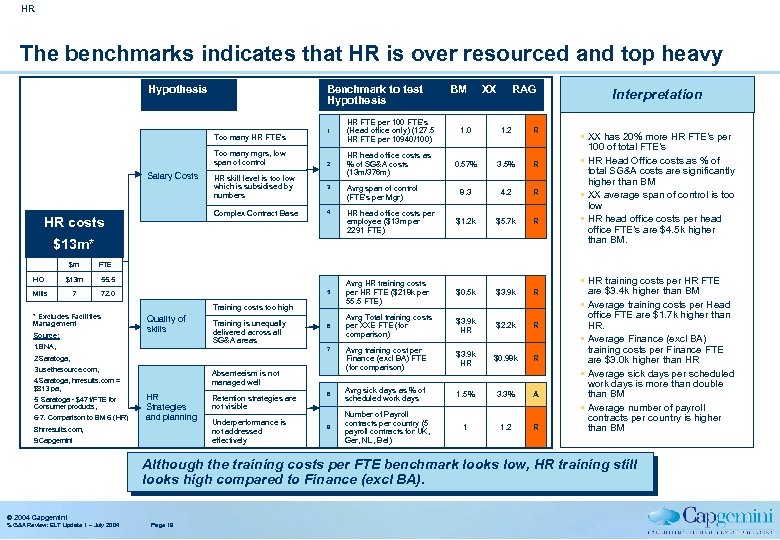 HR The benchmarks indicates that HR is over resourced and top heavy Benchmark to test Hypothesis Too many HR FTE’s Too many mgrs, low span of control Salary Costs BM XX RAG 1 HR FTE per 100 FTE’s (Head office only) (127. 5 HR FTE per 10940/100) 1. 0 1. 2 R 2 HR head office costs as % of SG&A costs (13 m/376 m) 0. 57% 3. 5% R 8. 3 4. 2 R 3 Avrg span of control (FTE’s per Mgr) Complex Contract Base 4 HR head office costs per employee ($13 m per 2291 FTE) $1. 2 k $5. 7 k R 5 HR costs HR skill level is too low which is subsidised by numbers Avrg HR training costs per HR FTE ($218 k per 55. 5 FTE) $0. 5 k $3. 9 k R 6 Avrg Total training costs per XXE FTE (for comparison) $3. 9 k HR $2. 2 k R Avrg training cost per Finance (excl BA) FTE (for comparison) $3. 9 k HR $0. 98 k R 8 Avrg sick days as % of scheduled work days 1. 5% 3. 3% A 9 Number of Payroll contracts per country (5 payroll contracts for UK, Ger, NL, Bel) 1 1. 2 R $13 m* $m Interpretation XX has 20% more HR FTE’s per 100 of total FTE’s HR Head Office costs as % of total SG&A costs are significantly higher than BM XX average span of control is too low HR head office costs per head office FTE’s are $4. 5 k higher than BM. FTE HO $13 m 55. 5 Mills ? 72. 0 Training costs too high * Excludes Facilities Management Source: Quality of skills 1. BNA, Training is unequally delivered across all SG&A areas 7 2. Saratoga, 3. usethesource. com, 4. Saratoga, hrresults. com = $813 pa, 5. Saratoga - $471/FTE for Consumer products, 6 -7. Comparison to BM 6 (HR) Absenteeism is not managed well HR Strategies and planning 8. hrresults. com, 9. Capgemini Retention strategies are not visible Underperformance is not addressed effectively HR training costs per HR FTE are $3. 4 k higher than BM Average training costs per Head office FTE are $1. 7 k higher than HR. Average Finance (excl BA) training costs per Finance FTE are $3. 0 k higher than HR Average sick days per scheduled work days is more than double than BM Average number of payroll contracts per country is higher than BM Although the training costs per FTE benchmark looks low, HR training still looks high compared to Finance (excl BA). © 2004 Capgemini S. G&A Review: ELT Update 1 – July 2004 Page 19
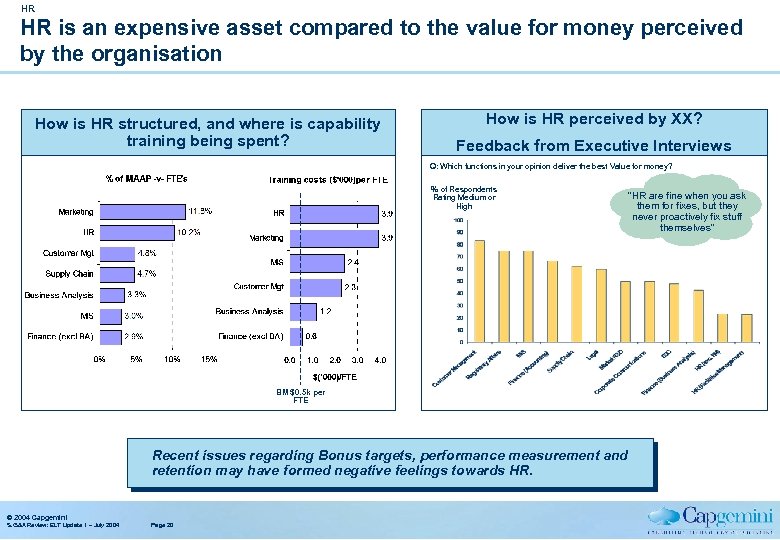 HR HR is an expensive asset compared to the value for money perceived by the organisation How is HR structured, and where is capability training being spent? How is HR perceived by XX? Feedback from Executive Interviews Q: Which functions in your opinion deliver the best Value for money? % of Respondents Rating Medium or High BM $0. 5 k per FTE Recent issues regarding Bonus targets, performance measurement and retention may have formed negative feelings towards HR. © 2004 Capgemini S. G&A Review: ELT Update 1 – July 2004 Page 20 “HR are fine when you ask them for fixes, but they never proactively fix stuff themselves”
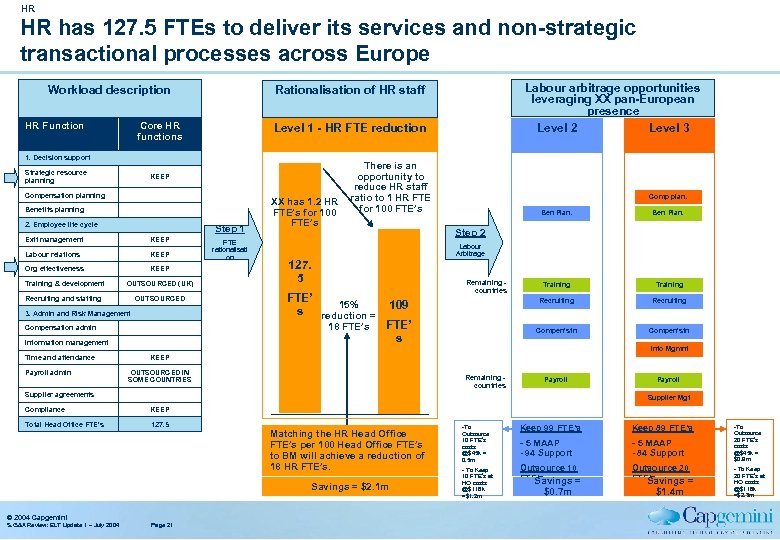 HR HR has 127. 5 FTEs to deliver its services and non-strategic transactional processes across Europe Workload description HR Function Core HR functions Level 1 - HR FTE reduction 1. Decision support Strategic resource planning KEEP Compensation planning Benefits planning 2. Employee life cycle Step 1 Exit management KEEP Labour relations KEEP Org effectiveness KEEP Training & development OUTSOURCED (UK) Recruiting and staffing OUTSOURCED 3. Admin and Risk Management Information management Time and attendance Payroll admin FTE rationalisati on XX has 1. 2 HR FTE’s for 100 FTE’s There is an opportunity to reduce HR staff ratio to 1 HR FTE for 100 FTE’s Comp plan. Ben Plan. Training Recruiting Compen’stn Step 2 Labour Arbitrage 127. 5 FTE’ 15% s reduction = 18 FTE’s Compensation admin Labour arbitrage opportunities leveraging XX pan-European presence Level 2 Level 3 Rationalisation of HR staff Remaining countries 109 FTE’ s Info Mgmnt KEEP OUTSOURCED IN SOME COUNTRIES Remaining countries Payroll Supplier agreements Payroll Supplier Mgt Compliance KEEP Total Head Office FTE’s 127. 5 Matching the HR Head Office FTE’s per 100 Head Office FTE’s to BM will achieve a reduction of 18 HR FTE’s. Savings = $2. 1 m © 2004 Capgemini S. G&A Review: ELT Update 1 – July 2004 Page 21 -To Outsource 10 FTE’s costs @$45 k = 0. 5 m - To Keep 10 FTE’s at HO costs @$116 k =$1. 2 m Keep 99 FTE’s Keep 89 FTE’s - 5 MAAP Outsource 10 FTE’s Savings = Outsource 20 FTE’s Savings = - 94 Support $0. 7 m - 84 Support $1. 4 m -To Outsource 20 FTE’s costs @$45 k = $0. 9 m - To Keep 20 FTE’s at HO costs @$116 k =$2. 3 m
 Business Analysis © 2004 Capgemini S. G&A Review: ELT Update 1 – July 2004 Page 22
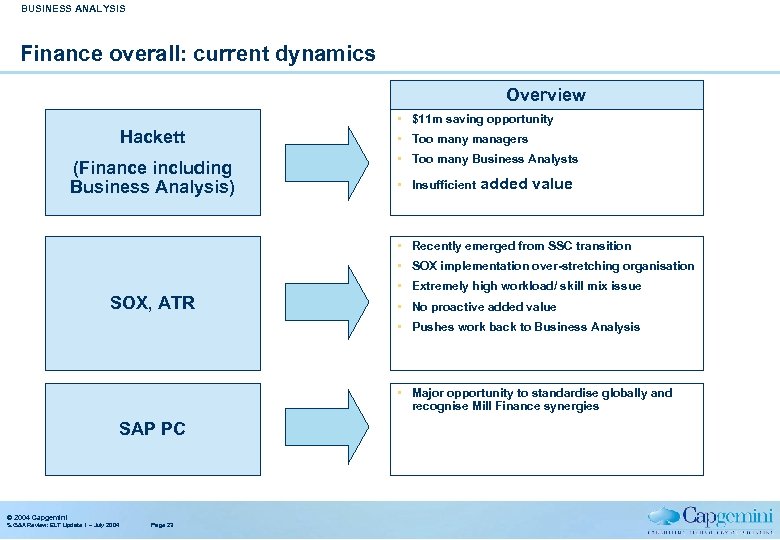 BUSINESS ANALYSIS Finance overall: current dynamics Overview • $11 m saving opportunity Hackett (Finance including Business Analysis) • Too many managers • Too many Business Analysts • Insufficient added value • Recently emerged from SSC transition • SOX implementation over-stretching organisation SOX, ATR • Extremely high workload/ skill mix issue • No proactive added value • Pushes work back to Business Analysis • Major opportunity to standardise globally and recognise Mill Finance synergies SAP PC © 2004 Capgemini S. G&A Review: ELT Update 1 – July 2004 Page 23
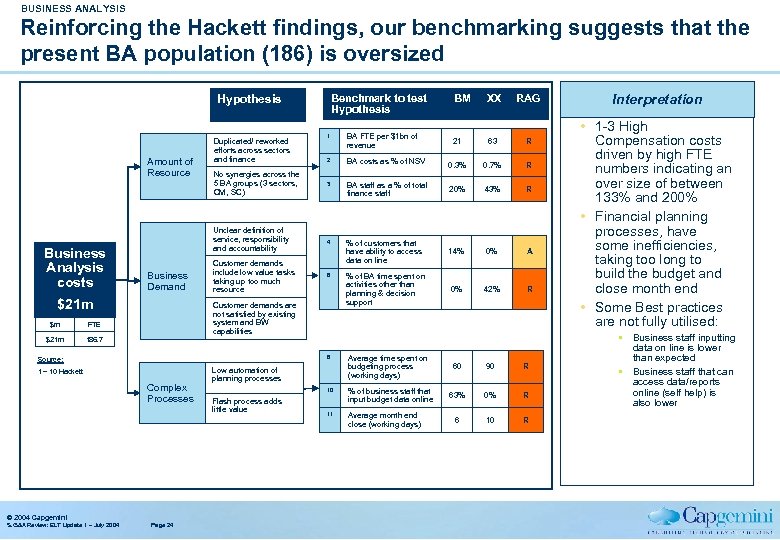 BUSINESS ANALYSIS Reinforcing the Hackett findings, our benchmarking suggests that the present BA population (186) is oversized Benchmark to test Hypothesis Business Demand $21 m $m 186. 7 21 63 R BA FTE per $1 bn of revenue 2 BA costs as % of NSV 0. 3% 0. 7% R No synergies across the 5 BA groups (3 sectors, CM, SC) 3 BA staff as a % of total finance staff 20% 43% R 4 14% 0% A Customer demands include low value tasks taking up too much resource % of customers that have ability to access data on line 6 % of BA time spent on activities other than planning & decision support 0% 42% R Duplicated/ reworked efforts across sectors and finance 8 Source: 1 – 10 Hackett Complex Processes © 2004 Capgemini S. G&A Review: ELT Update 1 – July 2004 RAG 1 Customer demands are not satisfied by existing system and BW capabilities FTE $21 m XX Unclear definition of service, responsibility and accountability Amount of Resource Business Analysis costs BM Page 24 Low automation of planning processes Average time spent on budgeting process (working days) 10 Flash process adds little value % of business staff that input budget data online 11 Average month end close (working days) 60 90 R 63% 0% R 6 10 R Interpretation 1 -3 High Compensation costs driven by high FTE numbers indicating an over size of between 133% and 200% Financial planning processes, have some inefficiencies, taking too long to build the budget and close month end Some Best practices are not fully utilised: Business staff inputting data on line is lower than expected Business staff that can access data/reports online (self help) is also lower
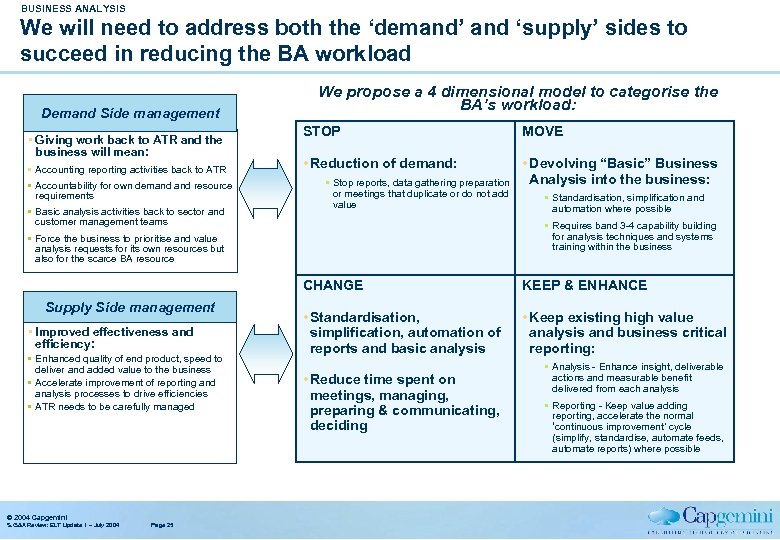 BUSINESS ANALYSIS We will need to address both the ‘demand’ and ‘supply’ sides to succeed in reducing the BA workload Demand Side management • Giving work back to ATR and the business will mean: • Accounting reporting activities back to ATR • Accountability for own demand resource requirements • Basic analysis activities back to sector and customer management teams We propose a 4 dimensional model to categorise the BA’s workload: STOP MOVE Reduction of demand: Devolving “Basic” Business Analysis into the business: Stop reports, data gathering preparation or meetings that duplicate or do not add value Standardisation, simplification and automation where possible Requires band 3 -4 capability building for analysis techniques and systems training within the business • Force the business to prioritise and value analysis requests for its own resources but also for the scarce BA resource CHANGE Supply Side management • Improved effectiveness and efficiency: • Enhanced quality of end product, speed to deliver and added value to the business • Accelerate improvement of reporting and analysis processes to drive efficiencies • ATR needs to be carefully managed © 2004 Capgemini S. G&A Review: ELT Update 1 – July 2004 Page 25 KEEP & ENHANCE Standardisation, simplification, automation of reports and basic analysis Keep existing high value analysis and business critical reporting: Reduce time spent on meetings, managing, preparing & communicating, deciding Analysis - Enhance insight, deliverable actions and measurable benefit delivered from each analysis Reporting - Keep value adding reporting, accelerate the normal ‘continuous improvement’ cycle (simplify, standardise, automate feeds, automate reports) where possible
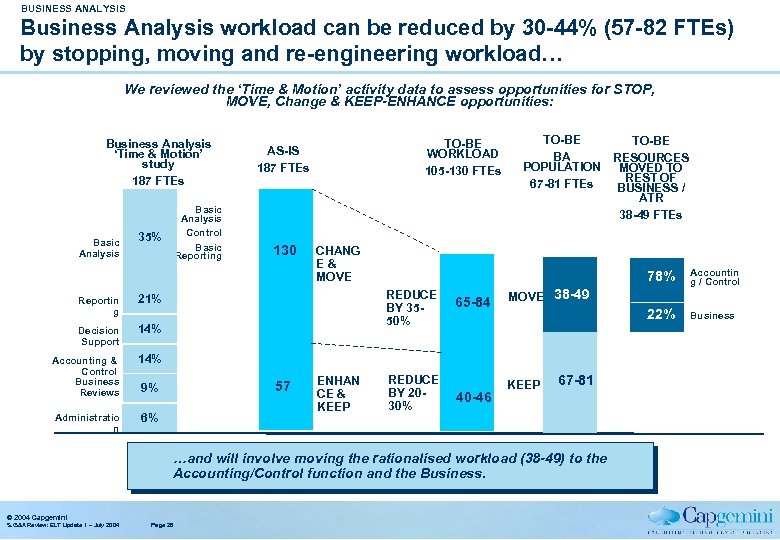 BUSINESS ANALYSIS Business Analysis workload can be reduced by 30 -44% (57 -82 FTEs) by stopping, moving and re-engineering workload… We reviewed the ‘Time & Motion’ activity data to assess opportunities for STOP, MOVE, Change & KEEP-ENHANCE opportunities: Business Analysis ‘Time & Motion’ study 187 FTEs Basic Analysis Control Basic Reporting 35% Reportin g 78% REDUCE BY 3550% 6% 57 9% ENHAN CE & KEEP REDUCE BY 2030% 65 -84 40 -46 22% KEEP 67 -81 …and will involve moving the rationalised workload (38 -49) to the Accounting/Control function and the Business. © 2004 Capgemini S. G&A Review: ELT Update 1 – July 2004 Page 26 Accountin g / Control Business MOVE 38 -49 14% Administratio n TO-BE BA RESOURCES POPULATION MOVED TO REST OF 67 -81 FTEs BUSINESS / ATR 38 -49 FTEs CHANG E& MOVE 14% Accounting & Control Business Reviews 130 21% Decision Support TO-BE WORKLOAD 105 -130 FTEs AS-IS 187 FTEs
 Facilities Management © 2004 Capgemini S. G&A Review: ELT Update 1 – July 2004 Page 27
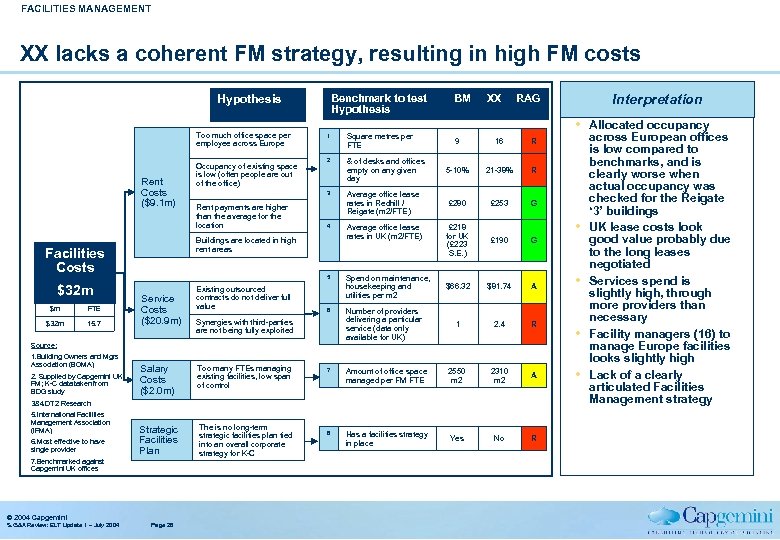 FACILITIES MANAGEMENT XX lacks a coherent FM strategy, resulting in high FM costs Benchmark to test Hypothesis Too much office space per employee across Europe Rent Costs ($9. 1 m) $m FTE $32 m 15. 7 Square metres per FTE 2 & of desks and offices empty on any given day 3 Rent payments are higher than the average for the location 4 Buildings are located in high rent areas Facilities Costs $32 m Occupancy of existing space is low (often people are out of the office) 1 5 Service Costs ($20. 9 m) Existing outsourced contracts do not deliver full value 6 Synergies with third-parties are not being fully exploited Average office lease rates in Redhill / Reigate (m 2/FTE) Average office lease rates in UK (m 2/FTE) Spend on maintenance, housekeeping and utilities per m 2 Number of providers delivering a particular service (data only available for UK) BM XX RAG 9 16 R 5 -10% 21 -38% R £ 280 £ 253 G £ 218 for UK (£ 223 S. E. ) £ 190 G $66. 32 $81. 74 A 1 2. 4 R Source: 1. Building Owners and Mgrs Association (BOMA) 2. Supplied by Capgemini UK FM; K-C data taken from BDG study Salary Costs ($2. 0 m) Too many FTEs managing existing facilities, low span of control Strategic Facilities Plan The is no long-term strategic facilities plan tied into an overall corporate strategy for K-C 7 Amount of office space managed per FM FTE 2550 m 2 2310 m 2 A 8 Has a facilities strategy in place Yes No R 3&4. DTZ Research 5. International Facilities Management Association (IFMA) 6. Most effective to have single provider 7. Benchmarked against Capgemini UK offices © 2004 Capgemini S. G&A Review: ELT Update 1 – July 2004 Page 28 Interpretation Allocated occupancy across European offices is low compared to benchmarks, and is clearly worse when actual occupancy was checked for the Reigate ‘ 3’ buildings UK lease costs look good value probably due to the long leases negotiated Services spend is slightly high, through more providers than necessary Facility managers (16) to manage Europe facilities looks slightly high Lack of a clearly articulated Facilities Management strategy
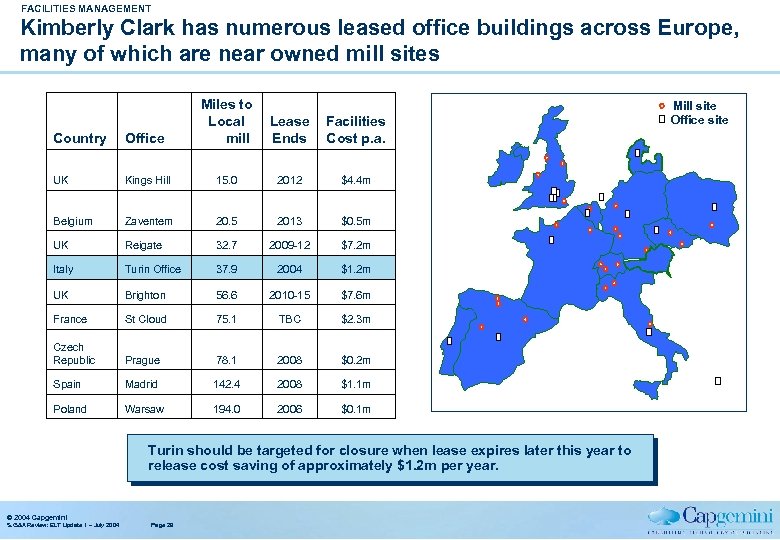 FACILITIES MANAGEMENT Kimberly Clark has numerous leased office buildings across Europe, many of which are near owned mill sites Country Office Miles to Local mill UK Kings Hill 15. 0 2012 $4. 4 m Belgium Zaventem 20. 5 2013 $0. 5 m UK Reigate 32. 7 2009 -12 $7. 2 m Italy Turin Office 37. 9 2004 $1. 2 m UK Brighton 56. 6 2010 -15 $7. 6 m France St Cloud 75. 1 TBC $2. 3 m Czech Republic Prague 78. 1 2008 $0. 2 m Spain Madrid 142. 4 2008 $1. 1 m Poland Warsaw 194. 0 2006 $0. 1 m Lease Ends Facilities Cost p. a. Turin should be targeted for closure when lease expires later this year to release cost saving of approximately $1. 2 m per year. © 2004 Capgemini S. G&A Review: ELT Update 1 – July 2004 Page 29 Mill site Office site
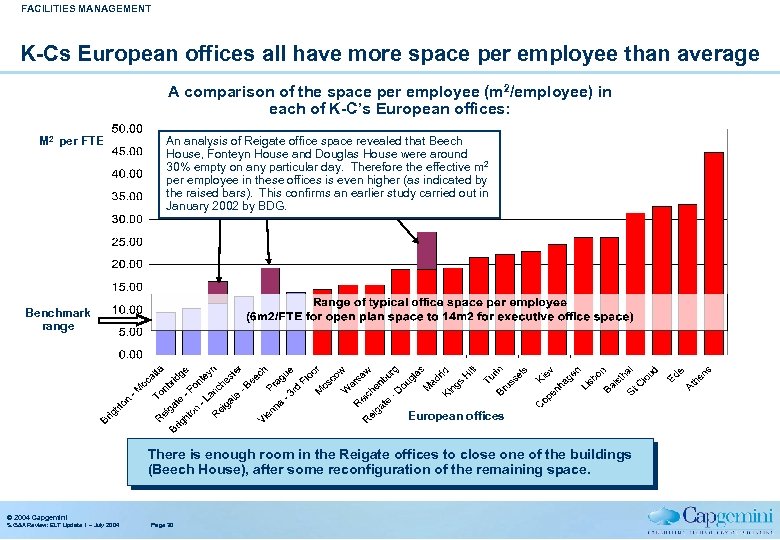 FACILITIES MANAGEMENT K-Cs European offices all have more space per employee than average A comparison of the space per employee (m 2/employee) in each of K-C’s European offices: M 2 per FTE An analysis of Reigate office space revealed that Beech House, Fonteyn House and Douglas House were around 30% empty on any particular day. Therefore the effective m 2 per employee in these offices is even higher (as indicated by the raised bars). This confirms an earlier study carried out in January 2002 by BDG. Benchmark range European offices There is enough room in the Reigate offices to close one of the buildings (Beech House), after some reconfiguration of the remaining space. © 2004 Capgemini S. G&A Review: ELT Update 1 – July 2004 Page 30
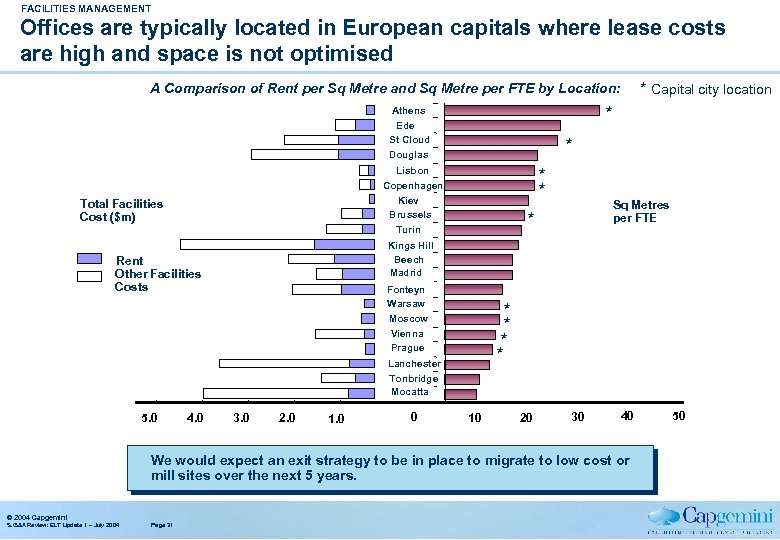 FACILITIES MANAGEMENT Offices are typically located in European capitals where lease costs are high and space is not optimised A Comparison of Rent per Sq Metre and Sq Metre per FTE by Location: * Athens Ede St Cloud Douglas * Lisbon Copenhagen Kiev Brussels Turin Total Facilities Cost ($m) * Capital city location * * Sq Metres per FTE * Kings Hill Beech Madrid Rent Other Facilities Costs Fonteyn Warsaw Moscow * * Vienna Prague Lanchester Tonbridge Mocatta 5. 0 4. 0 3. 0 2. 0 1. 0 0 10 20 30 40 We would expect an exit strategy to be in place to migrate to low cost or mill sites over the next 5 years. © 2004 Capgemini S. G&A Review: ELT Update 1 – July 2004 Page 31 50
 Outsourcing and Labour Arbitrage © 2004 Capgemini S. G&A Review: ELT Update 1 – July 2004 Page 32
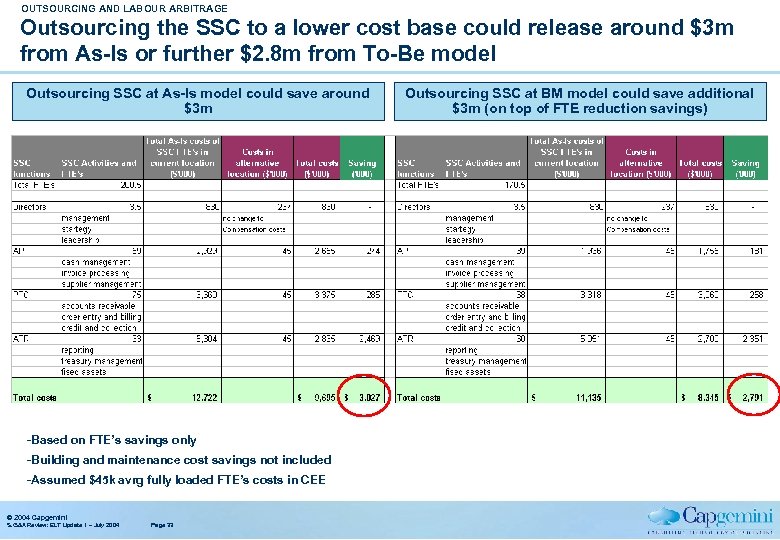 OUTSOURCING AND LABOUR ARBITRAGE Outsourcing the SSC to a lower cost base could release around $3 m from As-Is or further $2. 8 m from To-Be model Outsourcing SSC at As-Is model could save around $3 m -Based on FTE’s savings only -Building and maintenance cost savings not included -Assumed $45 k avrg fully loaded FTE’s costs in CEE © 2004 Capgemini S. G&A Review: ELT Update 1 – July 2004 Page 33 Outsourcing SSC at BM model could save additional $3 m (on top of FTE reduction savings)
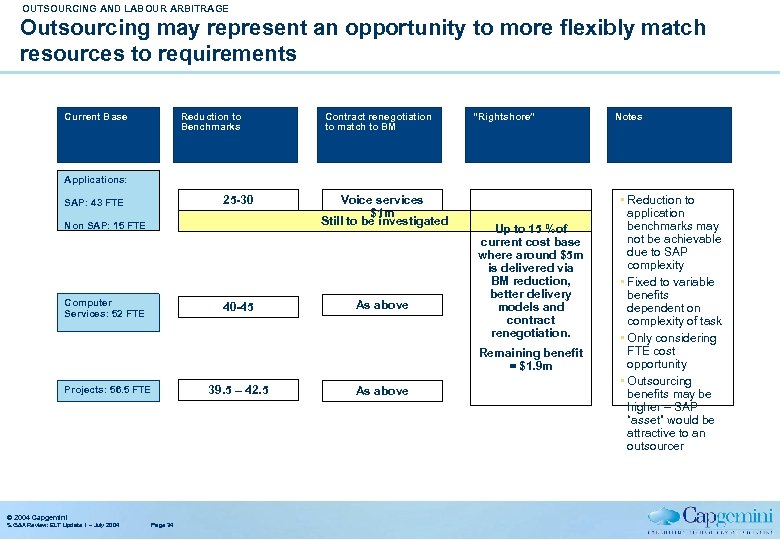 OUTSOURCING AND LABOUR ARBITRAGE Outsourcing may represent an opportunity to more flexibly match resources to requirements Current Base Reduction to Benchmarks Contract renegotiation to match to BM “Rightshore” Notes Applications: 25 -30 SAP: 43 FTE Non SAP: 15 FTE Computer Services: 52 FTE 40 -45 Voice services $1 m Still to be investigated As above Up to 15 %of current cost base where around $5 m is delivered via BM reduction, better delivery models and contract renegotiation. Remaining benefit = $1. 9 m 39. 5 – 42. 5 Projects: 56. 5 FTE © 2004 Capgemini S. G&A Review: ELT Update 1 – July 2004 Page 34 As above • Reduction to application benchmarks may not be achievable due to SAP complexity • Fixed to variable benefits dependent on complexity of task • Only considering FTE cost opportunity • Outsourcing benefits may be higher – SAP “asset” would be attractive to an outsourcer