


 Скачать презентацию — Client-oriented Logistics Information System CLIS — April
649504276f92e1a12c9383b52f3077b4.ppt
- Количество слайдов: 29
 - Client-oriented Logistics Information System (CLIS) - April 25, 2008 Presented by Chun, Hong-Uk Director General, Clearance Facilitation Bureau Korea Customs Service
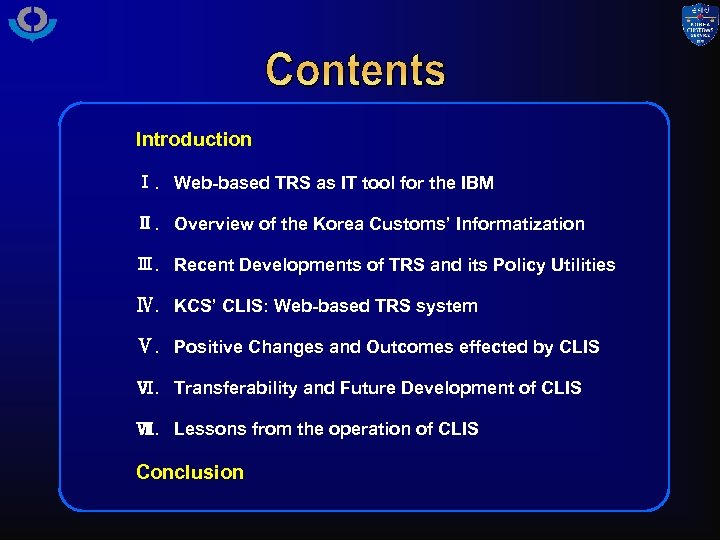 Introduction Ⅰ. Web-based TRS as IT tool for the IBM Ⅱ. Overview of the Korea Customs’ Informatization Ⅲ. Recent Developments of TRS and its Policy Utilities Ⅳ. KCS’ CLIS: Web-based TRS system Ⅴ. Positive Changes and Outcomes effected by CLIS Ⅵ. Transferability and Future Development of CLIS Ⅶ. Lessons from the operation of CLIS Conclusion
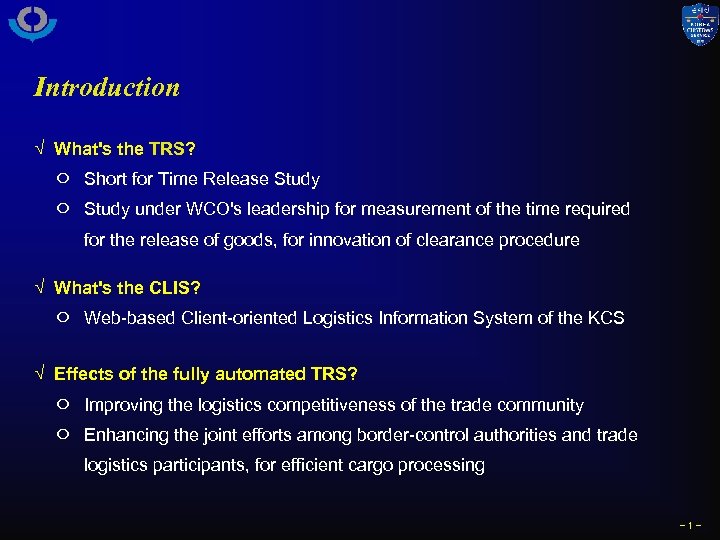 Introduction √ What's the TRS? ㅇ Short for Time Release Study ㅇ Study under WCO's leadership for measurement of the time required for the release of goods, for innovation of clearance procedure √ What's the CLIS? ㅇ Web-based Client-oriented Logistics Information System of the KCS √ Effects of the fully automated TRS? ㅇ Improving the logistics competitiveness of the trade community ㅇ Enhancing the joint efforts among border-control authorities and trade logistics participants, for efficient cargo processing -1 -
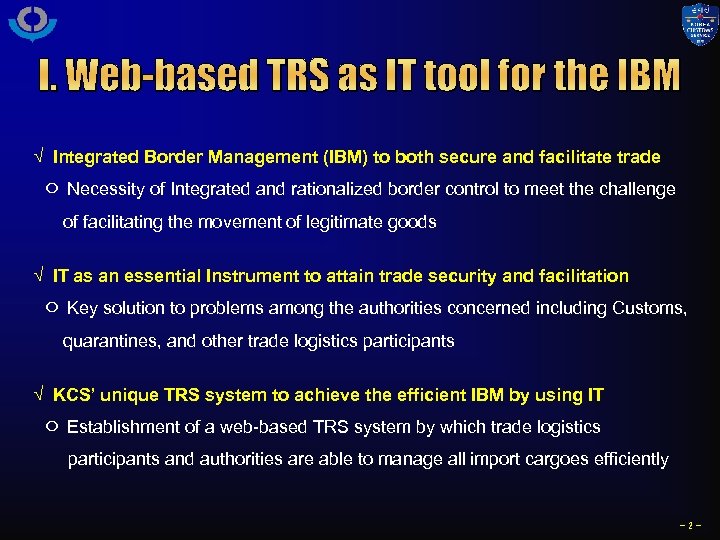 √ Integrated Border Management (IBM) to both secure and facilitate trade ㅇ Necessity of Integrated and rationalized border control to meet the challenge of facilitating the movement of legitimate goods √ IT as an essential Instrument to attain trade security and facilitation ㅇ Key solution to problems among the authorities concerned including Customs, quarantines, and other trade logistics participants √ KCS’ unique TRS system to achieve the efficient IBM by using IT ㅇ Establishment of a web-based TRS system by which trade logistics participants and authorities are able to manage all import cargoes efficiently -2 -
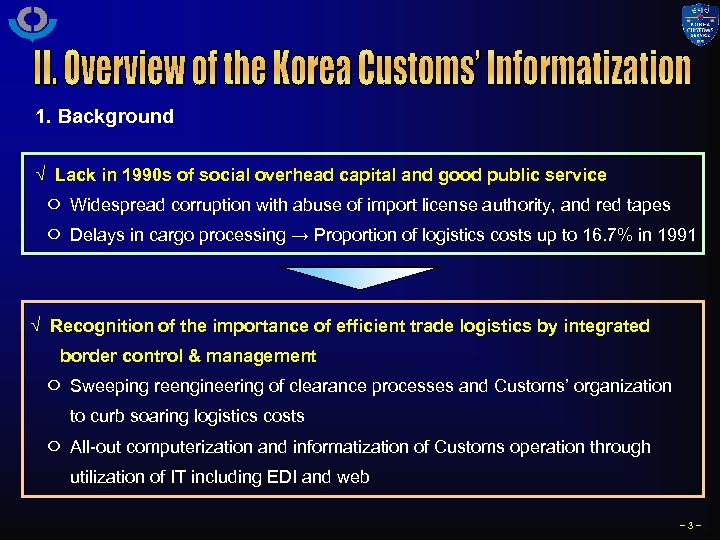 1. Background √ Lack in 1990 s of social overhead capital and good public service ㅇ Widespread corruption with abuse of import license authority, and red tapes ㅇ Delays in cargo processing → Proportion of logistics costs up to 16. 7% in 1991 √ Recognition of the importance of efficient trade logistics by integrated border control & management ㅇ Sweeping reengineering of clearance processes and Customs’ organization to curb soaring logistics costs ㅇ All-out computerization and informatization of Customs operation through utilization of IT including EDI and web -3 -
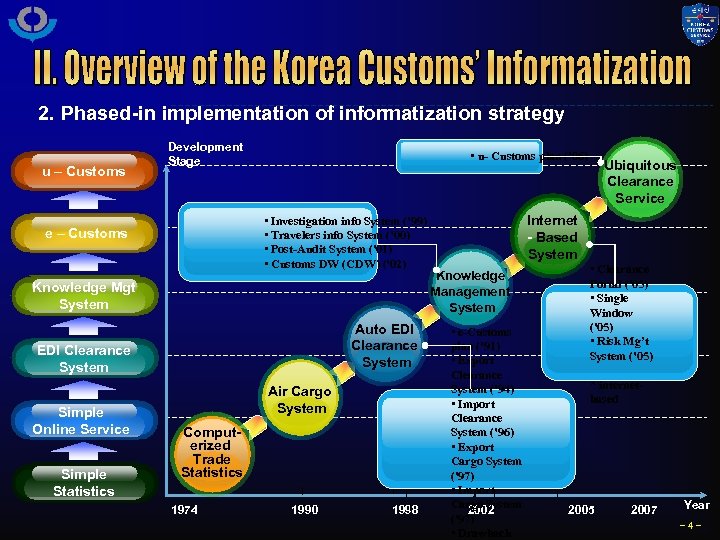 2. Phased-in implementation of informatization strategy u – Customs Development Stage • u- Customs plan ('06) • Investigation info System ('99) • Travelers info System ('00) • Post-Audit System ('01) • Customs DW (CDW) ('02) e – Customs Knowledge Mgt System Auto EDI Clearance System Simple Online Service Simple Statistics Air Cargo System Computerized Trade Statistics 1974 1990 1998 Ubiquitous Clearance Service Internet - Based System Knowledge Management System • e-Customs plan ('91) • Export Clearance System ('94) • Import Clearance System ('96) • Export Cargo System ('97) • Import Cargo System 2002 ('97) • Drawback • Clearance Portal ('05) • Single Window ('05) • Risk Mg’t System ('05) * internetbased 2005 2007 Year -4 -
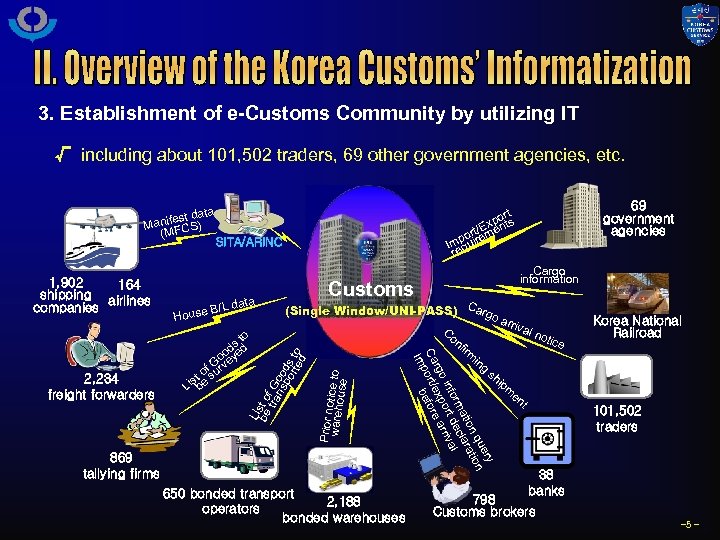 3. Establishment of e-Customs Community by utilizing IT √ including about 101, 502 traders, 69 other government agencies, etc. data se B/L Hou to ds d ooeye f G rv o su st Li be Cargo information Customs (Single Window/UNI-PASS) Cargo arr ival Co no tice nf irm in g sh ip m en t 869 tallying firms 650 bonded transport 2, 188 operators bonded warehouses ry ue n q ion tio rat ma cla for de l in ort rriva rgo xp a Ca port/e efore b Im 2, 234 freight forwarders SITA/ARINC Li best o traf G ns ood po s rte to d 1, 902 164 shipping airlines companies 69 government agencies rt po Ex ents / ort m mp uire I eq r Prior no t warehoice to use t data anifes S) M (MFC Korea National Railroad 101, 502 traders 38 banks 798 Customs brokers -5 -
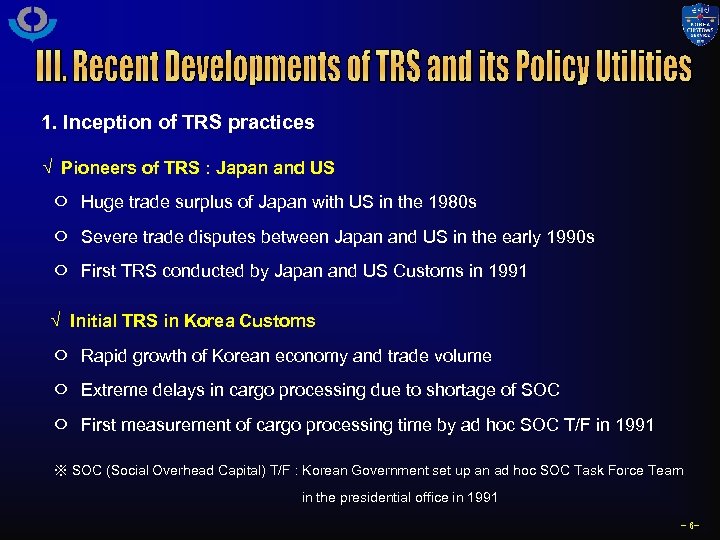 1. Inception of TRS practices √ Pioneers of TRS : Japan and US ㅇ Huge trade surplus of Japan with US in the 1980 s ㅇ Severe trade disputes between Japan and US in the early 1990 s ㅇ First TRS conducted by Japan and US Customs in 1991 √ Initial TRS in Korea Customs ㅇ Rapid growth of Korean economy and trade volume ㅇ Extreme delays in cargo processing due to shortage of SOC ㅇ First measurement of cargo processing time by ad hoc SOC T/F in 1991 ※ SOC (Social Overhead Capital) T/F : Korean Government set up an ad hoc SOC Task Force Team in the presidential office in 1991 - 6 -
 2. WCO's guideline to Time Release Survey √ Customs as foremost agency at the border and its prominent role in the release of goods ㅇ Necessity to measure the level of effectiveness of Customs operations ㅇ Measurement of average time taken between goods arrival and their release √ WCO PTC's adoption of TRS based on similar initiatives undertaken by Japan and US Customs in 1994 √ WCO's adoption in 2001 of 'Guide to Measure the Time required for the Release of Goods (TRS Guideline)' -7 -
 3. Adoption as Collective Action Plan (CAP) item of APEC SCCP √ Support at APEC Ministerial Meeting in 2003 and 2004 for the steady progress of TRS ㅇ International efforts to promote TRS, mainly driven by Korea & Japan Customs ㅇ Proposal as a new CAP item by Japan Customs in 2005 and its adoption √ Approval as CAP item at SCCP Meeting in Feb. 2005, as a meaningful means for furthered trade facilitation ㅇ Technical assistance to APEC member countries for their easy introduction ※ APEC SCCP : Asia-Pacific Economic Cooperation Sub-Committee on Customs Procedures -8 -
 1. TRS practices before CLIS √ Before 1997 ㅇ Simple measurement of average cargo-processing time required from arrival at port to release ㅇ Survey conducted by a research institute, every several years on an as required basis, by use of sampling method √ Between 1998 and 2005 ㅇ Simply measuring average cargo-processing times at 3 intervening stages ㅇ Limited to measurement of average clearance time of import declarations lodged for one month with Customs, on a yearly basis by use of EDI system -9 -
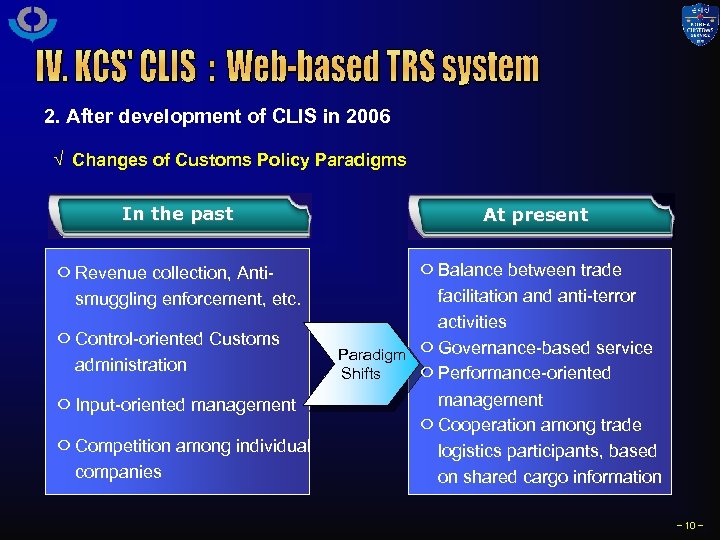 2. After development of CLIS in 2006 √ Changes of Customs Policy Paradigms In the past At present ㅇ Balance between trade facilitation and anti-terror activities ㅇ Control-oriented Customs Paradigm ㅇ Governance-based service administration Shifts ㅇ Performance-oriented management ㅇ Input-oriented management ㅇ Cooperation among trade ㅇ Competition among individual logistics participants, based companies on shared cargo information ㅇ Revenue collection, Anti smuggling enforcement, etc. - 10 -
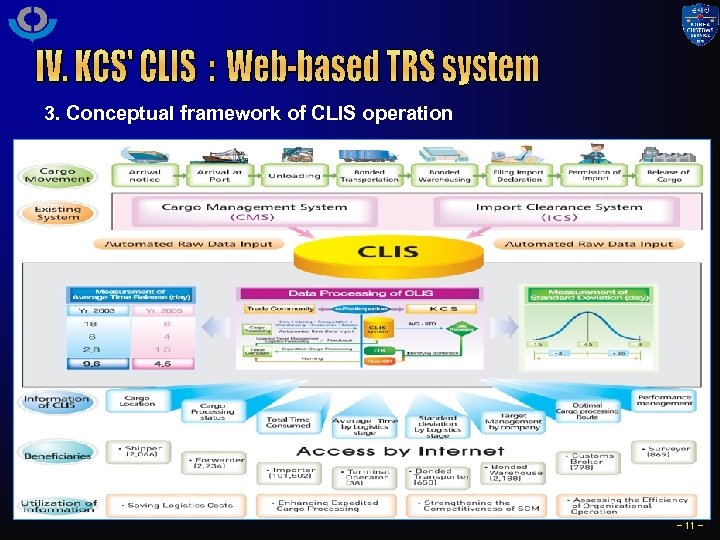 3. Conceptual framework of CLIS operation - 11 -
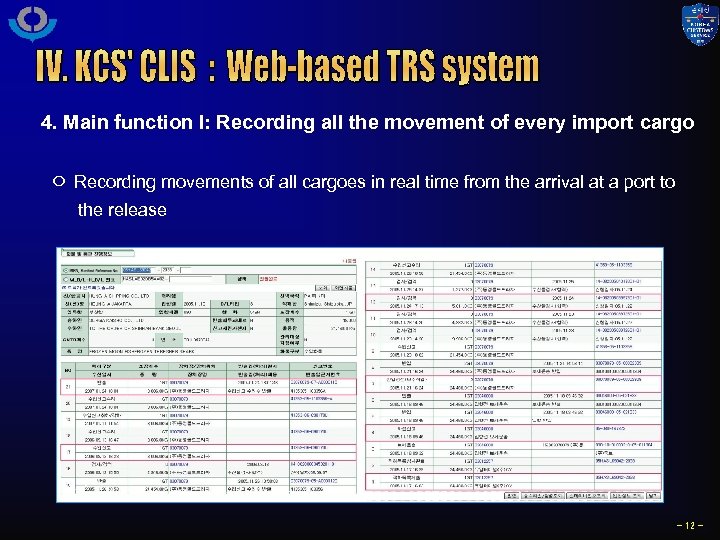 4. Main function I: Recording all the movement of every import cargo ㅇ Recording movements of all cargoes in real time from the arrival at a port to the release - 12 -
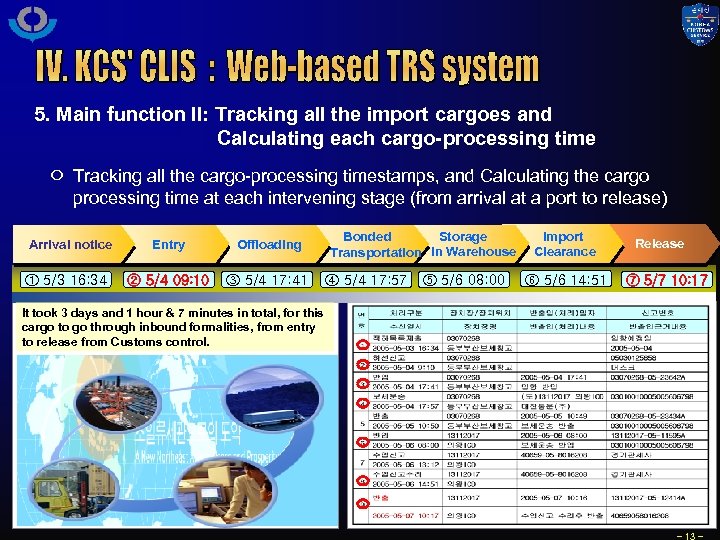 5. Main function II: Tracking all the import cargoes and Calculating each cargo-processing time ㅇ Tracking all the cargo-processing timestamps, and Calculating the cargo processing time at each intervening stage (from arrival at a port to release) Arrival notice ① 5/3 16: 34 Entry ② 5/4 09: 10 Import Storage Bonded Offloading in Warehouse Clearance Transportation ③ 5/4 17: 41 ④ 5/4 17: 57 ⑤ 5/6 08: 00 ⑥ 5/6 14: 51 Release ⑦ 5/7 10: 17 It took 3 days and 1 hour & 7 minutes in total, for this cargo to go through inbound formalities, from entry to release from Customs control. - 13 -
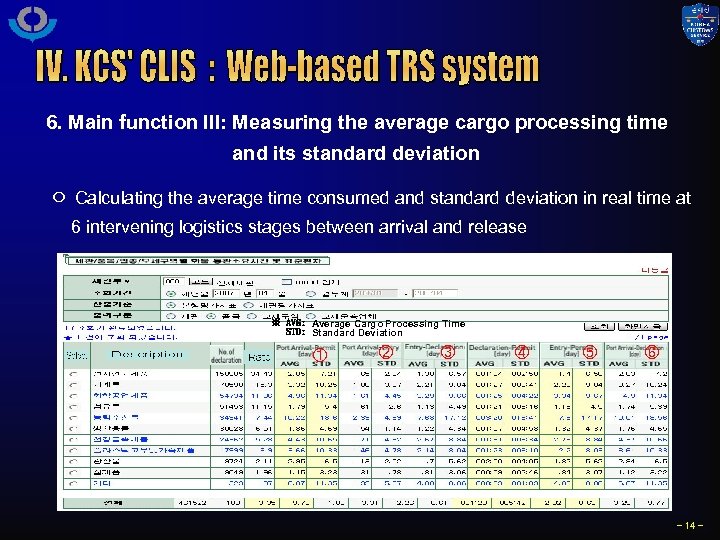 6. Main function III: Measuring the average cargo processing time and its standard deviation ㅇ Calculating the average time consumed and standard deviation in real time at 6 intervening logistics stages between arrival and release ※ AVG: Average Cargo Processing Time STD: Standard Deviation ① ② ③ ④ ⑤ ⑥ - 14 -
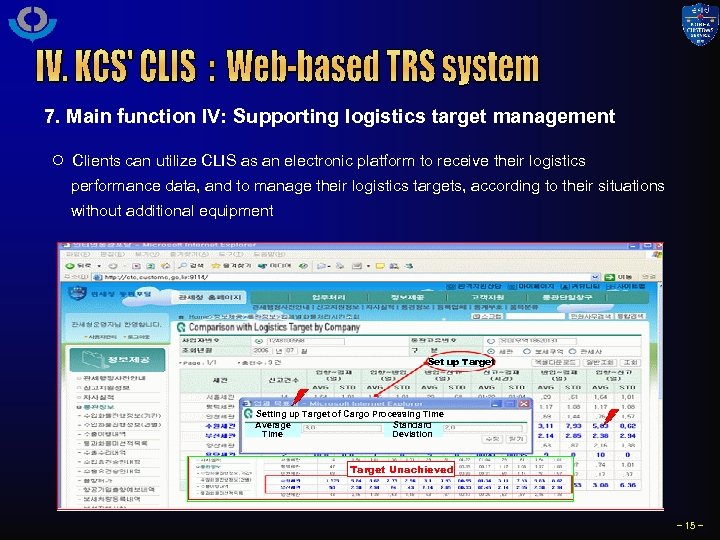 7. Main function IV: Supporting logistics target management ㅇ Clients can utilize CLIS as an electronic platform to receive their logistics performance data, and to manage their logistics targets, according to their situations without additional equipment Set up Target Setting up Target of Cargo Processing Time Average Standard Time Deviation Target Unachieved - 15 -
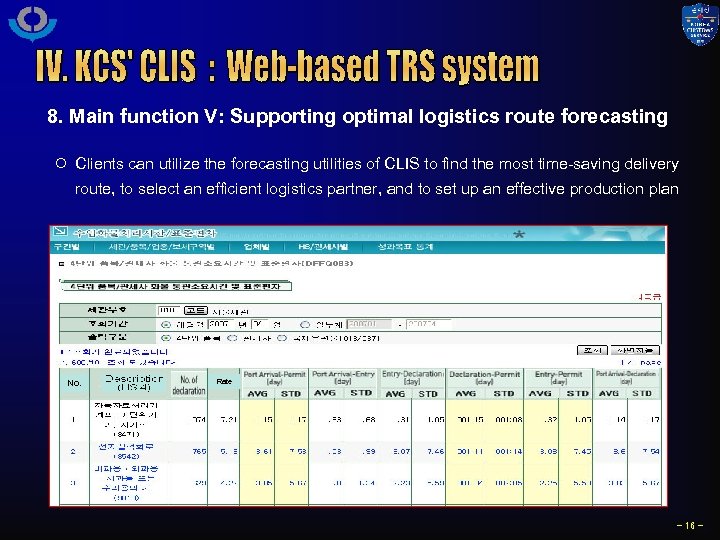 8. Main function V: Supporting optimal logistics route forecasting ㅇ Clients can utilize the forecasting utilities of CLIS to find the most time-saving delivery route, to select an efficient logistics partner, and to set up an effective production plan No. Rate - 16 -
 1. Behavioral changes in Customs and trade community √ Stimulating voluntary improvement of logistics management ㅇ diagnosing bottlenecks in logistics, finding the optimal delivery route √ Promoting client-oriented administrative service and e-participation ㅇ Providing clients with internet-based cargo processing data service, tailored to the needs and capacities of their logistics management √ Improving transparency, accountability and responsiveness ㅇ Encouraging the Customs to eliminate its red tape dramatically, and Prompting responsiveness to clients’ demands through real time performance measurement and integrated border activities - 17 -
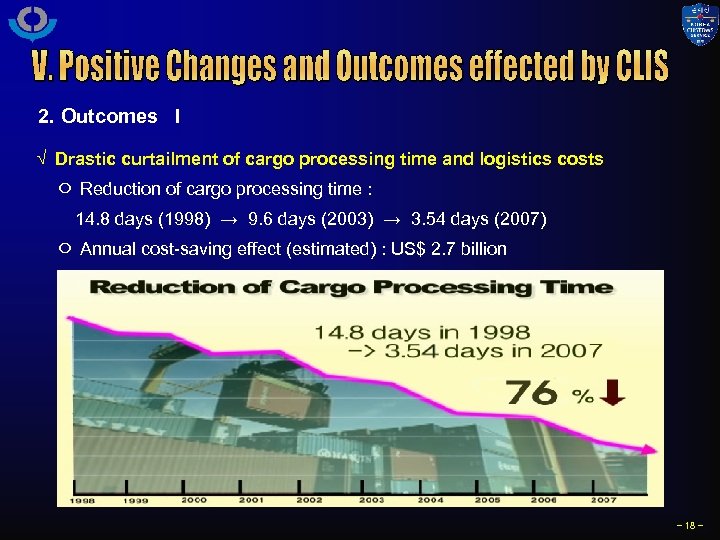 2. Outcomes I √ Drastic curtailment of cargo processing time and logistics costs ㅇ Reduction of cargo processing time : 14. 8 days (1998) → 9. 6 days (2003) → 3. 54 days (2007) ㅇ Annual cost-saving effect (estimated) : US$ 2. 7 billion - 18 -
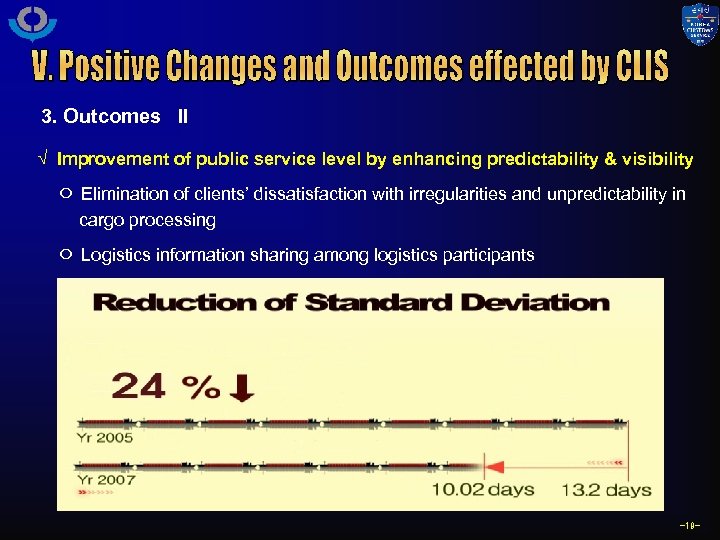 3. Outcomes II √ Improvement of public service level by enhancing predictability & visibility ㅇ Elimination of clients’ dissatisfaction with irregularities and unpredictability in cargo processing ㅇ Logistics information sharing among logistics participants -19 -
 1. Transferability √ Trade security and facilitation for social stability and national prosperity is a key issue of international society and all the countries √ CLIS, a Korean-style, fully automated and web-based TRS system, has a high return-to-investment effect, because of low development costs and great cost-saving effects; and in view of integrated border activities √ Any kind of TRS, once introduced, is expected to be a useful tool to promote the trade and create various positive effects √ Especially, many countries already have electronic systems for cargo and clearance which are the foundations of a web-based TRS - 20 -
 2. Further development toward its betterment √ To develop as an SCM information hub for Korea's trade circle ㅇ Providing ceaseless logistics information connecting home and abroad to companies with globalized production network √ To nurture as a cargo tracking and consuming-time measurement center for Korean traders ㅇ Collecting and offering logistics information of companies and government agencies at a single point ※ SCM (Supply Chain Management) : the process of planning, implementing, and controlling the operations of the supply chain for the purpose of satisfying customer requirements as efficiently as possible - 21 -
 1. Finding a feasible / proper method in light of national situation √ Korea Customs made use of TRS as a critical tool to improve trade logistics ㅇ To eliminate red tapes, and to improve its clearance procedures without additional large-scale investment in SOC √ KCS first adopted a very restricted sampling method which made use of fax and questionnaire √ Next, KCS moved to an EDI system to measure cargo processing time, once or twice a year √ Lastly, KCS uses an Internet system to provide various TRS data to clients -22 -
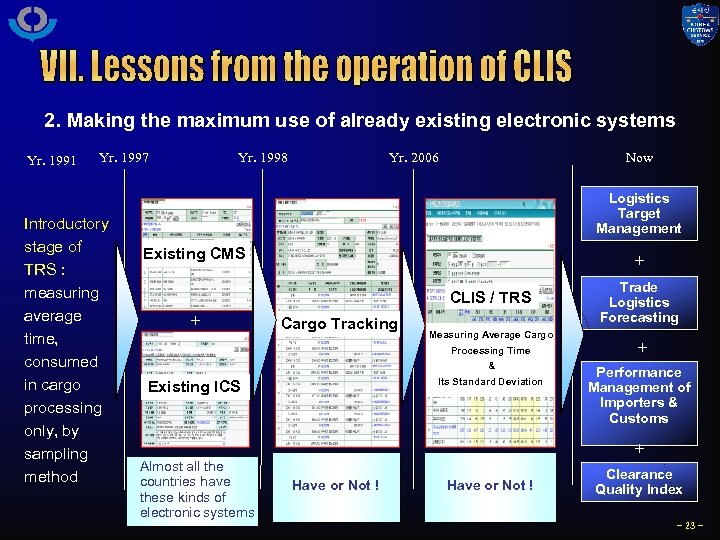 2. Making the maximum use of already existing electronic systems Yr. 1991 Yr. 1997 Introductory stage of TRS : measuring average time, consumed in cargo processing only, by sampling method Yr. 1998 Yr. 2006 Now Logistics Target Management Existing CMS + CLIS / TRS + Cargo Tracking Measuring Average Cargo Processing Time & Its Standard Deviation Existing ICS Almost all the countries have these kinds of electronic systems Trade Logistics Forecasting + Performance Management of Importers & Customs + Have or Not ! Clearance Quality Index - 23 -
 3. Enhancing the logistics competitiveness of trade community √ Today, “curtailed logistics costs” (the 3 rd profit) is one of the prerequisites for enhancing corporate and national competitiveness √ Leading companies manage trade logistics information by establishing globally integrated Supply Chain Management at home and abroad √ Sharing cargo tracking information and processing time data among logistics participants by using IT is essential to improving logistics competitiveness of trade companies and to integrated border activities - 24 -
 4. Improving the effectiveness of organizational operation √ In the past, logistics participants were not assessed in terms of their operational performance and quality √ CLIS as an enabler to real-time evaluate the operational efficiency of organizations related to Customs clearance √ Such a function helps CLIS to be a solid customs innovation motivator - 25 -
 Conclusion √ Korean-style TRS provides reliable grounds necessary to work out measures to attain the goals of trade facilitation and to induce the joint efforts in cargo processing across Customs border √ TRS creates tremendous economic effects and administrative public service improvement, with a small amount of development costs √ However, because each country relies on a different IT infrastructure and cargo processing system, the methods of introducing a web-based TRS do not necessarily have to be the same in all countries as Korea Customs’ CLIS √ In conclusion, I’d like to say that, as you see in the Korea Customs’ case, today the extensive introduction of advanced IT in the Customs modernization shall become an essential and indispensable key to solve the various problems which every Customs authorities unceasingly faces - 26 -
 - 39 -