


 Скачать презентацию Click to edit Master Update Summer Internship Progress
455dd77c39ed33c58c1702975e562c5f.ppt
- Количество слайдов: 22
 Click to edit Master Update: Summer Internship Progress title style Analysis and Modeling of Neural-Recording ADC Vaibhav Karkare Advisors: Wolfgang Eberle Vito Giannini Dejan Markovic
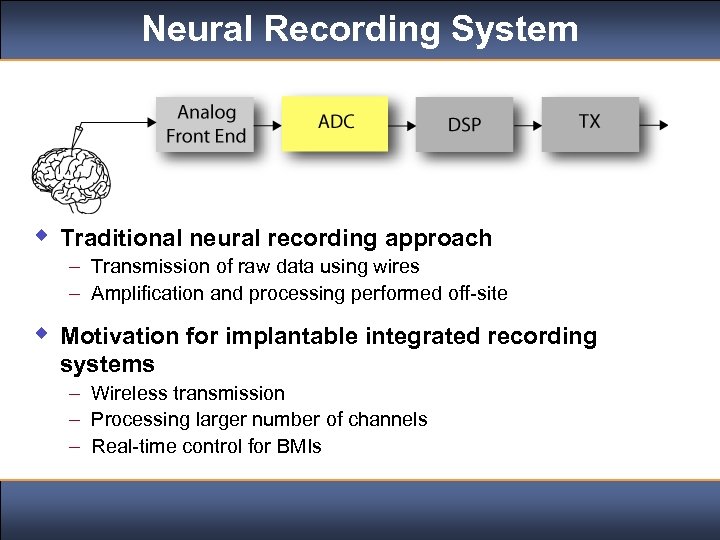 Neural Recording System Click to edit Master title style w Traditional neural recording approach – Transmission of raw data using wires – Amplification and processing performed off-site w Motivation for implantable integrated recording systems – Wireless transmission – Processing larger number of channels – Real-time control for BMIs
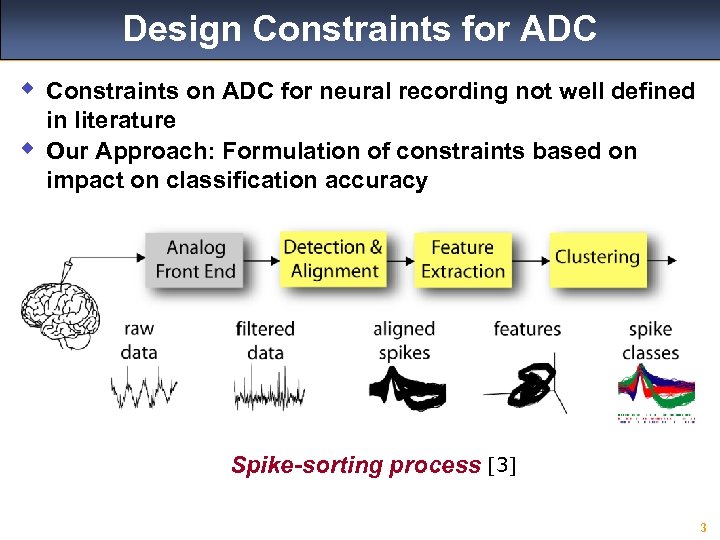 Design Constraints for ADC w Constraints on ADC for neural recording not well defined w in literature Our Approach: Formulation of constraints based on impact on classification accuracy Spike-sorting process [3] 3
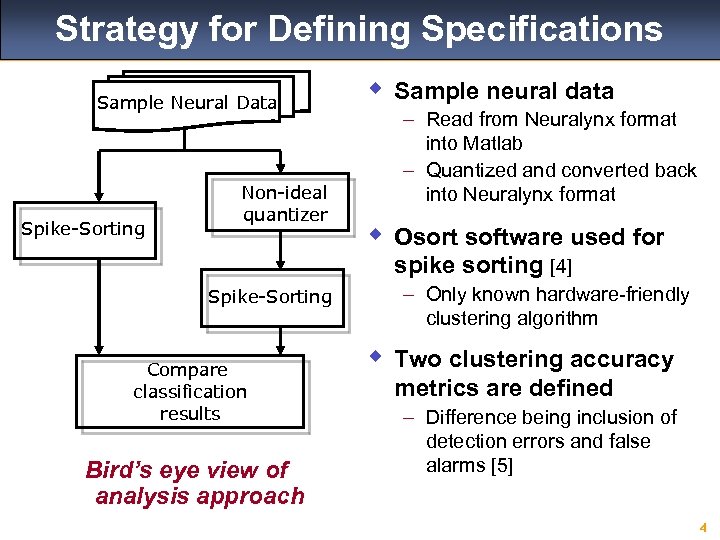 Strategy for Defining Specifications Sample Neural Data Spike-Sorting Non-ideal quantizer w Sample neural data – Read from Neuralynx format into Matlab – Quantized and converted back into Neuralynx format w Osort software used for spike sorting [4] Spike-Sorting Compare classification results Bird’s eye view of analysis approach – Only known hardware-friendly clustering algorithm w Two clustering accuracy metrics are defined – Difference being inclusion of detection errors and false alarms [5] 4
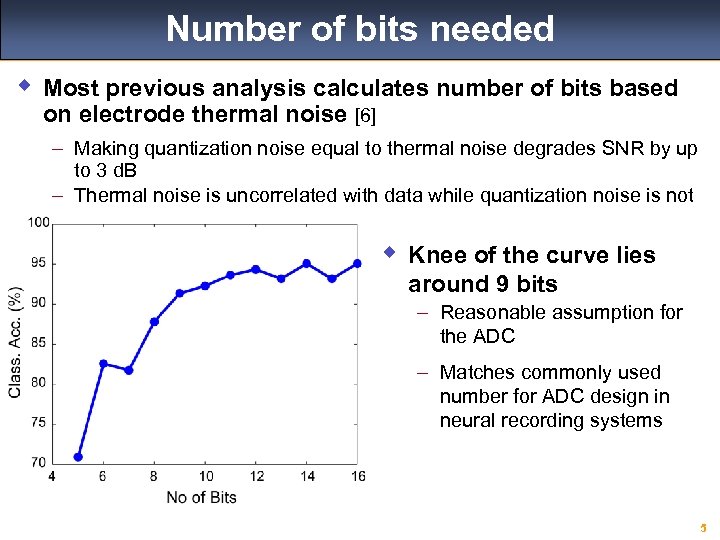 Number of bits needed w Most previous analysis calculates number of bits based on electrode thermal noise [6] – Making quantization noise equal to thermal noise degrades SNR by up to 3 d. B – Thermal noise is uncorrelated with data while quantization noise is not w Knee of the curve lies around 9 bits – Reasonable assumption for the ADC – Matches commonly used number for ADC design in neural recording systems 5
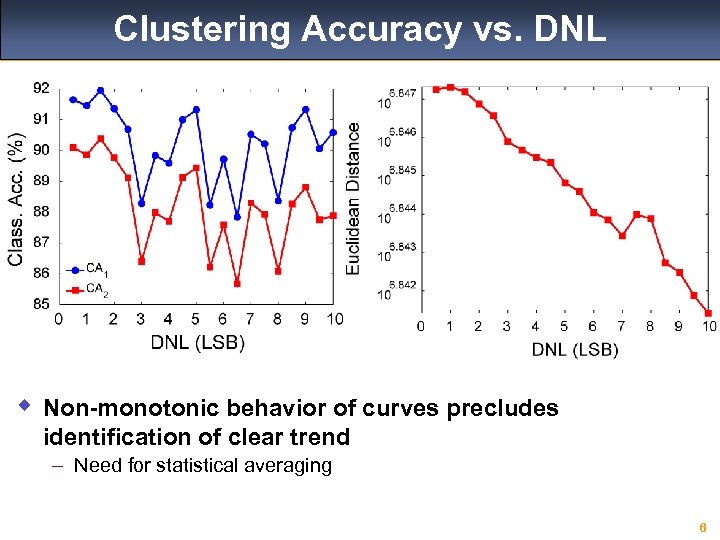 Clustering Accuracy vs. DNL w Non-monotonic behavior of curves precludes identification of clear trend – Need for statistical averaging 6
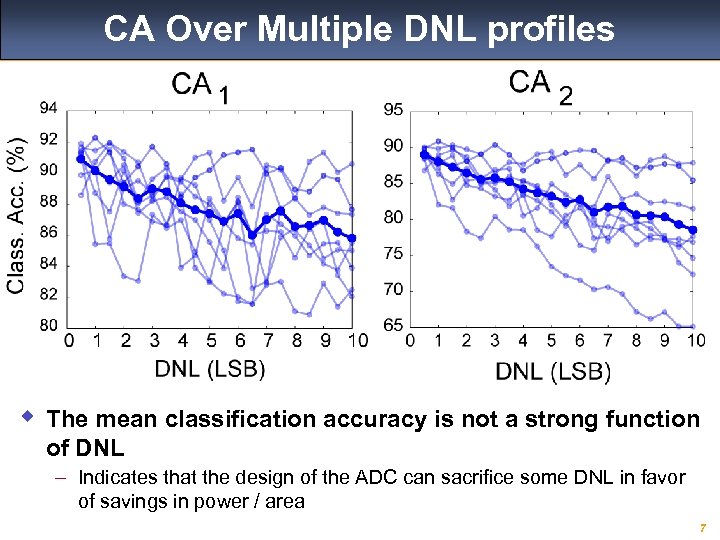 CA Over Multiple DNL profiles w The mean classification accuracy is not a strong function of DNL – Indicates that the design of the ADC can sacrifice some DNL in favor of savings in power / area 7
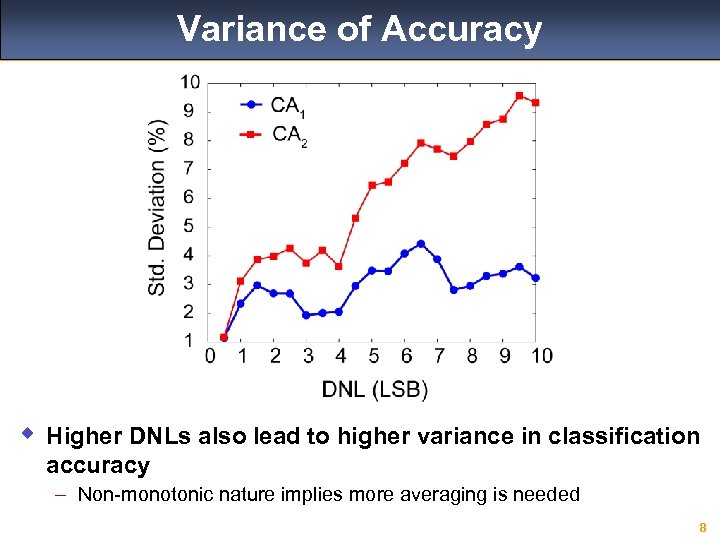 Variance of Accuracy w Higher DNLs also lead to higher variance in classification accuracy – Non-monotonic nature implies more averaging is needed 8
 Conclusions: Part 1 w Summary of this work: – Created automated simulation setup for evaluation of impact of quantization error on spike-sorting results – Initial results point towards classification accuracy being a weak function of DNL – DNL around 1. 5 LSB can be tolerated without significantly affecting classification accuracy – Higher DNLs lead to lower classification accuracy and higher variance in classification results w Future Work: – Simulation over larger number of DNL profiles and large number of data sets is required to establish validity of results – Similar analysis can be performed to include other non-idealities in analog front-end 9
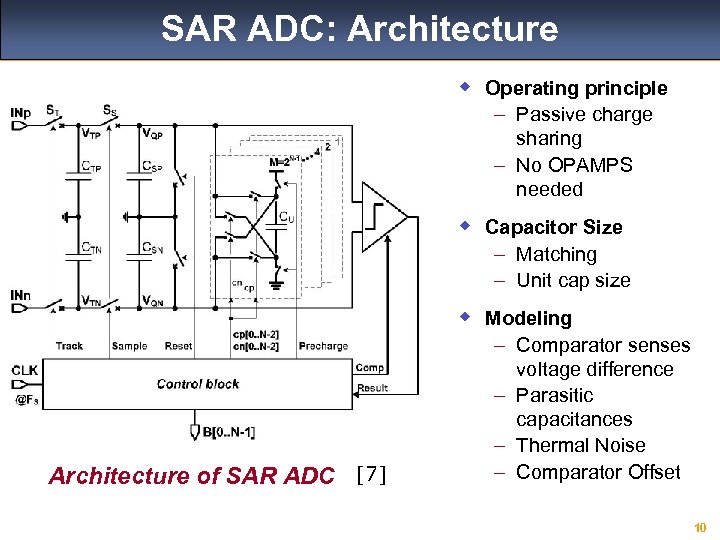 SAR ADC: Architecture w Operating principle – Passive charge sharing – No OPAMPS needed w Capacitor Size – Matching – Unit cap size w Modeling Architecture of SAR ADC [7] – Comparator senses voltage difference – Parasitic capacitances – Thermal Noise – Comparator Offset 10
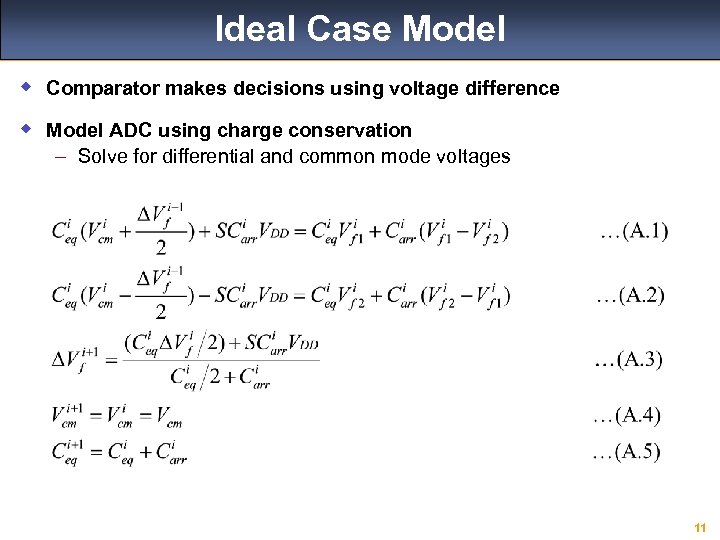 Ideal Case Model w Comparator makes decisions using voltage difference w Model ADC using charge conservation – Solve for differential and common mode voltages 11
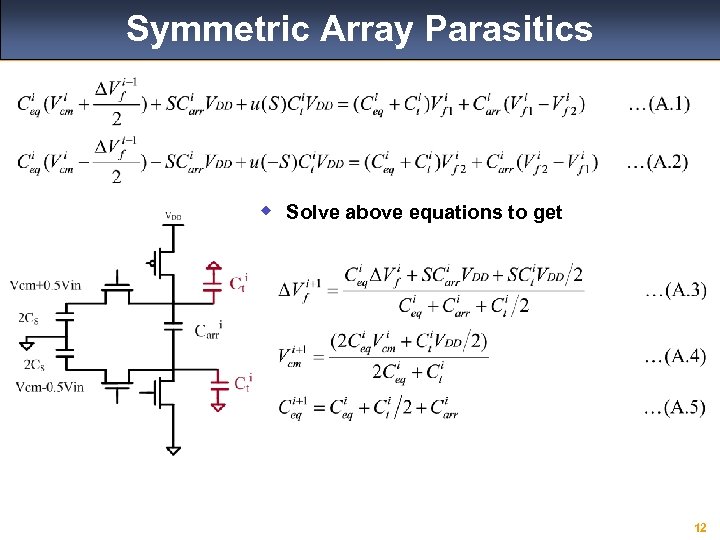 Symmetric Array Parasitics w Solve above equations to get 12
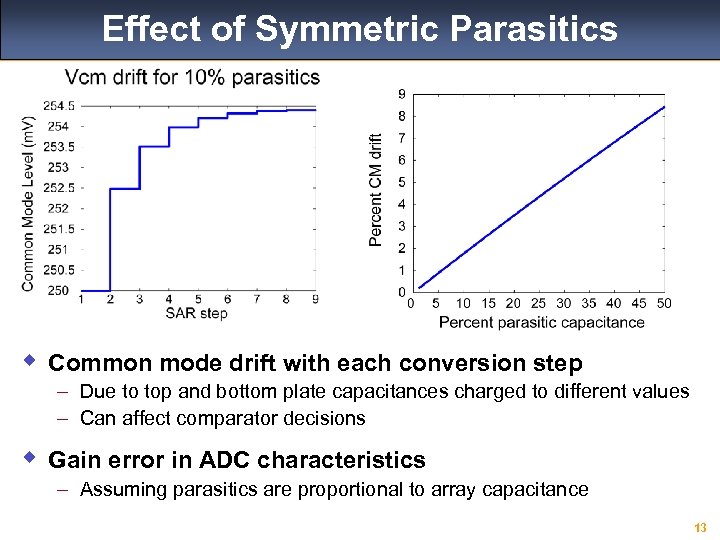 Effect of Symmetric Parasitics w Common mode drift with each conversion step – Due to top and bottom plate capacitances charged to different values – Can affect comparator decisions w Gain error in ADC characteristics – Assuming parasitics are proportional to array capacitance 13
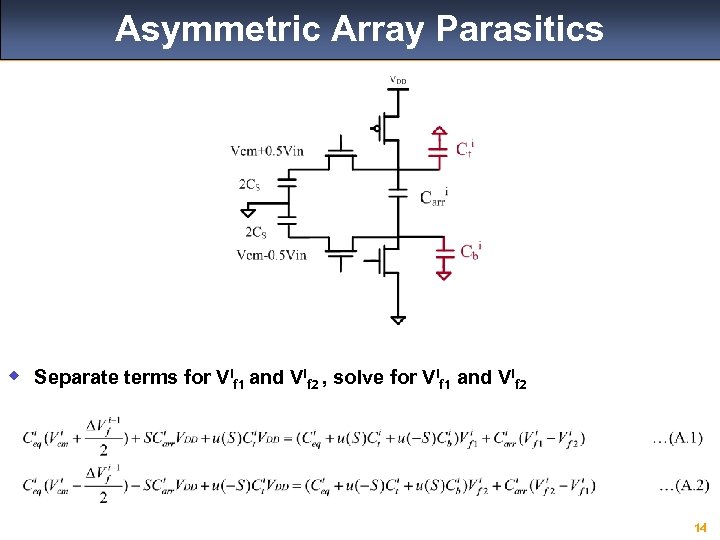 Asymmetric Array Parasitics w Separate terms for Vif 1 and Vif 2 , solve for Vif 1 and Vif 2 14
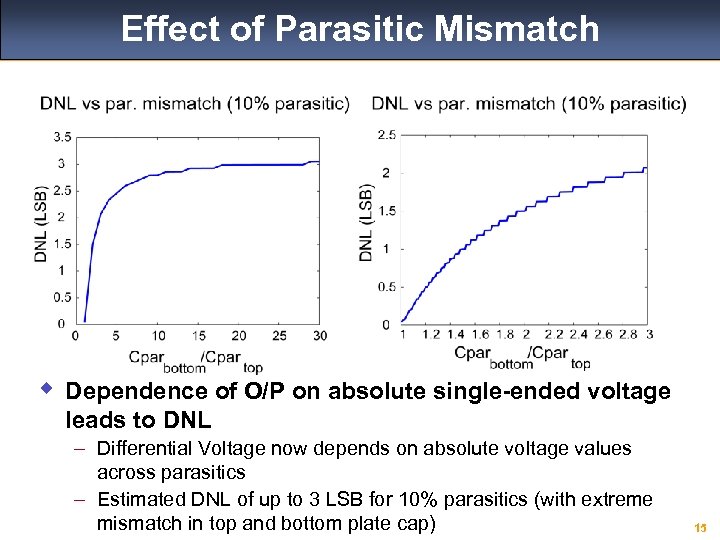 Effect of Parasitic Mismatch w Dependence of O/P on absolute single-ended voltage leads to DNL – Differential Voltage now depends on absolute voltage values across parasitics – Estimated DNL of up to 3 LSB for 10% parasitics (with extreme mismatch in top and bottom plate cap) 15
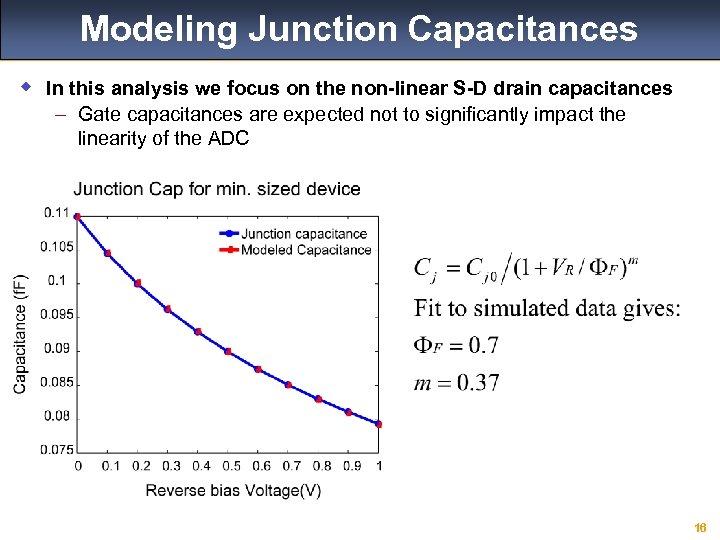 Modeling Junction Capacitances w In this analysis we focus on the non-linear S-D drain capacitances – Gate capacitances are expected not to significantly impact the linearity of the ADC 16
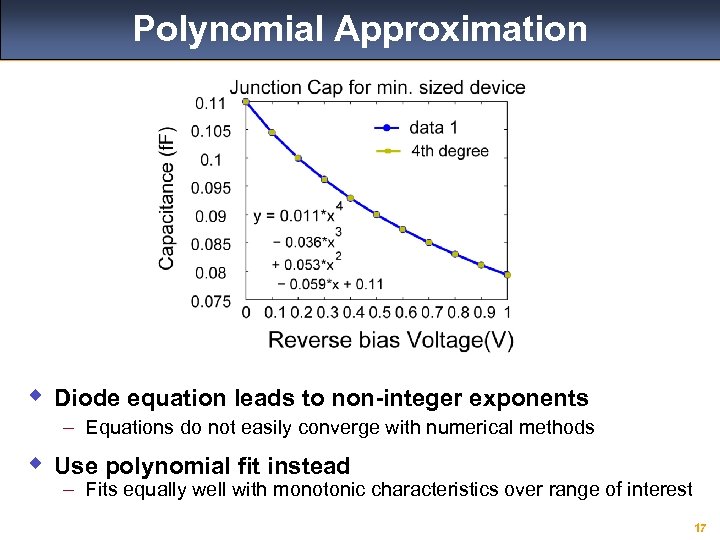 Polynomial Approximation w Diode equation leads to non-integer exponents – Equations do not easily converge with numerical methods w Use polynomial fit instead – Fits equally well with monotonic characteristics over range of interest 17
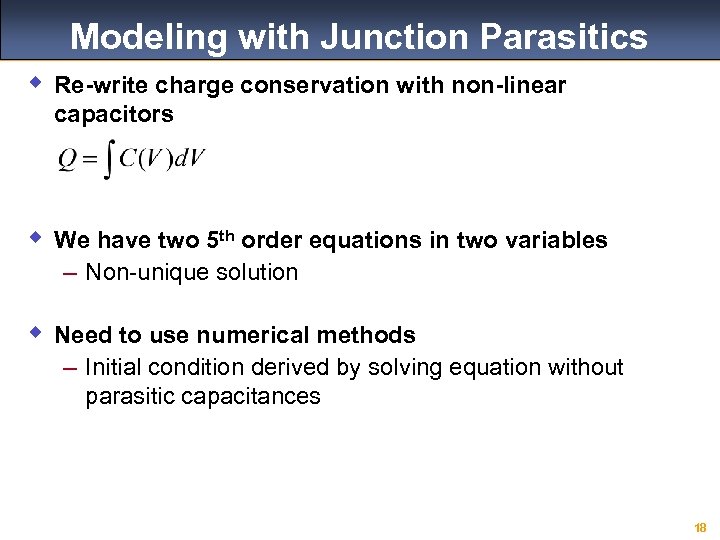 Modeling with Junction Parasitics w Re-write charge conservation with non-linear capacitors w We have two 5 th order equations in two variables – Non-unique solution w Need to use numerical methods – Initial condition derived by solving equation without parasitic capacitances 18
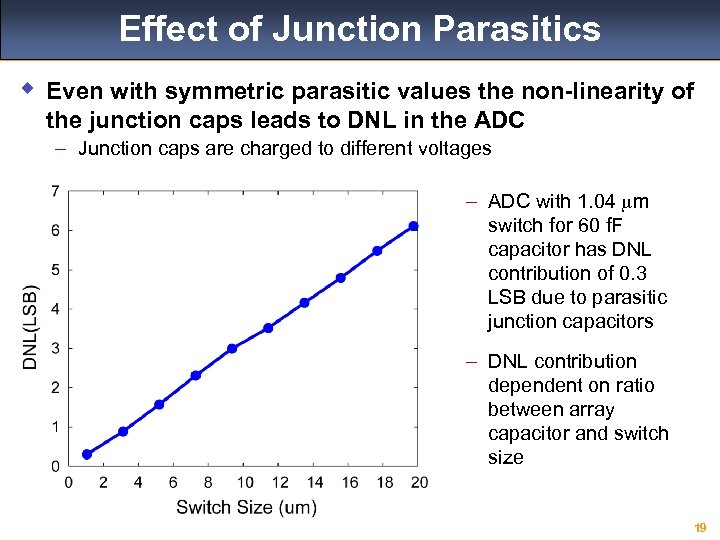 Effect of Junction Parasitics w Even with symmetric parasitic values the non-linearity of the junction caps leads to DNL in the ADC – Junction caps are charged to different voltages – ADC with 1. 04 mm switch for 60 f. F capacitor has DNL contribution of 0. 3 LSB due to parasitic junction capacitors – DNL contribution dependent on ratio between array capacitor and switch size 19
 Conclusions: Part 2 w Summary of this work: – Modeled the effect of non-linearities on static characteristics of ADC – Matlab model integrated with existing model which also includes comparator mismatch and thermal noise – Parasitics of array capacitance lead to a CM drift – Mismatch in parasitic capacitances leads to DNL – Junction capacitances lead to DNL even when switches are perfectly symmetric w Future Work: – Validation of model with Cadence simulations – Modeling dynamic non-idealities of ADC – Combining Part 1 and Part 2 to have a application-specific optimized ADC – Check out for options to better performance of previous ADC using trends shown by models 20
![References/Acknowledgments REFERENCES [1] B. Murmann, “ADC Performance Survey 1997 -2009”, [Online] Available: http: //www.](https://present5.com/presentation/455dd77c39ed33c58c1702975e562c5f/image-21.jpg "References/Acknowledgments REFERENCES [1] B. Murmann, “ADC Performance Survey 1997 -2009”, [Online] Available: http: //www.") References/Acknowledgments REFERENCES [1] B. Murmann, “ADC Performance Survey 1997 -2009”, [Online] Available: http: //www. stanford. edu/~murmann/adcsurvey. html [2] B. Razavi, “Principles of Data Conversion System Design”, IEEE Press, 2005 [3] V. Karkare, S. Gibson, and D. Markovic, “A 130 m. W, 64 -Channel Spike-Sorting DSP Chip”, ASSCC, Nov’ 09 [4] U. Reutishauser, E. Schuman, and A. Mamelak, “Online detection and sorting of extracellularly recorded action potentials in human medial temporal lobe recordings in vivo”, JNM, May’ 05 [5] S. Gibson, J. W. Judy, and D. Markovic, “Comparison of Spike-Sorting Algorithms for Future Hardware Implementation”, EMBC, Aug’ 08 [6] M. Chae, et. al. , “Design Optimization for Integrated Neural Recording Systems”, JSSC, Sep’ 08 [7] J. Craininckx and G. Van der Plaas, “A 65 f. J/Conversion-Step 0 -to-50 MS/s 0 -to 0. 7 m. W 9 b Charge Sharing SAR ADC in 90 nm Digital CMOS”, ISSCC, Feb’ 07 ACKNOWLEDGMENTS Wolfgang Eberle, Vito Gianniani, Dejan Markovic, Sarah Gibson, and Ivan Gligorijevic. 21
References/Acknowledgments REFERENCES [1] B. Murmann, “ADC Performance Survey 1997 -2009”, [Online] Available: http: //www. stanford. edu/~murmann/adcsurvey. html [2] B. Razavi, “Principles of Data Conversion System Design”, IEEE Press, 2005 [3] V. Karkare, S. Gibson, and D. Markovic, “A 130 m. W, 64 -Channel Spike-Sorting DSP Chip”, ASSCC, Nov’ 09 [4] U. Reutishauser, E. Schuman, and A. Mamelak, “Online detection and sorting of extracellularly recorded action potentials in human medial temporal lobe recordings in vivo”, JNM, May’ 05 [5] S. Gibson, J. W. Judy, and D. Markovic, “Comparison of Spike-Sorting Algorithms for Future Hardware Implementation”, EMBC, Aug’ 08 [6] M. Chae, et. al. , “Design Optimization for Integrated Neural Recording Systems”, JSSC, Sep’ 08 [7] J. Craininckx and G. Van der Plaas, “A 65 f. J/Conversion-Step 0 -to-50 MS/s 0 -to 0. 7 m. W 9 b Charge Sharing SAR ADC in 90 nm Digital CMOS”, ISSCC, Feb’ 07 ACKNOWLEDGMENTS Wolfgang Eberle, Vito Gianniani, Dejan Markovic, Sarah Gibson, and Ivan Gligorijevic. 21
 Questions / Comments? 22