


 Скачать презентацию Click on the picture Main Menu Click on
d1ad0e35c0b69a46df5d0b6db896ff32.ppt
- Количество слайдов: 52
 Click on the picture Main Menu (Click on the topics below) Permutations with Some repetitions Example r-Combinations with Some repetitions Example Permutations and Combinations with Repetitions Balls in Boxes: Boxes maybe empty Balls in Boxes: Boxes non-empty
 Permutations and Combinations with Repetitions Sanjay Jain, Lecturer, School of Computing
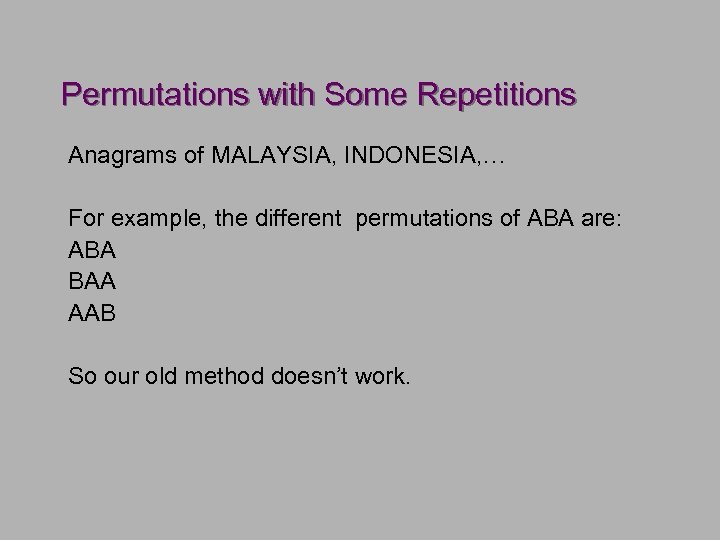 Permutations with Some Repetitions Anagrams of MALAYSIA, INDONESIA, … For example, the different permutations of ABA are: ABA BAA AAB So our old method doesn’t work.
 END OF SEGMENT
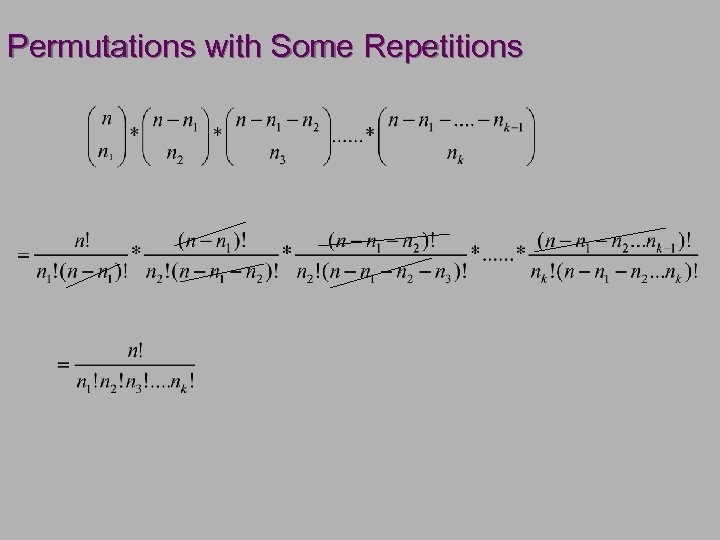
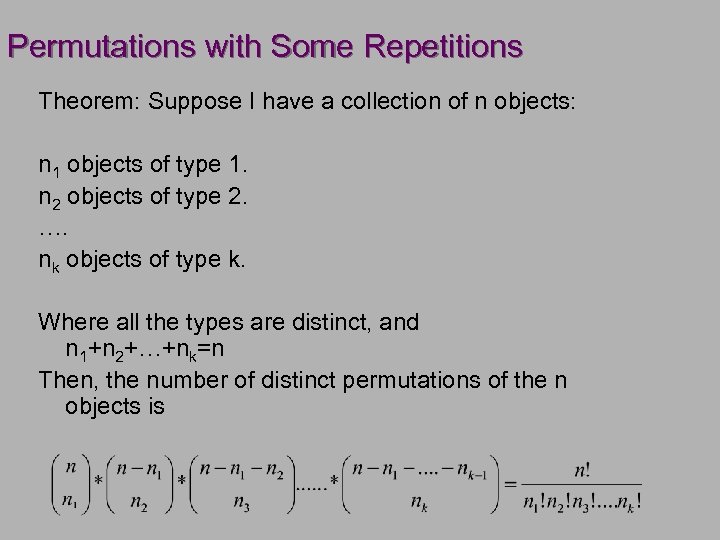 Permutations with Some Repetitions Theorem: Suppose I have a collection of n objects: n 1 objects of type 1. n 2 objects of type 2. …. nk objects of type k. Where all the types are distinct, and n 1+n 2+…+nk=n Then, the number of distinct permutations of the n objects is
 END OF SEGMENT
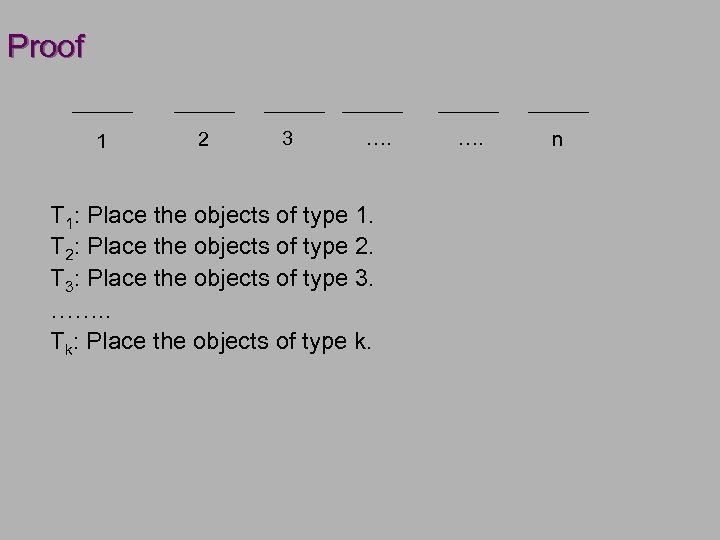 Proof 1 2 3 …. T 1: Place the objects of type 1. T 2: Place the objects of type 2. T 3: Place the objects of type 3. ……. . Tk: Place the objects of type k. …. n
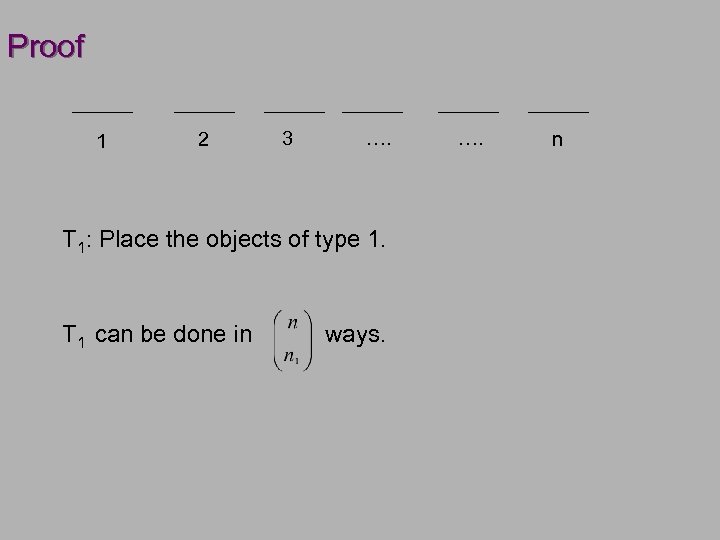 Proof 1 2 3 …. T 1: Place the objects of type 1. T 1 can be done in ways. …. n
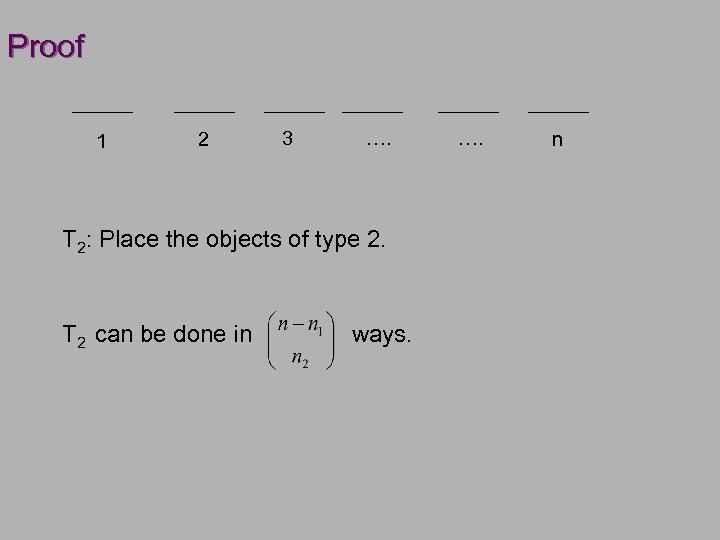 Proof 1 2 3 …. T 2: Place the objects of type 2. T 2 can be done in ways. …. n
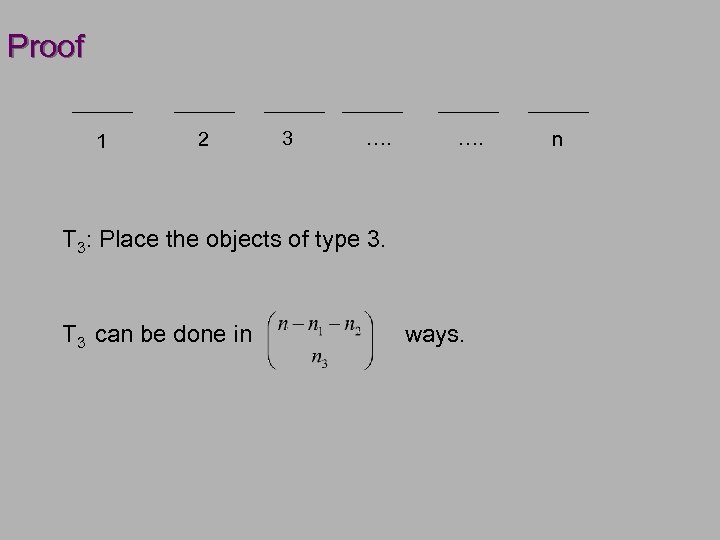 Proof 1 2 3 …. T 3: Place the objects of type 3. T 3 can be done in ways. n
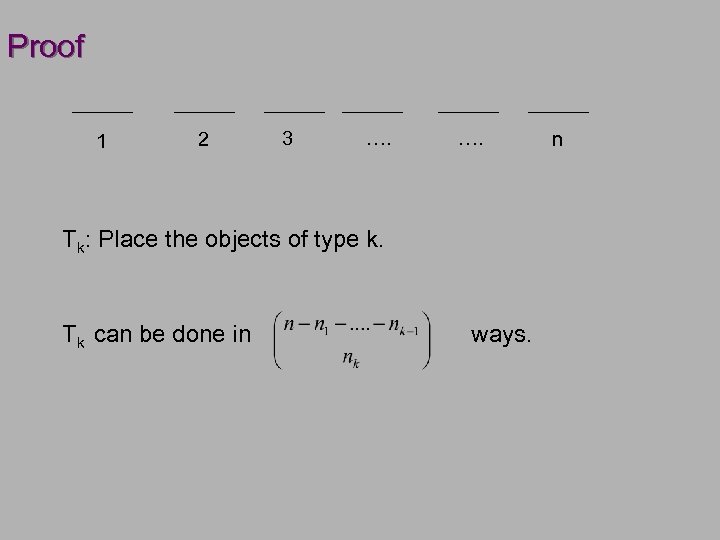 Proof 1 2 3 …. Tk: Place the objects of type k. Tk can be done in ways. n
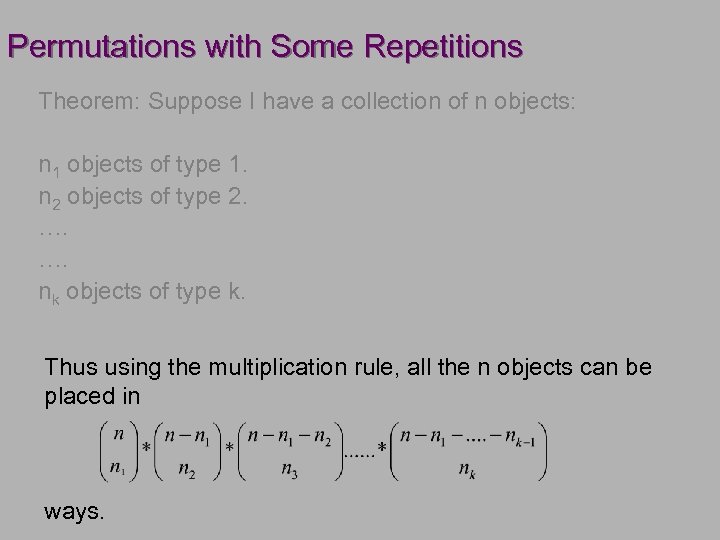 Permutations with Some Repetitions Theorem: Suppose I have a collection of n objects: n 1 objects of type 1. n 2 objects of type 2. …. …. nk objects of type k. Thus using the multiplication rule, all the n objects can be placed in ways.
 END OF SEGMENT
 Permutations with Some Repetitions
 END OF SEGMENT
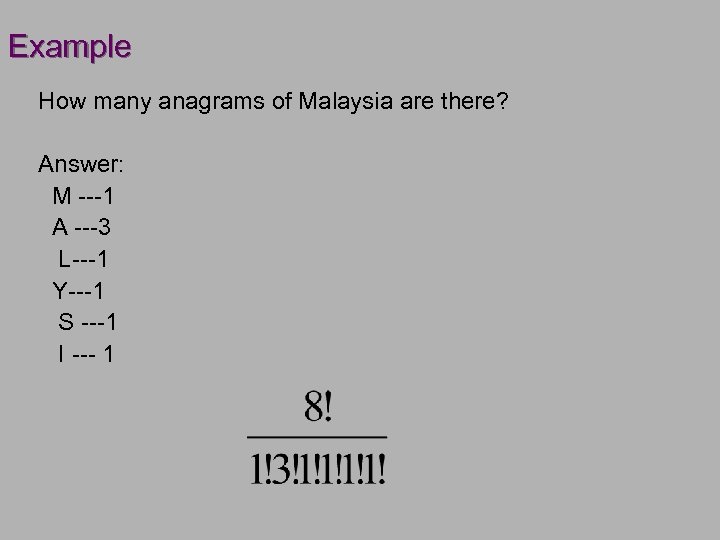 Example How many anagrams of Malaysia are there? Answer: M ---1 A ---3 L---1 Y---1 S ---1 I --- 1
 END OF SEGMENT
 r-Combinations with Repetitions allowed A r-combination, with repetition allowed, chosen from a set X of n elements is an unordered selection of elements taken from X, where repetitions are allowed. That is we can take several copies of any element of X in the selection.
 END OF SEGMENT
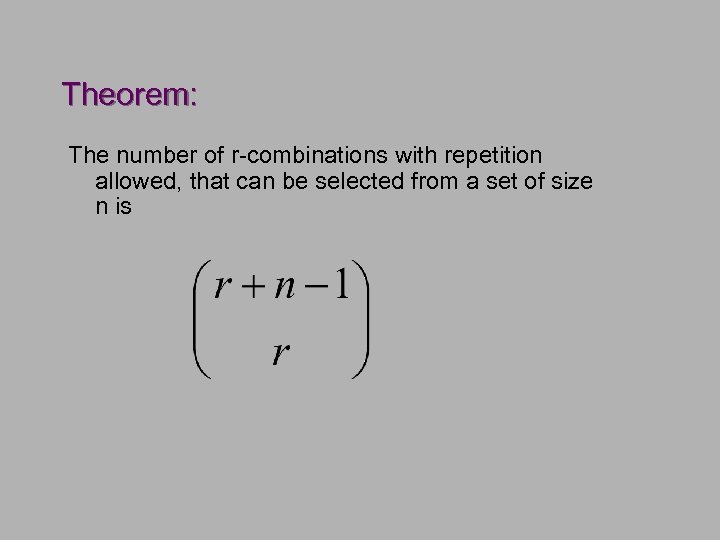 Theorem: The number of r-combinations with repetition allowed, that can be selected from a set of size n is
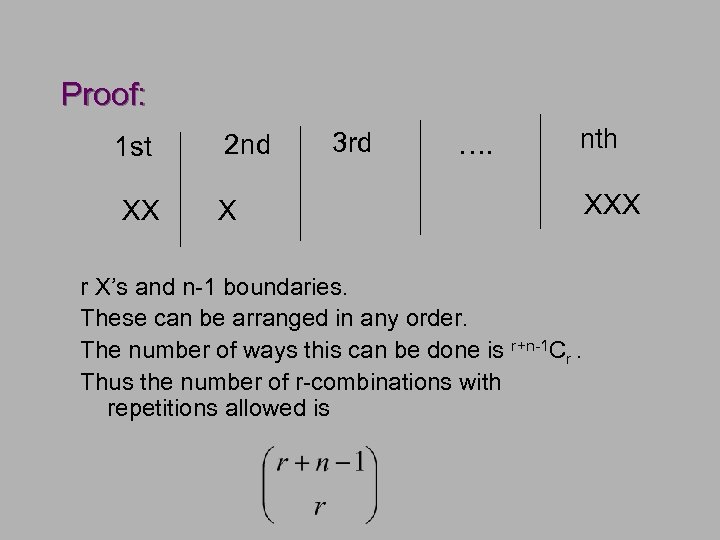 Proof: 1 st 2 nd XX 3 rd …. nth X r X’s and n-1 boundaries. These can be arranged in any order. The number of ways this can be done is r+n-1 Cr. Thus the number of r-combinations with repetitions allowed is XXX
 END OF SEGMENT
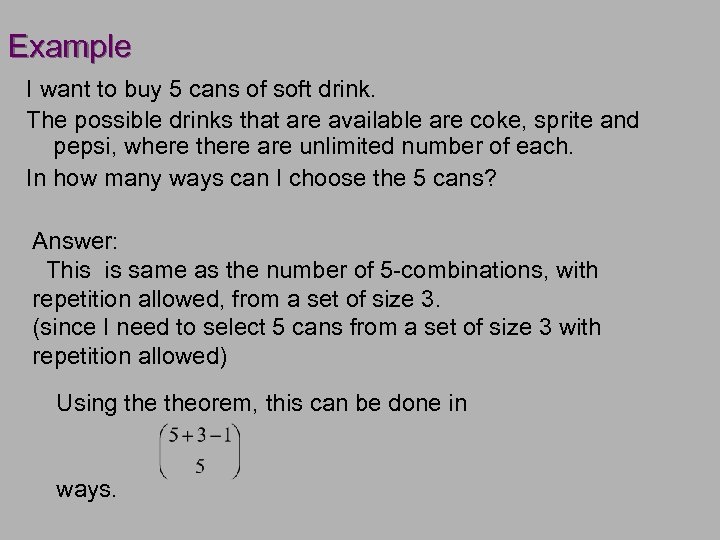 Example I want to buy 5 cans of soft drink. The possible drinks that are available are coke, sprite and pepsi, where there are unlimited number of each. In how many ways can I choose the 5 cans? Answer: This is same as the number of 5 -combinations, with repetition allowed, from a set of size 3. (since I need to select 5 cans from a set of size 3 with repetition allowed) Using theorem, this can be done in ways.
 END OF SEGMENT
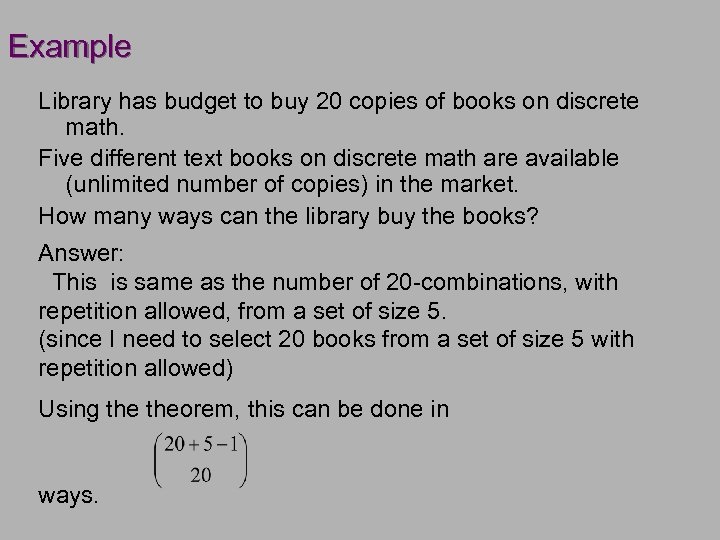 Example Library has budget to buy 20 copies of books on discrete math. Five different text books on discrete math are available (unlimited number of copies) in the market. How many ways can the library buy the books? Answer: This is same as the number of 20 -combinations, with repetition allowed, from a set of size 5. (since I need to select 20 books from a set of size 5 with repetition allowed) Using theorem, this can be done in ways.
 END OF SEGMENT
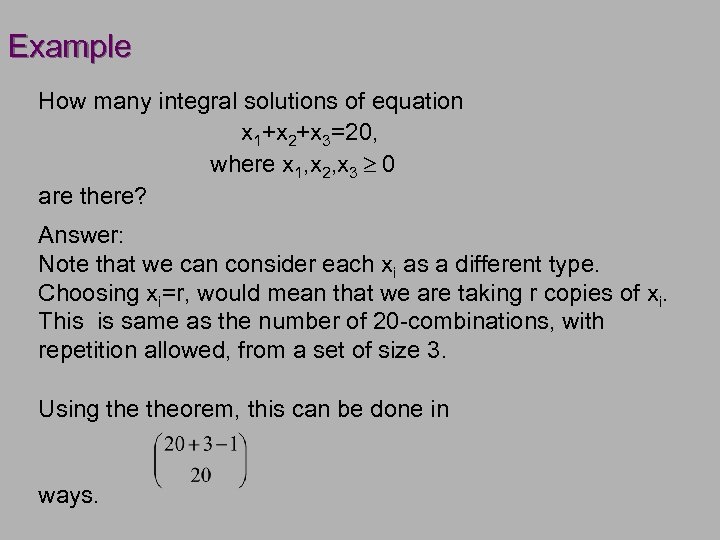 Example How many integral solutions of equation x 1+x 2+x 3=20, where x 1, x 2, x 3 0 are there? Answer: Note that we can consider each xi as a different type. Choosing xi=r, would mean that we are taking r copies of xi. This is same as the number of 20 -combinations, with repetition allowed, from a set of size 3. Using theorem, this can be done in ways.
 END OF SEGMENT
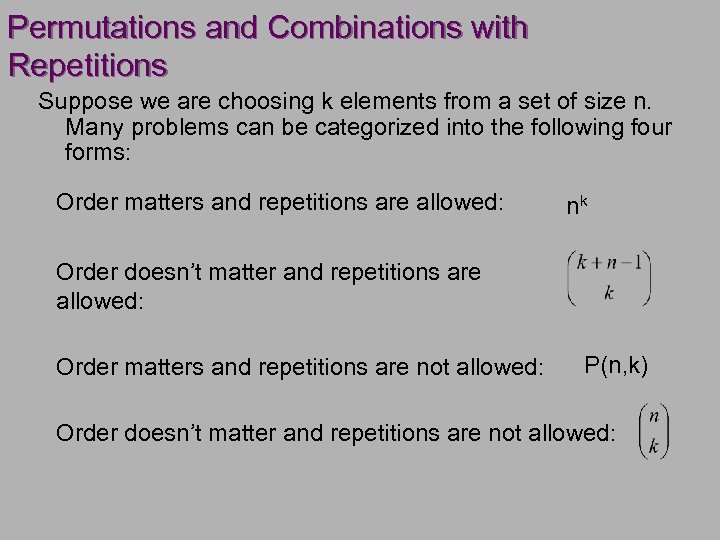 Permutations and Combinations with Repetitions Suppose we are choosing k elements from a set of size n. Many problems can be categorized into the following four forms: Order matters and repetitions are allowed: nk Order doesn’t matter and repetitions are allowed: Order matters and repetitions are not allowed: P(n, k) Order doesn’t matter and repetitions are not allowed:
 END OF SEGMENT
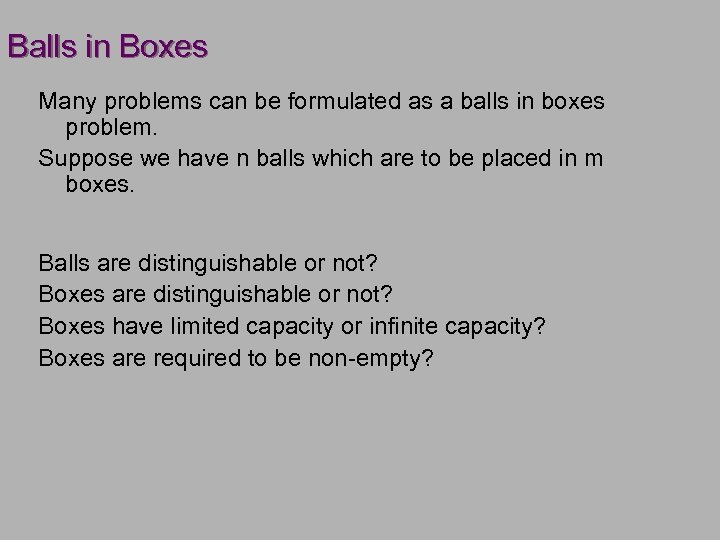 Balls in Boxes Many problems can be formulated as a balls in boxes problem. Suppose we have n balls which are to be placed in m boxes. Balls are distinguishable or not? Boxes have limited capacity or infinite capacity? Boxes are required to be non-empty?
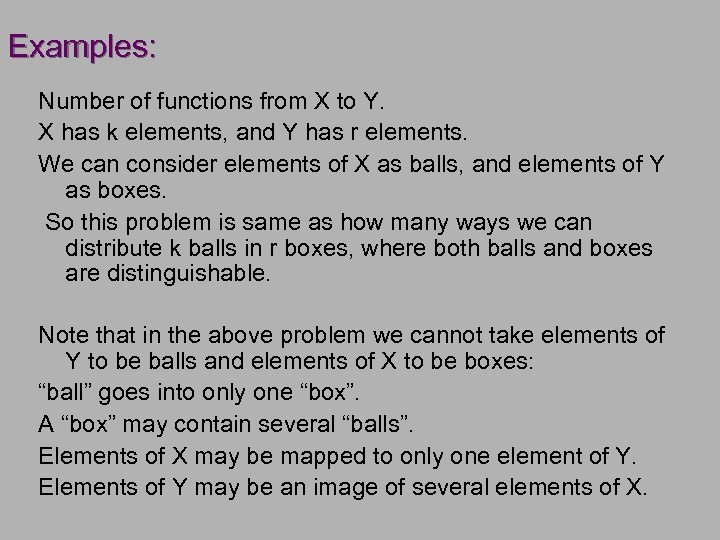 Examples: Number of functions from X to Y. X has k elements, and Y has r elements. We can consider elements of X as balls, and elements of Y as boxes. So this problem is same as how many ways we can distribute k balls in r boxes, where both balls and boxes are distinguishable. Note that in the above problem we cannot take elements of Y to be balls and elements of X to be boxes: “ball” goes into only one “box”. A “box” may contain several “balls”. Elements of X may be mapped to only one element of Y. Elements of Y may be an image of several elements of X.
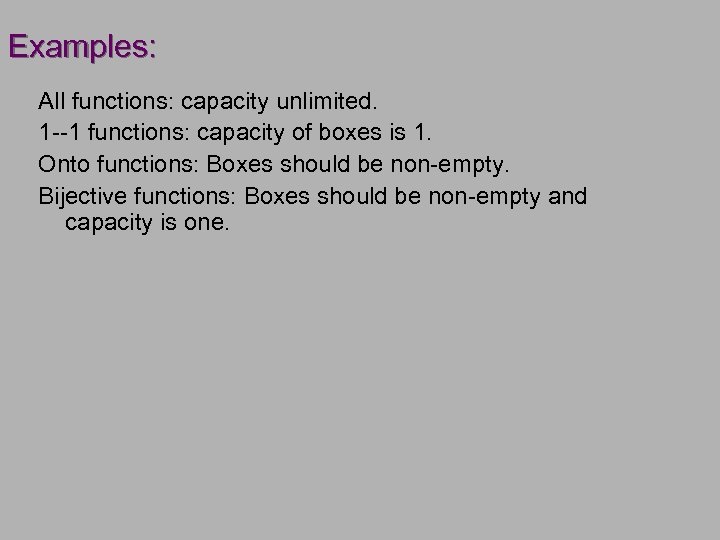 Examples: All functions: capacity unlimited. 1 --1 functions: capacity of boxes is 1. Onto functions: Boxes should be non-empty. Bijective functions: Boxes should be non-empty and capacity is one.
 END OF SEGMENT
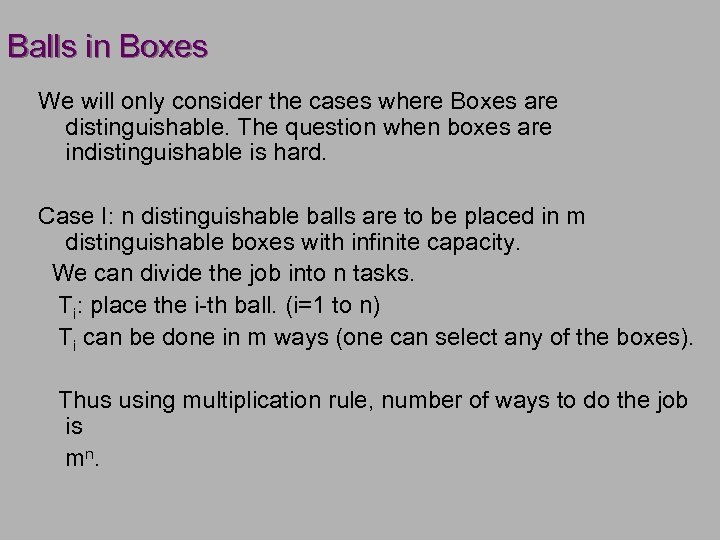 Balls in Boxes We will only consider the cases where Boxes are distinguishable. The question when boxes are indistinguishable is hard. Case I: n distinguishable balls are to be placed in m distinguishable boxes with infinite capacity. We can divide the job into n tasks. Ti: place the i-th ball. (i=1 to n) Ti can be done in m ways (one can select any of the boxes). Thus using multiplication rule, number of ways to do the job is mn.
 END OF SEGMENT
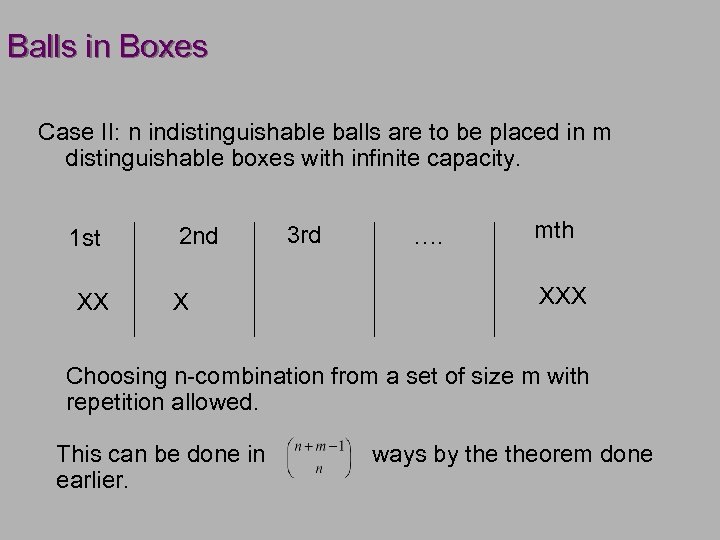 Balls in Boxes Case II: n indistinguishable balls are to be placed in m distinguishable boxes with infinite capacity. 1 st XX 2 nd X 3 rd …. mth XXX Choosing n-combination from a set of size m with repetition allowed. This can be done in earlier. ways by theorem done
 END OF SEGMENT
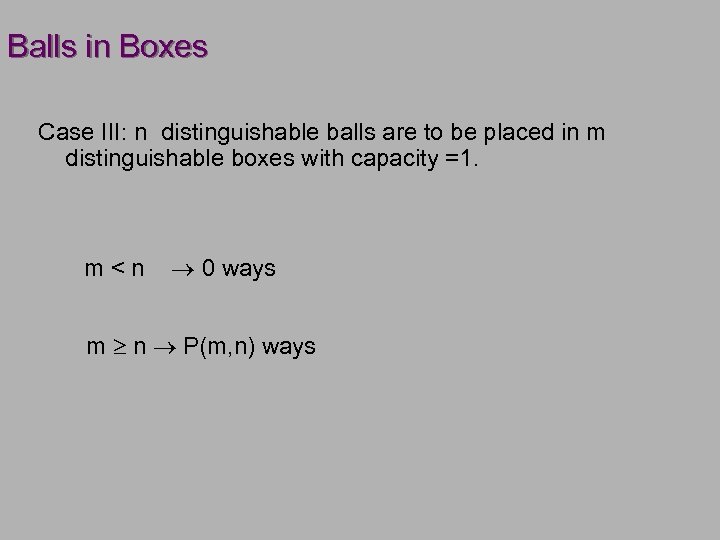 Balls in Boxes Case III: n distinguishable balls are to be placed in m distinguishable boxes with capacity =1. m
 END OF SEGMENT
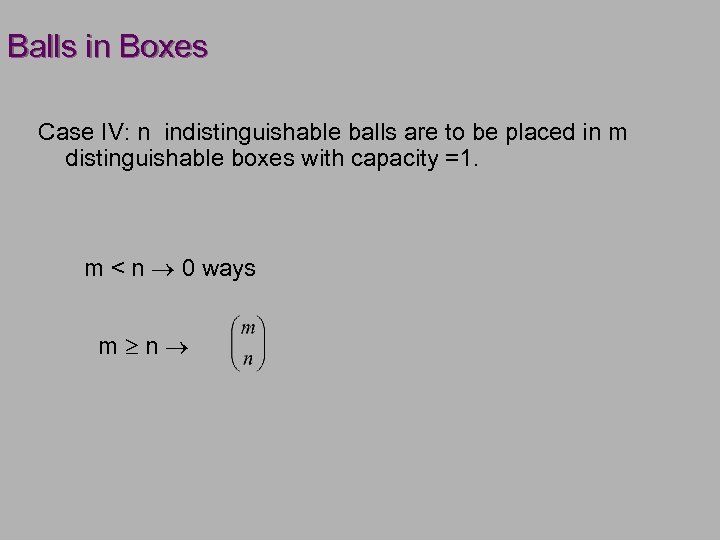 Balls in Boxes Case IV: n indistinguishable balls are to be placed in m distinguishable boxes with capacity =1. m < n 0 ways m n
 END OF SEGMENT
 Balls in Boxes: non-empty boxes. We will only be considering the case of distinguishable boxes and indistinguishable balls. Case V: n indistinguishable balls are to be placed in m distinguishable boxes, with unlimited capacity such that each box is non-empty. n
 END OF SEGMENT
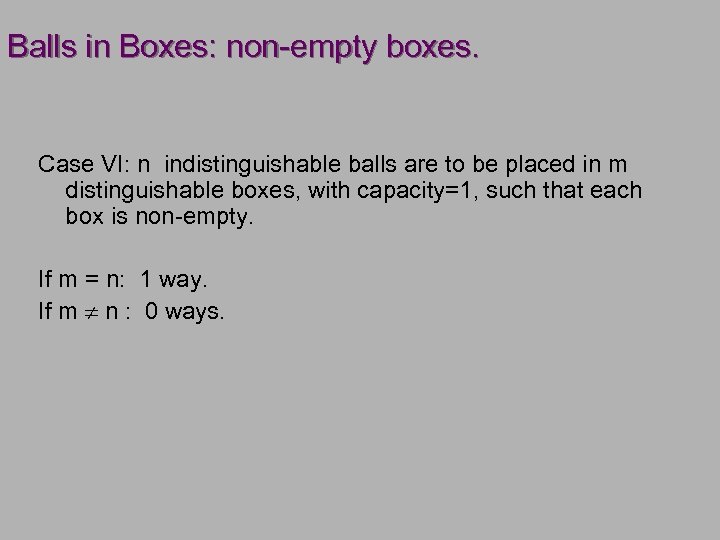 Balls in Boxes: non-empty boxes. Case VI: n indistinguishable balls are to be placed in m distinguishable boxes, with capacity=1, such that each box is non-empty. If m = n: 1 way. If m n : 0 ways.
 END OF SEGMENT
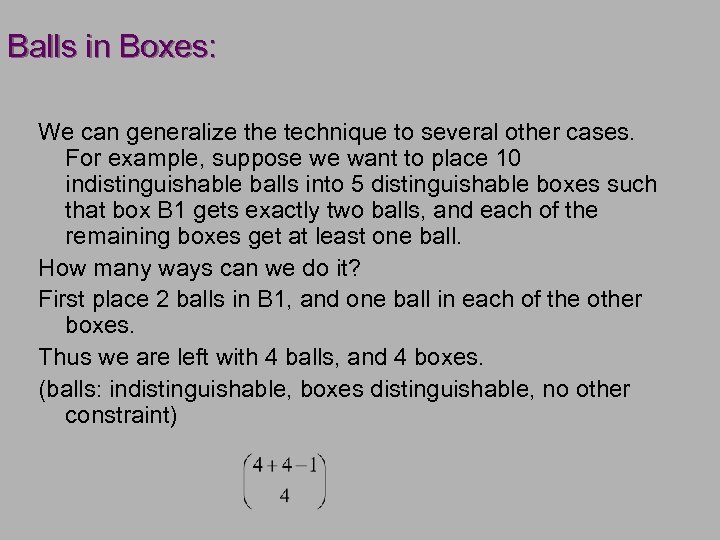 Balls in Boxes: We can generalize the technique to several other cases. For example, suppose we want to place 10 indistinguishable balls into 5 distinguishable boxes such that box B 1 gets exactly two balls, and each of the remaining boxes get at least one ball. How many ways can we do it? First place 2 balls in B 1, and one ball in each of the other boxes. Thus we are left with 4 balls, and 4 boxes. (balls: indistinguishable, boxes distinguishable, no other constraint)
 END OF SEGMENT
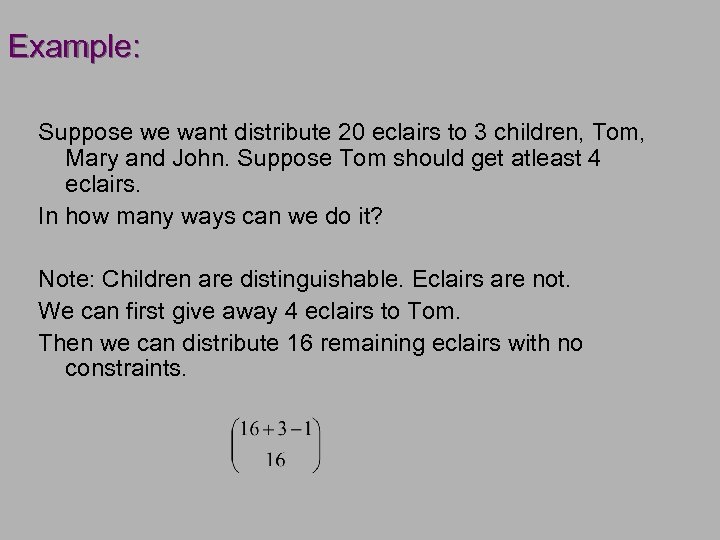 Example: Suppose we want distribute 20 eclairs to 3 children, Tom, Mary and John. Suppose Tom should get atleast 4 eclairs. In how many ways can we do it? Note: Children are distinguishable. Eclairs are not. We can first give away 4 eclairs to Tom. Then we can distribute 16 remaining eclairs with no constraints.
 END OF SEGMENT
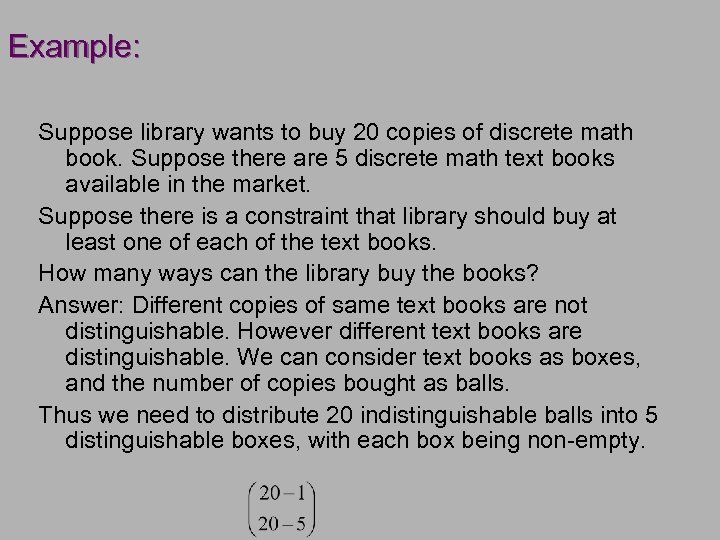 Example: Suppose library wants to buy 20 copies of discrete math book. Suppose there are 5 discrete math text books available in the market. Suppose there is a constraint that library should buy at least one of each of the text books. How many ways can the library buy the books? Answer: Different copies of same text books are not distinguishable. However different text books are distinguishable. We can consider text books as boxes, and the number of copies bought as balls. Thus we need to distribute 20 indistinguishable balls into 5 distinguishable boxes, with each box being non-empty.
 END OF SEGMENT