 Скачать презентацию Clearing and Settlement of spot bonds 03 February
fbd67734037433159350fb395d58534d.ppt
- Количество слайдов: 17



Clearing and Settlement of spot bonds 03 February 2005 Brett Kotze
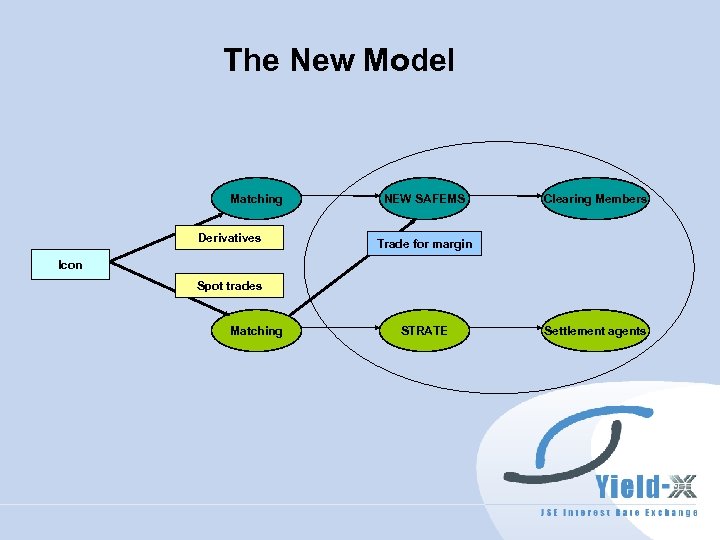
The New Model Matching Derivatives NEW SAFEMS Clearing Members Trade for margin Icon Spot trades Matching STRATE Settlement agents
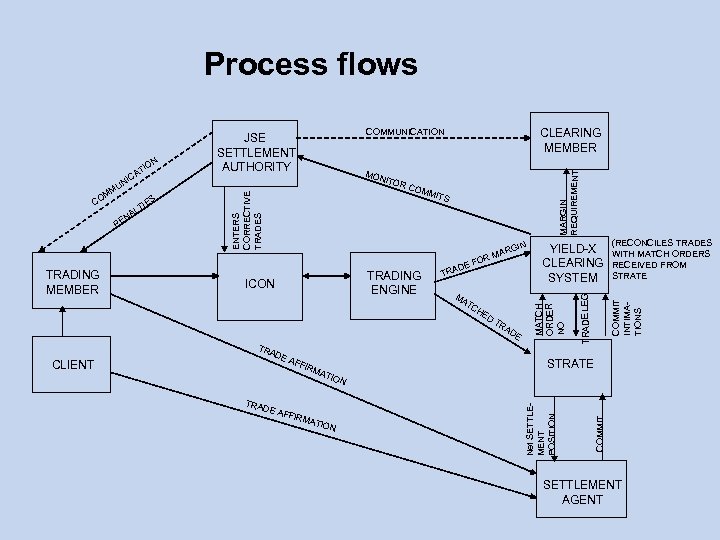
Process flows MIT S IN RG TRADING ENGINE ICON DE TRA MA A RM FO TC HE D TR AD E YIELD-X CLEARING SYSTEM TRA FFI TRA DE A FFIR RM STRATE ATI MAT IO ON N Net SETTLEMENT POSITION DE A CLIENT (RECONCILES TRADES WITH MATCH ORDERS RECEIVED FROM STRATE COMMIT INTIMATIONS COM TRADE LEG TRADING MEMBER N TI AL ES COMMIT PE TOR MARGIN REQUIREMENT M CO MON I ENTERS CORRECTIVE TRADES I N MU MATCH ORDER NO N IO T CA CLEARING MEMBER COMMUNICATION JSE SETTLEMENT AUTHORITY SETTLEMENT AGENT
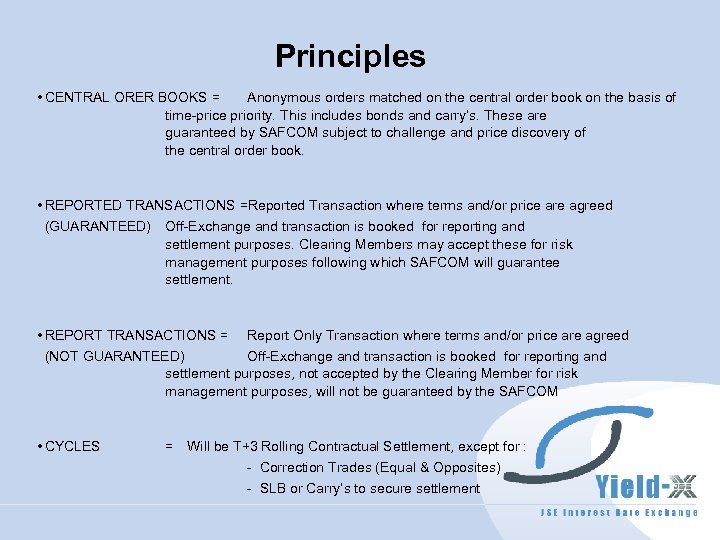
Principles • CENTRAL ORER BOOKS = Anonymous orders matched on the central order book on the basis of time-price priority. This includes bonds and carry’s. These are guaranteed by SAFCOM subject to challenge and price discovery of the central order book. • REPORTED TRANSACTIONS =Reported Transaction where terms and/or price are agreed (GUARANTEED) Off-Exchange and transaction is booked for reporting and settlement purposes. Clearing Members may accept these for risk management purposes following which SAFCOM will guarantee settlement. • REPORT TRANSACTIONS = Report Only Transaction where terms and/or price are agreed (NOT GUARANTEED) Off-Exchange and transaction is booked for reporting and settlement purposes, not accepted by the Clearing Member for risk management purposes, will not be guaranteed by the SAFCOM • CYCLES = Will be T+3 Rolling Contractual Settlement, except for : - Correction Trades (Equal & Opposites) - SLB or Carry’s to secure settlement
Principles (Cont. ) • ALLOCATIONS = On T, late allocations and allocation corrections done by Settlement Authority • UNCONDITIONAL COMMIT= Settlement Agents commits become unconditional at 12 h 00 on T+2 unless provisional sequestration
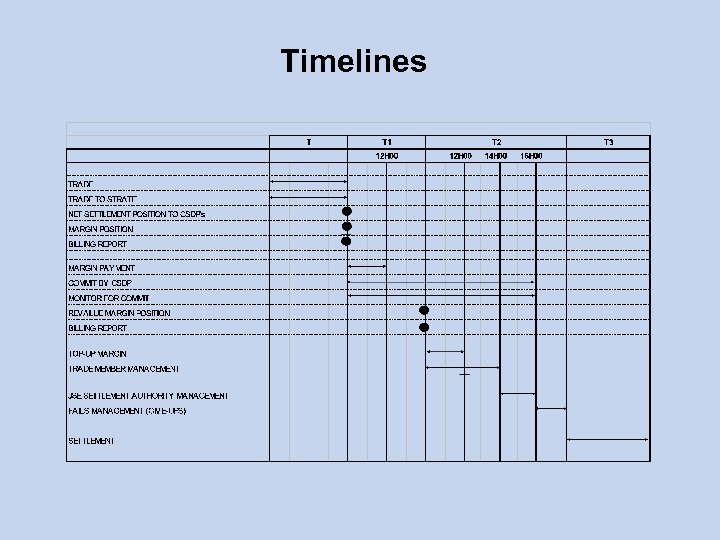
Timelines
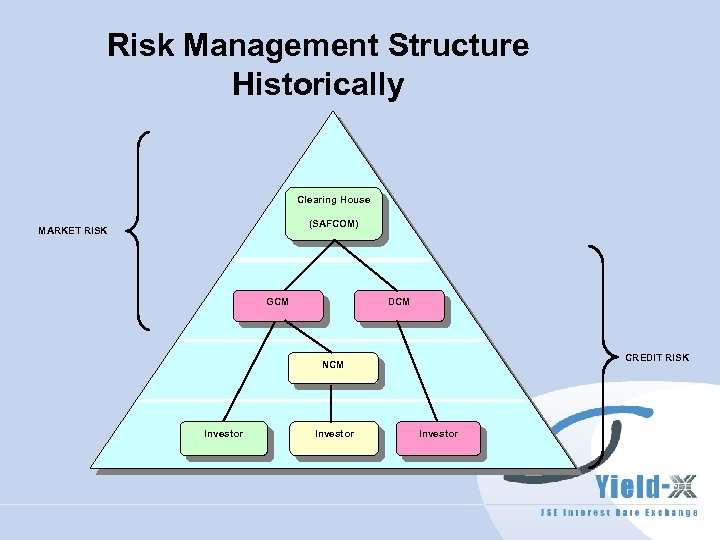
Risk Management Structure Historically Clearing House (SAFCOM) MARKET RISK GCM DCM CREDIT RISK NCM Investor
Definitions Market Risk The risk that adverse price movements in the level or volatility of a price may create an anticipated loss. For example, a dramatic change in the interest rate during one day may create the risk of loss. Credit Risk The risk that a counterparty will not settle an obligation for full value, either when due or at a time thereafter.
But what about settlement risk? The guaranteeing of settlement of loan stock by SAFCOM brings in a new element of risk to SAFCOM, settlement risk Defined as: The risk that a party will default on one or more settlement obligations due to no funds or securities
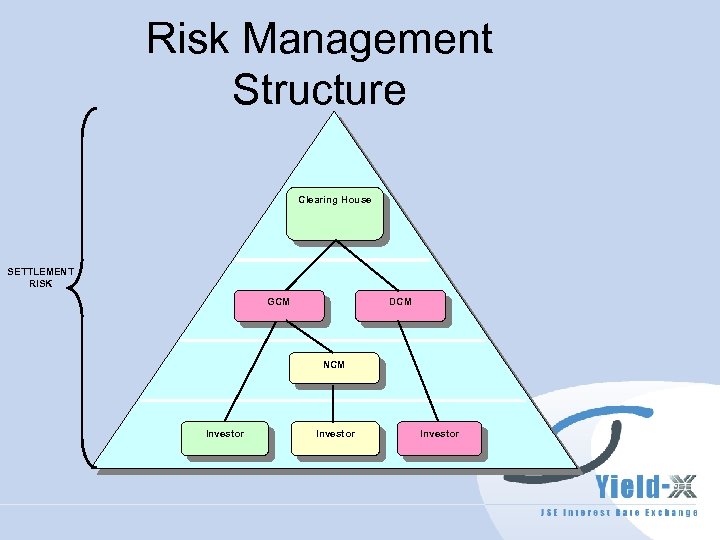
Risk Management Structure Clearing House SETTLEMENT RISK GCM DCM NCM Investor
Risk and Margin Methodology MARKET RISK: - The Calm methodology was developed specifically for Yield. X. It is a conventional Va. R (Value at Risk) calculation. The parameters which Yield-X uses in this calculation are one trading day (the loss is estimated over the period to the end of the next trading day) and 99. 95% confidence level, which equates to Initial Margin. SETTLEMENT RISK: - Using the Calm methodology with the resultant figure computing to points per instrument, and applying rands per point, which equates to Settlement Margin.
Market Risk versus Settlement Risk MARKET RISK • • Where offset is allowed between Forward Bonds Where offset is allowed between Derivatives and Forward Bonds All Derivative products Forward Bonds SETTLEMENT RISK • Where there is SFIDv. P • Only on S-3 of the transaction
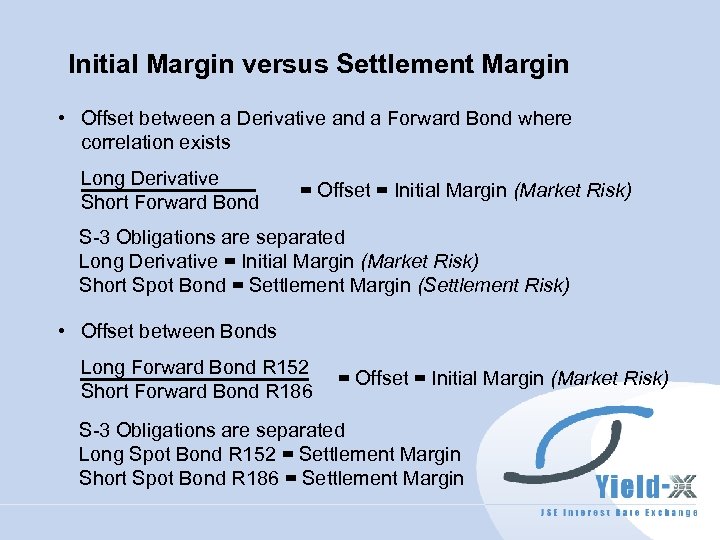
Initial Margin versus Settlement Margin • Offset between a Derivative and a Forward Bond where correlation exists Long Derivative Short Forward Bond = Offset = Initial Margin (Market Risk) S-3 Obligations are separated Long Derivative = Initial Margin (Market Risk) Short Spot Bond = Settlement Margin (Settlement Risk) • Offset between Bonds Long Forward Bond R 152 Short Forward Bond R 186 = Offset = Initial Margin (Market Risk) S-3 Obligations are separated Long Spot Bond R 152 = Settlement Margin Short Spot Bond R 186 = Settlement Margin
Initial Margin versus Settlement Margin • The calculation for both Initial Margin and Settlement Margin will be computed and the higher of the 2 will be taken on S-3 • The unsettled position will be Marked-to-Market on EOD T+1, any short-fall will be requested as a Top-up Margin • The Settlement Margin will be used as the Sweetener for Fails Management, i. e. Give-ups. Where Initial Margin is held (higher of the 2), surplus will be returned to the Clearing Member
Trading Members / Clients • Financial Instrument Principal (FIP) Ø Principal Transactions • Financial Instrument Traders (FIT) Ø Principal Transactions Ø Member Settled clients Ø Non-Member Settled clients
Securities Lending & Borrowing • SETTLEMENT AGENT SECURITIES LENDING AND BORROWING (SLB) Ø Settlement Authority will book Ø Identified as SLB on STRATE and Settlement Agent systems • SETTLEMENT AUTHORITY Ø Lender of last resort Ø Identified as SLB on STRATE and Settlement Agent systems
Questions
Скачать презентацию Clearing and Settlement of spot bonds 03 February
fbd67734037433159350fb395d58534d.ppt