


 Скачать презентацию Cleaning Products and Asthma Elise Pechter MPH CIH
4d30616d19b013271c0c5590a067701e.ppt
- Количество слайдов: 36
 Cleaning Products and Asthma Elise Pechter MPH, CIH Work-related Asthma Coordinator/Industrial Hygienist Occupational Health Surveillance Program Massachusetts Department of Public Health
 Goals—Explore cleaning, cleaning products, and relation to asthma • Benefits and risks of cleaning • Evidence of asthma associated with cleaning • When and how is cleaning dangerous? – Ingredients in cleaning products – Not “Hygiene” hypothesis • Making cleaning safer
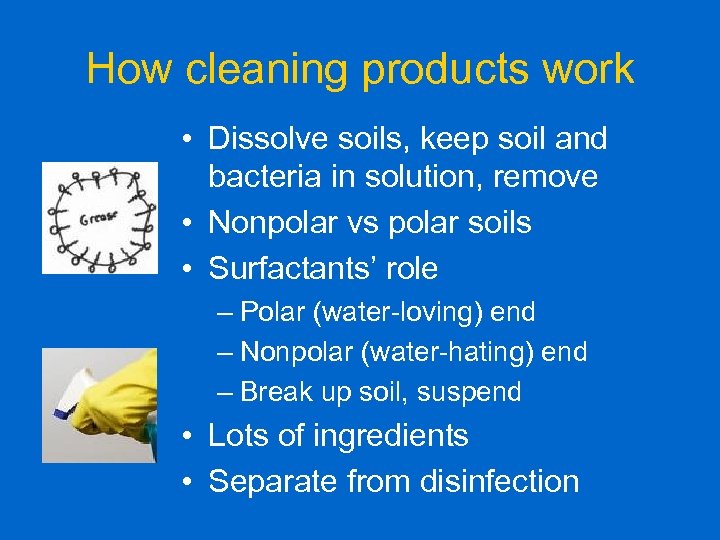 How cleaning products work • Dissolve soils, keep soil and bacteria in solution, remove • Nonpolar vs polar soils • Surfactants’ role – Polar (water-loving) end – Nonpolar (water-hating) end – Break up soil, suspend • Lots of ingredients • Separate from disinfection
 Cleaning recommended to control asthma • Reduce dust – PM 2. 5 associated with asthma • Discourage pests – Cockroaches & mice associated with asthma • Remove mold – Molds associated with asthma – Dampness may remain
 But cleaning can be hazardous • Cleaning workers, commercial and domestic, have more asthma • Bystanders exposed to cleaning products have asthma • Some cleaning product ingredients can cause asthma • Some evidence that children exposed to cleaning sprays at home have more asthma
 State based surveillance of workrelated asthma • National Institute for Occupational Safety and Health (NIOSH), Centers for Disease Control and Prevention (CDC) • Case based surveillance – Health care providers and hospital records and workers’ compensation • Population based surveillance BRFSS • Massachusetts Occupational Health Surveillance Program (OHSP) and CA, MI, and NJ
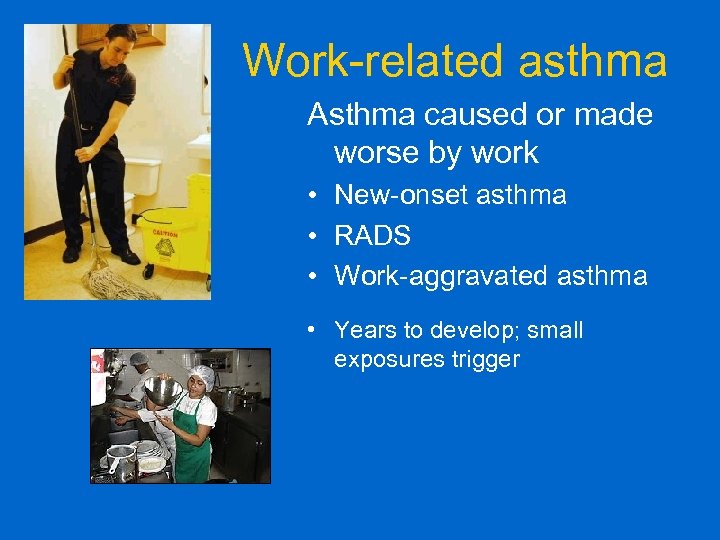 Work-related asthma Asthma caused or made worse by work • New-onset asthma • RADS • Work-aggravated asthma • Years to develop; small exposures trigger
 Surveillance case definition Work-related asthma • Health care professional diagnosis consistent with asthma AND • An association between symptoms of asthma and work
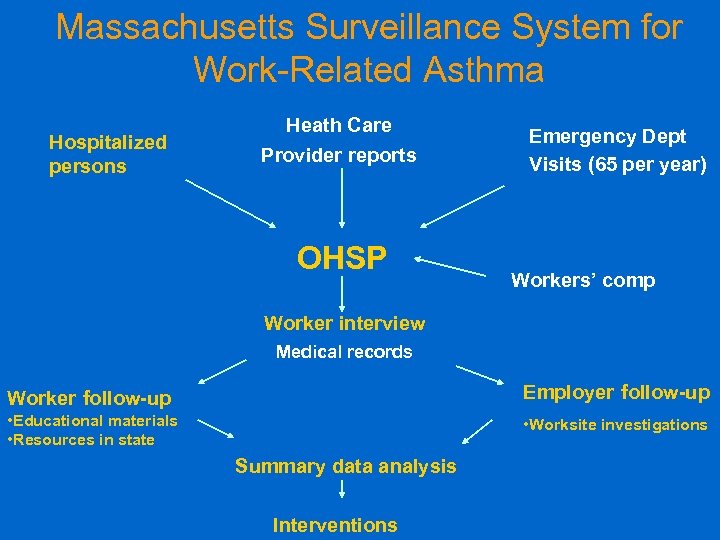 Massachusetts Surveillance System for Work-Related Asthma Hospitalized persons Heath Care Provider reports OHSP Emergency Dept Visits (65 per year) Workers’ comp Worker interview Medical records Worker follow-up Employer follow-up • Educational materials • Resources in state • Worksite investigations Summary data analysis Interventions
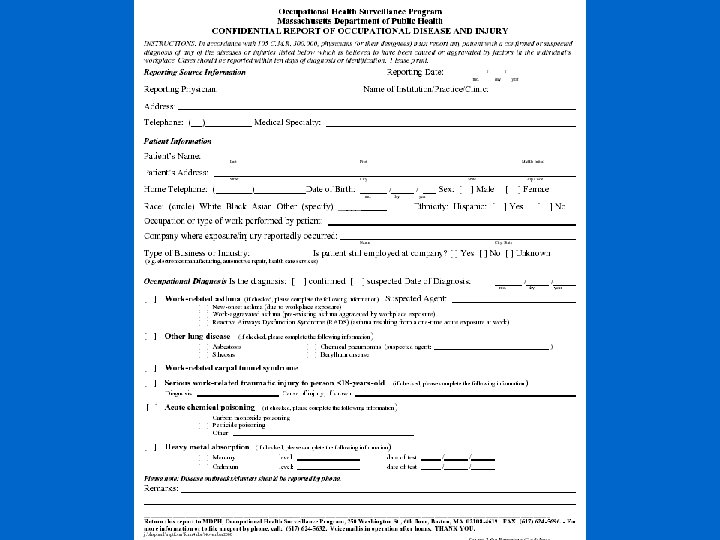
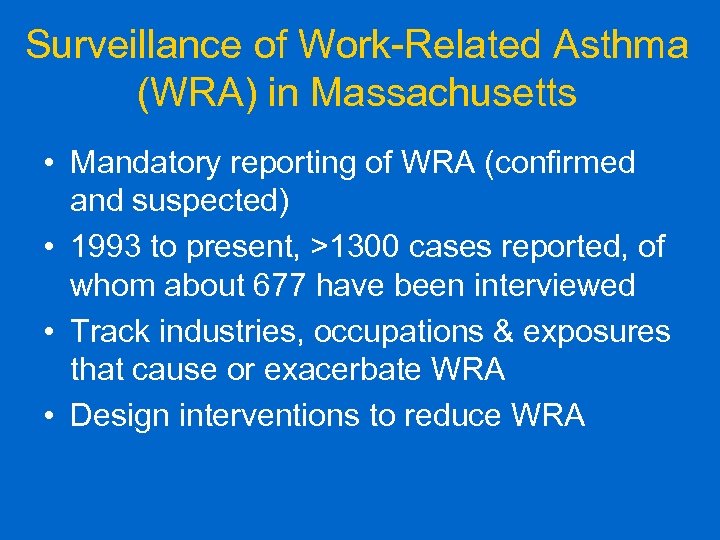 Surveillance of Work-Related Asthma (WRA) in Massachusetts • Mandatory reporting of WRA (confirmed and suspected) • 1993 to present, >1300 cases reported, of whom about 677 have been interviewed • Track industries, occupations & exposures that cause or exacerbate WRA • Design interventions to reduce WRA
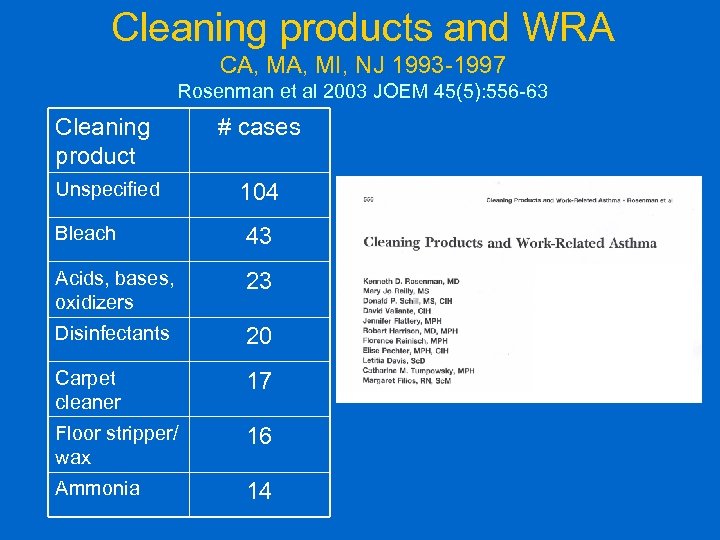 Cleaning products and WRA CA, MI, NJ 1993 -1997 Rosenman et al 2003 JOEM 45(5): 556 -63 Cleaning product # cases Unspecified 104 Bleach 43 Acids, bases, oxidizers 23 Disinfectants 20 Carpet cleaner 17 Floor stripper/ wax 16 Ammonia 14
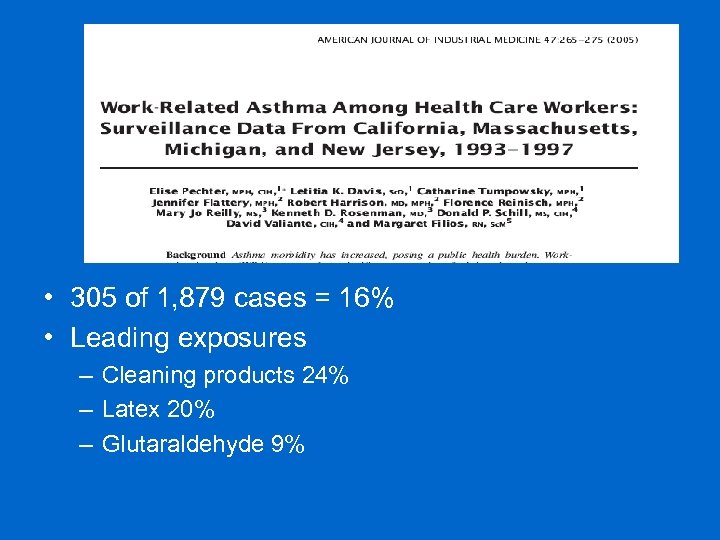 • 305 of 1, 879 cases = 16% • Leading exposures – Cleaning products 24% – Latex 20% – Glutaraldehyde 9%
 Cleaning-products related asthma • Cleaning products are chemicals • Annually 2 nd or 3 rd most common exposure in Poison Control Center data (adults) • Studies from US, Europe, Finland, Spain, Brazil, Singapore, Australia, Sweden, South Africa – 2 negative studies, remainder all show cleaners have asthma – 1. 5 to 2. 5 X background risk; mixing only some – Sensitization—not just irritation • Rosenman KD. Clinical Pulmonary Medicine 2006; 13(4): 221 -228
 Cleaning products associated with respiratory symptoms • Cleaning materials associated with RADs – Henneberger JOEM 2003 4 -state data • Short-term respiratory effects of cleaning, with bleach, degreasing chemical sprays, air fresheners in domestic cleaners – Medina-Ramon Euro. Resp. J 2006 27(6): 1196 • “Janitors, housekeepers and cleaners” was the occupational group with highest # of occupational asthma in Sao Paulo, Brazil – Mendonça AJIM 2003 43(6): 611
 Cleaning products associated with respiratory symptoms • Relative risk of asthma of 1. 5 for cleaners compared to administrators in Finland – Karjalainen ERJ 2002 19: 90 -95 • Asthma prevalence for indoor cleaners in Spain 1. 7 times rate for office workers – Zock Scand. J Work. Env. Health 2001 27: 76 -81 • 26 papers by 2004 (Nazaroff) implicating cleaning as cause of respiratory health impairment – Nazaroff, Weschler 2004 Atmos. Environ 38: 2841 -2865
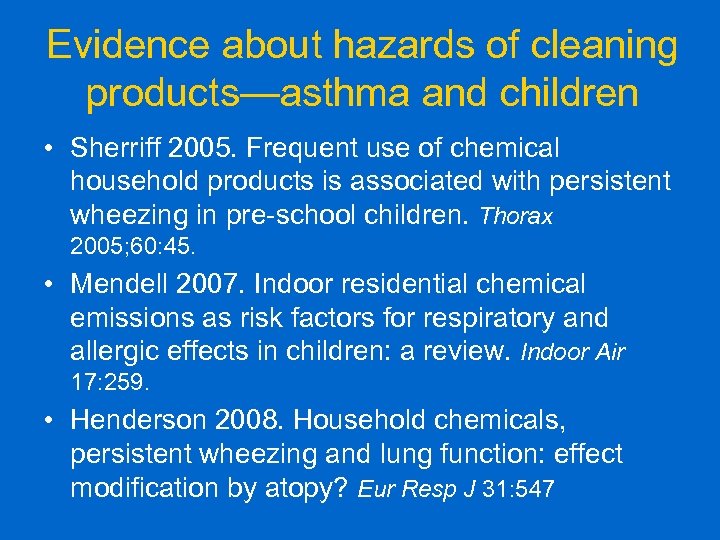 Evidence about hazards of cleaning products—asthma and children • Sherriff 2005. Frequent use of chemical household products is associated with persistent wheezing in pre-school children. Thorax 2005; 60: 45. • Mendell 2007. Indoor residential chemical emissions as risk factors for respiratory and allergic effects in children: a review. Indoor Air 17: 259. • Henderson 2008. Household chemicals, persistent wheezing and lung function: effect modification by atopy? Eur Resp J 31: 547
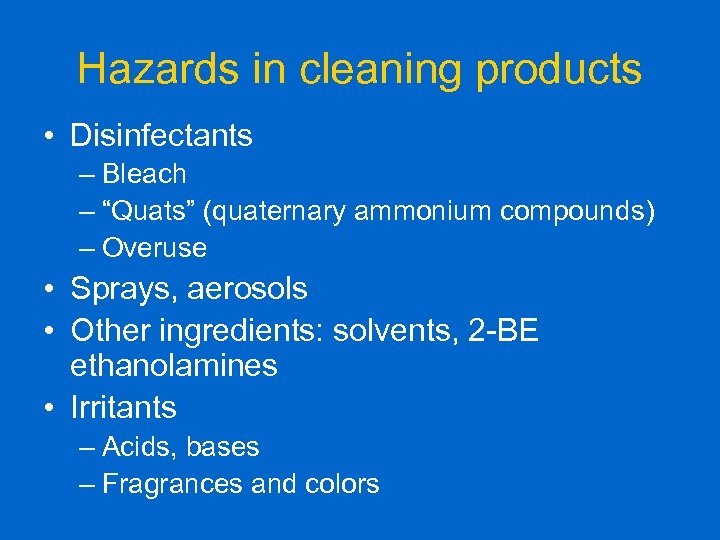 Hazards in cleaning products • Disinfectants – Bleach – “Quats” (quaternary ammonium compounds) – Overuse • Sprays, aerosols • Other ingredients: solvents, 2 -BE ethanolamines • Irritants – Acids, bases – Fragrances and colors
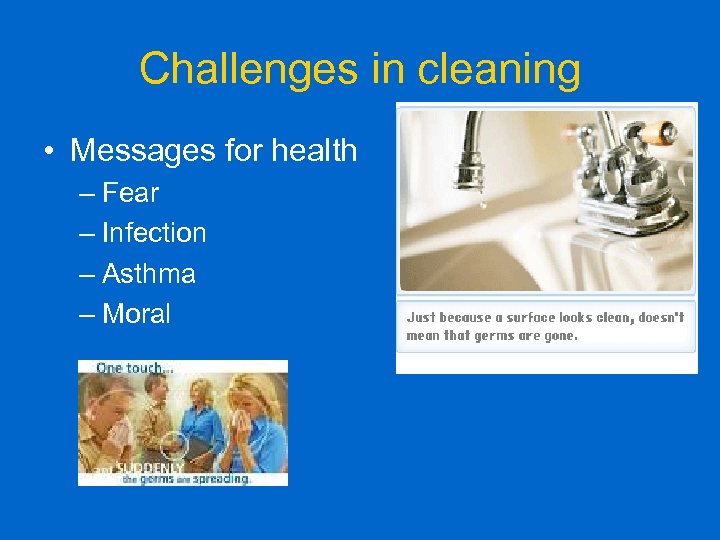 Challenges in cleaning • Messages for health – Fear – Infection – Asthma – Moral
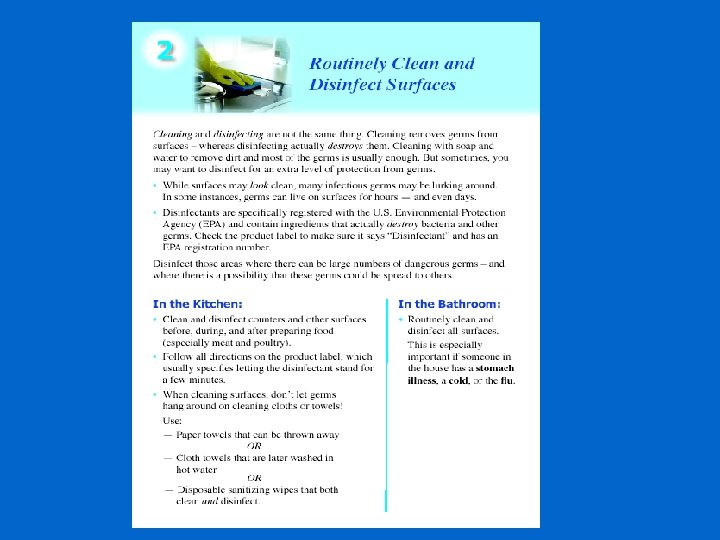
 Challenges in Cleaning: Healthcare • Requirements for disinfection • Single product—disinfectant combined with cleaning • Thousands of products • Multiple ingredients in each product • Hospital acquired infections – C. dif and MRSA • Round-the-clock occupancy • Patients with health problems
 Challenges of Cleaning Schools – School always occupied – Kids, food, arts materials – Understaffing – Poor ventilation – MRSA—superbug – Thousands of cleaning products, marketing – MSDSs—difficult to use – Pressure from parents – Staff brings cleaners from home
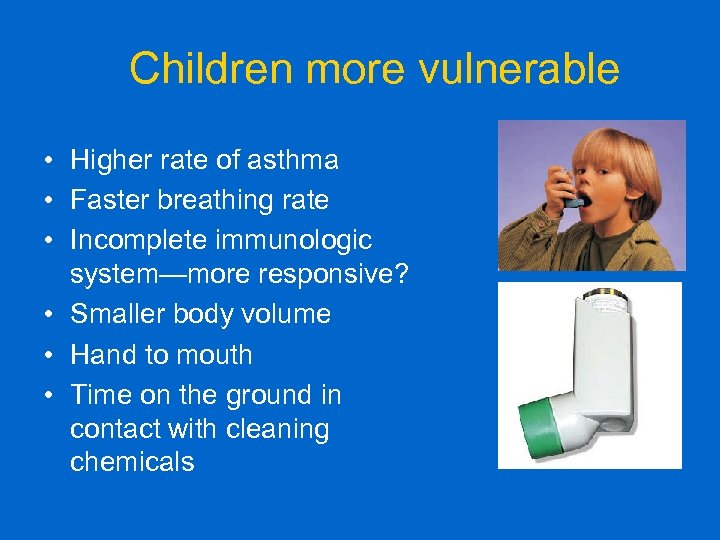 Children more vulnerable • Higher rate of asthma • Faster breathing rate • Incomplete immunologic system—more responsive? • Smaller body volume • Hand to mouth • Time on the ground in contact with cleaning chemicals
 Hygiene hypothesis • Lack of exposure to infectious agents in children leads to increased susceptibility to allergic disease, including asthma – 1989 Strachan – Th 1 and Th 2, endotoxin, some evidence • Opposed by Soap and Detergent Association • Hypothesis • Making cleaning products safer—different!
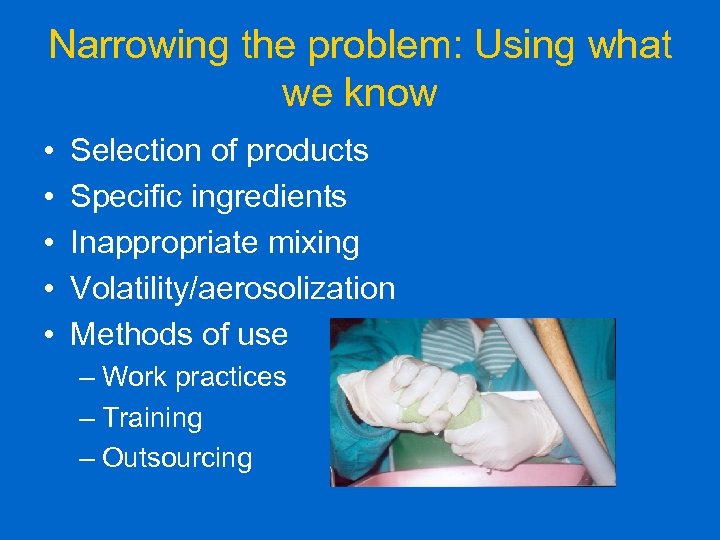 Narrowing the problem: Using what we know • • • Selection of products Specific ingredients Inappropriate mixing Volatility/aerosolization Methods of use – Work practices – Training – Outsourcing
 Prevention opportunity • Primary prevention—make cleaning safer – Using data—occupational and children – Asthma planning linked with intervention – Potential for broad based improvement • Addresses challenges – Review of dozens of MSDS to pick the best – Go beyond individual approaches (schools, long term care, residences, etc) – Address the limits of “green chemicals”
 Existing methods to evaluate cleaning products Third party certification • Criteria for environment and performance, and now health • Corporate funding by companies who want to get their product certified • Greenguard, Design for Environment (EPA)
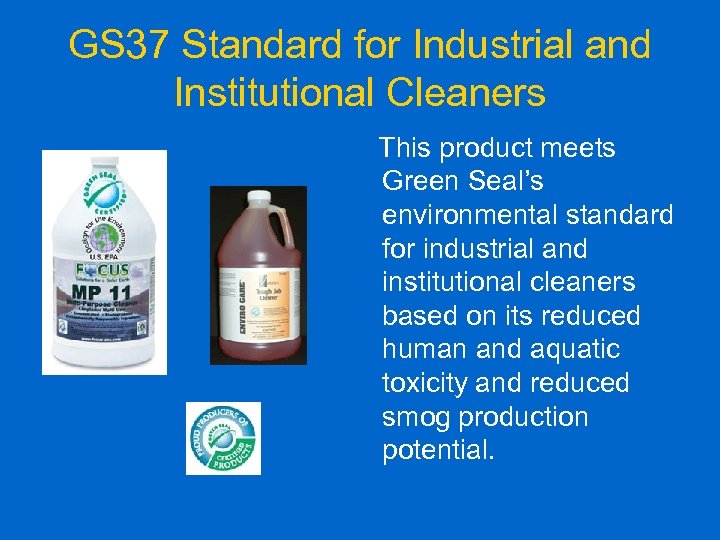 GS 37 Standard for Industrial and Institutional Cleaners This product meets Green Seal’s environmental standard for industrial and institutional cleaners based on its reduced human and aquatic toxicity and reduced smog production potential.
 GS 37 Criteria • • • Performance, using cold water Oral and inhalation toxicity No carcinogens, mutagens, repro toxins Not corrosive to skin and eyes Not skin sensitizer No ozone depletion No toxicity to aquatic life Packaging Concentrated-reduce transportation costs Consensus standard
 GS 37 Green Seal cleaners to protect against asthma • Chemicals defined as asthma-causing agents by AOEC – Criteria based on peer-reviewed articles about workers • Absence of consensus • Purpose—protect workers and bystanders, including children in schools and residents in long term care
 Can GS 37 protect against asthma? • Chemical ingredients – MEA, DEA, TEA, sulfuric acid, terpene, glacial acetic acid • Only ~5 out of 500 GS approved products have one of these ingredients • Skin sensitizers excluded • Strong corporate opposition
 Suggestions: Disinfectants • Use disinfectants only when needed • Promote cleaning • Decide when and where disinfection needed • Use disinfectants correctly • Correct concentration, not more • 10 minute requirements? • Purchase safer disinfectants • Be aware of health effects
 Suggestions: Fragrances • Avoid air fresheners • Suggest policies that discourage perfumes and colognes • Buy products without scents
 Suggestions: Cleaning • Select products carefully – Reduce total # of cleaning products – Read MSDS – Use Green Seal or other 3 rd party certification • • • Clean—don’t disinfect Provide training, labeling and directions No sprays or aerosols Good ventilation Pick timing to reduce exposure
 Cleaning products and asthma • Provides an opportunity for primary prevention • Will help adults and children • Applicability on the job, in schools, health care and at home • Opportunity for collaboration between work -related asthma and asthma planning
 Elise Pechter MPH, CIH Industrial Hygienist/Intervention Coordinator Occupational Health Surveillance Program 250 Washington Street Boston, MA 02108 617 624 -5681 Occupational. Asthma@state. ma. us www. mass. gov/dph/ohsp/