 Скачать презентацию Cleaner Production- A Move Towards Sustainability Abhilash Vijayan
9a3f92a000bb41a37daecf1d34238aab.ppt
- Количество слайдов: 18



Cleaner Production- A Move Towards Sustainability Abhilash Vijayan Charanya Varadarajan University of Toledo
Cleaner Production - Timeline n Late 1980’s n n Environmental managers in the U. S. and Europe realized the importance of pollution prevention at the source Stress on reducing waste and pollution at source rather than treating waste produced Combined effort of production, administration and environmental specialist teams to reduce waste generation and improve efficiency 1990’s n n n EPA decided on Pollution Prevention (P 2) National Pollution Prevention Act passed by Congress P 2 – the top priority for protecting the environment from pollution Established that recycling is not P 2 but finding use for something that’s already waste New P 2 programs established in many states The United Nations Environment Programme (UNEP) in Paris made similar observations about the need for Pollution Prevention
Cleaner Production n In Developing Countries n n n Weak or no regulations regarding treatment of pollution UNEP - major resource for Environmental Policy Decided on cost effective prevention through improved efficiency and business management as the means to reduce industrial pollution UNEP called this “CLEANER PRODUCTION” Cleaner Production (CP) is the international term for reducing environmental impacts from processes, products and services by using better management strategies, methods and tools A global movement for improving business performance and a profitable, cleaner, sustainable future n CP called Pollution Prevention (P 2) in North America
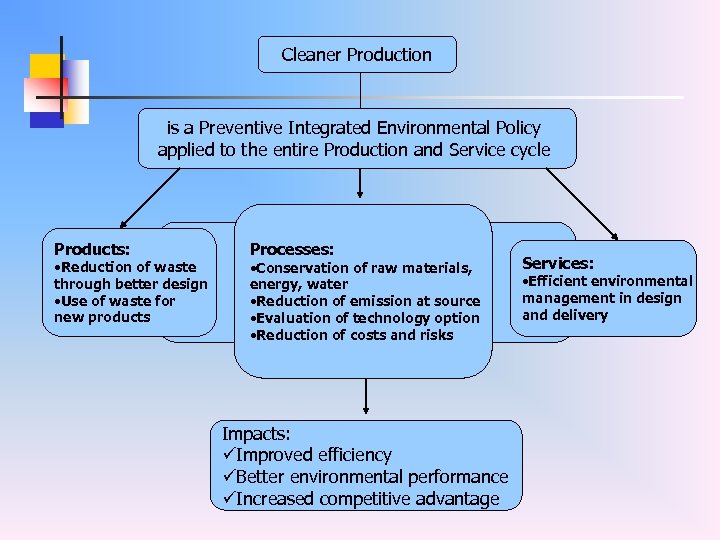
Cleaner Production is a Preventive Integrated Environmental Policy applied to the entire Production and Service cycle Products: • Reduction of waste through better design • Use of waste for new products Processes: • Conservation of raw materials, energy, water • Reduction of emission at source • Evaluation of technology option • Reduction of costs and risks Impacts: üImproved efficiency üBetter environmental performance üIncreased competitive advantage Services: • Efficient environmental management in design and delivery
Critical CP Factors n n n Management Systems n Ensures right tools are used properly n Environmental Management Systems (EMS) most common tool for CP and P 2 n Other Management systems such as Balanced Scorecard and Balridge Quality Award are also in use Assessments n To identify CP and P 2 opportunities n Assessments get integrated with the management system as a continual improvement process over time Measurements n To obtain data on what’s happening in an organization before applying CP and P 2 n Performance indicators linked with the mission and strategy developed n Accounting tools used for developing the right data n CP and P 2 projects evaluated financially and by risk and impact assessments
Critical CP Factors (Contd. ) n Design n Product design - ultimate driver for CP and P 2 process improvements Process improvement follow proper Product Design Purchasing n Critical for CP and P 2 n Green Purchasing or Environmentally Preferred Procurement creates demand for better products that in turn creates better supply n Reporting n Public reporting of CP and P 2 and social performances
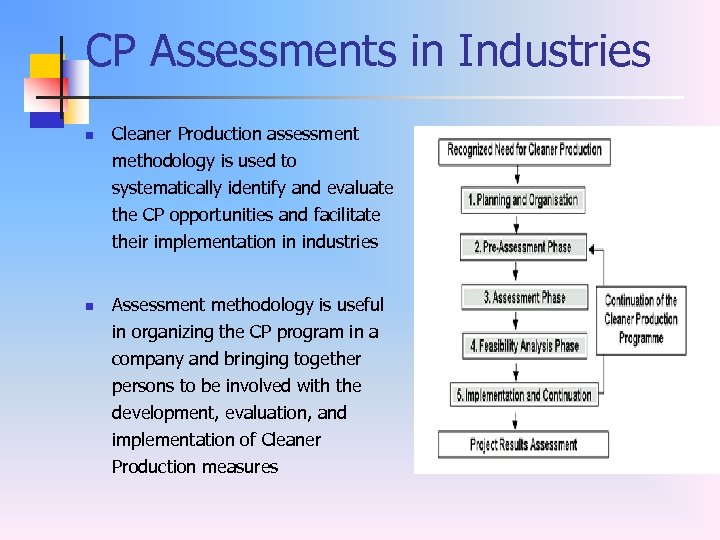
CP Assessments in Industries n n Cleaner Production assessment methodology is used to systematically identify and evaluate the CP opportunities and facilitate their implementation in industries Assessment methodology is useful in organizing the CP program in a company and bringing together persons to be involved with the development, evaluation, and implementation of Cleaner Production measures
Phase 1: Planning & Organization n Elements important for the successful start of a Cleaner Production program: n n n n Management commitment Employee involvement Cost awareness Organize a project team Identify barriers and solutions Set plant-wide goals Effective CP Planning Process ensures n Selection & implementation of the most cost effective CP options n Broader business planning investment analysis and decisionmaking (such as capital budgeting and purchasing) n Cleaner Production objectives and activities are consistent with those identified in the organization’s broader planning process
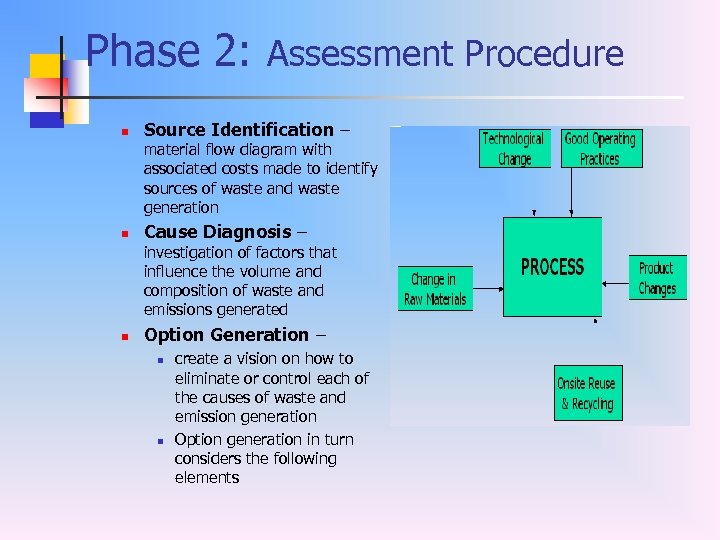
Phase 2: Assessment Procedure n Source Identification – material flow diagram with associated costs made to identify sources of waste and waste generation n Cause Diagnosis – investigation of factors that influence the volume and composition of waste and emissions generated n Option Generation – n n create a vision on how to eliminate or control each of the causes of waste and emission generation Option generation in turn considers the following elements
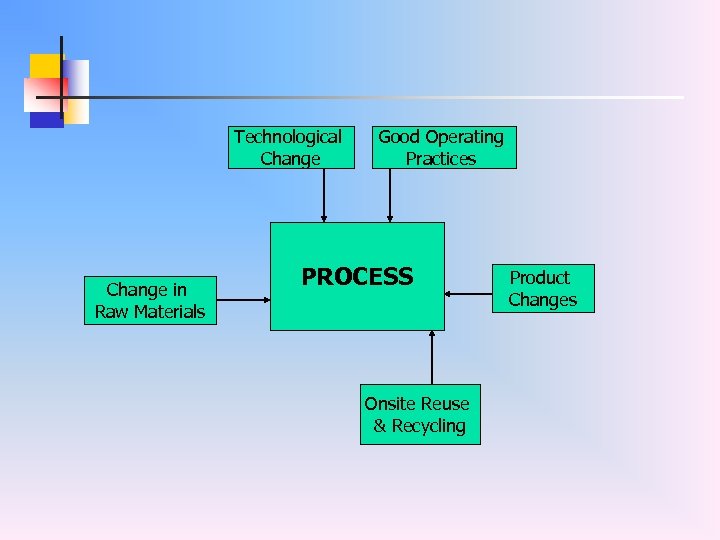
Technological Change in Raw Materials Good Operating Practices PROCESS Onsite Reuse & Recycling Product Changes
Phase 3: Feasibility Studies Evaluates the technical and economic feasibility of options n Preliminary Evaluation n n Options are sorted to identify additional evaluation needs for complex processes Technical Evaluation n n Effects on product quality and productivity n Expected maintenance and utility requirements n n Availability and reliability of equipment Operating and supervising skills Economic Evaluation § Collection (regarding investments and operational costs, and benefits) § Evaluation criteria (pay back period, Net Present Value (NPV) or Internal Rate of Return) and feasibility options n Environmental Evaluation n n Determine the positive and negative impacts of the option for the environment Selection of Feasible options n Elimination of technically non-feasible and environmentally insignificant options n Selection of the right option in case of competing options or limited funds
Phase 4: Implementation and Continuation Evaluates the feasible prevention measures which are implemented and provisions taken to ensure the ongoing application of CP Results of this phase include: ü Implementation of feasible CP measures ü Monitoring and Evaluation of the progress achieved by the implementation of the feasible options ü Initiation of the ongoing CP activities
Case Study n n n Company A is a Drycleaner which cleans over 2500 garments everyday Garments are loaded into an Ilsa dry-cleaning machine, in which they are immersed in perchlorethylene (solvent) Perchlorethylene and soaps dissolve grease and oil Solvent is removed and recycled in a still, where most of it is recovered Process produces liquid waste residue which has to be legally disposed off
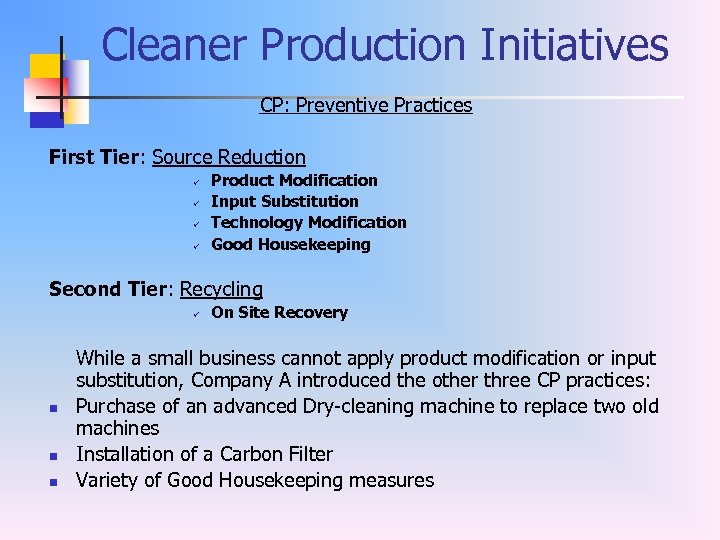
Cleaner Production Initiatives CP: Preventive Practices First Tier: Source Reduction ü ü Product Modification Input Substitution Technology Modification Good Housekeeping Second Tier: Recycling ü n n n On Site Recovery While a small business cannot apply product modification or input substitution, Company A introduced the other three CP practices: Purchase of an advanced Dry-cleaning machine to replace two old machines Installation of a Carbon Filter Variety of Good Housekeeping measures
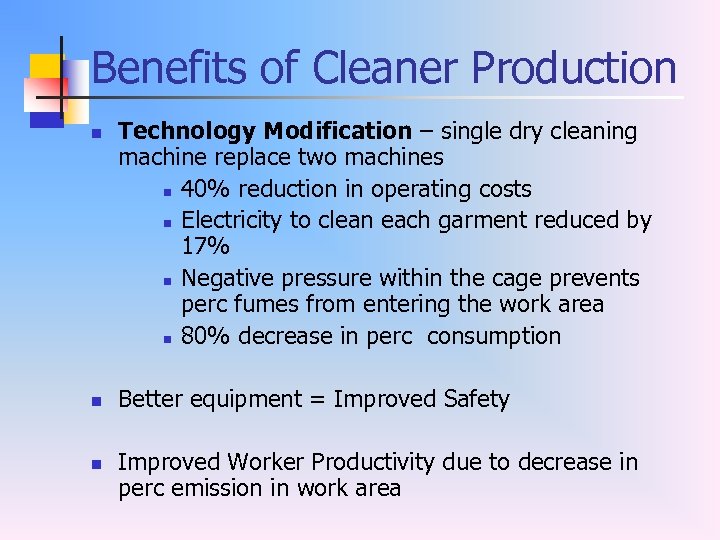
Benefits of Cleaner Production n Technology Modification – single dry cleaning machine replace two machines n 40% reduction in operating costs n Electricity to clean each garment reduced by 17% n Negative pressure within the cage prevents perc fumes from entering the work area n 80% decrease in perc consumption Better equipment = Improved Safety Improved Worker Productivity due to decrease in perc emission in work area
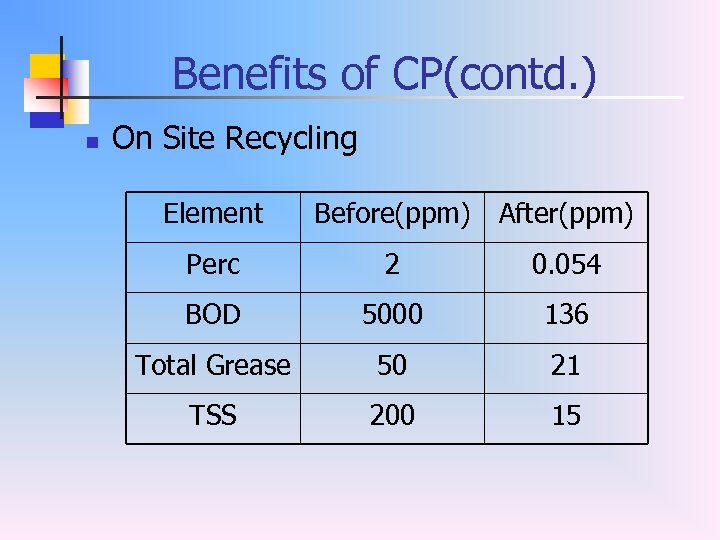
Benefits of CP(contd. ) n On Site Recycling Element Before(ppm) After(ppm) Perc 2 0. 054 BOD 5000 136 Total Grease 50 21 TSS 200 15
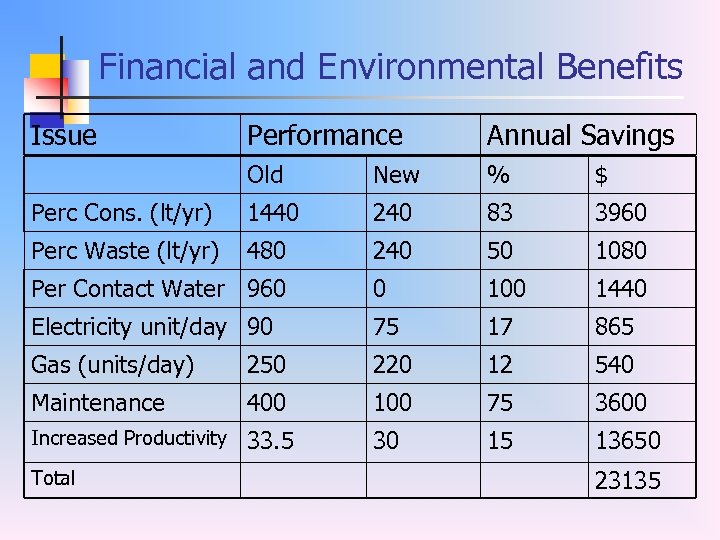
Financial and Environmental Benefits Issue Performance Annual Savings Old New % $ Perc Cons. (lt/yr) 1440 240 83 3960 Perc Waste (lt/yr) 480 240 50 1080 Per Contact Water 960 0 100 1440 Electricity unit/day 90 75 17 865 Gas (units/day) 250 220 12 540 Maintenance 400 100 75 3600 Increased Productivity 33. 5 30 15 13650 Total 23135
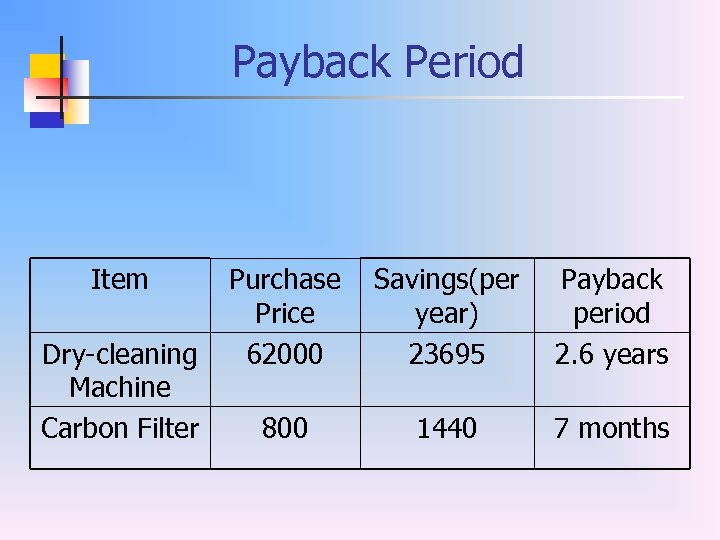
Payback Period Item Dry-cleaning Machine Carbon Filter Purchase Price 62000 Savings(per year) 23695 Payback period 2. 6 years 800 1440 7 months
Скачать презентацию Cleaner Production- A Move Towards Sustainability Abhilash Vijayan
9a3f92a000bb41a37daecf1d34238aab.ppt