


 Скачать презентацию CLEAN DEVELOPMENT MECHANISM OPPORTUNITIES FOR THE PHILIPPINES Climate
d351b2b6c83b6f717040562c92ff04b7.ppt
- Количество слайдов: 32
 CLEAN DEVELOPMENT MECHANISM: OPPORTUNITIES FOR THE PHILIPPINES Climate Change Information Center Manila Observatory Ateneo de Manila University
 Clean Development Mechanism • • Enables developed countries (known as Annex I countries) to meet their emission reduction commitments in a flexible and costeffective manner Assists developing countries (non-Annex I countries) in meeting their sustainable development objectives Investors benefit by obtaining Certificates of Emissions Reductions (CERs) Host countries benefit in the form of investment, access to better technology, and local sustainable development
 Value & Benefits of CDM: From a developing country perspective • Attract capital for less-carbon intensive projects • Encourage active participation of private and public sectors • Technology transfer – environmentally friendly sustainable technologies • Investment priorities in sustainable development projects
 CDM contributions to Sustainable Development objectives • Transfer of technology and financial resources • Sustainable ways of energy production • Increasing energy efficiency & conservation • Poverty alleviation through income and employment generation • Local environmental side benefits
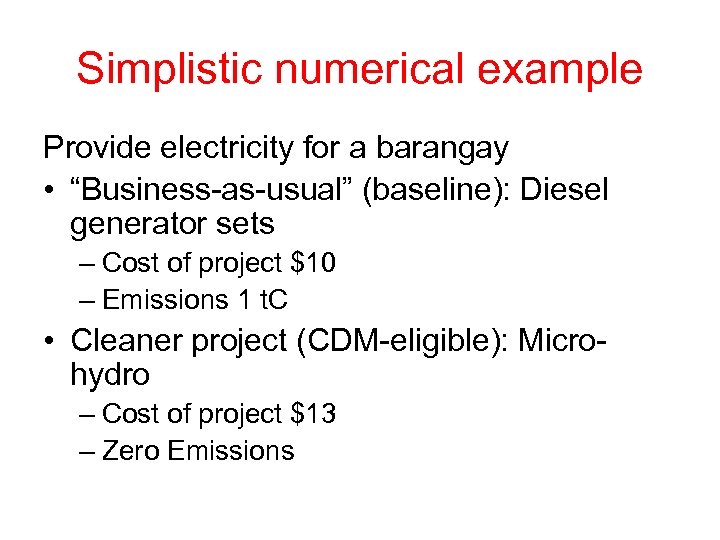 Simplistic numerical example Provide electricity for a barangay • “Business-as-usual” (baseline): Diesel generator sets – Cost of project $10 – Emissions 1 t. C • Cleaner project (CDM-eligible): Microhydro – Cost of project $13 – Zero Emissions
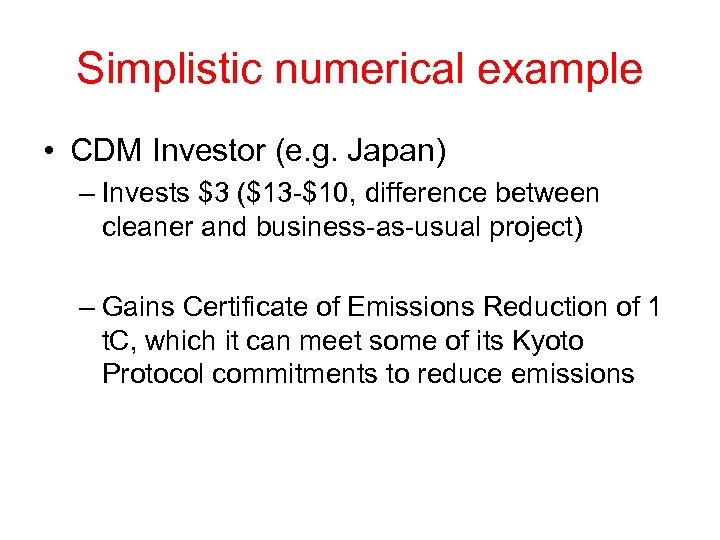 Simplistic numerical example • CDM Investor (e. g. Japan) – Invests $3 ($13 -$10, difference between cleaner and business-as-usual project) – Gains Certificate of Emissions Reduction of 1 t. C, which it can meet some of its Kyoto Protocol commitments to reduce emissions
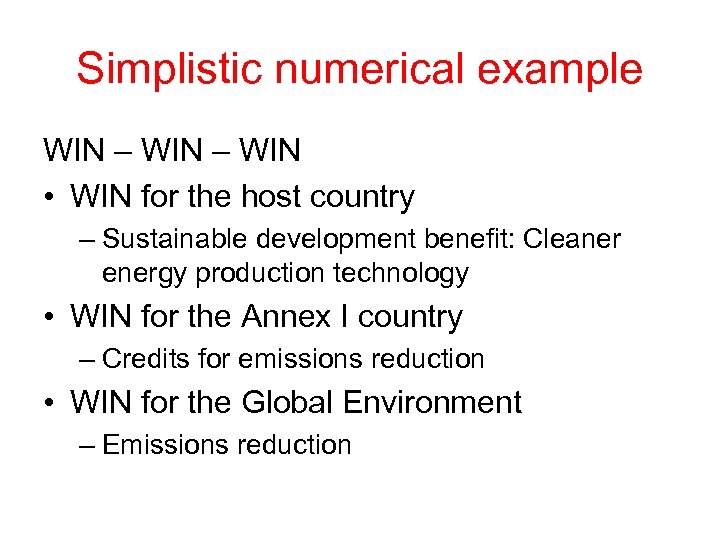 Simplistic numerical example WIN – WIN • WIN for the host country – Sustainable development benefit: Cleaner energy production technology • WIN for the Annex I country – Credits for emissions reduction • WIN for the Global Environment – Emissions reduction
 CDM Project • Achieves Sustainable Development objectives for the host developing country • Reduces GHG Emissions
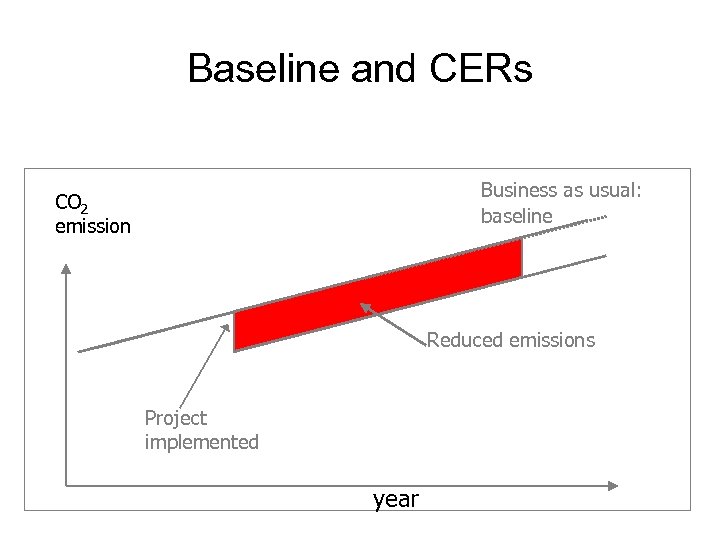 Baseline and CERs Business as usual: baseline CO 2 emission Reduced emissions Project implemented year
 CDM: A special product • CER is a payment for the Project Developer not to produce • To reduce GHG emissions • Thus, the importance of special requirements – Definition of baselines – Calculation of GHG emission reductions
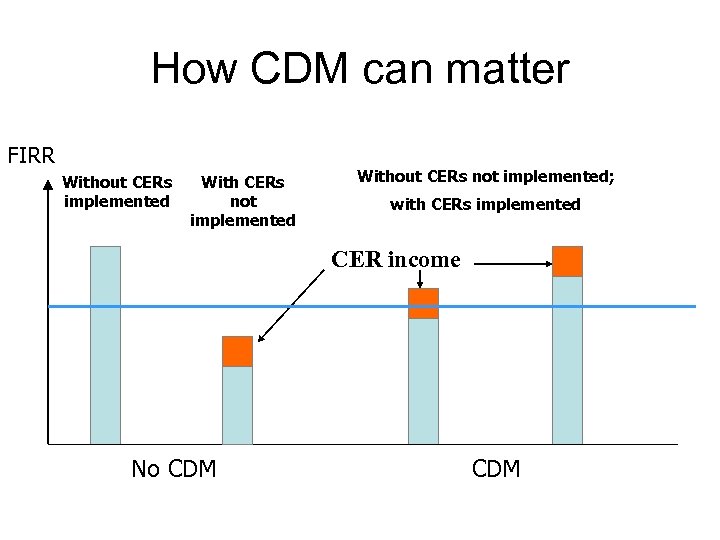 How CDM can matter FIRR Without CERs implemented With CERs not implemented Without CERs not implemented; with CERs implemented CER income No CDM
 CDM Eligible Projects • • • Renewable energy Fuel switching End-use energy efficiency improvements Supply-side energy efficiency improvement Agriculture (reduction of CH 4 & NO 2 emissions) • Industrial processes (CO 2 from cement, HFCs, etc) • Sink projects (only afforestation & reforestation)
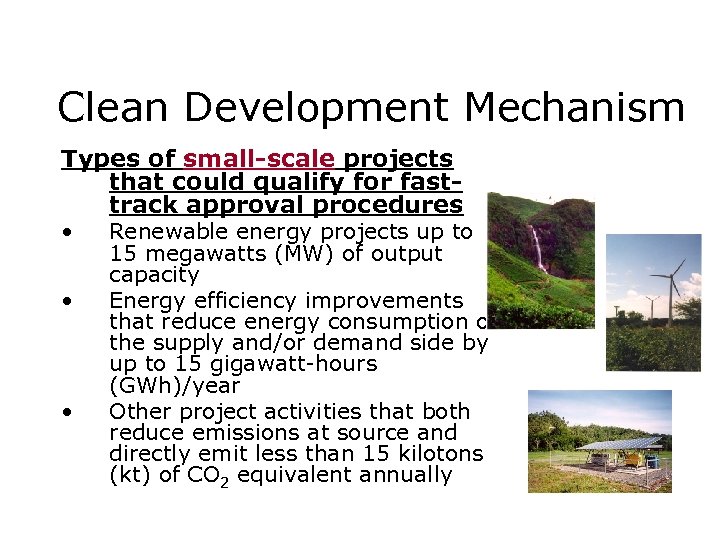 Clean Development Mechanism Types of small-scale projects that could qualify for fasttrack approval procedures • • • Renewable energy projects up to 15 megawatts (MW) of output capacity Energy efficiency improvements that reduce energy consumption on the supply and/or demand side by up to 15 gigawatt-hours (GWh)/year Other project activities that both reduce emissions at source and directly emit less than 15 kilotons (kt) of CO 2 equivalent annually
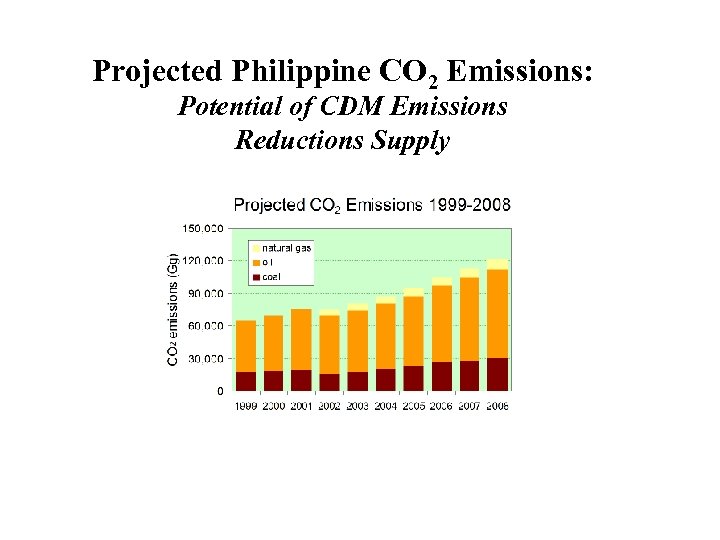 Projected Philippine CO 2 Emissions: Potential of CDM Emissions Reductions Supply
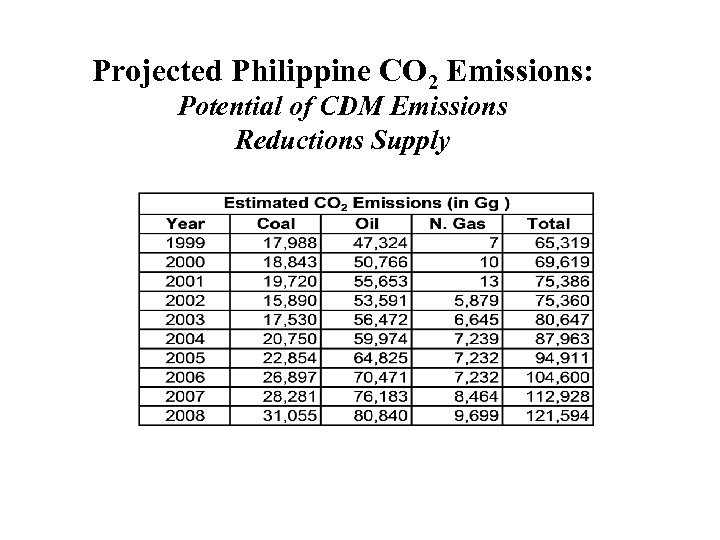 Projected Philippine CO 2 Emissions: Potential of CDM Emissions Reductions Supply
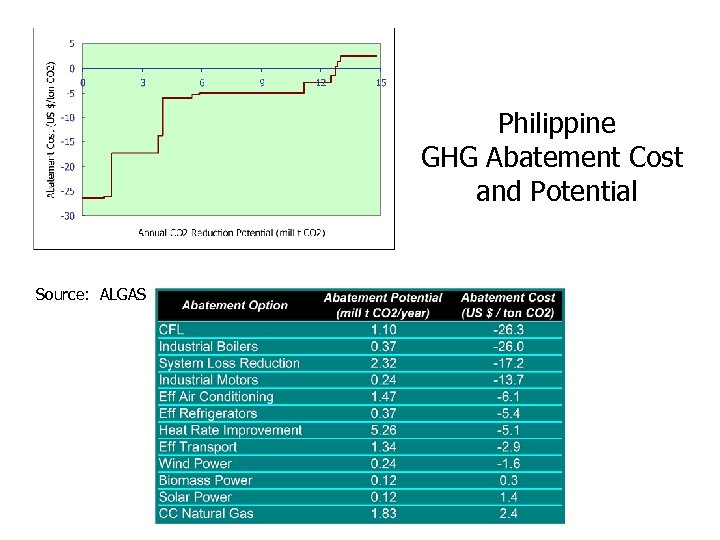 Philippine GHG Abatement Cost and Potential Source: ALGAS
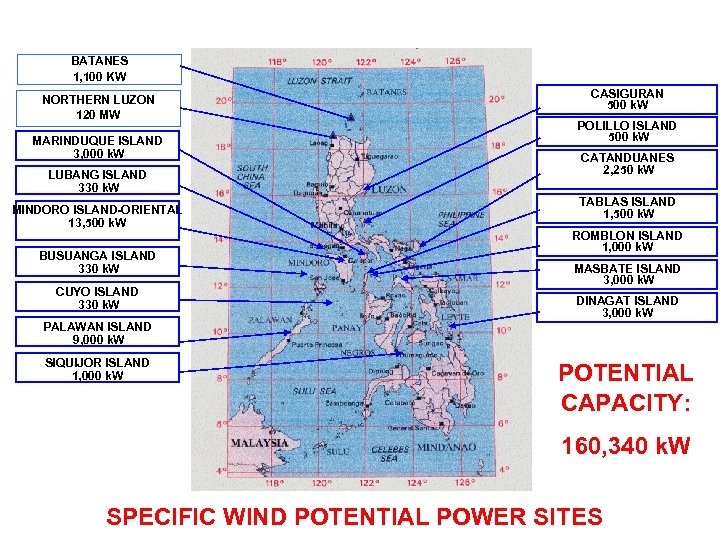 BATANES 1, 100 KW NORTHERN LUZON 120 MW MARINDUQUE ISLAND 3, 000 k. W LUBANG ISLAND 330 k. W MINDORO ISLAND-ORIENTAL 13, 500 k. W BUSUANGA ISLAND 330 k. W CUYO ISLAND 330 k. W CASIGURAN 500 k. W POLILLO ISLAND 500 k. W CATANDUANES 2, 250 k. W TABLAS ISLAND 1, 500 k. W ROMBLON ISLAND 1, 000 k. W MASBATE ISLAND 3, 000 k. W DINAGAT ISLAND 3, 000 k. W PALAWAN ISLAND 9, 000 k. W SIQUIJOR ISLAND 1, 000 k. W POTENTIAL CAPACITY: 160, 340 k. W SPECIFIC WIND POTENTIAL POWER SITES
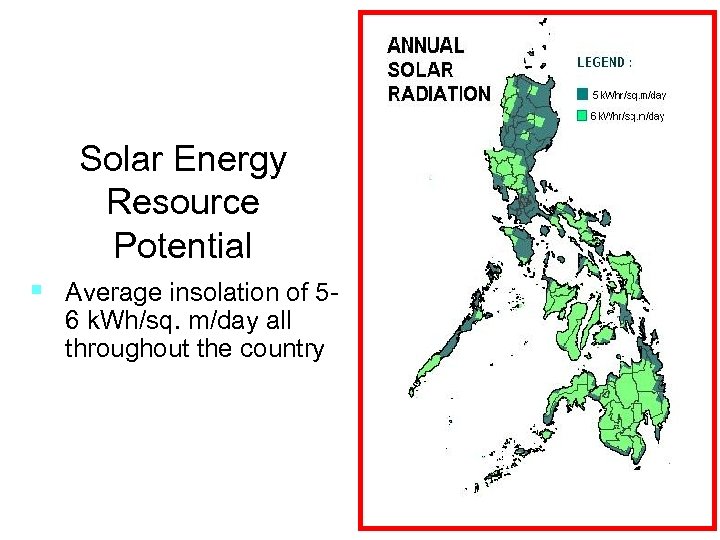 Solar Energy Resource Potential § Average insolation of 5 - 6 k. Wh/sq. m/day all throughout the country
 Requirements for the Philippines to Participate in CDM • Ratify the Kyoto Protocol • Designate the CDM National Authority
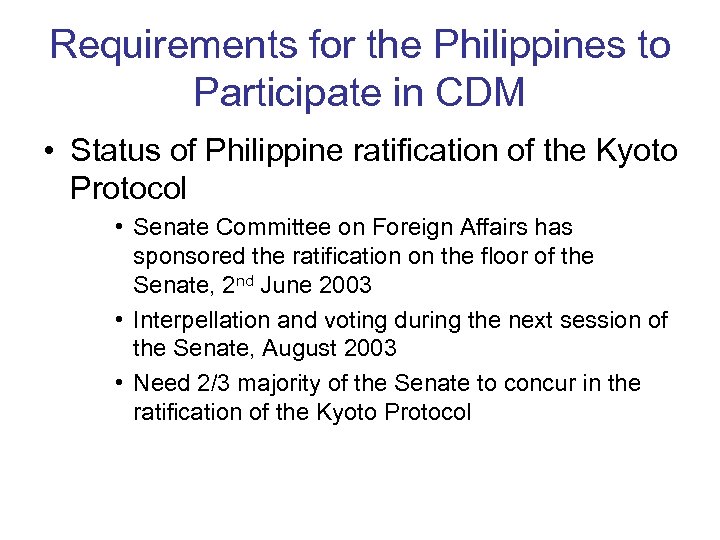 Requirements for the Philippines to Participate in CDM • Status of Philippine ratification of the Kyoto Protocol • Senate Committee on Foreign Affairs has sponsored the ratification on the floor of the Senate, 2 nd June 2003 • Interpellation and voting during the next session of the Senate, August 2003 • Need 2/3 majority of the Senate to concur in the ratification of the Kyoto Protocol
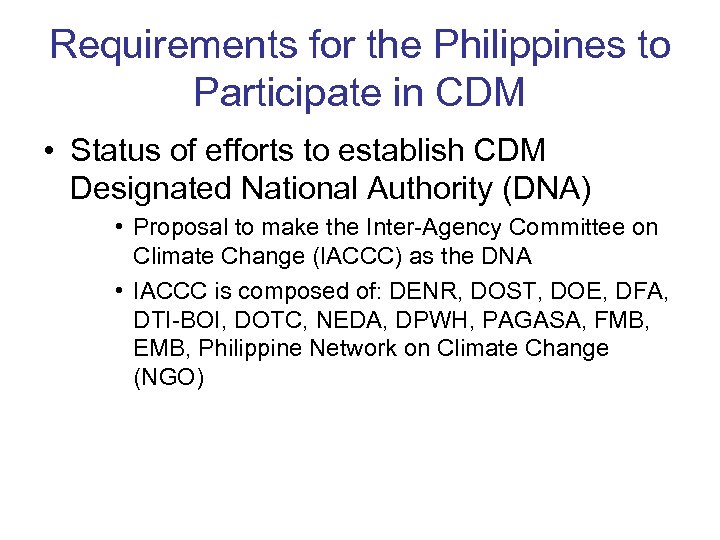 Requirements for the Philippines to Participate in CDM • Status of efforts to establish CDM Designated National Authority (DNA) • Proposal to make the Inter-Agency Committee on Climate Change (IACCC) as the DNA • IACCC is composed of: DENR, DOST, DOE, DFA, DTI-BOI, DOTC, NEDA, DPWH, PAGASA, FMB, EMB, Philippine Network on Climate Change (NGO)
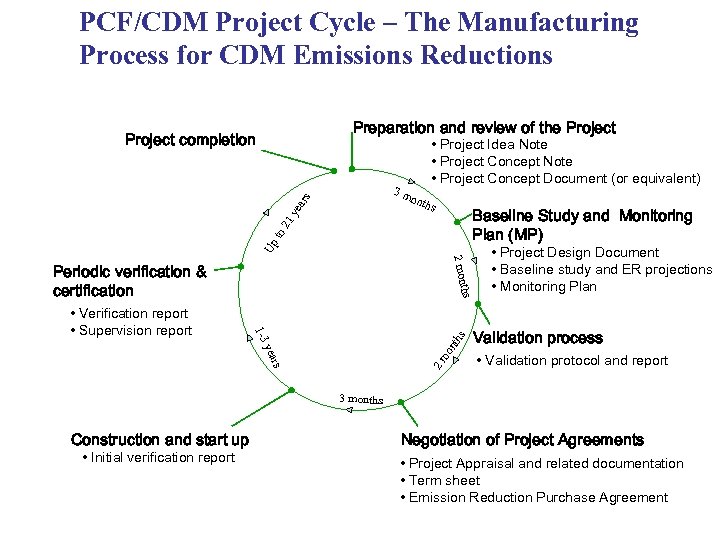 PCF/CDM Project Cycle – The Manufacturing Process for CDM Emissions Reductions Preparation and review of the Project • Project Idea Note • Project Concept Document (or equivalent) 3 m ont hs Baseline Study and Monitoring Plan (MP) Up to 21 ye ars Project completion 2 mon rs 2 m yea on th s 1 -3 • Verification report • Supervision report ths Periodic verification & certification • Project Design Document • Baseline study and ER projections • Monitoring Plan Validation process • Validation protocol and report 3 months Construction and start up • Initial verification report Negotiation of Project Agreements • Project Appraisal and related documentation • Term sheet • Emission Reduction Purchase Agreement
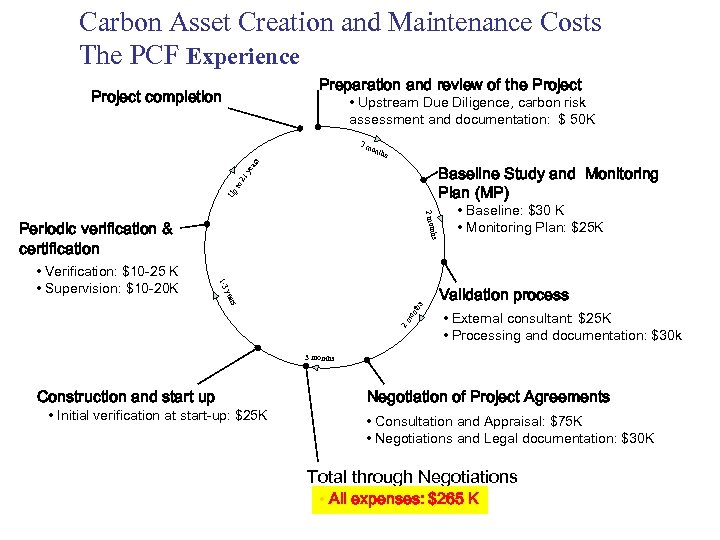 Carbon Asset Creation and Maintenance Costs The PCF Experience Preparation and review of the Project completion • Upstream Due Diligence, carbon risk assessment and documentation: $ 50 K 3 m ont ars hs Up to 21 ye Baseline Study and Monitoring Plan (MP) 2 mon 1 -3 2 m on ths rs yea • Verification: $10 -25 K • Supervision: $10 -20 K ths Periodic verification & certification • Baseline: $30 K • Monitoring Plan: $25 K Validation process • External consultant: $25 K • Processing and documentation: $30 k 3 months Construction and start up • Initial verification at start-up: $25 K Negotiation of Project Agreements • Consultation and Appraisal: $75 K • Negotiations and Legal documentation: $30 K Total through Negotiations • All expenses: $265 K
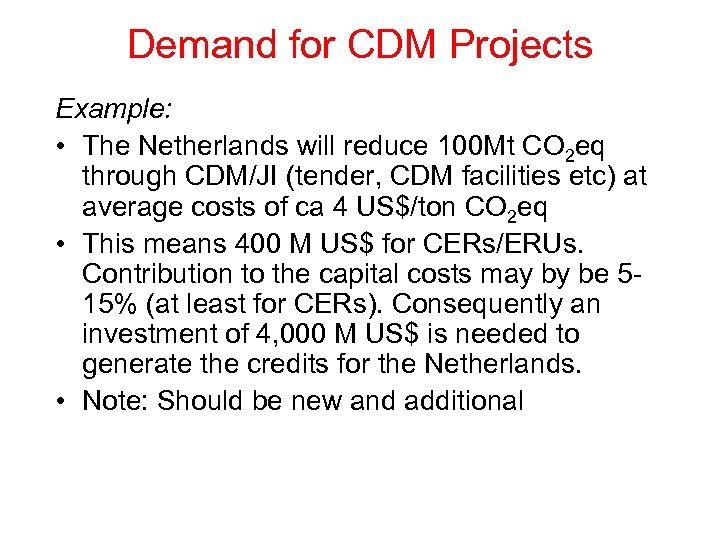 Demand for CDM Projects Example: • The Netherlands will reduce 100 Mt CO 2 eq through CDM/JI (tender, CDM facilities etc) at average costs of ca 4 US$/ton CO 2 eq • This means 400 M US$ for CERs/ERUs. Contribution to the capital costs may by be 515% (at least for CERs). Consequently an investment of 4, 000 M US$ is needed to generate the credits for the Netherlands. • Note: Should be new and additional
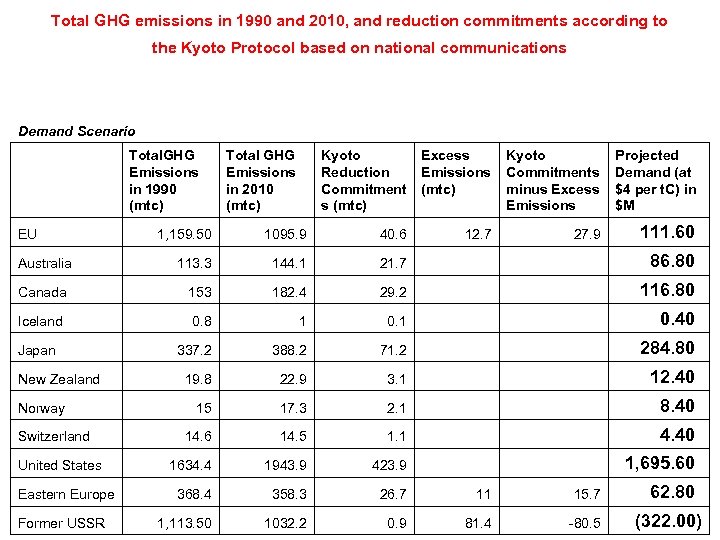 Total GHG emissions in 1990 and 2010, and reduction commitments according to the Kyoto Protocol based on national communications Demand Scenario EU Total. GHG Emissions in 1990 (mtc) Total GHG Emissions in 2010 (mtc) Kyoto Reduction Commitment s (mtc) Excess Emissions (mtc) Kyoto Commitments minus Excess Emissions Projected Demand (at $4 per t. C) in $M 12. 7 27. 9 111. 60 1, 159. 50 1095. 9 40. 6 113. 3 144. 1 21. 7 86. 80 Canada 153 182. 4 29. 2 116. 80 Iceland 0. 8 1 0. 1 0. 40 337. 2 388. 2 71. 2 284. 80 19. 8 22. 9 3. 1 12. 40 15 17. 3 2. 1 8. 40 14. 6 14. 5 1. 1 4. 40 1634. 4 1943. 9 423. 9 1, 695. 60 368. 4 358. 3 26. 7 11 15. 7 62. 80 1, 113. 50 1032. 2 0. 9 81. 4 -80. 5 (322. 00) Australia Japan New Zealand Norway Switzerland United States Eastern Europe Former USSR
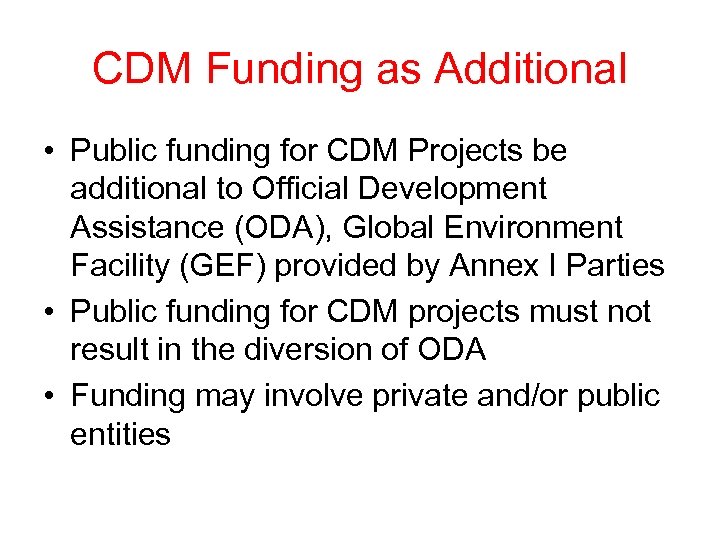 CDM Funding as Additional • Public funding for CDM Projects be additional to Official Development Assistance (ODA), Global Environment Facility (GEF) provided by Annex I Parties • Public funding for CDM projects must not result in the diversion of ODA • Funding may involve private and/or public entities
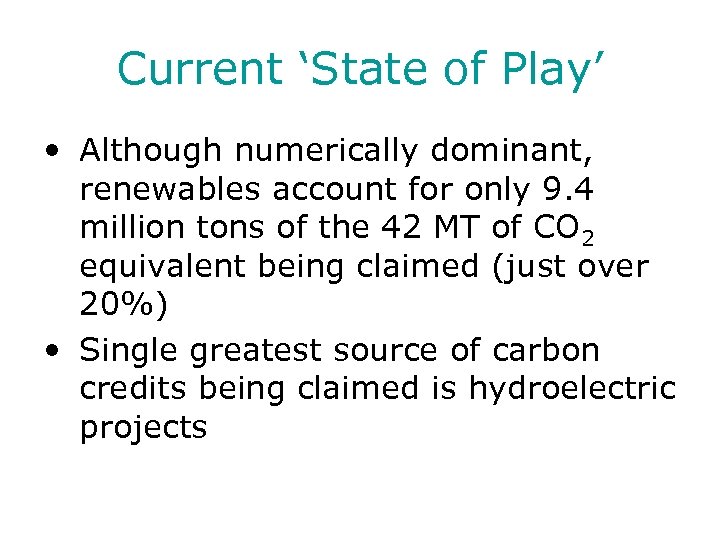 Current ‘State of Play’ • Although numerically dominant, renewables account for only 9. 4 million tons of the 42 MT of CO 2 equivalent being claimed (just over 20%) • Single greatest source of carbon credits being claimed is hydroelectric projects
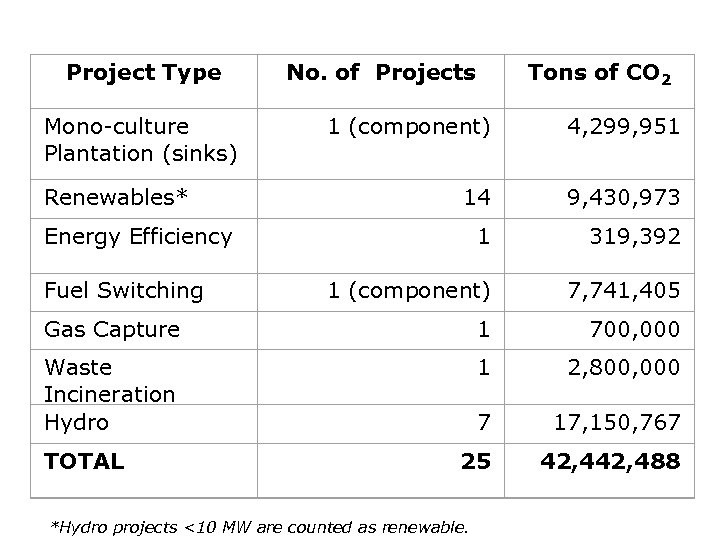 Project Type Mono-culture Plantation (sinks) No. of Projects Tons of CO 2 1 (component) 4, 299, 951 14 9, 430, 973 1 319, 392 1 (component) 7, 741, 405 Gas Capture 1 700, 000 Waste Incineration Hydro 1 2, 800, 000 7 17, 150, 767 25 42, 488 Renewables* Energy Efficiency Fuel Switching TOTAL *Hydro projects <10 MW are counted as renewable.
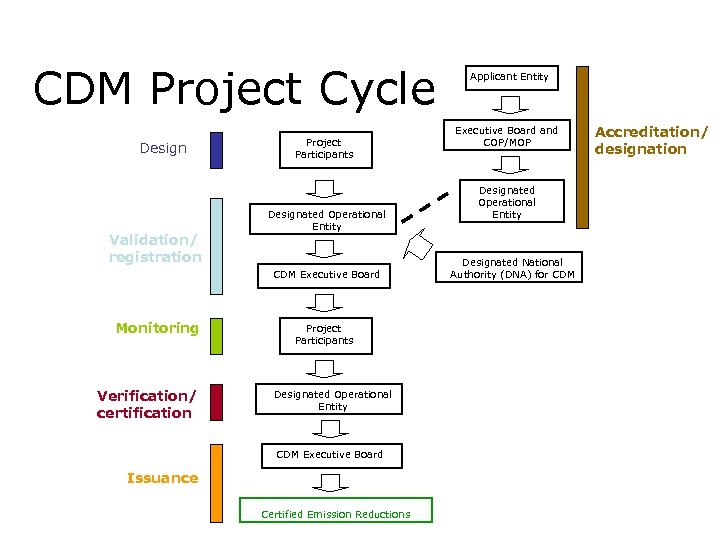 CDM Project Cycle Design Validation/ registration Project Participants Designated Operational Entity CDM Executive Board Monitoring Verification/ certification Project Participants Designated Operational Entity CDM Executive Board Issuance Certified Emission Reductions Applicant Entity Executive Board and COP/MOP Designated Operational Entity Designated National Authority (DNA) for CDM Accreditation/ designation
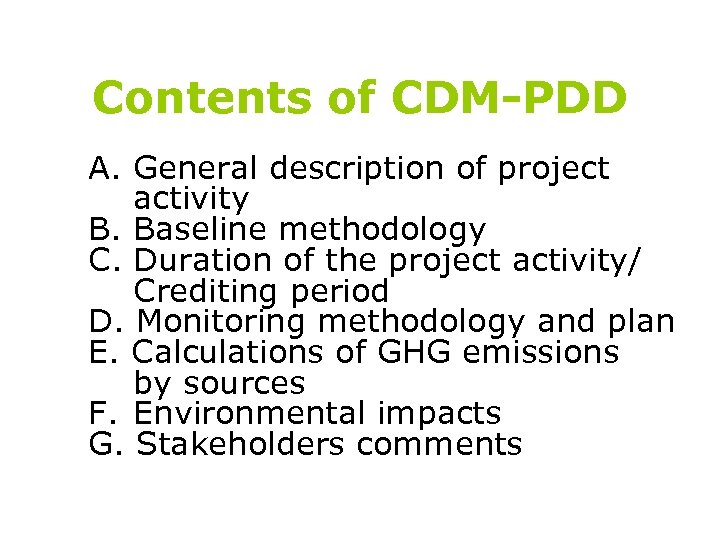 Contents of CDM-PDD A. General description of project activity B. Baseline methodology C. Duration of the project activity/ Crediting period D. Monitoring methodology and plan E. Calculations of GHG emissions by sources F. Environmental impacts G. Stakeholders comments
 Roberto C. Yap, S. J. , Ph. D. Environmental Economist Climate Change Information Center Manila Observatory Ateneo de Manila University Tel +63 2 426 -6144 Fax +63 2 426 -6070 rcyapsj@observatory. ph