


 Скачать презентацию CLE CREATIVE LEARNING EXERCISE CLE 21 A
e7c7b3bf9c2f5ca4499b8e6d33c0b000.ppt
- Количество слайдов: 99
 CLE CREATIVE LEARNING EXERCISE CLE 21 – A ONE DAY PROGRAM OF MARKETING LANGUAGE AND PRACTICE “COMMUNICATE CONFIDENTLY WITH MARKETING STAFF” LECTURE/CASE SESSION ADD SOUND Patrice Anne Nuq Robert Boland Anthony Harris Copyright RGAB/PN/AH 2005/1
 marketing for creative learning Patrice Anne Nuq Robert Boland Tony Harris
 CLE 21 – A ONE DAY PROGRAM OF MARKETING LANGUAGE AND PRACTICE • Materials to be covered in this lecture/case section. 3
 CLE 21 – A ONE DAY PROGRAM OF MARKETING LANGUAGE AND PRACTICE • Chapter 1 Introduction to Consumer Marketing • • Chapter 2 Basics of Marketing LU 2. 1 Marketing and the Marketing Mix LU 2. 2 Product Types and Distribution LU 2. 3 Consumer Motivation • • • Chapter 3 LU 3. 1 LU 3. 2 LU 3. 3 LU 3. 4 • Chapter 4 Place and Promotion • • • LU LU LU • • • Chapter 5 Marketing Management LU 5. 1 Concept and Strategy LU 5. 2 Planning LU 5. 3 Control LU 5. 4 Customer Relationship Management Product and Price Product Management and Policy Product Life cycle Major Determinants of Price Pricing Policy 4. 1 Distribution Channels 4. 2 Outlets and Distribution Control 4. 3 Advertising and Sales Promotion 4
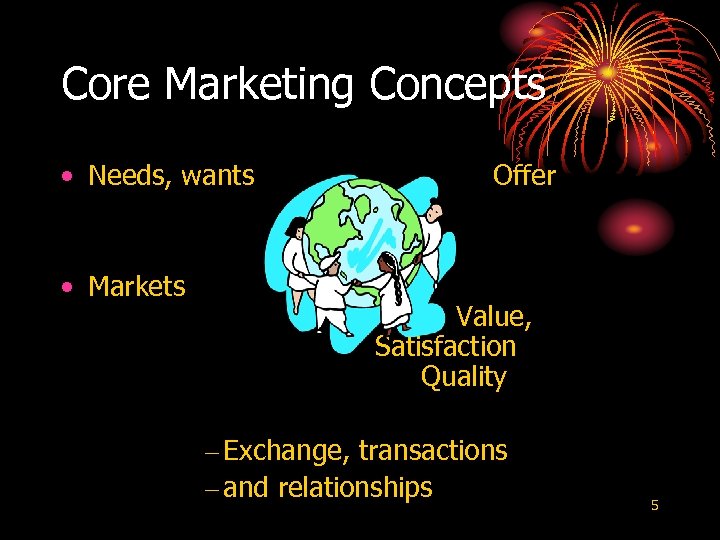 Core Marketing Concepts • Needs, wants • Markets Offer Value, Satisfaction Quality – Exchange, transactions – and relationships 5
 Chapter 1 – INTRODUCTION TO CONSUMER MARKETING • MARKETING • Marketing directs all company activities to discover and satisfy the present and potential needs of target customers. • MARKETING CONCEPT • The Marketing Concept looks at the needs and desires of the customer first, and then develops a product “offer” that satisfies the needs of the customer. 6
 Chapter 1 – INTRODUCTION TO CONSUMER MARKETING • MARKETING MIX • The Marketing Mix concerns: • • Product what kind of product to market? Price at what prices? Place where and how do to distribute it? Promotion how to people to buy it? 7
 Chapter 1 – INTRODUCTION TO CONSUMER MARKETING • PRODUCT • To market a product, we develop an organization to satisfy the consumer demand by carefully studying the: • • • Kind of ‘offer’ required, Llfe cycle of this product on the market Development possibilities and implications of this product. 8
 Chapter 1 – INTRODUCTION TO CONSUMER MARKETING • PRICE • Pricing policy is determined by the “offer” value that the customer receives and perceives. Pricing policy is determined by: • • What the buyer will pay based on perceived value Position' of the product in the market Nature and strength of the competition Life cycle of the product Image of the product Patent position Market objectives in the market context Cost of producing the product. 9
 Chapter 1 – INTRODUCTION TO CONSUMER MARKETING • PLACE • The place in which the product will be distributed and how it will be distributed involves the selection of appropriate channels and outlets. • It also demands constant reappraisal of consumer needs, purchasing patterns, and trends. 10
 Chapter 1 – INTRODUCTION TO CONSUMER MARKETING • PROMOTION • Advertising and sales promotion create the desire in the consumer to buy the product, by making consumers aware of product benefits and then by stimulating consumer buying habits. 11
 Chapter 1 – INTRODUCTION TO CONSUMER MARKETING • MARKETING STRATEGY • Marketing strategy requires an understanding of the market and customer • A good market segmentation enables a company to make specific “offers” based on different customer segments. • Market positioning is the image that the brand or “offer” has in the mind of the consumer. • A market strategy must have a sustainable 12 competitive advantage to ensure market share
 Chapter 1 – INTRODUCTION TO CONSUMER MARKETING • CASE: 1 Telecommunications Company • A new telecommunicaton brand is entering a new market where competition has been limited due to the monopolistic PTT. They are a successful brand in other markets and they want to establish a global brand. • Question: How should they position themselves? 13
 Chapter 1 – INTRODUCTION TO CONSUMER MARKETING • CASE 1 ANSWER • They first need to develop their market strategy, ie. Segmentation, targeting and value positioning. • They need to determine their unique strengths that are equally important to customers. 14
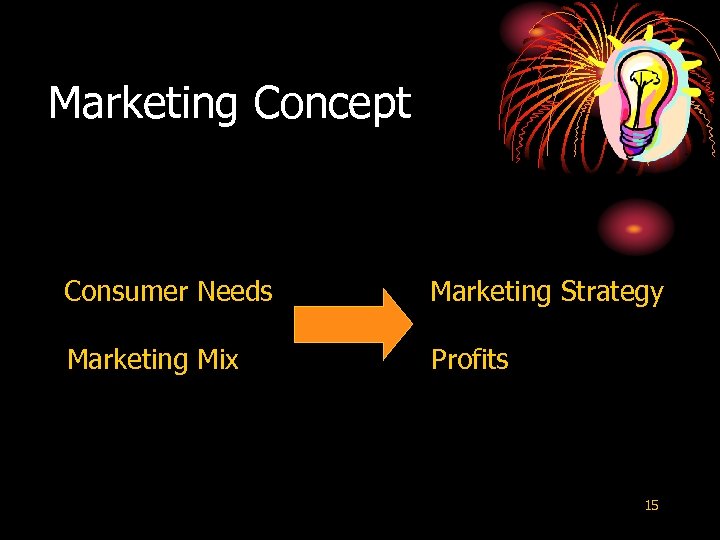 Marketing Concept Consumer Needs Marketing Strategy Marketing Mix Profits 15
 Chapter 2 – BASICS OF MARKETING LU 2. 1 Marketing and the Marketing Mix • Consumer marketing management deals with selling goods and services to the ultimate consumer. It seeks ways to discover and satisfy both the present and potential needs of this final consumer. • The Consumer Marketing “MIX” has four “P’s”: Product, Price, Place (distribution), and Promotion. 16
 Chapter 2 – BASICS OF MARKETING LU 2. 1 Marketing and the Marketing Mix • The Consumer Marketing “CONCEPT” seeks to be: Consumer oriented to identify and satisfy consumer needs Profit oriented to achieve a profitable sales volume; and Strategically oriented to achieve corporate objectives. 17
 Chapter 2 – BASICS OF MARKETING LU 2. 1 Marketing and the Marketing Mix • Consumer marketing has changed from targeting all customers (mass marketing) to identifying customer segments and targeting individual customers, in “one to one” marketing. • One to one marketing seeks to develop an “individual”, very personal, relationship with each customer e. g. Amazon. com. 18
 Target Market • A set of buyers who share common needs or characteristics. 19
 Chapter 2 – BASICS OF MARKETING LU 2. 1 Marketing and the Marketing Mix • CASE 2 • A leading telecommunications company wants to identify their customers based on value. • QUESTION: How do they approach this exercise? 20
 Chapter 2 – BASICS OF MARKETING LU 2. 1 Marketing and the Marketing Mix • CASE 2 ANSWER • First, they need to segment their customers based on monthly revenue. • They then need to set tiers to classify customers by high, medium, and low value. 21
 Chapter 2 – BASICS OF MARKETING LU 2. 2 Product Types and Distribution • • Consumer products are of three main types of goods: Specialty Convenience Shopping The major distribution channels used in consumer marketing may be: Direct manufacturer to consumer) or Indirect manufacturer to agent/middleman to consumer. 22
 Chapter 2 – BASICS OF MARKETING LU 2. 2 Product Types and Distribution • Marketing 'push' means the influencing of consumer buying at the point of purchase. • The manufacturer has the most 'push' when the distribution channel is shortest, but when distribution costs are usually highest. • It is generally more expensive for a manufacturer to sell direct to the consumer than through wholesalers and retailers. 23
 Chapter 2 – BASICS OF MARKETING LU 2. 2 Product Types and Distribution • Case 3: • A beer manufacturer wants to enter a new city and is deciding on both a ‘push’ and ‘pull’ approach. • Question: How would you develop a ‘push’ approach? 24
 Chapter 2 – BASICS OF MARKETING LU 2. 2 Product Types and Distribution • Case 3 Answer: • You should contact local bars and give incentives to sell your product. • Therefore, the bartenders will ‘push’ your beer instead of other brands if the incentive is appealing. 25
 Chapter 2 – BASICS OF MARKETING LU 2. 3 Consumer Motivation • Consumer buying motives are rational and emotional. Rational motivation involves: economy, efficiency, dependability, durability, convenience, gain or profit, etc. • Emotional motivation involves: imitation, individuality, conformity, comfort, ambition, pride, prestige, pleasure, etc. • On the market for consumer goods we can focus on either: • Consumer needs and attitudes • Population differ ences, or • Geographical regions. 26
 Chapter 2 – BASICS OF MARKETING LU 2. 3 Consumer Motivation • To maintain consumer motivation for a particular product, it must be differentiated by: • • • Maintenance of product individuality Unique features Design to yield consumer benefits. • Market “Gap analysis” matches consumer needs against the products offered, to discover any market gaps which might profitably be filled. 27
 Chapter 2 – BASICS OF MARKETING LU 2. 3 Consumer Motivation • Marketing ‘Pull’ is the direct influence of consumer buying power. • With enough ‘pull’ the customer goes to a retail shop and asks for the ‘offer’. • With a balanced ‘push’ and ‘pull’ approach, the seller can effectively create and manage demand. 28
 Chapter 2 – BASICS OF MARKETING LU 2. 3 Consumer Motivation • To create consumer “motivation”, the supplier must first make the consumer aware of the ‘offer’ and then arouse interest and conviction. • Finally, the seller must motivate the consumer to either ‘try’ or ‘buy’ the offer. 29
 Chapter 2 – BASICS OF MARKETING LU 2. 3 Consumer Motivation • Case 4: • A new snack chip is entering a new product category, the healthy snack chips segment. • Question: How do you motivate consumers to try your new product? 30
 Chapter 2 – BASICS OF MARKETING LU 2. 3 Consumer Motivation • Case 4 Answers: • The best approach is to offer incentives to get customers to try the product such as: coupons, special offers such as 2 for 1, etc. 31
 CHAPTER 3 – PRODUCT AND PRICE LU 3. 1 Product Management and Policy • A sound product policy is essential to business survival and the growth, covering: production, personnel, finance, industrial relations, accounting systems, general management, etc. as well as the all important marketing function. • Products are key assets of the business and therefore must be contin ually improved, developed, and in due course replaced. 32
 CHAPTER 3 – PRODUCT AND PRICE LU 3. 1 Product Management and Policy • Product planning is a competitive tool which requires an understanding of consumer needs and market trends in an ever changing environment. • Product policy must relate to: consumer needs and market potential, It must be creative, constantly reappraised, planned and always focused on new developments. 33
 CHAPTER 3 – PRODUCT AND PRICE LU 3. 1 Product Management and Policy • Case 5: • A consumer electronics company wants to develop a new product that improves the quality of prior products on the market. • Question: What are the product development steps? 34
 CHAPTER 3 – PRODUCT AND PRICE LU 3. 1 Product Management and Policy • Case 5 Answers: • The steps are: • Ideas, qualification of ideas, market research and analysis, business planning, prototype, market testing, and commercial launch. 35
 CHAPTER 3 – PRODUCT AND PRICE LU 3. 2 Product Life Cycle • • In a continually changing marketing environment, with • continually chang ing consumer needs, our products move • through a five phase cycle: • • • a) introduction b) growth c) maturity d) saturation e) decline • … so study them again. 36
 CHAPTER 3 – PRODUCT AND PRICE LU 3. 2 Product Life Cycle • Changing consumer needs and product obsolescence • require systematic “forward planning” and sound product • policy. This will involve: • • • a) market segmentation b) product differentiation c) product simplification d) product diversification e) planned obsolescence 37
 CHAPTER 3 – PRODUCT AND PRICE LU 3. 2 Product Life Cycle • Case 6: • In Switzerland, the rate of penetration of Mobile phones is greater than 70%. • Question: What stage of the product life cycle is mobile phones? 38
 CHAPTER 3 – PRODUCT AND PRICE LU 3. 2 Product Life Cycle • Case 6 Answers: • Mobile phones with a high customer penetration rate has moved into the mature stage of the product life cycle. • This is the stage where profits are maximized. 39
 CHAPTER 3 – PRODUCT AND PRICE LU 3. 3 Major Determinants of Price • Relate price to customer value received and perceived. • Price indicates the company’s intended value positioning of its products and brand. • Pricing decisions involve consideration of: • • Market segmentation Market positioning Value propositions Other marketing mix elements 40
 CHAPTER 3 – PRODUCT AND PRICE LU 3. 3 Major Determinants of Price • Relate price to the company's marketing objectives because pricing decisions involve market share, competitive reaction, price leadership, market leadership and they influence working capital required contribution and profit. • Costs of production set the minimum selling price of a product, but only relevant costs, to the pricing decision. 41
 CHAPTER 3 – PRODUCT AND PRICE LU 3. 3 Major Determinants of Price • Pricing is based on product quality strategies such as charging a premium price for a high quality product, charging a medium price for a medium quality product, and charging an economy price for a low quality product. • This assumes that there are three types of buyers: • • • high quality conscious buyers average quality buyers, and price conscious buyers. 42
 CHAPTER 3 – PRODUCT AND PRICE LU 3. 3 Major Determinants of Price • You can target each of these three buyers, with different versions of your product such as stripped down versions for price sensitive customers and thereby charging a lower price. • Costs can be divided into fixed costs and variable costs. • Fixed costs (overheads) include salaries, rent, insurance, • maintenance of premises and equipment, taxes, and • interest on capital. • Total fixed costs are not affected by an increase in production volume (up to the total maximum production capacity the firm can achieve without plant expansion). • Unit fixed cost decreases with increase in production volume. 43
 CHAPTER 3 – PRODUCT AND PRICE LU 3. 3 Major Determinants of Price • Variable costs include the cost of raw materials and labour directly involved in the manufacturing process. • Total variable costs increase with increased volume. • Unit variable cost is constant despite changes in production volume. • Profit = selling price costs (fixed and variable). • Contribution is defined as selling price less variable costs. • Since unit selling price and unit variable cost are constant despite changes in production volume, unit contribution is also 44 constant.
 CHAPTER 3 – PRODUCT AND PRICE LU 3. 3 Major Determinants of Price • However, total contribution, which is made up of all the individual unit contributions, will increase with increased volume and decrease with decreased volume. • Contribution is a contribution to fixed costs and profit, so: profit = contribution less fixed costs. • For profit, unit contribution must be positive (i. e. unit selling price must be greater than unit variable cost), and total contribution must be greater than total fixed costs. 45
 CHAPTER 3 – PRODUCT AND PRICE LU 3. 3 Major Determinants of Price • Case 7: ELIZA COMPANY • The next year draft financial budget forecast indicates a doubling of sales but a stable inventory and a gross profit increasing from 32 to 35%. • Is this a reasonable expectation Why? 46
 CHAPTER 3 – PRODUCT AND PRICE LU 3. 3 Major Determinants of Price • Case 7 Answers: • No! Not reasonable. • Doubling sales with increased gross profit percentage from 32% to 35% is unlikely. • Doubling sales almost always requires more (not a stable) inventory! • Need to check out the price and cost assumptions very carefully, before we accept them as a budget target! 47
 CHAPTER 3 – PRODUCT AND PRICE LU 3. 4 Pricing Policy • Pricing depends mainly on what the market will pay, but it also depends upon: • • a) leadership • b) competition • c) the position in the product life cycle • d) the length of the life cycle • e) the distribution network • f) costs and contribution • g) the patent position • h) company marketing objectives 48
 CHAPTER 3 – PRODUCT AND PRICE LU 3. 4 Pricing Policy • Important determinants of price are costs, the state of the market, the contribution concept, marketing objectives, geographical conditions, and government and legal regulations. • In effective pricing, we seek primarily contribution rather than profit. • Total contribution depends upon volume, selling price, and variable costs. A high contribution is possible at different volumes. 49
 CHAPTER 3 – PRODUCT AND PRICE LU 3. 4 Pricing Policy • Skimming pricing is a high price policy for introduction of a new product to get the largest possible recovery of new product investment. • Penetration pricing is a low price strategy designed to gain as much of the potential market as possible within a short time after the introduction of a new product. 50
 Setting the Price • Step 1: Selecting the pricing objective – Market skimming or penetration pricing 51
 CHAPTER 3 – PRODUCT AND PRICE LU 3. 4 Pricing Policy • Case 8: • Sony Corporation introduced a new robot dog called Aibo, it was the first of its kind and was very pricey at 2, 500 Euros when in was launched in 1999. • Question: What pricing strategy did Sony employ? 52
 CHAPTER 3 – PRODUCT AND PRICE LU 3. 4 Pricing Policy • Case 8 Answers: • They used a market skimming pricing approach as they initially priced high due to no competition in order to maximize their return on investment. • When competitors will enter, they will gradually lower prices. 53
 CHAPTER 4 – PLACE AND PROMOTION LU 4. 1 Distribution Channels • Channels of distribution are 'direct' or 'indirect' paths for the distribution of goods to the ultimate consumer. • Management of the channels of distribution calls for: • a) selection • b) assistance • c) coordination • d) control 54
 CHAPTER 4 – PLACE AND PROMOTION LU 4. 1 Distribution Channels • In the selection of channels, 'market coverage' may be: • • • limited selective mass 55
 CHAPTER 4 – PLACE AND PROMOTION LU 4. 1 Distribution Channels • Direct channels go direct to the ultimate consumer, and indirect channels go via various kinds of middlemen. • Both have many advantages and disad vantages. • Channels people are the final customers and not buildings. 56
 CHAPTER 4 – PLACE AND PROMOTION LU 4. 1 Distribution Channels • Case 9: • Dell Corporation differentiates themselves mainly through their ease of ordering and delivering. • Question: What distribution channel do they use to customize their offers? 57
 CHAPTER 4 – PLACE AND PROMOTION LU 4. 1 Distribution Channels • Case 9 Answers: • Dell uses the Internet to reach their customers in a 1 to 1 way, enabling customers to tailor their needs. • Customers are able to customize their computing needs directly through the use of interactive ordering. 58
 CHAPTER 4 – PLACE AND PROMOTION LU 4. 2 Outlets and Distribution Control • We select outlets to meet consumer needs to achieve our market share. • Middlemen must be convinced about our product, our services, and profitability. • Comprehensive formal agreements are essential. 59
 CHAPTER 4 – PLACE AND PROMOTION LU 4. 2 Outlets and Distribution Control • Outlet assistance consists of credit, billing and pricing, product advice and sales aids, inventory backup and warehousing, sales staff training, management guidance and advice, and, of course, promotion. 60
 CHAPTER 4 – PLACE AND PROMOTION LU 4. 2 Outlets and Distribution Control • Overall control of distribution requires: • Continual reappraisal of consumer needs and buying patterns • Prediction of marketing trends • Evaluation of competitors • Setting of efficiency targets • Establishment of timely and pertinent reports, and … • Creation of a feeling of partnership between the • manufacturers and the outlets. 61
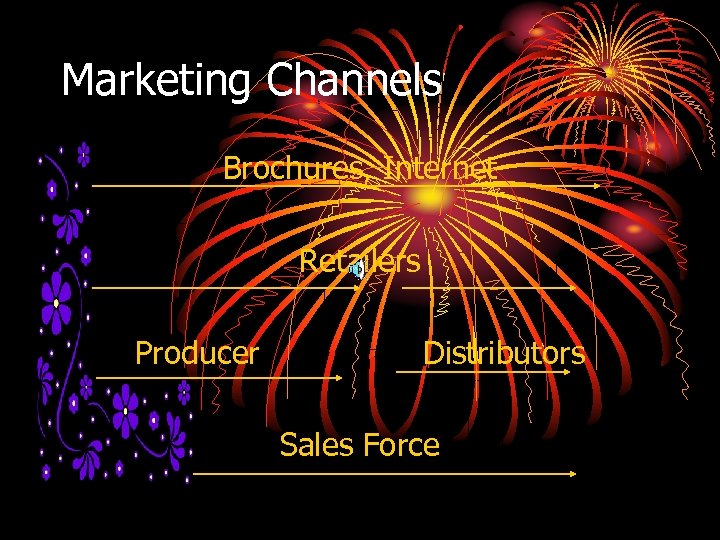
 Distribution Strategy Decision Areas Channel Type Locations Middlemen Service levels Transportation Internet 62
 CHAPTER 4 – PLACE AND PROMOTION LU 4. 2 Outlets and Distribution Control • Case 10: • Mobile services companies use retail outlets to sell and distribute their offers. • Question: Why would companies not sell and distribute directly? 63
 CHAPTER 4 – PLACE AND PROMOTION LU 4. 2 Outlets and Distribution Control • Case 10 Answers: Retail outlets cover a larger percentage of the target market and are able to reach potential customers better in some cases. • Costs play a major role in deciding to use indirect channels since setting up direct channels of distributions is quite expensive. • Usually companies use a mix of both direct and indirect channels. 64
 CHAPTER 4 – PLACE AND PROMOTION LU 4. 3 Advertising and Sales Promotion • Promotion involves advertising, sales aids, and the education of both the consumer and the salesman. • Sales staff build confidence and motivation with: good consumer and product knowledge, target budgets to achieve, and with recognition and reward for achievement. 65
 CHAPTER 4 – PLACE AND PROMOTION LU 4. 3 Advertising and Sales Promotion • Advertising and sales promotion are two elements of the promotion mix. • Direct marketing and public relations are also part of the mix. • Advertising is effective when the ad meets the objective of making a sale. • Advertising can be for awareness, for information, to help make a choice, and to ultimately buy the offer. • Advertising uses the ”hierarchy of effects” model to build awareness, to build conviction, and to trigger a sale. 66
 CHAPTER 4 – PLACE AND PROMOTION LU 4. 3 Advertising and Sales Promotion • Sales Promotion motivates consumers to try your product at the point of sales or through coupons. • Advertising and sales promotion creates selective demand for a product by informing consumers of product benefits, stimulating their buying, introducing new products to new markets, and setting up special promotions. 67
 CHAPTER 4 – PLACE AND PROMOTION LU 4. 3 Advertising and Sales Promotion • Advertising media must be chosen for their effectiveness in reaching specific market segments and consumer groups. • In choosing the media to be used in putting a campaign strategy into action, we must ensure that the medium meets specific predetermined objectives in terms of ‘reach’, ‘frequency’, and ‘cost’. 68
 CHAPTER 4 – PLACE AND PROMOTION LU 4. 3 Advertising and Sales Promotion • It is also important to ensure that the media image matches with the desired advertising image. • Advertising budgets may be determined by a percentage of sales, competitive parity, or the objective and task method. 69
 Marketing Channels Brochures, Internet Retailers Producer Distributors Sales Force
 CHAPTER 4 – PLACE AND PROMOTION LU 4. 3 Advertising and Sales Promotion • Case 11 • A new brand of shampoo is being lauched on the market. The target audience is everyone. • Question: What form of promotion would be the most effective? 71
 CHAPTER 4 – PLACE AND PROMOTION LU 4. 3 Advertising and Sales Promotion • Case 11 Answers: • In a product introduction where there is no brand product awareness and the targeted audience is everyone, the most effective communication is advertising since it is a mass communications’ medium and creating awareness is the issue. 72
 CHAPTER 5 – MARKETING AND MANAGEMENT LU 5. 1 Concept and Strategy • The old marketing concept was to develop a new product and then find a customer. This approach demands too much risk and is more of a “hit or miss” approach. • The new marketing management concept is to be consumer oriented where everything evolves around the customer. 73
 CHAPTER 5 – MARKETING AND MANAGEMENT LU 5. 1 Concept and Strategy • Marketing management requires understanding customer needs and is the key to market strategy. • The “offer” is developed once customer needs, desires, and wants are understood and known. 74
 CHAPTER 5 – MARKETING AND MANAGEMENT LU 5. 1 Concept and Strategy • Marketing management requires assessment of marketing opportunities which involves a broad but deep understanding of the strengths and weaknesses of the company and its relationship to its total environment. 75
 CHAPTER 5 – MARKETING AND MANAGEMENT LU 5. 1 Concept and Strategy • Marketing management involves market research into consumers, competitors, and markets; and clear identification of corporate objectives. • Marketing management is a continuous assessment to ensure that the firm knows its customers, is dynamic in marketing and production, identifies challenges and problems, and seizes marketing opportunities. 76
 CHAPTER 5 – MARKETING AND MANAGEMENT LU 5. 1 Concept and Strategy • Marketing management is vital to the survival of the firm. 77
 CHAPTER 5 – MARKETING AND MANAGEMENT LU 5. 1 Concept and Strategy • Case 12: • An existing brand wants to enter a new market ( new country). • Question: What types of research should be conducted prior to setting market strategy? 78
 CHAPTER 5 – MARKETING AND MANAGEMENT LU 5. 1 Concept and Strategy • Case 12 Answers: • Firstly, the company needs to investigate all secondary research available. • If this is not adequate, a company must undertake primary research for their specific requirements. 79
 CHAPTER 5 – MARKETING AND MANAGEMENT LU 5. 2 Planning • Planning the marketing effort is necessary for efficient functioning of the entire enterprise. Plans may be long or short term, or strategic. • • The plan should be prepared in terms of objectives, creative alternatives, evaluation, and implementation. • The sound plan should be assessed in terms of: unity, continuity, flexibility, relevance, and measurability. 80
 CHAPTER 5 – MARKETING AND MANAGEMENT LU 5. 2 Planning • Case 13 • A consumer marketing company is not sure what direction to take for the next coming years. • Question: What should they do? 81
 CHAPTER 5 – MARKETING AND MANAGEMENT LU 5. 2 Planning • Case 13 Answers: • The best way to start is by developing a structured marketing plan which involves both strategy and implementation. • The plan gives you a structured approach to developing objectives and strategy. 82
 CHAPTER 5 – MARKETING AND MANAGEMENT LU 5. 3 Control • Control is the method of keeping an operation going according to plan. • Stages of control are: • • • set standards for performance measurement create tools for recording performance take remedial action maintain overall management assessment of results 83
 CHAPTER 5 – MARKETING AND MANAGEMENT LU 5. 3 Control • Control standards for marketing performance are in terms of: : • market share • marketing plans • marketing budget • past performance • market potential • marketing cost analysis • productivity • competitive performance 84
 CHAPTER 5 – MARKETING AND MANAGEMENT LU 5. 3 Control • Case 14 • A large multi national corporation wants to efficiently monitor, control, and take actions based on the performance of their marketing plan. • Question: What is the best approach? 85
 CHAPTER 5 – MARKETING AND MANAGEMENT LU 5. 3 Control • Case 14 Answers: • Today, companies incorporate what is called the ‘balanced scorecard’ that measures quantitative and qualitative performance variables such as market share, customer satisfaction, customer retention, etc. 86
 CHAPTER 5 – MARKETING AND MANAGEMENT LU 5. 4 Customer Relationship Management • Customer Relationship Management (CRM) or Relationship Marketing means putting customers first. • It is a business philosophy for managing profitable relationships with customers with the objective of building long term loyalty. Thus, CRM is building customer loyalty. • The longer a customer stays with a brand, the more profitable that customer becomes. • On average, it costs six times more to acquire a new 87 customer than to retain an existing customer.
 CHAPTER 5 – MARKETING AND MANAGEMENT LU 5. 4 Customer Relationship Management • Acquiring new customers means spending more money on marketing, advertising, sales promotion, distribution, etc. • Companies are looking more at customer lifetime value as a way to evaluate a customer’s potential worth. 88
 CHAPTER 5 – MARKETING AND MANAGEMENT LU 5. 4 Customer Relationship Management • All customers are not created equal, thus customers should be treated differently based on their value and profitability. 89
 CHAPTER 5 – MARKETING AND MANAGEMENT LU 5. 4 Customer Relationship Management • Customers who are high value are given extra services, invited to special events, and more marketing money is spent on them to ensure retention and satisfaction. • Lower value customers are charged for extra services and are not given personal attention. 90
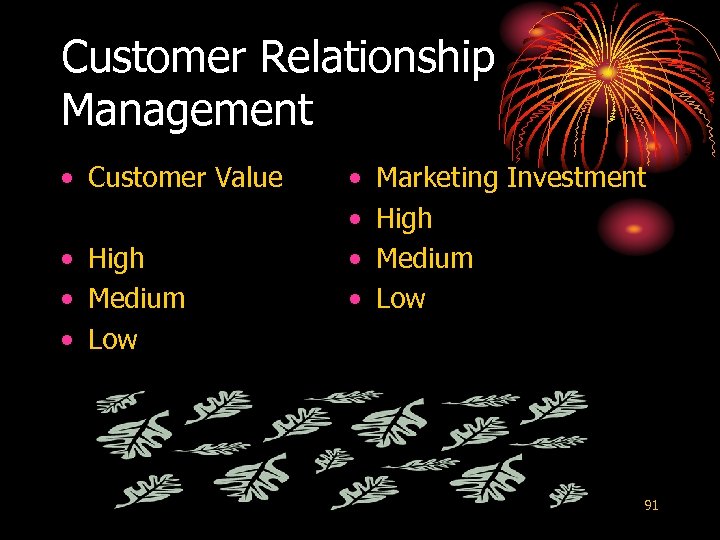 Customer Relationship Management • Customer Value • High • Medium • Low • • Marketing Investment High Medium Low 91
 CHAPTER 5 – MARKETING AND MANAGEMENT LU 5. 4 Customer Relationship Management • Case 15 • Mobile Telephone companies use CRM to acquire, develop, and retain customers. • Question: What types of campaigns are done to retain customers? 92
 CHAPTER 5 – MARKETING AND MANAGEMENT LU 5. 4 Customer Relationship Management • Case 15 Answers: • Campaign management is the application of CRM to retaining customers. • Campaign management systems are used to develop special ‘offers’ for segmented customers (high, medium, and low value) and to determine profiles. 93
 CLE 21 – A ONE DAY PROGRAM OF MARKETING LANGUAGE AND PRACTICE • Materials covered in the lecture/case section. • Chapter 1 Introduction to Consumer Marketing 94
 CLE 21 – A ONE DAY PROGRAM OF MARKETING LANGUAGE AND PRACTICE • Chapter 2 Basics of Marketing • • LU 2. 1 Marketing and the Marketing Mix • • LU 2. 2 Product Types and Distribution • LU 2. 3 Consumer Motivation 95
 CLE 21 – A ONE DAY PROGRAM OF MARKETING LANGUAGE AND PRACTICE • Chapter 3 Product and Price • • LU 3. 1 Product Management and Policy • • LU 3. 2 Product Life cycle • LU 3. 3 Major Determinants of Price • • LU 3. 4 Pricing Policy 96
 CLE 21 – A ONE DAY PROGRAM OF MARKETING LANGUAGE AND PRACTICE • Chapter 4 Place and Promotion • LU 4. 1 Distribution Channels • LU 4. 2 Outlets and Distribution Control • LU 4. 3 Advertising and Sales Promotion 97
 CLE 21 – A ONE DAY PROGRAM OF MARKETING LANGUAGE AND PRACTICE • Chapter 5 Marketing Management • • LU 5. 1 Concept and Strategy LU 5. 2 Planning LU 5. 3 Control LU 5. 4 Customer Relationship Management 98
 CLE 21 – CONSUMER MARKETING – LANGUAGE & CONCEPTS o END OF LECTURE/CASE SESSION o CHECK AGAIN ON EACH CASE STUDY 1 15 o DEVELOP … PERSONALLY … YOUR o “INSTINCTIVE MARKETING REACTION” … o IT CAN SERVE YOU SO WELL IN THE FUTURE. o GOOD LUCK! 99