


 Скачать презентацию Clawson A resource is a
3e490c1849c2f7662f7705f121c74139.ppt
- Количество слайдов: 21
 Clawson
 • A resource is a concept – it reflects modification to reflect the needs and wants of society – we fit the eventual resource to our needs and wants (social image) – The resource may not change necessarily but the vision surrounding it could • (image of cemeteries over time)
 • Natural Base Resources – Left, as much as possible, as is – Changes for observation and/or preservation – not market oriented in sense of location unless mobile - (dinosaur remnants) • Human-Base Resources – Cultural significance, possible enhanced by the natural environment – Could be mobile - possibility of market orientation
 • Synthetic Resources – No ‘distinctive’ properties – Major factors are market considerations • All this possible linked to our park system – National parks oriented to resources – Parks oriented to historical/cultural developments – Urban parks that are synthetic (Eglinton and Duplex)
 Clawson Park Classification 1 Resource-Based Parks – Emphasis is normally on the natural qualities of the environment than on activities (Gunn) – Location (to an extent) is not a consideration
 – These parks tend to be fairly large (protection aspect) – Normally associated with the National System – Have (because of past history) unique, natural characteristics (Yellowstone, Banff) – Vacation (tourist) oriented
 2 Intermediate Parks – A combination of resource base and market considerations – normally a maximum of 2 hrs. drive from the major market (150 K)
 – Parks still fairly large and the emphasis is still on the natural qualities of the site – But - greater degree of facility development (because of the market) – General link to the Provincial Park system – Stress on general outdoor activity therefore high modification
 – Water-based activities are the most popular in the province so as would be expected - developed beach sites and swimming and boating facilities • Link to Human and Synthetic Base (‘nature trails can be cut through old farmers fields)
 • User-oriented Parks – Typified by local municipal or conservation parks – Emphasis on user and access (one-half hour travel) – Variance ins size (parkettes at the lower end) and the landscape is less important
 – Find exceptions and combinations - High Park is a good example • Local users and travellers • Environment important but high facility development • Ice rinks for example – Concentration on human-created facilities and supervised activities – Intensive usage, level, sculpted, welldrained land synthetic development
 • Gunn - consideration of environmental content but concerns for human and synthetic resources • Clawson - factor or location though exceptions abound (Stanley Park in Vancouver) • Link to – Purposes of a park system – Satisfaction of varying demands (seminar)
 Why Parks? 1 Population Change and Demand • Early in our history - no demand for wilderness. It was next door – highly rural population, smaller urban areas • Problem is the growth of cities (in-migration and natural increase) – Proof in the records (1840’s, 50’s) where open space (cemeteries) are utilized for outings
 • Emphasis on urban parks – commons, parks, plazas • Need for larger ‘green’ areas - regional parks – picnic sites then the protection (display) of species • Concept of Reserves – Yosemite is the 1 st in California (1862) purpose of protection (giant sequoias) – Emphasis on vista (image) - non-urban
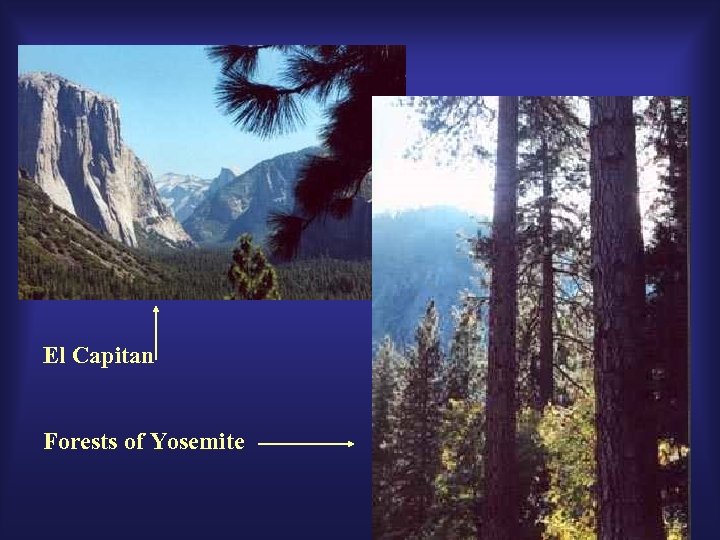 El Capitan Forests of Yosemite
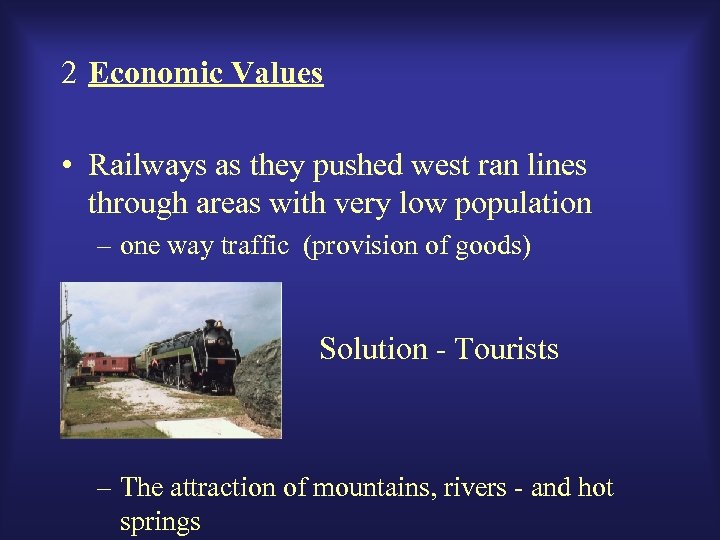 2 Economic Values • Railways as they pushed west ran lines through areas with very low population – one way traffic (provision of goods) Solution - Tourists – The attraction of mountains, rivers - and hot springs
 • 1883 - hot Springs were discovered near Banff • 1884 - ownership squabbles between railway workers and the Railways • 1885 - The Canadian Government declares Banff as a Reserve – About 26 Sq. K (now 6, 641 sq. K)
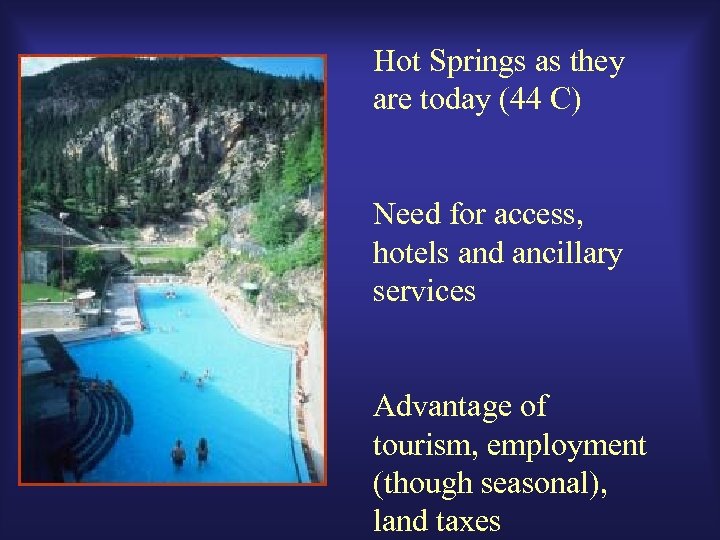 Hot Springs as they are today (44 C) Need for access, hotels and ancillary services Advantage of tourism, employment (though seasonal), land taxes
 • Protection Aspect • Again an American concept imported into Canada – Link to the concept of the Frontier • Based on romantic and aesthetic grounds rather than any scientific basis or exploration of environmental systems – Base for future problems
 • Link to Marsh Physical Geography as Modified by Human Action – Massive changes in environments based on human action • Practical aspect in that game animals were becoming scarcer – Teddy Roosevelt a hunter – Disappearance of Passenger Pigeon and Buffalo • Reports of unique environments
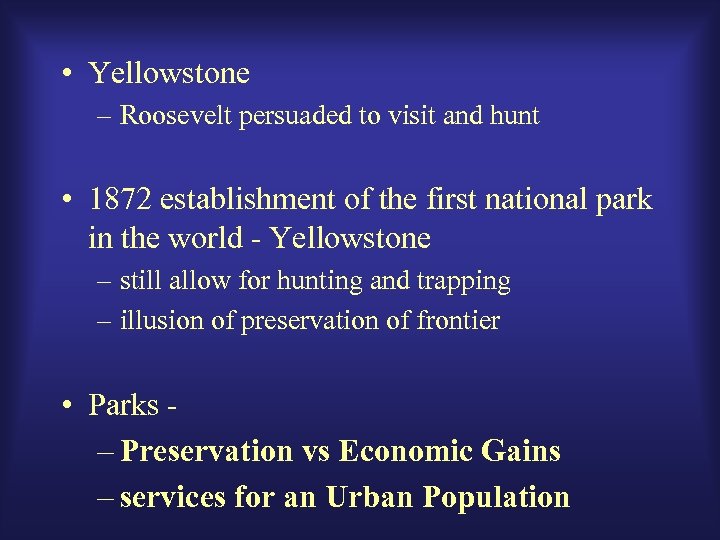 • Yellowstone – Roosevelt persuaded to visit and hunt • 1872 establishment of the first national park in the world - Yellowstone – still allow for hunting and trapping – illusion of preservation of frontier • Parks – Preservation vs Economic Gains – services for an Urban Population