 Скачать презентацию Clause Combining in Otomi before and after Contact
01f40942d3a9998da0bf10d638f4119a.ppt
- Количество слайдов: 54



Clause Combining in Otomi before and after Contact with Spanish Dik Bakker – Lancaster Ewald Hekking – Querétaro Clause Combining in Otomi 1
Preliminary assumptions A A 1. In face to face discourse, many relations between phrases and clauses can & will very often remain unexpressed A 2. In written varieties, they are typically made explicit, via Adpositions, Coordinators, Subordinators, etc. A 3. In languages with a long-standing written tradition, and a majority of literate speakers, spoken varieties may be remodelled on the basis of the written variety on this point Clause Combining in Otomi 2
Preliminary assumptions B B. Languages with only/mainly a spoken tradition in intensive contact with dominant languages that have a strong written tradition: 1. will often borrow relational markers from the latter 2. will use these markers more frequently, including the native ones Clause Combining in Otomi 3
Overview 1. The Languages: Otomi & Spanish 2. The Grammars on coordination & subordination 3. The Data 4. Borrowing coordinators & subordinators 5. Conclusions Clause Combining in Otomi 4
1. The Languages Clause Combining in Otomi 5
Otomi Oto-Mangue (Querétaro, Mexico) 9 dialects 250. 000 speakers Mainly spoken tradition Clause Combining in Otomi 6
Spanish Indo-European (Spain, America, Africa, Asia) many dialects 28 million speakers (Spain) 300 million (rest of the world) 60 million L 2 Long written tradition Clause Combining in Otomi 7
2. The Grammars Clause Combining in Otomi 8
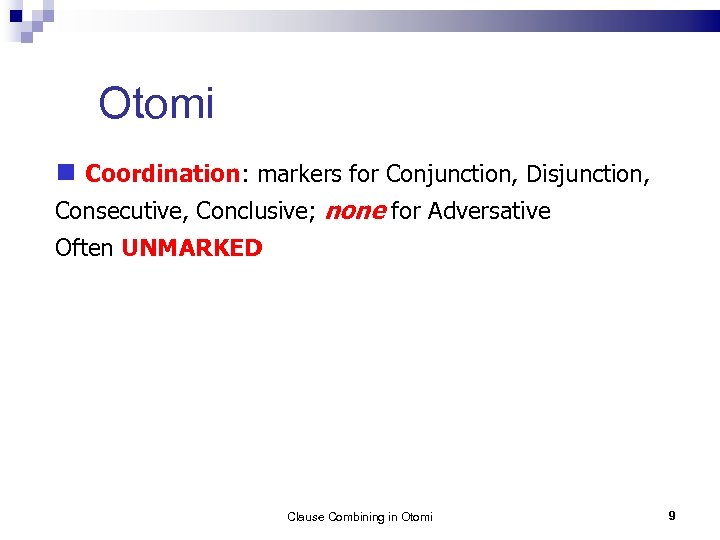
Otomi Coordination: markers for Conjunction, Disjunction, Consecutive, Conclusive; none for Adversative Often UNMARKED Clause Combining in Otomi 9
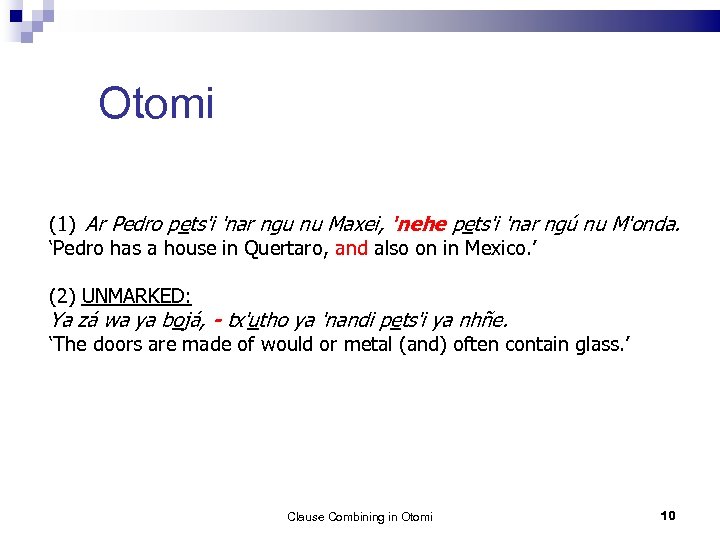
Otomi (1) Ar Pedro pets'i 'nar ngu nu Maxei, 'nehe pets'i 'nar ngú nu M'onda. ‘Pedro has a house in Quertaro, and also on in Mexico. ’ (2) UNMARKED: Ya zá wa ya bojá, - tx'utho ya 'nandi pets'i ya nhñe. ‘The doors are made of would or metal (and) often contain glass. ’ Clause Combining in Otomi 10
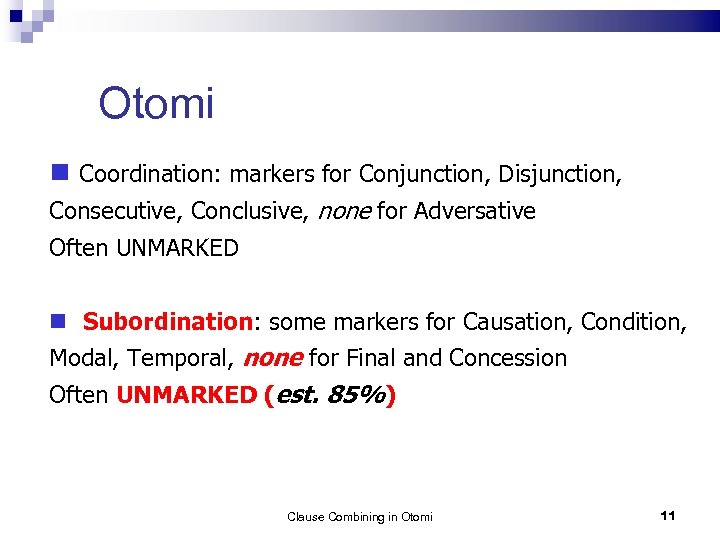
Otomi Coordination: markers for Conjunction, Disjunction, Consecutive, Conclusive, none for Adversative Often UNMARKED Subordination: some markers for Causation, Condition, Modal, Temporal, none for Final and Concession Often UNMARKED (est. 85%) Clause Combining in Otomi 11
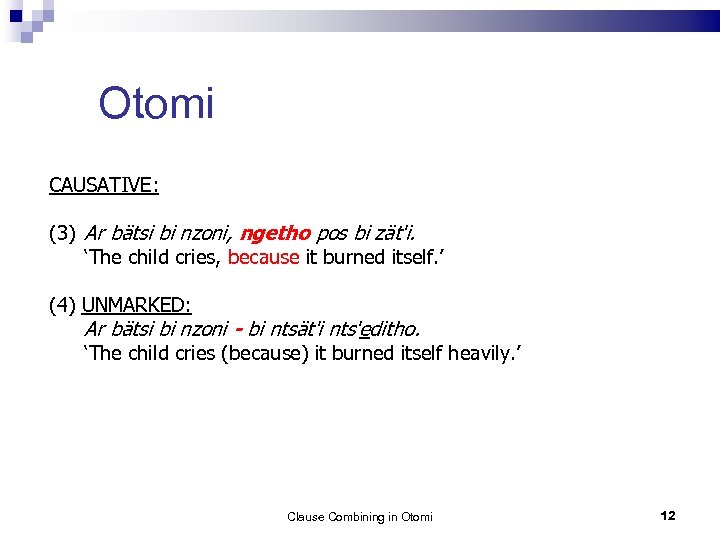
Otomi CAUSATIVE: (3) Ar bätsi bi nzoni, ngetho pos bi zät'i. ‘The child cries, because it burned itself. ’ (4) UNMARKED: Ar bätsi bi nzoni - bi ntsät'i nts'editho. ‘The child cries (because) it burned itself heavily. ’ Clause Combining in Otomi 12
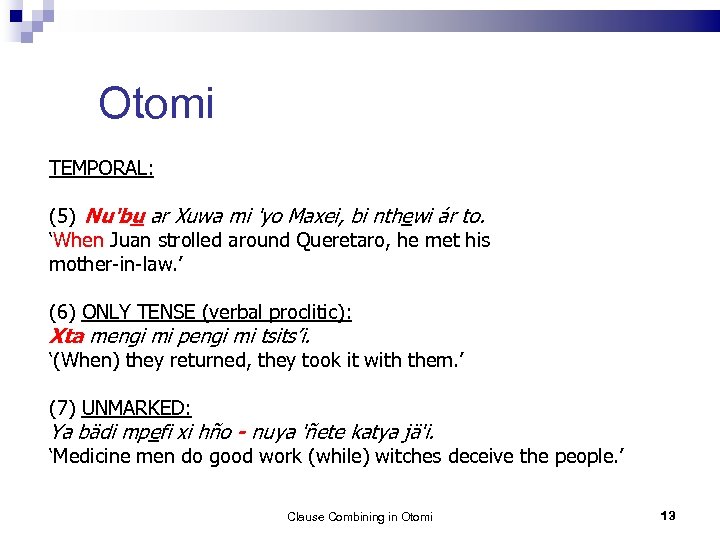
Otomi TEMPORAL: (5) Nu'bu ar Xuwa mi 'yo Maxei, bi nthewi ár to. ‘When Juan strolled around Queretaro, he met his mother-in-law. ’ (6) ONLY TENSE (verbal proclitic): Xta mengi mi pengi mi tsits’i. ‘(When) they returned, they took it with them. ’ (7) UNMARKED: Ya bädi mpefi xi hño - nuya 'ñete katya jä'i. ‘Medicine men do good work (while) witches deceive the people. ’ Clause Combining in Otomi 13
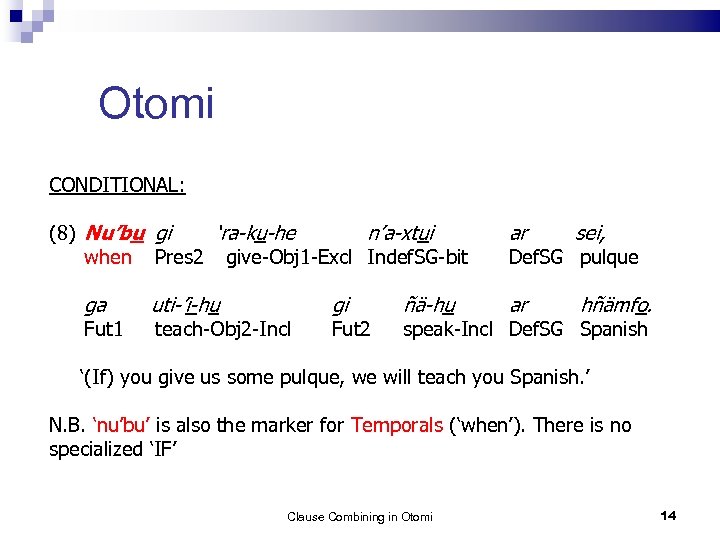
Otomi CONDITIONAL: (8) Nu’bu gi ‘ra-ku-he n’a-xtui when Pres 2 give-Obj 1 -Excl Indef. SG-bit ga Fut 1 uti-’i-hu teach-Obj 2 -Incl gi Fut 2 ñä-hu ar sei, ar hñämfo. Def. SG pulque speak-Incl Def. SG Spanish ‘(If) you give us some pulque, we will teach you Spanish. ’ N. B. ‘nu’bu’ is also the marker for Temporals (‘when’). There is no specialized ‘IF’ Clause Combining in Otomi 14
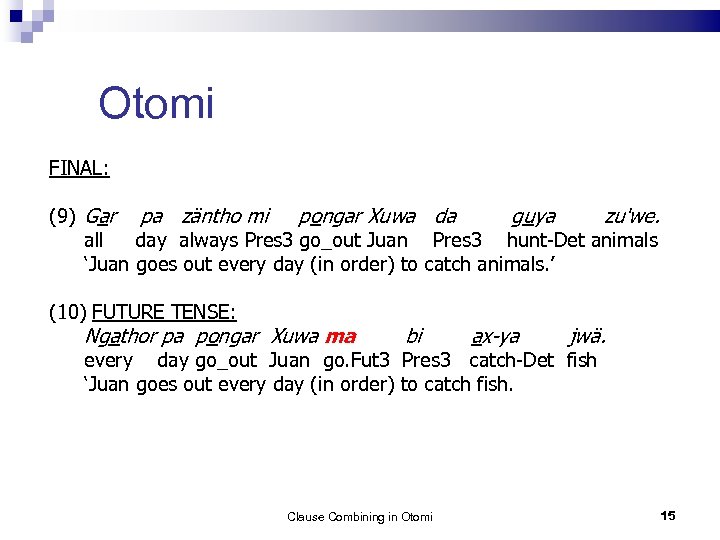
Otomi FINAL: (9) Gar pa zäntho mi pongar Xuwa da guya zu'we. all day always Pres 3 go_out Juan Pres 3 hunt-Det animals ‘Juan goes out every day (in order) to catch animals. ’ (10) FUTURE TENSE: Ngathor pa pongar Xuwa ma bi ax-ya jwä. every day go_out Juan go. Fut 3 Pres 3 catch-Det fish ‘Juan goes out every day (in order) to catch fish. Clause Combining in Otomi 15
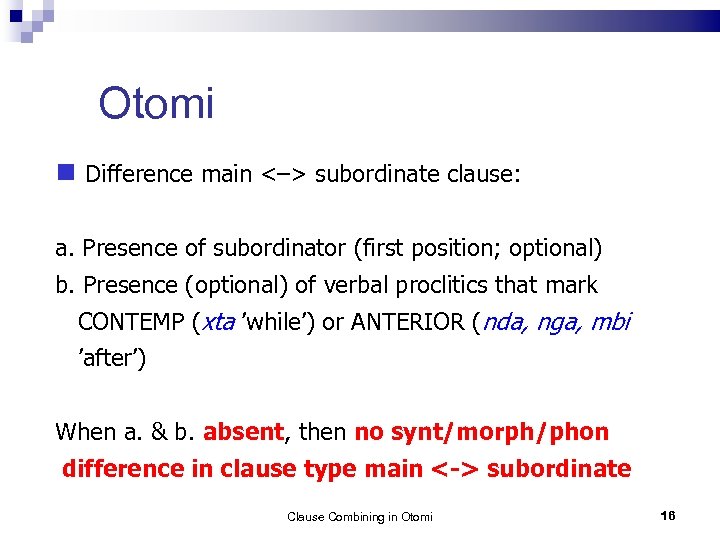
Otomi Difference main <–> subordinate clause: a. Presence of subordinator (first position; optional) b. Presence (optional) of verbal proclitics that mark CONTEMP (xta ’while’) or ANTERIOR (nda, nga, mbi ’after’) When a. & b. absent, then no synt/morph/phon difference in clause type main <-> subordinate Clause Combining in Otomi 16
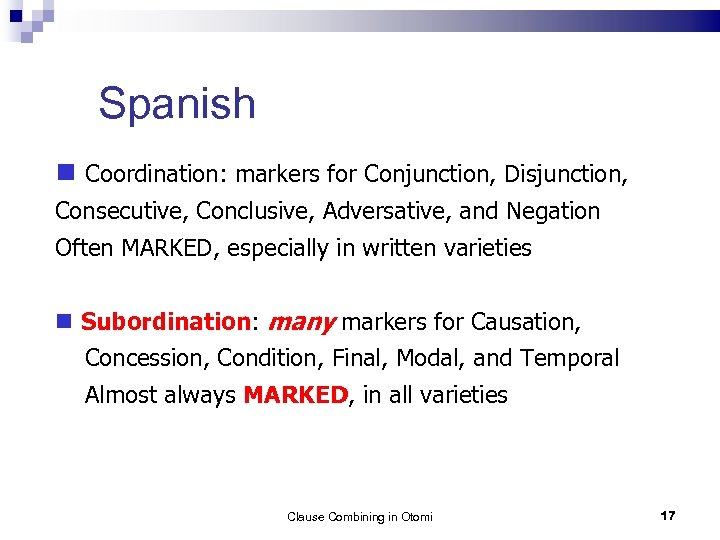
Spanish Coordination: markers for Conjunction, Disjunction, Consecutive, Conclusive, Adversative, and Negation Often MARKED, especially in written varieties Subordination: many markers for Causation, Concession, Condition, Final, Modal, and Temporal Almost always MARKED, in all varieties Clause Combining in Otomi 17
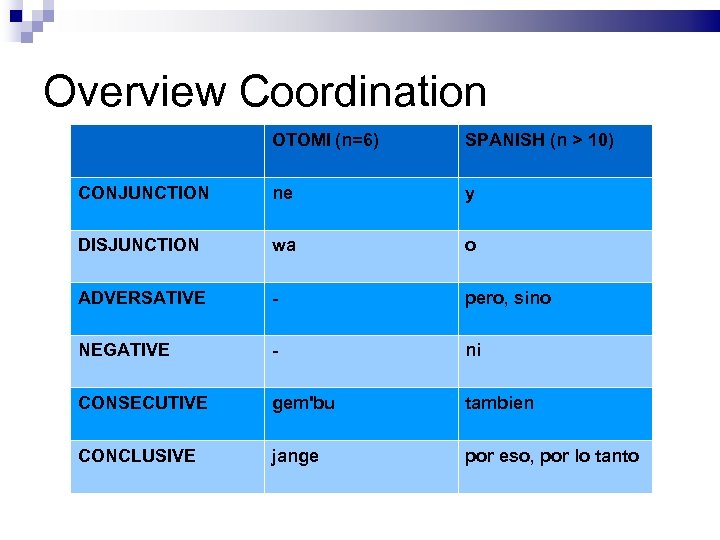
Overview Coordination OTOMI (n=6) SPANISH (n > 10) CONJUNCTION ne y DISJUNCTION wa o ADVERSATIVE - pero, sino NEGATIVE - ni CONSECUTIVE gem'bu tambien CONCLUSIVE jange por eso, por lo tanto
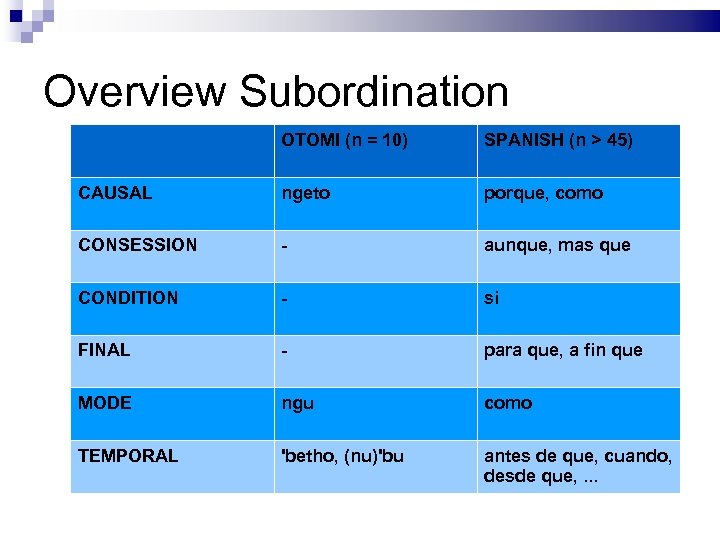
Overview Subordination OTOMI (n = 10) SPANISH (n > 45) CAUSAL ngeto porque, como CONSESSION - aunque, mas que CONDITION - si FINAL - para que, a fin que MODE ngu como TEMPORAL 'betho, (nu)'bu antes de que, cuando, desde que, . . .

3. The Data Clause Combining in Otomi 20
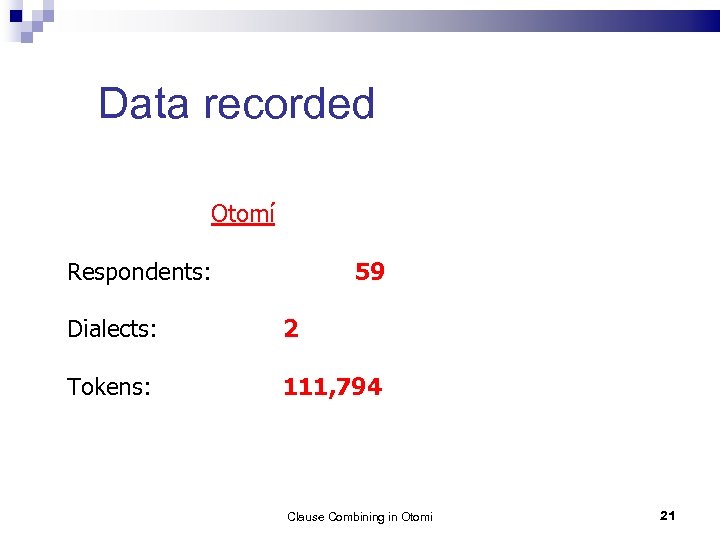
Data recorded Otomí Respondents: 59 Dialects: 2 Tokens: 111, 794 Clause Combining in Otomi 21
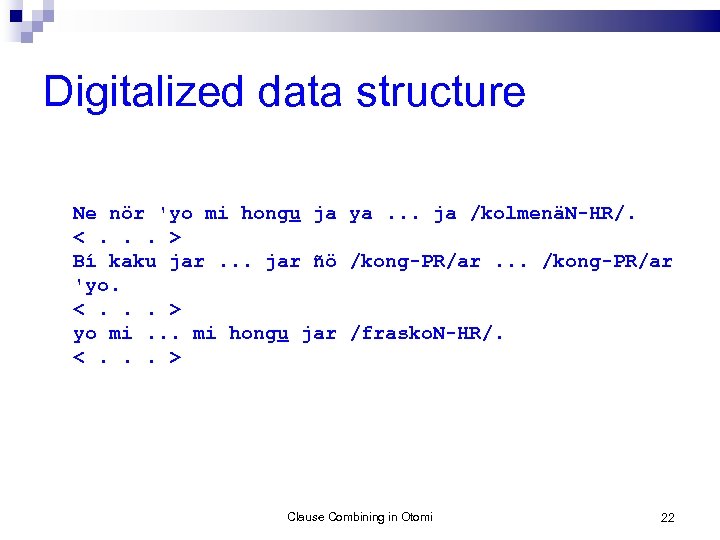
Digitalized data structure Ne nör 'yo mi hongu ja ya. . . ja /kolmenäN-HR/. <. . . > Bí kaku jar. . . jar ñö /kong-PR/ar. . . /kong-PR/ar 'yo. <. . . > yo mi. . . mi hongu jar /frasko. N-HR/. <. . . > Clause Combining in Otomi 22
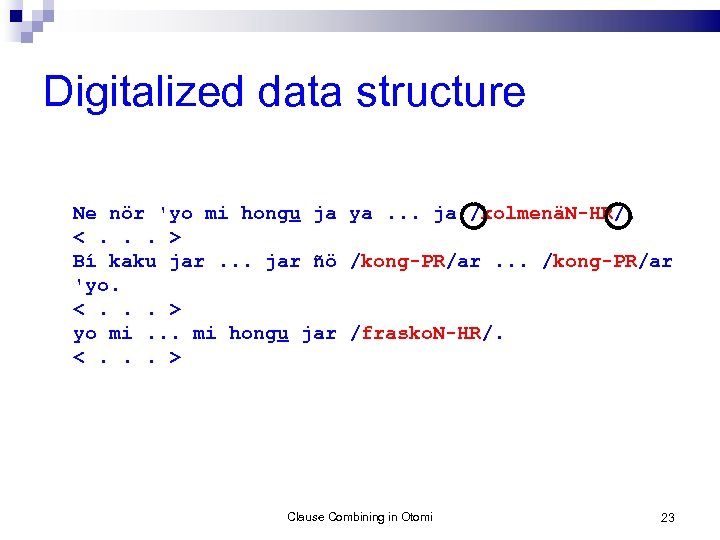
Digitalized data structure Ne nör 'yo mi hongu ja ya. . . ja /kolmenäN-HR/. <. . . > Bí kaku jar. . . jar ñö /kong-PR/ar. . . /kong-PR/ar 'yo. <. . . > yo mi. . . mi hongu jar /frasko. N-HR/. <. . . > Clause Combining in Otomi 23
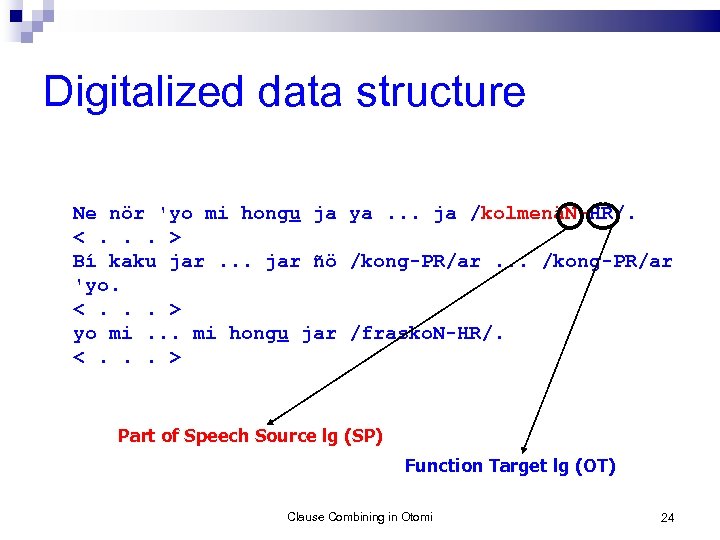
Digitalized data structure Ne nör 'yo mi hongu ja ya. . . ja /kolmenäN-HR/. <. . . > Bí kaku jar. . . jar ñö /kong-PR/ar. . . /kong-PR/ar 'yo. <. . . > yo mi. . . mi hongu jar /frasko. N-HR/. <. . . > Part of Speech Source lg (SP) Function Target lg (OT) Clause Combining in Otomi 24
4. Borrowing from Spanish Clause Combining in Otomi 25
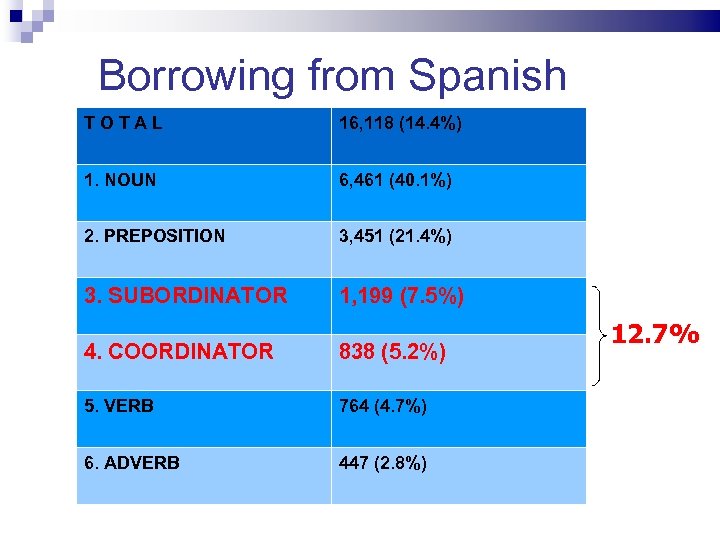
Borrowing from Spanish TOTAL 16, 118 (14. 4%) 1. NOUN 6, 461 (40. 1%) 2. PREPOSITION 3, 451 (21. 4%) 3. SUBORDINATOR 1, 199 (7. 5%) 4. COORDINATOR 838 (5. 2%) 5. VERB 764 (4. 7%) 6. ADVERB 447 (2. 8%) 12. 7%
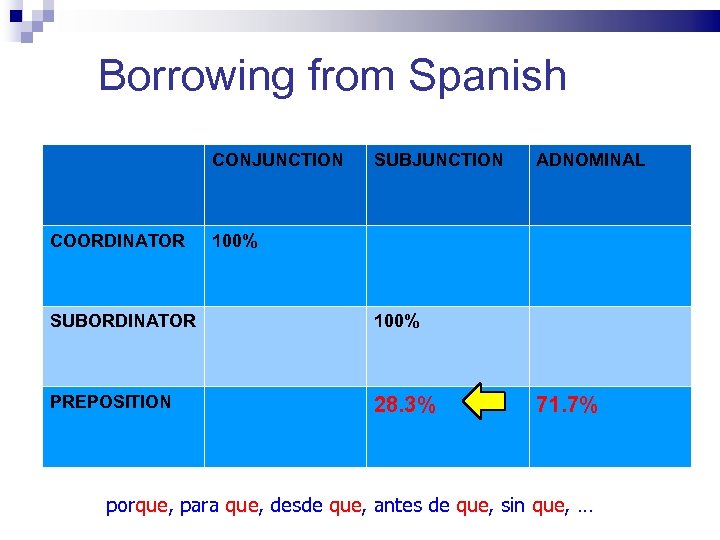
Borrowing from Spanish CONJUNCTION COORDINATOR SUBJUNCTION ADNOMINAL 100% SUBORDINATOR 100% PREPOSITION 28. 3% 71. 7% porque, para que, desde que, antes de que, sin que, …
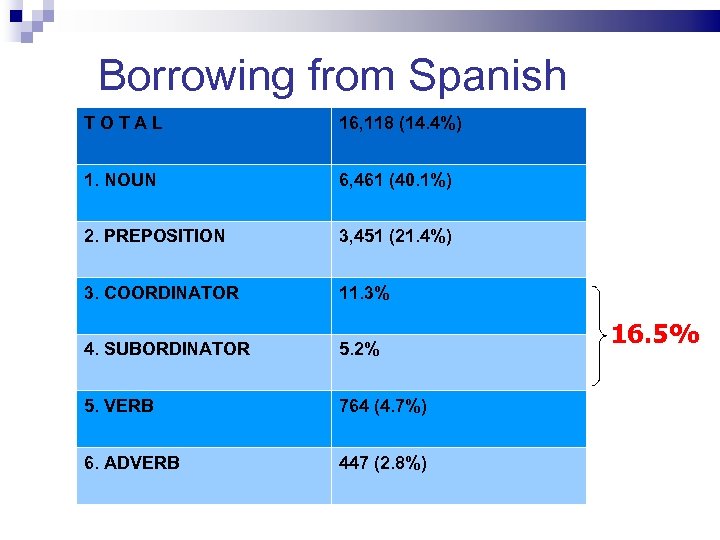
Borrowing from Spanish TOTAL 16, 118 (14. 4%) 1. NOUN 6, 461 (40. 1%) 2. PREPOSITION 3, 451 (21. 4%) 3. COORDINATOR 11. 3% 4. SUBORDINATOR 5. 2% 5. VERB 764 (4. 7%) 6. ADVERB 447 (2. 8%) 16. 5%
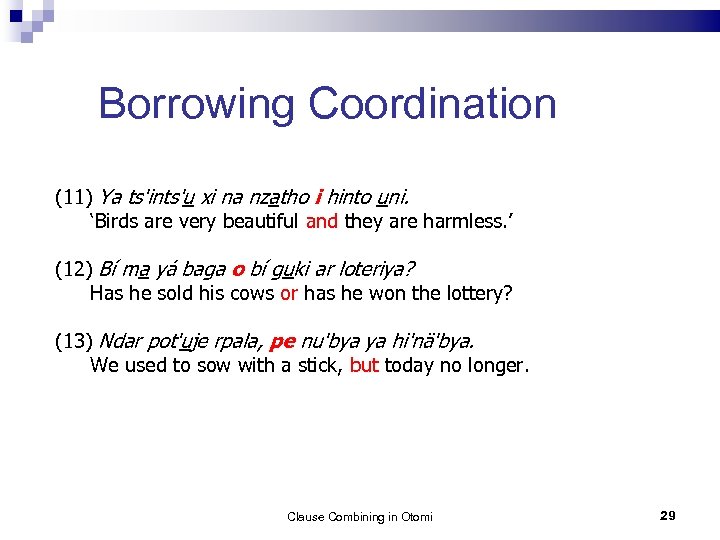
Borrowing Coordination (11) Ya ts'ints'u xi na nzatho i hinto uni. ‘Birds are very beautiful and they are harmless. ’ (12) Bí ma yá baga o bí guki ar loteriya? Has he sold his cows or has he won the lottery? (13) Ndar pot'uje rpala, pe nu'bya ya hi'nä'bya. We used to sow with a stick, but today no longer. Clause Combining in Otomi 29
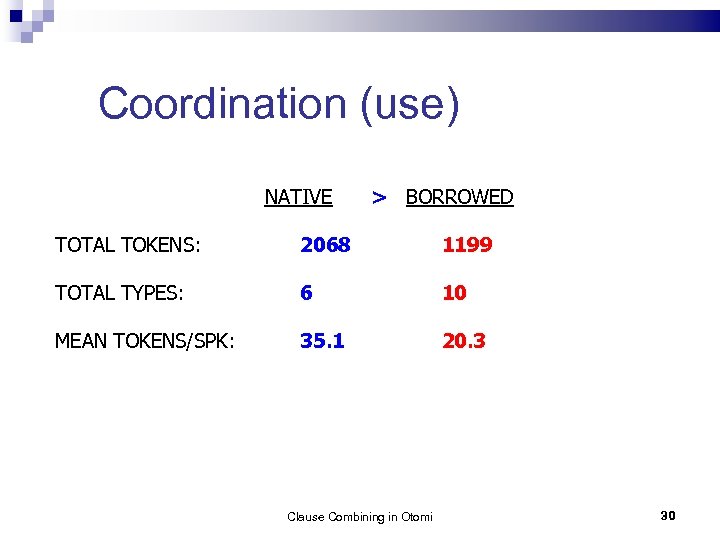
Coordination (use) NATIVE > BORROWED TOTAL TOKENS: 2068 1199 TOTAL TYPES: 6 10 MEAN TOKENS/SPK: 35. 1 20. 3 Clause Combining in Otomi 30
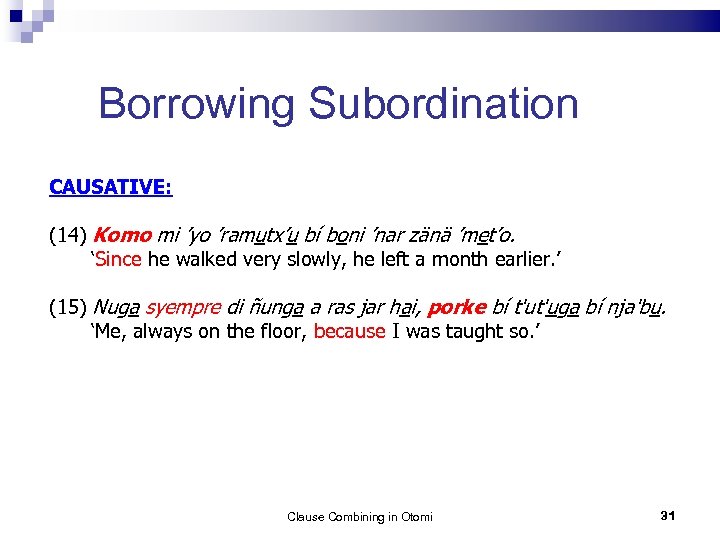
Borrowing Subordination CAUSATIVE: (14) Komo mi ’yo ’ramutx’u bí boni ’nar zänä ’met’o. ‘Since he walked very slowly, he left a month earlier. ’ (15) Nuga syempre di ñunga a ras jar hai, porke bí t'ut'uga bí nja'bu. ‘Me, always on the floor, because I was taught so. ’ Clause Combining in Otomi 31
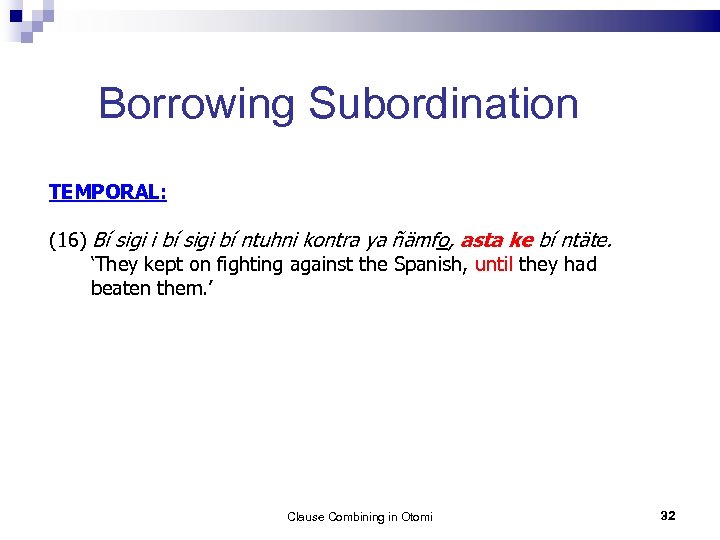
Borrowing Subordination TEMPORAL: (16) Bí sigi i bí sigi bí ntuhni kontra ya ñämfo, asta ke bí ntäte. ‘They kept on fighting against the Spanish, until they had beaten them. ’ ‘Siguieron y siguieron luchando en contra de los españoles, hasta que los vencieron’ Clause Combining in Otomi 32
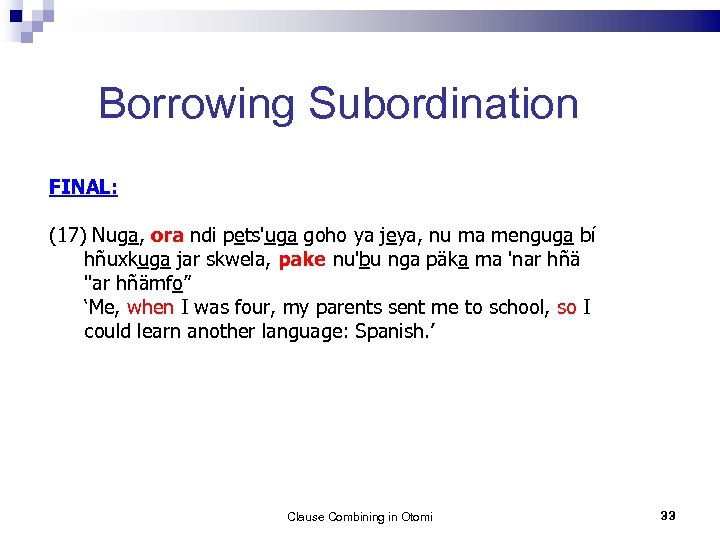
Borrowing Subordination FINAL: (17) Nuga, ora ndi pets'uga goho ya jeya, nu ma menguga bí hñuxkuga jar skwela, pake nu'bu nga päka ma 'nar hñä "ar hñämfo” ‘Me, when I was four, my parents sent me to school, so I could learn another language: Spanish. ’ Clause Combining in Otomi 33
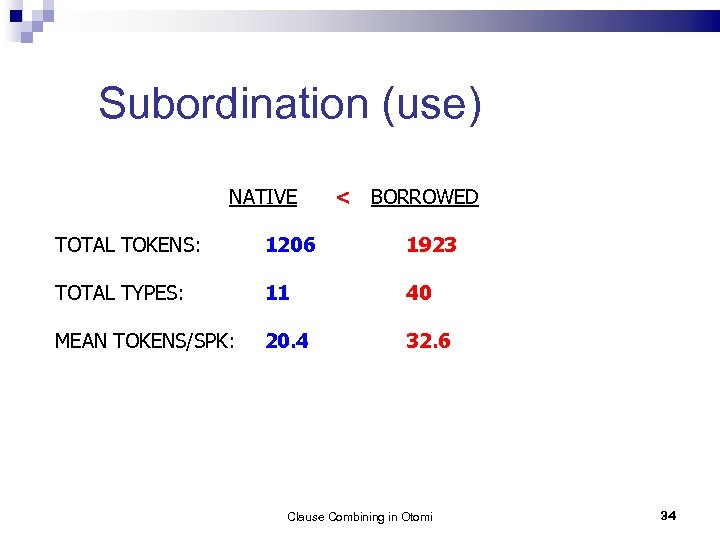
Subordination (use) NATIVE < BORROWED TOTAL TOKENS: 1206 1923 TOTAL TYPES: 11 40 MEAN TOKENS/SPK: 20. 4 32. 6 Clause Combining in Otomi 34
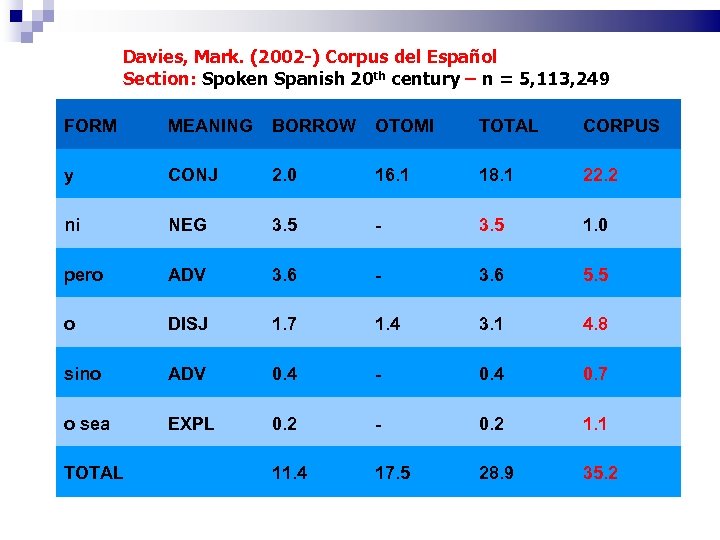
Davies, Mark. (2002 -) Corpus del Español Section: Spoken Spanish 20 th century – n = 5, 113, 249 FORM MEANING BORROW OTOMI TOTAL CORPUS y CONJ 2. 0 16. 1 18. 1 22. 2 ni NEG 3. 5 - 3. 5 1. 0 pero ADV 3. 6 - 3. 6 5. 5 o DISJ 1. 7 1. 4 3. 1 4. 8 sino ADV 0. 4 - 0. 4 0. 7 o sea EXPL 0. 2 - 0. 2 1. 1 11. 4 17. 5 28. 9 35. 2 TOTAL
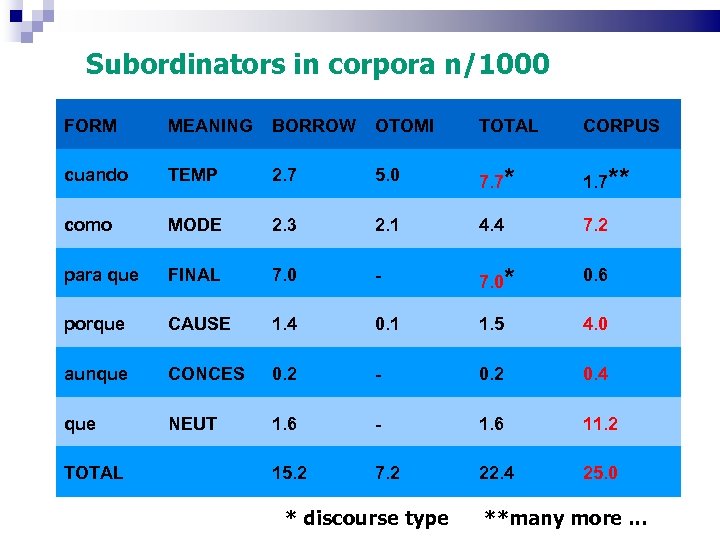
Subordinators in corpora n/1000 FORM MEANING BORROW OTOMI TOTAL CORPUS cuando TEMP 2. 7 5. 0 7. 7* 1. 7** como MODE 2. 3 2. 1 4. 4 7. 2 para que FINAL 7. 0 - 7. 0* 0. 6 porque CAUSE 1. 4 0. 1 1. 5 4. 0 aunque CONCES 0. 2 - 0. 2 0. 4 que NEUT 1. 6 - 1. 6 11. 2 15. 2 7. 2 22. 4 25. 0 TOTAL * discourse type **many more. . .
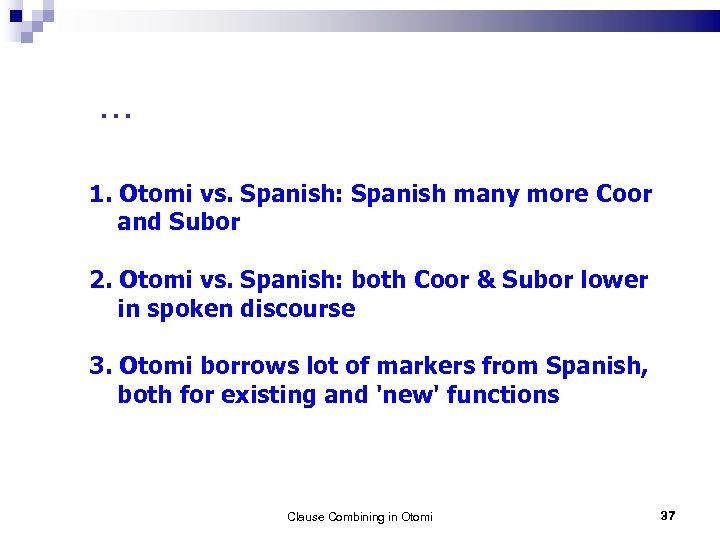
. . . 1. Otomi vs. Spanish: Spanish many more Coor and Subor 2. Otomi vs. Spanish: both Coor & Subor lower in spoken discourse 3. Otomi borrows lot of markers from Spanish, both for existing and 'new' functions Clause Combining in Otomi 37
![Code doubling r hñäñho ko[P]=r hñämfo i[C] ya ha: i pa[P] di 'bot'i i[C]](https://present5.com/presentation/01f40942d3a9998da0bf10d638f4119a/image-38.jpg "Code doubling r hñäñho ko[P]=r hñämfo i[C] ya ha: i pa[P] di 'bot'i i[C]")
Code doubling r hñäñho ko[P]=r hñämfo i[C] ya ha: i pa[P] di 'bot'i i[C] i > ne n = 28 (of 220) hindi pähe xuger syertoa[? ] o[C] a ya kostumbre[N] ar hnini o[C] o > wa n = 5 (of 156) ne nu'i gi xiki ko[P]= (JDJ) ne pa[P] di nsongi. (TDP) wa hi'nä. (REG) wa xkagentho. (JDJ) kwando[S] nu'bu: hinti jar 'be: fi (TDP) kwando[S] nu'bu: mi thokar ar nura (MFC) ndezu: [P] ya mna häm'bu: kwando > nu’bu n = 2 (of 87) Clause Combining in Otomi 38
![Code doubling ar dehe mbo jar ots'i, komo[S]=ngu 'nar hñe 'na da (MRM) kwä](https://present5.com/presentation/01f40942d3a9998da0bf10d638f4119a/image-39.jpg "Code doubling ar dehe mbo jar ots'i, komo[S]=ngu 'nar hñe 'na da (MRM) kwä")
Code doubling ar dehe mbo jar ots'i, komo[S]=ngu 'nar hñe 'na da (MRM) kwä ar txi hmu hmets'i komo[S]=ngu ba 'raku: m nzaki komo[S]= (FDJ) ar ots'i bí ñuxar dehe, komo[S]=ngu bí nthe: wi 'nar däthe. (JEM) ar ots'i bí ñuxar dehe, komo[S]=ngu bí nthe: wi 'nar däthe. (MFX) komo=ngu n = 28 (of 198) All instances : Spanish marker > Otomi marker Clause Combining in Otomi 39
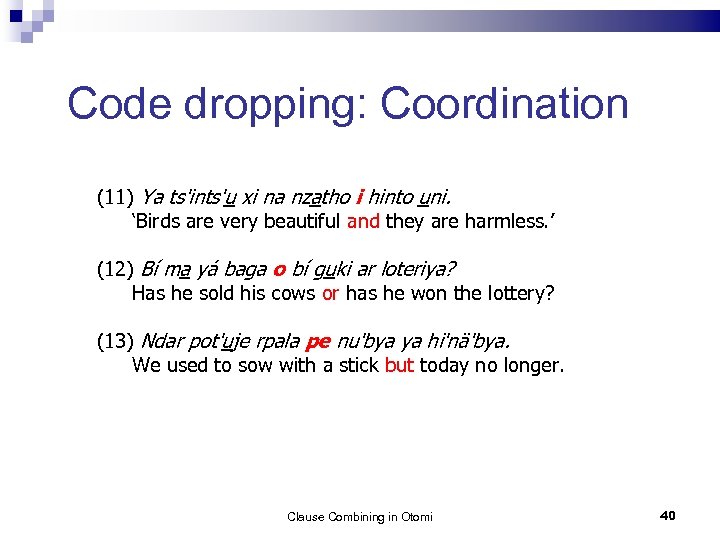
Code dropping: Coordination (11) Ya ts'ints'u xi na nzatho i hinto uni. ‘Birds are very beautiful and they are harmless. ’ (12) Bí ma yá baga o bí guki ar loteriya? Has he sold his cows or has he won the lottery? (13) Ndar pot'uje rpala pe nu'bya ya hi'nä'bya. We used to sow with a stick but today no longer. Clause Combining in Otomi 40
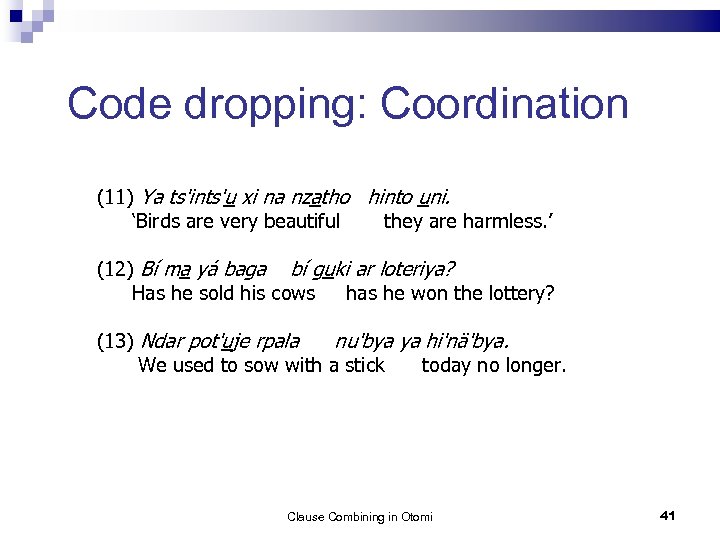
Code dropping: Coordination (11) Ya ts'ints'u xi na nzatho hinto uni. ‘Birds are very beautiful they are harmless. ’ (12) Bí ma yá baga bí guki ar loteriya? Has he sold his cows has he won the lottery? (13) Ndar pot'uje rpala nu'bya ya hi'nä'bya. We used to sow with a stick today no longer. Clause Combining in Otomi 41
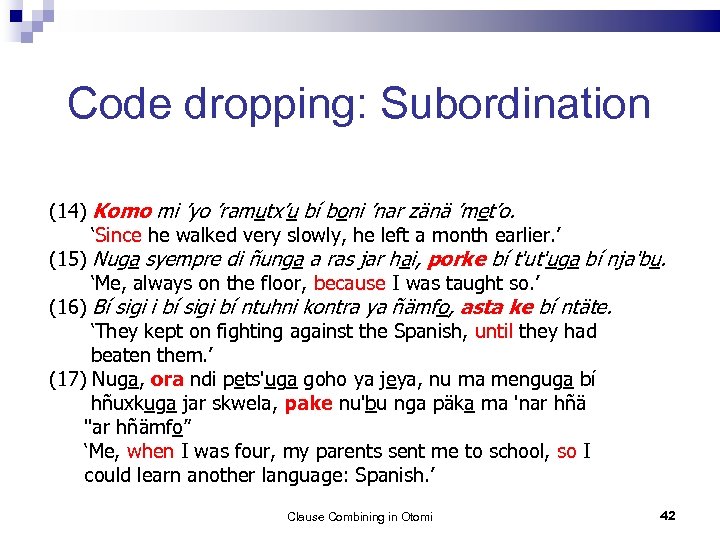
Code dropping: Subordination (14) Komo mi ’yo ’ramutx’u bí boni ’nar zänä ’met’o. ‘Since he walked very slowly, he left a month earlier. ’ (15) Nuga syempre di ñunga a ras jar hai, porke bí t'ut'uga bí nja'bu. ‘Me, always on the floor, because I was taught so. ’ (16) Bí sigi i bí sigi bí ntuhni kontra ya ñämfo, asta ke bí ntäte. ‘They kept on fighting against the Spanish, until they had beaten them. ’ (17) Nuga, ora ndi pets'uga goho ya jeya, nu ma menguga bí hñuxkuga jar skwela, pake nu'bu nga päka ma 'nar hñä "ar hñämfo” ‘Me, when I was four, my parents sent me to school, so I could learn another language: Spanish. ’ Clause Combining in Otomi 42
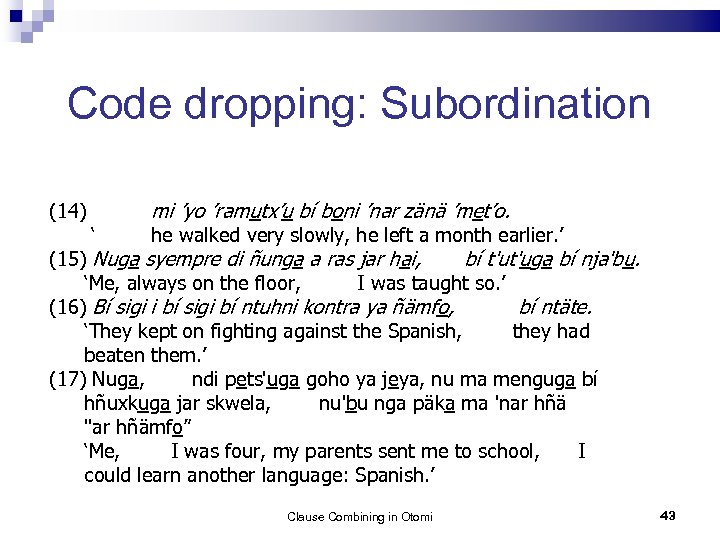
Code dropping: Subordination (14) mi ’yo ’ramutx’u bí boni ’nar zänä ’met’o. ‘ he walked very slowly, he left a month earlier. ’ (15) Nuga syempre di ñunga a ras jar hai, bí t'ut'uga bí nja'bu. ‘Me, always on the floor, I was taught so. ’ (16) Bí sigi i bí sigi bí ntuhni kontra ya ñämfo, bí ntäte. ‘They kept on fighting against the Spanish, they had beaten them. ’ (17) Nuga, ndi pets'uga goho ya jeya, nu ma menguga bí hñuxkuga jar skwela, nu'bu nga päka ma 'nar hñä "ar hñämfo” ‘Me, I was four, my parents sent me to school, I could learn another language: Spanish. ’ Clause Combining in Otomi 43
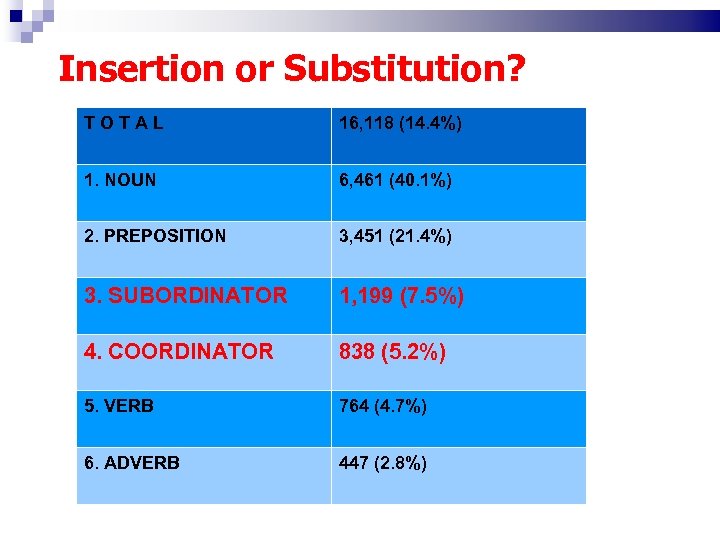
Insertion or Substitution? TOTAL 16, 118 (14. 4%) 1. NOUN 6, 461 (40. 1%) 2. PREPOSITION 3, 451 (21. 4%) 3. SUBORDINATOR 1, 199 (7. 5%) 4. COORDINATOR 838 (5. 2%) 5. VERB 764 (4. 7%) 6. ADVERB 447 (2. 8%)
Substitution! Arguments: 1. Code doubling Clause Combining in Otomi 45
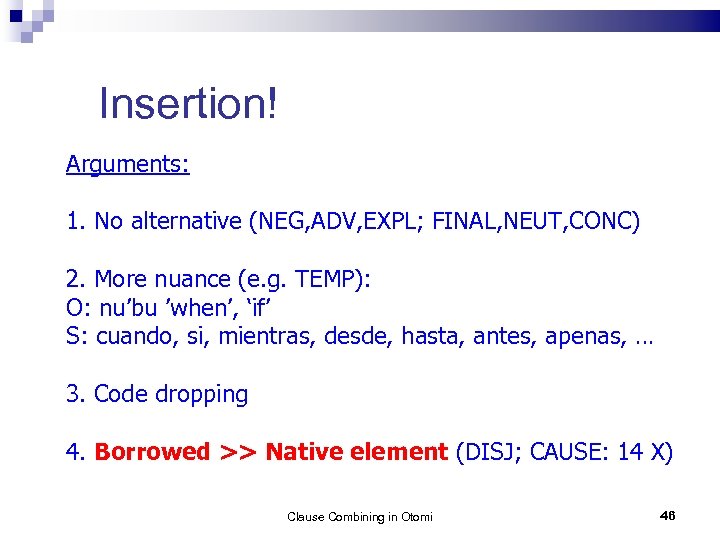
Insertion! Arguments: 1. No alternative (NEG, ADV, EXPL; FINAL, NEUT, CONC) 2. More nuance (e. g. TEMP): O: nu’bu ’when’, ‘if’ S: cuando, si, mientras, desde, hasta, antes, apenas, … 3. Code dropping 4. Borrowed >> Native element (DISJ; CAUSE: 14 X) Clause Combining in Otomi 46
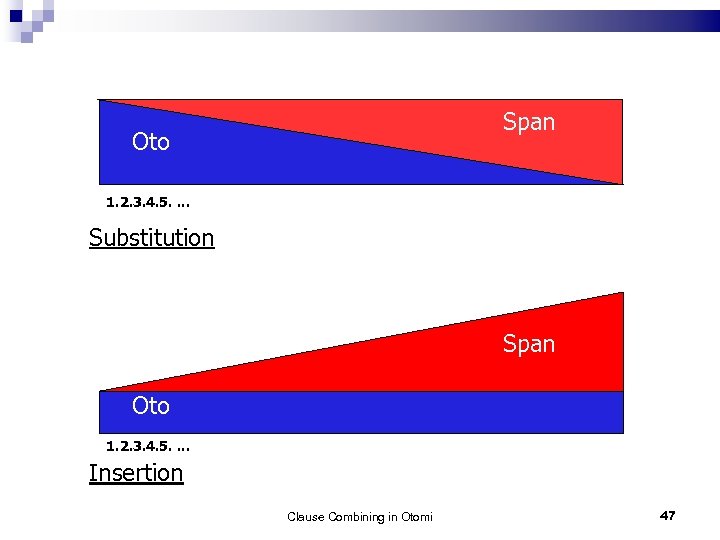
Span Oto 1. 2. 3. 4. 5. . Substitution Span Oto 1. 2. 3. 4. 5. . Insertion Clause Combining in Otomi 47
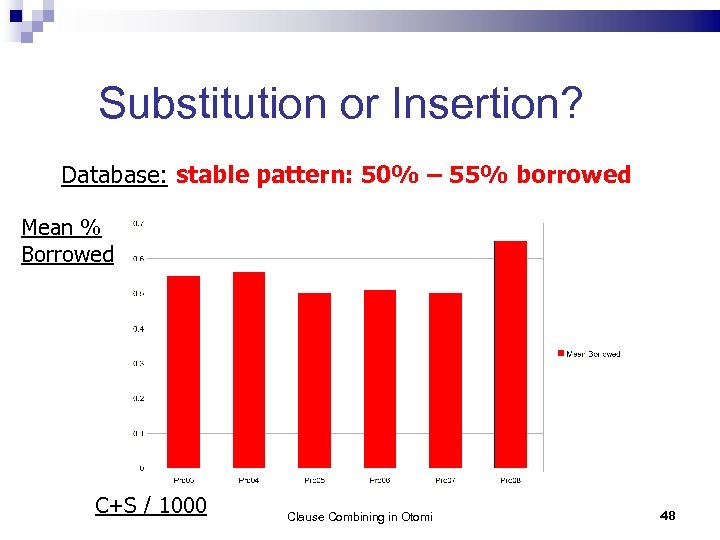
Substitution or Insertion? Database: stable pattern: 50% – 55% borrowed Mean % Borrowed C+S / 1000 Clause Combining in Otomi 48
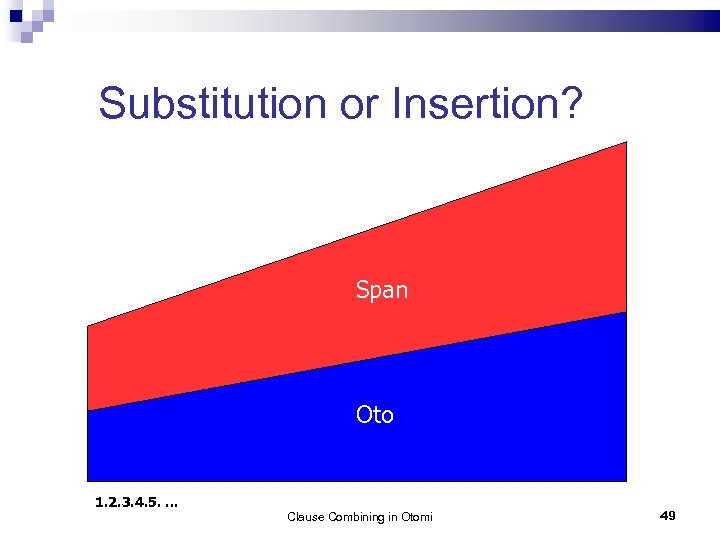
Substitution or Insertion? Span Oto 1. 2. 3. 4. 5. . Clause Combining in Otomi 49
Substitution and Insertion! ALL SPEAKERS: - highly frequent COOR: borrowed rather long ago - both substitution (CNJ/DIS) and insertion (ADV) PART OF SPEAKERS: - also lower frequent SUBOR: borrowed more recently - mainly insertion Clause Combining in Otomi 50
5. Conclusions Clause Combining in Otomi 51
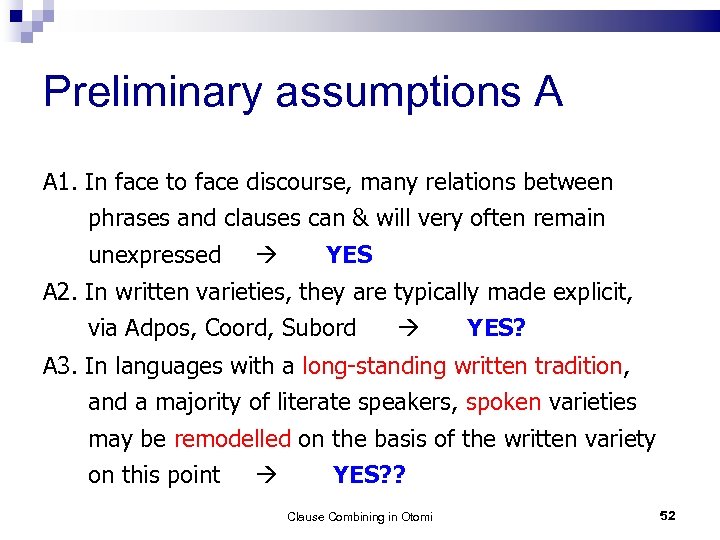
Preliminary assumptions A A 1. In face to face discourse, many relations between phrases and clauses can & will very often remain unexpressed YES A 2. In written varieties, they are typically made explicit, via Adpos, Coord, Subord YES? A 3. In languages with a long-standing written tradition, and a majority of literate speakers, spoken varieties may be remodelled on the basis of the written variety on this point YES? ? Clause Combining in Otomi 52
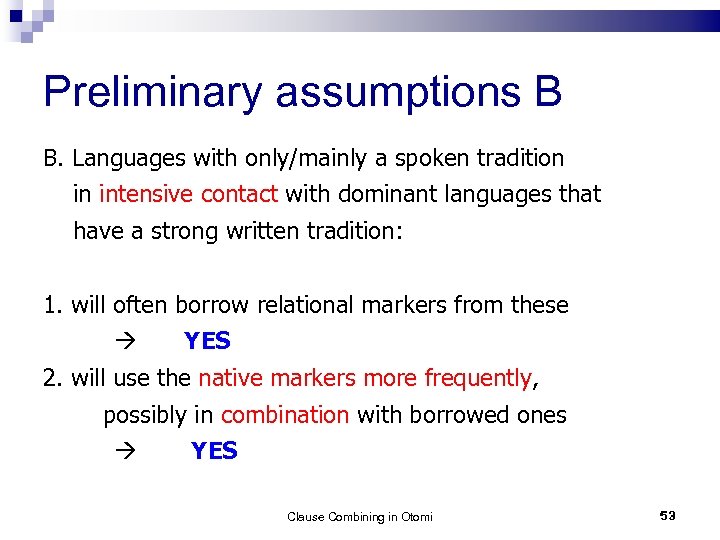
Preliminary assumptions B B. Languages with only/mainly a spoken tradition in intensive contact with dominant languages that have a strong written tradition: 1. will often borrow relational markers from these YES 2. will use the native markers more frequently, possibly in combination with borrowed ones YES Clause Combining in Otomi 53
AND ? ? ? More distinction between clause types & Establishment clear dichotomy main vs subordinate Clause Combining in Otomi 54
Скачать презентацию Clause Combining in Otomi before and after Contact
01f40942d3a9998da0bf10d638f4119a.ppt