


 Скачать презентацию Classifier Systems Anil Shankar Dept of Computer Science
38033968074846d5cdd5b51f31ea76ef.ppt
- Количество слайдов: 20
 Classifier Systems Anil Shankar Dept. of Computer Science University of Nevada, Reno Anil Shankar Classifier Systems
 Overview • • • Introduction and problem overview Architecture Component details Track a specific example Summary Anil Shankar Classifier Systems 2
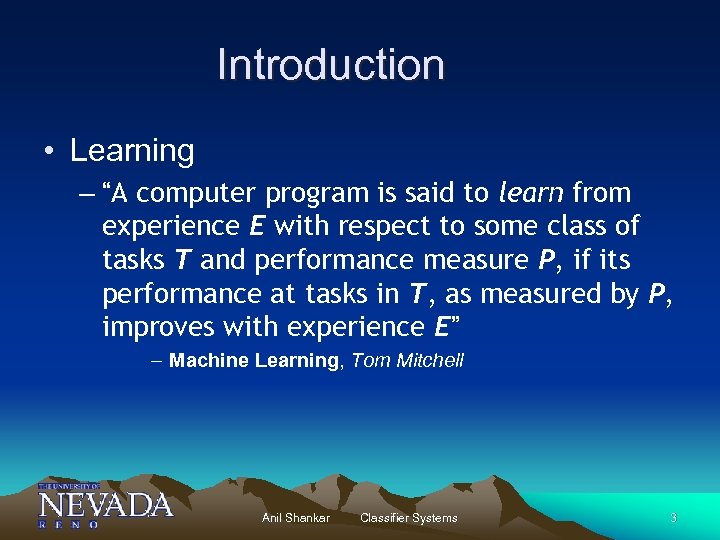 Introduction • Learning – “A computer program is said to learn from experience E with respect to some class of tasks T and performance measure P, if its performance at tasks in T, as measured by P, improves with experience E” – Machine Learning, Tom Mitchell Anil Shankar Classifier Systems 3
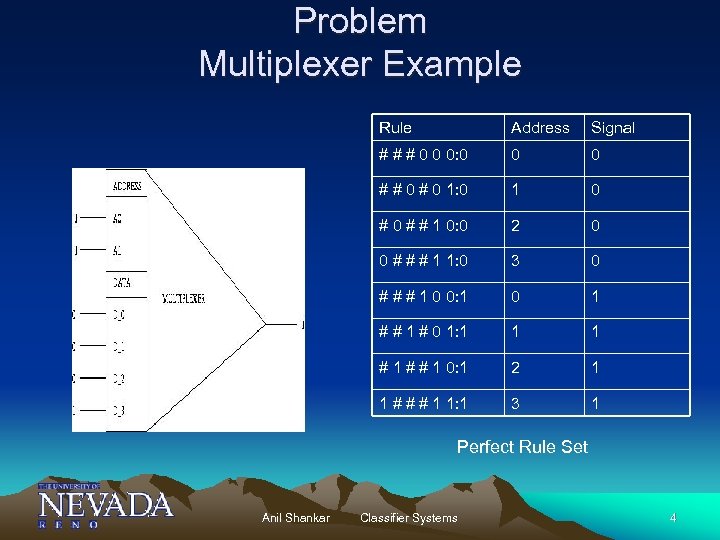 Problem Multiplexer Example Rule Address Signal # # # 0 0 0: 0 0 0 # # 0 1: 0 1 0 # # 1 0: 0 2 0 0 # # # 1 1: 0 3 0 # # # 1 0 0: 1 0 1 # # 1 # 0 1: 1 1 1 # # 1 0: 1 2 1 1 # # # 1 1: 1 3 1 Perfect Rule Set Anil Shankar Classifier Systems 4
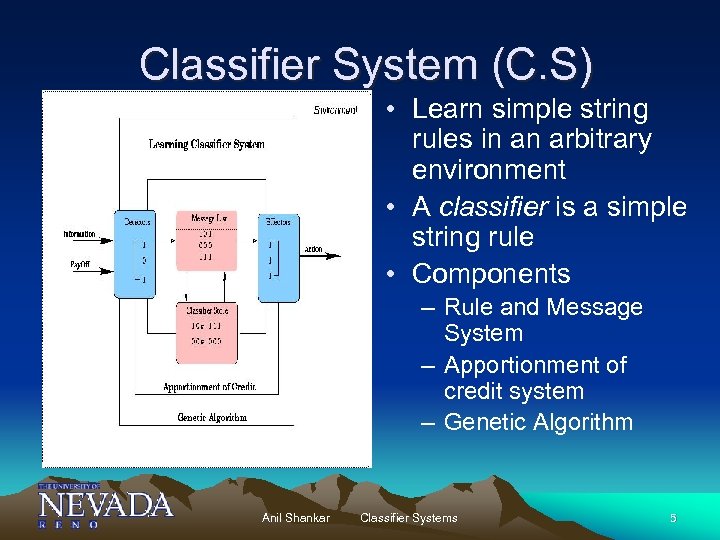 Classifier System (C. S) • Learn simple string rules in an arbitrary environment • A classifier is a simple string rule • Components – Rule and Message System – Apportionment of credit system – Genetic Algorithm Anil Shankar Classifier Systems 5
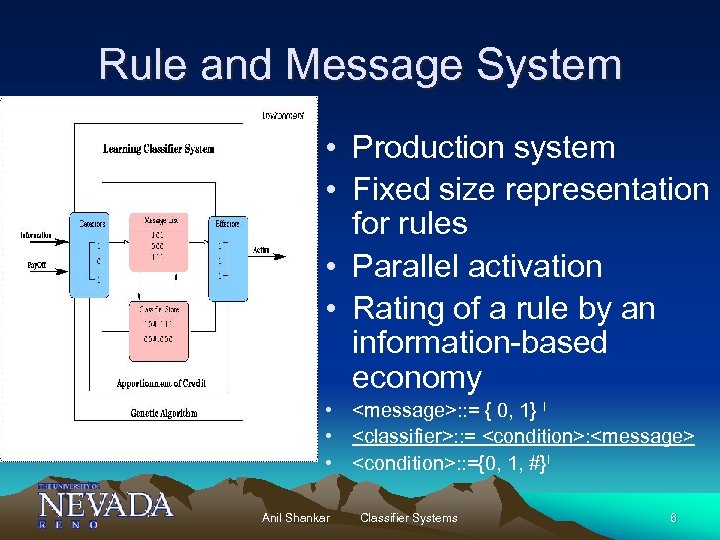 Rule and Message System • Production system • Fixed size representation for rules • Parallel activation • Rating of a rule by an information-based economy •
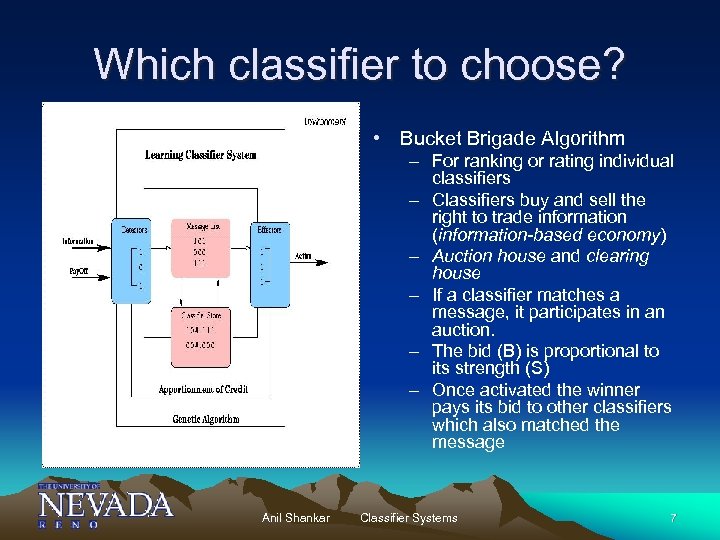 Which classifier to choose? • Bucket Brigade Algorithm – For ranking or rating individual classifiers – Classifiers buy and sell the right to trade information (information-based economy) – Auction house and clearing house – If a classifier matches a message, it participates in an auction. – The bid (B) is proportional to its strength (S) – Once activated the winner pays its bid to other classifiers which also matched the message Anil Shankar Classifier Systems 7
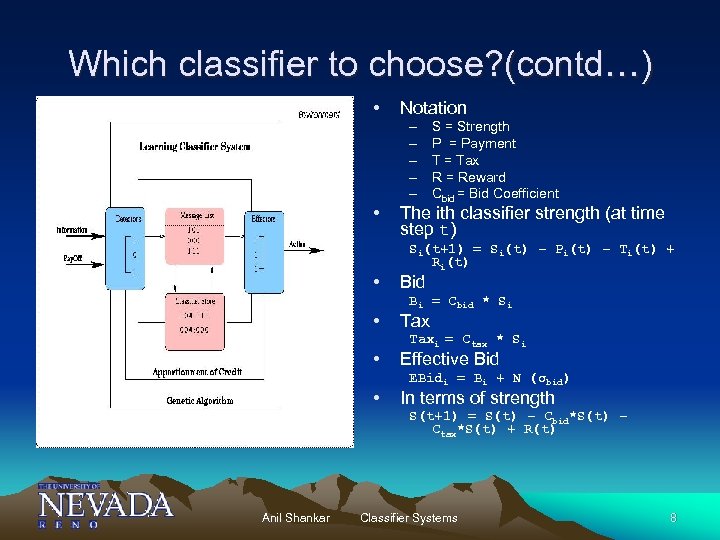 Which classifier to choose? (contd…) • Notation – – – • • • S = Strength P = Payment T = Tax R = Reward Cbid = Bid Coefficient The ith classifier strength (at time step t) Si(t+1) = Si(t) – Pi(t) – Ti(t) + Ri(t) Bid Bi = Cbid * Si Taxi = Ctax * Si Effective Bid EBidi = Bi + N (σbid) In terms of strength S(t+1) = S(t) – Cbid*S(t) – Ctax*S(t) + R(t) Anil Shankar Classifier Systems 8
 Generating better rules • Bucket brigade algorithm evaluates rules and decides among competing alternatives. • Use a Genetic Algorithm (GA) to generate new rules • A classifier’s strength (S) is used as its fitness • Similar to the simple genetic algorithm • Entire population is not replaced at the next generation (Generation gap ) • GA period (epoch) – Number of time steps between GA calls – Time step = rule-message cycle • Crowding to maintain diversity • Mutation over a ternary alphabet {1, 0, # } Anil Shankar Classifier Systems 9
 Generating better rules • Selection is performed using roulettewheel selection • The GA is run according every GA Period or when conditioned on particular events (lack of match or poor performance) Anil Shankar Classifier Systems 10
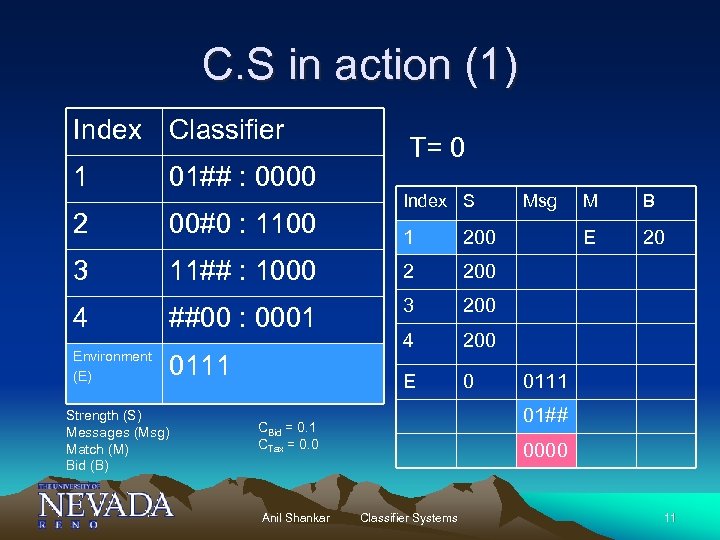 C. S in action (1) Index Classifier 1 01## : 0000 2 00#0 : 1100 3 T= 0 Index S 1 2 ##00 : 0001 3 Environment (E) 0111 200 E 0 20 200 4 B 200 4 M E 200 11## : 1000 Msg Strength (S) Messages (Msg) Match (M) Bid (B) 01## CBid = 0. 1 CTax = 0. 0 Anil Shankar 0111 0000 Classifier Systems 11
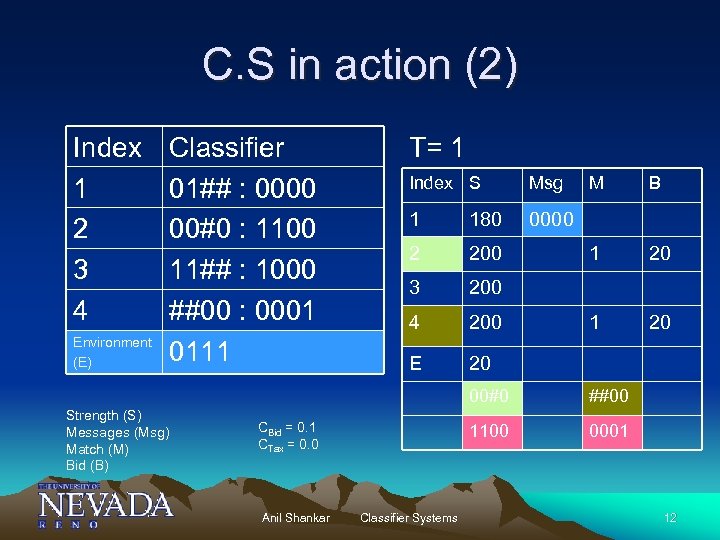 C. S in action (2) Index 1 2 3 4 Environment (E) Classifier 01## : 0000 00#0 : 1100 11## : 1000 ##00 : 0001 0111 T= 1 Index S Msg 1 180 0000 2 200 3 200 4 200 E M B 1 20 20 00#0 Strength (S) Messages (Msg) Match (M) Bid (B) 1100 CBid = 0. 1 CTax = 0. 0 Anil Shankar Classifier Systems ##00 0001 12
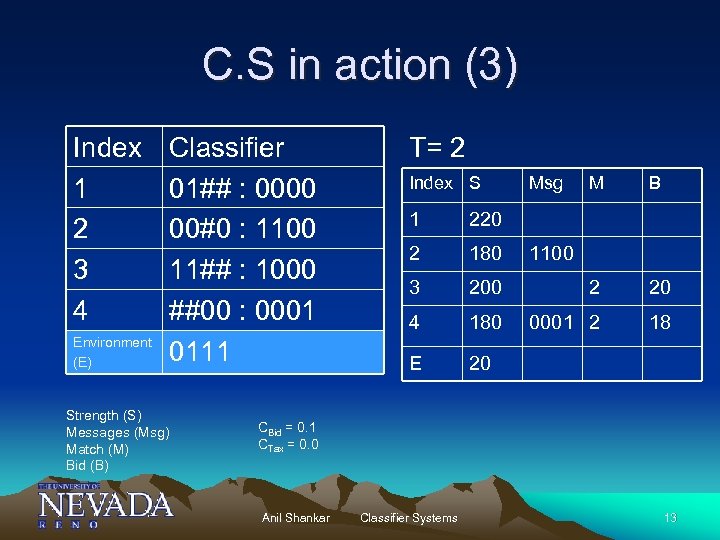 C. S in action (3) Index 1 2 3 4 Environment (E) Classifier 01## : 0000 00#0 : 1100 11## : 1000 ##00 : 0001 0111 Strength (S) Messages (Msg) Match (M) Bid (B) T= 2 Index S Msg M B 1 220 2 180 3 200 2 20 4 180 0001 2 18 E 20 1100 CBid = 0. 1 CTax = 0. 0 Anil Shankar Classifier Systems 13
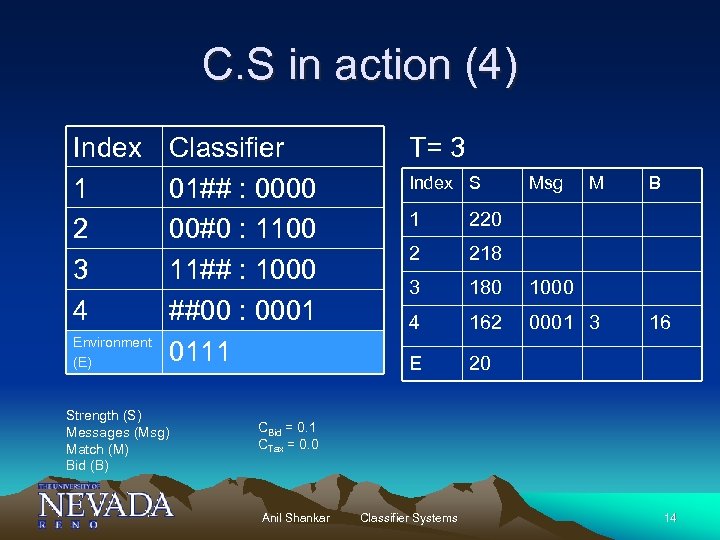 C. S in action (4) Index 1 2 3 4 Environment (E) Classifier 01## : 0000 00#0 : 1100 11## : 1000 ##00 : 0001 0111 Strength (S) Messages (Msg) Match (M) Bid (B) T= 3 Index S Msg M 1 220 2 218 3 180 1000 4 162 0001 3 E B 20 16 CBid = 0. 1 CTax = 0. 0 Anil Shankar Classifier Systems 14
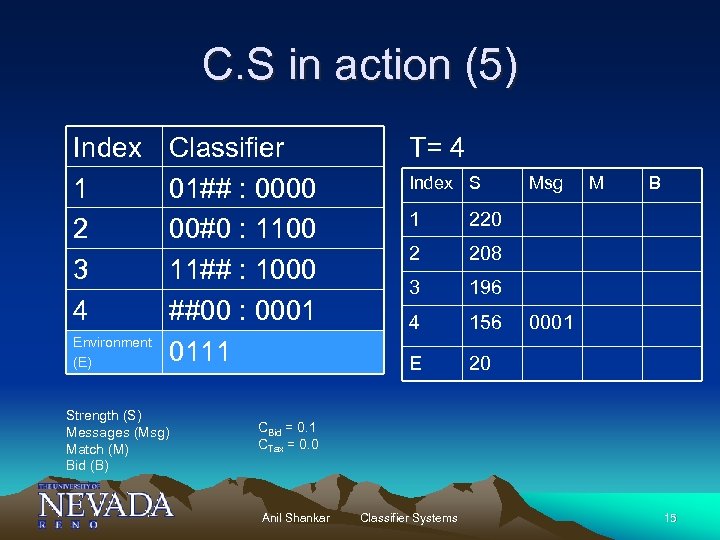 C. S in action (5) Index 1 2 3 4 Environment (E) Classifier 01## : 0000 00#0 : 1100 11## : 1000 ##00 : 0001 0111 Strength (S) Messages (Msg) Match (M) Bid (B) T= 4 Index S 1 196 4 156 E B 208 3 M 220 2 Msg 20 0001 CBid = 0. 1 CTax = 0. 0 Anil Shankar Classifier Systems 15
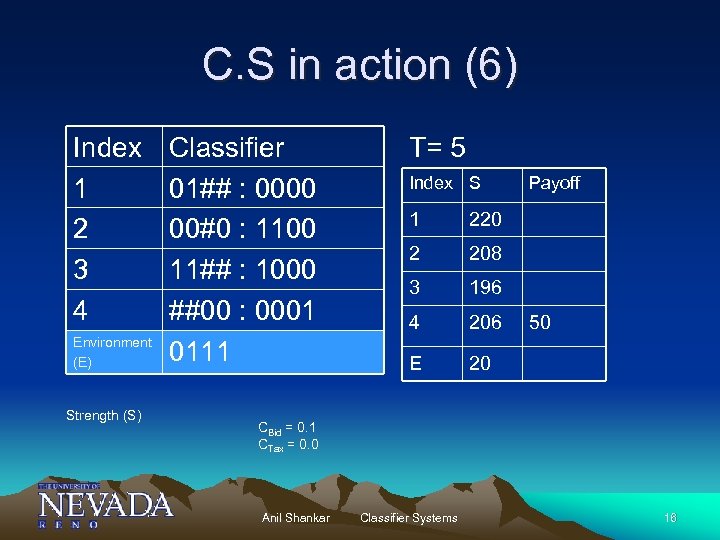 C. S in action (6) Index 1 2 3 4 Environment (E) Strength (S) Classifier 01## : 0000 00#0 : 1100 11## : 1000 ##00 : 0001 0111 T= 5 Index S 1 220 2 208 3 196 4 206 E Payoff 20 50 CBid = 0. 1 CTax = 0. 0 Anil Shankar Classifier Systems 16
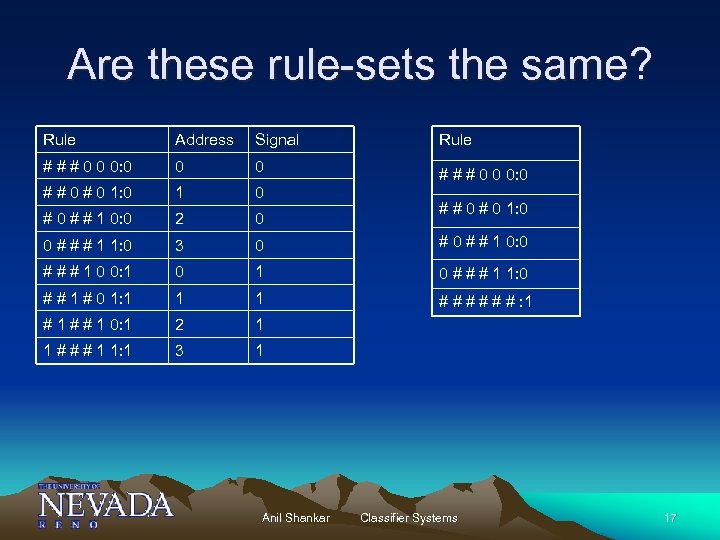 Are these rule-sets the same? Rule Address Signal Rule # # # 0 0 0: 0 0 0 # # # 0 0 0: 0 # # 0 1: 0 1 0 # # 1 0: 0 2 0 0 # # # 1 1: 0 3 0 # # 1 0: 0 # # # 1 0 0: 1 0 # # # 1 1: 0 # # 1 # 0 1: 1 1 1 # # # : 1 # # 1 0: 1 2 1 1 # # # 1 1: 1 3 1 Anil Shankar # # 0 1: 0 Classifier Systems 17
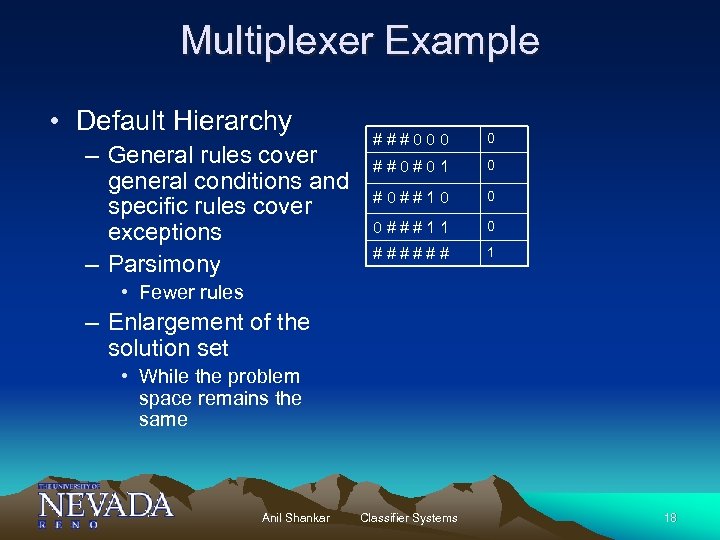 Multiplexer Example • Default Hierarchy – General rules cover general conditions and specific rules cover exceptions – Parsimony ###000 0 ##0#01 0 #0##10 0 0###11 0 ###### 1 • Fewer rules – Enlargement of the solution set • While the problem space remains the same Anil Shankar Classifier Systems 18
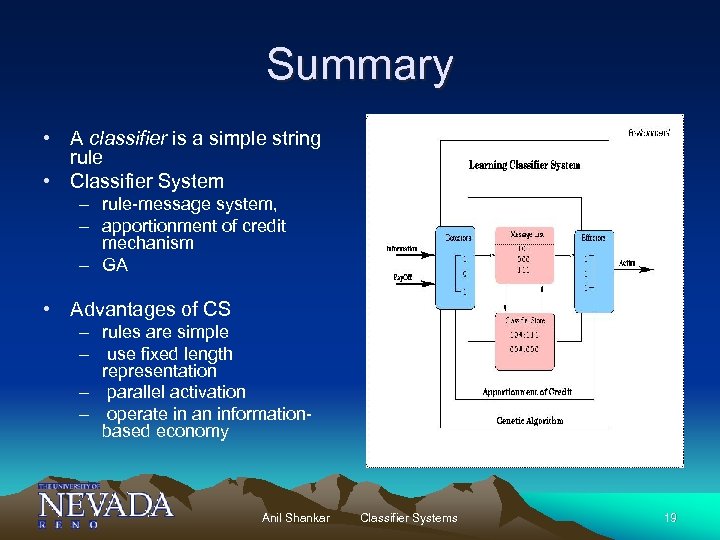 Summary • A classifier is a simple string rule • Classifier System – rule-message system, – apportionment of credit mechanism – GA • Advantages of CS – rules are simple – use fixed length representation – parallel activation – operate in an informationbased economy Anil Shankar Classifier Systems 19
 Thank You Questions ? Anil Shankar Classifier Systems 20